On this page
Brahma turns to the divine sage Narada and says, listen. From the moment you finished teaching the daughter of the mountain king the five-syllable mantra of Shiva and took your leave, her heart lifted and one certainty settled hard within her: that Mahadeva would be won by austerity alone, . Through her friends Jaya and Vijaya she sent word to her father Himachal and her mother Mena, asking their permission to go to the forest. Let her make her body and her beauty and her whole line bear fruit, the two girls said to the mountain king, and there is one road to that and no other. Her father considered it and agreed: the house would be fortunate for it, and if Mena also liked it, what better course could there be? Out of love, though, Mena would not have it. Where do you mean to go for this penance, she asked; every god is already in my house, and every holy ford and every shrine besides. Your body is a slender thing and the penance is a hard one; perform it here. What did you gain the last time you went out to him, and what do you expect to gain now? Do not be stubborn. That a woman should walk off to a grove of penance to get what her heart wants is a thing nobody has ever heard of. As she pleaded, two syllables slipped from her lips, u, ma, meaning do not go. From that day the name Uma became hers.
Then Parvati folded her own palms, and holding the feet of Shiva in her mind, said the thing plainly: mother, in the morning I am going out to win Shiva by penance, and I am asking you to let me go. Mena looked at her and saw how far past persuading she was, and seeing her daughter so unhappy she changed her mind and gave her leave to perform the austerity. The moment the permission came, Parvati, faithful to the highest vows, remembered Shankara and felt a deep happiness rise in her. She bowed to her mother and father and set out with her two friends. The princess left her cherished garments behind. A girdle of munja grass was tied at her waist, bark cloth came upon her body, and in place of a necklace a deerskin was drawn across her heart. She walked toward the sacred ford of Gangavatarana, toward Gangotri.
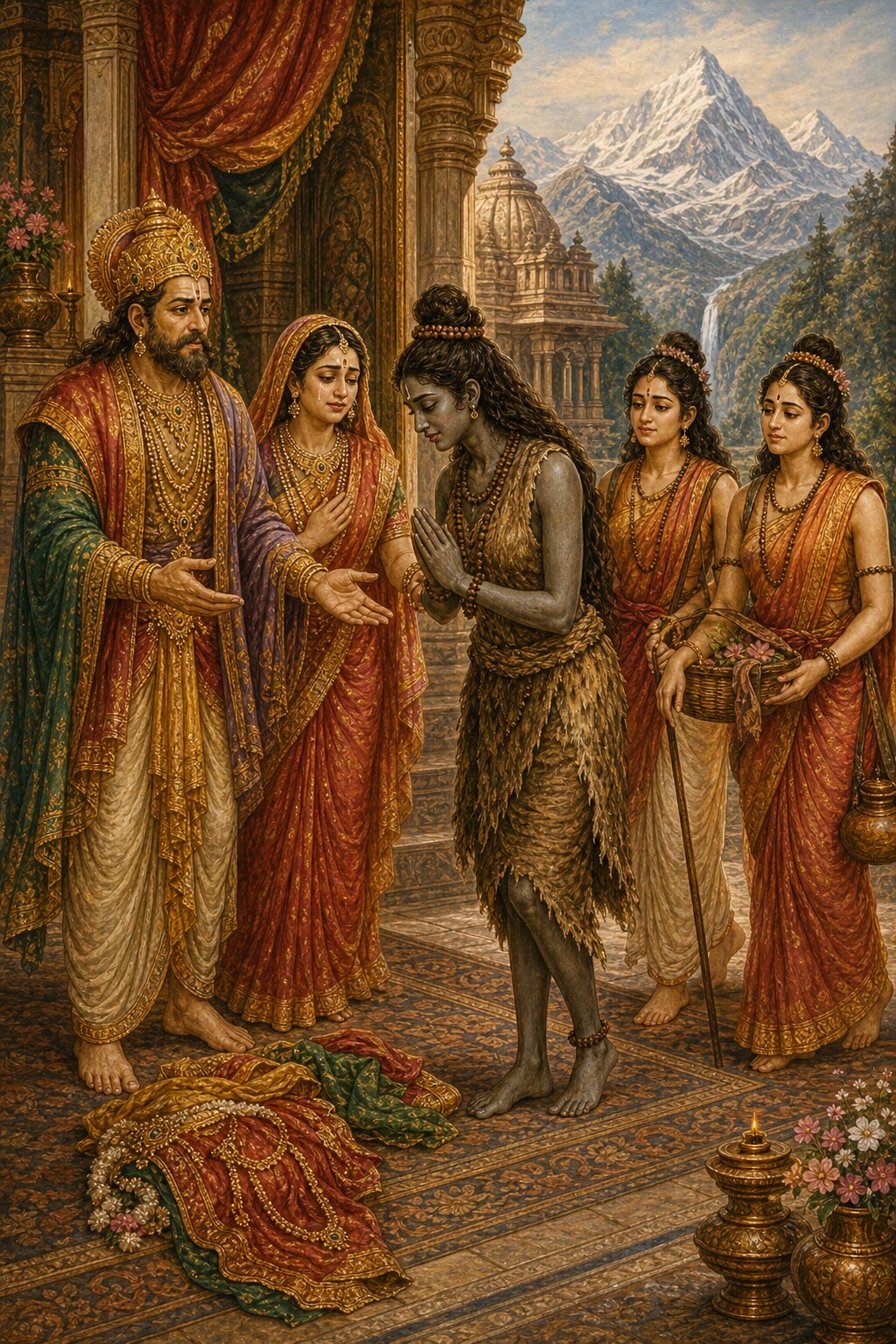
That very peak of the Himalaya where Shankara, deep in meditation, had once burned Kama to ash is called Gangavatarana. She came to it and found it empty of him, and the sight of that ridge without Shiva in it hurt her more than the walk had. She stood a while on the ground where he had sat at his own penance, and the separation took her; she cried out for him aloud and grieved there like any woman who has lost what she loves. It was a long time before she put the grief down and took the vows of her observance. Then, at the supremely holy ford of Shringi, Parvati began her austerity. From the tapas of Gauri the peak itself took the name Gauri Shikhar. To test her own austerity, she also planted there many beautiful, sacred, fruit-giving trees.
Amid the Five Fires
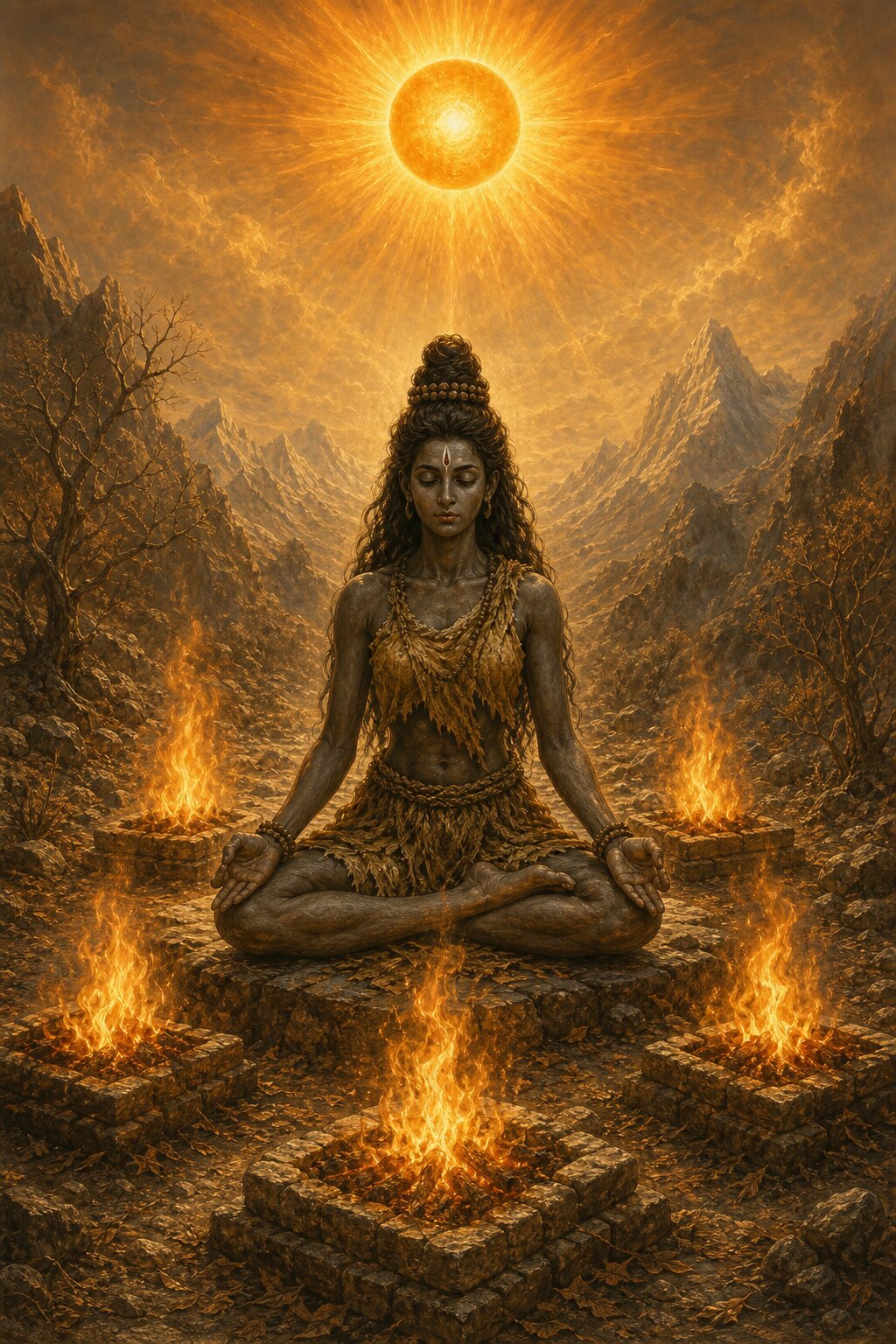
First she purified the ground and raised an altar. Then, mastering her mind and every one of her senses, she began an austerity that even the great sages would have found impossible. Through the heat of summer she sat surrounded day and night by burning fires, four of them ringing her and the summer sun standing overhead as the fifth, and from inside that ring she chanted the five-syllable mantra without pause. Through the rains she settled on the altar or on a slab of bare rock and let the torrents from the sky drench her. Through winter she took no food and stood inside the icy water, and she passed her nights, and the nights when the snow came down, seated on the stones. Between these ordeals Parvati meditated on Shiva, the giver of every heart’s desire, and when a moment came free she watered with her friends the trees she had planted and welcomed the guests who arrived at the hermitage. Fierce gales, biting cold, rain, punishing sun, whatever suffering came to her she counted as nothing; her mind fixed on Shiva, she held steady in that place.
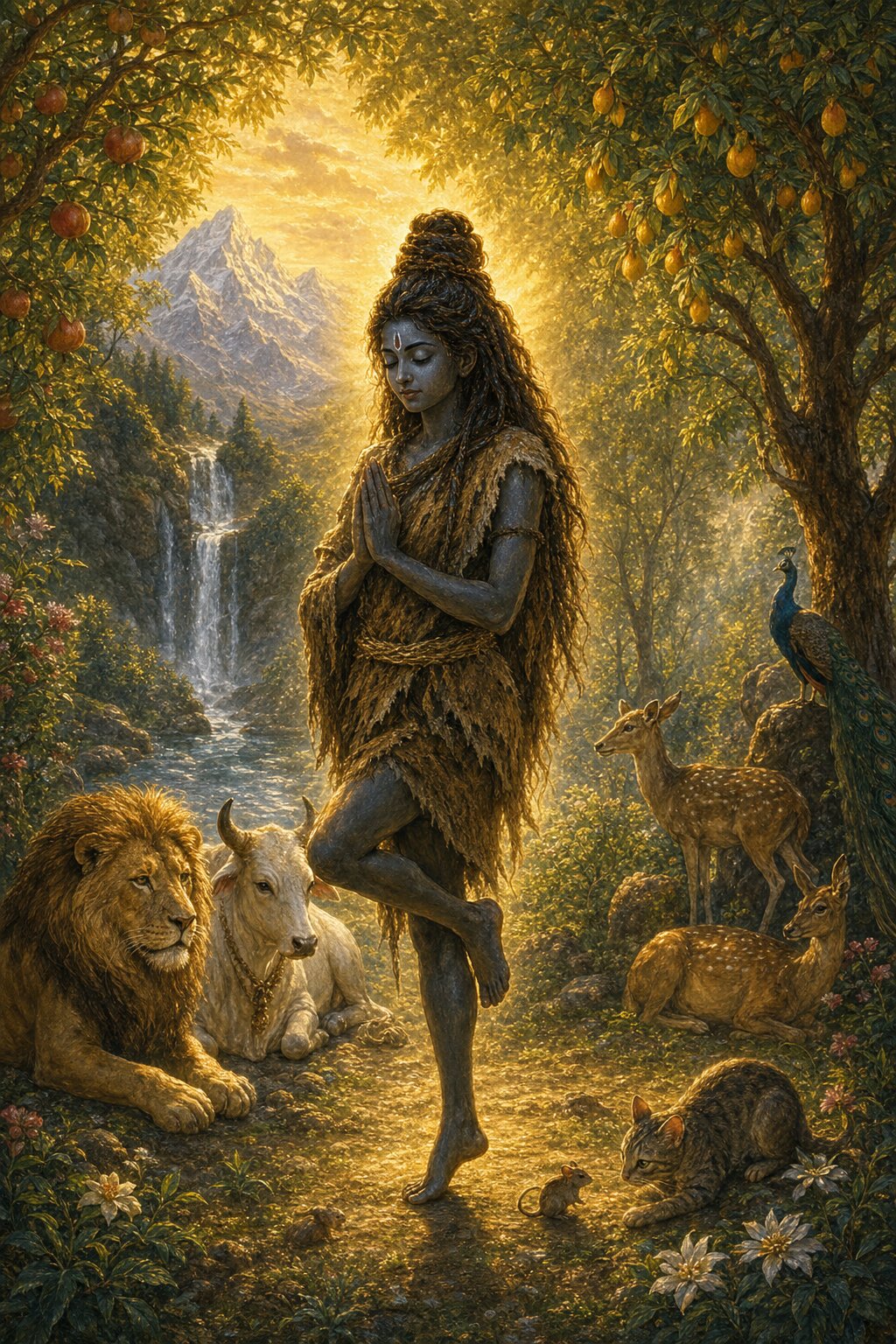
The first year passed on fruit, the second on chewing leaves alone, and in this manner countless years slipped away. Then the daughter of Himavan gave up even leaves and lived wholly without food, and still her love for the discipline only deepened. Because she had renounced even a leaf, parna, for her nourishment, the gods gave her the name Aparna. Now, remembering Shiva, she stood on one foot and chanted the five syllables, rags and bark cloth upon her limbs, a mass of matted locks upon her head. By this austerity she surpassed even the sages, and in that grove of penance, her thought fixed on Maheshvara, three thousand years went by for Kali, as Parvati is also called.
Then she paused a moment at the very place where Mahadeva had once performed austerity for sixty thousand years, and she began to wonder: does Mahadeva not know that I am keeping every rule and performing this tapas for his sake? Why, after so long a penance, has he not come to me, his servant? The world, the Vedas, and the sages all say that Lord Shankara is all-knowing, the soul of all, the seer of all, that he grants his devotees whatever they desire and carries away every torment. Then she said within her own heart: if I have surrendered every craving and given myself to the one whose banner bears the bull, if I have always chanted the five-syllable mantra of Shiva by the rule Narada laid down, with proper rite and the purest devotion, if I am filled with love for Shiva and free of every flaw, then may the gracious Lord Shankara be pleased with me. Thinking this without cease, Parvati, wearing matted hair and bark cloth, her face lowered, remained in her austerity for a very long time.
Now hear the second effect of that penance. Any creature that came near the hermitage forgot the enmity of its nature. The lion and the cow did each other no harm; even lifelong foes like the mouse and the cat showed no anger there. The trees stood always in fruit, and grasses of every kind and strange, lovely flowers made the forest more beautiful. That whole stretch of woodland became like Kailasa, as though the perfected power of Parvati’s tapas had itself taken the shape of a forest.
The Vow
Many more years went by, and still Lord Shankara did not appear. Then Himachal, Mena, Mandarachal, and the others came to the hermitage and began to beg her to give up that punishing austerity and return home with them. Do not torture yourself, her father said; the man will not be seen, he is detached and that is the whole of it. You are a girl with tender limbs and this penance will finish you. Get up and come back to our house. What is the use of a Shiva who burned Kama to ash? He feels nothing, he will never come to claim you, and you cannot catch him any more than you can reach up and take the moon out of the sky. Mena said the same, and so did Meru and Mainaka and Krauncha and the rest of them, each with his own argument, and none of it moved her. Parvati answered, “Father, mother, all my kinsmen, have you forgotten what I told you before? Then hear my vow once more. The one who in his anger burned Kama to ash, who set fire even to the forest of this mountain, that Mahadeva has renounced the world, and he is tender toward his devotees as well. By austerity alone I will call him here, and I will surely win his favor. Go home, all of you, with glad hearts, and know this: the service of Sadashiva is reached only through the great power of tapas. This I tell you as truth, and truth again.”
Having said this, the sweet-voiced daughter of the mountain king fell silent, and Sumeru and the other mountains, praising Girija again and again, and marveling within themselves at what they had failed to talk her out of, went back the way they had come. The moment they left, Parvati, surrounded by her friends, fixed her resolve on the great Truth and began an austerity fiercer than any before.

The Three Worlds Begin to Burn
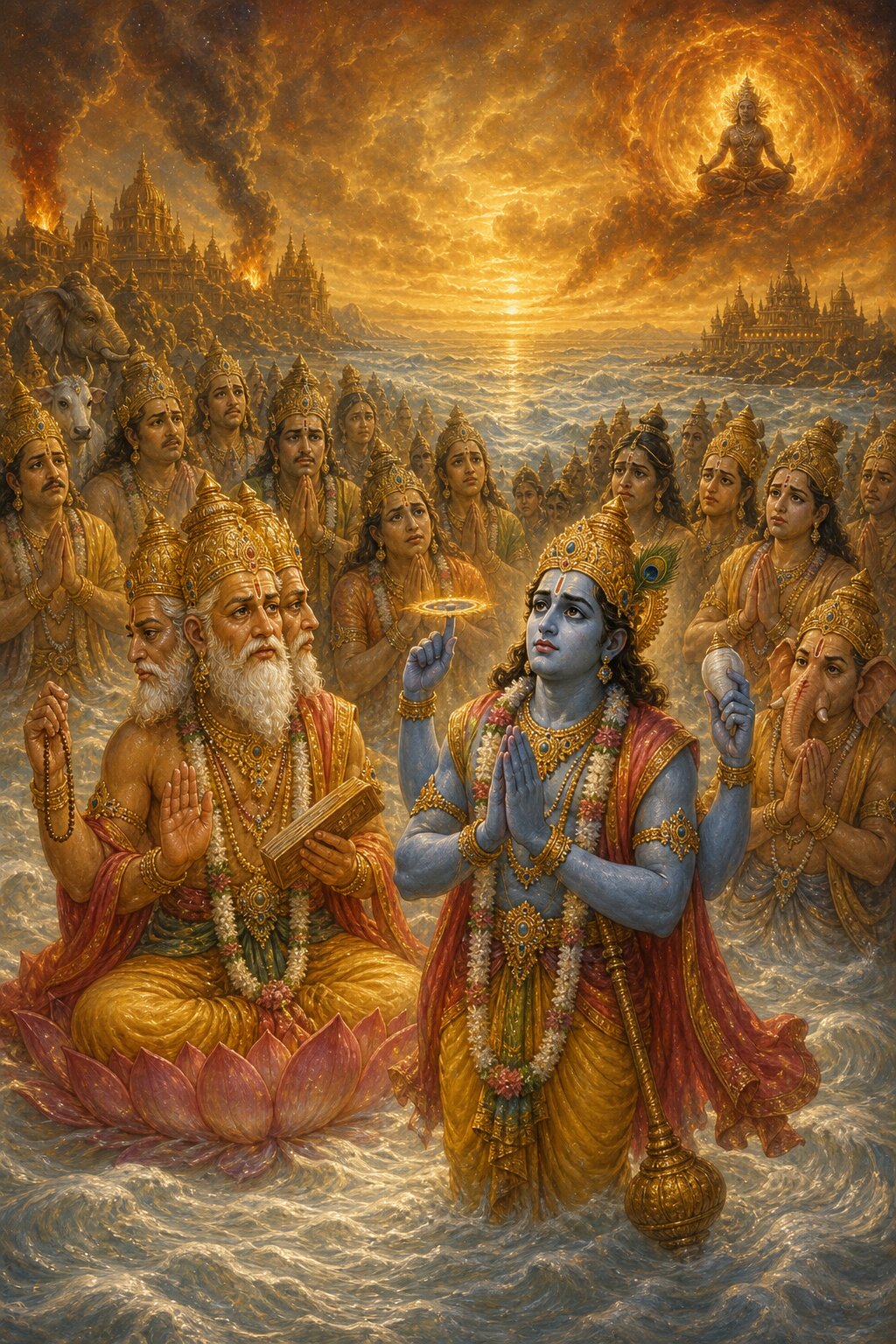
Now hear what followed. The whole of the three worlds, gods and asuras and human beings and every moving and unmoving creature, grew scorched by that mighty austerity. Gods, asuras, yakshas, kinnaras, charanas, siddhas, sadhyas, sages, vidyadharas, the great nagas, the lords of creatures, and the guhyakas all fell into the deepest distress, and not one of them could understand its cause. Then Indra and the other gods took counsel with Brihaspati and came in great agitation to Sumeru, to take refuge with me, their maker, their limbs seared, their radiance drained away. They bowed and praised me and asked with one voice, “Lord, you made this whole world, everything that moves and everything that does not. Why is it burning? What is the cause of the world’s torment? There is no one else to protect us.”
Remembering Shiva within my own heart, I understood that this burning of the universe was the fruit of Girija’s austerity, and I took them all and went at once to the Ocean of Milk. There, with the gods, I folded my hands and praised Shri Hari, seated on his blissful throne, and said, “Great Vishnu, scorched by the fierce austerity of Parvati, we have all come to take refuge with you. Save us.”
The lord of Lakshmi answered, “Gods, today I have learned the whole cause of Parvati’s austerity. Now I will go with all of you to the supreme lord Shiva, and together we will pray that he take Girija in marriage. For the good of the world, the god of gods who bears the Pinaka must take Parvati as his bride, and by whatever means we can, we will go to his hermitage and work toward it.”
But hearing this, the gods trembled. They said, “Lord, we cannot go near the wrathful great lord Rudra, who blazes like the fire at the end of time, whose eyes are terrible. Just as he burned the unconquerable Kama in his anger, so he will burn us to ash as well, of that there is no doubt.” Shri Hari reassured them, “Gods, hear my words with love and respect. Lord Shiva is the master of the gods and the destroyer of their fear; he will not burn you. Hold him in your minds as the kind one, and go to him with your wits about you. He is the ancient primal being, the lord of all, higher than the highest, and an ascetic himself. To the gracious Shambhu we must all go for refuge, without fail.”
At Shiva’s Door
When Vishnu had spoken, all the gods went with him for the darshan of the god who holds the Pinaka. Parvati’s hermitage lay first along the road, so they all went there in wonder, and the moment they beheld the surpassing austerity of the mountain king’s daughter they were flooded by her radiance. Bowing to that luminous mother of the world at her penance, praising again and again the tapas of the goddess Parvati, the very embodiment of perfection, they moved on toward the place where the Lord whose banner bears the bull was seated.
But who had the courage to approach him first? Narada, the gods sent you before anyone else, and they themselves stood far from Hara, who had burned Madana, the god of desire, to ash, watching to see whether the Lord was angry or pleased. You have always been fearless, and above all a devotee of Shiva. You went near, found him wholly at peace, and came back to lead Shri Vishnu and all the rest to his seat, and it took some effort to move them. There everyone saw him: Shiva, tender to his devotees, in a serene posture, surrounded by his ganas, wearing the form of an ascetic, seated on his yoga mat, penance itself in the shape of a man. I, Brahma, together with Shri Vishnu, the gods, the siddhas, and the great sages, bowed and hymned him with the sacred verses of the Vedas and the Upanishads.
Then the kind Nandikeshvara, praising the Lord as the friend of the helpless, made his appeal, “Lord, the gods and the sages have come to take refuge with you in their distress; the asuras press them hard and they have come looking for a remedy to your feet, where fear ends; lord of all, deliver them.” At Nandi’s word the Lord Shambhu slowly opened his eyes, rose out of his meditation, and, leaving his deep absorption, said, “Shri Vishnu, Brahma, and you other lords of the gods, how have you all come near me? Whatever the reason for your coming, tell it quickly.”
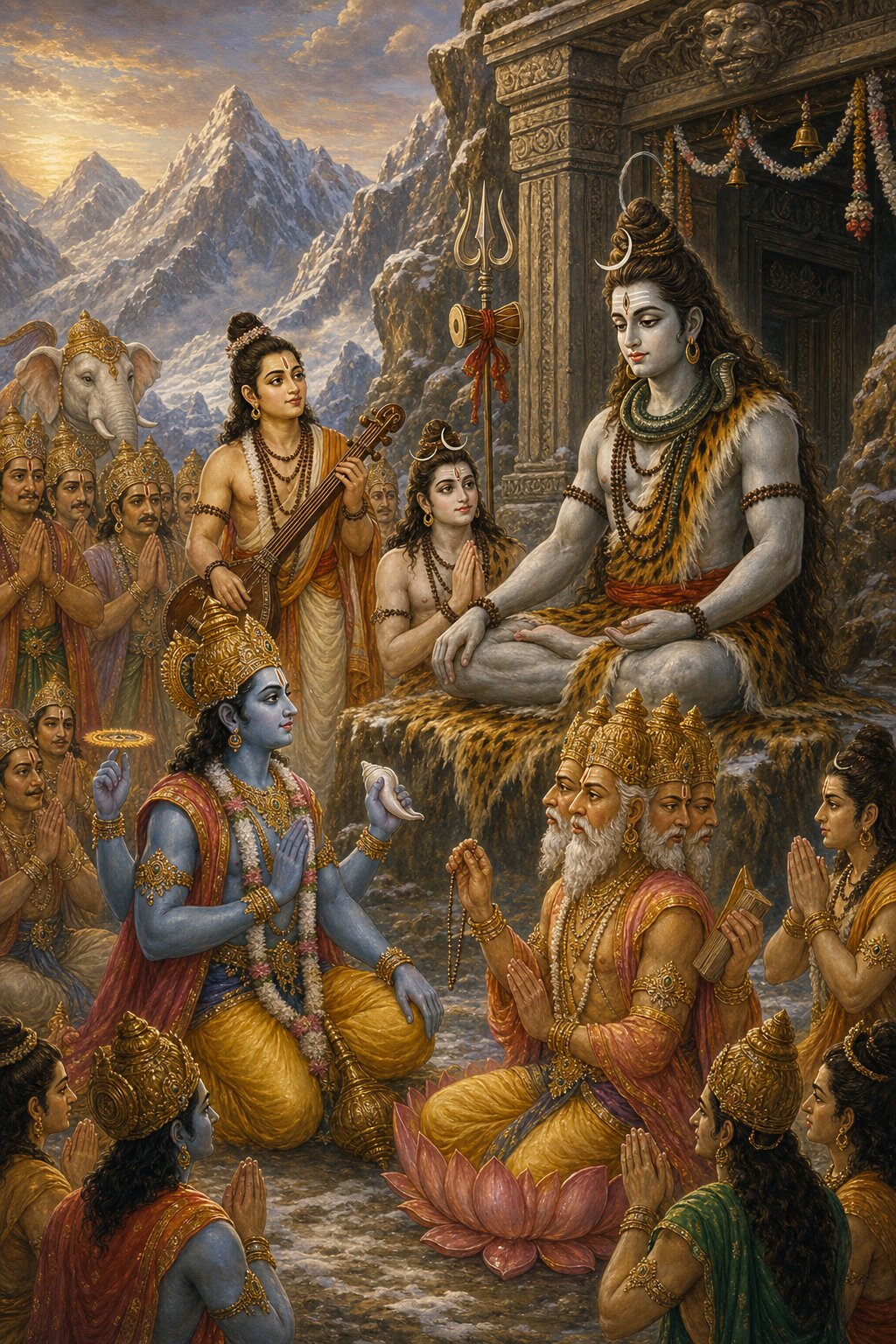
All the gods looked toward Vishnu’s face for him to state the cause. Then Shri Vishnu, the great devotee of Shiva, said, “Shambhu, Tarakasura has brought terrible suffering upon the gods, and it is to lay this before you that they have all come here. Lord, that demon Taraka can be slain only by a son born of your own body, by no other means; what I say is wholly true. Brahma himself gave him the boon, and under it there is no other hand in the worlds that can reach him, and he has been at the universe ever since. Master, deliver these gods whom Tarakasura torments. God, Shambhu, take the hand of Girija with your own right hand. Grant your grace to the noble Parvati, given by Himavan the mountain king, by taking her hand in marriage; there is not a good quality she lacks.”
On that same Gauri peak, on one side, Aparna stood on a single foot and kept up her chant; on the other, before the yogi seated on his mat, a request for marriage had been laid. The one who had burned Kama to ash was now being asked to become a bridegroom. What Mahadeva said to this, and how he tested Girija, is the next story.
Source: Shiva Purana (Gita Press, Sankshipta Shivapurananka), Rudra Samhita (Parvati Khanda)