On this page
Near Prayag, where the Ganga and the Yamuna run together, in the town of Pratishthanapura, there stood a shrine of Shiva where sadhus and holy men gathered in numbers and a Brahmin recited the Shiva Purana aloud each day, to whoever happened to be sitting there. Into that shrine, one day, came a Brahmin named Devaraj, wandering in by pure chance, on no errand at all. He hailed from a town of the Kiratas, and he was feeble in learning, wretched by nature, and turned altogether away from Vedic dharma. The evening rites and all such observances he had given up long ago, and he kept a trader’s life under a Brahmin’s thread. He sold liquor, and whoever trusted him he cheated. Brahmin, kshatriya, vaishya, shudra, he had fleeced them all by one pretext or another, some by fraud and some by killing, and heaped up a great store of wealth out of the poverty he began in, and not a single cowrie of it had he ever spent in the service of dharma.
No sooner had he taken shelter in the shrine than a fever seized Devaraj. He writhed in pain, yet all the while the Shiva Purana that the Brahmin was reciting close by kept falling on his ears, and for a full month he went on listening to it, with no devotion in him and no attention to spare, because the words were in the air he lay in. Then he died. The messengers of Yama came, bound him fast in their nooses, and dragged him by force toward the city of Yama. At that very moment four attendants of Lord Shankara arrived from Shivaloka. Their limbs shone bright as camphor, tridents were in their hands, sacred ash covered their bodies, and strings of rudraksha beads hung at their throats. They drove the messengers of Yama away, thrashing them where they stood, freed Devaraj from the nooses, and seated him upon a divine chariot, and all of it inside Yama’s own city. The uproar brought Dharmaraja himself out of his palace. He saw four figures who might each have been Rudra, he read the whole business at a glance with the sight that misses nothing, and recognizing these envoys of Shiva he worshiped them with due ceremony and said nothing. He was afraid to ask. The attendants carried Devaraj to Kailasa and delivered him into the hands of the ever-merciful Samba Shiva and the mother Parvati, and the man who had killed for his money was free in that instant.
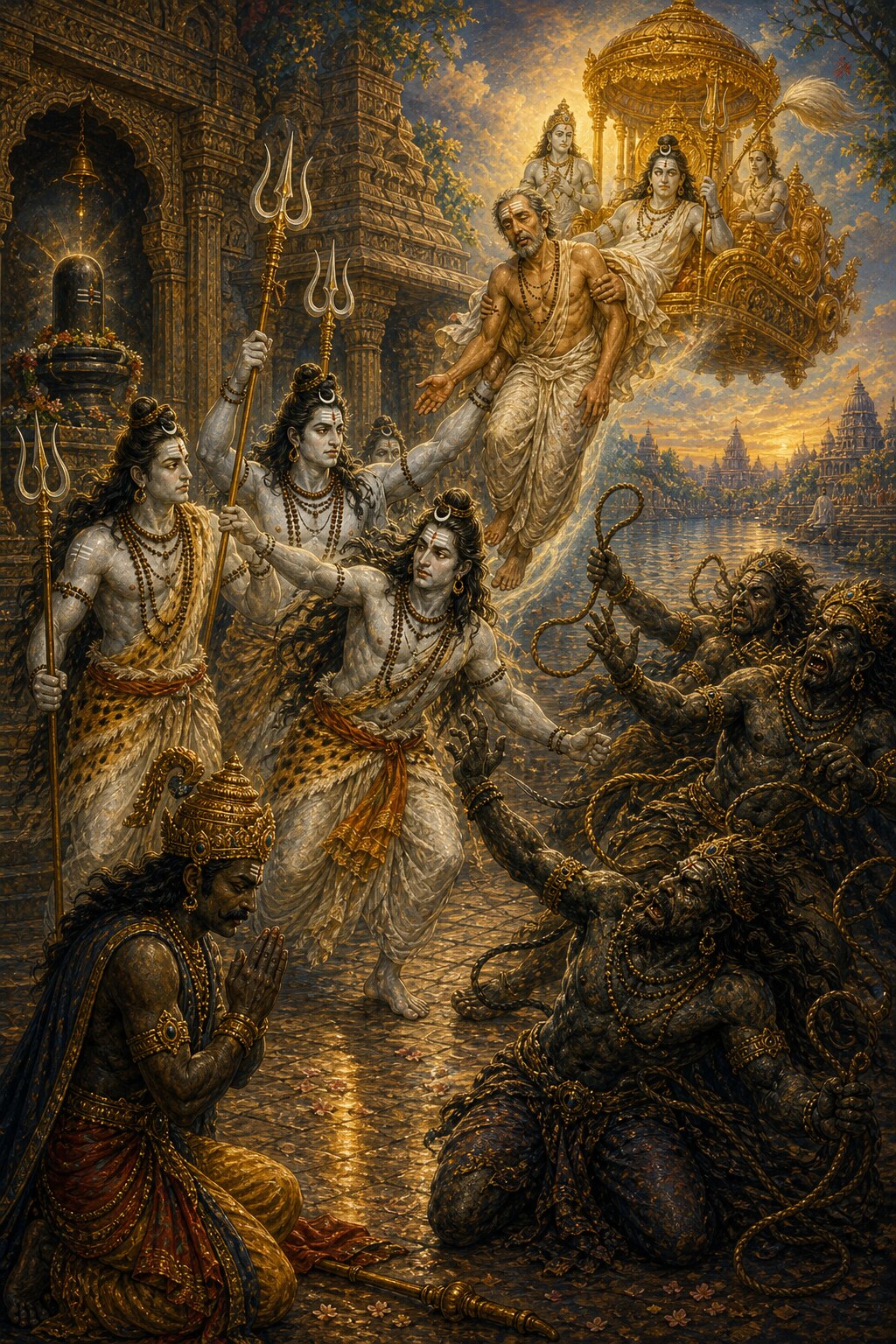
Suta told Shaunaka that even those who are sinful, given to evil deeds, and forever sunk in lust and rage are cleansed by the mere hearing of this Purana; the cruel, the deceivers, those who eat up what was given to a temple. The hearing is itself a yajna made of knowledge, and it pays out in this world and the next together. Listen now to another ancient account on the very same theme.
Vindug of Vashkala Village
Near the sea lay a village called Vashkala, where the Brahmins who dwelt there were estranged from the dharma of the Vedas and steeped in the pleasures of the senses; they went out to their fields carrying weapons, they believed in nothing, and their entertainment was the tearing down of absent men. The women there too were wayward and empty of virtue. In that village lived a Brahmin named Vindug, a most degraded man, wicked of soul and a great sinner. His wife, Chanchula, was very beautiful and forever devoted to the practice of the highest dharma, yet Vindug forsook her and gave himself to harlots. Many years drained away in this vileness. For a long time Chanchula held to dharma and held her distress quietly, afraid of what breaking would make of her. In the end, worked upon by her husband’s conduct, she too turned wanton.
So a great span of the lives of both was squandered. Then that man of corrupted mind, Vindug, died when his time came and fell into hell. After suffering the torments of hell for many days, he became a fearsome pishacha (a flesh-eating ghoul) upon the Vindhya mountain, driven into that shape by the sins he had not yet paid off. Chanchula, meanwhile, went on living in the house with her sons for a long while after her husband’s death, and her old ways went on with her until her youth was spent.
Dispassion at Gokarna
One day, on some holy festival, Chanchula journeyed with her kinsfolk to the sacred field of Gokarna. Nothing in that day was her own doing. Having bathed in the waters of the tirtha because everyone bathes, she wandered here and there, taking in the fair. As she roamed she came upon a temple where a Brahmin was reciting the most sacred ancient katha of Lord Shiva, and she caught a piece of it the way you catch a stranger’s sentence in a crowd. He was saying that women who commit adultery with other men go, after death, to the realm of Yama, where the messengers of Yama bind them fast against pillars of red-hot iron.
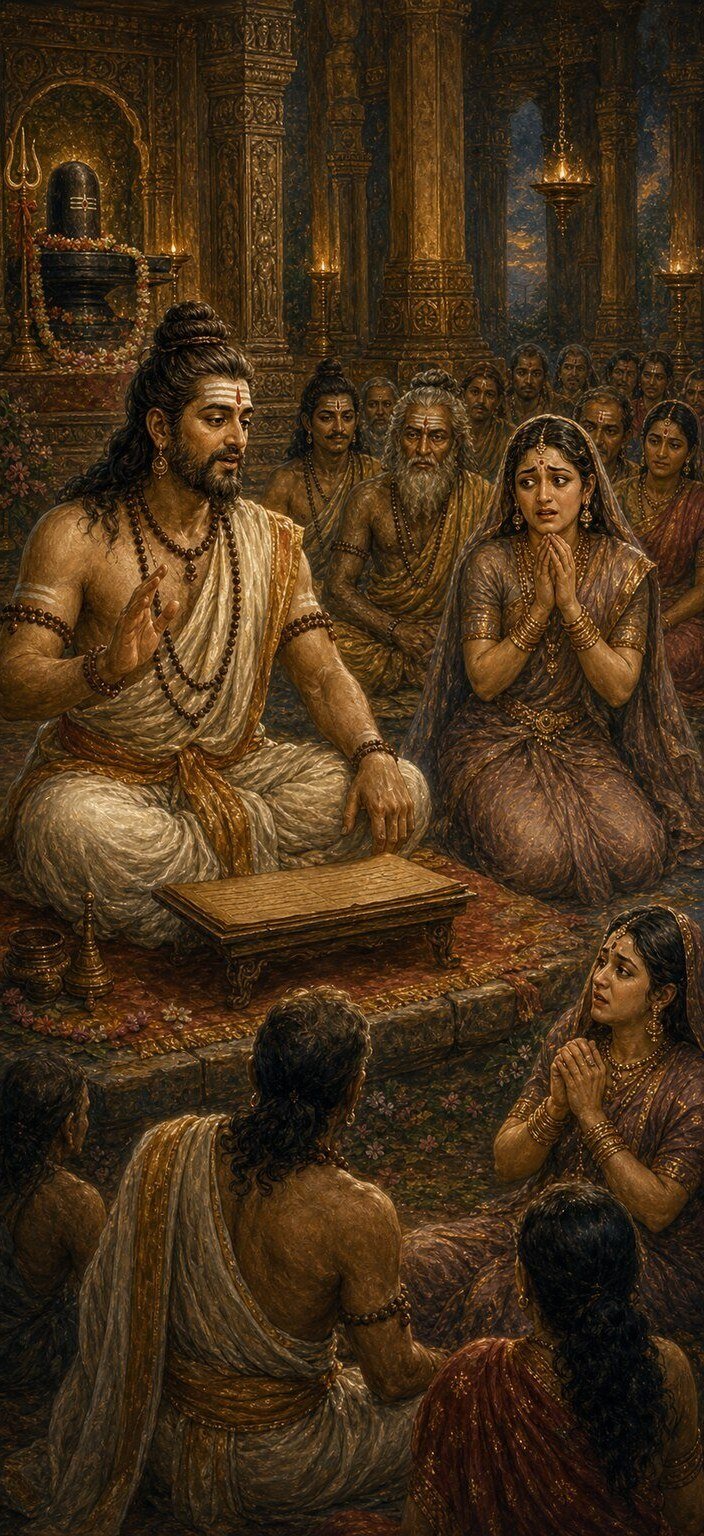
At these words Chanchula shook with terror. The katha ended and all the listeners departed, and then the frightened woman spoke to the reciter Brahmin in a quiet corner. “Brahmin,” she said, “I never knew my own dharma, and so a great wrong has been worked through me. Blinded, I spent the whole of my youth as a harlot spends it, and bought all of this with a pleasure that lasted about as long as a glance. Hearing today this discourse of yours, brimming with the rasa of dispassion, I am gripped by a great fear; I tremble, and my heart has come loose from this world. Alas, into what grim degradations I must yet fall I cannot say, nor how I shall look upon those terrible messengers of Yama in the hour of death, nor what I shall do when they put the noose around my neck and pull. I will not sleep tonight. If I bathed in the Ganga for a hundred years, if I performed a hundred sacrifices, it would not lift what I am carrying. You alone are my guru, you my mother, you my father. I have come into your refuge; lift up this wretched woman, lift her up.” So saying, she fell upon both the Brahmin’s feet.
The Brahmin’s Teaching and the Realm of Shiva
The wise Brahmin raised her up with kindness and said, “Woman, it is a blessing that by the grace of Lord Shankara you have heard this katha steeped in dispassion and come to your senses in time. Do not be afraid. Go into the refuge of Shiva; by his grace all sin is destroyed in an instant. Repentance is the greatest penance a sinner can offer; whoever feels true remorse for his misdeed is sure to win the highest state, and many have come to this katha in the state you are in and walked away from it clean. As a mirror grows spotless once it is cleaned, so the mind is made pure by this katha of the Shiva Purana, and in a pure mind dwells Lord Shiva together with Parvati, the Mother of the worlds. Draw your mind back, then, from the objects of sense, and hear with devotion this most holy katha of Shankara; through it you will attain moksha. The hearing steadies the mind on him, that steadiness ripens into knowing, and the knowing sets you free. Should this life end before you can hold him in your thought, the hearing follows you into the next one and finishes its work there. Whoever contemplates the feet of Lord Shiva with a spotless mind wins his liberation within a single lifetime. I am telling you the truth.”
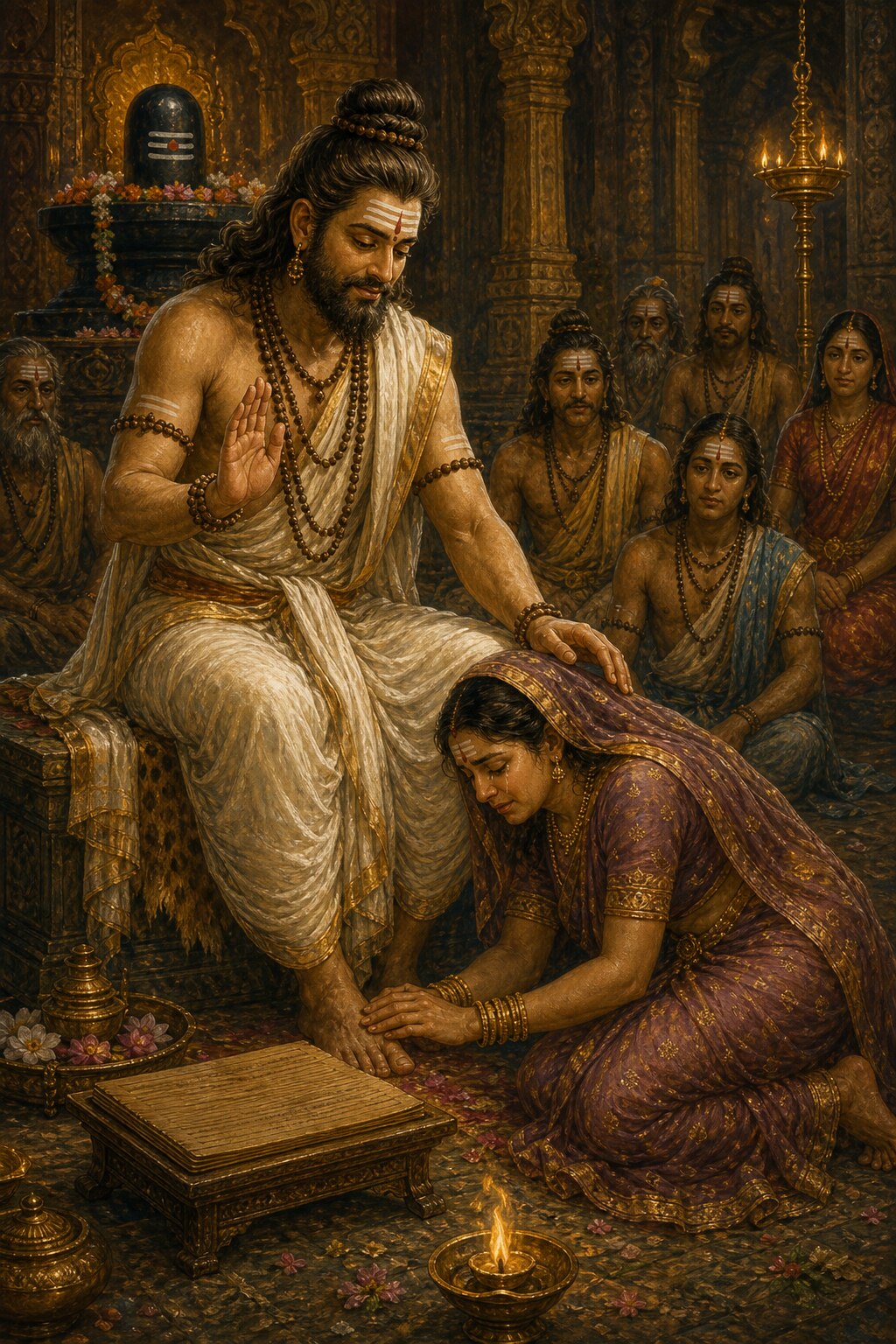
Having spoken so, the Shiva-devoted Brahmin sank into meditation upon Shiva and said no more. Tears of joy shone in Chanchula’s eyes; she fell at his feet and said, “I am fulfilled.” Then she rose, shaking, her words stumbling over each other. “Holy one, I have been sinking into the ocean of hell; hearing that beautiful katha, dispassion toward every object of sense has risen in my heart, and now I long with all my faith to hear that Shiva Purana.” She stayed on and served him for it. Then, in that same field of Gokarna, the Brahmin recited to her the entire Shiva Purana, which nourishes devotion, knowledge, and dispassion, and which bestows liberation.
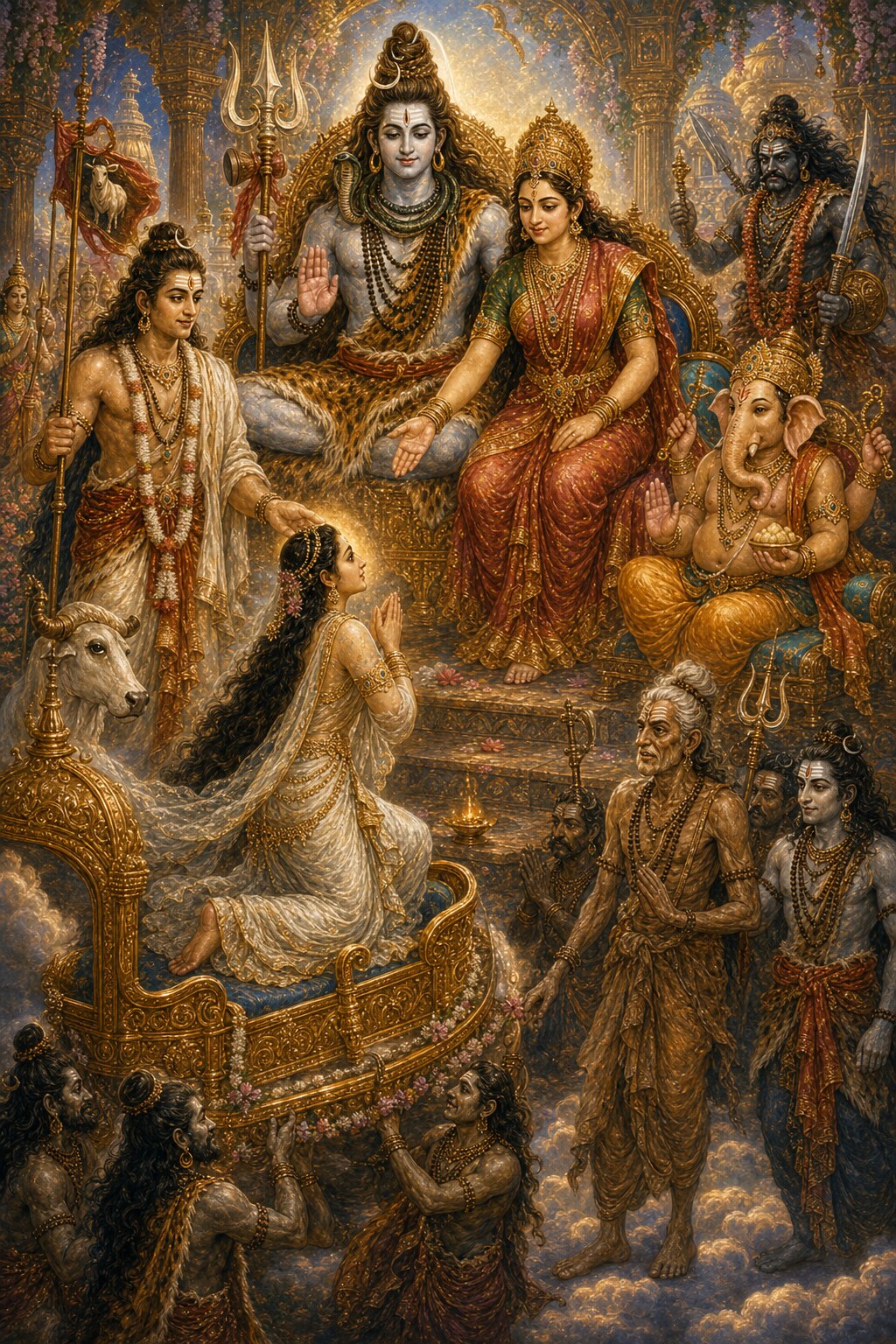
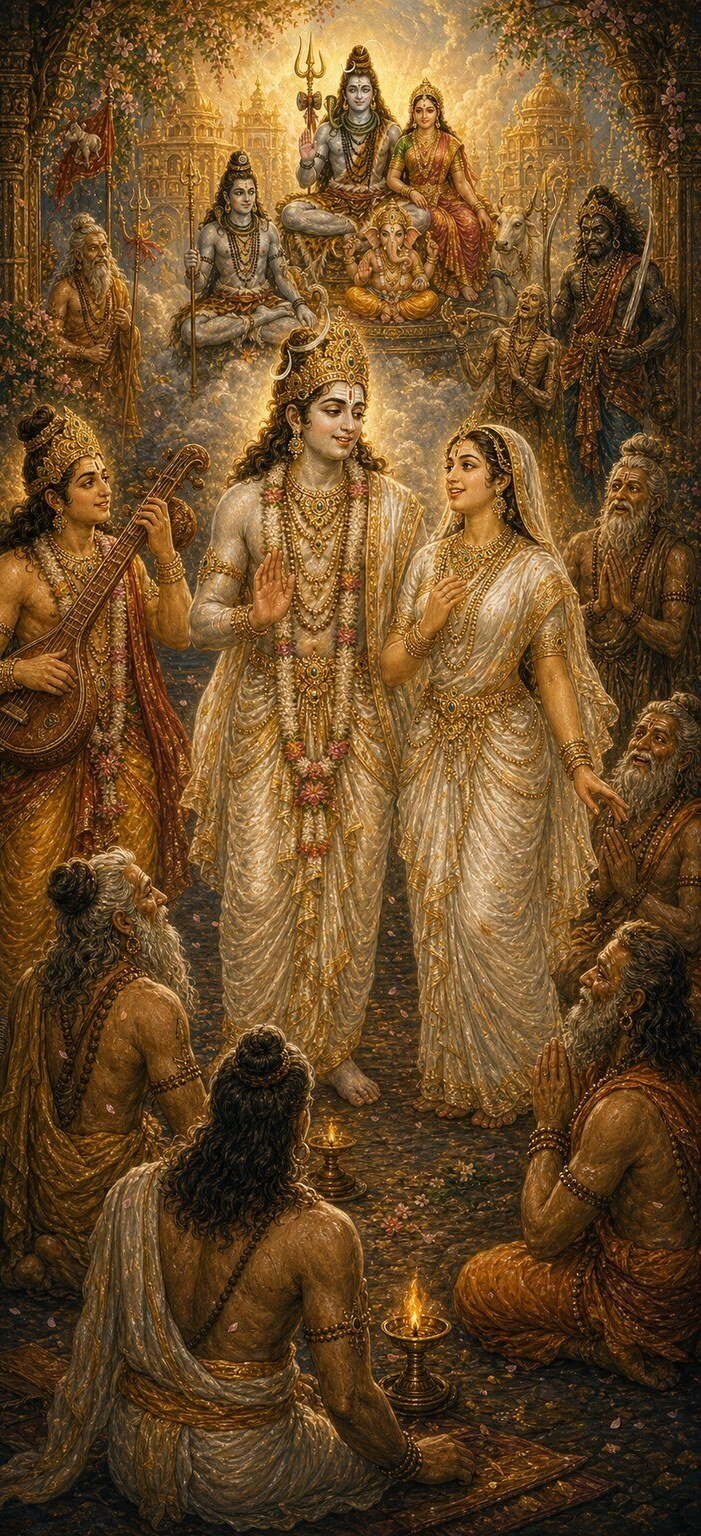
Hearing the katha, Chanchula’s mind was swiftly made pure, and she began to dwell again and again upon the form of Lord Shiva, that being of pure existence, consciousness, and bliss. She wore bark and let her hair mat, smeared ash over her body, hung rudraksha at her throat, bathed in the holy water every morning, kept a rein on what she said and what she ate, and said his name and said it again, exactly as the Brahmin had taught her, and she stayed at it for years. When her time was complete she laid down her body without the least distress. In that same moment a divine chariot sent by Lord Shiva arrived. Mounting that chariot amid his hosts, Chanchula was borne to Shivapuri; every stain was washed from her, and she took on a radiant, fair-limbed divine form with the crescent moon at her brow. There she beheld the three-eyed Mahadeva, white as camphor and dressed in white, ash across his body, five-faced, his throat holding its blue, burning like ten million suns, attended by Ganesha, Bhringi, Nandishwara, Virabhadra, and the rest, with the goddess Gauri at his left side like lightning at rest. As Chanchula bowed again and again, weeping, the goddess Parvati called her near with a gentle look and took her for a companion. Winning an unshakeable place in that eternal abode of perfect bliss, she came to know a joy that never wanes.
The Pishacha of the Vindhya and Tumburu
One day Chanchula went before the goddess Uma and sang her praises: you are the primordial Prakriti, you make and keep and unmake the worlds, and Brahma and Vishnu and Mahesha stand up in you. Pleased, Parvati told her to ask for anything at all, since there was nothing she could not give. With folded hands, Chanchula asked, “Daughter of the mountain-king, where is my husband Vindug now, and what fate has befallen him? I do not know. Have mercy, and deliver that husband of mine as well.” Parvati answered, “Your husband Vindug was a great sinner. That fool who consorted with harlots died and fell into hell, and now, to work off the remainder of his sin, he has become a pishacha upon the Vindhya mountain; there he lives on nothing but the wind and endures torments of every kind.” Hearing this, Chanchula was stricken with grief at her husband’s great suffering, and steadying her mind she began once more to pray.
Parvati said, “If your husband should hear the holy katha of the Shiva Purana but once, he may cross beyond all his degradations and become an heir to the highest state.” Then that daughter of the mountain-king, so tender toward her devotees, summoned Tumburu, king of the gandharvas and singer of Shiva’s glory, and said to him with gladness, “Tumburu, your love is set on Lord Shiva, and you know the wish of my heart. Go quickly to the Vindhya mountain with this companion of mine. A most dreadful pishacha lives there who in a former birth was this Chanchula’s own husband, a Brahmin named Vindug, and who abandoned the evening rites and all such observances to drown himself in impure ways. He went armed among poor men and squeezed them, he set fire to the houses of others, he took his food with his left hand, he quarreled with every good man he met, and no undertaking of his ever turned out well. Recite there, with all reverence, the divine katha of the Shiva Purana; the hearing of it is the highest of all meritorious deeds. By it his heart will be cleansed and he will let go of the ghost’s form. Then seat him upon the chariot and bring him near to Lord Shiva.”
Given this command, Tumburu was glad in his heart, and taking the chaste and faithful Chanchula with him he mounted the chariot and came to the Vindhya range. There the pishacha, huge of body and huge of jaw, now laughed, now wept, now sprang into the air; his shape was hideous to look at, and nothing in it remembered a Brahmin. Tumburu bound him fast with nooses, sat him down, and made ready the pavilion for the katha. The instant word spread that by the command of the goddess Parvati, Tumburu had come to recite the katha for the deliverance of a pishacha, the talk ran through every world, and many celestial sages gathered there as well. Tumburu took up the vina in his hands and began the katha of Gauri’s lord, reciting the whole of the Shiva Purana, from the Vidyeshwara Samhita to the Vayaviya Samhita, all seven samhitas together with their glories.
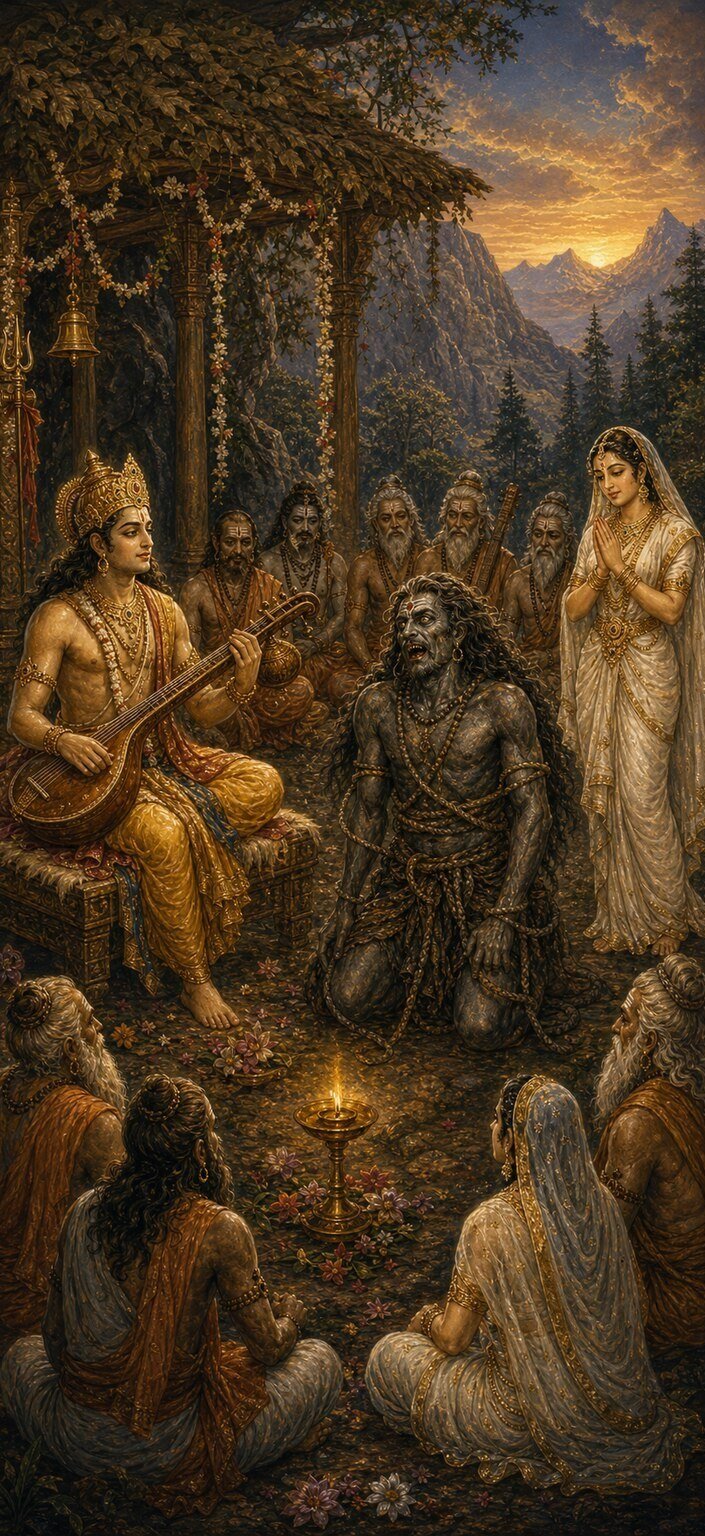
The moment the pishacha heard that supremely holy katha, all his sins were washed away and he cast off his pishacha body. His form turned divine. White garments graced his body, ornaments glittered on his limbs, and he shone with a splendor like the three-eyed Chandrashekhara. Divine of body now, the noble Vindug began to sing the praises of Lord Shiva at the side of his beloved Chanchula, with the mouth that had spent a lifetime on other errands. All the celestial sages marveled, and having heard that wondrous tale they returned with love to their several abodes, counting themselves fortunate to have been there. Then Vindug, with his beloved and with Tumburu, came swiftly to the abode of Shiva, and high in the sky, with his wife beside him, he was a light worth looking up at. Lord Maheshwara and Parvati received him with great honor and made him one of their own attendants. His wife Chanchula became a companion of Parvati, and the two of them, husband and wife, lived on in perfect happiness in that eternal abode.
Source: Shiva Purana (Gita Press, Sankshipta Shivapurananka), Shiva Purana Mahatmya