On this page
In the snow-wrapped palace on Kailash, a small conversation began one day, and see how, out of that small conversation, the birth of the remover of obstacles came forth. Long years had gone by since Shiva brought Parvati home from her father’s mountain and settled again on that peak, long enough for the goddess to have noticed where in that household she did not quite fit. It happened like this. Parvati’s dear companions Jaya and Vijaya came and sat beside the mother of the worlds and gently opened a subject. “Friend,” they said, “just think about it. Every one of these ganas belongs to Rudra. Nandi and Bhringi, who are said to be ours, spend their days in Shiva’s service as well, and among the countless Pramatha ganas there is not one who is truly our own. They stand at these very doors and wait for his word and no one else’s. They are counted as ours too, yet if you ask the honest truth, our hearts do not meet theirs. You ought to fashion a gana of your own.”
Parvati found the counsel sound, and it settled deep in her mind. Then one day the resolve grew firm. The goddess was bathing when Sadashiva, scolding and berating Nandi, walked straight into the inner chambers. Startled, the mother of the worlds rose in a rush from her bath, flushed with embarrassment. He had not waited a moment at the threshold, and there was no one at that threshold to make him wait. In that very moment her companions’ words came back to her. She resolved within herself: I must have a servant of my own, one wholly auspicious, skilled in his work, ready for my command alone, who will not waver from it in the slightest, not by so much as a speck.
A son molded from her own body
Then, from the paste of her own body, the goddess shaped a living being. He was endowed with every auspicious mark, each limb beautiful and without flaw, his frame tall and richly resplendent, brimming with strength and valor. No father had a hand in him; he came out of what she rubbed from her own limbs, and he was hers down to the last grain. The goddess clothed him and adorned him, blessed him to her heart’s content, and said, “You are my son, my very own. There is no one here as dear to me as you.”
The boy folded his hands and asked, “Mother, what task has fallen to you today? Tell me, and I will see it done.” The mother said, “Listen, son. From today you are my doorkeeper. Without my leave, let no one force his way and set foot inside my house, no matter where he comes from, no matter who he is. I have told you the plain truth.” She named no exceptions, and in a house where every other servant already had a master, that silence was the whole of his instruction.
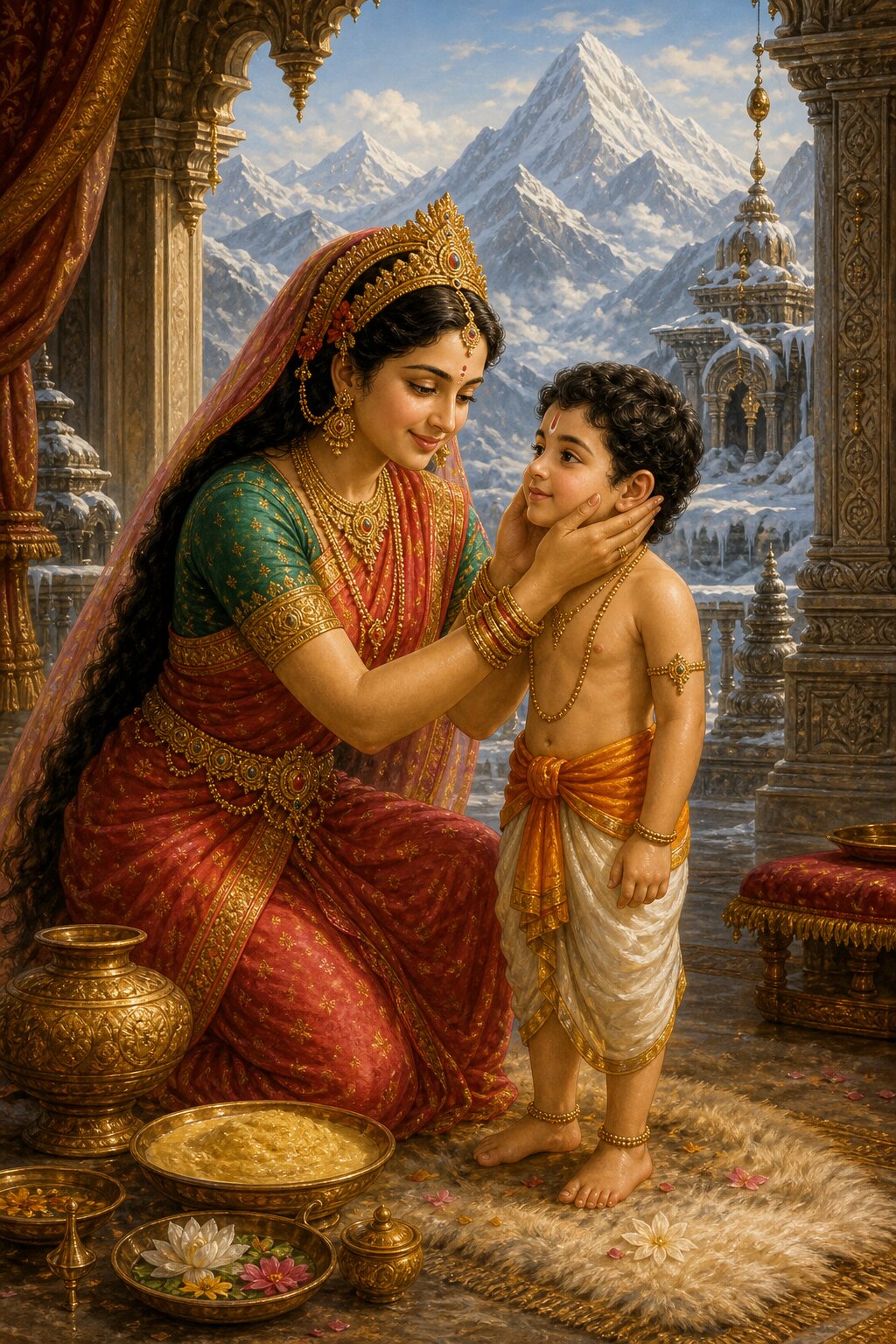
With these words the goddess placed a stout staff in her son’s hand, looked once at that handsome face and was glad of it, kissed his face lovingly, held him to her breast, and, having seated the staff-bearing lord of ganas at the door, went off to bathe with her companions, easy in her mind for the first time in that house. The boy, for his part, took up his staff and stood guard. His mother had commanded it, after all.
The standoff at the door
Now listen. At that very moment the ever-playful Lord Shiva arrived at the door, in the mood of a man walking into his own house and expecting the walls to know him. The boy did not know him. No one had told him yet what a trident means or whose throat wears a serpent. He raised his staff and said, “Lord, without my mother’s leave you may not go in just now. My mother has sat down to bathe. Turn back from here for the present.”
Shiva snapped at him, “You fool, whom do you think you are stopping? Does he not recognize us? There is no one but Shiva standing here.” Still the boy would not budge, and when the lord made to walk past him anyway, the staff came down and struck him. Shiva stood back outside his own door and called his ganas to see to it. Then Maheshvara’s ganas came to reason with him. “Listen. We are the chief ganas of Shiva, the doorkeepers of this place, and we have come at the command of all-pervading Shankara to move you aside. We took you for a gana as well, and so we have not yet raised a hand against you; had we done so, you would have been slain long ago. It is best that you step aside of your own accord. Why call your own death upon yourself for nothing?”
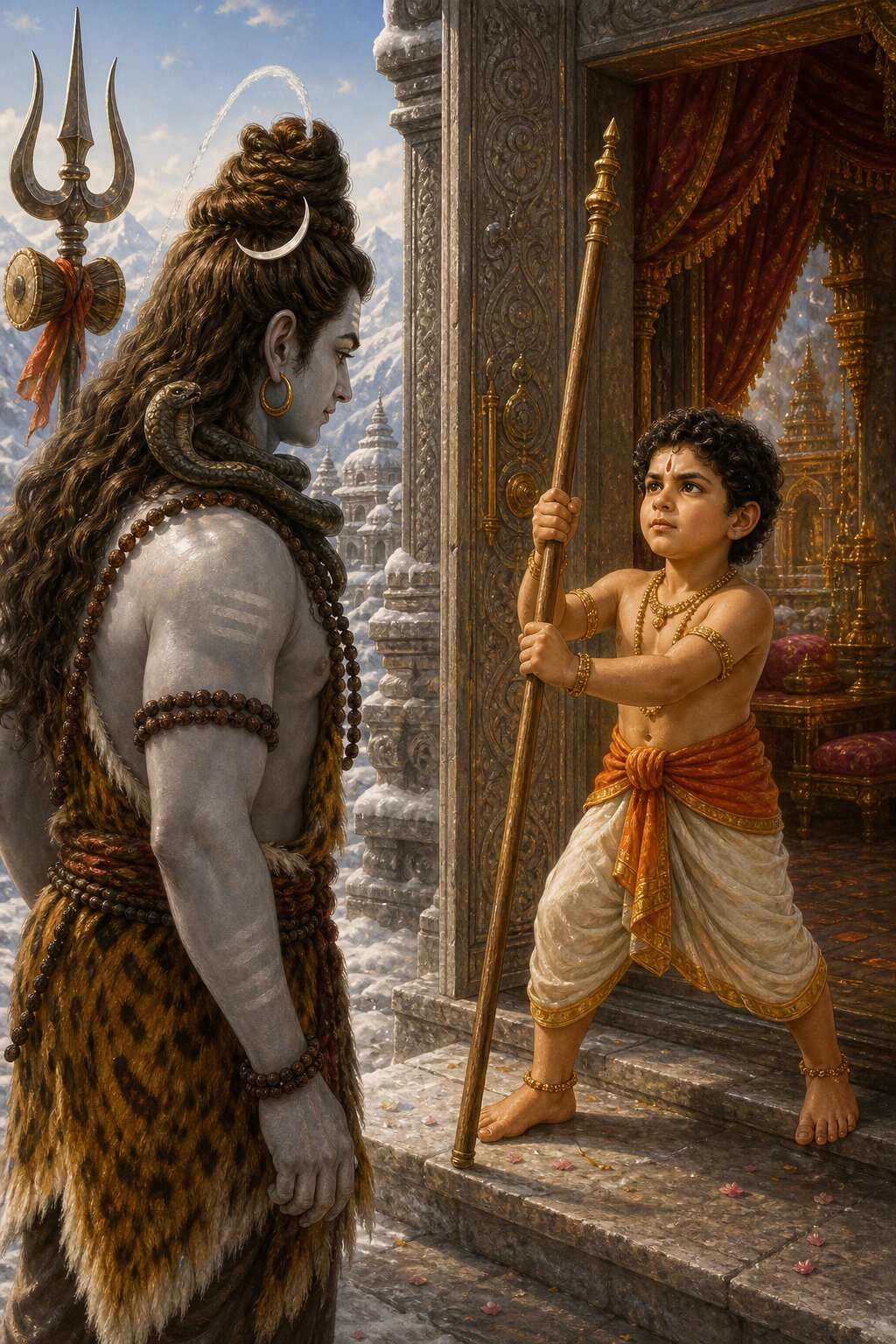
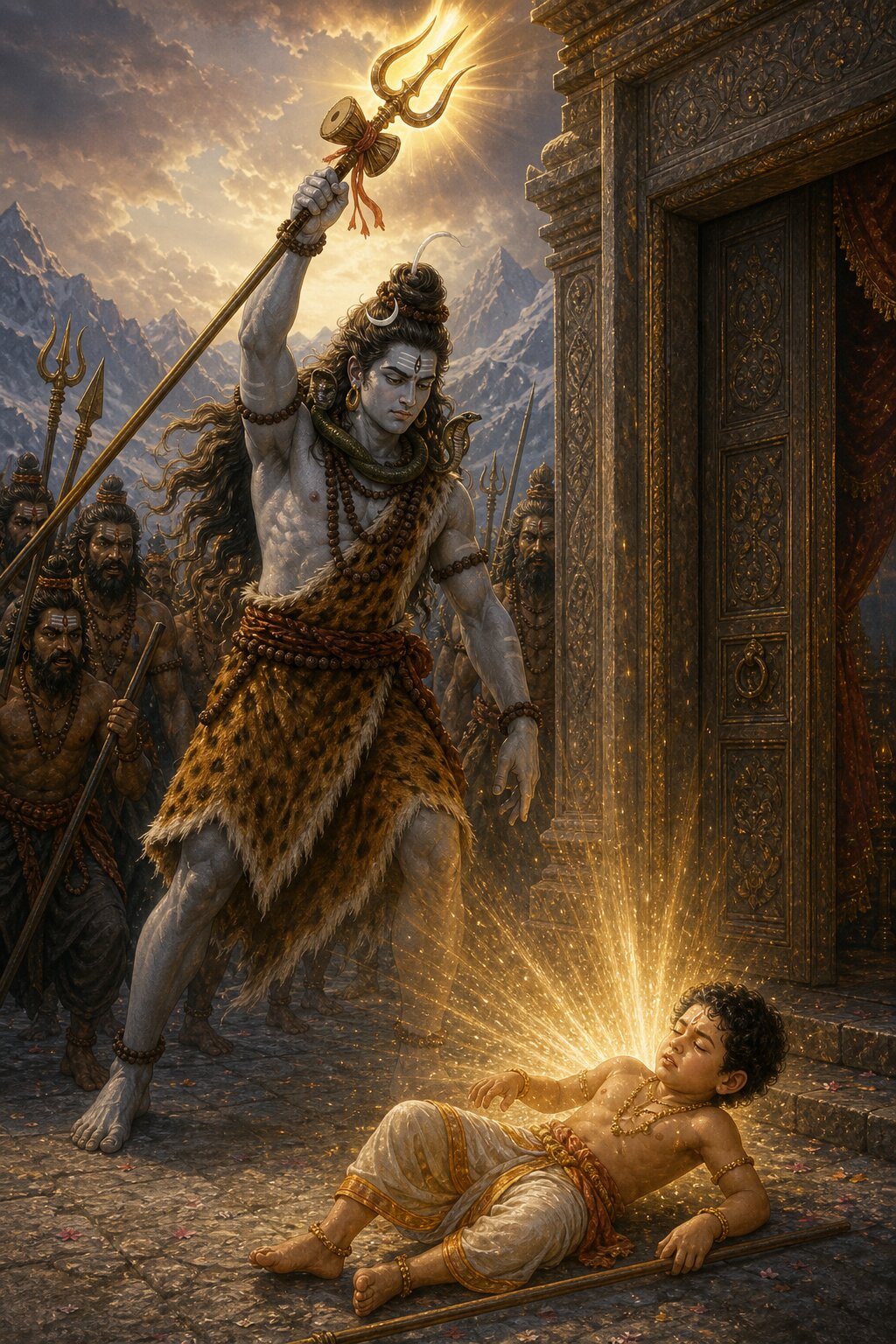
The son of Girija stood unafraid, rebuked the ganas, and did not leave the door. His answer was the simplest thing on that mountain: they were standing where their lord had told them to stand, and he was standing where his mother had told him to stand. When the ganas returned and told the whole tale, Maheshvara, the master of wondrous play, rounded on them instead. “Who is this that speaks up so boldly, like an enemy? Drive that new doorkeeper far off. What good is it to stand here reciting his story to me?” The ganas went back, and again the boy stopped them. When inquiries were made, it came out that he was the son of Sri Girija, appointed as her doorkeeper. Now Shankara resolved on a strange piece of play, and with it he meant to melt the pride of his own ganas. He summoned the ganas and the gods, and a terrible battle broke out, yet no one could defeat Ganesha. Nandi seized one of his legs and Bhringi the other; he broke both grips, caught up an iron club, and swept the doorway clear of them, and the ganas who had come in their thousands scattered the way deer scatter at the sight of a lion. Brahma came to make peace and went back with his beard plucked. Parvati sent two shaktis to stand with her son, and the weapons the gods threw were caught in the mouth of one of them and returned. At last Maheshvara himself, the trident-bearer, came forward, and while Vishnu drew the boy’s face aside, by his own trident Ganesha’s head was cut off and fell. Keeping guard over his mother’s command to the very end, the boy gave up his life and never left the door.
Brahma tells Narada that the tale in which the head is severed by the gaze of Shani belongs to another kalpa (world-cycle); in this one, the Shvetakalpa, it was Shiva himself who staged this play, and the story runs differently in each age because the one telling it plays a different game each time.
A mother’s wrath
When the news reached Parvati, she filled with rage. My son has been killed by all the gods and all the ganas together, she said, and either I destroy every one of them or I drown the worlds. She brought forth a great host of shaktis (powers) in a moment, and they bowed and asked for her command, and she gave the order that, without a second thought, a deluge of destruction be unleashed. That was all it took; the shaktis fell upon the world the way fire falls on dry grass, lifting gods up in their hands and dropping them into their own mouths. Wherever anyone turned to look, a shakti was already standing there, and their blazing radiance began to scorch every direction. Shiva’s ganas fled in terror and took up a stand far off.
At that moment the divine sage Narada arrived. He and the gods bowed to Shankara and agreed that all should take counsel together over this calamity. Even Shiva, who had begun the whole play and had never in any age been touched by anything, looked in that hour like a man in trouble. It was settled that until the goddess Girija showed her grace, there would be no road to peace. So all the gods and sages went to the goddess Girija and, with folded hands, began to praise her. “Wife of Shiva, we bow to you. Chandika, Amba, you alone are the primordial power; you alone create, sustain, and dissolve the worlds. Mistress of the gods, the whole of the three worlds is in torment from your wrath. Be pleased now; let your anger grow still.”
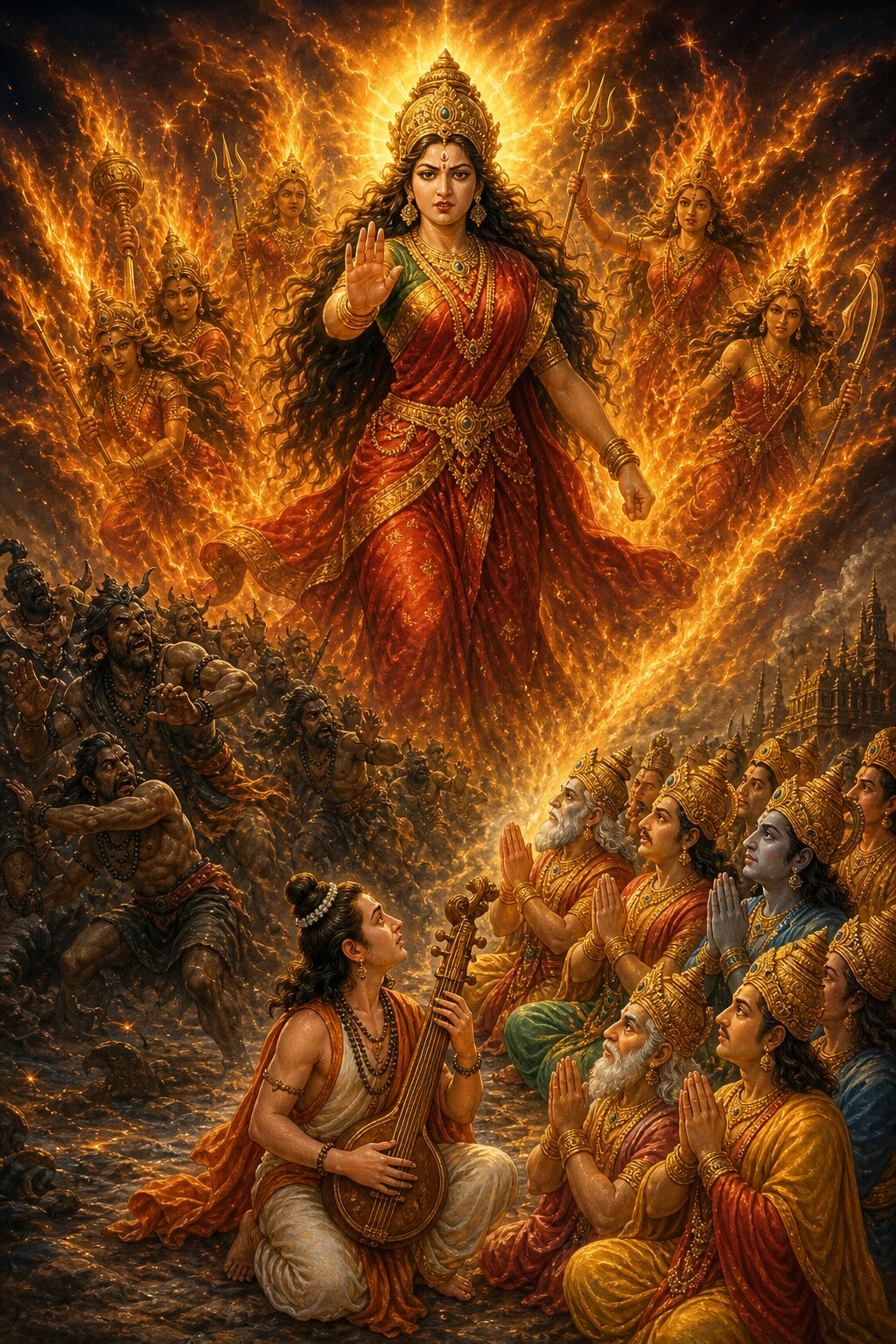
The supreme goddess only looked at them with wrath-filled eyes and said nothing. Her brilliance burned all around her, and not one of them could stand close to it. The sages bowed again at her feet. “Devi, destruction is now upon us. Forgive us, forgive us. Amba, your own lord Shiva stands here too; turn your eyes toward him for a moment. These gods, Brahma and Vishnu and the rest, and all your creatures, are yours, and they stand before you with anxious, folded hands. Supreme goddess, pardon the offense of them all and grant them peace.”
At this humble pleading Chandika’s heart softened, and compassion welled up within her. She said, “If my son comes back to life and is held worthy of worship among you all, then there will be no destruction. The day you grant him the office of chief over all, that day peace will come to the worlds; short of that, there will be no relief.” She was asking them for something harder than her son’s life. She was asking for his place among them.
The first creature to the north
The sages carried this condition to the gods, and the gods carried it to Shiva. Shiva said, “So be it; do whatever will bring peace to all the three worlds. Go toward the north, and the first creature you meet, cut off its head and join it to this boy’s body.” Whatever the north gave up first would be what his son wore for the rest of time.
The gods washed and wiped the child’s body, worshiped it, and set out to the north. The very first creature they met was an elephant, one with a single tusk. They brought back its head and joined it to the boy’s body. Then all the gods, Brahma and Vishnu among them, folded their hands to Shankara in his formless aspect and said, “Lord, may that same radiance of yours, from which all of us were born, enter this boy.” They were asking him to put into this one small body the same thing he had once put into each of them. Together they consecrated water with Vedic mantras, called Shiva to mind, and sprinkled that water over the boy’s body. At its touch the boy filled with consciousness and sat up as though waking from sleep.
An elephant’s face, a glowing body the color of red dawn, a happiness playing across his features, a graceful form, and a lovely light spreading all around. The head taken from a beast on a road sat on him as though it had always been his. Wherever anyone stood, he was steeped in bliss, and every sorrow dissolved in an instant. Overcome with joy, the gods carried the boy to Parvati. Seeing her son alive, the mother was overwhelmed with delight.
The boon of first worship
Then the elephant-faced one was anointed. In her overflowing joy, Parvati took her son in both hands and pressed him to her breast, and gave him many garments and ornaments. The Siddhis worshiped him according to the proper rites and laid every attainment they had at his feet, and the mother stroked his limbs with her own hand that takes away all sorrow. Kissing his face, she gave him a boon. “Son, this time you have suffered greatly, yet now you are fulfilled, now you are blessed. From today your worship will come first among all the gods, and you will never have to know sorrow. At this moment sindur (vermilion) glows on your face, and so let people always worship you with sindur. Whoever worships you duly with flowers, sandal, fragrance, food-offering, a lovely arati (lamp offering), betel, gifts, circumambulation, and salutation, all their attainments will be secured and every obstacle will be cut away, of this there is no doubt.” Every word she spoke turned the morning’s wound into the boy’s inheritance.
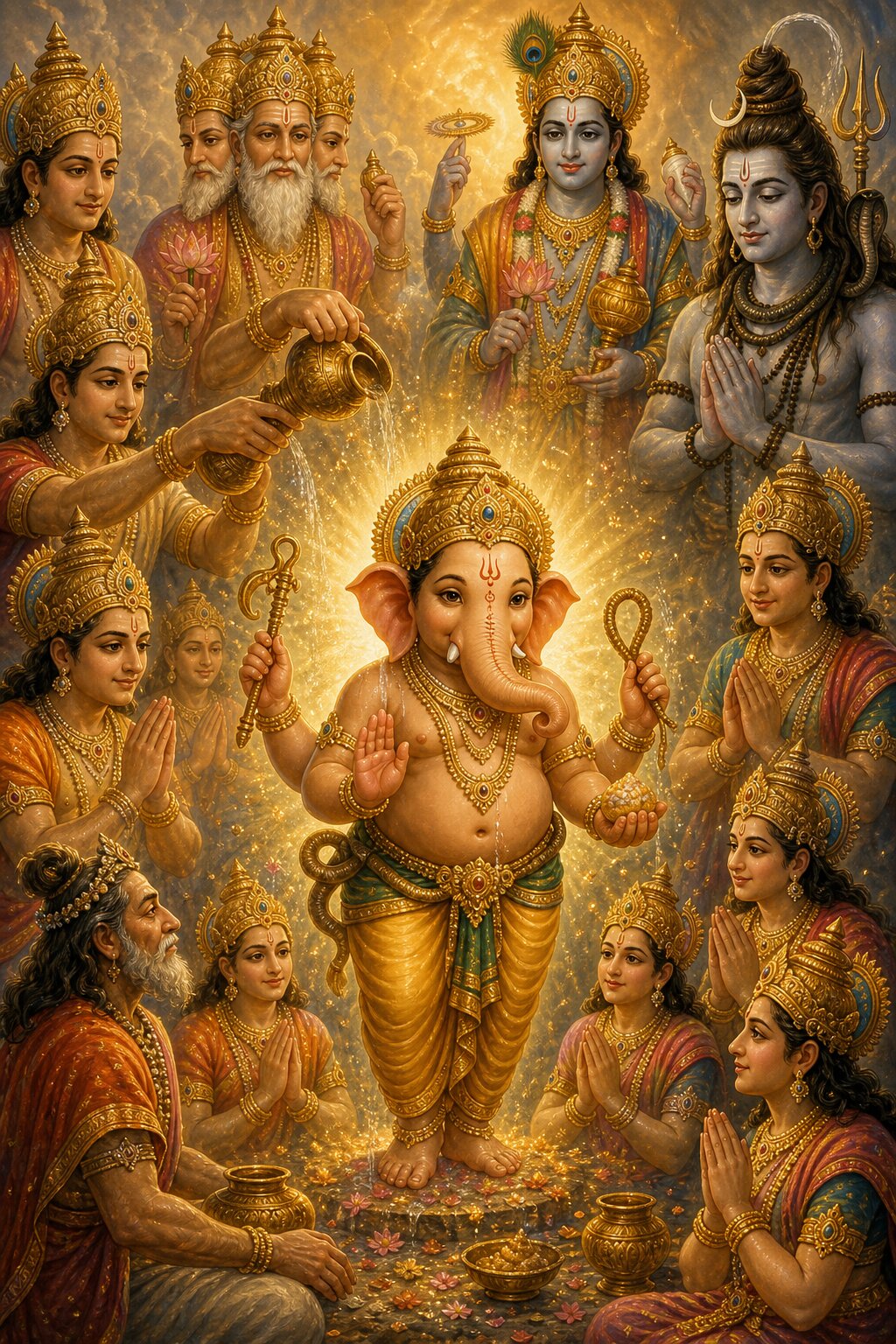
Then Indra and the other gods, wishing for the welfare of the three worlds, led the boy away and seated him in Shiva’s lap. Shiva passed his lotus hand over the boy’s head and said, “This is my second son.” The hand that had taken the head off was the hand that now rested on it. Ganesha rose and bowed at Shiva’s feet, then bowed to Parvati, Brahma, Vishnu, Narada, and all the rest, and said with humility, “Pride is the very nature of a person, so may you all forgive my offense.” He had held a door against the lord of the universe, and he was the one who apologized. Then Brahma, Vishnu, and Shankara together, with love, gave a boon. “As the three of us gods are worshiped throughout the three worlds, so let everyone worship this Ganesha as well. Let people worship him first and us after, and only then will our worship be complete. Whoever worships any other god without first worshiping him, the fruit of his worship will be destroyed.”
Then Shiva said to the son of Girija, “Without doubt we are supremely pleased with you, and when we are pleased, know that the whole world is pleased. Now no one can oppose you. You are the son of Shakti, and so you are radiant beyond measure. Though only a child, you displayed great valor against gods who had never yielded a field before, and so you will always be happy. In the work of removing obstacles your name will stand above all others. You are worthy of everyone’s worship, so become now the chief of all our ganas.” The ganas he was given to rule were the same ones he had scattered with a club that morning.
With great affection he added one more boon. “In the hour when your form first appeared in Girija’s beautiful mind, it was the chaturthi, the fourth day, of the dark fortnight of Bhadrapada; the moon had risen auspiciously, and the first watch of the night was passing. So let your finest vrata (vow) be kept on that very date; it will be most gracious and will grant every attainment.” He was fixing the date of the boy’s birth at the moment his mother first thought of him, which is when a son is truly born. Then he recited the full method of the vrata: on the dark chaturthi of Margashirsha, one fashions an image of metal, of coral, or of white madar, gives it the consecration of life, worships it with fragrance, sandal, and flowers; when the first watch of the night has passed, one honors it with one hundred and one or twenty-one blades of durva grass, each twelve fingers long and having three knots, with incense, lamp, food-offering, and betel; then one worships the young moon, feeds the Brahmins sweet food and oneself takes sweet unsalted prasad; and when the year is complete, one performs the concluding rite by feeding twelve Brahmins. He said also that people of all varnas, women especially, and kings who desire prosperity should certainly keep this vrata; whatever the observer wishes for, he will surely obtain it.
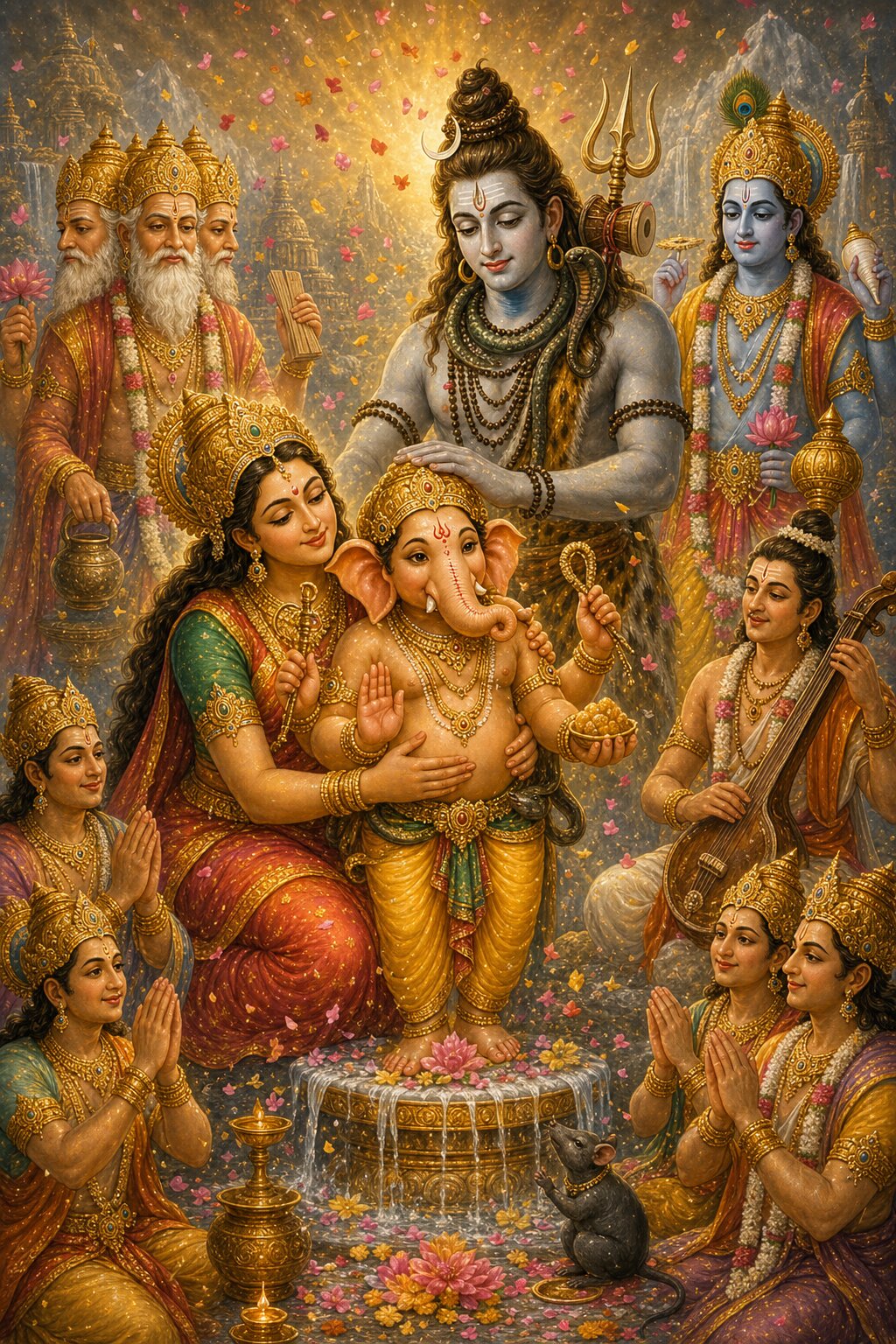
All the gods, the sages, and Shiva’s beloved ganas said “so be it” in support and worshiped the lord of ganas with elaborate rites. Shiva worshiped him first, then Vishnu, then Brahma, then Parvati, and after them every god in that assembly. Brahma says that the joy Girija felt at that moment cannot be told even by our four mouths. Kettledrums sounded, apsaras danced, gandharvas broke into song, and flowers rained down. A great festival was held at this installation to the rank of lord of ganas; peace spread across all the worlds, and every sorrow departed. As the gods and sages returned to their own realms, all along the way they kept saying to one another, “What a wondrous battle that was!” Every one of them had seen wars, and not one of them had seen a boy hold a door like that. Meanwhile Girija’s anger was stilled, Shiva took up his gladdening work for the good of the worlds as before, and that boy was now the first-worshiped lord of ganas of all, without whose first worship the fruit of no worship is made complete.
It is said that whoever listens to this most auspicious tale with senses held in check becomes a partaker of every blessing. The sonless gain a son, the poor gain wealth, the sick gain health, and a person sunk in an ocean of grief is set free of grief by the mere hearing of it. Whatever a listener has been kept from, the story hands back.
Source: Shiva Purana (Gita Press, Sankshipta Shivapurananka), Rudra Samhita, Kumara Khanda