On this page
When the tale of the forty-two incarnations had been told to its end, Sanatkumara pressed his palms together and put a question to Nandishwar. “My lord, you were born from a portion of Mahadeva himself, and afterward you came again to Shiva. How did that happen? I long to hear the whole account, exactly as it fell out. Be kind, and tell it.”
Nandishwar, lord of the ganas, answered. “Sanatkumara, you who know all things, I will tell you the very way in which I was born from a portion of Mahadeva and gained access at last to Shiva. Listen closely, and listen with attention.”
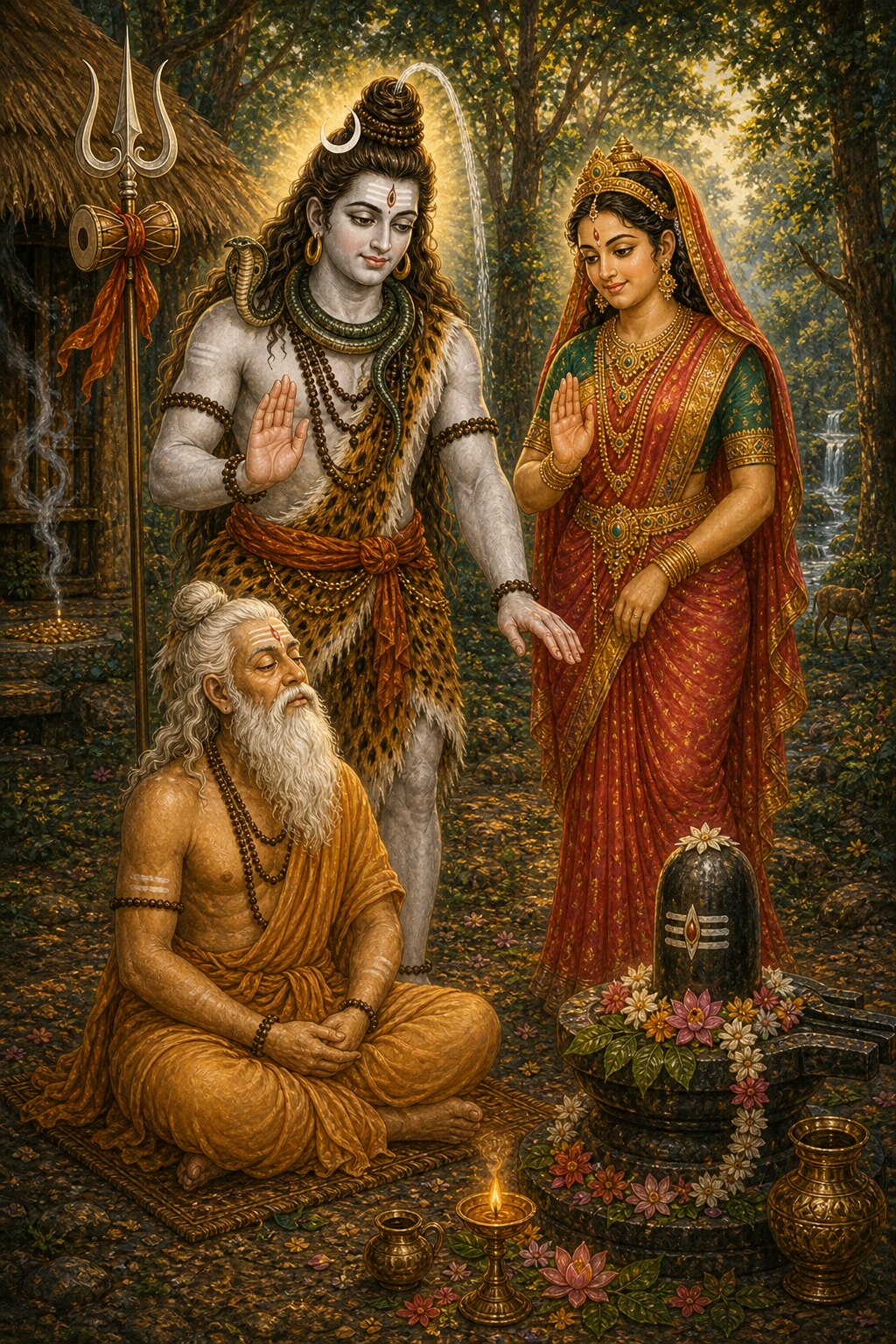
Shilada’s vow
There was a righteous sage named Shilada, the son of Shalankayana. His ancestors pressed him eagerly, wanting to be raised up, and so he set his heart on a son, and on a son of a rare kind: one not born from any womb, firm in his vows, and beyond the reach of death. To win such a boon he undertook fierce austerity, holding his mind steady, and pleased Indra, king of the gods, who came to grant him what he asked. But when he heard the asking, Indra drew back. I can give you a son born of a womb and certain to die, he said, and nothing else; there is no one at all who escapes death. Even Vishnu dies, even Brahma dies, and the span of each of them is written down in the sacred lore. Neither I nor Vishnu nor Brahma can give what you want. Only Shiva can, if he is pleased. Go and propitiate him. With that, Indra blessed him and returned to his own region.
So Shilada sat down again to his austerities, this time to please Mahadeva, and a thousand divine years went by him like a moment. An anthill closed over his body. A hundred thousand worms with beaks hard as adamant, and every kind of blood-drinking insect, settled on him and worked at him where he sat, until the flesh and the blood were drained out of him and a bare skeleton was left in that cavity of earth. The penance moved the god, and Shiva came to the place in person, showed him the divine body that people of crooked intellect never see, and said aloud, “I am here, the granter of boons.” Shilada, sunk in that great trance, did not hear a word of it. Only when the slayer of the Tripuras touched him did he let his penance go. He opened his eyes, saw Shiva with Parvati, and fell at his feet, and praised him with his voice choked with joy. When Lord Shiva made ready to grant a boon, the sage said, “My lord, I want a son who is deathless and born of no womb, a son like you yourself.”
Shiva was pleased, and he said, “Brahmin, rich in penance, in an age long past Brahma and the greatest of the gods worshiped me through austerity and urged me to take birth among them. And so, sage, though I am the father of the whole universe, you will become my father, and I will be born as a son of no womb and carry the name Nandi.” Having said this and given the sage his directions, the gracious Shankara turned a look of grace upon Shilada and vanished on the spot, Uma with him.
The descent on the sacrificial ground
After Mahadeva departed, Shilada returned to his hermitage and told the whole account to the sages there. Some time passed. One day the great sage, foremost among those who knew the science of sacrifice, was preparing the ground for a yajna and had given orders for the altar to be raised. At that very moment, by Shambhu’s command, before the rite had even begun, Nandishwar came forth. The child’s radiance was like the fire that burns at the end of an age. The Pushkaravartaka clouds and the rest poured down rain; kinnaras, siddhas, and sadhyas walked through the sky, and the great sages showered flowers on every side. Brahma and the other gods came with their wives, and Vishnu, and Shiva with Parvati, and the celestial damsels danced, and gladness spread through every direction, and on all sides people began to praise Shilada.
Shilada saw that the infant blazed like the sun and fire of the world’s dissolution: he had three eyes, four arms, a crown of matted hair, and weapons that included the trident, altogether the very form of Rudra. At the sight he sank into a great joy, and bowing to the child worthy of worship, he said, “Lord of the gods, since you have delighted me, you will carry the name Nandi. And so I bow to you, lord of the worlds, who are joy itself.”
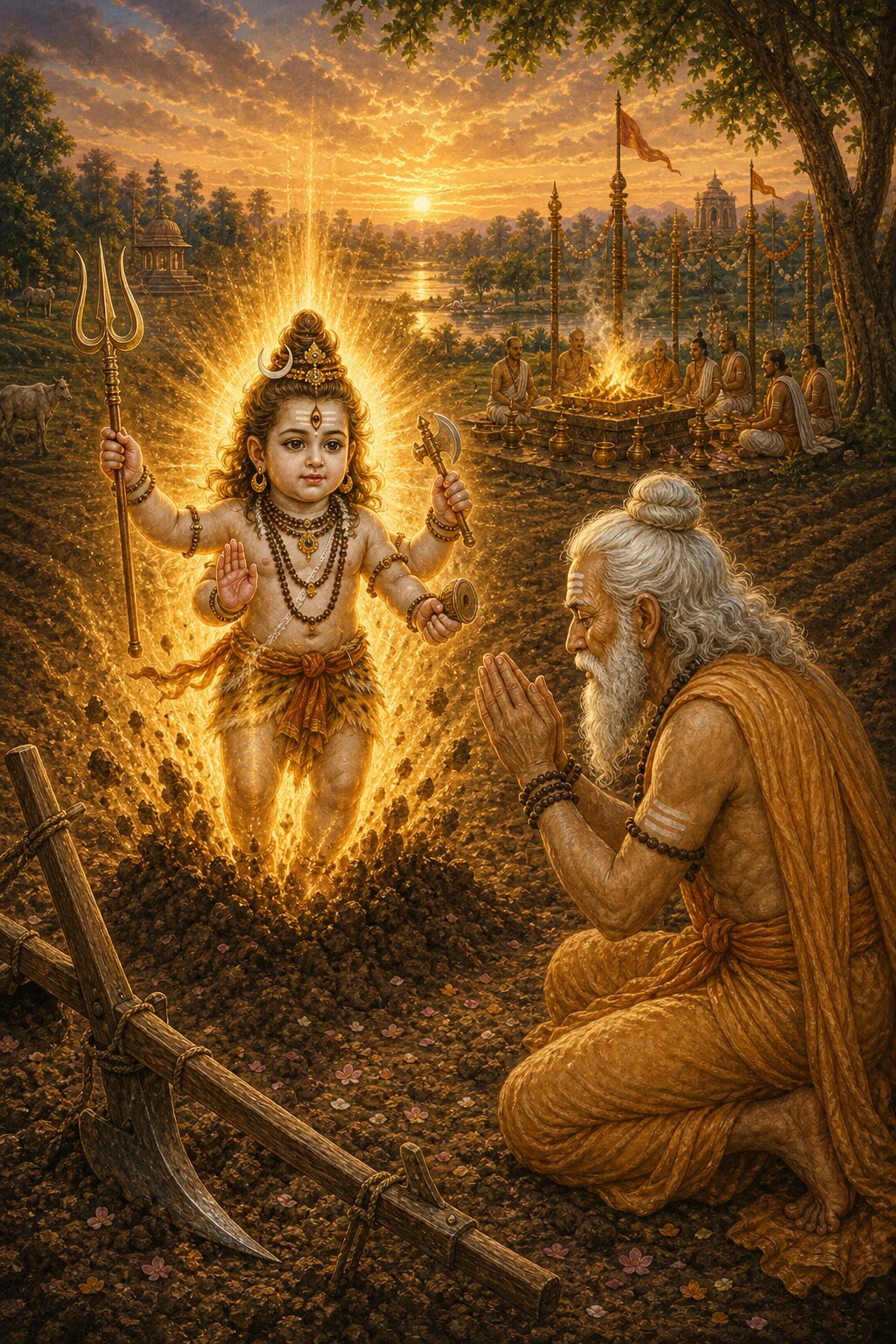
A single year of life
As a poor man rejoices when a hoard of treasure comes into his hands, so Shilada rejoiced in his son. He paid homage to Mahadeva, gathered the boy up, and returned to his leaf-thatched hut. The moment he reached the hermitage, Nandi set aside that form of Rudra and took on the shape of a human child, and at the sight of it his father, honored across the world, was stricken and lamented with his own people around him. Then he steadied himself and performed all the rites, from the birth ceremony onward, and by the fifth year had the boy taught the complete Vedas with all their branches and sub-branches, along with the other sacred texts.
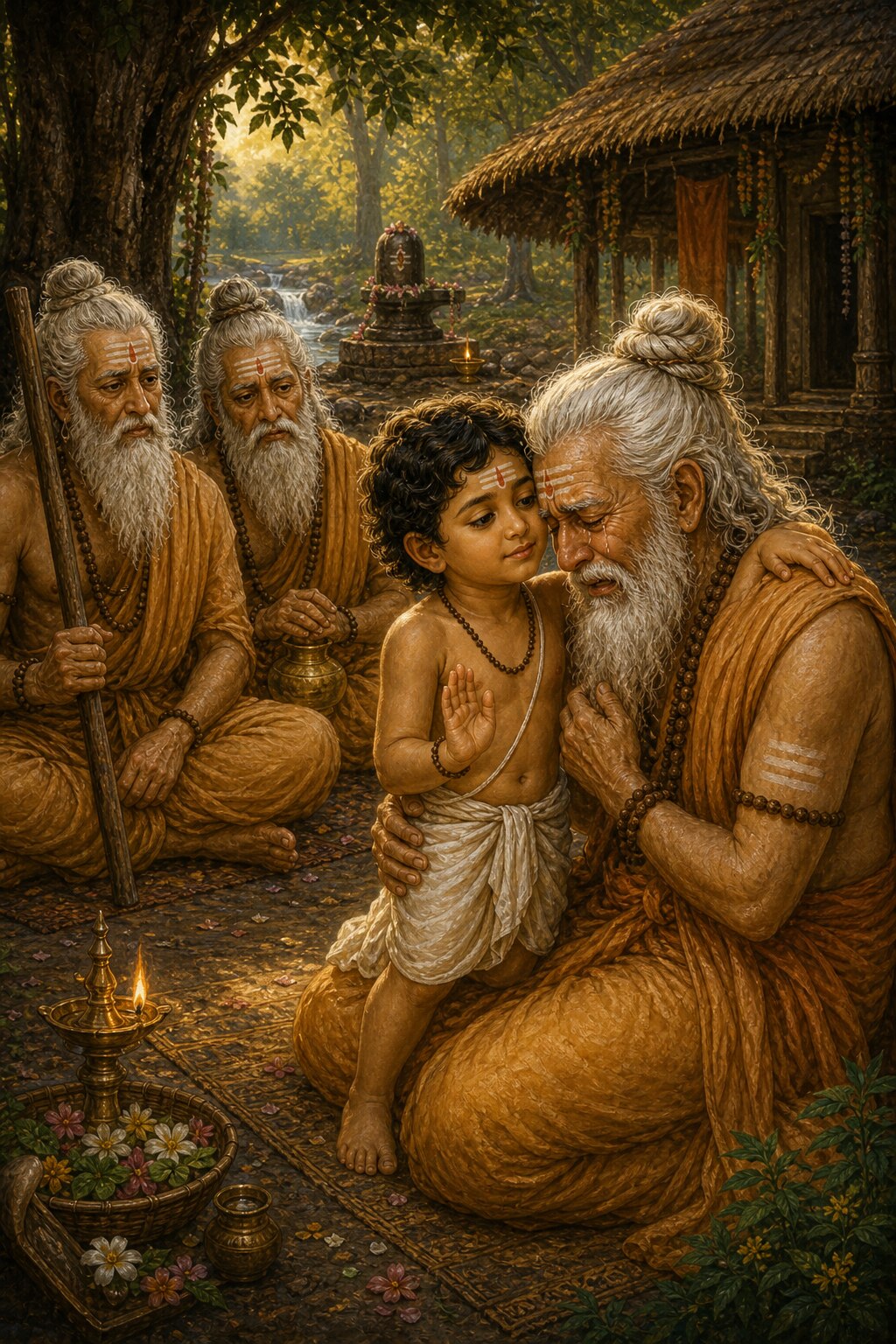
When the seventh year was complete, two sages named Mitra and Varuna came to the hermitage, at Shiva’s command, to see Nandi. Shilada gave them full and gracious welcome and seated them. Once they were seated, they looked at the boy again and again, and said, “Dear Shilada, your son is a scholar who has crossed to the far shore of every meaning in the sacred texts. And yet his life is very short. We have weighed it with care, and we do not see his span running past a single year from now.”
At these words Shilada clutched his son to his chest and wept aloud; father and grandfather both fell to the ground like dead men. Then Nandi called to mind the lotus feet of Shiva and asked, calmly and even gladly, “Father, what sorrow has come upon you, that your body trembles and you weep? I wish to know where this misery has come from.” His father said, “My child, I am stricken to see how short your life will be. Who can turn this aside? In him alone I shall seek refuge.” Nandi answered, “Father, I tell you the truth, and I take a vow on it: even if the demons, Yama, Time itself, and every other living being joined together to kill me, my life would not be cut short. Do not grieve.” His father said, “What is your penance? What is your knowledge? What is your yoga? Who is your lord? By what do you propose to turn aside this terrible misery of mine?” The son said, “Father, I shall cheat death by my penance; learning will not do it. By worshiping the great god I will conquer death, and there is no other way.” With that he bowed at his father’s feet, walked once around him in reverence, and set out on the road to the forest.
Austerity in the forest, and a boon
In a solitary place in the forest Nandi took his seat and began an austerity that would have taxed even the greatest of sages. Sitting on the holy northern bank of a river, his mind gathered to a single point and his thoughts made pure, he meditated within the lotus cavity of the heart on the tranquil Tryambaka, the Sadashiva of five faces, ten arms, and three eyes, and began to recite the Rudra mantra. Seeing him lost in that recitation, Chandrashekhara, the moon-crested Mahadeva, was pleased. He came to the place with Uma and said with affection, “Son of Shilada, I am pleased by this penance of yours; you have performed it very well. Tell me what you desire. I am here, the granter of boons.”
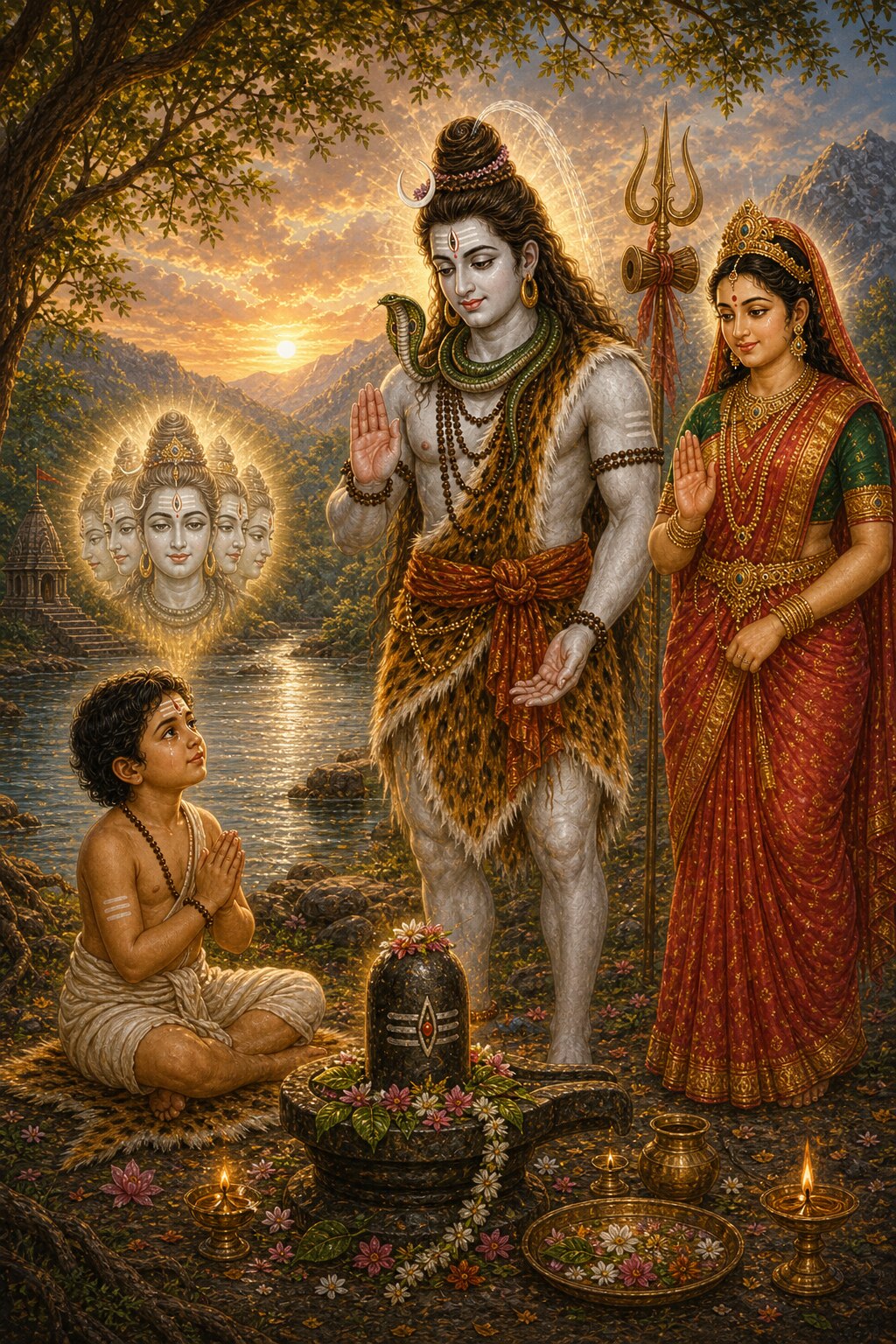
Nandi bowed his head to those feet and began to praise the Lord who destroys old age and sorrow. As he praised him, tears filled his eyes, and he fell prostrate with his head resting there. Then Shambhu, tender toward his devotees, lifted him up with both hands, clasped him, and stood face to face with him. He passed his hand over the boy’s body, and glancing first at the leaders of the ganas and at the daughter of Himavat, he looked at Nandi with sympathy and said, “Nandi, my child, wherefore can you be afraid of death? Those two Brahmins were sent by me alone; there is no doubt in it. You are equal to what I am. You will remain free of death and of old age, you will not be unhappy, and you will be forever the leader of my ganas, unchanging and unwasting, loved by all in the company of your father and your friends. You will gain your strength from me. You will always be at my side, and my love for you will never break. By my favor you will have neither birth, nor old age, nor death.”
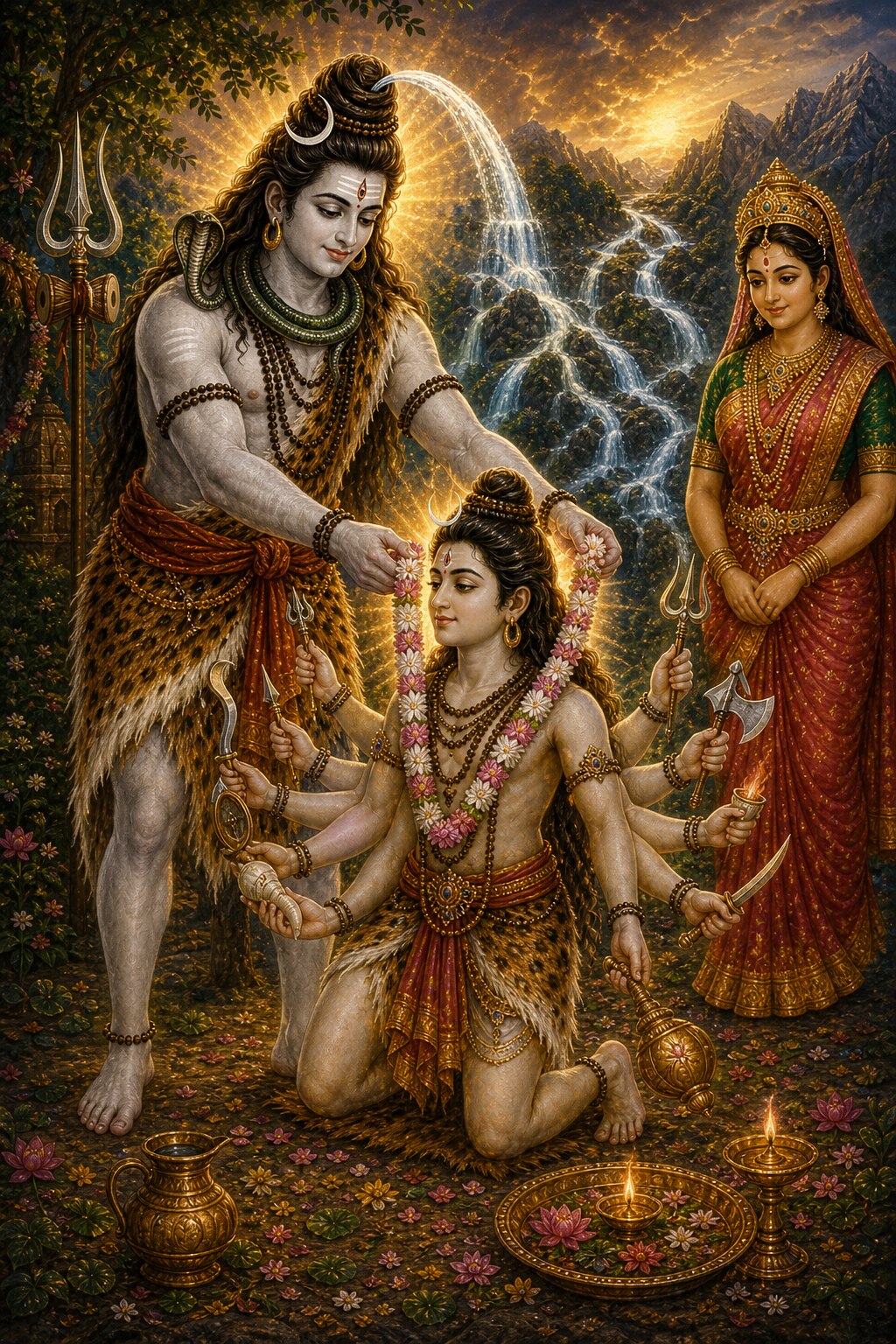
With these words the storehouse of mercy lifted the garland of lotuses from his own head and at once tied it round Nandi’s neck. The instant Nandi wore that garland, he became a being of three eyes and ten arms, and looked like a second Shankara. Then Maheshwara took his hand and asked, “Tell me, what other excellent boon shall I grant you now?” He took water from his own matted hair into his palm, water as pure as a necklace, and, saying, “Be Nandin,” let it fall. That water turned into five auspicious rivers, pure, swift, beautiful, and divine in form, whose names are Jatodaka, Trisrota, Vrishadhvani, Svarnodaka, and Jambunadi. That basin where the five come together is called Panchanada. It lies near Japeshvara and is a supremely auspicious spot of Shiva; whoever goes there, bathes, performs the japa of the lord of lords, and worships him reaches union with Shiva beyond any doubt.
Lord of the ganas
After this, Shambhu said to Parvati, “Undying one, I wish to consecrate Nandi and make him lord of the ganas. What is your thought on this?” Parvati said, “My lord, it behoves you to give it to him; this son of Shilada is my most beloved son as well.” Then Shankara, the independent lord, called his leaders of the ganas to mind, and even as he remembered them they came, countless, every one of them shaped like Shiva himself and delighted to be summoned. They bowed with joined palms and asked what was wanted of them. Shall we dry up the oceans? Shall we kill Yama and his servants? Shall we slay great death, or the aged Brahma? Shall we bind Indra with all the gods, or Vishnu with all his attendants, or the daityas and the danavas, and bring them here? To whom shall we cause terrible distress at your behest? Shiva praised them and then spoke. “Nandishwar is my son. He is the lord of lords, the favorite leader of my ganas, and the chief of the whole host. Come together and crown him lovingly as your leader. From today Nandishwar is master of you all.”
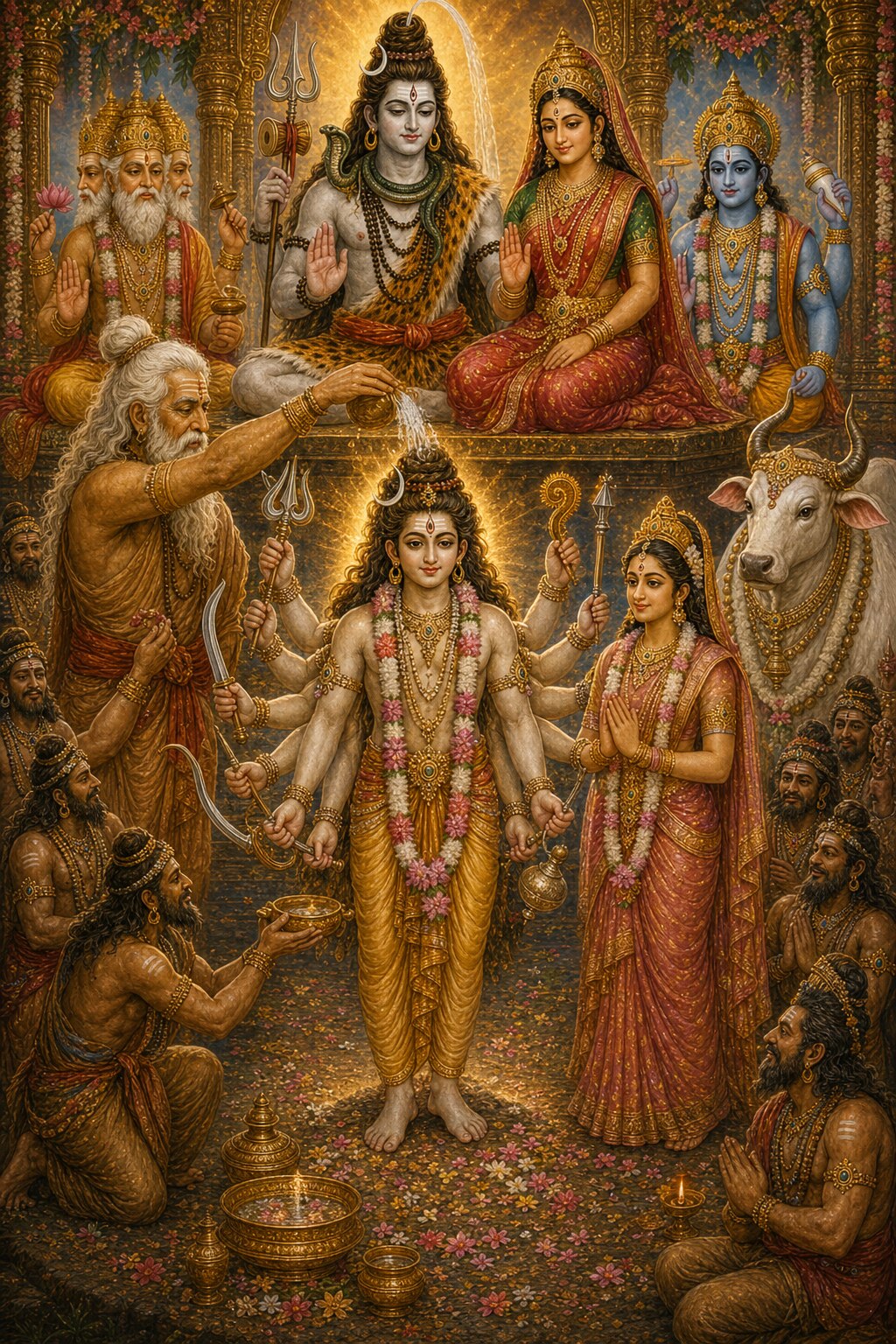
All the leaders of the ganas said, “So be it,” and brought everything the rite required. Then Narayana and the other gods, Indra among them, and the sages came from every world with pleased faces, and at Shiva’s behest the holy Brahma performed Nandi’s consecration with care and attention, and Vishnu, Indra, the guardians of the quarters, and the sages praised him. Vishnu himself, lord of the universe, joined his palms above his head, bowed, and cried out shouts of victory, and all the leading ganas, the gods, and the asuras did the same in their order.
The marriage and the blessing
After this, at Brahma’s instance and amid great jubilation, Nandi was married to Suyasha, the lovely and gentle daughter of the Maruts, and she pleased his eyes and his mind. A well-decorated umbrella shedding a moonlike luster was held above her, and women stood about her with chowries in their hands. He took a fine throne along with her, and Lakshmi bedecked him with a crown and other ornaments and gave him the necklace from her own throat, and there came to him a fine bull, a white elephant, a lion, the lion-banner, a chariot, a gold necklace like the disc of the moon, and many other auspicious things. Once the marriage was done, Nandi and his wife bowed at the feet of Shambhu, the goddess Shiva, Brahma, and Shri Hari. Then Shiva, lord of the three worlds, spoke to Nandi and his wife. “Good son, you and your beloved Suyasha, hear me. Nandi, lord of the ganas, together with the goddess Parvati I am forever pleased with you. You will be bound to me in unbreakable love, rich beyond measure in majesty, a great yogi, a fine bowman, unconquerable along with your father and your grandfather, immensely strong, all-victorious, and worthy of worship always. Where I dwell, there you will be; where you dwell, there I will be present. Your father will be endowed with all prosperity, a presiding officer of the ganas, a great devotee of mine and very powerful, and your grandfather likewise. This is my rule: whoever approaches me is certainly endowed with a boon.”
Then the blessed goddess Uma, eager to grant a boon, said to Nandi, “My child, speak out your desire; tell me all your wishes, and I will fulfil every one you cherish.” Nandi folded his hands and said, “Goddess, may I always hold the finest devotion at your feet.” The goddess said, “So be it.” Then, with great pleasure, she said to Suyasha, Nandi’s beloved, “Dear daughter, take your chosen boon as well. You will have three eyes, you will be freed from the bondage of births to come, you will be blessed with sons and grandsons, and your devotion to me will stand unshaken alongside your husband and your children.”
After this, at Shiva’s behest, the delighted Brahma, Vishnu, all the gods, and the ganas gave their boons to the two of them with pleasure. Then Lord Shiva took Nandi into his own family and, with Uma, mounted his bull and set out for the abode of the goddess along with kin, kinsmen, and companions. And all the gods gathered there, Vishnu and the rest, went to their own realms, praising Shiva and the goddess lovingly as they went.
Nandishwar said, “Sage, this is the account of my own descent, and I have told it to you in full. It is always pleasing, and it heightens the power of Shiva. Whoever, in a spirit of faith and devotion, hears this tale of Nandi’s birth, the granting of the boons, the consecration, and the marriage, or tells it, or reads it, or teaches it to others, will enjoy the pleasures of this world and reach the highest goal at the last.”
Source: Shiva Purana (Gita Press, Sankshipta Shivapurananka), Shatarudra Samhita