On this page
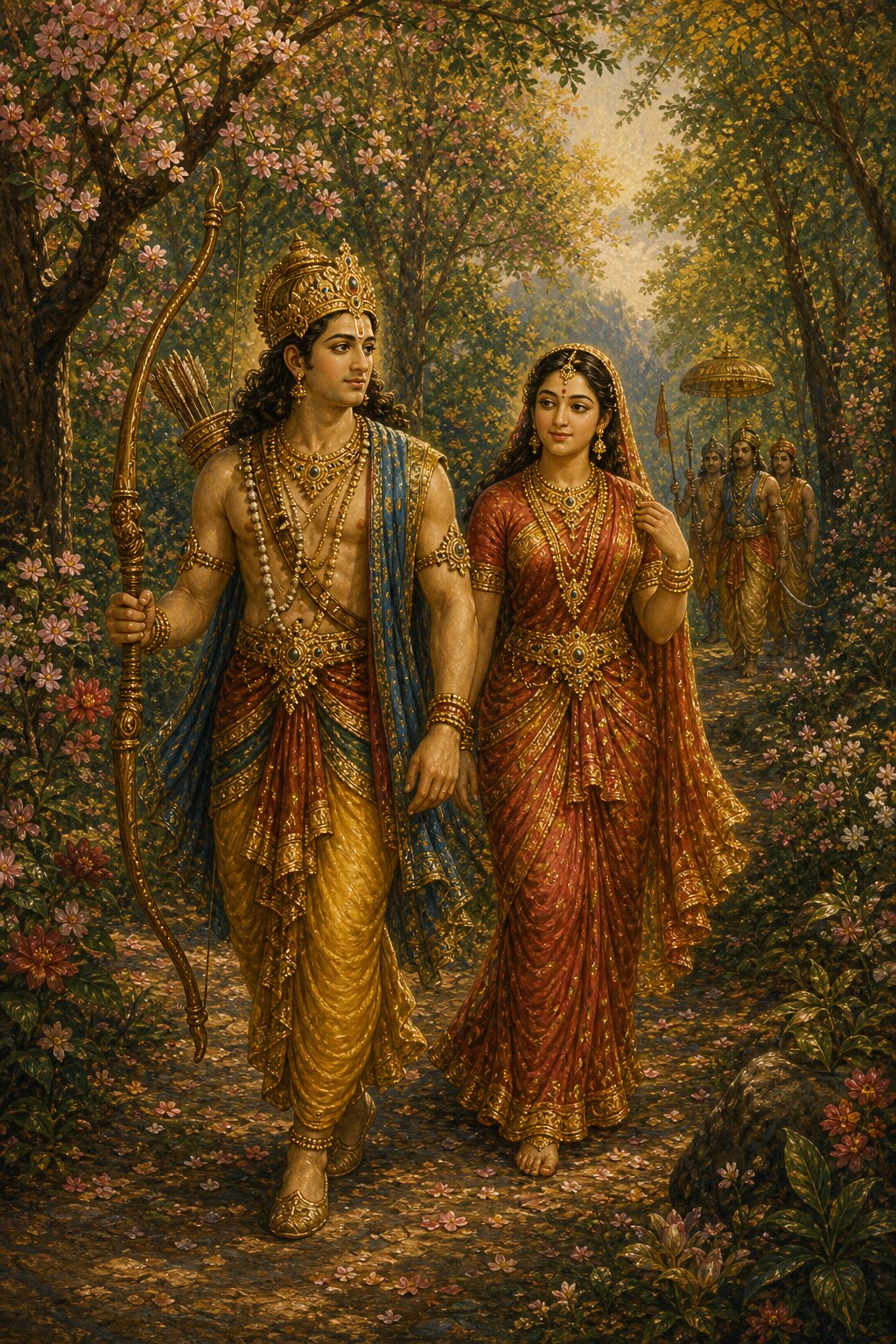
It was springtime. The branches of the forest were loaded with blossom, the air was steeped in the scent of flowers, and into that deep wood, one day, a royal party came down. King Bhadrayu had ridden out with his devoted wife Kirtimalini to wander the woods for sport. This was the same Bhadrayu you met before this story, the one on whom Lord Shiva had shown his grace by taking the form of a bull (rishabha). By the power of that very bull he had conquered his enemies on the field of battle and, a mighty prince, risen to the throne; and he had married the chaste and steadfast Kirtimalini, daughter of King Chandrangada and Queen Simantini. He rode that morning through a forest with nothing in it that could frighten him, carrying a bow he had never once had reason to doubt.
It was Nandishvara who opened this account. He had been telling Sanatkumara the stories of Shiva’s incarnations one after another, and as the telling of the Vaidyanath incarnation came to its close he said: listen now, dear one, for this one is pleasing to the good. The Lord appeared once more, and this time with Shiva at his side, in the form of a dvijeshvara (a lord of the twice-born), which is to say in the plain guise of a Brahmin. He came to test that same king’s steadfastness and his dharma.
The matter was this. Queen Kirtimalini gave shelter to all who came to her for refuge, and the king held to the same vow so completely that the word had gone out: if you are hunted, run to Bhadrayu. That was the vow to be tested. Lord Shiva, together with Parvati, devised a leela, a play, and set it running in the very forest where the two of them walked. Shiva and his consort took the form of a Brahmin and his wife, and out of maya, in sport, the two of them fashioned a tiger.
The Tiger, the Scream, and the Empty Arrows
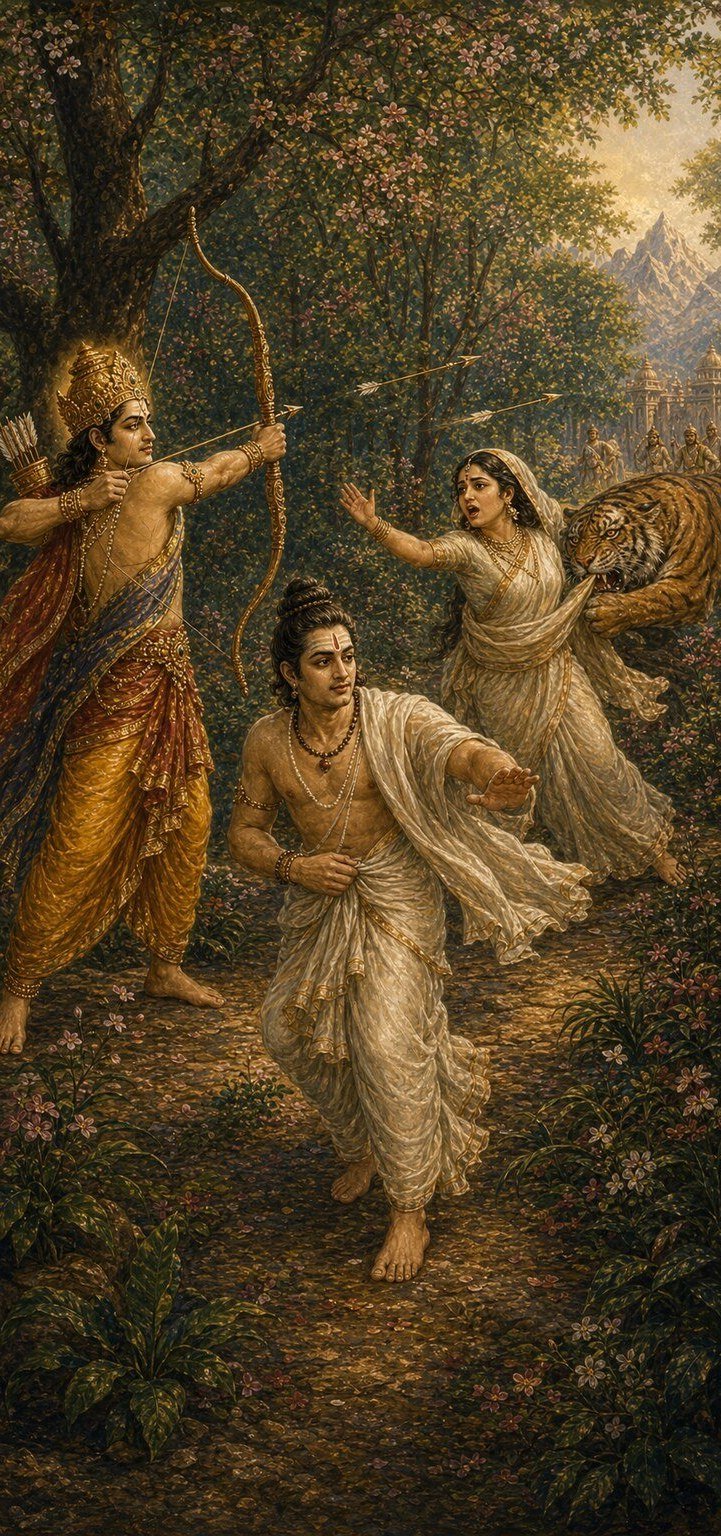
Now picture the scene. Not far ahead of where the king stood, along a forest path, a Brahmin and his wife come running, weeping and shouting, and close behind them, the tiger. Overcome with terror, the two reached the king and sought his protection, pleading: Great king, foremost of those who know what is right, save us, save us both. That tiger is rushing at us to devour us. This is a beast of prey like the god of death himself, a thing every living creature fears. You know what is right. Save the two of us before it is on us and we are its meal.
Hearing their piteous cries, the king of great heroism had no sooner lifted his bow than the tiger was upon them, and it seized the Brahmin’s wife. The poor woman wept and wailed as it took her, crying, Ah my lord, ah my husband, ah Shiva, ah teacher of all the worlds. Bhadrayu struck at the beast’s vital points with sharp arrows, and here is the wonder: those arrows did not so much as scratch it. It stood in that storm of iron the way a tall mountain stands in a shower, taking everything and feeling nothing. Then, dragging the Brahmin’s wife away by force, it turned and ran, and it was gone into the distance.
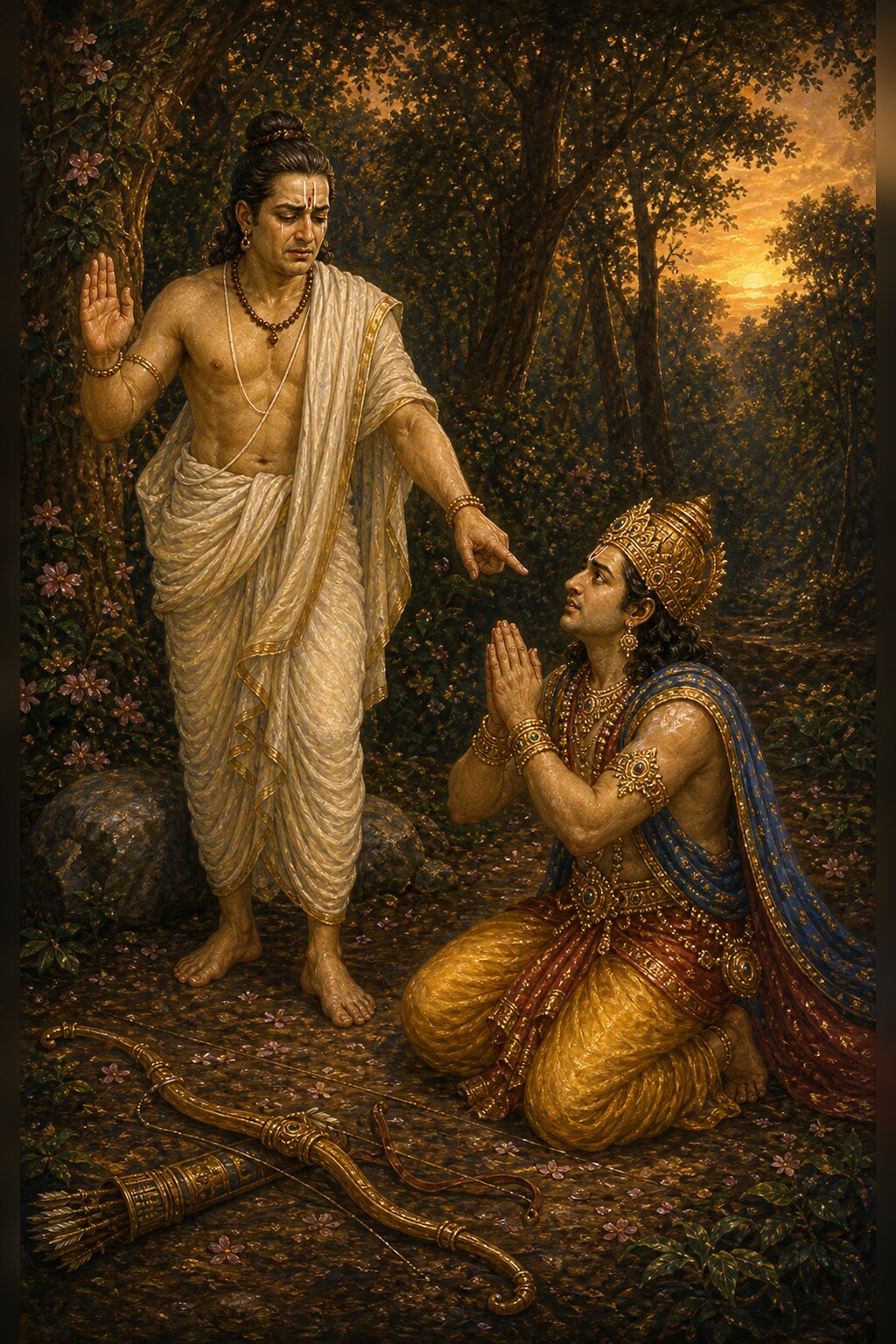
Seeing his wife carried off into the tiger’s mouth, the Brahmin was struck with grief and wept again and again, in the way of the world. When he had wept a long while, the Brahmin who was the Lord himself wielding his maya spoke to King Bhadrayu, and every word was aimed at the arrogance in him. King, where are those great weapons of yours? Where is that vast bow of yours that professes to guard the suffering? I had heard that you carry the strength of twelve thousand great elephants. What has become of it? What use was your sword, your conch, your mastery of the mantra-weapons? All of it has come to nothing, because a wild animal came at you and you could not meet it. To rescue others from danger is the highest duty of a kshatriya, a duty your family has practiced and handed down for generations, and today it is lost in you. What is your life for now? A righteous king protects the poor and the suffering who come to him for refuge, giving up his wealth and his life to do it. Better death than a life that protects no one. Better to swallow poison, better to walk into fire, than to stop protecting the oppressed and the helpless.
Hearing the Brahmin’s lament, and the scorn he heaped on his valor, the king sank into sorrow. He thought within himself: alas, today, by some reversal of fate, my valor is destroyed and my fame with it, and a great sin has come to sit on me. The dharma my family kept for generations lies smothered under me. Now my wealth, my kingdom, and my very lifespan will surely be lost as well. Then he found the one thing he still had to give. My life is dear to me, he thought, and I will hand it over and free this Brahmin of his grief. Having settled it, King Bhadrayu fell at the Brahmin’s feet and, steadying him, said: Brahmin, I am a base kshatriya with no strength left in me. Take pity. Great-minded one, be kind, and let go of your grief. I will give you whatever you ask. This kingdom, this queen, and this body of mine, all of it is yours to command. Tell me, what is the greatest thing you want?
The Brahmin’s Strange Demand
The Brahmin let the silence sit, and then he named it. King, what use is a mirror to a blind man? What will a man who lives by begging alms do with a house full of rooms? What use is a book to a fool? And what will a man do with wealth when his wife is gone? I have not had my fill of the pleasures of this life, and now the wife I had has been snatched out of my hands. So give me that pleasure another way. Give me this chief queen of yours. Let her be handed to me.
The king was stunned. Brahmin, he said, I can give away everything I hold, to the last stretch of earth in it. My kingdom, my horses, my elephants, this body of mine, ask and any of it is yours. My wife I cannot give. Not to you, not to anyone, not ever. The sin a man earns by going to another man’s wife cannot be washed off him by a hundred penances.
But the Brahmin would not be moved. Let it be the killing of a Brahmin, he said. Let it be the drinking of liquor. I have tapas (austerity) enough to burn either of them off me and feel nothing. Set beside those, what does union with another’s wife amount to? So give me this wife of yours. I want nothing else from you. And know this: it is your failure to protect the helpless that will drop you into hell, beyond all doubt.
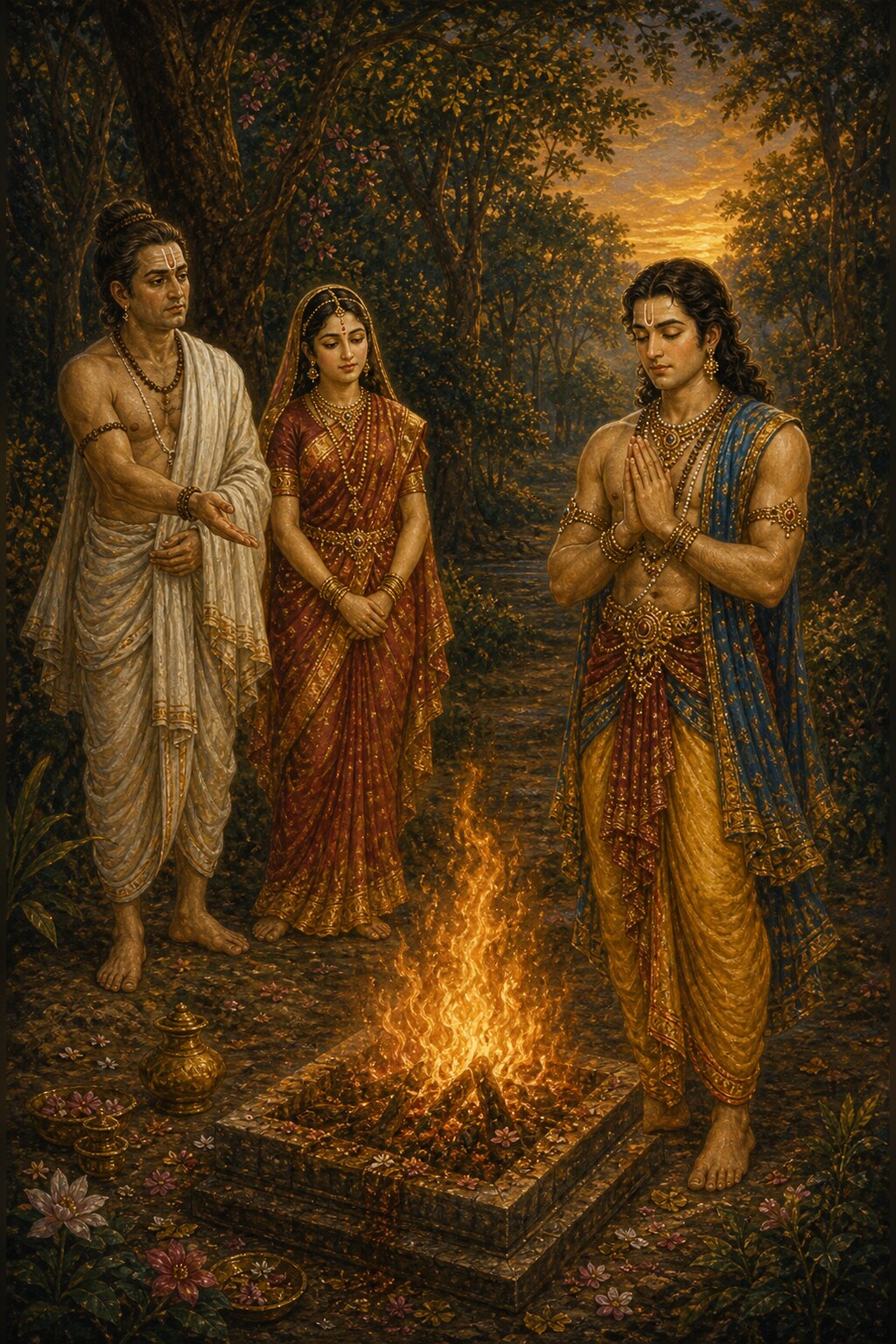
Now the scales of dharma began to tremble within the king, and the fear in him was real. To withhold protection is a sin, he reasoned, and under these circumstances the right course is to give her up. So: I will give my wife to this deserving Brahmin and be freed of the sin, and the moment it is done I will enter the fire, and then men will know what my name stood for. Having settled it, the king kindled a blazing fire. He called the Brahmin over, and he poured the water into his hands and gave him his wife, and once the water has fallen a gift cannot be called back. Then he bathed and made himself pure, bowed to the gods, walked three times around the fire, and, with his mind fixed on a single point, began to meditate on Lord Shiva.
Vishvanath at the Edge of the Fire
Seeing the king poised to fall into the fire, Lord Vishvanath, master of the worlds, appeared there all at once and stayed him. He had five faces and three eyes. On his head the crescent moon served as an ornament, and his matted locks, faintly golden, hung loose with the waves of Ganga breaking through them. Great serpents lay around his throat for necklaces. His radiance was as though ten million suns had risen together. In his hands were the trident, the khatvanga staff, the axe, a shield, a deer, the gesture of fearlessness (abhaya), the gesture of granting boons (varada), and the bow Pinaka. Flowers came down out of the open sky. Seated on the back of his bull, the blue-throated Lord Nilakantha stood revealed before the king’s own eyes, and Bhadrayu wept until his own tears covered him, the hair standing up along his arms and his throat closed tight; and then, lost in the joy of that darshan, he folded his hands and began to sing his praise.
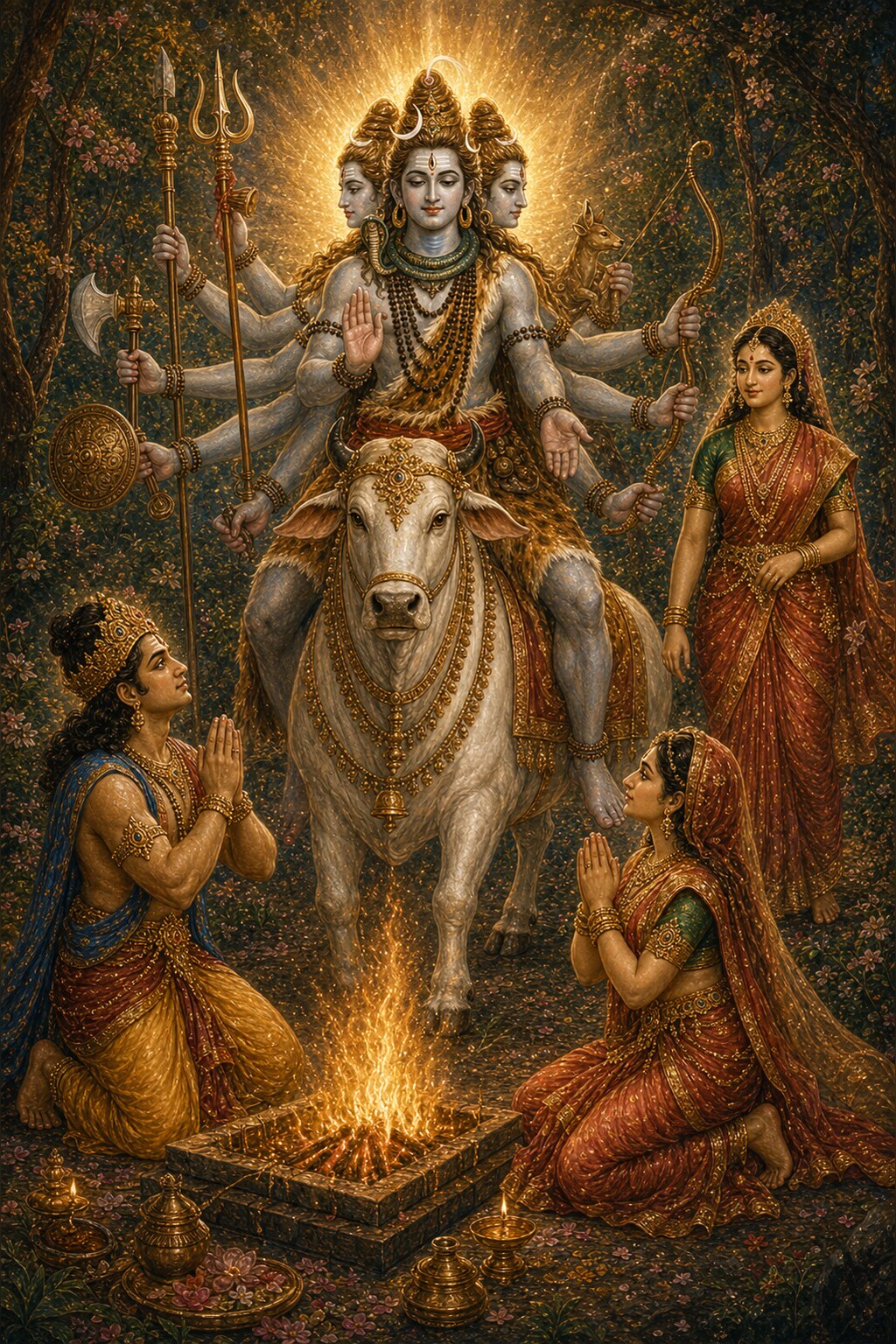
Pleased, along with Parvati, by the king’s hymn, Maheshvara, that storehouse of mercy, spoke. King, it is your devotion that has satisfied me, and it has satisfied me more than your dharma did. You have never given your thought to any other, and you have worshiped us always, without end, and hearing the sacred hymn you have offered we are greatly pleased. It was to test what you feel, and how far down it goes, that we came ourselves in the form of a Brahmin. She whom the tiger carried off was none other than Uma, the daughter of the mountain king, standing here beside me now. And the tiger, on whose body your arrows left no wound and could leave none, was a thing of maya, of illusion. It was only to see whether your courage would hold that we asked you for your wife. Name the boon you want, you and your queen both, and there is no doubt that I will grant it.
The king said: Lord, you are the Supreme Being himself. I have walked all my life under the sun of worldly existence, scorched the whole way, and today you have become visible to my own eyes. That alone is the great boon, and there is nothing past it that I want. You are the best of all who grant boons, and since out of pity you wish to grant me one, I will choose the way a devotee chooses from his lord. Great god, take my father Vajrabahu and his wife, take me, your servant at your feet, take my wife along with me, take Padmakar the merchant (vaishya) and his son Sunay, and make every one of us residents near you.
After this, Queen Kirtimalini bowed and, by her devotion, pleased Lord Shankara, and asked her boon, and it was a fine one. Supreme God, she said, my father Chandrangada and my mother Simantini: let those two stay near you, in joy, forever. Gauripati, who loves his devotees, was delighted and said, So be it; and having granted the husband and wife each the boon they had chosen, in a single moment he vanished.
The king, having received the grace of the trident-bearing Lord Shankara, enjoyed the pleasures he loved with Queen Kirtimalini, and his power went unopposed for as long as he held it. After ruling ten thousand years he handed the kingdom to his son and went into the presence of Shiva. And King Chandrangada and Queen Simantini, worshiping Mahadeva with devotion, reached his feet, exactly as their daughter had asked.
And hear, at the end, the fruit of this story, just as the text itself declares it. That was the Lord’s incarnation as Dvijeshvara, and it handed Bhadrayu a bliss with no bottom. Whoever recites this most sacred and secret account of Lord Shiva to the learned, or, with a purified mind, hears it himself, gains enjoyment and lordly fortune in this world, and in the end attains Lord Shiva. And whoever hears it day after day will not swerve from his duty, whatever the tiger in his path turns out to be.
Source: Shiva Purana (Gita Press, Sankshipta Shivapurananka), Shatarudra Samhita