On this page
In the story-assembly on Kailasa, Nandishvara spoke. Great sage, hear now the tale of Shambhu’s descent as the Kirata, the hunter, in which the lord who carries the Pinaka bow killed the demon Muka and, well pleased, granted Arjuna a boon. The story begins in Dvaitavana. The Pandavas had lost everything across a dice board and walked out of a kingdom into the forest, and there they passed their days with Draupadi, their one resource the cooking pot the Sun had given them, and from it they fed every guest who came.
The Test at Dvaitavana
Away in his palace, Duryodhana could not bear even this much contentment in his cousins. He worked on the great sage Durvasa until the rishi agreed to call on the Pandavas. Durvasa arrived at Dvaitavana with ten thousand disciples behind him and asked for a meal of his own choosing. The Pandavas accepted the request and sent the whole company down to the water to bathe, as a host does while the food is being made ready, and only then looked into the pot and understood what had been done to them. There was no food left at all. The danger was so sharp that thoughts of surrendering their lives began to stir in their hearts. Then Draupadi called Krishna to mind. He came at once, accepted a single leaf of greens and ate it, and in that instant every one of the ascetics was satisfied. Durvasa understood that his disciples had no room left for a meal, and he left from there without another word.
Then Krishna told them to turn now to the worship of Shiva, and he spoke out of his own history. On the instruction of the noble Upamanyu he had once propitiated Shiva for seven months on the mountain Batuka, until the lord stood before him and filled every desire he had. He served Shiva still. Let them do the same. Soon after, Vyasa arrived as well, ash on his forehead, rudraksha on him, his hair matted, the five-syllabled mantra moving on his lips, and he said that Shiva is the destroyer of every sorrow, that devotion pleases him in a very short while, and that he grants enjoyment in this world and even moksha, liberation, in the next. Then he weighed the five brothers against one another and named Arjuna the one fit for this worship. For now, he said, let Arjuna first recite the Shakra-vidya, the lore of Indra, with steady resolve. Indra would test him first, then, satisfied, would clear away every obstacle and secure for him Shiva’s supreme mantra. So saying, Vyasa gave Arjuna that lore, which Arjuna received after bathing and turning his face toward the east. Then, having explained the rite for worshiping an earthen Shiva-linga, the sage said, Partha, go now to Mount Indrakila and perform austerities on the bank of the Jahnavi, the Ganga, and this lore will stay unseen and forever work for your good. Blessing the Pandavas to hold firm to dharma, Vyasa vanished. The moment Arjuna took up the Shiva-mantra, a matchless radiance filled him, so bright that his brothers grew certain of victory. Arjuna asked leave of his four brothers and of Draupadi, who held her tears where they were and told him to do exactly as Vyasa had instructed. The pain of parting touched them all, and still they saw the greatness of the errand and gave their consent.
Austerity on Indrakila
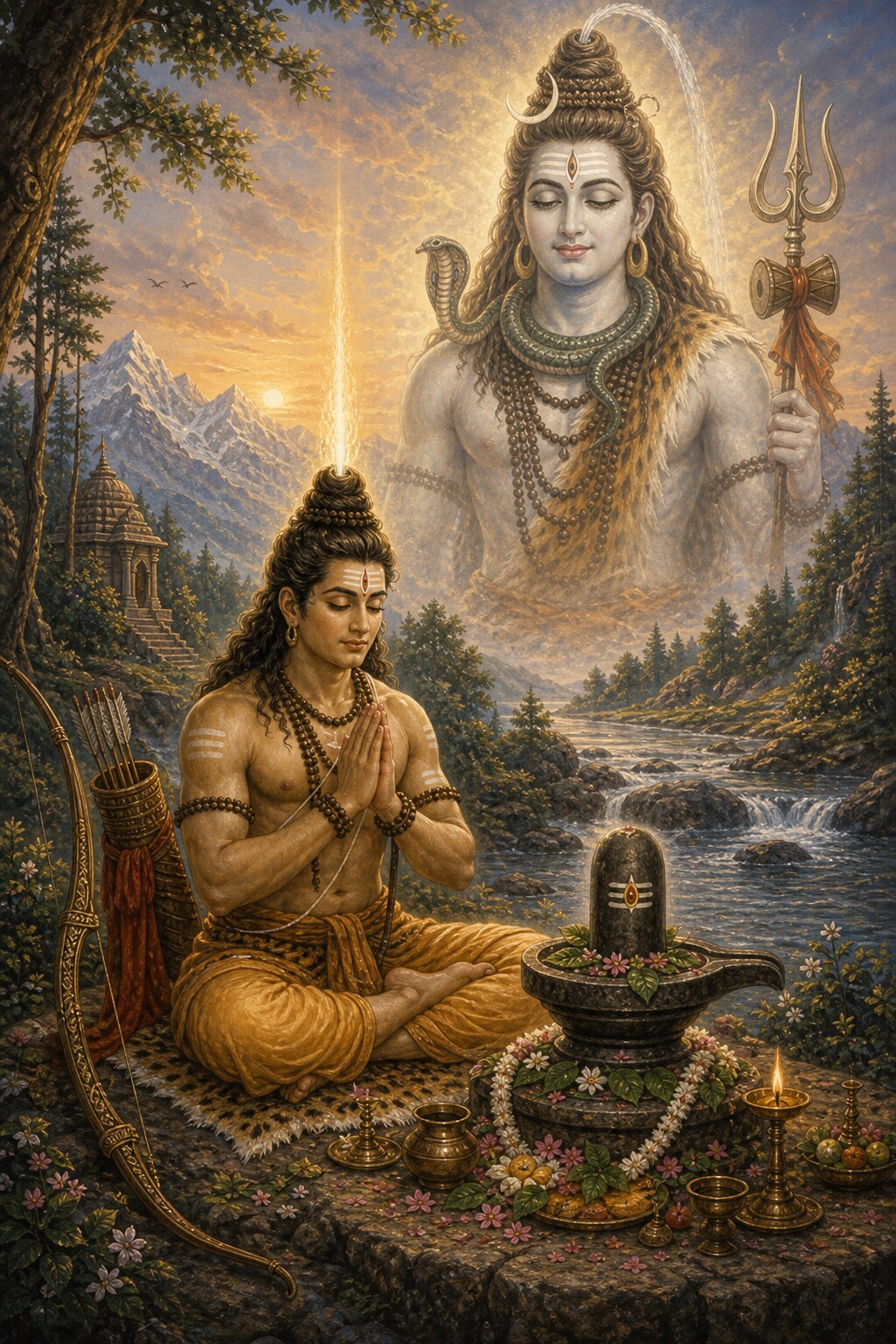
Arjuna crossed impassable mountains to reach Indrakila, and near the Ganga he found a place lovelier than heaven itself, a fine spot set about with groves of ashoka. He bathed, bowed to his guru, dressed as the teaching he had received prescribed, drew his senses inward, settled onto his seat, and sat. With his own hands he shaped a fine, well-proportioned earthen Shiva-linga and before it began to meditate on Shankara, that mass of pure radiance. Bathing at the three junctures of the day, worshiping again and again, his devotion grew so single-pointed that a flame of light began to rise from the crown of his head and stand in the air above him.
Indra’s spies, unnerved, reported to the king of the gods. Lord of the devas, some man is performing austerities in the forest, and we cannot tell whether he is a god, a rishi, the Sun, or Fire itself. Indra guessed at once that this was the resolve of his own son, Arjuna. He went to test him in the guise of an elderly celibate brahmana student. Arjuna honored the guest, praised him, and asked the reason for his welcome arrival. The student asked why a man would spend the prime of his youth on penance, and called it useless, since Indra hands out happiness and salvation lies past anything Indra has to give. Arjuna held his anger in and answered that he did this on the word of Vyasa, with no kingdom and no salvation in view. Indra was delighted, and he let his own form be seen, and Arjuna stood there ashamed. Told to choose any boon, Arjuna asked for victory, and Indra named the men in his way without softening it: Duryodhana’s people, Drona, Bhishma, Karna, and Ashvatthama, who carried a portion of Rudra in him. Then Indra told Arjuna the mantra of Lord Shankara, commanded him to set the Indra-lore down and recite this instead, ordered his attendants to protect him, and said, gentle one, never rule your kingdom with negligence. Let the seeker keep his patience, for Shiva himself is the protector, and he grants wealth and moksha alike, with an equal hand. Having said this, the king of the gods returned to his palace.
The Boar, the Hunter, and Two Arrows
Now Arjuna began fierce austerity. He performed the ablution and the nyasa as the shastras prescribe, then stood on the sole of a single foot, fixed one eye upon the sun, and recited the five-syllable mantra. Alarmed by that radiance, the gods came to Shiva and said, Lord of all, whatever he wants, why not simply give it to him. The great lord laughed and said, gods, go back, we will accomplish your errand in every way.
At that very moment a demon named Muka arrived there in the form of a boar, wielding maya. Understand this: the cunning Duryodhana had sent him against Arjuna. Tearing up mountain peaks, snapping trees, making all manner of noises, the beast came forward along that same path. Arjuna called Shiva’s lotus feet to mind and began to reason. Who is this, and where has he come from? He is ruthless in his actions, and he is certainly coming to harm me. The one whose sight gladdens the heart is a well-wisher, and the one whose mere appearance throws the heart into distress is an enemy. Eyes too are said to be of four kinds: bright, tender, slanted, and red. The eye is bright when friends meet, tender at the sight of a son, slanted in the presence of the beloved, and red at the sight of an enemy. The instant I saw this creature my senses grew clouded, so it deserves to be killed, and my Shiva-guru’s own command is that whoever comes bent on killing should be killed without a second thought. Arjuna fitted an arrow to his bow and stood ready.
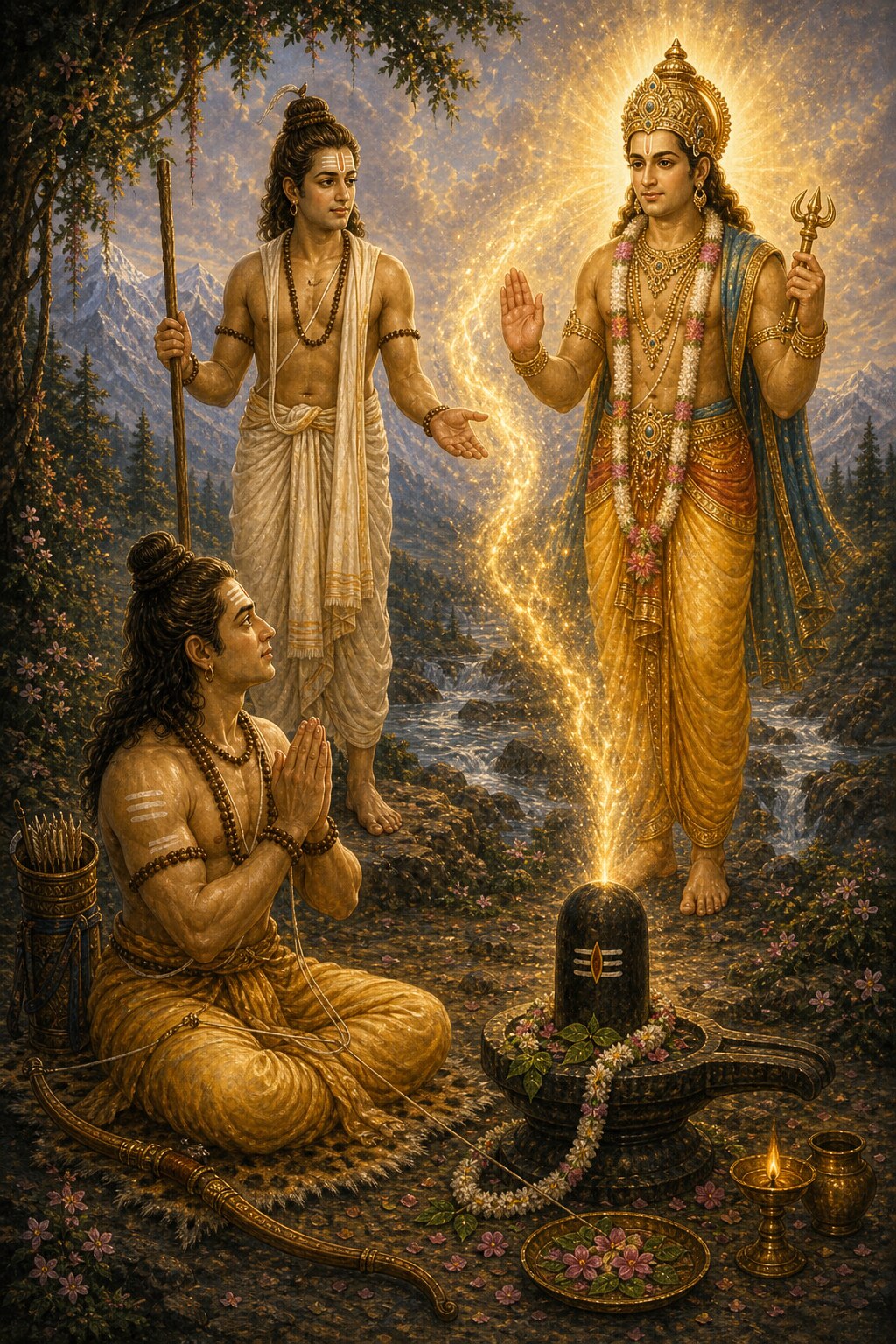
Meanwhile Shankara, tender toward his devotees, came in person to test that devotion, to guard Arjuna, and to destroy the demon. Shiva had taken the form of a king of the Bhillas, the forest hunters: his loincloth cinched tight, a banner of cloth-scraps knotted about him, white stripes across his limbs, a full quiver on his back, bow and arrows in hand, and a troop of his ganas beside him in the same hunter’s dress. The commander of that troop set up a hunting call, and just then the boar’s snarl rang through all ten directions, and the very mountains shuddered with the sound. Startled, Arjuna began to wonder whether this might be Lord Shiva himself, come to do him good. Krishna had said as much, and Vyasa, and the gods, that Shiva is the doer of blessings. Those who worship him with their whole being never meet sorrow even in a dream, he thought. The hardship of a test only purifies a devotee the way fire purifies gold. He turns poison to nectar and nectar to poison, A devotee holds his mind steady through all of it, rich or ruined, safe or dying, praised or censured. By worshiping Shiva I will win the highest happiness from him alone.
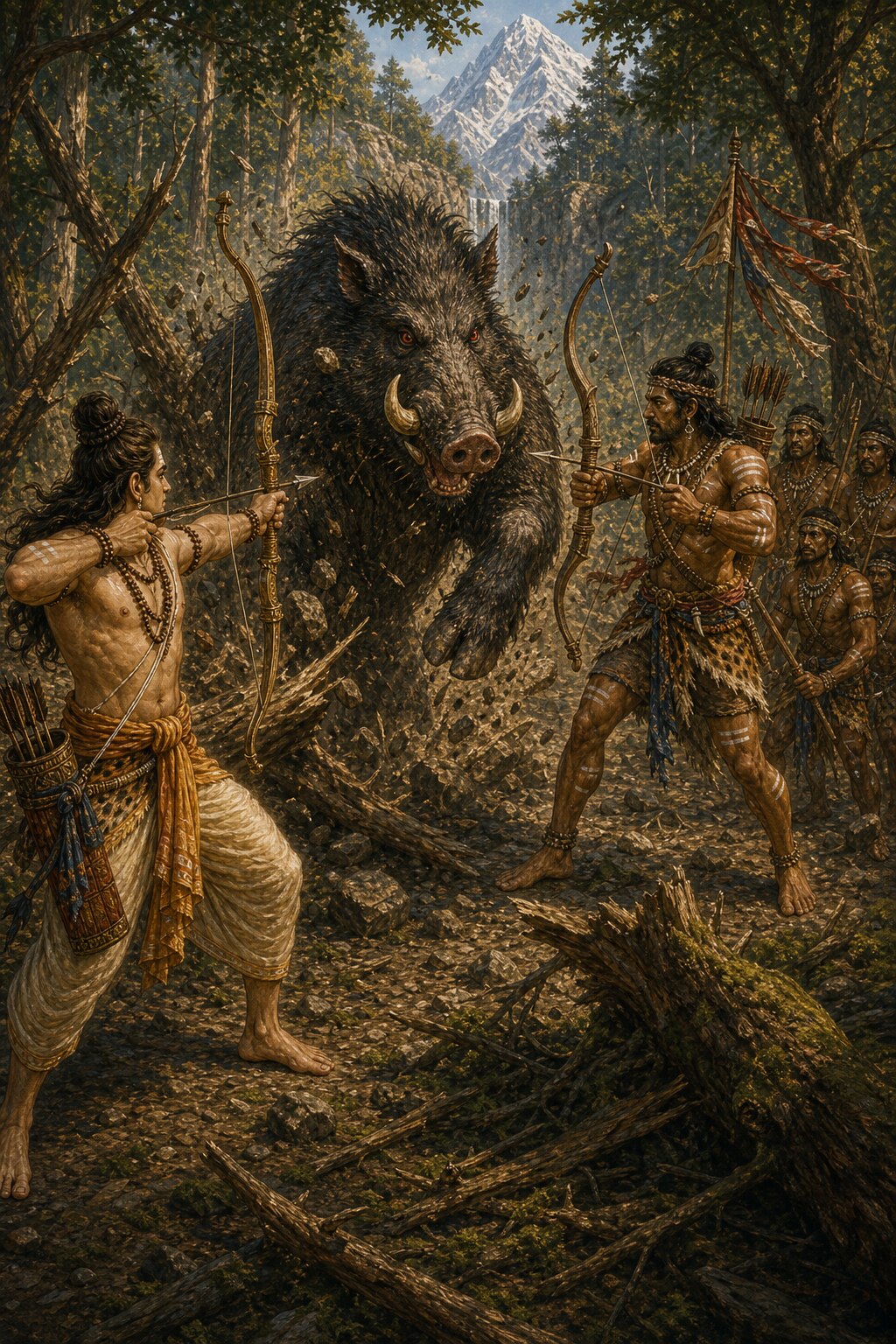
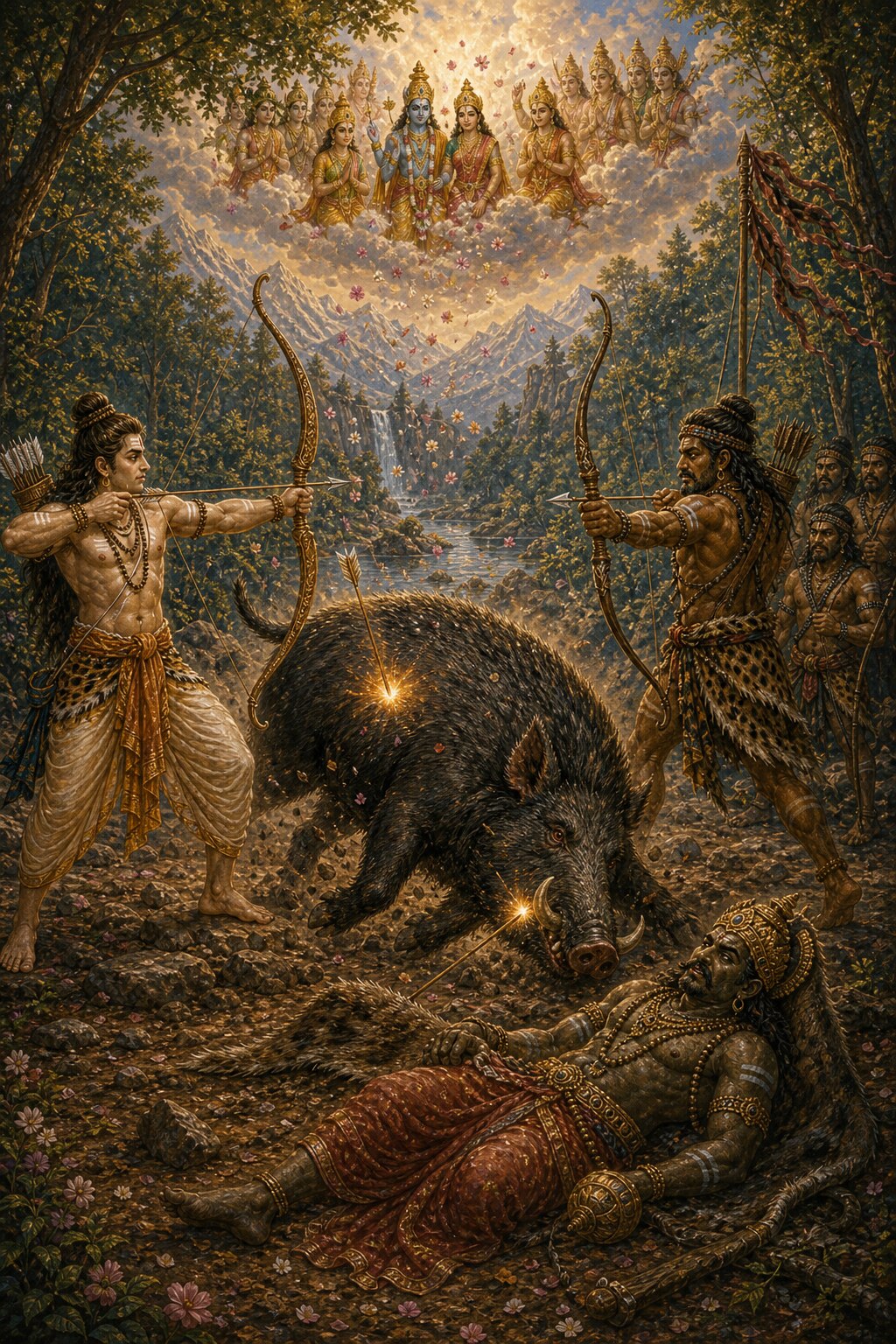
Arjuna was still turning these thoughts over when the boar came straight into his arrow’s line, and behind it he could see Shiva as well, closing on it to keep him safe. Between the two of them the beast rushed forward and then halted, and it loomed there like some strange peak. In the same instant both loosed arrows at it. Shiva aimed at the tail, Arjuna at the mouth. Shiva’s arrow entered through the tail, emerged from the mouth, and vanished into the earth; Arjuna’s arrow passed out through the hind part and fell to one side. The demon died in that instant and collapsed, and his cruel true form was laid bare. The gods raised shouts of victory, bowed low, and rained down flowers; Shiva was glad at the sight of what had been hiding inside the boar, and Arjuna felt a great happiness. He said to himself, this is a huge Daitya; he wore that shape and came here to kill me, and it was Shiva who protected me, and Shiva who gave me the wit to see it. Arjuna sang the name of Shiva aloud and, bowing again and again, offered his praise.
Recognition and the Pashupata
Shiva sent one of his attendants across to fetch the arrow, and Arjuna reached it in the same moment. Arjuna rebuked him and took up his own shaft, and the gana said, why are you taking this arrow? The arrow is mine. Leave it off. Arjuna answered that he had loosed it a moment ago and that his own name was cut along the shaft in many lines. The gana laughed at the sage in front of him. That is my master’s arrow in your hand, he said. He shot to save you, he killed your enemy for you, and you have kept the shaft; penance is ruined by theft. Arjuna answered in measured words. I am a king and you are a thief; I fight men of my own strength, never base ones. Let your master come and fight me for it. No lion is frightened of a jackal. The Kirata heard the report, delighted, and sent word back to work the softest place in a man: his brothers were in distress, his wife grief-stricken, his kingdom slipping away, and all of it hung on one arrow. It was said only to test how firm he stood. Arjuna answered that his brothers could stay distressed and his every skill come to nothing before he handed over what was his. So Shankara himself, in his Kirata’s disguise, closed with his own devotee. The ganas came at him with sharp weapons; he split their arrows and drove them off, and when Shiva called them back not one answered. The two fought on alone until the earth and its oceans shook. Shiva broke his weapons, cut away his armor, and left him standing in his bare body, and Arjuna, frightened, remembered Shiva and fought on, into mid-air and back. Then Arjuna came back to the ground, called the lotus feet of Shiva to mind, took hold of those very feet, and whirled the lord of the worlds off the earth. Shiva laughed, for all of it was his own doing, arranged for a devotee. Arjuna’s blows kept landing on the hunter’s body, the very blows that would later be counted as worship of Mahadeva. Then Shiva let his own form be seen, the form Vyasa had told him to meditate upon, and Arjuna stood stunned. This is Shiva, the one I chose as my lord, and see what I have done; his maya deludes even those who deal in maya. He joined his palms and spoke with devotion. Shambhu, you are the most excellent of masters; how can we describe your compassion? Forgive my fault; you hid your own form and let me fight you, my own master. Shiva told him to set the sorrow down, called him a great devotee, said the whole thing had been a test, and lifted him with his own hands. And Arjuna began his hymn of praise. God of gods, dweller on Kailasa, five-faced supreme lord, Sadashiva, before you we bow our head. Wearer of matted locks, three-eyed one, blue-throated one, bull-bannered lord who holds Girija at your left side, to you we bow again and again. With the damaru drum, the skull, the trident, and the Pinaka bow in your hands, your sacred form fair as camphor, a tiger’s skin across your body, bearer of the Ganga, chief of the ganas whom the ganas serve, to you we bow. And we bow also to that self of yours which, in grace toward us, put on this Kirata’s guise. Whatever is seen in the world is only your own radiance. As the raindrops cannot be counted, so your virtues are beyond number, and the Vedas themselves cannot count them; what count, then, are we? You are the master, we are the servant; be gracious to us.
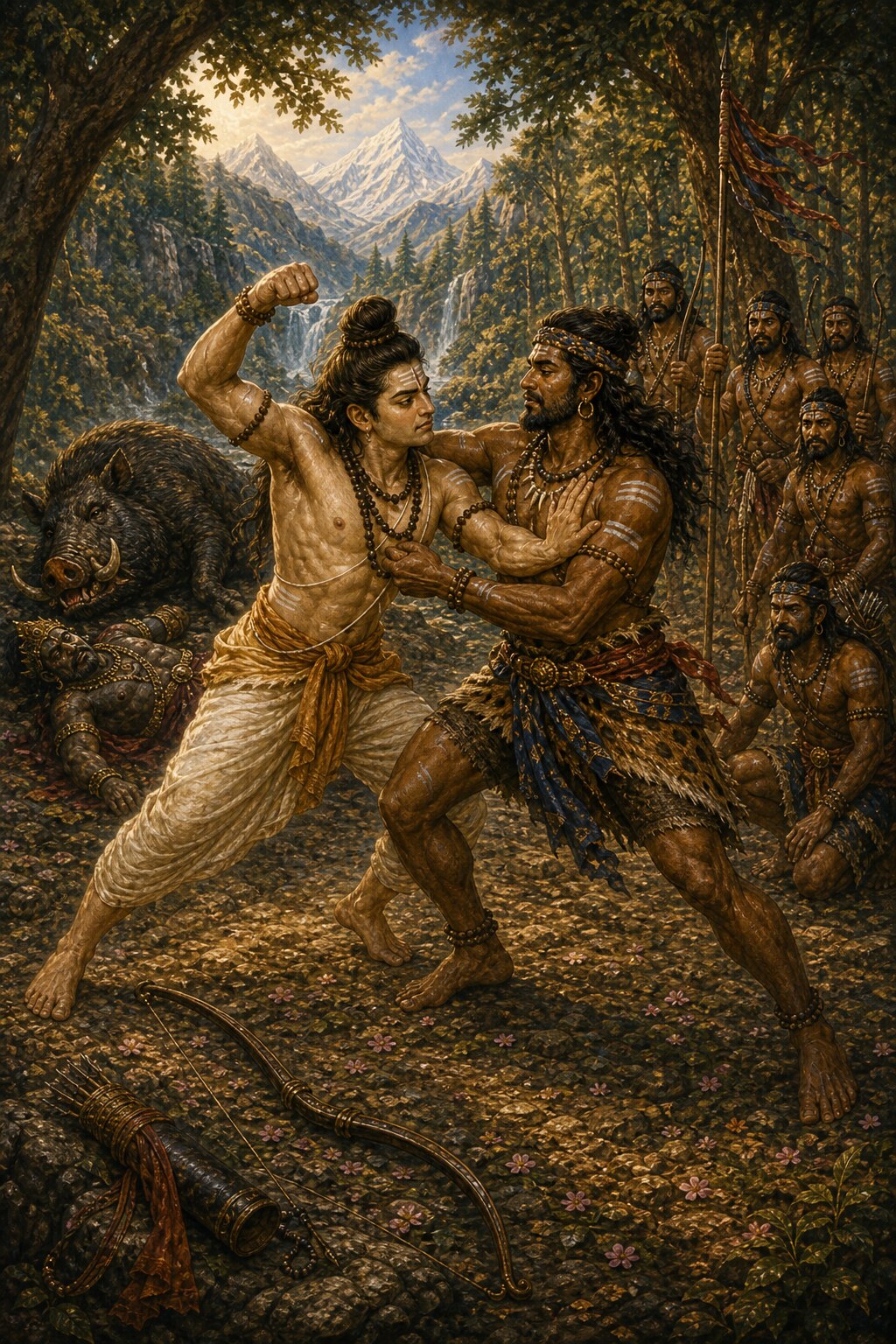
Hearing the hymn, Shankara laughed and said, child, we are supremely pleased; now ask your boon. The blows and strikes you dealt us we have accepted as our own worship. All of this happened by our will alone; where is any fault of yours in it? What has come to pass has come out well, for the sake of your fame and the founding of your kingdom among your enemies. Set aside your worry, and ask for whatever you long for; we have nothing at all that we would withhold from you. Arjuna joined his palms and bent his head and said in a voice thick with feeling, all-pervading lord, you are the inner ruler of every heart; what is there for us to say? The suffering my enemies caused has been destroyed by your darshan itself. Now grant me such grace that I may win the highest accomplishment in this world.
Looking at him standing so, Shiva saw the foremost of his devotees, and he was glad past measure, and the great lord gave Arjuna his weapon called the Pashupata, forever unconquerable by every living being. By wielding this you will become invincible against all your enemies; go, and win your victory. We will speak to Krishna as well, and he will help you, for Krishna is our own self, our devotee, the one who carries out our work. Bharata, by our power enjoy a kingdom free of every thorn, and see to it always that your brother Yudhishthira performs the works of dharma. So saying, Shankara laid his lotus hand on Arjuna’s head, received his worship, and vanished.
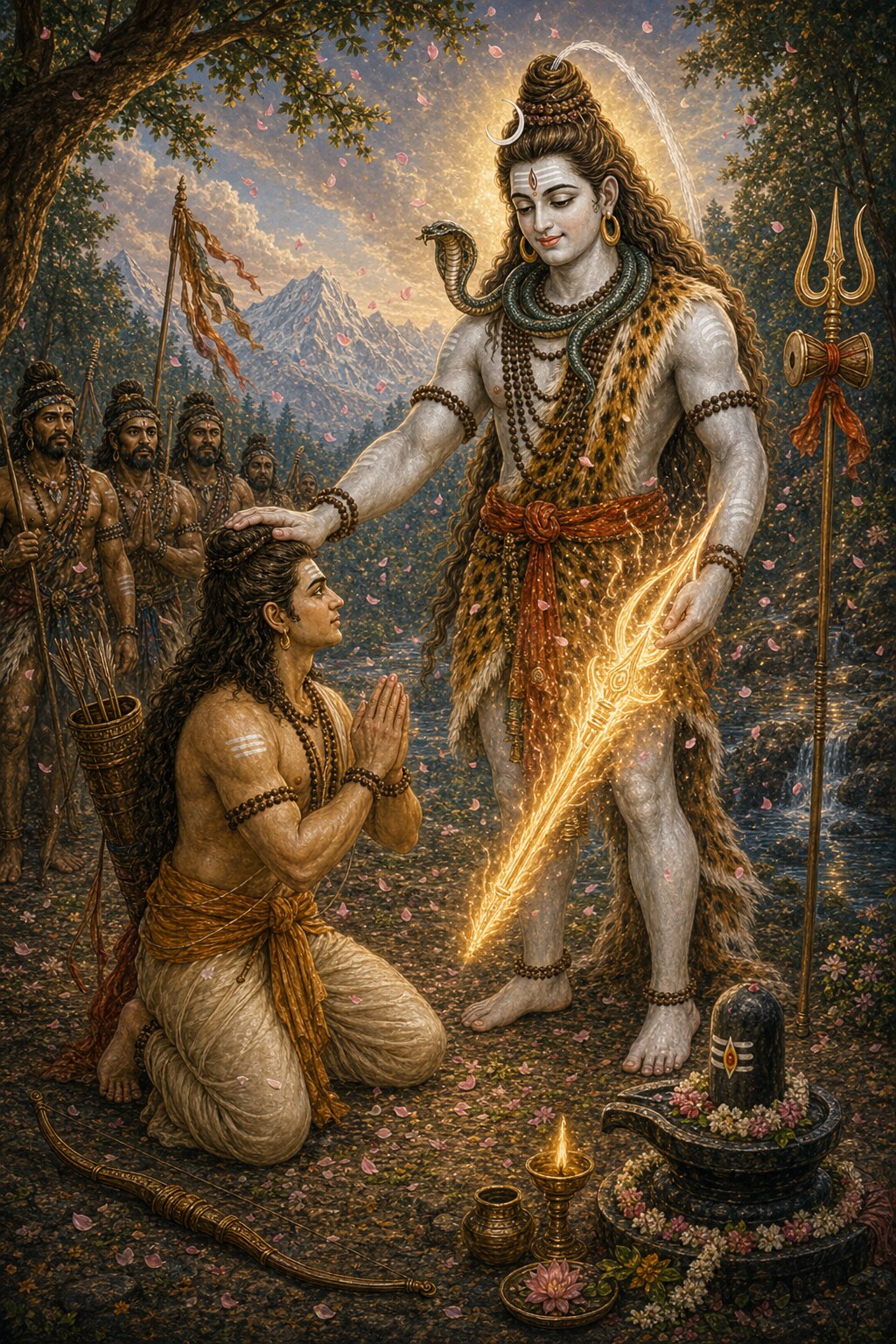
With the boon and the weapon won, Arjuna returned to the hermitage, holding his chief preceptor and Shiva in mind the whole way. His brothers felt a joy as though life had come back into dead bodies; Draupadi, faithful to her vows, was overjoyed as well, and none of them could hear enough of the story, however long the telling ran. In that same hour a rain of flowers and sandal paste began to fall on the hermitage, honoring the Pandavas and Arjuna, the enemy of the boar. They bowed to Shiva, the doer of blessings, and, knowing that the term set for them had run its course, made up their minds for victory. When the news reached him, Krishna too came to meet them, glad, and said, this is exactly why we told you that Shankara is the destroyer of every affliction. We serve him without fail; you should do the same.
Nandishvara drew the story to a close. Sage, whoever hears or tells this Kirata-charita, this deed of the hunter, sees all his desires fulfilled. Let us say one thing plainly: in the familiar telling of the Mahabharata, the quarrel over the kill breaks out directly between Arjuna and the Kirata, yet the Shiva Purana holds that Muka was sent by Duryodhana and that the first exchange of words was with Shiva’s messenger, over the arrow that killed the boar.
Source: Shiva Purana (Gita Press, abridged Shiva Purana edition), Shatarudra Samhita
The same story, there too
- Chapter 12 · Pilgrimage, Arjuna’s Austerity, the Kirata (the Weapon from Shiva), Indra’s World
Mahabharata (the Vana Parva): Arjuna’s austerity and the Pashupata from Shiva in the form of the Kirata