On this page
The Chariot Boarded, and Ayodhya Gives Chase
The chariot stood waiting in the courtyard, and the three who were about to climb into it had one duty left inside the palace. Rama, Sita, and Lakshmana came before the king with their palms joined, touched his feet, and walked around him in the sunwise circle that a child owes a father, and the whole time their hearts were sinking, because there was nothing any of them could do for the two old people they were leaving. Rama took his leave. Grief had him near senseless, and still he went with Sita to Kausalya and bowed to her, and Lakshmana, a step behind his brother, bowed to Kausalya first and only then went to his own mother and clasped the feet of Sumitra. She bent over him as he bowed and breathed in the scent of his hair, the way a mother marks a child as hers, and she was weeping when she spoke. “You love your kinsman past all measure, and so I have let you go and live in the forest with your eldest brother. Only do not grow careless, my son, in the service of Rama as you walk beside him. In hardship or in plenty he is the one refuge you have. This is the rule the good have kept in the world since it began: the younger brother lives inside the will of the elder.
“To give, to consecrate oneself for the great rites, and to lay the body down on a battlefield: that has been the conduct of this house of Raghu for all time, and it is yours.” Then she turned to Rama, whose mind was fixed and whom everyone loved, and said to him again and again, “Go now. Go. May all be well with you.” And to Lakshmana she gave the sentence that a whole exile could be lived inside. “Take Rama for Dasharatha your father. Look on Sita, the daughter of Janaka, as you look on me, your mother. Count the forest as Ayodhya, your home. And go, dear son, in gladness.” Sumantra had been standing by with his hands joined, the king’s charioteer and counselor, a man who knew how a servant speaks to a prince, and he addressed Rama now the way Matali, who drives the chariot of Indra, would address Indra himself. “Mount the chariot, prince of great splendor, and may all be well with you. Wherever you tell me to go, I will take you there at speed. And know this: the fourteen years in the forest that the queen has laid on you are to be counted as beginning from this very day.”
Sita climbed in first. She had dressed herself in the garments and the ornaments her father-in-law had given her, and her mind was glad as she mounted that chariot, which shone like the sun. Behind her seat the two brothers stowed what the king had provided: the clothing and jewels for Sita, chosen with her years in the forest counted out one by one, and the sets of weapons and the pieces of armor he had given them, and the basket sheathed in leather, and the spade. When it was secured, Rama and Lakshmana climbed up onto that gold-mounted chariot that blazed like fire. Sumantra looked back once, saw the three of them seated, Sita the third, and gave the horses their heads. They were fine animals, prized in the royal stables, and they went like the wind.
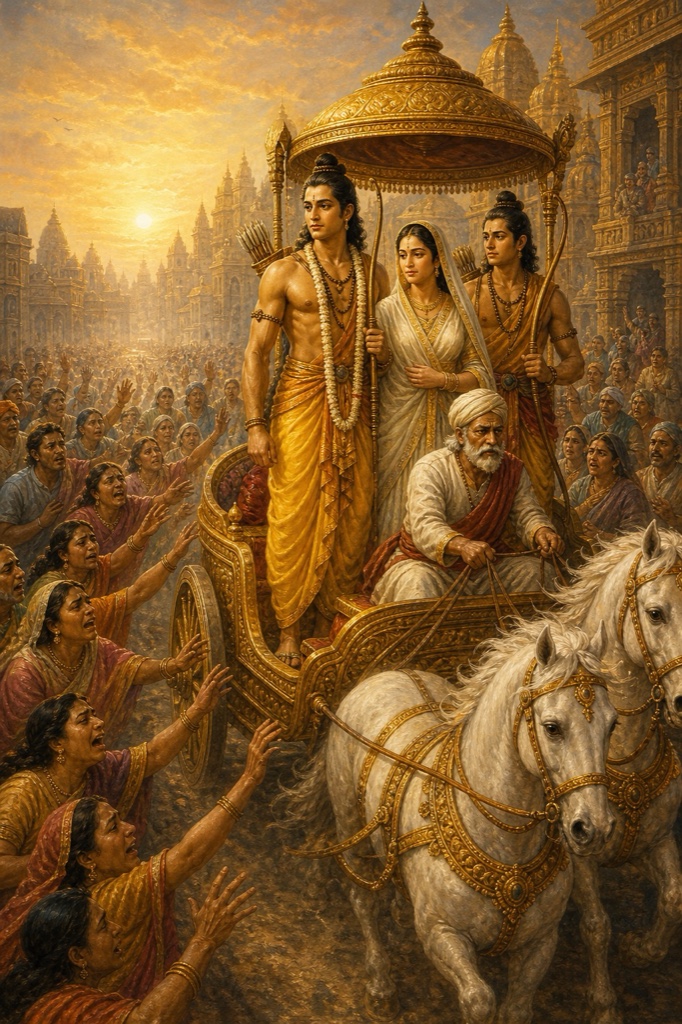
Rama was leaving for the great forest of Dandaka, and for a long time, and the moment the chariot moved the city seemed to lose consciousness. The army fainted where it stood, and the horses and elephants with it, and so did the country people who had come into Ayodhya that day from the outlying districts. The elephants in rut trumpeted in their frenzy, the ornaments on the horses jangled, and the whole city rang with a noise that had no shape. Then it ran. Young and old together, the stricken people of Ayodhya rushed after Rama the way someone scorched by the sun rushes toward water. They caught hold of the sides and the back of the chariot and hung there with their faces turned up to him, wet with tears, and all of them shouted at the charioteer at once. “Rein in the horses, charioteer. Go slowly, slowly. Let us look at Rama’s face, which we will find so hard to see from now on.
“The heart of Kausalya must be made of iron, that it does not split in two when a son like hers, the image of a child of the gods, goes away to the forest.” They looked at Sita and said that the princess of Videha had done what a wife should do, following her husband like his own shadow, holding to her duty and refusing to be parted from him any more than sunlight can be parted from Mount Meru. And to Lakshmana they called out, “You are the one who has won, Lakshmana. You will serve your godlike brother, who never speaks to anyone except gently. This is your great wisdom, this is your great good fortune, and this is the road to heaven for you, that you go with Rama.” Saying it, they could not hold their tears, and they walked on behind the man they loved, the delight of the house of Ikshvaku.
Inside the palace the king could not stay where he had been left. Ringed by his queens, every one of them wretched, and sick in his own heart, Dasharatha came out through the doors saying, “I will see my beloved son.” Ahead of him went a great crying of women, like the trumpeting of she-elephants when the bull that leads the herd has been bound in chains. And the father of Rama, the glorious king of the line of Kakutstha, looked at that hour as lightless as the full moon when Rahu swallows it in eclipse. Rama’s composure was past anything a mind can imagine. He told the charioteer, “Drive fast.” So Rama said “Go on,” and the people at the wheels said “Stop,” and Sumantra, pressed from both sides on the road, could do neither the one thing nor the other.
The dust that rose under the wheels as Rama drove out of the city toward the forest was laid again by the tears that fell from the eyes of the citizens. They wept and they wailed and in the end they dropped where they were, unconscious, and the tears of the women, in their agony at losing sight of him, fell like drops of water from lotuses shaken by fish stirring underneath. The king looked at his city, which had one mind left in it, and he dropped where he stood, like a tree cut at the root; and at the sight of him in that agony a cry went up from the men behind Rama, some of them calling out, “Oh, Rama,” and others, “Oh, Rama’s mother.” Then Rama looked back, and saw the king behind him on the road, bewildered and lost, and his own mother Kausalya coming after on foot. He was bound by the cord of duty, and he could not look openly at them any more than a foal caught in a snare can look at its mother. They were people who should have been riding, who had never been made for suffering and had always been given comfort, and here they were walking in the dust after him. He said to the charioteer, “Drive fast,” and the words came out of him the way an elephant moves when the goad is in its neck: he could not turn his head to look, because he could not bear to see his father and mother on foot.
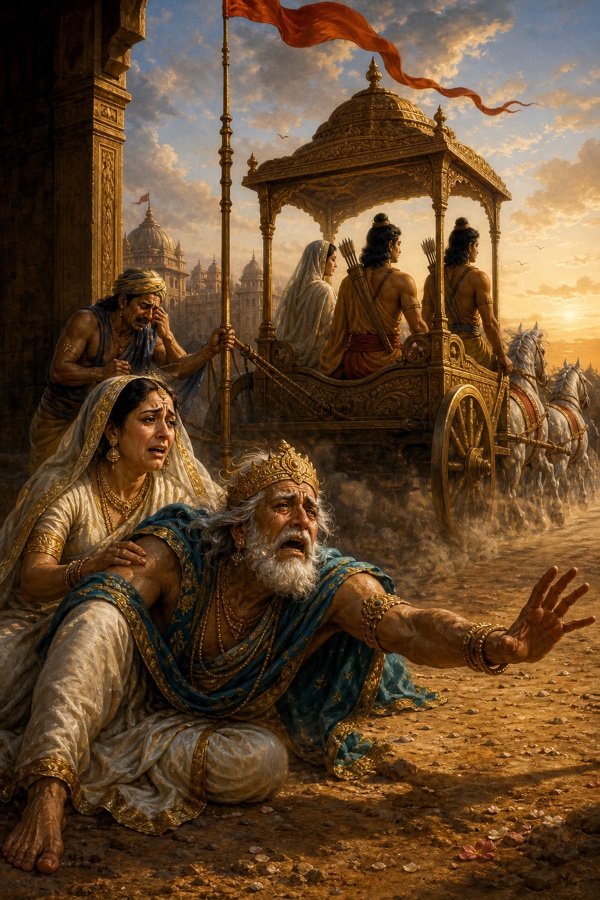
Kausalya ran behind the chariot as a cow runs to her calf when the calf has been tied at the stall and she is coming home from pasture. She was calling, “Rama! O Rama! O Sita! O Lakshmana!” and the tears poured down her face for the three of them, and her running, in that state, looked almost like dancing, and Rama turned again and again to look at his mother. The king was shouting “Stop!” and Rama was calling “Go on! Go on!” and Sumantra’s mind was caught between the two the way a body would be caught between two turning wheels. Rama leaned toward him. “When the king reproaches you afterward for not obeying him, tell him you did not hear. To draw out this agony, watching my old parents in this state, would be the worst harm of all.” Sumantra took Rama at his word, took leave of the crowd that was clinging to the chariot, and drove the horses, already moving, harder still. The king’s men, who could not keep up, walked around Rama in their minds, in the circle of respect, and turned their bodies back toward the king, though their hearts went on to the forest with him; the common people did not turn back even in body, because their hearts had gone too far ahead to be recalled. The ministers came to Dasharatha and said, “One should not follow far after a man one hopes to see come home.” The king heard them. He was a man of every virtue, and he was wretched, his whole body running with sweat and his face utterly cast down, and he stopped there in the road with his wives around him and stood looking after his son.
The gist: The three take leave of the mothers and board the chariot, and all Ayodhya runs after it, clinging to its sides. Rama orders the charioteer to drive fast, so that his parents’ agony will not be drawn out by the sight of him, and tells Sumantra to say afterward that he did not hear the king. Dasharatha stops at last on the road and stands gazing after his son.
The Women’s Lament, and a World Gone Empty
Rama drove out through the gate of Ayodhya with his palms joined, and the moment he was gone a great cry broke from the women’s quarters of the palace, a sound with nothing held back in it. “Where is he going, the lord who was the refuge and the protector of us, the helpless, the weak, the forlorn? Where is he going, the prince to whom joy and sorrow made no difference, who did not lose his temper even when he was slandered, who never said the word that provokes and who calmed everyone who was angry? Where is Rama going, that great soul, blazing with glory, who treated every one of us exactly as he treated his own mother Kausalya? Where is Rama going, who protected all of us and the whole world with us, sent to the forest by a king that Kaikeyi has tormented into it? How insensible is this king, who sends into exile the righteous Rama, the support of every living creature, a man vowed to the truth, as if he were sending the world itself to its ruin.” So the queens lamented, all of them, crying at the top of their voices like cows whose calves have been taken.
Dasharatha heard that terrible wailing from the women’s quarters, and it went into a heart already burned through by the loss of his son, and he grew more wretched still. Then the city stopped. No one who kept the sacred fire poured an oblation into it that evening. No householder cooked food. The people did not carry on their trades, and the sun went out of sight before sunset behind clouds that had no business in the sky at that season. The elephants let the mouthfuls of grass fall from their mouths, the cows refused to let their calves suck, and mothers took no joy in a firstborn son. In the heavens Trishanku and Mars, and Jupiter and Mercury too, and all the other lights, drew backward into conjunction with the moon and stood there with a stern look on them. The stars lost their brightness and the planets their splendor, and they wandered off their courses and cast a hazy glow across the sky. Clouds rose over the city like an ocean in a storm, and the whole of Ayodhya rocked from side to side the moment Rama went to the forest. Every quarter of the sky was swallowed in darkness, and neither planet nor lunar mansion gave the faintest light.
All at once the people of Ayodhya fell into a misery none of them could name. No one could give a thought to food or to any pleasure. Tormented by grief that came back in wave after wave, sighing heavily and without end, the people of the city cursed their king. On the royal road every face was smeared with tears; no one anywhere looked glad; everyone was sunk. No cool breeze blew that night. The moon did not look gentle, and the next day the sun did not warm the world with its rays, and the whole world was troubled in its mind. Sons forgot their mothers and husbands were of no use to their wives, brothers had nothing for their brothers; everyone let go of everything else and fixed their thoughts on Rama alone. The ones who had been Rama’s friends, crushed under the weight of it, could not think and could not sleep. And Ayodhya, bereft of him, shaken by fear and by grief, shuddered like the earth with all its mountains when Indra, the breaker of strongholds, is taken from it, and the city cried out with its elephants, its warriors, and its horses.
The gist: The moment Rama goes to the forest the women of the palace and then the whole city drown in grief. Nature itself breaks step: the sun goes early behind clouds out of season, the planets draw back into a stern conjunction with the moon, the stars go dim, and Ayodhya trembles like the earth when Indra is taken from it.
When Even the Dust Is Gone, Dasharatha Falls
Dasharatha, the foremost of the Ikshvakus, a king rich in prudence and in piety and in the modesty of a well-bred man, stood in the road and did not take his eyes from the cloud of dust that followed Rama toward the forest for as long as it could be seen. For as long as the king could see his beloved and most virtuous son, though what he saw was only the dust his chariot raised, his body seemed to grow taller on the ground where he stood, straining for one more glimpse of a boy who was getting smaller by the moment. Then even the dust of Rama’s chariot was gone. In that instant the king dropped to the earth, stricken and lost. His senior queen Kausalya came to his right side to lift him by that arm, and Kaikeyi, that notorious woman of the lovely limbs, came up to his left.
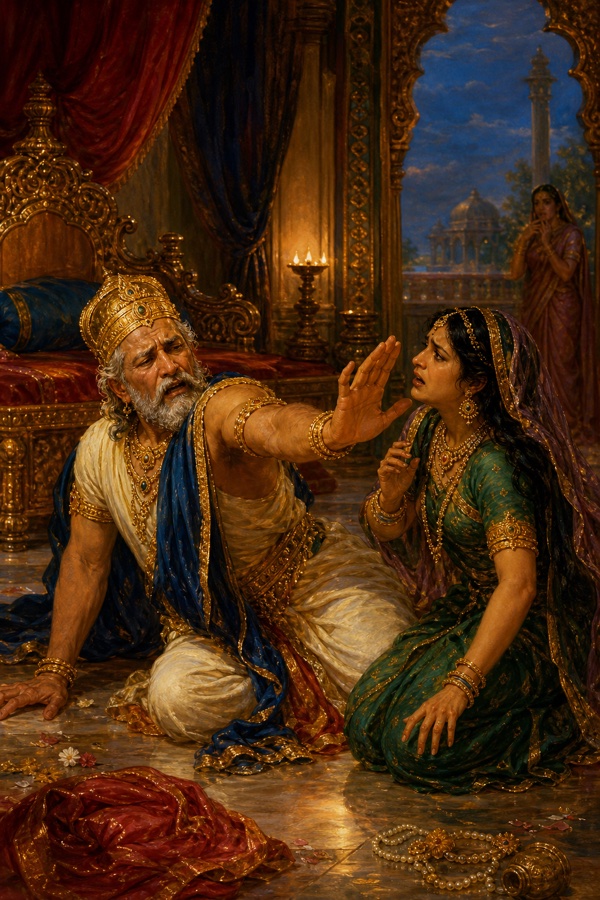
The king saw Kaikeyi bending over him, and he was a man endowed with prudence and with piety and with every decency of conduct, and his heart was torn, and he said to her, “Kaikeyi, you of the sinful resolve. Do not touch my limbs. I do not wish to look at you. You are neither my wedded wife nor any kin of mine. Those who depend on you for their bread, I am no longer their master, and they are no servants of mine. I disown you, given over as you are to your own ends and a deserter of dharma. The hand of yours that I took in marriage, and the fire I led you around, and every benefit that was to come to me from those things in this world and in the next: I renounce them all. And if Bharata is glad to receive this kingdom with no one to dispute it, then let the water and the rice-balls he offers me after my death, the offerings a son owes his departed fathers, never reach me in the other world.” Kausalya, wasted with grief, lifted the king from where he had fallen, coated in dust, and turned him toward the palace. The whole way back he kept twisting around to look at the road Rama’s chariot had taken, and his face had no more charm in it than the disc of the sun in eclipse. Someone told him his son had passed the outskirts of the city, and he began to talk to himself. “The marks of the hooves of the fine horses that draw my boy’s chariot can still be seen on the road. My boy cannot. That jewel of my sons, who slept smeared with sandal paste on cushions and pillows while beautiful women in costly jewels fanned him, will lie down tonight in some place I do not know, at the foot of a tree, with his head on a block of wood or a stone. He will rise at the end of the night from the bare ground, in a wretched state, covered in dust, breathing hard like a bull elephant heaving itself up from beside a spring. The people who live in that forest will see Rama, the guardian of the world, with his long arms, getting up from sleep and setting out like a man forsaken. And Janaka’s daughter, who deserves every comfort there is, will walk barefoot in the forest today and be torn by thorns. She knows nothing of the woods. She will be frightened out of her senses when she hears the deep roar of the beasts that hunt at night. Kaikeyi, your wish is fulfilled. Enjoy the kingdom as a widow. I cannot live without that tiger among men.” Lamenting so, hemmed in by a crowd of his people, the king went in through the doors of his palace the way a man goes home from bathing at the death of a kinsman. He had seen, on the way, the whole of Ayodhya with its crossroads and its gateways empty, the awnings in front of the shops rolled down, the people feeble and dejected, the great streets nearly bare, and he went into the palace wailing and thinking of Rama alone, as the sun goes into a cloud. The palace was like a great pool gone still because Garuda has carried off its serpents. The king spoke to the porters at the door in a voice that faltered, soft and pitiful, hard to make out. “Take me quickly to the apartments of Kausalya, the mother of Rama. Nowhere else will my heart find rest.” They carried him there and laid him gently on a couch, and even lying there his mind would not be still. He looked around the palace, empty of his two sons and of his daughter-in-law, and it had no more charm than a sky without the moon and the stars. He lifted his arm and cried aloud, “Rama, are you truly deserting the two of us, your mother and me? Only those men will be happy, those jewels among men, who live through the years of Rama’s exile and see him come home, and hold him to their chests.” Night came, and for Dasharatha it was the night of the world’s dissolution. At midnight he spoke to Kausalya. “Kausalya, I cannot see you. Touch me with your hand, properly, so that I know it. My sight went after Rama, and it has not come back.” That was how Dasharatha, a man of pious mind, began to pay for what he had done: thinking of his son without pause, he was stung with remorse at having sent Rama into exile under Kaikeyi’s pressure, the way a man is stung who has knowingly killed a Brahmin, or laid his own hand on a blazing fire.
The gist: When even the dust of the chariot is lost from sight, Dasharatha falls to the earth. As Kaikeyi bends to hold him up he renounces her and every fruit of their marriage, and even Bharata’s funeral offerings if the kingdom pleases him. Kausalya leads him home through an emptied city, he asks to be carried to her rooms, and at midnight he tells her that his sight went after Rama and has not returned.
Kausalya’s Lament: The Fire of Losing a Son
Kausalya sat by the couch where the king lay broken, and what came out of her was a mother’s grief with the manners stripped off it. “If Rama had been allowed to stay in Ayodhya, in his own home, and live on alms like a beggar, I would have taken that over this exile. I would have handed my son over to Kaikeyi as her slave, and thought it the better bargain.
“She has spat her poison on Rama, and now Kaikeyi of the crooked ways will glide about the palace as free as a she-snake that has cast its old skin. She threw Rama out of his place for no reason at all, the way a man who tends the sacred fire might take the oblation meant for the gods on the day of the new moon or the full and hand it to the ogres. She has her wish. Her stars are favorable and her mind is at rest, and now she will frighten me a little more every day, from inside my own house, like a snake that has settled in the walls and fears nothing.
Then her mind went to the road. “By now he has walked into the forest, my mighty-armed son, with his wife and with Lakshmana, his bow in his hand, moving the way a bull elephant moves at the head of the herd. What is waiting for them there except the hardships of the forest, those three young people who had never known a day of suffering, whom you sent to live among the trees because Kaikeyi wished it? They were sent away at the very age when life should have been giving them its fruit. Stripped of everything precious, how will the poor children drag out their days on roots and wild fruit?
And then, because a mother cannot help it, she began to count the years forward to the day they would come back. “Will that happy time ever come, the end of my grief, when I see Rama back in Ayodhya with his wife and his younger brother? When will Ayodhya be herself again, thronged with glad crowds and dressed in rows of tall banners the moment word comes that the two princes are here? When will the city rise in joy like the ocean on a night of full moon to see those two tigers among men come home from the forest? When will my mighty-armed Rama drive into Ayodhya again with Sita set before him in the chariot, following her the way a bull follows a cow? When will thousands of people on the royal road rain parched rice over my two sons, Rama and Lakshmana, the subduers of their enemies, as they enter the city? When will I see the two of them in their splendid earrings, with their fine bows and swords, coming in through the gate like two mountains crowned with peaks? When will my three darlings walk in gladness around the city sunwise, taking flowers from the hands of young girls and fruit from the hands of the Brahmins? And when will Rama himself come back, ripe in judgment, shining like a god in the years that never age, to foster the world the way a good rain fosters it when it falls in season?
At the last she turned on herself. “Surely, in some other life, this mean-minded woman cut the teats off cows while their calves stood waiting to drink. That is why I, who love my child the way a cow loves hers, have had my child torn from me by Kaikeyi, as a lion tears her young calf from a cow. I have only the one son. I cannot live without him, that boy of every virtue who has read all the scriptures. There is not the smallest strength left in me to keep breathing while I cannot see my beloved Rama and the mighty Lakshmana. This fire that was born the day my son was taken from me is burning me now the way the glorious sun, at the height of its power, burns this earth with its rays in summer.”
The gist: Kausalya’s lament runs through three chambers of grief: dread of what the forest will do to three young people who never knew hardship, rage at Kaikeyi, who has spat her poison and now rests easy like a snake in the walls, and a self-accusing torment, a crime imagined in some former life to explain the punishment of this one. Between them lies a long litany of when: every scene of a homecoming that is fourteen years away.
Sumitra’s Consolation: Remembering Rama’s Greatness
Sumitra had been listening. She was the mother of Lakshmana and of Shatrughna, the second of the king’s three principal queens, a woman who lived inside dharma and who had a gift for saying the thing that needed saying, and what she now offered Kausalya, the foremost of women, was an argument. “Noble lady, your son Rama is adorned with every excellence, and he is the first of men. What is served by your wailing like this, by all this weeping? Your noblest son, with all his great strength, has given up the throne and walked to the forest so that his father, a great soul, should stand proven true. That road he has taken is the path of dharma, the path the cultured have kept from the beginning of time, and it pays its reward in the world beyond this one. Such a son can never be an object of pity.
“Lakshmana, who has no sin in him and whose compassion reaches every living creature, is with him and gives him the finest service a man can give. For a soul like Rama that is nothing except gain. And the daughter of the king of Videha, who deserves every comfort there is, went after your pious son with her eyes open, knowing exactly what forest life costs. Is there any blessing left that your son has not secured, a man who is all virtue, who is pledged to the truth, and whose banner of fame flies over the whole world?
Then Sumitra told over the greatness of Rama, and the telling grew as she went. “The sun knows his purity, which is famous everywhere, and knows the largeness of his spirit; it will not dare scorch his body with its rays. A kindly breeze out of the woods, neither too hot nor too cold, will wait on Rama at every hour. When he lies down at night the cool moon will stroke him with its rays and hold him like a father and draw off the heat of the day, and he will wake refreshed. And he has the strength of his own two arms to lean on. This is the hero to whom Vishvamitra gave the celestial weapons, that Brahmin sage who once vied with Brahma himself by building a world of his own; he gave them the day he saw the demon Subahu, the son of Shambara, whose banner carried a great fish, killed in battle by Rama. A man like that will live in the forest without a tremor, as if he were living in his own palace.
“The enemy falls the moment he steps into the path of Rama’s arrows; how can the earth refuse to obey him? Everything in him, the splendor, the valor that is his by nature, the strength that works only good, tells you one thing: the moment the term of exile has run, he will take back his throne. He is the light by which the sun, that lights the whole universe, is seen; he is the fire that makes fire visible; he is the ruler of rulers, the splendor of splendor, the substance of glory itself, and the power that holds up forbearance. He is the god the gods adore, the first being of all beings. Lady, what hardship can touch a man like that, in the forest or in Ayodhya or anywhere? Soon enough he will be seated on the throne with three beside him: the Earth, who is the Lord’s consort, and Sita, the princess of Videha, and Shri herself, the goddess of fortune.
“The whole of Ayodhya wept with pain to watch him go. Sita, who is the equal of Lakshmi, followed her unconquered husband when he walked out dressed in kusha grass. Ahead of him walks Lakshmana, the finest of bowmen, with sword and arrows and the rest of his weapons. What can be hard for such a man to reach? Lady, I am telling you the truth: you will see Rama come home when the term is over. Let go of grief and of this confusion. You will see your son again as one sees the moon rise, and he will bow his head at these feet of yours, blessed and irreproachable lady that you are. Let there be no more grief or sorrow over Rama, for there is no ill fortune anywhere in him. And think: all these people, stricken at losing him, deserve comfort from you. Why then should you hold such grief in your own heart at this hour, you who are so like a goddess? A woman whose son is Rama has no business grieving, for there is no one in the world more devoted to the right road than he.
“When you see him back in the palace, installed on the throne, blazing with splendor, you will weep tears of joy, and plenty of them. When you see him greeting you with his friends around him, the tears will pour out of you the way the monsoon clouds pour rain. Home soon in Ayodhya, that son of yours who can grant boons to others will press your feet with his soft, strong hands. When you see your brave son bow to you, with his friends around him, after greeting you with the reverence he owes you, you will drench him in tears of joy the way a bank of cloud drenches a mountain.” So Sumitra, the lovely and faultless queen who was a master of speech, comforted Rama’s mother through every mode of persuasion she had, and then fell silent. And when Kausalya, the mother of Rama, had heard that speech from the mother of Lakshmana, the grief that had wasted her body went out of her as swiftly as an autumn cloud that carries little water.
The gist: Where Kausalya let her grief run, Sumitra binds it with dharma and with faith. Rama’s purity is such that sun, wind, and moon will serve him; the hero to whom Vishvamitra gave the celestial weapons has nothing to fear from a forest; and his return when the fourteen years are done is certain. Her reasoning turns a sister queen’s sorrow into trust, and the grief that had dried Kausalya’s body passes off like a thin autumn cloud.
The Citizens Follow, and the Bank of the Tamasa
The people who loved Rama, that great soul whose valor never failed, went after him along the forest road. There is a rule of conduct among friends and kin for such a day: you walk with the one who is leaving as far as decency asks, and then you turn home. The king had been made to turn back by that rule, against every wish in him. The people would not. They would not turn back on any account, and they kept on behind the chariot, because Rama, famous everywhere and rich in every excellence, had become to the people of Ayodhya what the full moon is to the sky. They begged him and begged him, and Rama, the scion of Kakutstha, kept on toward the forest, because a father’s word had to be shown true.
He looked at them with love, as if he were drinking them in through his eyes, and he spoke to them as if every one of them were his own child. “The love and the high regard you have given me, give it now, for my sake, in special measure to Bharata. He is a joy to Kaikeyi and his conduct is excellent, and he will do for you what pleases you and what is truly good for you as well. He is old in wisdom while young in years, gentle while full of a hero’s qualities, and he will be a master worth having; he will take away your fears. He has every virtue a king needs, and he has been judged fit to be the prince regent. For that reason, and because I ask it of you, carry out the command of your master. And for my sake, deal with the great king so gently that he does not suffer while I am away in the forest.”
The more firmly Rama held to dharma in obedience to his father, the more the people wanted him and no one else for their king. He and Lakshmana, by their virtues alone, seemed to draw the weeping citizens of Ayodhya after them as if the two had bound them with cords. Among the crowd were Brahmins who were senior in three ways at once, in learning, in years, and in the power gathered by a lifetime of austerity, and their heads shook with age. They could not keep up with the chariot, and so they called out from far behind, and they called to the horses. “Turn back, swift horses of noble breed, who carry Rama. Be friends to your master. By carrying him off against our wishes you are doing him harm; you must not go on. Every creature with ears knows what we are asking, and horses more than any; so hear our prayer and turn back. This master of yours is pure in mind and heroic and firm in his resolve, and what he deserves from you is to be carried closer to the city, never away from it toward the forest.”
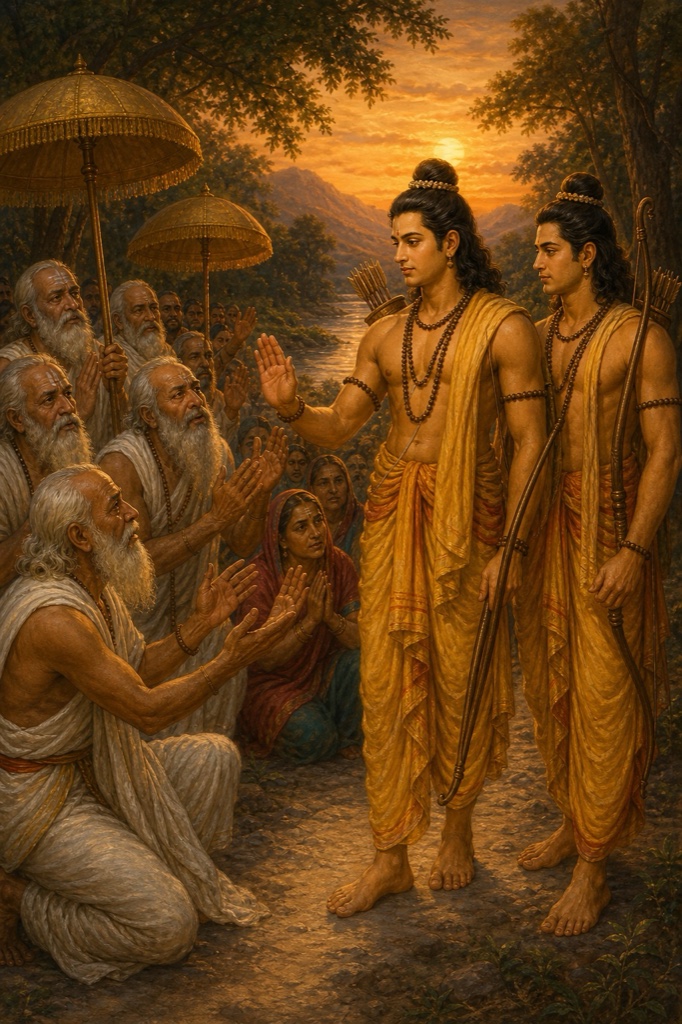
Rama saw those aged Brahmins crying out so piteously, and he got down from the chariot at once. He was tender by nature, with compassion in his eyes, and he could not go on sitting in a chariot while Brahmins followed him on foot. So he walked, with Sita and with Lakshmana, toward the forest that was his only destination, and he shortened his stride so that the old men could catch up with him; he did not stop, and he did not turn back to meet them, because either would have broken the vow that carried him to the forest. The Brahmins saw that he was still moving away from them, and it bewildered them and hurt them, and they said, “The whole community of Brahmins is following you, who have always loved the Brahmins. And our sacred fires are following you too, carried on our shoulders in the two sticks that kindle them by friction and the vessel that holds them. Look, child, at these white umbrellas of ours, which we earned in the Vajapeya sacrifice; they come after you like the white clouds of autumn when the monsoon is over. You have no umbrella, and the sun is scorching you; with these Vajapeya umbrellas we will give you shade. Our minds, which until now were fixed on the study of the Vedic texts, have been turned to follow you into exile, dear child. The Vedas, which are our supreme wealth, are safe in our hearts, and our wives, guarded by their own character, will stay in our homes, so there is nothing there to make us anxious.
“We have already decided to follow you, and nothing about that needs deciding again. And still we will say this to you: if you turn indifferent to dharma, that is, to the advice of the Brahmins, what creature anywhere will stay on the path of virtue? We bow our heads to you, heads white as the down of swans and grimed with dust from lying on the ground before you, and we beg you, prince of resolute conduct, turn back. Many Brahmins here have begun sacrifices, and their finishing depends on your return, dear child. Every being here, the ones that move and the ones that stand still, is devoted to you. Show your love to these devotees who are begging you to come home, by granting what they ask.
“The tall trees cannot follow you; their roots go too deep into the earth for that. Listen to them creaking in the wind. That is how they cry, and that is how they ask you to turn back. And the birds, sitting motionless on their branches, unable to go out and look for food, fixed to the one spot: they too are begging you, who have compassion for every living thing, to come home.” While the Brahmins pleaded like this to turn Rama around, the river Tamasa came into view ahead, as if the river itself had come to check his going. Sumantra freed the tired horses from the chariot, let them drink and washed them down in the river, let them roll, and put them to graze not far from the Tamasa’s bank.
The gist: This following of the people is the proof of Rama’s hold on their hearts, and the Brahmins, old in learning and years, appeal even to the horses to carry their master home. Rama gets down and walks, shortening his stride, because he cannot ride while aged Brahmins go on foot; still he will not stop and will not turn, and as the day fails the whole company reaches the bank of the Tamasa.
Night on the Tamasa, and Slipping Past the People
Rama stood on the lovely bank of the Tamasa, looked at Sita for a moment, and then said to Lakshmana, “Today is the first night of our exile in the forest. It is to the forest we have been sent, so do not let yourself grieve for the ones we left behind; may all be well with you. Look at these woods. The beasts and the birds have gone back each to its own shelter, and the empty woods seem to be crying on every side. Tonight Ayodhya, my father’s capital, every man and woman in it, will be weeping for the three of us who have gone to the forest, of that there is no doubt; for the people are devoted to the king, and to you and me, and to Bharata and Shatrughna as well, for all our qualities.
“It is my father I grieve for, and my glorious mother. I am afraid that the two of them, weeping without cease, will lose the sight of their eyes. But Bharata is pious, and he will comfort my parents with words that speak of dharma, and of wealth, and of the good things of the senses. Every time I remember the tenderness of Bharata’s heart, I stop grieving for my father and mother. And you, by coming to the forest after me, have served a great purpose of mine; otherwise I would have had to look for someone to help me guard Sita. Tonight I will live on water alone. There are wild fruits and roots of many kinds here, and this is what pleases me.”
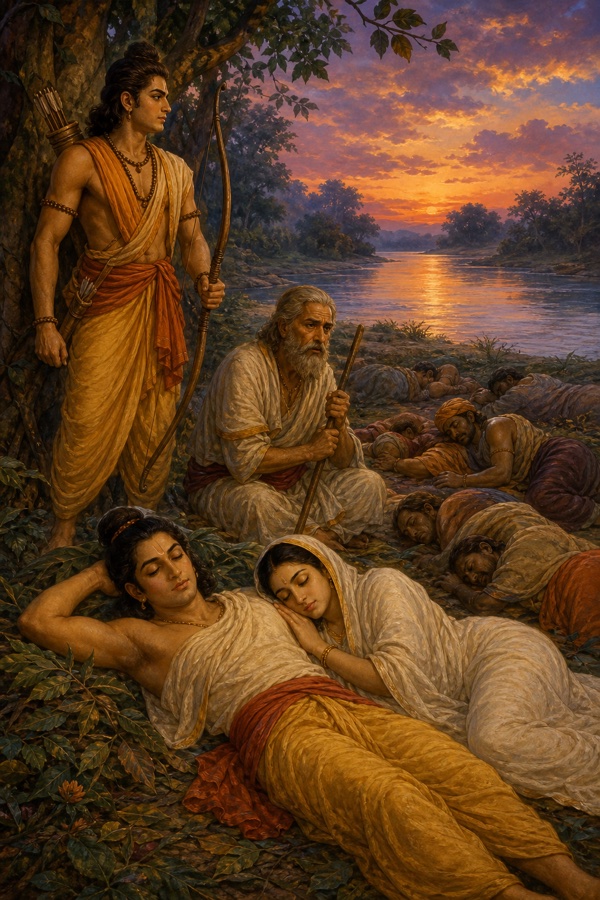
Having said this to Lakshmana, Rama said to Sumantra too, “Attend to the horses now, good sir.” The sun was fully down. Sumantra tethered the horses fast, gave them plenty of grass, and came back to Rama. He worshiped the goddess of the evening twilight as a man of his order does, and then, seeing night fallen, he and Lakshmana cleared a patch of ground for Rama to sleep on, brushing away the gravel and the dust, and spread a bed of leaves. Rama saw that bed on the bank of the Tamasa, fresh leaves laid down by Sumantra with Lakshmana’s help, and he lay down on it with his wife. He was exhausted, and he fell into a deep sleep with Sita beside him, and Lakshmana, watching him sleep, began to tell the charioteer of his brother’s virtues, one after another. He was still telling them, on the bank of the Tamasa, when the sun came up. The two of them had kept awake the whole night.
Rama had passed that night with the citizens around him, at a respectful distance from the Tamasa, on a stretch of land whose bank was crowded with herds of cows. He rose from his bed and saw the people lying asleep a little way off, and he said to Lakshmana, whose body carried every auspicious mark, “Look at them, Lakshmana. The citizens are so full of longing for us that they have no thought of their homes or of the people who love them, and here they lie at this late hour with their heads against the roots of trees. From the pains they are taking to bring us back, I think they will lay down their lives before they give up their resolve. So while they are fast asleep, let us mount the chariot quickly and take a road where no one can molest us from any side, so that these people of Ayodhya, the ancient capital of Ikshvaku, who are so devoted to me, never again have to sleep propped against tree roots as they are sleeping now. The residents of a king’s city should be wholly rid, by the sons of their rulers, of the suffering they bring on themselves; the citizens should never be made to carry a grief the princes themselves have caused, as these people are carrying ours.”
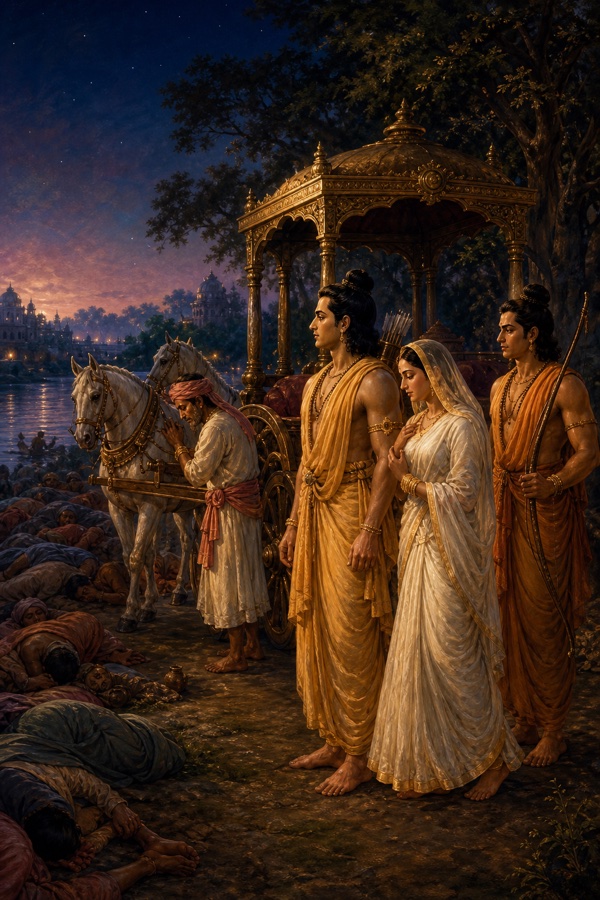
Lakshmana answered Rama, who stood there like dharma itself, “This pleases me, brother. Mount the chariot quickly.” Then Rama said to the charioteer, “Get the chariot ready, and fast. On it I will go to the forest. Let us leave this place at once, sir.” Sumantra yoked those fine horses to the chariot with all the speed he had, and then stood before Rama with his palms joined. “Here is your chariot, mighty-armed prince, ready for you. Mount it quickly with Sita and Lakshmana, jewel among chariot-warriors, and may prosperity go with you.” Rama climbed up with everything the journey needed aboard, the bow and the armor and the quivers, the spade and the basket, and the chariot crossed the swift Tamasa, thick with eddies, and came out on the far side onto a smooth road, clear of obstacles, safe even for people who travel in fear.
Then Rama set about throwing the people off his scent. “Charioteer, mount the chariot alone and drive north at speed for a while, and then bring it back here. Be careful how you do it. Drive so that the citizens cannot find where I have gone.” Sumantra did exactly as he was told. He drove north, turned, came back by a different road, and reported to Rama that the chariot had come. Rama and Lakshmana took their seats comfortably with Sita, the chariot having been made ready for them, and the charioteer urged the horses along the road that led toward a forest fit for the life of austerity. At the start Sumantra faced the chariot to the north, because in that quarter he saw the omens that favor a journey. Then Rama, the son of Dasharatha, a great warrior of the chariot, drove on with him toward the forest.
The gist: Here Rama’s cunning is a form of compassion. To spare the people the pain of following, he slips away by night while they sleep, and by sending the empty chariot north and bringing it back by another road he wipes out his trail. The charioteer faces the chariot north at the start because the omens favor that quarter for a journey; the real road runs elsewhere.
The Citizens Wake, Blame Themselves, and Turn Back
The night ended in dawn, and the citizens woke on the bank of the Tamasa and could not find Rama. The grief of it stunned them; they might as well have been unconscious. They looked in every direction with eyes wrecked by weeping and could not catch so much as a glimpse of him. Their faces withered with despair. They had lost the one man among them who was full of wisdom, and they could not think what to do, and even the sensible ones among them began to say pitiful things. “Curse that sleep, that knocked us senseless so that today we could not see Rama, with his broad chest and his mighty arms. How could Rama, whose every act hits its mark, leave for another country in the dress of an ascetic and abandon us, his own devoted people? How could that jewel of the Raghus, who always protected us the way a father protects his children, go off to the forest and leave us behind?
“What good is life to us now, without Rama? Let us end it here, by fasting; or let us set out on the great journey to the north, the walk that does not stop until death. Or look, there are great dry logs here in plenty. Let us build a pyre and all of us walk into the fire together. When the people we left behind in Ayodhya ask us, what are we going to tell them? That Rama of the mighty arms, who envies no one and speaks gently to everyone, was carried off to the forest by us? How can such words come out of our mouths? And that city, when it sees us come back without him, with its women and its children and its old people, will turn wretched and joyless. We went out with that great soul for good; how are we to look on the city again without him?” They lifted their arms and lamented in every way they knew, like cows of fine breed whose calves have been taken from them.
Then they followed the chariot’s track a little way, and for a few moments it gave them hope, and then it vanished, because the chariot had come back by another road, and they sank into a despair deeper than before. In the end the high-minded citizens turned and walked home along the ruts the chariot had cut on its way out of Ayodhya, saying, “How can the track have disappeared so soon? What are we to do? Fate has finished us.” Downcast, they all went back by the road they had come, to Ayodhya, where every good person was already in distress. They looked at their city and it presented a sorry sight, and the tears poured from eyes that grief had wrecked, their minds distracted with the cheerlessness of it.
Without Rama, Ayodhya had no more charm in it than a river whose deep pool Garuda has emptied of its serpents. Joyless as a sky with no moon, as an ocean with no water: that was how the city looked to the bewildered men who came back into it. They went into their houses, rich houses, full of every good thing, and it took an effort to go in at all, and once inside they looked around and could not tell their own people from strangers, so stricken were they, with every gladness in them gone for good.
The gist: Waking to find Rama gone, the citizens first curse their own sleep, then talk of fasting to death or walking into a pyre, and at last, beaten by a chariot track that simply ends, trail home to an Ayodhya that looks to them like a sky without a moon. Rama’s ruse has worked, and the price of it is the emptiness of the city.
The Women of Ayodhya, and Curses on Kaikeyi
The men who had met Rama on the road and come back without him were as good as dead: dejected, dispirited, full of grief and of a longing to give up the breath in their bodies, their eyes running over with tears. Each reached his own house and sat down among his sons and his wife and wept, his face covered. No one made merry; no one rejoiced. The merchants did not spread out their goods, and what goods were out did not look inviting, and householders did not cook food at home. The people of Ayodhya took no joy in recovering something lost or in coming into a great fortune, and a mother took no joy in the birth of a first son. In house after house the women, weeping because Rama had not come home with the men, cut into their husbands with reproaches, the way a mahout pricks an elephant with the goad. “What use are a home, or a wife, or wealth, or even sons, or any pleasure at all, to men who cannot see Rama? The one good man in this world is Lakshmana, who went after Rama with Sita to serve him in the forest.
Then, because they could not go, the women went in their minds, and out of love they made the forest itself Rama’s servant. “Blessed are the rivers and the lotus ponds and the lakes in whose holy water Rama, the scion of Kakutstha, will bathe as he goes on. Blessed the tracts of land rich in water, and the mountains with their lovely peaks, which will grace his presence. Whatever forest or mountain Rama visits will honor him like a beloved guest come to its door. Trees crowned with flowers of every kind, laden with clusters and black with bees, will stand before him. Out of regard for him the mountains will bring out their finest blossoms and fruit even out of season, and open picturesque cascades, and let their clearest waters run. The trees on the mountaintops will delight him. Where Rama is there is no cause for fear, and no cause for humiliation. He is the son of Dasharatha, heroic, mighty-armed, and he cannot be far from here. Let us follow him again. The shelter of the feet of a master like that is our only joy; he is the protector of us all; he is our goal, and he is our final refuge.
Then the women said to their husbands, “We will attend on Sita, and you will serve Rama. Rama will look after your needs in the forest and guard your interests, and Sita will do the same for us, the women. Who could be happy living in this city, which has nothing left to recommend it and nothing to please the mind, where every soul is longing for Rama to come back and every mind is unsettled? If the rule of Kaikeyi comes, a rule with no dharma in it and as good as no protector, then our lives are of no use, and our sons and our riches even less. She has thrown off her stepson and her husband both for the sake of power. Whom will Kaikeyi, the disgrace of her family, not throw off? We swear by our sons: as long as there is breath in us we will not live in Kaikeyi’s kingdom while she is alive, even if she should feed us.
“Who could live happily with a sovereign like that, a pitiless, wicked woman who has sent into exile the son of Dasharatha, the ruler of rulers? This whole kingdom will soon be without its ruler. There will be no more sacrifices in it, and calamity after calamity will visit it; thanks to Kaikeyi everything will come to ruin. With Rama in exile, the king will not survive, and when Dasharatha is dead the destruction of this great kingdom, which has run unbroken since the days of Ikshvaku, is certain. So, since your merit is spent and your misery is complete, mix poison in water and drink it; or go into the forest after Rama; or leave for some country where even the name of Kaikeyi will never reach your ears. Rama has been sent into exile by deceit, with his wife Sita and his younger brother Lakshmana, and we have been tied to Bharata the way animals are roped together in a slaughterhouse.”
And then, remembering him, the women described him to one another. “That great chariot-warrior with the lotus eyes, Rama, the elder brother of Lakshmana, a tiger among men and a subduer of enemies, dark-brown of skin, with a face like the full moon; whose collarbone is hidden under muscle and whose arms reach to his knees; who is the first to speak, and sweet when he speaks, and truthful, and immensely strong, and easy for anyone to approach, and as pleasant to look at as the moon; who walks with the gait of an elephant in rut: he will adorn the woods now, as he roams them.” Lamenting like this in the city of Ayodhya, tormented, the citizens’ wives cried out as people cry when some danger that means death is coming toward them. And the sun went down past those women, still mourning Rama in their houses, and night came on.
In that city the kindling of fires, even for the daily Agnihotra, had stopped; the chanting of the Vedas and the telling of the old sacred stories from the Puranas had died away; and Ayodhya at that hour looked as if it had been coated in darkness. The business of the trading class had come to a standstill, its joy was gone, and it had no one now to lean on, and the city looked as dark as a sky whose stars have gone out. The women of Ayodhya, who were sick at heart for Rama as they would have been if their own son or brother had been sent away, gave their grief every voice they had that day, and cried until they fell unconscious, for Rama was dearer to them than their own sons. And the celebrated city, in which all singing and rejoicing and dancing and music had been laid to rest, whose delight had fled for good and whose steady, growing trade had been broken off, looked at that hour like an ocean whose water has dried up.
The gist: Home again, the men bear the reproaches of their wives. The women imagine the forest itself waiting on Rama, swear by their sons never to live under Kaikeyi, and tell their husbands to drink poison, or follow Rama, or leave for a land where Kaikeyi’s name is never heard. Then they draw his portrait from memory, and the day ends on an Ayodhya where even the daily fire is out and the city lies like a sea without water.
Three Rivers Crossed: Vedasruti, Gomati, Syandika
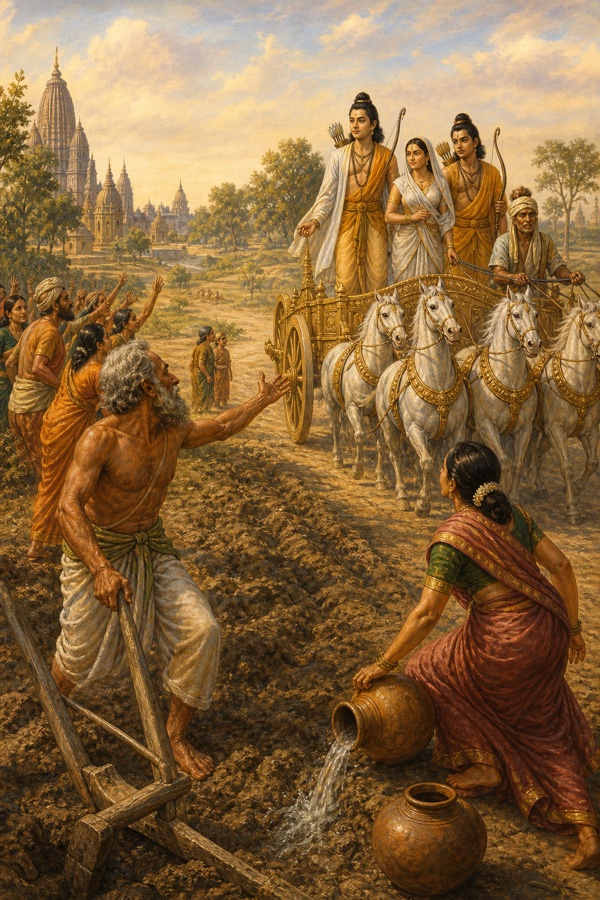
With his father’s command turning in his mind, Rama put a long distance behind him in the hours of the night that were left. The chariot kept the same pace all the way, and the lovely night passed. He worshiped the goddess of the morning twilight at dawn and then drove on through one territory after another. The villages had carefully tilled fields at their edges, and the woods were heavy with blossom, and Rama, drawn by those fine horses, went quickly and seemed to go slowly, so absorbed was he in what he saw. He could hear what the people in the villages and hamlets near the road were saying as he passed. “Shame on King Dasharatha, who has fallen into the clutches of lust. That cruel and sinful Kaikeyi, hot-tempered, evil in her designs, who has trampled every bound of decency, is playing a cruel game now, sending into the forest a son of the emperor so pious, so enlightened, so compassionate, so master of himself. And the blessed Sita, King Janaka’s daughter, who has known nothing but comfort all her life: how is she to bear hardship? What a pity that Dasharatha has lost all affection for his own son, that he throws away Rama, who has never done the people a wrong.” Rama heard the remarks of the men in the villages and hamlets, and the heroic prince of Kosala crossed the border of Kosala itself.
He crossed the river Vedasruti, whose waters are auspicious, and pressed on toward the south, the quarter that belongs to the sage Agastya. After a long journey in that direction he crossed the Gomati, which carries cool water toward the sea by way of the holy Ganga, and whose banks are dotted with grazing cows. Beyond the Gomati the swift horses carried him across the Syandika, loud with peacocks and swans. And there Rama showed Sita the prosperous land of Kosala, whose southern boundary the Syandika marks, the land that Manu, the king of kings, gave in ancient times to his eldest son Ikshvaku, and which is hemmed on every side by the territories of others.
The glorious Rama, the first of men, whose voice had the note of a swan in the mating season, kept turning to the charioteer as they went, and addressed him again and again as “Charioteer.” “Charioteer, when I have come back to Ayodhya and am with my parents again, when will I go hunting in the woods along the Sarayu, when the trees are in flower? I do not hanker much after sport in the Sarayu woods. It is a rare pleasure, one the royal sages have always prized. Hunting in a forest was taken up in this world for the delight of the royal sages; the sons of Manu did it in their time, and other bowmen have sought it out, and still I do not long for it overmuch.” Talking with the charioteer like this, on one subject and then another, the prince of the Ikshvakus went on along the road.
The gist: This canto is a travelogue. Across three rivers, the Vedasruti, the Gomati, and the Syandika, Rama passes beyond the bounds of Kosala, the land Manu gave to Ikshvaku. From the villages along the road ring the blame of Kaikeyi and pity for Sita, and Rama talks easily with the charioteer as he goes, of the Sarayu woods and the hunting he does not greatly miss.
Farewell to Ayodhya, the Ganga, and Guha the Nishada King
When he had crossed the wide and lovely country of Kosala, the wise Rama, the elder brother of Lakshmana, turned to face Ayodhya, joined his palms, and spoke to the city itself. “I take my leave of you, first of cities, so carefully guarded by King Dasharatha of the line of Kakutstha, and of the gods who guard you and live in you. When the term of my exile has run out and I have paid my debt to the king in full, I will see you again, and my mother and father with you.” Then he lifted his right arm. His eyes, which were a lovely reddish color, were full, and his face was wet, and he spoke in his wretchedness to the people of the countryside who had come out to see him. “You have shown me respect and pity according to my worth in your eyes. It is not right that this pain of yours should be drawn out by my company. So go, please, and see to the work of your homes.” They bowed to him and walked around him sunwise, and then they stood where they were, here and there, not minding where, and wailed. And while they were still lamenting, still unsated with the sight of him, Rama passed beyond their sight the way the sun passes out of sight at the beginning of night.
From the chariot Rama crossed the blessed and lovely territory of Kosala, full of grain and of every kind of wealth, peopled by men given to charity and safe from every fear, covered from end to end with temples and sacrificial posts, rich in gardens and mango groves, strewn with ponds full of water, thickly settled with contented, well-fed people and their herds of cows, every village of it worth a king’s protection, and ringing with the chant of the Vedas. From there he drove at an easier pace into a happy and prosperous country ruled by a number of lesser chiefs and full of lovely gardens, and in that country he saw the Ganga. She was the river that flows in three worlds, heaven and earth and the region under the earth, divine and cool, with no weed in her water, and the rishis lived along her. Splendid hermitages stood not far from her banks, and her pools were visited at their proper hours by glad celestial nymphs. Gods and demons graced her, and the gandharvas, the musicians of heaven, and the kinnaras, and the wives of the serpent kings and of the gandharvas came to her without cease. She was hemmed in by hundreds of pleasure hills of the Himalaya and decked with the gardens of the gods, and she ran through the sky itself for the gods’ sake, carrying the lotuses of heaven.
Where her water struck the rocks she seemed to break into a great harsh laugh, and where the white foam covered her she seemed to smile. In one place she ran in a curve and lay like plaited hair; in another she was all eddies. Here she was still and deep, there she was thrown into violent motion; here a deep roar came off her, there a terrifying cry. Hosts of gods went down into her water, which was covered with white lotuses; here her banks were broad, there they were lined with white sand. Swans and cranes made her loud, and the chakravaka pairs that lose each other at nightfall graced her, and birds that are always in their season hovered over her. The trees along her banks ringed her like garlands; here she was covered with lotuses in full bloom and there she was carpeted with them; here she carried beds of water lilies still in bud, there she was reddened with the pollen of countless flowers, like a woman flushed with desire. Whoever bathed in her or drank of her had the stock of his sins washed away, and she lay spotless as the light off a gem. Inside the forests along her banks the elephants that guard the quarters, and wild elephants, and tame elephants of the Airavata breed that Indra rides, kept up a constant noise. Ringed with trees heavy with fruit and flower and tender leaf, with shrubs and birds of every kind, she looked like a young woman dressed with skill in the finest jewels. She had flowed from the holy feet of Vishnu; she had no sin in her and she dispelled all sin. In her depths were sharks and crocodiles and serpents, and she had fallen to earth from the matted hair on the head of Shankara, by the power of the austerities of the emperor Bhagiratha. Near Sringaverapura, the town called Singraur today, Rama reached the bank of the Ganga, the first consort of the Ocean, loud with cranes and herons.
Rama looked at that river, at the eddies among the waves, and the great chariot-warrior said to Sumantra, “Let us halt here today, charioteer. Not far from the river stands this very large ingudi tree, thick with flowers and new leaves; we will halt under it. From here I can look properly on the benign Ganga, the first of rivers, whose waters gods and men, gandharvas, beasts, reptiles, and birds all hold in reverence.” Lakshmana and Sumantra said, “So be it,” and turned the horses toward the ingudi tree, and when they reached it Rama, the delight of the Ikshvakus, got down from the chariot with his wife and Lakshmana. Sumantra got down too, unyoked the fine horses, and stood with his palms joined beside Rama, who had seated himself at the foot of the tree.
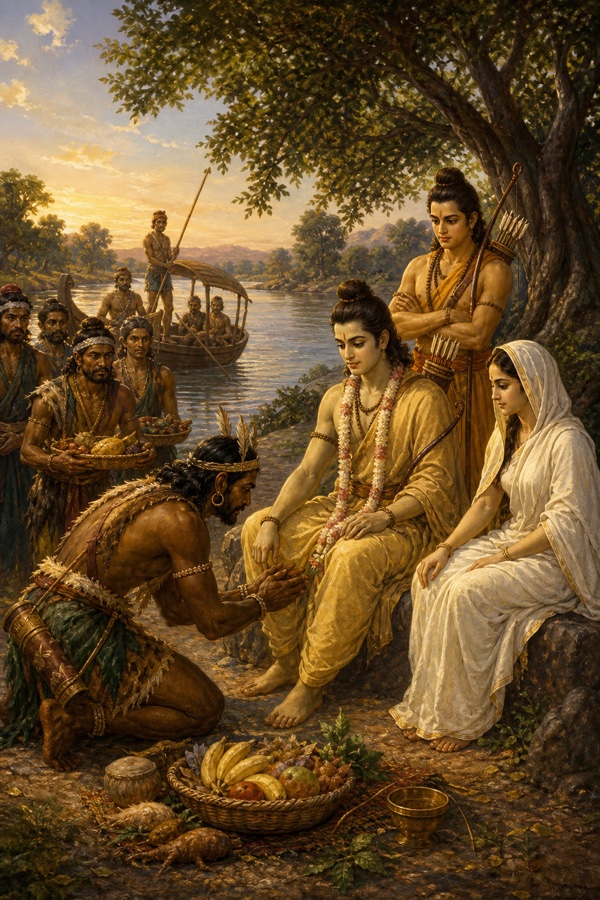
The king of that country was a man named Guha, and he was Rama’s friend, dear to him as his own life. He was a Nishada by birth, one of the hunting and boating people of the river, strong in his body and in his arms, master of an army of all four limbs, elephants and chariots and horsemen and foot soldiers, and he was known far around as the chief of the Nishadas. He heard that Rama had come into his territory, and he came to find him with his elderly ministers and his kinsmen around him. Rama saw the lord of the Nishadas waiting at a distance and went out with Lakshmana to meet him. Guha held Rama tight, and it hurt him to see his friend dressed in the robes of a hermit. “Rama, this principality of Sringaverapura is as much yours as Ayodhya. What shall I do for you? Who else is ever going to have a guest so dear?” He had brought cooked rice of the finest quality and dishes of many kinds, and he offered water for washing the hands and the other articles of welcome, and he said, “Welcome, mighty-armed prince. This whole land is yours. We are your servants and you are our master; rule our kingdom from today. Here is everything you could want to eat, what is chewed and what is swallowed soft, what is drunk and what is licked and what is sucked. There are fine beds for you, and fodder for your horses.”
Rama answered, “By coming on foot all this way to meet us, and by this love of yours, we are honored, and we are always glad of you.” He pressed Guha to him again in his rounded arms and went on, “I am glad, Guha, to see you in good health with your kin. Is all well with your state, and your allies, and your forests? All that you have set before us so lovingly I accept, and I give it back to you to keep; for I make no use of gifts for my own ends. Know me as a man under a vow: to wear a girdle of kusha grass, and bark, and deerskin; to live on fruit and root and nothing else; to practice austerity and dwell in the forest, given wholly to dharma. The one thing I want is food for the horses. Give me that and you have entertained me fully. These horses are dear to my father, King Dasharatha; feed them well and I am honored.” Guha gave his men their orders on the spot: the horses were to have, at once, the milk that fine horses are given after their grass, and barley flour mixed with ghee and sugar.
Then Rama, with an upper garment of tree bark over his shoulders, worshiped the evening twilight as it gathered in the west, and took for his food that night only the water that Lakshmana himself brought him, keeping a fast in honor of the sacred river he had reached. Rama and Sita lay down on the bare ground to sleep. Lakshmana washed their feet with care, and then he drew back a little and took up his place at the foot of another tree close by. Guha, with his bow in his hand, came and stood with him, and with the charioteer beside them the two kept Lakshmana talking of Rama’s virtues, and all three stayed alert through the night for Rama’s sake. And so, while the illustrious Rama, the son of Dasharatha, who had never suffered a day in his life and had known every comfort, lay on the ground, that night at last wore itself away.
A sub-tale: Valmiki names the Ganga here as fallen from Shankara’s matted hair through the austerities of Bhagiratha, and, at the next dawn, Rama calls her Jahnavi, the daughter of Jahnu. Both names carry a story that Valmiki himself tells earlier, in the Balakanda. Bhagiratha, an emperor of this same line of Ikshvaku, brought the Ganga down from heaven by the power of his austerities, so that her water could consecrate the ashes of the sons of Sagara, his kinsmen of generations before him; Shiva took the falling river on his matted hair so that the earth could bear her weight; and when, following Bhagiratha, she flooded the sacrificial ground of the sage Jahnu, he drank her up in his anger, and only when the gods and Bhagiratha had appeased him did he let her out again, through his ears, so that from that day she has counted as his daughter.
The gist: Rama takes leave of Ayodhya face to face, sends the country people home, and comes to the Ganga near Sringaverapura, in a description that runs from the laughter of the water on the rocks to the elephants of Indra’s own breed in the riverside forests. Guha’s kingly welcome Rama gently returns, holding to his ascetic’s vow and accepting nothing except fodder for his father’s horses, and he lies down on the bare ground with only water for his supper.
Lakshmana’s Night Watch, and His Talk with Guha
It hurt Guha to see the prince and his wife lying on the ground, and he said so to Lakshmana, who was keeping awake out of plain love, to guard his elder brother. “Here is a comfortable bed, made ready for you, dear brother. Lie down on it, prince, and rest. We are all used to hardship; you were made for comfort. We will keep watch tonight over Rama, the scion of Kakutstha. There is no one on earth I love more than Rama. That is the bare truth, and I swear it by the truth. By his grace I hope to win great fame in this world, and merit, and riches in plenty, and every pleasure a man can want. So with my kinsmen around me and my bow in my hand I will guard my dear friend Rama, asleep with Sita, from every side. Nothing in these woods is unknown to me; I roam them all the time. And we can deal with an army of all four limbs, however vast and however strong.”
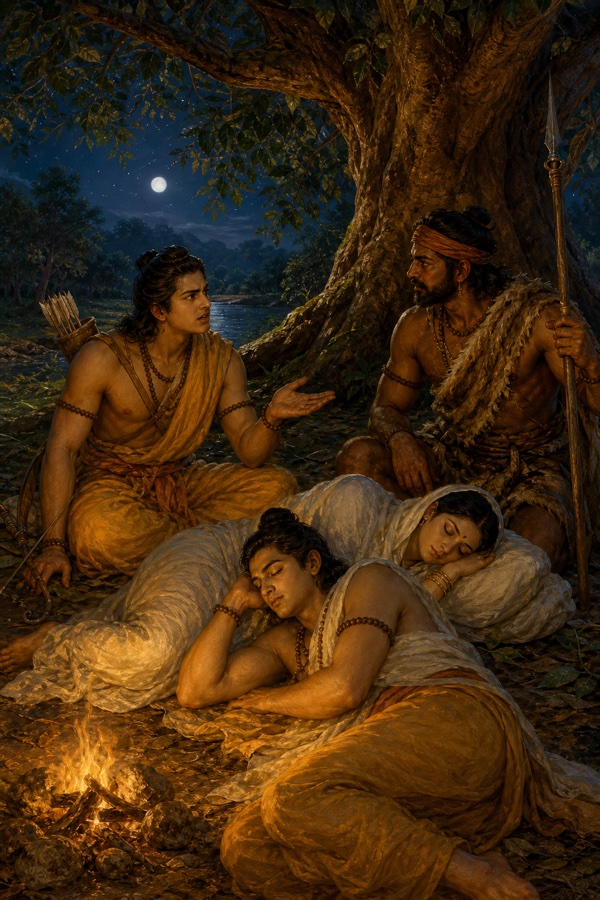
Lakshmana answered, “Guarded by you, Guha, who have no sin in you and keep nothing except your duty in view, none of us is afraid of anyone in this land. But when Rama, the son of Dasharatha, is lying on the ground with Sita, how can I sleep? How can I take food, even the little that keeps a body alive, let alone any comfort? Look at him. All the gods and all the demons together could not stand against him in battle, and he is sleeping at his ease on a bed of straw, with Sita. Dasharatha won him for his eldest son by the chanting of sacred texts, by austerity, and by sacrifice after sacrifice, and he came marked with his father’s own qualities; now that he has gone into exile the king will not live long, and the earth will be widowed at once. By this hour the women of the city have screamed themselves hoarse and stopped weeping from sheer exhaustion, and the palace, I think, has gone quiet after one long wail. I do not expect the great queen Kausalya, or the king, or my own mother, to outlive this night. My mother may survive it, because she is waiting for Shatrughna. But if Kausalya dies, who bore a hero, that will be a bitter thing.
“That city, crowded until now with men and women who loved Rama, a joy to all of them and a pleasure to the world, will die of grief when the king dies. How is the breath of that great-souled king going to keep its hold on his body when he can no longer see his eldest son, that great soul? And when the king is dead Kausalya will die after him, and my mother will follow at once. He wanted one thing, to see Rama installed on the throne of Ayodhya, and he will not have it, and my father will draw his last breath with the words ‘Lost, all is lost’ on his lips. When that unlucky hour comes, only fortunate men will be there to carry out the funeral rites for our father, and we will be far away.
Lakshmana could see the city as he spoke of it. “My father’s capital, with its crossroads laid out on lovely sites and its roads running straight and true; rich in the mansions of the well-to-do, in temples of the gods, in royal palaces, graced by the finest courtesans; crowded with chariots and horses and elephants, ringing with music, full of every blessing, thronged with glad, well-fed people, well provided with gardens and royal parks, and bright with the festivals its guilds put on: if Dasharatha lives, the people will go about happily in that city. If our father lives, we may see that great-souled king of noble vows once more when we come home from exile. Let us hope that when this term in the forest is over, we come back safe to Ayodhya with Rama, who keeps every promise he makes.” So Lakshmana, the son of Dasharatha, a friend to the people, spoke the truth out of love for his elder brother, and Guha, pinched hard by their misfortune and oppressed by grief, wept as an elephant weeps when the fever is on it. And while the high-souled prince sat lamenting, stricken, the night passed away.
The gist: Lakshmana courteously refuses Guha’s offer to take the watch: he cannot sleep or eat while his elder brother lies on straw. Out of him breaks the dread that Dasharatha, Kausalya, and his own mother Sumitra will not outlive the night, and a longing for the Ayodhya that will go on living only if his father lives. The night wears away in that talk, and Guha weeps with him.
Across the Ganga, Sumantra Sent Home, and the Matted Locks
The night ended in dawn, and Rama, broad-chested and blazing with splendor, said to Lakshmana, whose body carried every auspicious mark, “The hour of sunrise is near and the glorious night is spent. Over there that very dark bird, the cuckoo, is calling, dear brother, and you can hear the peacocks crying in the woods. So let us cross the swift Ganga, the daughter of Jahnu, that runs to the sea.” Lakshmana caught the intention in his brother’s words, told Guha and the charioteer, and came and stood facing Rama. Guha heard the command, bowed to it, and called his ministers together at once, and to one of them he said, “Bring to the landing place, quickly, a beautiful and sturdy boat, fitted with oars and with a helmsman, so that Rama and his party can cross easily.” Guha’s chief minister went, brought a fine boat to the nearest ghat, and came back and reported it done.
Then Guha joined his palms and said to Rama, “The boat is ready. What more shall I do for you? Here is a boat brought for you, to cross the Ganga that flows to the sea. Prince as radiant as the son of a god, keeper of noble vows, please get into it at once.” Rama, in his great splendor, answered, “You have done what I wished. Have everything put into the boat, quickly.” The two archers, Rama and Lakshmana, each buckled on his armor and fastened quiver and sword to his body, and with Sita they went down to the Ganga by the same ghat that everyone else used to cross. Sumantra came humbly up to Rama, who knew what was right and stood ready to leave, and asked with his hands joined, “What shall I do?”
Rama laid his auspicious right hand on Sumantra. “Go back quickly to the king, Sumantra, and keep your presence of mind.” Then, “Turn back now. This much service is enough for me. From here we leave the chariot and go on foot to the great forest of Dandaka.” The charioteer, distressed to find himself dismissed, said, “No man in this world has ever set aside a destiny like the one that has sent you into the forest, with your wife and your younger brother, like a common man. If adversity has come even to you, in the shape of exile, then I see no gain in the austere life of a student in his teacher’s house, or in the study of the Vedas that goes with it, or in the cultivation of gentleness and a guileless heart. Living in exile in the forest with the princess of Videha and your brother, you will reach the very state that a man reaches who has conquered all the worlds. And we are finished, Rama. Forsaken by you, we will fall under the rule of the sinful Kaikeyi and suffer for it.” Speaking in that strain, which was worthy of him, Sumantra wept a long time, because he was already seeing Rama far away, with the eyes of his mind.
When his tears had dried, and the charioteer had sipped water to make himself clean again after them, Rama spoke to him gently, and kept speaking. “I see no one who is as true a friend to the Ikshvakus as you are. Act so that King Dasharatha does not grieve for me. The king is confused with grief, and old, and every hope he had has been thwarted, and that is why I say this to you: whatever that great-souled king commands you to do to oblige Kaikeyi, do it, and without hesitation. Kings rule their kingdoms for this one end, that their will should not be crossed in anything. Handle everything so that the king is neither displeased nor made wretched with grief. Bow first to the old and venerable king, who has never known suffering and who has mastered his senses, and then give him this from me:
“‘I do not grieve, and neither does Lakshmana, and Sita is not sorry, that we have been uprooted from Ayodhya or that we are going to live in the forest. When fourteen years have passed, you will see Lakshmana, and me, and Sita too, come back to you quickly.’ Say this to the king, Sumantra, and to my mother, and to the other queens with Sumitra, and to Kaikeyi, and say it again and again; tell Kausalya that I am in good health, and then lay at her feet the salutations of Sita, and of me, the eldest, and of Lakshmana. And tell the king, my father, this as well: ‘Send for Bharata soon. When he comes back from his maternal uncle’s house, install him in the office you have meant for him. Once you have met Bharata and embraced him and installed him as prince regent, the remorse you feel on our account will not be able to overpower you any longer.’ And to Bharata say: ‘Behave toward all your mothers without any distinction, exactly as you behave toward the king. Kaikeyi and Sumitra are equally worthy of your respect, and my mother, Queen Kausalya, the senior of them all, more so. Accept the office of prince regent to please our father, and you will thrive in both worlds, this one and the next.’”
Sumantra listened to the whole of it, to every instruction Rama gave him in the course of sending him home, and then he answered out of love. “If I speak to you plainly, out of affection, and not with the reverence I owe my master, forgive the way I speak; take me for a man who is wholly devoted to you. Without you, dear child, how am I to go back to that city, which your leaving has turned into a mother sick with grief for her son? The people of Ayodhya were torn apart just to see this chariot with you in it, on the day you left. When they see it come back without you, the city itself may split in two. Seeing this chariot with no one in it, the city will be as wretched as an army that sees its hero’s chariot come back with only the charioteer alive, the warrior killed in battle. Today, thinking of you, who are far away and always in front of their minds, the people of Ayodhya will have gone without food and drink. Rama, you saw with your own eyes the confusion that broke out among the people when you were exiled. When they see me alone with the chariot, they will raise a cry a hundred times louder than the one they raised the day you were banished.
“And what am I to say to Queen Kausalya? Shall I lie to her, and tell her, ‘Your son has been taken to his uncle’s house; do not grieve,’ and spare her the agony for a little while? I cannot tell such a lie, however sweet it would be to her ear. And the truth, that Rama has gone to the forest, that unwelcome report: how am I to make it? Even if you insist that I go back at any cost, how will these fine horses, which answer to my hand and have never carried anyone except you and your kin, draw the chariot without you? So without you I cannot return to Ayodhya, prince without sin, even if I try; you must let me share your exile. If you leave me here in spite of my begging, then the moment you forsake me I will walk into a fire on this spot, chariot and all. In the forest, whatever creatures come to interrupt your austerities, I will drive them off with the chariot. By your kindness I had the pleasure of driving your chariot; by your grace I now hope for the pleasure of living beside you in the forest. Be gracious to me; let me follow you. I long to be your close companion in the forest, and I want to hear you say it, in love: ‘Be my companion.’ These horses too, prince, if they get the chance to serve you while you live in the forest, will reach the highest destiny there is, serving their beloved master. I will serve you in the forest with my head bowed, and for the sake of that privilege I give up Ayodhya for good, and heaven itself, the realm of the gods. Without you Ayodhya is no more a place I can enter than Amaravati, the capital of Indra, is a place a sinner can enter. My one ambition is this: that when your exile ends I bring you home to Ayodhya in this very chariot. If I stay with you in the forest, the fourteen years will slip past me as if they were fourteen moments; away from you they will stretch a hundredfold. Prince who loves those who depend on you, do not desert a devoted servant who has resolved to walk the road his master’s son has chosen, and who has never once stepped out of bounds.”
Rama, who had compassion for anyone who depended on him, answered Sumantra, still pleading piteously in every way he could find. “Charioteer, you love your master, and I know your supreme devotion to me. Still, hear why I send you back to Ayodhya from here. When my youngest mother, Kaikeyi, sees you come home, she will be convinced that I, Rama, have gone to the forest. If you stayed with me, Kaikeyi, who is not going to be satisfied by anything less even now that I am in exile, might suspect the pious king of lying. My first intention is this: that my youngest mother should get the kingdom of Ayodhya in good order, protected by Bharata and so ruled by her own son. That is possible only when you return. Until then my coming back is not ruled out, and Bharata will not be sent for, and everyone will hang in suspense. So for my sake and the king’s, Sumantra, go back to the capital and deliver every message you have been given, each in the way you were told.”
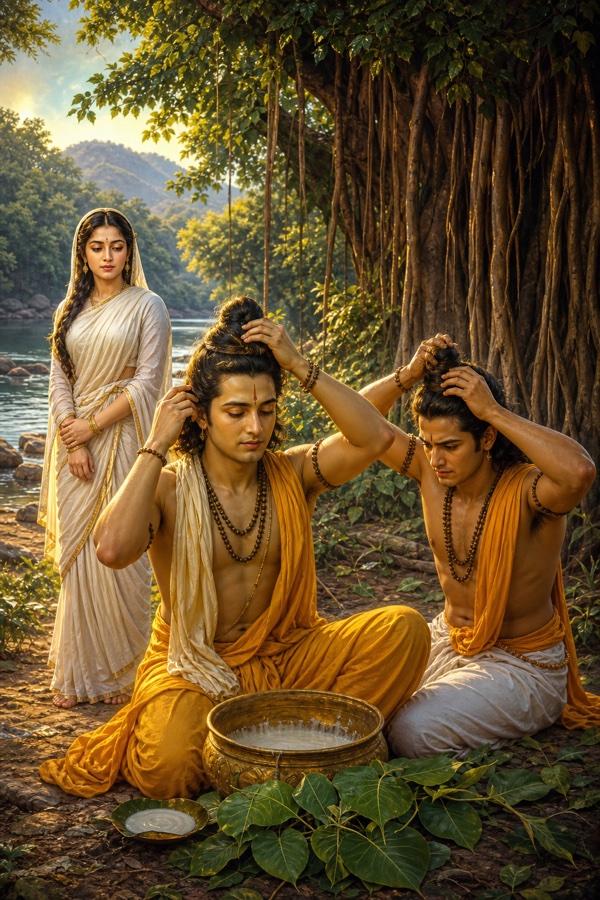
When he had explained himself to the charioteer and consoled him over and over, Rama, who felt no fear of anything, gave Guha his reasons for what he did next. “Guha, it is not right that I go on living in a forest where my own men are present. I must take up a hermit’s dwelling in some uninhabited region and keep the rule that belongs to it. For my father’s spiritual good, and with the consent of Sita and Lakshmana, I will take on the discipline that is the ornament of ascetics, the wild fruits and roots and bulbs, the sleeping on the ground, and I will go forward from here wearing matted hair. So bring me the milk of a banyan tree.” Guha fetched the banyan’s milky sap at once. With it Rama worked his own hair and Lakshmana’s, who had taken the ascetic’s vow with him, into thick masses of matted locks, and so put on the mark of an ascetic. Dressed in bark, with rounded crowns of matted hair on their heads, the two brothers looked at that hour like two rishis.
Having taken up the hermit’s way with Lakshmana, the way the ascetics call Vaikhanasa, Rama said to Guha, who had helped him into it, “Guha, be vigilant over your army, your treasury, your fortress, and your people; a state is reckoned the hardest thing there is to protect.” He took his leave of Guha, and with his mind untroubled he went quickly on with Sita and Lakshmana. He saw the boat waiting at the river’s edge, and, eager to cross the swift Ganga, he said to Lakshmana, “Hold the boat where it stands and steady it. Help Sita in slowly, for she is timid, and then step in yourself at once, lion among men.” Lakshmana heard his elder brother’s order and did exactly as it was given: he helped Sita, the princess of Mithila, into the boat first, and then, self-possessed, got in after her. Rama, the glorious elder brother of Lakshmana, got in last, and Guha, the ruler of the Nishadas, ordered his kinsmen to row.
Seated in the boat, Rama, in his unique splendor, recited a sacred text for his own good, the old verse that begins with the words “Daivi navam,” which Brahmin and warrior alike may say. He sipped the water of the Ganga as the scriptures prescribe and bowed low, with Sita, to the river, and Lakshmana, the great chariot-warrior, did as his brother did. Then he took leave of Sumantra, and of Guha and his army, and, settled in his seat, Rama told the boatmen to row.
A key to reading (the Vaikhanasa vow): The “Vaikhanasa way” is the ascetic’s rule of life as Rama himself states it to Guha: a diet of wild fruit, roots, and bulbs, sleeping on the ground, and wearing matted locks. Rama’s working of the matted locks with banyan milk is the mark of initiation into this vow; it is the moment the forest dweller’s form is completed, bark already on his body and the locks now on his head, and Lakshmana takes it with him.
Sita’s Prayer to the Ganga, and Entry into the Vatsa Land
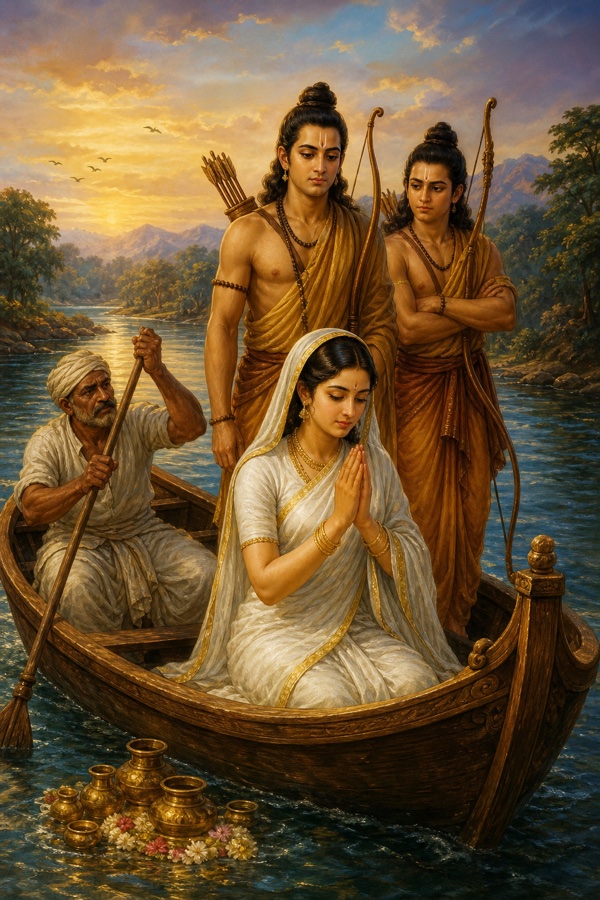
Rowed by the boatmen and steered by the helmsman, driven by the quick beat of its fine oars, the boat moved swiftly out across the water. When it reached the middle of the Ganga, Sita, the princess of Videha, in whom there was no fault, joined her palms and spoke to the river. “Mother Ganga, guarded by you on every side, may this son of the wise emperor Dasharatha carry out the emperor’s decree and live fourteen years in exile. And when he has lived those fourteen years to the full, and comes again to your bank with his younger brother Lakshmana and with me, returned in safety, blessed goddess, with every wish of mine fulfilled, then I will worship you with great delight. When Rama, that tiger among men, has come home safe and won back his kingdom, I will give a hundred thousand cows, and garments, and food of the finest quality to the Brahmins to please you. Back in Ayodhya I will worship you with a thousand and one offerings that even the gods cannot come by, with lands free of revenue, with raiment and with cooked rice. Goddess, be gracious to me.
“Goddess, you flow through heaven and earth and the region under the earth, and your basin takes in the realm of Brahma, and here on this earth you are seen plainly as a consort of the king of the ocean; so I, Sita, greet you and sing your praise. I will worship every deity that has its home on your banks, and every holy ford and sacred spot along them. And may the sinless Rama of the mighty arms come back from the forest into Ayodhya, with Lakshmana and with me, goddess without sin.” Praying to the Ganga in those words, Sita, faultless in every way and devoted to her husband, came quickly to the southern bank.
On the bank they left the boat, and Rama, that jewel among men and chastiser of his enemies, went on with his younger brother Lakshmana and with Sita, the princess of Videha. And Rama said to Lakshmana, who was the joy of Sumitra, “Be ready to guard Sita, in inhabited country and in the wild alike. In an empty forest a woman must be guarded by men like me, who keep the moral order standing. So lead the way, Lakshmana, and let Sita follow you. I will come behind, guarding Sita and you both from the rear; we must guard one another, jewel among men. No hard trial is behind us yet. It is only today that Sita will begin to taste what living in the forest means. Today she enters a forest where there is no track of grass crushed under human feet, because no one comes this way; a forest empty of field and garden, rugged underfoot, full of yawning chasms.” Lakshmana heard him and led the way, Sita followed, and close behind Sita came Rama, the delight of the Raghus.
On the far bank Sumantra stood and watched Rama, who had crossed the Ganga so soon, and did not stop watching until the distance the exiles had put between them and him took them out of his sight, and then the charioteer, full of remorse and grief, wept for his parting from Rama. Rama, who matched the guardians of the world in glory and could grant a boon to anyone he chose, had crossed the great river, and now he came, step by step, into the prosperous and happy land of Vatsa, which lies between the Ganga and the Yamuna, and whose fields stood in rows of beautiful crops. There, for the love of the sport, the two brothers hunted four large deer, of the kinds called varaha, rishya, prishata, and maharuru, and gathered fruit fit to be offered into the sacred fire; and when they were hungry, at the day’s end, they went quickly back to the tree where they had kept Sita within their sight the whole time they hunted, to eat, and to rest there for the night.
The gist: Sita’s prayer to the Ganga is the tender center of this passage: every word of it is for her husband’s vow and his safe return, and the offerings she promises are a queen’s, a hundred thousand cows and lands free of tax. Across the river Rama sets the marching order that will hold for years, Lakshmana ahead, Sita between, himself behind guarding them both, and tells Lakshmana that for Sita the true exile begins today; the three enter the empty forest of the Vatsa land.
The First Night Under the Banyan: Rama Asks Lakshmana to Return
At the foot of that tree Rama worshiped the evening twilight, and then he, who gave more delight to others than anyone alive, said to Lakshmana, “This night that has come down on us outside the country of our own people is the first night that will pass without Sumantra. You must not grieve over it. From now on the two of us keep awake through the nights, and without slackening, because getting Sita what she needs, and guarding her person and her honor, is our care, Lakshmana. Let us get through this night somehow. Let us lie on the ground and cover it with straw and leaves gathered with our own hands.”
Rama, who had slept all his life on costly beds, sat down on the bare earth, and what he said to Lakshmana was fitted to the hour. “Tonight the great king is sleeping badly, and Kaikeyi, with her object won, must be feeling well pleased. When Bharata comes home from his grandfather’s house, I am afraid Queen Kaikeyi may take the king’s very life for the sake of the throne. And what can the king do to foil her designs on him? He still wants to see me installed as regent; he has fallen into Kaikeyi’s clutches; he is old, and helpless, and cut off from me. Looking at my own evil plight and at the wreck of the king’s judgment, I am led to think that the pleasure of the senses weighs more with men than gain or merit. What man, even an ignorant one, would throw away a son who lives inside his will, for a woman’s sake, the way my father has thrown me away?
“Kaikeyi’s son Bharata is the only happy man in this, and his wife is a lucky woman, because he is going to rule the prosperous kingdom of Kosala like an overlord, with no one to dispute his claim. Father is past his prime and I have gone off to the forest, so the whole undivided blessing of the kingdom falls to him alone. A man who chases pleasure and neglects wealth and virtue soon comes to grief, as King Dasharatha has. I believe Kaikeyi came into this house for three things only: to bring about Dasharatha’s end, to exile me, and to win the throne for Bharata. And blinded by the pride of her good fortune, she may even now persecute Kausalya and Sumitra for their connection with me and with you. Your mother, Queen Sumitra, is likely to suffer because she is bound to us. So go back to Ayodhya, Lakshmana, from this very place, tomorrow morning. I will go on to the Dandaka forest alone with Sita, and you will be the protector of Kausalya, who will have no protector once King Dasharatha is dead. Kaikeyi is capable of anything. In her malice she may use foul means; she may even give poison to your mother and mine.
Rama’s voice went lower. “In some other birth, my mother Kausalya must have parted women from their sons, and that act alone has come back on her now in this visitation. At the very time when Kausalya should have found her labors repaid by me, she has been robbed of my company, after she nursed me for years and raised me in pain. Shame on me. Let no woman bear a son like me, Lakshmana, who has laid endless sorrow on his mother. I think the myna that my mother keeps as a pet loves her better than I do; at least from that bird one hears the words, ‘Parrot, bite the foot of our master’s enemy, so that he cannot march against him.’ My mother is grieving and unlucky and as good as childless; what use to her is a son like me, who does her no good at all? Unlucky, my mother Kausalya, who is bereft of me and stricken and lies drowning in grief.
“Lakshmana, if I were angry I could subdue the kingdom of Ayodhya with my arrows single-handed, and the whole earth with it. But a show of valor does not always serve a man in the other world. I am afraid of the sin I would take on if I failed to help my father honor the boons he gave Kaikeyi, and afraid of ruining my prospects beyond this world; and that is why I do not install myself as regent, by force, today.” So Rama wailed, in those words and in many more, in that lonely forest, and then he sat quiet through the night, stricken, his face bathed in tears.
When the lament had stopped, and Rama sat there like a fire whose flames have gone out, like a sea that has lost its surge, Lakshmana comforted him. “Rama, now that you have come away from it, Ayodhya has been stripped of its splendor; it is like a night without a moon, jewel among armed men. It is not right that you grieve like this, when it makes Sita and me sad too. Without you, neither Sita nor I could survive even a short while, any more than fish taken out of the water. Without you I have no wish today to see my father, or Shatrughna, or Sumitra, my own mother, or even heaven.”
Not far from where they sat, at the foot of the banyan, Lakshmana had made a bed and made it well, and Rama and Sita, mindful of what each owed the other, went to it. Rama had listened with full attention to Lakshmana’s speech, well worded and complete, and he had taken up the hermit’s way of life for a long term; and there in that empty forest, keeping Sita in sight a little way off, he resolved to spend all the years of his exile with Lakshmana at his side. From that night on, the two mighty princes, the increasers of the line of Raghu, felt no more fear and no more agitation in that great lonely forest than two lions feel on a mountain peak.
The gist: The first night under the banyan is one of the most open windows into Rama’s mind that Valmiki gives: he fears Kaikeyi will go on from exile to poison, aches for his mother Kausalya, and orders Lakshmana home to guard her. Lakshmana refuses flatly, on the ground that neither he nor Sita could live without Rama any more than fish out of water, and Rama accepts his staying for all fourteen years.
The Ashram of Bharadvaja, and the Pointing Toward Chitrakuta
They passed a beautiful night under that great tree, and when the sun was well up they set out again. Through a great forest they made for the place where the Yamuna comes rushing to meet the Ganga, the river Bhagiratha brought down. Tract after tract of country opened in front of them, regions that captured the soul, none of which they had ever seen, and the glorious travelers went on looking. They walked at ease, gazing at trees heavy with blossom, and as the day was ending Rama said to Lakshmana, “Look there. That pleasant, fragrant smoke, the sign of the glorious god of fire, near Prayaga. From this I conclude that the sage Bharadvaja is close by. We have certainly reached the confluence of the Ganga and the Yamuna, because you can hear the noise the two rivers make where their waters clash. And here at the hermitage you can see logs cut by men who live on what the forest yields, and trees of various kinds felled and cut up.”
Still walking at their ease, the two archers came to the edge of the sage’s dwelling in the strip of land between the Ganga and the Yamuna as the sun was going down. Rama’s very appearance, a bowman with weapons on him, frightened the beasts and birds of the place as he crossed the short distance to the hermitage of Bharadvaja. The two heroes, longing for a sight of the sage, stopped a little way off with Sita and waited for permission to see him. It came through one of his pupils, and Rama went in. The sage was a man of rigid vows, who had won omniscience through austerity and sat absorbed in meditation in the midst of his hosts of pupils; he had just poured the oblation into the sacred fire. Rama, with Lakshmana and Sita, greeted him with folded hands.
Rama, the elder brother of Lakshmana, introduced himself. “We are Rama and Lakshmana, venerable sage, sons of the emperor Dasharatha. This is my wife, blessed and without reproach, a princess of Videha and daughter of King Janaka, who has followed me into the lonely forest that is fit for austerities. And when my father was sending me into exile, this beloved younger brother of mine, Lakshmana, of firm vows, followed me too. At our father’s command we are going to a forest fit for austerity, and there we will practice virtue alone, living on nothing except roots and fruit.” The sage, whose mind was given to piety, heard the wise prince out and offered him what is due to an honored guest, a bull, and water to wash his hands, as the beginning of hospitality. The ascetic then gave them delicacies of every description made from wild roots and fruit, and arranged a place for them to stay.
Rama had come up to the sage by slow stages, pausing at intervals and then advancing with care, out of respect, and Bharadvaja, seated with the beasts and birds and hermits of the place all around him, welcomed him with kind words, and when Rama had accepted his hospitality and taken his seat, spoke to him in words that matched dharma. “I have been expecting you for a long while, scion of Kakutstha. And I have heard of your exile, and that there was no cause for it. This open stretch of ground at the meeting of the two great rivers is secluded, and it is sacred, and it is lovely. Live here in comfort.” Rama, who wanted the good of everyone, answered him agreeably. “Venerable sir, the people of the city and the kingdom of Ayodhya are very near this place. If I am easy to find here, the people who want to look at Sita and at me will keep coming to this hermitage, and for that reason I do not relish staying here. So please look for some excellent site for a hermitage in a lonely place, where Sita, the daughter of Janaka, who deserves every comfort there is, may find some delight.”
Bharadvaja heard that pious answer, took its meaning, and pointed Rama to the place he was looking for. “Sixty miles from here, dear son, there is a sacred mountain on which you can make your home. Great rishis live on it; it is beautiful to look at; it throws out a number of spurs. It is full of the black long-tailed monkeys, and apes and bears haunt it, and its name is Chitrakuta, and it is as beautiful as Mount Gandhamadana. As long as a man can see the peaks of Chitrakuta, he gives himself to virtuous acts and never sets his mind on sin. Many a seer has passed a hundred winters in austerity on that mountain as if it were play, and gone up to heaven with a head as white with age as a bare skull. To my mind it is a lonely and comfortable place for you to live. Or else stay here with me, at the meeting of the Ganga and the Yamuna, for the whole term of your exile.”
Bharadvaja entertained his dear guest Rama, with his wife and his brother, and delighted them with everything they could have wished for. And while Rama sat talking with the great seer at Prayaga on one subject after another, the lovely night came on. He was very tired, and Rama, who deserved every comfort, with Lakshmana the second of the party and Sita the third, passed that night happily at the beautiful hermitage of Bharadvaja.
At dawn Rama went to Bharadvaja, who shone with spiritual glory, and said, “We have spent the night at your hermitage, venerable sir. Now, sage devoted to truth, give us leave to go on to the place fixed for our dwelling.” The night was over, and Bharadvaja, asked in that way, answered, “Go gladly to Chitrakuta, which is rich in honey, roots, and fruit. I judge it a fit home for you, Rama of the great strength. Go to that famous mountain, sacred and lovely, adorned with clusters of trees of every kind, visited by kinnaras and by serpent folk, charming with the cries of its peacocks, roamed by lordly elephants, rich in roots and fruit. Herds of elephants and troops of deer range the woods there, and you will see them, and rivers, cascades, mountain peaks, fissures in the rock, caves, and little streams, and as you roam the woods with Sita they will delight your mind. That blessed and agreeable mountain greets whoever comes to it with the notes of the glad tittibha bird and the cuckoo, and it is most delightful with its many deer and its elephants in rut, and it is a fit place to live. Go there, and make your home on it.”
A key to reading (sixty miles): Bharadvaja’s word in the Sanskrit is “ten,” ten kroshas, a krosha being roughly two miles. The commentary called Ramayana Shiromani reads that “ten” as a shortened “ten and ten and ten,” thirty kroshas, which gives the sixty miles of the Gita Press rendering. The distance from Prayaga to Chitrakuta was long reckoned at twenty-eight kos, about fifty-six miles, close to the commentator’s figure; measured today it comes to about eighty. Either way, Rama has days of walking ahead of him.
The gist: Bharadvaja’s hermitage at the confluence is both a halt and a guidance. The sage has been expecting Rama and offers him the confluence itself; Rama declines it because Ayodhya is too near and the people would keep coming, and asks for somewhere lonely enough that Sita can find some delight in it. The sage points him to Chitrakuta and paints its holiness and its loveliness, and sends the three of them on at dawn with his blessing.
Across the Yamuna, and Night on the Kalindi’s Bank
Having spent the night at Bharadvaja’s hermitage, the two princes, Rama and Lakshmana, subduers of their enemies, greeted the great seer and set off toward the mountain. The sage saw the three of them ready to start, and he performed for them the rite that secures a safe journey, scattering boiled rice on the ground and calling down blessings with the sacred texts, exactly as a father would bless his own sons and his daughter-in-law. Then Bharadvaja, in his great spiritual glory, gave Rama the road. “When you reach the confluence of the Ganga and the Yamuna, follow the Yamuna, you two jewels among men, along the stretch where the force of the Ganga’s water has turned her to run westward. Then, when you come to where the Yamuna turns back the other way, look carefully for the crossing place that is most used, and there, Raghava, build a raft and cross the Yamuna, the river whose goddess is the daughter of the sun.
“Beyond it you will come to a huge banyan, thick with dark green leaves, which is why it is called Shyama, the dark one; many trees stand around it and the Siddhas, the perfected ones, visit it. There let Sita join her palms and pray to the deity of that tree for your safe return. When she reaches the foot of the tree let her rest there a while if she is tired, or else go on past it. Only two miles from that tree you will see the Nila forest, with sallaki and jujube trees mixed through it and lovely with the bamboos that grow on the Yamuna’s bank, and there you will find the delightful way to Chitrakuta. I have gone that way many times; it is smooth, and there are no forest fires on it.” When he had pointed out the road, Rama bowed to him and said, “I will follow your instructions,” and urged him to go back, and the great seer turned and went home.
When the sage had gone, Rama said to Lakshmana, “May prosperity be with you. We must have done some meritorious deeds in the past, that the sage has shown us such compassion.” Talking like that, with Sita walking in front of them, the two brothers headed for the Yamuna. They came to the bank of the swift-running river and stood there thinking, because they wanted to cross its water quickly. Then the two brothers built a raft, a big one, of logs laid side by side, spread over with dry bamboo and covered with the fragrant roots of the ushira grass. Lakshmana, with all his strength, cut shoots of cane and twigs of the rose-apple tree and made a comfortable seat for Sita.
Rama, the son of Dasharatha, helped his beloved Sita onto the raft; she rivaled Shri herself in a beauty past imagining, and she was a little shy as he helped her up. Beside her he carefully set the pair of her garments and her jewels, and the spade and the basket. With Sita seated first, the two sons of Dasharatha held the raft steady between them and, full of delight, began cautiously to row it out. In midstream Sita saluted the goddess of the river and prayed. “May I cross your waters in safety, glorious lady, and let my husband fulfill his vow of fourteen years in the forest. When Rama comes home safe to Ayodhya, the city the Ikshvakus rule, I will propitiate you with a thousand cows and a hundred and one offerings of worship that even the gods cannot come by.” Praying to the Kalindi like that with her palms joined, Sita, whose complexion was the loveliest of any woman’s, came to the southern bank of the Yamuna.
So on their own raft they crossed the swift, rippling Yamuna, the daughter of the sun, fringed with the many trees that grow along her banks. They left the raft among those trees, came out of the riverside forest, and reached the cool banyan with the green leaves that is called Shyama. Sita, the princess of Videha, went very close to the tree and bowed low to it. “Hail to you, giant tree. Let my husband fulfill his vow of life in the forest, and let us see once more our mother Kausalya and the illustrious Sumitra.” So saying, with her palms joined, the high-minded Sita walked around the banyan sunwise. Rama watched his beloved and gentle wife, whose conduct no one could fault, praying to the deity of the tree, and he said to Lakshmana, “Take Sita with you and walk in front, Lakshmana, younger brother of Bharata. I will come behind with the weapons, jewel among men. Whatever fruit or flower Sita asks for, whatever Janaka’s daughter’s mind takes delight in, give it to her as you go.”
Every tree, shrub, or flowering creeper that she had never seen before, that gentle woman asked Rama about, and at her word Lakshmana went hurrying off and came back with lovely sprays laden with flowers. The daughter of Janaka was happy, looking at that river with its beautiful sands and waters, loud with swans and cranes. Then, after walking only a couple of miles, the two brothers, Rama and Lakshmana, killed a number of deer of the kinds fit for the sacrifice and roamed the forest along the Yamuna. They took their pleasure in that lovely wood, loud with flocks of peacocks and full of monkeys and elephants, and when they came to a level stretch of the riverbank the travelers, with no gloom on their faces, quickly found a tree they could shelter under for the night.
The gist: Guided by Bharadvaja, who blesses them like a father, they cross the Yamuna, the Kalindi, daughter of the sun, on a raft they build themselves. In midstream comes Sita’s second prayer to a river, and on the far bank her prayer to the Shyama banyan, this time for the sight of both mothers again. Across the river the marching order holds, Lakshmana ahead with Sita, Rama behind with the weapons, and they roam the woods with delight and halt for the night under a tree.
The Road to Chitrakuta, and the Leaf Hut at Valmiki’s Ashram
The night slipped by, and Rama, that jewel of the Raghus, gently woke Lakshmana, who had woken once and gone back to sleep. “Listen, Lakshmana, to the wild birds singing so sweetly, the parrot and the cuckoo and the myna. The hour for setting out has come, tormentor of enemies; let us be on our way.” Woken in time by his eldest brother, Lakshmana, who had been sound asleep, shook off in a moment the sleep and the drowsiness and the fatigue of the previous day’s journey. They rose, bathed in the cool water of the Yamuna, and took the path to Chitrakuta that the seers had worn. As they walked, Rama said to the lotus-eyed Sita, “Look, Sita, at the kimshuka trees, covered on every side with blossom, so that in this spring season at the tail of winter they look lit up, as if someone had hung them with garlands. Look at the marking-nut trees and the bel trees, out of the reach of men and untouched, bent low under the weight of their fruit and flowers. We are going to be able to live. And look, Lakshmana, at the honeycombs hanging from every tree, each one the weight of a drona, fifteen kilograms of honey, built and filled by the bees. Here is a chataka calling and a peacock answering it, in this lovely part of the forest where the flowers lie scattered thick on the ground.”
On foot, with Sita between them, the two brothers came to the hill of Chitrakuta, and it was a delight to look at. Rama said, “Look at this Chitrakuta hill, with its high peaks, alive with herds of elephants and loud with flocks of birds. We will take our pleasure, dear brother, in the lovely and holy forest of Chitrakuta, with its level ground and its many trees.” When they had reached that lovely mountain, full of birds of many kinds, with plenty of roots and fruit and sweet water in abundance, Rama said to Lakshmana, “This delightful mountain captures the soul, with all its trees and creepers, and it is rich in roots and fruit. To me it looks like a place where sustenance can be found with ease, gentle brother. Great-souled ascetics live on this mountain too. We may be able to live here, dear brother. Let us make our home here.”
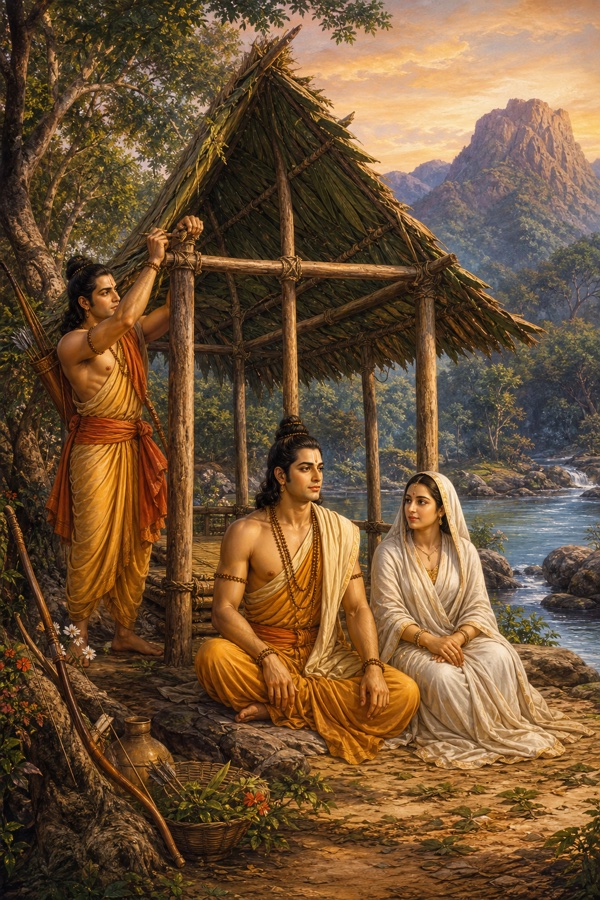
So saying, they went into the hermitage of Valmiki, and Sita and Rama, and Lakshmana with his palms joined, greeted the sage. Valmiki, that eminent sage who knew what was right, was delighted to see Rama, received them with honor, and said, “Be seated.” Rama presented himself to the seer with every propriety of that age, and then he said, “Lakshmana, fetch strong, good logs of wood and build a hut, gentle brother. My mind is set on living here.” Lakshmana heard the order, brought boughs of many kinds of trees, and the prince, subduer of his enemies, raised a hut of leaves.
Rama looked at the hut, braced with a wall of strong wooden stakes, thatched, and charming to the eye, and he said to Lakshmana, who stood listening with all his attention, “We will fetch the pulp of the bulb called gajakanda and propitiate the deity who presides over the hut with it. Those who wish to live long must go through the rite that appeases the spirit haunting a newly raised dwelling. Dig out the bulb and bring it here at once, fair-eyed Lakshmana; the procedure the scriptures lay down must be kept. Always keep your sacred obligations in mind.” Lakshmana, the destroyer of hostile warriors, grasped his eldest brother’s command and did as he was told, and Rama said to him again, “Cook this bulb. With it we will propitiate the deities who preside over the hut, the god of fire and Parjanya, the rain-giver, and the rest of them, fifty in all. Be quick. The present hour is propitious, and this day bears the name Dhruva, the fixed, the undying.”
Lakshmana dug out that bulb with its black skin, fit to be offered to the gods, and cast it into the blazing fire. When he was sure that its pulp was fully roasted and cooked through and had lost its ruddy color, he said to Rama, “This bulb, the gajakanda with the black skin, the one that sets every disordered limb right, I have cooked thoroughly. Now propitiate the gods who preside over the hut by offering it to them, for you are well versed in the rite, brother who rivals the gods in glory.” Rama bathed. He was fully disciplined, full of every virtue, and versed in the texts to be murmured on such an occasion, and he went through, in its short form, the Vastu-shanti, the rite of peace for a new dwelling, reciting the texts that close a sacrifice. Then he bathed in the Mandakini in the way the scriptures prescribe, murmured the Gayatri and the other sacred texts in their proper order, and, meaning to ward off every evil that attends a new house, performed the Vaishvadeva, the offering to all the gods with its portions of cooked food set out for them and for the fire that carries the food, and after it made fine oblations to Rudra and to Vishnu.
Rama built and consecrated altars in proportion to the hut for oblations to the eight guardians of the quarters and the points between them, and shrines for Ganesha and the other gods, and sanctuaries for Vishnu and the rest. When he had propitiated every host of gods presiding over the newly built hut, and was pure, Rama entered it, and a great contentment came over him, whose glory had no limit. As the multitudes of the gods enter their assembly hall in heaven, Sudharma, so the three exiles entered together, to live there, that lovely hut, thatched with the leaves of trees, well built on a fit site, sheltered from the wind. Rama had reached Chitrakuta, that most delightful of places, and the famous river Malyavati, the Mandakini, with its good bathing places, sought out by beasts and birds, and he rejoiced, and the grief of his exile from the city of Ayodhya fell away from him.
A key to reading (eneya and gajakanda): The Sanskrit has the words “eneya mamsa.” The Gita Press commentators take “mamsa” here as the pulp of a bulb called gajakanda, which the lexicon Madanapala Nighantu lists under the name “mriga,” and they refuse the reading “the flesh of a deer,” because Rama had already vowed three times, before his mother, before his father, and before Bharadvaja two evenings earlier, to live on roots, bulbs, and fruit and to forgo meat like the ascetics, and the poet himself says of Rama elsewhere that he never goes back on his word. So the rendering is of the bulb’s pulp, and the rite Lakshmana cooks it for is the house-blessing.
The gist: Seeing the beauty of Chitrakuta, Rama resolves to settle there. Reaching Valmiki’s ashram, Lakshmana builds the leaf hut, and Rama, on a day named Dhruva at a propitious hour, does the house-blessing in full, from the roasted gajakanda offered to the fifty deities of the dwelling to the altars for the guardians of the quarters, and enters the hut. Here, at last, the grief of the parting from Ayodhya begins to ease.
Source: Srimad Valmiki Ramayana, Ayodhyakanda, Cantos 14 to 56; this second part follows Cantos 40 to 56. The Gita Press Hindi edition is the controlling witness. The Sanskrit e-text and an independent complete translation were used to verify names, sequence, and principal events. Where recensions differ, this retelling follows Gita Press.
Basis: Valmiki Ramayana (Gita Press, Gorakhpur)