On this page
Find these passages in the source
This episode continues the end of Narada’s Sunda-Upasunda story and reaches the end of Adi Parva. Gita Press chapters 211 to 233 correspond here to Ganguli sections CCXIV to CCXXXVI (214 to 236). Their numbering differs. These five turns orient the retelling; the division of the kingdom and the building of Indraprastha (Ganguli 203 to 213) are told in chapter 7a, just before this one.
- Tilottama and the brothers’ rule
Gita Press 211 · Ganguli CCXIV (214) - Arjuna’s journey and marriage to Subhadra
Gita Press 212 to 220 · Ganguli CCXV to CCXXIII (215 to 223) - Agni’s request and the divine weapons
Gita Press 221 to 224 · Ganguli CCXXIV to CCXXVII (224 to 227) - The burning, the battle, and Maya’s survival
Gita Press 225 to 227 · Ganguli CCXXVIII to CCXXX (228 to 230) - Jarita’s chicks and the close of Adi Parva
Gita Press 228 to 233 · Ganguli CCXXXI to CCXXXVI (231 to 236)
Editions and comparison: Gita Press (Adi Parva 211 to 233); K. M. Ganguli (Adi Parva CCXIV to CCXXXVI (214 to 236)).
Narada had come to the Pandavas at Khandavaprastha with a warning, and he had put it in the form of a story that was now at its last turn. The treasures of the gods, the gandharvas, the yakshas, the nagas, the rakshasas and every king on earth had been carried home to them. The weariness of the long campaign had worn off, the brothers could think of nothing further that needed doing, and so they gave their days to pleasure the way the immortals do: women, perfumes, garlands, food and drink, each in greater plenty than they could use, taken in houses and gardens, in woods and on hillsides, wherever the mood found them.
Tilottama and the end of the two asura brothers
One day the mood took them to the Vindhya range, to a tableland of level stone grown over with trees in blossom. Everything they might want had been carried up ahead of them, all of the most pleasing kind, and the two settled contentedly on a fine seat with beautiful women around them. The women, eager to please, began to dance to music and to sing, song after sweet song, in praise of the pair who had beaten the world.
Up the slope toward them, picking wildflowers as she came, walked the woman who had been made for this hour. Brahma had ordered her built, the craftsman of the gods had assembled her from a small measure of every gem in creation, and she had been sent to the brothers with one instruction: let them see you, and let them quarrel. Her name was Tilottama. She wore a single length of red silk that hid nothing of her, and she came on slowly. The brothers had been drinking deeply, and the sight of her went through them both at once. They left their seat and hurried to where she stood, each of them wanting her for himself alone, and Sunda took her, this woman of the lovely brows, by her right hand.
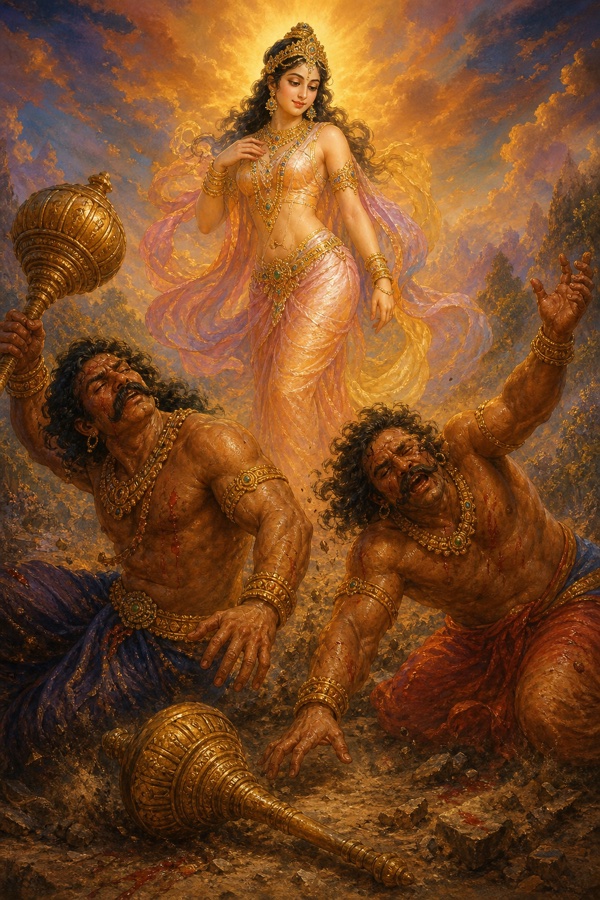
They were drunk four times over: on the boons they had won, on the strength of their own bodies, on the wealth and jewels gathered from every quarter, and on the wine. Desire came on top of all four and finished the work. They turned to face each other with their brows drawn tight. “She is my wife,” said Sunda, “which makes her your superior.” “She is my wife,” said Upasunda, “which makes her your sister-in-law.” Then each to the other: “She is mine. She is no part of yours.” Rage came up fast, and under it the love and loyalty of a lifetime were forgotten. Passion had taken their reason, and each took up his terrible mace. Each shouted that he had been first, he had been the first to take her hand, and each swung. The two fierce asuras went down together, their bodies running with blood, like two suns knocked loose from the sky.
The women who had come up to the tableland saw it, and so did the other asuras in attendance, and all of them ran, shaking with grief and terror, and did not stop until they had hidden themselves in the regions under the earth. Then Brahma himself came to the place, with the gods and the great rishis behind him. He praised Tilottama for what she had done and wished to reward her, and before she could say a word he named the reward himself, gladly: “You will move through the region of the Adityas, lovely one, and your radiance will be so strong that no one will be able to look at you for long.” With that gift given, he set the three worlds back under Indra’s rule, as they had been before the brothers, and returned to his own realm.
A key to reading this (the idea): Tilottama was made to order. At Brahma’s command the divine craftsman Vishvakarma built her with a minute portion of every gem there is, and Brahma gave her the name that records it. She was needed because of the boon the brothers had won from Brahma by their austerities: they were to have nothing to fear from any creature in the three worlds, moving or unmoving, except each other. Their deaths could come from one direction only, and she was sent to open it.
“That is how it went,” Narada told the five brothers. “Two asuras who had never once been divided, who had wanted the same things all their lives, killed each other in a rage over Tilottama. I tell you this out of affection for you, princes of the Bharata line. If you wish to please me, make some arrangement among yourselves so that you never come to quarrel over Draupadi.”
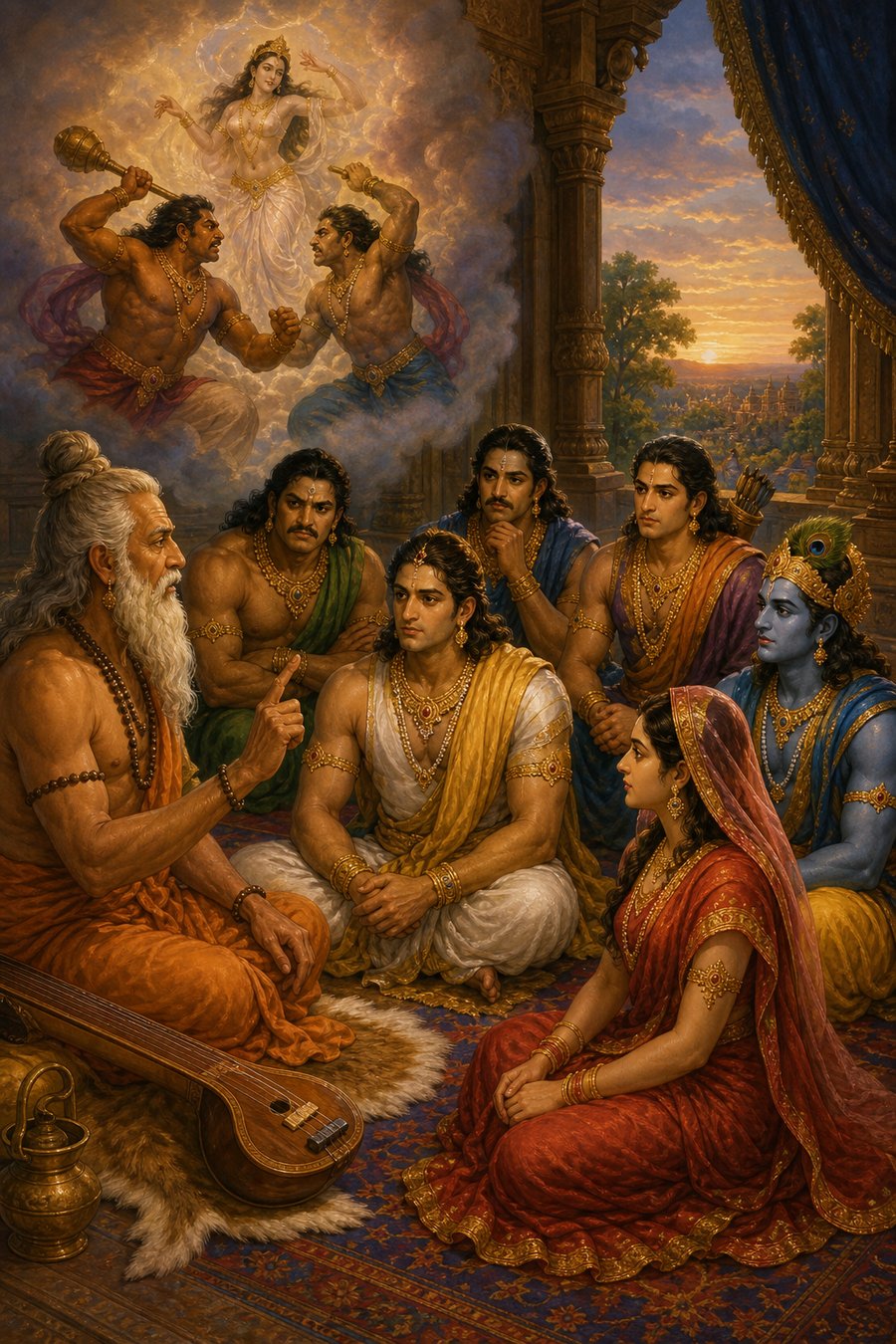
The Pandavas took the point. Draupadi was the wedded wife of all five of them, and Narada had named the one thing that could divide them. They talked it over among themselves, and while the divine rishi was still present to witness it they made a rule. Whenever one brother was sitting with Draupadi, any of the other four who came upon him so must leave for the forest and live there for twelve years as a brahmachari, under a vow of celibacy. Narada was pleased with them, and went on his way to wherever he wished to go. That rule about their shared wife, Vaishampayana told King Janamejaya, who was hearing the history of his own forefathers, was the reason no quarrel ever broke out among the five.
The gist: Narada closes the story of Sunda and Upasunda, two inseparable brothers who clubbed each other to death over Tilottama, and asks the Pandavas to guard against the same end. In his presence they bind themselves: a brother who sees another sitting with Draupadi goes to the forest for twelve years of celibacy.
The Brahmin’s cattle and the rule Arjuna broke
With the rule made, the Pandavas went on living at Khandavaprastha, and by the strength of their arms they brought king after king under their authority. Draupadi gave herself faithfully to all five sons of Kunti, men with the courage of lions, and she was happy in them and they in her, the way the river Sarasvati is glad of the elephants that crowd her water and the elephants are glad of the river. The brothers kept so strictly to what was right that the whole Kuru people shared in the result: they prospered, they were content, and no guilt lay on them.
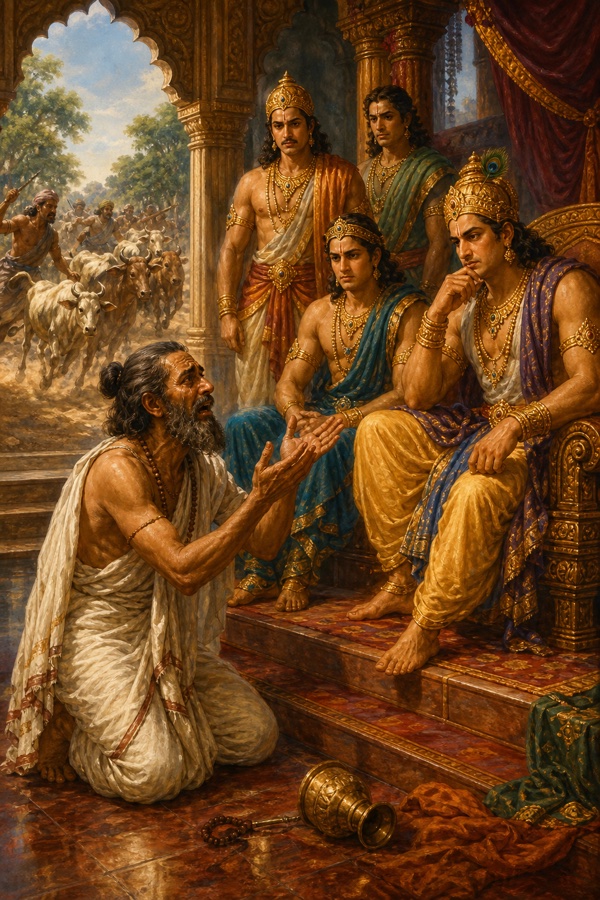
Then, some time later, thieves drove off a Brahmin’s cattle. While the herd was still on the road the Brahmin, beside himself with anger, came to Khandavaprastha and stood at the Pandavas’ gate crying out against them. “Pandavas! Here, in your own kingdom, low and vicious men are driving off my cows by force, this very hour. Go after them! The butter a peaceful Brahmin keeps for the sacrifice is being carried off by crows. A wretched jackal has walked into the lion’s cave and found it empty. The wise have a name for a king who takes his sixth of the harvest and gives no protection for it: they call him the worst sinner in the whole world. A Brahmin is being robbed, and right itself is growing smaller while you stand there. Take me by the hand, Pandavas. I am sinking in grief.”
Arjuna heard the man weeping and shouted back at once, “Have no fear!” Then he remembered where the weapons were. The Pandavas kept their arms in a single chamber, and in that chamber, at that hour, Yudhishthira was sitting with Draupadi. Arjuna could not go in, and he could not go off with the Brahmin unarmed, and the Brahmin kept calling to him, each cry more wretched than the last. So he stood and thought it through, heavy at heart. This man has done nothing, and he is being stripped of what he owns. He has come to our gate in tears, and it is for me to dry them. If I leave him unprotected, my indifference stains the king, the whole kingdom will talk of how we failed in our duty, and the sin will be a great one. If I walk in on the king, I break faith with a brother who has no enemy in the world, and I earn the forest. Then let it be the forest. Let it be the sin of slighting the king, and let me die out there in the woods if it comes to that. What is right is worth more than the body, and it is still standing when the body is gone.
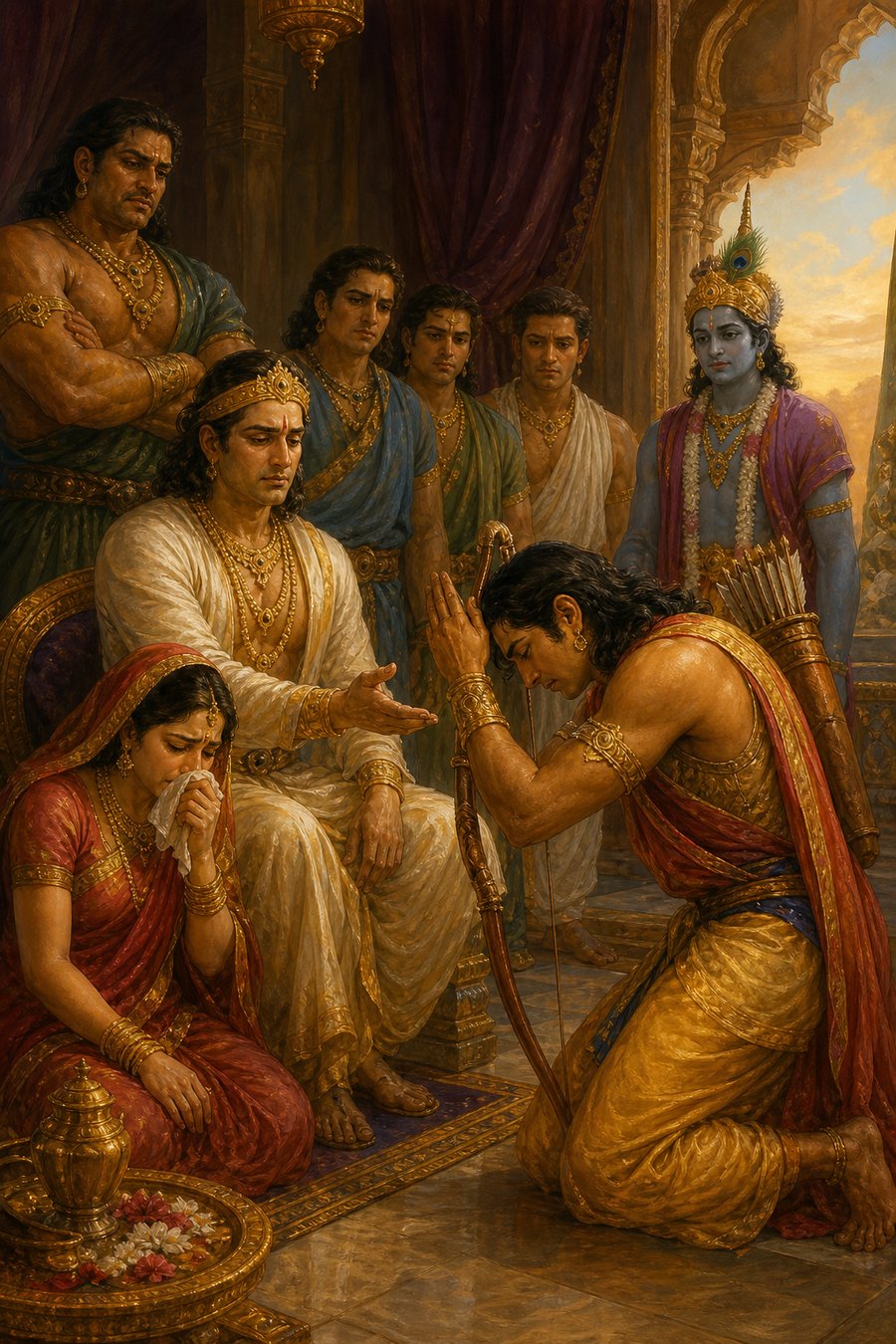
His mind made up, he went in, spoke with Yudhishthira, and came out carrying his bow. “Quickly, Brahmin,” he said, and he said it cheerfully. “Those wretches must not get much farther ahead of us. I am coming with you, and what has fallen into thieves’ hands will be back in yours.” He put on his mail, took up the bow he could draw as well with one arm as with the other, mounted his war chariot with its standard flying, and went after them. His arrows found the robbers, and they gave up the herd. He handed the cows back to the Brahmin, and came home to the capital with great fame won. He bowed to the elders, one after another, and accepted the congratulations everyone pressed on him. Then he went to Yudhishthira. “Give me leave, my lord, to keep the vow I took. I saw you sitting with Draupadi, and I have broken the rule we made for ourselves. I am going to the forest. That was our agreement.”
The words hit Yudhishthira without warning. Grief took him, and all he managed at first, in a voice that shook, was “Why?” After a little while he tried again, speaking to this curly-haired younger brother who had never yet gone back on a vow. “If my word counts for anything with you, then listen to it. I know exactly why you came into that room, and I know you think you did me an injury. I feel none. There is no displeasure anywhere in me. A younger brother may walk into the room where his elder sits with his wife and commit no fault at all. The offense against propriety runs the other way, when an elder walks in on a younger brother and his wife. So give this up. Do as I ask. Your virtue has lost nothing, and you have shown me no disrespect.”
Arjuna answered, “I have heard it from you yourself: in the doing of one’s duty there is no room for quibbling. I cannot bend away from the truth. Truth is my weapon.”
The king gave his permission, since permission was all that was left for him to give. Arjuna made himself ready for a forest life and went out to live it for twelve years.
A sub-tale: Yudhishthira’s offer is a real one. By his reading the fault lies only with an elder who walks in on a younger brother and his wife, so Arjuna could have stayed at home with a clear record. He had already counted the cost at the door of the weapons room, exile and perhaps death in the woods, set it against a Brahmin’s stolen herd, and gone in. He answers the king with the king’s own teaching, that duty leaves no room for quibbling, and pays a penalty his judge has just waived.
The gist: Thieves take a Brahmin’s cattle, and the only way to Arjuna’s bow lies through the room where Yudhishthira sits with Draupadi. He enters, recovers the herd, and claims the penalty himself. Yudhishthira argues that a younger brother commits no fault by entering. Arjuna refuses to quibble with his own vow and leaves for twelve years in the forest.
Arjuna’s pilgrimage and the naga maiden Ulupi
Arjuna, who spread the fame of the Kuru house wherever he went, left for the forest with a crowd behind him. Brahmins who knew the Vedas walked out after him and kept walking: scholars of the Vedas and their branches, men given to contemplation of the Supreme Spirit, musicians, ascetics devoted to God, reciters of the Puranas, tellers of sacred stories, celibate devotees, forest hermits, Brahmins who could recite the histories of the gods in voices worth hearing, and others whose gift was simply good talk. He traveled in the middle of them like Indra with the Maruts around him. The road showed him forests and lakes, rivers and seas, whole provinces and their sacred waters, each of them worth the stopping, until he came to the source of the Ganges, where the river comes down into the plains, and thought of settling there.
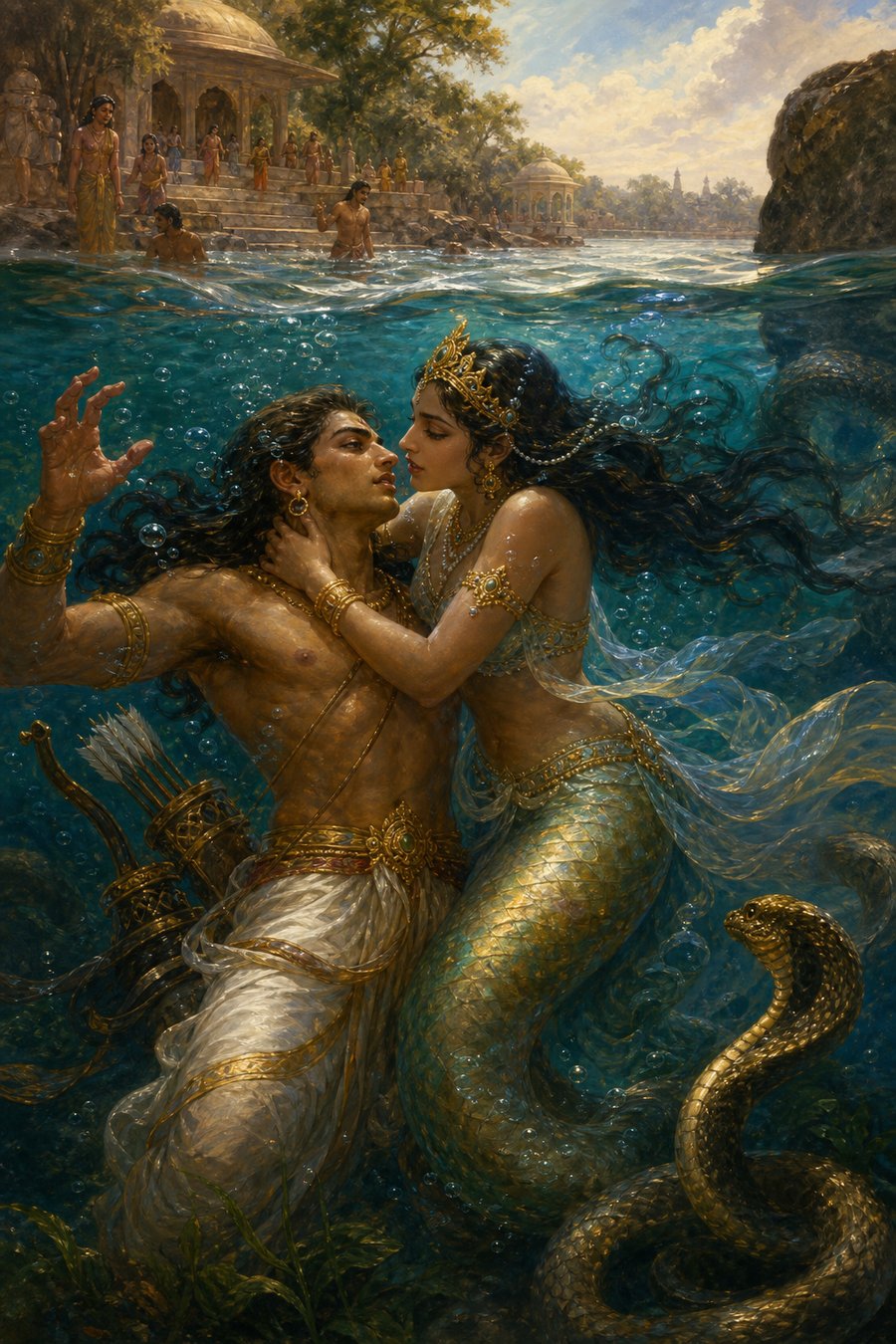
What he did there, Vaishampayana told the king, was a marvel worth the hearing. Arjuna and the Brahmins made their home in that country, and the Brahmins, learned men who kept their vows and never left the right path, filled the riverbank with fire. Every day after bathing they laid and lit their sacrificial fires with the proper mantras, poured clarified butter into them, and honored them with offerings of flowers, agnihotra after agnihotra beyond counting, until the stretch where the Ganges enters the plains was a beautiful thing to see. One day Arjuna went down into the river, as he did every day, to bathe. He finished, and he offered water to his dead ancestors. He was about to climb out and go to his own fire when something took hold of him and pulled him under, all the way to the bottom. It was Ulupi, daughter of the king of the nagas, and the god of desire had sent her.
She carried the son of Pandu down into the palace of Kauravya, the naga king, a beautiful place under the river. And there, waiting for him, Arjuna found a sacrificial fire already lit. He had been taken on his way to his rites, so he performed them where he was, with full devotion, and Agni, the god in the fire, was well pleased with a man who could pour his offerings into the flame so fearlessly in such a place. Only when the rite was complete did Arjuna turn to the naga king’s daughter. He was smiling. “That was a reckless thing to do, lovely one, and you look far too timid to have done it. Whose country is this? Who are you, and whose daughter?”
“There is a naga named Kauravya, born in the line of Airavata,” she said. “I am his daughter, prince, and my name is Ulupi. I saw you come down into the water to bathe, and the god of desire took my senses from me. I am not yet married. It is because of you that I am suffering, so make me happy today. Give yourself to me.”
“King Yudhishthira has laid a vow on me,” Arjuna said gently. “For twelve years I am to live as a brahmachari, and I am not free to do as I like. I would still be glad to please you, woman of the waters, if a way exists. I have never told a lie in my life. So tell me how I can do what you ask and be guilty of no untruth and no breach of my duty.”
Ulupi had her answer ready. “I know why you are wandering the earth, son of Pandu, and I know why your elder ordered you to live as a brahmachari. All of you who share Drupada’s daughter made a compact: whoever should blunder into the room where another sat with her would spend twelve years celibate in the forest. The exile of any one of you is on Draupadi’s account and concerns her alone. You are keeping the duty that vow created, and nothing you do for me can make your virtue smaller. Think further, large-eyed one. It is a duty to relieve those in distress, and relieving me costs your virtue nothing. Suppose it did cost you some small part: you would earn far more by saving a life, and it is my life I am speaking of. I worship you, Arjuna. Give yourself to me. The wise hold that a woman who comes asking should be accepted. Refuse, and understand that I will kill myself. You have always sheltered the wretched and those with no one to protect them, son of Kunti. I am asking for that shelter now, in tears, full of longing. Do this for me.”
Arjuna did everything she asked, and he did it with what was right as his reason. He spent that night in the naga’s palace and rose with the sun. Ulupi came up with him out of Kauravya’s halls to the place where the Ganges enters the plains, and there the virtuous woman took her leave and turned for home. She gave him a gift before she went: he would never be beaten in water. “Every creature that lives in the water,” she told him, “will be yours to overcome. Have no doubt of it.”
A key to reading this (the lineage): Ulupi gives her own line: her father is Kauravya, king of the nagas, born in the family of Airavata. His palace lies under the Ganges at the place where the river enters the plains, which is where Arjuna is taken and where Ulupi brings him back the next morning.
The gist: At the Ganges the naga princess Ulupi pulls Arjuna to the riverbed and into her father Kauravya’s palace, where he calmly completes his fire rite. She argues that his vow of celibacy concerns Draupadi alone and that saving a life is a duty. He consents, stays one night, and leaves with her gift: no creature of the water can defeat him.
Chitrangada, princess of Manipura
Back among the Brahmins, Arjuna told them the whole of it, and then he turned toward the Himalaya. He went first to the place called Agastyavata, and from there to Vasishtha’s peak, and from there to the peak of Bhrigu, where he bathed and performed the rites of purification and gave the Brahmins cows by the thousand and houses to live in. Next came the sacred hermitage of Hiranyabindu. He bathed there too, and the country around it showed him one holy place after another. Then he came down out of the heights with the Brahmins still beside him and walked east, because he wanted to see what lay in that direction.
The east was a country of sacred water, and he took the places in order as they came. In the Naimisha forest he saw the river Utpalini with its lotuses, the Nanda and the Apara Nanda, the Kaushiki whose name is known everywhere, the great rivers Gaya and Ganga, and every bathing place among them, and he purified himself with the proper rites and gave many cows to the Brahmins. Vanga and Kalinga had their own sacred waters and shrines, and he missed none: he saw them all, performed what each required, and gave away a great deal of wealth. At the gate of the kingdom of Kalinga the Brahmins who had walked with him all this way stopped. They said their farewells there and came no farther.
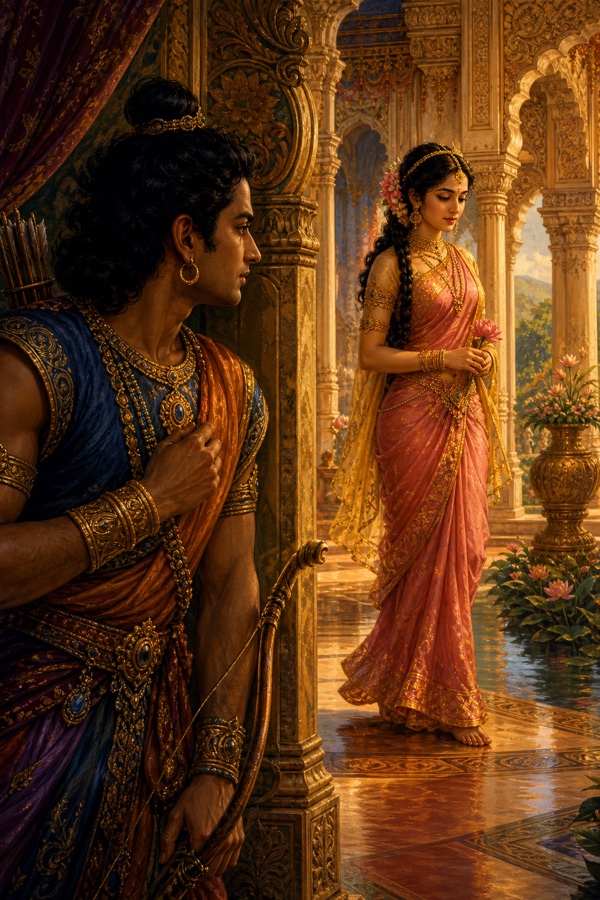
With their leave Arjuna went on toward the ocean, and now only a few attendants traveled with him. He crossed the country of the Kalingas, passing lands and holy sites and handsome houses as he went, saw Mount Mahendra with ascetics living on its slopes, and followed the seashore slowly to Manipura. He visited the sacred waters and shrines of that province as he had everywhere else, and at last presented himself to its ruler, the upright King Chitravahana. The king had a daughter named Chitrangada, and she was very beautiful. Arjuna happened to see her in her father’s palace, walking about as she pleased, and wanted her for his own. He went to the king and said what he had come for. “Give me your daughter in marriage. I am the son of a Kshatriya of high name.” “Whose son?” the king asked. “I am Dhananjaya,” said Arjuna, “the son of Pandu and of Kunti.”
The king’s answer came mildly, and it was a family history. “There was once a king in our line called Prabhanjana, and he had no child. To get one he took on fierce austerities, and by them he pleased Shiva himself, the god of gods, Uma’s husband, the lord who carries the bow Pinaka. The boon Shiva gave him was that every man of his line in turn should have a child, and only one. So it has gone, one child to each generation. Every ancestor of mine had a son. I have a daughter, and she is all there is to carry the family on. I have always regarded her as my son, and I have made her a putrika in the proper way, a daughter appointed to continue her father’s line. So one of the sons you father on her must be the one who continues mine. That son is the bride-price I ask for her. If you choose to, son of Pandu, you may take her on that understanding.”
Arjuna agreed to every word of it. “So be it,” he said, and he took Chitravahana’s daughter as his wife and lived in that city for three years. When Chitrangada at last gave birth to a son, he held the princess close, took his leave of the king her father, and set out on his wanderings again.
A key to reading this (the idea): Chitravahana calls his daughter a putrika. She is the only child of a line in which, by Shiva’s boon to Prabhanjana, each generation has exactly one, so her son is to continue her father’s family, and the king names that son as the price of the marriage. Arjuna accepts the terms, and when he passes through Manipura again he finds the boy, Babhruvahana, seated on its throne.
The gist: Walking east and then along the coast, Arjuna reaches Manipura and asks King Chitravahana for his daughter Chitrangada. The king gives her as a putrika, on condition that a son of the marriage carries on the royal line of Manipura. Arjuna stays three years, sees the son born, and moves on.
The five crocodiles and the freed apsaras
From Manipura he went on to the sacred waters along the shore of the southern ocean, a coast with ascetics settled all along it. Five of those bathing places lay in one neighborhood, and ascetics lived around them too, yet no one went into the water at any of the five. They had names, and reputations: Agastya, Saubhadra, Pauloma of great holiness, Karandhama, a place of great good fortune where a bath earned the merit of a horse sacrifice, and Bharadvaja, which washed sin away. Arjuna looked at five famous waters with nobody in them, satisfied himself that the holy men of the district really were keeping clear, and went to them with his palms joined to ask why. “Why do those who chant the Veda avoid these five sacred waters?” The ascetics told him. “Five great crocodiles live in them, and they carry off any ascetic who goes in to bathe. That is why they are shunned.”
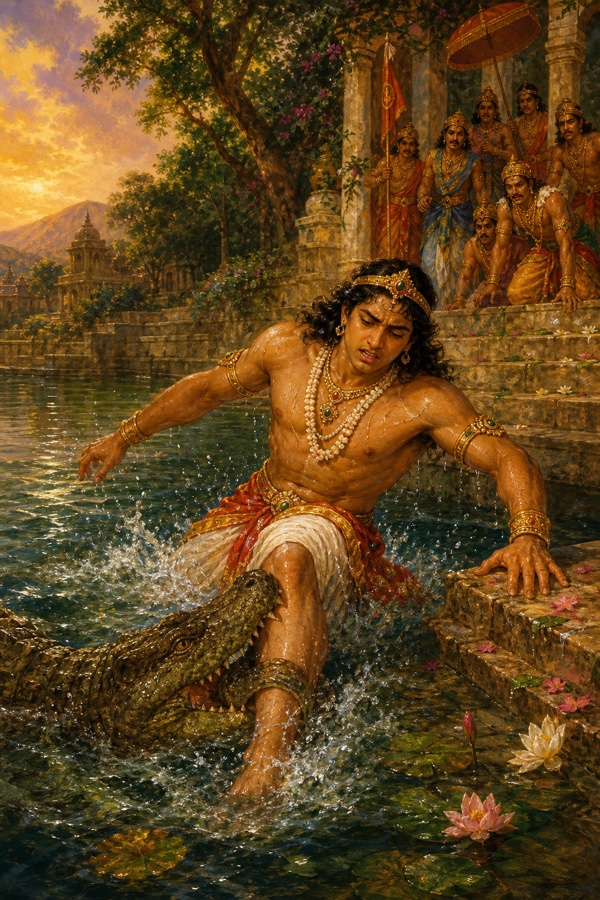
They tried to talk him out of going near. He went anyway. He came to Saubhadra, the fine water named for a great rishi, and plunged straight in to bathe, and he had hardly gone under before a great crocodile had him by the leg. Arjuna, whose arms were as strong as any man’s alive, took hold of the thrashing animal and hauled it by main force up onto the shore. On dry land it changed. Where the crocodile had been there stood a beautiful young woman, jeweled, shining with a beauty that belonged to heaven. Arjuna looked at this strange thing with delight and asked her, “Who are you, lovely one? What were you doing living in the water? And why would you commit so terrible a sin as this?”
“I am an apsara, strong-armed one,” she said. “I used to play in the forests of heaven. My name is Varga, and Kubera, the treasurer of the gods, has always been fond of me. I have four companions, every one of them lovely, every one able to go wherever she pleases. One day the five of us were on our way to Kubera’s house, and on the road we saw a Brahmin, a strict keeper of his vows and a very handsome one, studying the Vedas alone. The whole forest around him seemed to be covered by the glow of his austerity. He lit that place the way the sun does. We saw how deep his devotion went, and how beautiful he was, and we came down there to break his concentration. Saurabheyi, Samichi, Budbuda, Lata and I went up to him together. We sang, we smiled, we tried everything we knew. He never once let his heart turn toward us. His mind was set on pure meditation and it stayed there, and the one look he did give us, hero, was a look of anger. He stared at us and said, ‘Become crocodiles, and range the waters for a hundred years.’”
“That curse left us wretched,” Varga went on. “We tried to win him over, that Brahmin rich in austerity who had never left his vow. We said to him, ‘We were vain of our looks and our youth, the god of desire was driving us, and we have behaved very badly. Forgive us, Brahmin. It was death to us that we ever came here to tempt a man of such vows and such merit. Yet the virtuous have said that women must never be killed. Grow in virtue, then, and do not kill us this way. You know what is right, and it is said that a Brahmin is the friend of every living creature. Let that saying of the wise prove true. The great protect those who come to them for protection. We have come to you. Pardon us.’”
The Brahmin was a man of upright soul and good deeds, and he shone like the sun or the moon. He softened toward them. “The words hundred and hundred thousand are both used to mean forever,” he said. “When I said a hundred, I meant a fixed term with an end to it. As crocodiles you will seize men and drag them away, for a hundred years and no longer. When the time is up, a great man will pull you all out of the water onto dry land, and you will have your own forms again. I have never said an untrue thing, even as a joke, so every part of this will happen. And the waters where I am placing you will be known across the world, once he has freed you, as the Nari-tirthas, the women’s waters, sacred and able to wash away sin in the judgment of the good and the wise.”
Varga came to the end of it. “We bowed to him and walked around him in respect, and then we left that place heavy at heart. As we went we kept asking one question: where are we going to find him, and how soon, this man who will give us back our shapes? We were still turning it over when, almost at once, we saw the great divine rishi Narada. The sight of him filled us with joy. We bowed to him, Arjuna, and stood in front of him with our faces burning. He asked what was grieving us, and we told him everything. Then he said, ‘In the low country along the southern ocean there are five sacred waters, lovely and very holy. Go there, and do not delay. Dhananjaya, the pure-hearted son of Pandu, will come soon and free you from this misery. Do not doubt it.’ So all of us came here. And it is true: today you have set me free. My four friends are still in the other waters. Do one more good thing, and free them too.”
Arjuna did it gladly. The remaining four came up out of their waters and stood in their own shapes, and all five apsaras looked exactly as they had before the curse. The bathing places were safe again. He gave the apsaras leave to go wherever they liked, and found that what he himself wanted was to see Chitrangada once more. So he went back to the city of Manipura, and there, on the throne, he saw the son he had fathered on her, whose name was Babhruvahana. He saw Chitrangada again, and then he took the road to the place called Gokarna.
The gist: On the southern coast five sacred waters stand empty because of five crocodiles. Arjuna bathes at Saubhadra, is seized, and drags the animal ashore, where it becomes the apsara Varga. She and her four companions had tried to distract a Brahmin at his studies and been cursed to live as crocodiles for a hundred years, until a great man should pull them onto land. Arjuna frees all five, revisits Manipura, sees his son Babhruvahana on its throne, and goes on to Gokarna.
Meeting Krishna at Prabhasa, and entering Dwarka
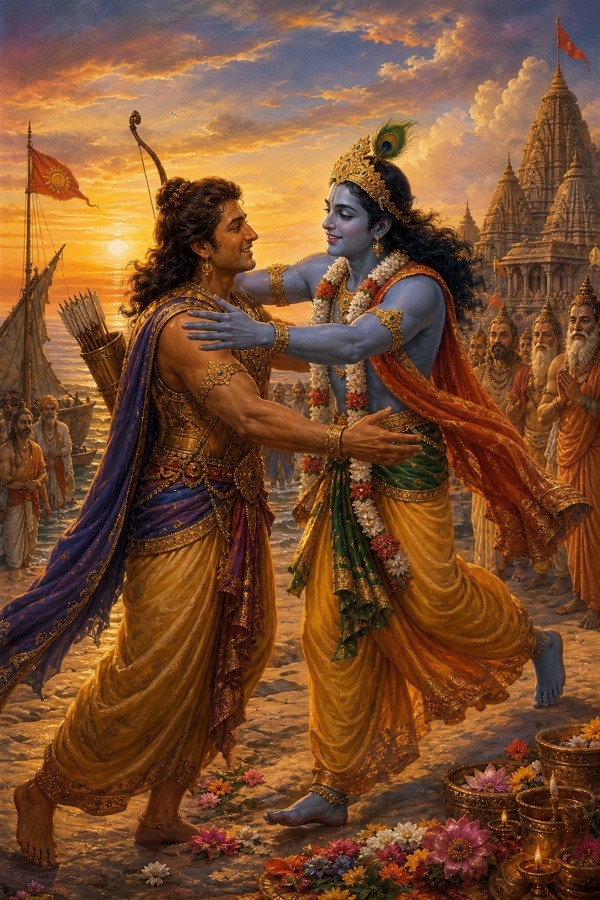
After the south, the west. Arjuna, whose strength no one had yet found the limit of, worked his way along the shore of the western ocean from one sacred water and shrine to the next, and so came to the holy ground called Prabhasa. Krishna heard that Arjuna had reached that sacred and lovely place, and went at once to see his friend, Kunti’s son. They met, and embraced, and each asked how the other had been. Then the two of them sat down together, close friends who were also the ancient rishis Nara and Narayana, and Krishna asked about the journey. “Why are you wandering the earth, Pandava, visiting every sacred water and shrine there is?” Arjuna told him all of it, from the beginning. Krishna, the great hero of the Vrishni clan, heard him through and said, “That is as it should be.”
They stayed at Prabhasa for a while, enjoying themselves as they pleased, and then went on to Mount Raivataka to spend some days there. Krishna had sent orders ahead. By the time they arrived, craftsmen had dressed the whole mountain for a guest, and food had been laid in, in quantity. Arjuna enjoyed everything that had been prepared for him, and sat beside Krishna to watch the actors and the dancers perform. Afterward he sent the performers away with the courtesies due to them and lay down on a fine, richly made bed. Lying there, he began to tell Krishna about what he had seen: the sacred waters, the lakes, the mountains, the rivers, the forests. He was still describing them, stretched out on that heavenly bed, when sleep came and took him in the middle of the telling.
He woke in the morning to music: sweet singing, the notes of the vina, and the bards chanting his praises and their blessings. He performed the rites the morning required, and Krishna greeted him with affection. Then Arjuna climbed into a golden chariot and set out for Dwarka, the capital of the Yadavas. The city had been decorated in his honor, every garden and every house in it. The people of Dwarka wanted to see Kunti’s son with their own eyes, and they poured into the main streets by the hundred thousand. In the squares and along the avenues, women in their hundreds and thousands stood in among the men and swelled the gathered crowd of the Bhojas, the Vrishnis and the Andhakas. All the sons of those three clans welcomed him with respect. He paid honor to everyone who was owed honor and received their blessings in return, the young men of the Yadavas received him with open affection, and he embraced, again and again, every man who was his own age. Then he went to Krishna’s delightful house, which was full of jewels and of every good thing, and lived there with Krishna for many days.
A sub-tale: The two friends who sit down together at Prabhasa are the ancient rishis Nara and Narayana, and the identification returns twice in the burning of Khandava. Brahma tells Agni that those old deities Nara and Narayana have been born among men to do the work of the gods, and are called Arjuna and Krishna on earth. Later a bodiless voice tells Indra the same thing, as the reason no one in any world can defeat them.
The gist: Arjuna reaches Prabhasa on the western coast, where Krishna comes to meet him and hears the story of his exile. After some days of entertainment on Mount Raivataka, Arjuna rides to Dwarka in a golden chariot. Its people crowd the streets to see him, and he settles in Krishna’s house for many days.
The festival on Raivataka and the carrying off of Subhadra
A few days later the great festival of the Vrishnis and the Andhakas opened on Mount Raivataka. It was the mountain festival of all three clans, Bhojas, Vrishnis and Andhakas, and their leading men began it by giving wealth away to Brahmins, thousands of them. All around the hill stood pavilions bright with jewels, and artificial trees in gaudy colors. The musicians struck up together, the dancers began to dance, and the singers sang. The young men of the Vrishnis, full of energy, wearing every ornament they owned, drove about in chariots trimmed with gold and looked magnificent. The townspeople came in their hundreds and thousands, some walking and some in fine chariots of their own, with their wives and their households behind them.
Balarama was there, the lord who carries the plow, wandering wherever he liked, cheerfully drunk, with his wife Revati beside him and a train of musicians and singers after him. Ugrasena was there, the powerful king of the Vrishnis, with his thousand wives and his own sweet-voiced singers. Rukmini’s son and Samba, those two who were always savage in a fight, went about flushed with wine in beautiful garlands and costly clothes, enjoying themselves like a pair of gods. Akrura came, and Sarana, and Gada; Babhru, Nishatha and Charudeshna; Prithu, Viprithu, Satyaka and Satyaki; Bhangakara, Maharava, Hardikya and Uddhava; and many more besides, each with his wives and each with a band of singers, and all of them added to the splendor of the mountain.
Into this great, glad noise walked Krishna and Arjuna, side by side, looking at everything. And there, as they wandered, they saw her: Vasudeva’s beautiful daughter Subhadra, whom her brother called Bhadra, in all her ornaments, with her maids around her. Arjuna saw her and the god of desire had him in the same instant. Krishna noticed. He watched his friend stare, lost to everything else, and said with a smile, “What is this? Can a man who lives in the woods have his heart shaken by desire? That is my sister, Arjuna, born of the same mother as Sarana. Her name is Bhadra, bless you, and she is my father’s favorite daughter. Tell me if your heart is set on her, and I will speak to my father myself.”
“She is Vasudeva’s daughter and Krishna’s sister,” Arjuna said, “and she looks like that. Whom could she fail to enchant? If this sister of yours, this daughter of the Vrishnis, becomes my wife, then everything in my life will have gone well. Tell me how I can win her, Krishna. I will do anything a man is able to do.”
Krishna considered it as a practical matter. “For Kshatriyas the ordained way to marry is the svayamvara, where the bride chooses for herself. The trouble with that, Arjuna, is that nobody can say how it will end. We do not know this girl’s temper or her mind. For Kshatriyas who are brave there is another way, and the learned praise it: to carry the bride off by force. So carry my lovely sister off, Arjuna. Who knows what she would do at a svayamvara?” The plan was settled between them then and there, and fast messengers went to Yudhishthira at Indraprastha to tell him the whole of it. Yudhishthira heard it and gave his consent at once.
Word of that consent came back to Arjuna. He learned, too, that the girl had gone up to Mount Raivataka. He went over everything that had to be done with Krishna one more time, and had Krishna’s consent as well.
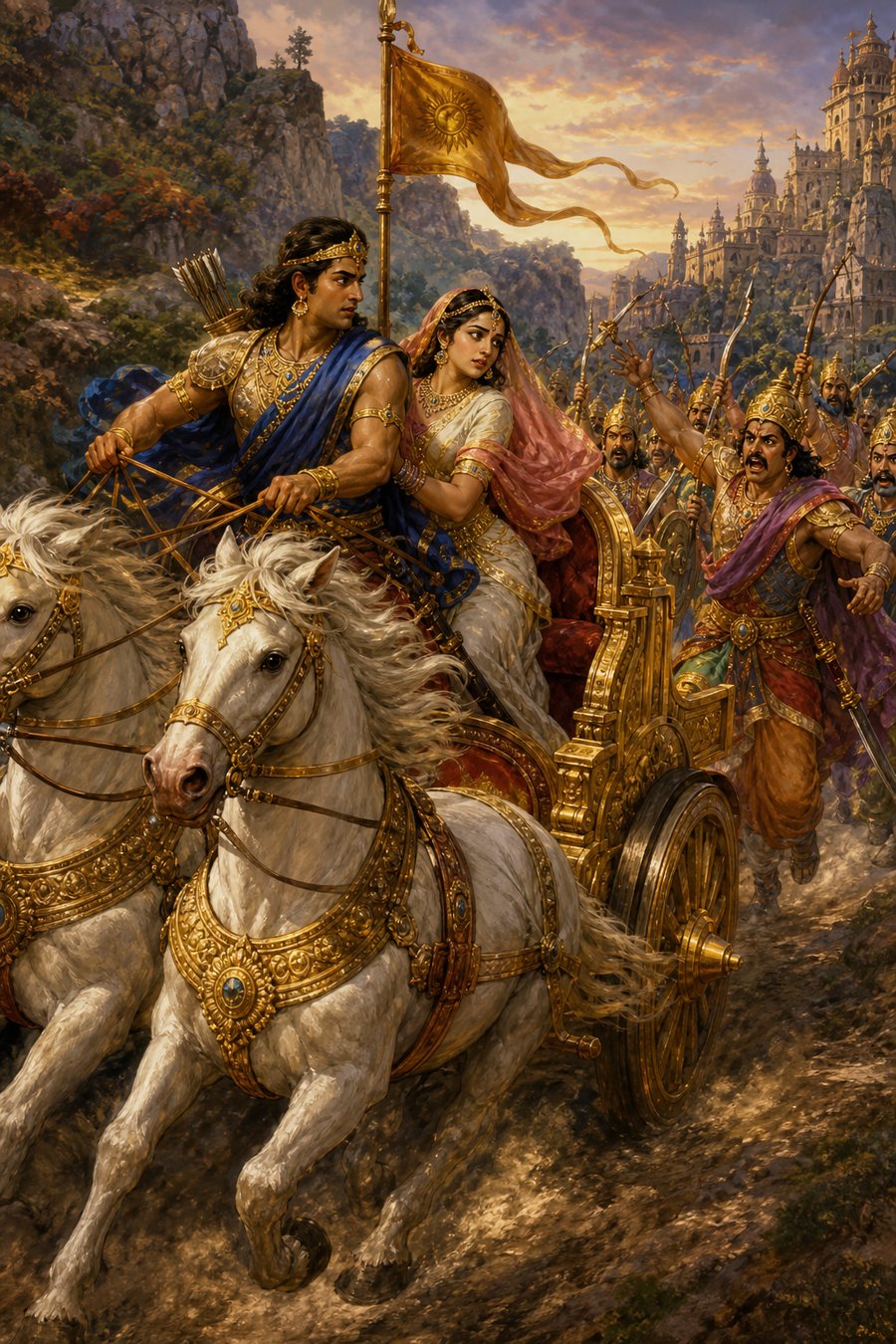
Then he armed. He put on his mail, belted on his sword, and drew the leather guards over his fingers, and he mounted a chariot of gold, well built, hung with rows of small bells and stocked with every kind of weapon, whose wheels sounded like thunderclouds and whose brightness was the brightness of a blazing fire, a thing to frighten any enemy who saw it coming. The horses in its harness were Shaibya and Sugriva. To anyone watching, he was a prince going out to hunt. Subhadra, meanwhile, had finished her worship. She had paid her respects to Raivataka, that prince of hills, honored the gods, received the blessings of the Brahmins, and walked the full circuit of the mountain, and she was on the road home to Dwarka. Arjuna, with the arrows of the god of desire in him, drove straight at that flawless Yadava girl, lifted her by force into the chariot, and with the sweet-smiling girl beside him turned the golden chariot toward his own city.
Subhadra’s armed escort saw her seized and taken, and they ran, all of them, shouting, back to Dwarka. They came in a body to Sudharma, the assembly hall of the Yadavas, and told the chief officer of the court everything about what Arjuna had dared. He heard the messengers out. Then he lifted his gold-mounted trumpet and blew the call to arms, loud and long. The sound went through the city, and the Bhojas, the Vrishnis and the Andhakas came pouring in from every side. Men who were eating left their food where it was. Men who were drinking put down their cups.
The great warriors of the Vrishnis and the Andhakas took their places on their thousand thrones of gold, thrones spread with fine carpets, set with gems and coral, bright as fire, and as each man sat the hall brightened, the way fires blaze up when wood is laid on them. It was an assembly like a council of the gods. When all were seated, the chief officer, with his men standing behind him, told them what Arjuna had done. The proud Vrishni heroes, their eyes red with wine, were on their feet as soon as they heard it. They could not stomach it.
“Yoke the chariots!” some shouted. “Bring our weapons!” shouted others. “Bring the costly bows and the strong mail!” Some bawled for their drivers to harness up, and some were too impatient to wait and went to yoke their gold-decked horses with their own hands. Chariots, armor and standards were being fetched, and the noise of angry men grew and filled the hall. Then Balarama spoke. He stood white and tall as a peak of Kailasa, with a garland of wildflowers on him and robes of blue, proud, and drunk. “You fools, what are you doing, while Krishna sits there and says nothing? We do not know what is in his mind, and here we are roaring to no purpose. Let him tell us what he proposes. Then do what he wants done, and do it promptly.”
It was sense, and they knew it. “Well said! Well said!” they called, and they went quiet, and the quiet that the clear-headed Balarama had made held while they found their seats again. Then Balarama turned on his brother. “Why are you sitting there staring and saying nothing, Krishna? It was for your sake that we welcomed the son of Kunti and honored him, and it turns out the wretch was never worth it. What man from a decent family eats his dinner and then smashes the plate? Even a man who wanted this very alliance, if he remembered what he had been given here and wanted any happiness afterward, would never go about it so rashly. He has slighted us, he has slighted you, and today he has laid violent hands on Subhadra. He must be looking for his own death. He has put his foot on the crown of my head, Krishna. Am I to bear that meekly? I will answer it the way a snake answers the foot that treads on it. I will empty the earth of Kauravas today, alone. I will never swallow this from Arjuna.” Every Bhoja, Vrishni and Andhaka in the hall roared his agreement, a deep sound like kettledrums, like thunder.
A key to reading this (the idea): Krishna names two ways a Kshatriya may marry. The first is the svayamvara, the bride’s own choice, which he calls uncertain because no one knows the girl’s mind. The second is to carry the bride off by force, which he says the learned praise in Kshatriyas who are brave. The seizure of Subhadra is therefore planned by her own brother and approved in advance by Yudhishthira. Balarama and the assembled clans, who were told nothing, take it as an insult from a guest.
The gist: At the mountain festival on Raivataka, Arjuna sees Krishna’s sister Subhadra and wants her for his wife. Krishna advises him to carry her off, Yudhishthira consents by messenger, and Arjuna takes her from the road in his chariot. The alarm sounds in Dwarka, the clans arm, and Balarama, furious, swears to empty the earth of Kauravas, while Krishna sits silent.
Krishna’s resolution and the marriage of Subhadra
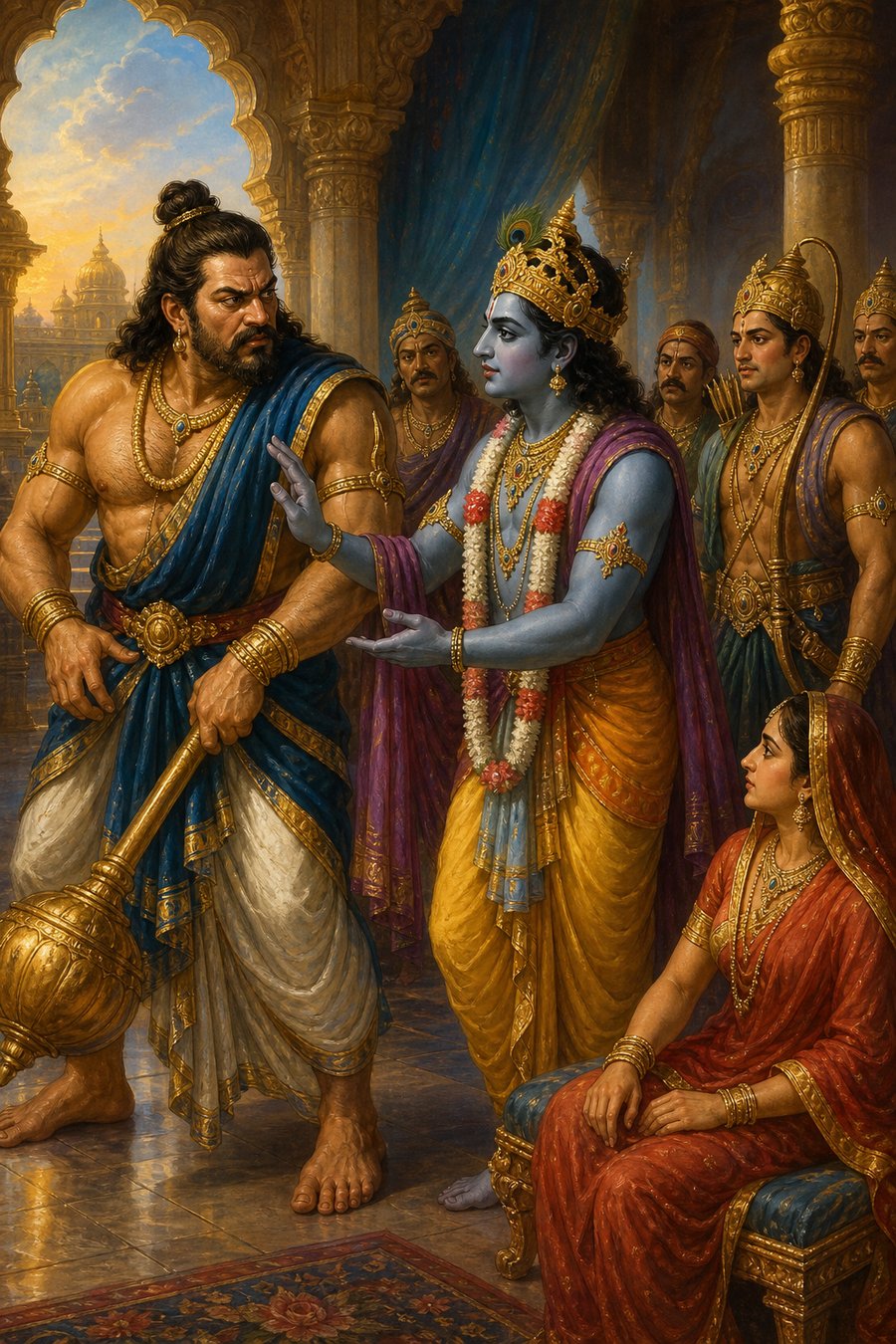
The Vrishni heroes said the same thing many times over and in many voices before Krishna answered them. When he did, what he said was weighty and it was sound. “Arjuna has not insulted this family by what he did. He has raised its standing, and I do not doubt it. He knows that we Satvatas cannot be bought. He also thinks, as I do, that nobody can tell how a svayamvara will turn out. And what are the other ways? Who would approve of taking a bride handed over as a gift, as if she were an animal? What man on earth would sell his own child? My belief is that Arjuna looked at the flaws in every other method and then took the girl by force, as the ordinance allows.
“The match is a very good one. Subhadra has a name, and so has he. Perhaps he thought of all this before he took her. Who would not want Arjuna for a friend? He is born in the line of Bharata and of the famous Shantanu, and his mother is Kuntibhoja’s daughter. In all the worlds, counting Indra and the Rudras, I can see no one able to beat him in a fight by force, except the three-eyed god Shiva. Everyone knows that chariot. The horses pulling it are my own. Everyone knows what kind of fighter he is, and how quick his hands are. Who is going to match him? So here is what I think. Go after him gladly, stop him with friendly words, and bring him back. If Arjuna reaches his own city after beating us in battle, our reputation is finished. There is no shame at all in making peace.”
They did as he told them. They caught up with Arjuna and stopped him, and he came back to Dwarka, and there he and Subhadra were married. The sons of the Vrishnis honored him, he enjoyed himself there as he liked, and a full year went by in Dwarka. The last year of his exile he spent at the sacred place called Pushkara. Then the twelve years were complete, and he came home to Khandavaprastha. He went to the king first. Next he paid his respects to the Brahmins with careful attention. Last of all he went in to Draupadi.
Draupadi was jealous, and she let him hear it. “What are you waiting here for, son of Kunti? Go where the Satvata girl is. Tie a second cord around a bundle and the first one always goes slack.” She said a good deal more in the same vein, grieving as she said it. Arjuna soothed her, and kept soothing her, and asked her to forgive him. Then he went quickly to the place where Subhadra was waiting in her red silk, and had her change before he sent her in to the women’s quarters: she went dressed as a simple cowherd woman, with nothing of the queen about her. In that plain dress the famous Subhadra looked lovelier than before. With her large eyes, faintly red, she went first to Kunti and bowed, and Kunti in a rush of affection breathed in the scent of the flawless girl’s hair and gave her blessings without end. Then Subhadra, her face like the full moon, hurried to Draupadi, bowed to her, and said, “I am your maid.” Draupadi got up at once and put her arms around Krishna’s sister. “May your husband have no enemy left,” she said, and Subhadra, delighted, answered, “So be it.” From that day the Pandavas, great warriors all, lived happily, and Kunti was very happy too.
The gist: Krishna answers the angry clans: Arjuna has honored the family, a svayamvara is uncertain, a bride given as a gift or sold is worse, and no one except Shiva could beat him in battle, so he should be brought back with friendly words. Arjuna returns, marries Subhadra, spends a year in Dwarka and the last year of his exile at Pushkara, and comes home to Khandavaprastha. There Draupadi’s jealousy gives way when Subhadra comes to her dressed as a cowherd woman and calls herself her maid.
The Yadavas’ dower and the birth of Abhimanyu
Word reached Dwarka that Arjuna was home in his own fine city of Indraprastha, and Krishna, clear of soul, with eyes like lotus petals, came to him there. Balarama came with him, and the other heroes and great chariot fighters of the Vrishnis and the Andhakas, and his own brothers and sons, and a great many more brave men, with a large army around him for protection. With Krishna came Akrura, a man of great intelligence and reputation and an open hand, who commanded the whole brave Vrishni host. Anadhrishti came, a formidable fighter, and the famous Uddhava, wise and great of soul, who had been a pupil of Brihaspati himself. Satyaka came, and Salyaka, and Kritavarma, and Satvata; Pradyumna, Samba, Nishatha and Shanku; Charudeshna and the powerful Jhilli; Viprithu, the strong-armed Sarana, and Gada, the most learned of them all. These and many other Vrishnis, Bhojas and Andhakas arrived at Indraprastha loaded with wedding gifts.
King Yudhishthira heard that Krishna had come and sent the twins, Nakula and Sahadeva, out to receive him. With those two as their escort the Vrishni host in all its prosperity entered Khandavaprastha, and found a city dressed for them. Flags and banners flew everywhere. The streets had been swept and watered and hung with garlands and bunches of flowers, then sprinkled with sandalwood water, cool and fragrant, and the sweet smoke of burning aloe wood drifted through every quarter. The town was full of cheerful, healthy people, and busy with merchants and traders.
Krishna entered with Balarama and a great company of Vrishnis, Andhakas and Bhojas, and the townspeople and the Brahmins came out in their thousands to honor him. He came at last to the king’s palace, which was like the palace of Indra himself. Yudhishthira received Balarama first, with all the proper ceremony. Then he breathed in the scent of Krishna’s hair and embraced him, and Krishna, glad of the welcome, bowed humbly to Yudhishthira and paid his respects to Bhima as well. After that Yudhishthira received the other leading men of the two clans, each with the ceremony that fit him. Some he honored as his elders. Some he greeted as his equals. Some he received with plain affection, and some bowed to him.
Then Krishna, whose fame went everywhere, gave gifts. To the bridegroom’s family he gave great wealth, and to Subhadra he handed over the wedding presents her own relatives had given her. To the Pandavas he gave a thousand chariots of gold, each hung with rows of bells, each with four horses in harness and a trained driver. He gave ten thousand cows from the country of Mathura, heavy milkers, all of fine color. He gave, with pleasure, a thousand mares in gold harness, white as moonbeams, and a thousand mules, well broken and fast as the wind, white with black manes. He gave a thousand young women skilled in attending at the bath and at the drinking table, girls not yet come to womanhood, well dressed, fair of complexion, each wearing a hundred pieces of gold at her throat, smooth-skinned, fully adorned, and trained in every kind of personal service. As Subhadra’s dowry he gave hundreds of thousands of draft horses from the country of the Bahlikas, and for her own private wealth ten loads of the finest gold, bright as fire, some of it refined and some still in the ore, each load as much as a bearer can carry.
Balarama, whose weapon is the plow and who has always loved courage, gave Arjuna his own wedding present: a thousand elephants, each the size of a mountain peak, each in full rut with the fluid running in three streams from its temples and its ears and beneath its tail, impossible to stop in battle, hung with cloths and bells and gold ornaments, with a fine seat strapped on its back. The whole gift of the Yadavas came in like a tide of wealth and jewels. The cloths and blankets were its foam, the elephants its crocodiles and sharks, the flags its floating weed, and it swelled and ran into the sea of the Pandavas and filled it to the brim, to the great grief of everyone who wished them ill. Yudhishthira accepted all of it and honored every one of those great Vrishni and Andhaka warriors.
For many days the heroes of the Kurus, the Vrishnis and the Andhakas enjoyed themselves together like good men come to their reward in heaven. They amused themselves with glad hearts, and from time to time the whole company broke into loud shouting and the clapping of hands. When the days of feasting and games had run their course, the Vrishni heroes, honored by the Kurus to the last, started home for Dwarka with Balarama at their head, carrying the clear-rayed jewels the Kuru princes had given them. Krishna let them go without him. He stayed on with Arjuna in the delightful city of Indraprastha, and the two of them roamed the banks of the Yamuna after game, and Krishna sent his arrows into deer and wild boar for the sport of it at Arjuna’s side.
Then Subhadra, Krishna’s favorite sister, gave birth to a splendid son, as Puloma’s daughter, the queen of heaven, once gave birth to Jayanta. The boy had long arms, a broad chest, and eyes as large as a bull’s, and he would be the ruin of his enemies. They called him Abhimanyu, because he was fearless and quick to anger. He had come from Arjuna and the Satvata princess the way fire comes from the sami wood when the sticks are rubbed for a sacrifice. On the day of his birth Yudhishthira, Kunti’s powerful son, gave ten thousand cows and coins of gold to the Brahmins.
From his first days the child was the darling of Krishna, of his father and of his uncles, as the moon is the darling of everyone in the world. Krishna himself performed the rites of infancy for him. He grew the way the moon grows through the bright fortnight. Before long he knew the Vedas, and from his father he learned the science of arms, the divine weapons and the human, in all four of its branches and all ten of its divisions.
He was very strong, and he learned the answers as well as the attacks: how to turn aside weapons thrown at him, how to keep his hands light and fast, how to move forward and back, sideways and in a wheel. In knowledge of scripture and of the rites he became his father’s equal, and Arjuna looked at him and was filled with joy, as happy in this son as Indra is when he looks at Arjuna. Abhimanyu had it in him to bring down any enemy, and every mark of good fortune was on his body. No enemy could hold him in view in a fight. He had the shoulders of a bull, a face broad as a cobra’s hood, a lion’s pride, a great bow, and the force of an elephant in rut. His face was as beautiful as the full moon, his voice was as deep as a drum or a thundercloud, and in courage and energy, in looks and in build, he was the equal of Krishna.
Draupadi, blessed in this as in much else, had five sons by her five husbands, heroes of the first rank, as hard to move in battle as hills: Prativindhya by Yudhishthira, Sutasoma by Bhima, Shrutakarma by Arjuna, Shatanika by Nakula, and Shrutasena by Sahadeva. She bore those five great warriors as Aditi bore the Adityas. Each name had its reason. The Brahmins, who could see what was coming, told Yudhishthira that his son would stand up to the weapons of an enemy as the Vindhya mountains stand, and should be called Prativindhya. The son she bore to Bhima arrived after Bhima had performed a thousand soma sacrifices, and so he was called Sutasoma.
Arjuna’s son was born after his father came home from an exile in which he had done many famous deeds, and so he was called Shrutakarma. Nakula named his boy Shatanika, after a royal sage of that name in the Kuru line. The son Draupadi bore to Sahadeva came into the world under the constellation Krittika, whose presiding god is Fire, and he was named Shrutasena, a name of Kartikeya, the general of the armies of heaven. The five were born a year apart, one after another, and all of them grew up famous and devoted to each other. Dhaumya, the Pandavas’ priest, performed every rite of their infancy and boyhood as the ordinance lays it down, the first cutting of the hair and the investiture with the sacred thread among them. They kept their vows and behaved well, they studied the Vedas, and then they learned from Arjuna the use of every weapon, divine and human. The Pandavas now had sons like the children of the gods, broad in the chest and great warriors every one, and they were filled with joy.
A key to reading this (the lineage): Draupadi’s five sons, in the order of their fathers, are Prativindhya by Yudhishthira, Sutasoma by Bhima, Shrutakarma by Arjuna, Shatanika by Nakula, and Shrutasena by Sahadeva. They are born a year apart, Dhaumya performs their boyhood rites, and Arjuna trains all five in arms. Abhimanyu is Arjuna’s son by Subhadra, Krishna’s sister. Krishna performs his infancy rites, and his father teaches him the science of weapons.
The gist: Krishna, Balarama and the Yadava chiefs come to Indraprastha with Subhadra’s dowry: a thousand gold chariots, ten thousand cows of Mathura, mares, mules, serving girls, horses of the Bahlika country, gold, and a thousand elephants from Balarama. After the feasting the clans go home, and Krishna stays. Subhadra bears Abhimanyu, whom Arjuna trains to be his equal, and Draupadi bears five sons, one to each husband, a year apart.
Yudhishthira’s reign at Indraprastha
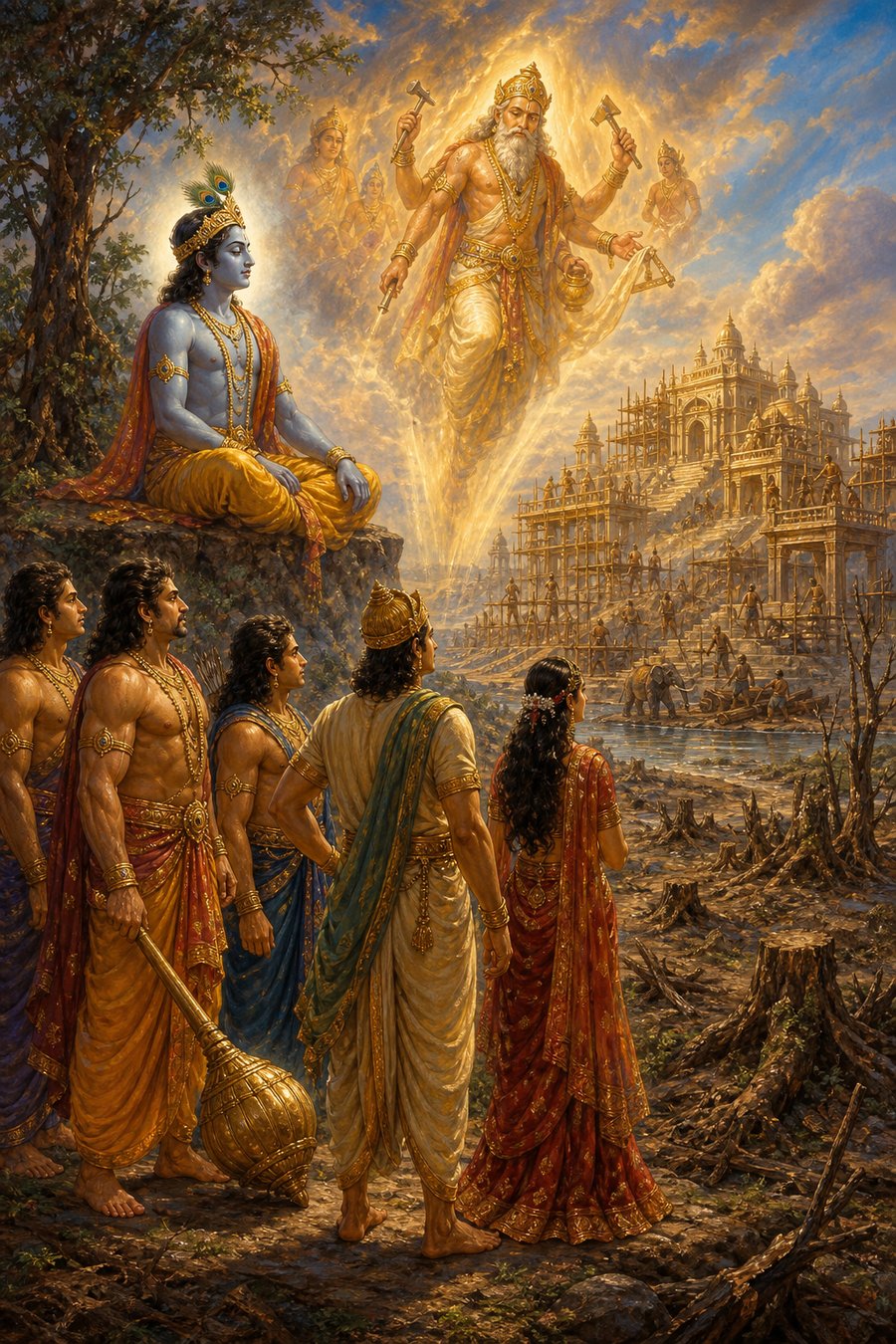
The Pandavas had made their home at Indraprastha by the command of Dhritarashtra and Bhishma, and from that seat they began bringing other kings under their authority. Everyone in the kingdom lived happily in reliance on Yudhishthira the just, the way a soul lives happily in a body that carries the marks of good fortune and a record of good deeds. He gave their due to the three aims of life, virtue, pleasure and profit, each in sound proportion, as if each were a friend as dear to him as himself. To those who watched him it seemed that virtue, pleasure and profit had taken bodies and come to live on earth, and that the king stood among the three as a fourth.
His people had got, in one man, a king devoted to the study of the Vedas, a performer of the great sacrifices, and a protector of everyone who was good. Under his influence the good fortune of every monarch on earth held steady, their hearts turned toward contemplation of the Supreme Spirit, and virtue itself grew on every side. With his four brothers around him and working with him he shone more brightly than he could have alone, like a great sacrifice that rests on the four Vedas and is carried by them. Many learned Brahmins, each of them a match for Brihaspati, with Dhananjaya at their head, attended him as the gods attend the Lord of creation.
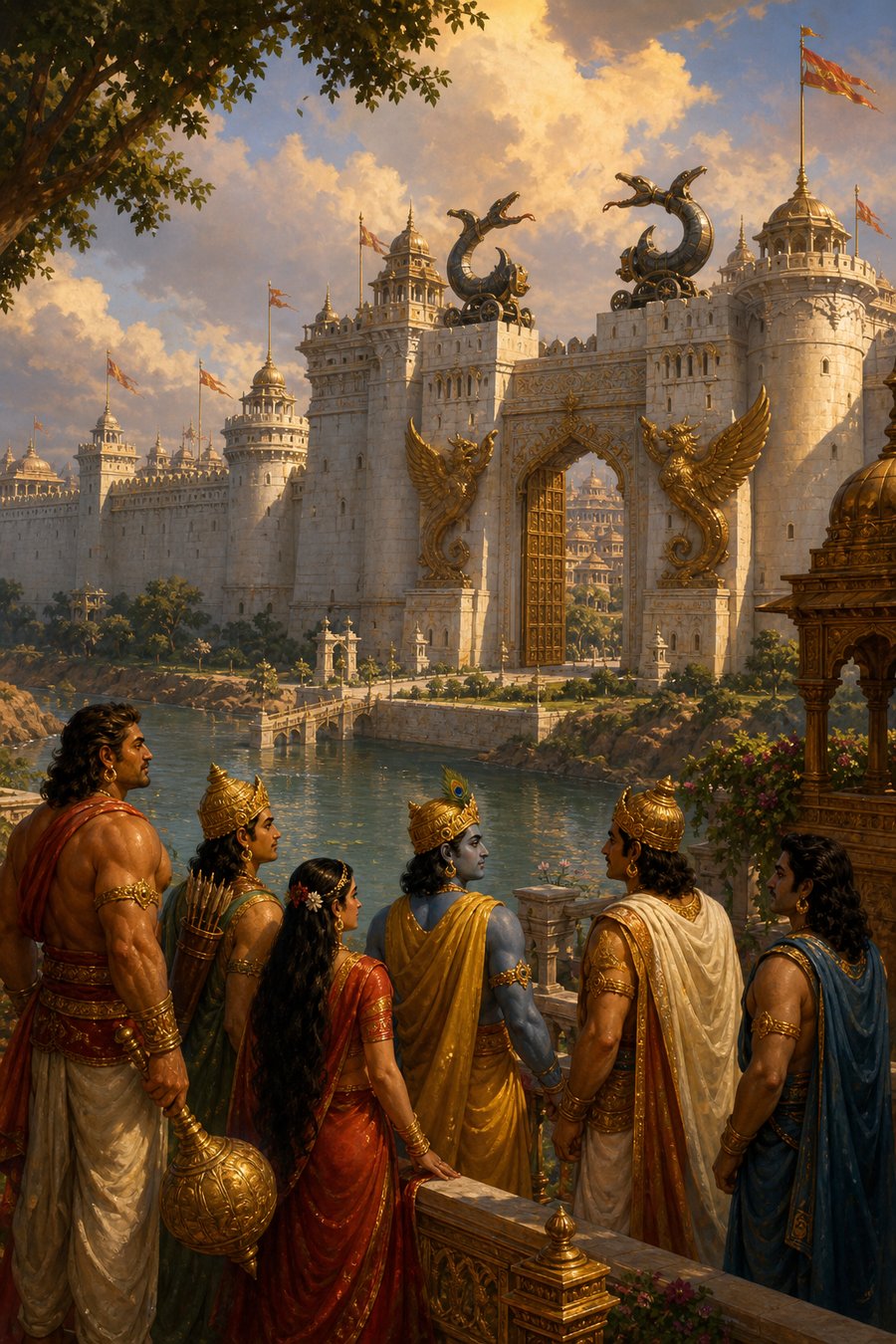
The eyes and hearts of all his people rested on Yudhishthira with delight, out of the sheer abundance of their love for him, as on a full moon with no mark on it. He was their king, and that was one reason they were glad of him; the other was honest affection. He always did what they would wish done. He spoke sweetly and he thought clearly, and nothing ever came out of his mouth that was improper, or untrue, or hard to bear, or unkind. So this great king of the Bharata line passed his days happily, working for everyone’s welfare as if it were his own, and his brothers, whose energy kept bringing other kings under their rule, lived as happily as he did, with no enemy anywhere to disturb their peace.
The gist: From Indraprastha, where Dhritarashtra and Bhishma had settled them, the Pandavas extend their authority over other kings. Yudhishthira serves virtue, pleasure and profit in due proportion, studies the Vedas, performs the great sacrifices, and never says a false or unkind word, and his people love him for himself as well as for his office.
Agni comes in the form of a Brahmin
A few days into this good time Arjuna said to Krishna, “The hot weather is here, Krishna. Let us go down to the banks of the Yamuna. We can spend the day at play there with our friends and come home in the evening.” Krishna said, “I was wishing for the same thing. Let us go and play in the water as long as we like, with our friends around us.”
They agreed on it, asked Yudhishthira’s leave and got it, and set out with their friends around them. The place they came to on the Yamuna was made for pleasure. Tall trees grew thick on the bank, and among the trees stood high pavilions, so many and so fine that the spot looked like the city of the gods. Everything had been brought there ahead of Krishna and Arjuna: costly food of every flavor, drink, garlands, perfumes of many kinds. The party went straight in, to inner rooms bright with clear-rayed jewels, and everyone began to enjoy himself in whatever way he pleased.
The women of the party, wide-hipped, full-breasted, lovely-eyed, a little unsteady on their feet from the wine, played wherever Krishna and Arjuna told them they might: some in the woods, some in the water, some inside the pavilions. Draupadi and Subhadra, both merry with wine, began taking off their own costly robes and jewels and giving them away to the women as they played. Some of the women danced for joy and some sang. Some laughed and joked, and some went on drinking the excellent wine. Some blocked each other’s way, some fell to scuffling, and some drew apart to talk in private. Flutes and vinas and kettledrums sounded through the pavilions and the trees, and the whole place was a picture of Prosperity herself.
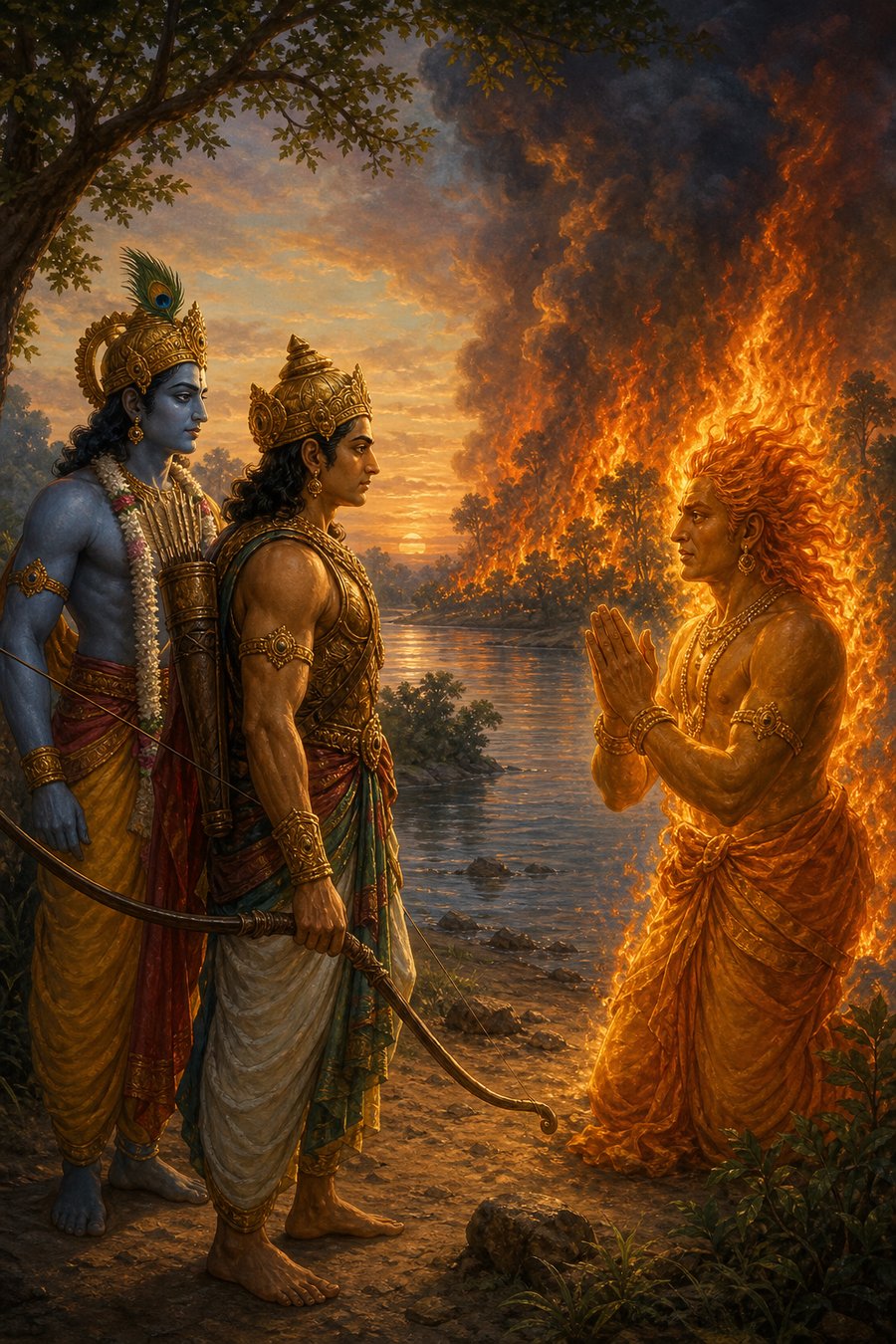
While all this was going on, Krishna and Arjuna walked a little way off to a pleasant spot in the trees, within easy reach of the others, and sat down there on two very costly seats. They talked, as friends do, about old feats of arms and whatever else came up. They were sitting there as easily as the twin Ashvins sit in heaven when a Brahmin came toward them. He was as tall as a sala tree. His skin was the color of molten gold, and his beard was a bright yellow shading to green. His height and his breadth were in exact proportion. His hair was matted and he wore rags, and yet he was as radiant as the sun at morning, and his eyes, shaped like lotus petals and tawny in color, seemed to burn. Both of them saw that blazing Brahmin coming, and both got quickly to their feet and stood waiting to hear what he wanted of them.
The Brahmin spoke to Arjuna and to Krishna of the Satvata line. “The two of you, sitting here so close to Khandava, are the two greatest heroes on earth. I am a Brahmin with a huge appetite. I eat a great deal, always. Krishna of the Vrishnis, and you, Arjuna, I am asking you to give me enough to satisfy me.” They answered together: “Tell us what kind of food will satisfy you, and we will do our best to give it to you.” Having been asked what kind of food he had in mind, the Brahmin told them. “It is no ordinary food I want. Know that I am Agni. Give me the food that suits me. This forest of Khandava is under Indra’s protection, always, and because he protects it I have never managed to burn it.
“A naga named Takshaka lives in that forest with his followers and his family, and Takshaka is Indra’s friend. It is for his sake that the god of the thunderbolt guards the place, and a great many other creatures are kept safe there because Takshaka is. I want to consume that forest and I cannot. Indra’s power stops me. The moment he sees me blaze up, he pours water down on me from the clouds, every time, and so Khandava stands, much as I long to burn it. Now I have come to you, and you are both masters of weapons. With your help I will burn this forest, and this forest is the food I am asking for. You know the great weapons. When I begin, I ask you to keep the rain from falling, and to keep every creature in the forest from getting out.”
Here King Janamejaya broke in with a question. “Why did Agni want to burn Khandava at all? The forest was full of living creatures of every kind, and the chief of the gods was guarding it. If Agni burned it in anger, the cause must have been a grave one. I want to hear all of this in detail. Tell me how the Khandava forest was consumed in those days long ago.”
A key to reading this (the idea): Agni comes disguised and asks first for food in general terms. Only when Krishna and Arjuna have offered to feed him does he name himself and the meal. He wants a whole forest, and he has failed to take it because Indra protects it for the sake of his friend, the naga Takshaka, and drowns every fire with rain. The help he asks for has two parts: stop the rain, and let no creature escape. Why a god should need to eat a forest is the question Janamejaya puts next.
King Shvetaki and the malady of Agni
Vaishampayana answered that he would tell the story of the burning of Khandava as the rishis tell it in the Purana. There was once, the Purana says, a famous king called Shvetaki, strong and brave, a match for Indra himself. No one on earth has ever equaled him in sacrifices, in giving, or in intelligence. He performed the five great sacrifices and many others beside, and at every one of them the gifts to the Brahmins were lavish. Sacrifice, ritual and giving in all its forms: that king’s heart was never set on anything else.
With his ritwiks, the priests who officiate at the fire, Shvetaki sacrificed for years on end, so many years that the unending smoke ruined the priests’ eyes. Half blinded, and worn down to weakness, they finally left him, hoping never to assist at a sacrifice of his again. The king sent for them, and sent again. They stayed away, because their eyes hurt too much. In the end, on those same priests’ instructions, he called in other men of the same standing and finished the sacrifice he had begun.
A few days went by, and Shvetaki wanted another sacrifice. This one was to last a hundred years. He could find no priest to help him with it. The famous king, with his friends and his relatives beside him, threw off all idleness and went after his own priests with great persistence. He bowed to them. He spoke to them gently. He offered them wealth. Every one of them refused to take on what that tireless king had in mind.
Then the royal sage lost his temper. He went to the Brahmins where they sat in their hermitages and said, “If I were a fallen man, Brahmins, or if I had ever failed in respect or service to you, then you and every other Brahmin would be right to abandon me without a second thought. I am neither of those things. I am no outcast, and I have never been short in my respect for you. So it is wrong of you to block my sacrifice and wrong to desert me like this, with no good reason given. I am asking for your protection. Be kind to me. If you abandon me anyway, out of plain ill will or some other unworthy motive, I will go to other priests for help with this sacrifice. I will win them with soft words and gifts, I will lay my business before them, and they will see it done.” Having said it, he fell silent.
The priests knew perfectly well that they could not manage the king’s sacrifice. So they put on a show of anger, and said to him, “Your sacrifices never stop! We have assisted you again and again, and it has worn every one of us out. We are exhausted by this labor, and you ought to let us go. Your judgment has left you, and you cannot wait; you only press us harder. Go to Rudra. He will assist at your sacrifice.” They had spoken in scorn and anger, and the king was angry in his turn. He took them at their word. He went to the mountains of Kailasa and gave himself up to austerity there.
He worshiped Rudra, the great god Shiva, with his whole attention fixed, keeping the hardest vows there are. For long stretches he ate nothing at all. When he did eat it was fruit and roots, taken sometimes at the twelfth hour of the full day and sometimes at the sixteenth. For six months King Shvetaki stood with his arms raised and his eyes unmoving, rapt, like the trunk of a tree or a pillar set in the ground. Shiva was pleased at last with a king who could bear such penance, and showed himself. The god’s voice was calm and grave. “I am pleased with you for your austerity. Blessings on you. Ask now for the boon you want.”
The royal sage bowed to Rudra, whose power has no measure, and said, “Lord whom the three worlds worship, god of gods, if you are pleased with me, then assist at my sacrifice yourself.” Shiva was pleased by the request too, and he smiled as he answered it. “We do not assist at sacrifices ourselves. You, though, have gone through hard penance to win a boon, so I will assist at yours, on one condition. For twelve years, pour clarified butter into the fire in a stream that is never interrupted, and live all that time as a brahmachari with your attention fixed. Do that, and you will have from me what you ask.”
Shvetaki did everything the bearer of the trident had told him to do. Twelve years went by, and he came back to the great god. Shiva, the maker of the worlds, saw that excellent king and spoke at once, with evident pleasure. “You have pleased me by this work of yours. The duty of assisting at sacrifices belongs properly to Brahmins, though, and so I will not assist at yours myself today. There is a great Brahmin on earth who is a portion of my own self. His name is Durvasa. He has the power for it, and he will assist you in your sacrifice. Have everything made ready.”
The king went home to his capital and began to gather what the sacrifice needed. When all of it was collected he came before Rudra again. “Every article has been gathered, god of gods, and by your grace my preparations are complete. Let me be installed for the sacrifice tomorrow.” Rudra sent for Durvasa. “Durvasa, this is the great king called Shvetaki. I command you to assist him in his sacrifice.” And the rishi Durvasa said to Rudra, “So be it.”
So the sacrifice that Shvetaki had prepared for so long was held. It was performed according to the ordinance and in its proper season, and the gifts to the Brahmins were large. When it was over the other priests who had come to assist took their leave of Durvasa and went home, and so did the sadasyas, the men who had been seated in the assembly of the sacrifice. The king went into his palace honored by Brahmins who knew the Vedas, praised by the chanters of hymns, and cheered by the citizens.
That is the history of the royal sage Shvetaki. He won great fame on earth, and when his time came he went up to heaven, and the ritwiks and sadasyas who had helped him in life went with him.
And at that sacrifice of Shvetaki’s, Agni had been drinking clarified butter for twelve years. It had been poured into his mouth in one stream that never broke. He had drunk so much that he was glutted, and he wanted no more butter from anyone’s hand at any sacrifice anywhere. He grew pale. His color left him and he could not shine as he had. Surfeit took his appetite, his energy drained away, and he was sick.
When the drinker of sacrificial offerings understood that his strength was going from him little by little, he went to the sacred dwelling of Brahma, which all beings revere, and came before the great god where he sat. “Shvetaki,” Agni said, “has fed me past all measure with his sacrifice. I am still suffering from the surfeit and I cannot shake it off. Lord of the universe, my brightness and my strength are both shrinking. By your grace I want my own lasting nature back.” The creator of all things smiled at him. “For twelve years you ate a continuous stream of sacrificial butter poured into your mouth. That is what has made you ill. Do not grieve over it, Agni. You will soon be yourself again. I will clear this surfeit from you, and the time for it has come.
“There is a dreadful forest called Khandava, a home of the enemies of the gods. Once before, long ago, you burned it to ashes because the gods asked you to. Since then it has filled again with creatures beyond number. Eat the fat of those creatures and you will have your own nature back. Go there quickly and consume that forest with everything that lives in it. That will cure you.”
Agni heard it from the lips of the supreme god and went at great speed, and he reached the Khandava forest in full vigor. He blazed up there at once, in anger, with Vayu the wind helping him. The creatures that lived in Khandava saw their forest burning and fought the fire with everything they had. Elephants came in their hundreds of thousands, running, furious, with water in their trunks, and sprayed it on the flames. Many-hooded snakes came in their thousands, wild with anger, and scattered water from all their hoods. Every other creature in the forest did the same by whatever means and effort it could, and between them they soon had the fire out. Agni blazed up in Khandava seven times, and seven times the dwellers in the forest put him out.
A sub-tale: The chain runs backward from the fire to a king. Shvetaki sacrifices until smoke ruins his priests’ eyes, and they send him to Rudra in scorn. He takes the advice literally, wins Shiva by six months of standing penance, and is set a condition: twelve years of butter poured into the fire without a break. Shiva then gives him Durvasa, whom he calls a portion of himself, to conduct the rite. The twelve years of butter are what make Agni ill, and Brahma prescribes the cure, which is the fat of the creatures of Khandava.
The gist: King Shvetaki’s sacrifices exhaust his priests, who tell him to go to Rudra. He does. Shiva has him pour butter into the fire for twelve unbroken years and then sends Durvasa to conduct his great sacrifice. Agni, glutted by those twelve years, grows pale and weak, and Brahma tells him to cure himself on the fat of the creatures of Khandava. Seven times he sets the forest alight, and seven times its elephants, snakes and other dwellers put the fire out.
The divine weapons: Gandiva, the discus, and the chariot
Angry, disappointed, and no better than before, Agni went back to Brahma and told him everything that had happened. The god thought for a moment. “I see a way,” he said, “by which you can burn the Khandava forest today, with Indra looking on. The ancient gods Nara and Narayana have taken birth in the world of men to carry out the gods’ business there. On earth they are called Arjuna and Krishna. At this moment they are staying in the Khandava forest. Go and ask them to help you burn it. Then you will burn it, even with the gods themselves protecting it. Those two will keep the creatures of Khandava from getting away, and they will hold off Indra as well. I have no doubt of it.”
Agni came to Krishna and Arjuna in haste, and what he said to them, Vaishampayana reminded the king, has already been told. It was Arjuna who answered the god who meant to burn Khandava against Indra’s will, and his answer went straight to the practical difficulty. “I have divine weapons, excellent ones, more than I can count. With them I could fight many wielders of the thunderbolt at once. What I lack is a bow that is equal to the strength of my arms and can take what I put into it in battle. My hands are quick, so I also need arrows that never run out. And my chariot can hardly bear the weight of the arrows I would want to keep by me. I want horses of heaven, pure white, with the speed of the wind, and a chariot that shines like the sun, with wheels that sound like thunderclouds. Then there is Krishna. He has no weapon suited to his power, nothing with which he can kill nagas and pishachas. So give us the means, the means to succeed and the means to keep Indra from pouring his rain on that great forest. Everything that courage and strength can do, Agni, we stand ready to do. The means must come from you.”
Agni, the god whose banner is smoke, wanted a word with Varuna, and he turned his thoughts to him: Varuna, Aditi’s son, the guardian of one of the quarters of the sky, who lives in the waters and rules them. Varuna knew he was being thought of and appeared at once. Agni received the lord of the waters, fourth of the guardians of the world, with honor, and said to that eternal god, “Give me, quickly, the bow and the quivers that came from King Soma, and the chariot with the ape on its banner. Arjuna will do a great thing with Gandiva, and Krishna with the discus. Give me both today.”
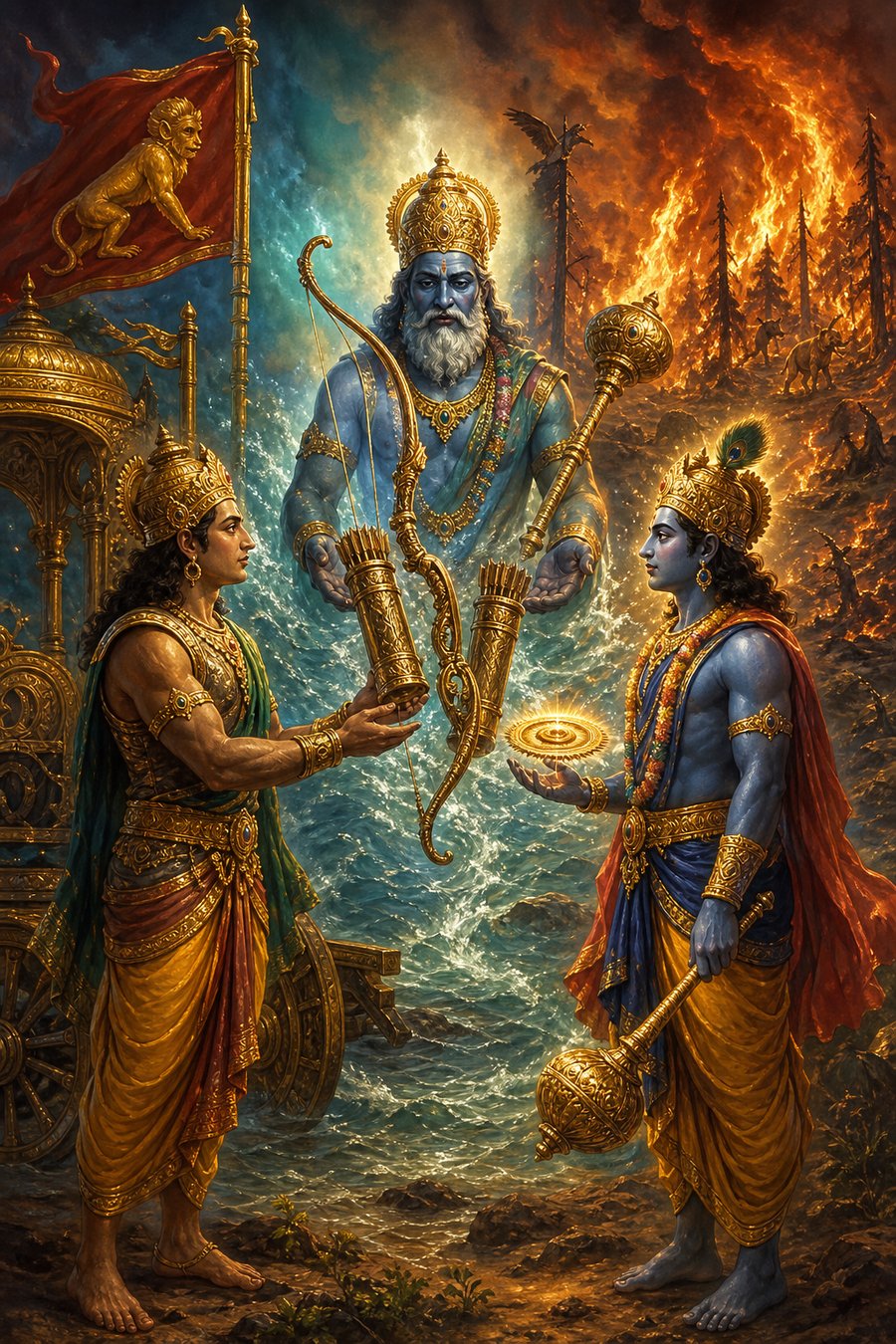
“I give them,” said Varuna, and he brought out the bow. It was a wonder and a jewel among bows, and there was great force in it. It made a man’s fame and it made his victories. No weapon could damage it. It outranked every other weapon and could break them all, it shattered hostile armies, and it was worth, by itself, a hundred thousand bows. It enlarged the kingdom of whoever carried it. It was painted in fine colors, well ornamented, beautiful to look at, and nowhere along its length was there a scar or a weak place. The gods and the gandharvas had always paid it worship.
Varuna gave two quivers that could never be emptied, and he gave the chariot, loaded with divine weapons, flying a banner with a great ape on it. The horses yoked to it were white as silver, white as fleecy cloud, bred in the country of the gandharvas, harnessed in gold, and as fast as the wind or as thought. The chariot carried every implement of war, and neither gods nor asuras could defeat it. It shone so that it was hard to look at, as the sun is, and the noise of its wheels was tremendous, and every creature that saw it was glad at the sight. Vishvakarma, architect of the universe and one of the lords of creation, had built it after long and severe meditation. It was the chariot from which the lord Soma had once beaten the danavas, and in its beauty it looked like an evening cloud lit by the setting sun. Its flagstaff was golden and very fine, and on the flagstaff sat a divine ape, as fierce in shape as a lion or a tiger, glaring down from that height as if it meant to burn whatever it saw. Other flags flew around it, bearing great creatures of several kinds, and their roars and howls were enough to make an enemy’s soldiers faint.
Arjuna put on his mail, belted on his sword, and pulled the leather guards over his fingers. He walked around that chariot with all its flags in a circuit of respect, bowed to the gods, and climbed up into it the way a good man mounts the heavenly chariot that carries him to paradise. Then he took up the bow. It was the first of bows, a thing of heaven, made by Brahma in ancient times, and its name was Gandiva. Joy filled him as he lifted it. He bowed to Agni, braced the great bow, and strung it by main strength, and the sound it made as he strung it shook everyone who heard it with fear. He had the chariot now, and the bow, and the two quivers that would never run dry, and he was glad, and he judged himself equal to what Agni was asking.
To Krishna, Agni gave a discus with an iron rod fixed through the hole at its center. It was a weapon of fire, and it became the weapon Krishna loved best, and with it in his hand he too was equal to the work. “With this, Krishna,” Agni told him, “you will be able to defeat in battle even enemies who are more than human. Have no doubt of it. With this you will be stronger in a fight than men and gods, than rakshasas and pishachas, daityas and nagas, and you will be able to strike down any of them. Throw it at your enemies in battle and nothing will stop it. It will kill, and then it will come back into your hand.” After this the lord Varuna gave Krishna a mace called Kaumodaki, which could kill any daitya and which roared like thunder when it was thrown.
Arjuna and Krishna were both filled with joy, and they said to Agni, “We have weapons now and we know how to use them. We have chariots, with flags and flagstaffs. We can fight all the gods and all the asuras together, and one wielder of the thunderbolt who wants a fight for the sake of his friend the naga gives us no trouble at all.” Arjuna added something of his own. “Agni, when Krishna moves across a battlefield with this discus in his hand, there is nothing in the three worlds he cannot destroy by throwing it. And I have the bow Gandiva and this pair of quivers that never empty, and with them I am ready to conquer the three worlds myself. So blaze up, lord, as fiercely as you like, and close in on this great forest from every side. We are well able to help you.”
A key to reading this (the idea): Three gifts change hands before the fire is lit. Varuna gives Arjuna the bow Gandiva, made by Brahma in ancient times, two quivers that never empty, and the ape-bannered chariot with its white gandharva-bred horses. Agni describes bow, quivers and chariot as things that came from King Soma. Agni himself gives Krishna the discus that returns to the hand, and Varuna adds the mace Kaumodaki.
The burning of Khandava and the battle with Indra
With that, Agni put on the most terrible of his forms and went to work. He ringed the Khandava forest with his seven flames and began to eat it, and the shape he showed was the all-consuming shape he wears at the end of an age. He took the forest from every side at once, roaring like a bank of thunderclouds, and every creature inside it shook. Burning, the forest shone like Meru, king of mountains, when the full light of the sun falls on it and it blazes.
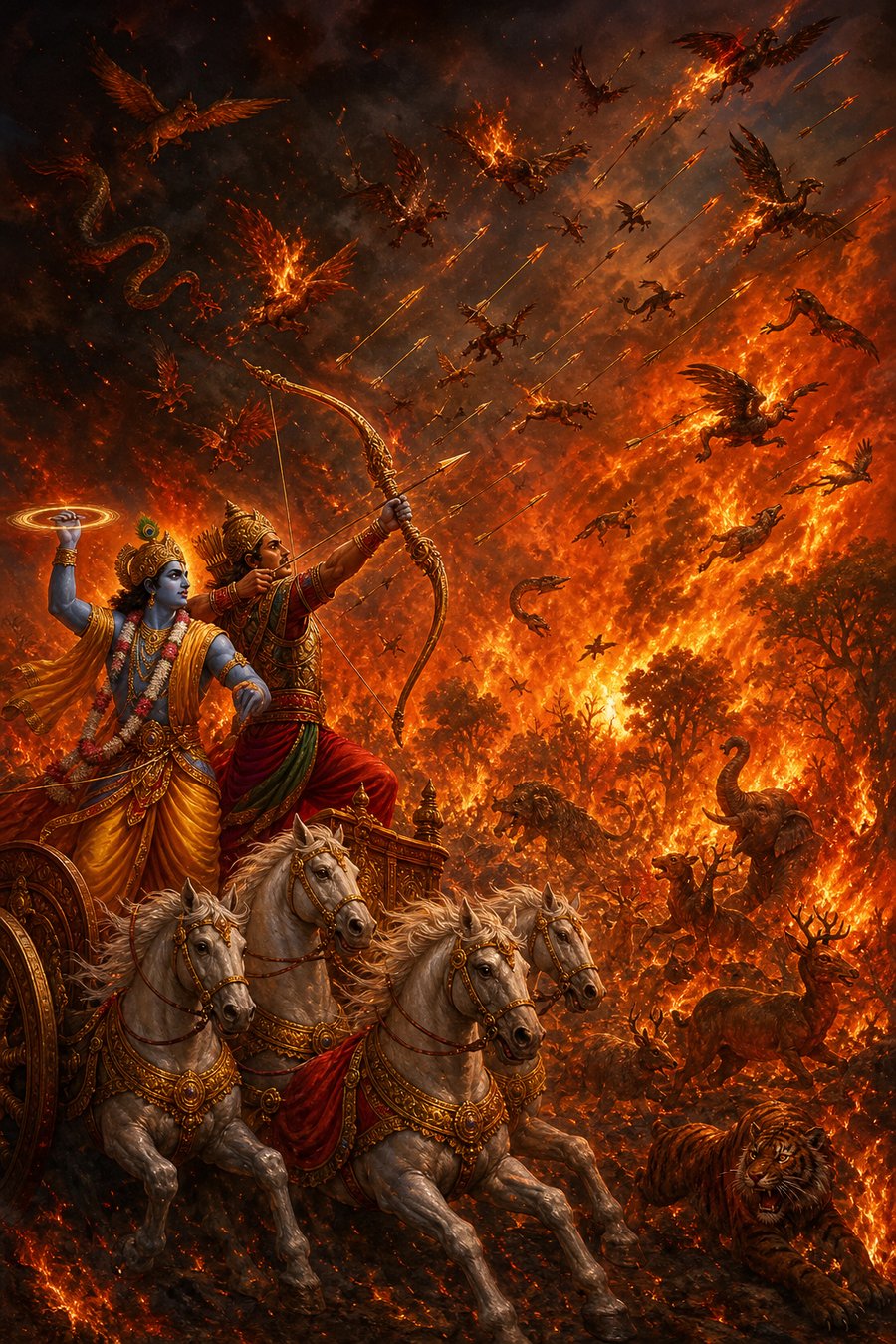
Krishna and Arjuna, masters of chariot fighting both, drove to opposite sides of the forest and began a great killing of the creatures that lived in it. Wherever any creature of Khandava was seen trying to break out, there one of the two arrived to stop it, and the two chariots moved so fast around the burning wood that they seemed to be a single chariot, and the two men in them a single man. Inside, living things in their hundreds and thousands ran in every direction, screaming. Some had a limb burned away. Some were scorched by the terrible heat. Some came out into the open, and some simply ran about in their fear. Some would not leave. They held on to their young, or to their parents, or to their brothers, loving them too much to let go, and died quietly where they were. Many bit their lower lips and flung themselves upward, and came spinning back down into the fire. Others rolled on the ground with wings, eyes and feet burned black. All of them died there, and quickly.
The tanks and ponds inside the forest were heated from every side until they boiled, and the fish and the turtles in them died in the boiling water. So many bodies of so many kinds were burning that it looked as if fire itself had taken on a multitude of forms. The birds rose to get away, and Arjuna’s arrows met them in the air; they came down cut to pieces, crying aloud, into the flames beneath. The animals on the ground were struck too, and bellowed and screamed, and the noise that went up from Khandava was like the dreadful uproar of the churning of the ocean long ago. The flames climbed until they reached the sky, and the gods themselves grew anxious.
All the dwellers in heaven went in a body to their chief, Indra of the hundred sacrifices and the thousand eyes, the breaker of the asuras. “Lord of the immortals,” they said, “why is Agni burning these creatures down below? Has the time come for the world to end?” Indra heard them, and looked, and saw for himself what Agni was doing. The killer of Vritra set out to save the Khandava forest.
He covered the sky with clouds of every kind, bank upon bank of them, and began to rain on the fire. By his command the clouds gathered in their hundreds and thousands and poured water down on Khandava in columns as thick as the flagstaffs of war chariots. None of it arrived. The heat of the fire dried the rain in mid-air, and the flames never felt a drop. Then Indra, who once killed Namuchi, grew angry with Agni. He massed clouds more enormous than before and let fall a far heavier downpour. Flame fought water above the trees. With the clouds piled overhead, the smoke rolling, and the lightning flashing through it, the forest was terrible to look at.
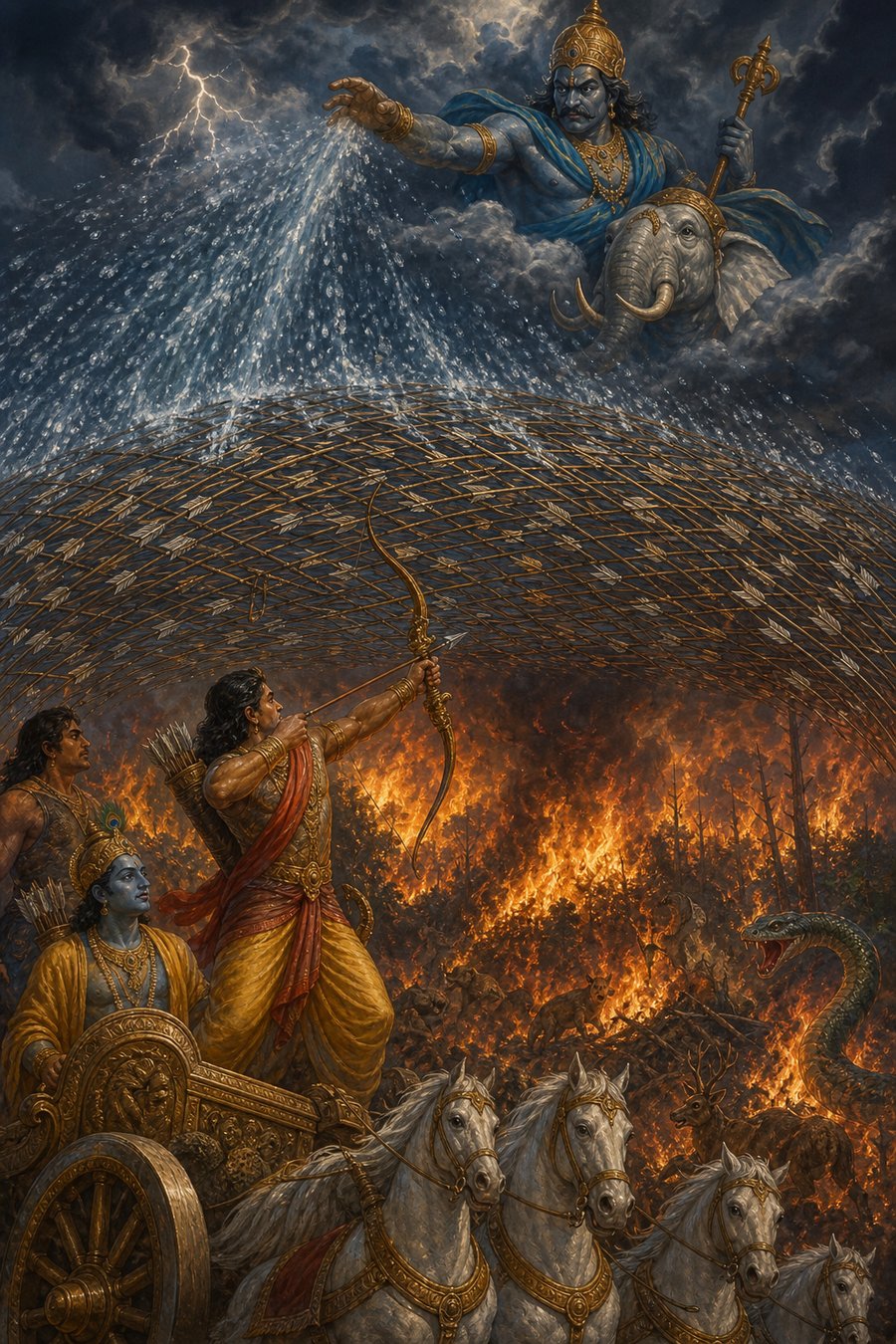
Arjuna answered the rain with arrows. He called up his best weapons and shot so many shafts so fast that Indra’s shower was stopped above the forest by a shower of his own. Arjuna, whose spirit had no measure, soon had all Khandava covered with arrows beyond counting, as the moon covers the air with thick mist, and under that roof of arrows no living thing could get out.
Takshaka, the chief of the nagas, was away. At the time of the burning he had gone to the field of Kurukshetra. His son was at home. Ashvasena, Takshaka’s powerful son, tried with all his strength to get clear of the fire, and Arjuna’s arrows shut him in whichever way he turned. Then his mother, herself the daughter of a snake, decided to save him by swallowing him. She took in his head first and went on swallowing toward the tail, and with the tail still passing down her throat she rose into the air to carry her son out. Arjuna saw her getting away. One arrow, sharp and keen-edged, took her head from her body.
Indra saw the whole of it. The god of the thunderbolt wanted his friend’s son saved, and he raised a wind so violent that it knocked the senses out of Arjuna, and in those few moments Ashvasena slipped free. Arjuna came to himself, understood that a power of illusion had been used on him and that the snake had tricked his way out, and was furious. From then on he cut every animal that tried to escape through the air into two pieces, or three, or more. And he in his anger, and Agni, and Krishna too, cursed the snake that had got away by deceit: “You will never have fame.”
The trick stayed in Arjuna’s mind and his anger grew with it. He covered the sky with a cloud of arrows and offered battle to the god of the thousand eyes himself. Indra saw Arjuna’s anger and accepted, and loosed his own fierce weapons until they filled the whole breadth of the sky. The winds rose, roaring, and stirred every ocean, and drove together in the heavens great masses of cloud loaded with rain. Those clouds began to spit thunder and terrible lightning. Arjuna knew the answer to them. He spoke the proper mantras and released the excellent weapon called Vayavya, the weapon of the wind, to break the clouds apart. It stripped the force from Indra’s thunderbolt and from the clouds together. The rain they carried dried up and the lightning that played among them went out. Within a moment the sky was clean of dust and darkness, a cool and pleasant breeze was blowing, and the disc of the sun looked as it always does. Agni, the eater of clarified butter, was delighted that nothing could stop him. He took on many shapes, and with the fat of dying creatures running over him he blazed up with every flame he had and filled the universe with his roar.
A sub-tale: Six creatures come out of Khandava alive, and Ashvasena is the first. His father Takshaka, for whose sake Indra guarded the forest, is away at Kurukshetra. His mother dies with her son half swallowed, cut down by Arjuna in the air. He himself escapes only because Indra stuns Arjuna with a wind, and he leaves under a curse spoken by Arjuna, Agni and Krishna together: he will never have fame.
The war of the gods and their defeat
Next came birds of Garuda’s race, a great many of them, splendid in their plumage. They saw that Krishna and Arjuna were guarding the fire, and they came down proudly out of the upper air to strike the two with wings like thunderbolts, with beaks, with claws. Nagas came too, in numbers past counting, dropping from above with fire in their faces and the deadliest venom pouring from their mouths. Arjuna watched them come and cut them to pieces with arrows steeped in the fire of his own anger. Birds and snakes together fell dead into the burning forest.
After them, eager to fight, came asuras beyond number, and gandharvas, yakshas, rakshasas and nagas with them, howling terribly. They brought engines that spat iron balls and shot from their mouths, catapults that hurled huge stones, and rockets, and they closed on Krishna and Arjuna with rage doubling their strength. They rained weapons. Arjuna shouted his contempt back at them and took off their heads with his sharp arrows. Krishna went among the daityas and danavas with the discus and killed them in great numbers. Asuras of enormous power, pierced by Krishna’s arrows and struck by the force of his discus, lay still, like wreckage that the violence of the waves has thrown up on a bank.
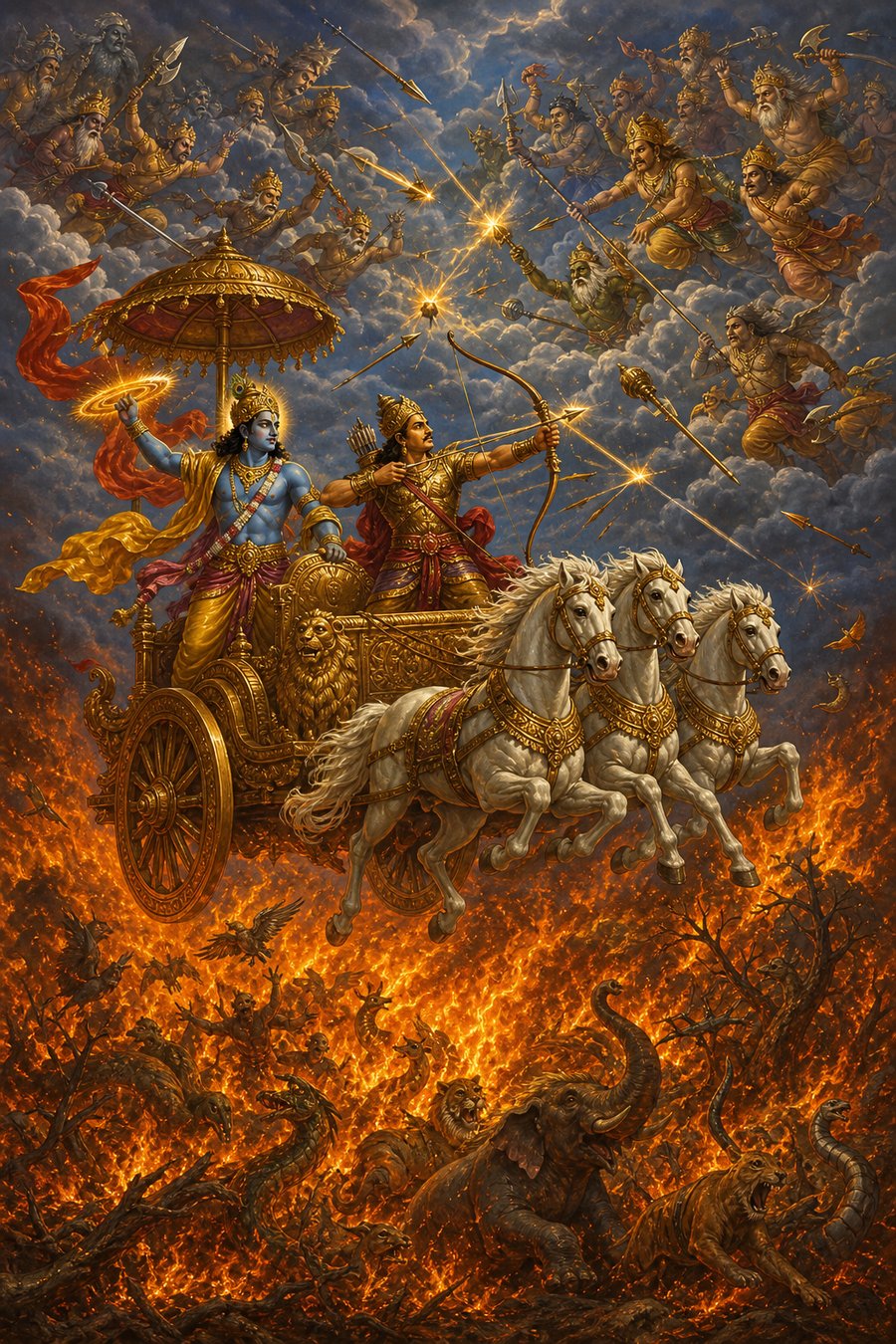
Then Indra himself, lord of the gods, came at the two heroes mounted on his white elephant. He took up the thunderbolt, the weapon that never misses, and hurled it with great force, and he told the gods, “These two are dead.” The gods saw their chief about to throw the terrible bolt, and each took up his own weapon. Yama took the mace that deals death. Kubera took his spiked club, and Varuna his noose and his beautiful missile. Skanda, who is Kartikeya, raised his long lance and stood as unmoving as Mount Meru. The Ashvins stood with shining plants in their hands. Dhatri stood bow in hand, and Jaya held a thick club. Tvashtri, strong and angry, picked up a huge mountain. Surya stood with a bright dart, and Mrityu, who is Death, with a battle-ax. Aryaman strode about with a terrible bludgeon set with sharp spikes, and Mitra stood holding a discus with an edge like a razor. Pusha, Bhaga and Savitri rushed at Krishna and Arjuna in anger with bows and curved swords in their hands. The Rudras came, and the Vasus, the powerful Maruts, the Vishvedevas and the Sadhyas, all shining with their own force, and many other gods with them, armed in many ways, and all of them charged those two great men to strike them down.
Strange and terrible signs appeared on every side of that great fight, signs that took away the wits of every creature that saw them, like the ones that show themselves when the universe is dissolved. Arjuna and Krishna saw Indra and the other gods ready for battle, and felt no fear. They could not be beaten in a fight and they knew their business, and they waited calmly with their bows in their hands. When the host of heaven advanced they met it in anger with arrows like thunderbolts. The gods were broken and thrown back, again and again, and in the end they left the field in fear and ran to Indra for protection. The munis who were watching the battle from the sky saw the gods defeated by Krishna and Arjuna and were filled with wonder.
Indra, watching their skill again and again, was more and more delighted with them, and he attacked once more. He wanted to learn the measure of Arjuna, who could draw a bow with his left hand as well as his right, and he sent down a heavy shower of stones. Arjuna, in a rage, scattered it with his arrows. The god of the hundred sacrifices saw that shower fail and sent a thicker one. Arjuna was Indra’s own son, and when he broke the second shower too with his swift arrows, his father was pleased. Then Indra, meaning this time to strike the son of Pandu down, tore loose with his hands a great peak of Mount Mandara, with the tall trees still standing on it, and threw it at him. Arjuna’s arrows went up to meet it, swift, with fire at their tips, and split the peak into a thousand pieces. The pieces came down through the sky like the sun and the moon and the planets shaken from their places and falling to earth. The mass of that broken peak fell on the forest, and its fall killed a great many more of the creatures that lived in Khandava.
A key to reading this (the idea): The god leading the defense of Khandava is Arjuna’s father. Arjuna is the son of the wielder of the thunderbolt, and when he breaks the second shower of stones his father is pleased. Indra fights in earnest, with thunderbolt, rain, stones and a mountain peak, and he is delighted each time he is beaten. The cost of the contest falls on the forest: even the peak Arjuna shatters kills the creatures it lands on.
Indra’s withdrawal and the sparing of Maya
The falling stones broke what nerve the forest had left. Danavas, rakshasas and nagas, wolves, bears and other wild animals, elephants with the rut streaming from their split temples, tigers, maned lions, deer and buffalo in their hundreds, birds, and creatures of every other kind ran in terror in all directions. Everywhere they ran they saw the forest burning, and they saw Krishna and Arjuna standing ready with their weapons. The terrible noises of the place took the power of movement out of them. They looked at the fire burning in countless places, and at Krishna with his weapon raised to cut them down, and all together they sent up a dreadful cry. That cry and the roar of the fire together made the whole sky ring as if with the voice of clouds that foretell disaster.
Krishna, dark-skinned and long-armed, threw his great fierce discus at them to make an end of them, and it flew shining with its own force. The forest dwellers it struck, danavas and rakshasas among them, were cut into hundreds of pieces and fell into the mouth of Agni. The asuras the discus had torn were smeared with blood and fat, and looked like clouds at evening. Krishna of the Vrishnis moved through that place like death itself, killing pishachas and birds and nagas and other creatures by the thousand. Again and again the discus left his hands, killed creatures without number, and came back to his hands. And as he went about that slaughter of pishachas, nagas and rakshasas, the face and the form of Krishna, who is the soul of every created thing, became terrible to look at.
Of all the gods assembled there, none could defeat Krishna and Arjuna in battle. They understood at last that they were unable to put out the fire and so save the forest from the strength of those two, and they turned away from the field. Indra, the god of the hundred sacrifices, saw the immortals retreating, and he was filled with joy, and he praised Krishna and Arjuna aloud.
The gods had given up the fight. Then a voice with no body spoke to Indra, deep and loud. “Your friend Takshaka, chief of the snakes, is alive. He was never in the fire. Before it began in Khandava he had gone to Kurukshetra. Learn this from me as well, Indra: no one can defeat Krishna and Arjuna in battle. They are Nara and Narayana, the gods of old, whose names are known in heaven. You yourself know the force that is in them and what they can do. These two ancient rishis cannot be conquered in battle by anyone in any of the worlds. They are worthy of the deepest reverence from all the gods and all the asuras, from yakshas and rakshasas and gandharvas, from human beings and kinnaras and nagas. So it is fitting, Indra, that you leave this place and take the gods with you. The destruction of Khandava has been ordained by fate.” The chief of the immortals recognized the truth of those words. He let go of his anger and his jealousy and went back to heaven, and the dwellers in heaven, seeing great Indra abandon the fight, followed him with all their soldiers.
Krishna and Arjuna watched the chief of the gods withdraw with every god behind him, and they roared like lions. With Indra gone they were very glad, and they went on helping the fire without a thing to fear. Arjuna had scattered the gods as wind scatters clouds, and now his arrows fell in showers on the creatures of Khandava and killed them without number. His shafts cut off every way out, and of all those countless creatures none could escape the burning forest. Fighting him was past thinking of. The strongest animals gathered there could not even look at Arjuna, whose weapons never missed. He drove here and there in his chariot, sometimes putting one arrow through a hundred creatures and sometimes a hundred arrows into one, and the creatures fell lifeless into the mouth of Agni as if Death himself had struck them.
The creatures of Khandava tried the riverbanks, the broken ground, the cremation grounds. Wherever they went they found no relief, because wherever they took shelter the heat found them. Whole hosts of them roared in pain, and the elephants and the deer and the wolves cried out in their misery. The sound of it frightened the fish in the Ganges and in the sea, and it frightened the tribes of the Vidyadharas who lived in that forest. Nobody could so much as look at Arjuna and dark Krishna, and nobody dreamed of fighting them. Rakshasas, danavas and nagas rushed at Krishna in bands, and he killed them with the discus. Their bodies were huge, and the swift wheel took their heads and cut through their trunks, and they dropped lifeless into the blaze. Fed with flesh and blood and fat in such quantity, the flames climbed to a great height, clean, with never a curl of smoke. Agni’s eyes blazed coppery red, his tongue was flame, his mouth was huge, and the hair on the crown of his head was all on fire. With Krishna and Arjuna to help him he drank that stream of animal fat as though it were nectar, and he was filled with joy and deeply content.
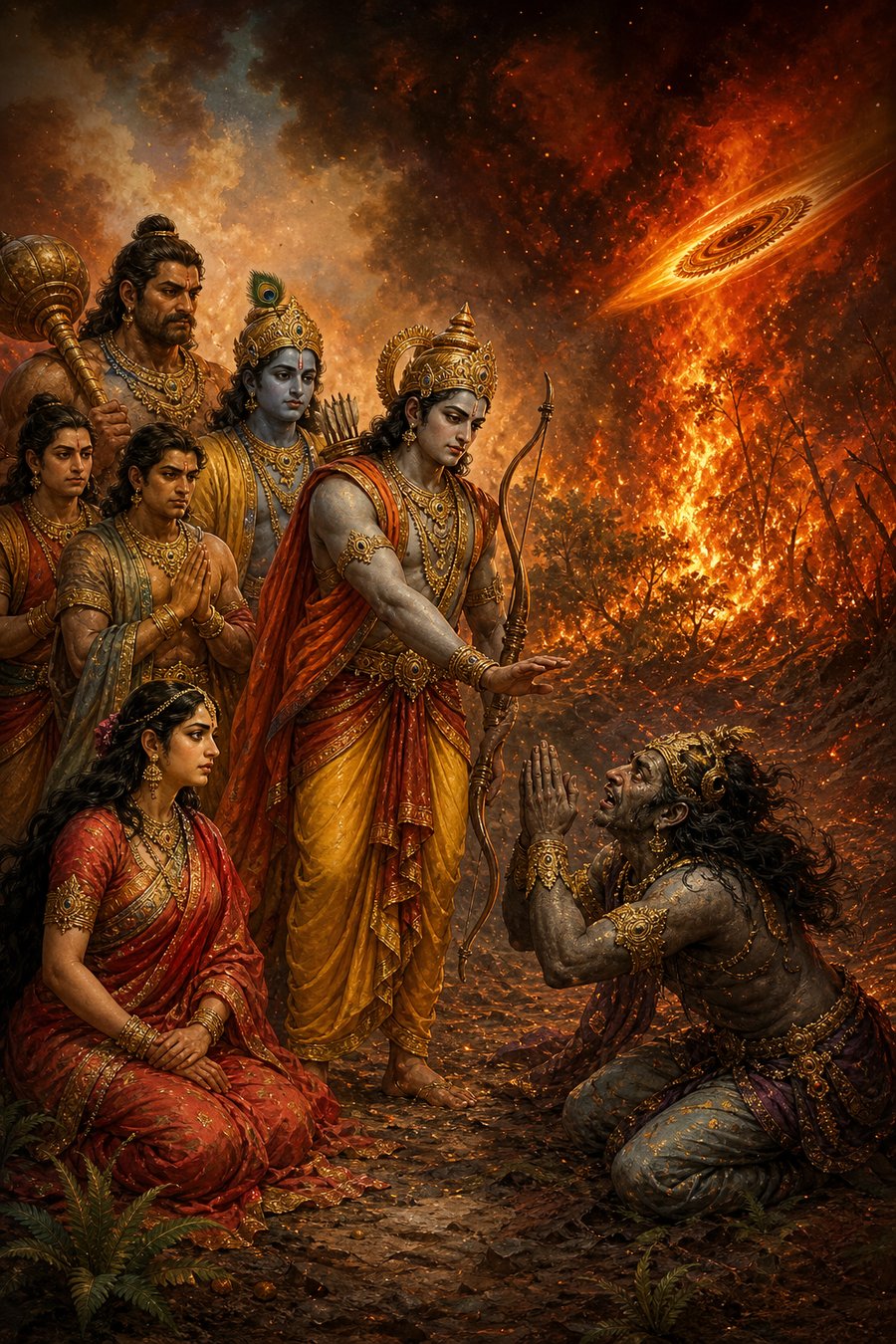
Then Krishna caught sight of something. An asura named Maya was running from the house of Takshaka. Agni went after him to burn him. The god had taken a body with matted hair on its head, he had Vayu the wind for his charioteer, and he came on roaring like thunderclouds. Krishna stood with the discus raised, ready to cut the asura down. Maya saw the lifted weapon in front of him and the fire coming up behind, and he cried out, “Arjuna! Run to me! Protect me!” Arjuna heard the terror in that voice and answered, “Do not be afraid.” Those words seemed to give Maya back his life. Because the merciful son of Kunti had told Maya he had nothing to fear, Krishna no longer wished to kill him, this Maya who was the brother of Namuchi, and Agni did not burn him.
Krishna and Arjuna kept Indra off him, and Agni, wise among the gods, burned that forest for fifteen days. In all that burning he spared six of those who lived there, and only six: Ashvasena, Maya, and four birds of the kind called sharngakas.
A key to reading this (the numbers, in modern terms): The fire burns for fifteen days. Agni had tried seven times before and been put out seven times; this time nothing stops him. Of everything that lived in Khandava, six are spared: Ashvasena, son of the naga Takshaka; Maya, an asura and the brother of Namuchi, who is saved by a few words from Arjuna; and four sharngaka birds, whose story comes next.
The gist: The creatures of the forest are trapped between the fire and the two chariots, and Krishna’s discus and Arjuna’s arrows kill whatever tries to leave. The gods give up, and a bodiless voice tells Indra that Takshaka is safe at Kurukshetra, that Krishna and Arjuna are Nara and Narayana, and that Khandava is fated to burn. Indra goes home to heaven. The asura Maya, caught between Krishna’s discus and Agni, calls to Arjuna and is spared. Agni burns for fifteen days and leaves six alive.
The rishi Mandapala and the birth of the sharngaka birds
Janamejaya had been counting. “Tell me why Agni left the birds called sharngakas alive when he burned the forest like that. You have given the reason Ashvasena was spared, and the reason the danava Maya was. You have said nothing yet about how the sharngakas came through. That those birds escaped seems to me a wonder. Tell us why they were not destroyed in that terrible fire.”
Vaishampayana promised him the whole of it. There was once a great rishi named Mandapala, he said, who knew every shastra, kept the hardest vows, gave himself to austerity, and was the most virtuous of men. He walked the road of those rishis who hold their seed drawn up and never spend it, with every sense under complete control, and his life was study and right conduct. He reached the farthest shore of asceticism, left his human body, and went to the world of the ancestors. And there the fruit he had expected of his acts was withheld from him. He went to the gods who sit around the king of the dead and asked them why. “Why are these worlds out of my reach? I believed my austerities had won them. Have I left undone the acts whose fruit these worlds are? Tell me, you who live in heaven, why they are shut against me, and I will do whatever it is that will give me the fruit of my penance.”
“Listen, Brahmin,” the gods answered, “and learn the things on account of which a man is born a debtor. There are three, beyond any doubt: the rites of religion, study as the ordinance lays it down, and children. The three debts are paid with sacrifices, with asceticism, and with offspring. You are an ascetic, and you have performed your sacrifices. You have no child. These worlds are shut against you for that reason alone. So father children, and you will enjoy happy worlds of many kinds. The Vedas declare that a son rescues his father from the hell called Put. Make the effort, Brahmin, and get yourself children.”
Mandapala took the gods at their word and gave the matter thought. He wanted the largest number of children in the shortest possible time, and when he had considered every kind of creature he concluded that birds alone are blessed with that sort of fertility. So the rishi took the form of a sharngaka, mated with a female of that species whose name was Jarita, and fathered four sons on her, every one of them a reciter of the Vedas. Then he left. The four were still inside their eggs when the ascetic abandoned them and their mother in the forest and went off to a second wife, Lapita. Once the great sage had gone to Lapita’s company, Jarita, full of love for her brood, grew heavy with worry. Their father had deserted them in the Khandava forest. She could not do the same to those infant rishis shut in their shells. She stayed, and out of a mother’s love she raised the children she had borne, living as a bird of her kind lives.
Some time afterward the rishi was wandering in that same forest with Lapita when he saw Agni coming toward Khandava to burn it down. Mandapala understood what the god intended, and he remembered that his children were still very young. Fear moved him. He set himself to please the god of fire, that powerful guardian of the universe, so that he could say a word for his unfledged sons.
“Agni,” the rishi said, “you are the mouth of all the worlds. You carry the sacrificial butter. You purify, and you move unseen in the body of every creature. The learned speak of you as one, and they speak of you again as having three natures. The wise make their sacrifices before you and count you as eightfold. The great rishis declare that this universe was created by you. Feeder on sacrificial butter, without you the whole universe would be destroyed in a single day. Brahmins bow to you, and with their wives and children go to the eternal worlds their own deeds have won them. The learned describe you, Agni, as the clouds in the sky, charged with lightning. The flames you send out consume every creature. Great and splendid one, this universe is your creation. The Vedas are your word. Everything that moves and everything that stands still depends on you. Water, first of all, depends on you, and so does the whole of this universe. Every offering of clarified butter and every oblation of food to the ancestors is established in you. God, you are the consumer, and you are the creator, and you are Brihaspati himself in wisdom. You are the twin Ashvins. You are Surya. You are Soma. You are Vayu.”
The praise pleased Agni, and he was well disposed toward a rishi of such power. “What good can I do you?” he asked. Mandapala joined his palms before the carrier of clarified butter. “When you burn the Khandava forest, spare my children.” “So be it,” said the god. And that is the reason Agni, burning Khandava, never let his fire rise to destroy the children of Mandapala.
A key to reading this (the idea): The gods name three debts a man is born with, rites, study and children, and three payments, sacrifice, asceticism and offspring. Mandapala has made two of the payments. For the third the gods quote the Vedas, that a son rescues his father from the hell called Put. That is why a celibate ascetic who has already left his human body takes the form of a bird, the creature he judges quickest to multiply, and fathers four sons on Jarita.
Jarita’s lament and the resolve of her chicks
The fire was in the Khandava forest now, blazing, and the four young birds were in terror and misery. Look where they might, they could see no way out. Their mother Jarita, helpless, knew they were too young to escape, and grief overcame her and she cried aloud. “This dreadful fire is coming toward us! It lights the whole universe, it is burning the forest down, and every moment it comes nearer my sorrow grows. These babies wring my heart: their minds are still unformed, they have no feathers and no feet, and they are the one hope our dead ancestors have. The fire is coming, spreading fear everywhere, licking the tallest trees with its tongue. My children have no feathers. They cannot get away. I cannot get away myself and carry all of them. And I cannot leave them, because my heart will not let me. Which of my sons do I leave behind? Which do I take? What can I do now that would be right? And you, my little sons, what do you think? I have thought and thought and I see no way out for you. I will cover you with my wings and die with you.
“Your cruel father went away and left me, some time ago, and this is what he said as he went: ‘Jaritari here is my eldest, and my family will rest on him. Sarisrikka, my second, will father children to enlarge the line of my ancestors. Stambamitra, my third, will give himself to asceticism. And Drona, my youngest, will know the Vedas better than anyone.’ Then how has this horror come down on us? Which one do I take with me? My judgment is gone. What is the right thing to do? I use what wits I have, and I cannot see my children coming out of this fire alive.”
The young birds answered their weeping mother. “Mother, put your love for us aside and go where there is no fire. If we die here, you can have other children. If you die, there can be no more children in our family at all. Think about both of those losses. The time has come for you to do what is good for our line. Do not let love for your young move you, when that love promises to destroy us and you together. If you save yourself, our father, who wants so much to win the happy worlds, may still have his wish.”
Jarita heard them and said, “There is a hole in the ground here, close to this tree. It belongs to a mouse. Get into it, now, quickly, and the fire will be nothing to fear. When you are inside, children, I will cover the mouth of it with dust. I can see no other way to save you from this blaze. Afterward, when the fire has burned itself out, I will come back here and clear the dust away. Do what I tell you if you want to come through this alive.”
“We have no feathers,” the young birds replied. “We are so many balls of flesh. If we go into that hole, the mouse will certainly kill us all, because a mouse eats flesh. We can see that danger in front of us and we cannot go in. We see no way to escape the fire, alas, and none to escape the mouse. We see no way to keep our father’s fathering of us from coming to nothing, and none to save our mother. In the hole, the mouse will destroy us. Out here, the fire that travels the sky will destroy us. We have thought about both deaths, and to die by fire is better than to die by being eaten. To be devoured by a mouse down a hole is an ignoble death. The wise approve of the body’s destruction in fire.”
Jarita tried again. “The little mouse that lived in this hole came out, and a hawk caught it in his claws and carried it off. You can go in now and be afraid of nothing.” The young ones said, “We are far from certain that the hawk took that mouse. There may be other mice living down there, and from them we have everything to fear. And it is doubtful whether the fire will come this far at all. We can already see a wind blowing against it and turning the flames back. If we go into the hole, death is certain from whatever lives in it. If we stay where we are, death is uncertain. Mother, a place where death is uncertain is better than a place where it is sure. So your duty is to save yourself. If you live, you may have other children as good as we are.”
“Children,” their mother said, “I saw it myself. That great hawk, the finest of birds, stooped and flew off with the mouse from this hole. He was flying fast and I flew after him, and I called a blessing on him for taking the mouse away. I said to him, ‘King of hawks, you are flying off with our enemy the mouse in your claws. May you live in heaven without an enemy, and may your body be golden.’ Later, when the hawk had eaten the mouse, I asked his leave and came away. So go into the hole and trust me, children. You have nothing to fear. The mouse that lived there was caught and carried off by the hawk, and I was watching.”
The young ones answered her once more. “Mother, we do not know that the hawk carried off the mouse. We do not know it at all. We cannot go into that hole in the ground unless we are certain.” “I know it for certain,” their mother said. “The hawk took the mouse. You have nothing to be afraid of, children. Do what I say.” And the young birds said, “Mother, we are far from saying that you are calming us with a made-up story. Whatever a person does when her reason is shaken can hardly be called her deliberate act. We have done you no good, and you do not know who we are. Why are you trying so hard to protect us, at such a cost to yourself? What are we to you? You are young and beautiful, and well able to find your husband again. Go to him. You will have fine children again. Let us go into the fire and win the happy worlds. And if the fire leaves us alive after all, you can come back and have us again.”
The mother bird did what her sons told her. She left them in Khandava and flew fast to a place where no fire was burning and she would be safe. Then Agni came on, quickly, with fierce flames, toward the spot where the sons of Mandapala were. The young birds watched the blaze approach. And Jaritari, the eldest of the four, began to speak, loudly enough for Agni to hear.
A sub-tale: The chicks argue their side of it by reasoning alone. First, the family: a mother who lives can have more children, and a dead mother ends the line. Second, the hole: a flesh-eating mouse makes death certain, an adverse wind already makes the fire uncertain, and an uncertain death is the better choice. Third, the manner of dying: to be eaten in a burrow is ignoble, and death by fire is approved by the wise. When Jarita insists she saw a hawk take the mouse, they decline to call her a liar. They say a mind shaken by fear cannot be held to its own acts, and they send her away.
The child-rishis’ hymn to Agni
“The wise man stays awake in the face of death,” Jaritari said, “and so when the hour of death arrives he feels no pain in it. The man whose soul is confused keeps no such watch. When that hour comes he feels the pain of dying, and he never reaches liberation.”
Sarisrikka, the second brother, said, “You are patient and you are intelligent. The moment has come when our lives are in danger. It is true beyond doubt that among many, only one turns out wise and brave.”
Stambamitra, the third, said, “The eldest brother is called the protector, because it is the eldest who brings the younger ones out of danger. If the eldest cannot rescue them, what are the younger ones to do?”
And Drona, the fourth and youngest, said, “The cruel god of fire is coming fast toward our home. He has seven tongues and seven mouths, he blazes as he comes, and he is licking up everything in his path.”
When the sons of Mandapala had said these things to one another, each of them, with devotion, addressed a hymn of praise to Agni. Vaishampayana recited the four hymns for the king as they were spoken.
Jaritari said, “Fire, you are the soul of the air. You are the body of everything green that grows on the earth. Shukra, water is your parent, and you are the parent of water. Powerful one, your flames reach out like the rays of the sun, above and below, behind and to either side.”
Sarisrikka said, “God of the smoke banner, our mother is nowhere to be seen, and our father we have never known. Our feathers have not grown yet. We have no one to protect us except you. We are infants, Agni, so protect us. We are in distress, so protect us with that gracious form you have, and with your seven flames. We are asking for shelter at your hands. You alone, Agni, give heat. There is no one else, lord, who gives heat to the rays of the sun. Protect us, who are young, and who are rishis. Carrier of the offering, be pleased to leave this place by some other road.”
Stambamitra said, “Agni, you alone are everything. This whole universe is founded in you. You sustain every creature and you hold up the world. You are the carrier of the sacrificial butter, and you are the excellent butter itself. The wise know you as one, the cause, and as many, the effects. You create the three worlds, carrier of the offering, and when the time comes you swell up and destroy them again. You are the cause that brings the whole universe forth, and you are the essence into which it dissolves.”
Drona said, “Lord of the universe, you grow strong inside the bodies of living creatures, and there you cause the food they eat to be digested. So everything is founded in you. Shukra, from whose mouth the Vedas came, it is you who take the form of the sun. You draw up the waters of the earth and every juice the earth yields, and in season you give them back as rain and make everything grow. From you, Shukra, come these plants and creepers with their green leaves. From you came these tanks and pools, and the great ocean too, blessed forever. God of fierce rays, this body of ours depends on Varuna, the god of water. We cannot bear your heat. Be our gracious protector, then, and let us live. God of the copper eyes and the red neck, whose path is marked in black, save us by passing along some distant road, as the ocean spares the house built on its shore.”
Drona had spoken the truth of the Veda, and Agni was well pleased with what he heard. He remembered, too, the promise he had made to Mandapala. “You are a rishi, Drona,” he answered, “because what you have said is the truth of the Veda itself. I will do what you want. Do not be afraid. Mandapala has spoken to me about you already, and asked me to spare his sons when I burned the forest. What he said to me and what you have said now both weigh heavily with me. Tell me what I am to do. Your hymn has given me great pleasure, Brahmin, and I wish you well.”
Drona said, “Shukra, these cats trouble us every day. Burn them, Agni, with their friends and all their kin.” Agni did what the sharngakas asked, and told them what he meant to do next. Then, growing in strength, he went on with the burning of the Khandava forest.
The gist: Mandapala, shut out of the worlds he had earned because he had no children, becomes a sharngaka bird, fathers four sons on Jarita, leaves them in the egg, and later wins Agni’s promise to spare them. When the fire comes, Jarita cannot carry four unfledged chicks and cannot bring herself to leave them. They refuse the mouse hole she offers, reason her into saving herself, and then, one after another, praise Agni. He spares them, and at Drona’s request burns the cats that trouble them.
Mandapala’s return and Indra’s boons
Mandapala had spoken for his children to the god of fierce rays, and still he was sick with worry about them. His mind would not settle. In his distress he turned to Lapita, the second wife he was with, and said, “Lapita, my children cannot move from where they are. What is happening to them? When the fire grows strong and the wind begins to blow hard, they will hardly be able to save themselves. And how is their mother to rescue them? That innocent woman will be overcome with grief when she finds she cannot save her young. How will she bear it? She will be crying out over my children, and none of them can take wing or rise into the air. How is my son Jaritari? How is Sarisrikka? How is Stambamitra, and how is Drona? And how is their helpless mother?”
He was weeping there in the forest as he said it, and Lapita answered him out of jealousy. “You have no need to worry about your children. You told me yourself that they are rishis, every one, with energy and power of their own. Fire can do nothing to them. You spoke to Agni for them, with me standing there, and the great god promised to save them. Agni is one of the guardians of the universe. He will never go back on his word. You have no anxiety at all, and yours is no heart that turns to helping friends. You are thinking about her, my rival, and that is the whole of what is troubling you. The love you have for me was never equal to what you had for her at the first, that much is certain. A man with two claims on his heart can watch one of them suffer every kind of pain easily enough, and still he ought to keep faith with the one who is nearest to it. So go to Jarita. Your heart is grieving for her. As for me, I will wander alone from now on, and it will be what I deserve for attaching myself to a wicked man.”
“I do not wander the earth for the reasons you imagine,” Mandapala said. “I am here for the sake of offspring and nothing else, and the offspring I have are in danger. A man who throws away what he has for the sake of what he might get is a wicked man, and the world despises and insults him. So I must go. You are free to do whatever you choose. That fire licking up the trees fills my anxious heart with sorrow, and it raises fears in me of something worse.”
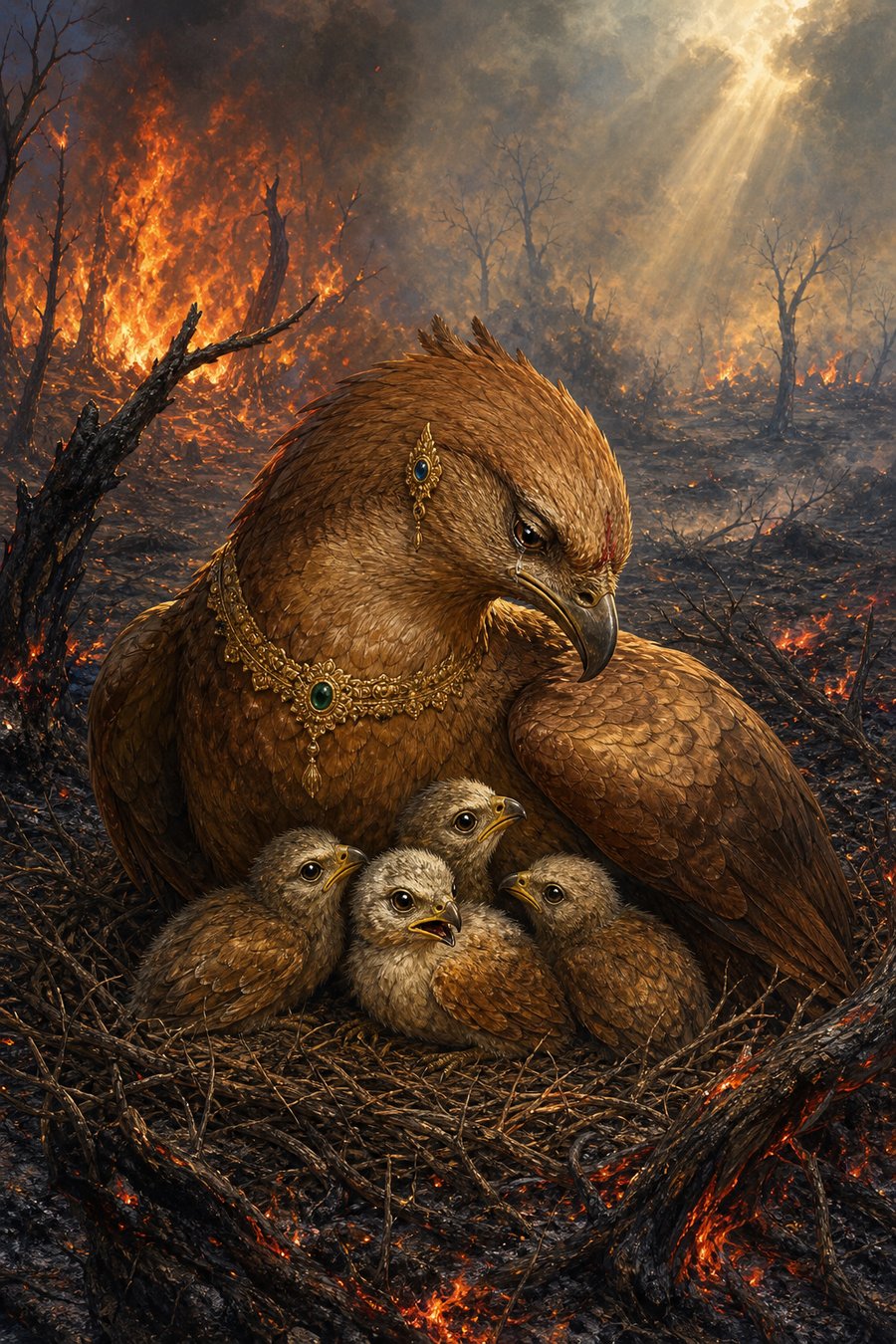
The fire had by this time moved on from the place where the sharngakas lived, and Jarita, who loved her children dearly, came flying back in haste to see what had become of them. She found every one of them out of the fire’s reach and perfectly well. When they saw their mother they began to cry, safe and sound though they were, and she wept too at the sight of them alive, and she embraced her weeping children one at a time.
At that moment the rishi Mandapala arrived. None of his sons showed any pleasure at seeing him. He spoke to each of them in turn, and to Jarita, and then spoke again, and again. Neither the sons nor Jarita said one word to him in reply, good or bad.
At last Mandapala said, “Which of these is your firstborn, and which came next? Which is the third, and which the youngest? I am speaking to you in misery. Why do you give me no answer? I left you, it is true. I had no happiness where I was.”
“What is the eldest of them to you?” said Jarita. “What is the second? What is the third to you, or the youngest? Go back to your Lapita, with her sweet smiles and her youth. You went to her before, when you looked at me and found me wanting in everything.” Mandapala answered, “Nothing in this world or the next destroys a woman’s happiness like a co-wife or a secret lover. Nothing feeds the fire of hatred like those two, and nothing breeds such anxiety. Even Arundhati, blessed and well conducted as she was, and honored by every creature, was jealous of Vasishtha, a man of great purity of mind who was always devoted to his wife’s good. She thought insultingly even of that wise sage among the seven. Because of those thoughts she became a small star, like a fire mixed with smoke, visible at one moment and gone the next, like an omen that promises nothing good. I look to you for the sake of children. I never wronged you, as Vasishtha never wronged his wife, and in your jealousy you have treated me as Arundhati once treated him. Men should never trust women, even their own wives. Once a woman is a mother, she cares little about serving her husband.”
After that all his children came forward and paid him their respects, and he in turn began to speak gently to every one of them and to reassure them.
“I spoke to Agni about the safety of all of you,” Mandapala told his sons, “and the great god gave me his word that he would do as I asked. I had his promise. I knew your mother’s goodness, and I knew the power that is in you yourselves. Those are the reasons I came no sooner. So keep no bitterness against me in your hearts, my sons. You are rishis, all of you, and you know the Vedas. Even Agni knows you well.”
With his sons reassured, the Brahmin Mandapala took his wife and his children with him, left that region, and went away to another country.
That is how the god of fierce rays, grown strong again, came to burn the Khandava forest with the help of Krishna and Arjuna, for the good of the world. Agni drank several rivers of fat and marrow there and was deeply satisfied, and he showed himself to Arjuna. Then Indra came down out of the sky with the Maruts around him and spoke to Arjuna and Krishna. “You have done what even a god could not have done. Each of you, ask me for a boon, one that no man could otherwise obtain. I am pleased with you.”
Arjuna asked Indra for all of his weapons. Indra, in his great splendor, named the time when he would give them. “When Krishna is pleased with you, son of Pandu, I will give you every weapon I have. I will know when that time has come. In return for hard austerities on your part I will give you all my weapons of fire and all my weapons of wind, and you will accept every one of them from my hands.”
Krishna asked for something else. He asked that his friendship with Arjuna should last forever, and the chief of the gods granted the wise Krishna exactly that. With both boons given, the lord of the Maruts spoke a word to Agni as well and went back up to heaven with the gods around him. Agni had burned that forest, with its animals and its birds, for fifteen days. He had eaten flesh in plenty and drunk fat and blood, he was entirely content, and he stopped burning. Then he spoke to Krishna and Arjuna. “The two of you, heroes both, have satisfied me. By my command you will be able to go wherever you choose.” When Agni had said this, Arjuna, Krishna and the danava Maya, the three of them together, walked about for a little while and then sat down on the pleasant bank of a river.
A key to reading this (the lineage): Mandapala has two wives in this story. Jarita is the sharngaka hen on whom he fathers four sons, Jaritari, Sarisrikka, Stambamitra and Drona, and Lapita is the wife he leaves her for. When he returns, he answers Jarita’s coldness with the case of Arundhati and Vasishtha. Arundhati, he says, thought ill of a faultless husband, a sage among the seven, and became a small star that is seen one moment and lost the next.
The gist: Mandapala, anxious in spite of Agni’s promise, quarrels with the jealous Lapita and goes back to Jarita. He finds the four young birds alive, and they and their mother silent toward him. He rebukes Jarita with the example of Arundhati, his sons come forward to honor him, and he takes the family away to another country. Agni, satisfied after fifteen days, stops burning. Indra promises Arjuna his weapons at a time still to come and grants Krishna unending friendship with Arjuna, and Arjuna, Krishna and Maya sit down together on a riverbank. Here the Adi Parva ends.
Source: the Mahabharata of Krishna-Dwaipayana Vyasa, Adi Parva, Rajyalabha through Khandava-daha sub-parvas, Sections 214 to 236. The Sanskrit e-text, the Gita Press Hindi edition, and Kisari Mohan Ganguli’s complete English translation were used to verify names, sequence, and principal events. Where the recensions differ, this English retelling follows Ganguli, and the Hindi edition follows Gita Press.
Based on: The Mahabharata, Vyasa (K. M. Ganguli’s English translation; Gita Press, Gorakhpur)