On this page
The world believed that the five sons of Pandu were dead, burned with their mother Kunti in a house built of lac, and the five were content to let the world go on believing it. They walked the roads in the dress of Brahmin beggars with their mother beside them, and the road they were on now led toward Panchala, where King Drupada was about to hold a svayamvara for his daughter Draupadi: the gathering at which a princess, before every king who cares to come, takes a husband of her own choosing. The sage Vyasa had sent them that way. Before they reached Drupada’s city they would take a priest into their company. Inside it they would lodge with a potter and live on alms. And on the sixteenth day of the festival a bow would be set out in front of the assembled kings of the earth, with five arrows beside it.
Winning the Priest Dhaumya
The meeting had begun with a fight and was ending in a friendship. On the bank of the Ganga a king of the Gandharvas, the celestial race that keeps the music and the old lore of heaven, had tried to bar the brothers from the river in the dark. Arjuna had burned his chariot from under him with the weapon of fire, spared his life at Yudhishthira’s word, and then sat listening while the beaten spirit told story after story of what a king gains when a learned priest walks ahead of him. The stories had a point, and Arjuna took it. “You know everything there is to know, Gandharva,” he said. “Tell us, then, which Brahmin learned in the Veda is worthy to be made our priest.”
“There is a shrine in these very woods called Utkochaka,” the Gandharva answered. “Dhaumya, the younger brother of Devala, is living there under the discipline of an ascetic. Appoint him your priest, if that is your wish.”
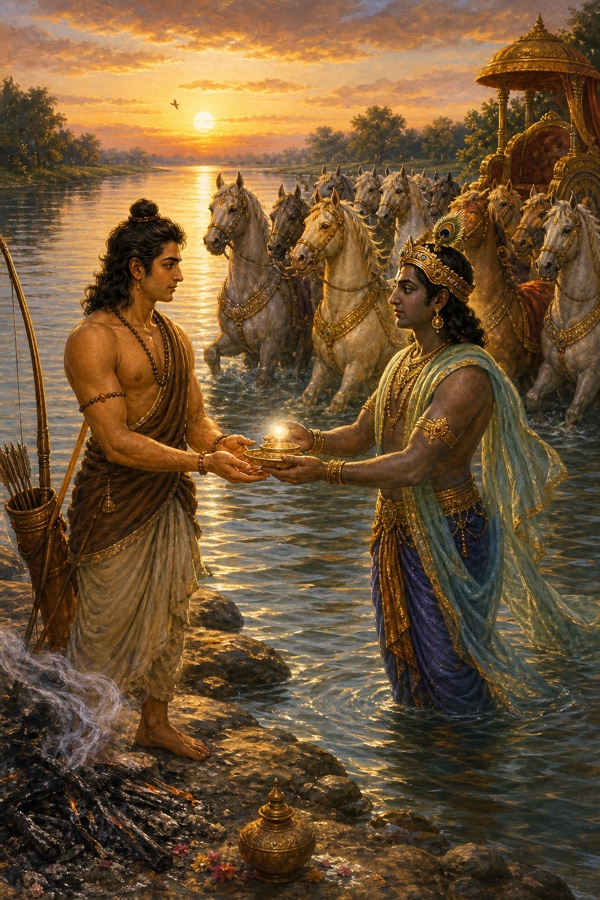
Arjuna was well pleased with everything the night had brought, and he closed the bargain the two of them had struck. With the proper ceremonies he made over to the Gandharva his weapon of fire, the price agreed for horses bred in the Gandharvas’ own country, a hundred for each brother, animals with the speed of thought. Homeless men traveling on foot as beggars had no stable for such a herd. “Keep the horses you are giving us with you for a time,” he said. “When the occasion comes we will take them from you. Good fortune to you.” Then the Gandharva and the Pandavas saluted one another with respect, left the pleasant banks of the Ganga, and went each where he wished.
The brothers went to Utkochaka. Dhaumya’s hermitage was a holy place, and the man in it knew the Vedas as few men living knew them. He welcomed the strangers with what a forest ascetic has to give, wild fruits and roots fit to eat, and when they asked him to be their priest he consented. They were six in the company, counting their mother, and now a seventh walked in front of them. The Gandharva had told them that a king who means to win the earth puts a Brahmin before him, and with Dhaumya as their priest the brothers felt themselves under a powerful protector. Having him, they counted their sovereignty and their kingdom as already won back, and the daughter of the Panchala king as already theirs at her svayamvara. Dhaumya knew the true meaning of the Vedas and every rule of right conduct, and in becoming their teacher in sacred things he took them as his patrons, the men for whom he would henceforth sacrifice. He looked at the five, saw intelligence and strength and perseverance of the kind the gods have, and concluded for his own part that such men were already as good as restored to their throne by their own merits. He spoke his benedictions over them, and they resolved to go on with him to the svayamvara of the princess of Panchala.
The gist: On the Gandharva’s advice the Pandavas go to the shrine of Utkochaka and appoint the ascetic Dhaumya, younger brother of Devala, as their priest. Arjuna pays the Gandharva with his weapon of fire and leaves the promised horses in his keeping. With their mother and their priest the brothers turn toward the svayamvara in Panchala.
Meeting the Brahmins on the Road
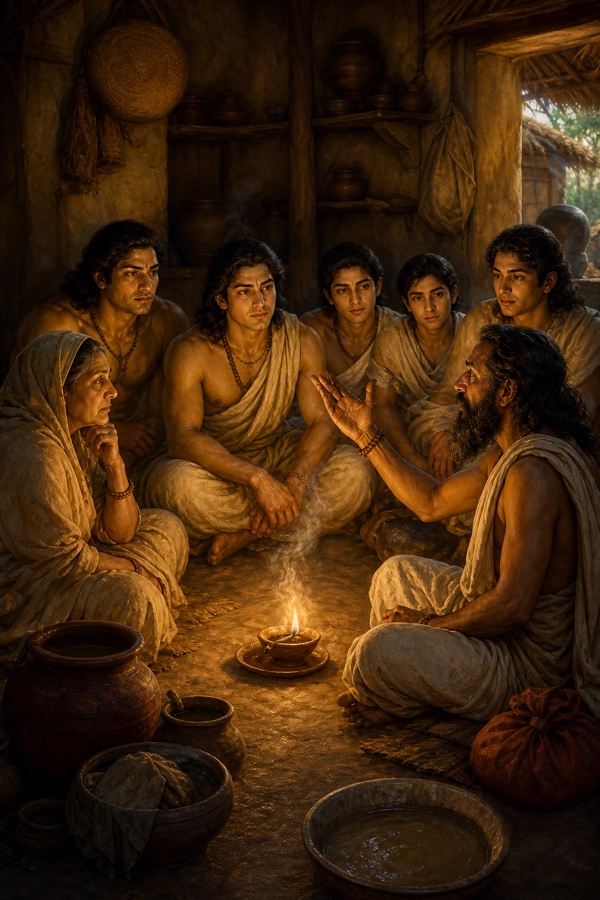
So the five brothers set out for Panchala, wanting to see that country, and Draupadi, and the festivities of her wedding. Their mother walked with them. On the way they fell in with a large party of Brahmins traveling together, every one of them a brahmachari, a student living under his vow of celibacy, and the students hailed the newcomers the way travelers do. “Where are you bound? And where have you come from?”
“We are brothers born of one mother, and we are traveling with her,” Yudhishthira answered. “We have come from Ekachakra.” It was the truth as far as it went. Ekachakra was the town where the six of them had been lodging, unknown, in a Brahmin’s house.
“Then go this very day to Drupada’s seat in the country of the Panchalas,” the Brahmins said. “A great svayamvara is being held there, and a fortune is going to be spent on it. We are headed that way ourselves. Let us all go together. There will be festivities such as nobody has seen.”
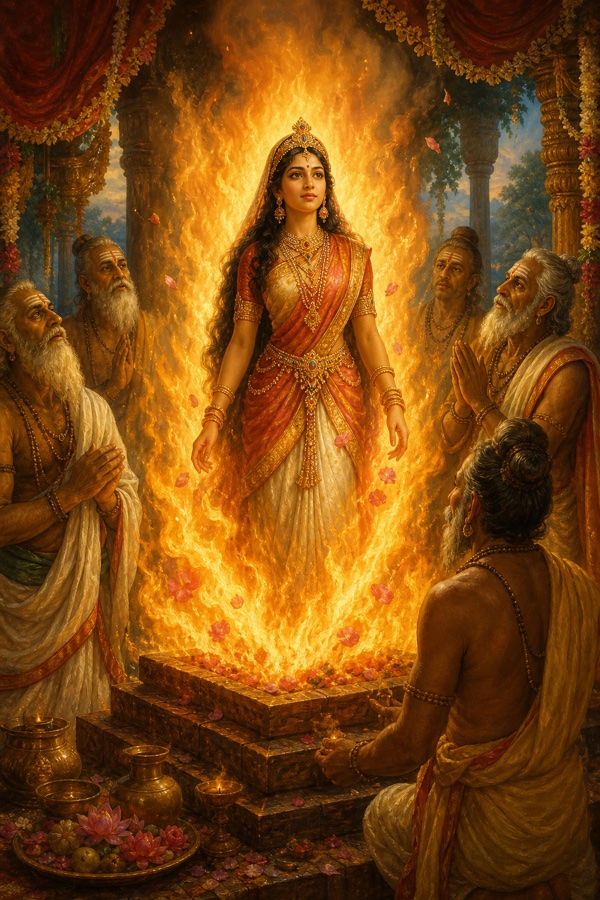
“Drupada, whom men also call Yajnasena, has a daughter who rose out of the middle of his sacrificial altar,” they went on. “Her eyes are like lotus petals. There is no fault in any feature of her. She is young, she is clever, and she is beautiful past describing, slender at the waist, and the scent of the blue lotus goes out from her body and can be caught two full miles away. She is the sister of Dhrishtadyumna, the strong-armed prince who is to be the death of Drona, the one who came out of the blazing fire already in his armor, with his sword and his bow and arrows in his hands, like a second Fire himself.
“That daughter of Yajnasena is going to choose her husband from among the princes who have been invited, and we are on our way to look at her and at a festival that will be like the festivals of heaven. Kings and princes are coming from every country: men who sacrifice and pay the Brahmins large fees when they do, men given to study, clean-living, famous, strict in their vows, young, handsome, great chariot fighters, trained in every weapon. Each of them wants that girl, and hoping to win her each of them will be giving away wealth and cattle and food and every kind of good thing. We will take whatever they give, watch the svayamvara, enjoy the festival, and go wherever we please afterward. There will be actors, and bards singing the praises of kings, and dancers, and reciters of the Puranas, and heralds, and powerful wrestlers. See the sights, take your share of what is handed out, and come back with us.” Then they looked the five strangers over, and the talk took a lighter turn. “All of you are handsome as gods. Draupadi might see you and, who knows, choose one of you over all the rest. And this brother of yours, with those arms and those looks, could enter the bouts and come away with a great deal of money.”
“We will all go with you, Brahmins,” Yudhishthira said, “to see this girl choose her husband, and the great festival that goes with it.”
A sub-tale: The Brahmins are describing a birth the Pandavas had heard about at Ekachakra. Drona, the teacher of the Kuru princes, had beaten Drupada and taken half his kingdom, and Drupada wanted a son who could kill him. Two Brahmin brothers, Yaja and Upayaja, performed the sacrifice. When the oblation went into the fire a boy rose from the flames with a crown on his head, armor on his body, and a sword and bow in his hands, and a voice in the sky said he was born for the destruction of Drona. Then a dark and beautiful girl rose from the center of the altar, and the voice said she would be the cause of the destruction of many Kshatriyas. The boy was named Dhrishtadyumna. The girl is Draupadi, Drupada’s daughter; she is called Yajnaseni after her father’s other name, Yajnasena, and Panchali after his country.
The gist: Brahmin students on the road tell the Pandavas about the svayamvara in Panchala, about Draupadi, who rose from Drupada’s altar, and about her brother Dhrishtadyumna, who rose from its fire. They invite the brothers to come for the gifts and the spectacle, joke that Draupadi might choose one of them, and all travel on together.
Entering Panchala and Meeting Vyasa
With the Brahmins for company the Pandavas went on toward the country of the southern Panchalas, where Drupada was king. On the road they met Vyasa. The sage called Dvaipayana, the island-born, pure of soul and free of every fault, was their own grandfather and the man who had told them to make this journey. They saluted him as he deserved and he returned the greeting, and when their talk was finished he told them to go on to Drupada’s city, and they went. They traveled by slow stages, stopping for a while wherever the woods were beautiful and the lakes were fine. Given to study, clean in their habits, gentle and pleasant in speech, they looked like what they claimed to be, and so they came at last into Panchala.
They looked over the capital and its fort, and then they took lodgings in the house of a potter. They followed the Brahmin’s calling and lived as beggars live, going out each day for alms, and nobody in Drupada’s capital recognized the men who were staying there.
Drupada had a wish he had never spoken aloud to anyone. He had always wanted to give his daughter to Arjuna, the son of Pandu whom men call Kiriti, and he did not know whether Arjuna was alive. Thinking of him all the same, the king of Panchala had a bow made, a bow so stiff that nobody but Arjuna would be able to bend it. He had a piece of machinery raised high in the air and a mark fixed to it. Then he made his proclamation: “The man who strings this bow, and with these well-adorned arrows shoots the mark set above the machine, shall have my daughter.”
That was how Drupada announced the svayamvara, and the word went out. Kings of other countries came to his capital. Great rishis came, wanting to see it. Duryodhana came with the Kurus, and Karna came with him. Brahmins of standing arrived from every land. Drupada received each king who came with all the honor due to him.
A key to reading this (the concept): A svayamvara is a bride’s own choice of her husband, made in public before the suitors her father has invited. Before the day is out the angry kings will say that by Vedic rule the svayamvara belongs to the Kshatriyas, the order of kings and warriors, and that a Brahmin has no claim in it. Drupada joined the choice to a trial of strength and aim: his daughter goes to the man who can string one particular bow and bring down one particular mark. Yudhishthira will call this a special kind of dower, a price fixed by the father and paid by the suitor in skill. In the Gita Press tradition and the popular telling this mark is a fish, and the scene is remembered as the matsya-vedh, the piercing of the fish.
The gist: Dressed as Brahmins, the Pandavas meet Vyasa on the road, enter Panchala, lodge in a potter’s house, and live on alms, recognized by no one. Drupada, who has always wanted Arjuna for his daughter, has a bow made that only Arjuna can bend and sets a mark above a machine raised in the air. Kings, rishis, Brahmins, and Duryodhana with the Kurus and Karna gather for the svayamvara.
The Arena of the Svayamvara and Draupadi’s Entrance
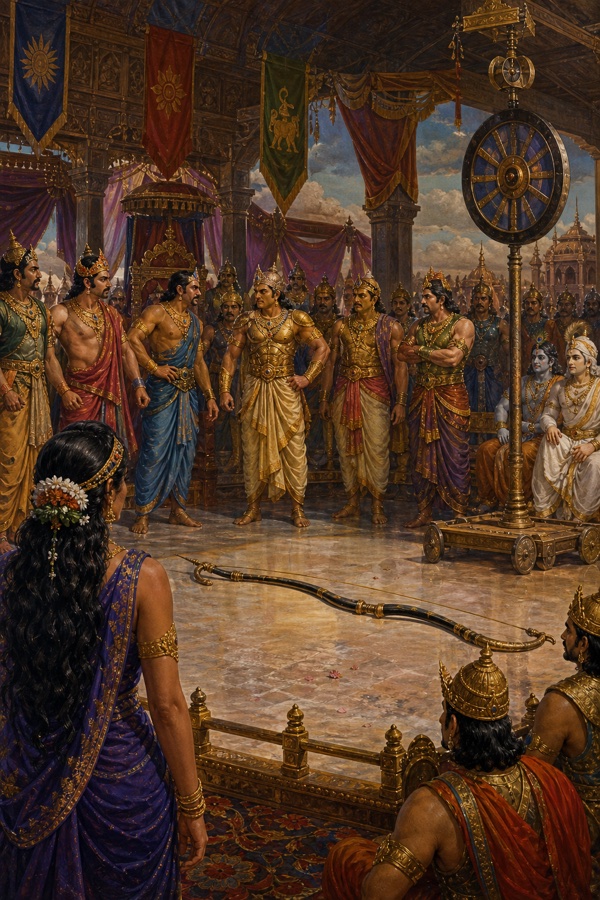
The citizens came to watch, and the noise of them was the noise of the sea as they took their seats on the platforms built around the arena. The amphitheater stood on a level and auspicious plain to the northeast of Drupada’s capital, and the royal entry was by its northeastern gate. Fine mansions surrounded it. High walls and a moat enclosed it on every side, with arched gateways at intervals, and over the whole vast space a canopy of many colors gave shade. Thousands of trumpets sounded there. The air was scented with black aloe, the ground had been sprinkled everywhere with water mixed with sandal paste, and garlands of flowers hung wherever a garland could be hung.
The mansions around it were tall and perfectly white, like the cloud-touching peaks of Mount Kailasa. Their windows were covered with lattices of gold. Their walls were set with diamonds and hung with costly carpets and cloths. Wreathed with flowers and sweet with the finest aloe, they were spotless as the necks of swans, and the fragrance of them could be caught a yojana away, a distance of eight miles. Each had a hundred doors wide enough to let a crowd pass through; each was furnished with costly beds and carpets and worked with many metals, and together they stood like the peaks of the Himalaya. They were seven stories high and of various sizes, and in them lodged the kings Drupada had invited, wearing every ornament they owned, each one bent on outshining the rest. From the platforms, the people of the city and the countryside who had come to see Draupadi could look across and see those kings seated in their mansions, every one of them anointed with the fragrant paste of the black aloe. They were openhanded kings, devoted to Brahman, defenders of their realms against every enemy, and loved through the world for the good they had done.
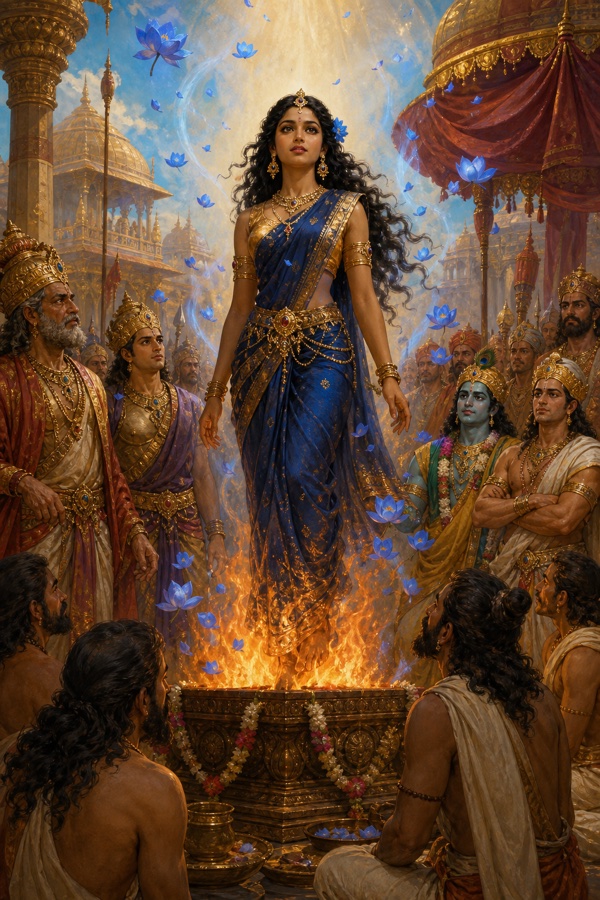
The Pandavas went in too. They sat down among the Brahmins and looked at the wealth of the king of the Panchalas, which had no equal. The gathering of princes and Brahmins and all the rest grew larger every day. Actors and dancers performed for it, and gifts of every kind of wealth were handed out without pause. It went on for many days. On the sixteenth, when the assembly was at its fullest, the daughter of Drupada bathed, dressed in rich clothes, put on every ornament, and entered the amphitheater carrying a dish of gold that held the arghya, the offering of welcome, and a garland of flowers.
Then the priest of Drupada’s house, the house of the Lunar line, a holy Brahmin who knew every mantra, lit the sacrificial fire and poured libations of clarified butter into it with the proper rites. When Agni had received his due and the Brahmins had spoken the formula of blessing, the priest stopped the instruments that were playing on every side. The whole vast amphitheater went perfectly still. Into that silence walked Dhrishtadyumna. He took his sister by the arm and stood with her in the middle of the gathering, and when he spoke his voice was loud and deep, the voice of a kettledrum or of the clouds.
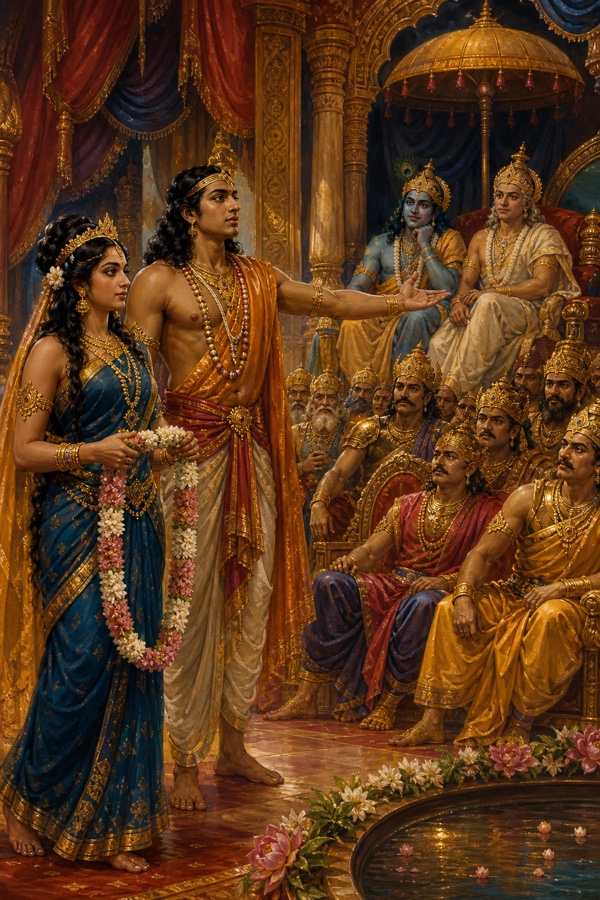
“Hear me, kings who are gathered here. This is the bow. That is the mark. These are the arrows. Shoot the mark through the opening in the machine with these five sharpened arrows. I say it truly: the man of good family, good looks, and strength who achieves this great feat shall have my sister Draupadi for his wife today.” Having said that much to the kings, Drupada’s son turned to his sister and began to tell her, one after another, the names and the lineages and the deeds of the lords who had come for her.
A sub-tale: The names Dhrishtadyumna recited to his sister, in his order. Of Dhritarashtra’s sons: Duryodhana, Durvishaha, Durmukha, Dushpradharshana, Vivimshati, Vikarna, Saha, and Duhshasana; Yuyutsu, Vayuvega, and Bhimavegarava; Ugrayudha, Balaki, Kanakayu, Virochana, Sukundala, Chitrasena, Suvarcha, and Kanakadhvaja; Nandaka, Bahushali, Tuhunda, and Vikata; and many more of those brothers, with Karna beside them. Of the house of Gandhara: Shakuni the son of Subala, Vrishaka, and Brihadbala. Then Ashvatthama and Bhoja; Brihanta, Manimana, Dandadhara, Sahadeva, Jayatsena, Meghasandhi; Virata with his two sons Shankha and Uttara; Vardhakshemi, Susharma, Senabindu; Suketu with his two sons Sunama and Suvarcha; Suchitra, Sukumara, Vrika, Satyadhriti, Suryadhvaja, Rochamana, Nila, Chitrayudha, Anshuman, Chekitana, Shreniman; Chandrasena the son of Samudrasena; Jarasandha; Vidanda and Danda, father and son; Paundraka, who also goes by the name Vasudeva; Bhagadatta; the kings of Kalinga, Tamralipta, and Pattana; Shalya, king of Madra, with his son Rukmangada, and Rukmaratha; Somadatta of the Kuru line with his three sons Bhuri, Bhurishravas, and Shala; Sudakshina; Kamboja of the Puru line; Brihadbala, Sushena, and Shibi the son of Ushinara; Patcharanihanta, king of Karusha. Of the Vrishnis: Balarama and Krishna, Rukmini’s son, Samba, Charudeshna, Pradyumna’s son, Gada, Akrura, Satyaki, Uddhava, Kritavarma the son of Hridika, Prithu, Viprithu, Viduratha, Kanka, Shanku with Gaveshana, Ashavaha, Aniruddha, Samika, Sarimejaya, Vatapi, Jhilli, Pindaraka, and Ushinara. And after them Bhagiratha, Brihatkshatra, Jayadratha of Sindhu, Brihadratha, Bahlika, Shrutayu, Uluka, Kaitava, Chitrangada and Suvangada, Vatsaraja, the king of Kosala, and Shishupala. “These and many other kings, Kshatriyas known through the whole world, have come for you,” he told her. “They are strong men, and they will shoot at the mark. Choose for your husband the one among them who brings it down.”
The gist: For many days the arena outside Drupada’s capital fills with kings, Brahmins, and performers. On the sixteenth Draupadi enters with a golden dish and a garland, the family priest feeds the fire and silences the music, and Dhrishtadyumna announces the terms: string the bow and shoot the mark through the opening in the machine with five arrows. Then he names the assembled kings to his sister, house by house.
The Kings’ Attempts and the Slighting of Karna
The young princes were on their feet. They wore earrings and carried weapons, each one believed that he was the finished fighter and the strong man of that company, and they stood brandishing their arms at one another. Pride had made them drunk: pride of looks, of prowess, of birth, of learning, of wealth, of youth. They were like the elephants of the Himalaya in the season of rut, when the temples split and run. Each looked at the others with jealousy. The god of desire had hold of them all, and they came up off their royal seats shouting, “Draupadi shall be mine!” Gathered in that arena, every one of them wanting Drupada’s daughter, the Kshatriyas looked like the gods of old standing around Uma, the daughter of the King of Mountains. The god with the bow of flowers had put his arrows into them. With their hearts lost in the thought of Draupadi they went down onto the floor of the amphitheater to win her, and began to look on even their closest friends as rivals.
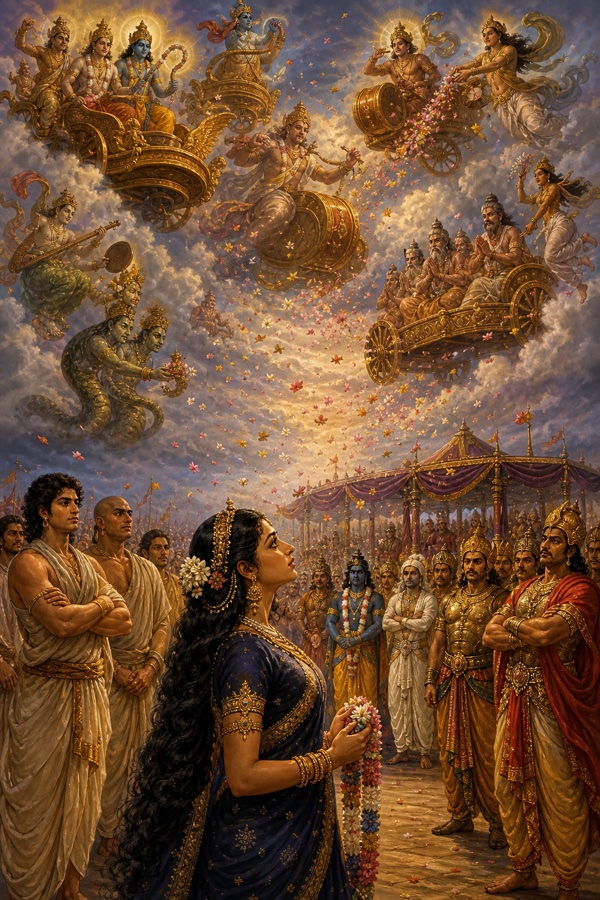
The gods came to watch. They arrived in their chariots, the Rudras and the Adityas, the Vasus and the twin Ashvins, the Svadhas and all the Maruts, with Kubera, lord of wealth, and Yama, king of the dead, going in front. The Daityas came, and the Suparnas, and the great Nagas, and the rishis of heaven; the Guhyakas and the Charanas; Vishvavasu and Narada and Parvata; and the chief Gandharvas with their Apsaras. The sky filled with celestial rishis and Gandharvas, Suparnas and Nagas, Asuras and Siddhas. It was thick with the perfumes of heaven and strewn with heaven’s flowers. It rang with kettledrums and with the deep hum of voices past counting, and under that ran the softer music of the flute, the vina, and the tabor, until the chariots of the gods could hardly find a way through. Balarama, who carries the plow for his weapon, was there as well, and Krishna, and with them the chiefs of the Vrishni, Andhaka, and Yadava clans, who followed where Krishna led. They too had come to look.
Krishna was looking at something nobody else had noticed. Five men sat among the Brahmins, and they were drawn toward Draupadi the way great elephants in rut are drawn to a lake grown over with lotuses. They were like fire under a covering of ash. Krishna studied them and thought it through. Then he said to Balarama, “That one is Yudhishthira. That is Bhima, and Arjuna with him. And those two are the twins.” Balarama looked them over slowly, one after another, and turned to Krishna with a glance of deep satisfaction.
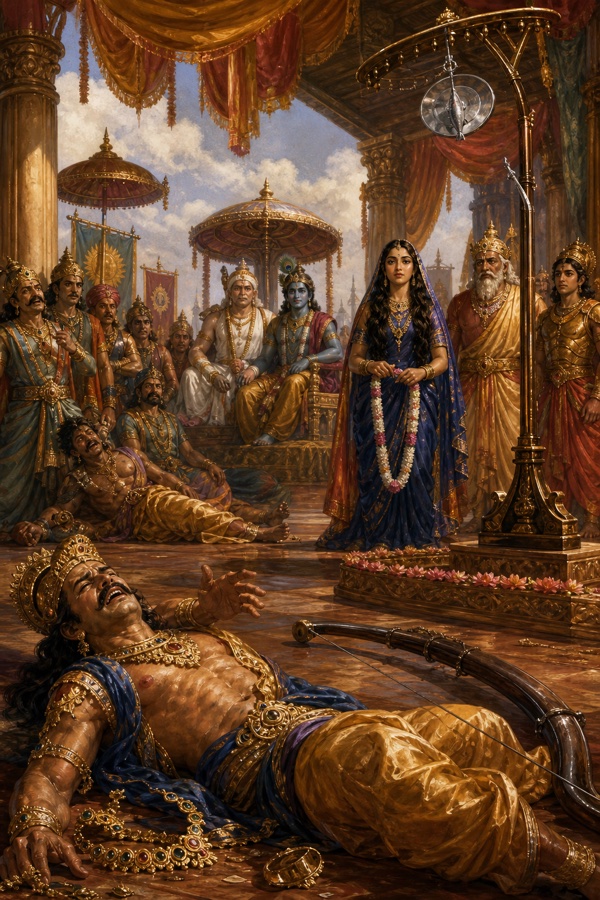
The other princes, the sons and grandsons of kings, had their eyes and hearts and thoughts fixed on Draupadi. They bit their lips in anger and stared at her alone, wide-eyed, and never noticed the Pandavas. The sons of Kunti, long-armed men, and the twins with them, looked at Draupadi and were struck by the arrows of Kama, the god of desire, exactly as the kings had been. Then the trial began. Duryodhana, Shalva, Shalya, Ashvatthama, Kratha, Sunitha, Vakra, the ruler of Kalinga and Banga, Pandya, Paundra, the ruler of Videha, the chief of the Yavanas, and many other sons and grandsons of kings, lotus-eyed lords of territories, came forward one after another to show what they could do and win a girl whose beauty had no rival. They wore crowns and garlands and bracelets. Their arms were powerful, and they were bursting with strength and energy. And the bow would not be strung. Its stiffness was beyond anything those princes knew, and they could not bend it even in imagination.
Some of them put everything they had into it. They strained at the bow with swelling lips, each according to his strength, his schooling, his skill, and his energy, and the bow threw them. They were flung to the ground and lay there for a while without moving. When they got up their strength was spent, their crowns and garlands had come loose, and they stood panting; the ambition to win that girl had cooled in them. Tossed about by that tough bow, with their garlands and bracelets and other ornaments in disorder, they began to cry out in distress. The whole assembly of kings, its hope of Draupadi gone, sat sad and woebegone.
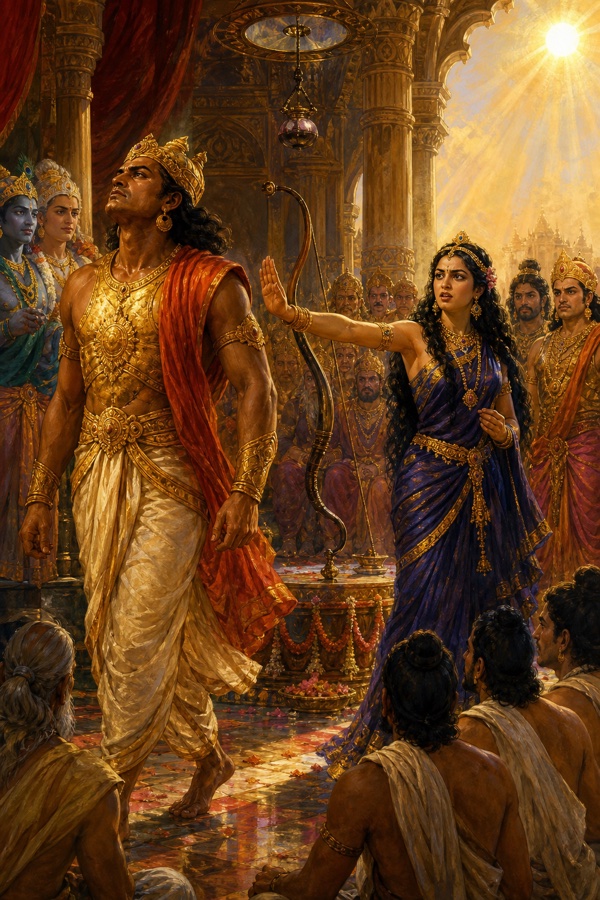
Karna watched the kings come to grief, and then he went to where the bow lay. No man alive handled a bow better. He lifted it quickly, strung it, and set the arrows to the string. He was the son of Surya, the Sun, and he was counted a man of the Suta tribe, the charioteers. Standing there resolved to shoot, he looked like fire, or like Soma the moon, or like the Sun himself, and the sons of Pandu, great bowmen all, looked at him and counted the mark as already hit and lying on the ground. Draupadi saw him too, and she spoke loudly: “I will not choose a Suta for my lord.” Karna laughed, and there was vexation in the laugh. He glanced up at the Sun. Then he threw aside the bow, which he had already drawn into a circle.
When all those Kshatriyas had given the task up, three more kings came to the bow. Shishupala, king of the Chedis, the son of Damaghosha, a determined man with the might of Yama in him, tried to string the bow and went down on his knees on the ground. King Jarasandha, whose strength was famous, walked up to the bow and stood beside it for a moment, fixed and motionless as a mountain. The bow tossed him, and he too fell on his knees; he got up, left the amphitheater, and started back to his own kingdom. Then Shalya, the powerful king of Madra, tried to string it and fell on his knees like the others. The gathering was made up of the most respected people in the land, and by now every king in it was being talked of with derision. It was then that Arjuna, the son of Kunti whom men call Jishnu, the victorious, made up his mind to string that bow and set the arrows to its string.
A key to reading this (lineage): Draupadi refuses Karna with one word, Suta. The Sutas were the charioteer people; elsewhere the epic defines a Suta as the son of a Kshatriya father and a Brahmin mother. Karna was the child of the Sun god and of Kunti. He was put into a box as an infant and set adrift on the river, and the Suta Adhiratha and his wife Radha found him and raised him as their eldest son. Kunti knew where her son had gone. Nobody at the svayamvara knew whose son he was. That is why the text calls him the son of Radha and a man of the Suta tribe even as it calls him the son of Surya. Readings differ on this moment: Ganguli’s translation also counts Karna among the princes the bow defeated, and this telling follows the Gita Press, where Karna strings the bow and lays it down unshot at Draupadi’s refusal.
The gist: One after another the kings fail at the bow and are thrown down by it. Karna strings it and sets the arrows to the string, Draupadi says aloud that she will not choose a Suta, and he throws the drawn bow aside. Shishupala, Jarasandha, and Shalya fall to their knees in turn. Then Arjuna decides to try.
Arjuna’s Piercing of the Mark
When every king had given up, Arjuna rose from his place in the crowd of Brahmins. He had the color of Indra’s banner as he walked toward the bow, and the leading Brahmins, seeing one of their own number go forward, set up a great clamor and shook their deerskins in the air. Some of them were displeased. Others were delighted.
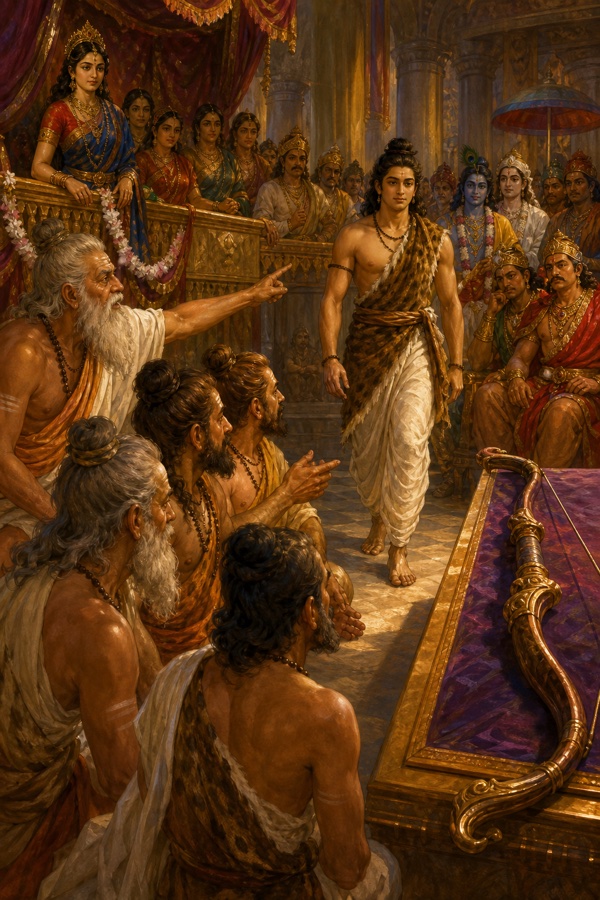
The cautious ones, men who thought ahead, turned to one another. “Brahmins, think. Shalya could not string that bow, nor could the others, famous Kshatriyas, strong men, schooled in the science of arms and practiced in it. How is a Brahmin boy going to do it, a stripling who has never trained with weapons and has no strength to speak of? He has taken this on out of a boy’s restlessness, without ever having tried such a thing. If he fails, every Brahmin here will look ridiculous in the eyes of the assembled kings. It is vanity that sends him to that bow, or a child’s daring, or plain unsteadiness. Forbid him. Do not let him go.”
“We will not be made ridiculous,” others answered, “and we will not earn anyone’s disrespect, or the displeasure of the kings.” And some said, “Look at him. This fine young man is like the trunk of a great elephant. Look at the build of his shoulders and arms and thighs. He has the patience of the Himalaya, he walks like a lion, he seems to have the power of an elephant in rut, and he is so sure of himself that he will very likely do this thing. He has strength and he has resolve. If he lacked them he would never have gone forward of his own accord. And is there anything in the three worlds that a Brahmin, of all mortal men, cannot accomplish? Brahmins go without food altogether, or live on air, or eat only fruit; they keep to their vows until they are thin and weak, and still they are strong with an energy of their own. No one should ever look down on a Brahmin, whether what he does is right or wrong, or suppose him unequal to any task, great or small, happy or painful. Rama, the son of Jamadagni, defeated all the Kshatriyas in battle. Agastya, by the power that is in a Brahmin, drank the bottomless ocean dry. So say it with us: let this youth bend the bow and string it with ease.” And many said, “So be it.” The Brahmins were still saying such things to one another when Arjuna reached the bow.
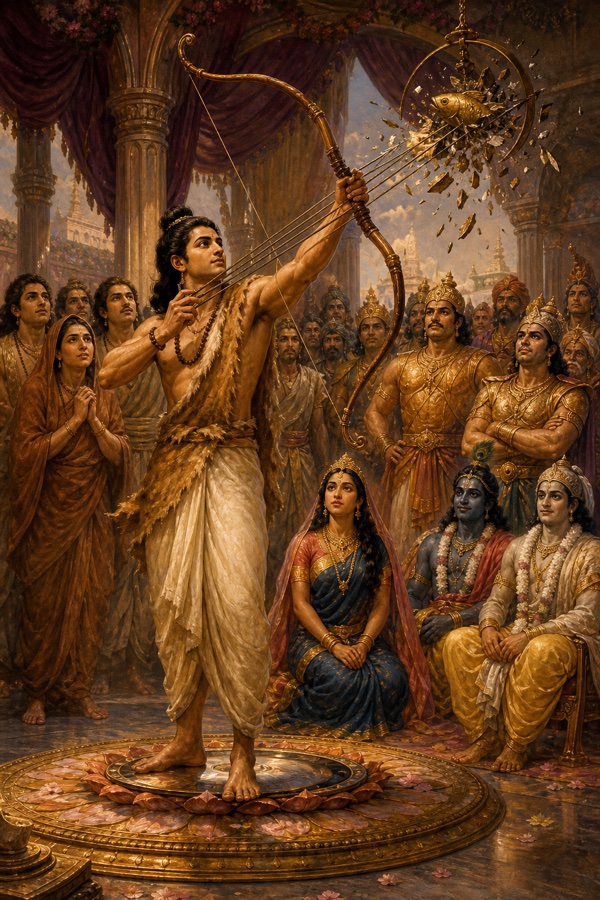
He stood beside it like a mountain. He walked around it. He bowed his head to Shiva, the lord Ishana, the giver of boons, and he turned his mind to Krishna. Then he picked it up. Rukma, Sunitha, Vakra, Duryodhana, Shalya, and many other kings accomplished in the science and the practice of arms had strained at that bow with all their might and had not been able to string it. Arjuna, the son of Indra, a man in whom energy burned as in no other and whose might was like that of Vishnu, Indra’s younger brother, strung it in an instant. He took up the five arrows. He shot the mark, and it came down through the hole in the machine above which it had been set and fell on the ground.
A great roar went up in the sky, and the amphitheater answered it with a roar of its own. The gods rained the flowers of heaven on Arjuna’s head. Thousands of Brahmins waved their upper cloths in the air for joy. All around the arena the kings who had failed cried out in grief and despair. Flowers fell from the sky over the whole amphitheater, the musicians struck up together, and the bards and heralds began to chant, in sweet voices, the praises of the man who had done it.
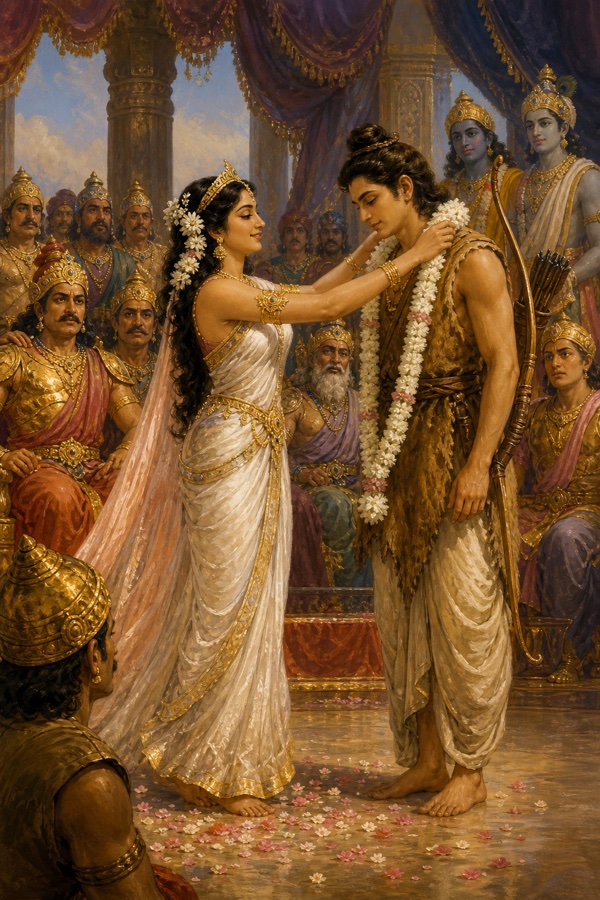
Drupada looked at the archer, and joy filled him. The king made up his mind to stand by this man with his army if the occasion arose. While the uproar was at its height Yudhishthira got up, and with the twins beside him he left the amphitheater quickly and made for the place where they were lodging. Draupadi had seen the mark brought down. She looked at the man who had shot it, who stood there like Indra himself, and she was filled with joy, and she came to the son of Kunti carrying a white robe and a garland of flowers. Arjuna had done a thing no one had believed could be done and had won her by it before the whole arena. All the Brahmins saluted him with reverence. Soon afterward he left the lists, and she who had in that way become his wife followed close behind him.
The gist: Arjuna rises from among the Brahmins, who argue over whether a Brahmin youth should be allowed to try. He walks around the bow, bows to Shiva, thinks of Krishna, strings the bow in an instant, and brings the mark down with the five arrows. The gods rain flowers, Drupada rejoices, Yudhishthira slips away with the twins, and Draupadi comes to Arjuna with a white robe and a garland and follows him out of the arena.
The Angered Kings and the Battle of Bhima and Arjuna
Drupada let it be known that he meant to give his daughter to the Brahmin who had shot the mark. The kings he had invited looked at one another, and rage took them all at once. “He passes over us. He treats a gathering of kings like so much straw, this Drupada, and means to hand his daughter, a woman without equal, to a Brahmin. He planted the tree, and now that it is about to bear fruit he cuts it down. The wretch has no regard for us, so let us kill him. He has earned neither our respect nor the reverence owed to his years. A man who behaves this way insults every king alive; we will kill him, and his son with him. He invited all of us and fed us at his table, and at the end of it he slights us. This assembly is like a council of the gods. Does he see no king in it who is his equal? The Vedic rule is well known: the svayamvara is for Kshatriyas. A Brahmin has no claim when a Kshatriya girl chooses her husband. And if this girl will have none of us for her lord, then, kings, let us throw her into the fire and go home to our kingdoms. As for the Brahmin, he has done the kings this injury out of meddling or out of greed, and even so he must not be killed. Our kingdoms, our lives, our treasure, our sons and grandsons, every kind of wealth we own, all of it exists for the sake of Brahmins. Still, something has to be done here, to him as well, so that fear of disgrace and respect for what belongs to each order keep other svayamvaras from ending as this one has.”
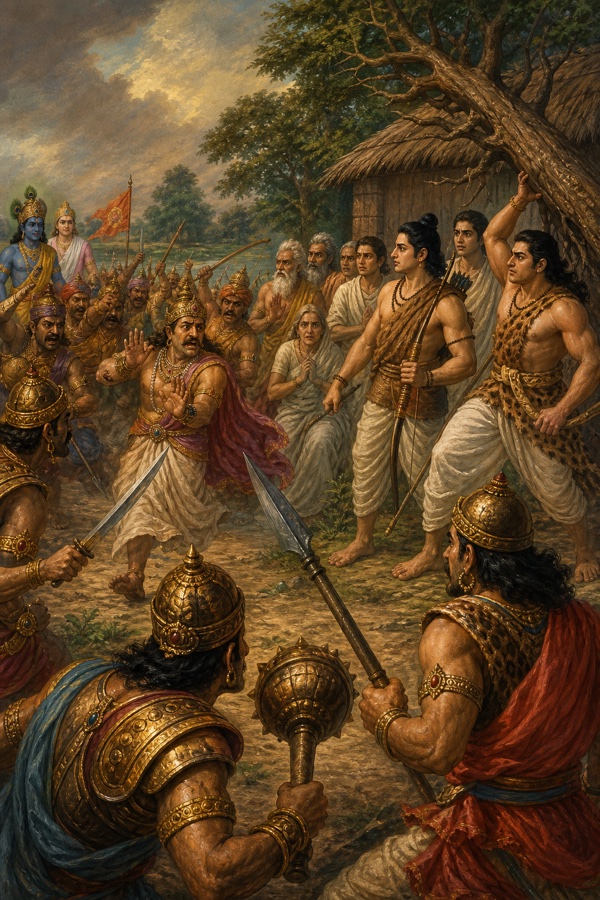
They had talked themselves into it. Those kings, whose arms were like spiked maces of iron, took up their weapons and ran at Drupada to kill him where he stood. Drupada saw them coming, all of them at once, furious, with bows and arrows in their hands, and in his fear he looked to the Brahmins for protection. Two of the Brahmins were already moving. Bhima and Arjuna, great bowmen both and able to punish any enemy, stepped out to meet the kings, who were coming on like elephants in the season of rut. The kings saw two men standing in their way. With leather guards on their fingers and their weapons raised, they turned their anger on the two Kuru princes and rushed at them to kill them.
Bhima’s strength was the strength of thunder, and he used it the way an elephant would. He tore a large tree out of the ground and stripped the leaves from it. Then, with the trunk in his hands, the long-armed son of Kunti took his stand beside Arjuna, like Yama, king of the dead, standing with his terrible mace. Arjuna had a quick mind and had done things himself that nobody would have believed, and still he marveled at what his brother had just done. His own deeds were a match for Indra’s. He shook off all fear and stood with his bow ready to receive the men who were coming.
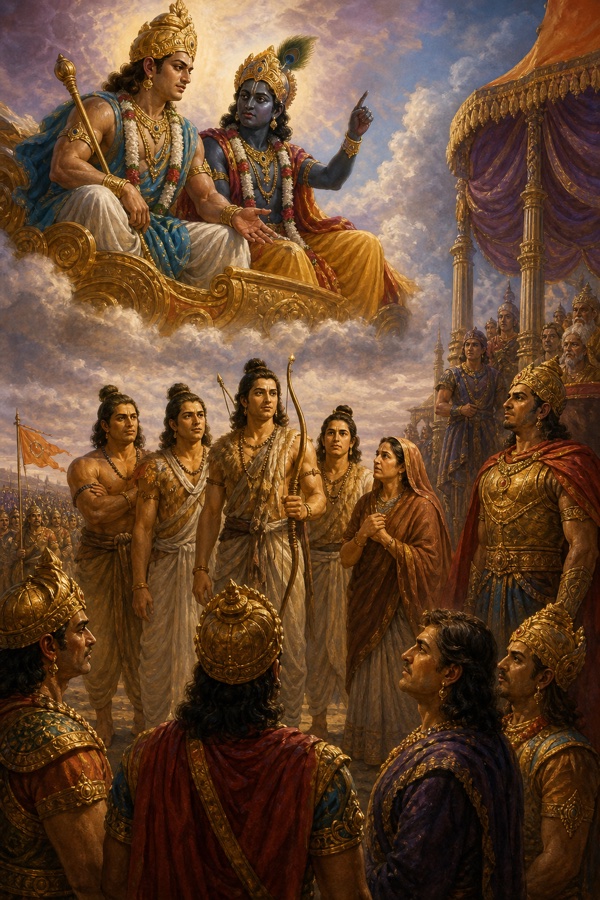
Krishna saw both of them do it. His understanding went beyond a man’s, and he turned to his brother Balarama, that fierce and powerful man, and spoke. “The one over there who walks like a great lion, the one drawing that big bow, four full cubits long: that is Arjuna. There is no doubt about it, as surely as I am Krishna, Vasudeva’s son. The other one, who tore up the tree in a moment and is suddenly ready to drive off the kings, is Bhima, the one they call Vrikodara. Nobody else in the world could do such a thing on a field of battle today. And the one who left the arena a little while ago, the fair one, with eyes like lotus petals, a full four cubits tall, with the walk of a great lion and a humble bearing all the same, with that high and shining nose: he is Dharma’s son, Yudhishthira. The two youths who went with him, each like Kartikeya, are the sons of the twin Ashvins, I suspect. I had heard that the sons of Pandu and their mother Pritha all escaped when the house of lac burned.”
Balarama, whose skin was the color of clouds that carry no rain, heard his younger brother out with great satisfaction. “I am happy to hear it,” he said. “It is pure good fortune. Our father’s sister Pritha has escaped death, and those Kaurava princes, the finest of their house, have escaped with her.”
A key to reading this (lineage): Kunti’s given name is Pritha, and she is the sister of the father of Krishna and Balarama. Balarama calls her “our father’s sister,” and when the two brothers come to the potter’s house they will touch her feet as their aunt. The five Pandavas are therefore first cousins of Krishna. It is Krishna who picks them out in their disguise, one by one, and he has heard the report that they came out of the burning house of lac alive.
The Duels of Karna and Arjuna, Shalya and Bhima
The Brahmins had no intention of standing by. They shook their deerskins and their water pots, which were made of coconut shell, and shouted, “Do not be afraid. We will fight these enemies.”
Arjuna smiled at them. “Stand to one side and watch,” he said. “I will shower them with arrows by the hundred, straight-pointed arrows, and I will stop every one of those angry kings by myself, the way snakes are stopped with mantras.” He took up the bow that had come to him as the bride’s dower, and with his brother Bhima beside him he stood as immovable as a mountain. The Kshatriyas came on, men who were always furious in battle, with Karna at their head. The two brothers did not wait for them. They rushed at the kings without fear, like two elephants charging a rival elephant. “It is lawful to kill in battle a man who wants to fight,” the kings shouted fiercely, eager for it, and with that they fell on the Brahmins.
Karna, full of energy, went straight for Arjuna. Shalya, the powerful king of Madra, went for Bhima, like one elephant rushing another over a she-elephant in heat. Duryodhana and the rest took on the Brahmins and skirmished with them lightly and carelessly. Arjuna saw Karna, the son of Vikartana the Sun, coming at him, drew his tough bow, and put sharp arrows into him. They were whetted arrows with a fierce energy in them, and the force with which they struck made Karna faint. When Radha’s son came to himself again he attacked Arjuna with more care than before.
After that the two of them, each a winner of battles, each wanting to beat the other, fought on like men possessed. Their hands were so quick that each disappeared inside the other’s shower of arrows, and the people watching could see neither of them. “See the strength of my arms!” “Look how I turned that one!” They called such things to each other, in words that only fighting men would follow. The strength and energy in Arjuna’s arms had no equal on earth; Karna found that out, and it enraged him, and he fought harder. He parried every one of the swift arrows Arjuna shot at him and sent up a loud shout, and every warrior there applauded the feat.
Then Karna spoke to the man he was fighting. “You are the first of Brahmins, and I am pleased with what I see: the energy of your arms, which never slackens in battle, and those weapons of yours, which are made for winning. Are you the science of weapons in a body? Are you Rama, the best of Brahmins? Are you Indra himself, or Indra’s younger brother Vishnu, the one called Achyuta, who has put on a Brahmin’s shape to hide himself and summoned up all this strength of arm to fight me? When I am angry on the field there is no one who can fight me except Indra himself, the husband of Shachi, or Kiriti, the son of Pandu.”
“Karna,” said Arjuna, “I am neither the science of arms in a body nor Rama with his more than human powers. I am only a Brahmin, though one who stands first among all fighters and all who carry weapons. By the grace of my teacher I have mastered the Brahma weapon and the Paurandara, the weapon of Indra. I am here to beat you in battle. So wait a little, hero.” Karna heard that and stopped fighting. The adopted son of Radha was a great chariot warrior, and he withdrew for one reason: he believed that the power of a Brahmin can never be overcome.
On another part of the field Shalya and Bhima had found each other. Both were heroes, both knew fighting thoroughly, both were enormously strong and skilled, and after an exchange of challenges they closed like two elephants in rut. They hit each other with clenched fists and with their knees. One would shove the other forward; one would drag the other close; one would throw the other down, on his face or on his side, and all the while the fists kept landing. The blows were as hard as two masses of granite coming together, and the lists rang with the sound of them.
It lasted only a few moments. Then Bhima picked Shalya up in his arms and hurled him some distance away. What astonished everyone was the control in it: he threw Shalya to the ground and yet did him no great harm. With Shalya down and Karna struck with fear, the other kings took alarm. They crowded quickly around Bhima and cried, “These Brahmins are splendid fighters, there is no denying it. Find out what family they were born into and where they live. Who can stand against Karna, the son of Radha, in a fight, except Rama, or Drona, or Kiriti, the son of Pandu? Who can stand against Duryodhana in battle except Krishna, the son of Devaki, and Kripa, the son of Sharadvat? And who can throw Shalya down, strong as he is, except Balarama, or Vrikodara, the son of Pandu, or Duryodhana? Let us stop fighting these Brahmins. A Brahmin must always be protected, whatever his offense. First let us find out who they are. Once we know that, we can fight them gladly.”
Krishna had watched Bhima do it, and he was now sure that both men were sons of Kunti. He spoke gently to the assembled kings. “This maiden has been fairly won,” he told them, and he persuaded them to give up the fight. They were seasoned in war, and they stopped. Then those kings went home to their own kingdoms, full of wonder. “The festival has ended in a victory for the Brahmins,” people said as they left. “The princess of Panchala has become a Brahmin’s bride.” Bhima and Arjuna, ringed about by Brahmins dressed in the skins of deer and other wild animals, had hard work getting out of the crowd. They had been knocked about by the enemy, and Draupadi was following them. When they came clear of the press at last they looked like the full moon and the sun coming out from the clouds.
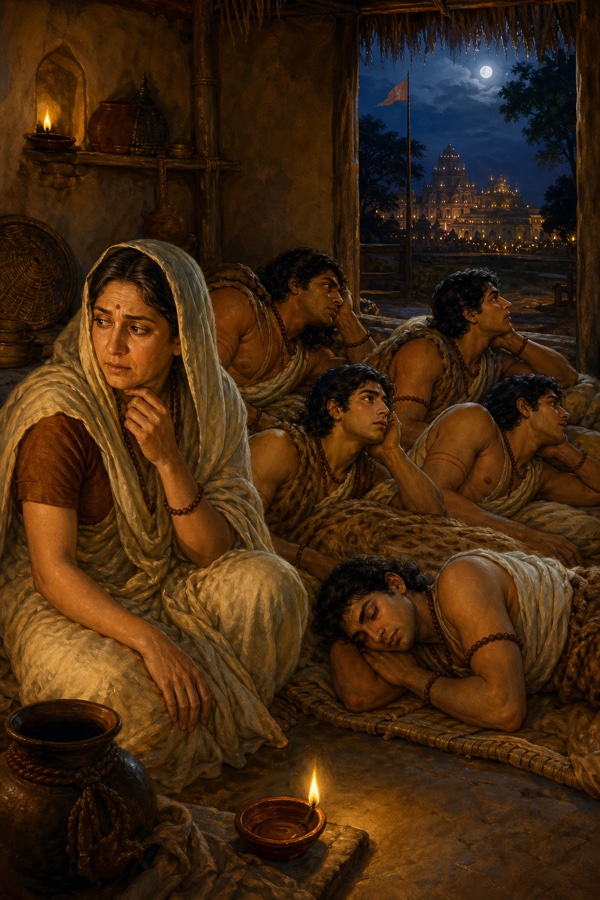
Kunti was waiting at the potter’s house. Her sons were late coming back from their round of alms, and she was filled with anxiety. She imagined one disaster after another. At one moment she thought the sons of Dhritarashtra had recognized her boys and killed them. At the next she feared that Rakshasas, cruel and strong and full of deceiving magic, had done it. She even asked herself, “Vyasa himself told my sons to come to Panchala. Could his judgment have gone wrong?” So her love for her children ran on. Then, in the stillness of the late afternoon, Arjuna came in at the potter’s door with a company of Brahmins around him, like the sun breaking through on a day of cloud.
The gist: Enraged that the bride is to go to a Brahmin, the kings rush at Drupada, and Bhima with an uprooted tree and Arjuna with the bow stand in their way while Krishna names the brothers to Balarama. Arjuna fights Karna, who breaks off when his opponent claims to be a Brahmin armed with the Brahma and Paurandara weapons. Bhima wrestles Shalya and throws him without doing him great harm. The kings decide to learn who these Brahmins are before fighting further, Krishna tells them the maiden was fairly won, and they go home.
Kunti’s Words and Yudhishthira’s Decision
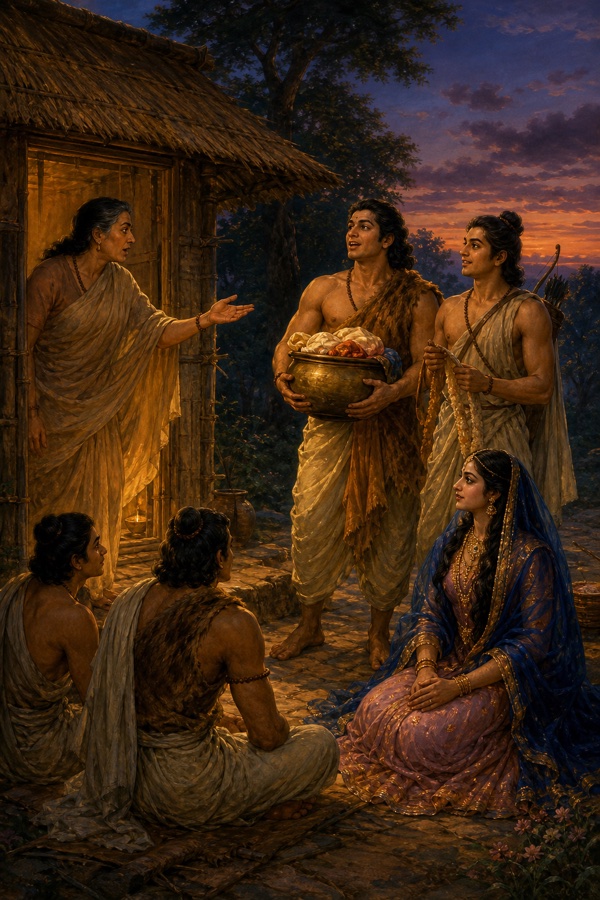
The sons of Kunti came up to the potter’s house and went to their mother. She was inside the room, where she could not see them. They presented Draupadi to her the way they would have presented any day’s takings: these were the alms they had obtained that day. From within, Kunti answered, “Enjoy it, all of you together.” A moment later she saw Draupadi. “Oh,” she said. “What have I said?”
A word once spoken could not be allowed to become a lie, and fear of sin took hold of her. She tried to think how every one of them could be got clear of the position she had put them in. Draupadi was standing there cheerful. Kunti took her by the hand and went to Yudhishthira. “Your younger brothers presented the daughter of King Yajnasena to me as the alms they had obtained,” she said, “and out of ignorance I said the proper thing: ‘Enjoy, all of you, what has been obtained.’ Tell me how my words can be kept from becoming an untruth, how sin can be kept from touching the daughter of the king of Panchala, and how she can be spared unhappiness.”
Yudhishthira was the eldest, a king in everything but a kingdom, and a thoughtful man. He considered for a moment. He said what he could to comfort his mother, and then he turned to Arjuna. “Phalguna, it was you who won Yajnaseni. It is right, therefore, that you should marry her. Light the sacred fire and take her hand with the proper rites.”
“Do not make me a party to sin,” Arjuna said. “What you command is against the law of virtue. That is the road the sinful take. You should marry first. Then Bhima, strong-armed Bhima, whose feats pass belief. Then I. Then Nakula, and last of all Sahadeva, quick as he is. Vrikodara and I, the twins, and this maiden too: all of us wait on your command. Things being so, think it over, and then do what is proper, what agrees with virtue, what will bring good fame, and what will be good for the king of Panchala. We are all obedient to you. Command us as you like.”
The words were full of respect and of love, and when Arjuna had finished, all the Pandavas turned their eyes on the princess of Panchala. She looked back at all of them. They looked at her, and then at one another, and then they sat down and could think of nothing but Draupadi. The god of desire had entered their hearts as soon as they looked at her, and he went on crushing every one of their senses. The Creator himself had shaped the beauty of the Panchala princess. It surpassed the beauty of every other woman on earth and could capture the heart of any creature living.
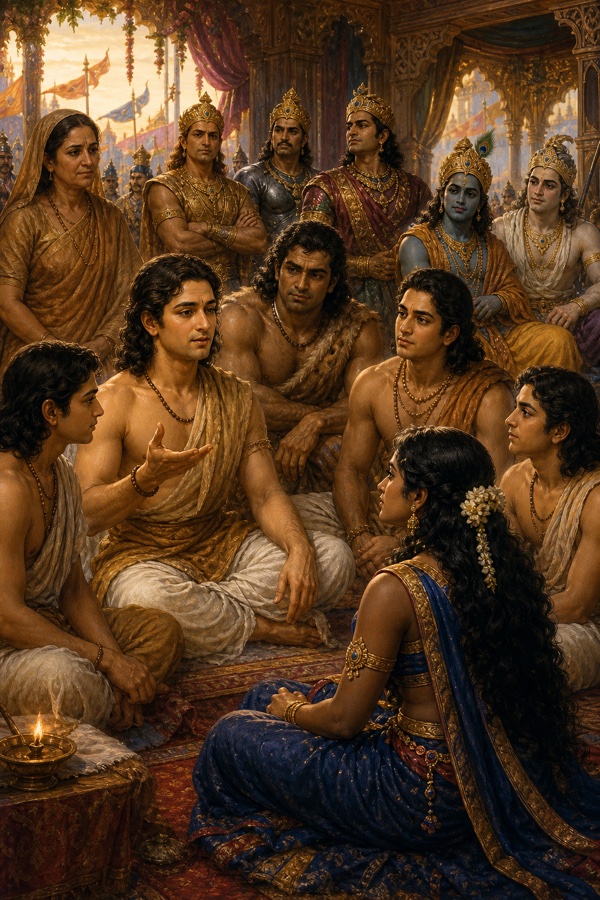
Yudhishthira watched his younger brothers and understood what was passing in their minds. At once he remembered the words of Vyasa. The sage had come to them at Ekachakra and told them of a girl who in an earlier life had asked Shiva five times for a husband, and had told them that this girl, born now in Drupada’s line, was appointed to be the wife of them all. And Yudhishthira was afraid of a division among the brothers. He spoke to all of them together. “The auspicious Draupadi shall be the common wife of us all.” The sons of Pandu heard their eldest brother say it, and they turned the words over in their minds with great gladness.
A sub-tale: Three things meet in the potter’s house. Kunti has said “enjoy it together” without seeing what her sons had brought, and she fears that her word will become an untruth. Arjuna will not marry ahead of his elder brothers and calls that the road of the sinful. And all five brothers have looked at Draupadi and want her, which Yudhishthira reads as the beginning of a division among them. Behind his ruling stands what Vyasa told the brothers at Ekachakra: that Drupada’s daughter was appointed to be the wife of all five. Drupada will object that no one has ever heard of one woman having many husbands, and Vyasa himself will say that the practice is opposed to usage and the Vedas and has become obsolete.
The gist: Kunti, not seeing Draupadi, tells her sons to enjoy together what they have brought, and then begs Yudhishthira to keep her word from becoming untrue. Yudhishthira tells Arjuna to marry the bride he won; Arjuna answers that the eldest must marry first. Seeing all five brothers taken with Draupadi, remembering Vyasa’s words, and fearing a division among them, Yudhishthira rules that she shall be the common wife of them all.
Krishna’s Arrival and Dhrishtadyumna’s Secret Vigil
Krishna had not forgotten the five men he had seen at the svayamvara. He suspected that they were the heroes of the Kuru house and no one else, and he came with Balarama, Rohini’s son, to the potter’s house where they had taken their lodging. Inside he saw Yudhishthira, whom men call Ajatashatru, a man with long and well-made arms, and around him sat his younger brothers, brighter than fire. Krishna went up to the son of Kunti, a prince of the line of Ajamidha, and touched his feet. “I am Krishna,” he said. Balarama came forward and did the same. The Pandavas were delighted to see the two of them and said so. Then the heroes of the Yadu line touched the feet of Kunti as well, their father’s sister.
Yudhishthira asked after Krishna’s health and well-being. Then he asked the thing he wanted to know. “We are living in disguise, Krishna. How did you manage to trace us?”
Krishna smiled. “Fire can be known even when it is covered. Who among men but the Pandavas could show strength like that? It was sheer good fortune, sons of Pandu, that you came alive out of that terrible fire, and sheer good fortune that Dhritarashtra’s wicked son and his counselors did not get what they wanted. Blessings on you. May you grow and prosper like a fire kindled in a cave, which grows little by little and spreads on every side. Now we should go back to our tent, before one of the kings recognizes you.” He asked Yudhishthira’s leave, and when he had it he and Balarama left the potter’s house in haste.
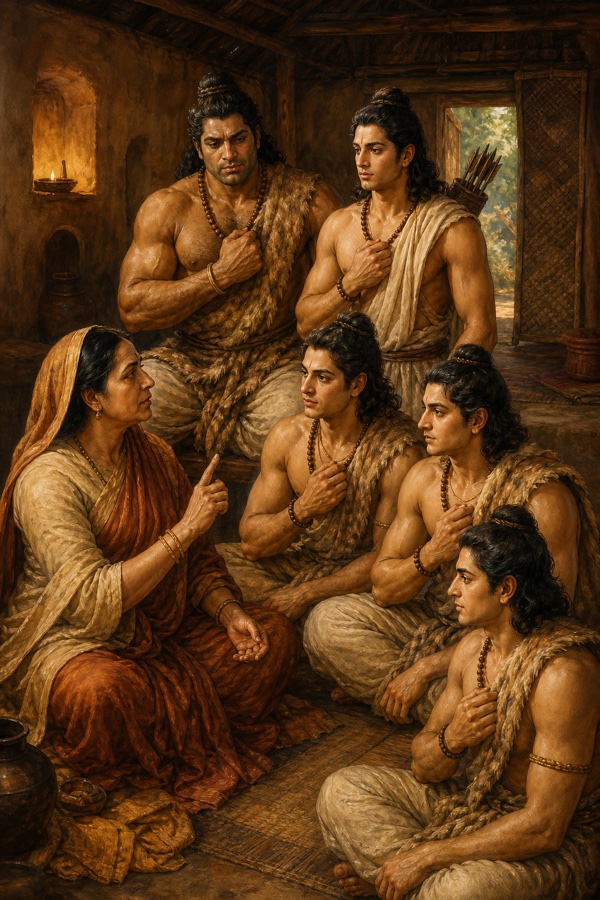
There had been one more pair of eyes on the brothers that day. When the two Kuru princes, Bhima and Arjuna, made their way from the arena toward the potter’s house, Dhrishtadyumna, the prince of Panchala, followed them. He sent all his attendants away and hid himself in a corner of the potter’s house, and the Pandavas knew nothing of it. In the evening Bhima, Arjuna, and the twins came back from their round of begging and cheerfully handed everything they had been given to Yudhishthira. Kunti, kind as always, turned to the daughter of Drupada. “Dear girl, first take a portion of this and offer it to the gods, and give to the Brahmins. Feed those who come wanting food, and give to those who have become our guests. Then divide what is left into two halves. Give one half to Bhima, dear girl. This strong, fair-skinned young man is like a king of elephants, and he always eats a great deal. Divide the other half into six parts: four for these young men, one for me, and one for yourself.”
The princess listened to her mother-in-law’s instructions and cheerfully did everything exactly as she had been told. So that evening all those heroes ate food that Draupadi had prepared. Afterward Sahadeva, the quick son of Madri, spread a bed of kusha grass on the ground. Each of the brothers laid his deerskin over the grass and lay down to sleep, with his head toward the south. Kunti lay down along the line of their heads, and Draupadi along the line of their feet. She was a king’s daughter, and she lay that night on a bed of grass at the feet of the sons of Pandu as though she were the pillow for their feet; and there was no grief in her heart, and she thought no less of those men of the Kuru house.
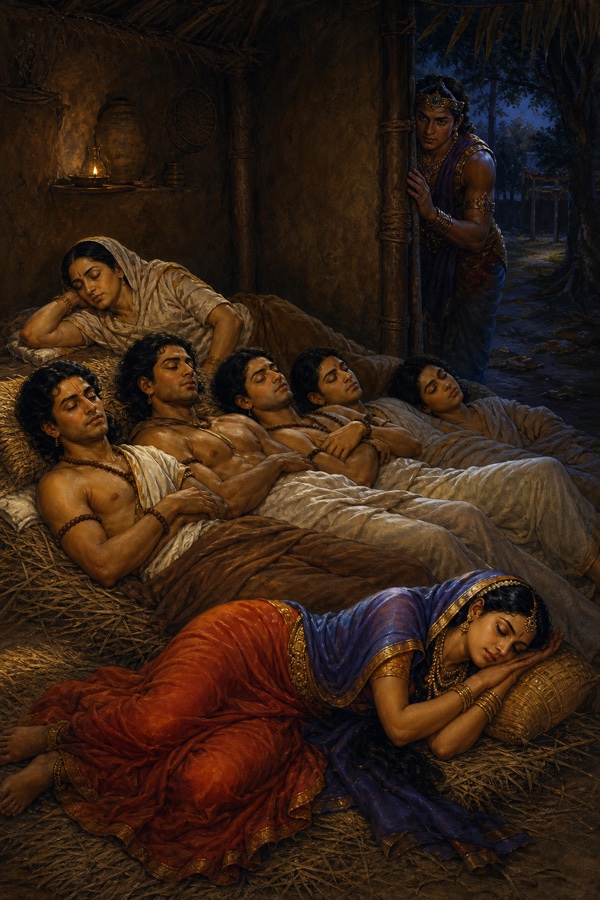
The brothers talked before they slept. Every one of them was fit to lead an army, and their talk was a pleasure to hear: it was of the chariots and the weapons of the gods, of elephants, of swords and arrows and battle-axes. The son of the Panchala king lay in his hiding place and heard every word. He and those who were with him saw, too, how Draupadi lay that night.
The gist: Krishna and Balarama come to the potter’s house, touch the feet of Yudhishthira and of their aunt Kunti, and leave quickly before any king can recognize the brothers. Dhrishtadyumna, hidden in the house, watches Draupadi divide the alms as Kunti directs and lie down at the brothers’ feet, and hears the brothers talk of chariots, weapons, and war.
Drupada’s Doubt and Dhrishtadyumna’s Report
When morning came Dhrishtadyumna slipped out of his hiding place and went in great haste to his father, to report in detail everything that had happened at the potter’s house and everything he had heard those men say to one another in the night. He found the king of Panchala sunk in gloom. Drupada did not know that the men who had taken his daughter away were the Pandavas.
He began questioning his son the moment he saw him. “Where has Draupadi gone? Who took her away? Has some Shudra done it, some man of low birth, or some tax-paying Vaishya, and by carrying off my daughter set his dirty foot on my head? My son, has that garland of flowers been thrown away on a burning ground? Or has a Kshatriya of high birth got her, or one of the higher order, a Brahmin? Has a man of mean descent won Draupadi and set his left foot on my head? I would not grieve, my son, I would be very happy, if my daughter has been joined with Arjuna, the son of Kunti. Tell me truly, who won my daughter today? Are the sons of Pandu alive, the sons of Vichitravirya’s son? Was it Arjuna who took up the bow and shot the mark?”
Dhrishtadyumna, a prince of the Lunar line, was glad to answer, and he told his father all that had happened and who had won Draupadi. “The young man who strung that bow and brought the mark down from where it hung has large red eyes, wears a deerskin, and is as handsome as a god. The leading Brahmins crowded around him at once and paid him honor for what he had done. He cannot bear the sight of an enemy, he is quick, and he began to show what he was made of; with the Brahmins around him he looked like Indra, thunderbolt in hand, standing among the gods and the rishis. And Draupadi went after him gladly, holding on to his deerskin, the way a she-elephant follows the leader of the herd.
“The assembled kings could not stand the sight. They got up in a rage and came on to fight. Then another hero rose, tore up a large tree, and ran at that crowd of kings, knocking them down right and left like Yama striking down the living. Father, the kings stood where they were, without moving, and watched that pair. The two of them looked like the Sun and the Moon. They took Draupadi with them, left the amphitheater, and went to the house of a potter on the edge of the town. In the potter’s house sat a lady like a flame of fire. I think she is their mother. Three other men sat around her, splendid men, each one like fire.
“The two heroes went up to her and did homage at her feet, and they told Draupadi to do the same. They left Draupadi with her, and then all those men went out on their round of begging. When they came back some time later, Draupadi took from them what they had received as alms. She set aside a portion for the gods and gave another portion away to Brahmins. Of what was left she gave a share to that venerable lady and divided the rest among the five men, and she took a little for herself and ate it last of all. Then all of them lay down to sleep, and Draupadi lay along the line of their feet, as the pillow for their feet. The bed was kusha grass with their deerskins spread over it. Before they slept they talked of many things, in voices as deep as black clouds. What they talked of marked them out. Vaishyas do not talk so, nor do Shudras, nor do Brahmins. Father, there is no doubt of it: they are Kshatriyas, and of the best, because everything they talked of was war.
“It seems that what we hoped for has come true, Father. We had heard that the sons of Kunti all escaped when the house of lac burned. The way that young man shot the mark down, the strength with which he strung the bow, and the way I heard them talk among themselves prove it beyond question: these are the sons of Pritha, wandering in disguise.” Drupada heard his son out and was overjoyed. He sent for his priest and dispatched him to the potter’s house with instructions to find out who these men were and whether they were the sons of Pandu.
The gist: At dawn Dhrishtadyumna reports to Drupada, who fears that a man of low birth has taken his daughter and hopes that it was Arjuna. The prince describes the archer, the man with the tree, the mother, the division of the alms, the bed of kusha grass, and the brothers’ talk of war, and concludes that these are Kshatriyas and the sons of Kunti in disguise. Drupada sends his priest to make sure.
The Priest’s Message and Yudhishthira’s Reply
The king’s priest went to them. He began by praising them all, and then he delivered Drupada’s message in due form. “You are men who deserve the first place in everything. Drupada, the king of this land and a giver of boons, wishes to learn who you are. He has seen the one among you who shot down the mark, and his joy has no limit. Tell us everything about your family and your people. Set your feet on the heads of your enemies, and gladden the heart of the king of Panchala, and the hearts of his men, and mine. King Pandu was Drupada’s dear friend, and Drupada looked on him as a second self. All along Drupada has cherished the wish to give this daughter of his to Pandu as a daughter-in-law. You are men without a flaw in your looks. Hear, then, what King Drupada has always kept in his heart: that Arjuna, with his strong, long arms, might marry this daughter of his according to the ordinance. If that is what has come about, nothing could be better, nothing more fortunate, nothing more to Drupada’s fame and merit.”
The priest said no more. He sat quietly and humbly, waiting for his answer. Yudhishthira looked at him sitting there and gave an order to Bhima, who was close by. “Bring water for this Brahmin to wash his feet, and offer him the arghya. He is King Drupada’s priest and deserves great respect. We should honor him with more than ordinary reverence.” Bhima did as he was told. The Brahmin accepted the honors paid to him, and with a glad heart he settled himself at his ease.
Then Yudhishthira answered him. “The king of the Panchalas gave his daughter away as the practice of his order allows, by fixing a special kind of dower. He did not give her freely. This hero met the price and so won the princess. King Drupada, therefore, has nothing to say now about the race, the tribe, the family, or the character of the man who did it. Every question he could ask was answered when the bow was strung and the mark was shot down. This man did exactly what the king demanded, and by doing it he brought Draupadi away from among the assembled kings. As things stand, the king of the Lunar line should not give himself up to regrets, which can only make him unhappy and mend nothing. The wish King Drupada has cherished all along will be fulfilled for his beautiful daughter, who bears, I think, every auspicious mark. No weak man could have strung that bow. No man of low birth, untrained in arms, could have shot down that mark. So the king of the Panchalas has no cause to grieve for his daughter today. And nobody in the world can undo the shooting of that mark. Let the king not sorrow over what must take its course.”
He was still speaking when another messenger arrived in haste from the king of the Panchalas. “The wedding feast is ready,” the man said.
The Feast and the Test at Drupada’s Palace
“King Drupada has made ready a good feast for the bridegroom’s party, in honor of his daughter’s wedding,” the messenger went on. “Finish your daily rites and come. Draupadi’s wedding will be held there. Do not delay. Here are chariots fit for kings, adorned with golden lotuses and drawn by excellent horses. Ride on them to the house of the king of the Panchalas.”
The Kuru princes sent the priest on his way. They had Kunti and Draupadi ride together in one of the chariots, climbed into those splendid vehicles themselves, and set out for Drupada’s palace. Drupada, meanwhile, had heard from his priest what Yudhishthira had said. He still wanted to know the order to which these men belonged, and he arranged to find out. He had a great collection of things made ready, everything the ordinance requires for a wedding in each of the four orders. There were fruits and consecrated garlands. There were coats of mail and shields, carpets, cattle, seeds, and the various tools and implements of farming. The king gathered the articles that belong to the other crafts, and the gear and apparatus for every kind of sport. He gathered excellent coats of mail and shining shields, swords and scimitars of fine temper, beautiful chariots and horses, bows of the first quality and well-adorned arrows, and missiles of many kinds ornamented with gold. He had darts made ready, and rockets, and battle-axes, and the various furnishings of war. And in the same collection were beds and carpets and fine things of many sorts, and cloths of every kind.
The party arrived at Drupada’s palace. Kunti took Draupadi with her and went into the king’s inner apartments, where the ladies of the royal household received the queen of the Kurus with glad hearts and paid her honor. The men came in before the court. Each had the easy stride of a lion. They wore deerskins for upper garments; their eyes were like the eyes of great bulls, their shoulders were broad, and their long arms hung like the bodies of great snakes. The king looked at them, and the king’s ministers, and the king’s son, and the king’s friends and attendants, and all of them were exceedingly glad. Excellent seats with footstools had been set out. The heroes took them without any awkwardness or hesitation. They sat down on those costly seats with perfect fearlessness, one after another, in the order of their ages.
When they were seated, well-dressed servants, men and women, came in with skilled cooks and served excellent and costly food, fit for kings, on plates of gold and silver. The brothers ate and were well satisfied. When the dinner was over they got up, walked past everything else that had been laid out, and began to look over the weapons of war with interest. Drupada’s son saw it. Drupada saw it, and all his chief ministers of state with him. They understood that the sons of Kunti were of royal blood, and they were exceedingly glad.
A sub-tale: Drupada asks no question at the feast. He sets out the goods that belong to the weddings of each of the four orders: garlands and fruits, cattle and seed and the tools of farming, the articles of the crafts and of sport, and the weapons and chariots of war. Then he watches where his guests go. They take their seats without hesitation and in the order of their ages, eat from gold and silver, and afterward pass by everything else to examine the weapons. From that the king, his son, and his ministers conclude that these men are of royal blood.
The gist: To the priest’s message Yudhishthira answers that the bow and the mark have settled every question about the man who won Draupadi. A second messenger calls the brothers to the wedding feast, and they ride to the palace in the king’s chariots, Kunti and Draupadi together in one. Drupada has laid out the goods of all four orders; after dinner the brothers go straight to the weapons, and the court understands that they are of royal blood.
The Revelation of Identity and the Question of Many Husbands
Then the king of Panchala spoke to Prince Yudhishthira, addressing him in the form that is used for Brahmins, and he was cheerful as he asked. “How are we to know you? As Kshatriyas? As Brahmins? Or as gods who have disguised themselves as Brahmins and are roaming the earth, and have come here for Draupadi’s hand? Tell us truly, because our doubts are great. Shall we not be glad when they are cleared away? Have the fates been kind to us? Tell us the truth, and tell it willingly. Truth becomes a king better than sacrifices do, better than the reservoirs he digs and dedicates to his people. So tell us nothing that is untrue. You have the beauty of a god. When I have your answer I will arrange my daughter’s wedding according to the order you belong to.”
“Do not be downcast,” Yudhishthira said. “Let joy fill your heart. The wish you have cherished has certainly been fulfilled. We are Kshatriyas, and we are the sons of Pandu. I am the eldest of the sons of Kunti. These two are Bhima and Arjuna. It was they who won your daughter in the midst of that gathering of kings. The twins, Nakula and Sahadeva, are waiting with Kunti where Draupadi is. Put grief out of your heart, for we are Kshatriyas. Your daughter is like a lotus that has only been carried from one lake to another. You are our revered elder, and our chief refuge. I have told you the whole truth.”
Drupada’s eyes rolled with ecstasy. He was so full of delight that for some moments he could not answer at all. With a great effort he mastered himself, and at last he replied to Yudhishthira in fitting words. He was a righteous king, and he asked how the Pandavas had got away from the town of Varanavata. Yudhishthira told him every detail of their escape from the burning palace of lac. When Drupada had heard everything the son of Kunti had to say, he condemned King Dhritarashtra. He gave Yudhishthira every assurance. And then and there Drupada, who knew how to use words, vowed to restore Yudhishthira to his father’s throne. At the king’s bidding Kunti and Draupadi, Bhima and Arjuna and the twins took up residence in the palace, and Drupada treated them with all the respect that was their due.
Everything that had happened had put the king’s mind at rest. With his sons beside him he came to Yudhishthira and said, “Today is an auspicious day. Let the Kuru prince Arjuna take my daughter’s hand with the proper rites today, and let him begin by performing the customary rites that open a marriage.”
Yudhishthira, careful of what was right, answered him. “I shall have to marry as well.”
“Then take my daughter’s hand yourself with the proper rites, if that pleases you,” Drupada said. “Or give Draupadi in marriage to whichever of your brothers you like.”
“Your daughter shall be the common wife of us all,” Yudhishthira said. “That is what our mother has ordered. I am still unmarried, and among the sons of Pandu so is Bhima. This jewel of a daughter of yours was won by Arjuna. And this is the rule among us: whatever jewel we obtain, we enjoy it equally, always. We cannot abandon that rule of conduct now. Draupadi, therefore, shall become the wedded wife of all of us. Let her take our hands before the fire, one after another.”
“It has been laid down that one man may have many wives,” Drupada answered. “That one woman may have many husbands has never been heard of. You are a prince of Kuru’s line and a son of Kunti. You are pure, and you know the rules of right conduct. It does not become you to do a sinful thing, a thing opposed both to usage and to the Vedas. Why has your understanding taken this turn?”
“Morality is subtle,” Yudhishthira said. “We do not know its course. Let us follow the way that the great men of earlier ages walked. My tongue has never spoken an untruth, and my heart never turns toward what is sinful. My mother commands this, and my heart approves it. Therefore it is in keeping with virtue. Act on it without scruple, and have no fear in the matter.”
“Then settle it among yourselves,” Drupada said, “you, son of Kunti, and your mother, and my son Dhrishtadyumna. Tell me what you decide, and tomorrow I will do what is proper.”
So Yudhishthira, Kunti, and Dhrishtadyumna sat down to talk the matter through. They were still at it when Vyasa, the island-born, arrived there in the course of his wanderings.
The gist: Asked for the truth, Yudhishthira tells Drupada that they are Kshatriyas, the sons of Pandu. Drupada, overjoyed, hears the story of the house of lac, condemns Dhritarashtra, and vows to restore Yudhishthira to his father’s throne. He proposes that Arjuna marry Draupadi; Yudhishthira answers that by their mother’s order she must be the wife of all five. Drupada objects that this is opposed to usage and the Vedas and leaves the matter to Yudhishthira, Kunti, and Dhrishtadyumna. At that moment Vyasa arrives.
Vyasa’s Resolution and the Tale of the Five Indras
Everyone stood up: the Pandavas, the king of the Panchalas, and all who were present. They saluted the rishi with reverence. He returned their salutations, asked after their welfare, and sat down on a carpet of gold, and at his word the others took their places on costly seats. A little while later Drupada, the son of Prishata, spoke to the sage in a gentle voice and asked him about his daughter’s wedding. “How can one woman become the wife of many men and not be stained by sin? Tell me the truth of it, all of it.”
“This practice is opposed to usage and to the Vedas,” Vyasa said, “and it has become obsolete. But first I want to hear what each of you thinks about it.”
Drupada spoke first. “In my opinion the practice is sinful, because it is opposed to both usage and the Vedas. I have never seen, anywhere, many men with one wife. The great men of earlier ages had no such custom among them either. The wise should never commit a sin. I cannot bring myself to act in this way. To me the practice has always looked morally doubtful.”
Dhrishtadyumna spoke next. “You are rich in austerities. Tell me how an elder brother, if he is a man of good character, can go to the wife of his younger brother. The ways of morality are always subtle, and so we do not know them. We cannot say what agrees with morality and what does not. We cannot do such a thing with a clear conscience. I for one cannot say, ‘Let Draupadi become the common wife of five brothers.’”
Then Yudhishthira gave his view. “My tongue never utters an untruth, and my heart never leans toward what is sinful. If my heart approves of a thing, it cannot be sinful. I have heard in the Purana that a lady named Jatila, of the line of Gotama, the first of all virtuous women, married seven rishis. So too an ascetic’s daughter, born of a tree, was joined in marriage in former times with ten brothers who all bore the one name Prachetas and whose souls had been lifted high by asceticism. You know the rules of morality better than anyone. It is said that obedience to one’s elders is always meritorious, and of all elders, as everyone knows, the mother is the first. She has commanded us to enjoy Draupadi as we enjoy anything obtained as alms. That is why I regard the act as virtuous.”
Kunti spoke last. “It is as the virtuous Yudhishthira has said. I am greatly afraid that my words will become an untruth. How shall I be saved from untruth?”
When all of them had finished, Vyasa turned first to Kunti. “You ask how you are to be saved from the consequence of untruth, gentle lady. This thing is itself eternal virtue.” Then he spoke to the king of the Panchalas. “I will not explain it in front of all of you. You alone shall listen while I disclose how this practice was established and why it is to be regarded as old and eternal. There is no doubt that what Yudhishthira has said is entirely in keeping with virtue.” The master rose, took Drupada by the hand, and led him into a private apartment. The Pandavas, Kunti, and Dhrishtadyumna of Prishata’s line sat where they were and waited for the two of them to come back. Alone with the king, Vyasa began to show him why the taking of one wife by several husbands could not be counted a sin.
It began, he said, in days long past. The gods had once undertaken a great sacrifice in the forest of Naimisha, and at that sacrifice Yama, the son of Vivasvat, the god who carries off the dead, served as the slayer of the consecrated animals. While he was so employed, Yama did not take the life of a single human being. Death was suspended in the world, and the number of human beings grew very great. Soma and Indra, Varuna and Kubera, the Sadhyas, the Rudras, the Vasus, the twin Ashvins, and other gods went to Prajapati, the Creator of the universe, frightened by the increase in the human population of the world. “Lord, we are alarmed at the increase of human beings on earth,” they said, “and we have come to you for relief. We ask for your protection.” The Grandsire answered, “You have little cause to be afraid of this increase. All of you are immortal. It does not become you to take fright at human beings.” “The mortals have all become immortal,” the gods replied. “There is no distinction now between us and them. The loss of all distinction troubles us, and we have come so that you may set us apart from them.”
“The son of Vivasvat is engaged in the great sacrifice even now,” the Creator said. “That is why men are not dying. When Yama’s work at the sacrifice is finished, men will begin to die again as before. When that time comes, Yama, strengthened by the energies of each of you, will sweep away the inhabitants of the earth by thousands, and they will have hardly any energy left in them.” The gods heard the first-born deity out and went back to the place where the sacrifice was being held. They were sitting by the Ganga when they saw a golden lotus being carried along on the current, and they wondered at it. Indra, the chief among them, wanted to find out where it came from, and he walked up along the course of the river. He reached the spot where the goddess Ganga flows out unceasingly, and there he saw a woman who shone like fire. She had come to take water, and she was washing herself in the stream and weeping the whole time, and every tear she shed turned, as it struck the water, into a golden lotus. The wielder of the thunderbolt went up to her. “Who are you, gentle lady? Why are you weeping? I want to know the truth. Tell me everything.”
“You may learn who I am, Indra, and why I weep, unfortunate as I am,” the woman said, “if you will come with me. I will lead the way, and you will see what it is I weep for.” Indra followed her. Before long, and no great distance off, he saw a handsome young man seated on a throne on one of the peaks of the Himalaya with a young woman beside him, and the two were playing at dice. “Know this, intelligent youth,” said the chief of the gods. “This universe is under my rule.” The young man was so absorbed in the dice that he took no notice of what had been said. Indra grew angry and said it again. “I am the lord of the universe.” The young man was Mahadeva, Shiva himself, the god of gods. He saw that Indra was full of wrath, and he only smiled and gave him one glance. At that glance the chief of the gods was paralyzed where he stood, and he stayed there, rigid as a stake.
When the game of dice was over, Shiva spoke to the weeping woman. “Bring Indra here. I am going to deal with him now in such a way that pride will never enter his heart again.” The woman touched Indra, and at her touch his paralyzed limbs gave way and the chief of the gods fell to the ground. Shiva, whose energy is fierce, said to him, “Never act in this way again, Indra. Your strength and energy are beyond measure, so move this great stone, and go into the hole it uncovers. Others are waiting there who shine like the sun, and they are all like you.” Indra moved the stone. Behind it was a cave in the breast of that king of mountains, and in the cave were four others who looked exactly like himself. He saw the state they were in, and grief seized him. “Am I to become like these?” he cried.
Shiva, the Lord of the Mountain, looked full at Indra with wide eyes, and he was angry. “You of the hundred sacrifices, get into this cave without wasting time. In your folly you have insulted me.” The curse was terrible, and it hurt Indra deeply. His limbs went weak with fear and he trembled like a leaf of the Himalayan fig when the wind shakes it. The god who rides a bull had cursed him without warning. With his hands joined, shaking from head to foot, Indra spoke to that fierce god of many forms. “Bhava, you are the overseer of the endless universe!” The god of fiery energy smiled. “Those who have a temper like yours never win my grace. These others in the cave were once as you are. Go in, then, and lie there for some time. The fate of all of you will certainly be the same. Every one of you will have to take birth in the world of men. There you will accomplish many hard feats and kill a great number of men, and then, by the merit of your own deeds, you will regain the prized realm of Indra. You will do all that I have said, and a good deal more besides, work of other kinds.”
The Indras, their glory shorn from them, answered. “We will go from our heavenly regions to the region of men, where release is ordained to be hard to win. But let the gods Dharma, Vayu, Indra, and the twin Ashvins beget us on the woman who is to be our mother. We will fight with men, using the weapons of gods and the weapons of men, and we will come back again to the realm of Indra.” When the former Indras had spoken, the wielder of the thunderbolt addressed Shiva once more. “I will not go myself. With a portion of my energy I will create a person out of myself to accomplish the task you assign, and he shall be the fifth among these.” Vishvabhuk, Bhutadhaman, the powerful Shibi, Shanti the fourth, and Tejasvin: these, it is said, were the five Indras of old. The god of the formidable bow was kind, and he granted the five Indras what they wished. And the woman of extraordinary beauty, the one who had wept by the river, was the heavenly Shri herself, the goddess of grace, and Shiva appointed her to be their common wife in the world of men.
With all those Indras Shiva then went to Narayana, whose energy is beyond measure, the Infinite, the Immaterial, the Uncreated, the Old, the Eternal, the Spirit of these universes without limit. Narayana approved of everything. So those Indras were born in the world of men. And Hari, who is Narayana, plucked two hairs from his body, one black and one white, and the two hairs entered the wombs of two women of the Yadu line, Devaki and Rohini. The white hair became Balarama. The black hair was born as Keshava’s own self, Krishna. Those Indras of old who had been shut up in the cave in the Himalaya are none other than the sons of Pandu, with all their energy; and Arjuna among the Pandavas, the one called Savyasachin because he uses both hands with equal skill, is a portion of Indra.
“So it is,” Vyasa told the king, “that the men born as the Pandavas are none other than those Indras of old, and the heavenly Shri, who was appointed to be their wife, is this Draupadi of extraordinary beauty. Her radiance is like the sun’s or the moon’s, and her fragrance spreads for two miles around. How could such a woman be born in any way except an extraordinary one, out of the earth itself, by the power of the sacrificial rites? I give you gladly one boon more, the gift of spiritual sight. Look now at the sons of Kunti in the sacred and heavenly bodies that were theirs of old.” The holy Brahmin, generous in all he did, gave the king the sight of the gods by the power of his austerities, and the king saw all the Pandavas in their former bodies. They had the bodies of gods, with golden crowns and garlands of heaven. Each resembled Indra himself. Their skin was radiant as fire or the sun; they wore every ornament; they were handsome and young, broad in the chest, and about five cubits tall. Dressed in heavenly robes of great beauty and in fragrant garlands of the finest making, endowed with every accomplishment, they looked to the king like so many three-eyed Shivas, or Vasus, or Rudras, or Adityas. He saw the Pandavas in the forms of those Indras of old, and Arjuna in the form of Indra, sprung from Indra himself, and he was delighted, and full of wonder at so much divine power hidden under so deep a disguise. He looked at his daughter, a woman of great beauty, like a maiden of heaven, with the splendor of fire or of the moon, and he judged her, for her beauty and splendor and fame, a worthy wife for those heavenly beings. And having seen that marvelous sight he touched the feet of Satyavati’s son and cried, “Great rishi, in you nothing is a miracle!”
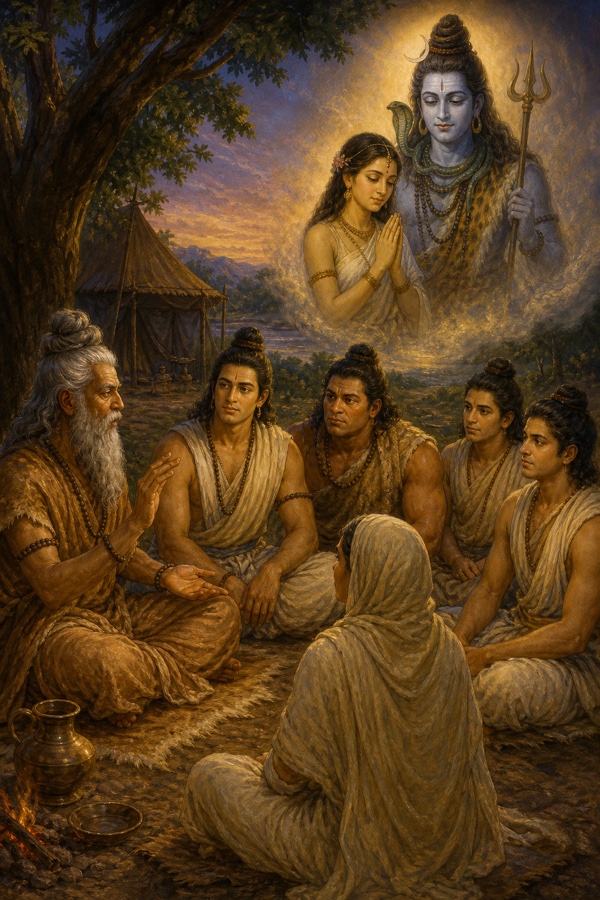
The rishi, in good humor, went on with one story more. In a certain hermitage, he said, there lived the daughter of a famous rishi, and though she was beautiful and chaste she could get no husband. She undertook severe austerities and by them won the favor of Shankara, who is Shiva. The lord, pleased with her penance, said to her himself, “Ask for the boon you want.” The girl said to the supreme lord, the giver of boons, and she said it again and again, “I want a husband who has every accomplishment.” Shankara, chief of the gods, was pleased with her, and he gave her the boon. “Gentle girl, you shall have five husbands.” She had won the god’s favor, and she spoke again. “Shankara, I want only one husband from you, one who has every virtue.” The god of gods, well pleased with her, answered once more. “Girl, you have addressed me five full times, saying each time, ‘Give me a husband.’ Therefore, gentle one, it shall be as you have asked. Blessings on you. All of this, however, will happen in a future life of yours.”
“Drupada, this daughter of yours, with her heavenly beauty, is that girl,” Vyasa said. “The faultless Draupadi, born in the line of Prishata, was appointed beforehand to be the common wife of five husbands. The heavenly Shri underwent severe austerities, and for the sake of the Pandavas she has been born as your daughter in the course of your great sacrifice. That lovely goddess, on whom all the gods attend, becomes the wife of five husbands as a consequence of her own acts. It was for this that the Self-created made her. You have heard it all, King Drupada. Now do what you wish.”
A key to reading this (the concept): Vyasa never tells Drupada that a marriage to five husbands is an ordinary custom. He grants at the outset that the practice is opposed to usage and to the Vedas and has become obsolete, and he asks each person in the room for an opinion before he gives his own. His answer, given to the king alone, rests on two histories of these particular people: the five Indras shut in the cave, to whom Shiva appointed the goddess Shri as their common wife on earth, and the rishi’s daughter who asked Shiva five times for a husband. He supports it by letting Drupada see the brothers in their former bodies. Yudhishthira argues from other ground: the precedents of Jatila and of the ten Prachetas brothers, and a mother’s command.
The gist: Vyasa hears Drupada, Dhrishtadyumna, Yudhishthira, and Kunti, declares Yudhishthira’s view to be in keeping with virtue, and takes Drupada aside. He tells him of the five Indras whom Shiva confined in a cave and sent to be born among men with the goddess Shri as their common wife, gives him spiritual sight to see the Pandavas in their former bodies, and adds the story of the rishi’s daughter who asked Shiva five times for a husband. Draupadi, he says, is that maiden and that goddess.
Draupadi’s Marriage to the Five Brothers
Drupada had heard it all. “It was only because I had not heard this from you that I tried to act as I told you I would,” he said. “Now I know everything, and I cannot set myself against what the gods have ordained. I am resolved, therefore, to do what you have said. The knot of destiny cannot be untied. Nothing in this world comes about through our own acts. What I arranged in order to secure a single bridegroom has ended in favor of many. In an earlier life Draupadi said again and again, ‘Give me a husband,’ and the great god himself granted her the boon she asked for. The god himself knows the right and the wrong of it. As for me, when Shankara has ordained it so, right or wrong, no sin can attach to me. Let these men take Draupadi’s hand with the rites, as it has been ordained, and let their hearts be happy.”
Then Vyasa spoke to Yudhishthira the just. “Today is an auspicious day, son of Pandu. Today the moon has entered the constellation called Pushya. Take Draupadi’s hand today, you first, before your brothers.” At that King Yajnasena and his son set about preparing the wedding. The king had many costly articles made ready as marriage gifts. Then he had his daughter brought out, bathed and decked with jewels and pearls in great number. All the king’s friends and relatives came to witness the wedding, and his ministers of state, and many Brahmins and citizens, and they took their seats, each according to his rank. The palace was filled with that gathering of leading men. Lotuses and lilies had been scattered over its courtyard, lines of troops stood there in their ranks, and diamonds and precious stones hung in festoons all around, so that King Drupada’s palace looked like the night sky set with bright stars.
The princes of the Kuru line came next. They were young, they wore earrings and costly robes, and they were perfumed with sandal paste. They had bathed and performed the customary rites, and now, with their priest Dhaumya, who shone like fire, they entered the wedding hall one after another in due order, glad at heart, like great bulls walking into a cattle pen. Dhaumya knew the Vedas thoroughly. He lit the sacred fire and poured libations of clarified butter into the blaze with the proper mantras. Then that master of mantras called Yudhishthira forward and joined him with Draupadi. The bridegroom and the bride walked around the fire and took each other’s hand. When their union was complete Dhaumya took his leave of Yudhishthira and went out of the palace.
After that the other princes of the Kuru line, great chariot warriors all, dressed in splendid clothes, took the hand of the princess, one each day, on successive days, and the same priest performed the rite for each. Here Vaishampayana, who was telling all of this to King Janamejaya, stopped to mention one thing. The celestial rishi, he said, had told him of something very wonderful and out of the common in these marriages: the slender-waisted princess became a virgin again every day, after each marriage that had gone before. When the weddings were over King Drupada gave those great chariot warriors wealth of many excellent kinds. He gave them a hundred chariots with standards of gold, each drawn by four horses with golden bridles. He gave them a hundred elephants with auspicious marks on their temples and faces, like a hundred mountains with peaks of gold. He gave them a hundred serving women in the first bloom of youth, dressed in costly robes and ornaments and wreaths of flowers. And with the sacred fire as witness of his gifts the king of the Lunar line gave to each of those princes, handsome as gods, much wealth besides, and many costly robes and ornaments of great splendor.
So the weddings were finished. The sons of Pandu, strong men, had won Draupadi, who was like a second Shri, and great wealth with her, and they passed their days in joy and happiness, like so many Indras, in the capital of the king of the Panchalas.
A sub-tale: The detail of Draupadi’s restored virginity comes with its own attribution. Vaishampayana, who recites this history to King Janamejaya, a descendant of the Pandavas, says that a celestial rishi told it to him, and he calls it very wonderful and extraordinary. It belongs to the account of the five weddings, held on successive days with Dhaumya officiating at each, Yudhishthira’s first.
The gist: Drupada accepts what the gods have ordained. On a day when the moon is in Pushya, Dhaumya lights the fire and joins Draupadi to Yudhishthira, and on the following days to each of the other brothers in turn. Drupada gives a hundred chariots, a hundred elephants, and a hundred serving women, with further wealth to each prince, and the Pandavas live happily in his capital.
Kunti’s Blessing and Krishna’s Gifts
His alliance with the Pandavas made, King Drupada had no fear left in him. He no longer stood in fear even of the gods. The ladies of his household came to Kunti and introduced themselves, each giving her name, and they honored her feet with their heads touching the ground. Draupadi came too. She was dressed in red silk, and the auspicious thread of the wedding was still tied around her wrists. She saluted her mother-in-law with reverence and stood before her contentedly, her palms joined.
Kunti looked at her daughter-in-law, a girl of great beauty, marked with every auspicious sign, sweet-tempered and of good character, and out of affection she pronounced a blessing on her. “Be to your husbands what Shachi is to Indra, what Svaha is to Agni, what Rohini is to Soma, what Damayanti is to Nala, what Bhadra is to Kubera, what Arundhati is to Vasishtha, what Lakshmi is to Narayana. Be the mother of long-lived and heroic children, dear girl, and have everything that can make you happy. May luck and prosperity always wait on you. May you always wait on husbands engaged in the performance of great sacrifices. Be devoted to your husbands. May your days always be spent in duly entertaining and honoring the guests and strangers who come to your house, and the pious and the old, the children and the elders. May you be installed as queen of the kingdom and the capital of Kurujangala, with your husband Yudhishthira the just. Daughter, may the whole earth, conquered by the prowess of your strong husbands, be given away by you to the Brahmins at a horse sacrifice. Whatever gems of the highest quality there are on earth, may you obtain them, fortunate girl, and be happy for a full hundred years. And as I rejoice today to see you dressed in red silk, daughter-in-law, so shall I rejoice again when I see you the mother of a son.”
After the sons of Pandu were married, Krishna sent them presents. He sent gold ornaments of many kinds set with pearls and with black gems, the stone called lapis lazuli. He sent costly robes woven in many countries, many beautiful soft blankets, hides of great value, and many costly beds and carpets and vehicles. He sent vessels by the hundred, set with gems and diamonds. He gave them serving women by the thousand, brought from many countries, young, beautiful, accomplished, and decked with every ornament. He gave them many well-trained elephants brought from the country of Madra, many excellent horses in costly harness, and chariots drawn by horses of fine colors with large teeth. And he sent them coins of pure gold by the crore, tens of millions upon tens of millions, in separate heaps. Yudhishthira the just wanted to please Krishna, whom men also call Govinda, and he accepted all those presents with great joy.
The gist: With the alliance made, Drupada fears no one. The women of his house honor Kunti, and Kunti blesses Draupadi, wishing her the fortune of the great wives of gods and kings, a queen’s seat in Kurujangala beside Yudhishthira, and a son. Krishna sends the Pandavas gold, robes, serving women, elephants from Madra, horses, chariots, and heaps of gold coin, and Yudhishthira accepts them gladly.
News in Hastinapura and the Kauravas’ Counsel
The kings who had come to Draupadi’s svayamvara had trusted spies, and the spies brought them the news: the beautiful Draupadi had been married to the sons of Pandu. They learned that the hero who had bent the bow and shot the mark was none other than Arjuna, a winner of battles and a master of the bow. It became known that the powerful fighter who had dashed Shalya, the king of Madra, to the ground, who in his anger had terrified the assembled kings with the tree he had torn up, and who had taken his stand before all enemies without a trace of fear, was none other than Bhima, the breaker of enemy ranks, whose mere touch was enough to take the life out of a foe. The kings were astonished to hear that the Pandavas had gone about in the guise of peaceable Brahmins. They had heard that Kunti and all her sons had been burned to death when the house of lac caught fire, and so they now looked on the Pandavas as men who had come back from the country of the dead. They remembered the cruel scheme contrived by Purochana, Duryodhana’s man, who had built that house, and they began to say, “Shame on Bhishma! Shame on Dhritarashtra of the Kuru line!”
With the svayamvara over and the news in their ears that Draupadi had been joined to the Pandavas, all those kings set out for their own dominions. Duryodhana heard that Draupadi had chosen Arjuna, the owner of the white horses, for her lord, and he was deeply dejected. He started for his capital with a heavy heart, and with him went his brothers, Ashvatthama, his uncle Shakuni, Karna, and Kripa. On the way Duhshasana, red with shame, spoke softly to his brother. “If Arjuna had not disguised himself as a Brahmin he could never have won Draupadi. It was because of that disguise that nobody could recognize him. Fate, I think, is always supreme, and effort is fruitless. A curse on our efforts, brother! The Pandavas are still alive!” They talked in that way among themselves, and they blamed Purochana for his carelessness, and so they entered the city of Hastinapura with downcast and sorrowful hearts. They had seen the sons of Kunti, strong men, escaped from the burning house of lac and allied with Drupada; they thought of Dhrishtadyumna, and Shikhandi, and the other sons of Drupada, every one of them accomplished in war; and fear struck them, and despair came over them.
Vidura learned that Draupadi had been won by the Pandavas and that the sons of Dhritarashtra had come home in shame, with their pride humbled, and he was filled with joy. He went to Dhritarashtra. “The Kurus are prospering, by good luck!” he said. The son of Vichitravirya heard that and was amazed and delighted. “What good luck, Vidura! What good luck!” The blind king, knowing no better, took it to mean that his eldest son Duryodhana had been chosen by Drupada’s daughter as her lord. He at once ordered ornaments of many kinds to be made for Draupadi. He commanded that Draupadi and his son Duryodhana both be brought to Hastinapura with pomp.
It was then that Vidura told him. Draupadi had chosen the Pandavas for her lords. Those heroes were all alive and at peace, and King Drupada had received them with great respect. And the Pandavas, Vidura went on, were now joined with Drupada’s many relatives and friends, each of whom commanded a large army, and with many others who had come to that svayamvara.
“Those children are as dear to me as they were to Pandu,” Dhritarashtra said when he had heard Vidura out. “More than that. Listen, and I will tell you why my affection for them is even greater now. The heroic sons of Pandu are well and at ease. They have won many friends. Their relatives, and the others they have gained as allies, are all very strong. What king is there, in good times or bad, who would not want Drupada and his kinsmen for an ally?”
“May your understanding stay just as it is, without change, for a hundred years,” Vidura said. And having said it, he went back to his own house.
Then Duryodhana came to Dhritarashtra, and Karna, the son of Radha, with him. “We cannot speak of any fault in front of Vidura,” they said to the king. “Now we have found you alone, and so we will say everything we like. What is this that you have wanted to do? Do you look on the prosperity of your enemies as if it were your own, that you have been praising the Pandavas in Vidura’s presence? You are not acting as you should. Father, from now on we ought to act every day in such a way as to weaken the Pandavas. The time has come for us to take counsel together, so that the Pandavas do not swallow us all, with our children and our friends and our relatives.”
A key to reading this (moral complexity): Two conversations are set side by side. To Vidura the king says that the sons of Pandu are dearer to him than ever and that any king would want Drupada for an ally. As soon as Vidura has gone home, Duryodhana and Karna come to him alone and rebuke him for praising their enemies. The king’s answer to them, which the epic gives next, is that he means to do exactly what they recommend, and that he praised the Pandavas only so that Vidura should not learn what was in his mind even by a sign.
The gist: Spies carry the news to the kings: the Brahmins were the Pandavas, alive. Duryodhana returns to Hastinapura dejected, with Duhshasana blaming the disguise and fate. Vidura brings the news to Dhritarashtra, who first thinks Duryodhana has won the bride and then, corrected, speaks warmly of the Pandavas and their new allies. When Vidura leaves, Duryodhana and Karna tell the king in private that the time has come to weaken the Pandavas.
Source: the Mahabharata of Krishna-Dwaipayana Vyasa, Adi Parva, the close of the Chaitraratha sub-parva, the Swayamvara and Vaivahika sub-parvas, and the opening of the Viduragamana, Sections 185 to 202. The Sanskrit e-text, the Gita Press Hindi edition, and Kisari Mohan Ganguli’s complete English translation were used to verify names, sequence, and principal events. Where the recensions differ, this English retelling follows Ganguli, and the Hindi edition follows Gita Press.
Based on the Mahabharata of Vedavyasa (Gita Press, Gorakhpur)