On this page
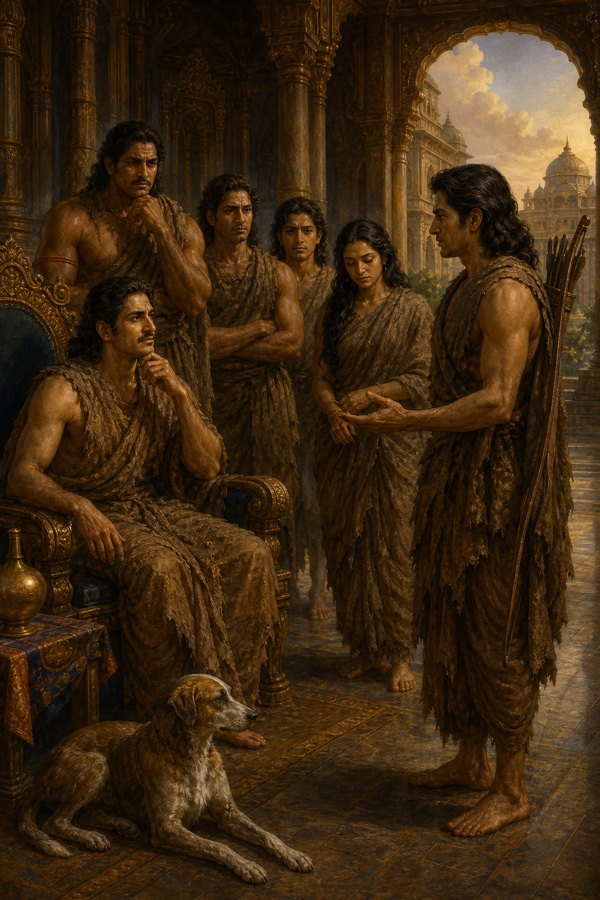
Dwarka was under the sea. In the thirty-sixth year after the great war Krishna’s own people, the Yadus, the clans of the Vrishnis and the Andhakas, had killed one another on the shore at Prabhasa, son striking father and father striking son with bolts of iron, and Krishna himself had put off his body and gone up to heaven. Arjuna had gone to Dwarka, burned the dead, and led the women and children out as the water came in behind them. On his way home the sage Vyasa told him that the time had come for the Pandavas too to leave the world. Then he returned to Hastinapura and laid before Yudhishthira all that had happened to the Vrishnis. When the king of the Kurus had heard the whole account of the slaughter, he set his heart on going. He turned to Arjuna. “You have a great mind,” he said. “It is Time that cooks every creature in his cauldron. I think what has happened is the work of the cords of Time, the cords he binds all of us with. You should see it too.” Arjuna answered with one word, said twice, “Time, Time,” and stood wholly with his eldest brother. When Bhima and the twins, Nakula and Sahadeva, the sons Pandu’s second wife Madri had borne, learned what Arjuna had resolved, they made his words their own. The five of them would withdraw from the world and earn what merit the withdrawal could bring.
The abdication and the shraddha
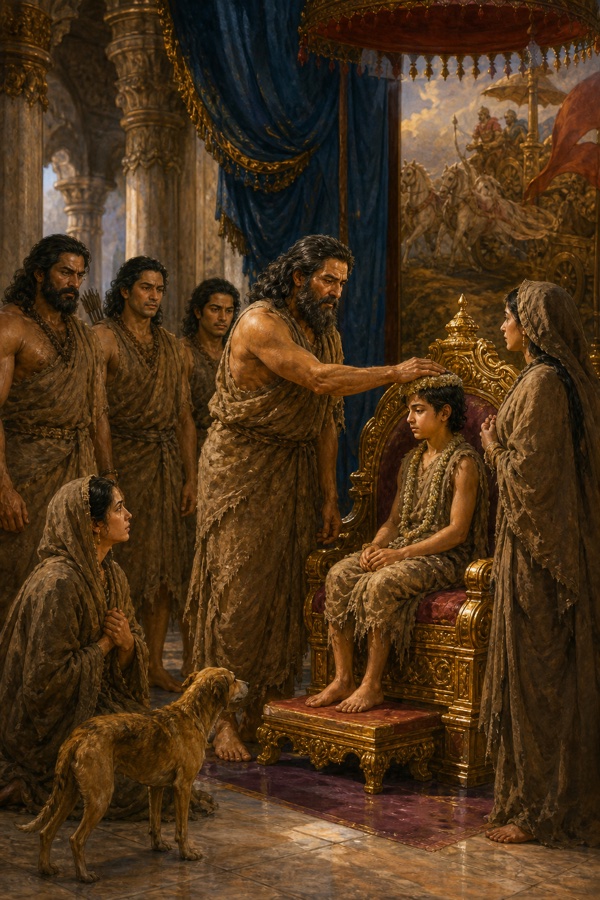
The resolve once taken, they sent for Yuyutsu. He was their cousin, the son their uncle Dhritarashtra had fathered on a Vaishya wife, and Yudhishthira gave the kingdom into his keeping. On the throne itself, as king, he set Parikshit, the son of Arjuna’s son Abhimanyu. There was a second king to think of. Arjuna had settled the women, the children and the old men of Dwarka at Indraprastha, the city that is also called Shakraprastha, and the rule there had been given to Krishna’s great-grandson Vajra. So the eldest of the Pandavas, heavy with sorrow, spoke to Subhadra, who was Krishna’s sister, Arjuna’s wife, and the new Kuru king’s grandmother. “This son of your son will be king of the Kurus,” he told her. “Vajra, the one survivor of the Yadus, has been made a king as well. Parikshit will rule in Hastinapura, and the Yadava prince Vajra in Shakraprastha. Keep him safe. And never let your heart turn toward what is wrong.”
When he had spoken, Yudhishthira and his brothers poured the water offerings for the dead: for Krishna, for their mother’s aged brother, who was Krishna’s father, for Balarama, and for the others. Then he performed the shraddha for every one of those kinsmen in its proper form, the meal set out in the name of the dead. In Krishna’s honor, and saying his name again and again, the king seated four sages before him and fed them many fine dishes: the island-born Vyasa, and Narada, and Markandeya, whose wealth was his austerities, and Yajnavalkya of Bharadvaja’s line. In Krishna’s name he gave away jewels and gems, robes and cloth, villages, horses, chariots, and serving women by the hundreds and thousands, all of it to Brahmins of the highest standing. Then he called the citizens together. Before them Kripa was installed as preceptor, and Parikshit was given into his charge as his pupil.
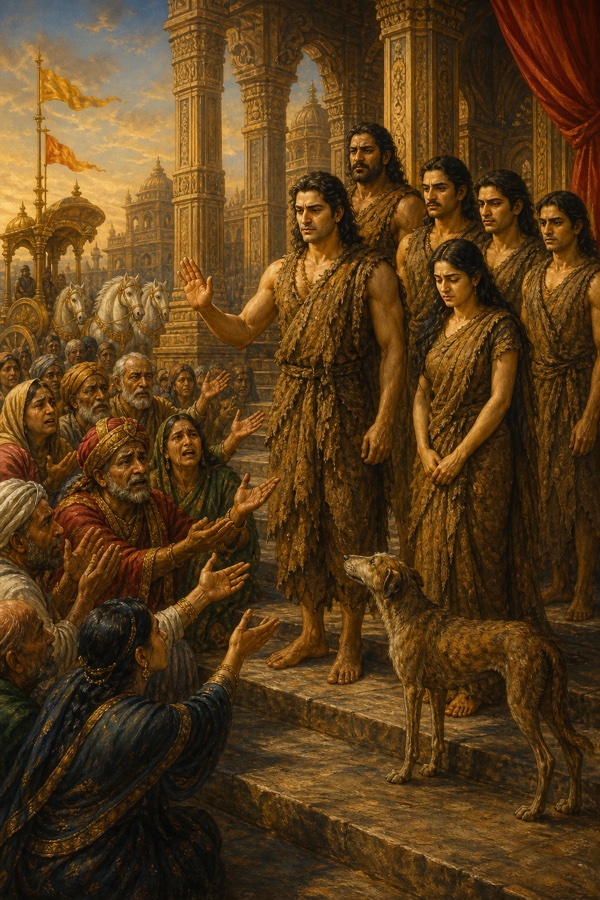
Then Yudhishthira summoned his subjects once more, the people of the city and the people of the provinces together, and told them what he meant to do. They heard him with dismay, and they would not have it. “This must never be done,” they said to their king. He knew what time does to all things, and he did not take their advice. He was a righteous man, and he brought the people round until they gave their consent to what he intended. After that his whole mind was on leaving, and his brothers were of the same mind.
A key to reading this (the lineage): Yuyutsu is Dhritarashtra’s son by a Vaishya woman who served in his household. On the field of Kurukshetra, before the fighting began, he left the Kaurava army and came over to Yudhishthira. Parikshit is the son of Abhimanyu, Arjuna’s son by Subhadra, and of Uttara. Ashvatthama’s weapon burned him in the womb, he was born without life, and Krishna revived him. Vajra is the son of Aniruddha and so Krishna’s great-grandson, the one prince the Yadus have left.
The gist: Told of the slaughter of Krishna’s people and of Krishna’s passing, Yudhishthira resolves to leave the world, and his four brothers resolve it with him. He gives the kingdom into Yuyutsu’s keeping, sets Parikshit on the throne at Hastinapura with Kripa as his teacher, commends Vajra at Indraprastha to Subhadra, and performs the rites for the dead. His people tell him it must never be done, and he wins their consent all the same.
Bark garments and the journey of seven
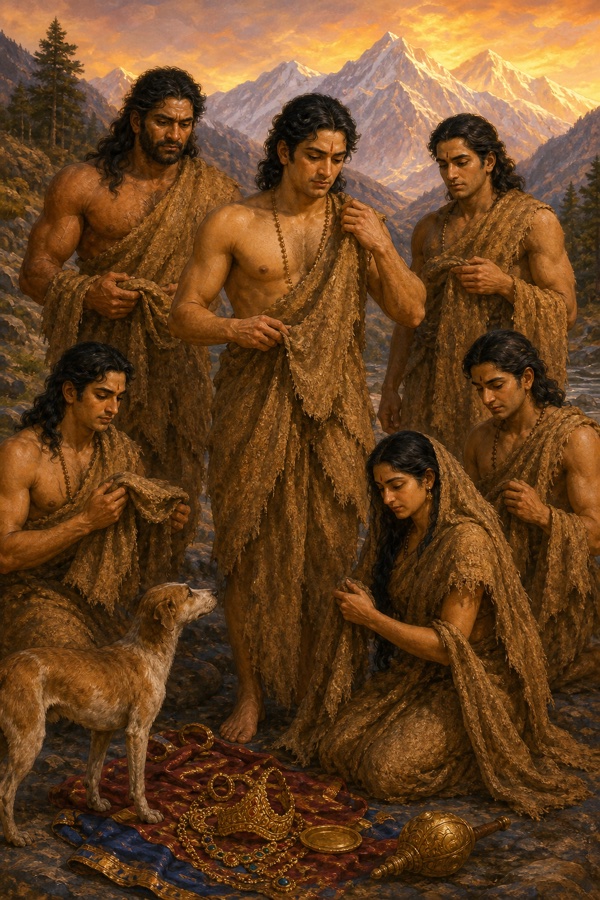
Then Yudhishthira, son of Dharma and king of the Kurus, took off his ornaments and put on the bark of trees. Bhima and Arjuna, the twins, and Draupadi, the wife of all five, dressed themselves in bark as he had. They had the opening rites performed, the ones that ask a blessing on a thing about to be undertaken, and then they gave their sacred fires to the water. When the women of the palace saw the princes dressed like that, they wept aloud. They had seen this sight once before: five brothers in bark, with Draupadi the sixth among them, walking out of the capital into exile after they were beaten at dice. The brothers themselves were cheerful at the thought of the life they were going to. They knew what Yudhishthira intended, they had seen the Vrishnis destroyed, and no other course could have pleased them now.
So they set out, five brothers, Draupadi the sixth, and a dog the seventh. Yudhishthira walked out of Hastinapura, the city named for the elephant, at the head of a party of seven. The citizens and the women of the royal household followed for some distance, and in all that way nobody could bring himself to speak to the king and ask him to turn back. Then the people of the city went home. Kripa and the others took their places around Yuyutsu. Ulupi, the Naga chief’s daughter and one of Arjuna’s wives, went down into the waters of the Ganga. Chitrangada, the princess who was another of them, set out for the capital of Manipura, her father’s city. The other women of the house, who were grandmothers to Parikshit, gathered around him.
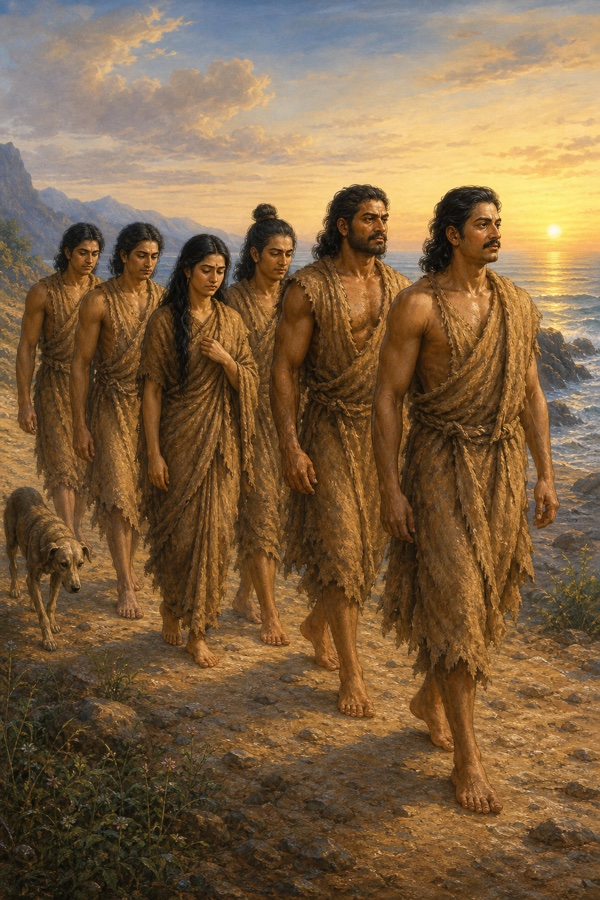
The Pandavas and Draupadi, meanwhile, had kept the fast that comes before such a journey, and they set out with their faces to the east. They had fixed themselves in Yoga, the mind drawn in and held, and they had resolved to live from now on by the rule of renunciation. In that state they passed through many countries and came to many rivers, and to seas. Yudhishthira walked first. Bhima came behind him, then Arjuna, then the twins in the order of their birth, and last of all Draupadi, dark and very beautiful, with eyes like lotus petals. And behind the Pandavas, as they made for the forest, came the dog.
A key to reading this (the number): The women weep because they have seen this before. After the defeat at dice, five brothers and Draupadi, six in all, left the capital dressed as they are dressed now. The same six leave again, and yet the count given for this journey is seven. The dog is numbered with them from the first step out of the city, before anyone has a reason to look at him. He is named again when the walking order is given, and again when Sahadeva is left on the road.
The gist: In bark, their sacred fires given to the water, the five brothers and Draupadi leave Hastinapura with a dog behind them, and the women who watch remember the day of the dice. Ulupi enters the Ganga and Chitrangada leaves for the capital of Manipura. The party faces east, Yudhishthira first and Draupadi last, all of them held in Yoga, and crosses countries and rivers until it comes to the sea.
Agni and the casting away of Gandiva
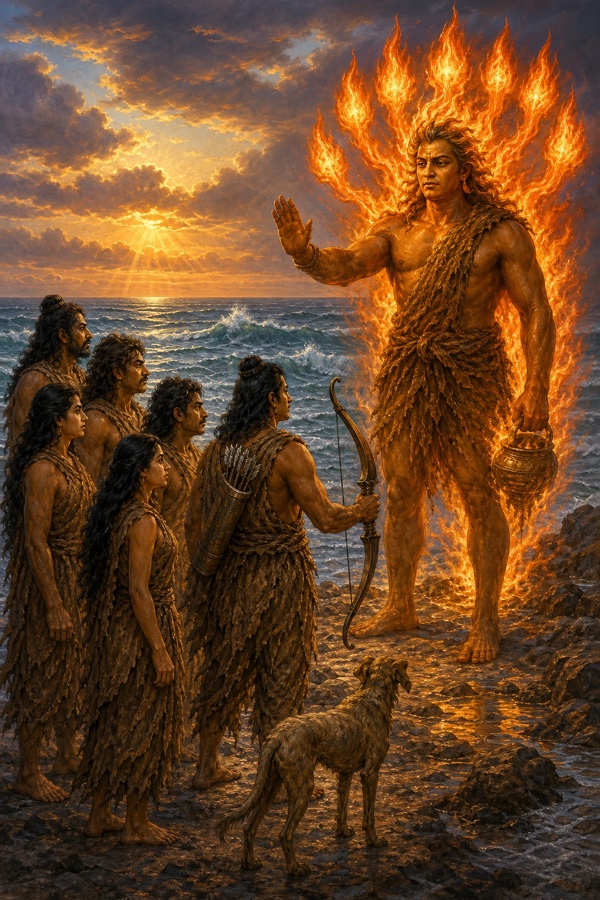
They went on until they came to the sea of red waters. Arjuna was still carrying Gandiva, the bow of the gods that had been his since the burning of the Khandava forest, and with it his two quivers that never emptied. He had given up a kingdom and kept these, held by the greed that ties a man to a thing of great worth. On that shore the Pandavas saw the god of fire standing in front of them like a hill. He had taken a body, and he stood across their road. Then the god of the seven flames spoke. “Heroic sons of Pandu, know that I am the god of fire. Yudhishthira, Bhima, Arjuna, and you two brave twins, listen to what I say. I am Agni. I burned the forest of Khandava, and it was Arjuna’s strength that let me do it, and the strength of Krishna, who is Narayana himself. Let your brother Arjuna put Gandiva down before he goes on to the forest. He has no more need of it. The precious discus that Krishna carried has gone out of the world, and when the time comes again it will come back to his hand. This bow, Gandiva, I got from Varuna for Arjuna to use. Let it go back to Varuna.”
His brothers all urged him to do as the god said. So Arjuna threw the bow into the sea, and both of the quivers after it, and the water, which is Varuna’s realm, closed over them. The god of fire vanished from the place where he had stood.
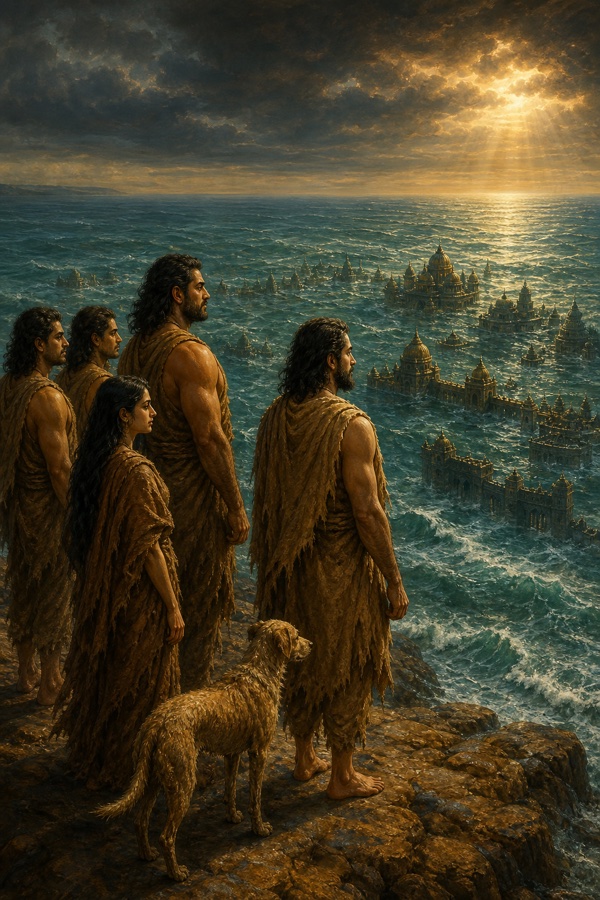
The sons of Pandu walked on with their faces to the south. Then they followed the northern shore of the salt sea toward the southwest. Then they turned west, and there they saw Dwarka, Krishna’s city, lying under the ocean, the city whose last people Arjuna had led out before the sea came in. Then they turned north and went on. They were holding to their Yoga, and what they meant to do was walk a full circle around the earth.
A key to reading this: Gandiva leaves the world by the road it came in on. When Agni wished to burn the Khandava forest and Indra stood ready to fight for it, he called on Varuna, lord of the waters, and Varuna handed over the bow, two inexhaustible quivers, and a chariot with an ape on its banner. Agni himself gave Krishna the discus. From Khandava through the eighteen days at Kurukshetra the bow was in Arjuna’s hand. It had already failed him once. On the road out of Dwarka, with Krishna gone, he strung it only with great difficulty, and the arrows that had never run out ran out. Vyasa told him then that his weapons had done their work and gone back to the place they came from, and would return to his hands when their time came again. Now Agni comes in person to ask for the bow back, and Arjuna gives it to the sea. The discus, Agni says, has left the world as well. Arjuna walks the rest of the way with empty hands.
The gist: On the shore of the red sea Agni stands across the road and asks for Gandiva and the two quivers, which he once obtained from Varuna for Arjuna’s use. Arjuna throws them into the water. The party turns south, then southwest along the salt sea, then west, where Dwarka lies drowned, and then north, meaning to walk around the whole earth.
The Himalaya, Meru, and the fall of Draupadi
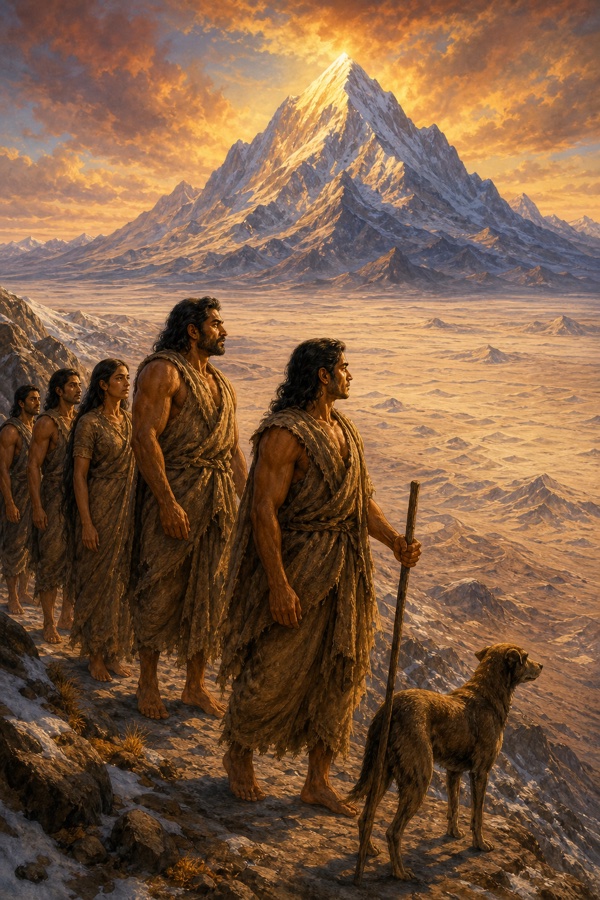
They walked north, masters of themselves and never letting go of their Yoga, until the great mountain Himavat, the Himalaya, stood before them. They crossed it. On the far side they saw a vast desert of sand, and then they saw Meru, the mighty mountain that is chief of all the high peaks. They were moving fast now, every one of them rapt in Yoga, when Draupadi lost her hold on that Yoga and dropped to the ground.
Bhima, the strong one, saw her lying there and spoke to Yudhishthira. “This princess never did a sinful thing,” he said. “Tell us the reason Draupadi has fallen to the earth.”
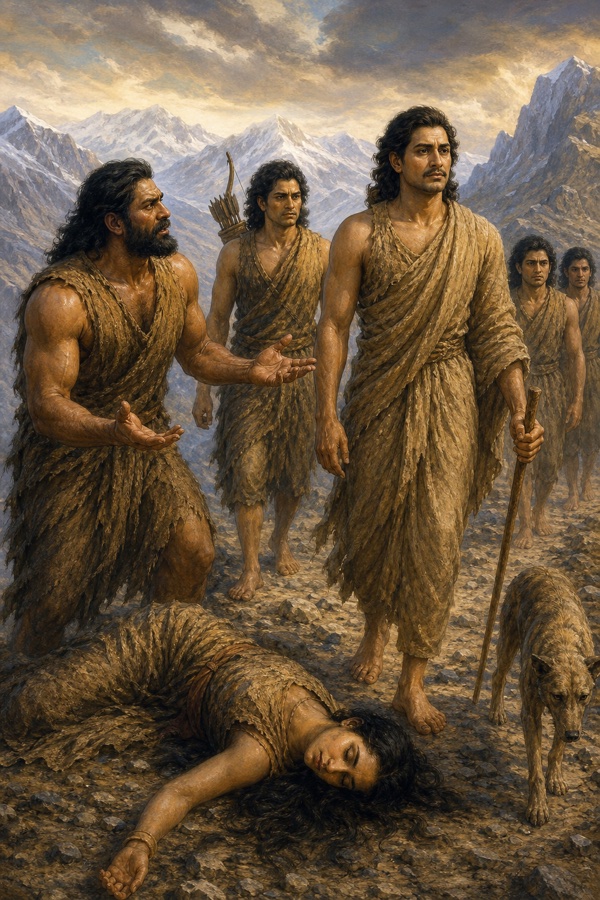
Yudhishthira said, “The five of us stood equal before her, and still she was greatly partial to Arjuna. Today she receives the fruit of that.”
Having said it, he went on. He was a righteous man and a man of great intelligence, and he walked as he had been walking, with his mind turned in upon itself. Draupadi had walked last in the line, and now the line went on without her.
A key to reading this (the idea): Bhima’s question carries a verdict of its own, that this woman never did a sinful thing, and Yudhishthira lets the verdict stand. What he names is a leaning of the heart: five husbands were equal before her, and she favored one. Every answer on this road will have that shape. Look also at how the fall itself is described. All of them are walking rapt in Yoga, and Draupadi falls at the moment she slips out of it.
The gist: North of the Himalaya, past a desert of sand and in sight of Meru, Draupadi is the first to lose her Yoga and fall. Bhima says she never sinned and asks why. Yudhishthira answers that the five of them were equal before her and she was partial to Arjuna, and he walks on with his mind turned inward.
The fall of Sahadeva, Nakula, and Arjuna
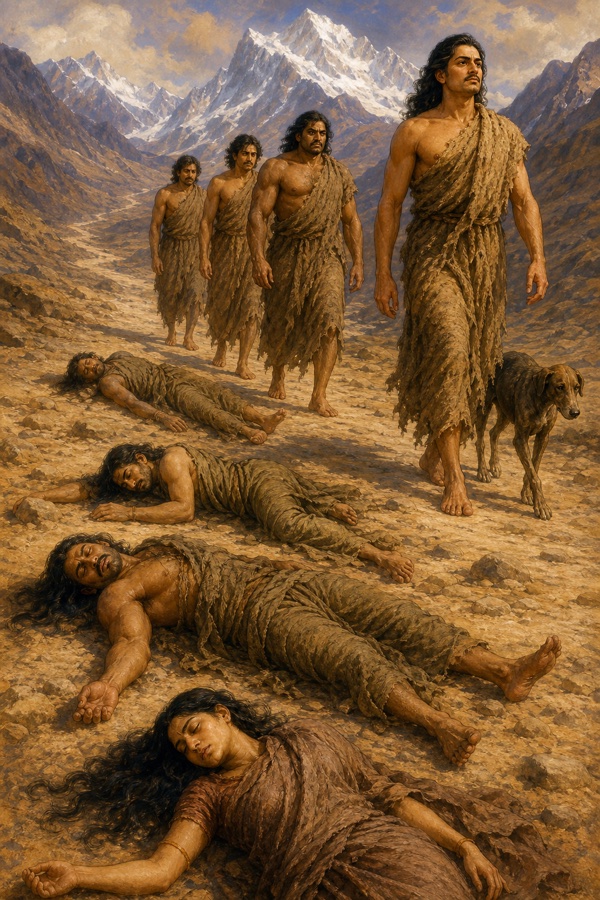
Sahadeva fell next, the learned one. Bhima watched him drop and said to the king, “He served every one of us, and with such humility. Why has he fallen to the earth, this son of Madri?”
Yudhishthira said, “He never thought anyone his equal in wisdom. That was his fault, and for that fault this prince has fallen.”
The king went on and left Sahadeva where he lay. He walked ahead with the brothers he still had, and with the dog. Nakula had now seen Draupadi fall, and his own twin after her. He was a brave man who loved his kin very greatly, and he went down himself. Bhima spoke to the king again. “This brother of ours was righteous, and nothing was missing from his righteousness. He always did what we asked of him. No one could match him for beauty. And Nakula has fallen.”
Yudhishthira answered him about Nakula. “He was righteous, and among men of intelligence he stood first. He also thought that there was no one who equaled him in beauty of person. In that one thing he held himself above everybody. That is why Nakula has fallen. Know it, Bhima. What is laid down for a man, he has to bear.”
Arjuna saw Nakula fall, and the others before him, and with great grief in his heart he went down too. This was Arjuna of the white horses, who had killed the heroes of every army that faced him, a man with Indra’s own fire in him whom nobody had been able to conquer. Now he lay at the point of death. Bhima said to the king, “I cannot remember one untruth this man ever spoke. He never said a false thing even as a joke. What did he do, then, that he should fall to the earth for it?”
Yudhishthira said, “Arjuna said he would burn up all our enemies in a single day. He was proud of his heroism, and he did not do what he had said. That is why he has fallen. He also looked down on every other man who carried a bow. A man who wants to prosper should never let such feelings into himself.”
A key to reading this (the idea): Two causes run side by side through these falls. Nakula goes down at the sight of Draupadi and his twin on the ground, and Arjuna goes down in grief at the sight of all three. Yudhishthira, asked why, names in each man a single pride. Sahadeva thought no one his equal in wisdom. Nakula thought no one his equal in looks. Arjuna promised to burn up every enemy in one day, did not do it, and held all other archers cheap. Bhima’s praise is never contradicted: of Nakula, Yudhishthira says outright that he was righteous and first among the intelligent. He is asked why each man fell, and that is the one question he answers.
The gist: Sahadeva falls, then Nakula at the sight of the two already down, then Arjuna in grief for all three. Each time Bhima recalls what was best in the one who has fallen and asks for the reason, and each time Yudhishthira names a pride: in wisdom, in beauty, in a boast to destroy every enemy in a single day that was never made good. Each time he goes on.
The fall of Bhima and the lone dog
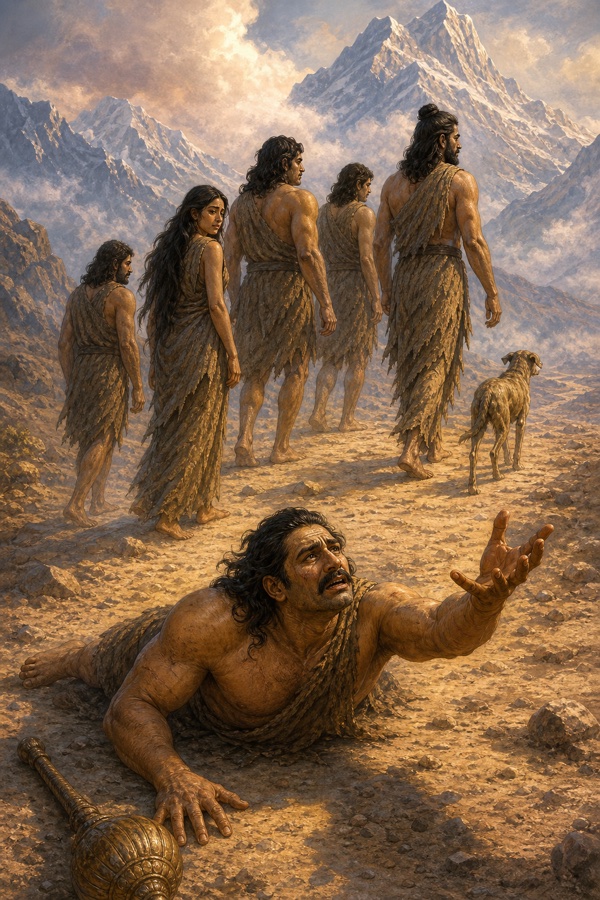
Then Bhima fell. From the ground he called to Yudhishthira, “Look at me, my king. I am the one you love, and I have fallen. For what reason have I gone down? Tell me, if you know it.”
Yudhishthira said, “You were a great eater, Bhima, and you used to boast of your strength. When you ate, you never gave a thought to what others needed. That is why you have fallen.”
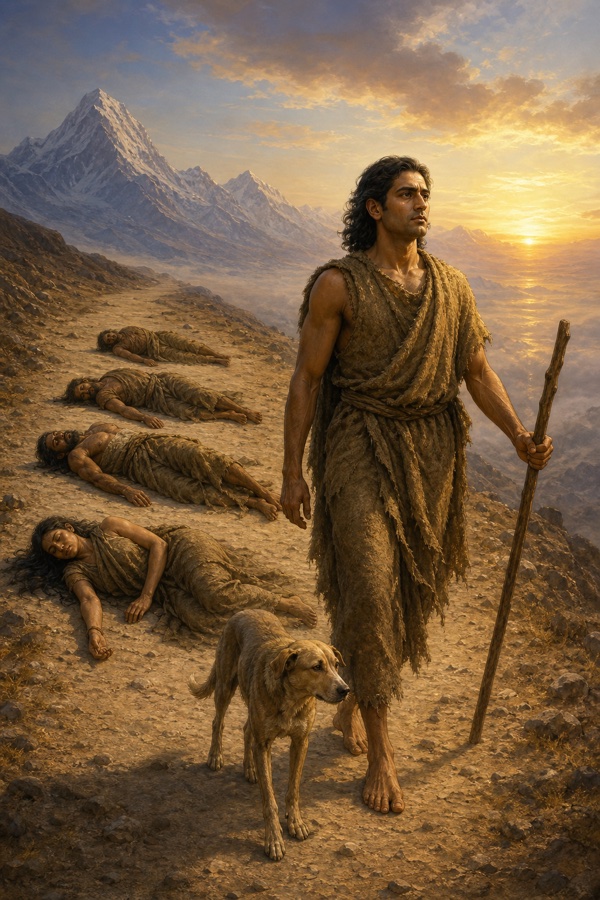
Having said this, Yudhishthira went on, and he did not look back. Seven had walked out of Hastinapura, and he had one companion left. The dog was still following him.
The gist: Bhima falls last and asks about himself. He is told that he ate greatly, boasted of his strength, and never minded the needs of others at his meals. Yudhishthira goes on without looking back. Draupadi and his four brothers lie behind him on the road, and the dog is the only one still with him.
Indra’s chariot and the test of the dog
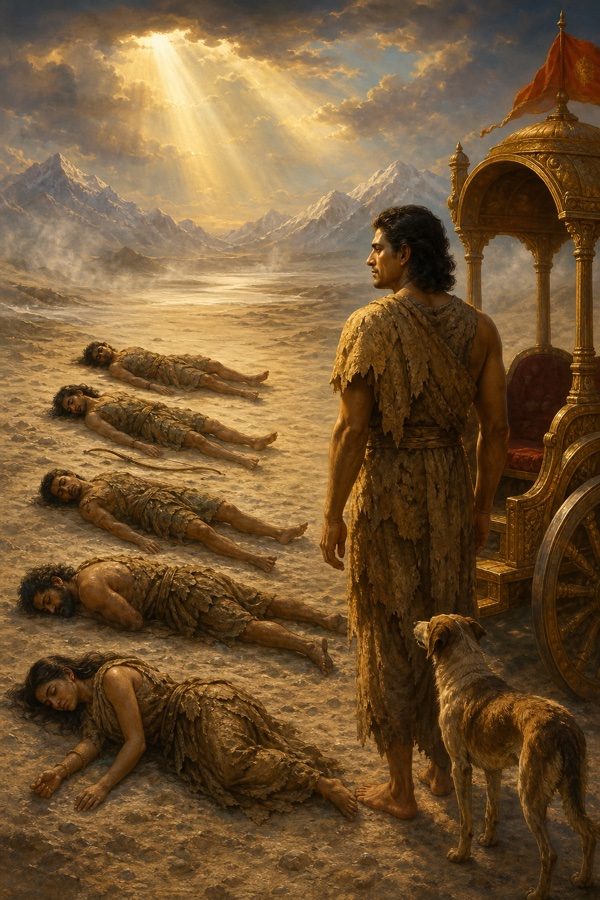
Then a great sound filled the sky and the earth, and Indra, king of the gods, came to Yudhishthira on a chariot and asked him to mount it. Yudhishthira looked at his brothers lying on the ground. He said to the god of a thousand eyes, “My brothers have all fallen here. They must go with me. I do not wish to go to heaven without them beside me. And the princess, who is delicate and deserves every comfort, should go with us. You are lord of all the gods. Allow this.”
Indra said, “You will see your brothers in heaven. They have reached it before you. You will see all of them there, and Draupadi with them. Do not give way to grief. They have put off their human bodies and gone. For you it is ordained that you go there in this very body.”
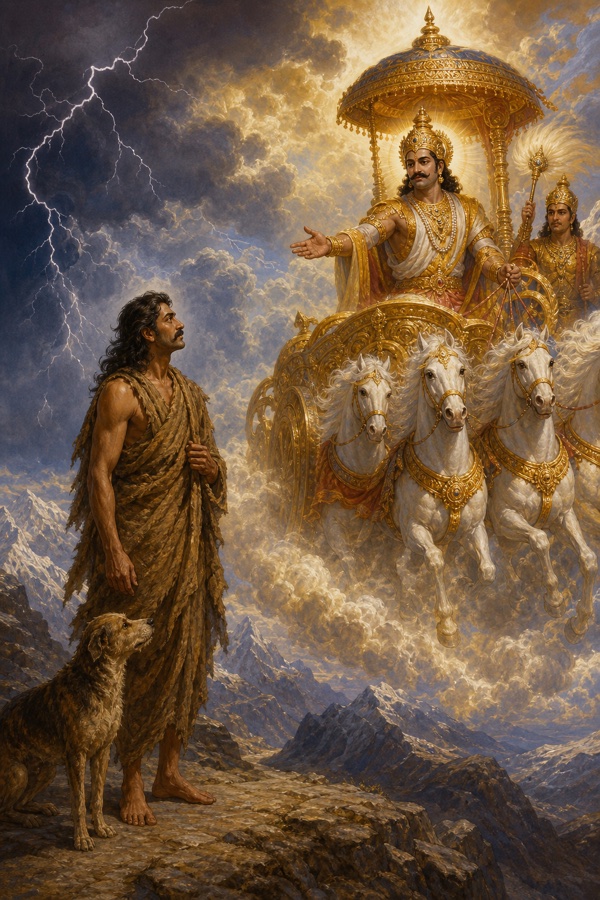
Yudhishthira said, “You are lord of what has been and of what is. This dog is deeply devoted to me. He should go with me. My heart is full of compassion for him.”
Indra said, “Today you have won immortality, and a state equal to mine, and prosperity reaching in every direction, and high success, and every happiness heaven holds. Leave this dog. There is nothing cruel in it.”
Yudhishthira said, “God of a thousand eyes, your own conduct is righteous. It is very hard for one whose conduct is righteous to do a thing that is unrighteous. I do not want a prosperity that I can have only by casting off one who is devoted to me.”
Indra said, “There is no place in heaven for those who come with dogs. And there is this besides. The deities called the Krodhavasas take away all the merit of such people. Think on that, Yudhishthira, and then act. Give up the dog. There is nothing cruel in it.”
Yudhishthira said, “It has been said that to abandon one who is devoted is a sin without end, equal to the sin of killing a Brahmin. So I will not give up this dog today, great Indra, out of a wish for my own happiness. This is my vow, and I have kept it steadily. I never give up one who is frightened, or one who is devoted to me, or one who seeks my protection and says he has nothing, or one who is suffering, or one who has come to me, or one too weak to protect himself, or one who is asking for his life. I will never give up such a one until my own life is at an end.”
Indra said, “Whatever a man gives away, whatever sacrifices he spreads out, whatever he pours on the sacred fire, if a dog has seen it the Krodhavasas carry it off. So give up this dog. Give him up and you reach the world of the gods. You left your brothers. You left Draupadi. By your own deeds, hero, you have won a world of happiness. Why are you so confused? You have renounced everything. Why can you not renounce this dog?”
Yudhishthira said, “All the worlds know this: with the dead there is no friendship and no enmity. When my brothers and Draupadi died, I had no power to bring them back to life. That is why I left them. As long as they were alive I did not leave them. To frighten one who has come for protection, to kill a woman, to steal what belongs to a Brahmin, to injure a friend: I hold, Indra, that each of these four is equal to abandoning one who is devoted.”
A key to reading this: Of the deities called the Krodhavasas Indra says only this much: they carry off the merit of any gift, sacrifice or fire offering that a dog has looked upon. He gives it as settled fact, alongside the plain statement that heaven has no place for those who come with dogs, and Yudhishthira disputes neither. He answers with a teaching he has heard, that to abandon one who is devoted is a sin equal to killing a Brahmin. Heaven is the price of holding to it, and Indra has told him so to his face.
A key to reading this (the idea): Indra’s last argument is the sharp one. You left your brothers and Draupadi on the road, so why hold on to a dog? Yudhishthira accepts the charge and marks where it stops. He left them when they were dead and he had no power to revive them. As long as they lived he never left them. The dog is alive and devoted to him, and giving up such a one is what his vow forbids. Then he sets the act beside four others he counts as its equal: frightening one who has sought protection, killing a woman, stealing from a Brahmin, injuring a friend.
Dharma revealed and the ascent to heaven
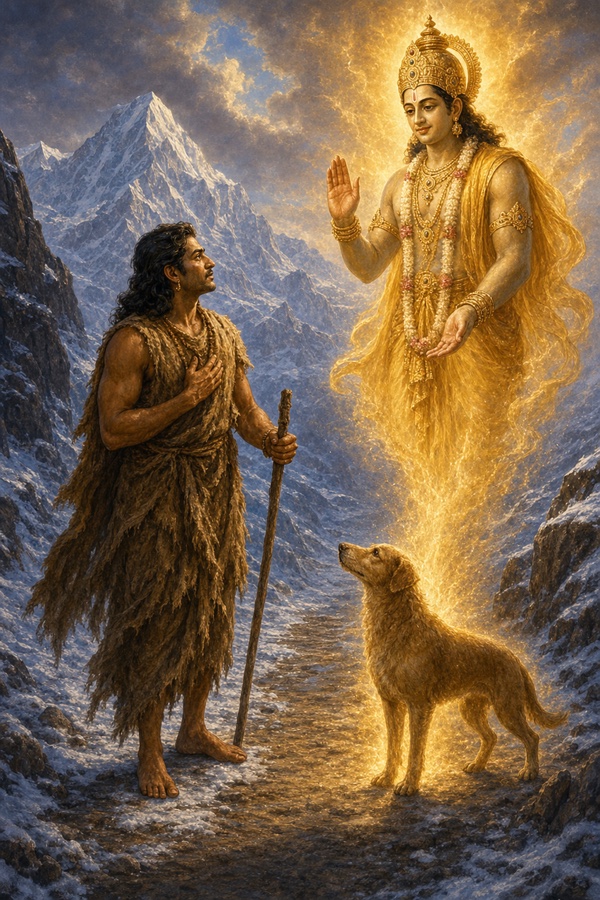
When Yudhishthira had said this, the dog was gone, and where it had stood was Dharma, the god of righteousness, whose son Yudhishthira was. He was well pleased. He spoke to the king in a gentle voice, and what he spoke was praise.
Dharma said, “You are well born, and you have Pandu’s intelligence and Pandu’s good conduct. You have compassion for every creature, and this is a bright example of it. Once before, my son, I tested you. It was in the Dwaita woods, where your brothers, for all their prowess, lay as if dead. You passed over your brothers Bhima and Arjuna and asked for Nakula to be brought back to life, because you wished to do good to your stepmother. And now, believing this dog devoted to you, you have given up the very chariot of the gods and kept the dog. For that there is no one in heaven who is your equal. For that the worlds of unending happiness are yours. You have won them, and the end you go to is high and heavenly.”
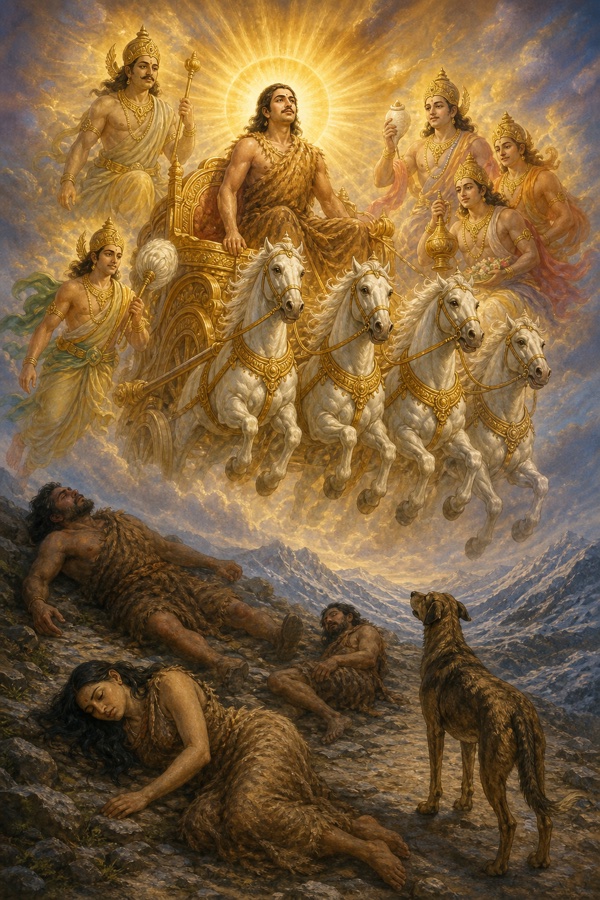
Then Dharma and Indra, the Maruts and the two Ashvins, the other gods and the sages of heaven had Yudhishthira mount a chariot, and they set out for heaven. All those beings, perfected, free to go wherever they wished, rode chariots of their own. And Yudhishthira, who had carried the line of Kuru forward, rose quickly on his, and the light that came off him set the whole sky blazing.
Out of that company of gods Narada spoke. No one surpassed him in speech, he was rich in austerities, and he knew every world there is. “All the royal sages who are here,” he said, “have had their achievements surpassed by Yudhishthira’s. He has covered all the worlds with his fame, his splendor and the wealth of his conduct, and he has reached heaven in his own human body. Nobody other than the son of Pandu has ever been heard to do this.”
The king heard Narada out. Then he saluted the gods and all the royal sages who were present, and he said, “Happy or miserable, whatever place my brothers are in now, that is where I want to go. I do not wish to go anywhere else.”
Indra, chief of the gods, answered him, and there was nobility in what he said. “Live here, in this place you have won by your good deeds. Why do you still hold on to human affections? You have reached a success that no other man has ever been able to reach. Your brothers have won worlds of happiness. And still human affections touch you. This is heaven. Look at these sages of heaven and these Siddhas, who have come to the world of the gods.”
Yudhishthira was a man of great intelligence, and he gave the chief of the gods his answer a second time. “I cannot bring myself to live anywhere apart from them. I want to go where my brothers have gone. I want to go where Draupadi has gone, a woman above all women, full of figure and dark, wise, and righteous in all she did.”
A key to reading this (the lineage): Dharma is Yudhishthira’s father. Pandu asked his wife Kunti to call down the god of justice, and the son she bore was that god’s, which is why Yudhishthira is called the son of Dharma and the just king. The earlier test Dharma speaks of belongs to the years of exile in the forest, in those same Dwaita woods. Four brothers lay dead beside a lake whose guardian, a yaksha, had forbidden them to drink before they answered his questions. Yudhishthira answered them all and was offered one brother’s life, and he chose Nakula, so that Madri, his father’s other wife, would have a living son as Kunti had. The yaksha restored all four and then named himself. He was Dharma, come to test his son. The dog is his second disguise.
The gist: The dog was Dharma, Yudhishthira’s own father, and the refusal to leave it was the test. Dharma praises him and recalls the earlier test in the Dwaita woods, and the gods take Yudhishthira up to heaven on a chariot in his human body, a thing Narada says no one else has been heard to do. There Yudhishthira asks for one thing, to be wherever his brothers and Draupadi are, happy or miserable. Indra tells him to stay and let human affection go, and he asks again. The Mahaprasthanika Parva ends on that request.
Source: the Mahabharata of Krishna-Dwaipayana Vyasa, Mahaprasthanika Parva, Sections 1 to 3. The Sanskrit e-text, the Gita Press Hindi edition, and Kisari Mohan Ganguli’s complete English translation were used to verify names, sequence, and principal events. Where the recensions differ, this English retelling follows Ganguli, and the Hindi edition follows Gita Press.
Based on: The Mahabharata, Vyasa (K. M. Ganguli’s English translation; Gita Press, Gorakhpur)