On this page
King Janamejaya sat at his snake sacrifice in Takshashila, and in the pauses between the rites Vaishampayana had been telling him the history of his own forefathers. The king had one thing more to ask. “They reached heaven,” he said. “My forefathers of old, the Pandavas and the sons of Dhritarashtra. What regions did each of them come to there? I want to hear it. I believe you know everything, because the great rishi Vyasa, whose feats are a wonder, taught you himself.”
“Then listen,” Vaishampayana answered, “to what your forefathers, Yudhishthira and the rest, did once they had come to heaven, the place where the gods live.”
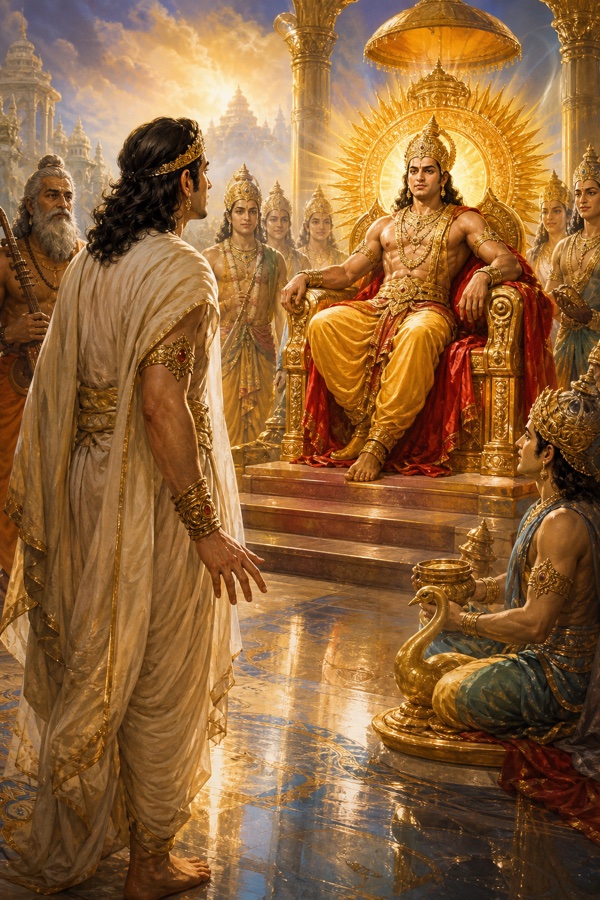
Yudhishthira the just, king of the Kurus, came into heaven still wearing the human body he had lived in, and what he saw there was Duryodhana. His cousin sat on a splendid seat in the full enjoyment of his fortune. He blazed like the sun. He wore every mark of glory that belongs to a hero, and around him sat gods bright with their own light, and the Sadhyas, whose deeds are righteous. This was the man for whose sake the earth had been laid waste, with her horses, her elephants and her people. Yudhishthira looked at him and at all that prosperity, and rage filled him without warning. He turned his back on the sight.
Yudhishthira turns away at the sight of Duryodhana in heaven
“I have no wish to share any region of happiness with Duryodhana,” he said, loudly, so that the gods who had come in with him heard every word. “Greed stained that man, and he could never see far ahead of himself. For him we slaughtered friends and kinsmen over the whole earth, we whom he had already ground down in the deep forest. For him Draupadi, the good princess of Panchala, our wife, a woman without a flaw in her, was dragged into the middle of the assembly in front of all our elders. Gods, I do not want even to look at Suyodhana. I want to go where my brothers are.”
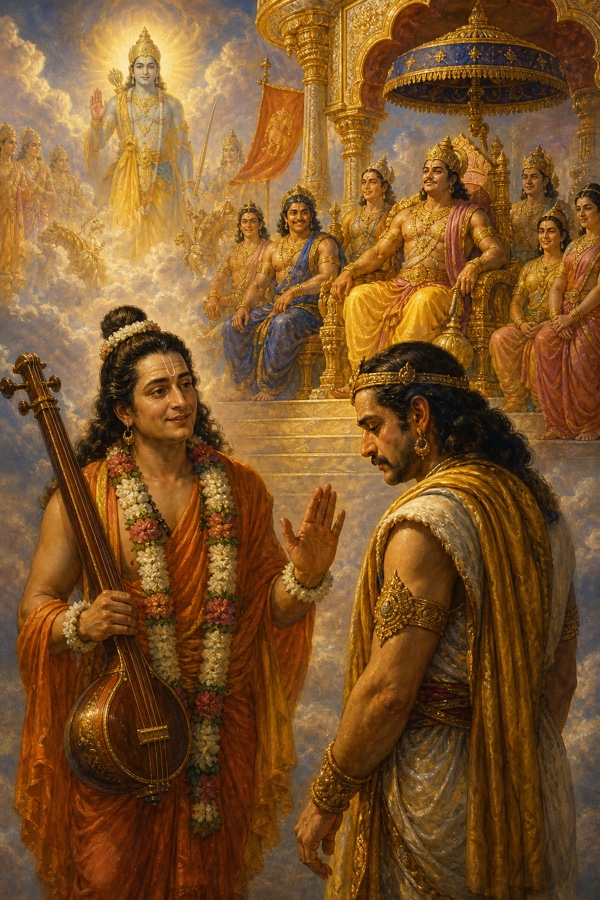
The rishi Narada was standing there, and he smiled. “That is no way to speak,” he told him. “Enmities end for those who live in heaven. Yudhishthira, do not say such things about King Duryodhana. Listen to me. Here he is, King Duryodhana, and the righteous men and the greatest of the kings who now live in heaven honor him alongside the gods. He poured his own body as an offering into the fire of battle, and so he has won the end that is kept for heroes. You and your brothers were gods walking the earth, and this man persecuted you without rest. Even so, he kept the Kshatriya way, and by keeping it he has reached this region. Where there was every cause for terror, this king felt none.
“Son, you should not carry in your mind what the dice match did to you. You should not go on remembering what Draupadi suffered, or the other wrongs your kinsmen’s acts brought down on all of you, whether they came through battle or through anything else. Go to Duryodhana now and meet him as courtesy requires. This is heaven. No enmity can exist here.”
A key to reading this (the idea): The Svargarohana Parva, the book of the ascent to heaven, is the eighteenth and last book of the Mahabharata, and it opens on its hardest question. Narada’s case for Duryodhana rests on one thing: he gave his body to the battlefield as a Kshatriya should and felt no fear there, and a hero’s region is the reward. Narada admits in the same breath that this man persecuted the Pandavas without rest, and he offers no excuse for it. His answer to the wrong is that heaven holds no enmity. What Yudhishthira says next shows how far that answer goes with him.
The gist: Yudhishthira enters heaven, sees Duryodhana enthroned in glory among the gods and the Sadhyas, and turns away in rage. He tells the gods he wants no region shared with the man for whom friends and kinsmen were slaughtered and Draupadi was dragged before the elders, and he asks for his brothers. Narada answers that enmities end in heaven and that Duryodhana, who gave his body to the battle as a Kshatriya, has won the region kept for heroes.
Yudhishthira searches for his brothers and Karna
Yudhishthira heard the rishi out, and with the clear mind he was known for he let the argument lie and asked about his brothers. “If these eternal regions kept for heroes are Duryodhana’s,” he said, “that unrighteous, sinful man, who destroyed his friends and the whole world with them, for whose sake the earth was laid waste with all her horses and elephants and people, for whose sake we burned with anger while we thought how our wrongs might be set right, then I want to see what regions my brothers have reached. They were heroes. They kept high vows, they did what they promised, they spoke the truth, and men knew them for their courage.
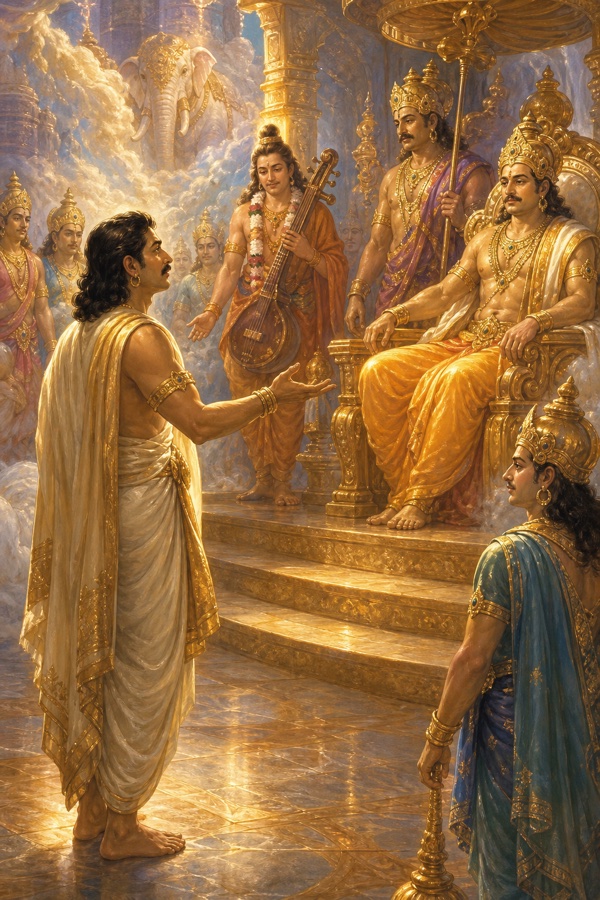
“Karna, the son of Kunti, whom no one could turn in battle: where is he? Where are Dhrishtadyumna and Satyaki, and the sons of Dhrishtadyumna, and the other Kshatriyas who died keeping the Kshatriya way? Where are those kings, Narada? I do not see them here. I want to see Virata and Drupada and the other great Kshatriyas, with Dhrishtaketu at their head. I want to see Shikhandi, the Panchala prince, and the sons of Draupadi, and Abhimanyu, whom no one could stop in battle.”
His eyes went over that bright company once more, and he turned from the rishi to the gods. “Gods, I do not see Karna here, Radha’s son to all the world, whose prowess had no measure. I do not see my brothers. I do not see Yudhamanyu and Uttamaujas, those great chariot warriors who poured their bodies into the fire of battle, or the kings and princes who met death in that war for my sake. They fought like tigers. Where are they? Have they won this region? If they have, then know that I will live here with them. If this blessed and eternal region was never given to those kings, then know this as well: without my brothers and my kinsmen I will not live here.
“When we were offering water to the dead after the battle, I heard my mother say, ‘Offer water for Karna too.’ I have been burning with grief since I heard those words. And there is a second grief that never leaves me. I had seen that Karna’s feet were like my mother’s feet, and when I saw it I did not go to him at once and put myself under his command, great soul that he was, the terror of every army that faced him. With Karna beside us, Shakra himself, the king of the gods, could not have beaten us in battle. Wherever that child of Surya is, I want to see him. We never knew he was ours, and I had him killed by Arjuna’s hand.
“Bhima too, whose strength was terrible, who is dearer to me than the breath in my body. Arjuna, who is like Indra himself. The twins, who were like the Destroyer in a fight. I want to see them. I want to see the princess of Panchala, who did right in everything all her life. I do not want to stay here. I am telling you the truth. You who are first among the gods, what is heaven to me if I am parted from my brothers? Heaven is the place where they are. This, as I see it, is no heaven.”
A sub-tale, hinted at: Yudhishthira’s grief over Karna goes back to the days just after the war. The Pandavas had known Karna all their lives as Radha’s son, and Arjuna had killed him. Then, while they were offering water to the dead, Kunti told her sons to offer it for Karna as well: he was her own firstborn, born to her by Surya, and their eldest brother. Yudhishthira had once noticed that Karna’s feet were shaped like his mother’s and had done nothing about it. Standing in heaven, he puts that grief beside all the wrongs he has just laid at Duryodhana’s door, and it is the only one he charges to himself.
The gist: Yudhishthira lets Narada’s argument lie and asks where his own people are: Karna, his four brothers, Draupadi and her sons, Abhimanyu, Dhrishtadyumna, Satyaki, Virata, Drupada and the others who died for him. He will live in heaven if they are in it and will leave it if they are absent. His sharpest grief is for Karna, the brother whose kinship he learned at the water rites, after he had already had Arjuna kill him.
The journey with the messenger down the foul road
“If that is where you long to be, son, then go, and lose no time,” the gods said. “The king of the gods has commanded it, and we are ready to do what pleases you.”
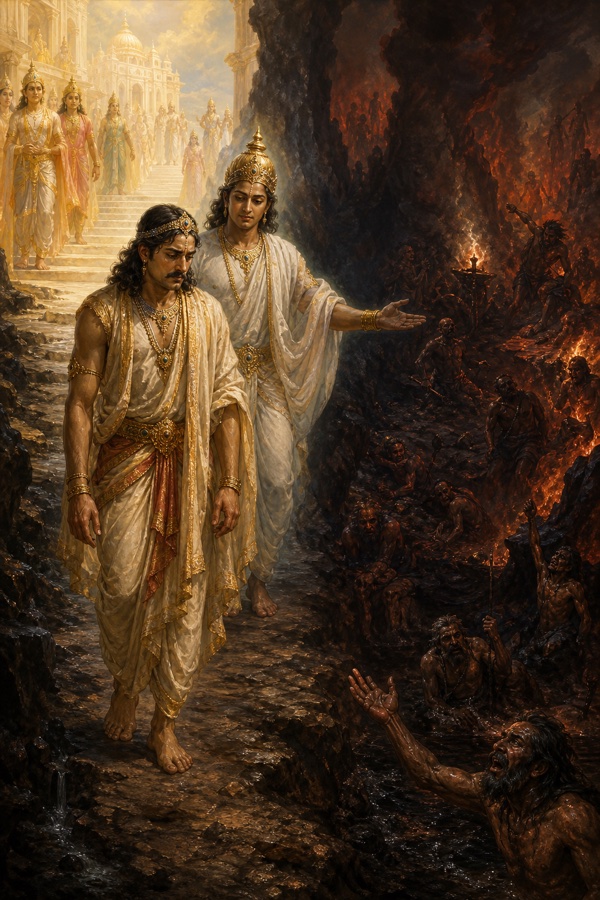
They turned to the messenger of heaven and gave him his order: “Show Yudhishthira his friends and his kinsmen.” So the royal son of Kunti and the messenger set out together for the place where the men he had asked for were. The messenger walked ahead. The king followed behind him.
The road to them was an evil one, hard going, worn by the feet of men who had done wrong. Thick darkness lay over it. Hair and moss grew on it where grass should have been. It stank of sinners, and the mud underfoot was flesh and blood. Gadflies swarmed over it, and stinging bees, and gnats, and grisly bears broke in upon it and made it dangerous. Rotting corpses lay here and there. Bones and hair were scattered over the ground, and worms and insects crawled through all of it. A blazing fire ran beside the road for its whole length. Crows haunted it, and vultures and other birds, every one with a beak of iron, and evil spirits with long mouths pointed like needles. There were heights and hollows along it as hard to cross as the Vindhya mountains. Human corpses lay strewn across it, smeared with fat and blood, some with the arms and thighs cut away, some with the entrails torn out and the legs severed.
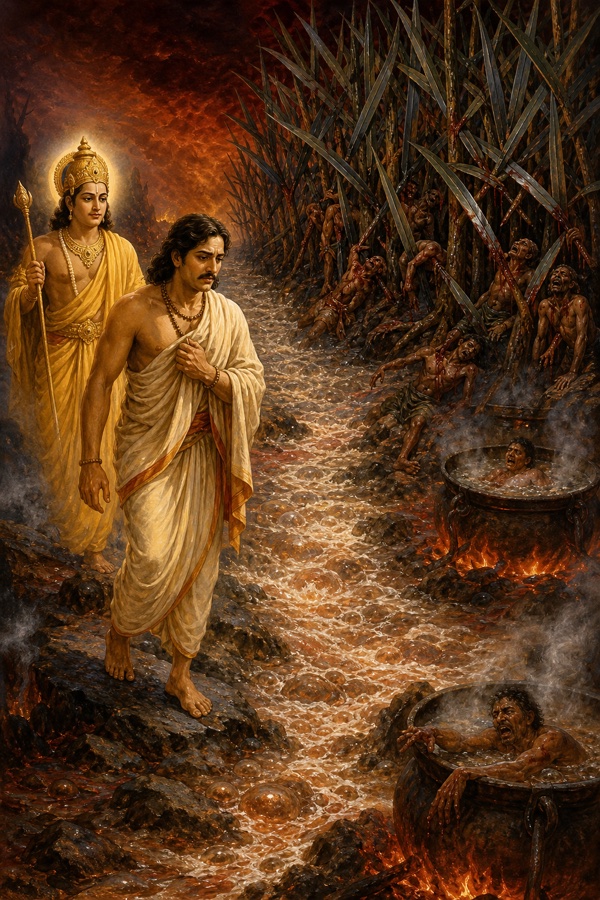
Through the stench of the dead, past things dreadful to see, the king walked on, a man who had lived his whole life by what was right, and his mind was crowded with thoughts. He saw a river running full of boiling water, which no one could have crossed, and a forest whose trees had sharp swords and razors for leaves. He saw plains of fine white sand heated beyond bearing, and rocks and stones made of iron. Iron jars stood all around, and the oil in them was boiling. Kuta-shalmali trees grew there in numbers, covered in sharp thorns, an agony to touch. And the son of Kunti saw the tortures that were being inflicted on sinful men.
He looked over that evil country, where every kind of foulness was gathered, and he spoke to the messenger. “How much farther are we to go along a road like this? You should tell me where my brothers are. And I want to know one thing more: what region of the gods is this?”
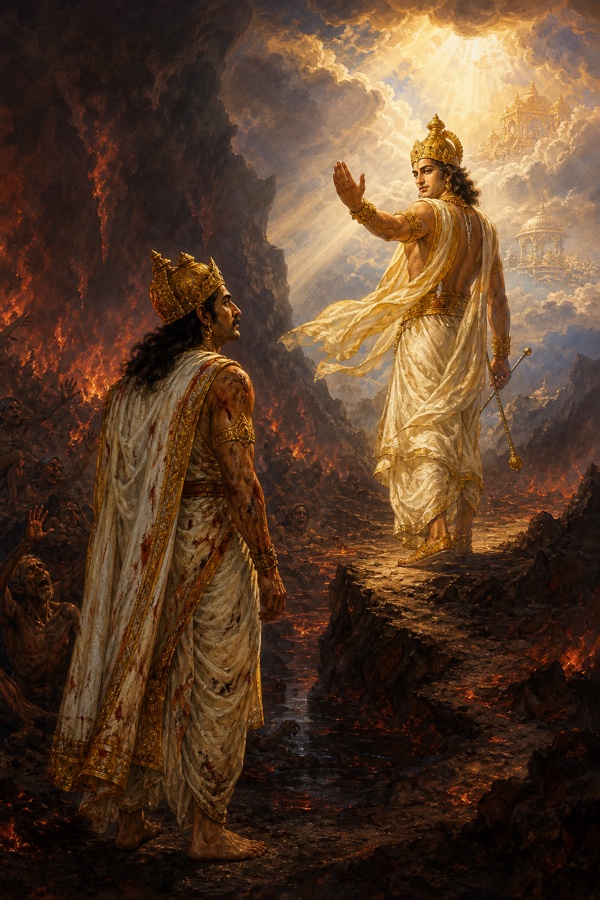
The messenger stopped where he was. “Your way comes this far,” he said. “The gods who live in heaven ordered me to come this far and then stop. If you are tired, you may go back with me.”
A key to reading this (the setting): On the road the river of boiling water has no name. It is given one when the gods arrive and the place dissolves: the Vaitarani, which vanishes together with the shalmali trees, the iron jars and the boulders. The messenger never uses the word hell. Yudhishthira, who was promised his friends and kinsmen, asks him which region of the gods this is, and all he is told is that the road ends here.
The gist: The gods send a messenger to lead Yudhishthira to his kinsmen. The road runs through darkness and stench, over mud of flesh and blood, past corpses, iron-beaked birds, a river of boiling water, a forest with blades for leaves, burning sand, jars of boiling oil and thorned Kuta-shalmali trees, with sinners under torture along it. When Yudhishthira asks how much farther they must go, the messenger halts. His orders were to come this far.
The kinsmen’s piteous call, and Yudhishthira’s choice to stay
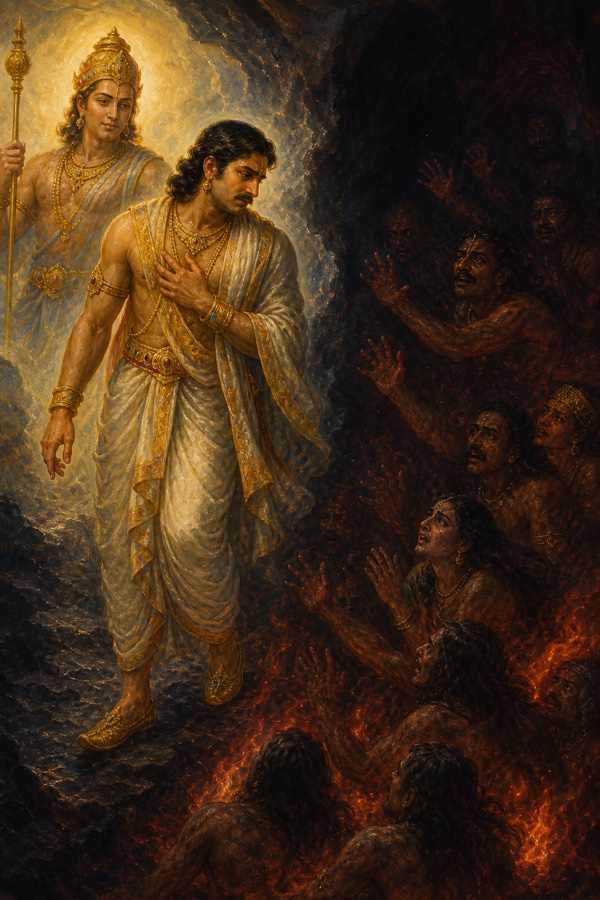
The smell had dazed him, and there was no comfort left in him at all. He made up his mind to go back. Heavy with sorrow and grief, the king turned around and began to retrace his steps, and at that moment voices rose on every side of him, crying out in misery.
They called him son of Dharma, and royal sage, and son of Pandu. They called him a man of sacred birth whom nothing had ever defeated. “Stay a moment, as a kindness to us,” they begged. “When you came near, a sweet breeze began to blow, and it carries the scent of your body to us. It has eased us greatly. The sight of you has made us happy. Let that happiness last a little longer. Stay a few moments more. Stay, if only for a short while. As long as you are here, the torments stop.”
These words and many more like them reached the king from every direction, spoken in the pitiful voices of people in pain. Yudhishthira had a heart that compassion moved easily. “Ah, how painful this is!” he cried out, and he stood still. There was something in those worn, suffering voices that he seemed to have heard before, and yet, standing there, he could not tell whose they were.
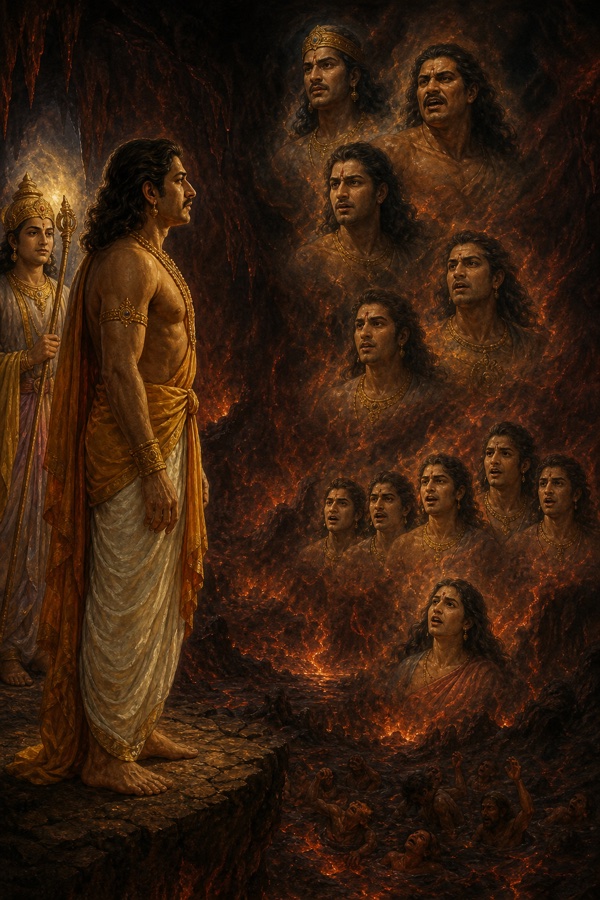
Because he could not place them, Dharma’s son asked. “Who are you? And why are you here?”
The answer came from all sides at once. “I am Karna!” “I am Bhimasena!” “I am Arjuna!” “I am Nakula!” “I am Sahadeva!” “I am Dhrishtadyumna!” “I am Draupadi!” “We are the sons of Draupadi!”
So the voices spoke, Vaishampayana told the king, one after another out of the dark.
The names came to him in voices of pain that belonged to that place, and Yudhishthira asked himself, “What perverse fate is this? Karna, the sons of Draupadi, the slender-waisted princess of Panchala: what sin did people of such greatness ever commit, that they should be given this country of stench and misery to live in? I know of no wrong that can be laid against any of them. Their deeds were righteous. And what did Dhritarashtra’s son do, King Suyodhana, with all his sinful followers, that he should be wrapped in such fortune? He is as prosperous as great Indra and as highly honored. What act bears a fruit like that, while these have fallen into hell? Every one of them knew every duty. They were heroes. They were devoted to truth and to the Vedas. They kept the Kshatriya way, they were righteous in what they did, they performed sacrifices, they gave great gifts to Brahmins. Am I asleep or awake? Am I conscious or unconscious? Or is all of this a delusion of the mind, some disorder in my brain?”
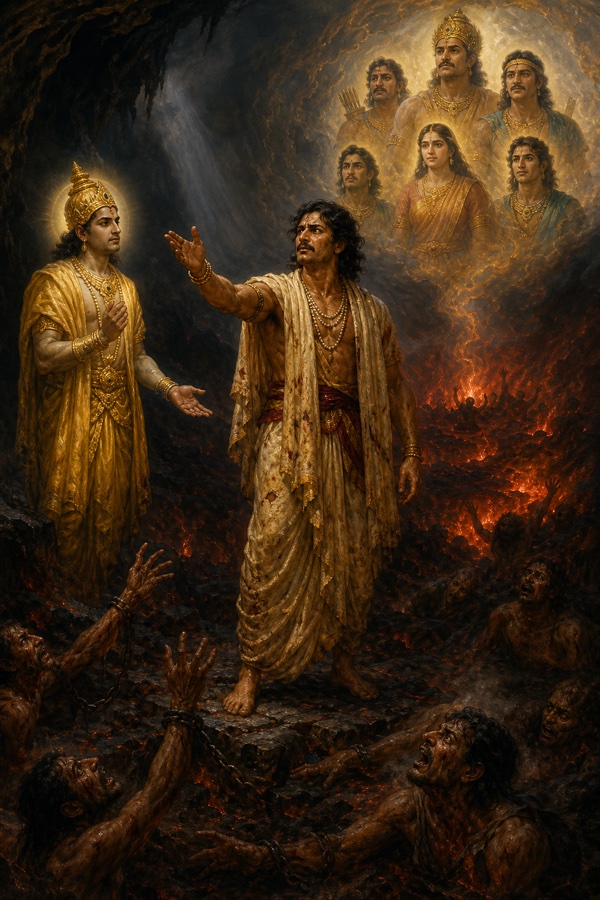
Sorrow and grief overwhelmed him, and anxiety shook his senses, and for a long time King Yudhishthira stood there turning these thoughts over. Then anger took him, a great anger. Dharma’s own son condemned the gods in that hour, and he condemned Dharma too.
The stench was still tormenting him when he spoke to the messenger. “Go back to those who sent you. Tell them I will not return to where they are. I will stay here, because my company brings comfort to these suffering brothers of mine.”
The messenger heard what the wise son of Pandu had to say and went back to the place where the king of the gods was, Indra, the god of the hundred sacrifices. He reported what Yudhishthira had done. He told Indra every word that Dharma’s son had said.
A key to reading this (the moral heart): Yudhishthira is the son of Dharma and is called the just, and here he condemns the gods and Dharma himself. What drives him to it is a comparison he cannot make come out: Duryodhana enthroned and honored like Indra, and people who knew every duty lying in this place. He doubts his own mind before he doubts them. Then he sends heaven’s messenger away and stays, for a reason he states himself: his being there eases their pain.
The gist: Dazed by the stench, Yudhishthira turns to leave, and voices beg him to stay, because the breeze that came with him has stopped their torment. They name themselves: Karna, Bhimasena, Arjuna, Nakula, Sahadeva, Dhrishtadyumna, Draupadi and her sons. He cannot find the sin that put them there or the act that enthroned Duryodhana, and in his anger he condemns the gods and Dharma. He sends the messenger back and stays, because his company comforts his brothers.
The coming of the gods, and the vanishing of the illusion of hell
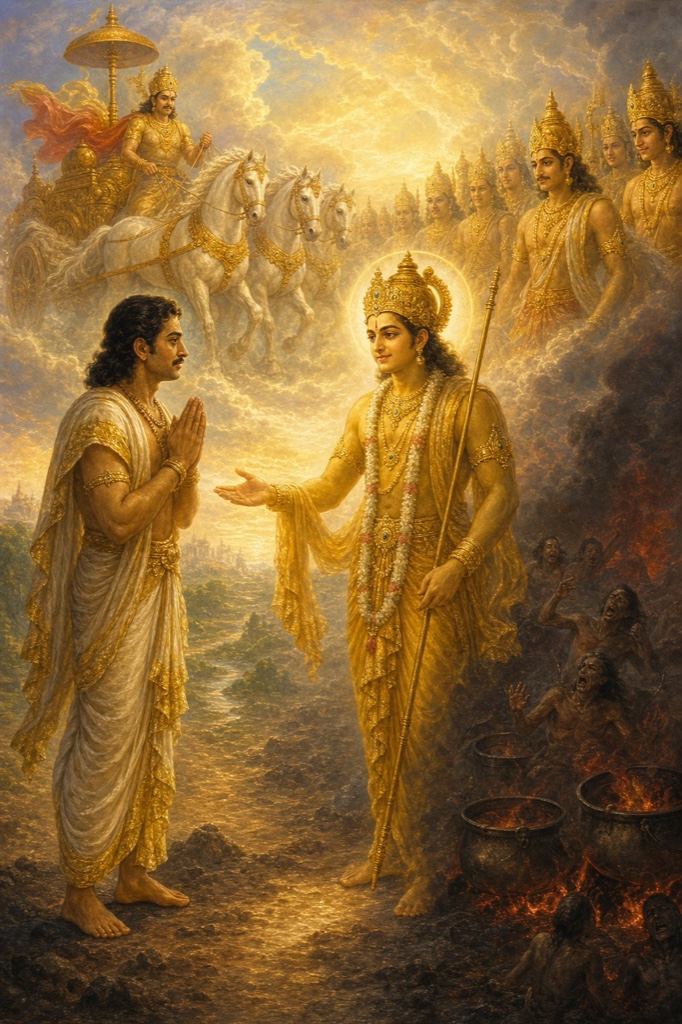
Yudhishthira the just, Pritha’s son, had stood in that place no longer than a moment when the gods came to it, all of them, with Indra at their head. Dharma came too, the god of righteousness, in a body that could be seen, to look at the king. Their bodies shone, and their deeds were pure and noble, and as they arrived the darkness that had covered that country was gone. The torments of the sinful could no longer be seen. The river Vaitarani vanished, and the thorned shalmali trees, and the iron jars, and the terrible boulders of rock. The foul corpses the Kuru king had seen disappeared in the same instant. Then, because gods were standing there, a breeze began to blow over the place, pure and cool and sweet with perfume. The Maruts had come with Indra. The Vasus had come with the twin Ashvins, and the Sadhyas, the Rudras, the Adityas and the rest of those who live in heaven, and the Siddhas, and the great rishis. All of them gathered where Dharma’s royal son stood.
Then Indra spoke, Shakra, the lord of the gods, blazing in his prosperity, and he spoke to comfort him. “Come, Yudhishthira, come. These illusions are over. You have succeeded, and regions that never end are yours. Do not give way to anger. Listen to what I tell you. Every king, son, must look upon hell; there is no doubt of it. Good and evil are both found in abundance. The one who first enjoys the fruits of his good acts must afterward endure hell. The one who first endures hell must afterward enjoy heaven. The one whose sinful acts are many enjoys heaven first. That is why I had you sent to see hell. I wished you well.
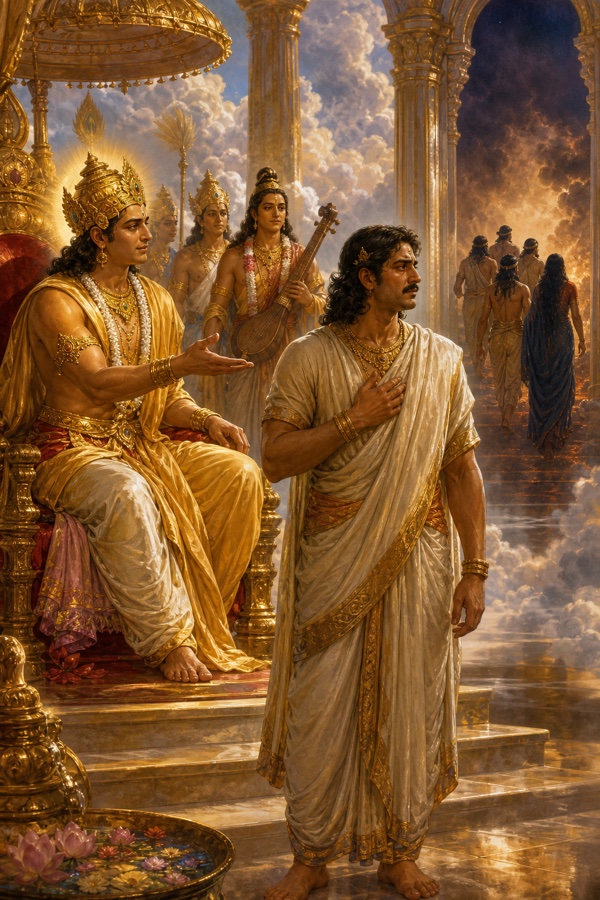
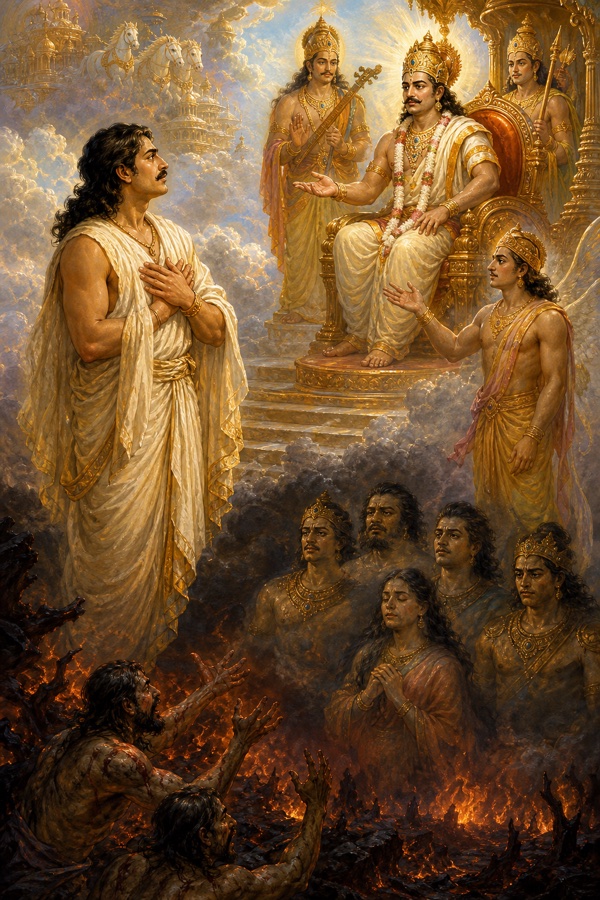
“Once, by a pretense, you deceived Drona in the matter of his son,” Indra went on, “and because of that, hell has been shown to you by an act of deception. Bhima and Arjuna and Draupadi have been shown the place of sinners in the same way that you were, by an act of deception. Come. All of them have been cleansed of their sins. The kings who took your side and were killed in the battle have all reached heaven. Come and see them.
“Karna, the great bowman, first among all who carry weapons, the man you grieve for, has reached high success as well. Look at him, the son of Surya. He is in the place that is his own. Kill this grief of yours. Look at your brothers, and at the others, the kings who stood on your side. Each has reached the place that is his. Let the fever in your heart go out. You have borne a little misery first. From this hour be happy with me, with your grief gone and every sickness lifted from you.
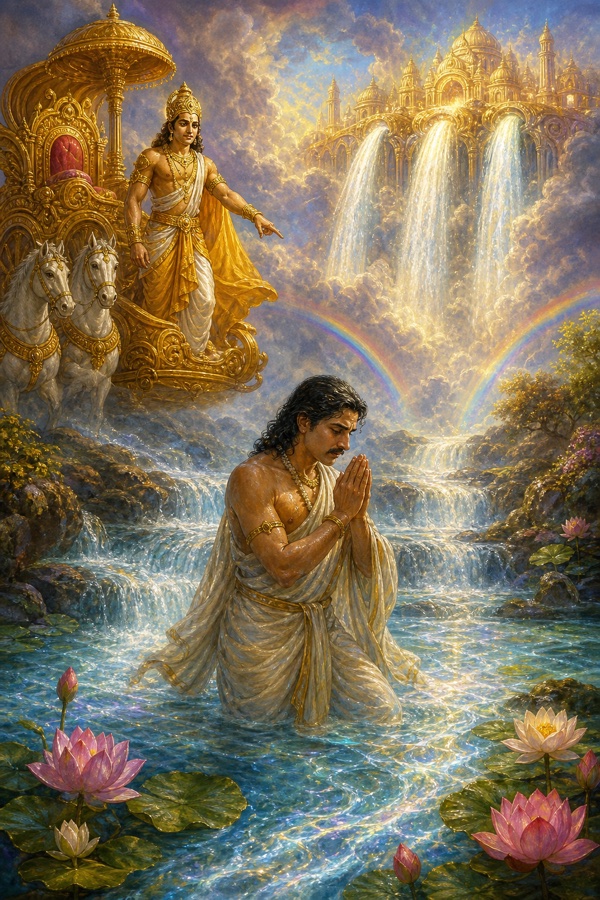
“Enjoy now what every righteous deed of yours has earned, the regions you won for yourself by your penances and by all your gifts. Let gods and Gandharvas and the Apsaras of heaven, in pure robes and fine ornaments, wait on you and serve your happiness. Enjoy the regions that became yours through the Rajasuya, the royal sacrifice you performed, regions made richer still by the sacrificial sword you used in it. Enjoy the high fruits of your penances. Your regions, Yudhishthira, lie above those of kings. They are equal to Harishchandra’s. Come and take your pleasure there. Where the royal sage Mandhata is, where King Bhagiratha is, where Bharata the son of Dushyanta is, there you will live in bliss. Here is the river of heaven, the sacred river that purifies the three worlds. Its name is the heavenly Ganga. Plunge into it and you will go to the regions that are yours. When you have bathed in this water, your human nature will leave you. Your grief will be gone, your sickness conquered, and you will be free of every enmity.”
A key to reading this (the moral heart): Indra gives two reasons, and he keeps them apart. The first is a rule: every king must look upon hell, and the one who endures it first has heaven afterward. The second belongs to Yudhishthira alone. During the war Bhima killed an elephant named Ashvatthama, and Yudhishthira then told Drona, his teacher, that Ashvatthama was dead, adding the word elephant too low to be heard. Drona took it for the death of his son. Indra calls that a pretense, and he says the hell Yudhishthira walked through was shown to him by an act of deception in return. Bhima, Arjuna and Draupadi were shown the same place by the same means, and Indra declares all of them cleansed.
The gist: The gods arrive with Indra and Dharma, and the darkness, the Vaitarani, the shalmali trees, the iron jars and the corpses vanish. Indra tells Yudhishthira that every king must see hell, and that whoever endures hell first enjoys heaven afterward. Hell was shown to him by deception because he once deceived Drona about his son, and Bhima, Arjuna and Draupadi were shown it the same way. All are cleansed. Indra promises him regions equal to Harishchandra’s and tells him to bathe in the heavenly Ganga.
Dharma’s third test, and the divine form from the Ganga
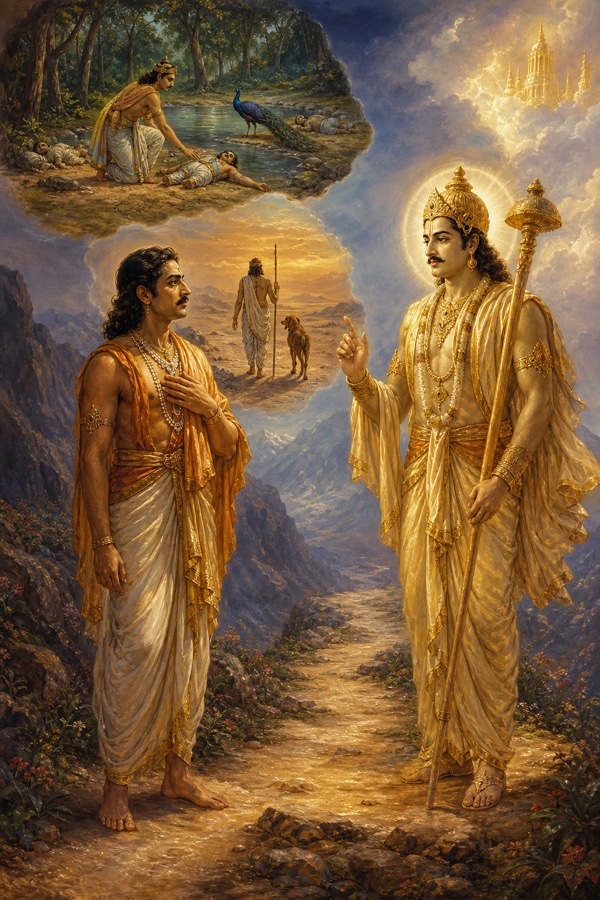
While the king of the gods was still speaking, Dharma, standing there in his visible body, turned to the man who was his own son. “I am greatly pleased with you, my wise son. Your devotion to me has pleased me, and your truthful speech, your forgiveness and your self-restraint. This was the third test I have put you to, and nothing can turn you from your nature or from your reason. I examined you once before, in the Dvaita woods, with my questions, on the day you came to that lake to recover a pair of fire sticks, and you stood the test well. I examined you a second time in the shape of a dog, son, when your brothers and Draupadi had fallen. This has been the third: you asked to stay in hell for your brothers’ sake. You are cleansed, and greatly blessed. Your sin is washed away. Be happy.
“Your brothers never deserved hell. All of this was an illusion, and the king of the gods made it. Every king, son, must look upon hell once; there is no doubt of that, and so for a little while you were put through this great suffering. Arjuna could never deserve hell for long. Bhima could not, the twins could not, and Karna could not, who always spoke the truth and whose courage was great. And the princess Draupadi, Yudhishthira, could never deserve that place of sinners. Come, come and see the Ganga, whose current runs through the three worlds.”
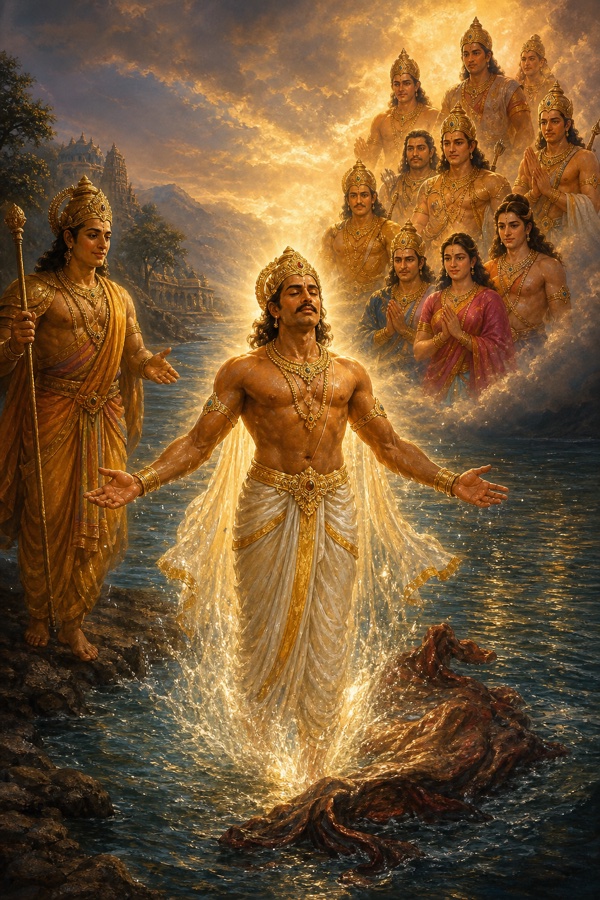
So the royal sage who was Janamejaya’s forefather went with Dharma and all the other gods. He bathed in the Ganga of heaven, the sacred, purifying river the rishis have always revered, and in that water he put off his human body. He came out of it in a celestial form, and the bath had taken every enmity and every grief from him. Then the Kuru king went on from that place with the gods around him and Dharma at his side, while the great rishis spoke his praises, and he came to where the heroes were, the sons of Pandu and the sons of Dhritarashtra, each in the station that was his, with their human anger gone from them.
A sub-tale: Dharma counts three tests, and the first two were met earlier in the epic. In the Dvaita woods a deer ran off with a Brahmin’s fire sticks, the Pandavas followed it to a lake, and a Yaksha there put his questions to Yudhishthira. When they were answered, the Yaksha said that he was Dharma, Yudhishthira’s father, and that the deer had been himself. The second test came when Draupadi and the four brothers had fallen and a dog still followed the king, and the dog was Dharma. The third is the one just passed, in which Yudhishthira asked to stay in hell because his company eased his brothers.
The gist: Dharma tells his son that this was the third test, after the questions at the lake in the Dvaita woods and the trial in the shape of a dog, and that he passed it by asking to stay in hell for his brothers. His brothers were never such as to deserve that place, and what he saw was an illusion made by Indra. Yudhishthira bathes in the heavenly Ganga, leaves his human body for a celestial one, and goes on, free of enmity and grief, to where the Pandavas and the sons of Dhritarashtra are.
Reunion with his kinsmen in the divine world
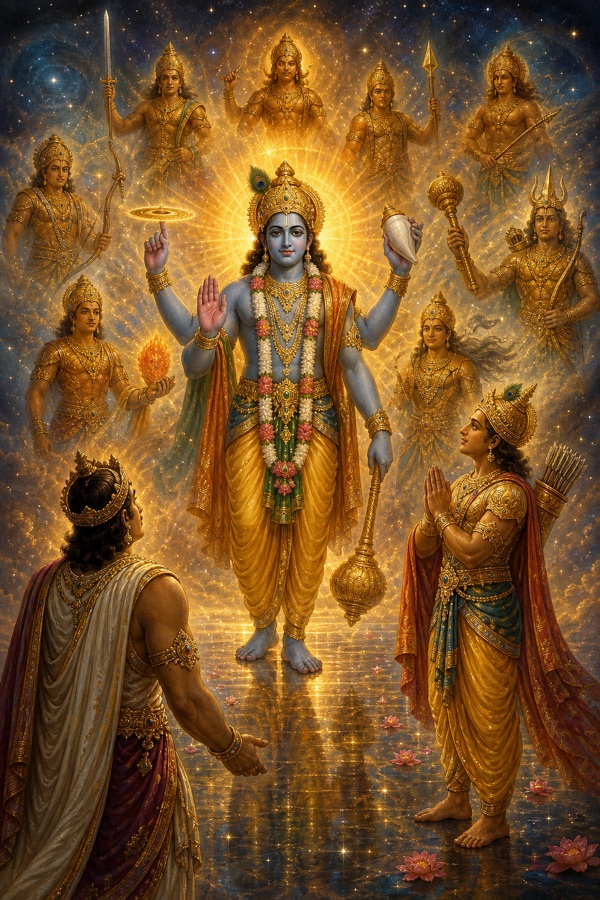
With the gods, the Maruts and the rishis praising him, King Yudhishthira came to the place where the great men of the Kuru line were. He saw Govinda there, Krishna, in his Brahma-form. It was like the form in which he had been seen before, and by that likeness Yudhishthira knew him. He blazed in it. His celestial weapons adorned him, the terrible discus and the others, each one present in a body of its own. The hero Phalguna, Arjuna, was giving him worship, and he too shone with a blazing light. Yudhishthira saw the slayer of Madhu in his own form as well. All the gods were honoring those two, the highest of beings, and when they saw Yudhishthira they received him with the honors that were due to him.
In another place he saw Karna, the greatest of all who ever carried weapons, as bright as twelve suns. In another he saw Bhimasena, that man of enormous strength, sitting among the Maruts in a blazing form, at the side of the Wind god, who was present in his own body. Bhima had a celestial form now, and great beauty, and he had reached the highest success. In the place that belongs to the Ashvins, the king who had been the joy of the Kurus saw Nakula and Sahadeva, each of them burning with a light of his own.
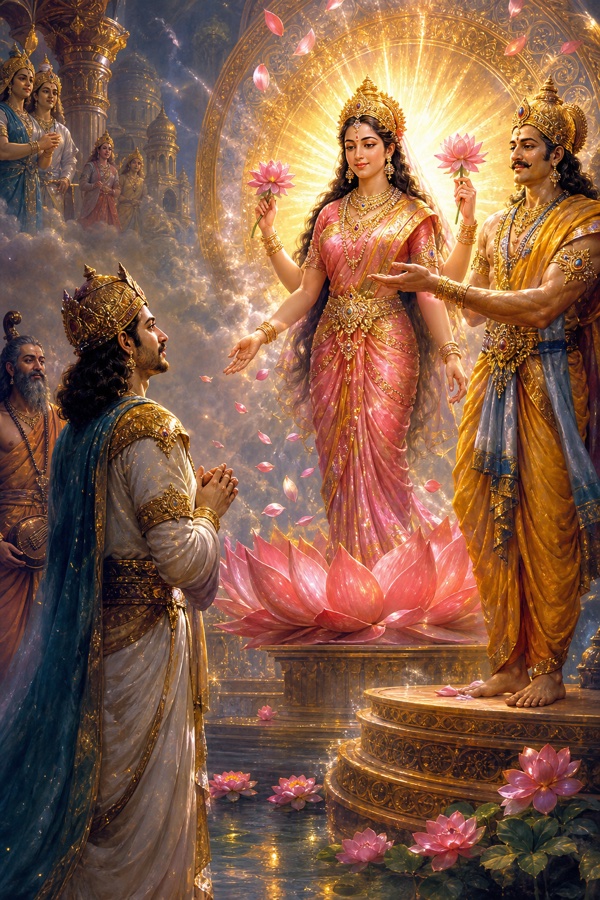
He saw the princess of Panchala too, wearing garlands of lotuses. She had reached heaven and sat there in a form as bright as the sun. All at once King Yudhishthira wanted to ask her something.
Indra, the king of the gods, spoke to him then. “This is Shri herself. She took birth among human beings for your sake, Yudhishthira, as the daughter of Drupada, and she came from no mother’s womb. She was fragrant, and she could delight the whole world. The wielder of the trident made her for your happiness. She was born into Drupada’s line, and all of you had her as your wife. And these five blessed Gandharvas, bright as fire and full of vigor, were your sons and Draupadi’s.
“Look at Dhritarashtra, the king of the Gandharvas, who has great wisdom. Know that he was your father’s eldest brother. And this one, bright as fire, is your own eldest brother, the son of Kunti. He is the son of Surya, and the world knew him as the son of Radha. He moves in the company of Surya. Look at him. Among the hosts of the Sadhyas, the gods, the Vishvedevas and the Maruts, look at the great chariot warriors of the Vrishnis and the Andhakas, those heroes with Satyaki first among them, and the strong men of the Bhojas. Look at Subhadra’s son, whom no one could defeat in battle. He stays with Soma now. He is Abhimanyu, the great bowman, and the gentle light of the moon, the great lamp of the night, is his. Here is Pandu, the great bowman, united again with Kunti and Madri. Your father often comes to me in his fine chariot. Look at royal Bhishma, Shantanu’s son, who is among the Vasus now. Know that the one beside Brihaspati is Drona, your teacher. These kings, and others who fought on your side, now walk with the Gandharvas or the Yakshas or other sacred beings. Some have become Guhyakas. They gave up their bodies, and by the merit they had earned in word, in thought and in deed they have won heaven.”
A key to reading this (lineage and secret): Indra tells Yudhishthira who the people of his life were. Draupadi is Shri herself, who came from no mother’s womb and was made by the wielder of the trident; she took birth in Drupada’s line for his sake. Her five sons are Gandharvas. And Karna is named three ways in as many sentences: Yudhishthira’s eldest brother and Kunti’s son, the son of Surya, the man the world knew as Radha’s son. The kinship Yudhishthira learned at the water rites is spoken aloud here by the king of the gods.
The gist: Yudhishthira sees Krishna in his Brahma-form with Arjuna worshiping him, Karna as bright as twelve suns, Bhima among the Maruts beside the Wind god, Nakula and Sahadeva in the place of the Ashvins, and Draupadi garlanded with lotuses. Indra names them for him: Draupadi is Shri, her five sons are Gandharvas, Karna is his eldest brother and moves with Surya, Abhimanyu is with Soma, Pandu is with Kunti and Madri, Bhishma is among the Vasus, and Drona sits beside Brihaspati.
Janamejaya’s question, and the final destiny of all
Janamejaya had another question. “Bhishma and Drona, great men both; King Dhritarashtra; Virata and Drupada; Shankha and Uttara; Dhrishtaketu, Jayatsena and King Satyajit; the sons of Duryodhana; Shakuni, the son of Subala; the strong sons of Karna; King Jayadratha; Ghatotkacha; and the others you have not named, the other heroic kings whose forms blazed: tell me how long they remained in heaven. Was their place there eternal? And when their acts came to an end, what end did those men reach? I want to hear this, and so I ask you. The fire of your penances lets you see all things.”
“The king asked it,” said Sauti, who had been reciting all of this to Shaunaka and the Brahmins with him, “and the Brahmin rishi, with the leave of the great Vyasa, began to answer him.”
“Not everyone is able to return to his own nature when his deeds are ended,” Vaishampayana said. “Whether it is so or not is a good question, and you have asked it. Hear, then, a mystery of the gods. It was explained to us by Vyasa, the ancient ascetic, Parashara’s son, a man of great force, celestial sight and great prowess, who keeps high vows always, whose understanding cannot be measured, who knows everything and so knows the end that follows every act.
“Bhishma, in all his power and brightness, attained the station of the Vasus, and eight Vasus are to be seen now. Drona entered Brihaspati, the first of the descendants of Angiras. Kritavarma, Hridika’s son, entered the Maruts. Pradyumna entered Sanatkumara, from whom he had come. Dhritarashtra obtained the regions of the Lord of treasures, which are so hard to win, and the famous Gandhari obtained the same regions with her husband. Pandu went with his two wives to the house of great Indra.
“Virata and Drupada, King Dhrishtaketu, Nishatha, Akrura, Samba, Bhanukampa, Viduratha, Bhurishravas, Shala, King Bhuri, Kamsa, Ugrasena, Vasudeva, and Uttara with his brother Shankha: all of these entered the gods. Soma had a son of great prowess named Varchas, and it was he who became Abhimanyu, the son of Phalguna. He fought as a Kshatriya should, with a bravery no one else had ever been able to show, and then that righteous man entered Soma. Karna, killed on the field of battle, entered Surya. Shakuni was absorbed into Dvapara, and Dhrishtadyumna into the god of fire.
“The sons of Dhritarashtra were all Rakshasas of fierce strength. Death by weapons purified them, and those prosperous beings all succeeded in reaching heaven. Kshattri, who is Vidura, and King Yudhishthira both entered the god of righteousness. The holy Ananta, who had taken birth as Balarama, went to the region below the earth, where at the Grandsire’s command he held up the earth by the power of his yoga. Krishna, the son of Vasudeva, was a portion of the eternal god of gods who is called Narayana, and so he entered Narayana.
“Krishna had married sixteen thousand women. When their time came, Janamejaya, they plunged into the Sarasvati. They cast off their human bodies in that river and rose again to heaven, and, changed into Apsaras, they came into his presence. Ghatotkacha and the other heroic chariot warriors who were killed in the great battle attained the station of gods, some of them, and some that of Yakshas. Those who fought on Duryodhana’s side are said to have been Rakshasas, and in time all of them too have come to excellent regions. Some have gone to the house of Indra, some to the house of wise Kubera, some to the house of Varuna. I have now told you everything about what the Kurus and the Pandavas did.”
A key to reading this (the idea): Vaishampayana calls this a mystery of the gods, learned from Vyasa: the people of the war were gods and other beings in human birth, and at death each went back to the one he came from. Pradyumna returns to Sanatkumara, from whom he had come. Soma’s son Varchas, who had become Abhimanyu, returns to Soma. Krishna, a portion of Narayana, enters Narayana. When Janamejaya goes on to ask how the Bharata should be heard, Vaishampayana says it in a sentence: the gods came to this world for sport, finished their task and went up to heaven again. The same account covers the other side. The sons of Dhritarashtra were Rakshasas, death by weapons purified them, and they reached the heaven where, as Narada told Yudhishthira, enmities end.
The gist: Janamejaya asks how long the heroes stayed in heaven and what end they reached when their acts were over. With Vyasa’s leave Vaishampayana answers. Bhishma joined the Vasus. Drona entered Brihaspati, Abhimanyu Soma, Karna Surya, Shakuni Dvapara, Dhrishtadyumna the god of fire, Vidura and Yudhishthira the god of righteousness. Ananta, born as Balarama, went below the earth to hold it up, and Krishna entered Narayana. The sons of Dhritarashtra, who were Rakshasas, reached heaven as well, purified by death under weapons.
The close of the tale, and the glory of the Mahabharata
“Janamejaya heard this in the intervals of the sacrificial rites,” Sauti said to the Brahmins, “and he was filled with wonder. The priests then completed the rites that were still to be done. Astika, who had saved the snakes from death in the fire, was full of joy. King Janamejaya gave rich gifts to all the Brahmins, and they, honored by the king, went back to their homes. When he had sent those learned men on their way, King Janamejaya returned from Takshashila to Hastinapura, the city named for the elephant.
“I have now told you everything that Vaishampayana, at Vyasa’s command, recited to the king at his snake sacrifice. It is called a history, and it is sacred, purifying and excellent. The ascetic Krishna composed it, Krishna Dvaipayana, the Island-born, a man whose speech is true. He knows all things. He knows every ordinance and every duty. He is a man of piety who can perceive what lies beyond the reach of the senses. He is pure, his soul has been cleansed by penances, he has the six high attributes, and he is devoted to Sankhya Yoga. He composed this with everything before his sight, through a celestial eye made clear and strong by many kinds of learning. He did it because he wished the fame of the Pandavas, and of the other Kshatriyas with their great wealth of spirit, to spread through the world.
“A learned man who recites this history on the sacred days, before people gathered to listen, is cleansed of every sin, wins heaven and attains the state of Brahman. When a man listens with his whole attention to the recitation of all of this Veda that the Island-born Krishna composed, a million sins are washed from him, the killing of a Brahmin and the other grave ones among them. When a man recites even a small part of this history at a shraddha, the rite for his dead, his ancestors receive food and drink that never run out. The sins a man commits during the day, with his senses or in his mind, are all washed away before evening if he recites a part of the Mahabharata. Whatever sins a Brahmin commits at night among women are all washed away before dawn if he recites a part of it.
“The great line of the Bharatas is its subject, and so it is called Bharata. Because its meaning is weighty, and because the Bharatas are its subject, it is called Mahabharata. Anyone who is skilled in interpreting this great work is cleansed of every sin. Such a man lives in righteousness, wealth and pleasure, and he attains moksha as well. What is found here is found elsewhere. What is not found here is found nowhere else. This history is known by the name Jaya. Everyone who wants moksha should hear it. Brahmins should read it, and kings, and women who are carrying children. The one who wants heaven attains heaven, and the one who wants victory attains victory. The woman with child bears a son or a daughter who is greatly blessed.
“The Island-born Krishna, who will not have to return to birth and who is moksha embodied, made an abstract of the Bharata because he wished to help the cause of righteousness. He made another compilation, of sixty lakhs of verses. Thirty lakhs of them were placed in the region of the gods. Fifteen lakhs, it should be known, are current in the region of the ancestors, and fourteen lakhs among the Yakshas. One lakh is current among human beings. Narada recited the Mahabharata to the gods, Asita-Devala to the ancestors, Shuka to the Rakshasas and the Yakshas, and Vaishampayana to human beings. This history is sacred and of high meaning, and it is held equal to the Vedas. The man, Shaunaka, who hears it with a Brahmin seated before him gains fame and has every wish of his fulfilled. The one who listens to the Mahabharata with fervent devotion comes afterward to high success through the merit of understanding even a very small part of it. All the sins of the man who recites this history or listens to it with devotion are washed away. In former times the great rishi Vyasa, when he had composed this work, had his son Shuka read it with him, together with these four verses: ‘Thousands of mothers and fathers, and hundreds of sons and wives, arise in the world and depart from it. Others will arise and depart in the same way. There are thousands of occasions for joy and hundreds of occasions for fear. They touch the ignorant man and never the wise one. With my arms raised I am crying aloud, and no one hears me. From righteousness come wealth and pleasure too. Why, then, should righteousness not be sought? No one should cast righteousness off for the sake of pleasure, or out of fear, or out of greed. No one should cast it off even to save his life. Righteousness is eternal. Pleasure and pain are not eternal. The soul is eternal. The cause of its being clothed in a body is not.’
“The man who wakes at dawn and reads this Savitri of the Bharata gains every reward that belongs to a recitation of the whole history, and in the end he attains the highest Brahman. As the sacred ocean and the Himavat mountain are both held to be mines of precious gems, so is this Bharata. The learned man who recites to others this Veda composed by the Island-born Krishna earns wealth. There is no doubt that the man who recites this history called Bharata with his whole attention attains high success. What need has a man of the waters of Pushkara sprinkled on him, if he listens with attention while this Bharata is recited to him? It is the nectar that fell from the lips of the Island-born. It cannot be measured. It is sacred, it purifies, it cleanses sin, and it is auspicious. The king asked one thing more, how the Bharata should be heard, and what Vaishampayana told him came, at its end, to this: ‘In the Vedas, in the Ramayana and in the sacred Bharata, Hari is sung at the beginning, in the middle and at the end. Sins done with the body, with words and with the mind are all destroyed by listening to the Bharata, as darkness is destroyed at sunrise. I have told you everything. The one who listens with devotion to this Bharata from its beginning is cleansed of every sin, even if he has killed a Brahmin, or violated his teacher’s bed, or drinks liquor, or robs other people of their goods, or was born a Chandala. He destroys all his sins as the maker of day destroys darkness, and beyond doubt he takes his joy in the region of Vishnu, like Vishnu himself.’”
Here the Svargarohana Parva ends, and with it the eighteen parvas of the Mahabharata are complete.
A key to reading this (the number in modern terms): A lakh is one hundred thousand. Sauti’s sixty lakhs come to 6,000,000 verses, and he accounts for every one of them: 3,000,000 with the gods, 1,500,000 with the ancestors, 1,400,000 with the Yakshas and 100,000 among human beings. One verse in sixty is recited on earth, and Vaishampayana is named as the one who recited it.
The gist: Sauti closes the frame: the snake sacrifice is completed, Astika rejoices for the snakes he saved, the Brahmins go home with their gifts, and Janamejaya returns from Takshashila to Hastinapura. Sauti then says what the history is. Vyasa composed it. It is called Bharata, Mahabharata and Jaya, and it is held equal to the Vedas. What is found in it is found elsewhere, and what is absent from it is found nowhere. Hearing it washes away sin. Vyasa taught it to his son Shuka with four verses, and they ask why righteousness, which is eternal, should not be sought.
Source: the Mahabharata of Krishna-Dwaipayana Vyasa, Svargarohana Parva, Sections 1 to 5. The Sanskrit e-text, the Gita Press Hindi edition, and Kisari Mohan Ganguli’s complete English translation were used to verify names, sequence, and principal events. Where the recensions differ, this English retelling follows Ganguli, and the Hindi edition follows Gita Press.
Based on: The Mahabharata, Vyasa (K. M. Ganguli’s English translation; Gita Press, Gorakhpur)