On this page
The thirty-sixth year after the great battle came, and Yudhishthira, king of the Kurus, began to see things in the sky and on the ground that no king wants to see. Winds blew from every side at once, dry and hard, and they carried gravel that came down like rain. Birds wheeled in circles that turned from right to left. The great rivers ran backward in their beds. The horizon stayed wrapped in fog in every direction, day after day, and meteors dropped out of the sky and scattered live coals over the earth. The disc of the sun was always filmed with dust. At its rising it had no brightness, and across its face lay shapes like the trunks of men whose heads had been taken off. Every day rings of fierce light stood around the sun and around the moon, and each ring showed three colors, with an edge that was black and rough and the red of ash. There were many more signs of the same kind, every one of them a warning, and the people who saw them went about their days afraid. Then, a little while later, the news came. The Vrishnis were dead. They were Krishna’s own people, the clans who lived with him in Dwarka beside the sea, and Krishna was the friend who had gone before Arjuna’s chariot through the whole of the war. An iron club had brought a slaughter down on all of them together. Yudhishthira heard that only two had come away with their lives, Krishna and his elder brother Balarama, and he sent for his four brothers so that the five Pandavas could take counsel on what they should do. They met, and the knowledge that the Vrishnis had died under a curse, the punishing rod of Brahmins laid across a whole people, bore down on every one of them. That Krishna could die was a thing they were unable to believe. The death of the man who carried the bow Sharnga was as far past belief, for them, as the drying up of the ocean. When the whole matter of the iron club had been laid before them, grief filled the five brothers, and they sat where they were with blank despair in their faces.
Samba’s deception and the sages’ curse
King Janamejaya, Arjuna’s great-grandson, to whom the sage Vaishampayana was reciting the history of his house, broke in here. “How could that be?” he asked. “The Andhakas and the Vrishnis and the Bhojas, those great chariot fighters, all destroyed, and with Krishna there to see it?”
Vaishampayana answered, “When the thirty-sixth year after the great battle came, a great calamity overtook the Vrishnis. Time drove them, and they all met their end by the iron club.”
“Whose curse was it?” Janamejaya asked. “Who cursed those heroes, the Vrishnis and the Andhakas and the Bhojas, so that they died like this? Tell me the whole of it, with nothing left out.”
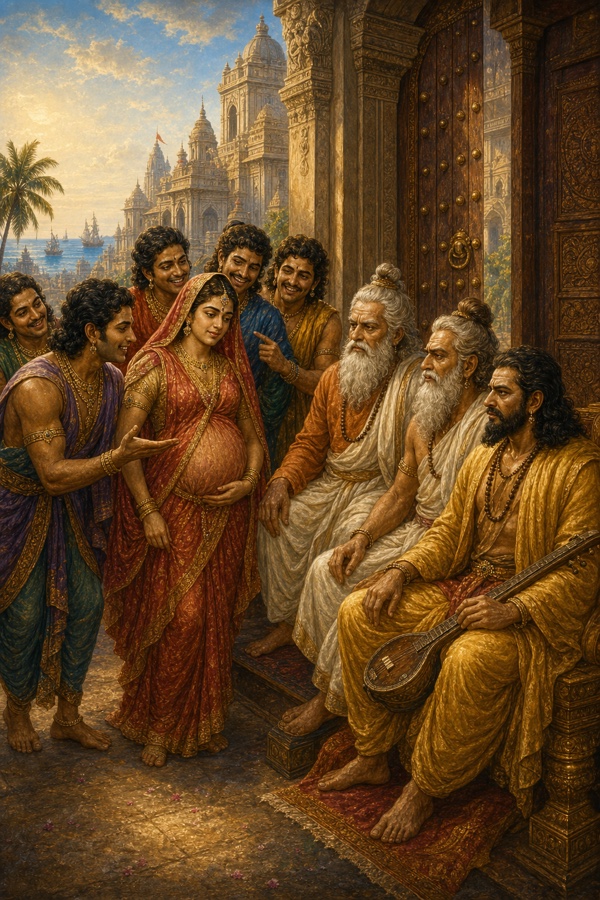
It began, Vaishampayana said, with a trick. One day a band of Vrishni heroes, Sarana among them, saw that three sages had arrived in Dwarka: Vishvamitra, Kanva and Narada. The gods had already marked those men for punishment, and it was under that mark that they did what they did next. They took Samba, who was Krishna’s own son, dressed him as a woman, and led him up to the three ascetics. “This is the wife of Babhru,” they said, “and Babhru is a man of great power who wants a son. You are rishis. Do you know for certain what she is going to bring forth?”
The ascetics saw what was being done to them, and Vaishampayana gave the king their answer as they spoke it. “This is Samba, the heir of Krishna,” they said, “and what he will bring forth is an iron club, a fierce one, for the destruction of the Vrishnis and the Andhakas. You are wicked men and cruel ones, drunk on your own pride, and with that club you will exterminate your own race, every man of it except Balarama and Krishna. Balarama, the blessed one who carries the plow, will put off his body and go into the ocean. And while Krishna lies on the ground, a hunter named Jara will pierce him.”
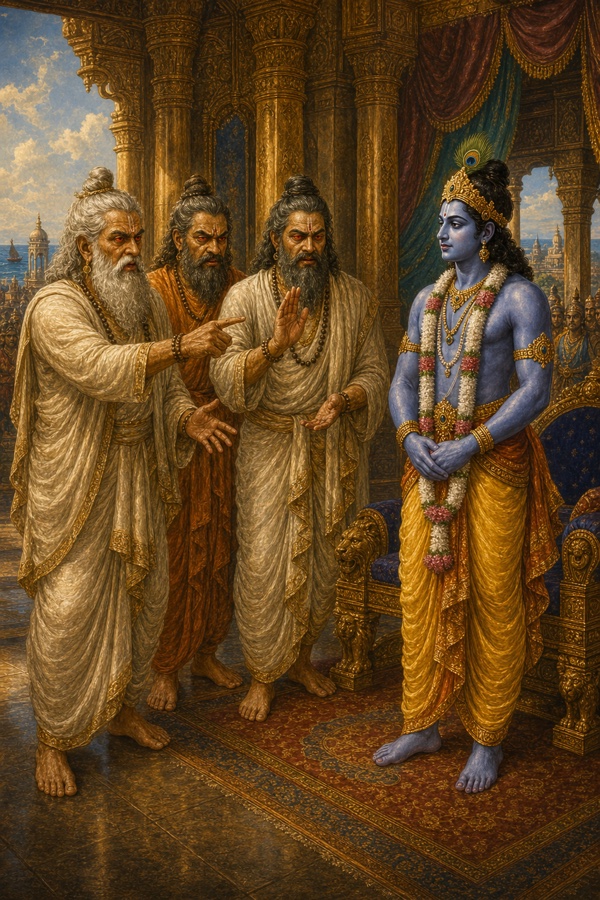
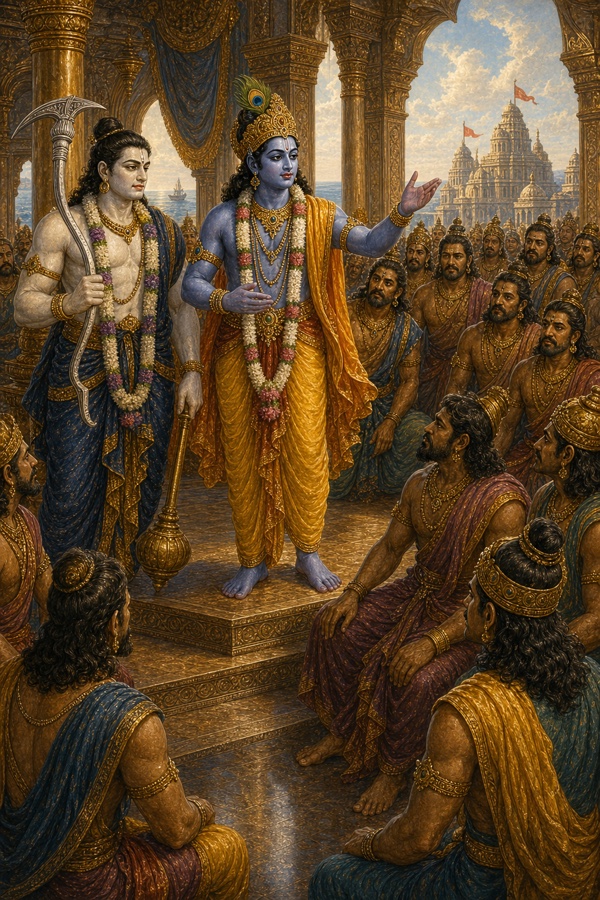
They had looked at one another before they spoke, those three, with eyes gone red, and when they had said it they left the men standing there and went to see Krishna. So Krishna knew the same day. He called all the Vrishnis together and told them what had been said. No one in that assembly understood more than he did, and he already knew in full how his people would end, and all he added was that what was destined would certainly happen. Then he went into his house. He was the Lord of the universe, and he did not choose to order it otherwise. The next day Samba brought forth an iron club. It came out of him through the curse, a fierce thing that looked like a giant messenger of death, and it was the club by which every man of the Vrishni and Andhaka race would be burned to ash. The matter was reported to the king in the proper form. Ugrasena was sick at heart, and he did what a king could do: he had the club ground down to a fine powder, and he set men to carry the powder out and throw it into the sea. A proclamation followed, cried through the whole city in the names of the king, whom men also called Ahuka, of Krishna, of Balarama and of Babhru. From that day no one among the Vrishnis and the Andhakas was to make wine or strong spirit of any kind, and any man found making it in secret would be impaled alive, and all his kinsmen with him. The citizens were afraid of the king. They knew also that the order was Balarama’s, whose conduct no one had ever been able to fault, and they bound themselves by a rule and stopped making wine and spirits.
A key to reading this (the lineage): The Vrishnis, the Andhakas, the Bhojas, the Kukuras and the Shaineyas are the clans of one people, the Yadavas, who are also called the Yadus. The Shaineyas are the house of Shini, to which Satyaki belongs. Dwarka is their city, and their king is Ugrasena, who is also called Ahuka, so that the order against wine goes out in the king’s name first and then in the names of Krishna, Balarama and Babhru. Krishna and Balarama are brothers, Balarama the elder, and their father is Vasudeva.
A key to reading this (the moral tangle): The ruin starts with a deceit. The Vrishni heroes dress Samba as a woman and ask three sages what she will bring forth, and the sages, who see what he is, call them wicked, cruel and drunk on pride before they pronounce the curse. The punishment of the gods was already on those men when they played the trick. Krishna hears the curse the same day and does nothing against it. He tells the assembled Vrishnis that what is destined will happen, and he goes indoors.
The gist: In the thirty-sixth year after the battle Yudhishthira sees the omens, and soon afterward he hears that the Vrishnis are destroyed. The cause lies back in Dwarka. Vrishni heroes present Samba to Vishvamitra, Kanva and Narada as the wife of Babhru, and the sages answer that Samba will bring forth an iron club that destroys the race, that Balarama will enter the ocean, and that a hunter named Jara will pierce Krishna. The club is born the next day. Ugrasena has it ground to powder and thrown into the sea, and the making of wine is forbidden on pain of impalement.
Time walks the city, and the road to Prabhasa
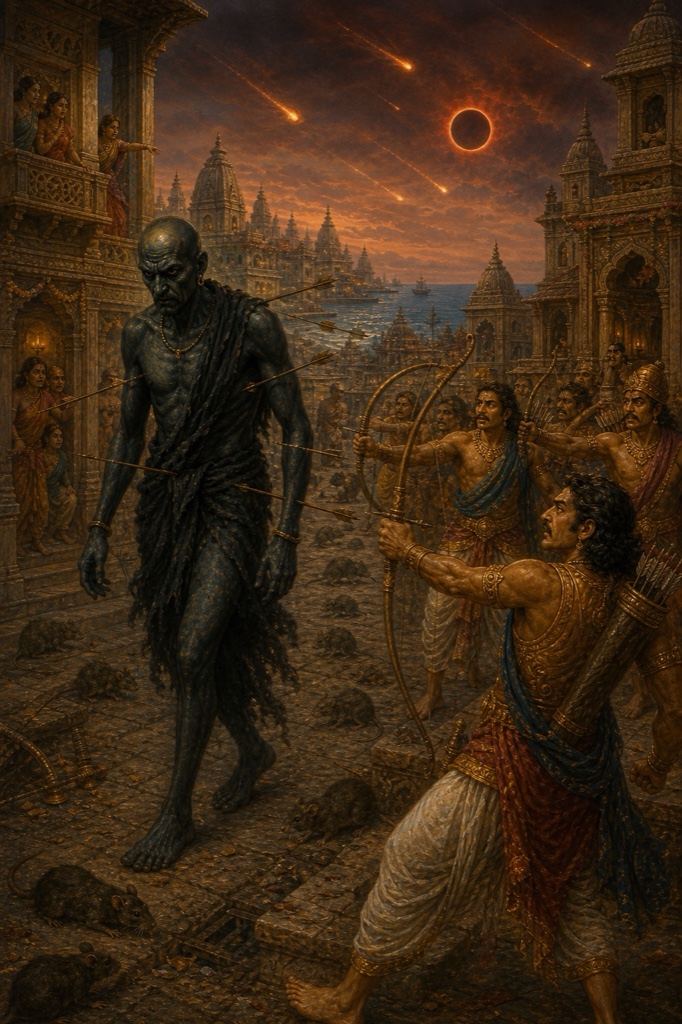
The Vrishnis and the Andhakas, Vaishampayana said, went on doing what they could to turn the calamity aside, and while they did, Time went about among their houses every day. He had taken a body, and the body was death. He looked like a man, a terrible one: bald, black and tawny of skin, fierce in the face. Now and then a Vrishni would look up and find him peering into the house. Their strongest archers shot at him, hundreds of arrows and then thousands, and no arrow went into him, because the figure they were shooting at was the Destroyer of all creatures. Day after day the wind blew hard, and the signs multiplied, each of them telling the same end for the Vrishnis and the Andhakas. Rats and mice swarmed in the streets. Clay pots cracked where they stood, or broke, with nothing near them. At night the rats and mice ate the hair and the nails of sleeping men. Sarika birds settled inside the houses and chirped, and the noise they made did not stop for one moment of the day or the night. Cranes were heard hooting like owls, and goats cried with the voices of jackals. Birds came that Death himself had sent, pale in the body and red in the legs. Pigeons were always about inside the houses. Cows gave birth to donkeys and mules to elephants, dogs littered cats, and the mongoose brought forth mice. The people changed with the signs. Vrishnis did sinful things and were seen to feel no shame. They slighted Brahmins, they slighted their own ancestors, they slighted the gods, and they insulted and humiliated their teachers and their elders. Only Balarama and Krishna behaved otherwise. Wives deceived their husbands, and husbands their wives. A fire, when it was lit, threw its flames to the left, and sometimes the flames burned blue and red. Over the city the sun rose and set with headless human trunks standing around it. In the kitchens, food that had been cleaned and properly boiled was carried out to be eaten and was found crawling with worms of every kind. When Brahmins accepted their gifts and pronounced a day or an hour fit for some undertaking, or when good men sat at their silent recitations, there came the heavy tread of a great many men running, and no one could be seen whose feet were making it. The planets were seen again and again to strike the constellations, and yet no Yadava could find the star he had been born under. And when the Panchajanya, the conch that was Krishna’s own, was blown in their houses, donkeys answered it from every direction in harsh and dreadful voices. Krishna read all of it as Time running crooked. Then he saw that the day of the new moon had fallen on the thirteenth of the fortnight, and the fourteenth with it, and he called the Yadavas together. Rahu, who swallows the sun and the moon, had once more made the fourteenth day into the fifteenth, he told them. “A day like this came at the time of the great battle of the Bharatas,” he said. “It has come again, and it seems to have come for our destruction.” He weighed the omens Time was showing him and understood what year it was. The thirty-sixth had come, and that was the year Gandhari had named. On the field, when the battle was over, with all her sons dead and every kinsman gone, she had burned with grief, and she had laid the fault for the whole slaughter on Krishna and cursed him: in the thirty-sixth year he would bring about the killing of his own kinsmen and friends and sons and then meet a mean death in the wilderness, and the women of his house would weep as the women of the Bharatas were weeping that day. Now it was about to happen. “This is that time over again,” Krishna said, “the time when the two armies stood drawn up for battle and Yudhishthira marked omens as dreadful as these.” Having said it, he set about bringing on the events that would make Gandhari’s words true. He ordered the Vrishnis to go on pilgrimage to some sacred water, and his messengers went out at once and cried it in his name: the Vrishnis were to travel to the coast and bathe in the holy waters of the ocean.
A key to reading this (the idea): Time has taken a body. He is the bald, dark man the Vrishnis see looking into their houses, and he carries two names: Time, and the Destroyer of all creatures. The word comes back at every turn. Time drives the clans to their end, Time’s net is what Arjuna will see thrown over Dwarka, and at the close Vyasa calls Time the seed of the universe and the power that withdraws everything again. Gandhari is the mother who lost all her sons in the great battle, and what she said in her grief is what Krishna now sets out to make true.
The gist: Time walks the city in the shape of a bald, dark man, and the Vrishni archers cannot pierce him. The omens multiply: rats in the streets, pots breaking untouched, births across kinds, fires that burn to the left, worms in clean food, the tread of runners no one can see, donkeys answering the Panchajanya. The Vrishnis lose their shame, all but Balarama and Krishna. Krishna sees the new moon fall on the thirteenth day, understands that the thirty-sixth year has come and that Gandhari’s words are about to be fulfilled, and orders the clans to the seacoast to bathe in the sacred waters.
The dreams of Dwarka, and Uddhava’s departure
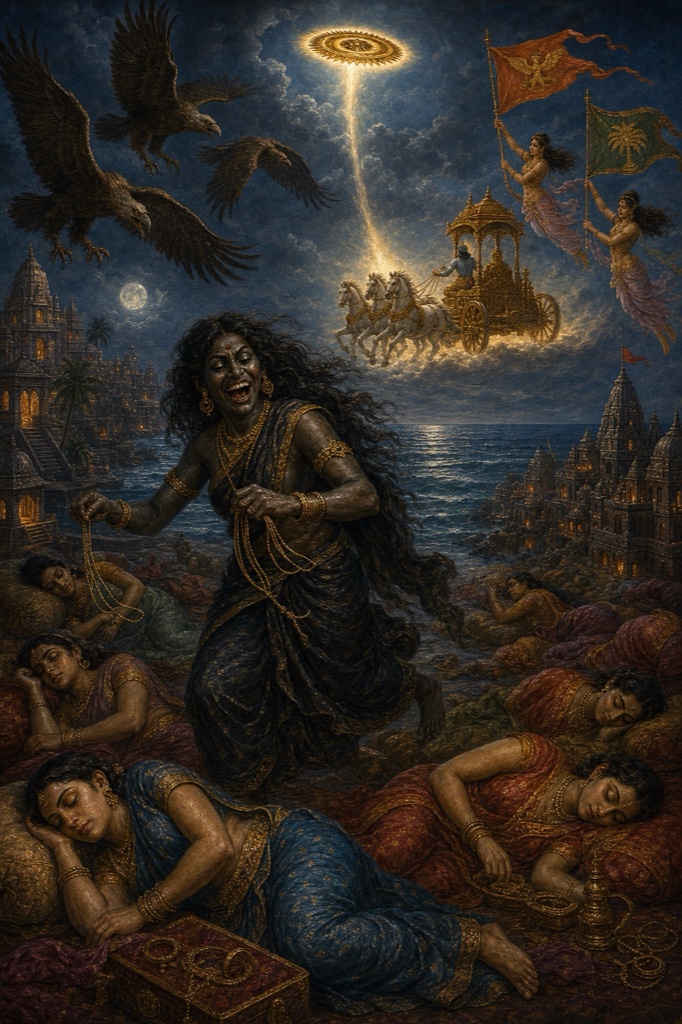
In those same days, Vaishampayana said, the women of the Vrishnis dreamed one dream night after night. A woman came into their houses, black of skin and white of tooth, and laughed out loud, and ran on through Dwarka snatching from their wrists the threads they wore there for good fortune. The men dreamed of vultures, terrible ones, that came into their houses and into the rooms where the sacred fires were kept and gorged on the dreamers’ own bodies. Their ornaments and their umbrellas, their standards and their armor were seen being carried off by fearful rakshasas. What followed was seen by men who were awake. In the plain sight of the Vrishnis the discus of Krishna rose into the sky and was gone: the discus the fire god Agni had given him, made of iron, with a hub of the hardest adamant. Daruka, Krishna’s charioteer, stood and watched his master’s chariot go. It was a splendid chariot, bright as the sun and fully fitted out, and the four horses yoked to it took it away of their own will. They were Shaibya, Sugriva, Meghapushpa and Balahaka, horses as fast as thought, and they ran out over the surface of the ocean dragging the chariot behind them. The two great standards went too, the one from Krishna’s chariot that bore Garuda, the lord of birds, and the one from Balarama’s that bore the palmyra palm, standards the two brothers had always worshiped with reverence. Apsaras, the women of heaven, took them, and day and night the apsaras called out to the Vrishnis and the Andhakas to set out on pilgrimage to some sacred water.
These things were seen and these things were heard, and the great chariot fighters of the Vrishnis and the Andhakas found that they wanted to go. They would make the pilgrimage, and they would take their whole families. They made ready food of every kind for the journey, and meat, and wine of many kinds, in a city where the making of wine had been forbidden on pain of death. Then the fighting men of the two clans rode out of Dwarka on chariots and horses and elephants, handsome and fierce and in their full strength. The Yadavas came with their wives to Prabhasa on the seacoast and settled there, each man in the lodging assigned to him, with food and drink in plenty all around them.
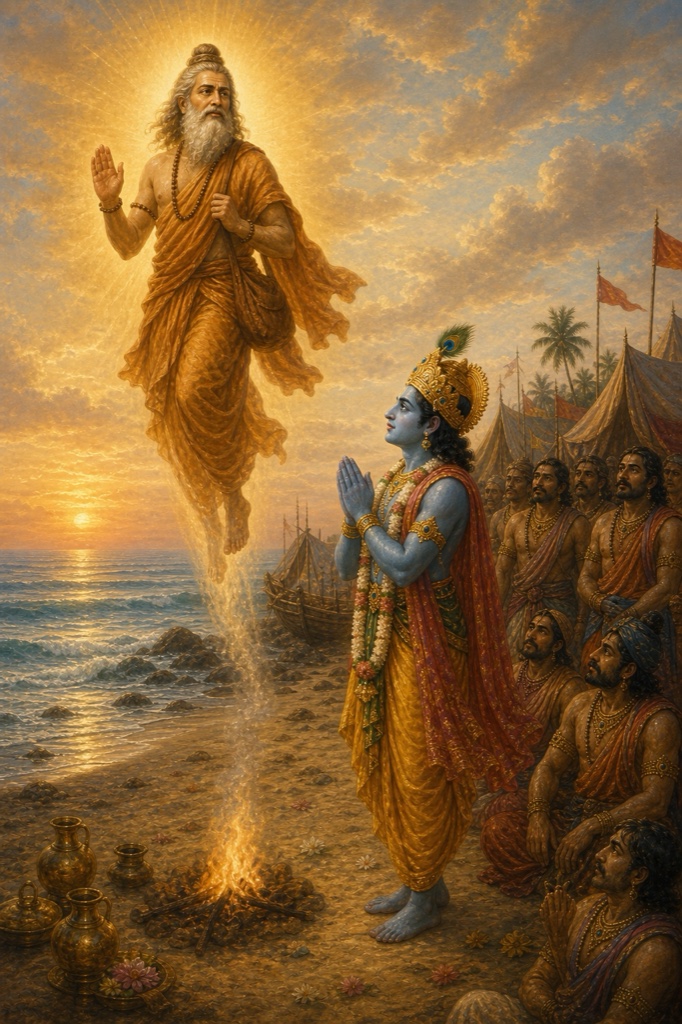
Uddhava heard that they had camped by the sea, and he went there to say goodbye. He was the wisest of men and a master of yoga besides, and he had made up his mind to leave the world. Krishna greeted him with joined hands. He saw what Uddhava intended, he knew that the destruction of the Vrishnis was close, and he felt no wish to hold him back. So the great chariot fighters of the Vrishnis and the Andhakas, men whose own hour had come, stood and watched Uddhava set out on his great journey, and as he went the whole sky filled with his light.
A sub-tale: Uddhava, the wisest of men and a master of yoga, comes to the shore at Prabhasa only to take his leave. He arrives when the clans have settled into their lodgings and before the drinking starts. Krishna salutes him with joined hands, sees that he means to depart from the world, and lets him go, knowing how near the destruction is. The warriors whose hour has come stand and watch him set out on his great journey with the whole sky full of his light, and then they turn back to their feast.
The gist: The Vrishni women dream of a black woman with white teeth who snatches the threads from their wrists, and the men dream of vultures feeding on them. Krishna’s discus rises into the sky, his four horses run off across the sea with his chariot, and apsaras carry away the Garuda standard and the palm standard and call the clans to pilgrimage. The Yadavas go to Prabhasa with their families, their meat and their wine. Uddhava takes his leave of Krishna there and sets out on his great journey.
The drinking at Prabhasa, and the spark of a word
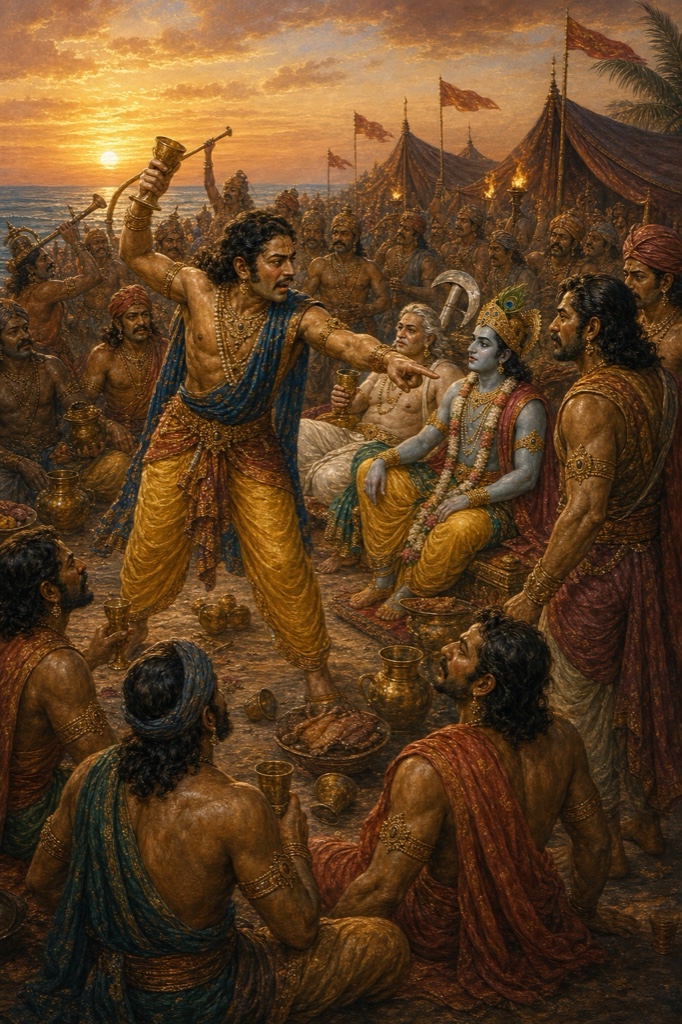
The feast at Prabhasa, Vaishampayana said, began with an insult to the Brahmins. Food had been cooked for them, men of high character, and the Vrishnis mixed that food with wine and gave it away to monkeys and apes. Then the revels started in earnest, and the chief part of them was drinking. Hundreds of trumpets blared across the whole ground, and actors and dancers worked their trades among the crowd. Balarama began to drink, in front of Krishna, and with him drank Kritavarma, Satyaki and Gada, and Babhru did the same. Satyaki was of the house of Shini. Kritavarma was the son of Hridika and a king among the Bhojas, and in the war he had gone with Ashvatthama, Drona’s son, among sleeping men, who were killed where they lay. Now Satyaki was drunk, and in the middle of that gathering he laughed in Kritavarma’s face. “What Kshatriya,” he said, “takes up his weapons and kills men who are locked in sleep, men as good as dead already? The Yadavas will never put up with what you did, Kritavarma.” Pradyumna, Krishna’s son and a great chariot fighter himself, applauded the words and let the son of Hridika see his contempt.
Kritavarma was furious. He pointed at Satyaki with his left hand, to show how little he thought of him, and he had a dead man of his own ready. “You call yourself a hero,” he said. “Then how could you so cruelly kill Bhurishravas, an armless man, who had put away every thought of fighting and sat down on the field of battle in praya, fasting to his death?”
Krishna heard that, and anger took him, and he turned an angry look on Kritavarma. Satyaki pressed on. He told Krishna how Kritavarma had dealt with Satrajit when the Syamantaka, the famous gem, was to be taken from him. Satrajit’s daughter was there. She was Satyabhama, Krishna’s wife, and as she listened to the account she gave way to rage and to tears together. She went to Krishna, sat down in his lap, and made his anger against Kritavarma burn hotter. Then Satyaki got to his feet in a fury and spoke to her. “I swear to you by Truth,” he said, “that I will soon send this man down the road that the five sons of Draupadi took, and Dhrishtadyumna, and Shikhandi. They were asleep, and this sinful wretch killed them, with Drona’s son to help him. Kritavarma’s life and his fame have both run out.”
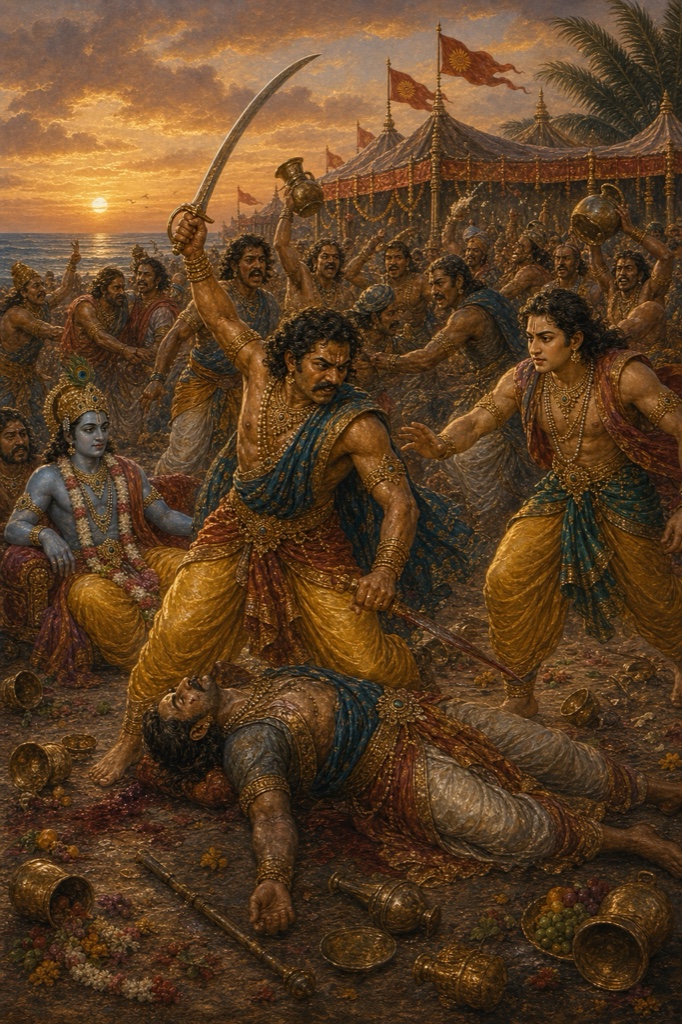
With those words he ran at Kritavarma and took his head off with a sword, with Krishna looking on. Then he began striking down other men who were standing there. Krishna ran forward to stop him before he did worse. At that moment the Bhojas, whose king Kritavarma had been, and the Andhakas with them, were moved by the crookedness of the hour that had come upon them, and they rose like one man and closed around Satyaki. Krishna knew what kind of hour it was. He stood where he was and watched those warriors rush at Satyaki in a rage from every side, and he let no anger rise in him. Fate was driving them and the wine was in them, and they beat Satyaki with what they had in their hands, the very pots they had been eating from. Pradyumna, Rukmini’s son, saw it and was enraged, and he threw himself into the press to bring Satyaki out. The two of them had strong arms and great spirit, and they fought with all the courage they had. The numbers against them were overwhelming. Both were killed, and Krishna saw his son die.
A key to reading this (the moral tangle): The quarrel is made of two killings from the great battle, and each man holds one against the other. Satyaki throws at Kritavarma the killing of sleeping men: the five sons of Draupadi, Dhrishtadyumna and Shikhandi, cut down with the help of Drona’s son. Kritavarma throws back the armless Bhurishravas, whom Satyaki killed as he sat fasting to death with all hostility laid aside. A third matter is added, the gem Syamantaka and Kritavarma’s conduct toward Satrajit, and it brings Satrajit’s daughter Satyabhama weeping into Krishna’s lap. Krishna himself turns an angry look on Kritavarma before the first blow is struck. The men who then mob Satyaki are urged on by fate, and they are drunk.
The gist: At Prabhasa the Vrishnis give the Brahmins’ food, mixed with wine, to monkeys and apes, and begin to drink. Satyaki, drunk, taunts Kritavarma with the killing of sleeping men. Kritavarma answers with the killing of Bhurishravas, and Satyaki swears to Satyabhama that Kritavarma’s life is over and cuts off his head in front of Krishna. The Bhojas and the Andhakas surround Satyaki and beat him with their eating pots. Pradyumna goes in to rescue him, and both are killed while Krishna, who knows the character of the hour, stands unmoved.
The eraka grass turns to iron, and the Yadavas cut one another down
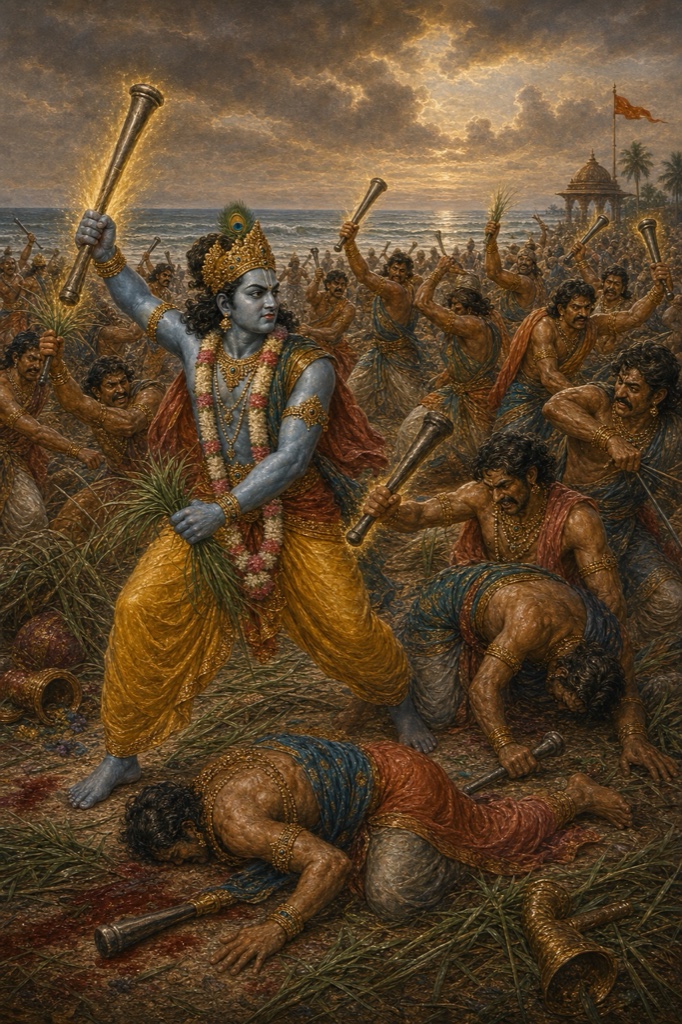
Krishna looked at his son lying dead, and at Satyaki dead with him, Vaishampayana said, and in his anger he reached down and pulled up a handful of the eraka grass that grew on that ground. In his hand the grass became a club of iron, a terrible one, with the force of the thunderbolt in it. With that club he killed every man who came in front of him. Then all of them were at it. Andhakas and Bhojas, Shaineyas and Vrishnis struck at one another in a fearful press, with Time urging them on. Any man who in his rage tore up a few blades of the eraka found them turned to a thunderbolt in his fist. Every blade of grass on that field was seen to become a dreadful iron club. All of it, Vaishampayana told the king, came from the curse the Brahmins had pronounced. A man had only to throw a blade of grass and it went through things that nothing could pierce, for every blade struck with the force of thunder. Son killed father, and father killed son. Drunk with wine, they rushed at one another and went down together. The Kukuras and the Andhakas died the way insects die that fly into a blazing fire, and through all that slaughter no man among them thought of saving himself by running.
Krishna knew that the hour of destruction had come. He stood in the middle of it with an iron club raised, a club that had been a blade of grass, and he watched everything. He saw that Samba had been killed. He saw Charudeshna dead, and Pradyumna, and Aniruddha, and rage filled him. Then he saw Gada lying dead on the ground, and the rage grew. The bearer of the bow Sharnga, of the discus and the mace, made an end of the Vrishnis and the Andhakas. Then two men spoke to him, and Vaishampayana repeated their words to the king. They were Babhru, a strong fighter who had taken enemy towns in his time, and Daruka the charioteer. “A very great number of men have been killed by you,” they said. “Turn now toward the place where Balarama has gone. We want to go where he went.”
A key to reading this (the idea): Eraka is the grass that grows on the ground at Prabhasa. The sages had said that an iron club would destroy the Vrishnis and the Andhakas, and the king had the club ground to powder and thrown into the sea. Here the iron returns in every hand at once. Krishna pulls up a handful of the grass and it becomes a club with the force of the thunderbolt, and after that any blade a man tears up in anger does the same. All of it is the curse of the Brahmins at work. The wine is the other measure that failed. Making it was forbidden in Dwarka on pain of impalement, and the clans carried wine of many kinds with them to the shore.
A key to reading this (the moral tangle): Krishna is the first to turn the grass into a weapon. He takes up the eraka in anger when he sees Pradyumna and Satyaki dead, and he kills all who come before him. Then he stands and watches, knowing the hour, until he has seen Samba, Charudeshna, Pradyumna and Aniruddha dead and Gada lying on the ground, and with his rage at its height he exterminates the Vrishnis and the Andhakas himself. He is the Lord of the universe, who did not choose to order the curse otherwise. Babhru and Daruka say the plain fact to his face: a very great number of men have been killed by him.
The gist: Krishna, seeing his son and Satyaki dead, pulls up a handful of eraka grass, and it becomes an iron club with the force of the thunderbolt. The same happens to every blade in every hand. Andhakas, Bhojas, Shaineyas, Vrishnis and Kukuras kill one another, son against father, and no one runs. When Krishna sees Samba, Charudeshna, Pradyumna, Aniruddha and Gada dead, he destroys the Vrishnis and the Andhakas who remain. Babhru and Daruka ask him to go now to where Balarama has gone.
The search for Balarama, the end of Babhru, and the care of the women
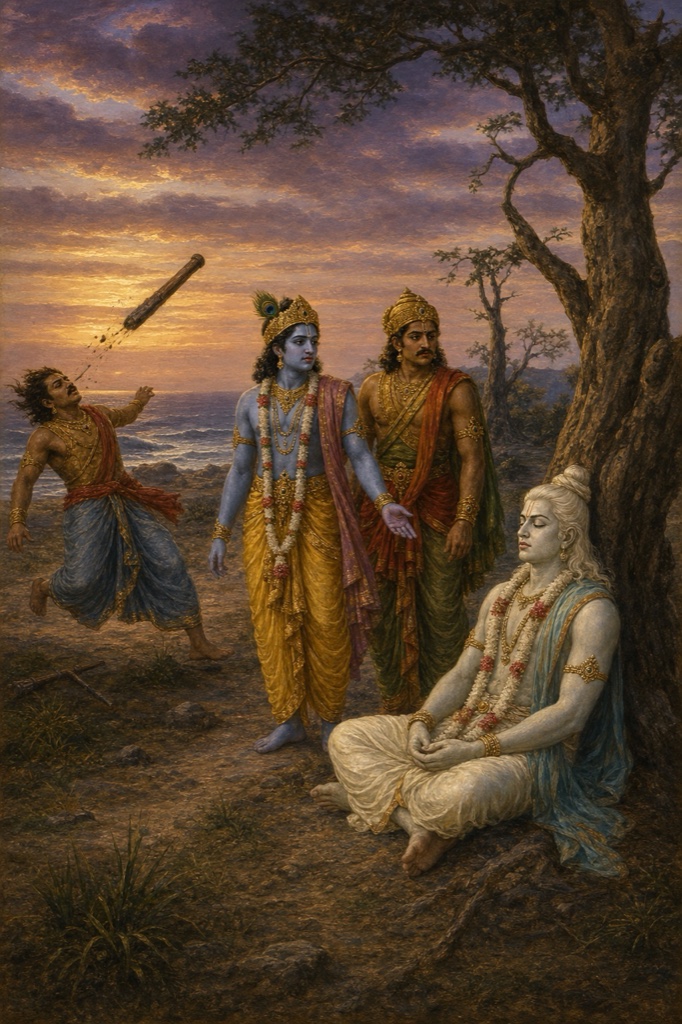
So the three of them left that ground, Vaishampayana said, Daruka and Krishna and Babhru, and followed the way Balarama had taken until they found where he had withdrawn. He had been drinking with the rest when the feast began. Now he was sitting alone in an empty place with his back against a tree, deep in thought, a man of boundless strength gone quiet. When Krishna had found his brother he turned to Daruka and gave him an order. “Go to the Kurus. Tell Arjuna of this great slaughter of the Yadus. Let him hear that the Yadavas have been destroyed through the Brahmins’ curse, and let him come here quickly.”
Daruka was half out of his senses with grief. He got up onto a chariot and drove for the capital of the Kurus. That left Babhru, standing by to be told what to do. “Go quickly and protect the women,” Krishna said to him. “They have wealth with them. Do not let robbers be tempted by it and do them harm.” Babhru was still helpless with wine, and the killing of his kinsmen had taken the heart out of him, and he went as he was told. He had rested a little at Krishna’s side first. He had gone only some distance when the iron club found him. It had fastened itself to a mallet in the hands of a hunter, and it sprang of its own accord at the one Yadava who had come through the slaughter alive, and killed him, for the curse of the Brahmins had taken him in with the rest. Krishna saw Babhru fall. He spoke to his elder brother. “Wait for me here, Balarama,” he said, “until I have put the women in the care of kinsmen.”
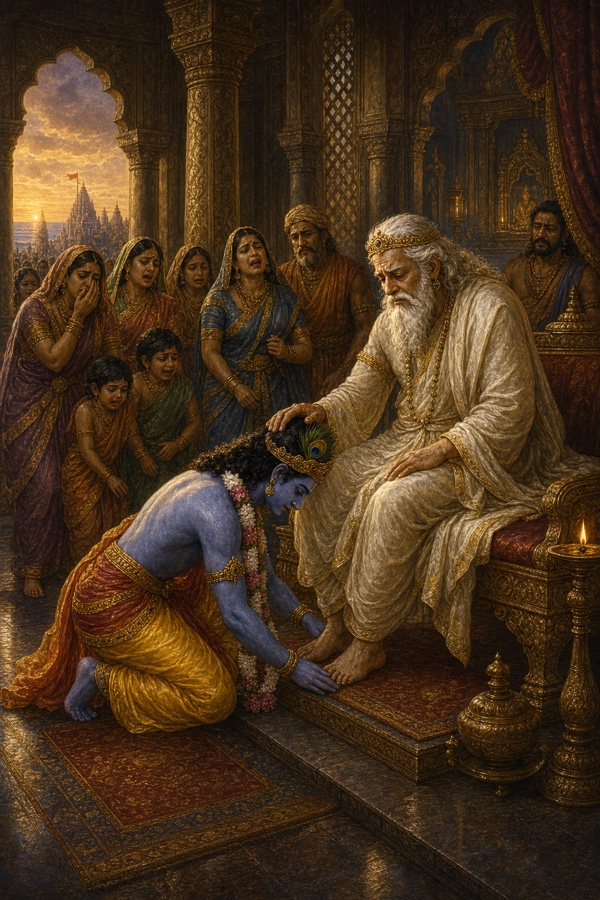
He went into the city, into Dwarka, which is also called Dwaravati, and found his father. “Protect all the women of our house until Arjuna comes,” he told Vasudeva. “Balarama is waiting for me at the edge of the forest, and I will join him today. I have watched this great slaughter of the Yadus as I once watched the slaughter of the Kshatriyas who were the first men of Kuru’s race. I cannot look at this city of the Yadavas with no Yadus in it. Know that I am going to the forest, and that I will live there in austerity with Balarama beside me.” When he had said it he bent and touched his father’s feet with his head, and went quickly out of his presence. A loud cry of grief went up behind him from the women and the children of his house. Krishna heard the women weeping and turned around and came back to them. “Arjuna will come here,” he said. “There is no better man, and he will lift this grief from you.”
A key to reading this (place and name): Dwarka, which is also called Dwaravati, is the city of the Yadavas by the sea, and Prabhasa is the place on the same coast where the clans went to bathe in the sacred waters. Vasudeva is the father of Krishna and Balarama, and his other name is Anakadundubhi. Daruka is Krishna’s charioteer, the man who watched the four horses bolt, and he is now sent by chariot to the Kurus. Their capital is Hastinapura, the city named after the elephant.
The gist: Krishna, Daruka and Babhru find Balarama sitting in thought against a tree in a lonely place. Krishna sends Daruka to the Kurus to bring Arjuna, and sends Babhru to protect the women from robbers. Babhru has gone only a little way when the iron club, fastened to a hunter’s mallet, springs at him and kills him. Krishna asks Balarama to wait, goes into Dwarka, and gives the women into his father Vasudeva’s keeping until Arjuna comes. He touches his father’s feet, and he turns back once to tell the weeping women that Arjuna will relieve their grief.
Balarama gives up his body, and Krishna departs by Jara’s arrow
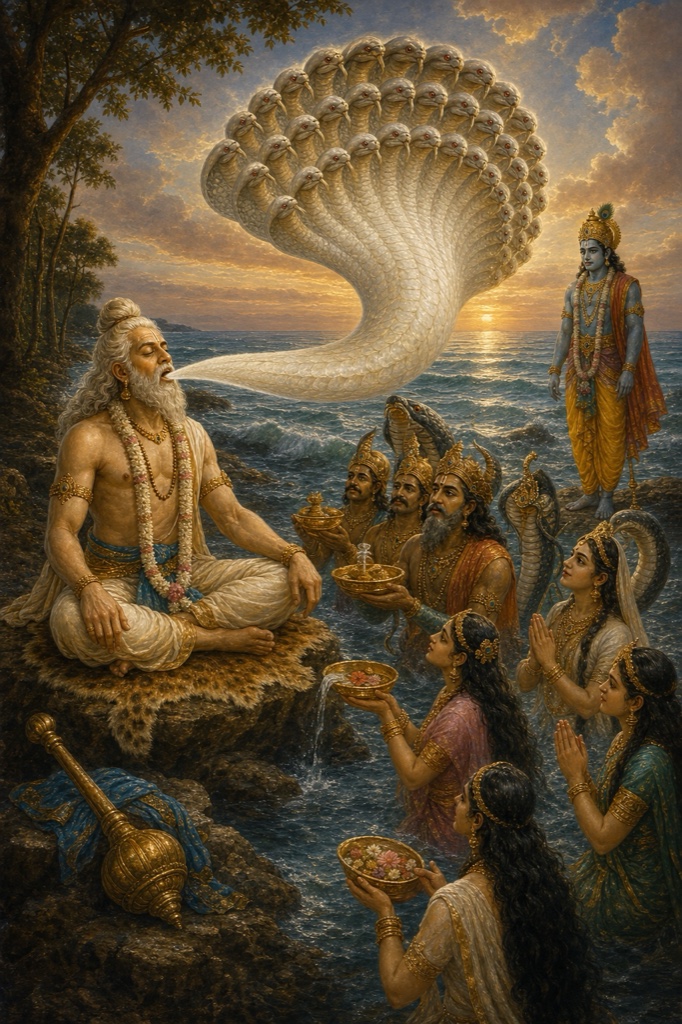
Krishna went back to the forest, Vaishampayana said, and found Balarama sitting in a lonely part of it. He had set himself in yoga. And out of his mouth a great snake was coming, and the snake was white. It was a naga with a thousand heads and red eyes, as large as a mountain, and it was leaving the human body it had lived in for so long. It moved off along the way that led to the ocean, as the three sages had said it would. The Ocean himself had come to receive him with honor, and with the Ocean had come many snakes of heaven and many sacred rivers. Karkotaka was there, and Vasuki and Takshaka, Prithushravas and Varuna and Kunjara, Mishri and Shankha, Kumuda and Pundarika. A naga who bore the name Dhritarashtra was there, and Hrada and Kratha, and Shitikantha, fierce in his power, and Chakramanda and Atishanda, and Durmukha, a chief among nagas, and Ambarisha, and King Varuna himself. They came forward to meet him. They offered him the arghya that is given to an honored guest, and water to wash his feet, and other rites besides, and so they all worshiped the great naga and greeted him with the questions that are asked of one who has just arrived.
His brother had left the world of men. Krishna had the sight of the gods and knew how all things end, and for some time he wandered through that empty forest, thinking. Then he sat down on the bare earth. He had already gone over all that Gandhari’s words had foreshadowed long before. Now he remembered other words as well, the ones Durvasa had spoken on the day that rishi, a guest in Krishna’s house, smeared Krishna’s body with what was left of the payasa he had eaten. He thought of the Vrishnis and the Andhakas destroyed, and of the Kurus slaughtered before them, and he concluded that the hour had come for his own departure from the world. He drew in his senses. He knew the truth of every matter, and he was the Supreme Deity, and he wished to die: to put an end to all doubt, to make the outcome certain, to uphold the three worlds, and to make the words of Durvasa, Atri’s son, come true. With his senses, his speech and his mind all held in, Krishna lay down on the ground in the deepest yoga.
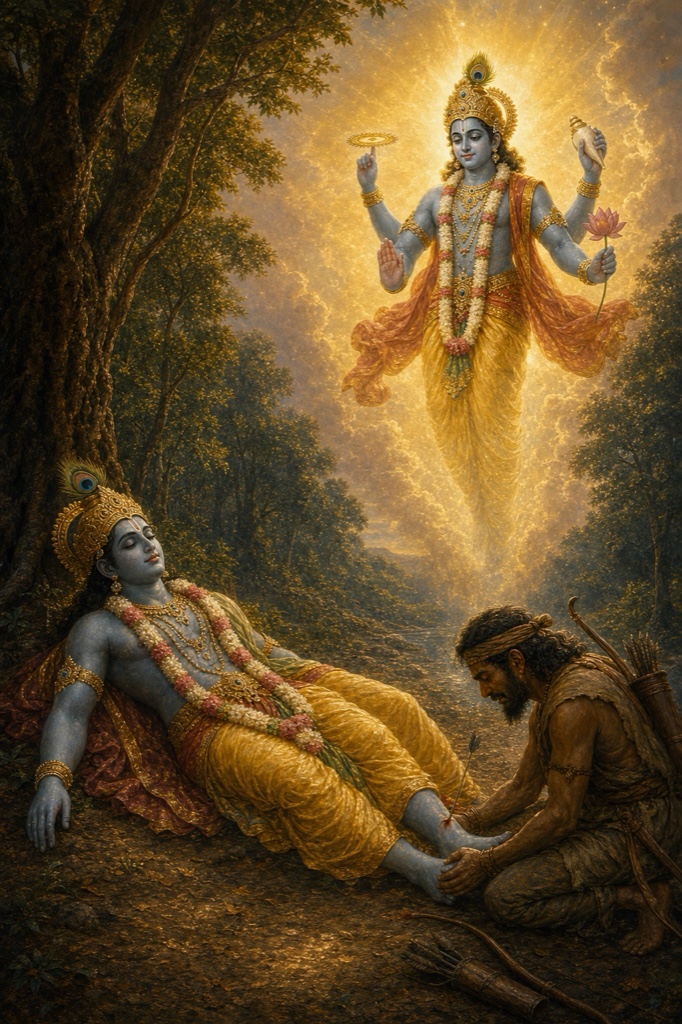
A hunter came that way looking for deer, a fierce man, and his name was Jara, the name the sages had spoken in Dwarka. He saw Krishna stretched on the earth in yoga and took him for a deer, and shot. The arrow went in at the heel. Jara came up quickly to lay hold of his prey, and what he found was a man, dressed in yellow, rapt in yoga, with many arms. He understood that he had done a wrong. Full of fear, he touched Krishna’s feet. Krishna comforted him. Then he rose upward, and the whole sky filled with his splendor. When he reached heaven, Indra came out to receive him, and the twin Ashvins, and Rudra, and the Adityas, the Vasus and the Vishvedevas, and munis and Siddhas, and the leading gandharvas with the apsaras. Then Krishna, who is Narayana, fierce in his power, the Creator and the Destroyer of all, the teacher of yoga, filled heaven with his light and came to his own region, a place past the reach of thought. There he met the gods and the rishis of heaven and the Charanas, the first among the gandharvas, many beautiful apsaras, and the Siddhas and the Sadhyas. All of them bowed low and worshiped him. The gods saluted him, the greatest of the munis and rishis worshiped him as the Lord of all, the gandharvas attended him singing his praise, and Indra too praised him with joy.
A sub-tale: Durvasa, the son of Atri, once lived as a guest in Krishna’s house. One day he asked for payasa, rice boiled in sweetened milk, and when he had eaten some of it he had the rest smeared over Krishna’s limbs, his body and his head. Before he left he declared himself pleased, and he said that for as long as Krishna wished to live, death would have no way to reach him through any part of his body the payasa had covered. Then he asked why Krishna had put none of it on the soles of his feet. Those are the words Krishna remembers as he sits on the bare earth, and the hunter’s arrow enters at the heel.
A key to reading this (the moral tangle): The sages at Dwarka named two things in advance: Balarama would put off his body and enter the ocean, and a hunter called Jara would pierce Krishna as he lay on the ground. Both happen as they were said. Krishna sits down on the bare earth, goes over the words of Gandhari and of Durvasa, concludes that his hour has come, and lies down. He is the Supreme Deity and he wishes to die, and his reasons are three: to end all doubt, to uphold the three worlds, and to make the rishi’s words true. The hunter who shoots him is comforted before Krishna rises.
The gist: Balarama, seated in yoga, leaves his body. A white naga with a thousand heads comes out of his mouth and goes toward the ocean, where the Ocean, the sacred rivers and the nagas, named one by one, receive him with honor. Krishna wanders the forest, sits on the bare earth, remembers the words of Gandhari and of Durvasa, and lies down in yoga. The hunter Jara takes him for a deer and shoots him in the heel, then touches his feet in fear. Krishna comforts him and rises, filling the sky with his splendor, and the gods receive him in heaven, where he reaches his own region.
Arjuna comes to Dwarka, and Vasudeva’s lament
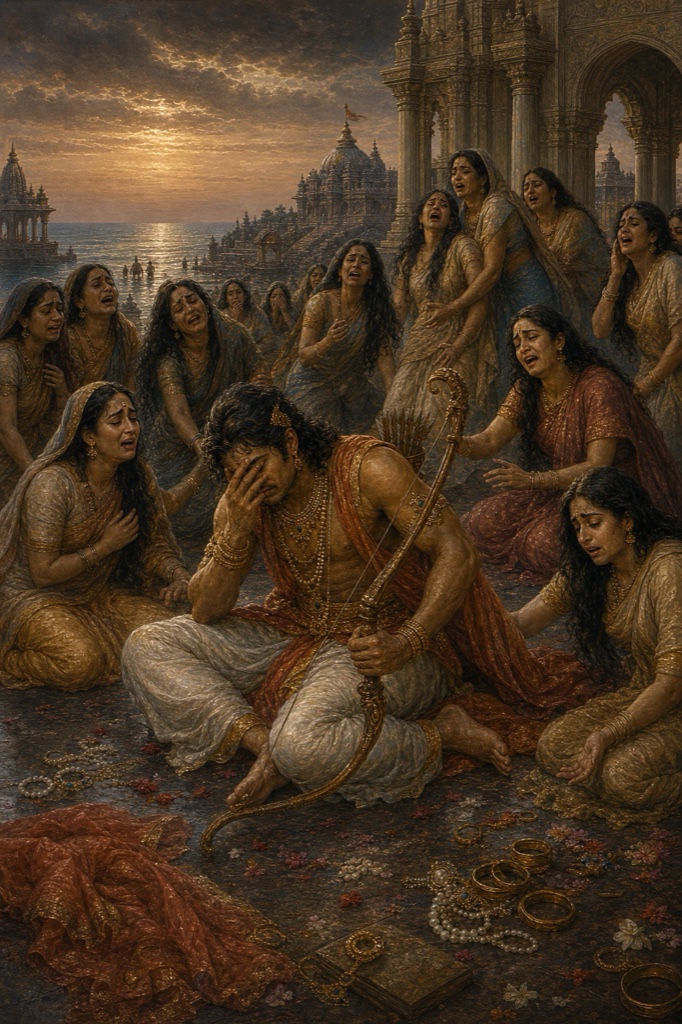
Daruka, meanwhile, had reached the Kurus, Vaishampayana said. He found the sons of Pritha, great chariot fighters all, and told them how the Vrishnis had killed one another with iron clubs. When they heard that the Vrishnis were dead, and the Bhojas and the Andhakas and the Kukuras with them, the Pandavas burned with grief and could not be still. Arjuna had been Krishna’s dear friend. He said goodbye to his brothers and set out to see his mother’s brother Vasudeva, and he said as he went that destruction would soon overtake everything. He traveled with Daruka, and when he came to the city of the Vrishnis he saw that Dwarka looked like a woman who has lost her husband. The women there had once had the Lord of the universe himself for their protector, and now they had no one. They saw that Arjuna had come to protect them, and they all cried out together. Sixteen thousand women had been married to Krishna, and the moment Arjuna came into their sight they raised one great cry of sorrow. He met them, those beautiful women who had lost Krishna’s protection and lost their sons as well, and he could not look at them, because tears had closed his sight.
Dwarka had been a river once. The Vrishnis and the Andhakas were its water. Horses were its fish and chariots its rafts, and the music of instruments and the rattle of chariot wheels made its waves. Houses and mansions and public squares were its lakes, gems and precious stones its thick moss, and the walls of adamant were the garlands of flowers that floated on it. The streets and roads were its strong currents, running in eddies along the surface, and the great open squares were the wide still pools along its course. Balarama and Krishna were its two mighty alligators. That pleasant river now looked to Arjuna like the Vaitarani, the fierce river of the dead, held fast in the net of Time. Arjuna was Indra’s son and had a clear mind, and that is how the city appeared to him with the Vrishni heroes gone out of it: stripped of beauty, wholly joyless, a lotus in the season of winter. He saw what Dwarka had become, and he saw the many wives of Krishna, and he cried aloud with his eyes full of tears and fell to the ground. Satyabhama fell down beside him, the daughter of Satrajit, and Rukmini too, whose son Pradyumna had died at Prabhasa, and they wept aloud in their grief. Then the women raised him and made him sit on a golden seat, and they sat around him and said what was in their hearts. Arjuna praised Krishna to them and talked with them and comforted them, and then he went on to see his uncle.
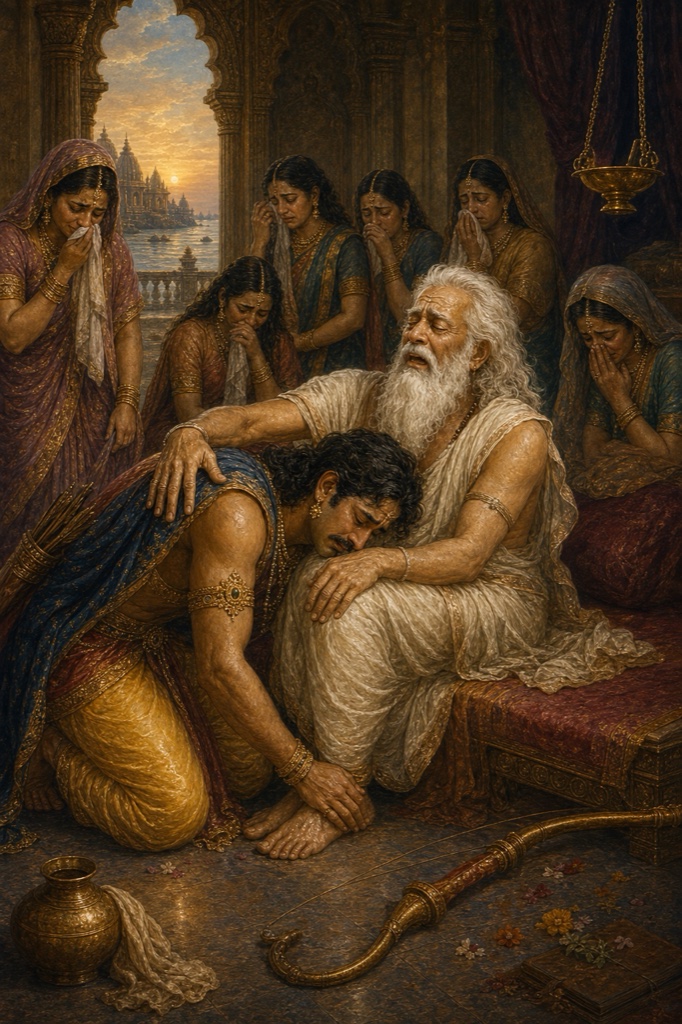
Arjuna found the old man lying on the ground, Vaishampayana said. He was Vasudeva, whom men also called Anakadundubhi, a hero in his day, and he was burning with grief for his sons. Arjuna, broad in the chest and long in the arm and more stricken even than his uncle, touched the old man’s feet with his eyes full of tears. Vasudeva wanted to greet his sister’s son as an elder does, by smelling the crown of his head, and he could not manage it. So he put his powerful arms around Arjuna and held him and wept aloud, remembering his sons, his brothers, his grandsons, his daughters’ sons and his friends.
“Arjuna,” Vasudeva said, “the heroes who beat all the kings of the earth, and the Daityas too, a hundred times over, are gone from my sight, and I am still alive. I think death has no place for me. It was through the fault of two men that the Vrishnis were destroyed, and they were your own dear pupils, the two you thought so much of. They were counted as atirathas, chariot fighters of the highest rank, among the first of the Vrishnis. You used to speak of them with pride. Krishna himself always loved them. And those two, Arjuna, became the chief cause of the destruction of the Vrishnis. Yet I do not blame the son of Shini, and I do not blame the son of Hridika. I do not blame Akrura or the son of Rukmini. The curse of the rishis is the one cause. Only think who my son was. He put out his strength and destroyed Keshi and Kamsa. He destroyed Chaidya in all his swollen pride, and Ekalavya, the son of the king of the Nishadas. He destroyed the Kalingas and the Magadhas, the Gandharas and the king of Kashi, and the many rulers who gathered in the middle of the desert, and many heroes of the East and of the South, and many kings of the mountain country. How could the lord of the universe, who did all that, stand indifferent before a calamity like this curse of the rishis?
“You knew what he was. You and Narada and the munis knew him for the eternal Govinda, the sinless one, the god whose glory does not fade. He was Vishnu himself, with all of Vishnu’s power, and he watched his own kinsmen being destroyed and did not step in. My son must have allowed all of it himself. He was the Lord of the universe. He did not wish the words of Gandhari and the rishis to prove false. You saw with your own eyes what he could do: when Ashvatthama killed your grandson, it was Krishna’s power that brought the child back to life. That same friend of yours did not wish to protect his kinsmen. He saw his sons and his grandsons, his brothers and his friends lying dead, and then he spoke to me. ‘The destruction of this race of ours has come at last,’ he said. ‘Arjuna will come to this city, to Dwaravati. Tell him what has happened, this great slaughter of the Vrishnis. I have no doubt that he will come here, strong as he is, without losing a moment, as soon as he hears that the Yadus are destroyed. Know, father, that I am Arjuna and Arjuna is myself. Whatever he says, do it. He will do what is best for the women and the children, and it is he who will perform your funeral rites. When Arjuna has gone, the ocean will swallow this city of Dwaravati at once, with its walls and its buildings. As for me, I will go to some sacred place with Balarama, who is wise, and keep strict vows there, and wait for my hour.’ That is what Krishna said to me, he whose power no one can conceive, and he left me here with the children and went away to a place I do not know. I think of those two brothers of yours, and of the terrible slaughter of my kinsmen, and I have given up all food, and grief has wasted me. I will not eat, and I will not live. It is good fortune that you have come. Do everything Krishna has said, Arjuna. This kingdom is yours now, with all these women and all the wealth that is here. As for me, I will put off my life, dear as the breath of life is.”
A key to reading this (the moral tangle): Vasudeva blames no man. He names the son of Shini and the son of Hridika, Akrura and the son of Rukmini, and clears each of them: the curse of the rishis is the one cause. His question is about his own son. Krishna destroyed Keshi and Kamsa and the armies of whole kingdoms, he brought Arjuna’s grandson Parikshit back to life after Ashvatthama had killed him, and he watched the destruction of his kinsmen without stepping in. The old man supplies the reason himself: Krishna did not wish the words of Gandhari and the rishis to prove false. Vyasa will tell Arjuna the same thing at the end.
A key to reading this (the numbers, a modern measure): Sixteen thousand is the number given for the women who had been married to Krishna. Arjuna will later put the dead at Prabhasa at five hundred thousand fighting men, as many people as live in a modern city of middling size, and the widows of the Bhoja, Vrishni and Andhaka heroes who leave Dwarka with him are counted in many millions.
The gist: Daruka brings the news to the Pandavas, and Arjuna sets out with him to see his mother’s brother. He finds Dwarka like a woman who has lost her husband, and the sixteen thousand women who had been married to Krishna cry out when they see him. He falls weeping to the ground, Satyabhama and Rukmini fall beside him, and he comforts the women before he goes to Vasudeva. The old man holds the curse to be the one cause, asks how his son, who was Vishnu himself, could watch and not step in, and repeats Krishna’s last message: Arjuna is to be obeyed, he will care for the women and children and perform Vasudeva’s funeral rites, and the ocean will swallow the city once he has gone. Vasudeva has given up food and means to give up his life.
Arjuna’s arrangements, and Vasudeva’s funeral
Arjuna heard his uncle out, Vaishampayana said, and when he answered, his heart was as heavy as the old man’s. “Uncle, I cannot look at this earth now that Krishna is gone from it, the hero of the Vrishni race, and my other kinsmen with him. The king, my brother Yudhishthira, is of the same mind. So are Bhima and Sahadeva and Nakula, and so is Draupadi, who makes the sixth of us. The time has come for the king to depart as well, and you should know that our own hour is close. No one understands the course of time better than you. First, though, I will take the women of the Vrishni race to Indraprastha, and the children, and the old.”
Then he turned to Daruka. “I want to see the chief officers of the Vrishni heroes, and I want to see them without delay.” Grieving for the great chariot fighters who were dead, he walked into Sudharma, the great hall where the Yadavas had held their court, and took his seat. The citizens came, the Brahmins among them, and all the ministers of state, and they stood around him. They were grieving people with no spirit left in them, more dead than alive, and Arjuna, whose grief was greater than theirs, said to them what the hour required. “I am going to take what is left of the Vrishnis and the Andhakas away with me. The sea will soon swallow this city. Fit out all your chariots and load all your wealth on them. Vajra here, Krishna’s great-grandson, will be your king at Shakraprastha. On the seventh day from today, at sunrise, we set out. Make your preparations and do not delay.”
Arjuna’s deeds had always been clean, and they did as he told them. They hurried their preparations, every one of them eager to come away safe. Arjuna spent that night in Krishna’s house, and there, all at once, grief came over him so heavily that it left him stunned. When morning broke, Vasudeva, a man of great strength and prowess, reached the highest goal by the way of yoga. A loud cry, terrible to hear, went up in his house from the weeping women. They were seen with their hair loose and their ornaments and garlands taken off, beating their breasts with their hands and lamenting. Devaki, Bhadra, Rohini and Madira, the first among those women, threw themselves on the body of their lord. Arjuna had his uncle’s body carried out on a costly bier borne on the shoulders of men. All the citizens of Dwarka followed it, and the people of the provinces, every one of them stricken, for they had loved the dead man. In front of the bier went the umbrella that had been held over Vasudeva’s head at the close of the horse sacrifice he had performed in his lifetime, and the blazing fires he had worshiped every day, with the priests who had tended them. Behind the body came his wives, wearing their ornaments, with thousands of women and thousands of their daughters-in-law around them. The last rites were performed at the place that had pleased him most while he was alive. The four wives of Vasudeva, the heroic son of Shura, climbed the funeral pyre and were consumed with the body of their lord, and all four went to the worlds that were his. Arjuna burned his uncle’s body together with those four wives, using scents of many kinds and perfumed wood. As the pyre blazed up there was the loud noise of the burning wood and the other fuel, and with it the clear chant of the Samans, the sung hymns of the Veda, and the wailing of the citizens and the others who were watching the rite. When it was all over, the boys of the Vrishni and Andhaka races, with Vajra at their head, and the women with them, offered the water that is poured for the dead to the hero who had gone.
A key to reading this (the lineage): Devaki, Bhadra, Rohini and Madira are the four wives of Vasudeva, the son of Shura, and all four ascend his pyre. Vajra is the son of Aniruddha, Krishna’s grandson, and so Krishna’s great-grandson. He stands at the head of the Vrishni and Andhaka boys at the water offering, and Arjuna names him king at Shakraprastha, which is Indraprastha under another name. Sudharma is the great hall where the Yadavas held their court.
The gist: Arjuna tells Vasudeva that the time of departure has come for Yudhishthira and is close for all the Pandavas, and that he will first take the Vrishni women, the children and the old to Indraprastha. In the hall Sudharma he gives his orders: the sea will soon swallow the city, Vajra will be king at Shakraprastha, and they leave at sunrise on the seventh day. He spends the night in Krishna’s house. At daybreak Vasudeva reaches the highest goal through yoga. Arjuna has the body carried out with the horse-sacrifice umbrella and the sacred fires before the bier, the four wives ascend the pyre, and Vajra leads the boys in the offering of water.
Dwarka sinks into the sea, and the Abhiras attack
Arjuna was careful in every duty, and when this one had been seen to he went next to the place where the Vrishnis had been slaughtered. He saw them lying dead on every side, and a great heaviness came over him. Still he did what the event required. The last rites were performed over those bodies in the order of their seniority, the bodies of heroes killed by iron clubs that had been blades of eraka grass until the curse of the Brahmins changed them. He searched out the bodies of Balarama and Krishna and had them burned by men skilled in that work. Then he performed the shraddha, the rites that are owed to the dead, in the proper way, and on the seventh day he mounted his chariot and set out without lingering.
The widows of the Vrishni heroes came behind him, wailing aloud, in wagons drawn by bullocks and mules and camels, and every one of them was in deep distress. The servants of the Vrishnis followed, and their horsemen, and their chariot fighters. At Arjuna’s order the citizens and the country people set out at the same time and traveled around the column, enclosing a company that had no heroes in it and was made up of women, the old and the children. The men who fought from the backs of elephants rode elephants as big as hills. The foot soldiers marched, and the reserves with them. All the children of the Andhaka and Vrishni races followed Arjuna. Brahmins and Kshatriyas, Vaishyas and wealthy Shudras went along, and they kept in front of them the sixteen thousand women of Krishna’s household and Vajra, Krishna’s great-grandson. The widows of the other heroes of the Bhoja, the Vrishni and the Andhaka races, who had no lords now and set out with Arjuna, numbered many millions. Arjuna had taken hostile cities in his time and had been the first of all chariot fighters, and now he rode as escort to this vast procession of the Vrishnis, which was still rich in wealth and which looked like an ocean on the move.
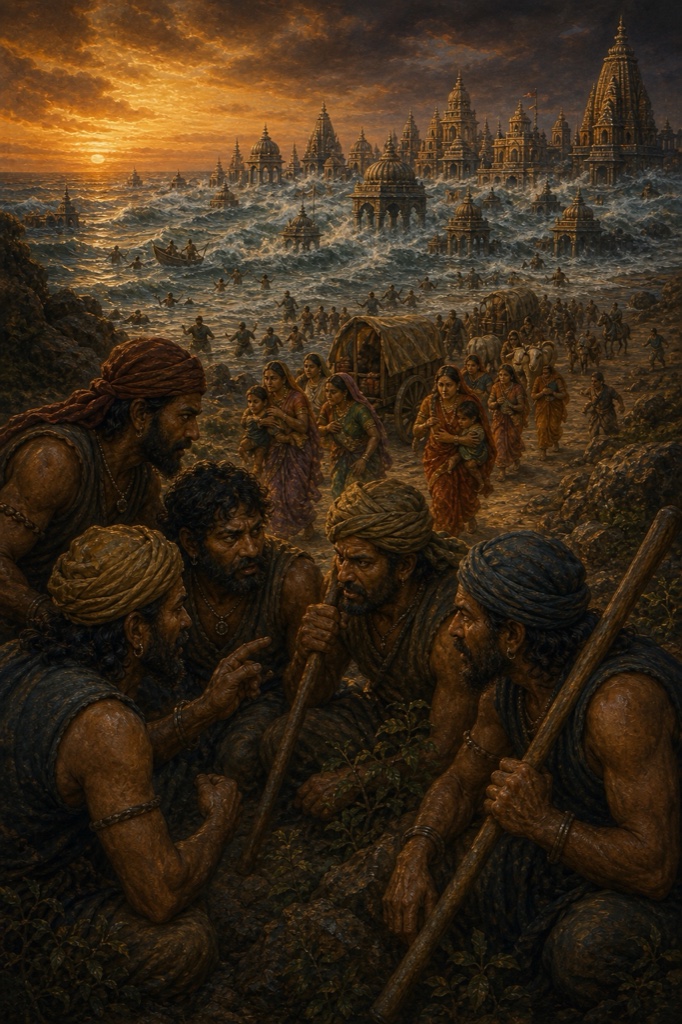
When all the people had left, the ocean, the home of sharks and alligators, came in over Dwarka and flooded it, as Krishna had told his father it would, though the city was still full of wealth of every kind. Each stretch of ground the people passed over, the ocean covered at once with its waters. They saw it happening behind them, and the people of Dwarka walked faster and then faster still, saying to one another, “How wonderful is the course of fate!” Once Dwarka was behind him, Arjuna went by slow marches. He let the Vrishni women rest in pleasant woods and on the hills and beside delightful streams. So he came to the country of the five waters, a land full of grain and cattle and other animals, and in the middle of it he made a rich camp.
There were robbers in that country, and they saw widows without lords traveling under the guard of one man. The temptation was great. They were Abhiras, sinful men and men of ill omen, and greed had mastered them. They gathered and talked it over. “There is only one bowman here, Arjuna. The column is children and old people. He is leading them past us as if we counted for nothing. And the Vrishni fighting men have no strength in them.” Then the robbers came on in their thousands, armed with clubs, running at the procession of the Vrishnis for plunder. The crooked course of time was driving them too. They fell on that enormous crowd with roars like lions, to frighten it, and they were ready to kill.
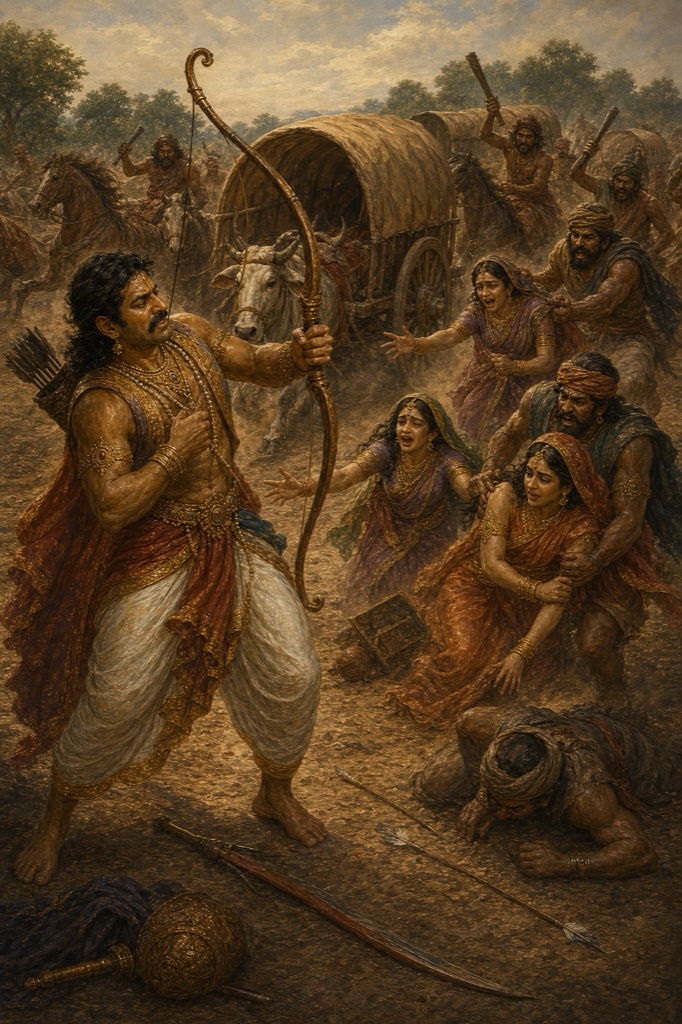
Arjuna stopped short on the road. He turned with his followers and went to the place where the robbers had struck the column, and he was smiling as he spoke to them. “Stop, you sinful wretches, if you love your lives. You will be sorry for this when my arrows go through your bodies and take the life out of you.” They paid no attention. He warned them off again and again, and they came at him anyway. So Arjuna set himself to string Gandiva, his great bow, a weapon of the gods that could never be destroyed, and found that it took effort. He got it strung, with great difficulty, and by then the fight had grown fierce. He turned his mind to his celestial weapons, and they would not come to him. There was the fight raging, there was his arm with the strength gone from it, there were the weapons of heaven that would not appear, and Arjuna was filled with shame.
The Vrishni fighting men were there, foot soldiers and elephant riders and chariot men, and they could not save the Vrishni women whom the robbers were snatching away. The crowd was very large and the robbers struck it at many points at once. Arjuna did all he could to protect it and failed. In full view of every warrior many of the noblest women were dragged off, and others went away with the robbers of their own accord. Arjuna, with the servants of the Vrishnis backing him, shot at the robbers with arrows sped from Gandiva. Soon the arrows were gone. In the old days his arrows had been inexhaustible, and now they gave out. When he found that he had none left, grief struck deep into him. Then the son of Indra began to hit the robbers with the horn tips of his bow. Those Mlecchas, Vaishampayana told Janamejaya, drew off under Arjuna’s eyes, and they took with them many of the noblest women of the Vrishnis and the Andhakas.
Arjuna took all of it as the work of destiny. He was full of sorrow, and he sighed heavily as he went over it: the celestial weapons that had not appeared, the strength that had left his arms, the bow that had refused to obey him, the arrows that had run out. He took it as the work of destiny, and his spirit sank very low. He made no further effort. He said that he no longer had the power he once had. Then he took what was left of the Vrishni women, and the wealth that was still with them, and came to Kurukshetra, the field of the great battle. Having brought the remnant of the Vrishnis that far, he settled them in different places. The son of Kritavarma he established in the city called Marttikavat, with what was left of the women of the Bhoja king. The rest he escorted on, children and old men and women with no hero among them, and settled them in the city of Indraprastha. The dear son of Satyaki he established on the banks of the Sarasvati, with a company of old men and children and women. And the rule of Indraprastha was given to Vajra.
The widows of Akrura wished to withdraw into the forest. Vajra asked them again and again to give up the idea, and they would not listen to him. Rukmini, the princess of Gandhara, Shaibya, Haimavati and Queen Jambavati climbed the funeral pyre. Satyabhama and the other dear wives of Krishna went into the forest, resolved to give themselves to austerities. They lived on fruits and roots and spent their time in the contemplation of Hari, the lord who had been their husband. They went beyond the Himavat and made their home in a place called Kalpa. The men who had followed Arjuna from Dwaravati were divided into groups and given over to Vajra. When he had done all that the time required of him, Arjuna, with his eyes full of tears, entered the retreat of Vyasa. There he saw the island-born rishi sitting at his ease.
A key to reading this (the moral tangle): Four things fail Arjuna at once: the celestial weapons do not appear, the strength leaves his arms, the bow refuses to obey him, and the arrows, which had once been inexhaustible, run out. The men he is fighting are robbers armed with clubs. The Vrishni soldiers in the column cannot save the women either, and some of the women go with the robbers of their own accord. Arjuna calls it the work of destiny and says that he no longer has the power he had. What has become of that power is a thing Vyasa will explain to him.
A key to reading this (the places): The country of the five waters is where Arjuna makes his camp and where the Abhiras, the robbers of that country, attack. He brings the survivors to Kurukshetra and divides them among three places: Kritavarma’s son and the Bhoja women at Marttikavat, Satyaki’s son and his company on the banks of the Sarasvati, and the rest at Indraprastha, where Vajra rules. Kalpa is the place beyond the Himavat where Satyabhama and the other wives of Krishna go to live in austerity.
The gist: Arjuna has the dead of Prabhasa given their last rites, finds the bodies of Balarama and Krishna and has them burned, and leaves on the seventh day with the whole city: the sixteen thousand women and Vajra in front, and widows in many millions. The ocean covers Dwarka behind them. In the country of the five waters thousands of Abhira robbers attack with clubs. Arjuna can barely string his bow, his celestial weapons do not come, his arrows give out, and many women are carried off. He settles the survivors at Marttikavat, at Indraprastha and on the Sarasvati. Rukmini and four other queens ascend the pyre, Satyabhama and the rest go to Kalpa for austerities, and Arjuna comes in tears to Vyasa.
Vyasa’s counsel: Time is the root of all
Arjuna entered the hermitage of Vyasa, Vaishampayana said, a rishi whose every word was true, and saw him, Satyavati’s son, sitting in a place apart. He was a man of great vows who knew every duty. Arjuna went up to him and said, “I am Arjuna,” and then stood and waited on the sage’s pleasure. “Welcome,” said Vyasa, whose austerities were great. His mind was calm. “Sit down,” he said. Then he looked at the man in front of him. Arjuna was sunk in dejection, sighing heavily again and again, a man full of despair, and Vyasa went through the things, small and great, that can strip a man of his fortune. “Has water touched you that was sprinkled from someone’s nails or hair, or from the end of someone’s garment, or from the mouth of a jar? Have you lain with a woman before her monthly flow had ended? Have you killed a Brahmin? Have you been beaten in battle? You look like a man whose good fortune has been cut away. I do not know of anyone who has defeated you. Why this look of utter dejection, then? Tell me everything, Arjuna, if there is no harm in the telling.”
“He is gone,” Arjuna said. “Krishna, whose color was the color of a new rain cloud, whose eyes were like two great lotus petals, has put off his body and gone up to heaven, and Balarama with him. At Prabhasa the Vrishni heroes were destroyed by iron clubs that came out of a curse the Brahmins pronounced. The slaughter was terrible, and no hero escaped it, no single one. The heroes of the Bhoja, the Andhaka and the Vrishni races were great of soul and great in strength, and proud as lions, and they have slaughtered one another in battle. Their arms were like maces of iron. They could take the blows of heavy clubs and darts. And all of them were killed with blades of eraka grass. See how crooked the course of Time is. Five hundred thousand fighting men, strong men all, have been laid low in this way. They met one another, and they were destroyed.
“I go over it again and again, this slaughter of the Yadava warriors, whose strength no one could measure, and of Krishna in his glory, and I can find no peace. That the bearer of Sharnga is dead is as hard to believe as that the ocean has dried up, or a mountain has moved from its place, or the vault of the sky has fallen, or fire has turned cold. Without the Vrishni heroes for company I have no wish to live in this world. And there is something else, more painful than this, and my heart breaks each time I think of it. Before my own eyes thousands of Vrishni women were carried off by the Abhiras of the country of the five waters, who attacked us. I took up my bow and found that I was unequal even to stringing it. The strength that had been in my arms seemed to have left them at that hour. My weapons, of all their many kinds, did not appear. Soon my arrows too were gone. And I see him no more: the one whose soul had no measure, four-armed, bearing the conch and the discus and the mace, dressed in yellow, dark in color, with eyes like lotus petals. Without Govinda, what have I to live for, dragging my life along in sorrow? He used to go striding ahead of my chariot, that divine form of great splendor and unfading power, and burn up every enemy warrior as he went. He would burn the enemy troops first with his energy, and I would finish them afterward with arrows from Gandiva. I see him no longer, and I am filled with grief, and my head swims. Dejection and despair have gone through me, and I cannot find peace. Without Krishna I do not dare to live. The moment I heard that Vishnu had left the earth, my eyes went dim and everything vanished from my sight. It is for you to tell me what is good for me now, because I am a wanderer with an empty heart, stripped of my kinsmen and of everything I had.”
“The great chariot fighters of the Vrishni and Andhaka races have all been consumed by the Brahmins’ curse,” Vyasa said. “You should not grieve over their destruction. What has happened was ordained. It was the destiny of those warriors. Krishna allowed it to take place, though he was fully able to turn it aside. Govinda could have altered the very course of the universe, with everything in it that moves and everything that stands still. What, then, was a curse to him, even a curse of Brahmins? He who used to go in front of your chariot, armed with discus and mace, went there out of affection for you, and he was the four-armed son of Vasudeva, that ancient rishi. Krishna of the wide eyes has lightened the burden of the Earth, he has put off his human body, and he has gone to his own high seat.
“You too have accomplished the great work of the gods, you with Bhima for your helper and the twins beside you. I count you and your brothers as men crowned with success, for you have fulfilled the great purpose of your lives. The time has come for you to depart from the world. That is what is good for you now. Understanding, prowess and foresight arise in a man while his days of prosperity last, and when the hour of adversity comes those same gains disappear. All of this has Time for its root. Time is the seed of the universe, Arjuna, and it is Time again that withdraws everything at its pleasure. A man becomes mighty, and then he loses that might and becomes weak. A man becomes a master and rules others, and then he loses that place and becomes a servant who obeys what others command. Your weapons have done what they were meant to do, and they have gone back to the place they came from. They will come into your hands again when the Time for their coming arrives. The time has come for all of you to reach the highest goal. That is what I hold to be the greatest good for you all.”
Vaishampayana brought the account to its close. Arjuna heard what Vyasa had to say, a sage whose power had no measure, and with his leave he went back to Hastinapura, the city named after the elephant. He entered it and went to Yudhishthira, and he told the king everything that had happened to the Vrishnis.
A key to reading this (the idea): Vyasa begins by asking what has stained or shamed the man in front of him, and Arjuna’s answer holds the whole account: Krishna and Balarama gone, five hundred thousand dead at Prabhasa, the women taken, the bow he could hardly string. Vyasa disputes none of it. He says that it was ordained, and that Krishna, who could have altered the course of the universe, allowed it. He tells Arjuna who it was that went before his chariot: the four-armed son of Vasudeva, the ancient rishi, who has lightened the burden of the Earth and gone to his own seat. The weapons that failed have finished their work and returned to the place they came from, and they will come to Arjuna’s hands again when their time arrives.
The gist: Arjuna finds Vyasa in his hermitage, and the sage, seeing his dejection, asks what has befallen him. Arjuna tells of the passing of Krishna and Balarama, of five hundred thousand warriors killed with blades of eraka grass at Prabhasa, and of his own failure against the Abhiras, and he asks what is good for him now. Vyasa answers that all of it was ordained and that Krishna allowed it though he could have turned it aside. The Pandavas have done the work of the gods. Time is the seed of the universe and withdraws everything again, Arjuna’s weapons have gone back to their source, and the hour has come for the brothers to seek the highest goal. Arjuna returns to Hastinapura and tells Yudhishthira all of it.
Source: the Mahabharata of Krishna-Dwaipayana Vyasa, Mausala Parva, Sections 1 to 9. The Sanskrit e-text, the Gita Press Hindi edition, and Kisari Mohan Ganguli’s complete English translation were used to verify names, sequence, and principal events. Where the recensions differ, this English retelling follows Ganguli, and the Hindi edition follows Gita Press.
Based on: the Mahabharata of Vedavyasa (K. M. Ganguli’s English translation; Gita Press, Gorakhpur)