On this page
In the shadow of the mountain of a hundred peaks, where the snow-crowned summits touched the sky and the hermitages of the sages were thick with the smell of incense and sunlight, King Pandu carried a grief he could not set down. He remembered the curse of the sage who had lived in the body of a deer, Kindama, struck through while he lay with his mate, who had promised the king that the moment desire led him to touch a woman, in that same moment his life would leave him. So Pandu had two young wives, a mountain, and a wall between them he could never cross. For this reason he had no children, and the ache of being sonless fed on him quietly from within. From this one knot, a single curse tied to a single boon, were born the five brothers the world would call the Pandavas, and alongside them grew the hundred sons of Dhritarashtra. This is the story of their birth, of their schooling in weapons, and of the astonishing sacrifice of a boy of the Nishada people.
The Debt of Sons, and Pandu’s Request
Pandu had won, by his austerities, the love of the Siddhas and the Charanas who lived on that slope. One sage would call him brother, another friend, and another would hold him to his heart as a son. On a certain day of the new moon, the great sages, bound by their strict vows, prepared to set out toward the north, hoping to see Brahma. Pandu made ready to follow them, taking both his wives, Kunti and Madri. The ascetics stopped him. They spoke of the high summits of Shatashringa, of the gardens of Kuvera and the palaces of the gods, and of the heights above, wrapped in unbroken snow, where nothing lives and nothing grows, where the only traveler is the wind and the only beings are the Siddhas and the great sages. “How would these tender princesses climb such peaks?” they asked. “Do not come with us.”
“For a man without a son there is no place in heaven, and I am such a man,” Pandu answered. “A person is born into this world owing four debts: to the ancestors who came before him, to the gods, to the sages, and to other men. Each must be paid in justice, and the wise have taught that no region of bliss waits for the one who leaves them unpaid. The gods are satisfied by sacrifice, the sages by study and meditation and penance, the ancestors by the raising of children and the offering of the funeral cake, and other men by a humane and blameless life. I have cleared my debts to the gods, the sages, and other men, but the debt to my ancestors stands against me still. Can children be begotten in my soil, upon my wives, as I myself was once begotten in my father’s soil by an eminent sage?”
The ascetics looked with their prophetic sight. “Offspring waits for you, sinless and blessed and godlike,” they told him. “Set yourself to the task.”
Then Pandu drew Kunti aside and spoke to her in private, and every word of it had been rehearsed a hundred times before he said it once. “The scriptures name many kinds of sons, and when a son of the first rank cannot be had, a son of the next rank is still sanctioned by dharma,” he said. “In times of distress men have always sought children from a person equal or superior to themselves.” He told her the story of the daughter of Saradandayana, who at her husband’s command went out at night and waited on a spot where four roads met, and there, from a Brahmin crowned with ascetic success, obtained three mighty sons, the eldest of whom was named Durjaya. “Follow her example,” he said, “and raise offspring through some Brahmin of high ascetic merit.”
A key to reading this (concept): rina (the debt that settles on a person from the moment of birth). The scriptural way to clear the debt owed to one’s ancestors is here shown to be the raising of a child. Pandu’s request grows out of this crisis of duty, and the Mahabharata neither hides it nor smooths it over; it sets the request before you with all its difficulty intact, a husband asking his wife to go to another man and calling it the most sacred thing he could ask.
The gist: the curse had taken from Pandu the power to father children. Tormented by the debt he owed his ancestors, he asked Kunti to raise offspring through some man of high merit.
Kunti’s Boon from Durvasa, and the Talk of an Older Custom
Kunti drew back at first. “I am your wedded wife and devoted to you,” she said, “and I will not so much as imagine another man in your place.” She told him the story of Vyushitaswa, a king of the line of Puru who loved his wife Bhadra so deeply that the two were seldom apart, and who died young, worn out by his own desire. Bhadra, left childless, wept over his corpse until an unseen voice granted her a boon, and from the body of her dead husband she bore seven children. Kunti’s meaning was plain: let Pandu himself raise offspring by the power of his own austerities.
Then Pandu told her of the ways of an older time, reaching for an age old enough to make his request ordinary. “In the ancient days women were not shut inside houses or bound in dependence on husbands and kin,” he said. “They moved about freely, as they pleased, and this was not counted a fault, for such was the sanctioned usage of that age. Among the Northern Kurus the custom is honored to this day.” Then he told her of Swetaketu. This son of the sage Uddalaka once saw, in his own father’s presence, a Brahmin take his mother by the hand and lead her away, and he burned with anger. “This is the practice sanctioned by antiquity,” his father said, calming him. Swetaketu refused it, and it was he who established the present rule, that a wife hold faith with her husband alone, and that a husband not violate a chaste and devoted wife. A boy’s anger had made the law that now stood in Pandu’s way.
Pandu reminded her of Madayanti and the sage Vasishtha, and of his own origin. “Just as my brothers and I were begotten by Krishna-Dwaipayana for the preservation of the Kuru line, so should you raise offspring through some Brahmin of high ascetic merit,” he said.
Then Kunti opened her secret to him. “When I was a girl in my father’s house I once served the sage Durvasa, a man of terrible vows, and served him so well that he was pleased to give me a mantra by which I may summon any god I choose,” she said. “That god will come to me, obey my will, and grant me a child. Which of the gods shall I call?”
“Summon the god of dharma,” Pandu answered, “for he is the most righteous of the celestials and will stain us with no sin, and the son born of him will stand first in dharma among all the Kurus.” A man with a curse on his body was choosing, deliberately, what kind of son the world would get.
A key to reading this (terms): mantra (the perfected formula of invocation that can summon a god); Dvaipayana (Vyasa, the son of Satyavati, who fathered Dhritarashtra, Pandu, and Vidura); pativrata (a wife whose devotion is fixed on her husband alone).
The gist: Kunti held a mantra Durvasa had given her, one that could summon any god. At Pandu’s request she agreed, and made ready first to call on the god of dharma.
The Birth of the Three Pandavas
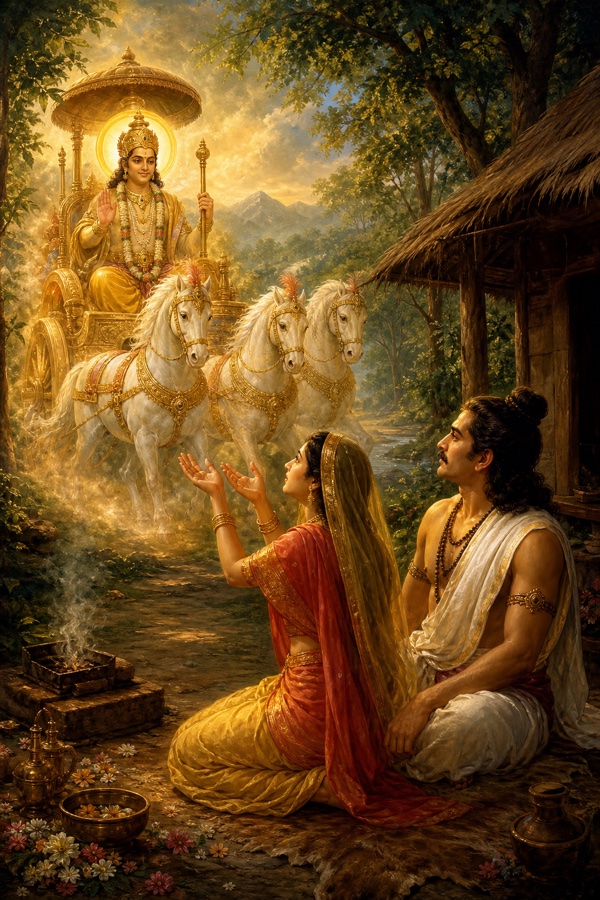
When Gandhari’s conception had run a full year, Kunti summoned the eternal god of dharma to obtain a child. She offered sacrifice, and repeated the formula Durvasa had given her, and the god came, seated in a chariot bright as the sun. “What do you wish?” he asked, smiling, and smiling in turn she asked for a child. United with the god of dharma in his spiritual form, Kunti conceived a son who would live for the good of all creatures. The boy was born at noon, in the eighth muhurta called Abhijit, on the fifth day of the bright fortnight of the seventh month, Kartika, when the star Jyeshtha stood with the moon in the ascendant. The hour was written down because everything about this child would one day be measured against it. The moment he was born, a voice from the sky declared, “This child will be foremost among the virtuous, a king renowned throughout the three worlds, and his name shall be Yudhishthira.”
“A Kshatriya must have bodily strength, or he is no Kshatriya,” Pandu said. “Seek a stronger son.” Kunti then invoked Vayu. The god of wind came to her riding upon a deer and asked what she wished, and she asked, in modesty, for a son of great strength and mighty limbs who could humble the pride of anyone. From Vayu she received the child later known as Bhima. At his birth too the voice declared, “He shall be the foremost of all in strength.” A strange thing happened then. Startled once by a tiger, Kunti sprang up without thinking of the infant asleep in her lap, and the child Bhima slipped and fell on the rock of the mountain. His body, hard as the thunderbolt, took no hurt at all; instead the rock broke into a hundred fragments beneath him. And on the very day Bhima was born, Duryodhana too was born, who would one day rule the whole earth.
After this Pandu longed for a son of the highest kind, one who would be famous across the world and able to conquer in battle both men and beings other than men. For this he practiced fierce austerities, standing on one leg from morning to evening for a full year, until he had gratified Indra. Pleased, Indra promised him a son renowned in all three worlds, one who would destroy the wicked and remain unconquered in battle. At Pandu’s command Kunti invoked Shakra, and from him was born the son called Arjuna. The instant he was born a voice, deep and heavy as thunder, filled the whole sky, and it did not stop at praise; it read out his life. “This child will equal Kartavirya in energy and Siva in prowess, invincible as Indra himself,” it declared. “He will burn the Khandava forest, perform three great sacrifices, gratify Mahadeva and receive from him the great weapon called Pasupata, slay at Indra’s command the demons called Nivatakavachas, gather every kind of celestial weapon, and restore the fallen fortunes of his race.”
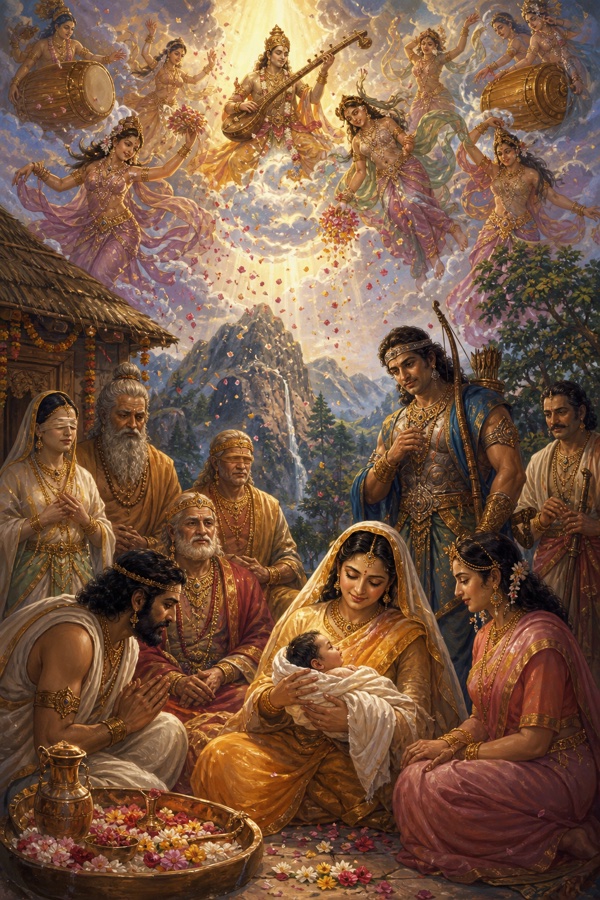
On that occasion the sages of Shatashringa, the gods with Indra, the seven great Rishis, the Gandharvas and the Apsaras, the twelve Adityas, the eleven Rudras, the Asvins, the Vasus, the Maruts, and many Nagas gathered there, until the air over one hermitage on one mountain held more of heaven than heaven had left in it, and raining down flowers and sounding their drums they chanted the praises of the son of Pritha. Only those sages who had reached the highest ascetic success could see that wondrous sight. To everyone else it was a quiet morning and a newborn crying. Their love for the children of Pandu grew all the deeper for what they had seen.
Pandu wished for still more children, and Kunti held him back. “Even in a season of distress the wise do not sanction a fourth delivery,” she said. “Press me no further.” There was a limit, and she was the one who set it.
A key to reading this (concept): these births follow the old practice of niyoga, in which a child was raised, at the husband’s bidding, for the sake of dharma. The three sons arrive as figures of three virtues: dharma in Yudhishthira, strength in Bhima, and valor in Arjuna.
The gist: Yudhishthira was born of Dharma, Bhima of Vayu, and Arjuna of Indra. At each birth a voice from the sky foretold the greatness to come, so that these children arrived already carrying their reputations. When Pandu pressed for a fourth child, Kunti refused.
Madri’s Twin Sons, and the Death of Pandu
After Kunti’s sons were born, and the hundred sons of Dhritarashtra as well, Madri spoke to Pandu in private of her sorrow. “Kunti and I are equals, and yet I alone am childless,” she said. “Entreat her on my behalf to grant me too the means of a child, for being a co-wife I feel a delicacy in asking her myself.” At Pandu’s request Kunti turned to Madri. “Think of some god,” she said, “and you will obtain from him a child in his likeness.” Madri thought of the twin Asvins, and from them were born twin sons, Nakula and Sahadeva, unrivaled on earth for beauty. “In energy and beauty these two will surpass even the Asvins themselves,” the voice said.
The sages performed the birth rites for all the children and gave them their names. Born a year apart from one another, the five sons looked like an embodied span of five years. When Pandu again asked Kunti on Madri’s behalf, Kunti refused. “With a single gift of the mantra Madri has contrived to get two sons at once,” she said. “I fear she will soon pass me in number.” One request, two children: Kunti had noticed, and she was not going to be outnumbered in her own household. So Pandu had five sons, born of the gods, endowed with great strength, who would carry the Kuru line forward. The five Pandavas and the hundred sons of Dhritarashtra grew swiftly, like a cluster of lotuses spreading across a lake.
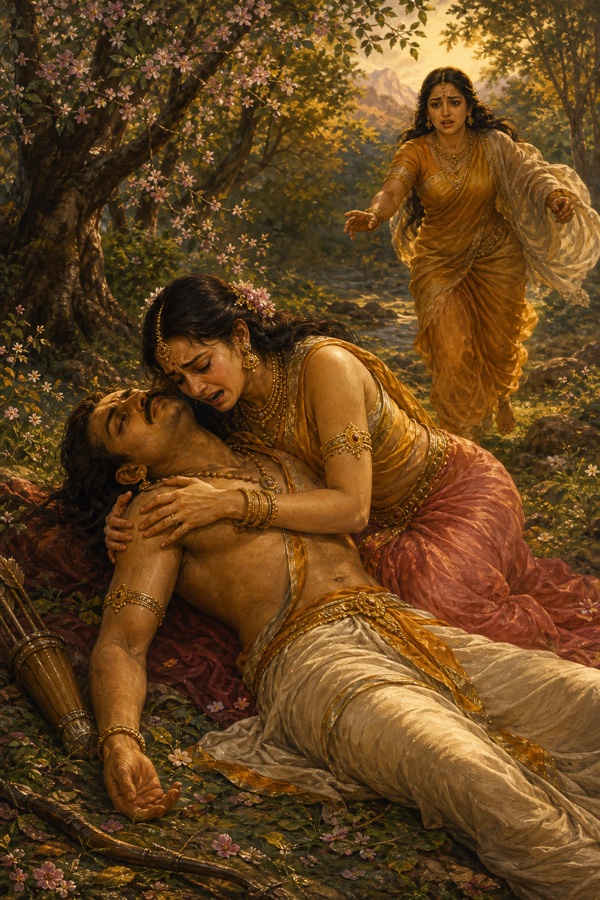
One day in the season of spring, when every creature runs mad with desire, Pandu was wandering with Madri through a forest in full flower. Palasa and tilaka, mango and champaka, asoka and kesara stood heavy with blossom; swarms of bees hummed, and the cuckoo poured its song from every twig, and the whole wood seemed to kindle desire. Seeing the youthful Madri in her light, half-sheer attire, Pandu’s longing flared up like a forest fire. Driven by fate, forgetting the terror of the curse, he seized her against her will. Madri, trembling with fear, resisted him with all her strength, but Pandu, overpowered by desire, could not hold himself back. In that very moment, joined with his wife, the life left Pandu. The curse had come true.
Madri clasped the still body of her husband and wept aloud. Hearing her cries of grief, Kunti came running with the children. “Come alone,” Madri called out to her, “and leave the boys behind.” Seeing Pandu and Madri both lying on the ground, Kunti cried out in sorrow. “I watched over him with such care. How did he forget the curse and let desire take him? And why, Madri, did you let him go with you into solitude?”
“With tears in my eyes I held the king back, but he could not restrain himself, as though he meant to make the curse come true,” Madri answered.
“As the elder wife the duty is mine, and I must follow my husband,” Kunti said then. “Do you raise the children.”
“I have not yet loosed my hold on our lord, and so I will go with him, my longing left unfulfilled,” Madri said. “I could not raise your sons as if they were my own, while you can raise mine as your own. So let my body burn with his.” So saying, Madri climbed onto her husband’s funeral pyre.
A sub-tale: the exchange between Madri and Kunti shows the moral fineness of the Mahabharata, where two widows argue over which of them holds the right to follow their husband in death. Madri rests her case on dharma, that she could not raise Kunti’s sons as her own, and so the burden of living should fall to Kunti. The story makes no attempt here to name anyone guilty or innocent. It simply leaves Kunti alive with five boys on a mountain, which is the harder of the two lots.
The gist: from the Asvins, Madri received the twins Nakula and Sahadeva. In spring, overcome by desire, Pandu touched Madri, and the curse took him at once, exactly as the dying sage had said it would. Madri followed him onto the funeral pyre, and Kunti was left with five sons and a mountain.
The Pandavas Enter Hastinapura, and the Funeral Rites
Seeing Pandu dead, the wise sages took counsel with one another. “Our duty now is to bring these children and their mother back to the kingdom and place them in the hands of Bhishma and Dhritarashtra,” they agreed. They set out for Hastinapura, carrying the Pandava boys, Kunti, and the remains of Pandu and Madri. Kunti, who had never in her life known hard travel, found the long road short now. Reaching Kurujangala, the sages sent word through the gatekeepers to announce their coming to the king.
When the citizens of Hastinapura heard that thousands of Charanas and Munis had arrived, they were filled with wonder, and at sunrise they poured out with their wives and children to see them. Bhishma the son of Shantanu came out, and Somadatta of Valhika, and the royal sage Dhritarashtra with his vision of knowledge, and Vidura, and the aged Satyavati, and the princess of Kosala, and Gandhari, and the hundred sons of Dhritarashtra. The Kauravas, with their family priest, bowed their heads to the sages and took their seats before them. Bhishma settled that vast crowd into stillness, offered the sages water to wash their feet and the customary arghya, and spoke with them of the kingdom and its sovereignty, while five boys stood in the middle of it all and nobody yet knew their names.
Then the oldest of the ascetics, his hair matted and his loins wrapped in deerskin, rose with the assent of the others and spoke, and the city learned everything in one breath. “King Pandu, the rightful lord of the Kurus, left the pleasures of the world to live a life of continence on the mountain of a hundred peaks,” he said. “There, for some hidden purpose of the gods, his eldest son Yudhishthira was born of Dharma himself; Bhima of Vayu; Dhananjaya of Indra; and these twins, Nakula and Sahadeva, of the twin Asvins, upon Madri. Living the life of a forest hermit in righteousness, Pandu revived the almost extinct line of his grandfather. Seventeen days ago he died, and Madri followed him onto the pyre and went with him to the region reserved for faithful wives. Let the rites now be done, and let Pandu’s first annual sraddha be performed to set him formally among the ancestors. These are the remains of Pandu and Madri, and here are their sons with their mother; receive them with honor.” Saying this, the sages, with the Guhyakas, vanished before the eyes of all, and left the Kurus holding what they had brought.
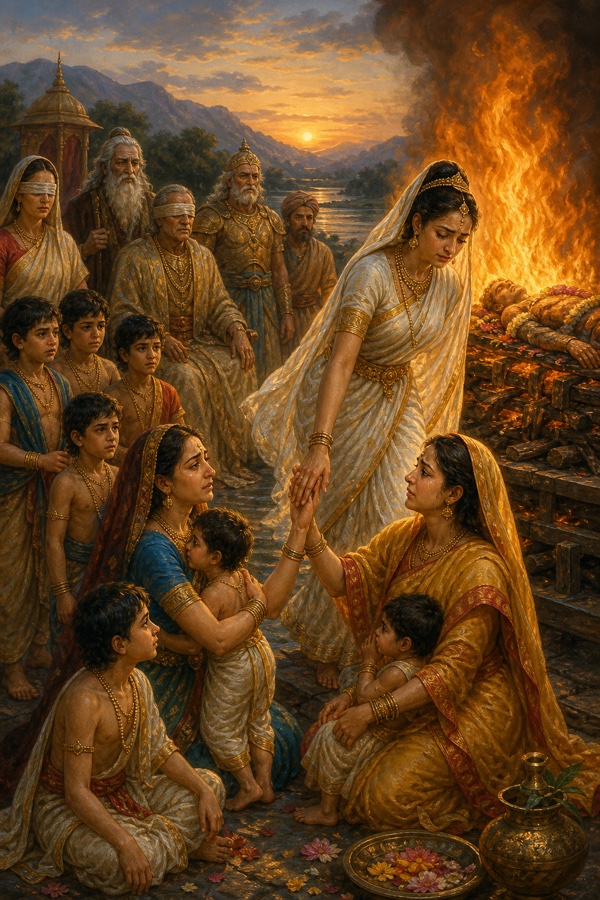
“Hold the funeral rites for Pandu and Madri in full royal style,” Dhritarashtra told Vidura. “Give away cattle, cloth, jewels, and wealth, and wrap Madri’s body so that neither the sun nor the wind may look upon it.” Vidura, in consultation with Bhishma, chose a sacred spot. The king’s body was decked with the flowers of the season and fragrant pastes, wrapped in white, and carried on men’s shoulders beneath a white umbrella and waving yak-tails, the same umbrella that had shaded him living. Thousands wept and followed, Brahmins and Kshatriyas, Vaisyas and Shudras alike. In a lovely wood on the bank of the Ganga the bodies of king and queen were laid down, washed with scented water and dressed in white, so that the king seemed alive and only sleeping on a costly bed. Then the Kauravas brought lotuses and sandal and fragrant things and set the two bodies alight. Seeing the flames, Kausalya cried out, “O my son, my son,” and fell senseless to the ground, and Bhishma and Vidura and all the rest were overcome with grief.
A key to reading this (places): Hastinapura (the Kuru capital, on the bank of the Ganga, near modern Meerut in western Uttar Pradesh); Shatashringa (the Himalayan mountain “Of a hundred peaks” where Pandu practiced his austerities); Kurujangala (the Kuru country that spread around Hastinapura).
The gist: the ascetics brought the five Pandavas and Kunti to Hastinapura, told Bhishma and Dhritarashtra who they were, and vanished before anyone could question them. The last rites for Pandu and Madri were carried out in royal style, and the five boys stayed on in a palace that already held a hundred.
The Birth of Kripa, and the First Lessons in Arms
As they grew up in Hastinapura, Duryodhana came to hate the Pandavas, and Bhima above all, because Bhima was the one who could not be beaten at anything and never once let his cousins forget it. Duryodhana tried to drown him in the river, and Bhima came back from the world of the Nagas stronger than before, having drunk their nectar. Then Duryodhana mixed poison into Bhima’s food, and Bhima digested it without harm. Yuyutsu, Dhritarashtra’s son by a Vaisya wife, warned the Pandavas of these plots, and on Vidura’s advice they swallowed their anger and kept their guard. Murder had been attempted twice before either boy had grown a beard, and the elders of the house chose to say nothing.
When King Dhritarashtra saw that the princes were idling their days away and growing unruly, he sent them to be taught by the son of Gautama, and under him the Kuru princes began to learn the use of arms. “How was Kripa born?” Janamejaya asked, and Vaisampayana told the story.
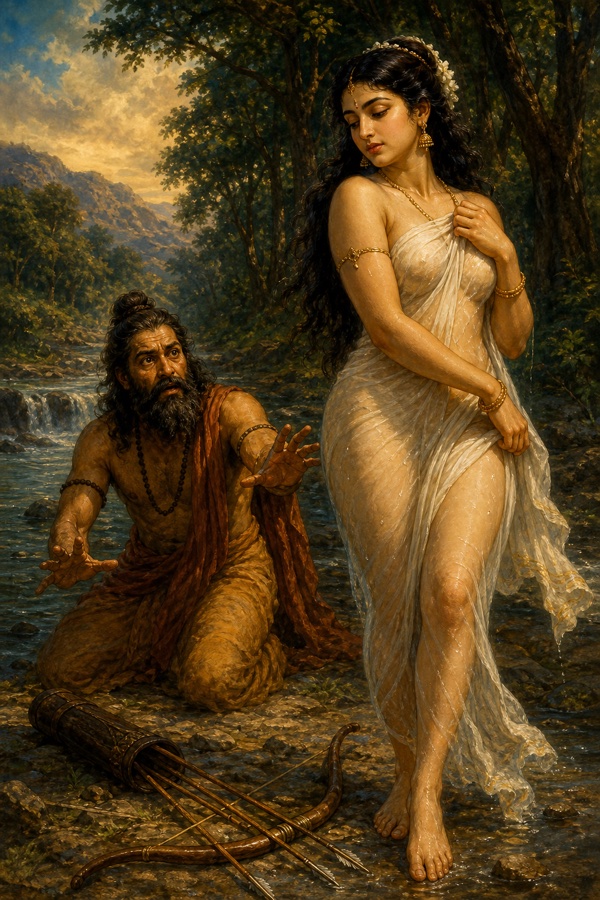
The great sage Gautama had a son named Sharadvan, who came into the world with arrows already in his hands. He had no bent for any learning except the science of the bow, and by austerities as fierce as those by which Brahmins master the Vedas he acquired every weapon. His penances made Indra himself afraid, for a mortal who masters every weapon is a threat to the king of the gods, and so Indra sent down a celestial girl named Janapadi to break them. Coming upon the ascetic alone in the woods, equipped with his bow and arrows, the girl, matchless in beauty and clad in a single piece of cloth, drew his gaze. Sharadvan’s bow and arrows slipped from his hands and his whole body shook. By the strength of his austerities he held himself, and the shock of the moment brought on an unconscious emission of his seed. Leaving his bow, arrows, and deerskin behind, he fled from her. His seed, falling upon a clump of reeds, split in two, and from the two parts sprang twins, a boy and a girl.
King Shantanu had come to that same wood to hunt. One of his soldiers, seeing the twins and the bow and arrows and deerskin lying near, understood that these were the children of some Brahmin skilled in arms, and brought them to the king. Moved by pity, the king said, “Let these be my children,” took them to his palace, and performed the usual rites for them. Because it was pity, kripa, that had moved him, he named them Kripa and Kripi, and the boy carried the reason for his own rescue in his name for the rest of his life. Meanwhile Sharadvan, the son of Gautama, learned by his inner sight that his son and daughter were in Shantanu’s palace. He came to the king, told him of his lineage, and taught Kripa the four branches of the science of arms and every other secret of that knowledge. In a short time Kripa became a renowned master of arms, and the hundred sons of Dhritarashtra, the Pandavas, the Yadavas, the Vrishnis, and princes from many lands began to take their lessons from him.
A key to reading this (terms): kripa (pity), from which the names Kripa and Kripi come; apsara (a celestial woman of the heavens, often sent to break an ascetic’s penance); the four branches of the science of arms (the skills of holding, hurling, aiming, and recalling weapons).
The gist: born on a clump of reeds from Sharadvan’s seed, the twins Kripa and Kripi were raised by Shantanu, who named them both for the pity that made him stop. Kripa became a master of arms and gave the Kuru princes their first lessons.
The Birth of Drona, and the Weapons from Parasurama
Bhishma wanted a finer teacher for his grandsons, and searched for a master radiant with energy and complete in the science of arms. He settled on Drona, the son of Bharadwaja, learned in all the Vedas, and set him over the Kuru princes. It was the most consequential appointment Bhishma ever made, and he made it for the best of reasons. “How were Drona and his son Ashvatthama born?” Janamejaya asked, and Vaisampayana told the story in full.
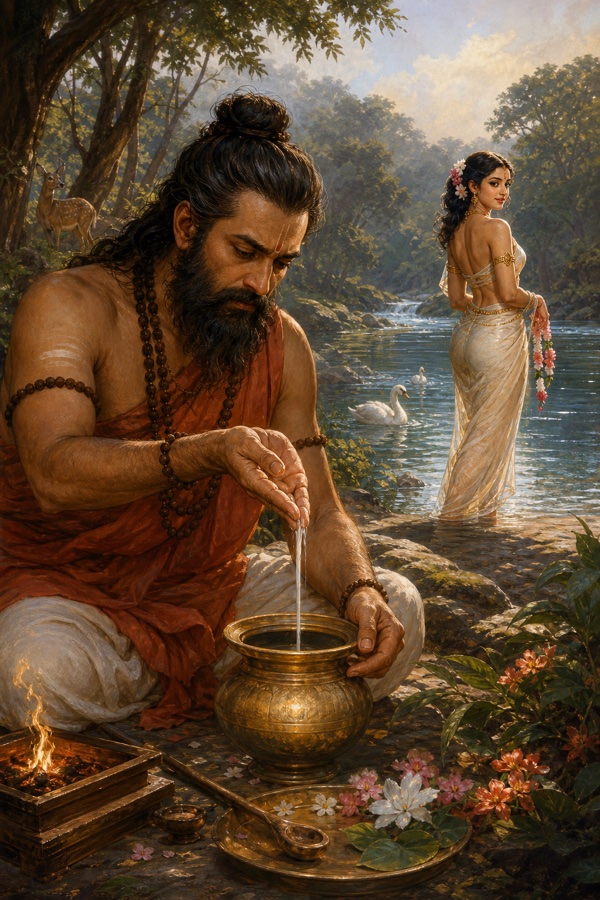
At the source of the Ganga a great sage named Bharadwaja kept the most rigid vows. One day, going down to the river to bathe before his fire-sacrifice, he saw the Apsara Ghritachi rising from the water, her loose attire disordered by the wind. A sharp surge of desire took the sage, and his seed came forth, which he caught at once in a vessel called a drona. From the seed kept in that vessel Drona was born, and he carried the name of the pot he was born in, and he studied all the Vedas and their branches. Bharadwaja had earlier given the knowledge of the weapon called Agneya to Agnivesa, and now Agnivesa passed that great weapon on to Drona, his teacher’s son.
Bharadwaja had a friend, the king Prishata, whose son Drupada came every day to the hermitage to play and study with Drona. They shared everything a hermitage has, which is very little, and they shared it as equals. When Prishata died, Drupada became king of the northern Panchalas, and about the same time Bharadwaja ascended to heaven. Drona stayed on in his father’s hermitage in penance, and at his father’s bidding married Kripi, the sister of Kripa. From that woman, ever devoted to the fire-sacrifice and to austerity, Drona had a son, radiant as the sun. At his birth the child neighed like the celestial horse Ucchaihsravas, and a voice from the sky named him Ashvatthama, the horse-voiced. Drona rejoiced in this son.
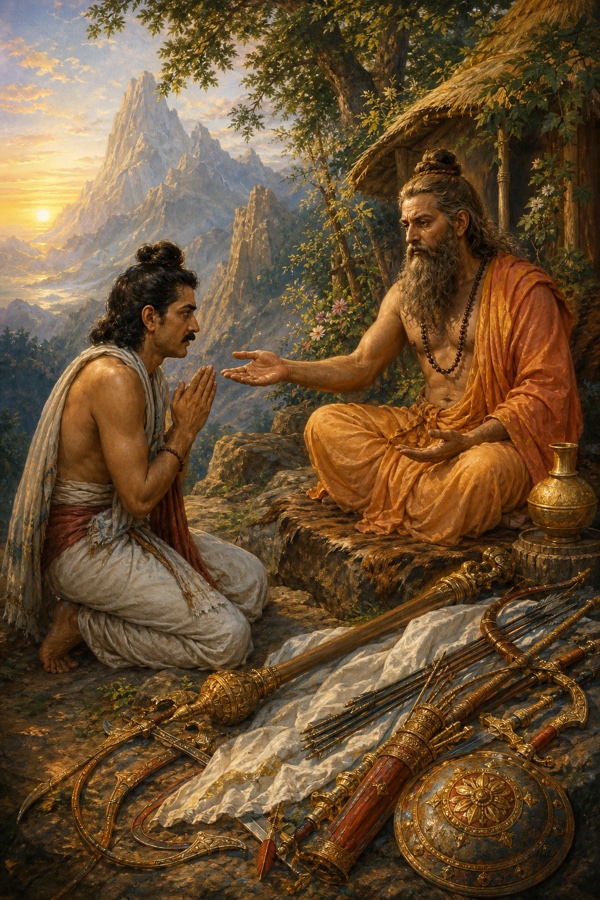
About this time Drona heard that Rama, the son of Jamadagni, wished to give away all his wealth to the Brahmins. Longing for Rama’s knowledge of arms, his celestial weapons, and his knowledge of dharma, Drona set out with his disciples for Mount Mahendra. There he touched the feet of Rama of the Bhrigu line, named himself as the son of Bharadwaja, and spoke of his birth in the line of Angiras. “I have come in hope of your wealth,” he said.
“My gold and my wealth have already gone to the Brahmins, and the whole earth to the sea’s edge has been given to Kasyapa,” Rama answered. “Only my body and my many precious weapons remain, and of these you may take whatever you wish.” Drona asked for all the weapons, together with the secrets of hurling and recalling them. “So be it,” said Rama, and gave him the whole science of arms with its mantras and its mysteries. Counting himself fulfilled, Drona set out with a glad heart for the city of his friend Drupada.
A sub-tale: the boyhood friendship of Drona and Drupada becomes the root of one of the great enmities of the Mahabharata. Two boys raised as equals grow into unequal men, and the story of how that friendship breaks unfolds from this very link.
The gist: born from seed kept in a vessel called a drona, Drona married Kripi and had a son, Ashvatthama. From Parasurama he received every celestial weapon, along with the secret mantras for their use, and walked away from that mountain the most dangerous poor man in the world.
Drupada’s Insult, and the Road to Hastinapura
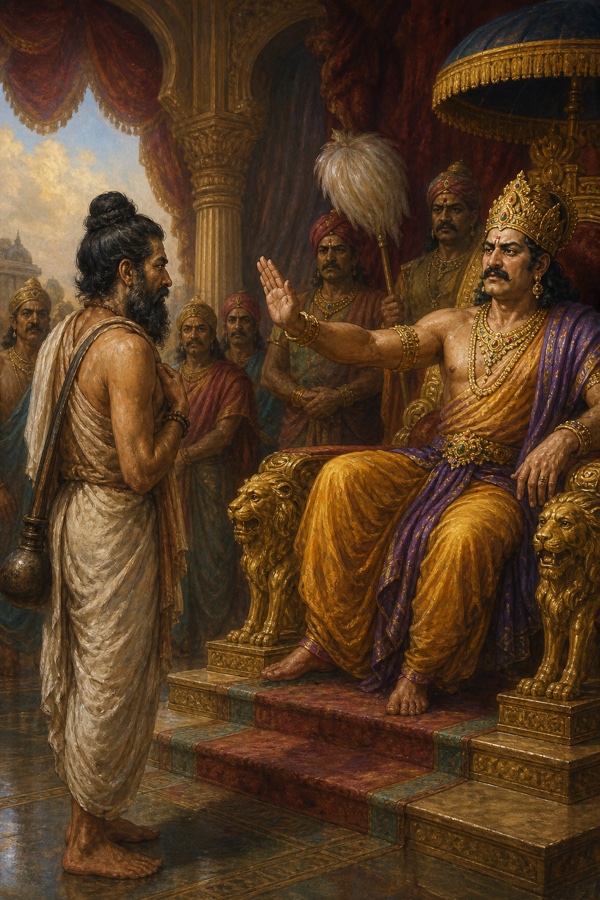
Drona came before Drupada and said, “Know me for your friend.” The king, drunk on the pride of his wealth, could not bear to hear it. His brows drew together in anger and his eyes reddened. “Your judgment, Brahmin, is hardly of a high order, that you should say all at once that you are the king’s friend,” he said. “Great kings can never be friends with luckless, penniless men like you. It is true there was friendship between us once, but we were then equally placed. Time wears down everything in its course, and friendship with it. There is no friendship between a poor man and a rich one, between the unlettered and the learned, between a coward and a hero. One who is not a king can never have a king for a friend.”
At these words Drona filled with anger. He thought for a moment, fixed his course, and resolved to break the pride of Panchala thoroughly. He said nothing at all in reply, which should have frightened Drupada more than any answer. Leaving the Panchala capital at once, he turned his steps toward Hastinapura.
The gist: when Drona came to him as a friend, Drupada, drunk on his wealth, insulted him, saying friendship cannot last between unequal men. Humiliated, Drona resolved to answer the insult and left for Hastinapura to find the hands that would do it for him.
The Ball in the Well, and a Teacher Revealed
At Hastinapura, Drona lived for a time quietly in the house of Kripa, the son of Gautama, a man holding the weapons of Parasurama in his hands and telling nobody. His son Ashvatthama, in the gaps between Kripa’s lessons, would give the sons of Kunti instruction in arms, though as yet no one knew what Ashvatthama could do. One day the princes came out of the city to play with a ball, and the ball fell into a well. They tried hard to recover it and could not, and stood looking at one another in embarrassment.
Just then they saw nearby a Brahmin of dark complexion, lean and worn, sanctified by his fire-sacrifice, who had finished his daily worship. The princes crowded around him. Drona, for the Brahmin was no one else, saw them at a loss. “Shame on your Kshatriya strength and your skill in arms, that, born in the race of Bharata, you cannot lift a single ball,” he said with a slight smile. “If you will promise me a dinner this day, I will bring up your ball with these blades of grass, and this ring besides, which I now throw into the well.” And with that Drona took off his ring and dropped it into the dry well.
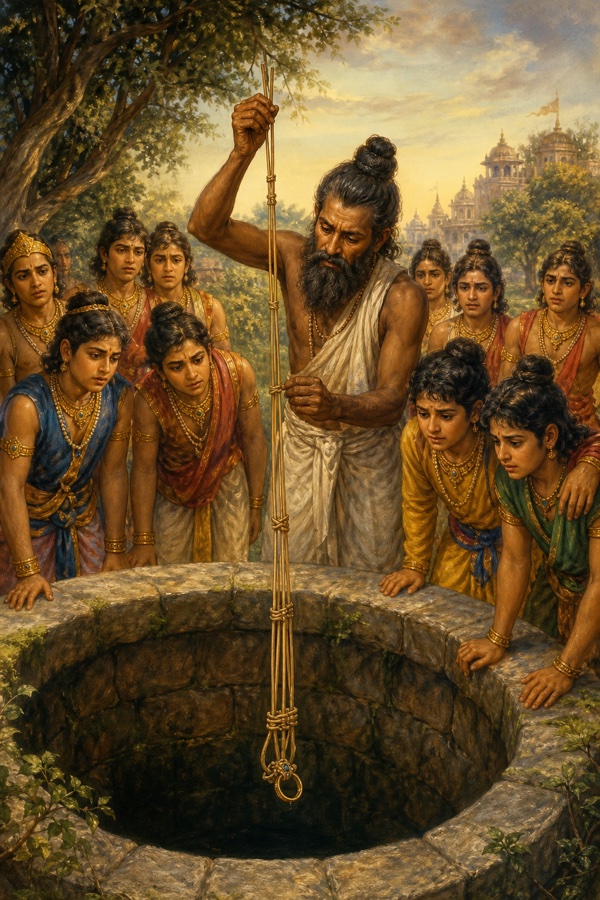
Yudhishthira said, “Brahmin, you ask for a trifle. With Kripa’s leave, take from us something that will last you your whole life.”
Drona smiled. “I will charge these blades of grass, by my mantras, with the power of weapons,” he said. “I will pierce the ball with one blade, then that blade with a second, and so make a chain and draw the ball up.” He did exactly as he said, and the princes stared in astonishment. Then they asked him to bring up the ring as well. Drona set an arrow to his bow, pierced the ring, and lifted it out still fixed on the shaft, and calmly gave it back to them.
The princes bowed. “No one else holds such skill,” they said. “Who are you, and whose son? What can we do for you?”
“Go to Bhishma and describe my likeness and my skill,” Drona told them, “and that great man will know me.” When the princes told Bhishma all of it, he understood at once that the Brahmin was Drona, and judging that he would make the teacher for the princes, went in person to bring him back with honor.
The gist: Drona showed his skill by lifting the fallen ball out of the well with mantra-charged reeds and the ring with a single arrow. From the princes’ account Bhishma recognized him and sent for him with honor, which is precisely what Drona had come to Hastinapura to arrange.
Drona’s Story, and Bhishma’s Welcome
“Why have you come to Hastinapura?” Bhishma asked Drona, and Drona told him everything. He had lived many years as a celibate student in the service of the sage Agnivesa, and there the Panchala prince Yajnasena, that is Drupada, had become his boyhood friend. To please him, Drupada used to say, “When I am made king of the Panchalas, my kingdom and my wealth and my happiness shall all be yours.”
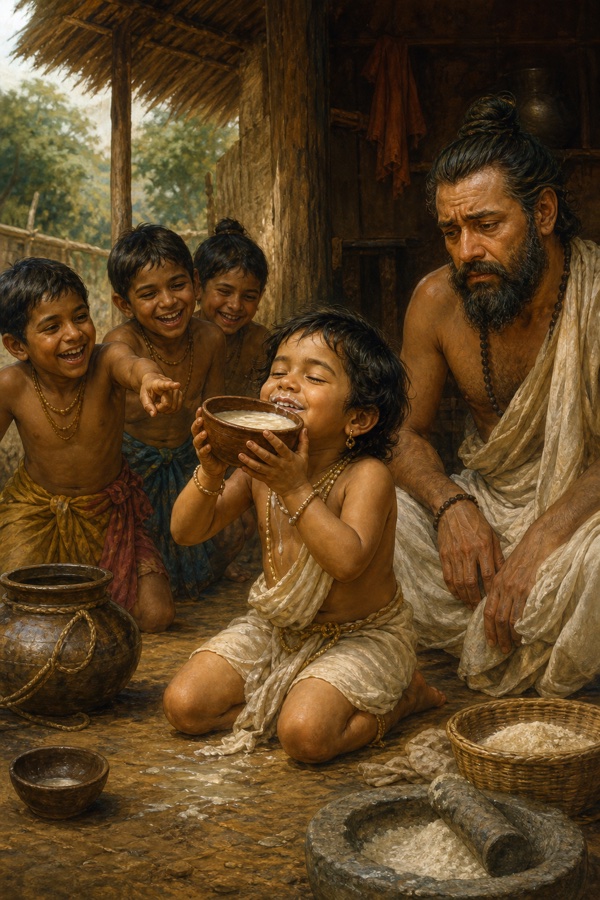
Drona went on. At his father’s bidding he had married Kripi and had a son, Ashvatthama. One day the boy, seeing the sons of rich men drink milk, began to cry, and Drona was so shaken that he lost all sense of direction. He could not so much as find a single cow, and while he was away and returning empty-handed, his son’s playmates gave the boy water mixed with powdered rice, and the trusting child, thinking it milk, danced about crying, “I have taken milk, I have taken milk.” The laughter of the boys and the jeers of the neighbors cut Drona to the heart, and he resolved that he would never, for the sake of wealth, become anyone’s servant. Then, for the sake of the old friendship, he took his wife and son to Drupada, and Drupada mocked him and cast him off. “I remember no promise of friendship,” the king said, “though I can spare you a single night’s food and shelter.” Filled with that insult, Drona had come to the Kurus in search of worthy and willing pupils.
“Brahmin, string your bow and make the Kuru princes masters of arms,” Bhishma said. “Whatever wealth and sovereignty and kingdom the Kurus hold, you are its lord, and by your coming we are blessed beyond measure.”
A sub-tale: the episode of Ashvatthama and the “Milk” plants two things at once in Drona’s heart, the pain of poverty and the fire of revenge against Drupada. Later in the story Drona will ask his pupils for that very revenge as his guru-fee, and so a private insult will spread outward into the war of the generations to come. A child crying for milk is where the Kurukshetra war quietly begins.
The gist: Drona told Bhishma the whole story, his boyhood friendship with Drupada, the episode of Ashvatthama’s milk, and the insult. He hid none of it. Bhishma set him in the office of teacher with full honor.
The Training in Arms, and Arjuna’s Focus
Bhishma gave Drona a clean and handsome house filled with paddy and every kind of wealth, and made his grandsons, the sons of Pandu and of Dhritarashtra, his pupils, with rich gifts besides. One day Drona called all the princes together in private and had them touch his feet. “There is a purpose in my heart,” he said. “Promise me truly that when you have become skilled in arms you will accomplish it.” The others kept silent, but Arjuna promised to do it, whatever it might be. Drona clasped Arjuna to his heart and took the scent of his head again and again, shedding tears of joy.
Drona taught the sons of Pandu many weapons, both celestial and human. The Vrishnis and the Andhakas, princes from many lands, and Radha’s foster son of the Suta caste, Karna, all became his pupils. Of them all, Karna, out of jealousy, kept defying Arjuna, and with Duryodhana’s backing slighted the Pandavas. Arjuna, out of devotion to the science of arms, always stayed close to his teacher, and in skill, in strength of arm, and in perseverance he outran all his fellow-pupils. Though the teaching was the same for everyone, in lightness of hand Arjuna became the first of them, and Drona grew certain that no pupil of his would ever equal this son of Indra.
Drona wished to give his own son Ashvatthama a special training. So he would hand his pupils narrow-mouthed vessels to fetch water, which took long to fill, and gave Ashvatthama a broad-mouthed one, so that his son might fill it quickly and return, and in the time so gained Drona could teach him finer methods. Arjuna saw through the trick. Filling his narrow vessel at once with the Varuna weapon, he began to return alongside the teacher’s son, and so fell behind in nothing. The teacher was cheating for his own blood, and the boy said nothing about it and simply refused to be left behind.
Drona secretly told the cook never to serve Arjuna his food in the dark. One day, while Arjuna was eating, the wind put out the lamp, yet his hand kept going to his mouth by habit. From this he understood the force of practice: the hand can learn a road so well it no longer needs the eyes. He set himself to shoot with his bow in the dark of night. Hearing the twang of the bowstring at night, Drona came to him, held him close, and said, “I tell you truly, I will make you such that there shall be no archer in this world to equal you.” After this Drona taught Arjuna to fight from horseback, from elephants, from a chariot, and on the ground, and to use the mace, the sword, the lance, the spear, and the dart, and to fight many enemies at once. Hearing of his skill, thousands of kings and princes flocked to Drona to learn the science of arms.
A key to reading this (terms): Suta (the mixed caste in which Karna was raised, though he was in truth a son of Kunti); the Varuna weapon (the celestial weapon of water); celestial and human weapons (arms perfected by the mantras of the gods, and ordinary ones, both kinds).
The gist: Drona taught all the princes the science of arms, and through focus and hard work Arjuna outstripped them and became the teacher’s favorite. Seeing him driven to practice through the night, Drona promised to make him an archer without equal. That promise is about to cost someone else everything.
Ekalavya, and a Thumb for the Guru’s Fee
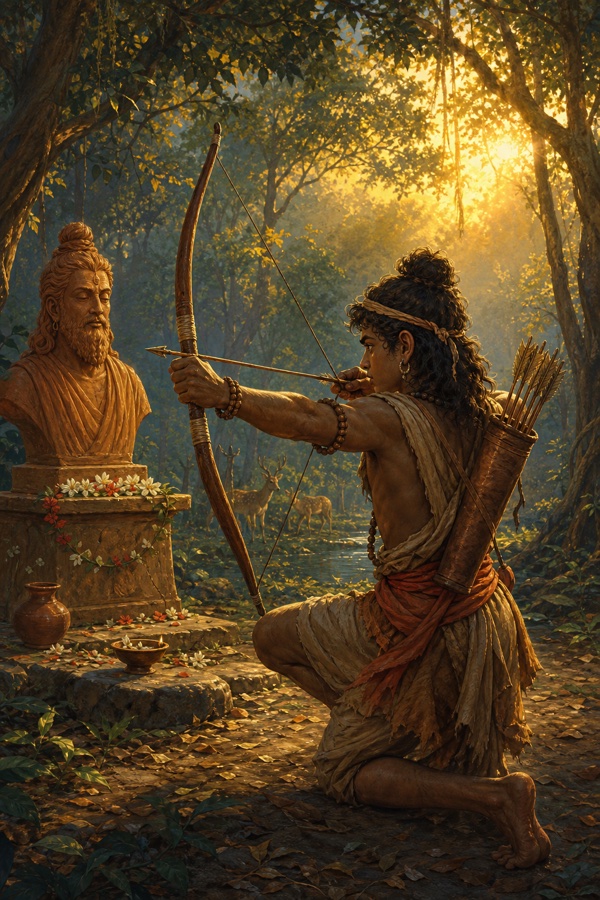
Among those pupils came a prince named Ekalavya, the son of Hiranyadhanus, king of the Nishadas. Drona, who knew all the rules of dharma, would not take him as a pupil in archery, seeing that he was a Nishada who might in time outstrip his high-born students. The refusal was not about talent. Drona had seen the talent, and that was the difficulty. Ekalavya bowed his head, touched Drona’s feet, and went off into the forest. There he made a clay image of Drona, and honoring it as his true teacher, he practiced before it under the most rigid discipline, giving his devotion to a man who had turned him away and never once holding it against him. Through his rare reverence for his teacher and his fidelity to his purpose, the three acts of fixing the arrow, aiming, and loosing became wholly easy for him.
One day the Kuru and Pandava princes, with Drona’s leave, went out into the forest to hunt. A servant followed slowly behind them with a dog and the usual gear. As it wandered, the dog came upon Ekalavya, and seeing this man of dark hue, his body smeared with filth, clad in black and wearing matted locks, the dog began to bark. To show his lightness of hand, Ekalavya, before the dog could shut its mouth, filled its open mouth with seven arrows. Seven arrows into a moving target he could not see, placed by sound alone, and not a drop of blood. The dog, pierced with seven arrows, came back to the Pandavas. The heroes stared at the sight, ashamed of their own skill, and marveled at the hand and the aim by sound alone of that unknown archer.
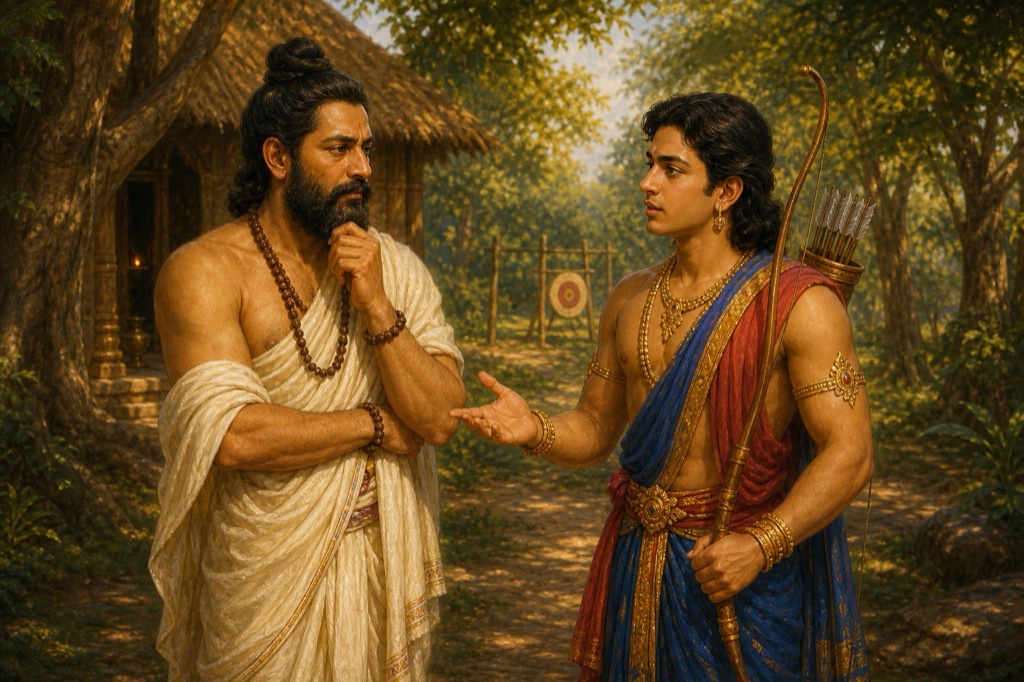
They searched the forest and found Ekalavya, still loosing arrow after arrow. Seeing his fearsome figure, they asked who he was and whose son. “I am the son of Hiranyadhanus, king of the Nishadas,” he answered, “and you should know me for a pupil of Drona, laboring for mastery of the art of arms.” He said it with pride. He had no idea what he had just done to himself. The Pandavas went back and told Drona of the wonderful archery they had seen. Arjuna, turning Ekalavya over and over in his mind, went to Drona in private and leaned on his teacher’s affection. “You held me to your heart and told me lovingly that no pupil of yours would ever equal me,” he said. “How then is this son of the Nishada king greater than I am?”
Drona thought for a moment, fixed on his course, and took Arjuna with him to Ekalavya. He found the boy, his body smeared with filth, his hair matted, dressed in rags, bow in hand, ceaselessly loosing arrows. Seeing Drona come, Ekalavya stepped forward, touched his feet, lay flat on the ground before him, and stood with folded hands. “I am your pupil, and I wait upon your command,” he said. He had waited years for this visit.
“If you are truly my pupil, you must give me my fee,” Drona said then.
“There is nothing I would not give my teacher,” Ekalavya answered with joy. “Do but command me.”
“If you truly mean to give me something,” Drona said, “give me the thumb of your right hand.” The thumb that draws the string. Without it no man alive can shoot.
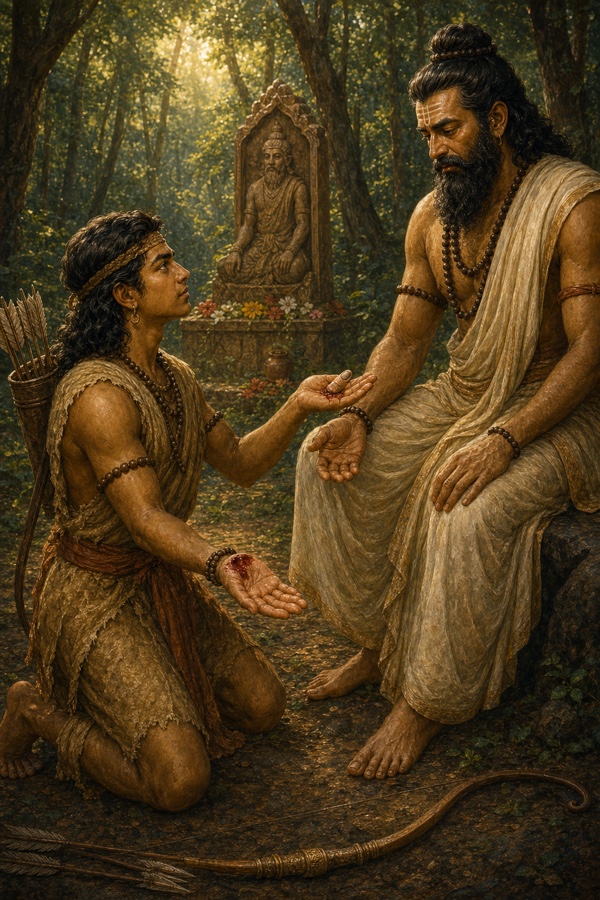
Hearing these hard words, Ekalavya, devoted to truth and set on keeping his promise, with a glad face and an untroubled heart cut off his thumb without hesitation and gave it to Drona. He did not ask why, and he did not stop smiling. After that, when the Nishada boy shot with his remaining fingers, his old lightness of hand was gone. Seeing this, Arjuna was content, and the fever of his jealousy left him.
A sub-tale: the Mahabharata glorifies no one here. Ekalavya’s devotion is beyond compare, and Drona’s demand is just as harsh, weighted with inequality, and the text itself calls his words “Cruel.” To keep his high-born pupil Arjuna at the top, the teacher took from a Nishada boy the very art he had mastered. The story does not hide this injustice, and does not justify it; it holds the injustice up in its full ugliness, so that you can see for yourself the fine line that runs between dharma and its opposite.
A key to reading this (terms): Nishada (a forest-dwelling people, whom the text calls “The lowest of the mixed orders”); guru-dakshina (the gift given to a teacher when one’s schooling is complete); shabda-bhedi aim (loosing an arrow at a target by sound alone).
The gist: though Drona had refused him, Ekalavya reached extraordinary skill by practicing before a clay image of the teacher, which is to say he was taught by no one and outshot everyone. To keep Arjuna’s supremacy untouched, Drona asked for his right thumb as the guru-fee, and Ekalavya cut it off and gave it without a moment’s hesitation.
Source: the Mahabharata of Krishna-Dwaipayana Vyasa, Adi Parva, Sambhava sub-parva, Sections 109 to 134. The Sanskrit e-text, the Gita Press Hindi edition, and Kisari Mohan Ganguli’s complete English translation were used to verify names, sequence, and principal events. Where the recensions differ, this English retelling follows Ganguli, and the Hindi edition follows Gita Press.
Based on the Mahabharata of Vedavyasa (Gita Press, Gorakhpur)