On this page
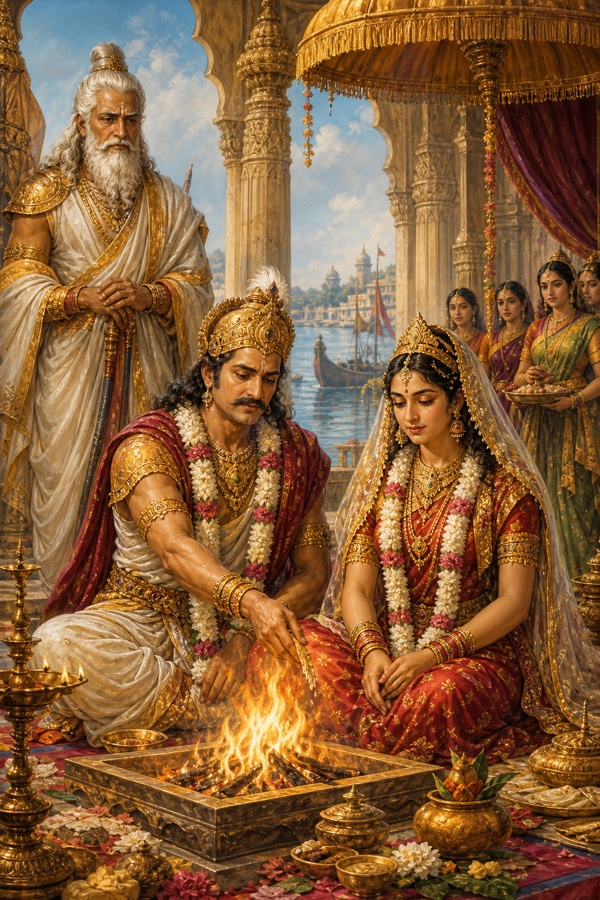
When Satyavati came into Shantanu’s house, the current of the Kuru line turned in a new direction, and it never turned back. She bore Shantanu two sons, and the story that opens behind those two is one of marriage, abduction, death, and a custom the scriptures call niyoga (raising offspring for a childless house through an appointed man, so the line survives). A dynasty that had ruled for generations comes within one death of ending here, and what saves it will trouble it forever after. Vaisampayana, Vyasa’s disciple, told it to King Janamejaya in this order.
Satyavati’s two sons: Chitrangada and Vichitravirya
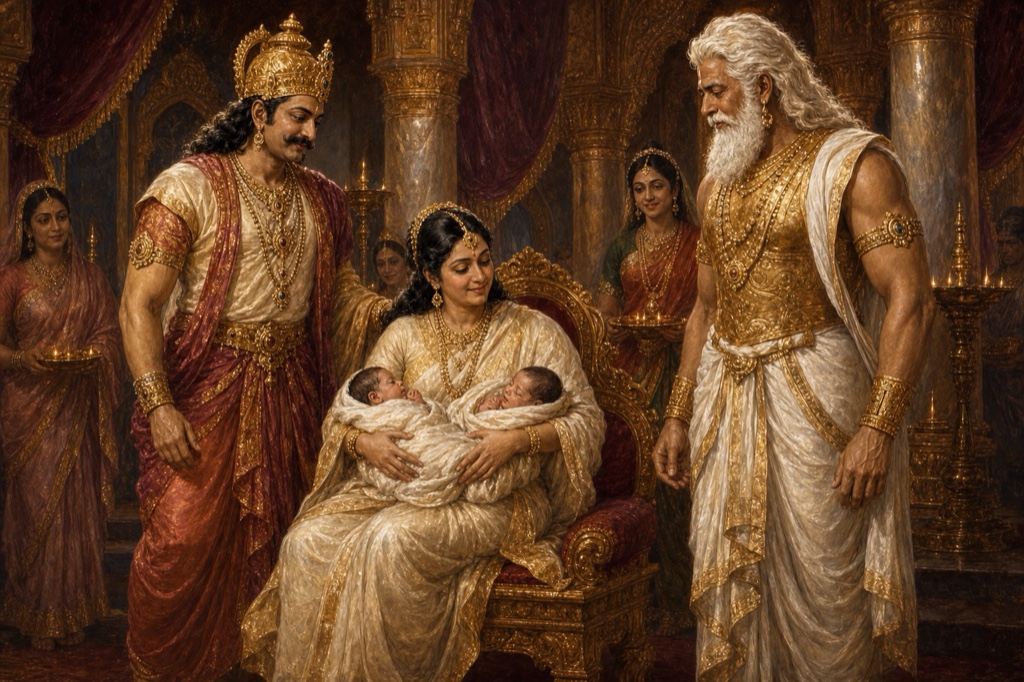
“When the wedding was over, Shantanu settled his beautiful bride in his household, and before long she gave him a son,” Vaisampayana said. They named the boy Chitrangada. He was quick and bold, charged with a great energy, and he grew into a man other men measured themselves against. Then Shantanu, whose own prowess was famous, fathered a second son on Satyavati, and this one they called Vichitravirya. He would become a formidable archer, and after his father he would be king.
Vichitravirya was still short of manhood when Shantanu felt the pull of time that spares no one. After the king ascended to heaven, Bhishma, holding himself under Satyavati’s command, set Chitrangada on the throne. He could have taken it himself in a breath, and every man in the hall knew it, and not one of them expected him to. The young king soon subdued every monarch by sheer force of arm and came to think no man his equal. He could overcome men, Asuras, and the gods themselves, and it was this that drew down on him an opponent of his own name: a powerful king of the gandharvas, the celestial singers who fight as well as they sing, also called Chitrangada, who came to challenge him to single combat.
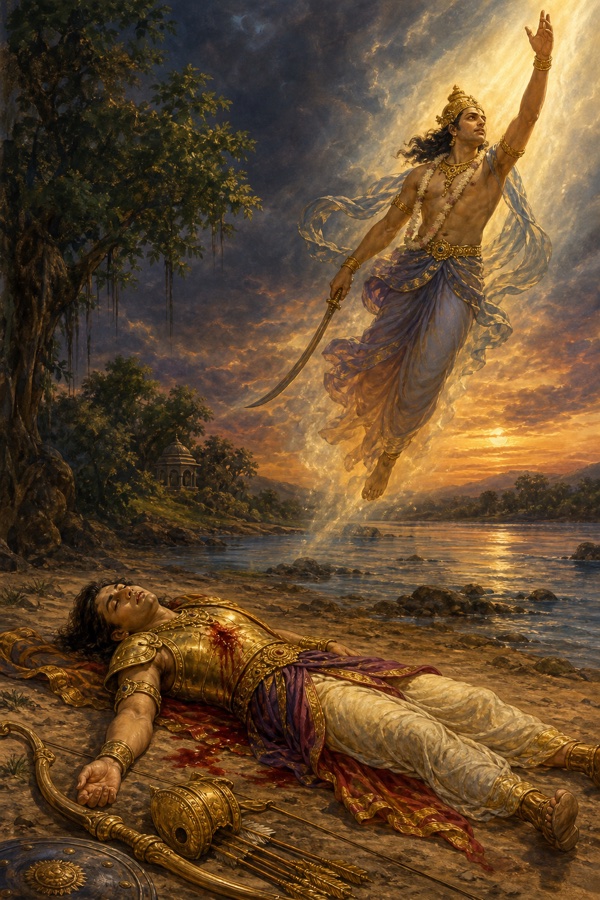
The two Chitrangadas, prince and gandharva, were both immense in strength, and their war was terrible. It was fought on the field of Kurukshetra, on the banks of the Saraswati, the same plain that will one day take in eighteen armies and give nothing back, and it ran for three full years. Through those years of dense, ceaseless volleys of weapons, with the two grinding at each other without mercy, the gandharva, who held the edge in strength or in cunning of strategy, at last struck the Kuru prince down. Having killed Chitrangada, the gandharva rose again to heaven, and the Kurus were left with a corpse and a boy.
When that warrior, so richly gifted with prowess, lay dead, it was Bhishma, Shantanu’s son, who performed all his funeral rites. Then he set Vichitravirya, still a boy, still a minor, on the throne of the Kurus, and the young king ruled his ancestral kingdom under Bhishma’s command. Vichitravirya honored Bhishma, who knew every rule of religion and law, and Bhishma in turn watched over a brother so faithful to his duty.
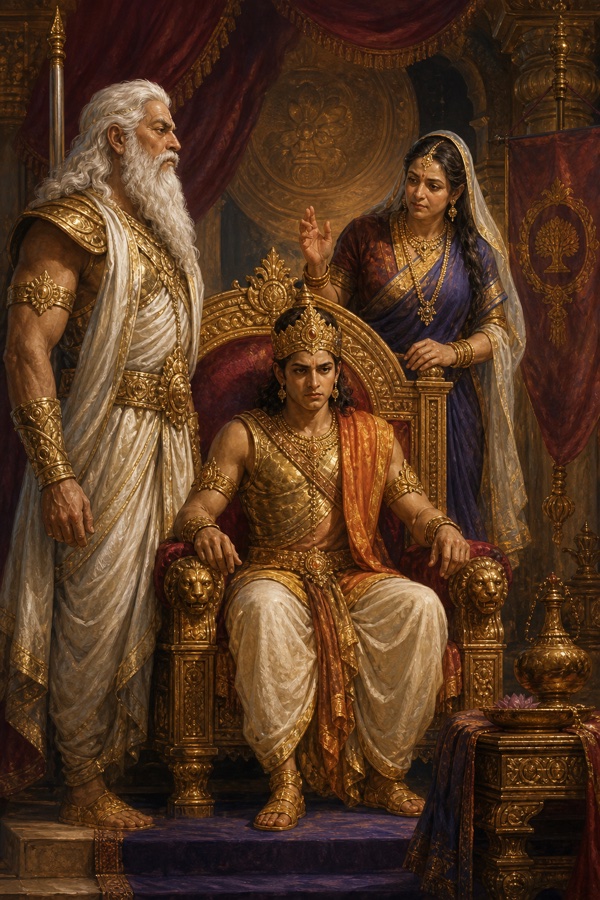
The gist: Satyavati bore Shantanu two sons, Chitrangada and Vichitravirya. After Shantanu ascended to heaven, Bhishma, acting under the queen mother Satyavati’s command, first made Chitrangada king; a gandharva king of the same name then killed him after a war of three years. Bhishma set the young Vichitravirya on the throne. Of Shantanu’s three sons, one has renounced the crown and one is already ashes; everything now hangs on the boy.
Bhishma carries off the three daughters of the king of Kasi
“With Chitrangada dead and his heir Vichitravirya a minor, Bhishma governed the kingdom under Satyavati’s command,” Vaisampayana said. When he saw that his brother, keenest of intelligent men, had come of age, he turned his mind to finding Vichitravirya a wife. Word reached him just then that the three daughters of the king of Kasi, each as lovely as an apsara, would choose their husbands at a single self-choice ceremony.
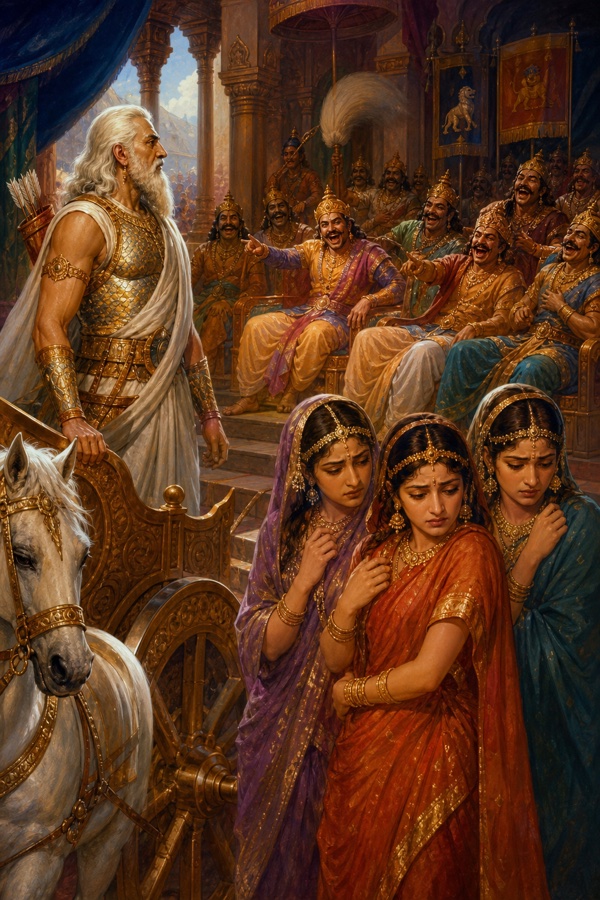
So that warrior rode alone in a single chariot to the city of Varanasi at his mother’s command. One chariot, one man, into a city filled with the armies of every king who had come courting. There Bhishma saw that countless kings had gathered from every direction, and he saw the three maidens who had come to choose. As each king was being named in turn to the assembly, Bhishma chose all three for his brother. He lifted them onto his chariot, and then, first among those who strike in battle, he spoke to the assembled kings and to the king of Kasi in a voice as deep as thunder in the clouds.
A sub-tale: There, before them all, Bhishma named the eight forms of marriage, since a man who is about to break a room full of kings may as well first show them the law. The wise, he said, hold it best when an accomplished man is invited and a maiden, decked in ornaments, is given to him along with many rich gifts. Some fathers bestow a daughter in return for a pair of cattle; some for a fixed price in wealth; and some carry maidens off by force. Some wed a girl with her own consent; some drug her into consenting; and some go to her parents and win their sanction. Some men take wives as the fee for officiating at a sacrifice. Of all these, the learned always praise the eighth. Kings praise the self-choice ceremony, the fifth form, and marry by it. The sages, though, have said that the wife most dearly to be prized is the one carried off by force, after the rival suitors are cut down, from the very midst of the kings gathered at a self-choice. He had just described, to their faces, what he was about to do to them.
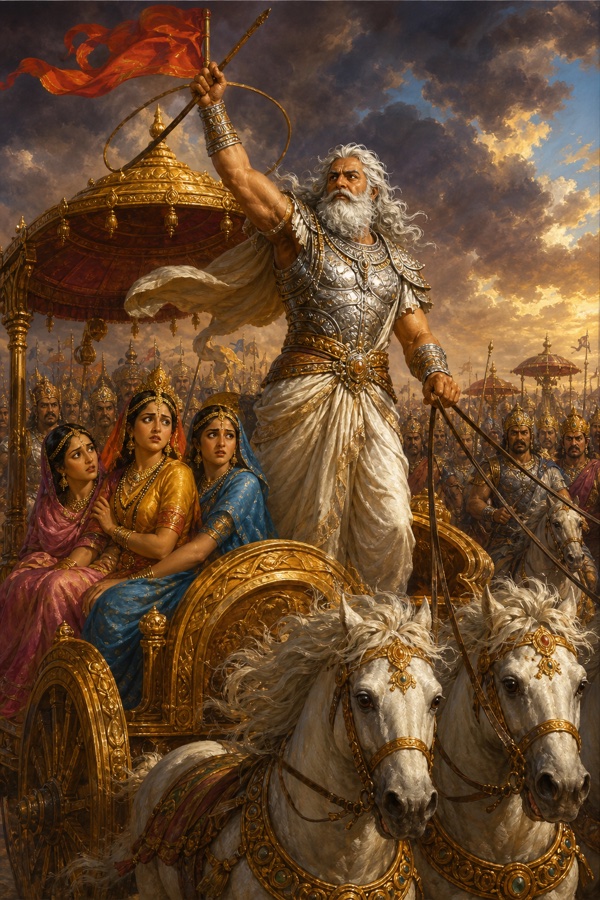
“So, kings, I carry these maidens away from here by force,” Bhishma declared. “Try with all your strength to conquer me, or to be conquered. I stand here ready to fight.”
Having addressed the gathered kings and the king of Kasi, the Kuru prince of great energy took the three maidens onto his chariot and sped it away, challenging the invited kings to come after him. Not one of the three had been asked.
At that the challenged kings sprang up, slapping their arms and biting their lips in fury. In frantic haste they flung off their ornaments and buckled on their armor, and the noise they raised was enormous. The flash of their jewels and mail was like meteors streaking the sky. Brows knotted, eyes red with rage, the kings surged forward without patience. Their charioteers hurried up handsome chariots yoked to fine horses, and the warriors, armed with every kind of weapon, mounted and gave chase to the retreating chief of the Kurus, their weapons raised high.
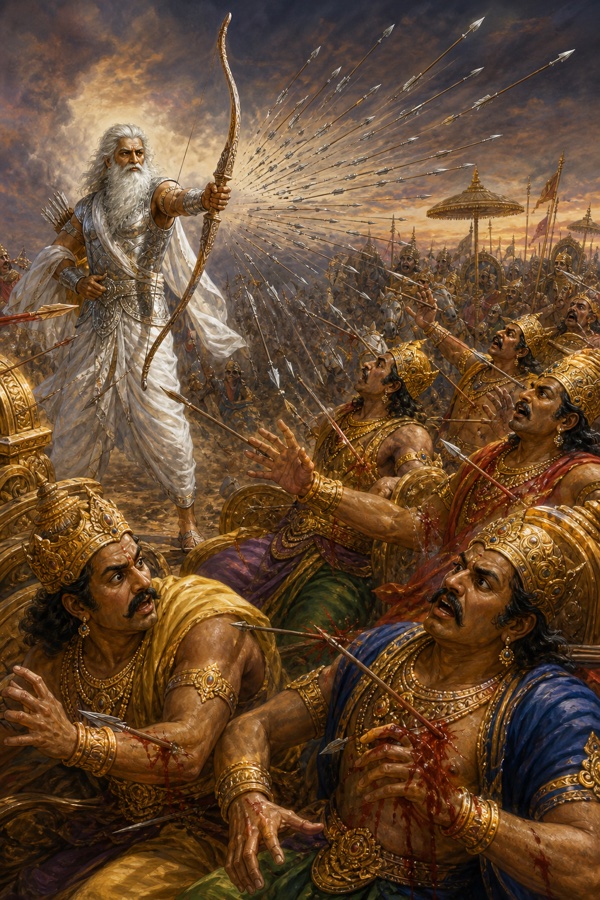
Then, between those countless kings on one side and the lone Kuru warrior on the other, a fearful battle broke out. The massed kings loosed ten thousand arrows at their enemy all at once. Bhishma checked every one of them before they could reach him, with a shower of his own shafts as thick as the down on a body. The kings ringed him about and rained arrows on him like storm clouds bursting on a mountain peak; and Bhishma, stopping that downpour with his own arrows, pierced each king with three shafts. They struck back, five shafts to a man. He held them off by sheer prowess and pierced each contending king with two more, keeping count while they lost theirs.
So dense was the storm of arrows and other missiles that the fight came to look like the ancient war between the gods and the Asuras, and even brave men who took no part in it trembled to watch. Bhishma sheared away bows and flagstaffs and coats of mail and human heads by the hundred and the thousand. His prowess was so terrible, his hand so unnaturally quick, and his self-defense so skilled that even the enemy chariot-warriors broke into loud praise of him, which is the rarest sound on any field: men cheering the man who is beating them. Then, having beaten every one of those kings, that foremost wielder of weapons took the road to the Bharata capital with the maidens beside him.
A key to reading this (a concept): In episodes like the levirate and marriage by abduction, the Mahabharata refuses to be morally simple. Bhishma seizes the maidens by force and calls it a sanctioned form of a warrior’s dharma, and this same act sets in motion the tragedy of Amba that follows, which will circle back to him decades later on a field of arrows. The text neither hides these deeds nor smooths them over by justifying them.
Bhishma’s duel with Shalya
It was then, on the road home, that the great chariot-warrior Shalya, a king of immeasurable strength, called out to Bhishma from behind and dared him to fight. Hungry for the maidens, he bore down on Bhishma the way a powerful bull elephant, catching sight of a cow in heat, charges another of his kind and rips at its haunches with his tusks. “Stay, stay,” Shalya shouted, driven by anger.
At those words Bhishma, that grinder of hostile armies, flared up in wrath like a fire fed fresh fuel. Bow in hand, his brow furrowed, he checked his chariot in the manner of a warrior and waited for his enemy, which is its own kind of answer. Seeing him halt, all the kings drew up too, to watch the coming clash between him and Shalya. The two began to show their power against each other like two great bulls bellowing at the sight of a cow in season.
King Shalya covered Bhishma with hundreds upon hundreds of swift arrows. Seeing Shalya bury Bhishma in shafts from the very first, the watching kings were amazed and shouted their approval. His speed of hand delighted the crowd of royal onlookers, and they praised him loudly. Hearing the Kshatriyas cheer his rival, Bhishma grew hot with anger and cried again, “Stay, stay.”
“Take my chariot to where Shalya stands,” he ordered his charioteer, “so I may kill him on the spot, as Garuda kills a snake.”
Then the Kuru chief fitted the Varuna weapon to his bowstring and with it tormented Shalya’s four horses. Warding off his enemy’s shafts with his own, he killed Shalya’s charioteer. Fighting for the sake of the maidens, Bhishma next brought down Shalya’s noble steeds with the Aindra weapon. He defeated that king, and then he let him keep his life. He had come for a wedding, and he took only what a wedding needed.
After his defeat Shalya went back to his own kingdom and ruled it well, carrying a grudge that would find its way to Kurukshetra in the end. And the other kings who had come to witness the self-choice ceremony returned, each to his own land.
The gist: Bhishma carried off all three daughters of the king of Kasi from the self-choice ceremony and beat every assembled king in battle. King Shalya pursued him, and in their duel Bhishma killed Shalya’s horses and charioteer and defeated him, then spared his life. Shalya and the rest of the kings returned to their own realms, and the three princesses rode on to a city none of them had chosen.
Amba’s release, the marriage of Ambika and Ambalika, and the death of Vichitravirya
Having beaten those kings, Bhishma set out with the maidens for Hastinapura, where Vichitravirya ruled the earth as his father Shantanu had before him. Crossing many forests and rivers and hills and thick stands of trees, he reached the capital in no time. The son of the ocean-going Ganga had killed numberless enemies in battle without a scratch on his own person, and he brought the daughters of the king of Kasi to the Kurus as gently as if they were his own daughters-in-law, his younger sisters, or his daughters.
Wanting only his brother’s good, Bhishma presented these accomplished maidens to Vichitravirya. Then, versed in every dictate of virtue and having achieved so extraordinary a feat by the custom of kings, Shantanu’s son set about preparing his brother’s wedding. When everything about the wedding had been arranged between Bhishma and Satyavati, when the fires were ready and nothing remained but the rites, the eldest daughter of the king of Kasi came to him and, with a soft smile, spoke.
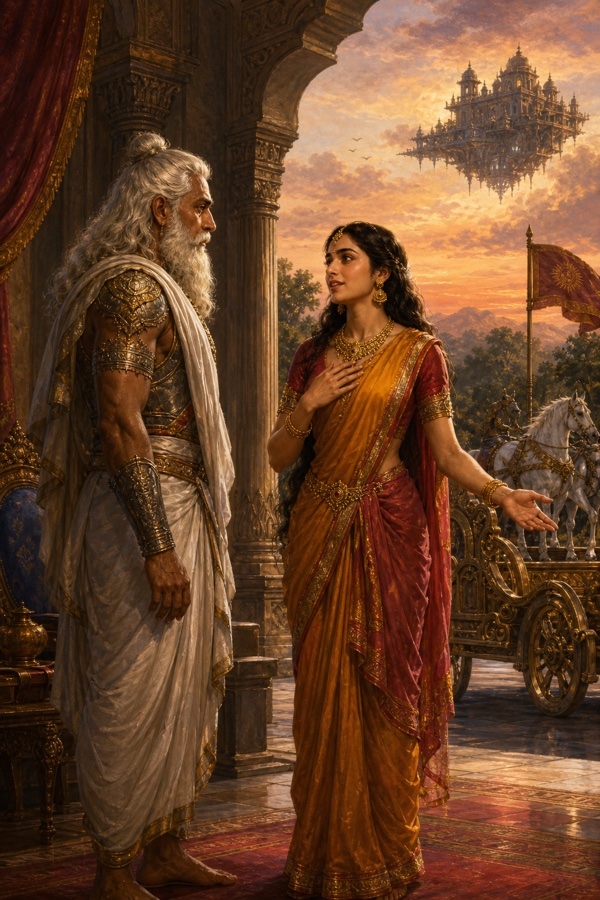
“In my heart I had already chosen the king of Saubha for my husband,” she said, “and in his heart he had accepted me for his wife. My father approved it too. At the self-choice I would have chosen him as my lord. You know every rule of virtue. Knowing all this now, do as you think right.”
When the maiden had spoken so before the Brahmins, Bhishma weighed what should be done. Because he knew the rules of virtue, he consulted the Brahmins who had mastered the Vedas, and he gave Amba, the eldest daughter of the king of Kasi, leave to do as she wished. The two younger daughters, Ambika and Ambalika, he bestowed with the proper rites on his brother Vichitravirya.
Vichitravirya was virtuous and self-controlled, and yet, proud of his youth and his good looks, he soon gave himself over to desire once he was married. Ambika and Ambalika were both tall women, the color of molten gold, their heads crowned with black curling hair, their nails long and red. Marked with every sign of good fortune, the two gentle young women counted themselves matched with a husband worthy of them in every way, and they loved and honored Vichitravirya deeply. He, for his part, had the strength of the gods and the beauty of the twin Ashvins, and he could steal the heart of any lovely woman.
The prince passed seven unbroken years in the company of his wives, and in seven years no child came. Then, still in the flush of his youth, he was seized by a wasting disease of the lungs (consumption). His friends and kinsmen took counsel together and tried every cure. In spite of all they did, the Kuru prince set like the evening sun and died.
Bhishma sank into worry and grief, and in consultation with Satyavati he had the funeral rites of the dead man performed by learned priests and by many of the Kuru house. Shantanu’s line was now down to one living man, and that man had sworn never to father a child.
The gist: The eldest daughter, Amba, revealed that she had already given her heart to the king of Saubha, so Bhishma let her go and married the two others, Ambika and Ambalika, to Vichitravirya. The prince spent seven years with them, then died childless of a wasting disease while still young. Bhishma saw to his funeral, and the throne of the Kurus stood empty.
Satyavati’s plea and Bhishma’s vow
“The luckless Satyavati was drowned in grief for her son,” Vaisampayana said. After she had performed his funeral rites together with her daughters-in-law, she comforted the weeping widows and comforted Bhishma as best she could. Then, turning her mind to religion and to the paternal and maternal lines of the Kurus, she spoke to Bhishma. The fisherman’s daughter had buried a husband and both her sons, and she was the only one left who could give an order in that house.
“The funeral offerings, the achievements, and the continuation of the line of Shantanu, all of it now rests on you,” she said. “As the winning of heaven cannot be parted from good deeds, as long life cannot be parted from truth and faith, so virtue cannot be parted from you. You know the rules of virtue in every detail and in the whole, and the many Srutis, and every branch of the Vedas. I know well that in steadiness in virtue, in knowledge of the special customs of families, and in finding a way out of hard straits, you are the equal of Shukra and Angiras. So, relying on you utterly, I now appoint you to a certain task. Hear me, and it is right that you do as I ask.” She had praised him for exactly the quality she was about to ask him to break.
“My son, your brother, who was full of energy and dear to you, has gone childless to heaven while still a boy,” Satyavati went on. “These wives of his, the gentle daughters of the king of Kasi, in their beauty and their youth, have come to long for children. So, at my command, raise offspring on them and keep our line alive. Guard virtue from ruin. Take the throne yourself and rule the kingdom of the Bharatas. Marry a wife by the proper rites. Do not cast your ancestors into hell.”
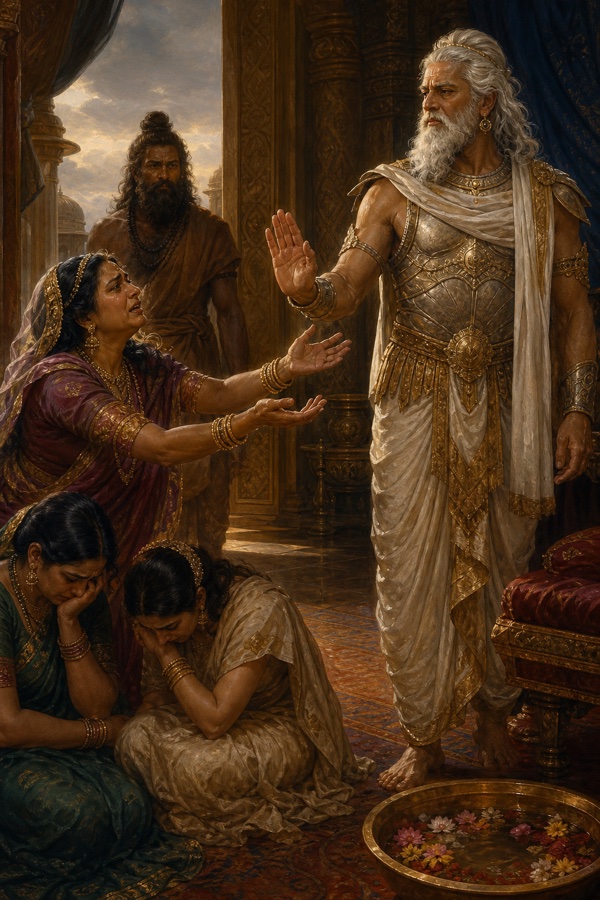
“So urged by his mother and by his kinsmen, Bhishma answered in keeping with the dictates of virtue, and he answered gently, which made it worse,” Vaisampayana said.
“Mother, what you say is certainly sanctioned by virtue,” Bhishma said. “You know the vow I took in the matter of begetting children, and you know all that happened over your bride-price.” She knew. She had been the bride-price.
“I say again, Satyavati, the pledge I once gave, that I would give up the three worlds, the empire of heaven, or anything greater still, before I would give up the truth,” he continued. “The earth may surrender its scent, water its wetness, light its power to show forms, air its touch, the sun his glory, fire its heat, the moon its cool rays, space its power to carry sound, Indra his might, the god of justice his fairness; the truth I cannot surrender.”
When her son had spoken so, out of the wealth of his energy, Satyavati answered him. “You whose very strength is truth, I know how firm you stand in it,” she said. “If you chose, you could use your energy to make three worlds other than these that exist. I know what your vow was, and that it was for my sake. Yet look at this emergency, and take up the burden a man owes his ancestors. Act so that the chain of the line is not broken and our kinsmen are not left to grieve.”
Pressed like this by a miserable, weeping Satyavati, who spoke words at odds with virtue out of her grief for her son, Bhishma answered her once more, and did not move an inch. “Queen, do not turn your eyes from virtue. Do not destroy us. Our books on religion never praise a Kshatriya who breaks the truth. Let me tell you instead what established Kshatriya practice can be used to keep Shantanu’s line from dying out on earth. Hear me, then weigh what should be done, taking counsel with learned priests and with those who know what conduct is allowed in times of emergency and distress, and keeping in mind, as well, the ordinary course of proper conduct.”
A key to reading this (a concept): Bhishma’s vow was really two vows, lifelong celibacy and the renunciation of the throne, which he gave to Satyavati’s father as a bride-price so that Satyavati’s own children, and only they, would inherit the kingdom. He paid that price to buy his father a wife, and the wife is the woman now weeping in front of him. That is why, even with the line in danger, Bhishma can neither father children himself nor become king. His truth is exactly what places the deepest of dangers before the very line he serves.
The tradition of the levirate: Bhishma’s examples
“Long ago, Rama the son of Jamadagni, enraged at his father’s death, killed the king of the Haihayas with his battle-axe,” Bhishma went on. “By cutting off the thousand arms of Arjuna, the Haihaya king (Kartavirya of the thousand arms), he accomplished a feat the world had never seen. Not content with that, he set out in his chariot to conquer the earth, and taking up his bow he cast his mighty weapons in every direction to wipe out the Kshatriyas. That blazing son of Bhrigu’s line destroyed the Kshatriya race twenty-one times over with his swift arrows.” Bhishma was answering a question about children, and he began with the total erasure of a caste, because that is where the answer starts.
“And when the earth had been stripped of Kshatriyas by that great sage, the Kshatriya women all across the land had children raised for them by Brahmins learned in the Vedas,” he said. “The Vedas say that a son so raised belongs to the man who married the mother. And those Kshatriya women went to the Brahmins for the sake of virtue, with no thought of lust. This, in fact, is how the Kshatriya race was brought back to life.” Every king listening to this story, and every king in it, descends from that arrangement.
A sub-tale (Utathya, Mamata, and Dirghatamas): There is another old story that bears on this, Bhishma said. In the old days there lived a wise sage named Utathya, who had a wife named Mamata whom he loved dearly. One day Utathya’s younger brother Brihaspati, priest of the gods and a man of great energy, came to Mamata. She told her husband’s younger brother that she had already conceived by his elder brother, and that he should not press for what he wanted. The child in my womb, she said, has already studied the Vedas with their six Angas; my womb has no room for two at once. Brihaspati could not master his desire. Then the child in the womb spoke to him: Father, give up your attempt. There is no room here for two, and I came first. Brihaspati would not listen to the child. Foreseeing the moment, the unborn child closed the way with his feet, so that the seed fell instead upon the earth. At this Brihaspati, offended, cursed the child: because you have spoken to me so at a time of pleasure that every creature seeks, may a long darkness overtake you. From that curse Utathya’s son was born blind, and he came to be called Dirghatamas, which means one wrapped in long darkness. Hold that word. Before this chapter ends another child will be born blind, and the whole war will grow out of his blindness.
Though born blind, the wise Dirghatamas, master of the Vedas, won for a wife a young and beautiful Brahmin woman named Pradveshi. To carry on Utathya’s line he begot several children on her, the eldest being Gautama. Yet these children were all given to greed and folly, and a man who cannot see is slow to learn what his sons are.
In time Dirghatamas learned from the son of Surabhi certain practices of his order, and he took them up fearlessly and held them in reverence. The sage who lived in that same hermitage, seeing sin where there was none, grew indignant that he broke the bounds of propriety, and they declared that he no longer deserved a place among them and should be cast out. His wife Pradveshi, too, now that she had her children, turned against him.
“Why are you also dissatisfied with me?” the husband asked his wife.
“A husband is called bhartri because he supports his wife, and pati because he protects her,” she answered. “You are neither to me. You have been blind from birth, and it is I who have supported you and your children. I will not do it any longer.”
“Carry me to the Kshatriyas, and you will be rich,” the sage said to her and to her children, stung by her words.
“I want no wealth that comes through you, for it can never make me happy,” his wife replied. “Do as you please; I cannot support you as I did before.”
“From this day I lay down a rule,” Dirghatamas said at this. “Every woman shall cleave to one husband for as long as she lives. Whether her husband is alive or dead, it shall not be lawful for her to go to another; and any woman who does shall surely be counted as fallen. A woman without a husband shall always be prone to sin, and even if she is wealthy she shall find no true joy in her wealth.” A rule that would bind every woman on earth came out of one quarrel in one hut.
Hearing this, Pradveshi flew into a rage and ordered her sons. “Throw him into the waters of the Ganga,” she said.
“Why should we keep this old man?” said Gautama and his brothers, slaves to greed and folly, and at their mother’s command they tied the sage to a raft and gave him to the current, then went home without a pang. The blind old man drifted down the stream on that raft, past the lands of many kings.
One day a king named Bali, a man versed in every duty, went down to the Ganga to bathe, and as he stood in the water the raft with the sage bound to it came to him, the way the river brings a thing to the one person who has use for it. The king lifted the old man out. Bali, ever devoted to truth, learned whom he had saved, and he chose the sage to raise up offspring for him. “Father a few sons on my wife who will be virtuous and wise,” he said. The sage agreed.
So King Bali sent his wife Sudeshna to him. The queen, knowing that he was blind and old, would not go herself; she sent her nurse in her place. On that Sudra woman the sage, a man of fully mastered passions, begot eleven children, the eldest of them Kakshivat. Seeing these eleven sons, with Kakshivat at their head, all of them versed in the Vedas and mighty utterers of the sacred word, King Bali one day put a question to the sage.
“Are these children mine?” he asked.
“No, they are mine,” the sage answered. “Kakshivat and the others I begot on a Sudra woman. Your unlucky queen Sudeshna, seeing me blind and old, insulted me by sending her nurse in her place.”
The king then made his peace with that sage and sent his queen Sudeshna to him. Merely by touching her body the sage spoke. “You will have five sons, named Anga, Vanga, Kalinga, Pundra, and Suhma, each glorious as the sun,” he said. “After their names, five countries on earth will be known: Anga, Vanga, Kalinga, Pundra, and Suhma.” Five kingdoms came out of one raft the river happened to carry to the right man.
“So it was that in the old days a great sage carried on the line of Bali,” Bhishma said. “In just this way many mighty bowmen and great chariot-warriors, wedded to virtue, sprang up in the Kshatriya race from the seed of Brahmins. Hear all this, mother, and do as you think right in the matter before us.”
The gist: Holding his own vow unbroken, Bhishma set out three examples of the levirate: after Parashurama’s slaughter, Kshatriya women bore children by Brahmins; the story of the blind sage Dirghatamas, who also laid down the rule that a woman must keep to one husband; and King Bali, whose sons Anga, Vanga, Kalinga, Pundra, and Suhma were fathered on his queen Sudeshna by Dirghatamas. In this way Bhishma hinted to Satyavati that the line could be saved through a worthy Brahmin.
The origin of Vyasa and his summoning
“Listen, mother, and I will name the means by which the Bharata line can be carried on,” Bhishma continued. “Let an accomplished Brahmin be invited with an offer of wealth, and let him raise offspring on the wives of Vichitravirya.” He was still speaking of a stranger, some worthy man to be found and paid. Satyavati already knew the name, and had known it for forty years.
“Then Satyavati, smiling softly, her voice breaking with shyness, answered Bhishma,” Vaisampayana said.
“Bharata, what you say is true,” she said. “Out of my trust in you, I will now tell you the means of carrying on our line, and you, who know the practices allowed in times of distress, will not be able to refuse it. In our house you are virtue, you are truth, you are our one refuge. So hear the truth I speak, and do what is right.”
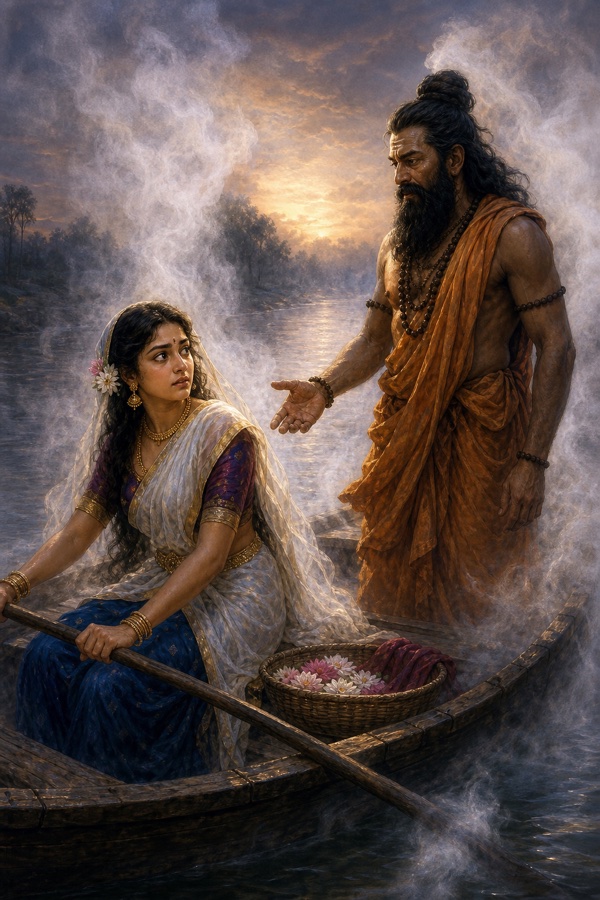
Then she told her story. “My father was a virtuous man, and for virtue’s sake he kept a ferryboat. One day, in the prime of my youth, I went to ply that boat. It happened that the great and wise rishi Parashara, foremost of all virtuous men, came to my boat to cross the Yamuna. As I rowed him over the river, desire stirred in the rishi, and he began to speak to me in soft words. My father’s fear stood uppermost in my mind. In the end the fear of the rishi’s curse won out. Having won from him a priceless boon, I could not refuse him. The rishi brought me wholly under his power, and first covering the whole region in a thick fog, he had his wish of me there and then, midstream, with the banks gone from sight.”
“Before that, my body carried a harsh smell of fish, and the rishi took it away and gave me this fragrance I have now, the fragrance that later caught a king walking by the river,” she went on. “He told me, too, that by bringing forth his child on an island in the river I would still remain a virgin. The son born of me in my maidenhood, by Parashara, grew into a great rishi of vast ascetic power, known as Dvaipayana, the island-born. Because by that power he divided the Vedas into four parts, he came to be called Vyasa on earth, the divider or arranger; and for his dark color, Krishna, the dark one. Truthful, free of passion, a great ascetic who had burned away all his sins, he left with his father the moment he was born.”
“Appointed by me and by you as well, that rishi of matchless splendor will surely beget fine children on the wives of your brother,” she said. “When he went away he told me, ‘Mother, think of me in your hour of difficulty.’ If you wish it, Bhishma, I will call him now. If you agree, I am certain that great ascetic will beget children on Vichitravirya’s field.” The hour of difficulty had taken a lifetime to arrive, and she had been carrying his promise the whole way.
“At the mention of the great rishi, Bhishma joined his palms,” Vaisampayana said.
“The truly wise man is the one who keeps his eyes with discernment on virtue, profit, and pleasure, and who, after weighing things with patience, acts so that virtue leads to further virtue, profit to further profit, and pleasure to further pleasure,” Bhishma said. “What you have said, then, being both good for us and in keeping with virtue, is the best of counsel, and it has my full assent.”
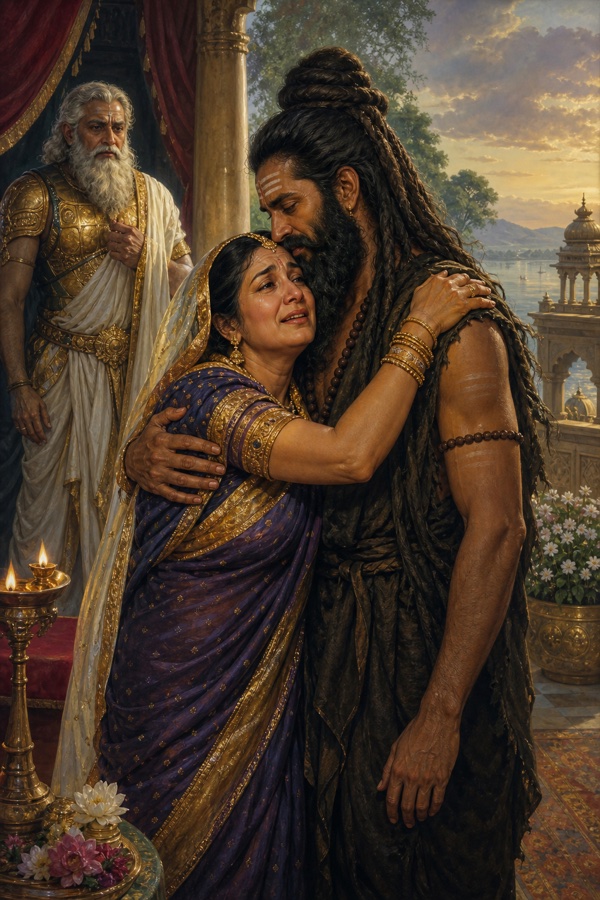
When Bhishma had spoken, Satyavati thought of the sage Dvaipayana. That was the whole of the summoning. Vyasa, busy just then with the interpretation of the Vedas, knew that his mother was calling him, and he came to her at once, without anyone’s knowing. Satyavati welcomed her son with the proper rites and took him in her arms, bathing him in her tears, for the sight of him after so many years set her weeping without restraint. Seeing her weep, Vyasa washed her with cool water and bowed to her. “I have come, mother, to do what you wish,” he said. “Command me without delay, and I will fulfill your desire.”
The family priest of the Bharatas then worshiped the great rishi with all due form, and Vyasa accepted the offerings and spoke the customary mantras. Pleased with the honor he had received, he took his seat, a stranger out of the forest sitting in the hall of a house that was about to depend on him entirely.
A key to reading this (the lineage): Krishna-Dvaipayana Vyasa is Satyavati’s son from her maidenhood, fathered by the rishi Parashara. That makes Vyasa the full brother of Vichitravirya, born of the same mother, and it is on the strength of this bond that Satyavati appoints him for the levirate. This same Vyasa is the author of the Mahabharata, so the maker of the story becomes the grandfather of the story’s own characters.
Vyasa’s condition and Satyavati’s assent
When Vyasa was comfortably seated, Satyavati, after the usual courtesies, spoke to him. “Sons are born of both the father and the mother, and so they belong to both,” she said. “There is no doubt at all that a mother has as much claim on them as a father. By the ordinance you are my eldest son, Brahmarshi, just as Vichitravirya is my youngest; and as Bhishma is Vichitravirya’s brother on the father’s side, so are you his brother on the same mother’s side.” She was building the case a step at a time, and every step of it was true.
“I cannot say how it seems to you,” she went on. “This is how it seems to me. Bhishma, Shantanu’s son, is so devoted to truth that for truth’s sake he will neither beget children nor rule the kingdom. So, out of love for your brother Vichitravirya, for the sake of our line, for Bhishma’s request and my command, out of pity for all creatures and care for the people, and out of the largeness of your own heart, it is right that you do as I ask. Your younger brother has left two widows, lovely as the daughters of the gods, full of youth and great beauty. For the sake of virtue they long for children. You are the fittest man to be appointed. Beget on them children worthy of our race, so our line goes on.”
“Satyavati, you know what virtue is, in this life and the next, and your own love is set on virtue,” Vyasa said when he had heard her. “So at your command, with virtue as my aim, I will do as you desire. This practice, which agrees with the true and eternal law, is known to me. I will give my brother children who will be like Mitra and Varuna. Let the two women first keep, for one full year, the vow I prescribe, and so be purified. No woman may come to me who has not kept a rigid vow.”
“Let it be as you say and yet arrange it so the women conceive at once,” Satyavati said. A year was exactly what she did not have. “In a kingdom with no king the people perish for want of protection, sacrifices and other holy acts are suspended, the clouds send no rain, and the gods withdraw. How can a kingdom with no king be guarded? So see to it that the women conceive, and Bhishma will watch over the children as long as they are in the womb.”
“If I must give my brother children so far out of season, then let the women bear my ugliness; that in itself will be the harshest of penances for them,” Vyasa replied. “If the princess of Kosala can endure my strong smell, my grim and ugly face, my dress and my body, then she will conceive an excellent child.”
“Let the princess of Kosala, in clean garments and adorned with ornaments, wait for me in her bedchamber,” Vyasa of great energy added. With that the rishi vanished, and the whole weight of it came down on a young widow who had not yet been told.
Satyavati went to her daughter-in-law and, alone with her, spoke words of good and virtuous purport. “Hear me, for what I say agrees with virtue,” she said. “Through my misfortune the line of the Bharatas has died out. Seeing my grief and the end of his father’s line, Bhishma, moved by the wish to keep our race alive, has made me a suggestion whose fulfillment rests on you. Fulfill it, daughter, and restore the lost line of the Bharatas. Bring forth a child as splendid as the king of the gods; he will carry the heavy burden of this our hereditary kingdom.”
With great difficulty Satyavati won the assent of her virtuous daughter-in-law to a proposal that did not run against virtue, and the difficulty is worth marking, because nobody in this room is enjoying any part of it. Then she fed the Brahmins and rishis and the countless guests who had come for the occasion.
The gist: Satyavati appointed Vyasa for the levirate, arguing that a mother’s claim on her sons equals a father’s and that Vyasa was Vichitravirya’s full brother. Vyasa agreed, on one condition: the women were to keep a year-long vow and be purified, or else to take his ugliness itself as their penance. Given the urgency of time, Satyavati won Ambika’s assent only with great difficulty. Every shortcut taken in this room will show up in a child’s body.
The birth of Dhritarashtra, Pandu, and Vidura
“As soon as the monthly season of the princess of Kosala had passed, Satyavati purified her daughter-in-law with a bath and led her to the sleeping chamber,” Vaisampayana said.
Seating her on a luxurious bed, Satyavati spoke. “Your husband has an elder brother, and today he will enter your womb as your child,” she said. “Wait for him tonight, and do not fall asleep.” That was everything Ambika was told, and no one told her what he looked like.
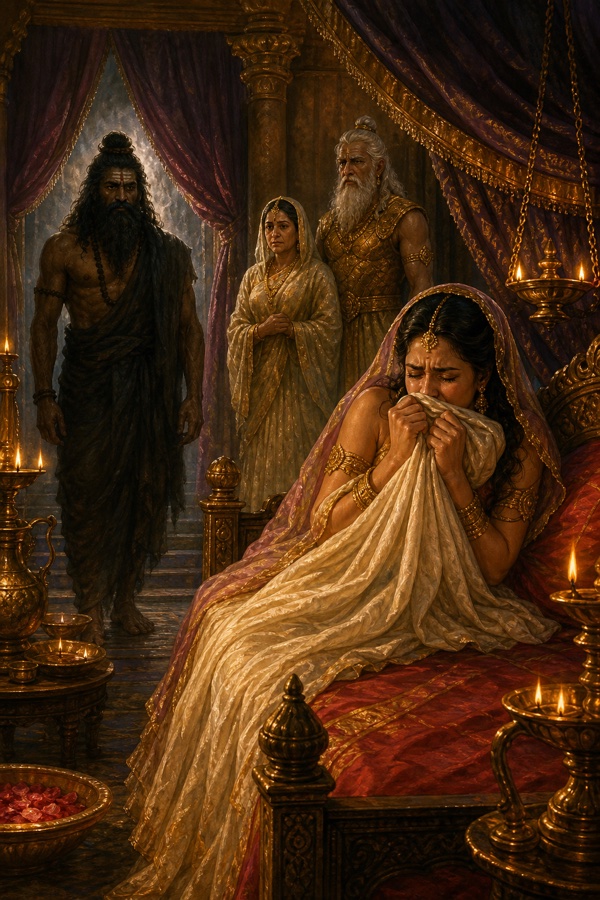
Hearing her mother-in-law, the gentle princess lay on her bed and let her mind run over Bhishma and the other elders of the Kuru house, waiting for one of those grave, groomed men. Then the rishi of truthful speech, who had given his word first about Ambika, the eldest of the princesses, entered her chamber while the lamp still burned. Seeing his dark face, his matted locks the color of copper, his blazing eyes, his fierce beard, she shut her eyes in fear. To fulfill his mother’s wishes the rishi knew her, and the frightened princess did not once dare open her eyes to look at him. That closing of the eyes lasted a moment and cost a hundred years.
When Vyasa came out, his mother met him. “Will the princess have a worthy son?” she asked.
“The son she will bear will be as strong as ten thousand elephants,” he answered. “He will be a glorious royal sage, rich in learning, intelligence, and energy, and in his time he will have a hundred sons. Through his mother’s fault, though, he will be born blind.”
“How can a blind man be a king fit for the Kurus?” Satyavati said at this. “How can a blind man be the guardian of his kinsmen and his house and the pride of his father’s line? You must give the Kurus another king.”
“So be it,” said Vyasa, and went away. And the first princess of Kosala, in due time, brought forth a blind son. His name was Dhritarashtra, and a hundred sons would come out of him, and every one of them would die on the same field.
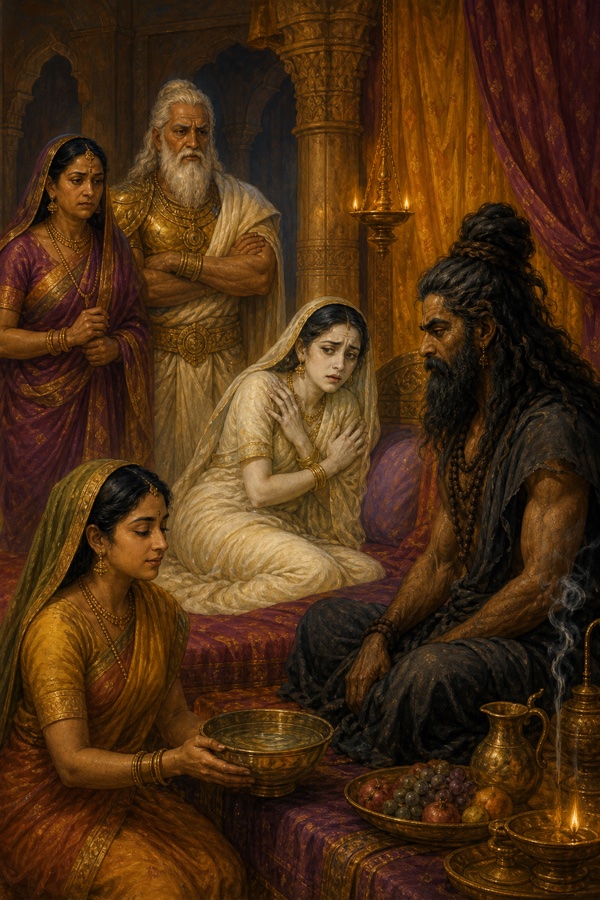
Soon after, Satyavati secured her daughter-in-law’s assent and summoned Vyasa again. True to his word, he came and approached his brother’s second wife as before. Ambalika, seeing the rishi, turned pale with fear. She had kept her eyes open, and it was not enough. “Because you have gone pale with fear at the sight of my grim face, your child will be pale in color, and his name will be Pandu, the pale,” Vyasa said to her, seeing her so frightened. With that the glorious rishi came out of her chamber.
As he came out his mother asked him about the child to be, and the rishi told her the child would be pale in color and known by the name Pandu. Satyavati begged the rishi for one more child. “So be it,” he answered. When her time came, Ambalika brought forth a pale son, a child ablaze with beauty and marked with every sign of good fortune. It was this child who would one day be the father of those mighty archers, the Pandavas.
Some time later, when the eldest of Vichitravirya’s widows had her monthly season again, Satyavati asked her to go to Vyasa once more. Lovely as a daughter of the gods, the princess remembered the rishi’s grim face and strong smell and refused to obey her mother-in-law. In her own place she sent a maid of hers, beautiful as an apsara and decked in the princess’s own ornaments, dressed as a queen and sent in as one.
When Vyasa came, the maid rose and saluted him. She waited on him with respect and, at his word, took her seat near him. Vyasa was well pleased with her, and as he rose to leave he spoke. “You will be a servant no longer,” he told her. “Your child, too, will be greatly fortunate and virtuous, and the foremost of all wise men on earth.”
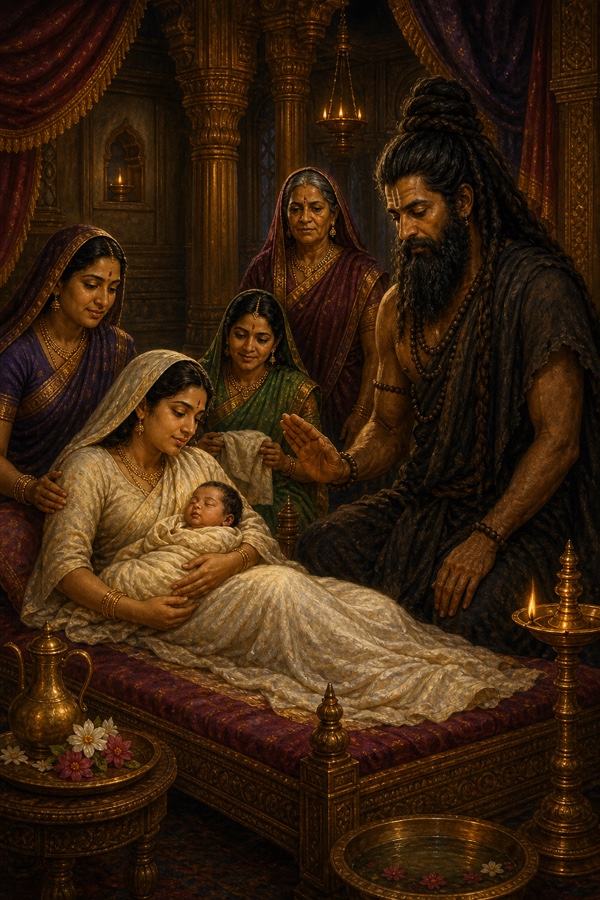
The son begotten on her by Krishna-Dvaipayana came to be known as Vidura, and so he was the brother of Dhritarashtra and of Pandu. Vidura was free of desire and passion, versed in the rules of government, and he was the god of justice himself, born on earth under the curse of the rishi Mandavya. The wisest man the Kurus would ever have was born to a servant, and the throne could never be his. When Krishna-Dvaipayana met his mother as before, he told her how the eldest of the princesses had deceived him, and how he had begotten a son on a Shudra woman. Having said this to his mother, the rishi vanished from her sight.
So it was that in the field of Vichitravirya, from Dvaipayana, those sons were born, bright as the children of the gods, the men who would carry the Kuru race forward. Three women, three nights, three children, and the shape of the war already set in them.
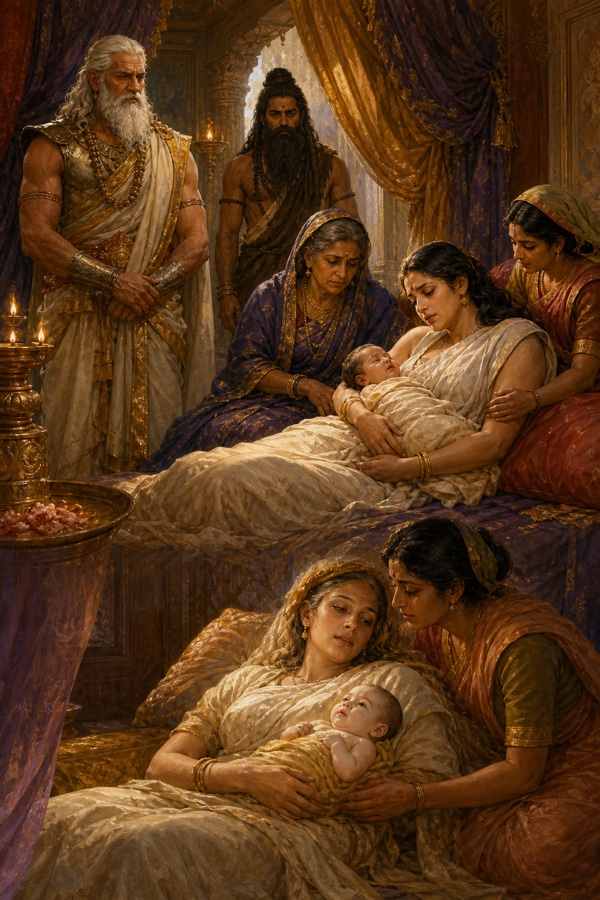
A key to reading this (numbers and places): Kosala and Kasi appear together here because the daughters of the king of Kasi are also called princesses of Kosala; these were neighboring janapadas of ancient north India, in the Varanasi and Ayodhya country of what is now eastern Uttar Pradesh. Three closely related births come from a single levirate: from Ambika, Dhritarashtra (blind, father of a hundred sons, the Kauravas); from Ambalika, Pandu (the pale, father of the Pandavas); and from the maid, Vidura (an incarnation of Dharma). These three brothers become the ground on which the whole conflict of the Mahabharata is built.
The gist: The three fruits of the levirate came in this way. Ambika shut her eyes against the rishi’s grim form, and so Dhritarashtra was born blind. Ambalika turned pale with fear, and so Pandu was pale in color. The third time, Ambika sent her maid in her place, and from the blameless, fearless maid was born Vidura, who was Dharma himself. A moment of fear, a moment of paleness, a moment of courage, and each one printed itself on a child. Here the story reaches the point that Vidura came into a human birth as the god Dharma through the curse of the rishi Mandavya, which Vaisampayana tells next.
Source: the Mahabharata of Krishna-Dwaipayana Vyasa, Adi Parva, Sambhava sub-parva, Sections 100 to 105. The Sanskrit e-text, the Gita Press Hindi edition, and Kisari Mohan Ganguli’s complete English translation were used to verify names, sequence, and principal events. Where the recensions differ, this English retelling follows Ganguli, and the Hindi edition follows Gita Press.
Based on: the Mahabharata, Vedavyasa (K. M. Ganguli’s English translation; Gita Press, Gorakhpur)