On this page
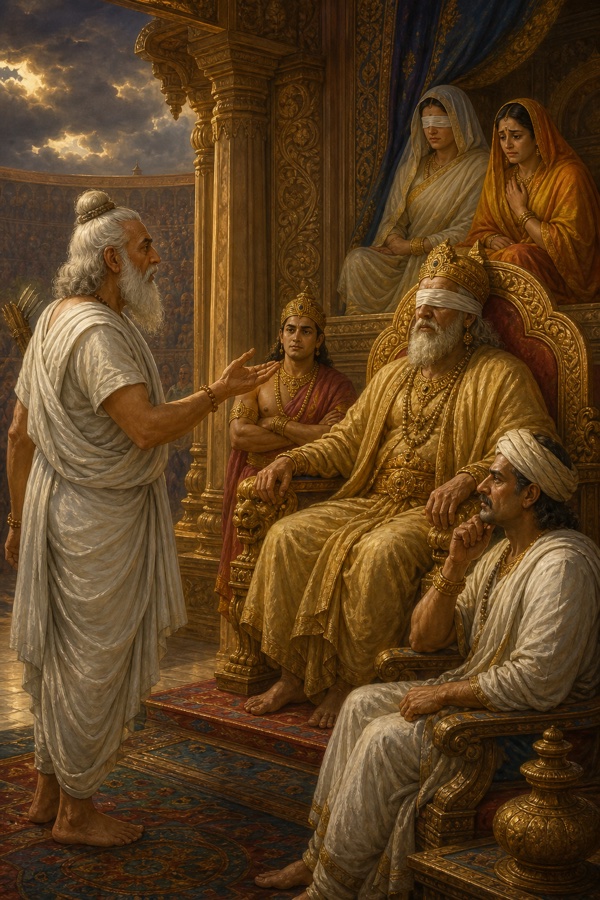
When Drona saw that the sons of Dhritarashtra and the sons of Pandu had finished their training in arms, he went to King Dhritarashtra and said, before Kripa, Somadatta, Bahlika, Bhishma, Vyasa and Vidura, “Your children have completed their education. With your leave, let them now show what they can do.” The king heard him gladly. “You have done a great thing. Tell me yourself where and when the trial shall be held, and in what manner, and it will be so. My blindness is a grief to me, and it makes me envy the men who will watch my children’s skill with their own eyes. Vidura, do everything Drona asks. Nothing could please me more.”
Building the arena
Vidura gave the king his assurance and went out to see it done. Drona, who was wise in such matters, measured out a stretch of ground clear of trees and undergrowth and well supplied with wells and springs. On that plot he chose a lunar day on which the ascendant star stood favorable, had the citizens summoned by proclamation to witness it, and offered sacrifice to the gods before them.
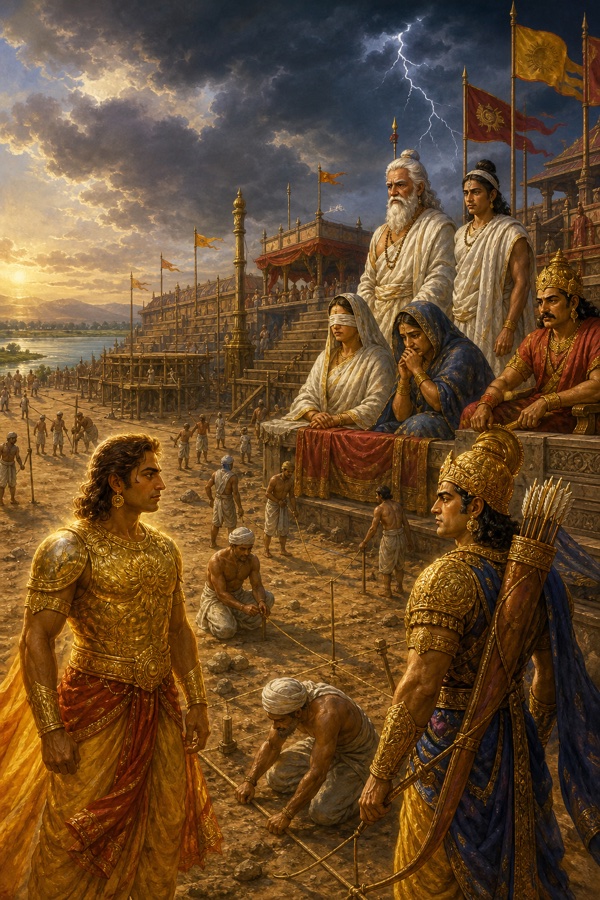
The king’s artisans then raised a broad and handsome stage on the spot, built by the rules the scriptures lay down and stocked with weapons of every kind, and beside it a second graceful hall for the women who would watch. The townspeople put up platforms of their own, and the wealthiest among them pitched wide, high tents on every side.
A key to reading this (concept): The arena, the rangabhumi, is the open ground where the princes show their skill in arms before the public, something like a royal exhibition field.
On the appointed day the king came out with his ministers, Bhishma and Kripa walking ahead of him, to an arena of almost divine beauty, built of pure gold, hung with strings of pearls and set with lapis lazuli. Gandhari, blessed with great good fortune, and Kunti and the other women of the royal house, dressed in their finest and attended by their waiting women, climbed to the platforms in delight, the way the women of heaven climb the slopes of Mount Sumeru. All four orders, Brahmins and Kshatriyas among them, left the city and came running to the ground to see what the princes could do. Everyone was so impatient for the spectacle that the great crowd seemed to gather in a single moment, and with the blare of trumpets and drums and the din of many voices it looked like an ocean whipped into motion.
The gist: The ground is chosen and consecrated, the stands go up, and on the day the whole city comes out to see what Drona has made of the princes. The arena itself is gold, pearls and lapis lazuli, with a stage stocked with every kind of weapon. Watch who sits where: the blind king with Bhishma and Kripa walking ahead of him, Gandhari and Kunti on the women’s platform, and below them a crowd of all four orders that has not yet been asked to take sides.
Drona and the princes enter
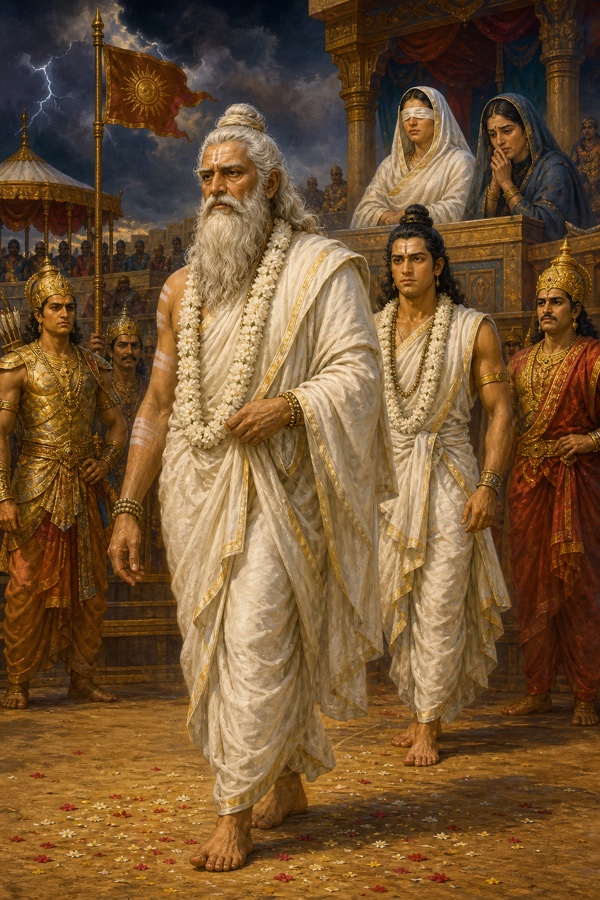
Drona came into the arena at last with his son, dressed in white, his sacred thread white, his hair and beard white, white garlands on him and white sandal paste rubbed over his body, like the Moon in a clear sky with the planet Mars beside him. He performed the worship the moment called for and had Brahmins skilled in mantras carry out the auspicious rites, and when sweet-sounding instruments had been struck up as a rite of peace, men came in carrying an array of weapons.
The princes of Bharata’s line came in next with their loins girded, wearing finger-guards and carrying bows and quivers. Yudhishthira led them, and they entered in order of age and began to show what they could do with their weapons. Some in the crowd ducked their heads for fear the arrows would fall on them; others watched without fear, lost in wonder. Riding hard and handling their horses with ease, the princes struck the marks with shafts cut with their own names, and the spectators, watching, felt they were looking at the city of the gandharvas, and amazement filled them. All at once hundreds and thousands of them, eyes wide, cried out, “Well done! Well done!”
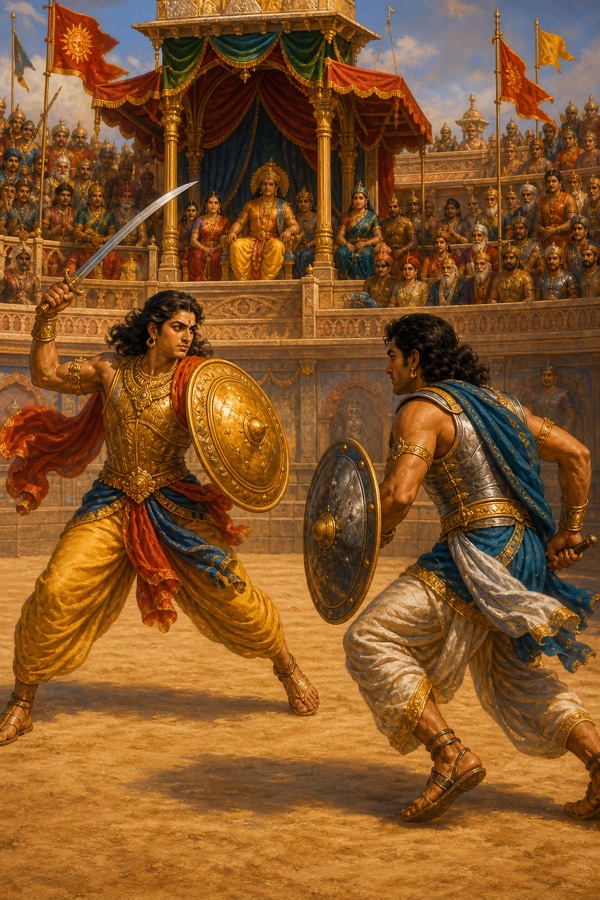
When they had shown their skill with bow and arrow and with their chariots again and again, the princes took up swords and shields and ranged across the lists, working their weapons. The onlookers marveled at their quickness, the balance of their bodies, their grace, their steadiness, the firmness of their grip, and their deftness with sword and shield. Then Bhima and Duryodhana, each inwardly pleased at the prospect of a fight, came down into the arena mace in hand, like two single-peaked mountains. They braced their loins, gathered their strength, and roared like two rutting elephants fighting over a cow, and, faultless by the rules of the science of arms, they circled the lists, wheeling right and left. Vidura described every feat to Dhritarashtra, and to Kunti, the mother of the Pandavas, and to Gandhari.
A key to reading this (names): The speeches that follow call the same few men by many names. Vrikodara is Bhima. Suyodhana is Duryodhana. Phalguna, Vibhatsu, Partha (the son of Pritha, that is, Kunti), Dhananjaya, Jishnu and Kiritin are all Arjuna. In Vyasa’s telling a single hero is called by different names as the occasion suits.
The gist: Drona comes in all in white, robe, thread, hair, beard, garlands and sandal paste, his son beside him like Mars beside the Moon, and opens the trial. The princes take their turns by age, from horseback and then on foot with sword and shield. Everything here is display, each prince hitting a mark with a shaft that carries his own name, while Vidura tells the blind king what he is missing. Then two of the princes stop displaying and square up to each other with maces, and the day changes.
Bhima and Duryodhana’s mace bout
The moment Duryodhana and Bhima, the two strongest men there, stepped down into the arena, the spectators split into two camps, each swayed by where its affection lay. Some shouted, “Look at the heroic king of the Kurus!” Others called back, “Look at Bhima!” and a sudden, huge uproar broke out. Seeing the place turn into a troubled sea, Drona said to his son Ashvatthama, “Hold back these two. They are mighty and skilled in arms, and this clash of Bhima and Duryodhana must not rouse the anger of the assembly.”
Ashvatthama held the two combatants back, their maces still raised, looking like two swollen oceans lashed by the winds that blow at the end of the world. Drona himself walked into the middle of the arena, ordered the musicians to stop, and said in a voice as deep as thunder, “Now look on Partha, who is dearer to me than my own son, the master of every weapon, the son of Indra himself, and like Vishnu, Indra’s younger brother.”
The gist: The crowd takes sides over the mace bout, and Drona ends it before the mood turns. Notice how quickly the city divides between Duryodhana and a Pandava, and that Drona treats the division as a danger in itself, sending his own son in to part the two. Bhima and Duryodhana are parted with their maces still raised. The silence Drona then orders from the musicians is for one entrance, and he names the pupil he loves best as the son of Indra.
Arjuna’s display of arms
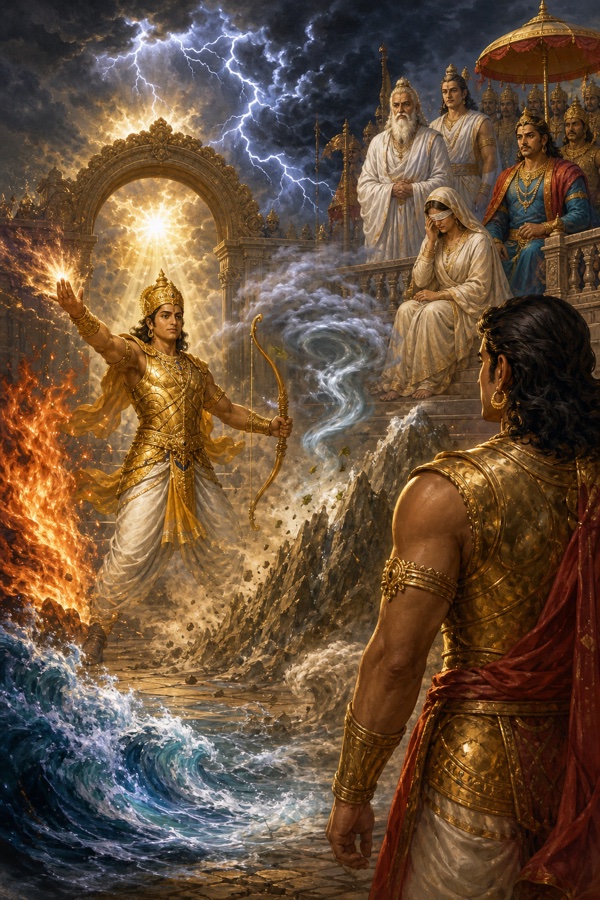
With the rites of peace complete, Arjuna appeared in the arena wearing his finger-guard, a quiver full of arrows at his back and his bow in his hand, clad in golden mail, like an evening cloud that catches the rays of the setting sun and glows with the colors of the rainbow and flashes of lightning. The whole assembly rejoiced at the sight of him, and conches and other instruments sounded on every side. A great clamor rose from the spectators. “This is the graceful son of Kunti!” “This is the middle Pandava!” “This is the son of mighty Indra!” “This is the protector of the Kurus!” “This is the first of all who know arms!” “This is the first of all who keep to virtue!” “This is the first of all who know how to conduct themselves, the great treasury of manners!” At these cries the tears running from Kunti’s eyes mixed with the milk of her breasts and wet her bosom.
His ears full of that clamor, Dhritarashtra turned to Vidura in delight. “Vidura, what is this great roar, like a troubled ocean, that has risen all at once and seems to tear the very heavens?” Vidura answered, “Phalguna, the son of Pandu and Pritha, has entered the lists in his mail. That is the reason for the roar.” Dhritarashtra said, “By the three fires sprung from Pritha, who is like the sacred fuel itself, I have been blessed, favored and kept safe.”
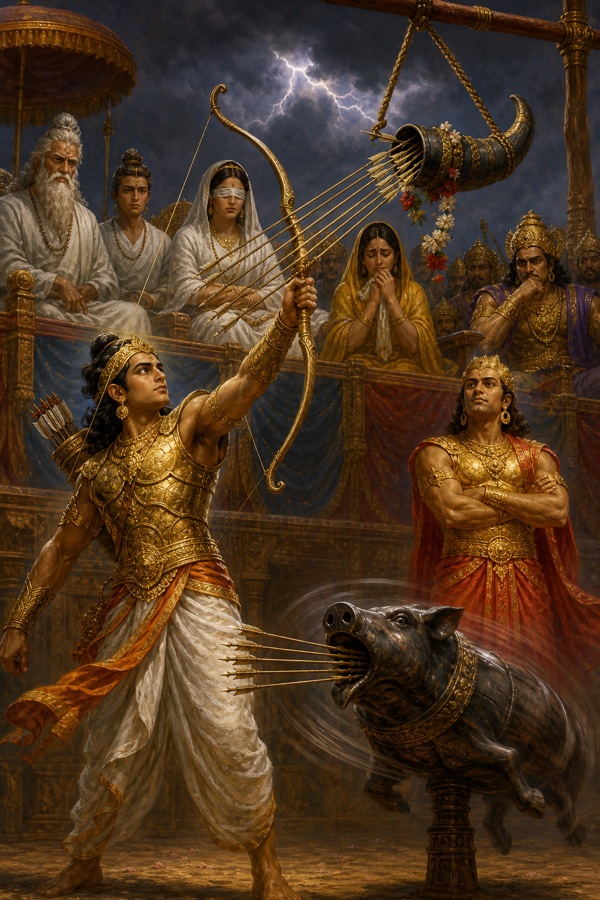
When the spectators had settled a little, Arjuna began to show his quickness with weapons. With the Agneya weapon he made fire, with the Varuna weapon water, with the Vayavya weapon wind, and with the Parjanya weapon he raised clouds; with the Bhauma weapon he made land, with the Parvatya weapon he brought mountains into being, and with the Antardhana weapon he made all of it vanish. One moment he looked tall, the next short; now he stood on the yoke of his chariot, now on the chariot itself, and the moment after on the ground. With his practiced skill he struck marks of every sort, some soft, some fine, some of thick make. He sent five arrows at once from his bowstring into the mouth of a moving iron boar as if they were a single shaft, and drove twenty-one into the hollow of a cow’s horn that hung swaying on a rope. In this way Arjuna moved in circles across the lists and showed his deep skill with sword, bow and mace.
A key to reading this (concept): The Agneya, Varuna, Vayavya, Parjanya, Bhauma, Parvatya, and Antardhana are celestial weapons, governed by mantra, that call up fire, water, wind, cloud, earth, and mountain in turn, and make everything disappear. They are powers brought to life by resolve and mantra.
The gist: Arjuna’s turn: the crowd names him before he has drawn, Kunti weeps on the platform, and the blind king, told what the roar means, blesses Kunti’s three sons. Then the celestial weapons come out one after another, and after them the marksmanship. Two feats are the ones to hold in mind, because a stranger will repeat them before the day is out: five arrows into the iron boar’s mouth, twenty-one into the swinging horn.
The slap of arms at the gate
The display had nearly ended, the excitement of the spectators had cooled, and the instruments had fallen silent, when from the direction of the gate came the slapping of arms against arms, a sign of power and strength, loud as the roll of thunder. The crowd wondered all at once, “Are the mountains splitting, or is the earth itself tearing open, or is the sky ringing with the roar of gathering clouds?” Every spectator turned toward the gate.
There stood Drona, ringed by the five sons of Pritha, like the moon in the company of the five-starred constellation Hasta. Duryodhana, that slayer of foes, sprang up in haste, and his hundred proud brothers closed around him, Ashvatthama among them. Mace in hand, ringed by his brothers with their weapons raised, he looked like Indra of old, encircled by the host of the gods on the day of battle with the Danavas.
The gist: The trial is all but over when a stranger announces himself from the gate. The sound is the slap of arms, a warrior’s way of saying he has come to fight, and the crowd takes it for the earth splitting. On the ground the court has already sorted itself before anyone has seen his face: Drona on one side with the five Pandavas around him, the moon among the five stars of Hasta; Duryodhana on the other with his hundred brothers and Ashvatthama.
Karna enters
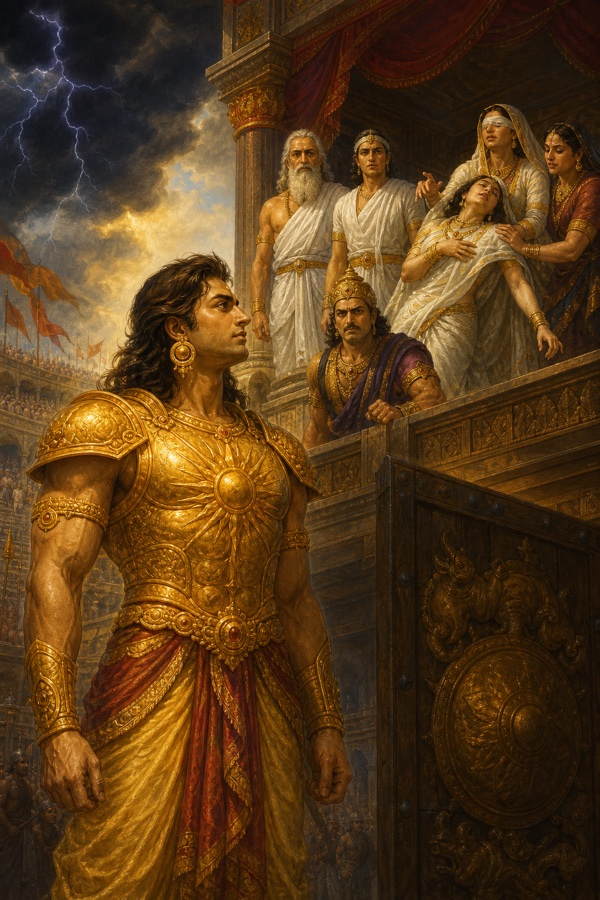
The spectators, their eyes wide with wonder, made way, and Karna came into the wide arena like a walking cliff, his body sheathed in the mail he had been born with, his face lit by his earrings, his bow in his hand and his sword at his side. Large-eyed, and already famed as a destroyer of hostile hosts, he had been born of Pritha in her maidenhood, a portion of the hot-rayed Sun, and his energy and prowess were those of a lion, a bull, or the leader of a herd of elephants. In brightness he was like the Sun, in beauty like the Moon, in energy like fire. Begotten by the Sun himself, he stood tall as a golden palm tree, and in the full vigor of youth he was strong enough to kill a lion. He was handsome of face and a man of countless gifts.
A sub-tale: The hint is dropped here, once. Karna is the son Pritha, that is Kunti, bore in her maidenhood, a portion of the Sun, and so the eldest brother of the Pandavas. No one in the assembly knows it, and the Pandavas do not know it either. The man the arena is about to shame as a charioteer’s son is a Kshatriya by birth and Kunti’s firstborn.
Karna looked around the arena and bowed, without much ceremony, to Drona and Kripa. The whole assembly, still and staring, wondered, “Who is he?” and grew restless to know him. Then he spoke to Arjuna, the brother he did not know, the son of Indra who subdued the Asura Paka, in a voice as deep as thunder. “Partha, before this watching crowd I will do greater feats than everything you have done. When you see them, you will be amazed.”
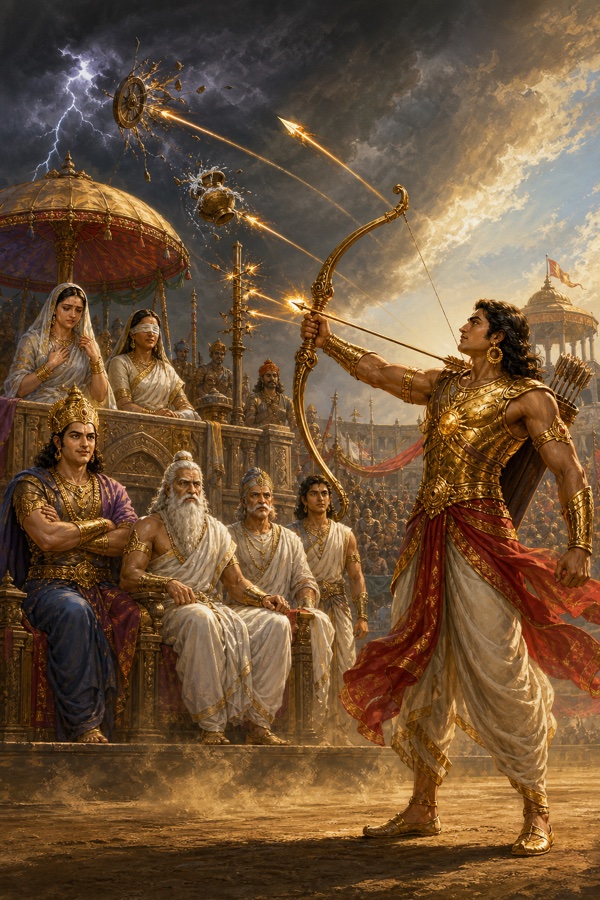
He had barely finished when the spectators rose all at once, as if a machine had lifted them. Duryodhana was filled with delight; Arjuna, in the same instant, with shame and anger. Then, with Drona’s leave, the mighty Karna, who loved a fight, did everything Arjuna had done before him.
Duryodhana and his brothers embraced Karna in their joy. “Welcome, mighty warrior. Good fortune has brought you to me. Live here as you please, and command me and the kingdom of the Kurus.” Karna answered, “Since you have said it, I count it already done. I ask only for your friendship. And my one wish is a single combat with Arjuna.” Duryodhana said, “Share with me all the good things of life. Be your friend’s benefactor, and set your foot on the heads of all your foes.”
The gist: The stranger is Karna. He bows to Drona and Kripa as if it were nothing, speaks straight to Arjuna, and the whole arena comes to its feet. Watch the two faces in the same instant, Duryodhana’s delighted and Arjuna’s shamed, and then watch Karna match Arjuna feat for feat and ask for nothing except a duel. The sub-tale says who he is. No one on the ground knows it, and Duryodhana claims him on the spot.
Arjuna’s insult and the challenge to a duel
Arjuna, feeling himself disgraced, said to Karna, who stood among the brothers like a cliff, “The path that the unwelcome intruder and the uninvited speaker come to, that path will be yours, Karna, for you will die at my hands.” Karna answered, “This arena is open to everyone, Phalguna. You do not own it. They are kings who are greatest in energy, and a Kshatriya honors might, and might alone. What need is there for argument, the resort of the weak? Speak in arrows, Bharata, until with arrows I strike your head from your shoulders today, before the teacher himself.”
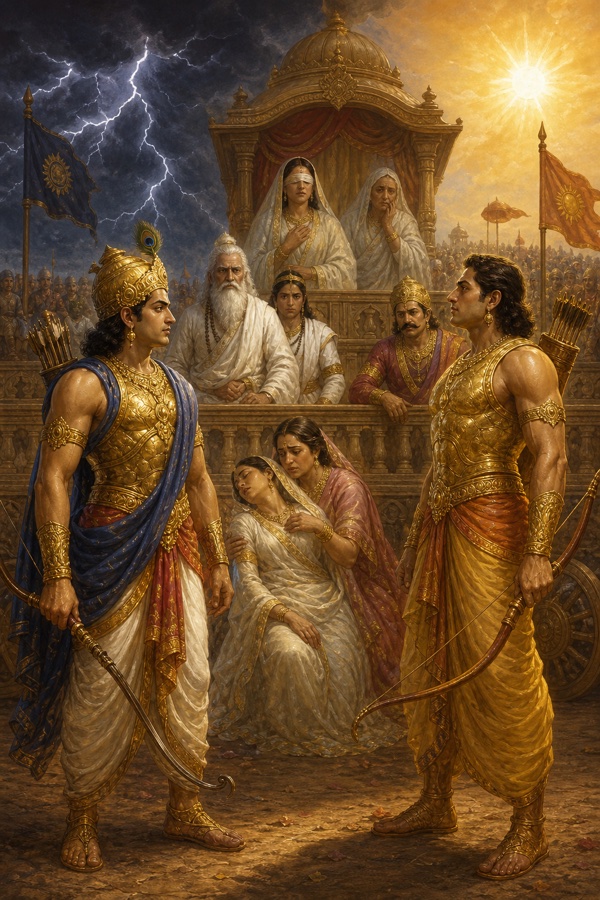
His brothers embraced him quickly, and with Drona’s leave Arjuna, the subduer of hostile cities, advanced for the fight. On the other side Karna, embraced by Duryodhana and his brothers, took up his bow and arrows and stood ready. Then the sky filled with clouds that flashed with lightning, and the colored bow of Indra appeared, scattering its bright rays; the clouds seemed to laugh, for rows of white cranes were on the wing. Indra had come to look down on the arena out of love for his son, and the Sun, seeing it, cleared the clouds from over his own child. So Arjuna stood hidden deep under cover of the clouds while Karna stayed in plain sight, wrapped in the rays of the Sun. Duryodhana stood beside Karna; Drona, Kripa and Bhishma stood with Arjuna. The assembly was divided, and so were the women who watched.
Kunti, the daughter of Bhoja, read what all this meant, and fainted. Vidura, who knew every duty, had her women help, and by sprinkling sandal paste and water over her he brought her back to herself. When she opened her eyes and saw her two sons in mail, fear took hold of her, and there was nothing she could do to shield them.
A key to reading this (lineage): Kunti is called here the daughter of Bhoja. She was the daughter of the Yadava Shurasena, and the childless Bhoja king Kuntibhoja adopted her, which is why she was called Kunti and also the daughter of Bhoja. Both Arjuna and Karna are her sons, and that is why the sight of the two of them in mail made her faint.
The gist: Words turn into a challenge. Arjuna speaks first, and Karna answers with the argument Duryodhana will take up after him: a Kshatriya honors might, and birth has nothing to say in an arena. Then the two fathers in the sky take sides, Indra covering his son with cloud and the Sun clearing it from his, and the court splits behind them, Duryodhana with Karna, the elders with Arjuna. One woman on the platform knows why both bowmen are hers.
The question of lineage and Kripa’s intervention
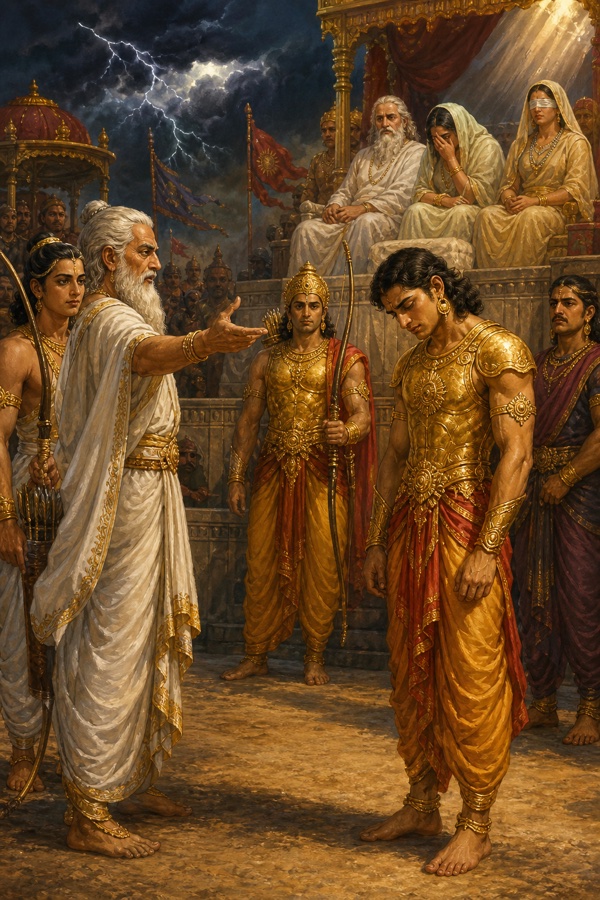
Seeing the two warriors standing with strung bows, Kripa, the son of Saradwat, who knew every duty and the rules that govern duels, spoke to Karna. “This Pandava, the youngest son of Kunti, belongs to the Kaurava line, and he will fight with you. But you too must tell us your lineage, the names of your father and mother, and the royal house you are the ornament of. When Partha has heard it, he will fight with you or not, as he sees fit. Sons of kings never fight with men of low birth.”
At Kripa’s words Karna’s face went pale and wilted like a lotus torn and battered by the pelting showers of the rainy season. Duryodhana said, “Teacher, the scriptures say that three kinds of men may lay claim to royalty: a man of royal blood, a hero, and one who leads armies. If Phalguna will not fight a man who is no king, then I will make Karna king of Anga.”
A key to reading this (place): Anga was one of the old realms of India, with its capital at Champa, in the region around present-day Bhagalpur in Bihar. By making Karna king of this land of Anga, Duryodhana gives him the royal standing of a rival worthy of Arjuna.
The crowning of the king of Anga
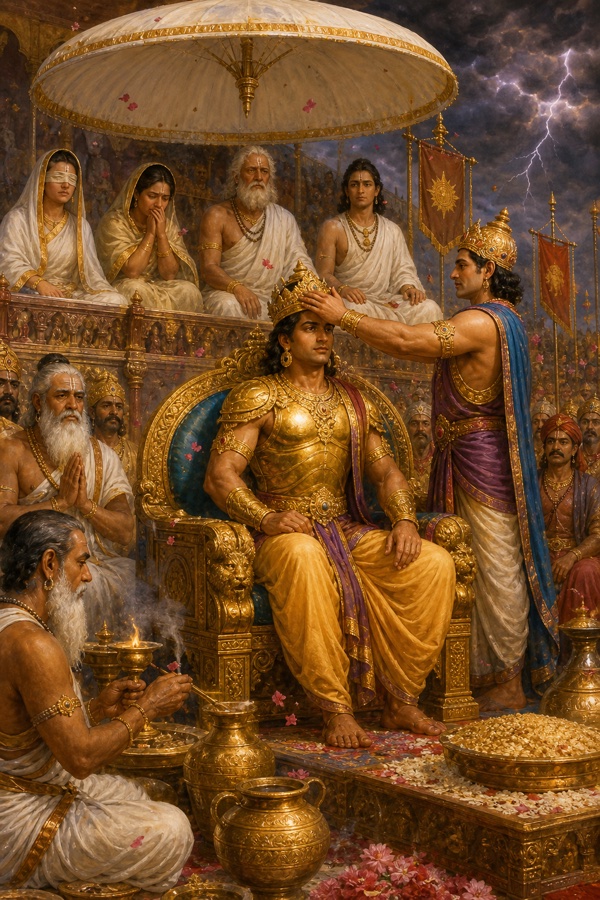
That very moment Brahmins skilled in mantras seated Karna on a golden seat and, with parched paddy, flowers, water-pots and abundant gold, crowned him king. The royal umbrella was raised over his head, and yak-tail whisks were waved around that redoubtable hero of graceful bearing. When the cheering had died down, King Karna said to Duryodhana, “What can I give you to match this gift of a kingdom? Whatever you command, I will do.” Duryodhana said, “I want nothing so much as your friendship.” “Be it so,” said Karna, and they embraced each other in joy and knew great happiness.
The gist: Kripa’s question about birth stops the duel. He asks it as the rules of a duel require, and Karna’s face answers before his mouth can. Duryodhana cites the scriptures for the three kinds of men who may claim royalty and then makes the question moot by crowning Karna himself, on the spot, with paddy, flowers and gold. The first thing the new king does is ask what he owes, and all Duryodhana wants is his friendship.
Adhiratha’s arrival and Bhima’s taunt
Into this arena came Adhiratha, his upper cloth hanging loose, sweating and trembling, leaning on a staff. Karna saw him, set down his bow, and bowed his head as a son bows to his father, the water of his anointing still on it. The charioteer hurried to cover his feet with the end of his cloth and called Karna, crowned with success, his son. He embraced him, and in the fullness of his love his tears fell on that head still wet from its crowning as king of Anga.
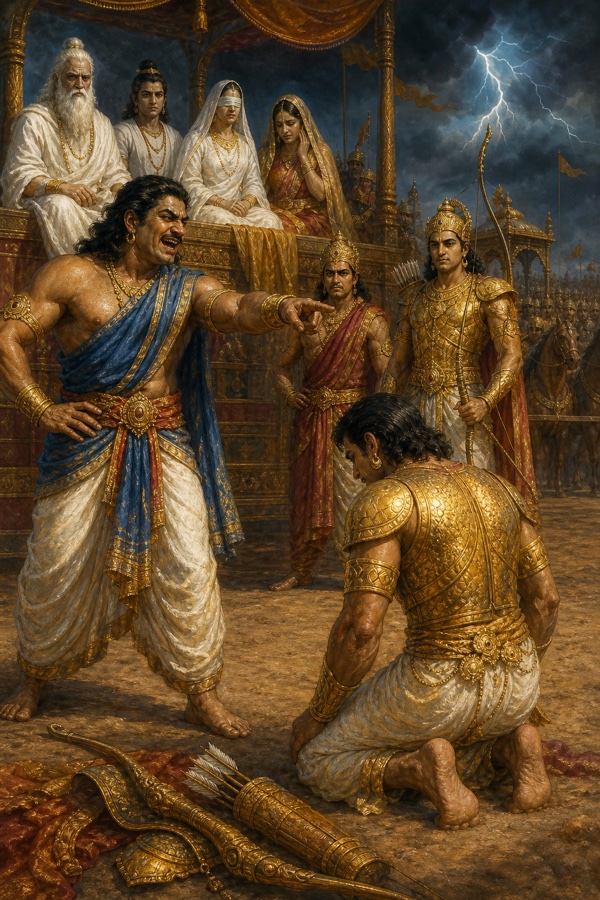
Seeing the charioteer, Bhima took Karna for a charioteer’s son and mocked him. “You do not deserve to die in battle at Partha’s hands. Pick up the whip that drives the horses; that is what your birth fits you for. And you are no more fit to rule the kingdom of Anga than a dog is fit for the butter set out before the sacrificial fire.” Karna’s lips trembled a little. He drew a long breath and looked up at the sun in the sky.
A key to reading this (concept): The suta was the order that traditionally did the work of the charioteer, the man who drove the chariot. Adhiratha was a suta, and his wife Radha raised the infant Karna after finding him adrift on the river, which is why Karna is called Radheya and suta’s son. Bhima’s taunt rests on this distinction of birth and order, and he does not know that Karna is in truth the son of the Sun and of Kunti, his own eldest brother.
Duryodhana’s reply and his word on lineage
Duryodhana rose in anger from among his brothers, as a rutting elephant rises out of a bed of lotuses, and said to Bhima, “Vrikodara, it does not become you to speak such words. Might is the first virtue of a Kshatriya, and even a Kshatriya of low birth deserves to be fought. The lineage of heroes, like the source of a lordly river, is always unknown. The fire that covers the whole world rises from the waters. The thunderbolt that killed the Danavas was made from the bone of a mortal named Dadhichi.”
“The god Guha, who gathers in himself the portions of all the other gods, is of a lineage no one knows. Some call him the son of Agni, some of Krittika, some of Rudra, and some of Ganga. We have heard that men born in the Kshatriya order have become Brahmins. Vishvamitra and others, born Kshatriyas, reached the eternal Brahma. Drona was born in a water-pot, and Kripa of the line of Gotama sprang from a clump of heath. Your own births, Pandava princes, are known to me.”
“Can a doe give birth to a tiger like Karna, with the splendor of the Sun, marked with every sign of fortune, born with mail and earrings of his own? By the might of his arm, and by my oath to obey him in everything, this prince among men has earned the sovereignty of the whole world. Anga is far too small a gift for him. If there is anyone here who cannot bear what I have done for Karna, let him mount his chariot and bend his bow with the help of his feet.”
A key to reading this (lineage): Drona was born in a drona, a vessel, which is where his name comes from. Kripa and Kripi were twins found in a thicket of heath, which is why Kripa is counted in the line of Gotama though his birth too was out of the ordinary. Guha, that is Kartikeya, was born from the portions of many gods, so opinions on his fatherhood differ.
Sunset and the dispersal of the assembly
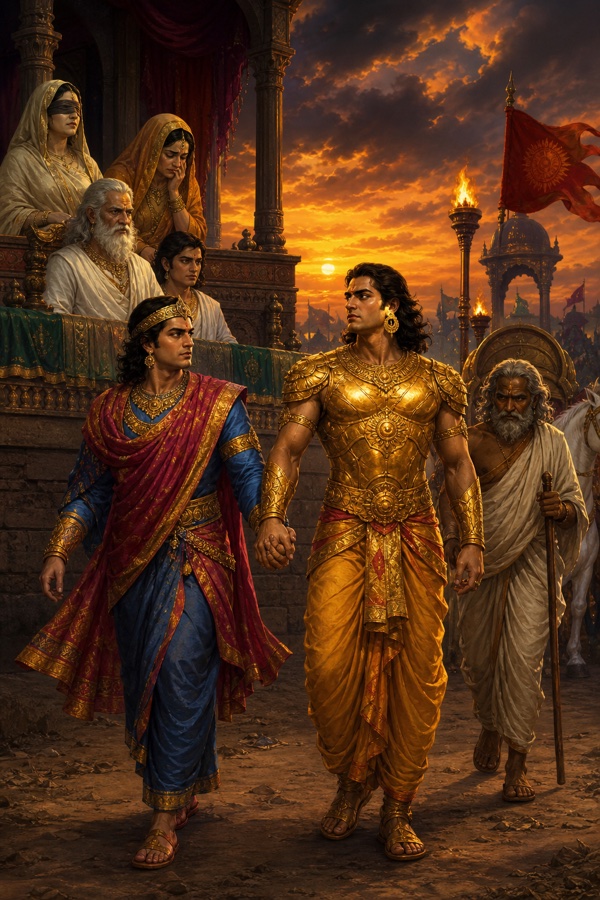
A confused murmur of approval for Duryodhana’s words ran through the crowd. But the sun went down, and Duryodhana took Karna by the hand and led him out of the arena, now lit by countless lamps. The Pandavas went back to their own homes with Drona, Kripa and Bhishma, and the people came away as well, some naming Arjuna the day’s victor, some Karna, and some Duryodhana.
Kunti had known her son by the many auspicious marks on his body, and she had seen him crowned over the kingdom of Anga. A mother’s joy filled her, and she kept what she knew to herself. Duryodhana, having won Karna, put away the fear that Arjuna’s skill in arms had raised in him. Karna, that hero accomplished in arms, set about pleasing him with sweet words, while in Yudhishthira’s mind the conviction settled that there was no warrior on earth to equal Karna.
The gist: Adhiratha’s entrance, trembling on his staff, is what undoes the crowning in Bhima’s eyes. Bhima’s taunt and Duryodhana’s reply leave the duel unfought, and the crowd murmurs for Duryodhana as the sun goes down on it. The day ends with three names on the crowd’s lips and a new friendship walking out hand in hand under the lamps. Kunti, who has known her son since he walked in, says nothing, and Yudhishthira carries home a worry he cannot put down.
Source: the Mahabharata of Krishna-Dwaipayana Vyasa, Adi Parva, Sambhava sub-parva, sections 135 to 138 (Ganguli 136 to 139). The Sanskrit e-text, the Gita Press Hindi edition, and Kisari Mohan Ganguli’s complete English translation were used to verify names, sequence, and principal events. Where the recensions differ, this English retelling follows Ganguli, and the Hindi edition follows Gita Press.
Based on: the Mahabharata of Vedavyasa (K. M. Ganguli’s English translation; Gita Press, Gorakhpur)