On this page
The war was over, the kingdom was theirs, and the Pandavas ruled the whole earth with a blind old man seated above them. Every one of Dhritarashtra’s hundred sons had died on the field at Kurukshetra. His counselors were dead. He had no refuge of his own and no wealth of his own, and the nephews he had once let be cheated at dice now owned everything he had ever owned. Yet each morning Yudhishthira came to him, touched his feet, and asked his opinion before deciding anything. For fifteen years that arrangement held, and to anyone walking through the palace it looked like peace. Vidura sat with the old king. Sanjaya, who had once described the whole war to him day by day, sat with him too, and so did Yuyutsu, the one son of Dhritarashtra’s house who had crossed to the Pandava side before the first arrow flew, born to a Vaishya wife and now the last son alive. Kripa, the old teacher of both sets of cousins, stayed near. Vyasa, the dark sage who had fathered Dhritarashtra himself, came when he chose and recited for him the histories of the ancient rishis, of the celestial ascetics, of the ancestors and the rakshasas. It all looked settled. There was one heart in that palace, though, in which the hall of the dice game had never stopped burning, and it belonged to Bhima.
The blind king’s second court
Janamejaya, the great-grandson of Arjuna, for whom this whole story is being recited, put the question himself. How had his grandsires, the Pandavas, conducted themselves toward Dhritarashtra once the kingdom was theirs? How did a king live at all when every counselor and every son had been killed and his wealth had passed to other hands? How did Gandhari carry herself? And for how many years did the Pandavas rule? Vaishampayana, the pupil of Vyasa who was telling it, answered him.
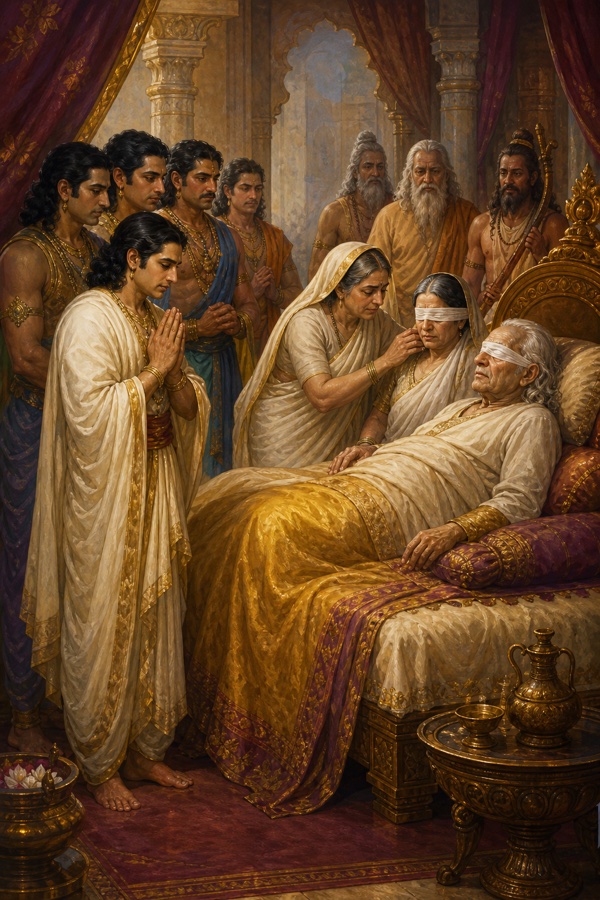
The Pandavas, he said, placed Dhritarashtra at their head and took his opinion in every matter, and for fifteen years they did all things by the old king’s advice. The five brothers went to him often, sat beside him after honoring his feet, and let him smell their heads in blessing the way a father does. Whatever Yudhishthira wished done, it was done under Dhritarashtra’s command. Kunti, the daughter of King Kuntibhoja and the widow of the old king’s brother Pandu, obeyed Gandhari in everything and treated her as a senior. Draupadi, Subhadra, and the other wives of the Pandavas behaved toward the two of them exactly as they would toward a father-in-law and a mother-in-law of their own. Costly beds, robes, ornaments, food and drink of the superior kinds fit for royal use came to Dhritarashtra from Yudhishthira in plenty. Vidura, at the old king’s orders, ran everything that touched religious merit and the administration of the law, and ran it so well that the Pandavas won the loyal service of their feudatories at small expense. Dhritarashtra freed prisoners and pardoned men under sentence of death, and Yudhishthira never said a word against it. Kings who arrived at Hastinapura from other lands waited on the old Kuru monarch as they had in his years of power. And the queens of the house, Kunti, Draupadi, Subhadra of the Satvata line, Ulupi the daughter of the serpent king, Chitrangada, the sister of Dhrishtaketu, and the daughter of Jarasandha, waited on Gandhari, the daughter of Subala, as if they were maids of all work.
So Dhritarashtra passed his days in comfort, as before. When he went out on pleasure excursions Yudhishthira supplied every article of enjoyment. The cooks who cut and dressed his potherbs, the makers of his drinks, the men who blended his spiced confections of long pepper and ginger and sugar, all served him as they had served him before the war. Yudhishthira collected fine robes and garlands of many kinds and offered them to him, and had prepared for him Maireya wine, fish of many varieties, sherbets and honey, and dishes made up in every delightful way, just as in his days of prosperity. Over and over Yudhishthira told his brothers to see to it that the old king, who had lost every child he had, was never given cause to feel unhappy in anything, and the brothers, hearing that grave command from their eldest, obeyed it with particular care. There was one exception, and it was Bhima. Everything that had followed from the match at dice, which the wicked understanding of Dhritarashtra himself had brought about, had stayed lodged in that hero’s heart, and he remembered all of it.
The gist: After the war Dhritarashtra was honored for fifteen years as the head of the house; Yudhishthira gave him every comfort and took his advice in all things, and the queens waited on Gandhari like maids. In Bhima’s heart the dice game, which the old king’s own weakness had allowed, stayed open.
Bhima’s arms and the hidden vow
Yudhishthira loved his uncle without any malice in him. He told his brothers and his ministers that Dhritarashtra was to be honored by every one of them, that whoever obeyed the old king’s commands was his own well-wisher, and that whoever behaved otherwise toward him was his enemy and would be punished. He placed under Dhritarashtra’s control the first offerings that were made to Brahmins, so that on the days set aside for the rites of the ancestors, and at the shraddhas performed for his own dead sons and his slain well-wishers, Dhritarashtra could give the Brahmins as much wealth as he pleased, to each as each deserved. The brothers executed all his orders, and they took care of one thing above the rest: that the old man should not die of his grief for his sons and grandsons, a grief the Pandavas themselves had caused. They lived under his command as disciples live under a teacher, and Dhritarashtra, seeing them so humble, took on toward them in return the affection a teacher has for his pupils. Gandhari, through the shraddha rites and her gifts to Brahmins of many objects of enjoyment, freed herself of the debt she owed her slain children.
Dhritarashtra could find no ill will in Yudhishthira, though he looked for it, and he was content. Gandhari, casting off her sorrow for her own children, began to show the Pandavas the affection of a mother. Whatever the old king or the helpless queen directed, grave or light, Yudhishthira did with reverence, and the one thing that still grieved the old man was the memory of his own son. Rising at dawn he purified himself and went through his recitations, and then he blessed the Pandavas with victory in battle, the sons who had killed his sons. He made the usual gifts to the Brahmins and had them speak their benedictions, and he poured libations on the sacred fire, praying for long life for the sons of Pandu. The happiness he had never had from his own children he was having now from Pandu’s. No one in the realm dared speak of the evil deeds of Duryodhana or Dhritarashtra, for fear of Yudhishthira, and anyone who did anything displeasing to the old king became an object of hatred to the son of Kunti. Gandhari and Vidura were both pleased with the way Yudhishthira bore old wrongs. They were less pleased with Bhima. Yudhishthira obeyed his uncle out of feeling. Bhima’s face darkened at the sight of Dhritarashtra, and seeing his elder brother reverence the old man, he reverenced him too, outwardly, with a most unwilling heart.
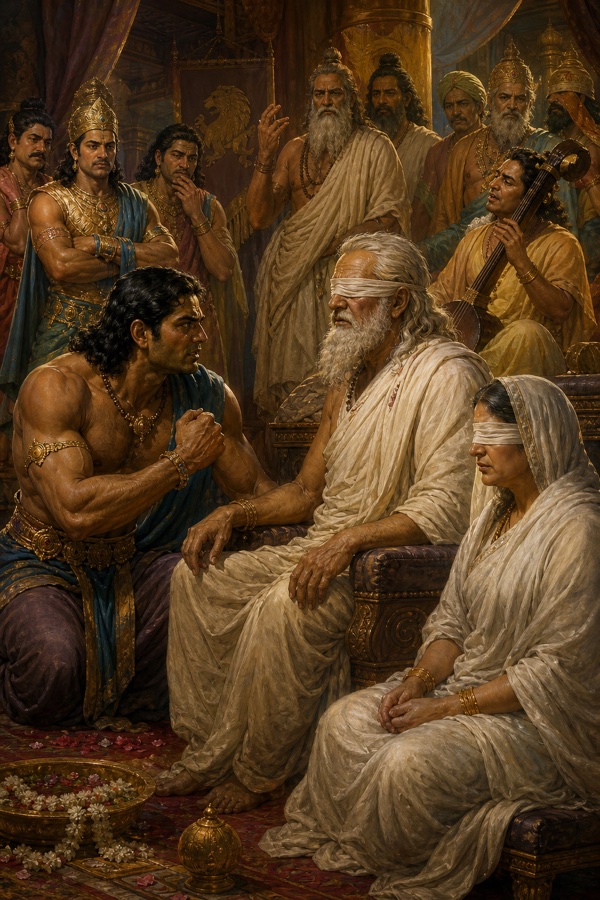
The people of the Kuru kingdom noticed no crack in the cordiality between Yudhishthira and Duryodhana’s father. Inside the palace there was one. When the old king remembered his wicked son he could not keep his heart friendly toward Bhima, and Bhima, driven by something in himself that looked like wickedness, could not stomach the old king. Bhima did many things in secret that Dhritarashtra would have hated, and through false servants he saw to it that his uncle’s orders went undone. Then one day, remembering the evil counsels of the old king and some of his acts, Bhima stood among his friends where Dhritarashtra and Gandhari could hear him and slapped his armpits, the gesture of a wrestler about to fight. He was remembering Duryodhana and Karna and Duhshasana, and the rage took him over. “The sons of the blind king, who could fight with every kind of weapon, have all been sent to the other world by me,” he said, “with these two arms that are like a pair of iron clubs. These are the arms, like maces of iron, that no enemy could withstand, and Dhritarashtra’s sons came within their clasp and were destroyed. These two round, well-developed arms of mine, like a pair of elephant trunks, the foolish sons of Dhritarashtra came within them and met their end. Smeared with sandal paste, and deserving of it, are these two arms by which Duryodhana was dispatched to the other world with all his sons and kinsmen.” He said these things and many others like them, and every word was a dart. Dhritarashtra heard them and gave way to sorrow. Gandhari heard them too, and Gandhari, who understood every duty and knew what Time carries along in its course, treated them as untrue.
Fifteen years of those darts, and Dhritarashtra was pierced through with despair. Yudhishthira did not know it. Arjuna did not know it, nor Kunti, nor Draupadi, nor Nakula and Sahadeva, the twin sons of Madri, who spent their days carrying out whatever the old king wished and never once said a thing that displeased him. Then one day Dhritarashtra took his friends into his confidence, and with tears standing in his sightless eyes he spoke.
The gist: Yudhishthira’s forbearance, and Bhima’s resentment, which grew in secret. In open company Bhima slapped his armpits and reminded the blind king by whose arms his sons had died; fifteen years of those darts broke Dhritarashtra apart from within, and no one in the family saw it.
Dhritarashtra asks leave to go to the forest
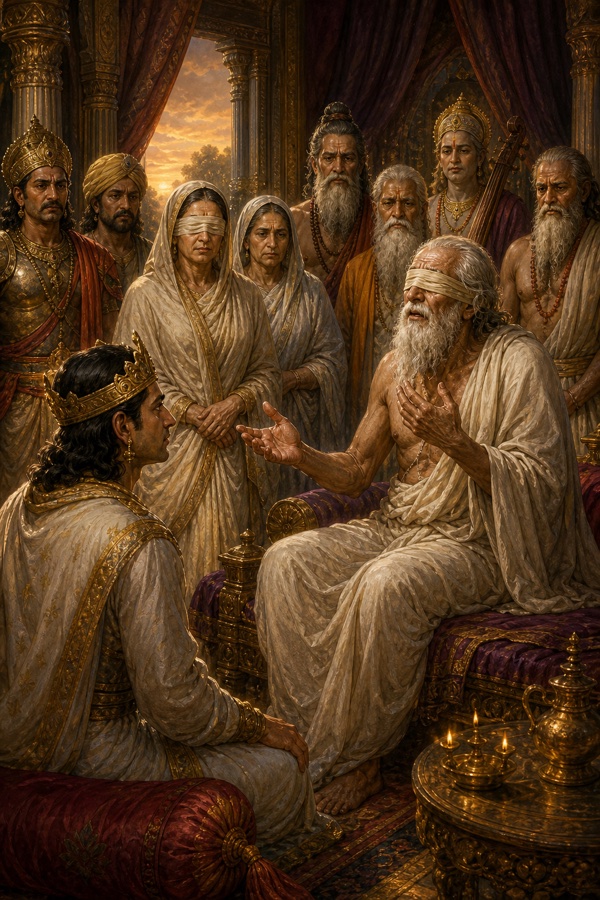
“How the destruction of the Kurus came about is known to you all,” Dhritarashtra said. “It was brought about by my fault, though the Kauravas approved of every counsel of mine. Fool that I was, I installed the wicked-minded Duryodhana, that enhancer of his kinsmen’s terrors, to rule over the Kurus. Vasudeva said to me, ‘Let this sinful wretch of wicked understanding be killed along with all his friends and counselors.’ I did not listen to those words, grave as they were. Every wise man gave me the same advice. Vidura said it, and Bhishma, and Drona, and Kripa. The holy Vyasa said it again and again, and so did Sanjaya, and so did Gandhari. Overwhelmed by love for my son, I could not follow it, and bitter repentance is my lot now for that neglect. I repent too that I never bestowed on the sons of Pandu, who had every accomplishment, the blazing prosperity that came down to them from their fathers and grandfathers. Krishna, Gada’s elder brother, foresaw the destruction of all the kings and thought it a good thing. So many divisions of troops, all of them mine, are gone. My heart is pierced with a thousand darts when I think of it.”
“Now, after fifteen years, wicked as my understanding was, I am trying to expiate my sins,” he went on. “At the fourth division of the day, or sometimes at the eighth, with the regularity of a vow, I eat a little food, just enough to conquer thirst. Gandhari knows this. Every one of my attendants believes I eat as I always did. It was through fear of Yudhishthira alone that I hid what I was doing, for if the eldest son of Pandu learned of my vow he would feel great pain. Clad in deerskin, I spread a little kusha grass on the earth and lie down on it, and I pass my time in silent recitation. Gandhari keeps the same vows. This is how we live, we two who have lost a hundred sons, and not one of those sons ever turned his back on a battle. For them I do not grieve. They died observing the duties of a Kshatriya.” The room was silent. Then the old king turned his face toward the one man he had been hiding from.
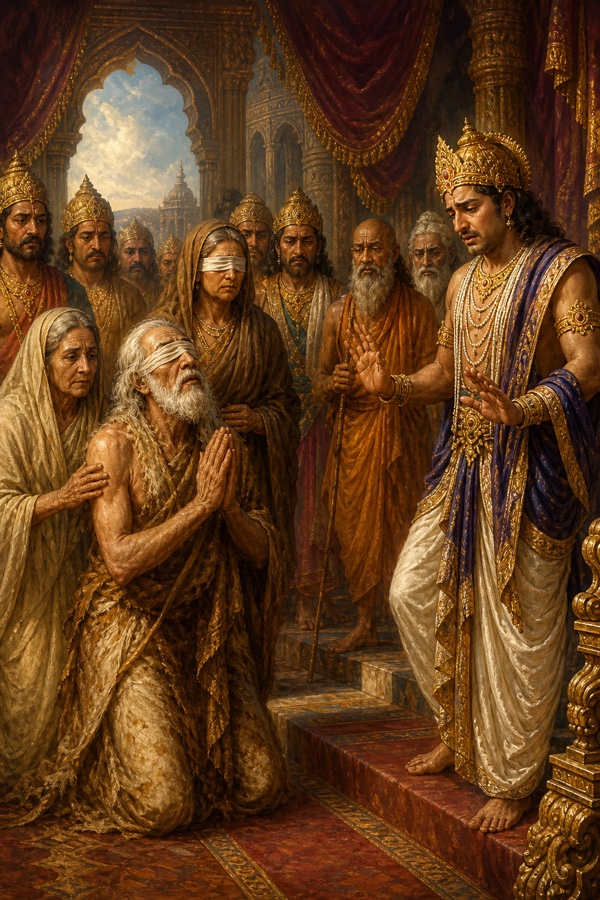
“Blessed be you, my son,” he said to Yudhishthira. “Listen to me now. Cherished by you, I have lived these years very happily. With your help I have made great gifts and performed shraddha after shraddha, and to the best of my power I have earned merit in large measure. This Gandhari, though not one son is left to her, has lived with great fortitude, watching over me all the while. The men who wronged Draupadi and robbed you of your wealth, those cruel men, have all left the world, killed in battle as the practice of their order demands. I have nothing more to do for them. They fell with their faces toward the fight, and they have reached the regions kept for men who bear weapons. What remains is for me and for Gandhari to do what is beneficial and meritorious for ourselves. Grant me leave. You stand first among righteous men, and the king is the teacher of all creatures, and that is why I ask you before I go. With your leave I will go into the woods clad in rags and bark, alone with this Gandhari, and I will bless you always. It is the custom of our race, when old age comes, to make the kingdom over to one’s children and take up the forest life. Living on air alone, or eating nothing at all, I will practice severe austerities there with this wife of mine. And you will share in those penances, for you are the king, and kings share in every act done in their realm, the auspicious ones and the others.”
A sub-tale: Dhritarashtra says aloud, in front of his friends, that Krishna once told him to have Duryodhana killed along with all his friends and counselors, and that Bhishma, Drona, Kripa, Vidura, Vyasa, Sanjaya, and Gandhari all gave him the same advice. A father ordered to kill his own son: the story sets that hard counsel down without softening it, and it lets the old king name his refusal, drowned as he was in love for the boy, as the root fault from which eighteen days of slaughter grew. He adds a second confession that is easy to miss: he never gave Pandu’s sons the inheritance that was theirs by descent, and he counts that among the sins he must now expiate.
Yudhishthira’s protest and the king’s faint
“When you are subject to grief like this, sovereignty gives me no pleasure at all,” Yudhishthira said. “Shame on me, wicked in my understanding, devoted to the pleasures of rule and heedless of what should concern me most. I and all my brothers never knew that you had suffered this long, wasted by fasts, refusing food, lying on the bare ground. Foolish that I am, I have been deceived by a man of deep intelligence: you gave me your confidence first and then went through all this in secret. What use do I have for a kingdom, for articles of enjoyment, for sacrifices or happiness, when you have suffered so much? I look on my kingdom as a disease, and on myself as sick with it. And yet, plunged in sorrow as I am, what good are these words I am saying to you? You are our father, you are our mother, you are the chief of our elders. Deprived of your presence, how are we to live? Let Yuyutsu, the son of your own loins, be made king, or anyone else you wish. I will go into the woods, and you will rule. Do not burn a man already burned by infamy. I am not the king. You are the king. I depend on your will. How can I dare to grant leave to the man who is my teacher?”
He said too that he carried no resentment in his heart for the wrongs Suyodhana had done. “It was ordained that it should be so. Both we and they were stupefied by fate. We are your children just as Duryodhana and the others were, and my conviction is that Gandhari is as much my mother as Kunti. If you go to the woods and leave me, I will follow you. I swear it by my soul. This earth with her belt of seas, full of wealth as she is, will bring me no joy without you. All of it belongs to you. I bend my head to you. We all depend on you. Let the fever of your heart be dispelled. I think that all of this that has come upon you is destiny, and I had thought, by good luck, that by waiting on you and carrying out your commands I could rescue you from it.”
“My mind is fixed on penance, my son,” Dhritarashtra answered. “It is right for our race that I go to the woods. I have lived long under your protection and been served by you with reverence for many years. I am old now. Grant me leave.” Then, trembling, his hands joined, he turned toward Sanjaya and toward Kripa, the great chariot warrior, and said, “I want to ask the king through the two of you. My mind has gone heavy and my mouth has gone dry, from the weakness of age and the effort of speaking.” With that he leaned on Gandhari, and all at once he looked like a man from whom the life had gone.
Seeing him seated there like a man without consciousness, Yudhishthira was pierced with grief. “He whose strength was equal to a hundred thousand elephants,” he cried, “that king sits today leaning on a woman. He who once ground the iron image of Bhima to fragments leans today on a weak woman. Shame on me, who am so unrighteous! Shame on my understanding! Shame on my knowledge of the scriptures! Shame on me, for whom this lord of the earth lies today in a state unbecoming of him! I too will fast, as my teacher fasts. If this king and Gandhari abstain from food, then so will I.”
Then Yudhishthira, who knew every duty, took cold water in his own hand and softly rubbed the old king’s breast and face with it. On that hand were jewels and capsules of healing herbs, the kind kings wore on their arms against many evils, and its touch was auspicious and fragrant, and at the touch Dhritarashtra came back to his senses. “Touch me again with your hand, my son,” he said, “and embrace me. I am restored by the auspicious touch of your hand. I want to smell your head. The clasp of your arms is a great comfort to me. This is the eighth division of the day, and so it is the hour for my food, and because I have not taken it I am too weak to move. I put great effort into pleading with you, and it wore me down, and I fainted. It is the touch of your hand, which works on me like nectar, that has brought me back.”
Yudhishthira, out of love, gently touched every part of his body. Dhritarashtra’s breath came back into him, and he folded the son of Pandu in his arms and smelled his head. Vidura and the others wept aloud in their grief, and the sharpness of it kept any of them from saying a word to the old king or to Yudhishthira. Gandhari, who understood every duty, bore her sorrow with fortitude and said nothing, though her heart was loaded. Kunti and the other women wept, shedding copious tears, and sat in a ring around the old king. Then Dhritarashtra spoke to Yudhishthira again. “Grant me leave to practice penance. Every time I speak, my mind grows weaker. Do not torment me any further.” A loud wail went up from all the warriors present as he said it. Yudhishthira looked at his father, once so splendid, now pale and wasted, worn out by fasting, a skeleton with skin drawn over it, and the tears came. “I do not want life or the earth,” he said. “I will do whatever pleases you. If I deserve your favor, if I am dear to you, eat something. Then I will know what to do.” And Dhritarashtra said, “With your leave, I wish to take some food.” As he said it, Vyasa, the son of Satyavati, came into the room.
The gist: Dhritarashtra asks leave to go to the forest; Yudhishthira refuses, saying he is only the king’s dependent and Dhritarashtra remains the true king. Halfway through his plea the fasting old man faints, revives at Yudhishthira’s touch, and at last agrees to eat if his son permits it; at that moment Vyasa arrives.
A key to reading this (a concept): Vanaprastha is the third of the four stages of life. When old age comes, a man makes over his kingdom or his household to his children and goes into the forest to live on what the wilderness gives and to practice penance. Dhritarashtra calls it the custom of his race, and Vyasa will shortly call it the highest duty of royal sages.
Vyasa’s command
“Do what Dhritarashtra asks, Yudhishthira, and do it without any scruple,” Vyasa said. “This king is old. He has been made sonless besides. I do not think he will be able to bear his grief much longer. Gandhari, blessed and wise and gentle of speech, bears her own excessive grief for her sons with fortitude. I am telling you what the old king tells you: obey my words. Let him have your leave. Do not let him die an inglorious death at home. Let this king follow the path of all the royal sages of old. For every royal sage, retirement into the woods comes at the last.”
“Your holy self is held by us in great reverence,” Yudhishthira said. “You alone are our teacher. You alone are the refuge of this kingdom and of this race. I am your son, and you are my father. You are our king and our teacher, and a son must obey the commands of his father according to every duty.” Vyasa answered him once more. “It is so. It is as you say. This king has reached old age. He is in the last stage of life. Permitted by me and by you, let him do what he proposes, and do not stand in his way. This is the highest duty of royal sages, Yudhishthira: they die either in battle or in the woods, as the scriptures direct. Your father Pandu revered this old king as a disciple reveres his teacher. In those days Dhritarashtra adored the gods in many great sacrifices with hills of wealth and jewels for gifts, and he ruled the earth and protected his subjects wisely and well. He gained a large family and a swelling kingdom, and for the thirteen years you were in exile he wielded great influence and gave away much wealth. You too, with your servants, have honored him and the famous Gandhari with the ready obedience a disciple pays his teacher. Grant your father leave. The time has come for him to attend to penance. He does not hold the slightest anger against any of you.” Having said this, Vyasa soothed the old king, and Yudhishthira answered him, “So be it.” Then the great ascetic left the palace and went on toward the woods.
When Vyasa had gone, Yudhishthira bent himself in humility before his old father and said softly that what the holy Vyasa had said, what the king himself intended, what Kripa the great bowman had said, what Vidura had expressed, and what Yuyutsu and Sanjaya had asked for, he would carry out with speed, for every one of them deserved his respect and every one of them was a well-wisher of the race. “This one thing, though, I beg of you with my head bent,” he said. “Eat first. Then go to your forest retreat.”
The gist: Vyasa himself comes and commands Yudhishthira to let the blind king go, since dying in battle or in the woods is the duty of royal sages, and he reminds him how well Dhritarashtra ruled through the exile years. Yudhishthira consents on one condition: food first, then the woods.
The last teaching on statecraft
With the king’s leave, Dhritarashtra went back to his own palace, Gandhari following. His strength was gone and his steps were slow; he walked with difficulty, like the aged leader of an elephant herd, and behind him came Vidura, his charioteer Sanjaya, and Kripa, the son of Sharadvat. Inside, he went through the morning rites, satisfied many of the foremost Brahmins, and took some food. Gandhari and Kunti, served with dish after dish by their daughters-in-law, ate as well, and after Dhritarashtra and Vidura and the rest had eaten, the Pandavas finished their own meal and came in and sat around the old king. Then Dhritarashtra reached out and laid his hand on the back of Yudhishthira, who was seated close beside him, and began, blind and fasting and about to leave forever, to hand his nephew everything he knew about holding a kingdom.
“You must always act without carelessness in everything that concerns your kingdom of eight limbs,” he said, “and keep the claims of righteousness foremost in it. You have intelligence and learning. Listen to me as I tell you the means by which a kingdom can be righteously protected. Honor those who are old in learning, listen to what they say, and act on it without scruple. Rising at dawn, worship them with due rites, and when the time for action comes consult them about what you intend; if you honor them because you want to know what is good for you, they will always tell you what is good for you. Keep your senses as you keep your horses; then they will serve you like wealth that is never wasted. Employ only ministers who have passed the tests of honesty, men of loyalty, of disinterest, of continence and courage, hereditary officers of state, pure in conduct, self-restrained, clever at business, and righteous. Collect your information through spies in many disguises, men whose faithfulness has been tested, natives of your own kingdom, and unknown to your enemies.”
A key to reading this (a concept): The eight limbs of a kingdom, as the old commentator on this passage counts them, are the law, the judge, the assessors, the scribe, the astrologer, gold, fire, and water. Dhritarashtra’s teaching touches several of them directly: the judges and their conduct, the men who make the king’s disbursements, and the treasury and the lawful filling of it.
“Your citadel should be protected by strong walls and arched gates. The walls, with their watchtowers standing close to one another, should be broad enough on top for six men to walk side by side, and the gates should be large and strong, placed well and guarded with care. Accomplish your purposes through men whose families and conduct are known. Guard your own person, too: in what you eat, in the hours of sport and eating, in the garlands you wear and the beds you lie on. The women of your household must be well protected, looked after by old and trusted servants of good behavior, well born and learned. Make your ministers of Brahmins who have learning and humility, who are well born, who understand both duty and wealth, and who are simple in their ways, and take counsel with them. Do not admit many people into your counsels. On particular occasions you may consult the whole council or a part of it.”
“Hold your consultations after entering a chamber or a spot that is well protected from intruders, or in a forest bare of grass, since grass can hide an enemy’s spy. Never consult at night, for the dark can hide one too. Apes, birds, and other creatures that can mimic human beings should be kept out of the council chamber, and so should idiots and the lame and the palsied. The evils that flow from the leaking of a king’s counsel are, I think, the kind that cannot be remedied, and you should say so often in the midst of your counselors, and speak too of the merit that flows from counsel properly kept. Find out the merits and the faults of the people of your city and your provinces. Let your laws be administered by trusted judges, contented men of good behavior, and have their acts checked by spies. Let them inflict punishments according to law, after careful weighing of the gravity of each offense. Those who take bribes, those who violate the wives of others, those who inflict heavy punishments, those who speak falsely, revilers, the greedy, murderers, doers of rash deeds, disturbers of assemblies and of other people’s sport, and those who bring about a confusion of castes should be punished, with due regard to time and place, with fines or with death.”
He set out the shape of a king’s day. “In the morning see the men who make your disbursements. After that attend to your toilet, and then to your food. Next inspect your forces, gladdening them at every opportunity. Set your evenings apart for envoys and spies. Give the last part of the night to settling what must be done in the day. Midnights and middays are for amusement and sport, but at every hour think of the means for accomplishing your purposes, and at the proper time, having adorned your person, sit ready to make gifts freely. The turns for these acts revolve without cease, like wheels. Exert yourself always to fill your treasuries of every kind by lawful means, and avoid the unlawful. Learn through your spies which enemies are hunting for your lapses, and through trusted agents have them destroyed from a distance. Examine the conduct of the men you appoint, and get all your work done through your servants whether it was assigned to them or not. The commander of your forces should be firm in conduct, courageous, able to bear hardship, loyal, and devoted to your good. The artisans and mechanics in your provinces should work for you the way cattle and asses do, content with their keep. Always take care to learn your own lapses as well as your enemy’s, and the lapses of your own men and of his. Those in your kingdom who are skilled at their callings and devoted to your good should be supported with adequate means, for a wise king sees to it that the accomplishments of his accomplished subjects are kept up; then they stay firmly devoted to him, seeing that they have not fallen away from their skill.”
Then Dhritarashtra taught him the mandalas, the circles of power in which every king stands. “Always know the circles that belong to you, to your enemies, to the neutrals, and to those who feel the same toward you and your enemies alike. Distinguish the circles of the four kinds of foe, those called atatayins, and of allies, and of the allies of foes.” The four kinds of foe, as the teaching counts them, are the foe proper, the ally of a foe, the man who wants both sides to win, and the man who wants both sides to lose; and the atatayins, the violent ones, are six: the man who sets fire to your house, the man who poisons your food, the man who comes at you weapon in hand, the man who robs you of your wealth, the man who invades your fields, and the man who steals your wife. “Your ministers, the people of your provinces, the garrisons of your forts, and your army may or may not be tampered with; behave so that your enemies cannot tamper with them. These twelve are the principal concerns of kings. These twelve, and the sixty others of which the ministers are foremost, the professors of the science of politics call the mandala. Understand that the six measures, peace, war, marching, halting, sowing dissension, and conciliation, all depend on these. Understand growth and diminution, and the condition of standing still, and understand carefully how the six measures rest on the seventy-two.”
A sub-tale: The blind king, dying by inches on a fast he has hidden for fifteen years, is still handing Yudhishthira the whole science of rule: spies, the width of a fort wall, the place and hour for counsel, the six kinds of violent men, the six measures of policy. The same man let his whole house be destroyed because he could not refuse a son, and he is the one who pours out this hard practical wisdom of government in the last days before he leaves it all behind. The story sets both facts side by side and leaves them there.
He set out the policy of war and peace. “When your own side has grown strong and the enemy’s side weak, that is the time to make war on him and strive for victory. When the enemy is strong and your side is weak, then a weak king, if he has intelligence, seeks peace with the enemy. Collect a large store of provisions, and when you are able to march, on no account delay; set your men to the offices they are fit for and let nothing else move you. If you are obliged to yield territory, give the enemy only land that yields poor crops. If you must give wealth, give gold heavy with base metal. If you must give troops, give men not known for their strength. A man skilled in treaties, when he takes land or gold or men from the enemy, takes fertile land, pure gold, and strong men. In a treaty of peace, demand the son of the defeated king as a hostage; any other course will not serve you. If a calamity comes upon you, work your way out of it with knowledge of means and counsels. Maintain the wretched and the destitute among your people, the blind, the deaf and dumb, and the diseased. Guarding your own kingdom, direct all your efforts against your enemies, one after another or all at once; afflict them, obstruct them, drain their treasuries. A king who wants his own growth never injures the subordinate chieftains under his sway. Never seek war with a king who wishes to conquer the whole earth; with the help of your ministers, gain your advantage by sowing dissension among his nobles and lesser chiefs. A powerful king should never try to exterminate weak kings, for they do the world good by cherishing the good and punishing the wicked. Live by the behavior of the cane.” The cane yields when pressure comes against it. In the old conversation the Ocean once asked the Rivers why they washed down the largest trees and never a single cane, and the Rivers answered that the cane bent and the trees did not. “If a strong king advances against a weak one, the weak one should make him desist by conciliation and the other means. If that fails to stop the invader, he and those who wish him well should fall on the enemy and fight, with his ministers and his treasury and his citizens all thrown into it. And if the fight becomes hopeless, then he should go down sacrificing his resources one after another, and casting off his life in this way he will attain liberation from all sorrow.”
“Reflect properly on war and peace,” he said. “Each is of two kinds, war with a strong foe and war with a weak one, peace with a strong foe and peace with a weak one, and the means and the circumstances are many. Reflect coolly on your own strength and weakness. Do not march suddenly against an enemy whose soldiers are contented and healthy and who has intelligence himself; think carefully first about the means of beating him, and march against the enemy whose fighters are discontented and sick. When everything is favorable, the enemy may be beaten. After that the victor retires to a strong position, plunges the enemy into calamity after calamity, sows dissension among his allies, afflicts him and puts terror in his heart and weakens his forces by attack. The king who knows the scriptures thinks, before he marches, of the three kinds of strength: the readiness of his troops to attack, his own mastery over them through discipline, and the strength of his plans. Only the king who has alacrity, discipline, and strength of counsel should march. Provide yourself with the power of wealth, the power of allies, the power of foresters, the power of paid soldiers, and the power of the artisan and trading classes. Of these, the power of allies and the power of wealth are the highest; the power of the classes and of the standing army are equal to each other, and the power of spies, when the time comes to use it, is as good as any of them. Calamities that overtake rulers are of many forms. Count them, distinguish their forms, and meet them with conciliation and the other known ways; do not hide from them in idleness. March when you are equipped with a good force, and attend to time and place, to the forces you have gathered, and to your other merits. A king attentive to his own growth does not march without cheerful, healthy warriors. When he is strong he may march even in an unfavorable season. Let the king make a river of his advance, with quivers for its stones, horses and chariots for its current, standards for the trees along its banks, and foot soldiers and elephants for its mire, and with such a river let him destroy his enemy. According to the science of Ushanas, form the arrays called Shakata, the cart, Padma, the lotus, and Vajra, the wedge that goes into an enemy’s divisions and out the other side. Learn everything about the enemy’s strength through spies, weigh your own, and begin the war within your territories or within his. Always gratify your army, and hurl your strongest warriors at the enemy. Protect your body by every means. Do what is beneficial for you both here and hereafter; the king who behaves by these ways rules his subjects righteously in this world and reaches heaven afterward. Bhishma instructed you in every duty, and Krishna, and Vidura. I give you these instructions too, out of the love I bear you. Do all this duly, and you will become dear to your subjects and attain felicity in heaven. The king who adores the gods in a hundred horse sacrifices and the king who rules his subjects righteously earn merit that is equal.”
“I will do as you bid me,” Yudhishthira said, “and I need still more teaching from you. Bhishma has gone to heaven. The slayer of Madhu has gone back to Dwarka. Vidura and Sanjaya will go with you to the forest. Who else is left to teach me? The instructions you have given me today, wishing me well, I will surely follow. Be assured of that.” Dhritarashtra, hearing it, wanted only the leave he had come for. “Stop now, my son,” he said. “My toil has been great.”
The gist: Before he goes to the forest, Dhritarashtra hands Yudhishthira the whole science of rule: ministers, spies, forts, the hours of a king’s day, the mandala of twelve concerns and sixty more, the six measures, the diplomacy of treaty and hostage, the three kinds of strength, the five powers, the arrays of Ushanas, and the policy of bending like a cane. Yudhishthira answers that with Bhishma dead, Krishna gone to Dwarka, and Vidura and Sanjaya leaving, no teacher will be left to him.
The gift-sacrifice for the dead sons
After the teaching Dhritarashtra went into Gandhari’s apartments and sat down, and Gandhari, who knew the right hour for everything, judged that the hour for this had come. “You have the leave of the great rishi, Vyasa himself,” she said to her husband. “When will you go to the forest, with Yudhishthira’s leave?” “I have my father’s leave,” Dhritarashtra said, for Vyasa had begotten him, “and with Yudhishthira’s, which comes next, I will go soon. First, though, I want to give away wealth that can follow our sons into the state they are in now, all those sons of mine who were addicted to that ruinous dice. For that I mean to invite everyone to my mansion.”
Dhritarashtra sent for Yudhishthira, and Yudhishthira, at his uncle’s command, had every needful article brought. Many Brahmins of Kurujangala, the Kuru heartland, and many Kshatriyas and Vaishyas and Shudras came gladly to Dhritarashtra’s mansion. The old king came out of the inner apartments to them, and there before him, though he could not see them, were his subjects gathered together, the citizens, the people of the provinces, his well-wishers, and Brahmins arrived from many realms. “You and the Kurus have lived together for many long years,” he said, “well-wishers of one another, each doing good to the other. What I am going to say now, the occasion having come, you should carry out the way disciples carry out the bidding of a teacher. I have set my heart on retiring into the woods, with Gandhari for my companion. Vyasa has approved it, and so has the son of Kunti. Give me your leave too, and do not hesitate. The goodwill that has always existed between you and us is not to be found, I believe, between rulers and ruled in other realms. I am worn out with this load of years on my head. I have no children. I am wasted with fasting, and Gandhari with me. Since the kingdom passed to Yudhishthira I have known great happiness, greater, I think, than any I could have expected under Duryodhana’s rule. Old as I am, and childless, what refuge do I have except the woods? Grant me the leave I ask.” At that, all the people of Kurujangala broke into loud lament, their voices choked with tears, and the old king, wanting to say something more to them in their grief, went on.
“Shantanu ruled this earth duly,” he said, “and Vichitravirya, protected by Bhishma, ruled you; you know all this. You know how dear my brother Pandu was to me and to you, and he too ruled you duly. I also have served you. Whether my service came up to the mark or fell short of it, forgive me, for I attended to my duties without carelessness. Duryodhana too enjoyed this kingdom without a thorn in his side, and foolish and wicked-minded as he was, he did you no wrong. Through the fault of that prince, and his pride, and my own bad policy, a great carnage of the royal order has come about. Whether I acted rightly or wrongly in it, I beg you with joined hands to put every memory of it out of your hearts. This man is old; this man has lost all his children; this man is stricken with grief; this man was your king; this man is a descendant of former kings: let such thoughts move you to forgive me. This Gandhari too is old and heavy with grief. She has lost her children and she is helpless, and she asks you with me. Knowing that we are both old and grieving and childless, grant us the leave we seek. Blessed be you all; we seek your protection. This Kuru king, Yudhishthira, the son of Kunti, should be looked after by all of you in prosperity and in adversity. He will never fall into distress, with four such brothers for counselors, all of them versed in righteousness and in wealth, like the very guardians of the world; and he will rule you like the illustrious Brahma himself, the lord of all creatures. What had to be said is said. I make over this Yudhishthira to you as a deposit, and I make you a deposit in the hands of this hero. Forget and forgive whatever injury was done to you by those sons of mine who are no longer alive, or by anyone else who belonged to me. You never held any anger against me before. I join my hands before you, who are known for your loyalty. Here I bow to you all. With Gandhari at my side I ask your pardon now for anything done to you by those sons of mine, restless in their understanding, stained by greed, who always did as their desires prompted.” The citizens and the people of the provinces, filled with tears, said nothing and only looked at one another.
For a while they stood there like men who had lost consciousness. Finding them silent, their throats choked with grief, the old king asked once more. “Old as I am, and sonless, and given, with this wedded wife of mine, to lament after lament out of a joyless heart, I have the leave of my father, the island-born Krishna himself, and of King Yudhishthira, who knows every duty, to retire into the forest. With Gandhari I ask you again and again, with bent head. Grant us leave.” Hearing those pitiable words, the assembled people of Kurujangala wept, covering their faces with their hands and their upper garments, as fathers and mothers weep when a dear son is about to leave them forever. Slowly, their agitation checked, they were able to speak to one another and settle their wishes, and by common consent they chose a learned Brahmin named Samba, a man of good conduct and a master of the Vedic hymns, to answer for them all. With the whole assembly’s leave and approval, Samba said, “The answer of this assembly has been committed to me, and I will voice it. All that you have said is true; there is nothing in it that is even slightly untrue. You are our well-wisher, as we are yours. In this race of kings there never was a king who came to rule his subjects and grew unpopular with them. You have ruled us like fathers and brothers. King Duryodhana never did us any wrong. Do what the righteous ascetic, the son of Satyavati, has said, for he is the first of our teachers. Left by you, we will pass our days in grief, remembering your hundreds of virtues. We were as well protected under Duryodhana as we had been under Shantanu, or under Chitrangada, or under your father, whom Bhishma’s strength protected, or under Pandu, whose every act you oversaw. Your son never did us the slightest wrong, and we relied on him as trustfully as on our own father. And in the same way we have known great happiness under the rule of Kunti’s son, wise and intelligent, who performs sacrifices with lavish gifts and follows the conduct of the royal sages of old in your line, Kuru and Samvarana and Bharata among them. There is nothing, even slightly, to censure in this Yudhishthira’s rule. Under you we have all lived in great happiness. Nothing can be alleged against you or against your son.”
Then Samba turned to the thing the old king had actually asked about. “The destruction that overtook the Kurus was not brought about by Duryodhana. It was not brought about by you, nor by Karna, nor by Subala’s son Shakuni. We know it was brought about by destiny, and destiny cannot be turned aside by human effort. Eighteen akshauhinis of troops were brought together, and in eighteen days that host was destroyed by the greatest of the Kuru warriors, Bhishma and Drona and Kripa and the rest, and by Karna, and by the hero Yuyudhana, and by Dhrishtadyumna, and by the four sons of Pandu, Bhima and Arjuna and the twins. A carnage like that could not have happened without destiny. Kshatriyas above all others must kill their enemies and meet death in battle, and by those men, with their science and their strength of arm, the earth was emptied of her horses and chariots and elephants. Your son was not the cause of the slaughter of those great kings. You were not the cause, nor your servants, nor Karna, nor Shakuni. Know that destiny destroyed the best of the Kurus and kings by the thousand. You are held to be the teacher and lord of the whole world, and so, in your presence, we absolve your righteous son. Let that king, with all his companions, reach the regions reserved for heroes; permitted by the best of Brahmins, let him sport in heaven. You too will win great merit and unswerving steadiness in virtue. Follow fully the duties laid down in the Vedas. Neither you nor we need look after the Pandavas. They could rule heaven itself; what need to speak of the earth? In prosperity and in adversity the subjects of this kingdom will obey the Pandavas, whose ornament is their conduct. The son of Pandu makes the gifts that are always to be made to the foremost Brahmins at sacrifices and funeral rites, as all the great kings of old did. He is mild, self-restrained, ready to spend like a second Kubera, served by great ministers, compassionate even to his enemies, straightforward in every dealing, and he rules and protects us like a father protecting his children. Bhima and Arjuna and the others, from living beside the son of Dharma, will never do us the least wrong. They are mild to the mild, and fierce as snakes of virulent poison to the fierce. Neither Kunti, nor your daughter-in-law Panchali, nor Ulupi, nor the princess of the Satvatas will do the people any wrong. The affection you showed us, which Yudhishthira shows in still larger measure, the people of the city and the provinces will never forget. Those great chariot warriors, the sons of Kunti, devoted to the duties of righteousness, will protect and cherish the people even where the people are unrighteous. So dispel all anxiety on Yudhishthira’s account, and set yourself to meritorious acts.” The whole assembly cried “Excellent, excellent,” and took his words as their own. Dhritarashtra praised them again and again, dismissed them slowly, joined his hands to return their honor, and went into his mansion with Gandhari.
When that night had passed, Dhritarashtra sent Vidura to Yudhishthira’s mansion. Vidura told him that the king had undergone the preliminary rites for his retirement into the woods and would set out on the coming day of the full moon in the month of Kartika, and that he now asked for some wealth. He wished to perform the shraddha of Bhishma, the son of Ganga, and of Drona, and of Somadatta and the wise Valhika, and of all his own sons, and of every well-wisher of his who had been killed, and, if Yudhishthira permitted it, of the wicked ruler of the Sindhus, Jayadratha, too.
Yudhishthira and Arjuna were glad of it and praised the request. Bhima, whose wrath could not be appeased, remembered what Duryodhana had done and did not take Vidura’s words in good spirit. Arjuna read his brother’s thoughts, bent his face a little downward, and spoke to him. “Bhima, our royal father, who is advancing in years, has resolved to go to the woods. He wishes to make gifts for the happiness of his slain kinsmen and well-wishers in the other world, and he wishes to give away wealth that belongs to you by conquest. It is for Bhishma and the others that he wants to make these gifts, and it becomes you to grant leave. By good fortune it is Dhritarashtra today who begs wealth of us, he who was once begged by us. See the reversal that Time has brought about. The king who was once lord and protector of the whole earth now wants to go into the woods, with his kinsmen and companions all slain by his enemies. Do not let your views stray from granting what he asks. Refusal would bring infamy, and demerit with it. Learn your duty in this from the king, your eldest brother, who is lord of us all. It becomes you to give and not to refuse.” Yudhishthira applauded him as he spoke.
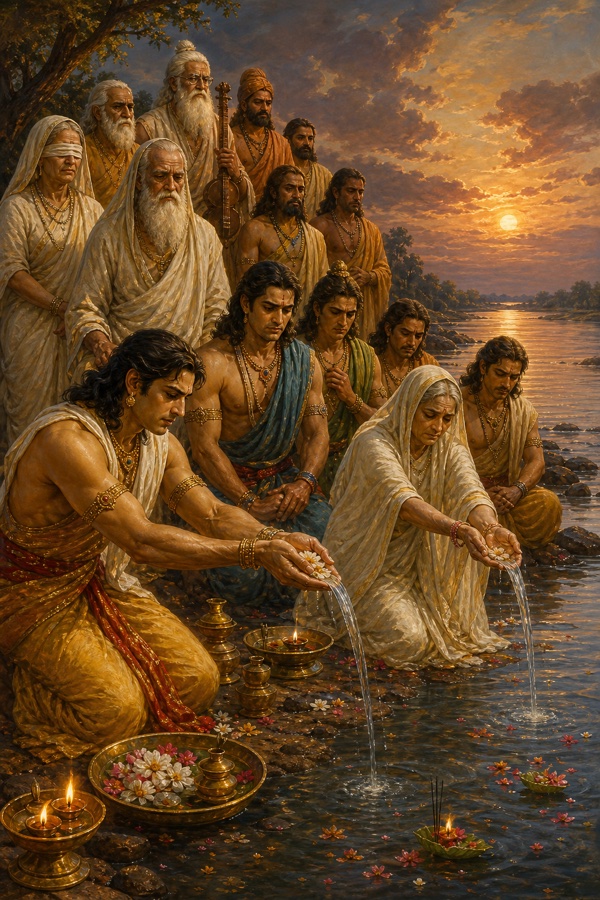
Bhima gave way to his anger. “It is we who will make the gifts for Bhishma’s funeral rites,” he said to Arjuna, “and for King Somadatta, and Bhurishravas, and the royal sage Valhika, and Drona, and all the rest. For Karna, our mother Kunti will make the offerings. Let Dhritarashtra not perform those shraddhas. That is what I think. Let our enemies not be gladdened. Let Duryodhana and the others sink from a miserable state to one more miserable, those wretches of their race who caused the whole earth to be laid waste. How have you been able to forget the anguish of those twelve years, and our life in deep disguise that was so painful to Draupadi? Where was Dhritarashtra’s affection for us then? Clad in a black deerskin, stripped of all your ornaments, with the princess of Panchala beside you, did you not follow this king into the woods? Where were Bhishma and Drona then, and where was Somadatta? For thirteen years you lived in the woods on what the wilderness gave. Your eldest father did not look at you then with a father’s eyes. Have you forgotten, Partha, that it was this wretch of our race, this man of wicked understanding, who kept asking Vidura, while the dice were being thrown, ‘What has been won?’” Yudhishthira had heard enough. He rebuked Bhima and told him to be silent.
A sub-tale: Bhima’s anger is the moral thorn of this stretch of the story. Yudhishthira and Arjuna answer the old man’s request with forgiveness and open hands; Bhima answers it with the bitter layer of truth beneath their generosity, that in the years of exile no one in this house showed the Pandavas any love, and that the man now begging for shraddha money is the one who sat in the gaming hall asking what had been won. Yudhishthira silences him, and Vidura will call his outburst the nature of a Kshatriya, yet the story never calls Bhima wrong and never calls Yudhishthira naive. It stands the two views beside each other and gives each its full weight.
Arjuna spoke once more. “Bhima, you are my elder brother, and so my senior and my teacher, and I dare not say more than I have said. But the royal sage Dhritarashtra deserves our honor in every way. Good men, the men who stand above the common level and never break the distinctions that mark the good, remember the benefits they have received and forget the wrongs.” Then Yudhishthira turned to Vidura. “Say to the Kuru king, from me, that I will give him as much wealth from my treasury as he wishes to give away for the funeral rites of his sons, and of Bhishma and the others among his well-wishers and benefactors. Let Bhima not be a cause of gloom in this.” He praised Arjuna as he said it, while Bhima kept casting angry looks at his younger brother. Then Yudhishthira spoke to Vidura again. “It does not become King Dhritarashtra to be angry with Bhima. This Bhima suffered cold and rain and heat and a thousand other griefs while we lived in the woods, and none of that is unknown to you. Tell the king that he may take from my house whatever articles he wishes and in whatever measure he likes, and tell him not to let his heart dwell on this show of pride that Bhima, in his deep pain, has indulged in. Whatever wealth I have, and whatever Arjuna has in his house, its owner is King Dhritarashtra. Tell him that too. Let him make gifts to the Brahmins and spend as largely as he likes, and free himself of the debt he owes his sons and well-wishers. And tell him this besides: this very body of mine is at his disposal, and all the wealth I have. Let there be no doubt of it.”
Vidura went back to Dhritarashtra and gave him the answer in full. He had delivered the message first, he said, and Yudhishthira had reflected on it and praised it highly. Arjuna placed all his mansions, with all the wealth in them, and his very life breath at the king’s disposal. Yudhishthira, the king’s son, offered his kingdom and his life and his wealth and everything else that was his. Bhima, remembering his countless sorrows, had given his consent with difficulty, breathing heavy sighs; the righteous king and Arjuna had pleaded with him and brought him around to cordiality. “King Yudhishthira prays you not to be displeased at the improper conduct Bhima showed when he remembered the old hostilities,” Vidura said. “That is how Kshatriyas generally behave in battle, and Bhima is devoted to battle and the ways of Kshatriyas. Both Yudhishthira and Arjuna beg you again and again to pardon him. ‘Be gracious to us. You are our lord. Whatever wealth we have, give it away as you like. You are the master of this kingdom and of every life in it. Let the head of the Kurus give away, for the funeral rites of his sons, all the first gifts that are made to Brahmins, taking from our mansions jewels and gems, cattle, slaves both male and female, goats and sheep. Let gifts go also to the poor and the blind and those in great distress, chosen as he likes. Let large pavilions be built and stocked with food and drink of many tastes, let reservoirs be dug so the cattle can drink, and let other works of merit be done.’ Those were the words of the king and of Arjuna, Pritha’s son. It is for you to say what should be done next.” Dhritarashtra was satisfied, and he set his heart on making large gifts on the day of the full moon of Kartika.
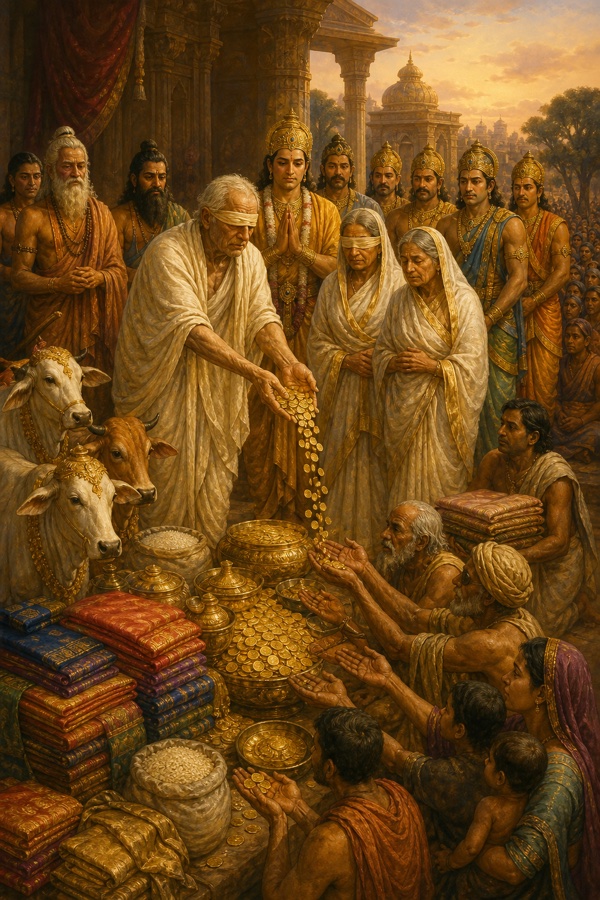
Pleased with what Yudhishthira and Arjuna had done, Dhritarashtra invited, after proper examination, thousands of deserving Brahmins and the foremost rishis, for the sake of Bhishma and of his sons and friends. He had a great quantity of food and drink prepared, and chariots and other vehicles, clothes, gold, jewels and gems, slaves both male and female, goats and sheep, blankets and costly articles, villages and fields, elephants and horses decked with ornaments, and many beautiful maidens, the best of their sex, and he gave all of it away for the advancement of the dead, naming each of them in due order as the gifts were made: Drona, Bhishma, Somadatta, Valhika, King Duryodhana, each one of his other sons, and all his well-wishers, with Jayadratha named first among them. With Yudhishthira’s approval that shraddha sacrifice ran rich with gifts of wealth and jewels and treasure of every kind. Tellers and scribes, under Yudhishthira’s orders, asked the old king without cease what should be given to whom, and everything he named was handed over the moment he spoke, and then multiplied: to a man who was to receive a hundred, a thousand was given, and to a man who was to receive a thousand, ten thousand, at the command of the son of Kunti. Like a raincloud reviving the crops, that royal cloud revived the Brahmins with downpours of wealth, and when the gifts had all gone out, the king deluged the guests of all four orders with wave after wave of food and drink. Dhritarashtra was an ocean that day, its waters jewels and gems, its green islands the villages and fields he gave, its caves heaped with precious things, its alligators and whirlpools the elephants and horses, its deep roar the sound of the mridanga drums, its waves the clothes and wealth and precious stones, and it flooded the earth. So he made gifts for the advancement in the other world of his sons and grandsons and ancestors, and of himself and Gandhari, until at last he tired, and the great gift sacrifice came to an end. Actors and mimes danced and sang all through it for the merriment of the guests. For ten days he gave in this way, and then the son of Ambika was free of the debt he owed his sons and grandsons.
A key to reading this (a number): Eighteen akshauhinis was the whole army fought at Kurukshetra, both sides together, and Samba’s point is that it was destroyed in exactly eighteen days. One akshauhini held about 21,870 chariots, as many elephants, 65,610 horses, and 109,350 foot soldiers, so the host that vanished in those eighteen days numbered in the millions, counting the riders. That is the scale of ruin that the assembly, and Dhritarashtra, are being asked to lay at destiny’s door.
The gist: Dhritarashtra asks his people’s pardon and gives them Yudhishthira as a deposit; the Brahmin Samba absolves him and his son, calling the ruin of eighteen akshauhinis in eighteen days the work of destiny. Vidura carries the request for shraddha money, Bhima explodes, Yudhishthira and Arjuna offer everything they own, and a ten-day gift sacrifice for the slain follows, every gift multiplied tenfold at Yudhishthira’s order.
Setting out for the forest
Having settled the hour of his departure, Dhritarashtra summoned the Pandavas, and he and Gandhari greeted the princes with due form. On the day of the full moon of Kartika he had the preliminary rites performed by Brahmins versed in the Vedas, and he had the fire he worshiped every day taken up from its hearth to travel with him, for a man who goes into the forest does not leave his fire behind. He put off his usual robes and put on deerskin and bark, and with his daughters-in-law around him he walked out of his mansion. A great wail rose from the Pandava women and the Kaurava women and every other woman of the house as he went. At the threshold he stopped and worshiped the house he had lived in, with fried paddy and fine flowers of many kinds, and he honored all his servants with gifts of wealth, and then he left that home and set out.
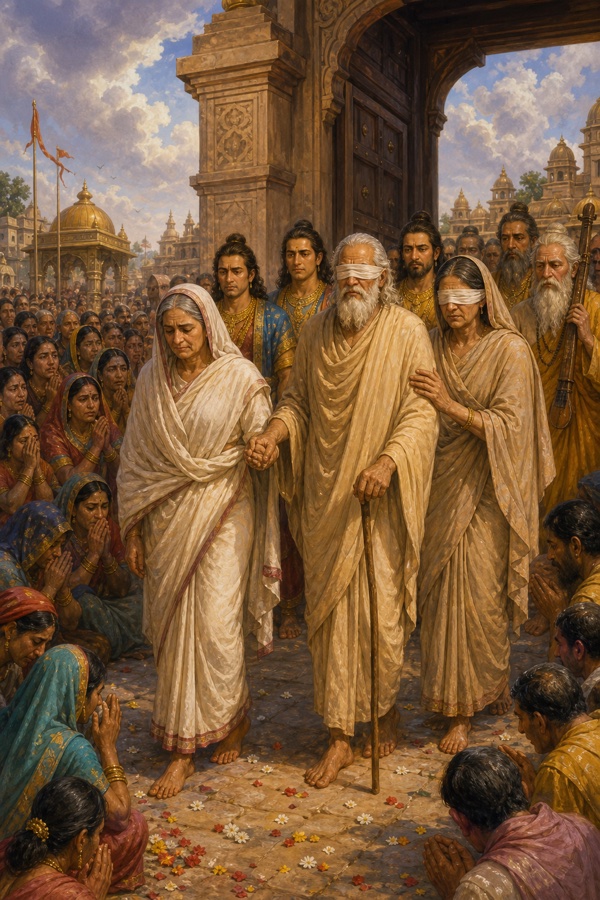
Yudhishthira, trembling all over, his voice choked with tears, cried out in a loud voice, “Where are you going?” and fell down in a faint. Arjuna, burning with grief, sighed and sighed again, and told his brother that he should not behave like this, and stood there himself with his heart sunk in distress. Then they walked. Bhima, Arjuna, the two sons of Madri, Vidura, Sanjaya, Yuyutsu, Kripa, Dhaumya the family priest, and other Brahmins followed the old king with their throats closed by grief. Kunti walked in front, carrying Gandhari’s hand on her shoulder, and Gandhari walked with the cloth bound over her eyes that she had worn since the day of her wedding, having refused to look on a world her husband could not see, and behind Gandhari, his hand on her shoulder, Dhritarashtra walked in full trust, blind leading blind led by the one who could see. Draupadi, Subhadra, Uttara, the young widow of Abhimanyu who had lately become a mother, Chitrangada, and the other women of the royal house went along with them, and the wail they raised was like the crying of a flock of she-ospreys. The wives of the citizens, Brahmin and Kshatriya and Vaishya and Shudra, came out into the streets from every side. Women who had never before been seen by the sun or the moon came out in their grief. Hastinapura was as stricken that day as it had been on the day the Pandavas, beaten at dice, had set out for the woods.
Men and women stood on the terraces of the mansions and on the ground, and the uproar was tremendous. The old king, his hands joined, trembling with weakness, moved with difficulty along the principal street through that crowd, and passed out of the city named after the elephant by its principal gate, and again and again he told the people to go back to their homes. Vidura had set his heart on going to the forest with him, and so had Sanjaya, the son of Gavalgana, his chief minister, who had been his eyes through the eighteen days of the war. Kripa and Yuyutsu the king held back and made over into Yudhishthira’s hands. When the citizens had at last stopped following, Yudhishthira and the women of his household prepared to stop too, at Dhritarashtra’s command. Then he saw that his mother did not mean to stop. “I will follow the old king,” he said to her. “You must turn back. Return to the city with these daughters-in-law of yours. The king is going to the woods firmly resolved on penance.” His eyes were full of tears as he said it. Kunti did not answer him. She walked on, holding Gandhari.
When she did speak, she gave instructions. “Never show any disregard for Sahadeva,” Kunti said. “He is very much attached to me, and to you, always. Always keep Karna in mind, who never turned back from a battle. Through my folly that hero was killed on the field. Surely this heart of mine is made of steel, since it does not break into a hundred pieces at never seeing that child of Surya again. That being so, what can I do now? I am very much to blame for never proclaiming the truth of his birth. I hope that you, with all your brothers, will make excellent gifts for the sake of that son of Surya. Always do what pleases Draupadi. Look after Bhima and Arjuna and Nakula and Sahadeva. The burdens of the Kuru race have fallen on you now. I will live in the woods with Gandhari, my body smeared with dust, practicing penance and serving my father-in-law and my mother-in-law.”
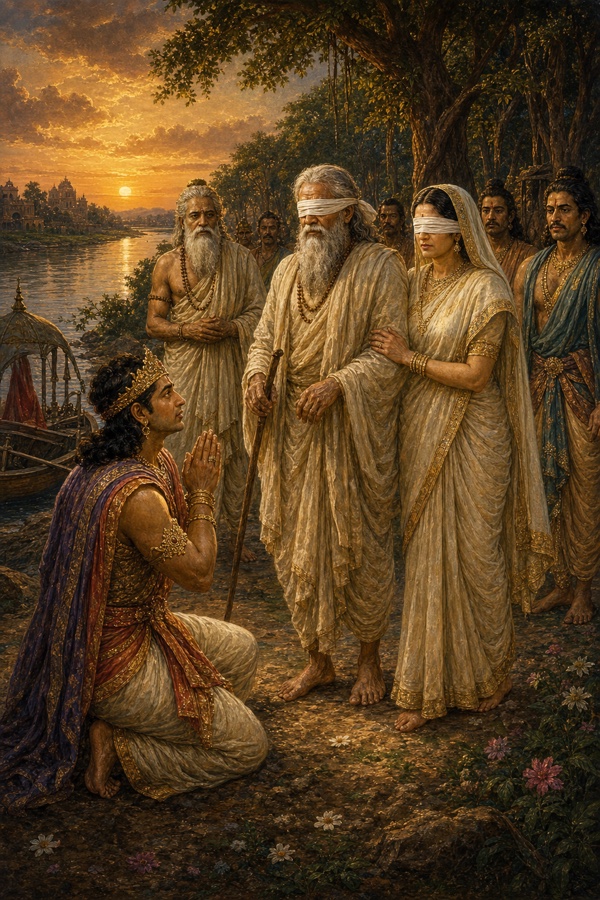
Yudhishthira, who kept his passions under complete control, was plunged into distress, and his brothers with him, and for a while he said nothing. Then, his heart low and anxious, he spoke. “Strange indeed is this purpose of yours. You should not carry it out. I can never grant you leave. Show us compassion. Once, when we were about to leave Hastinapura for the woods, it was you who recited to us the story of Vidula’s counsel to her son and roused us to exertion. Do not abandon us now. I killed the kings of the earth and won this sovereignty guided by your words of wisdom, sent to me through Vasudeva. Where is that understanding of yours now, which I heard of from Vasudeva? Do you mean to fall away from the Kshatriya practices you taught us? Leaving us, this kingdom, and this daughter-in-law of yours, famous as she is, how will you live in the trackless woods? Relent!” Kunti heard him with tears in her eyes and went on walking. Then Bhima tried. “Now that sovereignty has been won, Kunti, now that the time has come for you to enjoy what your children have won and the duties of royalty are waiting for you, where has this desire come from? Why did you make us exterminate the earth, then? Why would you leave everything and live in the woods? We were born in the woods. Why did you bring us out of the woods when we were children? Look, the two sons of Madri are overwhelmed with sorrow. Relent, mother. Do not go to the woods now. Enjoy the prosperity that Yudhishthira’s might has won.” Kunti, firmly resolved, disregarded her sons’ laments. Draupadi, her face fallen, and Subhadra with her followed their weeping mother-in-law, and the Pandavas with all their wives and servants followed too, while Kunti walked on, looking back again and again at her weeping children. Then she held back her own tears and spoke to them.
“It is even as you say, my sons. When you were all sunk in despair, that was exactly how I roused you. Your kingdom had been wrested from you at a match at dice; you had fallen from happiness; your own kinsmen were domineering over you; and I put courage and high thoughts into your minds. I encouraged you so that the sons of Pandu might not be lost, so that their fame might not be lost. You are all equal to Indra, and your prowess is like the gods’ own. I did it so that you would not live watching the faces of others, which is to live at the mercy of others. I put courage into your heart, Yudhishthira, first among the righteous, the equal of Vasava, so that you would not go into the woods again and live in misery. I put courage into your hearts so that this Bhima, who has the strength of ten thousand elephants and whose prowess and manliness are known everywhere, would not sink into insignificance and ruin. I put courage into your hearts so that this Vijaya, born after Bhima and the equal of Vasava himself, would not lose heart. I put courage into your hearts so that Nakula and Sahadeva, always devoted to their elders, would not be weakened and made wretched by hunger. And I acted as I did so that this woman with the large eyes and the well-formed limbs would not have to endure without vengeance the wrongs done to her in the public hall. In the sight of all of you, Bhima, Duhshasana in his folly dragged her, trembling all over like a plantain tree, during the days of her monthly illness, after she had been won at dice, as if she were a slave. All of it was known to me. The race of Pandu had been subjugated by its enemies. The Kurus, my father-in-law and the rest, sat in gloom while she cried out for a protector like a she-osprey. When that sinful, small-minded Duhshasana dragged her by her fair hair, I lost my senses. Know that it was to raise your energy that I put courage into your hearts by reciting Vidula’s words. I did it so that the race of Pandu, which my children carry, might not be lost. The sons and grandsons of a man who brings his race to infamy never reach the regions of the righteous, and the ancestors of the Kaurava line were in danger of losing the blessed worlds that were theirs.”
“As for me, my sons, I have already enjoyed the great fruits of the sovereignty my husband won. I made large gifts. I duly drank the soma juice in sacrifice. It was not for my own sake that I urged you on through Vasudeva with the stirring words of Vidula. It was for yours. I do not want the fruits of the sovereignty my children have won. By my penances I want to reach the worlds my husband has reached. By obedient service to my father-in-law and my mother-in-law, who both wish to make their home in the woods, and by penance, I want to waste this body. Stop following me, Yudhishthira, and Bhima, and all of you. Keep your understanding always devoted to righteousness. Let your minds be large.”
Kunti’s words were just, and the opposition her sons had offered was unreasonable, and hearing her the sinless Pandavas were ashamed. They gave up following her, and Draupadi gave it up with them. The women of the Pandava household, seeing that Kunti was really going, wailed aloud. The Pandavas walked around the old king in reverence and saluted him duly, and stopped where they were, having failed to turn their mother back. Then Dhritarashtra, leaning on Gandhari and Vidura, spoke. “Let the royal mother of Yudhishthira stop coming with us. Everything Yudhishthira has said is true. Why should she abandon the high prosperity of her sons, and the high fruits that could be hers, and go into the trackless woods, leaving her children behind like a person of little intelligence? Living in the enjoyment of sovereignty she can still practice penance and keep the high vow of gifts. Let her listen to me. Gandhari, I have been much pleased by the service this daughter-in-law has rendered me. You know every duty; command her to return.” Gandhari repeated all the old king’s words to Kunti and added grave words of her own, and none of it moved her, for that chaste and righteous woman had set her heart firmly on the woods. The Kuru women, seeing how firm she was and seeing that their husbands had stopped following, raised one more loud lament. Then the sons of Pritha and all the women turned back, and the old king’s party went on toward the forest without them. The Pandavas and their wives returned to the city on their chariots in deep grief. Hastinapura, young and old, men and women, sank into sorrow, and no festival of rejoicing was held. Deserted by Kunti, the sons of Pandu had no energy left in them; they were like calves cut off from their mothers.
A sub-tale: Here Kunti says openly that hiding the truth of Karna’s birth was her own fault, and that this is why the son of Surya died. On the road out of the city she asks her sons to make gifts for him, the brother they killed without knowing him. The mother who once sent Vidula’s words through Krishna to spur her sons to Kshatriya duty and revenge now names, at the root of that spurring, the one truth she herself concealed, and she chooses to waste her body in the woods over the kingdom that truth helped win. The story does not lighten that weight for her.
The gist: On the day of the full moon of Kartika, Dhritarashtra puts on deerskin and bark and walks out of Hastinapura with Gandhari and Kunti while the whole city weeps. Yudhishthira and Bhima plead with Kunti to turn back; she admits her fault in hiding Karna’s truth, explains why she once drove her sons to war, and holds to her resolve to reach, by her own penance, the regions her husband earned. The Pandavas return to the city like calves without their mother.
The first night on the bank of the Bhagirathi
That day Dhritarashtra reached a place far from the city, and he rested for the night on the bank of the Bhagirathi, the Ganga, at a retreat of ascetics. The Brahmins who had come with him, men versed in the Vedas, kindled their sacred fires there, and surrounded by those Brahmins the fires blazed up in beauty. The old king’s own fire, carried out of Hastinapura that morning, was lit too. Sitting beside it he poured his libations on it with due rites, and then he worshiped the thousand-rayed sun as it stood on the point of setting. Vidura and Sanjaya made him a bed by spreading blades of kusha grass. Near the bed of that Kuru hero they made another for Gandhari, and close beside Gandhari, Kunti, keeper of excellent vows, lay down content. Within hearing of the three of them slept Vidura and the others, and the sacrificing Brahmins and the rest of the king’s followers lay down on their own beds. The Brahmins chanted sacred hymns aloud, and the fires burned all around, and that night, filled with holy chanting, seemed as delightful to them as a Brahmi night, a night given over to sacred song. When it passed they rose, went through their morning acts, poured libations on the fire, and continued their journey. That first day of the forest had been very painful to them, because of the grieving people of the city and the provinces they had left.
A key to reading this (a place): The Bhagirathi is one of the names of the Ganga, from the penance of King Bhagiratha that drew her down from heaven. The king’s party first halts on her bank, then moves on toward Kurukshetra, and the whole of this chapter will keep returning to the river: the night of the dead and the water rites at the end both happen on her banks. The initiation lies inland at Kurukshetra, at Vyasa’s retreat, where the party goes next.
Shatayupa’s hermitage and the forest initiation
On Vidura’s advice the king took up his abode on that bank of the Bhagirathi, a sacred place that deserved to be peopled by the righteous. Many Brahmins who lived in the woods came to see the old king there, and many Kshatriyas and Vaishyas and Shudras, and sitting in their midst he gladdened them all with his words, honored the Brahmins and their disciples with due rites, and dismissed them. When evening came, the king and Gandhari went down into the stream of the Bhagirathi and performed their ablutions for purification, and Vidura and the others bathed in the sacred water too and performed the usual rites. When the king had purified himself with his bath, Kunti gently led him, who was as a father-in-law to her, and Gandhari, out of the water onto the dry bank. The sacrificing priests had raised an altar there for the king, and the king, devoted to truth, poured his libations on the fire. Then from the bank of the Bhagirathi the old king and his followers, keeping their vows and their senses restrained, went on to Kurukshetra.
There the king arrived at the retreat of the royal sage Shatayupa and had an interview with him. Shatayupa had been the great king of the Kekayas; he had made over the sovereignty of his kingdom to his son and come into the woods, and so he had already walked the road Dhritarashtra was walking. He received the old king with due rites and took him on to the retreat of Vyasa, and there Dhritarashtra received his initiation into the forest mode of life. Returning, he took up his abode in Shatayupa’s retreat, and Shatayupa, at Vyasa’s command, taught him all the rites of the forest life. So Dhritarashtra set himself to penance, and all his followers took the same course. Gandhari, with Kunti, put on bark and deerskin and took up the same vows as her husband. Restraining their senses in thought, word, and deed, and in the eye as well, they practiced severe austerities. Freed of every stupefaction of mind, Dhritarashtra practiced vows and penances like a great rishi, reducing his body to skin and bone, for his flesh dried up entirely; he wore matted locks and bark and skins. Vidura, who knew the true interpretation of righteousness, and Sanjaya waited on the old king and his wife, and the two of them, their souls in subjection, wasted their own bodies too, and wore bark and rags.
A key to reading this (lineage and place): Shatayupa is a former royal sage of the Kekaya country who gave up his kingdom to practice penance in the forest of Kurukshetra. His hermitage becomes Dhritarashtra’s home, and Vyasa’s own retreat is near it; the initiation is given there and the teaching of the forest rites is left to Shatayupa. When Narada arrives, it is Shatayupa’s own grandfather whose fate he tells first.
Narada’s prophecy
Narada, Parvata, and Devala of austere penance came to see Dhritarashtra there, and Vyasa came too with all his disciples, and other men of great wisdom crowned with ascetic success, and the royal sage Shatayupa, old and full of merit. Kunti worshiped them all with due rites, and all of them were pleased. Those great rishis gladdened the old king with discourses on religion and righteousness, and at the close of the talk the celestial rishi Narada, who sees all things as if they stood before his eyes, spoke.
“There was a ruler of the Kekayas of great prosperity and perfectly fearless,” Narada said. “His name was Sahasrachitya, and he was the grandfather of this Shatayupa. He resigned his kingdom to his eldest son, who was richly endowed with righteousness, and retired into the woods, and reaching the far end of blazing penance he attained the region of Purandara and lived there in Indra’s company. Many times, visiting Indra’s region, I have seen that king, his sins all burned away by penance, residing in Indra’s abode. In the same way King Shailalaya, the grandfather of Bhagadatta, attained the region of Indra by the power of penance alone. There was another king, Prishadhra, who was like the wielder of the thunderbolt himself, and he too went by his penances from the earth to heaven. In this very forest Purukutsa, the son of Mandhatri, attained high success, and the river Narmada herself became that king’s consort; having done his penance in this forest he went to heaven. There was another king, highly righteous, named Shashaloman, who also underwent severe austerities in this forest and then ascended to heaven. And you, having come to this forest, will through the grace of Vyasa attain a goal that is very high and very hard to reach. At the end of your penances you will be endowed with great prosperity, and with Gandhari you will attain the goal those kings attained. Pandu, who dwells in the presence of Indra, the slayer of Vala, thinks of you always, and he will certainly help you toward that prosperity. This daughter-in-law of yours, Kunti, through serving you and Gandhari, will win a dwelling with her husband in the other world. She is the mother of Yudhishthira, who is the eternal Dharma. Vidura will enter into Yudhishthira. Sanjaya, through meditation, will ascend from this world to heaven. All this we see with our inner vision.”
Dhritarashtra and Gandhari praised those words and honored Narada with honors no one had offered before, and the whole conclave of Brahmins, glad and wanting to gladden the old king, honored him too. Then Shatayupa spoke to Narada. “Your holy self has deepened the devotion of the Kuru king, of everyone here, and of me. I have something to ask, though. It concerns King Dhritarashtra. You know the truth of every matter, and with your celestial sight you see the various goals of human beings. You have said what goal the kings you named reached, and it was the company of the chief of the gods. You have not said what regions this king will win. I want to hear from you what region will be the royal Dhritarashtra’s, and when he will attain it.” Narada, in the midst of the assembly, gave the answer everyone wanted to hear. “Going at my will to the mansion of Shakra, I saw Shakra, the lord of Shachi, and I saw King Pandu there. A talk arose about this Dhritarashtra and the austere penances he is performing, and from Shakra’s own lips I heard that three years remain of the life allotted to this king. After that, Dhritarashtra, with his wife Gandhari, will go to the regions of Kubera and be highly honored by that king of kings. He will go there on a chariot that moves at his will, his person adorned with celestial ornaments. He is the son of a rishi, he is highly blessed, and he has burned all his sins away by penance. Righteous of soul, he will rove at will through the regions of the gods, the Gandharvas, and the Rakshasas. What you asked about is a mystery of the gods, and out of my affection for you I have declared this high truth. You all possess the wealth of the Vedas, and your penances have consumed your sins.” Hearing those sweet words of the celestial rishi, everyone assembled there, and Dhritarashtra himself, was greatly cheered. Having cheered the wise old king with such talk, the sages left the spot, going by the path that belongs to those who are crowned with success.
A key to reading this (a number): Narada reports what he heard from Indra’s own mouth, that Dhritarashtra has three years of life left, and that after them he and Gandhari will go to Kubera’s region on a chariot that moves at his will. Hold that number. It is the measure of the whole forest life, and the reckoning at the end of this chapter, three years in the forest, closes exactly on it.
The gist: In Shatayupa’s retreat near Vyasa’s hermitage, Dhritarashtra takes the vow of the forest life, and Gandhari, Kunti, Vidura, and Sanjaya waste their bodies beside him. Narada, recounting the kings he has seen in Indra’s realm, foretells the fate of each member of the party, and, pressed by Shatayupa, reveals the secret of the gods: the old king has three years left, and will then reach Kubera’s region with Gandhari.
The Pandavas journey to the forest and the meeting
With the chief of the Kurus gone into the forest, and grieving for their mother besides, the Pandavas sank into gloom. The city of Hastinapura was sunk in sorrow with them, and the Brahmins talked of the old king all the time. How would a king who had grown so old live in the solitary woods? How would the blessed Gandhari live there, and Pritha, the daughter of Kuntibhoja? The royal sage had lived his whole life in every comfort; he would certainly be miserable. What was the condition now of that man of royal descent, deep in the woods, and blind besides? Hard was the thing Kunti had done, separating herself from her sons, casting off kingly prosperity and choosing a life in the woods. And what of Vidura, always devoted to the service of his elder brother? And of the wise son of Gavalgana, so faithful to the food his master gave him? Even the children of the city asked one another these questions when they met. The Pandavas, grieving for their old mother, could not stay in the city for long. Thinking of their old father, the king who had lost every child, and of Gandhari, and of wise Vidura, they found no peace of mind. They had no pleasure in sovereignty, or in women, or in the study of the Vedas. Despair went through them as they thought of the old king and turned over, again and again, the slaughter of their kinsmen: the young Abhimanyu killed on the field, Karna, who never retreated, the sons of Draupadi, and their other friends. The earth, they kept thinking, had been emptied of both her heroes and her wealth. Draupadi had lost all her children, and the beautiful Subhadra had lost hers, and the two women grieved as deeply as the men. Only the sight of Uttara’s son, the infant Parikshit, kept them holding on to life.
The brothers were so stricken that they no longer attended to the offices of kingship in their capital at all. Nothing gave them pleasure. If anyone addressed them they did not honor him with an answer. Grave as the ocean they had always been, and now grief had taken their knowledge and their very senses from them. They thought of their mother, wasted with fasting, and how she was serving the old couple. “How is that king living alone with his wife in woods that are the haunt of beasts of prey, with all his sons dead and no refuge left him? How does the blessed Gandhari, whose dear ones are all dead, follow her blind lord through the solitary forest?” So they talked among themselves, and they set their hearts on seeing the king in his retreat. Then Sahadeva bowed to the king and said, “I see your heart is set on seeing our father. Out of respect for you I could not be the first to open my mouth about a journey to the woods. Now the time for it has come. By good fortune I will see Kunti living in penance, with matted locks on her head, practicing severe austerities, wasted by sleeping on blades of kusha and kasha grass. She was brought up in palaces and mansions and nursed in every comfort and luxury. When will I see my mother, who is now toil-worn and plunged in misery? Without doubt the ends of mortals are uncertain, when Kunti, a princess by birth, now lives in misery in the woods.” Draupadi honored the king with the proper salutation and said, “When will I see Queen Pritha, if she is even alive? I will count my life well spent if I see her once more. Let this understanding stay firm in you always. Let your mind always take pleasure in the righteousness of granting us so high a boon. Know that all the women of your house are standing with their feet lifted for the road, longing to see Kunti, and Gandhari, and my father-in-law.”
Yudhishthira summoned all the leaders of his forces. “Let my army march out,” he said, “full of chariots and elephants. I am going to see King Dhritarashtra in the woods.” To the men who supervised the women’s affairs he gave orders that conveyances of every kind be readied, and all his closed litters, which numbered in the thousands. Carriages, granaries, wardrobes, and treasuries were to be equipped and sent out; the mechanics were to march; the treasury officers were to go ahead along the road to the ascetic retreats of Kurukshetra. Whoever among the citizens wished to see the old king was free to come, under proper protection. Cooks and kitchen superintendents and the whole culinary establishment, with edibles of every kind, were to be carried on carts. It was to be proclaimed that the march began the next day, and there was to be no delay, and pavilions and rest houses of many kinds were to be raised along the way. When morning came the king set out with a great train of women and old men, and having gone out of the city he waited five days for whatever citizens wanted to join him, and then turned toward the forest. The troops marched out under heroes led by Arjuna, men like the guardians of the universe, and at once a great clamor went up of horsemen shouting “Equip, equip!” as they readied their mounts. Some went on carriages, some on swift horses, some on chariots of gold that shone like blazing fire, some on mighty elephants, some on camels, and some on foot, the fighters who wore iron tiger claws tied at their waists. The citizens and the people of the provinces, wanting to see Dhritarashtra, followed on conveyances of every kind. Kripa, the teacher of the house and a great leader of forces, took all the troops in his charge and moved toward the old king’s retreat at Yudhishthira’s command. Yudhishthira himself rode surrounded by a great number of Brahmins, his praises sung by bands of Sutas and Magadhas and bards, with the white umbrella of kingship held over his head and a great ring of chariots around him. Bhima, the son of the Wind, went on an elephant as big as a hill, fitted with strung bow and engines and weapons of attack and defense. The twin sons of Madri went on two swift horses, well armored, well guarded, flying their banners. Arjuna, his senses under control, rode an excellent chariot bright as the sun, drawn by fine white horses. The women of the household, led by Draupadi, went in closed litters guarded by the superintendents of women, scattering wealth in showers as they passed. Teeming with chariots, elephants, and horses, echoing with trumpets and the music of vinas, the Pandava host blazed with beauty as it moved, and it moved slowly, resting on the pleasant banks of rivers and lakes. Yuyutsu and Dhaumya the priest, at Yudhishthira’s command, stayed behind to protect the city.
By slow marches Yudhishthira reached Kurukshetra, the field where the eighteen days had been fought, and crossed the sacred Yamuna, and from a distance he saw the retreat of the wise royal sage and of Dhritarashtra. Everyone was filled with joy, and they entered the forest quickly, filling it with loud sounds of gladness. Some way off the Pandavas got down from their chariots and went on toward the king’s hermitage on foot, bending themselves in humility, and the fighting men, the people of the kingdom, and the wives of the Kuru chiefs all followed them on foot. They came to Dhritarashtra’s sacred retreat, full of herds of deer and adorned with plantain trees, and ascetics of rigid vows, full of curiosity, gathered to look at the Pandavas who had come. Yudhishthira, with tears in his eyes, asked them where his eldest father had gone, and they told him he had gone to the Yamuna to bathe and to fetch flowers and water.
The gist: Grieving for their mother and the old king, the Pandavas cannot govern; at the plea of Sahadeva and Draupadi, Yudhishthira marches with his army, the women in thousands of litters, and any citizen who wishes to come, waits five days outside the city for stragglers, crosses the Yamuna to the Kurukshetra retreat, and walks the last stretch on foot.
Sanjaya’s introduction
The king sat with his brothers, all of them with eyes like lotus petals, in his eldest father’s hermitage, and around him gathered many blessed ascetics who had come from many regions to look at the broad-chested sons of that lord of the Kurus. They could not tell one from another, and they wanted to know which of them was Yudhishthira, which were Bhima and Arjuna, which were the twins, and which of the women was the famous Draupadi. So Sanjaya, the Suta, the old king’s charioteer and minister, answered their questions, pointing out the Pandavas by name, and Draupadi, and the other women of the Kuru house.
The one as fair as pure gold, Sanjaya told them, with a body like a full-grown lion’s, a large aquiline nose, and wide, expansive eyes of a coppery hue, was the Kuru king. The one whose tread was like an infuriated elephant’s, whose color was like heated gold, whose frame was large and broad and whose arms were long and stout, was Vrikodara, the wolf-bellied Bhima, and they should look at him well. The mighty bowman seated beside him, of darkish color and youthful frame, like the leader of an elephant herd, with shoulders as high as a lion’s, a walk like a sporting elephant’s, and eyes as wide as lotus petals, was the hero called Arjuna. The two men seated beside Kunti were the twins, Nakula and Sahadeva, like Vishnu and Mahendra; in the whole world of men they had no equals in beauty, strength, and excellence of conduct.
Then he named the women. The lady with eyes as wide as lotus petals, who seemed to have touched the middle of life, whose color was the blue lotus and who looked like a goddess of heaven, was Krishna, Draupadi, the goddess of prosperity in a body. Beside her, with the color of pure gold, like the moon’s rays embodied among the other women, was the sister of the peerless hero who wields the discus, Subhadra. The one as fair as pure gold was the daughter of the serpent king and the wife of Arjuna, Ulupi. The one whose color was like pure gold or like madhuka flowers was the princess Chitrangada. The one with the color of a mass of blue lotuses was the sister of that lord of hosts who used always to challenge Krishna, and she was the foremost wife of Bhima. This was the daughter of Jarasandha, the king of Magadha, with the color of a mass of champaka flowers, the wife of Sahadeva, the youngest son of Madri; and the one seated on the ground, dark as the blue lotus, with eyes as wide as lotus petals, was the wife of Nakula, Madri’s elder son. The lady fair as heated gold, with a child on her lap, was Uttara, the daughter of King Virata, the wife of that Abhimanyu who, stripped of his chariot, was killed by Drona and the others fighting from their chariots, an unfair fight, since a man on the ground should never be attacked by a man on a chariot. And the women whose hair showed no parted line and who were clad in white were the widows of Dhritarashtra’s slain sons, the daughters-in-law of this old king.
The gist: Sanjaya introduces the Pandavas and the Kuru women one by one to the ascetics of the hermitage, by build, color, and lineage, from Yudhishthira to Abhimanyu’s widow Uttara with the infant Parikshit in her lap, and last of all the white-clad widows of the hundred sons.
Toward the forest: the Pandavas reach their aged elder
By slow marches King Yudhishthira had reached Kurukshetra, leaving the city behind him in the keeping of Yuyutsu and the priest Dhaumya, at his own command. Crossing the sacred Yamuna, he had seen from a distance the retreat where the wise royal sage Dhritarashtra lived, and at the sight everyone had been filled with joy and had entered the forest ringing it with high cries of gladness.
Some way from their chariots the Pandavas got down and went on foot toward the king’s hermitage, bending in humility, and the warriors who had come with them, the people of the kingdom, and the Kuru women all followed them on foot. They reached that sacred retreat of Dhritarashtra, full of herds of deer and adorned with plantain trees, and many ascetics of hard vows, full of curiosity, came to see the Pandavas who had arrived among them.
With tears in his eyes Yudhishthira asked the ascetics, “Where has our eldest father gone?” They answered that he had gone toward the Yamuna to bathe and to fetch flowers and water. The Pandavas hurried along the path the ascetics pointed out, and from a distance they saw all of them, and longing to meet their father they walked faster. Then Sahadeva broke from the others and ran to where Kunti was. He touched his mother’s feet and wept aloud. With tears pouring down her cheeks she looked at her darling son, raised him up, folded him in her arms, and told Gandhari that Sahadeva had come.
Then, seeing the king, and Bhima, and Arjuna, and Nakula, Kunti tried to hurry toward them. She was walking in front of the childless old couple, Dhritarashtra and Gandhari, and drawing them along with her, and when the Pandavas saw the three of them they fell to the earth. The wise and majestic old king knew them by their voices and by touch, and comforted them one after another. Shedding tears, the princes went up with due formality to the old king and to Gandhari and to their own mother, and when they had recovered their senses, comforted once more by their mother, they took from the king, their aunt, and their mother the jars of water the three had been carrying, and carried them themselves.
The wives of those lions among men, all the women of the royal household, and all the people of the city and the provinces then came before the old king. Yudhishthira presented each in turn to him, repeating their names and their races, and then he himself saluted his eldest father with reverence. Surrounded by them all, the old king, his eyes bathed in tears of joy, felt as though he stood once more in the middle of the city named after the elephant. Saluted with reverence by all his daughters-in-law, with Draupadi at their head, Dhritarashtra, with Gandhari and Kunti, was filled with delight. Then he went back to his forest retreat, a place praised by Siddhas and Charanas, and it was so thronged now with people eager to see him that it looked like the sky crowded with countless stars.
A key to reading this (lineage): Dhritarashtra was Pandu’s elder brother, and the eldest brother is looked on as a father, so Kunti treats him as a father and Gandhari stands to her as a mother-in-law. That is why Yudhishthira calls him “eldest father.” Gandhari has worn a cloth over her eyes since the day of her marriage, refusing to look on a world her husband could not see; when the two of them walk, Kunti’s shoulder is their only sight.
The gist: The Pandavas leave their chariots and walk, learn that the old king has gone to the Yamuna for water and flowers, run to meet him on the path, and take the water jars from the three old people’s hands. Yudhishthira presents every member of the household to the blind king, who feels himself back in Hastinapura.
Sanjaya makes the introductions: the Pandavas among the ascetics
King Dhritarashtra sat in the hermitage with those brothers whose eyes were like lotus petals, and around them gathered many blessed ascetics who had come from different regions, wishing to see the Pandavas. “We wish to know,” they said, “which of these is Yudhishthira, which are Bhima and Arjuna, which are the twins, and which is Draupadi of great fame.” The Suta Sanjaya answered them, pointing out the Pandavas by name, and Draupadi, and the other women of the Kuru house.
“This one whose color is as fair as pure gold,” Sanjaya said, “whose body is like a full-grown lion’s, whose nose is large and aquiline, and whose eyes are wide and expansive and coppery, is the Kuru king. This one whose tread is like an infuriated elephant’s, whose color is like heated gold, whose frame is large and broad and whose arms are long and stout, is Bhima, whom we call Vrikodara, the wolf-bellied. Look at him well. The mighty bowman seated beside him, of darkish color and youthful frame, who looks like the leader of an elephant herd, whose shoulders are as high as a lion’s, who walks like a sporting elephant, and whose eyes are as wide as lotus petals, is the hero called Arjuna. Those two seated beside Kunti are the twins, like Vishnu and Mahendra. In this whole world of men they have no equals in beauty, strength, and excellence of conduct.”
“This lady, with eyes as wide as lotus petals, who seems to have touched the middle age of life, whose color is like the blue lotus and who looks like a goddess of heaven, is Krishna, the embodied form of the goddess of prosperity. She who sits beside her, with the color of pure gold, who looks like the embodied rays of the moon among the other women, is the sister of that unrivaled hero who wields the discus. This other, as fair as pure gold, is the daughter of the serpent king and the wife of Arjuna. This other, whose color is like pure gold or like madhuka flowers, is the princess Chitrangada. This one, with the color of a mass of blue lotuses, is the sister of that lord of hosts who used always to challenge Krishna; she is the foremost wife of Bhima. This is the daughter of the king of Magadha who was known as Jarasandha; with the color of a mass of champaka flowers, she is the wife of the youngest son of Madravati. She who sits there on the ground, dark as the blue lotus, with eyes as wide as lotus petals, is the wife of the eldest son of Madravati.”
“This lady whose color is as fair as heated gold and who sits with her child on her lap is the daughter of King Virata. She is the wife of that Abhimanyu who, stripped of his chariot, was killed by Drona and the others fighting from their chariots. These women, whose hair shows no parted line and who are clad in white, are the widows of the slain sons of Dhritarashtra. They are the daughters-in-law of this old king, the wives of his hundred sons, deprived now of husbands and children alike, all of them killed by heroic enemies. I have pointed them out to you in order of precedence. Through their devotion to Brahmins their understandings and hearts are free of every crookedness. Pure of soul, all these princesses of the Kaurava household have been shown to you, in answer to your questions.”
When all the ascetics had gone, that Kuru king of many years asked his sons about their welfare. The warriors who had come with the Pandavas left the retreat, got down from their chariots and their mounts, and sat down a little way off. When the whole crowd, the women, the old men, and the children, had been seated, the old king spoke to them with the usual inquiries of courtesy.
A key to reading this (the characters): Ulupi is a serpent princess and Chitrangada a princess in her own right, both wives of Arjuna. Bhima’s wife is identified only through her brother, a king who used always to challenge Krishna. The sons of Madravati, that is, of Madri, are Nakula and Sahadeva. Uttara is King Virata’s daughter and Abhimanyu’s widow; the infant on her lap is Parikshit, who will one day be king, and whose son Janamejaya is the man hearing this story recited.
The gist: Describing build, color, and gait before the ascetics, Sanjaya introduces the five Pandavas, Draupadi, Subhadra, Ulupi, Chitrangada, Bhima’s wife, the wives of the twins, and Uttara with her child, one by one, and last of all shows the hundred white-clad widows whose husbands and sons were killed in the war. Then the ascetics withdraw and the old king turns to his family.
Questions of welfare: Dhritarashtra and Yudhishthira, and the search for Vidura
“Yudhishthira,” Dhritarashtra asked, “are you at peace and happy, with all your brothers and the people of the city and the provinces? Are those who live in dependence on you happy too? Your ministers, your servants, your elders and teachers, are they happy? Are the people in your dominions free from fear? Do you follow the old and traditional conduct of rulers of men? Is your treasury filled without disregarding the restraints of justice and equity? Do you behave as you should toward enemies, neutrals, and allies? Do you look after the Brahmins duly, always making them the first gifts ordained in sacrifices and rites? Your citizens and servants and kinsmen, are they content with your behavior? Do you adore the ancestors and the gods with devotion? Do you honor guests with food and drink? Do the Brahmins of your dominions, devoted to the duties of their order, walk the path of righteousness? Do the Kshatriyas and Vaishyas and Shudras of your kingdom, and all your relatives, keep their own duties? I hope the women, the children, and the old among your subjects do not grieve in distress or beg for the necessities of life. Are the women of your household honored duly in your house? I hope that this line of royal sages, having got you for their king, has not fallen away from fame and glory.”
Yudhishthira, who knew morality and justice and was skilled in act and speech, answered with questions of his own. “Do your peace, your self-restraint, and your tranquility of heart grow? Is my mother able to serve you without fatigue and trouble? Will her residence in the woods bear fruit? I hope that this queen, my eldest mother, wasted by cold and wind and the toil of walking, given now to severe austerity, no longer gives way to grief for her sons of mighty energy, all of whom fell on the field devoted to the duties of the Kshatriya order. Does she accuse us, sinful wretches, who are answerable for their slaughter? Where is Vidura? We do not see him here. I hope Sanjaya, given to penance, is in peace and happiness.”
“Vidura is well, my son,” Dhritarashtra said. “He is performing austere penance, living on air alone, for he has given up all other food. He is wasted, and his arteries and nerves stand out on him. Sometimes the Brahmins see him in this empty forest.” As the old king was saying it, Vidura came into sight at a distance. He wore matted locks. He held gravel in his mouth. He was terribly thin, and he was entirely naked, and his body was smeared all over with filth and the dust of many wild flowers. The man who had once run the law and the religious merit of Hastinapura for its blind king stood at the edge of the trees like a thing the forest had made. When Kshatta, as the house called Vidura, was seen from that distance, someone told Yudhishthira.
Vidura stopped suddenly, his eyes on the retreat and the crowd that filled it. Then he ran into the deep forest, and Yudhishthira ran after him, alone, losing sight of him among the trees and finding him again. “Vidura! Vidura!” he called. “I am King Yudhishthira, your favorite!” and with great effort he kept after him. Vidura reached a lonely spot in the forest and stood still, leaning against a tree. He was so wasted that he kept only the shape of a human being; every feature that had been his had gone. Yudhishthira knew him anyway. Standing before him, he said, “I am Yudhishthira!” and, honoring Vidura in the proper way, he spoke words meant for Vidura’s ears alone.
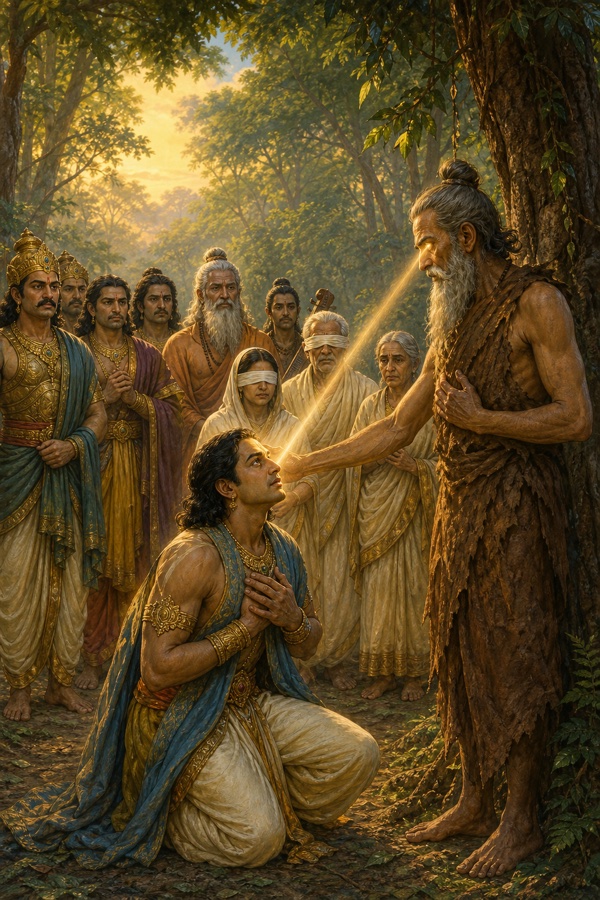
Meanwhile Vidura looked at the king with a steadfast gaze. With his eyes fixed on the king he stood motionless in yoga, and then, by the power of that yoga, he entered Yudhishthira’s body, limb by limb. He united his life breaths with the king’s life breaths and his senses with the king’s senses. Blazing with energy, Vidura passed into the body of Yudhishthira, and his own body stayed as it was, leaning against the tree, the eyes still fixed in that steadfast gaze. Soon the king saw that the life had gone out of it. In the same moment he felt that he himself had grown stronger than before, and that many new virtues and accomplishments had come to him. He had heard of the practice of yoga from Vyasa, and understanding what had happened, Yudhishthira remembered his own state before his birth among men.
Yudhishthira wished to perform the last rites for Vidura’s body and cremate it duly. Then a voice was heard from nowhere. “This body that belonged to him called Vidura should not be cremated. In him is your body too. He is the eternal deity of Righteousness. The worlds called Santanika will be his. He kept the duties of the yatis, the renouncers. You should not grieve for him at all.” At that Yudhishthira came back from the spot and told everything to the royal son of Vichitravirya, and the old king, and all the men there, and Bhima and the others, were filled with wonder.
Dhritarashtra was pleased by what he heard. “Accept from me these gifts of water and roots and fruit,” he said to the son of Dharma. “It has been said that a guest should take what his host takes himself.” “So be it,” Yudhishthira answered, and the king ate the fruits and roots the old king gave him. Then they all spread their beds under a tree, and having eaten fruit and roots and drunk the water the old king had given them, they passed the night that way, kings and queens on the ground like the ascetics around them.
A key to reading this (a concept): In the story Vidura is the deity of Righteousness himself, born as a man through the curse of the rishi Mandavya, and born in a Shudra womb at that; Yudhishthira too was born from that same Dharma, and so the two are of one essence. That is why Vidura can enter Yudhishthira by yoga, and why Yudhishthira feels his strength increase and remembers what he was before his human birth. The voice from the air forbids cremation because a body that housed Dharma, and that Yudhishthira now shares, is no ordinary corpse.
The gist: Dhritarashtra asks the Pandavas about the kingdom, and Yudhishthira asks about the mothers’ penance and about Vidura. Then Vidura, wasted, naked, matted-haired, with gravel in his mouth, appears at the edge of the forest; Yudhishthira runs after him alone, and Vidura, standing in yoga against a tree, merges his life breaths into the king’s. A voice from the air forbids the cremation of his body. That night the Pandavas eat the old king’s fruit and roots and sleep on the ground.
Touring the hermitage, the gifts, and Vyasa’s arrival
The Pandavas passed that night, under auspicious constellations, in the retreat of the righteous ascetics. The talk that arose was full of reflections on morality and wealth, delightful and sweet, graced with citations from the Vedas. Leaving their costly beds behind, the Pandavas lay down near their mother on the bare ground, having eaten the food of the old king. When the night was over, Yudhishthira went through his morning acts and, at Dhritarashtra’s command, went out with his brothers, the women of his household, the servants, and the priest, to look over the hermitage in every direction, as he pleased.
He saw many sacrificial altars with sacred fires blazing on them, and many ascetics seated beside them who had made their oblations and poured their libations to the gods. The altars were covered with the fruits and roots of the forest and with heaps of flowers, and the smoke of clarified butter curled up from them. Ascetics whose bodies looked like the embodied Vedas sat among them, and many of the lay brotherhood. Herds of deer grazed or rested here and there, free of every fear. Countless birds were giving out their melodious notes, and the whole forest rang with the cries of peacocks and datyuhas and kokilas and the sweet songs of other warblers. In some places the chant of Vedic hymns recited by learned Brahmins echoed. In others there were great heaps of fruits and roots gathered from the wilderness.
Yudhishthira gave the ascetics the jars of gold and copper he had brought for them, and many deerskins and blankets, and sacrificial ladles of wood, the kind with a cup at one end and the kind with a cup at both, and kamandalus, the water pots of ascetics, and wooden platters, and pots and pans. He gave away vessels of iron of many kinds, and smaller vessels and cups of various sizes, and the ascetics took as many as each one liked. Having roved through the woods this way, seen the many retreats of the ascetics, and made many gifts, Yudhishthira returned to the place where his uncle was.
He found Dhritarashtra at his ease, Gandhari beside him, his morning rites finished. He saw his mother Kunti seated not far off, like a disciple with a bent head, full of humility. He saluted the old king, proclaiming his own name so that the blind man would know who stood before him. “Sit down,” the old king said. With that permission Yudhishthira sat on a mat of kusha grass. Then Bhima and the other sons of Pandu saluted the king, touched his feet, and sat down with his leave. Surrounded by them, the old Kuru king looked exceedingly beautiful; he blazed with a Vedic splendor, like Brihaspati among the gods.
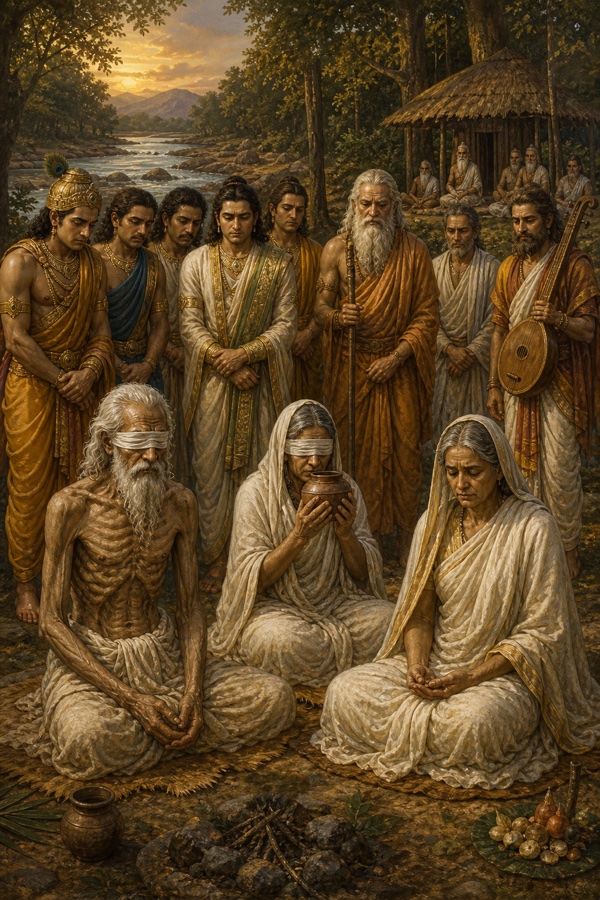
When they were seated, many great rishis who lived at Kurukshetra, Shatayupa and the others, came there. And Vyasa, learned and illustrious, revered even by the celestial rishis, showed himself before Yudhishthira at the head of his many disciples. Dhritarashtra, Yudhishthira, Bhima, and the rest stood up and went a few steps forward to salute the guests. Vyasa came near, with Shatayupa and the others around him, and said to Dhritarashtra, “Be seated.” Then he took the excellent seat they had reserved for him, made of kusha grass laid over a black deerskin and covered with a piece of silk, and when Vyasa was seated, all those Brahmins of abundant energy sat down with Vyasa’s leave.
The gist: The Pandavas pass an auspicious night in the hermitage on the bare ground; at dawn Yudhishthira tours it, seeing the altars, the fearless deer, and the ascetics like living Vedas, and gives them jars, deerskins, ladles, and vessels. Returning, he sits with Dhritarashtra, Gandhari, and Kunti, and just then Vyasa arrives with Shatayupa and the other great rishis and takes the seat kept for him.
Vyasa’s questions to Dhritarashtra and the secret of Vidura’s dharma
When all the Pandavas were seated, Vyasa spoke to Dhritarashtra. “Have you been able to achieve penance? Is your mind pleased with your residence in the woods? Has the grief that was yours, born of the slaughter of your sons in battle, gone from your heart? Are all your perceptions clear now? Do you keep the ordinances of forest life with a firm heart? Does my daughter-in-law Gandhari let herself be overwhelmed by grief? She has great wisdom; that queen understands both religion and wealth, and knows the truths of prosperity and adversity alike. Does she still grieve? Does Kunti, who left her children out of devotion to the service of her elders, attend to your wants and serve you with humility?”
“Have Yudhishthira, the high-minded son of Dharma, and Bhima and Arjuna and the twins been sufficiently comforted? Do you feel delight at seeing them? Has your mind become free of every stain? Has your disposition grown pure with the increase of your knowledge? These three together are the highest of all concerns: abstention from injury to any creature, truth, and freedom from anger. Does the forest life still give you pain? Can you gather the products of the wilderness for your food by your own exertion? Do the fasts still hurt you?”
“Have you learned how Vidura, who was Dharma’s own self, left this world? Through the curse of Mandavya the deity of Righteousness was born as Vidura. He had great intelligence and high penance; he was great in soul and in mind. Neither Brihaspati among the gods nor Shukra among the asuras had intelligence like his. The eternal deity of Righteousness was stupefied by the rishi Mandavya at the cost of penances Mandavya had earned over a long time with great care, for a Brahmin who curses spends his own penance to do it. At the command of the Grandsire, and through my own energy, Vidura was begotten by me upon a soil owned by Vichitravirya. A god of gods, eternal, he was your brother. The learned know him to be Dharma from his practice of dharana and dhyana, the fixing of the mind on one thing and the drawing of it away from everything else. He grows with truth, self-restraint, tranquility of heart, compassion, and gifts. He is always engaged in penance, and he is eternal.”
“From that same deity of Righteousness, through the power of yoga, the Kuru king Yudhishthira also took his birth. So Yudhishthira is Dharma, of great wisdom and immeasurable intelligence. Dharma exists both here and hereafter, like fire, or wind, or water, or earth, or space. He can go everywhere; he exists pervading the whole universe. Only the highest of the gods, and those cleansed of every sin and crowned with ascetic success, can see him. He who is Dharma is Vidura, and he who is Vidura is the eldest son of Pandu. That son of Pandu can be perceived by you. He stands before you as your servant. Your brother, endowed with great yoga power, saw Yudhishthira, the son of Kunti, and entered into his person. These too I will unite, to great benefit. Know, my son, that I have come here to dispel your doubts. Some feat never accomplished before by any of the great rishis, some wonderful effect of my penances, I will show you. What is it that you want accomplished by me? Tell me what you wish to see, or ask, or hear. I will bring it to pass.”
A key to reading this (a concept): Dharana is the stage of yoga in which the mind is fixed on a single object; dhyana is the drawing of the mind away from everything around it. Vyasa uses those two practices as the proof of who Vidura was. He also unties a doctrinal knot: the deity of Righteousness became Vidura, and that same Dharma is present in Yudhishthira as a portion, so it is natural for the one to merge into the other. The story does not hide the moral tangle behind it, that even the deity of Righteousness had to serve out a Shudra birth through a rishi’s curse, and that the rishi paid for the curse with his own hard-won penance.
The gist: Vyasa asks Dhritarashtra about his penance, his grief, and the forest life, asks after Gandhari and Kunti, and unlocks the secret of Vidura’s death: Vidura was Dharma himself, born a man through Mandavya’s curse, begotten by Vyasa in Vichitravirya’s house, and has now merged into Yudhishthira, who was born of the same Dharma. Then Vyasa offers the old king a boon: whatever he wishes to see, ask, or hear.
The Putradarshana Parva: Dhritarashtra’s grief and Vyasa’s word
Janamejaya asked what that wonderful feat was that the great rishi Vyasa accomplished after his promise to the old king, made when Dhritarashtra had taken up his home in the forest with his wife and his daughter-in-law Kunti, after Vidura had left his own body and entered Yudhishthira, and while all the sons of Pandu were staying in the ascetic retreat. For how many days did Yudhishthira stay in the woods with his men? On what food did the Pandavas support themselves there, with their men and their wives?
Vaishampayana said that with the Kuru king’s leave the Pandavas, with their troops and the women of their household, lived on many kinds of food and drink and passed about a month in great happiness in that forest. Toward the close of that time Vyasa came. While all those princes sat around Vyasa talking of many things, other rishis arrived: Narada, and Parvata, and Devala of austere penance, and Vishvavasu, and Tumburu, and Chitrasena, the last three of them Gandharvas, musicians of heaven. Yudhishthira, with Dhritarashtra’s leave, worshiped them with due rites, and honored so, they sat down on sacred seats of kusha grass and on excellent seats of peacock feathers. When they had all taken their places the old king sat down among them, surrounded by the sons of Pandu, and Gandhari and Kunti and Draupadi and Subhadra of the Satvata race and the other women of the household sat down too.
The talk that arose was excellent, and it ran on piety, and the rishis of old, and the gods and the asuras. At the close of it Vyasa, well pleased, turned to the blind king and spoke once more. “Burning as you are with grief for your children, I know what object you cherish in your heart. The sorrow that always lives in Gandhari’s heart, and the sorrow in Kunti’s, and the one Draupadi cherishes in hers, and that burning grief for the death of her son that Krishna’s sister Subhadra carries, all of it is known to me. Hearing of this meeting of yours with all these princes and princesses of your house, I have come here to dispel your doubts. Let the gods and the Gandharvas and all these great rishis see today the energy of the penances I have earned over these long years. So tell me what wish of yours I shall grant today. I have power enough to grant you a boon. See the fruit of my penances.”
Dhritarashtra reflected a moment and prepared to speak. “I am exceedingly fortunate. Lucky am I, to obtain your favor. My life is crowned with success today, since this meeting has come about between me and all of you men of great piety. Today I shall attain the happy goal reserved for me, for I have obtained this meeting with all of you, rich in penance, the equals of Brahma himself. There is not the least doubt that the sight of you all has cleansed me of every sin. I no longer have any fear about my end in the next world. Full as I am of love for my children, I always cherish their memory. But my mind is always tortured by the recollection of the many wrongs my wicked son, of exceedingly evil understanding, committed. Sinful in his understanding, he always persecuted the innocent Pandavas. The whole earth was devastated by him, with her horses, elephants, and men.”
“Many great kings, rulers of many realms, came to take my son’s side and met their death. Leaving their beloved fathers and their wives and their very lives, all those heroes became guests of the king of the dead. What end has been reached by those men who were killed in battle for the sake of their friend? What end by my sons and grandsons who fell in the fray? My heart is always pained by the thought that I brought about the slaughter of the mighty Bhishma, the son of Shantanu, and of Drona, first among Brahmins, through my foolish and sinful son, that injurer of his own friends. Wanting the sovereignty of the earth, he had the Kuru race, blazing with prosperity, annihilated. Reflecting on all this, I burn day and night with grief. Deep in that pain, I cannot find peace of mind. Father, thinking of all this, I have no rest.”
At these laments of the royal sage, Gandhari’s grief grew fresh, and so did the grief of Kunti, of Draupadi, of Subhadra, and of the other men and women and daughters-in-law of the Kuru house. Gandhari, her eyes bandaged, joined her hands and spoke to her father-in-law, grieving for her slaughtered sons. “Sixteen years have passed over the head of this king as he grieves for the death of his sons and finds no peace of mind. Grief for them makes him breathe heavily, and he never sleeps at night. Through the power of your penance you can create new worlds. What is it, then, to show this king his children, who are now in the other world? This Krishna, the daughter of Drupada, has lost all her kinsmen and children, and for that she, the dearest of my daughters-in-law, grieves without end.”
“Subhadra, the sweet-spoken sister of Krishna, burns as deeply for the loss of her son. This lady, honored by all, the wife of Bhurishravas, wails without ceasing for the fate that overtook her husband; her husband’s house was that of the wise Valhika of Kuru’s race, and Somadatta too was slain in the great battle, together with his father. A hundred sons of this son of yours, this king of great intelligence and great prosperity, heroes who never turned back from a battle, were killed in the war. The hundred wives of those sons all grieve, and again and again they renew the king’s grief and mine. Stricken by that great slaughter, they have gathered around me. Those heroes, those great chariot warriors, my fathers-in-law, Somadatta and the others: what end has been theirs? Through your grace, let that come about by which this king, and I, and this daughter-in-law of yours, Kunti, may all be freed from our grief.”
When Gandhari had spoken, Kunti, whose face had been wasted by many hard vows, began to think of her secret-born son, the one with the splendor of the sun. Vyasa, the giver of boons, who could see and hear what happened at any distance, saw the grief in the royal mother of Arjuna. “Tell me what is in your mind,” he said to her. “Tell me what you wish to say.” Then Kunti bent her head to her father-in-law, and, overcome with shame, told him a thing out of the past.
A key to reading this (the timeline): Sixteen years have passed since the war, fifteen of them in the city and the rest in the forest. The wife of Bhurishravas is singled out among the widows: Bhurishravas’s father was Somadatta and his grandfather Valhika, and all three died in the war, so one woman stands for three generations gone. Gandhari’s grief reaches past her own hundred sons to the hundred widows who surround her and to the daughters-in-law of the winning side; she names Draupadi and Subhadra in the same breath as the widows of her own sons, the women of the house that fought against theirs.
The gist: The Pandavas stay a month in the forest. Among Narada, the Gandharvas, and the other rishis, Vyasa reads the wish in Dhritarashtra’s heart and offers him a boon. Dhritarashtra laments Duryodhana’s wrongs, the deaths of Bhishma and Drona, and the kings who died for his son. Gandhari, counting sixteen years without sleep, asks that the slain be shown, and Kunti sinks into the memory of her secret-born son.
Kunti’s secret of Karna and Vyasa’s reassurance
“You are my father-in-law, and so you are my deity of deities,” Kunti said. “Truly you are my god of gods. Hear my words of truth. An ascetic named Durvasa, a Brahmin and full of wrath, came to my father’s house to be fed as a guest. I succeeded in pleasing him by the purity of my outward conduct and of my mind, and by refusing to notice the many wrongs he did. I did not give way to anger, though there was much in his behavior that could have roused it. Served with care, the great ascetic was highly pleased with me and disposed to grant me a boon. ‘You must accept the boon I shall give,’ he said, and fearing his curse I answered, ‘So be it.’ Then the rishi said, ‘You will become the mother of Dharma, blessed as you are. The gods you summon will obey you.’ Having said that, he vanished from my sight.”
“I was filled with wonder. The mantra the rishi had given me stayed in my memory at all times. One day, sitting in my chamber, I saw the sun rising. Wanting to bring the maker of day before me, I remembered the rishi’s words. With no sense of the fault I was committing, out of mere girlishness, I summoned the god. And the god of a thousand rays came into my presence. He divided himself in two: with one portion he stayed in the sky, and with the other he stood on the earth before me. With one he heated the worlds, and with the other he came to me. While I trembled at the sight of him, he said, ‘Ask a boon of me.’ Bowing my head to him, I asked him to leave me. He answered, ‘I cannot bear the idea of coming to you for nothing. I shall consume you, and that Brahmin too who gave you the mantra as a boon.’”
“The Brahmin had done no evil, and I wanted to protect him from Surya’s curse. So I said, ‘Let me have a son like you.’ Then the god of a thousand rays filled me with his energy and stupefied me completely. He said, ‘You will have a son,’ and went back to the sky. I went on living in the inner apartments, and wanting to save my father’s honor, I cast into the waters my infant son, named Karna, who had come into the world in secret. Without doubt, through the grace of that god, I became a virgin once more, as the rishi Durvasa had told me I would. Foolish that I am, though he knew me for his mother when he grew up, I made no effort to acknowledge him. This burns me, as you well know. Sinful or not, I have told you the truth. Satisfy this craving I feel to see that son of mine. And let this king too obtain today the wish he cherishes in his heart, which is known to you.”
“Blessed be you,” Vyasa said to her. “All that you have said to me will come to pass. As for the birth of Karna, no fault is ascribable to you. You were restored to virginity. The gods have the powers of yoga; they can enter human bodies. There are gods who beget offspring by thought alone. By word, by sight, by touch, and by union too, they beget children. These are the five methods. You belong to the order of humanity. In what happened you have no fault. Know this, Kunti. Let the fever of your heart be dispelled. For those who are mighty, everything is becoming. For those who are mighty, everything is pure. For those who are mighty, everything is meritorious. For those who are mighty, everything is their own.”
A sub-tale: Kunti’s girlhood is the root of the whole tragedy of Karna. Durvasa’s gift of a mantra, the girlish curiosity that summoned the sun, the god who would not go away empty, and the fear of shame that set the newborn adrift on the water: those choices together made Karna a foundling raised in a charioteer’s house, an insult he bore all his life, and they put him on the wrong side of the field at Kurukshetra, where his own brother killed him. Notice that Kunti calls herself foolish, and admits that even when the grown Karna knew her for his mother she did not claim him. Vyasa calls her faultless; her own guilt stays in the story exactly as she stated it, and the last four lines of his answer, that for the mighty everything is pure, are consolation and something short of acquittal.
The gist: Kunti opens her secret history before Vyasa: Durvasa’s boon, the sun summoned in girlish curiosity, the god divided in two, the birth of Karna and his casting on the water, her restored virginity, and her failure to claim him when he was grown. She asks to see that son. Vyasa calls her faultless, tells her the five ways in which the gods beget children, and dispels the fever of her heart.
Vyasa’s resolve: the divine portions of the slain, and the march to the Bhagirathi
“Blessed be you, Gandhari,” Vyasa said. “Tonight you will see your sons and brothers and friends and kinsmen, together with your fathers, like men risen from sleep. Kunti will see Karna, and she of Yadu’s race will see her son Abhimanyu. Draupadi will see her five sons, her fathers, and her brothers. Even before you asked me, this was the thought in my mind. I formed this purpose when the king urged me to it, and you, Gandhari, and Kunti. You should not grieve for those men. They met death through their devotion to the established practice of Kshatriyas. The work of the gods could not go undone. It was to accomplish that work that those heroes came down to earth. They were all portions of the deities.”
“Gandharvas and Apsaras, Pishachas and Guhyakas and Rakshasas, many persons of great sanctity, many crowned with the success of penance, celestial rishis, gods and Danavas, and heavenly rishis of spotless character met their death on the field of Kurukshetra, in the human bodies they had taken. It is heard that he who was the intelligent king of the Gandharvas, and was named Dhritarashtra, took birth in the world of men as your lord Dhritarashtra. Know that Pandu of unfading glory, distinguished above all others, sprang from the Maruts. Kshatta and Yudhishthira are both portions of the deity of Righteousness. Know that Duryodhana was Kali, and Shakuni was Dwapara. Know that Duhshasana and the others were all Rakshasas. Bhima of great might is from the Maruts. Know that this Dhananjaya, the son of Pritha, is the ancient rishi Nara. Hrishikesha is Narayana, and the twins are the Ashvins. Surya himself divided his body in two; with one portion he went on giving heat to the worlds, and with the other he lived on earth as Karna. He who was born as Arjuna’s son, the gladdener of all, the heir to the possessions of the Pandavas, who was killed by six great chariot warriors fighting together, was Soma, the moon. He was born of Subhadra; through the power of yoga Soma had divided himself in two.”
“Dhrishtadyumna, who sprang from the sacrificial fire together with Draupadi, was an auspicious portion of the god of fire. Shikhandi was a Rakshasa. Know that Drona was a portion of Brihaspati, and that Drona’s son was born of a portion of Rudra. Know that Ganga’s son Bhishma was one of the Vasus, born as a human being. So the gods took birth as men, and having accomplished their purposes they have gone back to heaven. The sorrow in all your hearts, for the return of these to the other world, I will dispel today. Go, all of you, toward the Bhagirathi. There you will see all those who were killed on the field of battle.”
Hearing Vyasa’s words, everyone present raised a shout like lions and set out for the Bhagirathi. Dhritarashtra with all his ministers, and the Pandavas, and all the foremost rishis and Gandharvas who had come, went out as he directed. Reaching the banks of the Ganga, that sea of people took up their places as it pleased them. The wise old king, with the Pandavas, took up his own place in a pleasant spot with the women and the aged of his household. They passed that day as if it were a whole year, waiting for the night in which they would see the dead princes. The sun reached the sacred mountain in the west, and all of them bathed in the sacred stream and finished their evening rites.
A key to reading this (a concept): Vyasa here unfolds the whole descent scheme of the Mahabharata: every great figure of the war was a portion of some god, rishi, or demonic power come down to earth to do the work of the gods, which was the emptying of the overburdened earth. The dead were never only men, and so the survivors should never have grieved for them only as men. That is offered as a way of easing grief. It does not erase the story’s moral tangle. Calling Duryodhana the age of Kali and Shakuni the age of Dwapara may make their deeds look fated, and it does nothing to quiet Dhritarashtra’s sense of his own guilt, as the next sections will show.
The gist: Vyasa promises that the dead will appear that very night, and names the divine portion of each chief figure: Dhritarashtra a Gandharva king, Pandu and Bhima of the Maruts, Vidura and Yudhishthira of Dharma, Arjuna the rishi Nara, Krishna Narayana, the twins the Ashvins, Karna a half of Surya, Abhimanyu a half of Soma, Duryodhana Kali, Shakuni Dwapara, Dhrishtadyumna of Fire, Drona of Brihaspati, Ashvatthama of Rudra, and Bhishma a Vasu. All go down to the bank of the Bhagirathi, finish the evening rites, and wait for the dark.
The night vision: the slain rising from the river
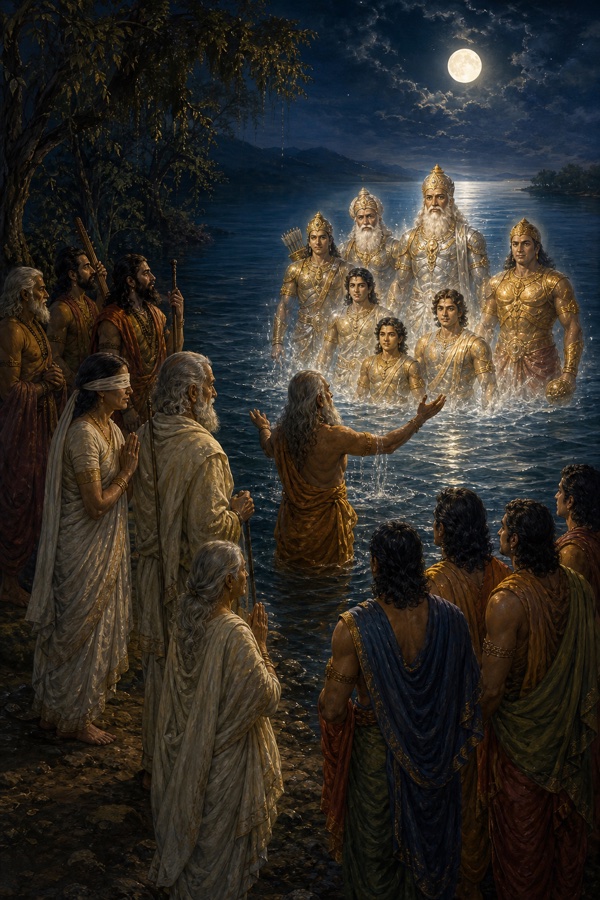
When night came, everyone finished the evening rites and came to Vyasa. Dhritarashtra, righteous of soul, his body purified and his mind fixed on the one thing, sat with the Pandavas and the rishis around him. The women of the royal household sat with Gandhari in a secluded spot. The citizens and the people of the provinces ranged themselves by age. Then Vyasa, the great ascetic of mighty energy, walked down into the Bhagirathi and bathed in her sacred waters, and standing in the river he summoned all the dead warriors, those who had fought on the side of the Pandavas and those who had fought for the Kauravas, and the blessed kings of many realms who had died with them.
Out of the water came a deafening uproar, the same sound that had once been heard from the armies of the Kurus and the Pandavas facing each other across the field. Then the kings, with Bhishma and Drona at their head, rose by the thousand from the waters of the Bhagirathi with all their troops. There were Virata and Drupada, with their sons and their forces. There were the sons of Draupadi, and the son of Subhadra, and the Rakshasa Ghatotkacha. There were Karna and Duryodhana, and the great chariot warrior Shakuni, and the other sons of Dhritarashtra, mighty men, with Duhshasana at their head.
There were the son of Jarasandha, and Bhagadatta, and Jalasandha of great energy, and Bhurishravas, and Shala, and Shalya, and Vrishasena with his younger brother. There were the prince Lakshmana, Duryodhana’s son, and the son of Dhrishtadyumna, and all the children of Shikhandi, and Dhrishtaketu with his younger brother. There were Achala and Vrishaka, and the Rakshasa Alayudha, and Valhika, and Somadatta, and King Chekitana. These and many others, too many to name, appeared that night. All of them rose from the waters of the Bhagirathi with resplendent bodies.
Each king appeared in the very dress, with the very standard and the very vehicle, that he had had while fighting on the field, so that a watcher could know him at once. Yet all of them were robed now in celestial vestments and wore brilliant earrings, and they were free of every animosity and every pride, and wrath and jealousy had gone out of them. Gandharvas sang their praises, and bards waited on them chanting their deeds. Robed in celestial garments and celestial garlands, every hero was attended by bands of Apsaras.
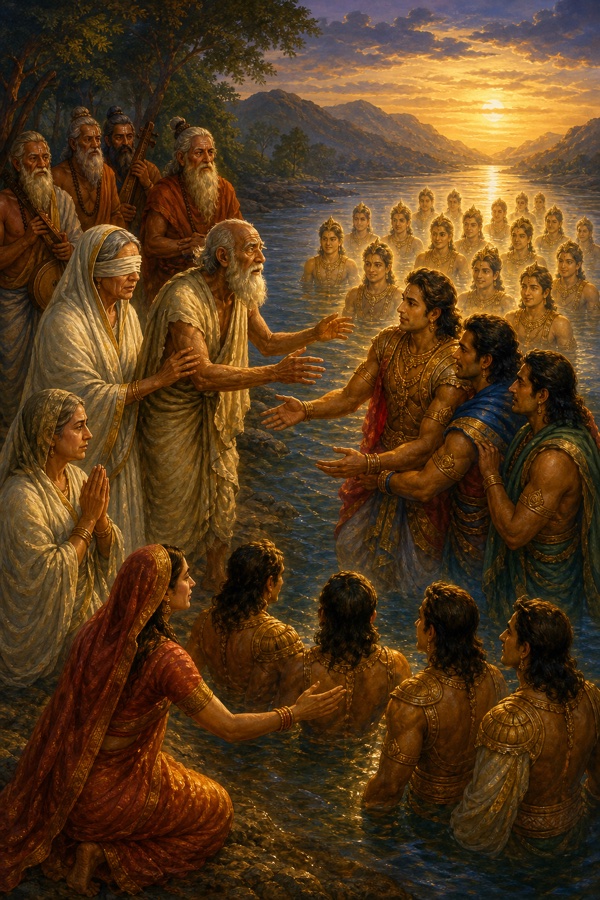
Then Vyasa, the son of Satyavati, through the power of his penance and out of his gladness with Dhritarashtra, gave the old king celestial vision, and the man who had been blind from birth saw. Gandhari, endowed with celestial knowledge and strength, saw all her children, and everyone else who had been slain in battle. Everyone assembled there watched with steadfast gaze and hearts full of wonder that amazing, inconceivable thing, which made the hair on their bodies stand on end. It looked like a great festival of gladdened men and women. That wondrous scene looked like a picture painted on canvas. And Dhritarashtra, seeing all those heroes with the celestial sight the sage had given him, was filled with joy.
The gist: In the night Vyasa stands in the Bhagirathi and summons all the slain of both sides, and they rise from the river with the uproar of the old armies: Bhishma, Drona, Karna, Duryodhana, Abhimanyu, Ghatotkacha, Draupadi’s sons, and thousands more, each in his battle dress, all in celestial robes, free of enmity and pride. Vyasa grants Dhritarashtra sight, and the blind king sees his sons for the first time in his life.
The night of reunion and the heroes’ return; the widows enter the water
Then all those heroes, free of wrath and jealousy and cleansed of every sin, met one another according to the high and auspicious ordinances the rishis have laid down for such meetings. All of them were happy of heart and looked like gods moving in heaven. Son met with father or mother, wife with husband, brother with brother, friend with friend. Full of joy, the Pandavas met the mighty bowman Karna, and the son of Subhadra, and the children of Draupadi. With glad hearts the sons of Pandu went up to Karna, the brother they had known only as an enemy, and were reconciled with him. Through the grace of the great ascetic all those warriors, meeting one another, were reconciled; they cast off every unfriendliness and stood firm on amity and peace.
So all those men, the Kauravas and the other kings, were united with the Kurus and their other kinsmen and with their children. They passed the whole of that night in great happiness. The Kshatriya warriors, for the happiness they felt, took that place for heaven itself. There was no grief, no fear, no suspicion, no discontent, no reproach in that region as they met one another that night. Meeting their fathers and brothers and husbands and sons, the women cast off all grief and felt great raptures of delight. And having sported with one another for one night, those heroes and those women embraced, took their leave of one another, and went back to the places they had come from.
The great sage dismissed that concourse of warriors, and in the time it takes an eye to close and open, that vast crowd vanished in the sight of all the living. Plunging into the sacred Bhagirathi with their chariots and their standards, those heroes went to their several abodes. Some went to the regions of the gods, some to the region of Brahma, some to the region of Varuna, some to the region of Kubera. Some of the kings went to the region of Surya. Among the Rakshasas and Pishachas, some went to the country of the northern Kurus. Others, moving in delightful attitudes, went in the company of the gods. So all of them disappeared, with their vehicles and their animals and all their followers.
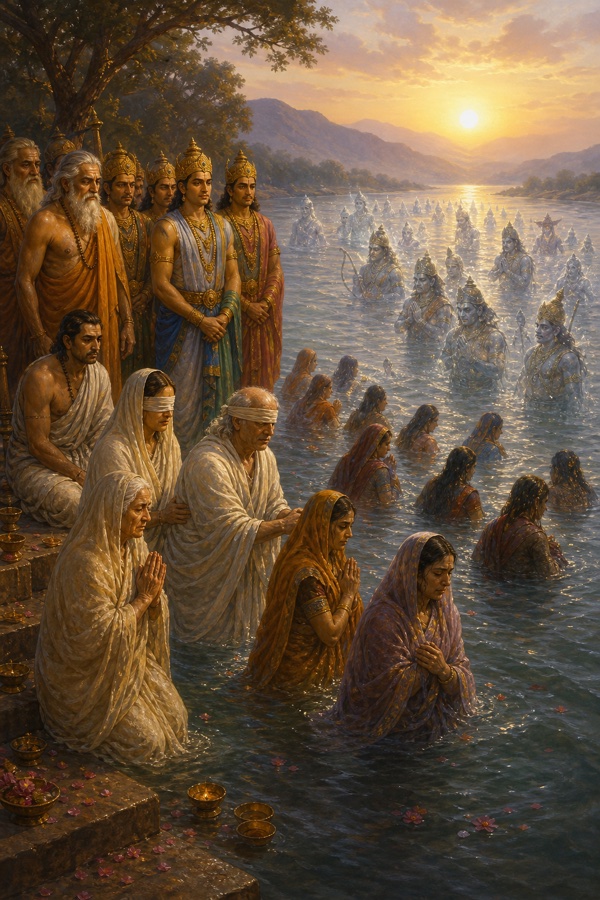
When they had all gone, the great sage, still standing in the waters of the sacred stream, Vyasa of great righteousness and energy, the benefactor of the Kurus, spoke to the Kshatriya women who had become widows. “Let those among you who wish to reach the regions your husbands have won cast off all sloth and plunge quickly into the sacred Bhagirathi.” Hearing that, and placing their faith in it, those women took the leave of their father-in-law and plunged into the waters of the Bhagirathi. Freed of their human bodies, those chaste women went with their husbands to the regions their husbands had won. Devoted to their husbands, virtuous in conduct, they entered the Bhagirathi and left their mortal frames and attained the companionship of their husbands in the regions those men had earned. Endowed with celestial forms and adorned with celestial ornaments, robes, and garlands, they went to the places where their husbands had found their abodes, and were seen riding on excellent chariots, their anxieties gone, to the regions of happiness that were theirs by right.
Then Vyasa, devoted to the duties of piety, became a giver of boons, and he granted to all the men assembled there the fulfillment of the wishes each one cherished. People of many realms, hearing of this meeting between the hallowed dead and living human beings, were filled with delight. The man who duly listens to this narrative meets with everything that is dear to him, here and hereafter, and the man who recites it for others wins fame here and an auspicious end hereafter, and union with his kinsmen, and all that he desires; he never has to labor painfully for his living, and every auspicious thing comes to him in life. Those who listen to this wonderful parva with good conduct, self-restraint, sincerity, tranquil souls, faith, and intelligence, cleansed of sin by the gifts they make, freed from falsehood and the wish to injure, attain the highest goal hereafter.
The gist: The slain and the living meet for one night, free of enmity; the Pandavas embrace Karna. In a moment all the dead return to their several regions, of the gods, of Brahma, of Varuna, of Kubera, of Surya, and of the northern Kurus. At Vyasa’s word the widows who wish it plunge into the Bhagirathi and go to their husbands’ regions, and Vyasa grants every living person there the wish he holds.
Janamejaya’s question and the vision of Parikshit
Hearing this story of the reappearance and departure of his forefathers, Janamejaya was greatly pleased, and full of joy he questioned Vaishampayana once more on the subject of the reappearance of the dead. How was it possible for people whose bodies had been destroyed to appear again in those very forms?
Vaishampayana, the disciple of Vyasa and first of speakers, answered him that this much is certain: acts are never destroyed without their consequences being enjoyed or endured. Bodies are born of acts, and so are features. The great primal elements are eternal, through their union with the Lord of all beings; they exist with what is eternal, and so they are not destroyed when the non-eternal is destroyed. Acts done without exertion are true and foremost and bear real fruit; the soul, united with acts that require exertion, enjoys pleasure and endures pain, yet it is never modified by them, as a mirror is never changed by the reflections that come and go in it, and it is never destroyed. As long as a man’s acts are not exhausted, so long does he take the body to be himself. The man whose acts are exhausted takes the self to be something other than the body. The various things that make a body come together as one, and to men of knowledge who understand the difference between body and self, those very things become eternal. In the horse sacrifice there is a scripture heard about the slaying of the horse: the sure possessions of embodied creatures, their life breaths and their senses, exist eternally even when they are carried to the other world. When the deities come to a sacrifice they are lords of the passage of the animals slain in it, and so by adoring the deities in sacrifice the eternal souls reach excellent goals. When the five elements are eternal, and the soul is eternal, and the Purusha in the body is eternal too, then the man who sees a creature as changing its forms has an erroneous understanding. He who indulges in too much grief at separation is a fool. He who sees evil in separation should give up union itself, for by standing aloof no unions are formed and sorrow is cast off, since sorrow in this world is born of separation. Only the man who understands the distinction between body and self is freed from that erroneous conviction, and he who knows the other, the self, attains the highest understanding. Creatures come from an unseen state and go back into the unseen. A man who has no such power enjoys or endures the fruits of his acts in the same body in which he did them: the consequences of a mental act are borne in the mind, and those of an act done with the body, in the body.
Dhritarashtra had never seen his own sons. Gaining eyesight through the grace of the rishi, he saw for the first time those children of his who were so like himself. The Kuru monarch had learned all the duties of kings, and the Vedas and the Upanishads, and had gained certainty of understanding from them. Vidura, through the power of his penance, attained high success, and Dhritarashtra too attained great success through his meeting with the ascetic Vyasa.
Janamejaya said that if Vyasa, disposed to grant him a boon, would show him his own father in the form he had had, clad as he used to be clad, and of the age he was when he left the world, then he would believe all that Vaishampayana had told him. Such a sight would be most dear to him. He would count himself crowned with success; he would have gained certainty. Let his wish be fulfilled through Vyasa’s grace.
Sauti, who was telling the whole of this to the rishis of the Naimisha forest, said that when Janamejaya had spoken so, Vyasa of great energy and intelligence showed his grace and brought Parikshit from the other world. Janamejaya saw his royal father, a man of great beauty, brought down from heaven in the same form he had had, and of the same age as when he had left the world. Shamika and his son Shringin, the sage and the boy whose curse had sent Parikshit to his death, were brought there too, and all the king’s counselors and ministers saw them. Janamejaya, performing the final bath of his sacrifice, was greatly glad, and he poured the sacred water over his father just as he had it poured over himself. Then, the final bath done, he spoke to the Brahmin Astika, sprung from the race of the Yayavaras, the son of Jaratkaru, the man who had stopped that sacrifice before it consumed every snake in the world.
“Astika, this sacrifice of mine is full of wonderful incidents,” Janamejaya said, “since my father has been seen by me, he who has dispelled all my sorrows.” Astika answered him. “The performer of a sacrifice at which the ancient rishi Vyasa, rich in penance, is present, is sure to conquer both worlds. You have heard a wonderful history. The snakes have been consumed to ashes and have followed in your father’s footsteps. Through your truthfulness, Takshaka has escaped a painful fate, and with difficulty. The rishis have all been honored. You have seen the end your father reached. Hearing this sin-cleansing history you have earned abundant merit, and the knots of your heart have been untied by the sight of Vyasa. Those who uphold the wings of righteousness, those of good conduct and excellent disposition, those at whose sight sins grow thin: to them we should all bow.” Janamejaya worshiped the rishi again and again in every way, and then, knowing every duty, he asked Vaishampayana what happened next in the story of Dhritarashtra’s life in the woods.
A key to reading this (lineage): Here the outer frame of the story shows through. The whole Mahabharata is being recited by Vaishampayana at the snake sacrifice of King Janamejaya, and outside that again by Sauti, the bard Ugrashrava, to the rishis of the Naimisha forest. Janamejaya is the son of Parikshit; Parikshit, the infant seen on Uttara’s lap in this very chapter, grew up to be king and died of the bite of the snake Takshaka, through the curse of the boy Shringin, son of the sage Shamika. In anger at that death Janamejaya began the snake sacrifice, which Astika stopped, saving Takshaka. So when Vyasa shows Janamejaya his father, exactly as he showed Dhritarashtra his sons, the listener has become, for one moment, part of the tale he is listening to.
The gist: Janamejaya asks how the dead, their bodies destroyed, could reappear; Vaishampayana answers with the law of acts, the eternity of the five elements and the soul, and the difference between body and self, and adds that grief at separation is folly. Then Janamejaya asks to see his own father, and Vyasa brings Parikshit down from heaven, with Shamika and Shringin, in the sight of the whole court.
Vyasa’s command and the Pandavas’ farewell
Janamejaya asked what Dhritarashtra and Yudhishthira did after they had seen their sons and grandsons and all their friends and followers.
Vaishampayana said that after that exceedingly wonderful sight, the reappearance of his children, the royal sage Dhritarashtra was freed of his grief and returned from the bank of the Bhagirathi to his retreat. The common people and all the great rishis, dismissed by him, went back where each of them wished. The Pandavas, with their wives and a small retinue, went to the old king’s retreat with him. Then Vyasa, the son of Satyavati, honored by the rishis and by everyone else, came to the retreat and spoke to Dhritarashtra. “Listen to me. You have heard many discourses from rishis of great knowledge and sacred deeds, rich in penance and excellent in blood, versed in the Vedas and their branches, of piety and years and great eloquence. Do not set your mind again on sorrow. A man of wisdom is never shaken by ill luck. You have heard the mysteries of the gods from Narada of celestial form. Your children, through observance of Kshatriya practice, have all reached that auspicious goal which is sanctified by weapons. You have seen how they move about at will in great happiness.”
“This Yudhishthira is waiting for your leave, with all his brothers and wives and kinsmen. Dismiss him. Let him go back to his kingdom and rule it. They have passed more than a month living in the woods. The seat of sovereignty must always be well guarded, and your kingdom has many enemies.” The Kuru king, well versed in words, summoned Yudhishthira. “Ajatashatru, you who have no enemy, blessings on you,” he said. “Listen to me, with all your brothers. Through your grace, grief no longer stands in my way. I am living here with you as happily as if I were in the city named after the elephant. With you as my protector I enjoy every agreeable thing. I have had from you every service a son renders his father. I am well pleased with you, and I have not the least dissatisfaction with you.”
“Go now, my son, and stay here no longer. Meeting with you slackens my penance. This body of mine, given to penance, I have been able to sustain only because of this meeting with you. These two mothers of yours, living now on fallen leaves and keeping vows like mine, will not live long. Duryodhana and the others, who have gone to the other world, have been seen by us through the power of Vyasa’s penance and the merit of this meeting with you. The purpose of my life is attained. I want now to set myself to the practice of the harshest penances. Grant me leave. On you now rest the ancestral cake, the fame and the achievements, and the line of our ancestors. Depart today, or tomorrow. Do not tarry, my son. You have heard again and again what the duties of kings are, and I do not see what more I can say to you. I have no further need of you.”
“You know every rule of righteousness,” Yudhishthira answered, “and it does not become you to cast me off this way. I am guilty of no fault. Let all my brothers and followers go as they like. With steadfast vows I will wait on you and on these two mothers of mine.” Then Gandhari spoke. “Let it not be so, my son. Listen: the race of Kuru depends on you now. The ancestral cake of my father-in-law depends on you too. So depart, my son. We have been honored and served by you enough. Do what the king says. A son obeys the commands of his father.”
Yudhishthira wiped his eyes, which were bathed in tears of love, and lamented. “The king casts me off, and so does Gandhari of great fame. My heart, though, is bound to you. Filled with grief as I am, how am I to leave you? And yet I do not dare obstruct your penance. There is nothing higher than penance. It is by penance that one reaches the Supreme. My heart no longer turns toward the kingdom as it did. My mind is set wholly on penance now. The whole earth is empty. She no longer pleases me. Our kinsmen are fewer, and our strength is no longer what it was. The Panchalas have been wholly exterminated; they exist in name only, and I see no one who can help them rise again. Drona burned them to ashes on the field of battle, and those who survived were killed by Drona’s son in the night. The Chedis and the Matsyas, who were our friends, are gone. Only the tribes of the Vrishnis remain, because Vasudeva has upheld them, and it is only to look on the Vrishnis that I want to live. My wish to live is for the sake of merit, and for nothing else, neither wealth nor enjoyment. Look on us with auspicious eyes. It will be hard for us to see you again. The king is going to begin the most austere and unbearable of penances.”
Sahadeva, that lord of battle, his eyes full of tears, spoke to Yudhishthira. “I dare not leave my mother. Return to the capital soon. I will practice penance here. Right here I will waste my body in penance, serving the feet of the king and of these mothers of mine.” Kunti embraced her youngest son. “Go, my son,” she said. “Do not say such things. Do my bidding. Go, all of you. Let peace be yours; my sons, let happiness be yours. By your staying here our penances will be obstructed. Bound by the ties of my love for you, I would fall from my high penance. So leave us, my son. Short is the span of life we have left.”
By these and many other words of Kunti the minds of Sahadeva and Yudhishthira were composed. With the leave of their mother and of the old king, the Pandavas saluted him and began to take their leave.
“Gladdened by your auspicious blessings, we will return to the capital,” Yudhishthira said. “With your leave, we go from this retreat freed of every sin.” The royal sage Dhritarashtra blessed him and gave him leave. The old king comforted Bhima, the strongest of men, and Bhima, in his energy and his intelligence, showed the king his submission; whatever had burned in him fifteen years in the palace, he bowed to the man in the deerskin. Embracing Arjuna, clasping the twins to his breast, and blessing them again and again, the Kuru king gave them leave to depart. They worshiped the feet of Gandhari and received her blessing. Their mother Kunti smelled their heads and dismissed them. Then they walked around the king in reverence like calves kept from their mother’s udder, going around him again and again and looking at him with steadfast eyes.
Then all the women of the Kaurava household, with Draupadi at their head, worshiped their father-in-law according to the rites of the scriptures and took their leave. Gandhari and Kunti embraced each of them, blessed them, told them how they should conduct themselves, and bade them go, and with leave granted they set out with their husbands. Then rose the loud cries of the charioteers, “Yoke, yoke!” and the grunting of camels and the brisk neighing of horses, and King Yudhishthira, with his wives, his troops, and all his kinsmen, set out for Hastinapura.
A key to reading this (a concept): The ancestral cake, the pinda, is the ball of food offered to the forefathers in the shraddha rite, and the right and the duty of offering it fall on the living heir of the line. Both Dhritarashtra and Gandhari remind Yudhishthira that the pinda, and with it the whole continuance of the Kuru house, now rests on him alone, and that is the argument that sends him back to the throne. One more layer of grief lies under the scene: Yudhishthira admits that his own mind has turned away from the kingdom, that the earth seems empty to him, and that he wishes to live only for merit, and he goes back to rule anyway.
The gist: Vyasa and Dhritarashtra tell Yudhishthira to return and rule, since a kingdom with many enemies must be guarded; Dhritarashtra says he will now take up the harshest penance and that the two mothers will not live long. Yudhishthira and Sahadeva wish to stay, but Gandhari and Kunti dismiss them. The Pandavas take leave of all three, circle the king like calves, and return to Hastinapura.
Narada’s arrival: the death of Dhritarashtra, Gandhari, and Kunti in the forest fire
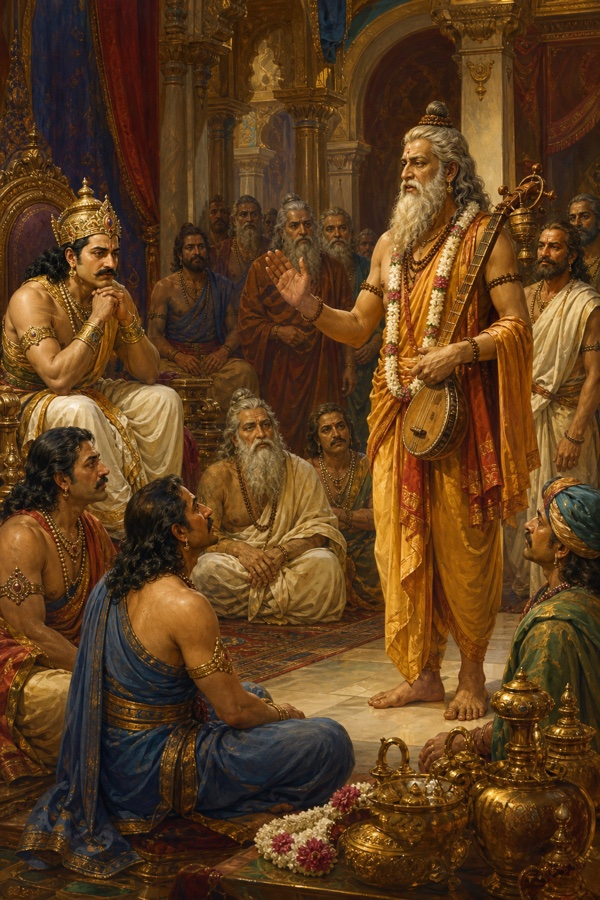
Two years after the Pandavas returned from the retreat of their father, the celestial rishi Narada came to Yudhishthira. The Kuru king worshiped him duly and gave him a seat, and when the rishi had rested a while, he asked, “It is after a long time that I see your holy self arrived at my court. Are you in peace and happiness? What countries have you passed through? What can I do for you? Tell me. You are the first of Brahmins and our highest refuge.”
“I have not seen you for a long while,” Narada said, “and so I have come to you from my ascetic retreat. I have seen many sacred waters, and the sacred stream of the Ganga too.”
The name of the river went through Yudhishthira like a current, and he asked at once about what mattered most. “People who live on the banks of the Ganga report that Dhritarashtra is practicing the harshest of penances. Have you seen him there? Is the old king at peace? Are Gandhari, and Pritha, and Sanjaya, the Suta’s son, at peace too? How is it going with that royal father of mine? I want to hear it, if you have seen the king and know how he is.”
“Listen with calmness,” Narada said, “as I tell you what I heard and saw in that retreat. After you returned from Kurukshetra, your father went toward Gangadwara, the gate of the Ganga, where the river comes down out of the mountains. That wise king took with him his sacred fire, Gandhari, his daughter-in-law Kunti, Sanjaya of the Suta caste, and all his sacrificing priests. Rich in penance, your father set himself to the practice of severe austerities. He held pebbles of stone in his mouth to keep himself from speech, and he had air alone for his food, and he abstained from speech altogether. Engaged in that severe penance, he was honored by all the ascetics of the woods. In six months the king was reduced to a skeleton. Gandhari lived on water alone, and Kunti took a little food every sixth day. The king’s sacred fire was duly worshiped by the sacrificing assistants who were with him, with libations of clarified butter, and they did this whether the king saw the rite or not.”
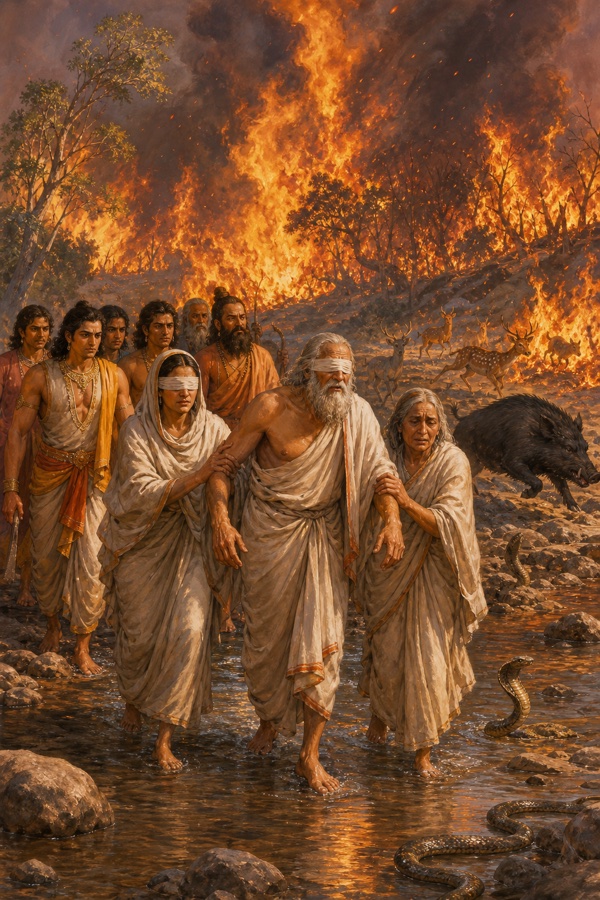
“The king had no fixed dwelling. He became a wanderer through those woods, and the two queens and Sanjaya followed him. Sanjaya was his guide over even and uneven ground. The faultless Pritha became the eye of Gandhari. One day that best of kings went to a spot on the margin of the Ganga, bathed in the sacred stream, finished his ablutions, and turned his face toward his retreat. The wind rose high. A fierce forest fire broke out and began to burn the forest all around. As the herds of animals burned on every side, and the snakes that lived in that region, herds of wild boar ran for the nearest marshes and waters.”
“With the forest burning on all sides and such distress upon every creature living in it, the king, who had taken no food, was incapable of moving or exerting himself at all. Your two mothers, wasted to nothing, could not move either. The king felt the fire coming at him from every side, and he spoke to the Suta Sanjaya. ‘Go, Sanjaya, to some place where the fire cannot burn you. As for us, we will let our bodies be destroyed by this fire and attain the highest goal.’ Sanjaya answered him: ‘This death, brought on by a fire that is not sacred, will prove calamitous to you. And yet I see no means by which you can escape from this fire. Tell me what should be done next.’”
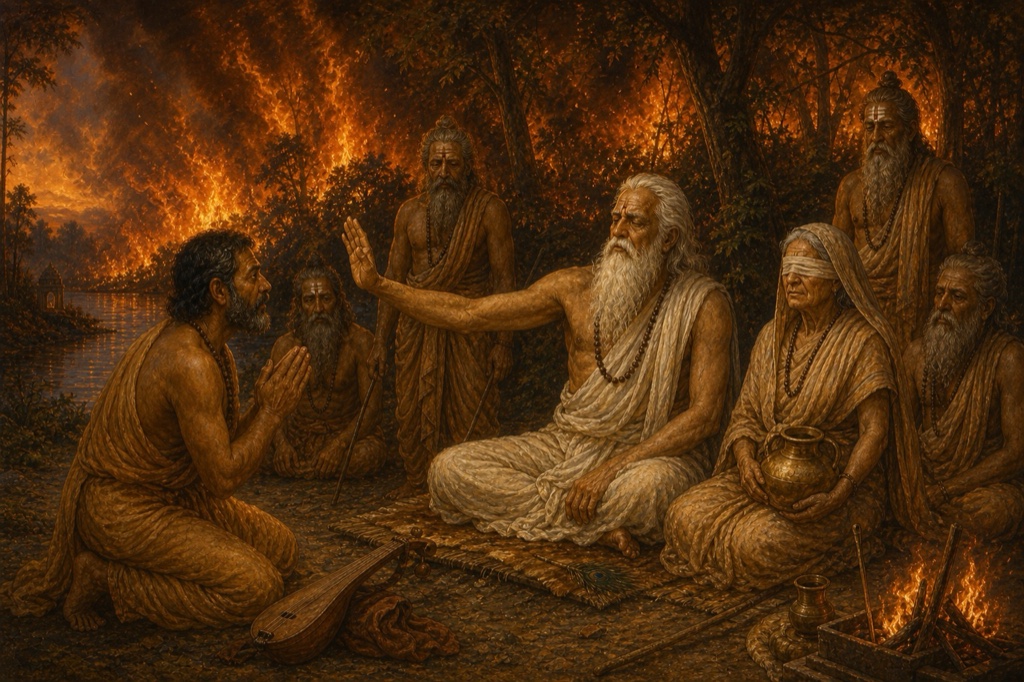
“The king answered him again: ‘This death cannot be calamitous to us, for we left our home of our own accord. Water, fire, wind, and abstention from food are laudable ends for ascetics. So leave us, Sanjaya, without any delay.’ Having said that, the king concentrated his mind. Facing the east, he sat down with Gandhari and Kunti. Seeing him in that attitude, Sanjaya walked around him in reverence and said, ‘Concentrate your soul.’ The son of a rishi, and a man of great wisdom himself, the king did as he was told. Restraining all his senses, he stayed like a post of wood. The blessed Gandhari and your mother Pritha stayed in the same attitude. Then your royal father was overtaken by the forest fire.”
“Sanjaya, his minister, succeeded in escaping from that fire. I saw him on the banks of the Ganga in the midst of ascetics. That man of great energy and intelligence took leave of them and set out for the mountains of Himavat. That is how the Kuru king met his death, and how Gandhari and Kunti, your two mothers, met theirs. In the course of my wanderings I saw the bodies of that king and of those two queens. Many ascetics came to that retreat, having heard of King Dhritarashtra’s end, and they did not grieve for it at all. There I heard all the details of how the king and the two queens had burned. You should not grieve for him. The king, of his own will, and Gandhari and your mother, obtained that contact with fire.”
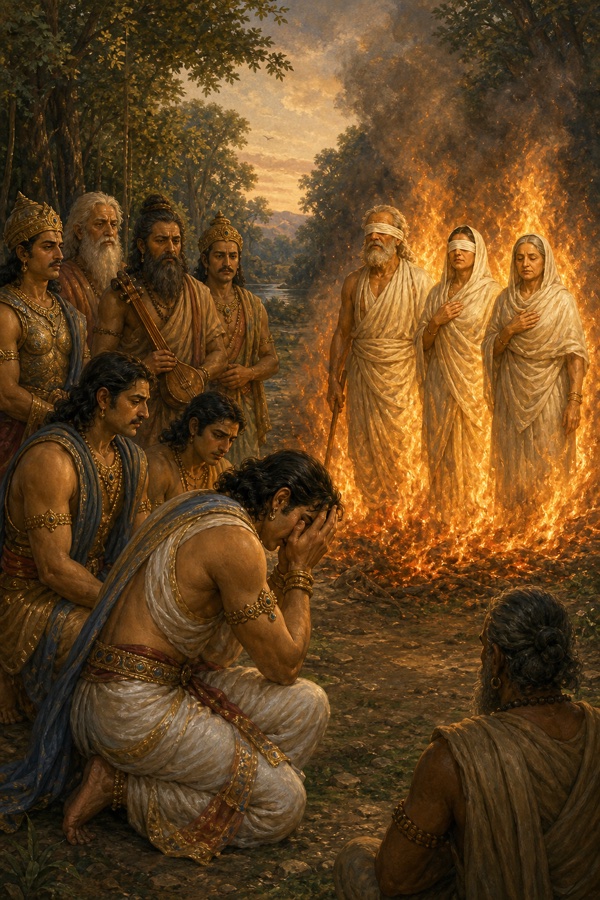
Hearing of Dhritarashtra’s going from this world, the Pandavas all gave way to great grief. Loud wailing rose within the inner apartments of the palace, and the citizens too, hearing of the end of the old king, lamented aloud. “Shame!” Yudhishthira cried in his agony, raising his arms over his head, and thinking of his mother he wept like a child. All his brothers, with Bhima at their head, did the same. Hearing that Pritha had met such a fate, the women of the royal house raised loud laments. And all the people grieved to hear that the old king, who had lost every child he had, had been burned to death, and that the helpless Gandhari had shared his fate.
A key to reading this (a place): Gangadwara is the gate of the Ganga, the place where the river leaves the mountains for the plain. Himavat is the Himalaya, where Sanjaya goes after escaping the fire; the man who saw the whole war for his blind master walks out of the story into the snow. Notice the thorn the story leaves in the scene: Sanjaya calls this a calamitous death by an unsanctified fire, and Dhritarashtra himself declares it acceptable, since the four laudable ends of an ascetic are water, fire, wind, and hunger. Narada will resolve the contradiction shortly, and Sanjaya’s misgiving stays on the record until he does.
The gist: Two years later Narada comes and tells Yudhishthira how it ended: Dhritarashtra went to Gangadwara and, in silent, air-eating penance with pebbles in his mouth, was reduced to a skeleton in six months, while Gandhari lived on water and Kunti ate every sixth day. When a forest fire broke out, the king, too weak to move, sent Sanjaya away and, with Gandhari and Kunti, sat facing east and gave up his body in the flames. Sanjaya escaped to the Himalaya. Hearing it, the whole palace breaks into grief.
Yudhishthira’s lament
When the wailing had stilled for a while, Yudhishthira summoned all his patience, stopped his tears, and spoke. “When such a fate could overtake that great king, engaged in austere penance, while kinsmen like ourselves were all alive, it seems to me that the end of human beings is hard to guess. Who would have thought that the son of Vichitravirya would be burned to death like this? He had a hundred sons, each of them strong and prosperous. The king himself had the strength of ten thousand elephants. And even he has been burned to death in a forest fire! He who was once fanned with palm leaves by the fair hands of beautiful women was fanned, after he burned, by vultures with their wings! He whom bands of Sutas and Magadhas once roused from sleep every morning had to sleep on the bare ground, through the acts of my sinful self.”
“For the famous Gandhari, who lost every one of her children, I do not grieve. She kept the same vows as her husband, and she has reached the same regions he has. It is Pritha I grieve for, who left the blazing prosperity of her sons and chose to live in the woods. Shame on this sovereignty of ours, shame on our prowess, shame on the practices of Kshatriyas! Though we live, we are really dead. The course of Time is very subtle and hard to understand, when Kunti could give up sovereignty and choose the forest. She who was the mother of Yudhishthira, of Bhima, of Vijaya, how could she burn to death like a helpless creature? Thinking of it, I am stunned. In vain did Arjuna gratify the god of fire at Khandava! Ingrate that he is, forgetting that service, he has burned to death the mother of his benefactor. How could that god burn the mother of Arjuna? He came to Arjuna once in the guise of a Brahmin, to beg a favor. Shame on the god of fire! Shame on the celebrated success of Partha’s arrows!”
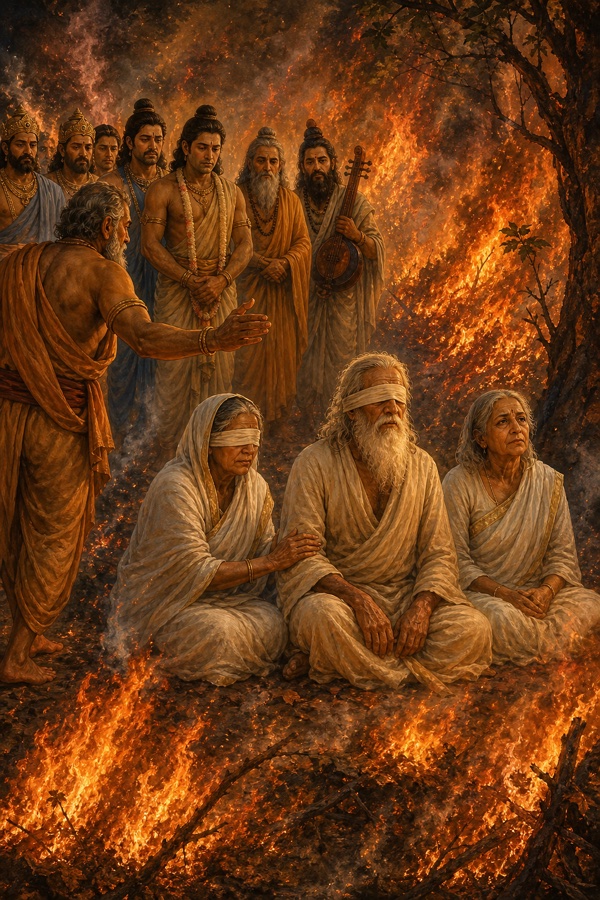
“And there is another thing here that gives me still greater pain: that king met death by union with a fire that was not sacred. How could such a death overtake that royal sage of Kuru’s race, who ruled the whole earth and then gave himself to penance? In that great forest there were fires that had been sanctified with mantras. And my father left this world by contact with an unsanctified fire! I suppose Pritha, wasted to a form in which every nerve showed, must have trembled in fear and cried out, ‘O son Yudhishthira!’ and waited for the terrible approach of the flames. She must have said, ‘O Bhima, rescue me from this danger!’ as she, my mother, was surrounded on all sides by that terrible fire. Of all her sons, Sahadeva was her darling. And that heroic son of Madravati did not rescue her.”
Hearing the king’s laments, everyone present wept, embracing one another. The five sons of Pandu were so stricken with grief that they looked like living creatures at the dissolution of the universe. The sound of the heroes’ weeping filled the spacious chambers of the palace, escaped from them, and went up into the sky.
A sub-tale: Yudhishthira’s anger at the god of fire reaches back to an old event, the burning of the Khandava forest, when Agni came to Arjuna in the guise of a Brahmin to beg a favor and Arjuna satisfied him, and the whole forest fed the god’s hunger. Yudhishthira now calls that a debt unpaid and names the fire an ingrate for burning the mother of the man who fed it. The charge is unjust, and it comes naturally from a Yudhishthira sunk in grief, and the story lets it stand as he said it; Narada’s answer, when it comes, will be about which fire it was, and it will leave the god of fire out of it.
The gist: Yudhishthira laments that Dhritarashtra, strong as ten thousand elephants and father of a hundred sons, should burn to death and be fanned by vultures; he does not grieve for Gandhari, who followed her husband, and grieves bitterly for Kunti, imagining her last cries; and, above all, he is tormented that the death came by an unsanctified fire. He recalls Agni’s debt from Khandava and calls him ingrate, and all the Pandavas break down.
Narada’s resolution and the funeral rites
“The king was not burned to death by an unsanctified fire,” Narada said. “I heard this there, and I tell you: that was not the fate of Vichitravirya’s son. It has been heard by us that when the old king, wise and living on air, went into the woods after his return from Gangadwara, he had his sacrificial fires duly kindled. Having performed his sacred rites with them, he abandoned them all. Then the sacrificing Brahmins he had with him cast those fires off in a solitary part of the woods and went away as they liked on other errands. The fire that was cast off grew in the woods, and it produced a general conflagration of the forest. This is what I heard from the ascetics dwelling on the banks of the Ganga. United with that sacred fire of his own, the king, as I told you, met his death on the banks of the Ganga. This is what the ascetics told me, the ones I saw on the banks of the sacred Bhagirathi.”
“So King Dhritarashtra, coming into contact with his own sacred fire, departed from this world and attained the high goal that has been his. Through the service she rendered to her elders, your mother has attained very great success; of that there is not the slightest doubt. It is fitting that you now discharge the rites of water in their honor, with all your brothers. Take the necessary steps toward that end.”
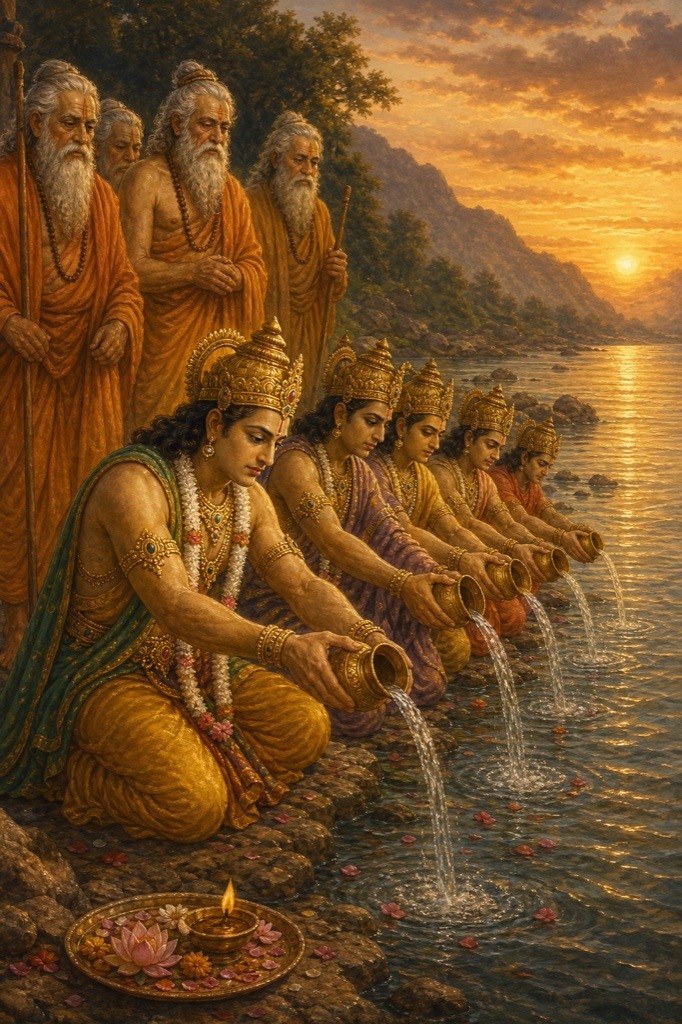
Then Yudhishthira went out with all his brothers and the women of his household. The people of the city and the provinces, moved by their loyalty, went out too. All of them proceeded to the bank of the Ganga, every one clad in a single garment. Plunging into the stream, and placing Yuyutsu at their head, for Yuyutsu was the dead king’s own son, they began to offer oblations of water to the king. They gave the same oblations to Gandhari and to Pritha, naming each separately and mentioning their families. Having finished those rites, which cleanse the living, they came back, and without entering their capital they took up residence outside it.
They sent a number of trusted men, well versed in the ordinances of cremation, to Gangadwara, where the old king had burned to death, and Yudhishthira, having rewarded them beforehand, commanded them to accomplish whatever rites of cremation the bodies of Dhritarashtra, Gandhari, and Kunti still awaited. On the twelfth day the king, duly purified, performed the shraddhas of his dead relations, and they were marked by gifts in abundance. In Dhritarashtra’s name Yudhishthira made many gifts of gold and silver, of cattle and costly beds. Speaking the names of Gandhari and Pritha, the king made many excellent gifts. Every man received the thing he wished and as much of it as he wished. Beds and food, chariots and conveyances, jewels and gems and other wealth were given away without stint. In the names of his two mothers the king gave away chariots and conveyances, robes and coverlets, many kinds of food, and female slaves adorned with ornaments of many kinds.
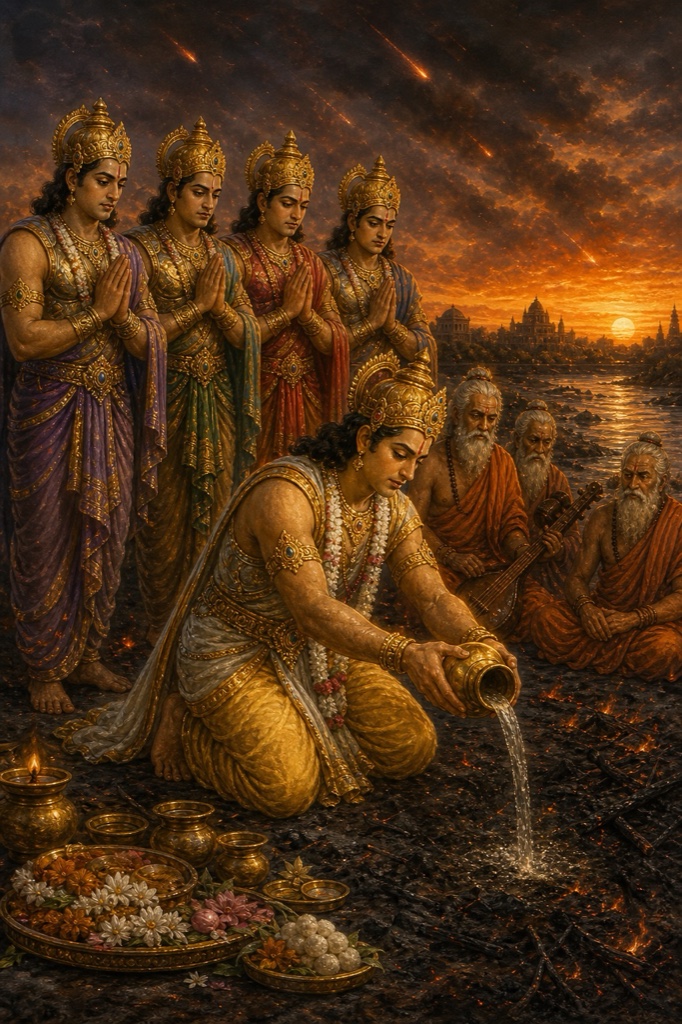
Having made gifts of many kinds, the king entered his capital named after the elephant. The men who had gone to the bank of the Ganga at the king’s command cremated the remains of the king and the two queens, honored them with garlands and scents of many kinds, and disposed of them, and returned to the city and told Yudhishthira that their task was done. The great rishi Narada comforted the righteous king and went away where he liked.
So King Dhritarashtra went out of this world, after three years in the forest and fifteen in the city. He had lost all his children in battle, and he had made many gifts in honor of his kinsmen, his relatives, his friends, his brothers, and his own people. After his uncle’s death Yudhishthira had little joy left in him. Deprived of his kinsmen and relatives, he somehow bore the burden of sovereignty.
A key to reading this (a concept): The unsanctified fire whose death so tormented Yudhishthira is the thorn Narada draws out: the old king had duly kindled his sacrificial fires at Gangadwara, and it was those fires, cast off in the woods by his priests when he abandoned the rites, that grew into the forest fire. So the king went in truth by contact with his own sacred fire, and Sanjaya’s misgiving and Yudhishthira’s anguish are both answered by the same fact. The numbers of the chapter close on each other too. Dhritarashtra ruled fifteen years under the Pandavas; Gandhari counted sixteen years of sleepless grief when the Pandavas visited about a year into the forest life; Narada was told by Indra that three years remained; the Pandavas went home, and two years later the news came.
The gist: Narada explains that the forest fire sprang from the king’s own abandoned sacrificial fires, so the death came by a sacred fire after all, and that Kunti attained success through her service. Yudhishthira, with Yuyutsu at the head of the mourners, offers the rites of water in the Ganga and, on the twelfth day, performs the shraddha with abundant gifts, while men sent to Gangadwara complete the cremation. Dhritarashtra passes three years in the forest after fifteen in the city; after his death Yudhishthira bears the burden of the kingdom without joy. Here the Ashramavasika Parva ends.
Source: the Mahabharata of Krishna-Dwaipayana Vyasa, Ashramavasika Parva, Sections 1 to 47. The Sanskrit e-text, the Gita Press Hindi edition, and Kisari Mohan Ganguli’s complete English translation were used to verify names, sequence, and principal events. Where the recensions differ, this English retelling follows Ganguli, and the Hindi edition follows Gita Press.
Based on: The Mahabharata, Vedavyasa (K. M. Ganguli’s English translation; Gita Press, Gorakhpur)