On this page
Karna was dead. Arjuna, the archer who could draw a bow with either hand, had killed the charioteer’s son, and Duryodhana, the son of the blind king Dhritarashtra, went down into a grief that had no floor to it and saw nothing ahead of him in any direction. He made his way back to camp with difficulty, crying “Karna! Karna!” as he went. The kings who were still alive on his side went with him and tried to steady him with the sound arguments the scriptures keep for such an hour, and none of it gave him any peace. He could not stop thinking about that death. In the end he judged that destiny and necessity rule everything, and having judged so he set his mind on battle again. He installed Shalya, king of the Madras, as supreme commander with the proper rites and marched out with what was left of his army, and the fight that followed between the Kurus and the Pandavas was like the war the old stories tell of the gods and the asuras. Shalya did great slaughter in it. He also lost a great part of his own troops, and at midday Yudhishthira killed him. Duryodhana, with every friend and kinsman gone, ran from the field and hid himself deep in a dreadful lake for fear of his enemies. That same afternoon Bhima had the lake ringed with chariot fighters, called him out of the water, forced him to come, and killed him. And in the night that followed, the three Kaurava chariot fighters who still lived, Ashvatthama, Kripa and Kritavarma, fell in their rage on the Panchala troops and butchered them.
Sanjaya enters Hastinapura, and Dhritarashtra’s lament
The next morning Sanjaya left the camp and came into Hastinapura, the Kuru capital. He was Dhritarashtra’s charioteer, the man through whose mouth the blind king had followed the whole war, and he came back with nothing in him except grief. Inside the city he threw up his arms, and his limbs were shaking as he walked into the palace. He was weeping aloud. “Alas, my king! We are ruined, all of us, by the killing of that great monarch. Time is stronger than anything and runs crooked, since every ally we had, men with the might of Indra himself, has been killed by the Pandavas.” The people saw the state he had come home in, and a great dread took hold of them, and they wept loudly and cried out for their king. Then the word passed that Duryodhana was dead, and the whole of Hastinapura, down to its children, sent up a wail from every quarter. Sanjaya saw men and women running through the streets, broken with grief, their wits gone, like people who have lost their minds.
He went on, badly shaken, into the king’s own apartments. Dhritarashtra was sitting there, a ruler whose only eyes were his understanding, with his daughters-in-law around him, and Gandhari his queen, and his brother Vidura, and the friends and kinsmen who had always wished him well. The old king was still turning over the death of Karna. Sanjaya stood before him weeping, and the words came out of a throat half closed with tears. “It is Sanjaya, my king. I bow to you. Shalya, the ruler of the Madras, has been killed. Shakuni, Subala’s son, has been killed, and Uluka with him, the gambler’s brave son. The Samshaptakas are all dead, and the Kambojas with the Shakas, and the Mlecchas, and the hill tribes, and the Yavanas. The men of the east are dead and all the men of the south. The northerners are all dead, and the westerners. Every king and every prince has been killed. King Duryodhana has been killed too, by the son of Pandu, in the very way that son of Pandu had sworn: his thighs are broken, and he lies in the dust covered with blood. Dhrishtadyumna has been killed, and Shikhandi, beaten at last. Uttamaujas and Yudhamanyu, the Prabhadrakas, the Panchalas and the Chedis have been destroyed. Your sons are all dead, and so are the five sons of Draupadi. Vrishasena, Karna’s brave strong son, is dead.
“Every man who had gathered for this war is dead. The elephants are all destroyed. The chariot fighters have fallen, every one, and all the horses. On your side, lord, very few are alive. The Pandavas and the Kauravas met each other, and the world, dazed by Time, is now a world of women only. On the Pandava side seven are living: the five brothers, Krishna, and Satyaki. On yours there are three: Kripa, Kritavarma, and Drona’s son Ashvatthama. Those three chariot fighters are all that remain of every akshauhini that was mustered for you. They are the survivors, my king. The rest have perished. It seems that Time has destroyed the world, and has made Duryodhana and his enmity the cause.” They were cruel words. Dhritarashtra heard them through and fell from his seat to the ground with his senses gone. Vidura saw the king go down, and the king’s pain overcame him, and he fell too. Gandhari fell, and all the Kuru women with her, struck down in a moment by what they had heard. The whole royal gathering lay on the ground, senseless and raving, like figures painted on a great stretch of canvas.
A key to reading this (the akshauhini): An akshauhini is the epic’s measure of one complete army, and the count it gives for one is exact: 21,870 chariots, the same number of elephants, 65,610 horses, and 109,350 men on foot. Eighteen of them, on the two sides together, came to the field of the Kurus. Sanjaya tells the king that three chariot fighters are left of all the akshauhinis that marched for him, and this is the arithmetic the old man is being asked to take in.
Dhritarashtra came back first, slowly and with difficulty, the breath returning to a man crushed by the death of his sons. His limbs shook. He turned his face one way and another, and he spoke to Vidura. “Vidura, you who are learned, you who are so wise, you are my refuge now. I have no one to protect me, and I have lost all my sons.” Having said it he fell senseless again. The kinsmen who were there sprinkled cold water over him and worked their fans, and after a long while he revived and sat without speaking, sighing heavily, the way a snake breathes when it has been shut in a jar. Sanjaya wept aloud to see him so, and all the women wept, and Gandhari with them. Again and again the king lost consciousness. When at last it held, he said to Vidura, “Let the women go, and Gandhari, and all these friends. My mind is badly unsettled.” Vidura, shaking and shaking again, sent the women out gently, and the friends went with them, having seen how it was with the king. Then Sanjaya looked sadly at his master, who had his senses back and was weeping helplessly, and Vidura stood by with his hands joined and spoke soft words to a man who could not stop sighing.
With the women gone, Dhritarashtra, Ambika’s son, sank into a grief heavier than the first. His breath came out of him like smoke. He kept waving his arms about, and after thinking a little he spoke. “Ah, Sanjaya, there is great grief in what you tell me: that the Pandavas are all safe and have lost nothing in this war. My heart must be hard, made from the core of the thunderbolt, since it hears that my sons have fallen and does not break. I think of their ages, Sanjaya. I think of them at their games as children, and I learn today that every one of them is dead, and my heart feels as if it were coming to pieces. I was blind and never once saw their faces, and I loved them all the same, the way a man loves his children. When I was told they had left childhood behind and grown into youths, and then into young men, I was so glad. Today I am told they are killed, stripped of their fortune and their strength, and I can find no rest anywhere for the pain of what has come to them. Come to me, king of kings, come to me. I have no protector now. What is to become of me without you, my strong-armed son? All the kings of the earth were gathered around you. Why have you left them and lain down on the bare ground, dead, like some poor ordinary king? You were the refuge of your kinsmen and your friends. Where are you going, my hero, leaving me blind and old? Where is your tenderness now, and your love, and the respect you showed me? No one could beat you in battle. How did the sons of Pritha kill you? When I wake at my hour, who will come to me now and say over and over, as you did, ‘Father, father,’ and ‘great king,’ and ‘lord of the world,’ and put his arms around my neck with wet eyes and ask for my orders, saying, ‘Command me, you who are of Kuru’s line’? Speak to me that way once more, my son.”
A sub-tale: Dhritarashtra remembers what Duryodhana used to say to him, and he says it over to Sanjaya as he heard it. “This wide earth is as much ours as it is the son of Pritha’s. Bhagadatta, Kripa, Shalya, the two princes of Avanti, Jayadratha, Bhurishravas, Shala, Somadatta, Bahlika, Ashvatthama, the chief of the Bhojas, the strong prince of Magadha, Brihadbala, the ruler of Kashi, Shakuni the son of Subala, Mlecchas and Shakas and Yavanas in their thousands, Sudakshina who rules the Kambojas, the king of the Trigartas, Bhishma our grandsire, the son of Bharadvaja, the son of Gotama, Shrutayus, Ayutayus, Shatayus, Jalasandha, the son of Rishyashringa, the Rakshasa Alayudha, Alambusha, the great chariot fighter Subala: these and many other kings have taken up arms for my sake and are ready to throw away their lives in a great battle. I will stand on the field among them, with my brothers around me, and fight all the sons of Pritha, and the Panchalas, and the Chedis, and the sons of Draupadi, and Satyaki, and Kuntibhoja, and the Rakshasa Ghatotkacha. Any one of these men of mine, once he is angry, can hold the Pandavas when they charge him. What then of all of them together, every one with a wrong of his own to settle? They will fight the Pandavas’ followers and kill them. Karna alone, with me, will kill the Pandavas themselves, and then every heroic king will live under my rule. As for their leader, Vasudeva, he has told me he will not put on armor for them.” So his son often talked, the old king tells Sanjaya, and hearing it he believed the Pandavas would be killed in battle.
“And when my sons, standing among heroes like those and fighting with everything they had, have all been killed, what can it be except destiny? Bhishma, lord of the world, met Shikhandi and died, a lion brought down by a jackal: what can that be except destiny? Drona the Brahmin, master of every weapon of attack and defense, was killed in battle by the Pandavas: what except destiny? Bhurishravas was killed, and Somadatta, and King Bahlika: what except destiny? Bhagadatta, who knew how to fight from an elephant’s back, was killed, and Jayadratha was killed. Sudakshina was killed, and Jalasandha of Puru’s line, and Shrutayus, and Ayutayus. The Pandya, first among all who carry weapons, was killed in battle by the Pandavas. Brihadbala was killed, and the powerful king of the Magadhas, and brave Ugrayudha, the model of every bowman. The two princes of Avanti were killed, and the ruler of the Trigartas, and Samshaptakas past counting. King Alambusha was killed, and the Rakshasa Alayudha, and Rishyashringa’s son. The Narayanas were killed, and the Gopalas, troops no one could beat, and Mlecchas in their thousands. Shakuni the son of Subala was killed, and strong Uluka, the one they called the gambler’s son, at the head of his men. Heroes without number, trained in every arm, with a prowess like Indra’s own, Kshatriyas who came to us from every kingdom, all of them killed in battle, Sanjaya; my sons and my grandsons, my friends and my brothers, with all their strength, killed. What can it be except destiny? A man is born under destiny, there is no doubt of it, and the man who has good fortune meets with good. I have none, and so I am stripped of my children. I am old. How am I to live under the rule of my enemies? Exile in the forest is the one good thing I can see for myself, lord. I have no relatives and no kin, and I will go to the forest. For a man fallen where I have fallen, a bird with its wings cut, there is nothing better. Duryodhana is killed. Shalya is killed. Duhshasana and Vivimshati and strong Vikarna are killed. How will I bear the roaring of Bhima, who alone has killed a hundred sons of mine in battle? He will talk of the killing of Duryodhana where I can hear him, again and again. I am burning with grief already, and his cruel words will be more than I can stand.”
The gist: The morning after the war ends, Sanjaya walks into Hastinapura and tells the blind king everything at once: Shalya dead, Shakuni dead, Duryodhana lying with his thighs broken, seven men left alive on the Pandava side and three on his own. The king and the whole court fall senseless. When he can speak he sends the women out and mourns his sons, repeats the boast Duryodhana used to make about the kings who would die for him, names those kings one by one as dead, and calls it destiny. The forest, he says, is all that is left to him, since he cannot bear to hear Bhima talk of Duryodhana’s death.
The rout after Karna’s fall, and Duryodhana’s resolve
So he went on, a king burning with grief and stripped of everyone who was his, fainting again and again under it. He wept for a long time. Then, with the hot heavy breath of a beaten man, he turned back to his charioteer, Sanjaya the son of Gavalgana, and asked for all of it in order. “When Bhishma and Drona were dead, and the charioteer’s son after them, whom did my warriors make their commander? Whoever they give the command to, the Pandavas kill him without delay. Bhishma was killed at the front of the battle by Arjuna with all of you looking on. Drona was killed with all of you looking on. Karna, brave as he was, was killed by Arjuna before the eyes of every king. Vidura told me long ago that through Duryodhana’s fault the people of the earth would be wiped out. There are fools who look straight at a thing and do not see it, and I was that fool with his words. Everything he said then has come out exactly so, since every word of it was true. Fate had hold of me and I did not act on it, and now the fruit of that wrong course is here. Tell it to me again, son of Gavalgana. Who led our army after Karna fell? Which chariot fighter went against Arjuna and Krishna? Who guarded the right wheel of the king of the Madras when he went into battle, and who the left, and who covered his rear? With all of you there together, how could the Pandavas kill Shalya, and how my son? Tell me how the great destruction of the Bharatas went. Tell me how Duryodhana fell. Tell me how the Panchalas fell with all their followers, and Dhrishtadyumna, and Shikhandi, and the five sons of Draupadi. Tell me how the five Pandavas came out of it alive, and the two Satvatas, and Kripa, and Kritavarma, and Drona’s son. I want to hear how the battle went and what kind of battle it was. You know how to tell a thing, Sanjaya. Tell me everything.” Sanjaya asked the king to listen closely, and took him back to the evening Karna died. Arjuna had killed the charioteer’s son. The Kaurava troops had been rallied again and again and had run again and again, the killing after Karna’s death had been terrible, and over it Arjuna had begun to roar like a lion. A great fear went into Dhritarashtra’s sons then. No fighter was left in that army with the heart to gather the men or to show what he could do alone. They were merchants shipwrecked on a bottomless sea with no raft, men adrift and wanting any shore at all, now that Arjuna of the diadem had killed the one who protected them. Cut up by arrows and sick with panic, they were men without a master looking for one, or a herd of deer with a lion among them. They went back that evening beaten by Arjuna, like bulls with their horns broken, like snakes with the fangs drawn. Their best man was dead and they were in confusion, and Dhritarashtra’s sons ran. Men who had lost their weapons and their armor lost their heads as well and did not know which way to go. They looked around them in terror, and many started killing each other. Many fell down, or went pale, each one thinking, “It is me Arjuna is after!” or “It is me Bhima is after!”
Great chariot fighters got away on fast horses, fast chariots, fast elephants, and left the infantry behind. In that flight elephants broke chariots, great chariots rode down horsemen, and troops of horse ran over the foot soldiers and killed them. With Karna gone the army was like the stragglers of a caravan in a forest full of robbers and beasts of prey. Elephants that had lost their riders, and others that had lost their trunks, saw the whole world as full of Arjuna. It was Bhima the troops were running from when Duryodhana saw them, and he cried out in dismay and turned to his driver. “If I take my stand at the rear of the army with my bow in my hand, Arjuna will never get past me. So push the horses. When I fight with everything I have, Kunti’s son will no more cross me than the sea crosses its shore. Today I will kill Arjuna and Krishna with him, and that proud Bhima, and whoever else is against me, and I will be free of what I owe Karna.” It was a speech fit for a hero and a man of honor, and the driver, hearing it, urged the horses forward slowly in their trappings of gold.
Many brave men had lost their elephants and horses and chariots by then, and twenty-five thousand soldiers on foot were moving up slowly to fight. Bhima, in a rage, and Dhrishtadyumna the son of Prishata closed around them with all four arms of their force and began to destroy them with arrows. The men on foot fought back hard. Many of them shouted challenges at the two Pandava champions by name. Ringed in by them, Bhima lost his temper. He was on his chariot, and he kept to the rules of a fair fight, which do not let a man on a chariot fight men who stand on the ground; so he got down quickly, trusting to his own two arms, and took up his mace. It was a heavy thing made wholly of iron, dressed with gold and fitted with a sling, and it looked like the Destroyer himself at the end of an age. He killed them with it the way Yama kills with his club. Those foot soldiers had lost their friends and kinsmen and were ready to throw their lives away. They were furious, and hard men to beat, and they ran at Bhima as insects run at a blazing fire, and they died as living things die at a glance from the Destroyer. Bhima went through them like a hawk, with the mace and with a sword, and killed all twenty-five thousand. When that brave division was dead he took his stand again, a man whose strength nobody had ever turned aside, with Dhrishtadyumna in front of him.
Arjuna meanwhile had gone for the Kaurava chariot division. Nakula and Sahadeva, the twin sons of Madri, went with Satyaki at full speed and in high spirits against Shakuni, wanting him dead; they killed his large cavalry with sharp arrows and then drove at Shakuni himself, and the fighting there was fierce. Arjuna went into the middle of the Kaurava chariots drawing Gandiva, the bow whose name was known in all three worlds. When the troops saw that chariot coming, the white horses in its traces, Krishna holding the reins and Arjuna standing as its fighter, they ran. Twenty-five thousand men on foot, their chariots and horses gone and arrows in them from every side, went toward Arjuna and surrounded him, and Dhrishtadyumna, the great chariot fighter of the Panchalas, with Bhima ahead of him, quickly destroyed that brave division and stood over it in triumph. The Panchala king’s son was a famous man, a great bowman, handsome, a breaker of whole companies. His horses were white as pigeons and his standard was a tall kovidara tree, and at the sight of them the troops ran. Then the twins and Satyaki came into view, hard after Shakuni, the Gandhara king, who was quick with his weapons. Chekitana and the five sons of Draupadi, having killed a great many of the Kaurava men, blew their conches. Seeing the whole army running with its faces turned from the field, the Pandava fighters went after it and struck it down, like bulls chasing bulls they have already beaten. One part of that army still held its ground. Arjuna saw it, and it angered him, and all at once he covered it with arrows. The dust that went up hid everything. Sanjaya could see nothing; a darkness spread, the field was roofed with arrows, and the Kaurava troops ran in fear in every direction.
With his army broken like that, the Kuru king charged, and he charged at friend and foe alike. Duryodhana called out every one of the Pandavas to fight him, the way the asura Bali in the old days called out all the gods. They came together in a fury, shouting their contempt at him again and again, shooting whatever they had, and went for him where he stood roaring. He felt no fear, and he hit them back with his arrows. What Sanjaya saw of Duryodhana then astonished him, since all the Pandavas together could not get past that one man.
From there Duryodhana saw his own troops a little way off, badly cut up by arrows and making ready to run. He rallied them. He had made up his mind to fight and he wanted to put heart in them, and this is what he said. “I do not see the place, on the plains or in the mountains, where you can run and the Pandavas will fail to kill you. So what is the use of running? Their army is down to a remnant. Krishna and Arjuna are both badly wounded. If we all make our stand here, the victory is ours for certain. If you break your ranks and run, the Pandavas will come after you, sinners that you will then be, and kill every one of you. Death in battle is the better thing for us. To die on the field, fighting as Kshatriyas fight, is a sweet death, with no grief in it, and the man who meets it has happiness without end in the next world. Listen to me, all you Kshatriyas who are gathered here. It would be better to give yourselves into the hands of Bhima in his anger than to give up the duties your fathers kept before you. A Kshatriya can do nothing more sinful than run from a battle. There is no road to heaven, Kauravas, better than the duty of battle. A fighter wins in one day the worlds of bliss that other men work long years to reach.” The great chariot fighters of the warrior order did as he asked. They could not stomach having been beaten, they were set on showing what they were worth, and they went at the Pandavas again; and a battle began once more, savage as the one between the gods and the asuras, in which Duryodhana, with all his troops, drove at the Pandavas where Yudhishthira led them.
A key to reading this (the samshaptakas): The Samshaptakas were soldiers sworn to conquer or die. Earlier in the war, bathed in clarified butter and dressed in kusha grass, they had lit fires and sworn before them to kill Arjuna or never come back from the field, and they called him out to its southern part. Susharma of the Trigartas and his brothers took that oath. Sanjaya’s first words to the king count the Samshaptakas among the dead, and on this last morning Arjuna is still fighting them.
The gist: On the evening of Karna’s death the Kaurava army runs without a leader. Duryodhana has his driver take him to the rear so that he can hold the rout, and swears to clear his debt to Karna. Bhima gets down from his chariot and kills twenty-five thousand foot soldiers with his mace, Arjuna breaks the chariot division, and Duryodhana, after holding off all the Pandavas alone, talks his men back into the fight with duty, sin and heaven.
Kripa’s plea for peace, and Duryodhana’s refusal
Kripa had seen all of it. He had seen the broken boxes of chariots lying about, and the chariots of great men, and the elephants and foot soldiers dead on a field that looked as dreadful as the ground where Rudra takes his sport. He had seen kings in their hundreds and thousands come to an end with no glory in it. He had watched what Arjuna could do, after Duryodhana had drawn back heartsick and the troops stood about, anxious and in deep trouble, asking one another what should be done next. He could hear the Kaurava fighters wailing as they were crushed, and he could see the emblems of great kings thrown down in disorder. Kripa was a leader of the Kurus, old in years and good in conduct, a compassionate man and an eloquent one, and he went up to King Duryodhana, and what he said he said in anger. “Duryodhana, listen to what I am going to tell you, and when you have heard it, act on it if it pleases you. There is no path better than the duty of battle. It is on that path that Kshatriyas fight. A man who lives as a Kshatriya fights his son, his father, his brother, his sister’s son, his mother’s brother, his relatives and his kin. If he is killed in battle there is great merit in it, and if he runs from the field there is great sin, which is why the life of a man who chooses to live by a Kshatriya’s duties is so terrible. So let me say a few words for your good. Bhishma has fallen, and Drona, and the great chariot fighter Karna. Jayadratha is dead, and your brothers, and your son Lakshmana. What is there left for us to do? The men on whom we rested the whole weight of the kingdom we were enjoying have thrown off their bodies and gone to the blessed worlds that are won by those who know Brahman. And we, without those great and gifted fighters, having brought so many kings to their deaths, will have to live out our time in grief.
“Even when all of them were alive, Arjuna could not be beaten. He has Krishna for his eyes, and the gods themselves cannot defeat him. This great army has always shaken with fear when it came up against his standard, the one with the ape on it, tall as the pole they raise for Indra and bright as Indra’s bow. Bhima’s roaring, the blare of Krishna’s conch Panchajanya, the twang of Gandiva: at those sounds the heart dies in us. Gandiva blinds the eye. It moves like flashes of lightning, it turns in his hands like a wheel of fire, and the pure gold on it flashes on every side when he shakes it. His horses are white, white as the moon or as kasha grass, and so fast they seem to swallow the sky, and with Krishna driving them they carry him into battle in their gold harness the way wind drives the clouds. He knows more of weapons than any man living, and he burned that great force of yours the way a spreading fire burns dry grass in a winter forest. We have seen him come into our ranks with the splendor of Indra, like an elephant with four tusks. We have seen him shake your army and terrify the kings, like an elephant churning a lake full of lotuses. We have seen him frighten every fighter with the sound of his bowstring, like a lion among lesser animals. Krishna and Arjuna in their armor, the first two bowmen in all the worlds, are a beautiful sight. Today is the seventeenth day of this dreadful battle and of the dying in it. The divisions of your army are broken and scattered like autumn clouds in the wind. Arjuna made your army shake and reel like a boat in a storm on the open sea. Where was the charioteer’s son, where was Drona with all his followers, where was I, where were you, where was Kritavarma, where was your brother Duhshasana with his brothers, when Jayadratha was killed? Arjuna saw Jayadratha, had him within range, set his strength against all your kinsmen and brothers and allies and uncles, put his foot on their heads, and killed King Jayadratha while every one of them looked on. So what is left for us to do? Who is there among your troops now who is going to beat him? He has celestial weapons of many kinds, and the sound of Gandiva alone takes the strength out of us. This army of yours has no leader. It is a night without a moon. It is a river gone dry, with the trees on its banks broken down by elephants. Arjuna of the white horses will go through it wherever he likes, as a blazing fire goes through a heap of grass. As for Satyaki and Bhima, the force of those two would split every mountain there is, or dry up every sea. What Bhima said in the middle of the assembly, he has very nearly done, all of it, and what he has still to do he will do. Even while Karna was fighting in front of it, the Pandava army was hard to beat, with Arjuna guarding it as he did. You have done the Pandavas many foul wrongs, and they are righteous men who had given you no cause. The fruit of those acts has come. For your own ends you took great care to gather a large force, and that whole force, and you with it, have fallen into great danger.
“Save yourself now. A man’s own self is the vessel everything else rests in, and when it breaks, whatever was in it is scattered in every direction. The one who is growing weaker should seek peace by conciliation, and the one who is growing stronger should make war: that is the policy Brihaspati taught. We are the weaker now in the strength of our army. So I think, my lord, that peace with the Pandavas is what is good for us. A man who does not know what is good for him, or knows it and sets it aside, soon loses his kingdom and gets no good of any kind. If we can keep a sovereignty by bowing to King Yudhishthira, even that is to our good, and far better than to be beaten through sheer folly. Yudhishthira is a compassionate man. If Dhritarashtra, Vichitravirya’s son, asks it of him, and Krishna asks it, he will let you go on as king. Whatever Krishna says to Yudhishthira in his victory, and to Arjuna, and to Bhima, all of them will do without question. Krishna, I think, will be unable to go against the word of Dhritarashtra of the Kurus, and Yudhishthira will be unable to go against Krishna’s. An end to the fighting with the sons of Pritha is what I hold to be good for you. I have no low motive in saying this and no thought of saving my own life. I am telling you what I believe will help you. You will remember these words when you are at the point of death.” Kripa, Sharadvat’s son, was an old man, and he was weeping as he spoke. When he had finished he drew long hot breaths, gave himself up to his sorrow, and came close to fainting.
Duryodhana heard Gotama’s famous grandson out, breathed long and hot, and said nothing. He thought for a little while. Then the king answered Kripa. “You have said to me everything a friend ought to say. You have also done everything for me in battle and never counted your life. The world has seen you go into the middle of the Pandava divisions and fight their greatest chariot fighters. What a friend should say, you have said, and still it does not please me, any more than medicine pleases a man who is about to die. Your words are sound and good and full of reason, and I cannot accept them. We took the son of Pandu’s kingdom from him once. Why would he put his trust in us? We beat that great king at dice. Why would he believe anything I say now? Krishna came to us as an envoy, Krishna who works always for the good of Pritha’s sons, and we deceived him. That was a badly judged act. Why would he trust my word after it? Draupadi stood in the middle of our assembly and wept, and Krishna will never forget what we did there, or that we stripped Yudhishthira of his kingdom. We used to hear that Krishna and Arjuna have one heart between them and are bound fast to each other. Today we have seen it with our own eyes. Since he heard that his sister’s son was killed, Krishna passes his nights in sorrow. We have offended him deeply, and why should he forgive us? Arjuna has been a wretched man since Abhimanyu died. Even if he were begged, why would he lift a hand for my good? Bhima, the second of them, is savage, and he has made a terrible vow. He will break before he bends. The twins hate us with every breath, and in their armor, with their swords in their hands, they look like a pair of Yamas. Dhrishtadyumna and Shikhandi have drawn their swords against me. Why would those two work for my good? Draupadi was wearing a single cloth, and it was the time of her month, and Duhshasana treated her cruelly in the middle of the assembly with everyone looking on. The Pandavas remember her, stripped and in misery, to this day. Nothing will turn them from battle.
“And there is this. Draupadi, Drupada’s daughter, is living in sorrow and under the hardest penances, for my destruction and for the success of her husbands, and she sleeps every night on the bare ground and means to go on doing so until this quarrel is finished. Krishna’s own sister Subhadra has put away her honor and her pride and waits on her like a serving woman. Everything is on fire, and that fire cannot be put out. Peace with them became impossible when Abhimanyu was killed. And think of me. I have had the rule of this earth as far as the sea. How would I enjoy a kingdom in peace as a favor from the Pandavas? I have shone like the sun over the heads of all the kings. How would I walk behind Yudhishthira like a slave? I have had every pleasure and I have been generous, and how would I now lead a poor life among poor men? I do not hate what you have said; it was gentle and well meant. I only think this is no time for peace. To fight a righteous fight is what I hold to be good policy. This is no time to act like a eunuch. This is the time for battle. I have performed many sacrifices. I have given the Brahmins their sacrificial gifts. I have had everything I wished for. I have listened to the Vedas recited. I have walked on the heads of my enemies. My servants have all been well kept, and I have relieved people in distress. I cannot bring myself to say such humble words to the Pandavas. I have conquered other men’s kingdoms and governed my own properly. I have enjoyed every kind of pleasure, I have pursued duty and wealth and desire, and I have paid what I owed to my ancestors and to the duty of a Kshatriya. There is certainly no happiness here. What becomes of a kingdom, or of a good name? Fame is the one thing worth getting in this world, and fame is got by battle and by nothing else. A Kshatriya who dies at home is blamed for it. To die in one’s bed at home is a great sin. The man who has performed his sacrifices and then throws away his body in the forest or in battle wins great glory. He is no man who dies wretched and weeping, wasted by disease and age, with his family crying around him. I will give up every pleasure I have had and go by righteous battle to Indra’s world, into the company of those who have reached the highest end. Heroes who behave rightly, who never turn back from a fight, who are intelligent and truthful, who have performed sacrifices and been made holy in the sacrifice of weapons, have their home in heaven; of that there is no doubt. The apsaras watch such men with joy while they fight, and their ancestors see them honored in the assembly of the gods. We will now climb the road the gods walk and the heroes who do not come back from battle, the road our revered grandsire took, and our wise teacher, and Jayadratha, and Karna, and Duhshasana. Many brave kings have been killed straining for my sake in this war. They lie on the bare earth, full of arrows, with their limbs washed in blood. They were men of courage and of great skill with weapons, they had sacrificed as the scriptures lay down, they gave up their lives doing their duty, and they live now in Indra’s house. They have laid that road. It will be crowded again, and hard to travel, with all the heroes hurrying along it toward the same blessed goal. I remember with gratitude what those men did who died for me, and I want to pay what I owe them. My heart is no longer set on a kingdom. If I let my friends and my brothers and my grandsires be killed and then saved my own life, the world would certainly condemn me. And what sort of kingship would it be, with no kinsmen, no friends, no one who wished me well, and my head bowed to the son of Pandu? I have been lord of the whole world. I will now win heaven by a fair fight. It will not be otherwise.” The Kshatriyas who were standing there applauded that speech and cheered the king, crying, “Excellent! Excellent!”
None of them grieved any longer over the defeat. They had made up their minds to fight and show what they could do, and a kind of eagerness went through them. They saw to their animals, and then the Kauravas, glad at the thought of battle, went to their quarters for the night at a place a little less than two yojanas from the field. It was open tableland at the foot of the Himavat mountains, sacred ground and beautiful, and the Sarasvati ran there with red water. They bathed in it and drank. Duryodhana had lifted their spirits, and they stayed on that resting ground, each man steadying himself and steadying the others, Kshatriyas whom fate was driving, and waited.
A key to reading this (the yojana): The yojana is the epic’s long measure, the unit in which it gives the reach of a march or the spread of a camp. When Shalya first led his army toward this war, its encampment alone covered a yojana and a half. The reckonings of the unit differ, one giving it about four miles and another about eight, so that a camp a little less than two yojanas away lay short of eight miles from the field by the first count and short of sixteen by the second, on the tableland where the Sarasvati runs red at the foot of Himavat.
The gist: Kripa, old and in tears, tells Duryodhana that Arjuna cannot be beaten, that the army has no leader, that the wrongs done to the Pandavas have come due, and that Brihaspati’s rule for the weaker side is to make peace; Yudhishthira is merciful and will leave him a throne if Dhritarashtra and Krishna ask. Duryodhana thanks him and refuses. He lists what stands between him and any peace, the dice, the deceiving of Krishna the envoy, Draupadi in the assembly, the death of Abhimanyu, and says that a man who has ruled the earth to the sea will not walk behind Yudhishthira. He chooses battle, fame and Indra’s heaven, and the army camps by the red Sarasvati.
The consecration of Shalya as commander
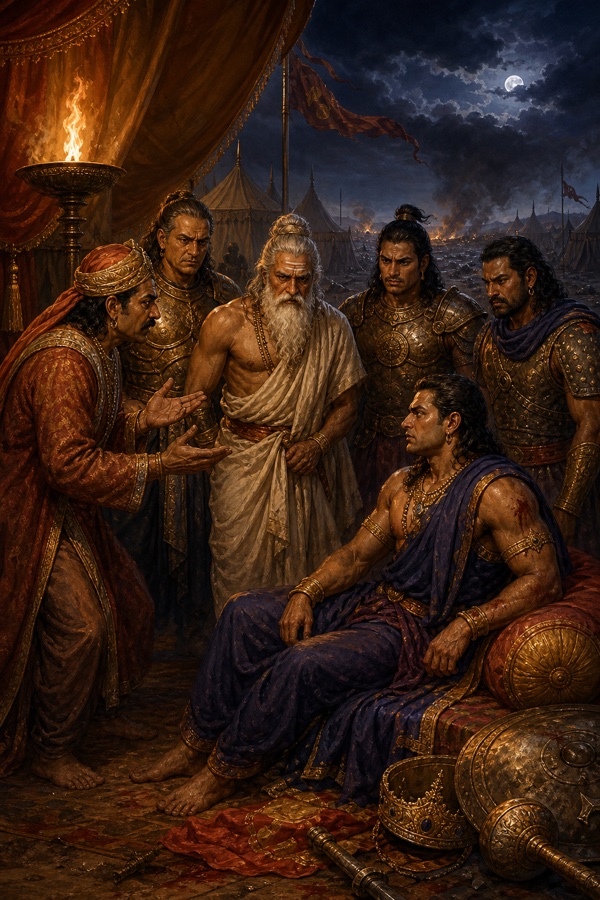
They passed the night on that tableland under Himavat, glad of the battle to come. Shalya was there, and Chitrasena, and the great chariot fighter Shakuni, and Ashvatthama, and Kripa, and Kritavarma of the Satvata line, and Sushena, and Arishtasena, and Dhritasena with his great energy, and Jayatsena, and all the other kings. Since Karna’s death Dhritarashtra’s sons had been so afraid of the Pandavas, who were hungry for their victory now, that they had found no rest anywhere short of the mountains. All of them were resolved to fight. They paid Duryodhana the honor due him, and then, with Shalya standing by, they said, “Appoint a commander for your army and then fight the enemy. With such a man to protect us in battle, we will beat them.”
Duryodhana did not get down from his chariot. He drove to Ashvatthama, Drona’s son, who knew every rule of war and who in battle was like the Destroyer himself. Ashvatthama’s limbs were beautiful, his head well covered, his neck marked with three lines like the lines on a conch shell. His speech was sweet. His eyes were like the petals of a lotus fully open and his face had the dignity of Mount Meru. In his neck, his eyes, his walk and his voice he was like the bull of Mahadeva. His arms were large and massive and well jointed, his chest broad and well made; he had the speed and strength of Garuda or of the wind, the radiance of the sun’s rays, the intelligence of Ushanas, and in form and in the charm of his face the beauty of the moon. His body looked as if it had been put together from golden lotuses. His joints were well made, and his thighs and waist and hips; his fingers were beautiful and his nails were beautiful. He looked as if the Creator had collected every good and lovely quality in creation, one after another, and made him with care. He carried every auspicious mark. He was clever at everything he did and an ocean of learning. He always beat his enemies fast, and they could not beat him by force. He knew the science of weapons in every detail, its four divisions and its ten limbs, and he knew the four Vedas with all their branches and the old histories that are counted as a fifth. His father Drona, himself born of no woman, had worshiped the three-eyed god with great care and hard vows, and so had fathered him on a wife who was also born of no woman. To this man, whose feats and whose beauty no one on earth could equal, who had mastered every branch of learning, Duryodhana said, “Son of my teacher, you are our highest refuge today. So tell us: who is to be the commander of my forces now? Whom shall we put at our head, so that all of us together may beat the Pandavas?”
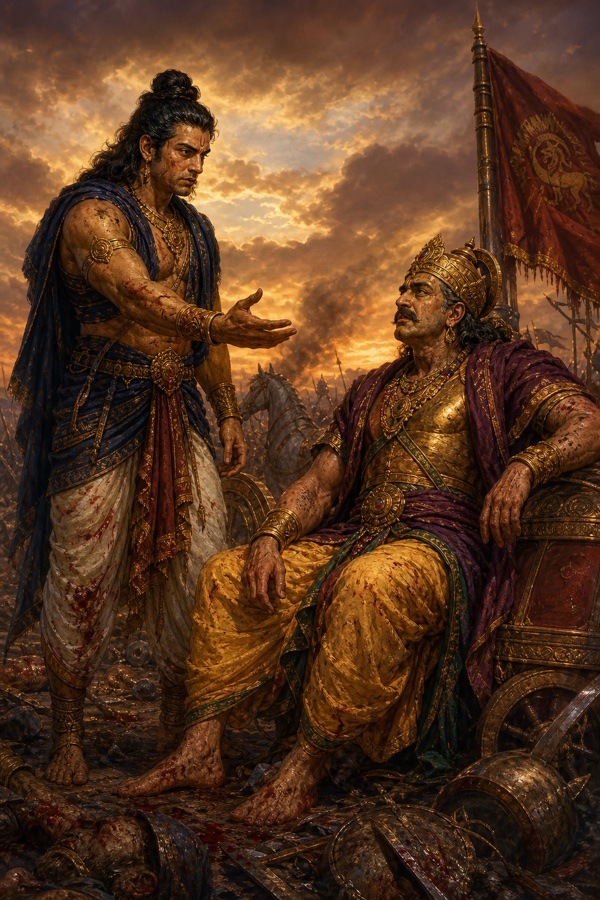
“Let Shalya lead our army,” Drona’s son answered. “In birth, in prowess, in energy, in fame, in the beauty of his person, in every accomplishment he stands above the rest. He remembered the service that was done him, and he came over to our side and left his own sister’s sons. He has a large force of his own, and with those great arms he is a second Kartikeya, the general of the gods. Make that king our commander and we will be able to win, the way the gods won when they put that same unbeaten Skanda at their head.” When he had said it, all the kings went and stood around Shalya and cried victory to him. Their minds were made up for battle, and it made them very glad.
A sub-tale: Shalya is king of the Madras, and the twins Nakula and Sahadeva are his sister’s sons. When the armies were gathering he set out with a large force to join the Pandavas. Duryodhana heard he was on the road and had pavilions built for him along the way, stocked with food and drink and every comfort, and Shalya, waited on there like a god, believed it was Yudhishthira’s doing and asked to reward the men who had done it. Duryodhana, who had kept himself hidden, then came forward. Shalya embraced him and told him to ask for whatever he wished, and Duryodhana asked him to be the leader of all his army. Shalya said, “Be it so.” That is the service Ashvatthama means when he says that Shalya remembered what was done for him and left his own sister’s sons.
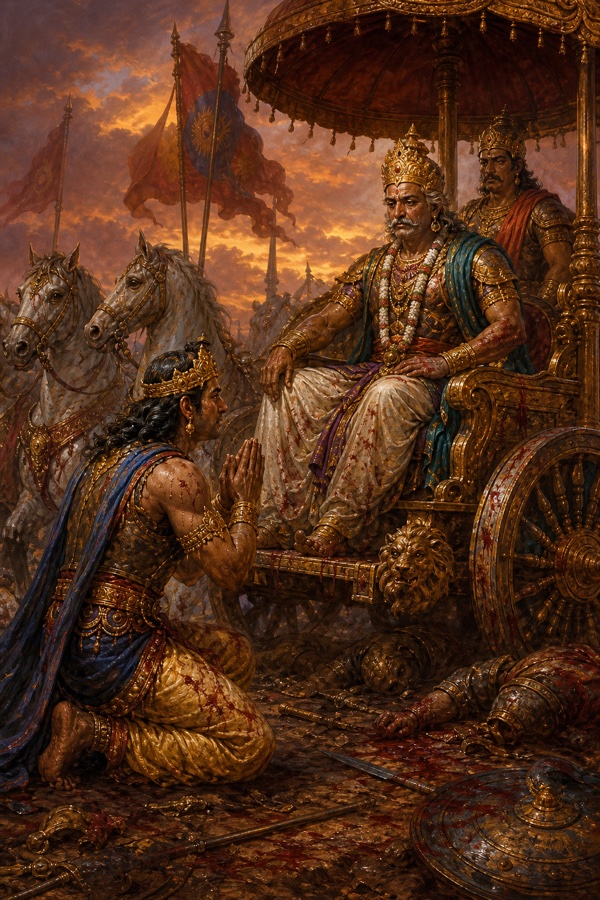
Now Duryodhana got down from his chariot. Shalya was seated on his own, a man who was the match of Drona and Bhishma in battle, and the king stood on the ground before him with his hands joined. “You are a man devoted to his friends. The time has come for your friends when wise men look hard at those who wear the look of friends and see which of them are true. You are brave. Be our commander and stand at the front of our army. When you go into battle the Pandavas and their friends will lose heart, and the Panchalas will sink.” Shalya answered him, “King of the Kurus, I will do what you ask me to do. Everything I have is at your service: my life’s breath, my kingdom, my wealth.” Duryodhana said, “Uncle, I am asking you to take the leadership of my army. Protect us as no one else could, as Skanda protected the gods in battle. Have yourself installed in the command, king among kings, as Kartikeya, the fire god’s son, was installed in the command of the gods’ army. Kill our enemies in battle, hero, as Indra killed the Danavas.”
Shalya heard the king out and replied. “Listen to me, Duryodhana, strong of arm and good with words as you are. You look at Krishna and Arjuna on their one chariot, the two Krishnas, and think them the greatest chariot fighters alive. The two of them together are no match for me in strength of arm. What need is there to speak of the Pandavas? When I am angry I can stand at the front of a battle and fight the whole world, gods and asuras and men, if it rose in arms against me. I will beat the sons of Pritha and the Somakas when they come together. I will be the leader of your troops; have no doubt of it. I will make an array that our enemies will be unable to master. I am telling you this, Duryodhana, and there is no doubt in it.”
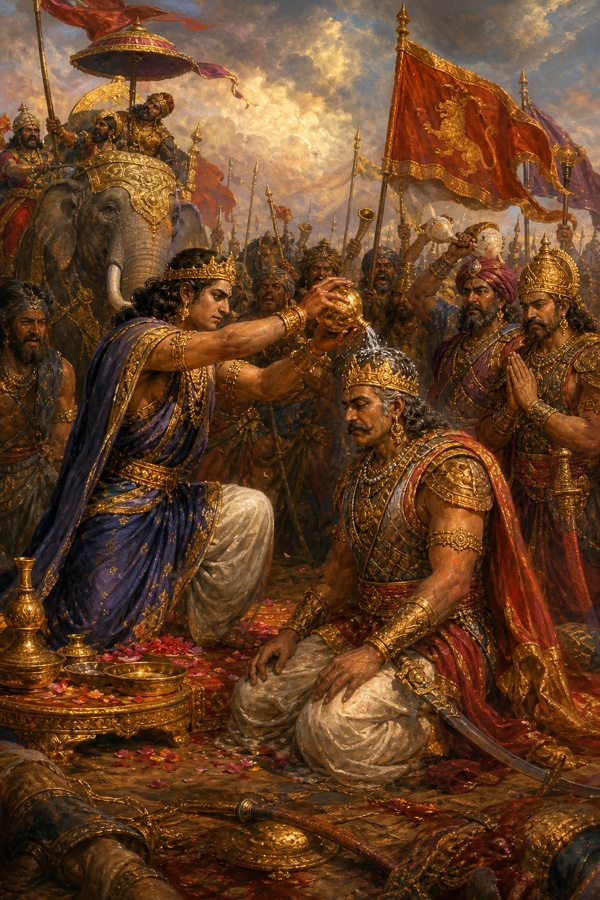
King Duryodhana was delighted, and he lost no time. There in the middle of his troops he poured the consecrated water over the ruler of the Madras, following the rites the scriptures lay down, and when Shalya stood invested with the command a great lion roar went up from the army, and drums were beaten and horns blown. The Kaurava fighters were in high spirits, and so were the great chariot fighters of Shalya’s own Madrakas. They praised the royal Shalya with one voice: “Victory to you, king! Long life to you! Kill all the enemies who have gathered! Let the sons of Dhritarashtra, with the strength of your arms behind them, rule the wide earth with no enemy left on it. You could beat the three worlds in battle, the gods and the asuras with them. What are the Somakas and the Srinjayas, who are only mortal men?” Shalya, praised like that, felt the great joy that is out of reach of men with unformed souls, and he spoke. “Today, king, I will either kill all the Panchalas and the Pandavas in battle, or be killed by them and go to heaven. Let the world watch me move over the field today without fear. Let all the sons of Pandu watch, and Krishna, and Satyaki, and the sons of Draupadi, and Dhrishtadyumna, and Shikhandi, and all the Prabhadrakas: let them see my prowess, the great power of my bow, my quickness, the energy of my weapons and the strength of my arms. Let the sons of Pritha see it, and all the Siddhas, and the Charanas with them. Let the great chariot fighters of the Pandavas see what I can do today and try every means they have to answer it. Today I will rout the Pandava troops on every side. I will go over the field, Kauravas, doing what pleases you, and I will surpass Drona and Bhishma and the charioteer’s son.”
With Shalya in command, no one in the army grieved for Karna any longer. The troops were cheerful and glad. They counted the sons of Pritha as dead men already, delivered into the power of the ruler of the Madras, and that night Duryodhana’s army slept happily. Its shouting carried to the other camp. King Yudhishthira heard it, and he spoke to Krishna of the Vrishnis where all the Kshatriyas could hear. “Madhava, Dhritarashtra’s son has made Shalya the leader of his forces, the ruler of the Madras, a great bowman whom every fighter holds in high regard. You know now what has happened. Do what is best. You are our leader and our protector. Decide what should be done next.”
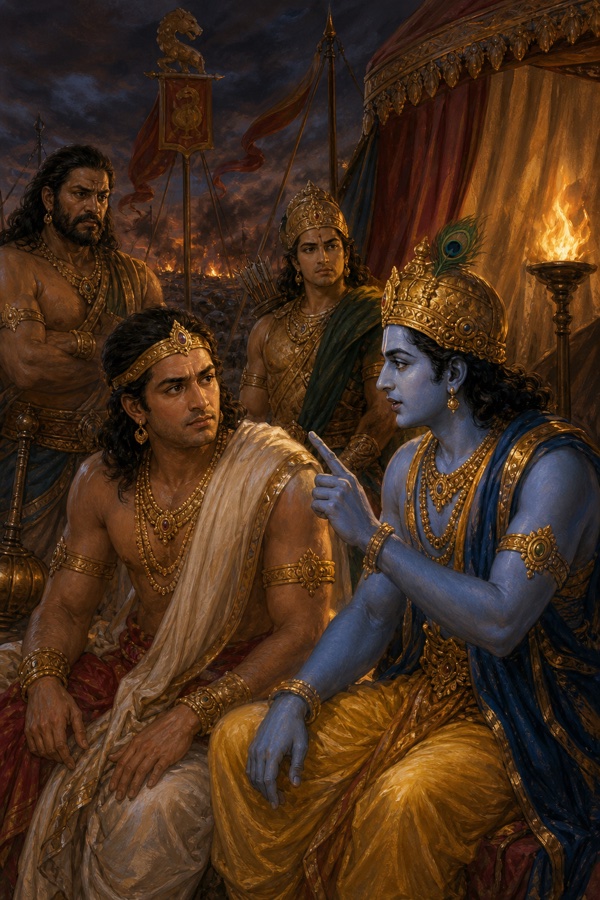
Krishna answered him. “I know Artayani, king. I know him as he truly is. He has prowess and great energy, and great renown. He is accomplished, he knows every mode of warfare, and his hand is very light. I think the ruler of the Madras is the equal in battle of Bhishma, or Drona, or Karna, and perhaps he is more than their equal. I have thought about it, ruler of men, and I cannot find the fighter who is a match for Shalya once he is engaged. In battle he is stronger than Shikhandi, than Arjuna, than Bhima, than Satyaki, than Dhrishtadyumna. He has the prowess of a lion or an elephant, and he will go about the field without fear, like the Destroyer himself, angry among living things when the time comes for the universe to end. I see no match for him in battle except you, who have a tiger’s prowess. There is no one else in heaven or in the whole of this world who could kill the ruler of the Madras when he is roused in battle. Day after day he has fought and shaken your troops. So kill Shalya in battle, as Indra killed Shambara. Dhritarashtra’s son has done him honor, and he cannot be beaten. When the ruler of the Madras falls, the victory is certainly yours, and when he is dead the great army of Dhritarashtra’s sons dies with him. Hear what I am telling you now and go against that great chariot fighter. Kill him as Indra killed the asura Namuchi. There is no call for compassion here, for thinking, ‘This man is my uncle.’ Keep the duties of a Kshatriya in front of you and kill the ruler of the Madras. You have crossed oceans with no bottom to them, Bhishma and Drona and Karna. Do not sink now, with everyone who follows you, in the print of a cow’s hoof that is Shalya. Show in battle the whole of your ascetic power and the whole of your Kshatriya energy. Kill that chariot fighter.”
A key to reading this (Artayani): Artayani is Shalya, called so after his father, and the name returns in the battle when the sons of Draupadi cover him with arrows. The hoofprint is Krishna’s measure of the danger and of the shame together. A cow’s hoof leaves a small hollow in the mud; an army that has crossed Bhishma, Drona and Karna, each of them a sea, could still go under in that. In the same speech Krishna rates Shalya the equal of those three or more, and says that Yudhishthira alone can kill him.
Having said this, Krishna went to his tent. It was evening, and the Pandavas paid him their reverence as he left. When he had gone, King Yudhishthira dismissed all his brothers and the Somakas and slept that night at ease, like an elephant from whose body the darts have been drawn. All the great bowmen of the Panchalas and the Pandavas slept well, glad that Karna had fallen. The fever had gone out of that army. Full of great archers and great chariot fighters, it felt that it had come to shore, and it was happy that night with the victory Karna’s death had given it.
The gist: In the night camp the kings ask for a commander. Duryodhana consults Ashvatthama without leaving his chariot, Ashvatthama names Shalya, and Duryodhana gets down, joins his hands, and asks him. Shalya gives his life, kingdom and wealth to the cause, declares himself stronger than Krishna and Arjuna together, and is consecrated among the troops. Across the field Yudhishthira hears the cheering and asks Krishna what to do. Krishna’s answer is that Shalya is the equal of Bhishma, Drona and Karna, that no one except Yudhishthira can kill him, and that Yudhishthira must do it with no pity for an uncle.
The array of the eighteenth day, and the strength of the two armies
When that night had passed, King Duryodhana called to all his soldiers, “Arm, great chariot fighters!” and the camp came alive to the order. Men began putting on their armor. Some hurried to yoke horses to their chariots, others ran this way and that, the elephants were being fitted out, the foot soldiers were arming, and thousands of others were spreading carpets on the decks of the chariots. Drums and horns started up to raise the men’s spirit for the fight. Then the whole force could be seen standing at its posts in armor, resolved to make death its goal. The great Kaurava chariot fighters had made the ruler of the Madras their leader, and they divided their troops and stood in divisions. Then all of them, Kripa and Kritavarma and Drona’s son and Shalya and Shakuni and the other kings who were still alive, met with Duryodhana and came to an understanding: no one of them would fight the Pandavas singly and alone. “Whoever among us fights the Pandavas alone and unsupported,” they said, “or leaves a comrade who is engaged, will be stained with the five grave sins and all the lesser ones.” And they said, “We will fight the enemy all together.” With that agreed among them, they put the ruler of the Madras at their head and moved quickly against their enemies. The Pandavas had drawn up their own troops for a great battle and were coming on against the Kauravas to engage them on every side. Soon that host, loud as a sea in commotion and wonderful with its chariots and elephants, looked like the great deep itself when the swell is running.
Dhritarashtra had a question. “Bhishma and Drona, those great bowmen, had fallen, and the great chariot fighter Karna. Kurus and Pandavas alike had been worn down in numbers. And then the sons of Pritha, strong as they are, grew angry in battle once more. What was the strength of each army then, Sanjaya?” Sanjaya told him how the two sides stood that morning. The Kaurava army had eleven thousand chariots, ten thousand seven hundred elephants, a full two hundred thousand horses, and three million men on foot. What remained to the Pandavas was six thousand chariots, six thousand elephants, ten thousand horses and one million foot. Those were the forces that went against each other.
A key to reading this (the strength of the armies): Kaurava side: 11,000 chariots, 10,700 elephants, 200,000 horses, 3,000,000 foot. Pandava side: 6,000 chariots, 6,000 elephants, 10,000 horses, 1,000,000 foot. By Sanjaya’s count Duryodhana still has three men on foot for every one of Yudhishthira’s, twenty horses for every one, and nearly twice the chariots and elephants. By the next morning Sanjaya will be telling the king that three chariot fighters are all that is left of that army.
After Drona and Bhishma and the charioteer’s son had been brought down, one hope had grown strong in Dhritarashtra’s sons: that Shalya would kill every son of Pritha in battle. Duryodhana held that hope close and took comfort from it. Leaning on the ruler of the Madras, he felt that he had a protector again. The fear had been great among Dhritarashtra’s sons when the Pandavas roared like lions after Karna fell, and Shalya had given them his assurance. Now he formed a grand array, auspicious in every part of its arrangement, and went against the sons of Pritha shaking a splendid, very strong bow that could give great speed to an arrow. He rode the finest of chariots, with horses of the Sindhu breed in its traces, and his driver made the vehicle a splendid sight as it came. Guarded by that chariot, he stood and drove the fear out of Dhritarashtra’s sons. In his armor he went at the head of the array with the brave Madrakas and the unbeaten sons of Karna. On the left was Kritavarma with the Trigartas around him. On the right was Kripa with the Shakas and the Yavanas. In the rear was Ashvatthama with the Kambojas around him. In the center was Duryodhana, guarded by the first fighters of the Kurus. Shakuni, Subala’s son, went with the rest, a large force of cavalry and other troops about him, and with him the great chariot fighter Uluka.
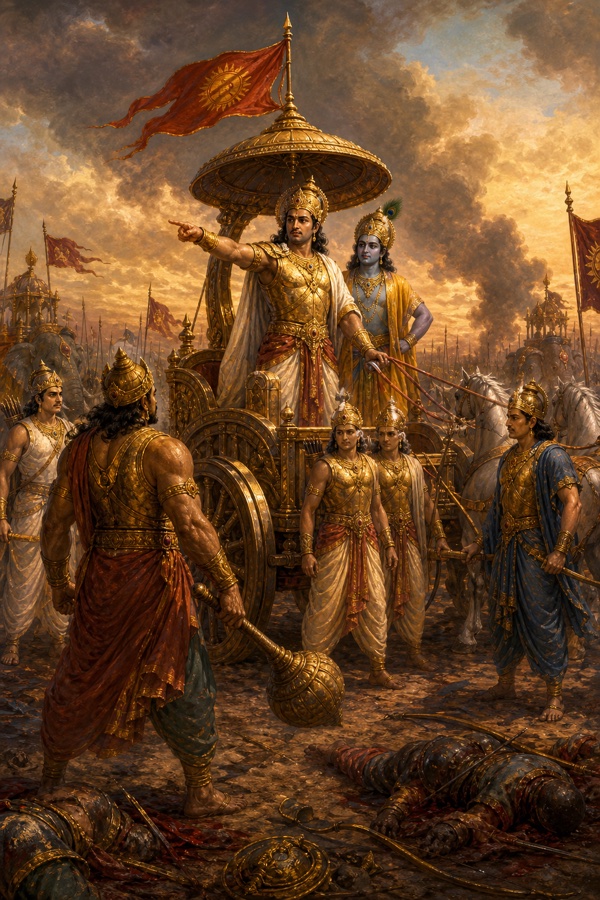
Across the field the great bowmen of the Pandavas divided themselves into three bodies and rushed the Kaurava troops. Dhrishtadyumna, Shikhandi and Satyaki went at full speed against Shalya’s army. King Yudhishthira, with his own troops around him, went against Shalya himself and no one else, wanting his death. Arjuna, who had destroyed whole companies in his time, drove hard at the great bowman Kritavarma and at the Samshaptakas. Bhima and the great chariot fighters of the Somakas went for Kripa. The two sons of Madri, with their troops, went against Shakuni and Uluka where those two stood at the head of their forces. From the other side thousands upon thousands of the Kaurava fighters, carrying every kind of weapon and full of rage, came on against the Pandavas. So the two sides, angry and each wanting the victory, the Kauravas under the command of the ruler of the Madras and the Pandavas with the Panchalas beside them, met at the dawn of the day, and what began then was a savage business of striking and killing.
The gist: At daybreak on the eighteenth day the surviving Kaurava leaders swear that none of them will fight the Pandavas alone, on pain of the five grave sins, and march with Shalya at the head: Kritavarma on the left, Kripa on the right, Ashvatthama in the rear, Duryodhana in the center. Sanjaya gives the king the count of both armies. The Pandavas come on in three bodies, and Yudhishthira makes for Shalya.
The great slaughter, and the river of blood
The battle that began then between the Kurus and the Srinjayas was as fierce and dreadful as the battle of the gods and the asuras. Men met men, and crowds of chariots and elephants met each other, and elephant fighters and horsemen in their thousands, and horses, every one of them full of strength. The noise of charging elephants, huge frightening shapes, was like the roar of clouds across the sky in the season of rains. Chariot fighters struck by elephants lost their chariots; other brave men ran over the field with those maddened animals behind them. Well-trained chariot fighters shot down large bodies of cavalry, and the foot soldiers who urge an elephant on and guard it, and sent them to the next world. Well-trained horsemen ringed great chariot fighters and rode around them, striking and killing with spears and darts and swords. Bowmen closed around great chariot fighters, many against one, and sent them to Yama’s house. Great chariot fighters closed around elephants and around the first fighters of their own kind and killed some strong man among those who were ranging the field. Elephants closed around single chariot fighters who stood shooting in their anger and sent them to the other world. Elephant fighter went at elephant fighter and chariot fighter at chariot fighter, and they killed each other with darts and lances and long arrows. Chariots and elephants and horses ran down the men on foot in the middle of the battle and made the confusion worse. Horses with yak tails tied to them as ornaments rushed in every direction, looking like the swans on the plains under Himavat, and so fast they seemed ready to eat the ground. Their hoofs cut the field all over, and it had the beauty of a woman who carries on her body the marks of her lover’s nails. The tread of heroes, the wheels of chariots, the shouting of foot soldiers, the grunting of elephants, the peal of drums and other instruments and the blare of conches made the earth ring as if with deafening thunder. Bows were twanging, sabers flashing, armor glaring, and in all of it nothing could be made out clearly.
Arms that had been hacked from men’s bodies, arms no weapon had been able to wound, looking like the tusks of elephants, leapt and writhed and thrashed about. Heads fell on the field with the sound that the fruit of the palmyra makes when it drops. The fallen heads were crimson with blood, and the earth under them shone as if it were dressed with gold-colored lotuses in their season; those lifeless heads, with their eyes turned up, badly hacked, made the battlefield bright, as if it had been strewn with lotuses full blown. The fallen arms of the fighters were smeared with sandal paste and wore costly armlets, and with these the ground looked as it does when it is strewn with the gorgeous poles put up in honor of Indra. The thighs of kings, cut off in that battle, lay all over the field like the tapering trunks of elephants. Hundreds of headless bodies were in it, and umbrellas and yak-tail fans were scattered through it, and that great army had the beauty of a forest in flower. Fighters went about the field without fear, their limbs washed in blood, like flowering kinshuka trees. Elephants hit by arrows and lances dropped here and there like torn clouds falling from the sky. Whole elephant divisions, cut up by great fighters, blew apart in every direction like clouds in the wind, and the animals came down, cloud-colored, like mountains split by thunder at the dissolution of the world, when an age ends. Fallen horses lay with their riders in heaps on heaps, and the heaps looked like hills.
A river appeared on that field, and it flowed toward the other world. Blood was its water. Chariots were its eddies, standards its trees, bones its pebbles. The arms of fighters were its alligators and bows its current; elephants were its large rocks and horses its smaller ones. Fat and marrow were its mud, umbrellas its swans, maces its rafts. It was thick with armor and headgear, and banners stood along it like handsome trees. Wheels floated on it in flocks like chakravaka birds, and it was covered with the shafts and poles of chariots. That savage river, which gave the brave delight and made the timid more afraid, set in with Kurus and Srinjayas crowding its banks, and brave fighters with arms like spiked clubs crossed it, using their chariots and animals for rafts and boats, as it ran on toward the country of the dead. Nobody in that battle showed consideration to anybody. All four arms of both armies were dying in it, as in the old war of the gods and the asuras. Some fighters shouted for their kinsmen and friends, and some, called by kinsmen who were crying out to them, came back, and came back afraid. In the middle of it Arjuna and Bhima stupefied their enemies. The great Kaurava army, cut down as it was, went faint on the field like a woman overcome by drink, and the two Pandavas, having stunned it, blew their conches and roared. Dhrishtadyumna and Shikhandi heard that peal, and at once, with King Yudhishthira at their head, they rushed the ruler of the Madras. It was wonderful and terrible to see how those heroes fought Shalya, now together and now in separate bodies. Madri’s two sons, quick, skilled with their weapons and hard to beat, drove at speed into the Kaurava army, wanting victory. And then the army, torn in so many ways by the arrows of the Pandavas, began to leave the field. Hit and broken by archers who did not waver, it ran in every direction with Dhritarashtra’s sons looking on. Cries of dismay went up among the fighters, and a few Kshatriyas of name among those running men, who still wanted to win, shouted, “Stop! Stop!” It made no difference. Broken by the Pandavas, the troops ran, leaving on the field their own dear sons and brothers, their mothers’ brothers and sisters’ sons, their kin by marriage and by blood. Thousands whipped up their mounts and fled, thinking of nothing except their own safety.
The gist: The eighteenth morning opens with every arm of both armies locked together: chariots, elephants, horse and foot killing each other in every combination. The field is strewn with heads like lotuses, arms like Indra’s poles and the thighs of kings, and a river of blood runs across it toward the country of the dead, with chariots for its eddies and maces for its rafts. Arjuna and Bhima stun the Kaurava army, Yudhishthira is brought up against Shalya, and the army breaks and runs while Dhritarashtra’s sons watch.
Nakula kills Chitrasena and two more sons of Karna
Shalya saw the army broken and spoke to his driver. “Make these horses go, and quickly; they are as fast as thought. King Yudhishthira is over there, Pandu’s son, shining under the umbrella they hold over his head. Take me to him fast, driver, and watch what I can do. The sons of Pritha cannot stand in front of me in battle.” The driver took him to where Yudhishthira stood, the just king whose aim was true, and Shalya fell all at once on the great Pandava host and checked it by himself, as the shore checks a sea in flood. That whole large force came up against him and stopped, like a running sea that has met a mountain. The Kauravas saw the ruler of the Madras standing his ground for battle, and they came back, with death for their goal, and took their places again in good order, each in his own post; and a dreadful fight began in which blood ran as freely as water. In it Nakula, whom no one had beaten, met Chitrasena, a son of Karna. Both were excellent bowmen. They closed and drenched each other with arrows like two rain clouds that have come up in the south and the north of the sky, and Sanjaya could mark no difference between Pandu’s son and the other man: both were skilled with their weapons, both were strong, both knew everything a chariot fighter does, and each was watching the other for a lapse and meant to kill him. Then Chitrasena, with a broad-headed shaft, well tempered and sharp, cut Nakula’s bow through at the grip. Nakula had no bow, and Karna’s son, without a tremor, put three arrows into his forehead, gold-winged and whetted on stone. With a few more sharp arrows he sent Nakula’s horses to Yama. Then he brought down his standard with three arrows and his driver with three. Nakula stood there with the three arrows from his enemy’s hand standing in his forehead, and he looked like a mountain with three peaks.
He had lost his bow and his chariot, and he picked up a sword and jumped down, like a lion coming off the top of a mountain. He ran in on foot. Chitrasena poured arrows at him as he came, and Nakula, quick and strong, took the whole shower on his shield. He knew every way there is of fighting and he did not tire, and with all the troops looking on he reached Chitrasena’s chariot and climbed onto it. Then he cut Chitrasena’s head from his body, a head that wore a diadem and earrings, with a fine nose and large eyes. Chitrasena, who had shone like the sun, fell on the deck of his own chariot. The great chariot fighters who saw it shouted their praise and roared like lions.
Karna had two other sons there, Sushena and Satyasena, great chariot fighters both. They saw their brother killed, and they came at Nakula fast, shooting, like a pair of tigers in deep forest going for an elephant they mean to kill. They poured their arrows over him like two masses of cloud pouring rain in torrents. He had arrows all over him, and he was cheerful, and he climbed onto another chariot and took up another bow and stood there like the Destroyer in a rage. The two brothers began cutting that chariot to pieces with their straight shafts. Nakula laughed, and with four sharp arrows he struck the four horses of Satyasena. Then he fitted a long shaft with gold wings and cut Satyasena’s bow. Satyasena got onto another chariot and took another bow, and he and Sushena rushed him together, and the son of Madri, with no fear in him at all, put two arrows into each of them at the head of the battle. Sushena was angry now. He laughed, and with a razor-headed arrow he cut the great bow in Nakula’s hands. Nakula, beside himself, took up yet another and hit Sushena with five arrows and his standard with one, and without losing a moment he cut the bow of Satyasena as well, and the leather guard on his hand, and at that all the troops gave a great shout. Satyasena took up another bow, a killing bow that could bear a heavy draw, and covered Nakula with arrows from every side. Nakula beat those arrows down and put two shafts into each of his enemies.
Each of them answered him separately with many straight-flying arrows, and then they put many sharp arrows into his driver. Satyasena had a very light hand. Without any help from his brother he cut the shafts of Nakula’s chariot and his bow with two arrows. Nakula stayed on the chariot. He picked up a dart that had a golden handle and a very keen point, a thing steeped in oil and very bright, like a she-snake full of poison flicking her tongue out again and again. He raised it and threw it at Satyasena, and it went into Satyasena’s heart and broke it into a hundred pieces, and he fell from his chariot to the earth with his senses and his life gone. Sushena saw his brother killed and went out of his mind with rage. He stripped Nakula of his chariot at once, and then, without a moment’s pause, poured arrows over the son of Pandu as he fought on foot.
Sutasoma saw it. He was a son of Draupadi and a great chariot fighter, and he drove to the place to rescue the man who was a father to him. Nakula climbed onto Sutasoma’s chariot and stood there like a lion on a mountain; then he took up another bow and fought Sushena. Those two great chariot fighters closed, shooting in showers, each trying for the other’s death. Sushena, raging, hit Nakula with three shafts and Sutasoma with twenty, in the arms and the chest. At that Nakula filled every point of the compass with arrows. Then he chose one sharp shaft, a very strong one with a head like a half-moon, and sent it at Karna’s son with all his force, and with that arrow, before the eyes of all the troops, he took Sushena’s head from his body. It seemed a wonderful thing to those who saw it. Sushena fell as a tall tree falls on a riverbank when the current has brought it down. The Kaurava army had now seen the sons of Karna killed and seen what Nakula could do, and it ran in fear.
A sub-tale: Sanjaya’s first report to the king had already named one son of Karna among the dead: Vrishasena, the eldest, whose bow, arms and head Arjuna cut away the day before, while Karna still lived to see it. The others marched out this morning at the very head of the Kaurava array, beside Shalya and his Madrakas. Three of them, Chitrasena, Satyasena and Sushena, are now dead in one fight, and all three at the hands of Nakula.
Their commander protected them. The brave ruler of the Madras rallied his host and stood in the battle without fear, roaring like a lion and making his bow twang fiercely, and the troops, with that steady bowman covering them, turned around in good heart and came on against the enemy from every side. They gathered around him, wanting to fight in every quarter at once. On the other side Satyaki and Bhima and the twin sons of Madri put Yudhishthira at their head, the king in whom modesty had its home, and ringed him on every side and roared; they made a loud whistling with the arrows they shot and shouted in every key. The Kaurava fighters, smiling in their rage, closed quickly around the ruler of the Madras and stood ready. Then a battle began between two armies that had both taken death for their goal, a battle to frighten the timid and swell the population of Yama’s kingdom, like the one between the gods and the asuras long ago. Into it came Arjuna, the ape on his banner. He had been slaughtering the Samshaptakas, and now he fell on that part of the Kaurava army; and all the Pandavas, smiling, with Dhrishtadyumna leading them, charged the same division behind a storm of sharp arrows. Overwhelmed, the Kaurava host lost its bearings. Its divisions could no longer tell one quarter of the sky from another. Covered with arrows, its first men gone, it wavered and broke on every side and began to be cut down by the great Pandava chariot fighters; and in the same hour the Pandava host was being cut down in hundreds and thousands by Dhritarashtra’s sons with their arrows. The two armies, both wild, went on killing each other, churned up like two streams in the rains, and a great fear came into the hearts of the fighters on both sides.
The gist: Shalya has himself driven straight at Yudhishthira and stops the Pandava advance alone, and the Kauravas come back to him. Nakula, his bow cut and his horses dead, runs in on foot under his shield, climbs Chitrasena’s chariot and beheads him; Karna’s sons Satyasena and Sushena attack together, and he kills the first with a thrown dart and the second, from Sutasoma’s chariot, with a crescent-headed arrow. The army runs, Shalya rallies it, and Arjuna arrives from the Samshaptakas.
Shalya’s ferocious battle, and the mace duel of Bhima and Shalya
The troops were cutting each other down and reeling under it. Many fighters had run. Elephants were screaming, foot soldiers shouting and wailing, horses bolting in every direction. The carnage had grown dreadful, a destruction of everything that had a body. Weapons of every sort were falling or clashing together; chariots and elephants were being torn up side by side. Heroes were happy in it and cowards more afraid than before, and men came at each other wanting nothing except to kill. In that fearful sport, which sent so many to Yama, the Pandavas killed the Kaurava troops with sharp arrows and the Kaurava troops killed theirs in the same way. It was morning, about the hour of sunrise. The Pandava heroes, good shots all of them, fought with Yudhishthira protecting them and with death for their goal, and the Kuru army, up against those proud strong men who knew how to hit and did not miss, grew weak and ran about like a herd of does frightened by a forest fire. Shalya looked at that army, weak and helpless as a cow sunk in mud, and he wanted to pull it out. In a rage he took up an excellent bow and went against the Pandavas. They wanted victory, and they came to meet him and put sharp arrows in him, and the ruler of the Madras, with all his strength, answered with showers of sharp arrows that tore their host while Yudhishthira the just king looked on. Then signs appeared. The earth shook, mountains and all, and made a great noise. Meteors with points as bright and keen as the heads of hafted lances tore through the air and fell to the ground. Deer and buffaloes and birds in great numbers passed with the Kaurava army on their right. Venus and Mars, in conjunction with Mercury, showed at the back of the Pandavas and in the faces of all the Kaurava lords. Flames seemed to come out of the points of the weapons and dazzle the men’s eyes. Crows and owls in great numbers settled on the heads of the fighters and on the tops of their standards.
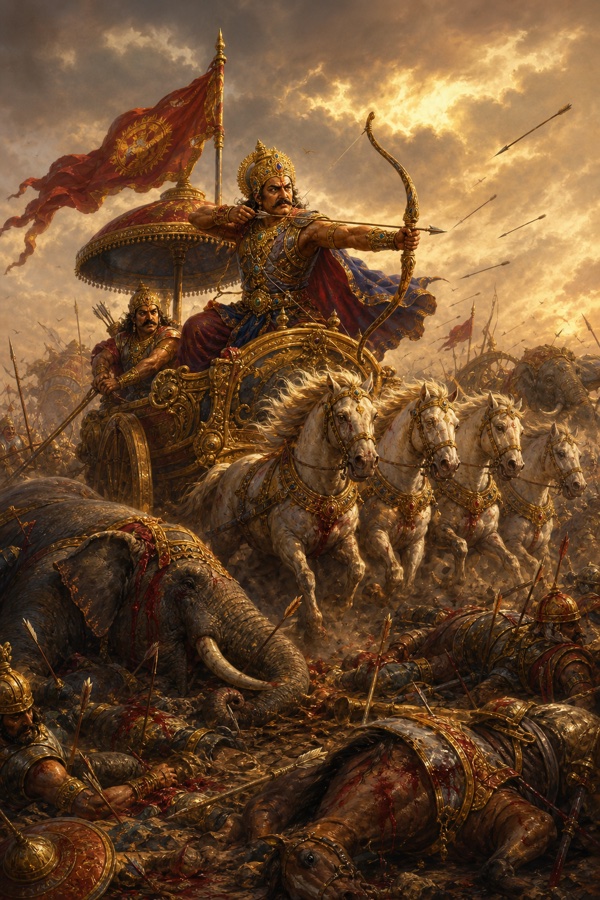
Once more the two sides came together in great bodies, and the Kauravas gathered all their divisions and charged the Pandava army. Shalya’s spirit could not be brought low. He rained arrows on Yudhishthira, Kunti’s son, as thick as Indra of the thousand eyes sends down rain. He was a very strong man, and he put ten arrows each, gold-winged and whetted on stone, into Bhima, into the five sons of Draupadi, into Dhrishtadyumna, into Madri’s two sons, into Satyaki the grandson of Shini, and into Shikhandi. He poured his arrows as Indra pours at the end of the hot season. Prabhadrakas and Somakas were seen down or going down by the thousand under those arrows, which came as thick as swarms of bees or flights of locusts and struck like thunderbolts out of cloud. Elephants and horses and foot soldiers and chariot fighters fell or wandered or screamed. Mad with anger and with his own prowess, the ruler of the Madras wrapped his enemies in arrows like the Destroyer at the end of an age, and he began to roar like thunder. The Pandava army, cut down by him like that, ran to Yudhishthira for shelter. Shalya, with his light hand, went on crushing it with whetted arrows and then turned a thick shower on Yudhishthira himself. The king saw him coming on hard with horsemen and foot soldiers, and in his anger he stopped him with sharp shafts, as a maddened elephant is stopped with iron hooks. Shalya then shot one terrible arrow at him, an arrow like a snake full of poison, and it went clean through the son of Kunti and dropped to the ground. Bhima, furious, put seven arrows into Shalya, and Sahadeva five, and Nakula ten; and the five sons of Draupadi rained arrows on Artayani as he came headlong, as a mass of clouds rains on a mountain.
Kritavarma and Kripa saw Shalya struck from every side by the sons of Pritha and rushed to the place in anger. Uluka came too, full of fight, and Shakuni the son of Subala, and the great chariot fighter Ashvatthama with a smile on his lips, and all Dhritarashtra’s sons, and they protected Shalya by every means they had. Kritavarma put three arrows into Bhima and then, shooting in a dense shower, held him, though Bhima at that moment seemed anger in a body. Kripa, roused, hit Dhrishtadyumna with many arrows. Shakuni went against the sons of Draupadi and Ashvatthama against the twins. Duryodhana, a fighter of savage energy, went against Krishna and Arjuna and hit them both with many arrows. So hundreds of combats, fierce and beautiful, went on between the Kaurava men and the enemy on different parts of the field. Kritavarma, chief of the Bhojas, killed the brown horses of Bhima’s chariot, and Bhima got down and fought with his mace, like the Destroyer with his club lifted. The ruler of the Madras killed Sahadeva’s horses in front of him, and Sahadeva killed Shalya’s son with his sword. Kripa fought Dhrishtadyumna again, without fear, each of them working with great care. Ashvatthama, with little anger in him, as if he were smiling, put ten arrows into each of the five sons of Draupadi. Bhima’s horses were killed once more. He got down quickly and took up his mace, like the Destroyer taking his club, and in his fury he crushed Kritavarma’s horses and his chariot, and Kritavarma jumped from the wreck and ran. Shalya too, in a rage, killed many Somakas and Pandavas, and again he hurt Yudhishthira with many sharp arrows.
Then Bhima bit his lower lip. Mad with rage, he took up his mace and marked Shalya for death. That mace was like the club of Yama. It hung over a man’s head like Kalaratri, the Night of Death. It had taken the lives of a great many elephants and horses and men. Cloth of gold was wound around it, and it looked like a blazing meteor; it had a sling fitted to it; it was as fierce as a she-snake and as hard as thunder, and it was made wholly of iron. It was smeared with sandal paste and other unguents like a woman a man desires, and it was fouled with marrow and fat and blood. It was like the tongue of Yama. Bells were hung on it, and it made a shrill sound, and it was like the thunderbolt of Indra. In shape it was like a venomous snake that has just come out of its old skin, and it was wet with the juices that run from elephants. It struck terror into enemy troops and put joy into friends. It was famous in the world of men and it could split the peaks of mountains. With that mace Kunti’s son had once, on Kailasa, challenged Kubera himself, the angry lord of Alaka and the friend of Shiva; with that weapon, though many tried to stop him, he had killed in his wrath a great number of proud Guhyakas, spirits with powers of illusion, on the slopes of Gandhamadana, when he went to get mandara flowers to please Draupadi. It was rich with diamonds and jewels and gems, it had eight sides, and men spoke of it as they speak of Indra’s thunder. He lifted it now and ran at Shalya. With that mace and its dreadful sound, Bhima, who knew his business in battle, crushed Shalya’s four fast horses.
Shalya, a brave man and angry now, threw a lance at Bhima’s broad chest and gave a great shout. The lance went through the armor of Pandu’s son and into his body. Bhima did not flinch. He pulled the weapon out and drove it into the chest of Shalya’s driver, and the driver, pierced in a vital place and vomiting blood, fell with his heart fluttering. The ruler of the Madras got down from his chariot. He looked at Bhima with a dark face. He had seen his own stroke turned back on him, and he wondered at it. Then, calm in his soul, he took up his mace and fixed his eyes on his enemy. The sons of Pritha saw what Bhima had done in that fight, a fearful thing, and they were glad at heart and honored him, the man whom no work could tire.
With his driver down, Shalya took up his mace, a thing made wholly of iron, and stood as still as a bull. Bhima came at him fast with his own great mace in his hands. Shalya looked like the blazing fire at the end of an age, or the Destroyer with his noose, or Mount Kailasa with its fearsome crest, or Indra with his thunderbolt, or Mahadeva with his trident, or a maddened elephant in the forest. Thousands of conches and trumpets blared at that moment, and loud lion roars went up, the sounds that give heroes joy. The fighters of both armies stood looking at those two from every side, and they applauded both. “Excellent! Excellent!” they said. “Except for the ruler of the Madras, or Rama, the joy of the Yadus, there is no one who could stand up to Bhima’s charge in battle. And except for Bhima there is no fighter who could stand up to the force of the mace of the great king of the Madras.”
A sub-tale: The Rama the soldiers name is Balarama, Rohini’s son, the elder brother of Krishna. Bhima and Duryodhana both learned the mace from him, and he will call them both his disciples when he comes to watch them fight with it. He is away as this is said: on the eve of the great battle he told Krishna he would help neither side, and left, and he returns only at the moment the mace fight between those two is about to begin. So the men who watch Shalya and Bhima are setting the king of the Madras beside the teacher himself. In their judgment only those two could stand up to Bhima, and only Bhima to Shalya.
Then those two, Bhima and the ruler of the Madras, bellowing like bulls, began to move in circles, leaping into the air again and again. No difference could be seen between the two of them, in the way they circled or in the way they handled the mace. Shalya’s was wrapped in a shining cloth of gold that looked like a sheet of fire, and it frightened the men who watched. Bhima’s, as he wheeled, looked like lightning inside a cloud. When the ruler of the Madras struck it with his own, Bhima’s mace threw sparks into the sky until the sky seemed to be burning; when Bhima struck, Shalya’s mace threw off a shower of live coals, which was a wonder to see. They hit each other with those great maces like two huge elephants striking with their tusks, like two great bulls striking with their horns, like two men fighting with iron-bound clubs. Before long the limbs of both were bathed in blood from the blows, and they looked the handsomer for it, like two kinshuka trees in flower.
The ruler of the Madras hit Bhima on his left side and on his right, and Bhima stood like a mountain. Bhima hit Shalya again and again with all the force of his mace, and Shalya did not move, like a mountain an elephant is goring. The crash of those two maces could be heard in every direction, one clap of thunder after another. They stopped for a moment. Then, with their maces up, they began to circle again, closer than before. Each took eight steps toward the other and they came together, two men whose feats were more than human, each bringing his iron club down on the other. Then, each trying to get at the other, they circled again, and both of them, masters of the weapon, began to show what they knew. They lifted those terrible maces and struck once more, like two mountains striking each other with their crests in an earthquake, and each, crushed by the strength of the other’s blow, went down at the same moment, like a pair of the poles set up for Indra’s worship. A cry of dismay went up from the brave men of both armies.
Both had been hit with great force in vital places, and both were badly shaken. Kripa, strong as he was, lifted Shalya, the pride of the Madras, onto his own chariot and carried him quickly off the field. Bhima was on his feet again almost at once. He was still reeling like a drunken man, and with his mace lifted he was calling the ruler of the Madras back to fight.
The gist: At sunrise, with evil signs in the sky and on the ground, Shalya goes in to rescue a sinking army. He wounds every Pandava leader at once and kills Prabhadrakas and Somakas by the thousand; Bhima twice loses his horses and wrecks Kritavarma’s chariot with his mace; Sahadeva kills Shalya’s son. Then Bhima crushes Shalya’s horses and kills his driver with Shalya’s own lance, and the two fight on foot with maces until both fall at the same instant. Kripa carries Shalya away. Bhima gets up reeling and calls for him.
The arrow-duel of Yudhishthira and Shalya
The brave men of the Kaurava army now came on against the Pandavas with weapons of every kind, to the noise of horns and drums. They had their arms and weapons lifted, they were shouting, and Duryodhana was leading them. The sons of Pandu saw that host and roared and ran to meet it. Out of all those charging heroes Duryodhana picked Chekitana, and he drove a lance deep into his chest. Chekitana fell on the deck of his chariot covered with blood, sunk in a deep swoon. When the great Pandava chariot fighters saw Chekitana killed, they poured their arrows on the Kauravas without a pause, and they went about among the Kaurava divisions on every side, wanting victory, and they were a fine sight as they did it. Kripa and Kritavarma and Shakuni, strong son of Subala, put the ruler of the Madras in front of them and fought Yudhishthira. Duryodhana fought Dhrishtadyumna, the man who had killed Drona. Three thousand chariots, sent by Duryodhana and led by Ashvatthama, fought Arjuna. Every man in that fight had made up his mind to win and had thrown away fear along with his life; the Kaurava fighters went into the middle of the Pandava army like swans into a great lake, and the two sides fought savagely, wanting to kill, and took a great pleasure in giving blows and taking them. In that battle, which was the end of great heroes, the wind raised a dust off the ground that was terrible to look at. Sanjaya knew who was fighting whom only from the names: the Pandava names he heard called out, and the Kuru names the Pandavas called. Then the blood that was being shed laid the dust, the dark went out of the air, and every quarter was clear again. No one on either side turned his back. They wanted the worlds of Brahman, they wanted a victory fairly won, and they showed what they were worth in the hope of heaven. Some fought to pay the debt they owed their masters for their keep; some were set on carrying through what their friends and allies needed; all of them had their hearts on heaven. The great chariot fighters shot and threw every kind of weapon and roared at each other and struck, and the words that could be heard on both sides were, “Kill! Pierce! Seize! Strike! Cut!”
Shalya wanted Yudhishthira dead, and he put many sharp arrows into that great chariot fighter. The son of Pritha knew where the vital places of the body are. With the greatest ease he struck the ruler of the Madras with fourteen long arrows, each aimed at one of them. Shalya, a famous man and a furious one, held him off with his own shafts and then, meaning to kill him, hit him with more arrows than could be counted, all fletched with the feathers of the kanka bird; and then he struck Yudhishthira once more with a straight shaft while all the troops looked on. Yudhishthira, a famous man too, and as angry, put many sharp arrows into him, fletched with kanka and peacock feathers. Then he pierced Chandrasena with seventy arrows, and Shalya’s driver with nine, and Drumasena with sixty-four. Those two were the guards of Shalya’s chariot wheels, and when Pandu’s son had killed them, Shalya killed twenty-five fighters of the Chedis. He put twenty-five sharp arrows into Satyaki, seven into Bhima, and a hundred into the two sons of Madri.
While Shalya was ranging about like that, Yudhishthira sent many shafts at him that were like poisonous snakes. Then, with a broad-headed arrow, Kunti’s son cut the top of the standard off Shalya’s chariot as Shalya stood facing him. Sanjaya saw it come down, cut through by Pandu’s son in the middle of that great battle, and it fell like the top of a mountain split away. Shalya saw his standard on the ground and the son of Pandu standing in front of him, and rage filled him, and he shot in showers. He poured arrows over the Kshatriyas as the god of the clouds pours rain. He put five each into Satyaki and Bhima and the twin sons of Madri, and he hurt Yudhishthira badly. A net of arrows could then be seen spread in front of the chest of Pandu’s son, like a bank of cloud that has risen, and the great chariot fighter Shalya, raging, wrapped him in straight shafts. Under those showers King Yudhishthira felt his prowess leave him, as the asura Jambha once felt before Indra, the killer of Vritra.
With the king so hard pressed, Satyaki and Bhima and Madri’s two sons brought their chariots in around Shalya and began to hurt him. He had no one with him. He was seen standing off those great chariot fighters alone, and loud applause was heard; the Siddhas were delighted, and the ascetics who had gathered to see the battle called it a wonder. Bhima hit Shalya with one arrow and then with seven; and Shalya, whose name means a dart, had become that day a dart no one could draw out. Satyaki, wanting to save the son of Dharma, put a hundred arrows into him and roared like a lion. Nakula hit him with five, and Sahadeva with seven and then with seven again. The ruler of the Madras fought carefully under all of it. He drew a formidable bow, one that could bear a great draw and give great force to an arrow, and put twenty-five shafts into Satyaki, seventy-three into Bhima, and seven into Nakula. Then with a broad-headed arrow he cut Sahadeva’s bow, with the shaft already on its string, and put seventy-three shafts into Sahadeva himself. Sahadeva strung another bow and hit his uncle with five arrows like poisonous snakes or blazing fire; in a great rage he struck Shalya’s driver with a straight shaft and Shalya again with three. Then Bhima put seventy arrows into the ruler of the Madras, Satyaki nine, and King Yudhishthira sixty. Blood ran from Shalya’s body after that, like the red streams that run down the breast of a mountain of red chalk. He answered at once with five arrows into each of those great bowmen, which seemed a wonderful thing, and with another broad-headed arrow he cut the strung bow of Dharma’s son. Yudhishthira took another and covered Shalya, his horses, his driver, his standard and his chariot with arrows, and Shalya, under that cover, struck him with ten.
Satyaki saw the son of Dharma hurt, and it enraged him, and he checked the ruler of the Madras with clouds of arrows. Shalya cut Satyaki’s great bow with a razor-faced arrow and put three arrows into each of the others. Satyaki, whose prowess never failed, was furious, and he threw a lance at Shalya that had a golden staff and was set with many jewels. Bhima sent a long arrow at him that looked like a blazing snake. Nakula threw a dart, Sahadeva a fine mace, and the son of Dharma, wanting to finish him, a shataghni, the weapon called the killer of hundreds. All five weapons were in the air toward his chariot together, and the ruler of the Madras stopped them all. He cut down Satyaki’s lance with a number of broad-headed arrows. With his valor and his very light hand he cut Bhima’s gold-decked shaft in two. He beat back with clouds of arrows the terrible dart with the golden handle that Nakula had thrown, and Sahadeva’s mace. With two more arrows he cut down Yudhishthira’s shataghni while the sons of Pandu watched, and he roared like a lion. The grandson of Shini could not bear to see his weapon beaten. Out of his mind with rage, he took up another bow and put two shafts into the ruler of the Madras and three into his driver. At that Shalya, roused, drove ten arrows deep into every one of them, as men drive sharp lances into great elephants, and the four of them, checked like that, could no longer hold their ground in front of him. King Duryodhana watched Shalya’s prowess and counted the Pandavas, the Panchalas and the Srinjayas as already dead.
Then Bhima, with his great arms and his great prowess, made up his mind to throw away his life, and closed with the ruler of the Madras. Nakula and Sahadeva and Satyaki ringed Shalya and shot at him from every side. Four of the great bowmen and chariot fighters of the Pandavas had him surrounded, and he fought all four. Then, in that dreadful battle, the royal son of Dharma quickly cut down one of the guards of Shalya’s chariot wheels with a razor-headed arrow. When that brave strong man was dead, Shalya covered the Pandava troops with showers of arrows. King Yudhishthira saw his troops wrapped in them and began to think. “How are those grave words of Krishna to come true? I hope the ruler of the Madras, in his rage, will not destroy my army in battle.” Then the Pandavas came up on Shalya with chariots and elephants and horses and began to hurt him from every side, and he blew that risen shower of arrows and of many other weapons apart as wind scatters great banks of cloud. Sanjaya saw the gold-winged arrows from Shalya’s bow going across the sky like a flight of locusts. Shot from the front of the battle, they were seen to fall like swarms of birds. The sky was so full of the gold-decked shafts from the Madra king’s bow that no inch of it was empty. A thick dark came on, made by those arrows, so light was his hand in that dreadful fight; and when they saw that darkness and saw the great Pandava host shaken by one man, the gods and the Gandharvas were filled with wonder. He hurt every Pandava fighter from every side with all his strength, and he wrapped King Yudhishthira in arrows and roared again and again like a lion. The great chariot fighters of the Pandavas, covered like that, could not go forward to fight him. Those who had Bhima at their head, though, and King Yudhishthira to lead them, did not run from Shalya, that brave man who was the ornament of the battle.
The gist: Duryodhana leads a fresh charge and drives a lance into Chekitana’s chest. Dust hides the field until blood lays it. Yudhishthira and Shalya trade arrows; the king kills the two guards of Shalya’s wheels and cuts down his standard, and Shalya answers until Yudhishthira feels his strength go. Satyaki, Bhima and the twins close in, and Shalya, alone, stops in the air a lance, an arrow, a dart, a mace and a shataghni thrown at him together, then fills the sky with gold-winged shafts. The gods and the Gandharvas wonder at it. Yudhishthira asks himself how Krishna’s words can come true.
Yudhishthira’s resolve, and the last of the battle
Elsewhere on the field Arjuna was fighting Ashvatthama. Drona’s son and his followers, the great chariot fighters of the Trigartas, had put many arrows into Arjuna; he answered with three shafts for Drona’s son and two for each of the others, and covered them all again with showers. The Kaurava troops were stuck so full of his sharp arrows that they looked like porcupines, and they still did not run from him. With Ashvatthama at their head they closed around him, and their gold-decked arrows quickly filled the deck of his chariot. They saw the two great bowmen, Krishna and Arjuna, covered with arrows, and those hard men were delighted. The pole of Arjuna’s chariot, its wheels, its shaft, its traces, its yoke and its drag-beam were buried in arrows; nothing like what the Kaurava fighters did to Arjuna then had ever been seen or heard of. Bright with those sharp, handsomely feathered shafts, the chariot looked like a vehicle of the gods come down to the earth and burning with hundreds of torches. Then Arjuna covered that division with straight arrows as a cloud pours rain on a mountain. Every arrow that hit them had his name cut into it, and the men thought the whole field was full of Arjunas. The fire that was Arjuna, with his arrows for its wonderful flames and the loud twang of Gandiva for the wind that fanned it, began to burn the fuel that was the Kaurava army. Along the track of his chariot the heaps could be seen: fallen wheels and yokes, quivers, banners and standards with the chariots that had carried them, shafts and drag-beams and poles, axles and traces and goads, the heads of fighters with their earrings and headgear, arms, thighs in thousands, umbrellas and fans, diadems and crowns. The ground along that track was a mire of blood that no one could cross, like the ground where Rudra takes his sport, and it frightened the timid and delighted the brave. When he had destroyed two thousand chariots with their fenders, he looked like a fire that burns without smoke; he looked as Agni looks when he blazes up at the end of an age to destroy everything that moves and everything that is still. Ashvatthama saw that prowess, and on his chariot with its many banners he set himself to stop it. Both of them drove white horses. Both were counted first among chariot fighters. They closed quickly, each wanting the other’s death, and the showers they shot were dreadful, as thick as the rain two masses of cloud pour down at the end of summer. Each of them called the other out, and they tore each other with straight shafts like a pair of bulls with their horns, and for a long while that fight was even, and the clash of weapons in it was terrible. Then Drona’s son put twelve gold-winged arrows of great force into Arjuna and ten into Krishna. For a little while Arjuna had shown his teacher’s son a kind of regard. Now he smiled and drew Gandiva hard. In a moment he had stripped his opponent of horses, driver and chariot, and without much effort he put three arrows into him. Ashvatthama stayed on the dead chariot. Smiling himself, he threw a heavy mallet at Pandu’s son, a thing like a dreadful mace with iron spikes, wrapped in cloth of gold, and Arjuna saw it coming and cut it into seven pieces. Drona’s son, a man of great anger and of skill in battle, picked up a terrible mace, iron-spiked, that looked like the peak of a mountain, and threw it. It came at Arjuna like the Destroyer in a rage, and Arjuna quickly cut it down with five fine shafts; it fell to the earth, and the hearts of the kings on that side seemed to break with it. Arjuna put three more shafts into Drona’s son, and deeply. Ashvatthama was a very strong man, he trusted to his own manhood, and he showed no fear and no disturbance. What he did next he did in front of all the Kshatriyas: he covered Suratha of the Panchalas with showers of arrows. Suratha was a great chariot fighter. He came at Drona’s son on a chariot whose rattle was as deep as thunder, drawing an excellent bow, a firm one that could bear a great draw, and he covered Ashvatthama with arrows like flames or like poisonous snakes. Ashvatthama watched him come on in anger, and his own rage rose like a snake’s when it is hit with a stick. He drew his brow into three lines. He licked the corners of his mouth. He looked at Suratha with fury, rubbed his bowstring, and shot one sharp long arrow that was like the fatal rod of Death. It went through Suratha’s heart with great speed, came out, and went into the earth, splitting it, like Indra’s thunderbolt thrown from the sky, and Suratha fell as a mountain peak falls when thunder splits it.
Ashvatthama climbed quickly onto the dead man’s chariot. Then, armored and armed, a man no one could beat in battle, with the Samshaptakas supporting him, he went on fighting Arjuna. It was noon by then. That battle of one against many grew very fierce and sent many to Yama, and Sanjaya counted it a wonder to watch, since Arjuna, seeing how strong all those fighters were, fought every one of them at the same time, alone and with no one to support him, as Indra once fought the great host of the asuras. Duryodhana and Dhrishtadyumna, Prishata’s son, were meanwhile fighting each other fiercely with arrows and darts beyond counting, each of them raining shafts like clouds in the wet season. Duryodhana put five arrows into the man who had killed Drona, and then seven more. Dhrishtadyumna, strong and steady, hurt Duryodhana with seventy. His own brothers, sons of the same mother, saw him hurt and closed around the son of Prishata with a large force, and the Panchala hero, ringed on every side by those great chariot fighters, moved about among them showing how fast he was with his weapons. Shikhandi, with the Prabhadrakas behind him, fought two Kuru bowmen, Kritavarma and the great chariot fighter Kripa, and that fight was savage too, since every man in it had resolved to lay down his life and had put his life up as the stake. Shalya was shooting in showers on every side and hurting the Pandavas, Satyaki and Bhima among them, and with patience and great strength he fought the twins at the same time, though each of them was like the Destroyer in prowess. The great Pandava chariot fighters, torn by his shafts, could find no one to protect them. Nakula saw King Yudhishthira badly hurt. He drove hard at his mother’s brother, covered him with arrows, and then, smiling, put ten into the middle of his chest, arrows made wholly of iron, polished by the smith, gold-winged, whetted on stone, and sent from the bow with great force. Shalya, hurt by his famous nephew, hurt him in return with many straight arrows. Then King Yudhishthira and Bhima and Satyaki and Sahadeva all rushed the ruler of the Madras together, filling every quarter with the rattle of their chariots and making the ground shake, and the commander of the Kuru army, who had beaten so many enemies, met all of them as they came. He put three arrows into Yudhishthira, seven into Bhima, a hundred into Satyaki and three into Sahadeva. Then with a razor-headed arrow he cut Nakula’s bow, with the arrow fixed on it, and it broke in pieces. Nakula took another and quickly covered his uncle with feathered arrows. Yudhishthira and Sahadeva each put ten into Shalya’s chest. Bhima and Satyaki ran in on him and hit him with kanka-feathered arrows, Bhima with sixty and Satyaki with nine. That enraged him. He put nine arrows into Satyaki and then seventy straight shafts more; he cut Satyaki’s bow at the grip, with the arrow on it, and sent his four horses to Yama. Having stripped Satyaki of his chariot, he hit him with a hundred arrows from every side, and then put ten each into Madri’s two angry sons, into Bhima, and into Yudhishthira. What Sanjaya saw of Shalya then was a great wonder, since all the sons of Pritha together could not get near him. Satyaki mounted another chariot. He saw the Pandavas hurt and giving way before the ruler of the Madras, and he drove at him fast, and Shalya drove at Satyaki’s chariot as one maddened elephant goes at another. The meeting of those two was fierce and wonderful to see, like the meeting long ago of the asura Shambara and the king of the gods. Satyaki saw Shalya standing in front of him, put ten arrows into him and shouted, “Wait! Wait!” Shalya, deeply hurt, answered with sharp, handsomely feathered shafts. The sons of Pritha saw their uncle set upon by Satyaki and came on quickly, wanting to kill him, and the fight that followed among those straining men ran with blood and was dreadful, like a fight among roaring lions over meat. The showers they shot covered the ground, and the sky all at once was one mass of arrows. A darkness fell around the field, a shadow like the shadow of clouds, and then the quarters seemed to be on fire with those blazing shafts, gold-winged, like snakes just out of their old skins. In that fight Shalya did the most wonderful thing of all: alone, with no one supporting him, he fought many heroes at once. The earth was covered with the savage arrows that fell from his arms, fletched with kanka and peacock feathers, and Sanjaya saw his chariot going about in that dreadful battle like the chariot of Indra in the old days when the asuras were destroyed.
Then the Kaurava troops, with Shalya at their head, went at the sons of Pritha once more with great force. They had been badly hurt and they were still savage fighters, and there were more of them, and very soon they had the Pandava ranks in confusion. Struck by the Kurus, the Pandava troops would not stay on the field, though Krishna and Arjuna were there to see it and Bhima was trying to hold them. That enraged Arjuna, and he covered Kripa and his followers, and Kritavarma too, with showers of shafts. Sahadeva checked Shakuni and all his forces. Nakula, on one flank, kept his eyes on the ruler of the Madras. The five sons of Draupadi checked a number of kings. Shikhandi, the Panchala prince, held Drona’s son. Bhima, with his mace in his hands, held Duryodhana, and Yudhishthira, Kunti’s son, held Shalya at the head of his troops. In those pairs the battle began again between men who had never retreated from a fight. And then Sanjaya saw the great feat of Shalya: alone, he fought the whole Pandava army. He stood near Yudhishthira like the planet Saturn close to the Moon. He hurt the king with shafts like poisonous snakes, and then he rushed Bhima and covered him with showers of arrows. The troops of both armies saw that lightness of hand and that mastery of weapons and applauded him loudly. The Pandavas, badly torn, left the battle and ran, and Yudhishthira shouted to them to stop and they paid no attention. His men were being slaughtered by the ruler of the Madras, and the just king, Pandu’s son, was filled with rage. He trusted to his own prowess and began to hurt Shalya, resolved to win that battle or to die in it. Then he called all his brothers to him, and Krishna of Madhu’s line, and spoke. “Bhishma and Drona and Karna, and the other kings who put out their strength for the Kauravas, have all died in battle. Each of you has done his part, according to his courage, against the share that was given him. One share is left, and it is mine: the great chariot fighter Shalya. I mean to beat the ruler of the Madras in battle today. I will tell you what I want for that work. These two heroes, the two sons of Madri, will guard my wheels. Men count them as fighters whom Indra himself could not beat. They deserve every honor and they keep their vows, and they will hold the duties of a Kshatriya in front of them and fight their own mother’s brother. Either Shalya will kill me in battle or I will kill him. Blessings on you all. Hear these true words, you who are the first heroes of the world. I keep the duties of a Kshatriya, and I will fight my uncle, firmly resolved to win or be killed. Let the men who fit out chariots load mine quickly, by the rules of the science, with weapons and gear of every kind, and with more than Shalya’s carries. The grandson of Shini will guard my right wheel and Dhrishtadyumna my left. Let Pritha’s son Arjuna guard my rear today. And let Bhima, first among all who carry weapons, fight in front of me. So I will be stronger than Shalya in the great battle that is coming.” All who wished the king well did what he asked. The Pandava troops were filled with joy again, and most of all the Panchalas, the Somakas and the Matsyas. Having made that vow, the king went against the ruler of the Madras. The Panchalas blew conches and beat drums beyond counting and roared like lions. Quick men, and angry, they rushed with loud shouts of joy at the ruler of the Madras, and they made the earth ring with the bells of their elephants and the loud blare of conches and trumpets.
Duryodhana and the brave ruler of the Madras stood to receive that charge like the two hills of sunrise and sunset. Shalya, boasting of what he could do in a battle, poured arrows on King Yudhishthira as Indra pours rain. The king took up his own beautiful bow and showed, one after another, the lessons Drona had taught him. His showers came in succession, beautifully, quickly, with great skill, and as he moved no one could mark a lapse in him. The two of them tore at each other like a pair of tigers fighting over a piece of meat. Bhima was engaged with Duryodhana, who delighted in battle. Dhrishtadyumna and Satyaki and Madri’s two sons met Shakuni and the other Kuru heroes on every side, and it was a dreadful fight between men who all wanted the victory. Duryodhana took aim with a straight shaft at Bhima’s gold-decked standard and cut it down, and that beautiful standard fell with its many bells. With a sharp razor-faced arrow he cut Bhima’s beautiful bow, which looked like the trunk of an elephant. Bhima, bowless, put out his strength and drove a dart into Duryodhana’s chest, and the Kuru king sat down on the deck of his chariot. While he was in that swoon, Bhima, with a razor-faced shaft, cut the head of his driver from its body. The horses, with no one to hold them, ran wild in every direction dragging the chariot behind them, and loud wails went up from the Kuru army. Ashvatthama and Kripa and Kritavarma went after that chariot to rescue Duryodhana, and the troops were badly shaken at the sight, and Duryodhana’s followers were terrified; and Arjuna drew Gandiva and began to kill them with his arrows. Then Yudhishthira, in a rage, went straight at the ruler of the Madras, urging his own horses, which were white as ivory and fast as thought. Sanjaya saw a wonderful thing in Kunti’s son then. He had always been mild and soft, and now he was savage. His eyes were wide and his body shook with anger, and he cut down enemy fighters in hundreds and thousands with his sharp shafts. Whatever soldiers the eldest Pandava went against, he overthrew, as thunder throws down the tops of mountains. He brought down chariots with their horses and drivers and standards and threw down their fighters in great numbers, and he did it without help, playing there like a strong wind destroying banks of cloud. He destroyed horses with riders and horses without them, and foot soldiers by the thousand, as Rudra destroys living creatures. When he had emptied the field around him with the shafts he shot on every side, he rushed the ruler of the Madras and shouted, “Wait! Wait!” The Kaurava fighters were afraid when they saw what that hero of terrible deeds was doing. Shalya went to meet him. Both were filled with rage, and both blew their conches. They came around, challenging each other, and closed. Shalya covered Yudhishthira with showers of arrows and the son of Kunti covered Shalya, and the two heroes, torn by each other’s shafts and bathed in blood, looked like a shalmali tree and a kinshuka tree in flower. Both were splendid, neither could be beaten, and they roared aloud. The soldiers who watched could not tell which would win: whether the son of Pritha would kill Shalya and have the earth, or Shalya would kill Pandu’s son and give the earth to Duryodhana. In the course of the fight Yudhishthira kept his enemies on his right. Shalya shot a hundred excellent arrows at him and with another, very sharp, cut his bow. Yudhishthira took up a second bow, put three hundred shafts into Shalya, and cut Shalya’s bow with a razor-faced arrow. Then he killed the four horses of his opponent with straight arrows. With two more, very sharp, he cut down Shalya’s two parshni drivers. With another shaft, blazing, well tempered and sharp, he cut the standard from the chariot in front of him. And the army of Duryodhana broke.
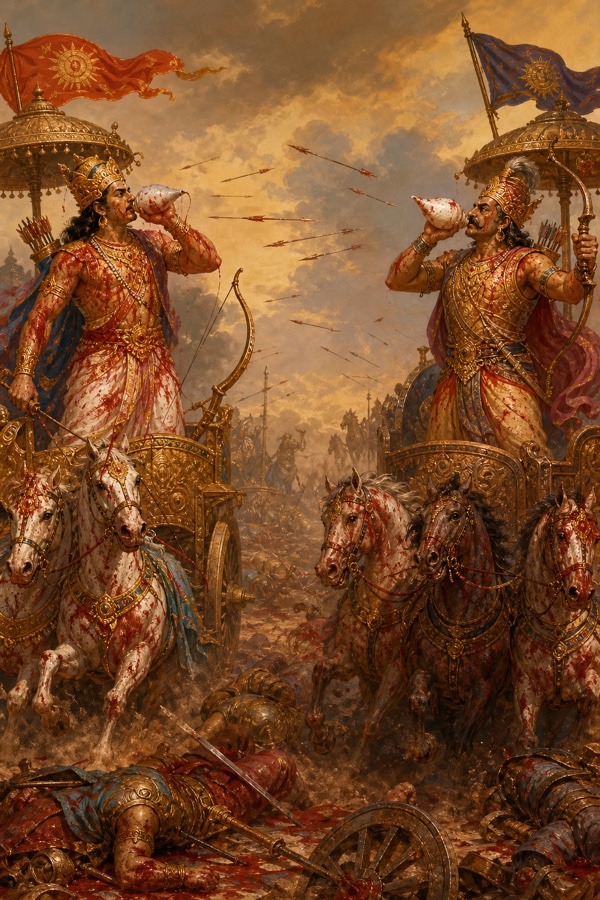
Drona’s son came up fast to the ruler of the Madras in that plight, took him onto his own chariot and drove quickly away. They had gone on for only a moment when they heard Yudhishthira roar. Shalya stopped. He climbed onto another chariot that had been properly made ready, an excellent one whose rattle was as deep as the roar of the clouds, well stocked with weapons and instruments and every kind of gear, a chariot to make an enemy’s hair stand up. From it the ruler of the Madras took up another bow, very strong and much tougher than the first, put an arrow into Yudhishthira, and roared like a lion. Then he poured his arrows on all the Kshatriyas as the god of the clouds pours rain in torrents. He put ten arrows into Satyaki, three into Bhima and three into Sahadeva, and he hurt Yudhishthira badly. He hurt all the other great bowmen too, with their horses and chariots and elephants, as hunters hurt elephants with blazing brands. He destroyed elephants and the men who rode them, horses and horsemen, chariots and the men in them. He cut off arms with the weapons still held in them, he cut down standards, and he strewed the ground with the dead as a sacrificial altar is strewn with blades of kusha grass. The Pandus, the Panchalas and the Somakas were filled with rage at a man who was killing their troops like all-destroying Death, and they closed around him. Bhima and the grandson of Shini and Madri’s two sons surrounded him while he was fighting the Pandava king, a man of terrible strength, and every one of them challenged him. Having got him at last, they checked him and began to hit him with feathered arrows of savage force. Guarded by Bhima, by the twins and by Satyaki, the royal son of Dharma struck Shalya in the middle of the chest with arrows of the same kind. The chariot fighters and other troops of the Kaurava army, armored and armed, saw the ruler of the Madras badly hurt, and at Duryodhana’s order they surrounded him on every side. Shalya quickly put seven arrows into Yudhishthira. Yudhishthira put nine into him. Then those two great chariot fighters covered each other with arrows washed in oil and shot from bowstrings pulled back to the ear. Both were strong, neither could be beaten by any enemy, each was watching for the other’s lapse, and they pierced each other fast and deep. The noise of their bows and bowstrings and palms was like Indra’s thunder as they showered each other with arrows past numbering. They moved over the field like two young tigers in deep forest fighting over a piece of meat; they tore each other like two maddened elephants with great tusks, each swollen with pride in his own prowess. Then Shalya, with all the force that was in him, put a shaft bright as fire or the sun into Yudhishthira’s chest. The king was deeply pierced, and he struck the ruler of the Madras with one well-shot shaft and was glad of it. Shalya lost his senses and had them back almost at once. His eyes red with anger, he hit the son of Pritha with a hundred arrows, quickly. The son of Dharma, in a rage, quickly pierced his chest and then, with no pause, struck his golden armor with six shafts. Shalya was full of joy. He drew his bow and shot many arrows, and at last, with a pair of razor-faced shafts, he cut the bow of the king who faced him. Yudhishthira took up a new bow, stronger than the last, and pierced Shalya from every side with keen-pointed arrows, as Indra pierced the asura Namuchi.
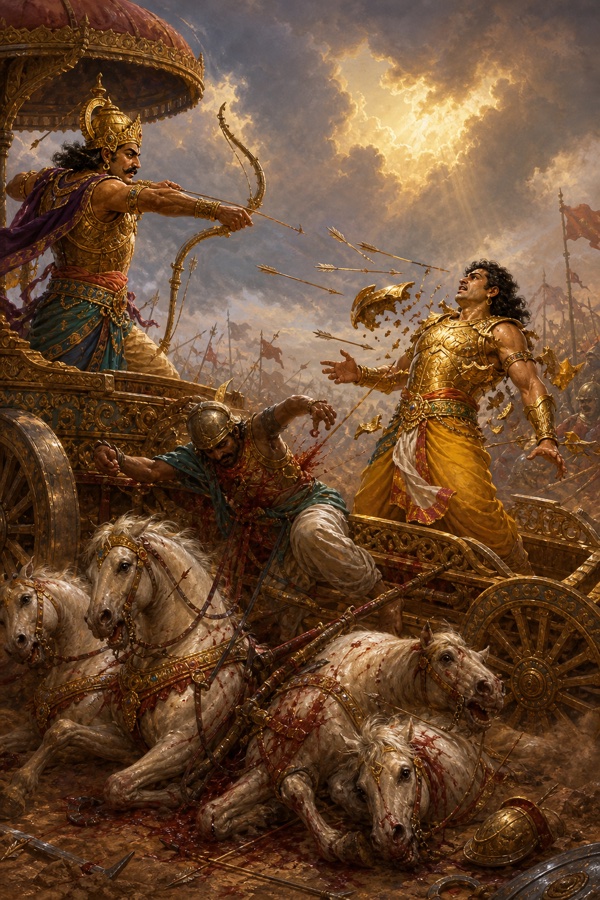
Shalya answered with nine arrows that cut the golden coats of mail from both Bhima and King Yudhishthira and pierced the arms of both. With another razor-faced arrow, bright as fire or the sun, he cut Yudhishthira’s bow again. In the same moment Kripa killed Yudhishthira’s driver with six arrows, and the man fell in front of the chariot, and the ruler of the Madras killed Yudhishthira’s four horses with four shafts. Having killed the horses, he began to kill the troops of Dharma’s royal son. Bhima saw the king brought to that pass. With one fast arrow he cut the bow of the Madra king, and he drove two arrows deep into the man himself. With another he took the head of Shalya’s driver off his body, whose middle was cased in mail, and then, in great rage and without a moment’s delay, he killed Shalya’s four horses as well. Shalya was moving about alone and headlong in that battle, and Bhima covered him with a hundred arrows, and Sahadeva, Madri’s son, did the same. Those arrows dazed him, and Bhima, seeing it, cut his armor away with others. With his armor gone, the ruler of the Madras took up a sword and a shield set with a thousand stars, jumped down from his chariot, and ran at the son of Kunti. On the way he cut through the shaft of Nakula’s chariot. He was a man of terrible strength and he was running straight at Yudhishthira. Dhrishtadyumna and Shikhandi and the five sons of Draupadi and the grandson of Shini saw him coming at the king like the Destroyer in a rage, and all at once they moved toward him. Bhima cut that matchless shield to pieces with ten arrows as Shalya came on. With one more, broad-headed, he cut the sword through at the hilt, and then, full of joy, he roared in the middle of the troops. All the first chariot fighters of the Pandavas saw what Bhima had done and were glad; they laughed aloud and roared and blew their conches, which were white as the moon. At that terrible noise the army that the Kaurava heroes were guarding lost heart. It was covered with sweat and bathed in blood, sunk in gloom, and close to lifeless. The strongest of the Pandava fighters, Bhima at their head, were all upon Shalya, and he paid them no attention. He went on toward Yudhishthira like a lion going to take a deer. King Yudhishthira had no horses and no driver, and in the anger that was on him he looked like a blazing fire. He saw the ruler of the Madras in front of him and rushed at him with all his force. He remembered what Krishna had said, and in that moment he set his heart on Shalya’s death.
The gist: Arjuna strips Ashvatthama of horses, driver and chariot and cuts down the mallet and the mace he throws; Ashvatthama kills Suratha of the Panchalas with one arrow, takes the dead man’s chariot, and fights on at noon. Shalya, alone, holds off every Pandava leader until their troops run. Yudhishthira then calls his brothers and Krishna and claims Shalya as the one share left to him, with the twins at his wheels, Satyaki and Dhrishtadyumna on either side, Arjuna behind and Bhima in front. Bhima knocks Duryodhana senseless and kills his driver. Yudhishthira kills Shalya’s horses and parshni drivers, and Ashvatthama carries Shalya to a fresh chariot. In the last exchange Shalya cuts the armor from Bhima and Yudhishthira and kills Yudhishthira’s horses, Bhima kills Shalya’s horses and driver and cuts away his armor, shield and sword, and Shalya comes on toward a king who has remembered Krishna’s words.
The death of Shalya by Yudhishthira’s spear
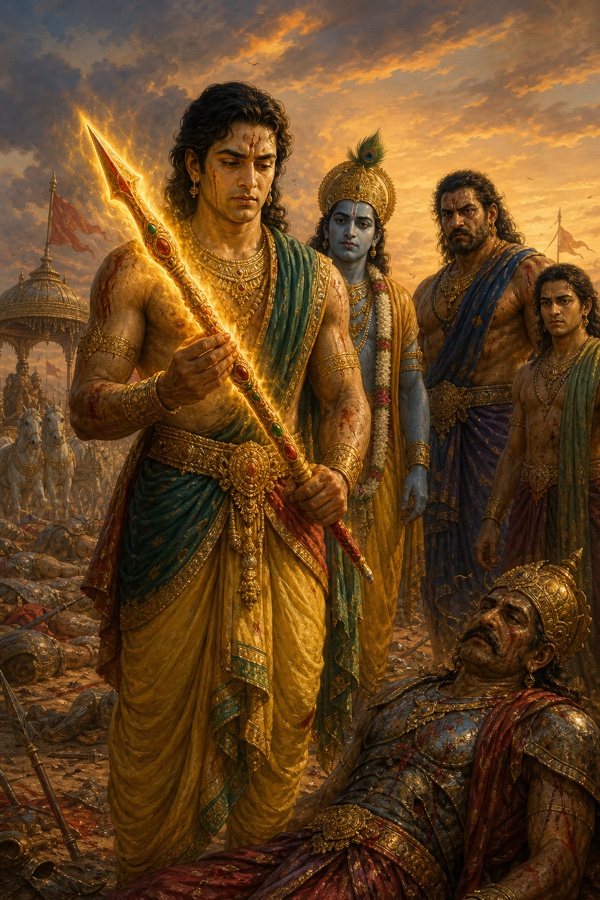
King Yudhishthira stood on a chariot that had no horses and no driver, and he wanted a spear in his hand. He had seen what Shalya could do. He thought of the one hero who had been given to him as his share and who was still alive, and he fixed his heart on doing the thing that Krishna, whom they call Indra’s younger brother, had counseled him to do. He took up a spear whose handle was dressed with gold and gems and whose brightness was the brightness of gold. He rolled his eyes, which were wide open, and turned them on the ruler of the Madras with his heart full of rage. Yudhishthira was a king whose soul was clean and whose sins had all been washed away, and when such a man looked at him like that, Shalya was not burned to ashes. To Sanjaya and those with him that seemed a great wonder.
Then the chief of the Kurus threw it. He threw it at the king of the Madras with great force, that blazing spear with its beautiful and terrible handle, bright with gems and coral, and all the Kauravas watched it go through the air shedding sparks, like a great meteor falling out of the sky at the end of an age. He had thrown it with care. It was like Kalaratri, the Night of Death, with the fatal noose in her hand; it was like the fearsome foster-mother of Yama himself; and like a Brahmin’s curse, it could not be turned aside. The sons of Pandu had always kept that weapon with care and worshiped it with perfumes and garlands, with the finest of seats, with the choicest food and drink. It seemed to blaze like the Samvartaka fire that ends the world, and it was as fierce as a rite performed by the Atharvan of Angiras. Tvashtri, the craftsman of the gods, had made it for the use of Shiva, the lord Ishana, and it ate the life-breaths and the bodies of every enemy. Its force could have destroyed the earth and the sky and all the stores of water and every kind of creature. It was hung with bells and banners, set with gems and diamonds and stones of lapis lazuli, and fitted with a golden handle; Tvashtri himself had forged it with great care after keeping many vows. It killed without fail, and it was the destruction of all who hate Brahman.
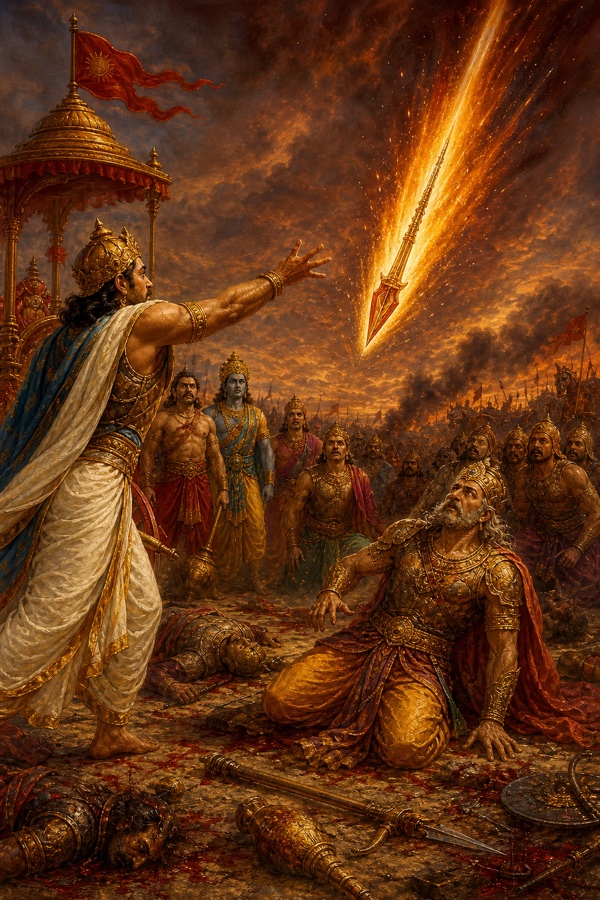
He had breathed many fierce mantras into it with care. He had given it a terrible speed with all the strength and all the attention he had, and he sent it along the straightest of paths to kill the ruler of the Madras. “You are dead, wretch!” he cried in a loud voice as it left him. So Rudra, long ago, loosed the shaft that destroyed the asura Andhaka. The king had stretched out his strong right arm, with its beautiful hand, and he seemed to be dancing in his wrath.
Shalya roared. He tried to catch it. The spear came at him with a power nothing could resist, thrown with all Yudhishthira’s strength, and he reached for it as a fire leaps up to take a stream of clarified butter that is poured on it. It went through his vital parts and through his fair broad chest and on into the earth, as easily as it would have gone into water, with nothing to slow it, and it carried away with it the fame of that king, which had filled the world. Blood came from his nostrils and his eyes and his ears and his mouth, and blood ran from the wound, and covered with it he looked like the great Krauncha mountain when Skanda pierced it. His armor had already been cut from him by that descendant of the Kurus. Strong as Indra’s elephant, the ruler of the Madras stretched out his arms and fell to the earth like the top of a mountain split by thunder.
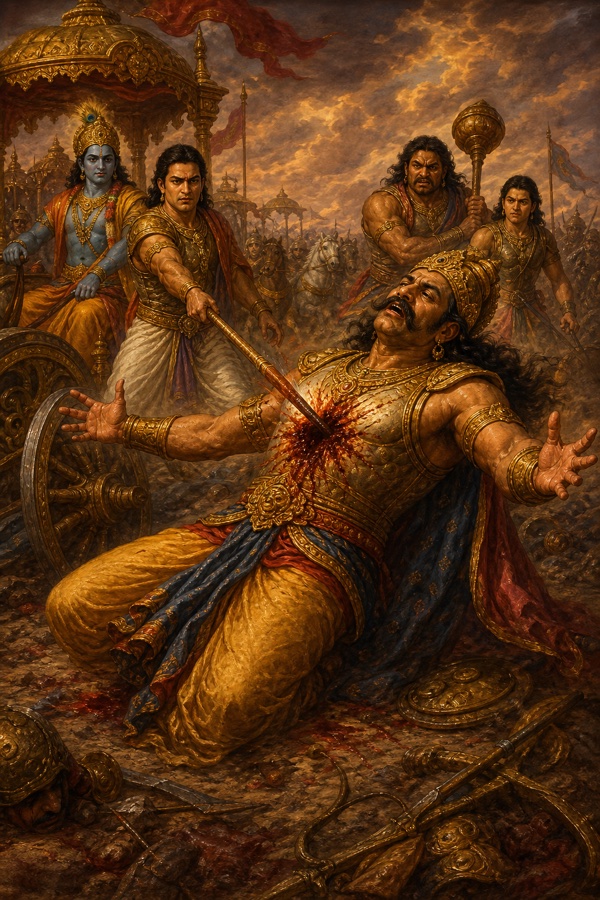
He fell with his arms stretched out and his face toward Yudhishthira the just king, like a tall banner raised in Indra’s honor coming down to the ground. The Earth seemed to rise a little to receive him, for love, as a dear wife moves to meet her dear lord when he is about to fall on her breast; and he came down to her with his limbs torn and bathed in blood. He had enjoyed the Earth for a long time, as a man enjoys a wife he loves. Now he seemed to sleep on her breast, holding her with all his limbs. He had been killed in a fair fight by Dharma’s righteous son, and he looked like a good fire lying put out on the platform of a sacrifice. His weapons were gone and his standard was gone and his heart had been pierced through, and even so, beauty would not leave the dead ruler of the Madras.
A key to reading this (the spear, and Krishna’s counsel): The weapon is a shakti, a spear made for throwing, and Sanjaya gives its history: Tvashtri forged it for Shiva, who is the Ishana he names, and the sons of Pandu kept it and worshiped it with perfume, garlands, a seat, food and drink. Yudhishthira throws it because of what Krishna told him the night before. Shalya, Krishna said, could be killed by no one else in heaven or on earth, his fall would bring down the whole Kaurava army, and there was to be no pity on the ground that the man was an uncle. In the middle of the fight Yudhishthira had asked himself how those words could come true. He answers the question here, with the cry “You are dead, wretch!”, against the brother of Madri, the mother of the twins who guard his wheels.
Yudhishthira then took up his bow, which was as bright as Indra’s bow in the sky, and went among his enemies as Garuda, the prince of birds, goes among snakes. He cut their bodies down with sharp shafts at the greatest speed. The showers he shot wrapped the Kaurava troops completely. They were overcome with fear, and with their eyes shut they began hitting one another. Blood ran from their bodies. Their weapons of attack and of defense fell from them, and then their lives.
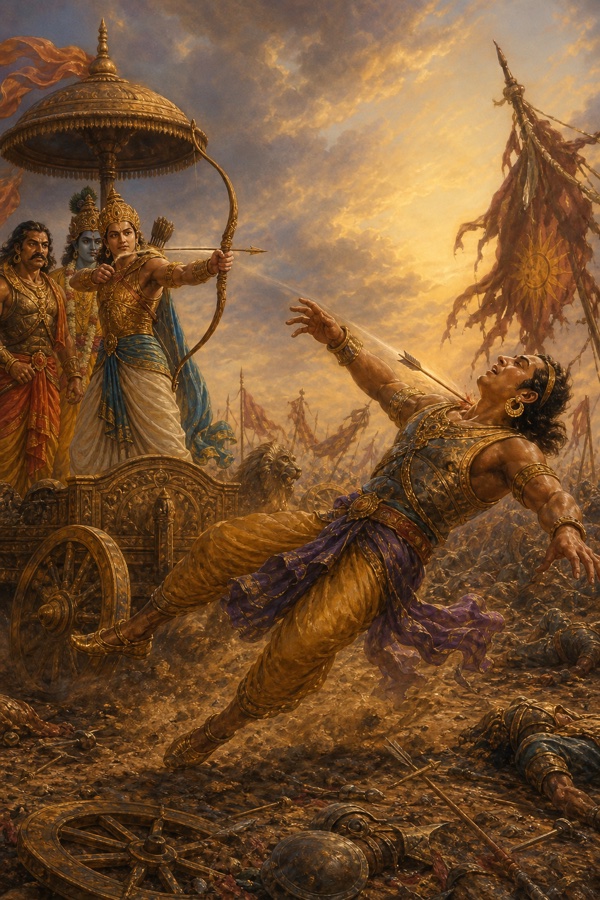
Shalya had a younger brother, a youth who was his equal in every accomplishment and was counted a great chariot fighter. When Shalya fell, that young man came against Yudhishthira. He was hard to beat, and he wanted to pay his dead brother the last thing owed him, and he quickly put a great many shafts into the Pandava. King Yudhishthira answered, very fast, with six arrows. With a pair of razor-faced arrows he cut the young man’s bow and his standard.
Then, with one blazing arrow, sharp and broad in the head and very strong, he struck off the head of the enemy who stood in front of him. Sanjaya saw that head fall from the chariot with its earrings on it, like a dweller in heaven falling when his merit is used up. The headless body followed it down, bathed in blood all over, and when the Kaurava troops saw that, they broke. The younger brother of the Madra king lay dead in his beautiful armor. The Kurus cried out in dismay and ran, fast, and the troops who had watched him die gave up hope of their lives; the fear of the Pandavas was in them, and they fled covered with dust.
Satyaki, the grandson of Shini, went after them, shooting as they ran. Kritavarma, Hridika’s son, came quickly and without fear to receive him, one great bowman against another, and neither a man who could be easily stopped. Both belonged to the Vrishni people, and they closed like two angry lions. Both shone like the sun, and they covered each other with arrows of a blazing brightness that were like the sun’s own rays. Sanjaya watched the shafts those two lions of the Vrishnis shot with all the force of their bows, and they looked like fast insects crossing the sky.
Kritavarma put ten arrows into Satyaki and three into his horses, and then cut his bow with one straight shaft. Satyaki laid the broken bow aside, a very good bow, and quickly took up another that was tougher. With that in his hands he put ten arrows into the middle of Kritavarma’s chest.
Then, with a great many well-shot arrows, he cut Kritavarma’s chariot apart, and its shaft, and quickly killed his horses, and killed both his parshni drivers. Kritavarma had no chariot left. Kripa, Sharadvat’s brave son, saw him so, took him up quickly onto his own, and carried him away.
The gist: Yudhishthira, with no horses and no driver, takes up the spear that Tvashtri made for Shiva, fills it with mantras and throws it. Shalya tries to catch it. It passes through his chest into the earth, and he falls with his arms out and his face toward the man who killed him, and the Earth rises a little to take him. Yudhishthira then turns his bow on the Kaurava troops and beheads Shalya’s younger brother, who has come to pay what is owed his brother. The army breaks. Satyaki goes after it, Kritavarma turns to stop him, and Satyaki cuts his chariot from under him; Kripa carries him out.
Shalya fell, and the Kaurava army broke
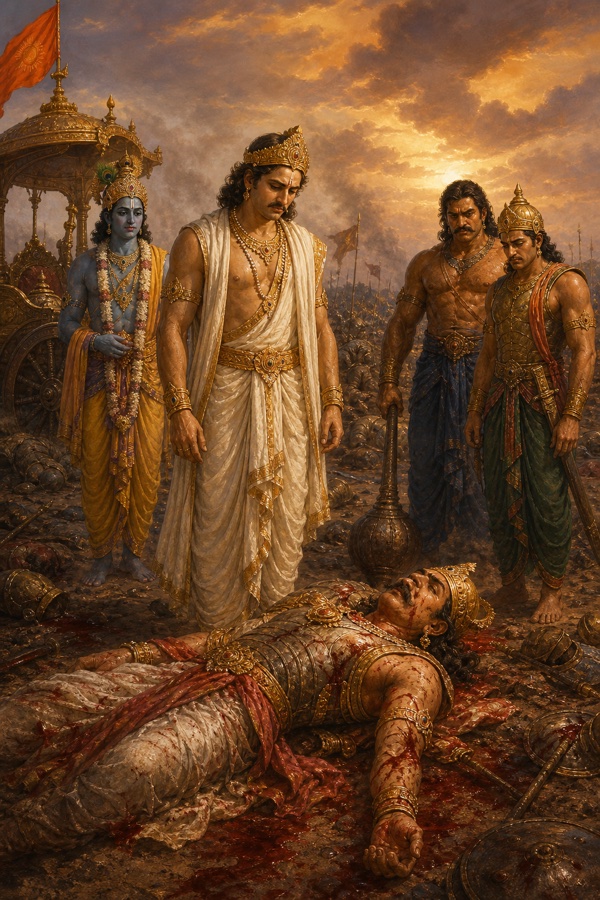
Sanjaya told the king what that did to the army. The ruler of the Madras was dead, and now Kritavarma had been stripped of his chariot, and the whole host of Duryodhana turned its face from the battle once again. A cloud of dust covered it. Sanjaya could see nothing. The greater part of the Kaurava army fell in that hour, and the men who were still alive had their backs to the fight. Then, before long, the dust that had risen from the ground was seen to settle, laid by the blood that ran in streams and soaked it on every side.
Duryodhana was close enough to see his army break. He stood, and alone he held all the sons of Pritha as they came on in fury. He saw the Pandavas on their chariots, and Dhrishtadyumna the son of Prishata, and Satyaki, the unbeaten chief of the Anartas, and he covered every one of them with sharp arrows. They did not come near him. Mortal creatures fear to go up to the Destroyer when he stands in front of them, and it was like that.
Kritavarma came back to the place on another chariot. Yudhishthira, a great chariot fighter himself, quickly killed its four horses with four shafts, and put six broad-headed arrows, very strong ones, into Kripa of Gotama’s line.
The king of the Pandavas had left Kritavarma without horses or chariot, and Ashvatthama took him up on his own and carried him out of Yudhishthira’s reach. Kripa answered with eight arrows into Yudhishthira and eight sharp shafts into his horses.
So the embers of that battle went on glowing, here and there across the field. Sanjaya told the old king whose doing that was: it came of his bad policy, and his son’s.
The sons of Pritha had seen Shalya killed on the field, that great bowman, by the king of their own house. They came together, full of joy, and blew their conches, and every one of them praised Yudhishthira in that battle as the gods long ago praised Indra when he had killed Vritra. They beat drums and sounded instruments of every kind, and the earth rang with it on every side.
A key to reading this (the parshni drivers): A war chariot carried more than one driver. Besides the principal driver there were two parshni drivers, a parshni being the wing or side of the man who fights from the chariot. Yudhishthira shot both of Shalya’s from their places before Shalya had to be carried off, and Satyaki has now killed both of Kritavarma’s along with his horses.
The gist: With Shalya dead and Kritavarma carried off without a chariot, the Kaurava army turns from the battle again, and most of it dies under a cloud of dust that only blood lays. Duryodhana holds the Pandavas alone for a time. Kritavarma returns on a second chariot and Yudhishthira kills its horses, so that Ashvatthama must carry him away. The Pandavas blow their conches and praise Yudhishthira as the gods praised Indra after Vritra.
The seventeen hundred men of Madra, and their slaughter
Sanjaya went on to what the dead king’s own men did. Shalya had followers among the Madrakas, seventeen hundred heroic chariot fighters, and after he was killed they went forward to fight with great energy. Duryodhana was riding an elephant as big as a hill, with an umbrella held over his head and yak tails fanning him, and he forbade them. “Do not go! Do not go!” he called to them. He called it again and again. Those men wanted Yudhishthira dead, and they drove into the Pandava host all the same. They were brave, they were loyal to Duryodhana, and they twanged their bows loudly and fought the Pandavas.
Arjuna heard two things: that Shalya had been killed, and that Yudhishthira was hard pressed by the great chariot fighters of the Madrakas, men devoted to their king’s cause. He came there stretching Gandiva and filling the earth with the rattle of his chariot. Then Arjuna and Bhima, Madri’s two sons, Satyaki, the five sons of Draupadi, Dhrishtadyumna and Shikhandi, and the Panchalas and the Somakas, all wanting to rescue Yudhishthira, surrounded him on every side. When they had taken their places around the king, the Pandavas began to churn the enemy force as makaras, the great beasts of the sea, churn the ocean, and they made the Kaurava army shake as a great storm shakes trees. The Madrakas answered it. Under them the Pandava host heaved again, like the great river Ganga when the wind blows against her.
Having made that great host tremble, the Madraka chariot fighters all shouted together. “Where is that King Yudhishthira? Why can we not see his brave brothers here, the Pandavas? What has become of the Panchalas and their great energy, and of the great chariot fighter Shikhandi? Where is Dhrishtadyumna? Where is the grandson of Shini? Where are those great chariot fighters, the five sons of Draupadi?” The sons of Draupadi were strong fighters, and it was they who began to cut down the followers of the Madra king as they shouted those words and fought hard. Some of those men were seen to die under their own tall standards.
The brave men of the Kaurava army saw the Pandava heroes there, and though Duryodhana forbade them too, they rushed in. He spoke softly to them and tried to keep them from fighting the enemy. No great chariot fighter among them obeyed. Then Shakuni, the son of the Gandhara king, a man who knew how to talk, said to Duryodhana, “How is it that we are standing here while the Madraka host is slaughtered in front of our eyes? With you here, king, this does not look well. The understanding we made was that we would all fight together. Why are you letting the enemy kill our troops?”
“I forbade them before,” Duryodhana said, “and they did not obey me. They have gone into the Pandava host all together.” Shakuni answered, “Brave men who are roused in battle do not obey their leaders’ orders. You should not be angry with them. This is no time to stand by and watch. All of us, then, with our chariots and horses and elephants, will go together and rescue those great bowmen, the followers of the Madra king. We will take great care, king, and protect one another.”
The Kauravas all thought as Shakuni did, and they moved toward the place where the Madras were. Duryodhana went too, as his uncle had urged, a large force around him, shouting like a lion and making the earth ring. “Kill! Pierce! Seize! Strike! Cut!” Those were the loud cries heard then among the troops.
Meanwhile the Pandavas had seen the followers of the Madra king coming at them in a body, and they had drawn themselves up in the array called Madhyama and gone to meet them. The Madrakas fought hand to hand for a short while, and they could be seen dying. Sanjaya and the others were still on their way to them when the Pandavas, united and very quick, finished the slaughter and shouted for joy. Then headless shapes were seen standing up all around. Great meteors seemed to fall from the disc of the sun. The ground was covered with chariots and broken yokes and axles, with dead chariot fighters and dead horses. Horses as fast as the wind, still in their yokes with no driver to guide them, were dragging chariot fighters this way and that across the field. Some were dragging chariots with broken wheels. Some ran in every direction with pieces of broken chariots behind them, and here and there a horse was seen hampered by its own traces. The chariot fighters, as they fell, dropped like dwellers in heaven who have used up their merit.
With the Madra king’s brave followers dead, the great chariot fighters of the Pandavas saw a body of horse coming toward them. They were hard hitters and they wanted the victory, and they went at it fast, their arrows whistling, their conches blaring, with other noises mixed in; sure of their aim, they shook their bows and roared like lions. By then Duryodhana’s whole army had seen the large force of the Madra king wiped out and had seen its heroic king killed, and once more it turned away from the field. Struck by the Pandavas, bowmen who did not waver, the Kuru army fled in fear in every direction.
A key to reading this (the Madrakas and the seventeen hundred): The Madrakas are Shalya’s own people, the men of the Madra country he ruled. Their great chariot fighters cheered when he was consecrated, and they marched at the very head of the array with him that morning. The seventeen hundred chariot fighters who charge here are his followers, and they charge for their dead king’s cause, against Duryodhana’s order. Shakuni’s argument for going after them rests on the pact made at dawn, when the leaders agreed that none of them would fight the Pandavas apart from the rest and that all would fight together.
The gist: Seventeen hundred Madraka chariot fighters go in to kill Yudhishthira although Duryodhana, from his elephant, calls to them again and again to stop. Arjuna and the other Pandava leaders close around their king. Duryodhana cannot hold back his own men either, Shakuni reminds him of the agreement to fight together, and the Kauravas advance; they are still on the way when the last of the Madrakas dies, and the Kaurava army runs again.
The Kaurava flight after Shalya’s death, and the Pandavas’ talk of victory
Sanjaya told the king how it had been with them when that great ruler and great chariot fighter fell, a hero no one had beaten in battle. The troops turned from the fight, and Dhritarashtra’s sons with them, nearly all. With Shalya killed by Yudhishthira they were merchants shipwrecked on the great deep with no raft to cross it. They were struck with fear and torn by arrows, men without a master wanting a protector, a herd of deer harried by a lion. They ran at midday, beaten by Yudhishthira, the king they call Ajatashatru, like bulls that have lost their horns, like elephants whose tusks are broken.
No one in that army, once Shalya had fallen, had the heart to rally the men or to show what he could do alone. The fear and the grief that had come over them when Bhishma fell, and when Drona fell, and when the charioteer’s son fell, came over them again, Sanjaya said, and he counted himself among them. They despaired of winning. Their heroes were dead, they were in great confusion, and the sharp arrows began to cut them down. All of them ran in fear.
Some went on horses and some on elephants. Great chariot fighters went on their chariots at great speed, and the foot soldiers ran. Two thousand elephants, big as hills and trained to strike, ran after Shalya’s fall, driven on with hooks and with toes. The soldiers fled in every direction, and they could be seen running, torn by arrows, breathing hard. The Panchalas and the Pandavas saw them beaten and broken and running with no spirit left, and they wanted the victory, and they went after them hotly. The whistle of arrows and other noises, the loud lion roars, the conches of brave men blowing: all of it together was tremendous.
The Panchalas and the Pandavas watched the Kaurava host run in terror, and they spoke to one another. “Today King Yudhishthira, who is firm in truth, has beaten his enemies. Today Duryodhana has been stripped of his splendor and his royal fortune. Today let Dhritarashtra, that king of men, hear of his sons’ death and lie stunned on the ground and feel the sharpest pain there is. Let him know today that Kunti’s son is the strongest of all bowmen. Today that sinful, wicked-hearted king will blame himself. Let him remember today the true and helpful words of Vidura. From this day let him wait on the sons of Pritha as their slave. Let that king feel today the grief the sons of Pandu felt. Let him know today the greatness of Krishna. Let him hear today the terrible twang of Arjuna’s bow in battle, and know the full strength of his weapons and the might of his arms. Today he will know the dreadful might of Bhima, when Duryodhana is killed in battle as Indra killed the asura Bali. No one in this world except Bhima could do what Bhima did when he killed Duhshasana.
“He will hear that the ruler of the Madras has been killed, a man the gods themselves could not defeat, and he will know the prowess of Pandu’s eldest son. When Subala’s brave son has been killed and all the Gandharas with him, he will know how strong Madri’s two sons are in battle. Why should the victory not go to men who have Arjuna to fight for them, and Satyaki, and Bhima, and Dhrishtadyumna the son of Prishata, and the five sons of Draupadi, and the two sons of Madri, and the great bowman Shikhandi, and King Yudhishthira? Why should the victory not go to men whose protector is Krishna, whom they call Janardana, the protector of the universe? Why should it not go to men whose refuge is righteousness? Who except Yudhishthira the son of Pritha, with Krishna for his protector, in whom righteousness and fame have their refuge, could have beaten Bhishma and Drona and Karna and the ruler of the Madras in battle, and the other kings by hundreds and thousands?” So the Srinjayas talked, full of joy, as they chased the Kaurava troops, who were badly torn by arrows. Arjuna, a man of great valor, went against the enemy’s chariot division. The two sons of Madri and the great chariot fighter Satyaki went against Shakuni.
Duryodhana saw them all running fast in fear of Bhima, and he spoke to his driver, with something like a smile. “Arjuna is standing over there with his bow, and he is getting past me. Take my horses to the rear of the whole army. If I make my stand in the rear, Kunti’s son will no more dare to cross me than the sea crosses its shores. Look at this great host, driver, with the Pandavas after it. Look at the dust that has gone up on every side from the movement of the troops. Listen to those lion roars, how loud and dreadful they are. So go slowly, driver, and take up your position in the rear. If I stay in the battle and fight the Pandavas, my army will rally and come back with spirit.” They were the words of a hero and a man of honor, and the driver, hearing them, slowly urged on those horses in their trappings of gold.
Twenty-one thousand foot soldiers still stood for battle. They had no elephants or horses or chariot fighters left with them, and they were ready to lay down their lives. They had been born in many countries and had come from many towns, and they held their ground because they wanted great fame. They rushed forward full of joy, and the clash was loud and terrible. Bhima and Dhrishtadyumna the son of Prishata met them with all four arms of their force. Other foot soldiers went straight at Bhima, shouting loudly and slapping their armpits, every one of them wanting to go to heaven. Those fighters of Dhritarashtra’s side were full of rage and hard to beat. When they reached Bhima they gave a furious shout, and after that they said nothing to one another. They ringed him in and began to hit him from every side. Surrounded by that great body of men on foot, and struck by them, Bhima did not move from where he stood, fixed like Mount Mainaka. His attackers, raging, did their best to hurt that great chariot fighter of the Pandavas, and they held off the other fighters who tried to reach him.
The fury rose in Bhima as they pressed him. He got down quickly from his chariot and went against them on foot. He took up his massive mace, which was dressed with gold, and began to kill the Kaurava troops like the Destroyer with his club. With that mace he crushed the twenty-one thousand, men who had no chariots, no horses and no elephants. When he had killed that strong division he showed himself again, a man whose prowess nothing had ever turned aside, with Dhrishtadyumna in front of him. The foot soldiers lay on the ground bathed in blood, like karnikara trees thrown down by a storm with all their weight of flowers. They wore garlands made of many kinds of flowers and earrings of many kinds; they were men of many races, come from many kingdoms, and they lay on the field with the life gone out of them. Banners and standards covered them. That great host of foot, cut down, was a fierce and dreadful sight where it lay. The great chariot fighters who fought under Yudhishthira, with their followers, had all gone after Duryodhana. Those bowmen had seen the Kaurava troops turn from the battle, and they drove at him, and they could not get past him, as the sea cannot get past its shores. What Sanjaya saw of Duryodhana then was a wonder to him: all the sons of Pritha together could not get past that one man.
Duryodhana’s own army had not run far. It was torn by arrows and it had set its heart on running, and he spoke to it. “I do not see the place on the plains or in the mountains where you can run and the Pandavas will fail to follow and kill you. What is the use of running, then? The army of the Pandavas has been cut down in numbers. Krishna and Arjuna are both badly torn. If all of us make a stand, the victory will certainly be ours. If you run and lose all order, the sinful Pandavas will come after you and kill you all. If we make a stand, good will come of it. Listen, all you Kshatriyas who are under attack here. The Destroyer kills heroes and cowards alike, always. What man is so stupid, calling himself a Kshatriya, that he will not fight? Good will come to us if we stay in front of Bhima in his anger. Death in battle, when a man is fighting as Kshatriyas fight, is full of happiness. The one who wins has happiness here. The one who is killed has great rewards in the next world. There is no better road to heaven, Kauravas, than the one a battle offers. Killed in battle, you may have all those blessed worlds without delay.”
The kings heard that speech and praised it highly, and once more they rushed the Pandavas to fight them. The sons of Pritha saw them coming fast. They were drawn up in order of battle, they knew how to hit, they were angry and they wanted the victory, and they rushed to meet them. Arjuna went against the enemy on his chariot, stretching Gandiva, the bow known in all three worlds. Madri’s two sons and Satyaki went for Shakuni. The other Pandava heroes, smiling, drove headlong at the Kaurava forces.
A key to reading this (Ajatashatru, the Srinjayas, the fourfold host): Ajatashatru is a name of Yudhishthira and means a man whose enemy has never been born. The Srinjayas are named beside the Panchalas and the Somakas among his allies, and the name also stands for the whole Pandava side: the fighting of this day is called the battle of the Kurus and the Srinjayas, and it is the Srinjayas who are said to chase the Kaurava troops with the talk of victory in their mouths. The four kinds of forces with which Bhima and Dhrishtadyumna meet the foot soldiers are the four arms of an army as Sanjaya counted them at dawn: chariots, elephants, horse and foot.
The gist: With Shalya dead the Kaurava army runs at midday as it ran when Karna died, and two thousand elephants run with it. The Panchalas and the Pandavas, giving chase, tell one another what Dhritarashtra will learn today. Duryodhana has himself driven to the rear to stop the rout. Twenty-one thousand foot soldiers from many countries surround Bhima, and he gets down and kills them all with his mace. Duryodhana, whom all the Pandavas together cannot pass, talks his men into one more charge.
The elephant-charge of Shalva, king of the Mlecchas, and his death
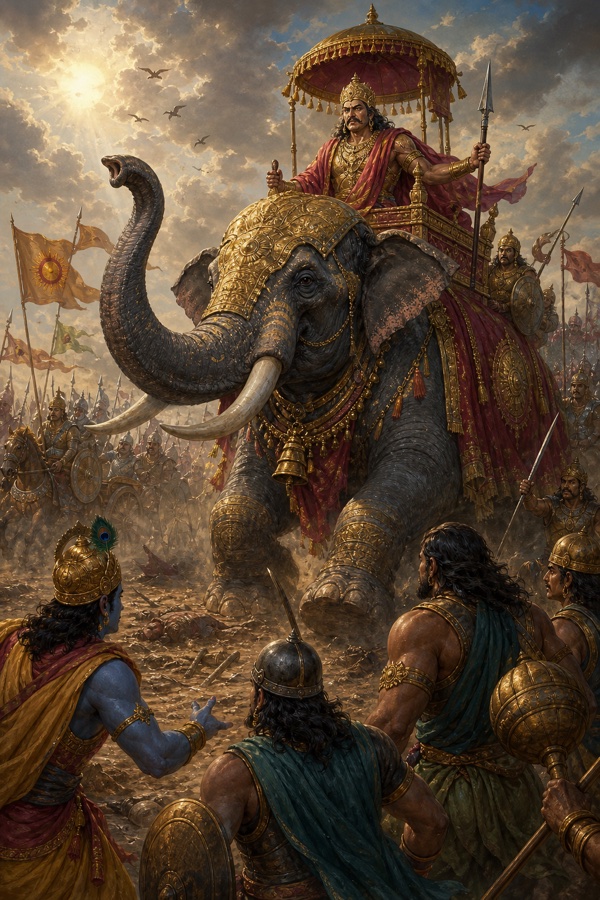
Sanjaya told the king what followed once the Kaurava ranks had been pulled back into line. Out of them, in a fury, rode Shalva, king of the Mleccha peoples, straight at the main body of the Pandava army, and he came on an elephant. It was an enormous animal, tall as a hill, with the rut running down its temples and cheeks, swollen with its own pride, the kind of beast men compared to Airavata, the elephant Indra rides, and it could break whole companies by walking through them. It came of a high and noble strain. Duryodhana himself had always paid it honor. Men who knew the lore of elephants had fitted it out and schooled it for war, and with Shalva seated on its back the watchers thought of the sun coming up on a morning at the end of summer.
From that height he drove at the Pandavas and began putting arrows into them on every side, sharp, terrible shafts that struck with the force of Indra’s thunderbolt. He shot, and men went to the house of Yama, and all the while neither the Kauravas nor the Pandavas could catch him in a single lapse, any more than the Daityas long ago could find one in Indra while he was grinding their divisions down. To the Pandavas, the Somakas and the Srinjayas that one elephant, wheeling around them, looked like a thousand, as Indra’s own elephant once looked to the enemies of the gods.
The army it was circling stared about in every direction like men with the life already gone out of them. They could not stand against it. They ran in terror, trampling one another as they went, and in a moment the great Pandava host, broken by one king on one animal, was streaming away on all sides because nothing in it could bear that elephant’s charge. The leading fighters of the Kaurava army saw the rout and the speed of it, hailed Shalva, and lifted their moon-white conches and blew. Those shouts of joy and that blare of conches reached Dhrishtadyumna, prince of the Panchalas, commander of the Pandava and Srinjaya forces, and his anger would not let him listen to it.
He went for the elephant at full speed, as the Asura Jambha once went for Airavata when he fought Indra. Shalva saw the Pandava commander coming and urged his animal forward to make an end of Drupada’s son. Dhrishtadyumna watched it bear down on him and put three arrows into it, the best he had, polished by the smith, keen, bright and hot as fire. Five more whetted shafts went into the two domes of its forehead. That was more than the elephant would take. It swung away from the fight and ran.
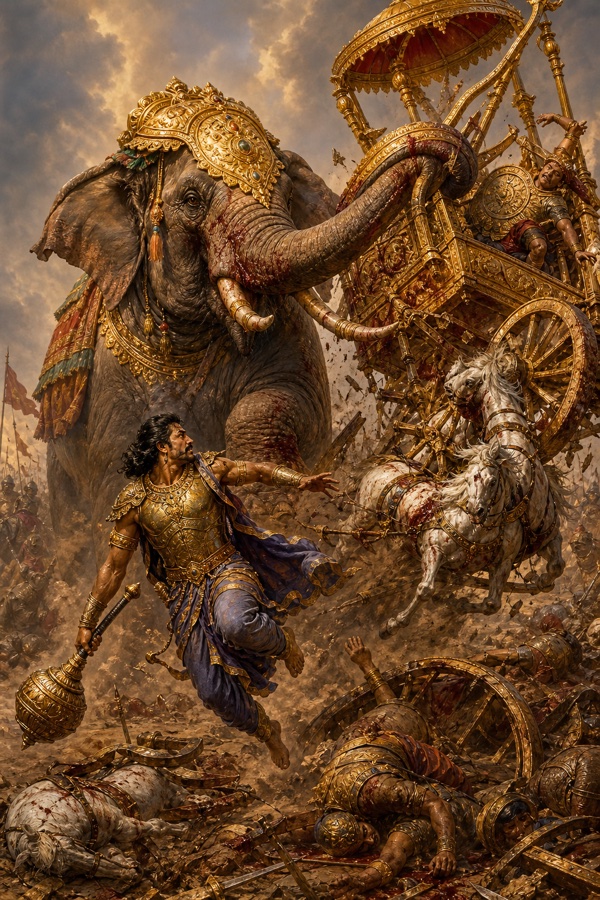
Shalva would not let it go. He hauled the torn and retreating animal to a stop, forced it around, and with hooks and sharp lances drove it at the chariot of the Panchala prince, pointing the chariot out to the maddened beast as its mark. Dhrishtadyumna saw what was coming. He snatched up a mace and jumped from the chariot to the ground, his limbs gone numb with fear, and he was only just clear when the elephant reached the place where he had stood. It crushed the gold-plated chariot with its horses and its driver, lifted the wreck into the air in its trunk, and smashed it down on the earth.
Bhima, Shikhandi and Satyaki, the grandson of Shini, saw the Panchala prince’s driver crushed under that animal and came at it together as fast as their horses could bring them. Their arrows checked its rush. Met by three chariot fighters at once and held, the elephant began to waver. Shalva, meanwhile, was shooting from its back the way the sun throws its rays, in every direction, and the Pandava chariot fighters his arrows found began to give ground and flee. The Panchalas, the Srinjayas and the Matsyas, watching what one man was doing to them, cried out “Oh!” and “Alas!” across the field. And still they closed around the elephant from every side.
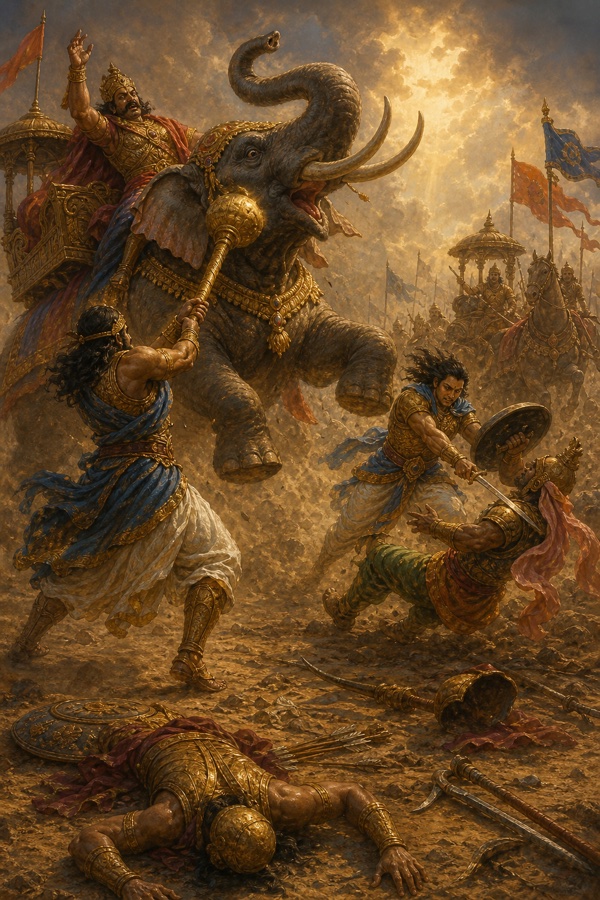
Then the Panchala prince was among them on foot, carrying his mace, a thing like the high crest of a mountain. He ran at the elephant without fear. It stood over him huge as a hill, shedding its rut like a mass of pouring cloud, and he came in close and began to beat at it with the mace. The domes of its forehead split open. It gave one great cry, vomited a flood of blood, and went down all at once, as a mountain goes down in an earthquake. While it was still falling, and while Duryodhana’s troops were wailing at the sight, Satyaki took the head off King Shalva with a single sharp broad-headed arrow. The headless king dropped to the earth beside his elephant, like a mountain summit split off by the thunderbolt of the king of the gods.
A key to reading this (Shalva versus Shalya): The two names differ by a letter and belong to two men. Shalya, king of the Madras, commanded the Kaurava army on this eighteenth day, and Yudhishthira killed him earlier in the day. Shalva ruled the Mlecchas. The elephant he rode was one Duryodhana had always honored, and it took Dhrishtadyumna’s mace and Satyaki’s arrow together to end the animal and its rider.
The gist: Shalva, king of the Mlecchas, rides an elephant like Airavata into the Pandava army and routs it. Dhrishtadyumna wounds the animal with eight arrows, loses his chariot, horses and driver to it, and comes back on foot to split its forehead with a mace; as it falls, Satyaki cuts off Shalva’s head with one broad-headed arrow.
Satyaki and Kritavarma clash again, and Duryodhana’s lone valor
With Shalva dead, Sanjaya went on, the Kaurava army broke as a great tree breaks when the storm gets hold of it. Shalva had been a man who graced any assembly he sat in, and his fall took the heart out of the ranks. Kritavarma saw them going. He was a chariot fighter of the first rank, brave and very strong, and he set himself in the path of the enemy and held it. The Kuru fighters who had run looked back and saw the Satvata hero standing in the battle like a hill, stuck all over with arrows and unmoved, and they rallied and came back. The fight that began then between the Pandavas and the returned Kurus was fought by men who had made death itself their goal. The stand Kritavarma made in it was a wonder, one man holding off an army nobody had beaten, and when his friends saw him do what could hardly be done they roared with delight until the sound seemed to reach the sky. At that sound the Panchalas felt fear.
Satyaki, the grandson of Shini, came up to that part of the field. He met the strong king Kshemakirti first and sent him to the house of Yama with seven sharp arrows. Kritavarma, the son of Hridika, drove hard at him as he came on shooting, and the two archers, both among the finest chariot fighters alive and both carrying the finest weapons, roared like lions and crashed together. The Pandavas, the Panchalas and every other fighter nearby stopped to watch. These were two heroes of one people, the Vrishnis and Andhakas, and they went at each other like two elephants in their pride, with long arrows and with shafts tipped in the shape of a calf’s tooth. Their chariots cut every kind of track across the ground. Each wore the other down under showers of arrows, and the shafts leaving the bows of those two Vrishni lions crossed the sky, Sanjaya said, like flights of swift insects.
Kritavarma closed first. He put four sharp arrows into Satyaki’s four horses, one for each. Satyaki, stung like an elephant jabbed with a lance, answered with eight of his best into Kritavarma himself. Kritavarma drew his bow to its full stretch and struck him with three arrows whetted on stone, and with a fourth he cut Satyaki’s bow in two. Satyaki laid the broken bow aside and had another in his hands at once, strung, with an arrow already on it. He was a fighter of the highest class, strong and quick of mind, and the cutting of his bow was a thing he could not swallow. He drove at Kritavarma in a fury, and ten sharp shafts struck Kritavarma’s driver, his horses and his standard.
Great archer that he was, Kritavarma looked at his gold-plated chariot standing without a driver and without horses, and rage took him. He raised a pointed lance and threw it with the whole strength of his arm, meaning to kill. Satyaki met it in the air with a volley of sharp arrows, cut it into pieces and let the pieces drop, and the speed of it left Kritavarma stunned. Another broad-headed arrow struck him in the chest. Stripped of horses and driver by Yuyudhana, as Satyaki was also called, a man who knew his weapons, Kritavarma had to step down onto the ground. A single combat had cost him his chariot, and the whole Kaurava army felt a cold fear at the sight. Dhritarashtra’s sons were sick at heart to see him standing there without horses, without a driver, without a chariot.
Kripa saw it too, and he rushed at Satyaki to send him to the house of Yama. In front of every archer on the field he took Kritavarma up onto his own chariot and carried him out of the press. With Kritavarma dismounted and the grandson of Shini master of that ground, the whole of Duryodhana’s army turned away from the fight once more. The Pandavas did not see it happen, because a cloud of dust had closed over the Kuru ranks. Every Kaurava fighter fled except the king. Duryodhana was near enough to watch his own army come apart, and he drove straight at the victorious enemy and took them on alone, all of them.
Fear had no hold on him, and nobody could turn him. In his rage he sent sharp arrows at all the sons of Pandu, at Dhrishtadyumna the son of Prishata, at Shikhandi, at the sons of Draupadi, at the massed bands of the Panchalas, at the Kaikeyas, at the Somakas. He stood in that battle with his mind made up, like a great fire blazing on the altar of a sacrifice after the mantras have been said over it, and from that stand he ranged the whole field. His enemies could no more come near him than living creatures can walk up to Death. That was the moment Kritavarma, the son of Hridika, returned, riding a fresh chariot.
A key to reading this (the Vrishni-Andhakas): Satyaki and Kritavarma are kinsmen. Sanjaya calls each of them a Satvata and names them together as two heroes of the Vrishni-Andhaka people; Satyaki is the grandson of Shini and Kritavarma the son of Hridika. In this war Satyaki fights for the Pandavas and Kritavarma for Duryodhana, and when the two of them meet, the Pandavas and the Panchalas stop their own fighting to watch.
The gist: Kritavarma rallies the broken Kaurava army. Satyaki kills King Kshemakirti with seven arrows, then strips Kritavarma of horses, driver and chariot, and Kripa carries him off the field. The army runs again under cover of dust, and Duryodhana, alone, turns on the whole Pandava force and holds it at a distance until Kritavarma comes back on a second chariot.
Duryodhana alone under a rain of arrows, and the scattered duels
Sanjaya described Duryodhana as he looked in that hour: a man on his chariot filled with the courage that comes when hope is gone, splendid as Rudra in his valor. The arrows he shot came in thousands, and the ground disappeared under them. He drenched his enemies the way clouds drench the flanks of mountains with rain. In that great battle there was no man on the Pandava side, no horse, no elephant, no chariot, that did not carry one of his arrows. Sanjaya told the king that wherever he turned his eyes among the warriors, every one he looked at had been hit by Duryodhana.
The Pandava army lay under those shafts as a host on the march lies under the dust it raises. To Sanjaya the earth itself seemed to have become one unbroken sheet of arrows, laid down by an archer whose hands had gone light and fast beyond belief. Thousands upon thousands of fighters stood on that field, from both armies, and it seemed to him that there was only one man on it. What they saw of Duryodhana’s prowess then was past wondering at: the sons of Pritha, all of them together, could not get near him.
He hit Yudhishthira with a hundred arrows, Bhimasena with seventy, and Sahadeva with seven. He hit Nakula with sixty-four, Dhrishtadyumna with five, the sons of Draupadi with seven, and Satyaki with three. Then with a broad-headed arrow he cut Sahadeva’s bow. The son of Madri put the broken bow down, took up another, a formidable one, rushed at the king, and pierced him with ten shafts. Nakula, a great archer and a brave one, struck Duryodhana with nine terrible arrows and let out a roar. Satyaki hit him with a single straight shaft, the sons of Draupadi with seventy-three, Yudhishthira with five, and Bhimasena hurt him with eighty. He was being struck from every side by the greatest fighters of the other army, with the troops of both sides standing by as witnesses, and he did not waver. Every man there saw that in quickness, in skill and in sheer prowess he had gone beyond anything a living creature could be expected to do.
The Dhartarashtra troops had not fled far. They saw their king still standing, and they buckled their armor back on and returned, and the noise of their coming was dreadful, like the roar of the sea when it swells in the season of the rains. They closed around their unbeaten king and went with him against the Pandavas. Ashvatthama, Drona’s son, took on the furious Bhimasena, and the arrows that flew in that one duel covered every quarter of the sky, until the fighters could no longer tell the main directions from the points between. Both men had done cruel things in war. Neither could be withstood. Both had forearms ridged with old scars from the snap of the bowstring, drawn and loosed more times than could be counted. Each undid what the other attempted, and they fought on, and the whole world was afraid of them.
Shakuni went for Yudhishthira. The son of Subala killed all four of the king’s horses and gave a great shout, and the troops around them trembled. Sahadeva came up, took the beaten king onto his own chariot, and carried him out of the fight. Yudhishthira came back on another chariot. He put nine arrows into Shakuni, and then five more, and it was his turn to roar. Terrible as it was, that fight was a marvel to see; it delighted the men who watched it, and the celestial Siddhas and Charanas applauded it.
Uluka, Shakuni’s son, rushed at the great archer Nakula, loosing arrows from every side, and Nakula held him off with a shower just as thick. Both were well born. Both were great chariot fighters. Each was plainly enraged at the other. Kritavarma was fighting Satyaki again, and he shone in it like Indra battling the Asura Bala. Duryodhana cut Dhrishtadyumna’s bow in that same hour and put sharp arrows into him while he stood without one; Dhrishtadyumna took up another, a formidable bow, and fought the king in the sight of every archer there. The fight between those two grew savage, like the meeting of two wild elephants in rut with the fluid running down their limbs.
Kripa, the heroic son of Gautama’s line, fought in a rage and pierced the strong sons of Draupadi with many straight arrows. He was one and they were five, and their battle looked like the struggle between an embodied creature and its five senses. It was dreadful and very fierce, and neither side gave the other any quarter. The five sons of Draupadi pressed on Kripa the way the five senses press on a foolish man. He fought them and kept them in hand by main strength. Sanjaya called it a wonder, that battle of one against five, like the contest every embodied being fights over and over with its own senses. Everywhere else men fought men, elephants fought elephants, horses fought horses, and chariot fighters fought chariot fighters, and the battle became general again and terrible. One encounter was beautiful to watch, another was dreadful, another savage beyond telling. There were many of them. Fighters of both armies met, pierced one another, and killed one another in that slaughter.
A dense cloud of dust rose over all of it, thrown up by the chariots and the animals. The running horses raised more, and the wind carried it from one part of the field to another. Churned by the chariot wheels and blown by the breath of the elephants, it climbed into the sky as thick as a cloud at evening. The sun dimmed behind it. The earth was hidden, and the great chariot fighters could no longer be seen. Then it was gone. The ground had been soaked with the blood of heroes, the dust was laid, and everything stood out clear. Sanjaya could see the single combats again, each man fighting at the noon of the day according to his strength and his rank, every one of them fierce, and all the blaze of what they did was in plain view. The noise of arrows falling grew loud in that battle, like the sound a great forest of bamboo makes when it is burning on every side.
A key to reading this (the metaphor of the senses): Sanjaya’s comparison is exact in its count. Kripa is one man and the sons of Draupadi are five, so their fight is likened to an embodied being contending with its five senses. The five press on him as the senses press on a foolish man, and he holds them in check by force, as a being that fights its senses again and again must.
The gist: Duryodhana, alone, covers the whole Pandava army with arrows, takes the shafts of Yudhishthira, Bhima, the twins, Satyaki and Draupadi’s sons in return, and does not waver. His troops come back to him, and the battle breaks into pairs: Ashvatthama against Bhima, Shakuni against Yudhishthira, Uluka against Nakula, Kritavarma against Satyaki, Duryodhana against Dhrishtadyumna, Kripa against the five sons of Draupadi. Dust hides the field until blood lays it, at noon.
The ring of seven hundred chariots, the evil omens, and Shakuni’s strike from the rear
The battle went on, terrible to be in, and in the course of it, Sanjaya said, the Pandavas broke Duryodhana’s army again. The king’s sons pulled their great chariot fighters together by main effort and kept fighting. The Kuru warriors who wished Duryodhana well turned and came back all at once, and with their return the fight between the two armies grew as fierce as the old war of the gods and the Asuras. On neither side did one fighter turn away. Men fought by guess, and by the names they shouted, and the killing that came of it was great.
Yudhishthira was filled with wrath by now, and he wanted the Dhartarashtras and their king beaten in this battle. He pierced Kripa, the son of Sharadvat, with three gold-winged arrows whetted on stone, and with four more he killed the four horses of Kritavarma. Ashvatthama carried the famous son of Hridika off the field. Kripa answered Yudhishthira with eight arrows. Then Duryodhana sent seven hundred chariots to the place where Yudhishthira was fighting. Fine warriors rode them, and they came with the speed of the wind, or of thought, straight at the chariot of Kunti’s son. They closed around him on every side and shot until he vanished behind their arrows, as the sun vanishes behind clouds.
The Pandava heroes saw Yudhishthira, the king men called the just, set upon in that way, and with Shikhandi at their head they could not stand for it. They came to the spot to rescue him on fast chariots hung with rows of bells. A dreadful battle began there between the Pandavas and the Kurus, with blood running like water, and it swelled the population of Yama’s kingdom. The Pandavas and the Panchalas killed those seven hundred Kuru chariot fighters and then turned and held off the whole Kuru army. Duryodhana and the Pandavas fought there as fiercely as men can; Sanjaya said that he had never seen or heard of the like. Nobody in it had a thought to spare for anybody. Fighters of both armies were falling fast. Men shouted and blew their conches, the archers roared and raised every kind of cry, the very vitals of the combatants were being struck, and troops hungry for victory ran at one another. It seemed that everything on earth was going down in one sorrowful destruction, and that numberless women of good birth and beauty were being made widows in that hour. And while that fight raged, with no man caring who was friend and who was foe, dreadful portents showed themselves, the kind that foretell the end of all things. The earth shook, with her mountains and her forests, and gave out a great noise. Meteors like blazing brands fitted with handles dropped from the sky on every side, as if they fell from the disc of the sun. A storm wind rose and blew in all directions, carrying hard pebbles along its lower course. The elephants shed streams of tears and trembled violently.
The Kshatriyas paid none of it any heed. They took counsel with one another and stood up for battle again, gladly, on the beautiful and sacred field that bears the name of Kuru, because they wanted heaven. Shakuni, the son of the king of Gandhara, said, “Fight them from the front, all of you. I will kill the Pandavas from behind.” The Madraka warriors among the advancing Kauravas, quick men, were filled with joy at that and raised cheers of delight, and others took up the cheering. The Pandavas, who could not be broken and did not miss, came on again, shook their bows, and buried the Kauravas in arrows, and the Madraka troops were killed where they stood. Duryodhana’s soldiers saw it and turned from the battle once more. Shakuni shouted at them, “Stop, you sinners! Fight! What good is running?” He had a full ten thousand horsemen at that time, men who fought with bright lances. With that force behind him, in the middle of the slaughter, he put out his strength and fell on the rear of the Pandava army, killing with sharp arrows. The great Pandava host broke as a bank of cloud breaks when a strong wind takes it from every side.
Yudhishthira was close enough to see his own army routed, and he spoke to Sahadeva without heat. “There is the son of Subala, in his armor, tearing at our rear. He is slaughtering our men. Look at that wicked man, son of Pandu. Take the sons of Draupadi with you, go at him, and kill Shakuni, the son of Subala. I will stay with the Panchalas and destroy the enemy’s chariot force. Let all the elephants go with you, and all the horse, and three thousand foot. With those at your back, kill Shakuni.”
So seven hundred elephants carrying archers, five thousand horse, Sahadeva himself, three thousand foot soldiers and the sons of Draupadi all went at Shakuni, a hard man to beat in any battle. He was getting the better of the Pandavas, he wanted the victory, and he kept on killing their troops from behind. The Pandava horsemen, wild with rage, cut their way past his chariot fighters and into the division of Subala’s son. Once there, they took their stand in the middle of their own elephants and covered his large force with arrows. The battle that followed was a dreadful one, and Sanjaya told the king plainly that it came of his own bad counsel. Maces and lances were the weapons, and only the brave took part. The twang of bowstrings was no longer heard on that part of the field, because all the chariot fighters had drawn up to watch. No difference could be seen between the two sides. Kurus and Pandavas alike watched the darts thrown by those strong arms cross the sky like meteors. The whole sky, filled with the flash of falling swords, became a thing of great beauty, and the lances hurled from every quarter looked like swarms of locusts in the air.
Horses went down on every side, in hundreds and in thousands, their limbs bathed in blood from the wounds that horsemen, wounded themselves with arrows, had given them. They ran into one another and were packed together, and many were seen mangled and many vomiting blood from their mouths. A thick darkness came when the dust covered the troops. In that darkness Sanjaya and those with him could make out brave fighters, horses and men together, moving away from the place. Others fell to the earth pouring out blood. Many, caught fast in one another’s hair, could not move. Many strong men dragged each other off the backs of their horses and, grappling like that, killed each other the way wrestlers fight. Many, already dead, were carried off on the backs of their mounts. Many who had been proud of their courage and sure of winning were seen to fall. The ground was strewn with hundreds and thousands of fighters bathed in blood, their limbs gone, their hair torn away. It was so covered with elephant riders and horsemen, with dead horses, with men in bloodstained armor, with men still holding weapons, with men who had tried to kill each other by every terrible means, all lying heaped close together, that no warrior could ride his horse far. Shakuni fought a little while longer and then left that place with what remained of his cavalry, six thousand horse. The Pandava force did the same, covered in blood, its animals spent, and its remnant numbered six thousand horse.
The bloodstained horsemen of the Pandava army still had their hearts set on fighting and were ready to die. “There is no fighting here on chariots any longer,” they said, “and on elephants it would be harder still. Let chariots go against chariots, and elephants against elephants. Shakuni has fallen back inside his own division. The royal son of Subala will not come out to fight again.” So the sons of Draupadi and the war elephants went off to the place where Dhrishtadyumna, the Panchala prince, was fighting, and Sahadeva, when the dust rose, made his way alone to King Yudhishthira. Shakuni waited until they had all gone. Then, in a rage, he fell on Dhrishtadyumna’s division and began to cut it up. Once more there was a dreadful battle between the two armies, among men who had stopped caring whether they lived and wanted only to kill. The fighters first looked each other steadily in the eye, and then they rushed and fell on one another in hundreds and thousands. Heads cut off by swords dropped with a noise like ripe palmyra fruit falling. The sound of bodies hitting the ground, stripped of armor and torn by weapons, and of falling weapons, and of arms and thighs hewn from the trunk, grew loud enough to raise the hair. Men struck at brothers and sons and even fathers with sharp weapons and fought like birds over scraps of meat. Thousands fell on one another in fury. Hundreds and thousands were killed by the mere weight of dead horsemen toppling onto them from their mounts. The neighing of fast horses grew loud, and the shouting of armored men, and the fall of darts and swords as each man tried to reach the vitals of another, and Sanjaya charged this too to the king’s policy. The Kaurava soldiers were worn out by then, emptied by their own rage, their animals exhausted, their throats parched, their bodies cut, and they began to turn away from the battle. Many were so maddened by the smell of blood that they killed friend and enemy alike, anyone they could reach. Great numbers of Kshatriyas who had wanted victory were struck with arrows and fell flat on the earth. Wolves and vultures and jackals howled and screamed in their glee. Under the eyes of Duryodhana himself, his army suffered a heavy loss.
The earth was covered with the bodies of men and horses and with streams of blood, a sight to terrify the timid. Struck and cut again and again by swords and battle-axes and lances, the Kaurava warriors and the Pandavas at last stopped closing with one another. They had hit as hard as their strength allowed and fought to the last drop of their blood, and they fell with the blood pouring from their wounds. Headless bodies were seen standing, one hand gripping the hair of the head, the other a raised sword dark with blood. When many such headless shapes had risen, when the smell of blood had left the fighters almost senseless, and when the great noise had sunk a little, Shakuni came back toward the large Pandava host with the small remnant of his horse. The Pandavas wanted the victory and wanted the war over. They had foot soldiers, elephants and cavalry, every weapon was raised, and they formed a wall around Shakuni on all sides and began to strike at him with whatever they held. The Kauravas saw their own men attacked from every quarter and rushed at the Pandavas with horsemen, foot, elephants and chariots. Some foot soldiers of great courage, who had no weapons left, went at their enemies with feet and fists and brought them down. Chariot fighters fell from their chariots and elephant riders from their elephants, like the virtuous falling from their heavenly vehicles when their merit has run out. So the fighters killed fathers and friends and sons in that great battle, where no one showed regard for anyone, and lances and swords and arrows fell thick on every side.
A sub-tale: When Yudhishthira picks a man to kill Shakuni, he picks Sahadeva. Shakuni is the gambler who won everything the Pandavas owned at dice, and on the day they left the Kaurava court Sahadeva told him to his face that he would kill him in battle with all his followers. Sanjaya’s account keeps that in view: Shakuni had fallen to Sahadeva’s share, and Sahadeva will remind him of the dice before the end.
The gist: Duryodhana sends seven hundred chariots against Yudhishthira, and the Pandavas and Panchalas destroy them. The earth shakes, meteors fall, and the elephants weep. Shakuni takes ten thousand lancers around to the Pandava rear; Yudhishthira sends Sahadeva after him with seven hundred elephants, five thousand horse, three thousand foot and the sons of Draupadi. The cavalry fight that follows is fought with maces and lances, and each side rides away from it with six thousand horse.
Arjuna’s cataclysmic forest of arrows, and the breaking of Duryodhana’s chariot
The noise of battle had sunk a little, Sanjaya said, and the Pandavas had killed great numbers of their enemies, when Shakuni came back to the fight with the horsemen he had left. There were seven hundred of them. He rode quickly up to his own soldiers and urged them on, calling again and again, “Fight with a will! You are men who break your enemies!” Then he asked the Kshatriyas standing there, “Where is the king? Where is that great chariot fighter?” They told him. “Over there. Where you see that great parasol, bright as the full moon. Where those chariot fighters are standing in their armor. Where that noise is coming from, deep as thunderclouds. Go there quickly, king, and you will find the lord of the Kurus.” Shakuni rode to the place and found Duryodhana ringed on every side by heroes who did not retreat.
The sight of the king in the middle of that chariot force gladdened Shakuni, and he let the chariot fighters see it. He spoke to Duryodhana cheerfully, in the manner of a man who counts everything he wanted as already won. “Kill their chariot divisions, king. I have beaten all their horse. Yudhishthira cannot be conquered in battle by any man who is not ready to lay down his life. Once that chariot force the son of Pandu is guarding has been destroyed, we will kill the elephants, the foot soldiers and all the rest.” The Kaurava warriors heard him and wanted the victory he described, and they rushed gladly at the Pandava army. Every man had his quiver on his back and his bow in his hand. They shook their bows and roared like lions, and once again the field heard the fierce twang of bowstrings, the slap of palms, and the whistle of arrows shot with force.
Arjuna, the son of Kunti, watched the Kuru fighters come toward the Pandava army with their bows raised, and he turned to Krishna, the son of Devaki, who held his reins. “Drive the horses on without fear and take us into this sea of soldiers. Today my arrows will bring this war to its end. This is the eighteenth day, Krishna, of the great battle between these two sides. The army of those proud heroes was beyond counting, and it has been almost wiped out. Look at what fate does. Dhritarashtra’s son had an army as wide as the ocean, and after meeting us it has shrunk to the puddle that gathers in the print of a cow’s hoof. If peace had been made when Bhishma fell, all would have been well. Duryodhana, foolish and weak in understanding, would not make it. What Bhishma said was for his good and deserved to be followed, and he had lost his senses and did not follow it.
“After Bhishma had been struck down and laid on the earth, I cannot tell you why the battle went on. I hold the sons of Dhritarashtra to be fools in every way, and weak of mind, for fighting on after the son of Shantanu had fallen. Then Drona fell, the greatest of those who speak the Veda, and the son of Radha, and Vikarna, and still the slaughter did not stop. Only a small remnant of their army was left once Karna had fallen with his sons, and still it did not stop. The brave Shrutayush fell, and Jalasandha of Puru’s line, and King Shrutayudha, and still it did not stop. Bhurishravas fell, and Shalya, and the heroes of Avanti, and still it did not stop. Jayadratha fell, and the Rakshasa Alayudha, and Bahlika, and Somadatta, and still it did not stop. The brave Bhagadatta fell, and Sudakshina, chief of the Kambojas, and Duhshasana, and still it did not stop. Strong kings, each with wide lands of his own, were seen lying dead on the field, and the slaughter did not stop. A whole akshauhini of troops was seen killed in battle by Bhimasena, and the slaughter did not stop, whether from the folly of the Dhartarashtras or from their greed. What king born in a noble house, and above all in a house like Kuru’s, would carry on so fierce a war for nothing? Only this fool Duryodhana. Who that had reason and wisdom, and could tell good from evil, would go on fighting when he knew his enemies were his betters in merit, in strength and in courage?
“How could he listen to anyone else, when he could not bring himself to make peace with the Pandavas even at your word? What medicine can reach a man who turned his back on Bhishma, the son of Shantanu, and on Drona, and on Vidura, when they begged him for peace? How can good advice enter a man who in his folly insulted his own aged father, and his own mother who wished him well, while they were telling him what was good for him? It is plain, Krishna, that Duryodhana was born to wipe out his own line. His conduct and his policy both point that way. Even now he will not give us our kingdom; that is my belief. Vidura told me many times that as long as there was life in Dhritarashtra’s son he would never give us our share. He told me this as well: ‘As long as Dhritarashtra lives, that sinful man will go on wronging you. You will never get the better of Duryodhana without a battle.’ Vidura sees truly, and he said this to me often. Everything that wicked man has done, I now find to be exactly as Vidura said it would be. A man who heard the wise and fitting words of Jamadagni’s son and brushed them aside is a man already standing in the mouth of destruction. Many who had won success in their austerities said, as soon as Duryodhana was born, that the whole Kshatriya order would be destroyed because of that wretch. The words of those sages are coming true now, Krishna, for the Kshatriyas are being all but wiped out by what Duryodhana has done.
“I will kill all these warriors today. When every Kshatriya has been killed and the Kaurava camp stands empty, Duryodhana will come looking for a fight with us, and it will be the end of him. That will finish this war. I have used my reason, Krishna, and turned it over in my own mind; I have thought of Vidura’s words and weighed what that wicked man has done himself, and this is what I conclude. Take us into the Bharata army, for I mean to kill Duryodhana and his army today with my arrows. I will cut down this weak army before the eyes of Dhritarashtra’s son, and I will do today what is good for Yudhishthira.”
Krishna, of the Dasharha line, took the reins and drove without fear into that great enemy host. It was a terrible forest of bows that the two of them entered. Darts were its thorns. Maces and spiked clubs were its paths. Chariots and elephants were its tall trees, and cavalry and infantry were its creepers. Krishna shone as he went into that forest on a chariot dressed with many banners and pennons, and the white horses that carried Arjuna were seen wheeling everywhere under his hand.
Arjuna went forward on that chariot shooting keen arrows by the hundred, like a cloud letting down its rain. The straight shafts made a great noise, and so did the men they covered. Showers of them went clean through the armor of the fighters and fell to the earth. Arrows from Gandiva, the bow known through the three worlds, with a touch like Indra’s thunderbolt, struck men and elephants and horses and dropped with a noise like winged insects. Everything was hidden by the shafts from Gandiva. No direction could be told from any other. The whole world seemed full of arrows with wings of gold, steeped in oil, polished by the smith, each one marked with Arjuna’s name. The Kauravas, struck by them and burned as a herd of elephants is burned with firebrands, grew faint and lost their strength. With bow and arrows in his hands Arjuna blazed like the sun and burned the enemy as a fire eats a heap of dry grass. When the people who live in a forest throw their embers out at its edge, a fire can rise there, roaring, and consume the whole wood with its trees and its heaps of dry creepers. Arjuna was that fire. Quick, fierce, a master of his weapons, with arrows for his flames, he burned through Duryodhana’s troops in his wrath. His gold-winged arrows, aimed with care, carried death in them, and no armor turned one aside. He did not need a second arrow for any man, any horse, or any elephant, however huge. Like Indra with his thunderbolt striking down the Daityas, Arjuna went alone into that division of great chariot fighters and destroyed it with arrows of many kinds.
With Gandiva he made nothing of what those heroes intended, men who never turned back, who were struggling and striking at their enemies. His arrows could not be stopped; they hit with great force and a touch like thunder, and they came like torrents from a rain cloud. The army broke under them and ran while Duryodhana looked on. Some men left fathers and brothers behind, others left their comrades. Some chariot fighters had lost their animals, some their drivers, some had a broken pole or yoke or wheel. Some had run out of arrows. Some were visibly suffering from their wounds. Some had no wound at all and fled in a body out of plain fear. Some, with all their kinsmen and animals gone, tried to save their sons. Some cried aloud for their fathers, some for their comrades and followers. Many great chariot fighters, deeply pierced by Arjuna’s shafts, were seen breathing hard, with their senses gone, and others lifted them onto their own chariots, soothed them a while, rested them, gave them water for their thirst, and then went back to the battle. Some, hard men to defeat, left the wounded where they lay and advanced again, wanting to do what Duryodhana had ordered. Some had drunk, or seen to their animals, or put on fresh armor; some had comforted their brothers and sons and fathers and left them in the camp; and these came back to fight. Some drew up their chariots in order of rank and went forward against the Pandavas once more. Those heroes, on chariots hung with rows of bells, looked as splendid as the Daityas and Danavas when they set out to conquer the three worlds. Some drove hard on vehicles decked with gold into the Pandava divisions and fought with Dhrishtadyumna. The Panchala prince, with the great chariot fighter Shikhandi and with Shatanika, the son of Nakula, met the enemy’s chariot force. Then Dhrishtadyumna, in a rage and with a large army behind him, rushed at the angry Kaurava troops to kill them, and Duryodhana met his rush with shower after shower of arrows. Fighting with his bow, the king quickly put many arrows into Dhrishtadyumna’s arms and chest.
They went deep, like pointed lances into an elephant. The great archer answered by sending Duryodhana’s four horses to the land of the dead with his arrows, and with one more, a broad-headed shaft, he cut the head of Duryodhana’s driver from its trunk. The king had lost his chariot. He mounted a horse and fell back to a spot a little way off. From there he looked at his own army and saw that the fight had gone out of it, and he rode to the place where Subala’s son was.
A key to reading this (the eighteenth day, and the cow’s hoofprint): Arjuna dates the day himself: it is the eighteenth of the war. His picture of the Kaurava army is of an ocean reduced to the water that collects in the hollow left by a cow’s hoof. Eleven akshauhinis had been assembled for Duryodhana, and a little later in this same day Arjuna will count what remains: five hundred of Shakuni’s horse, two hundred chariots, a hundred elephants and three thousand foot.
The gist: Shakuni returns with seven hundred horsemen and urges Duryodhana to destroy the Pandava chariot divisions. Arjuna tells Krishna that the war should have ended when Bhishma fell, lists the dead whose fall did not end it, recalls Vidura’s warning, and vows to finish it today; then he burns through the Kaurava chariot force alone. Dhrishtadyumna kills Duryodhana’s four horses and beheads his driver, and the king rides off on horseback toward Shakuni.
The ring of three thousand elephants, and Bhima’s mace
Sanjaya told the king what came when the Kaurava chariots had been broken: three thousand enormous elephants closed in around the five Pandavas, each of the brothers a chariot fighter of the first rank. Ringed by that elephant force, the five looked as fine as the planets when clouds stand all around them. Then Arjuna came forward on his chariot, sure of aim, behind his white horses with Krishna driving. Hemmed in by animals the size of hills, he began to kill them with sharp, polished arrows. One arrow was enough for each, and the watchers saw those huge elephants fallen or falling, torn by his shafts.
Bhimasena was like a maddened elephant himself. He looked at those animals, took up his terrible mace, jumped down from his chariot, and ran at them like Death with his club in his hand. At the sight of the Pandavas’ great chariot fighter on foot with his mace raised, Duryodhana’s soldiers were so afraid that they lost control of bladder and bowels, and the whole army shook. Then Sanjaya and the rest saw elephants as big as hills running this way and that, the domes of their foreheads split open by Bhima’s mace and their limbs bathed in blood. Struck by that mace they ran from him and fell, crying out in pain, like mountains shorn of their wings. So many of them were running about or lying dead with their skulls broken that the Kaurava soldiers were seized with fear. Yudhishthira too, full of wrath, and the two sons of Madri, began to kill the elephant warriors with arrows feathered from the wings of vultures.
Dhrishtadyumna had beaten the Kuru king and seen him ride away from that place on horseback, and now he saw that the Kaurava elephants had every one of the Pandavas surrounded. The Panchala king’s son started for the elephants, meaning to slaughter them. Meanwhile Ashvatthama, Kripa and Kritavarma of the Satvata line could not find Duryodhana among the chariots, and they asked every Kshatriya there, “Where has Duryodhana gone?” They could not see the king anywhere in that carnage, and all three took him for dead. Their faces were heavy with sorrow as they went on asking. Some men told them that after his driver fell he had gone to Subala’s son.
Other Kshatriyas there, badly cut up, said, “What do you want with Duryodhana? See whether he is even alive. Fight together, all of you. What is the king going to do for you?” Others again, men covered in wounds, who had lost many of their kin and were still being hurt by enemy arrows, said in voices that could hardly be made out, “Let us kill these troops that have us surrounded. Look, the Pandavas are coming this way, now that they have killed the elephants.” Ashvatthama heard them. He broke through the Panchala king’s force, which nobody had been able to stop, and went with Kripa and Kritavarma to the place where Subala’s son was. Those three steady archers left the chariot force behind and went looking for Duryodhana.
Once they had gone, the Pandavas, with Dhrishtadyumna at their head, advanced and began to kill. The Kaurava troops saw those brave and powerful chariot fighters come at them gladly; many faces among them went pale, and they gave up hope of living. Sanjaya was there himself. He saw his own side’s soldiers nearly out of weapons and surrounded, and with only two kinds of troops at his back he threw away care for his life, joined the five leaders of the Kaurava army, and fought the forces of the Panchala prince, posting their men on the ground where Kripa, the son of Sharadvat, had been stationed. They had all been hurt by Arjuna’s arrows before that. Even so there was a fierce battle between them and Dhrishtadyumna’s division, and in the end it beat them and every one of them fell back.
It was then that Sanjaya saw the great chariot fighter Satyaki rushing at them. Satyaki came after him with four hundred chariots. Sanjaya had barely got clear of Dhrishtadyumna, whose horses were tired, and he fell among Satyaki’s troops, he told the king, as a sinner falls into hell. The fight there was fierce and terrible and short. Satyaki cut away his armor and wanted him alive, and took hold of him as he lay senseless on the ground. Within a little while Bhimasena with his mace and Arjuna with his arrows had destroyed the elephant force. So many of those great animals, big as hills, lay fallen on every side with their limbs crushed that the Pandava warriors found their way almost entirely blocked, and Bhimasena dragged the huge carcasses aside and made a road for the Pandavas to come out. Ashvatthama, Kripa and Kritavarma, meanwhile, having failed to find Duryodhana among the chariots, had left the Panchala prince behind and were making for the place where Subala’s son was, anxious for a sight of the king in the middle of that terrible slaughter.
The gist: Three thousand elephants surround the five Pandavas. Arjuna kills them with one arrow each and Bhima with his mace, and Bhima drags the bodies aside to open a road. Ashvatthama, Kripa and Kritavarma, unable to find Duryodhana, break through the Panchalas and go toward Shakuni to look for him. Sanjaya, fighting beside five Kaurava leaders against Dhrishtadyumna, is driven back, runs into Satyaki’s four hundred chariots, and is taken alive.
The slaughter of Dhritarashtra’s sons by Bhima
After the elephant division had been destroyed, Sanjaya said, and while Bhimasena was slaughtering the Kaurava army, ranging in his rage like Death the destroyer of all with his club in his hand, those of Dhritarashtra’s sons who were still alive came together. They were brothers born of one mother. Duryodhana was nowhere to be seen at that moment. They were Durmarshana, Shrutanta, Jaitra, Bhuribala, Ravi, Jayatsena, Sujata, Durvishaha who had killed many an enemy, the one called Durvimochana, Dushpradharsha, and Shrutarva. Every one of them knew his business in battle. Together they closed on Bhimasena and shut him in on all sides.
Bhima climbed back onto his own chariot and began to put sharp arrows into them where a wound kills. Covered with his shafts in that dreadful fight, the princes set about hauling him down, the way men drag an elephant off a crossroads. That roused him. He cut off Durmarshana’s head with a razor-headed arrow, and it fell to the earth. With a second arrow, broad-headed and able to go through any armor, he killed Shrutanta, a great chariot fighter. Then, with no effort at all, he drove a long shaft through Jayatsena and knocked that prince of Kuru’s line off his chariot. Jayatsena hit the ground and was dead at once.
Shrutarva, in a rage at this, pierced Bhima with a hundred straight arrows winged with vulture feathers. Bhima’s own anger flared. He struck Jaitra, Ravi and Bhuribala, the three of them, with three shafts like poison or fire, and those great chariot fighters fell from their chariots like kinshuka trees cut down by the axeman in spring, when they are bright with flowers. Another broad-headed arrow, very sharp, hit Durvimochana and sent him to the house of Yama; he dropped from his chariot to the ground like a tree on a mountaintop broken by the wind. Next Bhima struck two more of the brothers, Dushpradharsha and Sujata, at the head of their forces, with two arrows each, and both of them fell. He saw yet another, Durvishaha, rushing at him, and put a broad-headed arrow through him, and that prince went down from his chariot in the sight of every archer on the field.
By now Shrutarva had watched one man kill so many of his brothers. Rage took hold of him, and he rushed at Bhima, drawing a formidable bow decked with gold and loosing a great number of arrows that burned like poison or fire. He cut the bow of Pandu’s son in that dreadful fight and put twenty arrows into Bhima while he had none in his hands. Bhima took up another bow, wrapped the prince in arrows, and shouted at him, “Wait! Wait!” The battle between those two was beautiful and fierce, like the one fought long ago between Indra and the Asura Jambha. Their sharp shafts, each like the deadly rod of Yama, hid the earth, the sky and every point of the compass. Shrutarva, in his fury, took up his bow and struck Bhimasena with many arrows in the arms and the chest. Deeply pierced, Bhima heaved like the ocean at the full moon or the new. Then in his wrath he sent the prince’s driver and his four horses to the house of Yama with his arrows, and seeing him left without a chariot, he showed how light his hands were and covered him with winged shafts.
Shrutarva, with no chariot under him, took up a sword and a shield. The shield was bright and set with a hundred moons, and as he moved about the field with it Bhima struck his head from his body with a razor-headed arrow and dropped it on the earth. The headless body crashed down, and the ground rang with the noise. Terrified as they were at the fall of that hero, the Kaurava troops rushed at Bhimasena, wanting to fight him. Bhima was in his armor, and he met those warriors as they came at him fast out of what was left alive of that ocean of soldiers. They reached him and closed around him on every side. Surrounded, he began to hurt them all with sharp arrows, as Indra of the thousand eyes hurts the Asuras.
He destroyed five hundred great chariots with their protective fences, and then he killed seven hundred elephants more. He killed ten thousand foot soldiers with his arrows, and eight hundred horses, and he was splendid to see. Bhimasena, the son of Kunti, had killed Dhritarashtra’s sons in battle, and he held that his object was gained and the purpose of his birth fulfilled. The Kaurava troops at that hour did not dare so much as look at the man who was fighting in that way and killing their people in that way. He routed all the Kurus and killed those who followed them, and then he slapped his armpits, and the crack of it frightened the great elephants. The Kaurava army had lost a very great number of men. Very few soldiers were left in it, and the heart had gone out of them.
A sub-tale: Bhima’s sense that the purpose of his birth was fulfilled looks back to the day the Pandavas lost at dice. As they were leaving the Kaurava court in deerskins and Duhshasana jeered at them, Bhima swore that he would quiet his wrath by killing the sons of Dhritarashtra in battle, before the eyes of all the warriors. Eleven of those sons ring him here, and Sanjaya names each one as he falls.
The gist: Eleven sons of Dhritarashtra attack Bhima together while Duryodhana is out of sight. He kills Durmarshana, Shrutanta, Jayatsena, Jaitra, Ravi, Bhuribala, Durvimochana, Dushpradharsha, Sujata and Durvishaha, and last Shrutarva, who had cut his bow and then faced him with sword and shield. After them he destroys five hundred chariots, seven hundred elephants, ten thousand foot and eight hundred horses.
The slaying of Sudarshana, and the end of Susharma king of the Trigartas
Two of the king’s sons were still alive on that field, Sanjaya said: Duryodhana, and Sudarshana. They were in the middle of the Kaurava cavalry. Krishna, Devaki’s son, saw Duryodhana there among the horsemen and spoke to Arjuna. “A great many of our enemies are dead, kinsmen who once had our protection. There is Satyaki coming back with Sanjaya his prisoner. Nakula and Sahadeva are both tired out from fighting the wretched Dhartarashtras and their followers. Those three, Kripa, Kritavarma and the great chariot fighter Ashvatthama, have left Duryodhana’s side and taken up a position somewhere else. The Panchala prince has killed Duryodhana’s troops and is standing over there in all his beauty among the Prabhadrakas. And there is Duryodhana, in the middle of his cavalry, with the parasol held over his head, throwing glances all around him. He has drawn up what is left of his army again and is standing inside it. Kill this one man with your sharp arrows and you will have everything you set out to gain. While these troops still stand, before they see you in their midst and learn what became of their elephant force and run, try to kill Duryodhana. Let someone go to the Panchala prince and ask him to come here. Their soldiers are all tired. That sinful man will never get away. He has killed a great number of your troops in battle, and he wears a proud look, as though he believes the Pandavas have been beaten. When he sees his own troops hurt and killed by the Pandavas, the Kuru king will certainly come out to fight, and it will be the end of him.”
Arjuna answered him. “Bhima has killed nearly all the sons of Dhritarashtra. Only these two are alive, and they too will meet their end today, Krishna. Bhishma has been killed. Drona has been killed. Karna, whom men called Vaikartana, has been killed. Shalya, king of the Madras, has been killed, and Jayadratha has been killed. Of the troops of Shakuni, the son of Subala, only five hundred horse remain, and of chariots only two hundred. Of elephants only a hundred remain that are worth fearing, and of foot only three thousand. Ashvatthama is left, and Kripa, and the ruler of the Trigartas, and Uluka, and Kritavarma of the Satvata line. That is what remains of Duryodhana’s force. Truly, nobody on earth escapes death. Yet look: after a slaughter like this one, Duryodhana is still alive. Today King Yudhishthira will be free of all his enemies. I do not think one of them will get away from me. Even if they are more than men, I will kill them all today, however fierce they are in battle, so long as they do not run from the field. I will kill the prince of Gandhara with my arrows in today’s fight, and so end the sleeplessness the king has suffered for so long. I will win back every treasure that Subala’s son, that crooked man, won from us at the gambling match in the assembly. All the women of Hastinapura, the city named for the elephant, will wail aloud when they hear that their husbands and sons have been killed in battle by the Pandavas. Today our work will be finished. Today Duryodhana will give up all his blazing fortune, and his life’s breath with it. You may count that foolish son of Dhritarashtra as dead already, Krishna, unless he runs today from the battle I mean to give him. Those horses cannot stand the twang of my bow and the slap of my palms. Drive there. I will kill them.”
Krishna urged the horses toward Duryodhana’s division. Three great chariot fighters made ready to attack that force together: Bhimasena, Arjuna and Sahadeva went at it with loud lion roars, wanting Duryodhana dead. Shakuni saw the three of them coming fast with their bows raised, and he moved to that spot to meet them. Sudarshana rushed at Bhimasena. Susharma and Shakuni took on Arjuna. Duryodhana, on horseback, went for Sahadeva, and with great speed and care he struck Sahadeva hard on the head with a lance. Sahadeva sat down on the floor of his chariot, his whole body bathed in blood, hissing like a snake. Then his senses came back, and in his rage he covered Duryodhana with sharp arrows.
Arjuna put out his strength and cut off the heads of many brave men on horseback. He destroyed that cavalry division with his arrows, brought down every horse in it, and then went on against the chariots of the Trigartas. The great Trigarta chariot fighters drew together and covered Arjuna and Krishna with showers of shafts. Arjuna turned on Satyakarma first and cut the shafts of his chariot with a razor-headed arrow. With a second, whetted on stone, he took off Satyakarma’s head, bright with gold, and he was smiling as he did it. Next he went for Satyeshu, in full view of all the warriors, the way a hungry lion in the forest goes for a deer. He killed him. Then he put three arrows into Susharma and killed all those chariot fighters in their golden ornaments.
Now he turned at speed on Susharma himself, the ruler of Prasthala, and poured out on him the poison of an anger he had been keeping for many long years. He covered him first with a hundred arrows and killed every horse of that archer’s team. Then he set on his bowstring a great arrow like the rod of Yama, took aim, and, smiling, let it fly. It came from a bowman blazing with wrath, and it reached Susharma and went through his heart. Susharma fell to the earth dead, to the joy of all the Pandavas and the pain of all the Kaurava warriors. After him Arjuna sent that king’s thirty-five sons, great chariot fighters every one, to the house of Yama with his shafts, and killed all of Susharma’s followers with his sharp arrows, and then he moved against what was left of the Bharata host.
Bhima, in the same battle, full of rage, hid Sudarshana from sight with his arrows, and, smiling, cut the prince’s head from his body with a razor-headed arrow of great sharpness. Sudarshana fell to the earth dead. His followers closed around Bhima and shot whetted arrows at him in showers, and Bhima covered that whole force with arrows of his own, sharp ones with a touch like Indra’s thunderbolt. In a very short time he had killed them all. While they were being wiped out, many strong Kaurava leaders came up to Bhima and began to fight him, and he covered every one of them with his arrows. The Kaurava warriors in their turn poured dense showers of arrows on the great chariot fighters of the Pandavas from every side. Both armies were locked together and badly shaken. Men of both sides, struck by one another, began to fall, crying aloud for their dead kin.
A key to reading this (Trigarta and the samshaptakas): Susharma, ruler of Prasthala, led the Trigartas. Under Drona’s command he and his brothers had lit fires and sworn that the earth would be left without Arjuna or without the Trigartas, and had called Arjuna out to the southern part of the field; Satyakarma and Satyeshu were among the brothers who took that oath. Men so sworn, to conquer or die, are the samshaptakas. Arjuna’s anger against Susharma had been kept for many years, and it ends here with Susharma dead and his thirty-five sons after him.
The gist: Krishna points out Duryodhana among his cavalry, and Arjuna, Bhima and Sahadeva attack. Duryodhana wounds Sahadeva in the head with a lance. Arjuna destroys the cavalry, kills Satyakarma and Satyeshu, shoots Susharma of the Trigartas through the heart, and kills his thirty-five sons; Bhima beheads Sudarshana, the last of Duryodhana’s brothers still fighting beside him.
Shakuni and Uluka slain at Sahadeva’s hands
Men and horses and elephants were dying in numbers, Sanjaya went on, when Shakuni, Subala’s son, rushed at Sahadeva. Sahadeva met his charge with showers of swift arrows, as thick as a flight of insects. Uluka closed with Bhima at the same moment and pierced him with ten arrows, and Shakuni put three into Bhima and then covered Sahadeva with ninety. Those heroes went on piercing one another with sharp shafts fletched with the feathers of the kanka and the peacock, winged with gold, whetted on stone, loosed from bowstrings drawn back to the ear. The arrows from their bows and arms hid every quarter of the sky, like a heavy fall of rain from the clouds.
Bhima in his rage and Sahadeva in his valor, both of them very strong, ranged through that battle and made an immense slaughter. Between them they covered the Kaurava army with hundreds of arrows, until the sky over many parts of the field went dark. Horses stuck full of shafts ran dragging the dead behind them, and in many places the tracks were blocked altogether. The earth was covered with horses killed with their riders, with broken shields and lances, with swords and darts and spears, and it looked as if it had been strewn with flowers of many colors. The fighters met in their wrath and took one another’s lives. Soon the field was littered with heads as lovely as the filaments of the lotus, still wearing their earrings, the eyes turned up in anger and the lips bitten in rage. Severed arms lay on it like the trunks of great elephants, with their armlets on and their leather guards, still gripping swords and lances and battle-axes. Headless bodies stood up on their feet, bleeding, and danced, and the place swarmed with flesh-eating creatures of every kind. It was a fearful sight. Only a small remnant of the Bharata army was left by then, and the Pandavas, full of delight in that dreadful battle, set about sending the Kauravas to the house of Yama. In the middle of it Shakuni’s brave son struck Sahadeva on the head with a lance, very hard. Shaken through by the blow, Sahadeva sat down on the floor of his chariot. Bhima saw the state he was in, and in his rage he held the whole Kuru army in check. He pierced hundreds and thousands of enemy fighters with his long shafts, and then he roared like a lion. All of Shakuni’s followers took fright at that roar and fled headlong, with their horses and their elephants.
Duryodhana saw them break and called out to them. “Stop, you Kshatriyas who know nothing of your duty! Fight! What use is running? The hero who gives up his life’s breath in battle without showing his back wins fame here and enjoys the worlds of bliss hereafter.” So urged by the king, the followers of Subala’s son made death their goal and advanced on the Pandavas again. The noise they made as they came was dreadful, like the sea when it is stirred up, and the whole field was in turmoil around them. The victorious Pandavas saw them coming and went to meet them. Sahadeva had recovered a little. He pierced Shakuni with ten arrows and Shakuni’s horses with three, and then, with no effort, he cut the bow of Subala’s son with several more. Shakuni could not be beaten so easily. He took up another bow and pierced Nakula with sixty arrows and then Bhimasena with seven. Uluka, wanting to rescue his father in that fight, pierced Bhima with seven arrows and Sahadeva with seventy. Bhimasena answered by piercing Uluka with many sharp arrows and Shakuni with sixty-four, and every other warrior fighting around them with three each. The Kauravas he had struck with those oil-steeped shafts turned in fury on Sahadeva and covered him with showers of arrows, as clouds charged with lightning pour rain on the breast of a mountain.
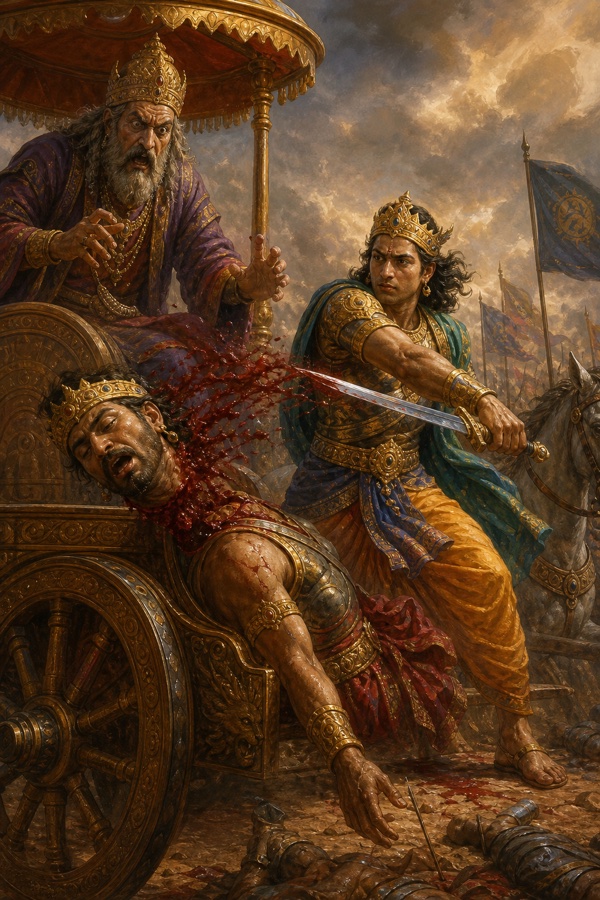
Uluka came on against him, and Sahadeva cut off his head with a broad-headed arrow. Uluka fell from his chariot to the earth with all his limbs bathed in blood, and the Pandavas were glad. Shakuni saw his son killed. His voice choked with tears, he drew deep breaths, and he remembered the words of Vidura. For a moment he stood thinking, his eyes full. Then, breathing heavily, he went up to Sahadeva and pierced him with three arrows. Sahadeva beat those arrows aside with showers of his own and cut Shakuni’s bow in that fight.
Shakuni saw the bow go. He took up a formidable scimitar and threw it at Sahadeva, and Sahadeva, with no trouble at all, cut that terrible blade in two as it came at him. Shakuni looked at his sword lying in halves, took up a formidable mace, and threw that. The mace missed its aim and fell to the earth. Then Subala’s son, in a rage, hurled a dreadful dart at the son of Pandu, a thing like the night of death coming on. Sahadeva cut it into three pieces in mid-flight with his gold-decked shafts, easily, and the gold-adorned dart came down in fragments, like a blazing thunderbolt falling from the sky and splitting into many flashes. The Kaurava troops saw the dart fail and saw fear on Subala’s son, and they all fled in fright, and Shakuni went with them. The Pandavas, eager for victory, raised a great shout. Nearly all the Dhartarashtras had turned away from the fight, and the son of Madri, seeing how the heart had gone out of them, checked them in that battle with many thousands of arrows.
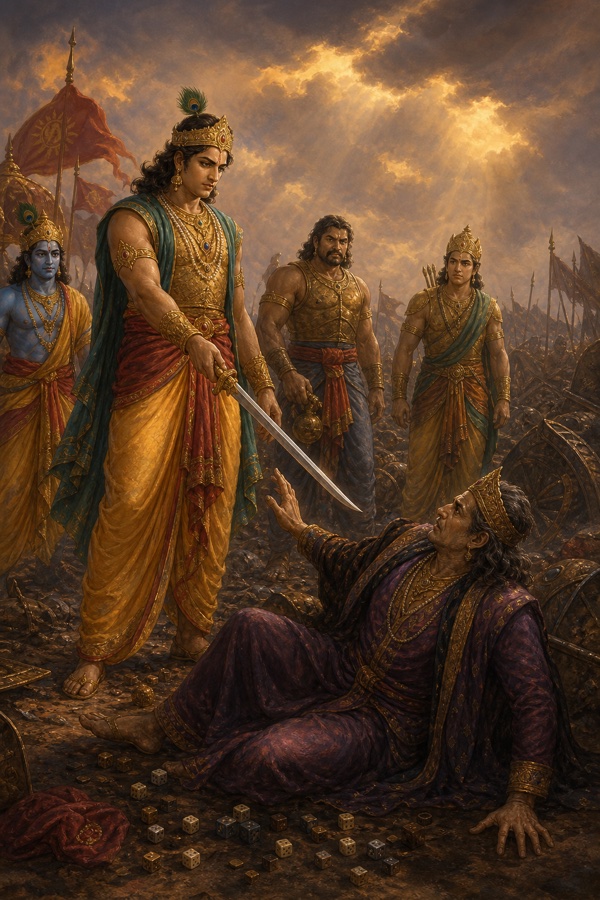
Then Sahadeva came upon Subala’s son himself. Shakuni still hoped for victory, and he was riding away with the fine cavalry of Gandhara around him for protection. Sahadeva remembered that Shakuni, the man who had fallen to his share, was still alive, and he went after him on his gold-adorned chariot. He strung his formidable bow, drew it with great force, and, full of rage, chased the son of Subala and struck him hard with many arrows, vulture-feathered and whetted on stone, the way a man jabs a great elephant with pointed lances. When he had hurt him so, Sahadeva spoke to him, as if to call his old misdeeds back to his mind. “Keep to the duties of a Kshatriya. Fight me, and be a man. You fool, you were very merry in the middle of that assembly when you were gambling with the dice. Take the fruit of that act now, you man of wicked mind. All those evil men who laughed at us then are dead. Only Duryodhana, that disgrace to his line, is still alive, and you, his mother’s brother. Today I will kill you. I will knock your head off with a razor-headed arrow, the way a man knocks a fruit from a tree with a stick.”
Sahadeva said this and rushed at Shakuni in a fury. He came up to his enemy, drew his bow hard, and, as if he would burn him with his anger, pierced Shakuni with ten arrows and his horses with four. Then he cut down Shakuni’s parasol, his standard and his bow, and roared like a lion. With standard, bow and parasol gone, Subala’s son was pierced with many arrows in every vital part, and Sahadeva sent another shower at him that could not be withstood. In a rage, the son of Subala rushed at Sahadeva alone and at speed, meaning to kill him with a lance adorned with gold. The son of Madri lost no time. At the head of the battle, with three broad-headed arrows shot together, he cut off the lifted lance and both of his enemy’s well-rounded arms, and gave a loud roar. Then, quick as he was, he took a broad-headed arrow made of hard iron, winged with gold, able to go through any armor, loosed it with great force and care, and cut his enemy’s head from his body. That gold-decked arrow was very sharp and bright as the sun, and the son of Subala, his head taken off by the son of Pandu, fell to the earth in that battle. With that swift shaft, whetted on stone, Pandu’s son in his rage had struck off the head that was the root of the evil policy of the Kurus.
The Kaurava warriors saw Shakuni lying headless on the ground, every limb drenched in gore. Fear took the strength out of them, and they fled on all sides with their weapons still in their hands. The Dhartarashtras, their chariots, elephants, horse and foot all broken, heard the twang of Gandiva and ran, pale and senseless with fright. The Pandavas had thrown Shakuni down from his chariot, and they were filled with delight. With Krishna among them they rejoiced and blew their conches in that battle to gladden their troops. All of them, with happy hearts, honored Sahadeva. “By good fortune, hero,” they said, “you have killed Shakuni, that man of wicked soul and evil ways, and his son with him.”
A sub-tale: When Uluka falls, Sanjaya stops over Shakuni for a moment. The man whose head will shortly be called the root of the evil policy of the Kurus stands with his voice choked and his eyes full of tears, breathing hard, and what comes into his mind is Vidura. Sanjaya does not repeat what Vidura had said. A little later Duryodhana, walking alone toward the lake, will remember Vidura too, and there the thought is spelled out: Vidura had foreseen this slaughter of the Kshatriyas.
The gist: Shakuni’s son wounds Sahadeva in the head with a lance, and Bhima holds the Kuru army off until he recovers. Sahadeva beheads Uluka. Shakuni, in tears, throws a scimitar, a mace and a dart at Sahadeva in turn, fails with all three, and flees with his Gandhara cavalry. Sahadeva rides him down, reminds him of the dice, cuts off his lance and both his arms with three arrows, and takes his head with one more.
The end of the army, and Duryodhana left alone
What came after, Sanjaya told the king, began with the followers of Subala’s son. They were filled with rage. Ready to lay down their lives in that dreadful battle, they turned and began to resist the Pandavas. Arjuna had resolved to see Sahadeva’s victory through, and he met those warriors, and so did Bhimasena, fierce as an angry snake full of poison. They had come with darts and swords and lances to kill Sahadeva, and Arjuna, with Gandiva, made nothing of their purpose. With his broad-headed arrows he cut down the horses of those rushing fighters, and their heads, and their arms with the weapons still held in them. The horses of those quick and gallant men, struck by him, dropped lifeless to the earth.
King Duryodhana watched his own troops being cut down, and rage filled him. He called together what chariots he had left, which still numbered many hundreds, and his elephants, his horse and his foot, and spoke to them. “Meet all the Pandavas in this battle, with their friends and allies, and the prince of Panchala with his troops. Kill them quickly, and then come back from the fight.” They took the order with respect. Hard men to beat in any battle, they went once more against the sons of Pritha at their king’s word. The Pandavas covered all of them with arrows like venomous snakes as they came on, that last remnant of the Kaurava army, rushing into the dreadful fight. That force had come to the battle and found no protector in it, and those great fighters wiped it out in a moment. The horses of the Kaurava side were running in every direction, coated in the dust the army had raised, and no quarter of the sky could be told from another. Many warriors came out from the Pandava array and killed the king’s troops in a moment in that battle.
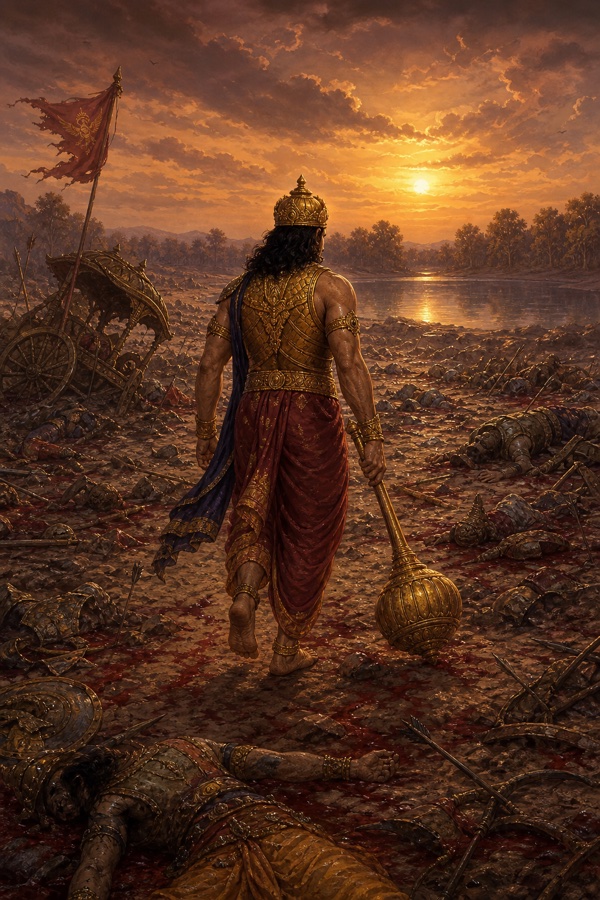
Eleven akshauhinis of troops had been assembled for Duryodhana, Sanjaya said to the king. The Pandavas and the Srinjayas had killed them all. Of the thousands upon thousands of proud kings who had taken his side, only Duryodhana could now be seen alive, and he was badly wounded. He cast his eyes in every direction and saw the earth empty. He had not one soldier left, and the Pandavas, filled with joy in that battle, were roaring aloud because everything they wanted had been accomplished. Duryodhana could not bear the whistle of the arrows those heroes were shooting. He stood stunned. Without troops, without animals, he set his heart on leaving the field.
Dhritarashtra asked, “When my troops had been killed and our camp had been left entirely empty, what strength did the Pandavas still have, Sanjaya? I want to know this. Tell me, for you know how to tell it. And tell me what my son did, the wicked Duryodhana, that king, the one man left alive out of so many, when he saw his army wiped out.”
Sanjaya gave him the count. Two thousand chariots, seven hundred elephants, five thousand horse and ten thousand foot: that was what remained of the great Pandava host. Dhrishtadyumna had charge of that force and waited with it on the field. Duryodhana, great chariot fighter that he was, could not see one warrior of his own side anywhere in the battle. He saw his enemies roaring and his army destroyed. He had no companion. The horse under him had been killed, and he left it and fled the field with his face turned to the east. The man who had been master of eleven akshauhinis took up his mace and fled on foot toward a lake.
He had not gone far on foot before he remembered the words of Vidura, that wise and righteous man. Vidura, he thought, had surely seen all of this long ago, this great slaughter of the Kshatriyas and of the Kurus themselves in battle. With that in his mind, and his heart burning with grief at having watched his army destroyed, the king wanted only to go down into the depths of that lake. Behind him the Pandavas, with Dhrishtadyumna at their head, rushed in a rage at the small remnant of the Kaurava army. The troops in it carried darts and swords and lances and were roaring loudly, and Arjuna with Gandiva made nothing of what they intended. He killed them with his sharp shafts, with their allies and their kinsmen, and stood on his chariot behind its white horses, very fine to look at. Subala’s son had fallen, and his horse and chariots and elephants with him, and the Kaurava army looked like a great forest laid flat by the wind. Duryodhana’s army had numbered many hundreds of thousands of warriors. Now no great chariot fighter in it could be seen alive except Drona’s son, and Kritavarma, and Kripa of Gautama’s line, and the king himself.
A key to reading this (the akshauhini): By the reckoning given at the start of the Mahabharata, an akshauhini is 21,870 chariots, the same number of elephants, 65,610 horse and 109,350 foot. Eleven of them had been assembled for Duryodhana. Against that, Sanjaya’s count of what the Pandavas have left on the evening of the eighteenth day is two thousand chariots, seven hundred elephants, five thousand horse and ten thousand foot.
The gist: Duryodhana throws his last few hundred chariots at the Pandavas, and they are destroyed in a moment. All eleven akshauhinis are gone; the Pandavas have two thousand chariots, seven hundred elephants, five thousand horse and ten thousand foot. Duryodhana, wounded, his horse dead, takes his mace and goes east on foot toward a lake, thinking of Vidura. Of his great chariot fighters only Ashvatthama, Kritavarma and Kripa are still alive.
Sanjaya set free, and Duryodhana’s entry into the lake
Sanjaya had his own story to tell at this point, for he was still a prisoner. Dhrishtadyumna caught sight of him and laughed, and said to Satyaki, “What is the use of holding this one? Nothing is gained by keeping him alive.” Satyaki, the grandson of Shini, heard that, raised his sharp sword, and made ready to kill him. At that moment Vyasa arrived, the wise Krishna who was born on an island. “Let Sanjaya go alive,” he said. “He is on no account to be killed.” Satyaki joined his hands before the island-born sage. Then he set his prisoner free and said, “Peace to you, Sanjaya. You may go.”
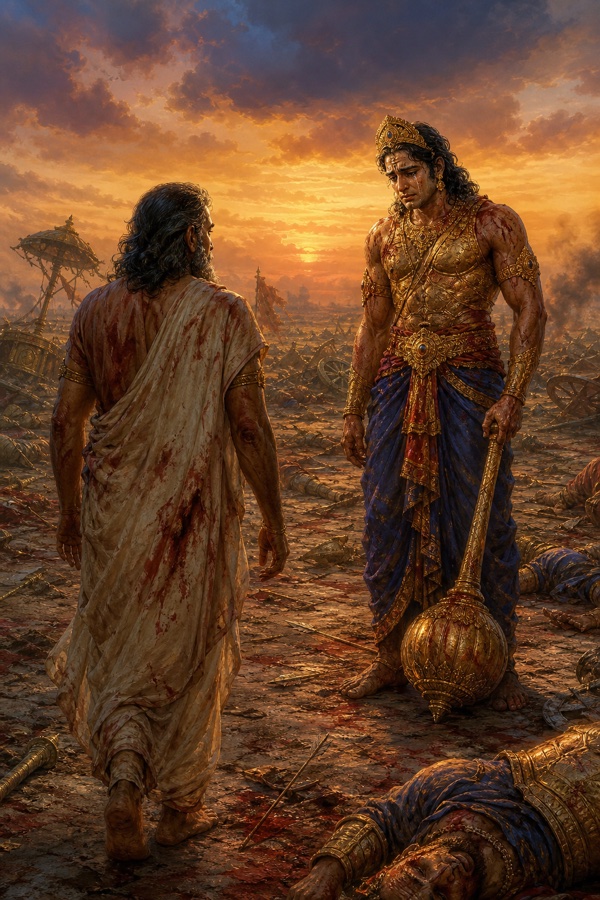
With that leave Sanjaya took off his armor and handed over his weapons, and set out in the evening on the road to the city, his limbs bathed in blood. He had come about two miles when he saw Duryodhana, standing alone, mace in hand, terribly wounded. The king’s eyes were full of tears, and because of them he could not see who was in front of him. Sanjaya stood before him, sick at heart. Duryodhana looked at him and did not know him. Seeing him stand there alone on the field, given over to grief, Sanjaya was overcome with sorrow himself, and for a little while he could not bring out a word. Then he told him everything: how he had been captured, and how he had been released by the grace of the island-born.
Duryodhana thought for a moment and came back to himself. He asked about his brothers and his troops. Sanjaya had seen it all with his own eyes and told him all of it: his brothers were dead, every one, and his troops had been wiped out. He told Duryodhana that only three chariot fighters of their side were left alive, for Vyasa had said so as he was setting out from the place where the Pandavas were. Duryodhana drew deep breaths and looked at him again and again. He touched Sanjaya with his hand. “Except for you, Sanjaya, not one of those who fought in this battle is alive. I see no other man of mine, and the Pandavas still have their allies living. Go to the blind king, Sanjaya, to my lord Dhritarashtra, and tell him that his son Duryodhana has gone down into the depths of a lake. I have lost such friends as I had. I have lost my sons and my brothers, and I see my kingdom taken by the Pandavas. Who, in my place, would want to live? Tell the king all this. Tell him too that I came out of that terrible battle with my life, and that, alive, though badly wounded, I will rest in the depths of this lake.” Having said this, the king went into the lake. By his power of illusion he charmed its waters, and made a space for himself inside them.
Sanjaya was left there with nobody of his own side near him. Then he saw three chariot fighters coming toward the place together, their animals worn out: Kripa, the son of Sharadvat; Ashvatthama, hero and great chariot fighter; and Kritavarma of the Bhoja line. All three were torn by arrows. They caught sight of him, whipped their horses to greater speed, and came up. “By good fortune, Sanjaya, you are still alive,” they said. Then they asked about the king. “Is our king Duryodhana still alive, Sanjaya?” He told them that the king was well in body. He told them everything Duryodhana had said to him, and he pointed out the lake the king had entered.
Ashvatthama heard him out. He turned his eyes on that wide lake and broke into a wail of grief. “Alas, alas, the king does not know that we are still alive. With him among us we are still well able to fight our enemies.” The three great chariot fighters wept there a long time. Then they saw the sons of Pandu and fled. Those three, all that remained of the Kaurava army, took Sanjaya up onto Kripa’s finely adorned chariot and drove to the Kuru camp. The sun had set a little while before.
A key to reading this (Krishna the island-born, that is, Vyasa): The Krishna who saves Sanjaya here is the sage Vyasa. He was born on an island in the Yamuna, the son of Satyavati and the sage Parashara, and so he is called Dvaipayana, the island-born; for his dark color he is called Krishna. The lake Duryodhana enters also bears the name Dvaipayana.
The gist: Dhrishtadyumna sees no use in keeping Sanjaya alive, and Satyaki lifts his sword; Vyasa arrives and orders him released. Two miles down the road to the city Sanjaya meets Duryodhana alone and in tears, tells him that his brothers and his army are dead, and is given a message for Dhritarashtra. Duryodhana charms the waters of the lake and goes in. Ashvatthama, Kripa and Kritavarma find Sanjaya, weep at the lake, and carry him to the camp on Kripa’s chariot after sunset.
The queens’ departure for the city, and Yuyutsu’s return to Hastinapura
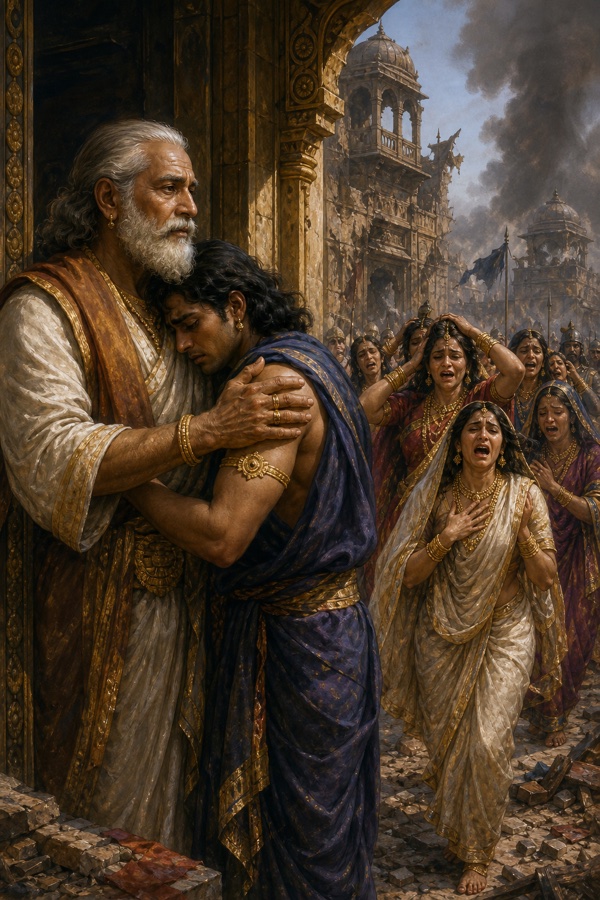
At the camp, Sanjaya went on, the troops who held the outposts learned that every one of the king’s sons had been killed, and they wept aloud. The old men appointed to look after the women of the royal household set out for the city, taking the princesses with them. When those women heard that the whole army had been destroyed, their wailing was loud. They cried without stopping, and the earth rang with their voices as it does with a flight of she-ospreys. They tore their bodies with their nails. They struck their heads with their hands and pulled loose their braids, crying out all the while. They filled the air with “Oh!” and “Alas!”, beat their breasts, wept and shrieked. Then the friends of Duryodhana, crushed by grief and left voiceless by their tears, set out for the city and took the women of the royal household with them.
The guards of the camp fled quickly toward the city, carrying with them many white beds spread with costly coverlets. Others put their wives on carts drawn by mules and went the same way. Women who, in their own houses, the sun itself had never been allowed to see were now on the open road to the city, under the eyes of the common people. They were delicate women. They had lost those nearest to them and their kin, and they traveled fast. The very cowherds and shepherds, and the common men with them, were in a panic for fear of Bhimasena and fled toward the city. Even such men as these were in great terror of the sons of Pritha, and they ran for the city looking at one another as they went.
In the middle of that general flight, with fear all around him, Yuyutsu, out of his senses with grief, thought about what he ought to do now that this hour had come. “The Pandavas, terrible in their prowess, have beaten Duryodhana in battle. He had eleven akshauhinis under him. All his brothers have been killed. All the Kauravas, with Bhishma and Drona at their head, are dead. By the working of fate, I alone have been spared. Everyone who was in the Kuru camp has fled. They are running in all directions, their strength gone, with nobody to protect them. Such a sight was never seen before. Sick with sorrow, their eyes wide with fear, they run every way like a herd of deer, looking at one another. Those of Duryodhana’s counselors who are still alive have fled toward the city and taken the women of the royal household with them. I think the time has come for me to enter the city with them too, once I have the leave of Yudhishthira and Krishna.” With that purpose the prince went and presented himself before those two.
King Yudhishthira is always compassionate, and he was well pleased with him. He embraced that son of a Vaishya mother and sent him on his way with affection. Yuyutsu mounted his own chariot and drove his horses hard. Then he oversaw the removal of the women of the royal household to the city. The sun was going down. He entered Hastinapura with those women, his eyes full of tears and his voice choked with grief.
There he saw the wise Vidura sitting with tears in his eyes. Vidura had come away from Dhritarashtra because his heart could bear no more sorrow. Yuyutsu bowed to him and stood before him. Vidura, who held to the truth, said, “By good fortune, my son, you are alive in this destruction of all the Kurus. Why have you come without King Duryodhana, though? Tell me the reason in full.” Yuyutsu answered him. “When Shakuni had fallen, sir, with all his kinsmen and friends, King Duryodhana left the horse he was riding and fled in fear toward the east. Once the king had fled, all the people in the camp were shaken with fear and fled toward the city. Then the guardians of the women put the king’s wives, and his brothers’ wives, on vehicles and fled in fear themselves. I asked leave of King Yudhishthira and of Krishna and set out for Hastinapura to protect the people who were fleeing.”
Vidura heard these words from the son of Dhritarashtra’s Vaishya wife. He knew every custom, he felt what the hour required, and he praised Yuyutsu, who had spoken well. “You have done what was right, with all the Bharatas destroyed as you tell me they are. Out of compassion you have also upheld the honor of your house. By good fortune we see you come back alive from that terrible battle, which has destroyed so many heroes, and we look at you as creatures look at the blazing sun. You, my son, are now in every way the one staff of the blind king. He had no foresight. Calamity has overtaken him and fate has struck him, and though he was warned again and again he could not leave off his evil policy. Rest here today. Tomorrow you may go back to Yudhishthira.”
With those words Vidura, his eyes full of tears, took leave of Yuyutsu and went into the king’s house. It rang with cries of “Oh!” and “Alas!” from people of the city and the villages, sunk in their grief. The house seemed to have lost all its beauty; comfort and happiness seemed to have left it. It stood empty and in disorder. Vidura had been full of sorrow already, and it grew at that sight. He knew every duty, and with a heavy heart, drawing deep breaths, he went into the palace. Yuyutsu spent that night in his own house. People greeted him with praises, and he was too wretched to take any joy in them. He passed the hours thinking of the terrible destruction the Bharatas had brought on one another.
A key to reading this (Yuyutsu): Yuyutsu was Dhritarashtra’s son by a Vaishya wife. Before the first day’s battle, when Yudhishthira called out in the hearing of all the warriors that he would accept as an ally any man who chose his side, Yuyutsu answered and crossed over to fight for the Pandavas. So at the end of the eighteenth day he is alive in the Pandava camp, and he says of himself that by the working of fate he alone has been spared.
The gist: The camp breaks up in panic: guards, counselors, cowherds and the women of the royal household all flee to Hastinapura. Yuyutsu takes leave of Yudhishthira and Krishna, sees the women safely into the city at sunset, and reports to Vidura. Vidura praises him, calls him the one staff left to the blind king, and tells him to rest and go back to Yudhishthira the next day.
Ashvatthama’s vow, and the hunters who found the secret
Dhritarashtra asked, “When the sons of Pandu had killed all the Kaurava troops on the field of battle, what did the survivors of my army do, Kritavarma and Kripa and the brave son of Drona? And what did that wicked king Duryodhana do then?”
Sanjaya took up the tale from the evening. The women of those Kshatriyas had fled and the Kaurava camp stood entirely empty, and the three chariot fighters the king had named were filled with anxiety. They heard the shouts of the victorious sons of Pandu. They saw the camp deserted as evening came on. They wanted to rescue the king, they could not stay on the field, and they made their way toward the lake. Yudhishthira was on the field with his brothers, full of joy, going over it in the hope of killing Duryodhana. The Pandavas were angry and wanted their victory complete, and they searched for him. They looked very carefully, and they could not find the Kuru king. Mace in hand, he had fled the battlefield at great speed and gone down into that lake, after making its waters solid by his powers of illusion.
At last the animals of the Pandavas were worn out, and they went to their camp and rested there with their soldiers. When the sons of Pritha had withdrawn, Kripa and Drona’s son and Kritavarma of the Satvata line went slowly on to the lake. They came to the water in which the king lay, an unbeaten king asleep beneath it, and they spoke to him. “Rise, king, and fight Yudhishthira with us beside you. Win, and enjoy the earth; or be killed, and go to heaven. You have destroyed the forces of the Pandavas too, Duryodhana. Those of them who are still alive are badly cut up. They will not be able to bear your charge, least of all when we are protecting you. So rise.”
Duryodhana answered from the water. “By good fortune I see you three come back alive from this ruinous battle between the Pandavas and the Kauravas. When we have rested a while and thrown off our weariness, we will meet the enemy and beat him. You are tired too, and I am badly wounded. The Pandava army is swelling with strength. For these reasons I have no wish to fight now. That you urge me to it does not surprise me, for your hearts are noble and your devotion to me is great. This is no hour for valor. Let me rest this one night. Tomorrow I will join you and fight the enemy. Of that there is no doubt.”
Drona’s son would not have it. He said to that king who had never been beaten in battle, “Rise, king, and may good come to you. We will still defeat the enemy. I swear by all my religious acts, by all the gifts I have made, by truth itself, and by my silent prayers, that I will kill the Somakas today. May I never have the joy that comes of performing sacrifices, the joy all pious men feel, if this night passes away without my killing the Pandavas in battle. I will not take off my armor until I have killed all the Panchalas. I am telling you the truth. Believe me, ruler of men.”
While they were talking, some hunters came to the place. They were tired from the weight of the meat they carried, and they had come there with no purpose except to quench their thirst. Every day these men used to bring Bhimasena a basketful of meat, with great respect. They sat down on the bank of the lake, out of sight, and they heard every word that passed between Duryodhana and the three warriors. They heard the Kuru king unwilling to fight, and those great archers, eager for battle themselves, pressing him hard to do as they advised. They saw the chariot fighters of the Kaurava army. They understood that the king, with no will to fight, was lying under the water, and as they listened to those heroes talking with their master down in the depths of the lake they saw clearly that it was Duryodhana who lay there. And they made up their minds. A little while before, the son of Pandu, searching for the king, had met these same men and asked them where Duryodhana might be. They remembered what he had said, and they whispered to one another. “We will show the Pandavas where Duryodhana is, and the son of Pandu will give us wealth. It is plain to us that the famous King Duryodhana is here. Let us all go to King Yudhishthira and tell him that Duryodhana, who never forgives, is hidden in the waters of this lake. Let us all go to Bhimasena too, that great and clever archer, and tell him that Dhritarashtra’s son is hidden here in the waters of this lake. He will be pleased with us and give us much wealth. Why should we wear ourselves out day after day fetching meat, and grow weak with that work?”
The hunters were full of joy and hungry for the money. They took up their baskets of meat and set off for the Pandava camp. The Pandavas, sure of aim and skilled in striking, had not found Duryodhana in battle, for he was hidden, and they were resting in their camp. They wanted to see the end of that sinful man’s evil policy, and they had sent spies out in every direction over the battlefield. All the soldiers sent on that errand came back to the camp together and told King Yudhishthira that no trace of King Duryodhana could be found. Yudhishthira heard what the returned messengers had to say, and he was filled with great anxiety and began to breathe heavily.
Gloom had settled on the Pandavas when the hunters arrived, having come at great speed from the bank of the lake, full of joy at having found Duryodhana. They were forbidden to enter. They entered the camp anyway, in full sight of Bhimasena, went up to that powerful son of Pandu, and told him everything they had seen and heard. Bhima gave them a great deal of wealth. Then he told all of it to King Yudhishthira. “The hunters who supply me with meat have found Duryodhana, king. The man you are grieving over is lying in a lake whose waters he has made solid.” The words were welcome. Kunti’s son Yudhishthira, the king called Ajatashatru, was filled with joy, and so were all his brothers.
A sub-tale: The men who give Duryodhana away are hunters who carry a basket of meat to Bhimasena every day. They come to the lake only to drink. A little while before, the son of Pandu, searching for the king, had met them and asked whether they knew where Duryodhana was, so when they overhear the king talking from under the water they know at once what the news is worth. Their reasoning is their own: the son of Pandu will pay, and they will be done with hauling meat.
The gist: The three survivors come to the lake in the evening and urge Duryodhana to rise and fight. He asks for one night’s rest and promises to fight in the morning. Ashvatthama swears that he will not take off his armor until he has killed all the Panchalas. Hunters resting on the bank hear the whole exchange, carry it to Bhima for a reward, and Bhima tells Yudhishthira that Duryodhana lies in a lake whose waters he has made solid.
The Pandavas reach Lake Dvaipayana, and Krishna’s counsel of stratagem
Sanjaya said that as soon as Yudhishthira learned that Duryodhana, that great archer, had gone down into the waters of a lake, he set out for the place at great speed, with Krishna going before him. A great noise went up from the Pandavas and the Panchalas, all of them full of joy. The warriors roared like lions and shouted aloud. Every Kshatriya there hurried toward the lake called Dvaipayana. On every side the rejoicing Somakas cried out, loudly and again and again, “The sinful son of Dhritarashtra has been found!” The chariots of those headlong fighters, driven at speed, made a noise that grew very loud and touched the sky.
Their animals were tired, and still all of them pressed on fast behind King Yudhishthira, who was bent on finding Duryodhana. Arjuna went with him, and Bhimasena, and the two sons of Pandu by Madri, and the Panchala prince Dhrishtadyumna, and the unbeaten Shikhandi, and Uttamaujas, and Yudhamanyu, and the great chariot fighter Satyaki, and the five sons of Draupadi, and those of the Panchalas who were still alive, and all the Pandavas, and all their elephants, and foot soldiers in their hundreds upon hundreds. Yudhishthira came to the lake known as Dvaipayana, where Duryodhana was. It was wide as the ocean, pleasant to look at, and its waters were cool and clear. Dhritarashtra’s son lay inside that lake, having made its waters solid by his power of illusion, by a method that was a wonder in itself. Under those waters lay a king armed with his mace whom no man could defeat.
From inside the lake Duryodhana heard the uproar of the Pandava army, like the roar of the clouds. Yudhishthira and his brothers were coming to that water to kill him, raising a thick dust, and the son of Pandu made the earth tremble with the sound of his chariot wheels and the loud blare of his conch. Kritavarma, Kripa and the son of Drona heard the noise of Yudhishthira’s army too, and they spoke to the Kuru king. “The Pandavas are coming here, full of joy and eager for victory. We will leave this place. We want you to know it.” Duryodhana heard those quick and able men and answered, “So be it,” and stayed where he was inside the waters he had made solid by his powers of illusion. The chariot fighters, with Kripa at their head, were full of grief. They took their leave of the king and went away to a place far from that spot. A long way off they saw a banyan tree and stopped in its shade, very tired, and sick with anxiety about the king. Their thoughts ran on him. Dhritarashtra’s strong son had made the waters of the lake solid and lay stretched at the bottom. The Pandavas had reached the place, wanting battle. How would the battle go? What would become of the king? With these things in their minds, Kripa and the others unyoked their horses from their chariots and made ready to rest there for a time.
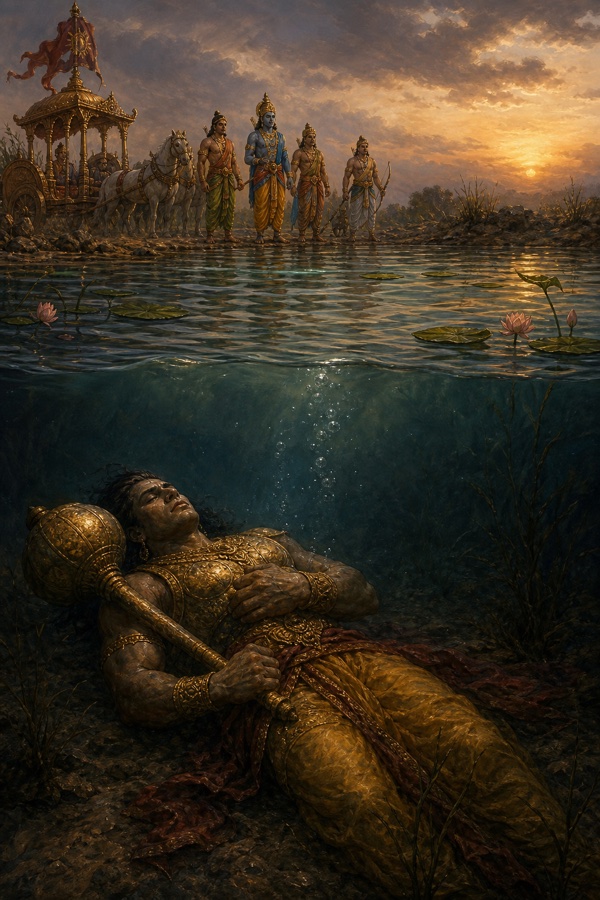
When the three chariot fighters had gone, the Pandavas arrived at the lake in which Duryodhana was resting. They came to the banks of Dvaipayana and looked at that body of water, enchanted by Dhritarashtra’s son. Yudhishthira spoke to Krishna. “Look, the son of Dhritarashtra has put his power of illusion on these waters. He has enchanted the water and is lying inside it. He can have no fear now of harm from any man. He has called up a celestial illusion and is there within the waters. He knows every kind of deceit, and by an act of deceit he has found this refuge. He will not escape me alive, though. Even if the wielder of the thunderbolt himself helps him in battle, Krishna, people will see him killed today.”
Krishna answered, “Use your own powers of illusion, Yudhishthira, and destroy this illusion of Duryodhana’s, for he is an adept in it. A man who deals in illusion should be killed by illusion. That is the truth. With acts and with means, and by putting your own power of illusion on these waters, kill this Suyodhana, who is the very soul of illusion. It was with acts and means that Indra himself killed the Daityas and the Danavas. Bali was bound by that great one, Upendra, with the help of many acts and means. The great Asura Hiranyaksha was killed with the help of many acts and means, and so was that other one, Hiranyakashipu. Vritra too, without any doubt, was killed with the help of acts. So was the Rakshasa Ravana of Pulastya’s line, with his kinsmen and followers, killed by Rama. Rely on acts and contrivances, and show your own powers. Those two ancient Daityas, Taraka and the fierce Viprachitti, were killed in old times with the help of acts and means. So were Vatapi and Ilvala, and Trishiras, and the Asuras Sunda and Upasunda: all of them were killed with the help of means. Indra himself enjoys heaven with the help of acts and means. Acts have great power, king, and nothing else has as much. Daityas and Danavas and Rakshasas and kings have been killed with the help of acts and means. So take the help of action yourself.”
A key to reading this (Krishna’s rule of “Illusion against illusion”): Krishna’s advice is short: a man who deals in illusion is to be killed by illusion, with acts and means. He supports it with a list. Indra killed the Daityas and Danavas so; Upendra bound Bali so; Hiranyaksha, Hiranyakashipu and Vritra died so; Rama killed Ravana of Pulastya’s line so; and Taraka, Viprachitti, Vatapi, Ilvala, Trishiras, Sunda and Upasunda fell the same way. Yudhishthira’s answer to the advice is to smile and begin talking to the man under the water.
The gist: Yudhishthira leads the whole surviving Pandava force to the lake called Dvaipayana. Hearing them come, Kripa, Ashvatthama and Kritavarma take leave of Duryodhana and withdraw to a distant banyan, where they unyoke their horses. Yudhishthira sees that the water has been enchanted, and Krishna tells him to break illusion with illusion, as Indra, Upendra and Rama did against their enemies.
Yudhishthira’s stinging taunts to Duryodhana within the water
Sanjaya told how Yudhishthira took that counsel. He smiled, and he spoke to Dhritarashtra’s powerful son where he lay inside the waters of the lake. “Why have you gone into this water, Suyodhana, after bringing all the Kshatriyas to their deaths, after causing your own family to be wiped out? Why have you gone into this lake today, wanting to save your own life? Rise, king, and fight us. Where has it gone now, that pride of yours and that sense of honor, that you have enchanted these waters and are lying inside them? In the assemblies all men speak of you as a hero. I think every word of it is false, since you are hiding now under this water. Rise, king, and fight, for you are a Kshatriya, born in a noble line. More than that, you are a Kaurava. Remember your birth.
“How can you boast of being born in Kuru’s line when you run from battle in fear and hide in the depths of this lake? To stay away from battle is no part of the eternal duty of a Kshatriya. Running from battle is not what honorable men do, king, and it does not lead to heaven. You wanted victory. How is it that you sit in this lake now, with the war unfinished, after causing the slaughter of your sons and brothers and fathers and relatives and friends and mother’s brothers and kinsmen, and watching it? You have always boasted of your courage, and you are no hero. You speak falsely when you call yourself a hero in the hearing of all men, you man of wicked mind. Heroes never run at the sight of an enemy. Or tell us, hero, what kind of courage it is that made you flee the battle.
“Rise, prince, and fight, and throw off your fears. You have had all your troops and your brothers killed, Suyodhana. If any righteous motive moves you, you ought not to be thinking now of saving your life. A man like you, who has taken up the duties of a Kshatriya, ought not to act this way. You leaned on Karna, and on Shakuni the son of Subala, and thought yourself immortal, and in your folly you failed to understand what you were. You have done grievous wrong. Fight now. How does running from battle recommend itself to a man like you? You have forgotten yourself. Where is that manliness of yours, and where is the pride you nursed? Where has your prowess gone, and all that great, swelling energy you had? Where is your skill in weapons? Why are you lying in this lake? Rise, and fight as the duties of a Kshatriya require. Either defeat us and rule the wide earth, or be killed by us and sleep on the bare ground. That is your highest duty, as the Creator himself laid it down. Do as the scriptures truly say it should be done, and be a king, great chariot fighter.”
The gist: Yudhishthira, smiling, calls down into the water. He asks Duryodhana why a man who has brought every Kshatriya and his own family to ruin now hides to save his life, tells him that flight is no part of a Kshatriya’s duty and leads to no heaven, reminds him that he trusted in Karna and Shakuni and thought himself immortal, and gives him the choice: conquer and rule the earth, or be killed and lie on the bare ground.
Duryodhana’s answer, his offer to give up the kingdom, and Yudhishthira’s refusal
Duryodhana heard Dharma’s wise son out, Sanjaya said, and answered him from inside the waters. “It is no wonder at all, king, that fear should enter the hearts of living creatures. As for me, I did not leave the battlefield out of fear for my life. My chariot was destroyed. My quivers were gone. The drivers who guarded my flanks were killed. I was alone, without one follower to stand by me in battle. That is why I wanted a little rest. I did not enter these waters to save my life, or from fear, or from grief. I entered them because I was tired, and for that reason only. Rest a while yourself, son of Kunti, and let those who follow you rest. I will rise from this lake and fight all of you in battle. Be sure of it.”
Yudhishthira would not wait. “All of us have rested enough. We spent a long while searching for you. Rise now, this moment, Suyodhana, and give us battle. Either kill the sons of Pritha in battle and make this prosperous kingdom your own, or be killed by us in battle and go to the worlds kept for heroes.”
Duryodhana said, “Those of the Kurus for whose sake I wanted the kingdom, my own brothers, all lie dead on the field. The earth has been stripped of her wealth and robbed of her best Kshatriyas, and she is like a widow now. I have no wish to enjoy her any longer. I do still hope to defeat you, Yudhishthira, once I have humbled the pride of the Panchalas and the Pandus. Yet there is no need for battle any more, now that Drona and Karna are quiet and our grandfather Bhishma has been struck down. This stripped earth exists for you now, king. What king would want to rule a kingdom that has lost its friends and allies? I have caused friends such as I had to be killed, and sons, and brothers, and fathers, and I see you taking my kingdom from me. Who, in my place, would want to live? I will put on deerskins and go into the woods. I have no desire for a kingdom, robbed as I am of friends and allies. Almost empty of friends and allies, of heroes and elephants, this earth exists for you. Enjoy her now, and be glad. As for me, I will go to the forest dressed in deerskins. I have no friends left, and I have no desire even for life. Go, king, and rule the earth as you please, an earth without lords, without warriors, without wealth, without citadels.”
Yudhishthira heard those words of sharp grief, Sanjaya said, and he spoke to Duryodhana, who was still inside the waters. “Do not rave in your sorrow like this from under the water. Words like these stir no pity in me for you, king, as they would in Shakuni. You may be willing now, Suyodhana, to make me a gift of the earth. I have no wish to rule an earth that comes to me as your gift. It would be a sin for me to accept this earth from you. To accept a gift is not the duty laid down for a Kshatriya. So I do not want the wide earth given away by you. I will enjoy the earth after I have defeated you in battle. You are not the lord of the earth now. Why do you want to make a gift of something you have no power over? Why did you not give us the earth then, king, when we kept to the rules of righteousness, wished our family well, and begged you for our share? You refused the request of Krishna first. Why do you want to give the earth away now? What folly is this? What king, when his enemies are upon him, would wish to give away his kingdom?
“Son of Kuru’s line, you are not able to give away the earth today. Why do you wish to make a gift of what you have no power over? Defeat me in battle and rule this earth. There was a time when you would not agree to give me even as much of the earth as the point of a needle would cover. How is it, then, that you make me a gift of the whole earth? How is it that you, who once could not part with as much land as a needle’s point covers, now wish to part with all of it? What fool, having won such fortune and ruled the entire earth, would think of making a gift of that earth to his enemies? Folly has dulled you, and you cannot see how improper this is. You wish to give away the earth, and still you will not escape me with your life. Either rule the earth after defeating us, or go to the blessed worlds after being killed by us. If the two of us both stay alive, you and I, every creature will remain in doubt about whose the victory is. Your life depends on me now, you man of short sight. If I choose, I can let you live, and you are not capable of protecting your own life. There was a time when you tried hard to burn us to death, and to take our lives with snakes and with other kinds of poison, and by drowning us. You wronged us too, king, by taking our kingdom, by the cruel words you spoke, and by the way you used Draupadi. For these reasons, wretch, your life must be taken. Rise. Rise and fight us. That will be for your good.”
In that strain, Sanjaya told the king, those heroes, the Pandavas, flushed with victory, spoke on and on there at the lake, rebuking Duryodhana and mocking him.
A key to reading this (land the size of a needle’s point): Yudhishthira is holding Duryodhana to his own earlier words. When the Pandavas, keeping to what was right, asked for their share, and when Krishna himself carried the request, Duryodhana refused, and would not agree to give up even as much land as the point of a needle covers. Now, from under the water, he offers all of it. Yudhishthira gives two reasons for refusing: a Kshatriya’s duty does not include accepting gifts, and the earth is no longer Duryodhana’s to give.
The gist: Duryodhana says that only weariness sent him into the lake, denies any fear, and promises to come out and fight. Pressed again, he says the earth is a widow without his brothers and offers it to Yudhishthira, meaning to go to the forest in deerskins. Yudhishthira will not take the earth as a gift. He recalls the land refused at a needle’s point, the attempts to burn, poison and drown the Pandavas, the stolen kingdom and the treatment of Draupadi, and tells him that his life must be taken.
Duryodhana rises from the lake, and the challenge to a mace duel
Dhritarashtra said, “When his enemies had lectured him in this way, how did he behave, my heroic and royal son, who is wrathful by nature? He had never in his life listened to reproofs like these. Everyone had treated him with the respect that is due to a king. He used to grieve at standing even in the shade of a parasol, thinking that he had taken shelter under something not his own. His pride was so tender that he could not endure the very brightness of the sun. How could he endure these words from his enemies? You have seen with your own eyes, Sanjaya, the whole earth, down to her Mlecchas and her wandering tribes, living on his favor. Rebuked like that, in that place, and by the sons of Pandu of all men, while he lay hidden in so lonely a spot with his followers and attendants gone, what answer did he make to the Pandavas, alas, on hearing such bitter taunts again and again from enemies who had won? Tell me everything about it, Sanjaya.”
Sanjaya told him. Rebuked like that by Yudhishthira and his brothers, Dhritarashtra’s royal son, lying in those waters, heard the bitter words and was wretched. He breathed out long, hot sighs, over and over. He waved his arms again and again. Then he set his heart on battle and answered the royal son of Pandu from inside the water. “You sons of Pritha all have friends, and chariots, and animals. I am alone, miserable, without a chariot and without an animal. Alone and without weapons, how can I dare to fight on foot against many enemies who are all well armed and have their chariots? Fight me one at a time, Yudhishthira. It is not right that one man should have to fight many brave men in battle, least of all when that one has no armor, is tired, is sunk in calamity, has wounds all over his limbs, and has neither animals nor troops.
“I have not the least fear of you, king, or of Bhima the son of Pritha, or of Arjuna, or of Krishna, or of all the Panchalas, or of the twins, or of Satyaki, or of all the other troops you have. Standing in battle, alone as I am, I will hold all of you off. The fame of every righteous man rests on righteousness, king. I say all this to you with both righteousness and fame in view. I will rise from this lake and fight all of you in battle. As the year meets each of the seasons in its turn, so I will meet each of you in the fight. Wait, Pandavas. As the sun at dawn puts out the light of all the stars by his own fire, so today, without a weapon and without a chariot, I will destroy all of you, with your chariots and your horses. Today I will free myself of the debt I owe to the many great Kshatriyas who have fallen for me: to Bahlika and Drona and Bhishma and the great-hearted Karna, to the brave Jayadratha and Bhagadatta, to Shalya the ruler of the Madras and Bhurishravas, to my sons, and to Shakuni the son of Subala, to all my friends and well-wishers and kinsmen. Today I will pay that debt by killing you and your brothers.” With those words the Kuru king fell silent.
Yudhishthira said, “By good fortune, Suyodhana, you know the duties of a Kshatriya. By good fortune your heart turns to battle. By good fortune you are a hero, son of Kuru’s line, and by good fortune you understand battle, since you wish to meet all of us alone. Fight any one of us, and take whatever weapon you like. The rest of us will stand here and watch. I grant you this other wish of your heart as well, hero: if you kill any one of us, you shall be king. Otherwise, be killed by us and go to heaven.”
Duryodhana took him at his word. “You are a brave man. If you grant me the choice of fighting only one of you, then this mace I hold in my hand is the weapon I choose. Let any one of you who thinks he can be my match come forward and fight me on foot, armed with a mace. Many wonderful single combats have been fought on chariots. Let this one great and wonderful combat with the mace take place today. Men who fight like to change their weapons. With your leave, let the manner of the fight be changed today. I will defeat you with my mace today, and all your younger brothers with you, and all the Panchalas and the Srinjayas and whatever other troops you still have. I have not the least fear, Yudhishthira, even of Indra himself.”
Yudhishthira answered, “Rise, rise, son of Gandhari, and fight me, Suyodhana. Alone as you are, fight us, meeting one man at a time, strong as you are, with your mace in your hand. Be a man, son of Gandhari, and fight with all your care. Today you will have to lay down your life, even if Indra becomes your ally.”
Duryodhana could not bear these words of Yudhishthira’s, Sanjaya said. He breathed long, heavy sighs from inside the water, like a great snake inside its hole. He had been struck again and again with those goads made of words, and he could not endure it at all, any more than a horse of high breeding can endure the whip. He churned the waters with great force and rose out of the lake like a lord of elephants, breathing heavily in his rage, armed with his heavy mace, which was hard as adamant and decked with gold. He broke through the waters he had made solid and rose with that mace of iron on his shoulder, like the sun itself scorching everything with its rays. Then, strong and quick-witted as he was, he began to handle the heavy mace, made of iron and fitted with a sling.
Those on the bank saw him with the mace in his hand, like a mountain with its crest, or like Rudra himself with the trident, casting angry glances on living creatures, and they noted that the Bharata chief shed a brightness around him like the scorching sun in the sky. Every creature there, seeing him stand with his mace on his shoulder after rising from the waters, thought he looked like Death himself armed with his club. All the Panchalas saw Dhritarashtra’s royal son as Indra with the thunderbolt, or as Hara with the trident. And yet, when they saw him come up out of the water, all the Panchalas and the Pandavas began to rejoice and to catch one another’s hands. Duryodhana took that behavior of the onlookers for an insult aimed at him. He rolled his eyes in wrath, as if he would burn the Pandavas with his glances. He drew his brow into three furrows and bit his lower lip again and again, and he spoke to the Pandavas, with Krishna in their midst. “You Pandavas will have to bear the fruit of these taunts. Killed by me today, you will go, with the Panchalas, to the house of Yama.”
He had risen from the water, Sanjaya said, and there he stood, armed with his mace, his limbs bathed in blood. Covered with blood and drenched with water, his body looked like a mountain shedding water from within. As he stood there with the mace, the Pandavas took him for the angry son of Surya himself, armed with the club called Kinkara. Then, in a voice deep as the clouds, or as a bull bellowing for joy, Duryodhana, with all his prowess and his mace in his hand, summoned the sons of Pritha to battle.
A key to reading this (the rule of fighting one at a time): Duryodhana states the rule twice, once from under the water and once standing on the bank: it is not proper for one man to fight many at once, least of all a man without armor, tired, wounded, and without chariot, animals or troops. Yudhishthira grants it and adds a boon of his own, that Duryodhana shall be king if he kills any one of them. His reply on the rule itself comes a moment later, and it is a question about Abhimanyu.
The gist: Dhritarashtra asks how his proud son bore such taunts. Duryodhana answers from the water that he is alone, unarmed and on foot, asks to be fought one at a time, and swears to pay his debt to Bahlika, Drona, Bhishma, Karna, Jayadratha, Bhagadatta, Shalya, Bhurishravas, his sons and Shakuni. Yudhishthira lets him fight one man with any weapon and promises him the kingdom if he kills that man. Duryodhana chooses the mace, breaks up through the solid water with the iron mace on his shoulder, and stands on the bank bleeding, calling the Pandavas to battle.
The memory of Abhimanyu, Yudhishthira’s second boon, and Krishna’s warning
Duryodhana spoke again. “You will have to meet me one at a time, Yudhishthira. It is not proper that one hero should fight many at the same time, above all when that single warrior has no armor, is worn out with effort, is covered with water, has wounds all over his limbs, and has no chariot, no animals and no troops. Let the gods in heaven watch me fight alone, with no equipment of any kind, without even armor or weapons. I will certainly fight all of you. You shall be the judge of what is proper and what is improper in everything, for you have the qualities a judge needs.”
Yudhishthira said, “How is it, Duryodhana, that you did not know this when many great chariot fighters joined together and killed Abhimanyu in battle? The duties of a Kshatriya are exceedingly cruel. They regard nothing, and they have not the least compassion. How else could all of you have killed Abhimanyu in those circumstances? All of you knew what righteousness is. All of you were heroes. All of you were ready to lay down your lives in battle. The high end promised to those who fight righteously is to reach the worlds of Indra. If this is your duty, that one man should never be killed by many, then why was Abhimanyu killed by many, acting on your counsel? All creatures, when they are in difficulty, forget what virtue requires. Then they see the gates of the other world shut against them.
“Put on armor, hero, and bind up your hair. Take whatever else you need. I grant you one more wish in addition, hero: if you can kill whichever of the five Pandavas you choose to meet, you shall be king. Otherwise, killed by him, you shall go to heaven. Short of your life, hero, tell us what boon we may grant you.”
Then, Sanjaya said, Duryodhana cased his body in armor made of gold and put on a beautiful helmet adorned with pure gold. In that bright golden armor and that helmet he shone like a cliff of gold. In his mail, with his mace in his hand and the rest of his equipment on him, he stood on the field of battle and spoke to all the Pandavas. “Let any one of you five brothers fight me, armed with a mace. For my part, I am willing to fight Sahadeva, or Bhima, or Nakula, or Arjuna, or you, Yudhishthira, today. Give me the encounter and I will fight any one of you, and I will certainly win on this field. Today, with my mace wrapped in cloth of gold, I will reach the end of this war, an end that is hard to reach. I think there is nobody who is my match in a fight with the mace. With my mace I will kill all of you, one after another. There is no one among you all who is able to fight me fairly. It is not proper for me to speak such proud words about myself. Even so, I will make these words of mine true in front of you. Within this very hour they will turn out true or false. Let the one of you who means to fight me take up his mace.”
Duryodhana went on roaring in that strain, Sanjaya said, and Krishna, full of anger, turned on Yudhishthira. “What rash words you have spoken, king: ‘Kill one of us and be king among the Kurus.’ What if Duryodhana chooses you for the fight, Yudhishthira, or Arjuna, or Nakula, or Sahadeva? For thirteen years, wanting to kill Bhimasena, Duryodhana has practiced with the mace on a statue of iron. How is our purpose to be achieved now? Out of compassion you have acted with great rashness. At this moment I see no match for Duryodhana except Bhima, Pritha’s son, and Bhima’s practice with the mace is not so great. So you have once again allowed a wretched game of chance to begin, like that other one long ago between you and Shakuni. Bhima has strength and prowess. King Suyodhana has skill. In a contest between strength and skill, king, the one who has skill always wins. With your own words you have put such an enemy at his ease and put yourself in difficulty, and all of us are in great danger because of it. Who would give up a sovereignty already in his grasp, after defeating all his enemies, when there is only one enemy left to deal with and that one sunk in trouble? I do not see the man in the world today, be he a god, who can defeat Duryodhana in battle when he has a mace in his hand. You cannot defeat Duryodhana in a fair fight, and Bhima cannot, and Nakula cannot, and Sahadeva cannot, and Arjuna cannot. King Duryodhana has great skill. How then can you say to such an enemy, ‘Fight, and choose the mace for your weapon, and if you can kill one of us you shall be king’? Even if Duryodhana meets Bhima out of all of us, and Bhima means to fight him fairly, our victory would be in doubt. Duryodhana has great strength and great skill. How could you say to him, ‘Kill only one of us and be king’? There can be no doubt of it: the children of Pandu and Kunti are not meant to enjoy sovereignty. They were born to spend their lives in the forest, in exile without end, or in beggary.”
A key to reading this (thirteen years of mace-practice): Krishna’s alarm has a number in it. For thirteen years Duryodhana has practiced with the mace on an iron statue, with the killing of Bhima as his aim. Bhima is the only match Krishna can see for him, and Bhima’s practice has been less. Yudhishthira’s boon lets Duryodhana fight any one of the five and promises him the kingdom if he kills that one, and Krishna calls it a second game of chance like the one Yudhishthira played against Shakuni.
The gist: Duryodhana repeats that one man should not be made to fight many. Yudhishthira asks where that knowledge was when many chariot fighters together killed Abhimanyu on Duryodhana’s own counsel, then tells him to put on armor and bind his hair, and grants him the kingdom if he kills whichever of the five he chooses to meet. Duryodhana arms himself in gold and offers to fight any one of the brothers with the mace. Krishna rebukes Yudhishthira for the promise: Duryodhana has thirteen years of practice on an iron statue, skill beats strength, and even with Bhima as the champion the outcome would be in doubt.
Source: the Mahabharata of Krishna-Dwaipayana Vyasa, Shalya Parva, Shalya-vadha and Hrada-pravesha sub-parvas and the opening of the Gada-yuddha sub-parva, Sections 1 to 33. The Sanskrit e-text, the Gita Press Hindi edition, and Kisari Mohan Ganguli’s complete English translation were used to verify names, sequence, and principal events. Where the recensions differ, this English retelling follows Ganguli, and the Hindi edition follows Gita Press.
Based on: The Mahabharata, Vyasa (K. M. Ganguli’s English translation; Gita Press, Gorakhpur)