On this page
By the afternoon of the seventeenth day the war had narrowed to two men. Karna, raised by the charioteer Adhiratha and his wife Radha, was commanding the Kaurava host for the second day running, and somewhere ahead in the dust he stood on a chariot cased in tiger skin with the bow called Vijaya in his hand; wherever his white horses turned, Panchala and Chedi and Somaka chariot fighters were dying. Arjuna was coming for him. He had left his eldest brother Yudhishthira in the camp with Karna’s arrows newly drawn out of his body, and he rode back into the battle behind four white horses of his own, with the ape on his banner and Krishna holding the reins. Somewhere ahead of him too was Bhima, fighting alone deep inside the Kaurava ranks. Arjuna heard the roar of chariots and the shouting from that quarter and asked Krishna for more speed, and Krishna answered that he was already driving as fast as the horses would go for the place where Bhima stood. Before the light failed a prince would have his blood drunk on the open field, a son would be killed in front of his father, the gods would quarrel in the sky over whom to favor, a serpent with a grudge from an old forest fire would ride an arrow, the earth would close on a chariot wheel, and a man standing in the dirt with both hands on that wheel would ask his enemy for a moment’s fairness.
A river of blood, and the fierce onrush of the two brothers
All of it reached the blind king Dhritarashtra at second hand. Sanjaya, his charioteer and counselor, had left the field on the night Karna fell and ridden to Hastinapura on horses as fast as the wind, and he sat now in a palace emptied of kinsmen, telling the old man the afternoon as he had seen it, hour by hour, with the king’s own sons on one side of it and the five sons of Pandu on the other.
Sanjaya told the king that the Kaurava chiefs went at Arjuna first. They came with chariots and cavalry and elephants and men on foot, and the ground carried the noise of their arrows, their wheels, and the hooves of their horses, and Arjuna met them alone. He cut down what they threw at him, and then their heads and arms, with razor-faced arrows and crescent-headed arrows and broad-headed ones; parasols, yak-tail fans, standards, horses, chariots, and whole bands of infantry went over like a forest in a storm, and the great elephants in their gold housings, stuck full of gold-winged shafts, looked like hills on fire. He went into that host the way a sea beast goes into the ocean. Duryodhana’s strongest chariot fighters, men with a tiger’s courage who had put the fear of death behind them, closed on him together with a din like the sea in a gale, and he scattered them as wind scatters piled cloud. Thousands of chariots and elephants and horses went to Yama, the lord of the dead, on his arrows. When four hundred of the chariot fighters had been killed the rest broke and ran, and the uproar they made at the front of the army was the sound of surf striking rock.
With that division in flight he turned toward the part of the field that Karna held, and the noise of his coming was the noise the great bird Garuda made in the old time, stooping on the serpents. Bhima heard it. He had been longing for a sight of his younger brother, and joy went through him. He was the son of the Wind, and from that moment he moved through the fighting like wind, careless of his own life, cutting the host around him apart with arrows and sending men in crowds to Yama. The Kaurava army rocked under him like a wrecked ship on open water, and the soldiers who saw his strength that afternoon thought of the Destroyer at the end of an age and were afraid.
Duryodhana saw his strongest men going down and gave an order to every king and every archer he had: kill Bhima. With Bhima dead, he said, he would count the whole Pandava army as already destroyed. The kings obeyed him and covered Bhima with arrows from every side. Elephants beyond counting, men hungry for the victory, chariots, and horse closed around the man they called Vrikodara, Wolf-belly, and for a moment he stood in the middle of that ring like the full moon inside its halo with the stars around it, a handsome man, and every king in the ring had eyes red with anger and was shooting to kill.
He came out of the press as a fish comes out of a net, driving straight arrows before him, and Sanjaya gave the king the count of what lay behind him: ten thousand elephants that had never once turned back in a fight, two hundred thousand two hundred men, five thousand horses, and a hundred chariot fighters. A river of blood ran where he had been. Blood was its water and chariots were its whirlpools. The elephants were its alligators, the men its fish, the horses its sharks, and the hair of animals grew in it as weed and moss. Arms cut from bodies moved in it like great snakes, and maces and spiked clubs were snakes of another kind. Jewels and gems rolled along in its current. Thighs were its gravel and marrow its mud, heads were its rocks, bows and arrows were the rafts on which men tried to cross it, parasols and standards were its swans, headgear its foam, necklaces its lotuses, and the dust that rose over it made its waves. A brave man could ford it easily. A frightened one found it very hard, as hard as the Vaitarani, the river that runs along the border of the country of the dead, and it flowed the same way that river flows, toward the kingdom of Yama.
A key to reading this (the numbers): Sanjaya’s figures for this hour are round and enormous: four hundred chariot fighters for Arjuna’s first charge, and for Bhima’s breakout ten thousand elephants, 200,200 men, five thousand horses, and a hundred chariot fighters. Set beside the river of blood that follows them, they do one work. They tell a blind king how far the killing had gone past anything a man standing inside it could have counted.
Duryodhana watched it and turned to Shakuni, his mother’s brother, the son of Subala. “Uncle, beat Bhimasena for me. With him beaten, the great host of the Pandavas can be counted as beaten.” Shakuni went forward with his brothers around him and stood in Bhima’s way as a coastline stands against the sea. Sharp arrows met Bhima and he ignored them and kept coming at the sons of Subala. Then Shakuni sent a flight of long shafts, gold-winged, whetted on stone, fletched with heron and peacock feathers, at the left side of Bhima’s chest, and they went through the armor and sank deep. Bhima answered with one arrow dressed in gold. Shakuni had very quick hands. He cut that arrow into seven pieces while it was still in the air.
Bhima watched the pieces drop and lost his temper, and with one broad-headed arrow he cut the bow in Shakuni’s hands as easily as breathing. Shakuni threw it down, took another, and with it sixteen broad-headed arrows. Two went into Bhima, one cut down his standard, two his parasol, and four struck his four horses. Bhima flung an iron dart with a gold-bound shaft, and it landed on Shakuni’s chariot. Shakuni picked up that same dart and threw it back. It went through Bhima’s left arm and dropped to the ground like lightning out of the sky, and the Kauravas all around raised a roar that Bhima could not stand to hear. He strung a fresh bow and covered Shakuni’s soldiers with arrows; then he killed the four horses, then the driver, and cut the standard down with a broad-headed shaft. Shakuni jumped clear of the dead chariot and stood on the ground with his bow drawn, his eyes red as blood, breathing hard, and shot at Bhima from every side. Bhima beat those arrows off, cut that bow as well, and put many sharp arrows into the man himself, and Shakuni went down on the earth almost lifeless. Duryodhana drove in, lifted his stunned uncle onto his own chariot in full view of Bhima, and carried him off the field, and because he feared for Shakuni’s life he kept going. When the troops saw the king himself leave the fighting, every man dropped whatever combat he was in and ran.
Arrows followed the runaways by the hundred. The fleeing divisions fetched up at the place where Karna was, gathered around his chariot, and turned to fight again. He was their shelter now. They took heart from standing near him and near one another, like sailors from a wreck who drag themselves at last onto an island, and with death for their only goal they went back at the Pandavas.
The gist: Arjuna rides back into the battle and breaks the Kaurava chiefs who meet him, killing four hundred chariot fighters. Bhima, hearing him come, cuts his way out of a ring of kings and leaves a river of blood behind him, then unhorses Shakuni and wounds him so badly that Duryodhana has to carry him off. The routed Kauravas gather around Karna, the one place on the field where they still feel safe.
Karna’s slaughter, and Arjuna’s second river of blood
Here the blind king stopped him. When Bhimasena broke our troops, Dhritarashtra asked, what did Duryodhana say, and Subala’s son? What did Karna say, that man who wins wherever he fights, and Kripa, and Kritavarma, and Drona’s son, and Duhshasana, and the rest of my warriors? One son of Pandu fought my whole army single-handed, and that seems to me a thing past wonder. Did Radha’s son deal with the enemy as he had vowed he would? Karna is the fortune of the Kurus, Sanjaya, their armor, their fame, their very hope of staying alive. When he saw the host broken by Kunti’s son, what did Karna do, the son of Adhiratha and Radha? What did my sons do, who are so hard to beat, and the other kings and chariot fighters on our side? Tell me all of it. You know how to tell a thing.
Sanjaya took up the afternoon again. Karna, he said, had started killing the Somakas, the Panchala clansmen of the Pandava side, under Bhima’s very eyes, while Bhima for his part went on destroying the king’s troops. Karna spoke to Shalya, king of the Madras, who was driving for him that day. “Take me to the Panchalas.” A little later, watching his own army come apart under Bhima, he said it again: “To the Panchalas, and nowhere else.” Shalya put the white horses, quick as thought, at the Chedis and the Panchalas and the Karushas, and once inside that host he took the chariot cheerfully to whatever spot Karna pointed out. It was cased in tiger skins and looked like a storm cloud coming. The Pandava soldiers and the Panchalas saw it and were afraid, and its rattle carried across the whole fight like a thunderclap, or like a mountain splitting into pieces.
Drawing the string back to his ear, Karna loosed arrows by the hundred and killed the Pandava soldiery by hundreds and thousands, and the best archers the Pandavas had came to stop him. Shikhandi and Bhima and Dhrishtadyumna of Prishata’s line, who led their army, Nakula and Sahadeva, the five sons of Draupadi, and Satyaki, the grandson of Shini, closed around Radha’s son and poured arrows onto him, meaning to send him out of the world. Satyaki put twenty sharp shafts into the joint of his shoulder. Shikhandi struck him with twenty-five, Dhrishtadyumna with seven, the sons of Draupadi with sixty-four between them, Sahadeva with seven, and Nakula with a hundred, and Bhima, furious, drove ninety straight arrows into that same shoulder joint.
The son of Adhiratha laughed at them. He drew his fine bow and gave every one of them five arrows back. He cut Satyaki’s bow and then his standard and put nine shafts into the middle of his chest; he hit Bhima with thirty; one broad-headed arrow took down Sahadeva’s standard and three more hurt Sahadeva’s driver; and in a moment he had stripped all five of Draupadi’s sons of their chariots. Having turned those champions back he began on the Panchalas and on the chariot fighters of the Chedis. Sanjaya told the king he had seen it with his own eyes and counted it a marvel: Karna alone, with nobody at his side, holding every archer the Pandavas could bring against him. The gods watching from above were pleased with the speed of his hands, and so were the Siddhas and the Charanas, and the Kaurava bowmen cheered him as the first archer living.
After that he burned the Pandava army the way a summer fire burns a heap of dry grass. Soldiers fled at the bare sight of him, a wailing went up among the Panchalas, and the host began to think of Karna as the only warrior on the field, because all the Pandava fighters together could no longer bear even to look at him. Their army broke on him like a rising flood on a mountain. He cut away arms and heads and ears with the earrings still in them; he cut swords with ivory hilts, standards, darts, horses, elephants, chariots, axles, yokes, and wheels. Where the elephants and horses lay, the ground turned to a mire of flesh and blood that no one could cross. Then he called up a celestial weapon, and in the darkness its arrows made, men could no longer tell their friends from their enemies.
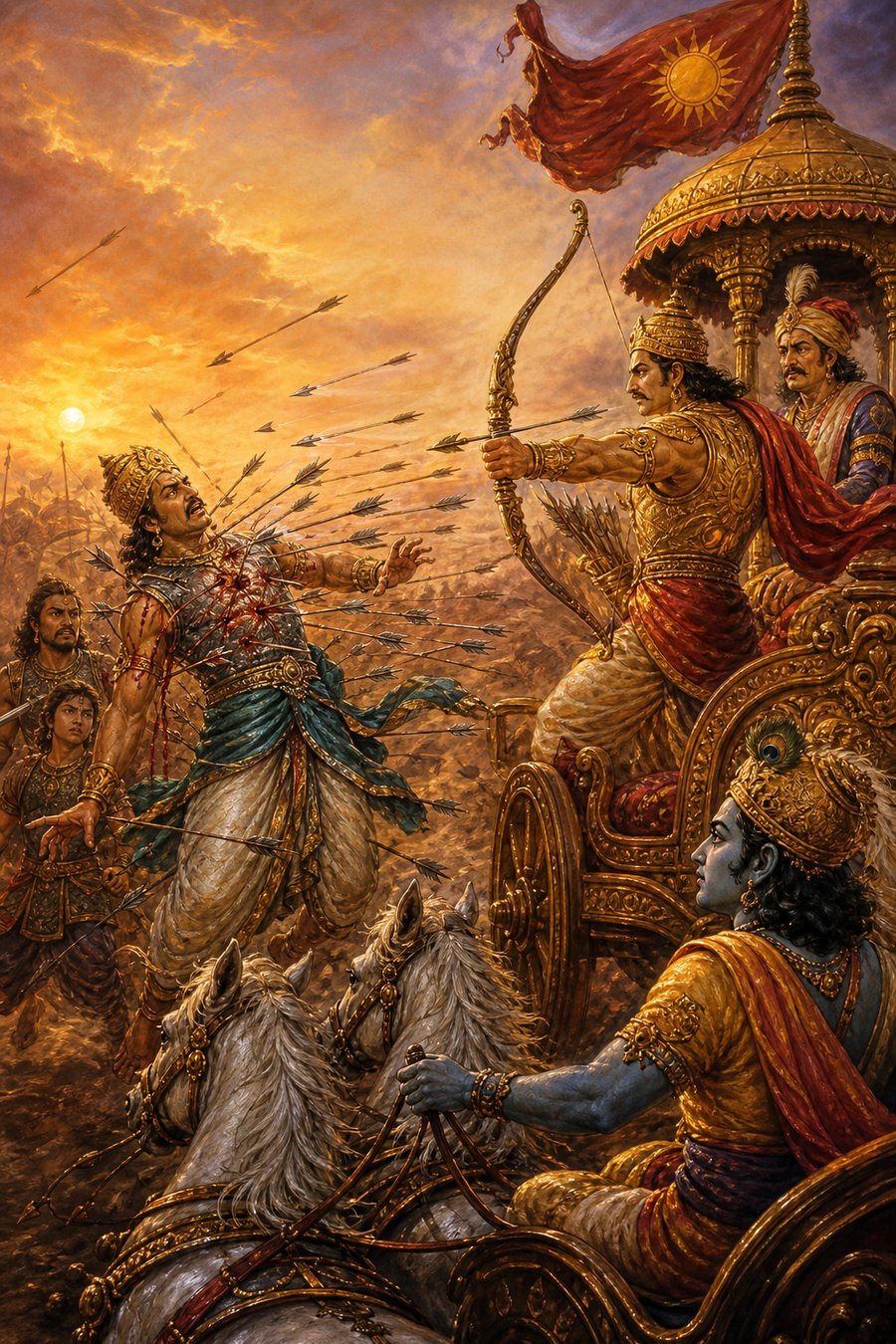
Duryodhana, delighted, had every drum and horn in the army sounded. The Panchala bowmen, though broken, came back with death for their goal, and Karna broke them a second time: twenty Panchala chariot fighters and more than a hundred Chedi warriors died on his arrows, and he stood alone above the dead Somakas, as hard to look at as the sun at noon. Even so the Panchalas would not run from him, and Sanjaya called their courage a marvel of its own. Elsewhere on the field Duryodhana, Duhshasana, Kripa, Ashvatthama, Kritavarma, and Shakuni were killing Pandava soldiers by hundreds and thousands, and Karna’s two sons were doing the same in several places at once. Against them Dhrishtadyumna and Shikhandi and the sons of Draupadi were cutting into the Kaurava host, and Bhima was costing it more than any of them.
Sanjaya told the king that Arjuna, meanwhile, had destroyed the four arms of the force sent against him, the elephants, the chariots, the horse, and the foot, and had caught sight of Karna in his rage; and where he had fought, a second river of blood was running, tawny with flesh and marrow and bone. Men’s heads were its rocks and stones. Dead elephants and horses made its banks. It was full of the bones of brave men and loud with the crying of ravens and vultures. Parasols rode on it like swans, and it carried warriors along as a flood carries trees. Necklaces were its lotus beds and headgear its foam, bows and arrows were its fish, and the crowns of crushed men floated on its surface. Shields and armor made its whirlpools, and chariots were its rafts. A man who wanted victory could ford it, and a coward could find no crossing anywhere.
From the bank of that river Arjuna spoke to Krishna, the son of Vasudeva. “There, Krishna, I can see the standard of the charioteer’s son. Bhimasena and the others are fighting him there. The Panchalas are running from him. And there is King Duryodhana with the white parasol over his head, driving the Panchalas with Karna beside him, splendid to look at. Kripa and Kritavarma and Drona’s son are guarding the king, and Karna is guarding them. There is Shalya, who knows the reins so well, sitting on the platform of Karna’s chariot and guiding it. Take me to that chariot. That is all I want. I will never come back from this battle without killing Karna. If I leave him alive, Radha’s son will wipe out the chariot fighters of the Parthas and the Srinjayas while I look on.”
The gist: Dhritarashtra asks what Karna did when Bhima broke the army, and Sanjaya answers: Karna had Shalya drive him among the Panchalas, threw back Satyaki, Shikhandi, Dhrishtadyumna, the twins, Bhima, and Draupadi’s five sons together, and scattered the Pandava host with a celestial weapon. Arjuna, with a river of blood of his own behind him, points out Karna’s standard to Krishna and asks to be taken straight to it.
Shalya’s goading, and Karna’s tribute to Arjuna
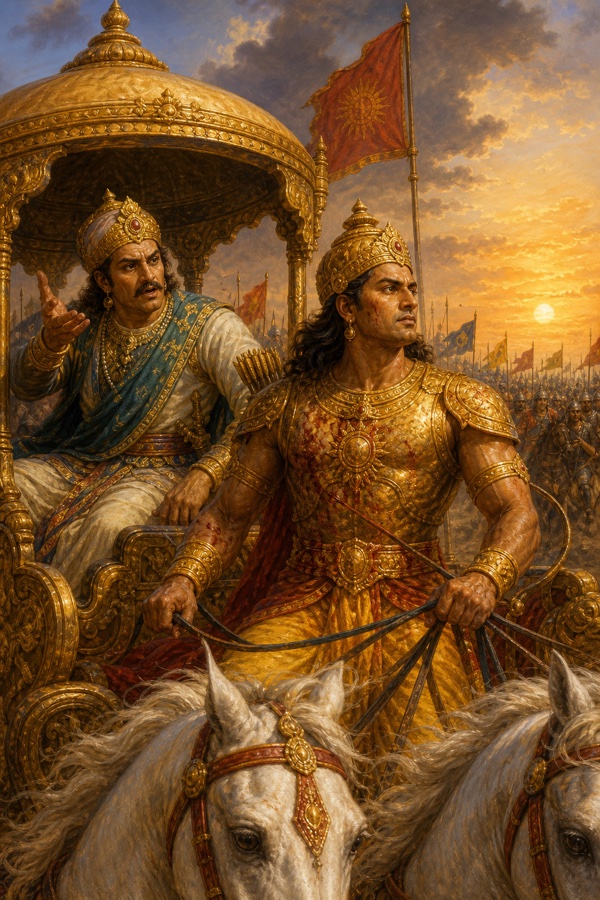
Krishna turned the horses toward Karna to bring the two of them together in single combat, and the sight of that chariot heading where it was heading put heart into the whole Pandava army. Shalya, on the driving platform of Karna’s chariot, saw the white horses and the standard and knew who was coming. “There he is, Karna, with his white horses and Krishna for a driver, killing as he comes. There is the man you were asking for, with Gandiva in his hand. Kill him today and great good comes to all of us. He passes every other fighter by, and I think he will stop for nobody except you. He has learned that you wounded King Yudhishthira badly and left him without a chariot. So he comes for you on a single chariot, and I can see no guard posted on his flanks or behind him. Go and meet him. You alone are fit to face the two Krishnas; you are the equal of Bhishma, of Drona, of Drona’s son, of Kripa. Our kings are running from him over there with no thought for one another, and no man alive except you can take that fear off them. Every Kuru on this field is sheltering behind you.”
Since the morning this same Shalya had praised Arjuna and belittled the man he drove. Karna noticed the change. “Now you sound like yourself, and now I like you,” he said. “Have no fear of Dhananjaya. Watch the strength of my arms today, and watch my skill. Alone I am going to destroy the great host of the Pandavas, and those two lions with it, the two Krishnas. I tell you this as plain truth. I will never leave this field today without killing those two. Or they will kill me, and I will sleep on it tonight. Nobody is promised victory in a battle. Killing or killed, I will have done what I came to do.”
Shalya could not leave it there. “Every great chariot fighter says that Arjuna cannot be beaten even when he fights alone. With Krishna guarding him, who is going to try?” And this time Karna agreed with him. “As far as I have ever heard, a chariot fighter like that one has never been born on this earth. See what I am made of, then, since I mean to fight exactly that man. He is a prince of Kuru’s line, and he goes through a battle behind his white horses, and it may be that he sends me to Yama’s house today. Know this, though: when Karna dies, everyone here dies after him. That prince’s arms never sweat. They never shake. They are thick, and they are covered with old scars. He takes up a fistful of arrows and shoots them as though they were one arrow; he sets them to the string faster than you can follow and sends them two miles, and they always land on his enemy. What fighter on earth is his equal?
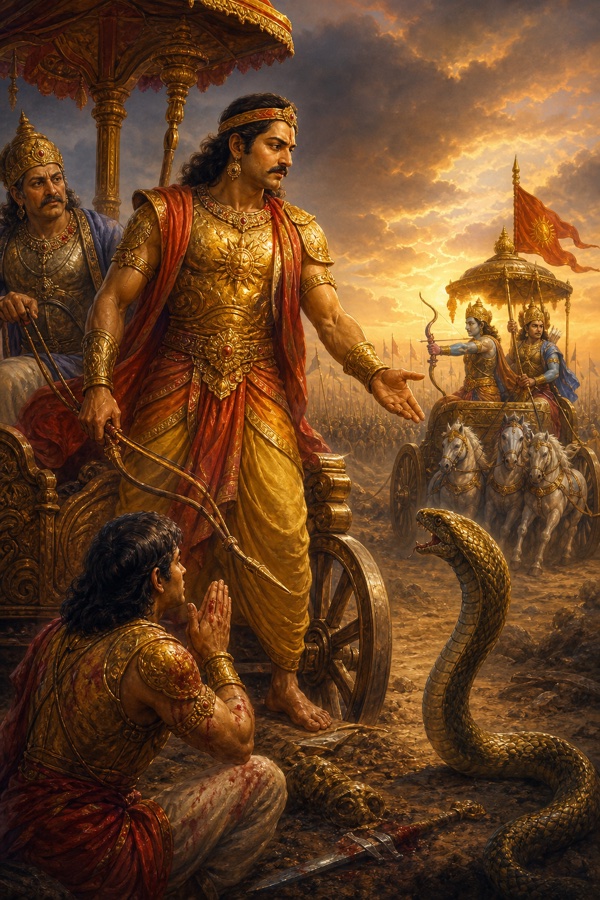
“With Krishna beside him he fed the god of Fire at the Khandava forest, and out of that burning Krishna got his discus and Arjuna got the bow Gandiva, and with it that terrible chariot and its white horses, and two quivers that can never be emptied, and a store of heavenly weapons, all from Agni’s hand. In Indra’s country he was given the conch Devadatta, and there he killed Daityas past counting and the whole race of the Kalakeyas. He pleased Mahadeva himself in a fair fight and had from him the Pashupata, the weapon that can end the three worlds. The guardians of the quarters each gave him a weapon of their own, and with those he destroyed the Kalakhanja demons when they banded together. At Virata’s city he beat all of us from one chariot, took the cattle from us, and stripped the best of our chariot fighters of pieces of their clothing. That is the man I am challenging, Shalya, and the Vrishni is his ally. For that I count myself the bravest man in the world.
“And he is guarded by Keshava, who is Narayana himself and has no rival, Vasudeva, Vishnu who never loses, with the conch and the discus and the mace in his hands. If the whole world sat down together to tell his qualities it would not finish in ten thousand years. When I see the two Krishnas standing on one chariot, fear comes into my heart, and courage comes in with it. Arjuna is the first of all archers, and nobody meets Narayana when he has the discus. The Himalaya may get up and walk before those two give ground. Both are brave, both are skilled, both have bodies hard as diamond. Who except me would go against Phalguna and Vasudeva, being what they are? The thing I have wanted is a battle with the son of Pandu, king of the Madras, and I am about to have it, a battle with no equal anywhere. Today I bring those two down, or the two Krishnas bring me down.”
A sub-tale: Shalya’s change of tone has a history. The Pandavas called him uncle, and before the war he had pledged his word to Duryodhana. Yudhishthira, hearing of that pledge, asked one thing of him: when the single combat between Karna and Arjuna came, Shalya would surely be holding Karna’s reins, and on that day he should protect Arjuna and speak so that the charioteer’s son lost heart. Yudhishthira admitted it was an improper thing to ask. Shalya gave his word that he would say things to Karna that were contrary and harmful, so that he might be stripped of pride and courage. Now, with the Kaurava army in flight, the same man tells Karna that he is the equal of Bhishma and Drona, and Karna answers by praising Arjuna at greater length than Shalya ever did.
When he had said it Karna roared, and the roar was like thunder in piled cloud. Then he drove to Duryodhana, who greeted him with respect, and he spoke to the king and to the men around the king: Kripa, Kritavarma the chief of the Bhojas, Shakuni the ruler of Gandhara with his son, the teachers, the younger brothers, and every foot soldier, horseman, and elephant rider within hearing. “Go at Achyuta and Arjuna. Close the road around them on every side and wear them out, so that when you have cut them up badly I can kill the pair of them with ease.” They answered that it would be done, and those champions went quickly against Arjuna, wanting his death, and began to hit him with arrows past all counting.
Arjuna took them in as the ocean takes in every river with all its tributaries. None of them could see the moment he set an arrow to the string or the moment he let it go; they saw only that men and horses and elephants kept falling dead with his arrows in them. He was smiling. He cut their arrows out of the air with showers of his own and put three shafts into the chest of each man who came at him. Ashvatthama, the son of Drona, hit him with ten arrows, Krishna with three, the four horses with four, and sent a stream of arrows at the Ape on the banner. Arjuna cut the drawn bow in Ashvatthama’s hand with three arrows, took off his driver’s head with a razor-faced one, killed his four horses with four, cut down his standard with three, and threw him from his chariot. Drona’s son got up angry, strung another bow where he stood on the ground, and went on shooting at the two of them from close range.
Kripa, Kritavarma, and Duryodhana covered Arjuna as clouds cover the sun. He had the strength of Kartavirya of the thousand arms that day. He poured arrows onto Kripa’s bow, his horses, his standard, and his driver, and Kripa took as many thousands of arrows from him as Bhishma had taken on the day Bhishma fell. Then he cut the standard and the bow of Duryodhana, who was roaring at him, killed Kritavarma’s handsome horses, and cut that standard down as well, and the great host broke into a hundred pieces like an earth bank washed out by a flood. Krishna brought the chariot around so that every beaten enemy lay to their right and drove on. Shikhandi, Satyaki, and the twins Nakula and Sahadeva, who were heading the same way as Arjuna, held off the chariots that tried to follow, and Kurus and Srinjayas went at one another with straight arrows, as the gods and the demons once did, until so many shafts were in the air that the light of the sun itself was covered.
The gist: Shalya, who has mocked Karna since the morning, now tells him that he alone can stop Arjuna. Karna vows to kill the two Krishnas or sleep on the field, and then describes Arjuna’s gifts and victories at length and without envy, from the burning of Khandava to the cattle raid at Virata’s city. He asks Duryodhana and the chiefs to tire Arjuna for him, and Arjuna breaks Ashvatthama, Kripa, Duryodhana, and Kritavarma in turn.
Bhima’s mace, and the end of Duhshasana
Sanjaya said that Arjuna did not go straight to Karna. Bhima, set on by many of the best Kaurava fighters, looked to be going under, and Arjuna swung away from the troops of the charioteer’s son to clear the men off his brother. His arrows spread across the sky like dense flocks of birds, and the ground under them grew as rough and as hard to cross as the Vaitarani. Four hundred trained war elephants came at him in fury, their riders in golden mail, and they went down like the peaks of great mountains breaking loose. The twang of Gandiva was as loud as thunder. The Kaurava army burned as a bamboo forest burns on a mountainside at night, and scattered like animals running from a forest fire, and the men who had been pressing Bhima let him go.
Arjuna pulled up beside his brother for a moment. The two of them talked, and Arjuna gave him the news he had been wanting: the arrows were out of Yudhishthira’s body and the king was perfectly well. Then, with Bhima’s leave, he drove on. Ten of Dhritarashtra’s sons, all of them younger than Duhshasana, surrounded him, and with their bows held out at full stretch they seemed to be dancing on their chariots. He took off the ten heads with ten broad-headed arrows winged in gold, one arrow to each, and the faces fell with their lips still bitten and their eyes still red with anger. Ninety more Kaurava chariot fighters came next, Samsaptakas, men who had sworn a terrible oath on their place in the next world. Krishna paid them no attention and kept the white horses pointed at Karna’s chariot, and the ninety chased after, shooting, until Arjuna’s arrows brought them down like Siddhas falling out of heaven when their merit is spent.
A larger force closed on him then, men and horses and elephants together, and Bhima saw his brother ringed by it, left the few chariot fighters he had not yet killed, and rushed toward him. He had his mace in his hand and he was not tired. That mace was as fierce as the night of the world’s death, and it came down without rest on men and elephants and horses. Ten thousand horses died under it, and many men on foot, and the Kaurava soldiers who saw Bhima coming with it thought Yama had walked in among them with his own club. He went into the elephant division like a sea beast into the sea and in a short time sent it to Yama’s house. Then he climbed back onto his chariot and followed behind Arjuna. What was left of the Kaurava host ran to Karna, calling on him, and Karna shouted to them to have no fear and went at the Panchalas again. Krishna told Arjuna that the Panchalas were being wiped out and that it was time to go and kill Karna, and the two brothers drove for him together, Bhima guarding Arjuna’s rear.
Duhshasana chose that moment. He was the king’s younger brother, and he came at Bhima fearlessly, shooting as he came, and Bhima went for him like a lion going for a big stag. They fought with their lives for a stake, as the demon Shambara and Indra once fought. Two razor-headed arrows cut Duhshasana’s bow and his standard, a third struck him in the forehead, and a fourth took the head off his driver. The prince picked up another bow and put twelve arrows into Bhima; then, holding the reins of his horses in his own hand, he poured straight shafts over him. After those he loosed a single arrow bright as a ray of the sun, dressed with gold and diamonds and other gems, that came on like Indra’s thunderbolt and could go through a man. It went into Bhima’s body, and Bhima fell back on his own chariot with his limbs slack and his arms flung out, like a man with the life gone out of him. Then his senses came back, and he roared like a lion.
Sanjaya did not hide from the king how well his son fought. With one arrow Duhshasana cut Bhima’s bow. With six he pierced Bhima’s driver and with nine Bhima himself, and when Bhima in a rage flung a dart at him, he cut it apart with ten shafts, and every man who saw it cheered. Bhima, blazing, spoke to him. “You have hit me fast and you have hit me deep, hero. Now stand under my mace once more.” He lifted the terrible thing and spoke again. “Black-hearted man, today I will drink your blood on this field.” Duhshasana’s answer was a dart thrown with all his strength, a weapon like Death. Bhima whirled the mace and let it go. It smashed the dart on its way and struck Duhshasana on the head, and it hurled him out of his chariot to a distance of ten bow-lengths. His horses were all dead, his chariot was in splinters, and the prince lay on the ground shaking, his armor and ornaments and garlands torn out of place, twisting with pain.
Standing there among the best fighters of the Kuru army, with the battle going on all around him, Bhima looked at the man on the ground and remembered. He remembered everything Dhritarashtra’s sons had done to his family. He remembered Draupadi seized by the hair, and the attempt to strip her at a time when she was unwell, and every other injury done to that princess while her husbands sat with their faces turned away, and he flared up like a fire when butter is poured on it. He called to Karna and Duryodhana and Kripa and Drona’s son and Kritavarma by name. “Today I am going to kill this wretch Duhshasana. Let every warrior here protect him, if any of you can.” Then he ran at him, a lion running at a great elephant, with Duryodhana and Karna looking on.
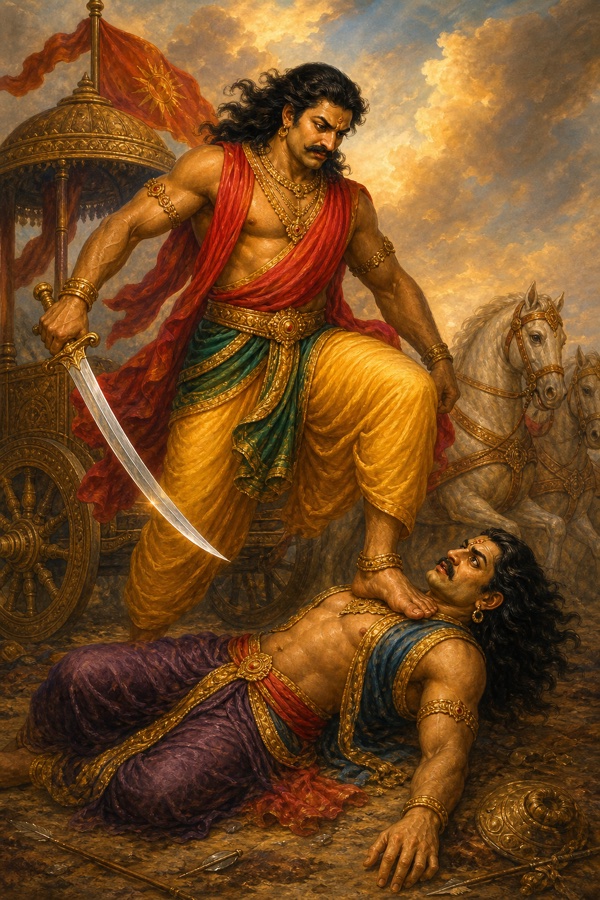
He jumped down from his chariot and stood over the fallen man and fixed his eyes on him. He drew his sword, a sharp one, newly whetted. He was shaking with rage. He set his foot on Duhshasana’s throat, cut open his chest where he lay, and drank his warm life-blood. Then he threw him down, cut off his head with the same sword, and, because he had a vow to complete, drank again, a little at a time, like a man who wants the taste. He looked down with anger still in his eyes and said, “I count the taste of my enemy’s blood above my mother’s milk, above honey, above clarified butter, above good wine made from honey, above sweet water, above milk and curds and buttermilk, above every drink on earth that is sweet as nectar.” And when he saw that Duhshasana was dead he laughed quietly. “What more can I do to you? Death has taken you out of my hands.”
The men who watched him walk the field after that, glad, with the blood in him, saying those things, fell down in fear. Those who kept their feet found their weapons slipping out of their hands. Many called out weakly and looked at him through half-shut eyes. Every soldier who had stood near enough to see him drink ran, and as they ran with Chitrasena they told one another, “That is no human being,” and, “This Bhima must be a Rakshasa.”
A key to reading this (moral complexity): Bhima had sworn this in the dice hall, before all the kings, on the day Draupadi was dragged there: he would tear open this man’s chest in battle and drink his life-blood, or never reach the world of his ancestors. Arjuna said then that the reckoning would come in the fourteenth year. Sanjaya tells the keeping of the oath plainly and softens nothing: the foot on the throat, the second drink taken slowly, the quiet laugh. He also reports what the watching soldiers said, and the word they use for Bhima is Rakshasa. A vow kept and a sight that makes armed men drop their weapons stand in the same scene.
Yudhamanyu, a Panchala prince, went after the fleeing Chitrasena at the head of his men and hit him with seven sharp arrows in quick succession. Chitrasena turned like a trodden snake that darts its tongue and wants to spit its poison, and put three arrows into the Panchala and six into his driver. Yudhamanyu drew his bow as far as it would go, aimed with care, and with one well-feathered, keen-pointed shaft struck off his head. Karna, in a fury at Chitrasena’s fall, drove the Pandava troops in front of him until Nakula rode out to meet him.
Bhima had killed Duhshasana within plain sight of Karna. Now he took a little of the blood in his hand and spoke in a voice that carried to every champion on the field. “Vilest of men, here I drink your life-blood from your throat. Be happy, and call us ‘beast, beast’ once more, the way you did.” And he went on. “The men who danced around us that day saying ‘beast, beast,’ we will dance around them now and give them their own words back. Our sleep in the palace at Pramanakoti, the deadly poison put in our food, the bites of the black cobras, the fire set to the house of lac, the kingdom stolen from us at dice, our exile in the forest, the cruel hand in Draupadi’s beautiful hair, the arrows and weapons we have taken in battle, our misery at home, all we suffered besides in Virata’s house: every one of those sorrows came to us through the counsels of Shakuni and Duryodhana and Radha’s son, and every one had you at its root. Through the wickedness of Dhritarashtra and his son we have borne them all. We have never once been happy.”
Then he turned to Krishna and Arjuna. He was drenched in blood, his own blood was running from his wounds, his face was dark red, and he was still in a great rage. “Heroes, what I swore about Duhshasana I have done today. Soon I will keep my other vow and kill the second beast, Duryodhana, in this sacrifice of a battle. When I have set my foot on that evil man’s head with the Kauravas watching, I will have peace.” And having said it, soaked as he was, he shouted for joy as Indra of the thousand eyes shouted when he had killed the demon Vritra.
The gist: Arjuna rescues Bhima, kills ten of Dhritarashtra’s sons and ninety sworn Samsaptakas, and the brothers turn toward Karna together. Duhshasana meets Bhima on the way, wounds him badly, and is struck from his chariot by a thrown mace. Bhima remembers the dice hall, tears open his chest, drinks his blood as he had vowed, and promises Krishna and Arjuna that Duryodhana is next. The soldiers who see it run, calling him a Rakshasa.
The death of Vrishasena, and Karna, grief-struck, rushing at Arjuna
Ten more of Dhritarashtra’s sons came at Bhima for their brother’s sake: Nishangi, Kavachi, Pashi, Dandadhara, Dhanurgraha, Alolupa, Saha, Shanda, Vatavega, and Suvarchas, chariot fighters who had never turned from a battle, sick with anger at what they had just seen. Together they hemmed him in with arrows, and Bhima, his eyes red as fire, looked like the Destroyer himself. Ten broad-headed shafts winged with gold flew from the son of Pritha, one to a prince, and the ten went to Yama’s house with their golden bracelets on their arms. The Kaurava army ran from the Pandavas under Karna’s own eyes. And Karna, watching what Bhima could do, felt a great fear come into his heart.
Shalya read it in his face and found the words the hour needed. “Do not grieve, son of Radha. It does not become you. These kings are running because they are afraid of Bhimasena. Duryodhana is stunned; his brother’s blood has been drunk in front of him, and Kripa and the king’s surviving brothers are sitting around him and tending him. The Pandavas, with Dhananjaya at their head, are coming for you. So keep a Kshatriya’s duty before your eyes and go against Dhananjaya. The son of Dhritarashtra has laid the whole weight of this war on you. If you win, the fame is great. If you lose, heaven is certain. And look there: your son Vrishasena has seen you standing dazed, and he is driving at the Pandavas in a rage.” Karna thought about it and settled in his own mind that there was no way left except to fight.
Vrishasena was making for Bhima when Nakula cut across his path. Nakula took down the jeweled standard with a razor-headed arrow and cut the gold-belted bow with a broad-headed one. Karna’s son, who wanted to do honor to Duhshasana, had another bow up at once and struck Nakula with one celestial weapon after another, and then he killed Nakula’s horses, white animals of the Vanayu breed in gold harness. Nakula got down from the dead chariot with a bright shield marked with golden moons and a sword as blue as the sky, and for a while he went over the field like a bird, leaping and turning in the air. Two thousand trained soldiers from many countries died under that one sword.
Karna’s son came at him again and shot him from every side. He cut the shield of a thousand stars out of Nakula’s hand in mid-turn; six razor-headed arrows broke the whirling steel sword; and more arrows struck Nakula deep in the middle of the chest. Hurt now, and without horses, Nakula reached Bhima’s chariot and sprang onto it as a lion springs onto a ledge, with Arjuna looking on, and Vrishasena poured arrows onto both brothers.
Bhima called across to Arjuna. “Look at Nakula; he is being hurt. Karna’s son is holding us all up. Go and deal with Karna’s son.” Arjuna brought his chariot alongside, and Nakula, standing in front of him, said only, “Kill this one, quickly.” Arjuna had Krishna turn the ape-bannered chariot straight at Vrishasena.
Word that Nakula had lost his chariot and his sword brought eleven Pandava fighters in on loud wheels: the five sons of Drupada, Satyaki, and the five sons of Draupadi. Kritavarma, Kripa, Ashvatthama, Duryodhana, Shakuni’s son, Vrika, Kratha, and Devavridha drove out and stopped them. Then the Kulindas came against those Kaurava chiefs, hill men from the Himalaya on elephants as big as mountain peaks. The Kulinda prince struck Kripa with ten arrows of solid iron, and Kripa’s shafts brought the prince and his elephant down together. The prince’s younger brother attacked Kripa’s chariot with iron lances, and he was still roaring over it when the king of Gandhara cut off his head.
Shatanika, Nakula’s son, was doing great slaughter on that part of the field when a Kulinda who fought on the Kaurava side shot him, smiling as he did it, and Shatanika took the man’s head, a head like a lotus, with one razor-headed shaft. At that Vrishasena put three iron arrows into Shatanika and three into Arjuna, three into Bhima, seven into Nakula, and twelve into Krishna. The Kauravas shouted for joy at the feat. The men who knew what Arjuna could do looked at Karna’s son and saw an offering already poured onto the fire.
Arjuna had seen Nakula left without horses in front of everyone, and he could see Krishna bleeding. He went for Vrishasena, who had taken his stand in front of his father, and Vrishasena came to meet him as the demon Namuchi once went at Indra. With nobody supporting him, the young man shot Arjuna and shouted aloud as Namuchi shouted when he had wounded the god. He drove more arrows into Arjuna under the left arm. He hit Krishna with nine and Arjuna with ten more. Until then Arjuna had been only a little angry. Now three lines came into his forehead, and he made up his mind to kill Karna’s son.
His eyes had gone red, and he was a man who could have killed Yama in a fight. He laughed, a terrible laugh, and called out to Karna and to all the Kaurava champions with Duryodhana and Ashvatthama at their head. “Karna, today, while you watch, I am going to send this fierce Vrishasena to Yama’s house with my arrows. People say that all of you together killed my son when I was away, and when he was alone on his chariot with nobody to help him. I will kill your son with all of you looking on. Let every Kaurava chariot fighter protect him. And after him, fool, I will kill you. I, Arjuna, will do it in the middle of this battle. You are the root of this quarrel, and Duryodhana’s favor has made you proud. I will kill you today, and Bhimasena will kill this Duryodhana, this wretch whose bad policy started the quarrel at the dice.”
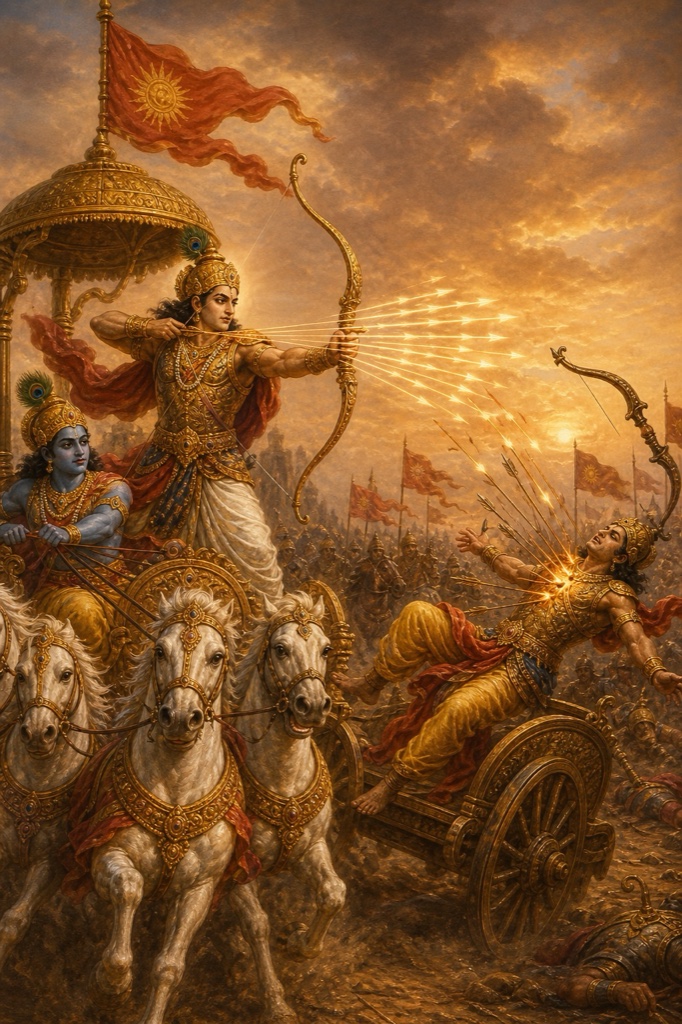
He rubbed his bowstring, took aim, and shot. Ten arrows went into Vrishasena, one into each of the places where a wound kills. Four razor-headed arrows followed, and they took the bow, the two arms, and the head. Karna’s son fell from his chariot without arms and without a head, the way a tall shala tree in full flower falls from a mountain top. Karna saw him fall. Tears ran from his eyes, grief for his son burned him, and in a fury he turned his chariot at the chariot of Arjuna and Krishna.
The gist: After ten more of Duryodhana’s brothers die, fear takes hold of Karna, and Shalya steadies him with a Kshatriya’s choice: fame in victory, heaven in defeat. Karna’s son Vrishasena cuts Nakula’s horses, shield, and sword away and wounds Arjuna and Krishna. Arjuna, naming the day the Kauravas together killed his own son, kills Vrishasena before his father’s eyes, and Karna comes for him.
Two suns face to face, and the division of creation
Krishna, of the Dasharha clan, watched Karna come. He was huge and he was roaring, a man the gods themselves could not have stopped, and he came on like a tide. “Here is the fighter you are to meet,” Krishna said, “with his white horses and with Shalya driving him. Be very cool now, Dhananjaya. Look at his chariot, hung with banners and rows of bells, like a chariot of the gods crossing the sky. Look at his standard with the elephant’s girth-rope on it, drawing a line across the heavens as clear as Indra’s rainbow. Listen to their drums and the blare of their conchs, and under all of it the twang of his bow Vijaya, which silences every other sound. The Panchala chariot fighters are breaking before him like deer that have seen an angry lion. You must kill the charioteer’s son, son of Kunti, and you must take every care in doing it. Nobody else can stand under his arrows. I know that you could conquer the three worlds with the gods and the Gandharvas in them. Men cannot bear even to look at the three-eyed Lord, Ishana, and you satisfied him in a fight, and the other gods gave you gifts as well. By the grace of that god of gods who carries the trident, Partha, kill Karna as Indra killed the demon Namuchi. May fortune stay with you, and may you win.”
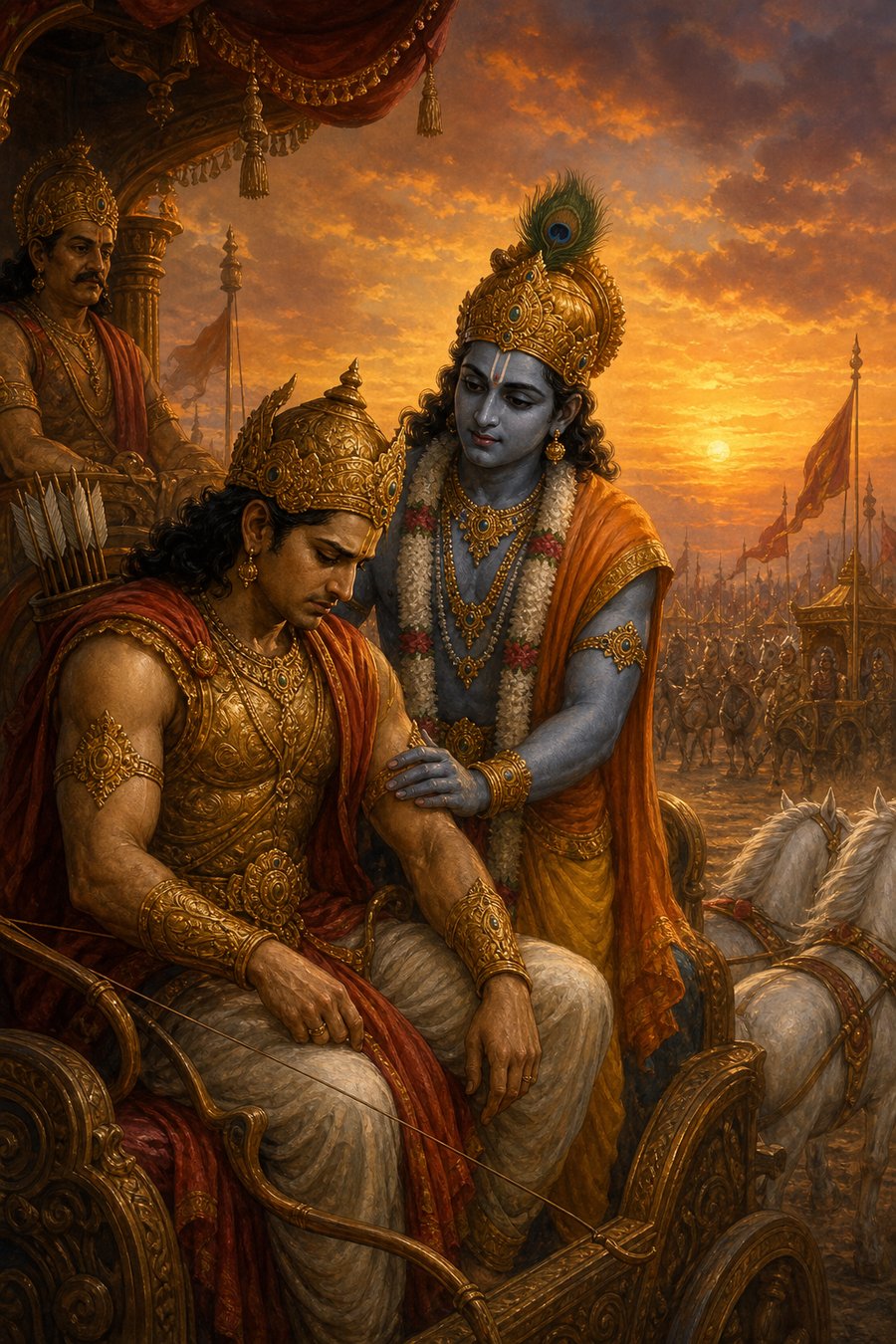
“My victory is certain, Krishna,” Arjuna said. “I have no doubt of it, because you, who are master of all the worlds, are pleased with me. Drive the horses, Hrishikesha. Today Phalguna does not come back from the fight without killing Karna. You will see Karna cut to pieces by my arrows today, Govinda, or you will see me dead by his. The battle that is about to begin could stun the three worlds, and people will talk about it for as long as the earth lasts.” He went toward Karna as one bull elephant goes toward another, and on the way he spoke once more: “Drive, Hrishikesha. Time is passing.” Krishna wished him victory and gave the horses their heads, and in a moment the chariot stood facing Karna’s.
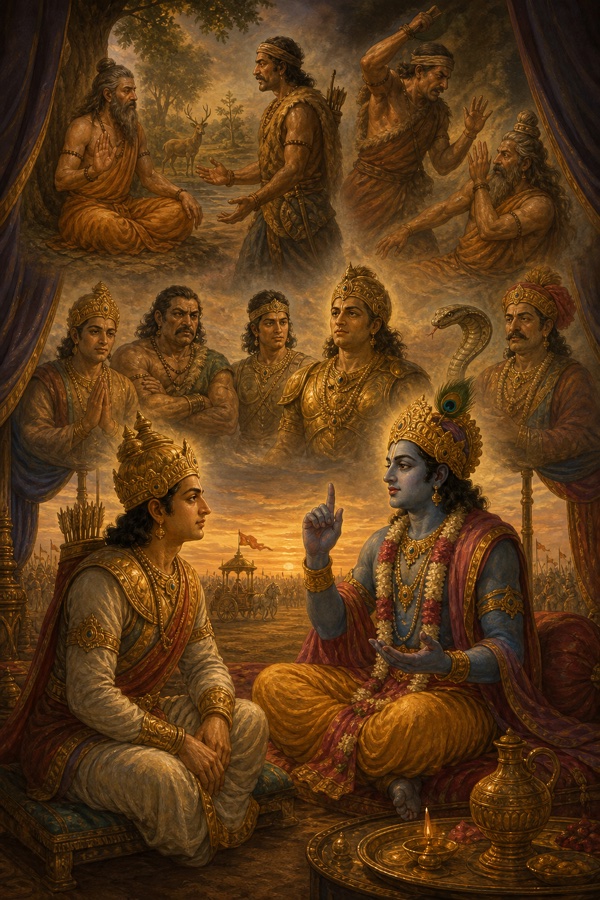
Karna had wept for his son. His eyes were now as red as copper, and he had called Arjuna out. The two chariots, both cased in tiger skin, both bright as the sun, drew together and looked like two suns side by side, and the two archers behind their white horses shone like the sun and the moon in one sky. Every creature watching was struck with wonder, as if Indra and Bali, the son of Virochana, were making ready once more to fight for the three worlds. The kings saw the two standards come toward each other through the noise of wheels and bowstrings and clapped palms, the elephant’s rope on Karna’s and the ape on Arjuna’s, and they were amazed.
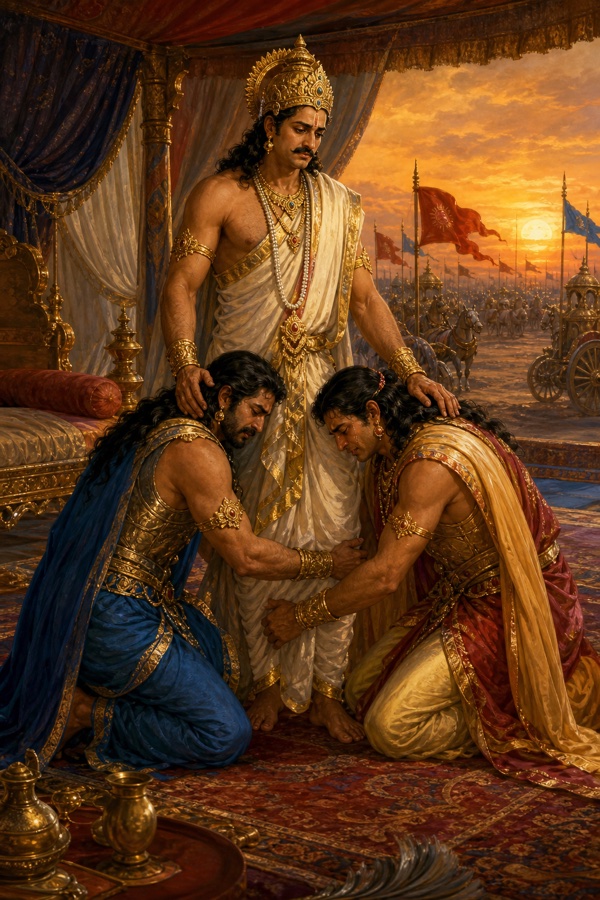
They roared and cheered both men. Thousands of soldiers slapped their arms and waved their clothes in the air. The Kauravas beat their drums and blew their conchs to hearten Karna, and the Pandavas filled every quarter with horns and conchs for Arjuna. The two stood on their chariots where everyone could see them, each with a great bow, each with arrows and darts, each under a tall standard, and they were alike. Both wore mail and had swords at their belts; both drove white horses and carried fine conchs. Both had the neck of a lion and long arms and red eyes and wore garlands of gold. One had Krishna for a driver and the other had Shalya.
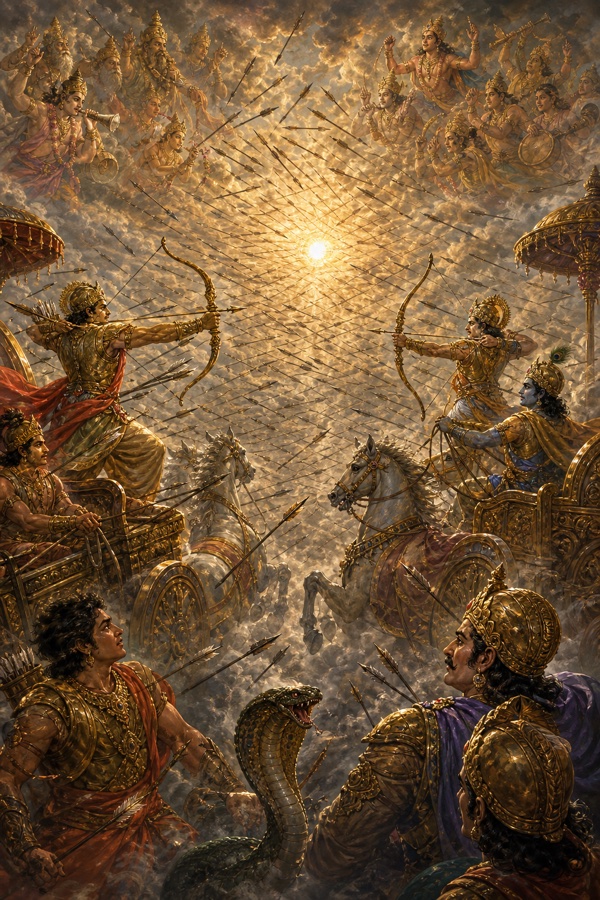
Each called the other out, and each meant to kill. They closed like two bulls in a cattle pen, like two elephants in rut, like two mountains in anger, like two young snakes full of venom. They were as furious as Indra and Vritra and as bright as the sun and the moon, two great planets risen to destroy the world at the end of an age, and each of them was the son of a god. The Kauravas drew up around Karna and the Pandavas, with Dhrishtadyumna leading them, around Arjuna. Sanjaya put it to the king as a game of dice: Karna was the stake his army had laid down, Arjuna was the stake of the Pandavas, the soldiers of both sides sat as the assembly that watches the throw, and no man there could tell which way it would fall.
In the sky a quarrel broke out over the two of them, with hard words in it, and everything that exists took a side. The gods, the Danavas, the Gandharvas, the Pishachas, the Snakes, and the Rakshasas divided. The heavens with all their stars were anxious for Karna, and the wide earth was anxious for Arjuna, as a mother is for her son. The rivers, the seas, the mountains, the trees, and the healing plants stood with Arjuna. The Asuras, the Yatudhanas, the Guhyakas, and the ravens and other birds of the air stood with Karna. Every gem and jewel, the four Vedas with the histories as a fifth, the Upavedas, the Upanishads with all their secrets, Vasuki, Chitrasena, Takshaka and Upatakshaka, all the mountains, all the children of Kadru and the great venomous serpents were for Arjuna; so were Airavata and his children and the offspring of Surabhi, while the smaller snakes were for Karna. The Vasus, the Maruts, the Sadhyas, the Rudras, the Vishvedevas, the two Ashvins, Agni, Indra, Soma, the Wind, and the ten directions took Arjuna’s part, and all the Adityas took Karna’s. The gods with the ancestors, and Yama, Kubera, and Varuna, were for Arjuna. The Brahmins, the Kshatriyas, the sacrifices, and the gifts made to priests were for Arjuna. The ghosts and the Pishachas, the beasts and birds that eat flesh, the Rakshasas, the monsters of the sea, the dogs, and the jackals were for Karna. The Vaishyas, the Shudras, the Sutas, and the castes of mixed birth all chose the son of Radha.
Brahma came to that part of the sky with the Brahmin seers and the lords of creatures, and Shiva came on his chariot. Indra looked down at the two men and said, “Let Arjuna defeat Karna.” Surya, the Sun, said, “Let Karna defeat Arjuna. Let my son Karna kill Arjuna and win this battle.” So the two fathers argued, each for his own, and the gods ranged themselves with Arjuna and the Asuras with Karna, and the three worlds shook at the sight.
The gods turned to Brahma, the Self-born. “Let these two lions among men come out equal, lord. Do not let the whole creation be destroyed because Karna and Arjuna have met. Say the word, and let them be equal.” Indra bowed to the Grandsire and put it another way. “You said once, holy one, that the two Krishnas are sure of victory always. Let it be now as you said then. Be gracious to me.” Brahma and Shiva answered him together. “The victory of Vijaya is certain. He is Savyasachi, the archer who draws with either hand, who fed the Fire in the Khandava forest, and who came up to heaven and fought for you, Shakra. Karna stands on the side of the Danavas, so it is right that he should be beaten, and the purposes of the gods will be served by it. Phalguna is devoted to truth and to dharma. He pleased the god whose banner bears the bull, and the lord of the universe, Vishnu himself, drives his chariot; how should he lose? These two are Nara and Narayana, the two ancient seers, the best of them. Nobody rules over them, they fear nothing, and neither in heaven nor among men is there anyone to equal either one. The three worlds walk behind them.
“Let Karna have the highest worlds of the blessed. Let him be made one with the Vasus or the Maruts. Let him be honored in heaven beside Drona and Bhishma, for the son of Vikartana is brave and he is a hero. The victory, though, belongs to the two Krishnas.” Indra of the thousand eyes received those words with reverence, saluted every creature present, and spoke to them all. “You have heard what the two gods have said for the good of the universe. It will be so, and in no other way. Stay, then, and be easy in your hearts.” The whole gathering marveled and praised him, and the gods rained down sweet-smelling flowers and sounded their trumpets.
A key to reading this (the idea: Nara and Narayana): “The two Krishnas” is what every speaker on this field calls Krishna and Arjuna together, and Brahma and Shiva say here who the two are: Nara and Narayana, ancient seers over whom nobody rules, with the three worlds walking behind them. That is the ground of the ruling. The same two gods, in the same breath, ask heaven for Karna: the worlds of the blessed, a place among the Vasus or the Maruts, and honor beside Drona and Bhishma, because he is brave and a hero. His defeat is decreed, and so is his reward.
The gist: Krishna points out Karna’s chariot and tells Arjuna to kill him with every care; Arjuna answers that one of them will not come back. The two chariots meet, as alike as two suns, and all creation takes sides, from the Vedas and the rivers to the jackals. Surya speaks for Karna and Indra for Arjuna. Brahma and Shiva rule that Arjuna will win and that Karna will have heaven.
The war of celestial weapons, and Ashvasena’s journey of vengeance
The horses of one chariot neighed at the horses of the other. The two drivers took each other’s measure as well: Krishna drove a hard stare into Shalya, Shalya gave it back, and Krishna won that contest of eyes as Arjuna won his against Karna. Karna turned to Shalya with a smile. “If Partha somehow kills me today, friend, tell me truly what you will do.” Shalya answered, “If you are killed, I will kill both Krishna and Dhananjaya myself, from this one chariot.” Arjuna put the same question to Krishna, and Krishna smiled too, and his answer was graver. “The sun may fall from its place. The earth may break into a thousand pieces. Fire may turn cold. Karna will still not be able to kill you, Dhananjaya. If such a thing ever did happen, know that the end of creation would be near, and I would kill Karna and Shalya both with my bare hands.”
Above them the two standards had already joined battle. The Ape on Arjuna’s banner, its jaws wide open and its teeth terrible, as hard to look at as the sun, sprang from its place onto Karna’s standard and tore at the elephant’s rope with nails and teeth, as Garuda falls on a snake. The rope was set with jewels and hung with little bells; it was as hard as iron and looked like the noose of Yama, and it wrapped itself around the Ape in a fury and fought back. This was a combat that had been settled long ago, Sanjaya said, at the gambling match, and the banners struck the first blows of it.
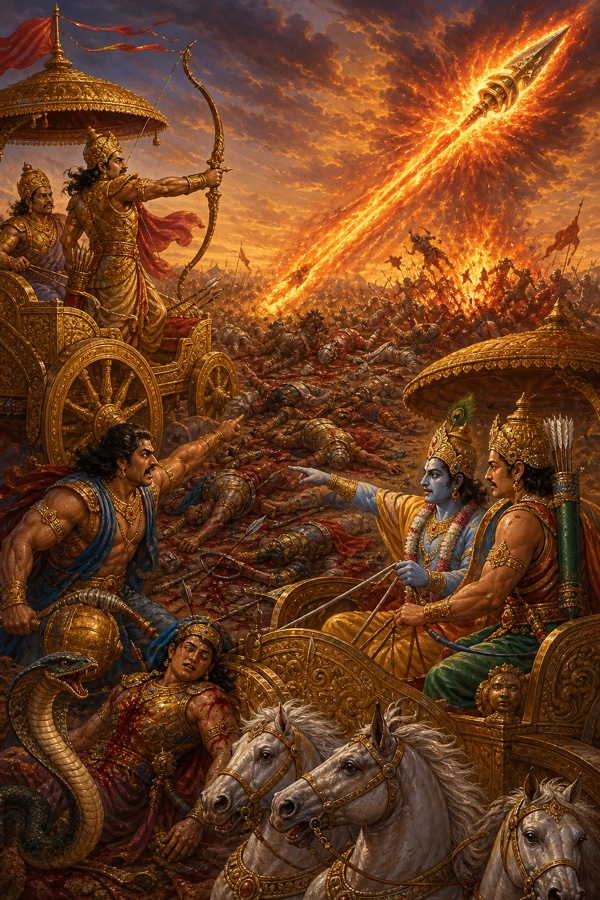
Then the men began. Karna shot first and hit Arjuna with ten strong arrows, and Arjuna put ten sharp-pointed ones into the middle of Karna’s chest. The son of Indra called up the weapon of Fire. Its glare covered the earth, the sky, and the very path of the sun; the clothes of the soldiers caught fire and they ran. Karna answered with the weapon of Varuna, lord of waters. Clouds with edges like mountain ranges closed over every quarter and put the fire out, and it grew so dark that nothing could be seen. Arjuna blew the clouds away with the weapon of the Wind. Then he charged Gandiva and its string with mantras and called up the weapon that Indra loves, and arrows poured out of the bow by the thousand and drove into Karna’s limbs, his horses, his bow, his yoke, his wheels, and his standard. Karna, covered in blood, bent his bow until it roared like the sea and called up the Bhargava weapon, which he had from Parashurama. With it he cut off that stream of arrows, and then he turned it on the Pandava army and destroyed chariots, elephants, and men on foot. He laughed at the two Krishnas and shot down the leading Panchalas. The Kauravas clapped and roared, sure that the two Krishnas were in his power.
Bhima could not bear it. He wrung his hands, he breathed hard, and he shouted at Arjuna. “Jishnu, how is this wretch, this charioteer’s son who has thrown dharma away, killing so many of the best Panchalas in front of you? The gods themselves could not beat you once, nor the Kalakeyas. You have felt the arms of Sthanu himself around you. How is this man turning your arrows aside? Remember what Draupadi suffered. Remember the cutting thing this villain said to us: ‘Sesame seeds with no kernel in them.’ Remember all of it and kill him today. This is no time for indifference. With the same steadiness you showed when you fed Agni at Khandava, kill the charioteer’s son. Or I will crush him with my mace.”
Krishna spoke next. “What is this, Arjuna? Karna is crushing your weapons with his. Why have you lost your wits? Can you not hear the Kauravas shouting for joy? With the steadiness that won you Mahadeva’s favor when he came to you as a hunter, kill Karna today. Take this Sudarshana from me, its edge as keen as a razor, and strike off his head as Indra struck off Namuchi’s with the thunderbolt.” Arjuna looked into himself, and he remembered why he had come into this world. He said to Krishna, “For the good of the world and the death of the charioteer’s son I am going to call up a great and terrible weapon. Give me your leave.” He bowed to Brahma and summoned the brahmastra, the weapon that is aimed by the mind alone. Karna broke that as well, and went on shooting like a cloud that will not stop raining.
Bhima told him that people called him a master of the brahmastra and that he had better use another. Arjuna called up a second weapon of the same kind, and gold-winged shafts by the hundred buried Karna’s chariot. Karna put three arrows each into Bhima, Krishna, and Arjuna and gave a terrible shout. Arjuna shot eighteen arrows back: one through Karna’s standard, four into Shalya, three into Karna, and ten into a Kaurava prince in golden mail named Sabhapati, who fell from his chariot like a shala tree cut down with an axe. He hit Karna again and again. He killed four hundred armed elephants, eight thousand chariot fighters, a thousand horses with their riders, and eight thousand men on foot, and for a time Karna, his driver, his horses, and his standard could not be seen at all for arrows.
Yudhishthira came up then to watch. The surgeons who loved him had drawn out the arrows and made him sound with mantras and medicines, and he arrived in golden mail, like the full moon risen clear after the demon Rahu has let it go. Everyone who saw him was glad. The watchers on the earth and the watchers in the sky reined in their animals and stood without moving.
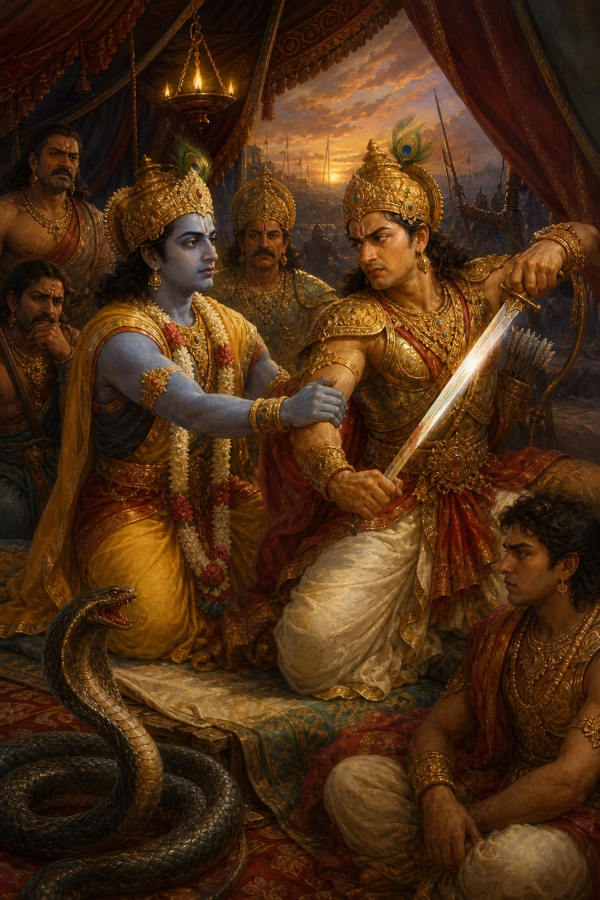
A sub-tale (Ashvasena): While the two fought, a serpent named Ashvasena, the son of Takshaka, was biding his time in the world below. Years before, when Arjuna fed the Khandava forest to Agni, this snake had been in the sky above the fire, hidden inside his mother’s body. Arjuna, seeing what he took for a single snake, shot the mother. The son got free of the burning and bored down through the earth in his anger. Now he felt the battle overhead, remembered her death, and flew up to look. He judged that his hour had come. He took the shape of an arrow and slipped into Karna’s quiver, and Karna did not know.
The string of Gandiva snapped with a loud crack. In the moment that gave him, Karna hit Arjuna with a hundred short arrows, sharp and oiled, then Krishna with sixty and Arjuna with eight more, and struck Bhima with arrows by the thousand. Arjuna restrung the bow. He struck Shalya on the armor with ten arrows, and Karna with twelve and then with seven, and Karna, running with blood, looked like Rudra in the burning ground at the end of the world. He answered with three arrows for Arjuna and five for Krishna, five blazing shafts that went through Krishna’s armor, entered the earth, and turned back toward Karna. Those five were serpents, allies of Takshaka’s son. Arjuna cut each of them into three pieces with ten broad-headed arrows. He had seen Krishna’s body torn by them, and he flared like fire in dry grass and drove arrow after arrow into every vital place Karna had, and Karna shook with pain and kept his feet only by a great effort. Then Arjuna killed the two thousand picked chariot fighters whom Duryodhana had set to guard Karna’s wheels and flanks. The king’s sons and every Kaurava still living ran, leaving their wounded behind. Karna looked around at the empty ground and was not shaken. He drove at Arjuna with a glad heart.
The gist: The banners fight first. Then the weapons: Fire is put out by Varuna’s clouds, the clouds are blown off by the Wind, Indra’s weapon is cut down by the Bhargava weapon, and two brahmastras follow, with Bhima and Krishna both rebuking Arjuna for letting Karna hold him. Yudhishthira, healed, comes to watch. Karna’s guard is killed or flees, and he fights on alone. Unknown to him, the serpent Ashvasena, whose mother Arjuna killed at Khandava, has entered his quiver as an arrow.
The Ashvasena-arrow, and the fall of the diadem
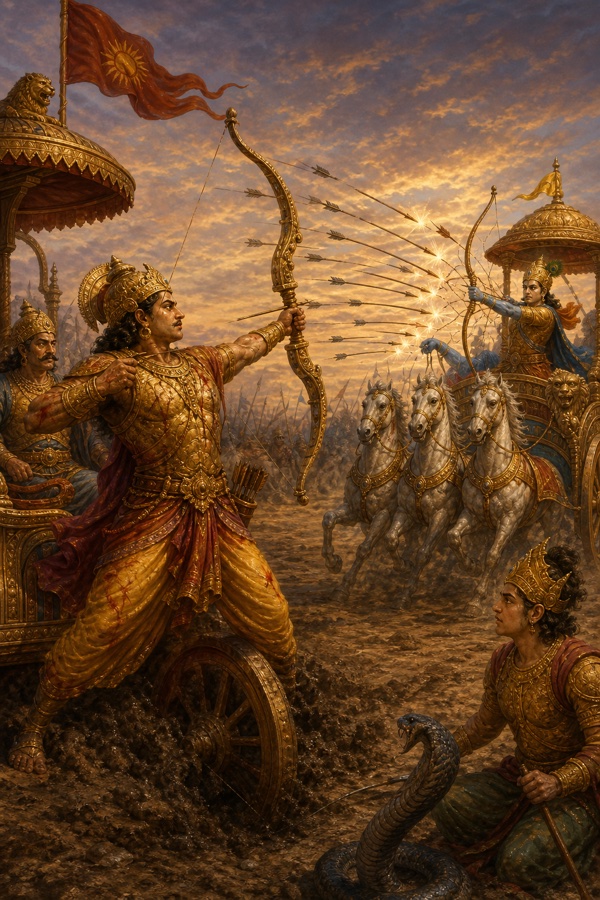
For a while neither could gain on the other, and the watchers in the sky called out “Well done, Karna!” and “Well done, Arjuna!” by turns. Both men were tired. Apsaras fanned them from above with young palm leaves and sprinkled them with sandal water, and Indra and Surya gently wiped the faces of the two men with their own hands. Karna was badly cut by then, and he understood at last that he could not get the better of Arjuna this way. His mind went to one arrow that lay by itself in its own quiver. It had the mouth of a snake, it blazed, and it had been polished by rule; and he had kept it for many years for the killing of Arjuna and for nothing else, laid in sandal dust in a golden quiver and always worshiped. It came of the race of the serpent Airavata. He set it on the string, drew the string back to his ear, and aimed at Arjuna’s head. Every quarter of the sky caught fire. Meteors fell, and thunderbolts, and the guardians of the worlds, Indra among them, cried out aloud. Karna did not know that Ashvasena had entered that very arrow by his yoga power.
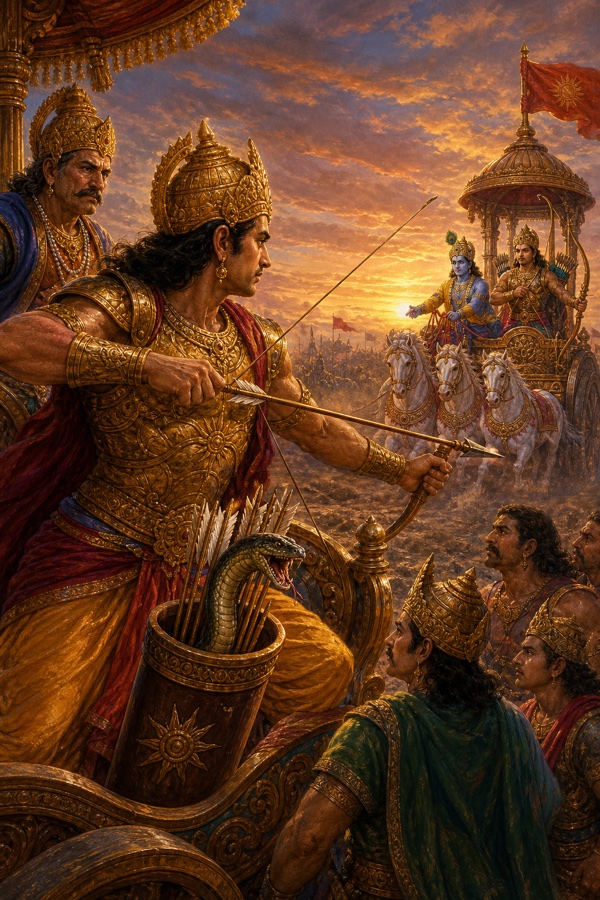
Shalya saw where the point was lying and spoke. “That arrow will not take Arjuna’s head off, Karna. Look carefully, and set another one that will.” Karna’s eyes were burning. “Karna never aims an arrow twice, Shalya. Men like me do not turn into crooked fighters.” With great care he released the shaft he had worshiped for so many years, and he was so sure of the victory that he called across to his enemy as it left the string: “You are dead, Phalguna!”
The arrow went with a terrible hiss, bright as fire, bright as the sun, and where it passed it seemed to part the sky in a single line, like the line a woman draws when she parts her hair. Krishna saw it blazing overhead. Quickly, and with no effort at all, he pressed the chariot down with his feet, and the chariot sank about a cubit into the earth. The horses, white as moonlight in their gold harness, bent their knees and lay down on the ground. A great sound of applause for Krishna rose in the sky. Voices of the gods were heard, flowers of heaven fell on him, and there was shouting like the roaring of lions.
So the arrow missed the head it was meant for and struck what was on it. With the chariot pressed down and Arjuna standing no higher than his horses’ reins, the serpent swept away his diadem, an ornament known through earth, sky, heaven, and the waters. It shone like the sun, like the moon, like fire, like a planet; it was worked with gold and pearls and gems and diamonds, and it gave off a fragrance. Brahma himself had made it, with great care, for Indra, and Indra had given it gladly to Arjuna in the days when Arjuna went out to kill the enemies of the gods. Rudra, Varuna, and Kubera, with the bow Pinaka and the noose and the thunderbolt and the finest arrows, could not have crushed it. Karna broke it with an arrow that had a snake inside. The serpent, burning with its own poison, tore the diadem from Arjuna’s head and shattered it, as a thunderbolt takes the top off a mountain with all its flowering trees, and the pieces fell to the ground like the blazing disc of the sun dropping from the hill of sunset. The noise that went through the worlds then was the noise of earth and sky and heaven and sea in a storm, and men who were trying to stand firm staggered where they stood.
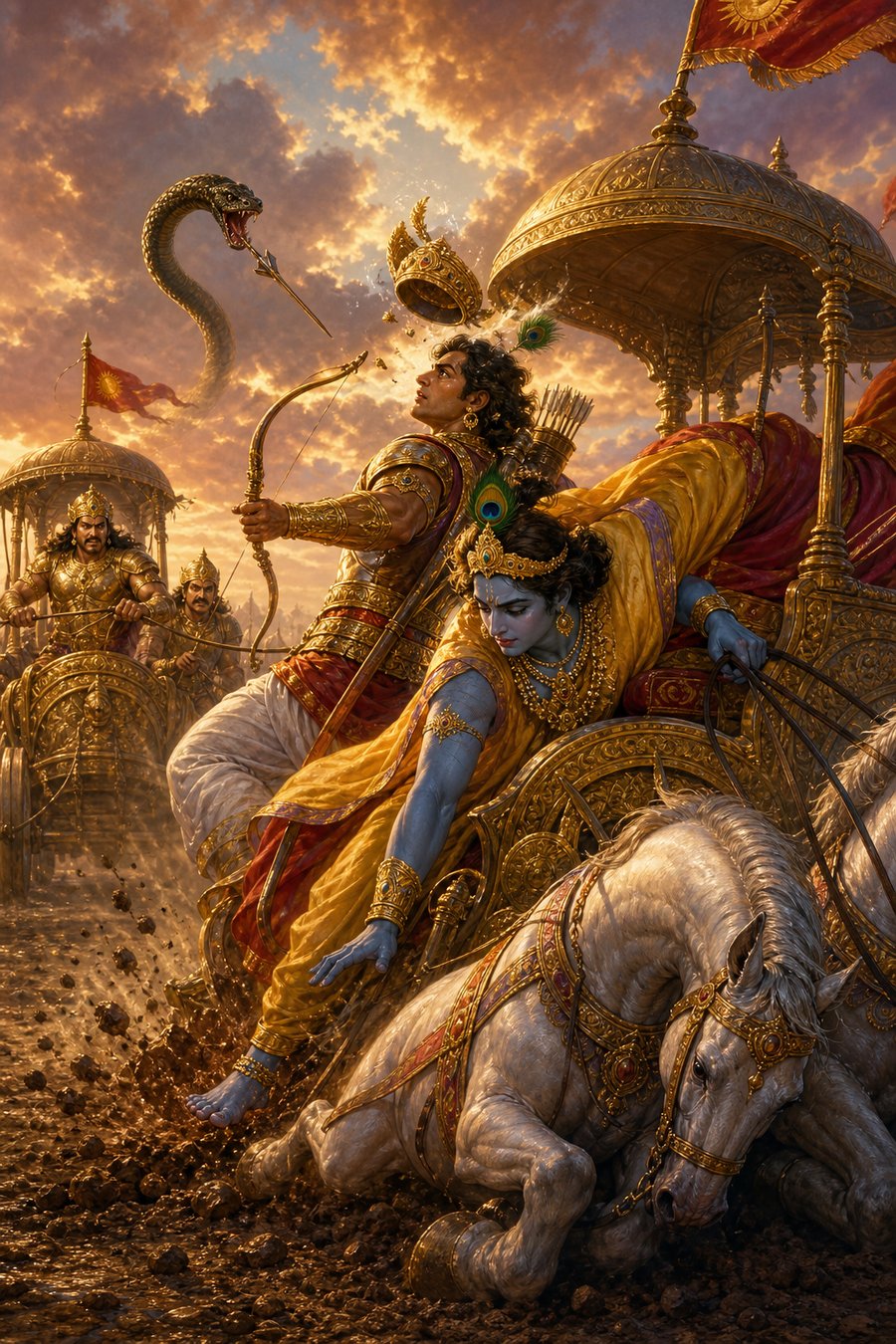
Arjuna stood bareheaded, a dark young man, as fine to see as a blue mountain with a high peak. He tied up his hair with a white cloth and did not move from his place, and with the white band on his head he looked like the eastern hill when the first rays of the sun strike it. That was all the serpent mother’s vengeance came to, carried by her son in the shape of an arrow from the bow of the Sun’s son: one diadem. And the son still had Arjuna to face.
Having burned the gold diadem, the serpent meant to go at Arjuna a second time, and he came back to Karna. Karna saw him and did not know what he was. “You shot me without looking at me, Karna,” the snake said. “That is why I could not take Arjuna’s head. Look at me well this time and shoot me again, quickly. I will kill your enemy, and mine.” Karna asked, “Who are you, with that terrible shape?” The snake said, “One whom Partha has wronged. He killed my mother, and that is my quarrel with him. If Indra himself with his thunderbolt came to protect him, Partha would still go down to the king of the dead. Do not make light of me. Do as I say. Shoot me, and lose no time.” Karna answered, “Karna does not want a victory in battle today that rests on another’s strength. If I had a hundred Arjunas to kill, snake, I would still not shoot the same arrow twice. I have other serpent weapons, and I have my own effort and my anger, and with those I will kill Partha. Go somewhere else, and be happy.” The king of snakes could not bear to hear it. In his rage he made himself an arrow again and flew at Arjuna on his own.
Krishna saw it first. “Kill that great snake. He is your enemy.” Arjuna asked, “Who is this snake that comes at me of his own will, like a creature flying into Garuda’s mouth?” Krishna told him. “When you stood at Khandava with your bow, feeding Agni, this snake was in the sky, hidden in his mother’s body. You thought there was one snake there, and you killed the mother. He remembers it, and today he comes to destroy you. Look at him, falling out of the sky like a burning meteor.” Arjuna turned his face toward it in anger, and as the serpent came slanting down through the air he cut it apart with six sharp arrows, and the body fell to the earth. Then Krishna, with his own arms, lifted the chariot out of the ground.
A key to reading this (Krishna’s intervention): Krishna is Arjuna’s driver, and what he does here he does from the driver’s place. He puts his feet to the floor of the chariot and presses it a cubit into the earth, the horses kneel, and an arrow aimed at Arjuna’s head passes at the height of his diadem. Sanjaya tells it openly, and heaven answers with voices and a fall of flowers. Karna’s conduct in the same scene is set down just as fully. Shalya warns him that the aim is off and he will not aim twice. The serpent offers to finish the work and he sends it away, because he will take no victory that rests on another’s strength.
The gist: Karna looses the snake-mouthed arrow he has kept for years, with Ashvasena inside it, at Arjuna’s head. Krishna sinks the chariot a cubit with his feet, and the arrow destroys only the diadem Indra gave. The serpent asks to be shot again; Karna refuses to shoot one arrow twice or to win by another’s strength. The snake attacks alone and Arjuna cuts it down with six arrows, and Krishna lifts the chariot out of the earth.
The cry for dharma, and the sinking of the chariot wheel into the earth
Karna looked sidelong at Arjuna and put ten arrows into Krishna, stone-whetted shafts fletched with peacock feathers. Arjuna answered with twelve and then drew to the ear and loosed one long shaft with the force of a venomous snake in it. It went through Karna’s armor, drank his blood, seemed for an instant to stop the breath in him, and buried itself in the ground with its feathers wet. Karna struck back like a snake that has been beaten with a stick. He hit Krishna with twelve arrows and Arjuna with ninety-nine, and then with one more terrible shaft, and he laughed and roared. Arjuna could not stand to see his enemy glad. He knew every place in a man’s body where a wound tells, and he found those places with hundreds of arrows, as Indra once struck the demon Vala. Then he sent ninety more, each one like the rod of Death, and Karna shook like a mountain when the thunderbolt splits it.
Winged arrows cut away Karna’s headgear, a thing of gems and diamonds and pure gold, and his earrings with it, and they fell to the ground. His armor, bright and costly, the long labor of many master smiths, Arjuna cut to pieces in a moment. Four sharp arrows went into the body the armor had covered, and Karna suffered as a sick man suffers when fever and every humor in him turn on him at once. More arrows followed, fast and careful, into the vital places, until he looked like a hill of red ocher with red water streaming down its face, and still more into the middle of his chest, iron shafts winged with gold. Then the charioteer’s son let go of his bow, which was as fine as Indra’s, and of his quiver. His grip had failed. He stood doing nothing, dazed, swaying, in great pain.
Arjuna held back. He kept to a fighting man’s code, and he did not want to kill an enemy who had fallen into such a state. Krishna, whom men call the younger brother of Indra, turned on him with heat. “Son of Pandu, why have you become so forgetful? The truly wise never spare an enemy, however weak he is, even for a moment. A man of sense wins merit and fame both by killing his enemies when they are in trouble. Karna has always been your enemy and he is the first of heroes; crush him now, and waste no time over it. When he is able he will come at you again exactly as before. Kill him as Indra killed Namuchi.”
“So be it, Krishna,” Arjuna said, and he did him honor and went back to his work. He covered Karna, the chariot, and the horses with calf-toothed arrows and filled every quarter with gold-winged shafts, and Karna, with all those arrows standing in his broad chest, looked like an ashoka or a palasha tree in full flower. Karna shot back, again and again, and with his arrows for rays he looked like the sun going down toward the western hill with its disc gone crimson. His shafts flew like great snakes and Arjuna’s shafts met them in the air and destroyed them all. Then Karna steadied himself, and he hit Arjuna with ten arrows and Krishna with six, each one like an angry snake.
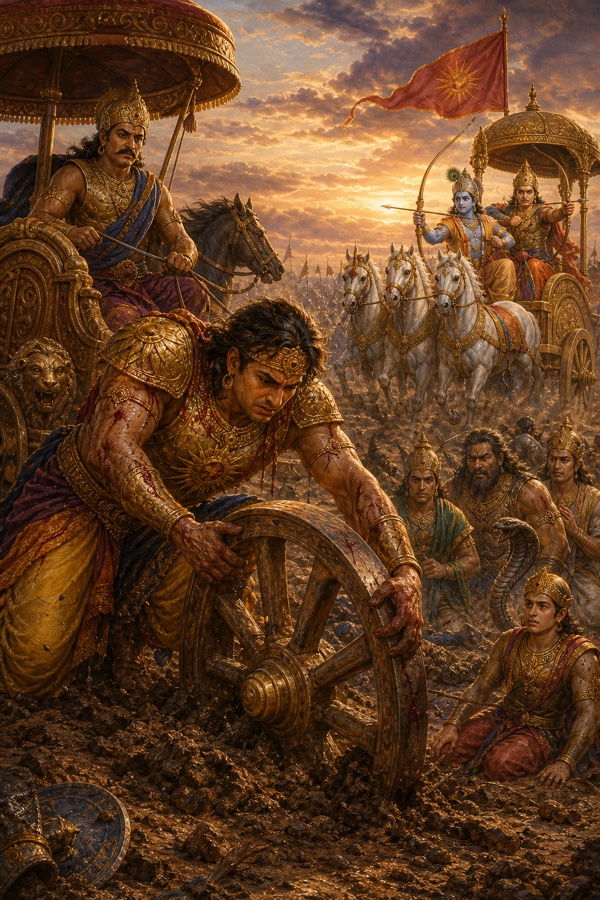
Arjuna chose an arrow made wholly of iron, charged with the power of a high celestial weapon, that hissed like Indra’s thunder, and he was about to shoot it. And now the hour of Karna’s death had come. Time itself, Kala, drew near him unseen and spoke to him of the Brahmin’s curse, wishing him to know that his death was close: “The earth is devouring your wheel.” In that same hour the great brahmastra that Parashurama of the Bhrigu line had taught him went out of his memory, and the earth began to swallow the left wheel of his chariot.
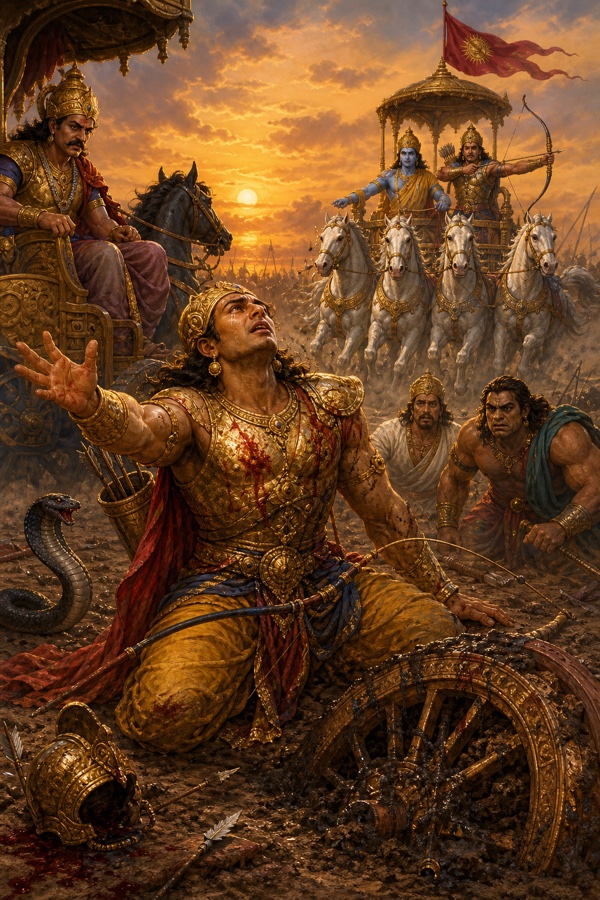
The Brahmin’s curse was doing its work. The chariot lurched and sank deep, and it stood fixed in that spot like a sacred tree, heavy with blossom, planted on its raised platform. Karna felt the chariot reel under him. The weapon he had from Parashurama no longer lit his mind from within. His snake-mouthed arrow had been cut down by Arjuna. Sorrow filled him, and he could not bear so many blows together. He threw up his arms and cried out against dharma itself. “Those who know dharma always say that dharma protects the people who keep it. We have always tried to practice it, with all the strength and understanding we have. And now dharma is destroying us, the very people devoted to it, when it ought to be protecting us. So I think dharma does not always protect those who worship it.” Arjuna’s arrows were striking him hard while he said it. His horses and his driver had been knocked out of their places. He was wounded in every vital spot, he no longer cared what he did, and he railed at dharma over and over.
A key to reading this (the two curses): Karna had told Shalya of both curses that same morning. Wanting celestial weapons, he had once lived with Parashurama in the disguise of a Brahmin. Indra, working for Arjuna’s good, took the form of a worm and bored through Karna’s thigh while the teacher slept with his head on it, and Karna did not move. Parashurama woke, saw the blood and the endurance, and said, “You are no Brahmin.” Told that his pupil was a Suta, he cursed him: because the weapon was won by deceit, it would not come to his memory at the time of need, when the hour of his death arrived. The second curse came from a Brahmin whose sacrificial cow had a calf. Karna, practicing with his bow in a lonely forest, killed the calf with a careless arrow, and the Brahmin said that the wheel of his chariot would sink into the earth in battle and fear would enter his heart. Karna offered him cattle, elephants, slaves, and all his wealth, and the Brahmin would not unsay it. Arjuna could never escape his brahmastra, Karna told Shalya, if only his wheels did not sink that day.
The gist: Arjuna strips Karna of headgear, earrings, and armor and wounds him until he drops his bow. Arjuna will not strike a helpless man, and Krishna tells him the wise never spare an enemy. Karna recovers and fights on. Then his hour comes: Kala whispers of the Brahmin’s curse, the brahmastra learned from Parashurama leaves his memory, and the earth takes his left wheel. Karna cries out that dharma does not always protect those who keep it.
Karna’s plea for the wheel, and Krishna’s rebuke
Karna went on fighting. He put three terrible arrows into Krishna’s arm and seven into Arjuna. Arjuna sent back seventeen, straight and fierce, bright as fire, that passed clean through Karna’s body and fell on the ground behind him. Karna shook under them. He steadied himself with a great effort and called up the brahmastra, and Arjuna met it with the weapon of Indra and rained arrows on Karna’s chariot, and Karna beat every one of them off. “Use your highest weapons, Partha,” Krishna said. “Radha’s son is turning your arrows.” Arjuna set the brahmastra on his string and covered the sky. Then Karna cut the string of Gandiva with a flight of sharp shafts. He cut the second string as well, and the third, and the fourth, and the fifth, and so on to the eleventh. Karna could shoot arrows by the hundred, and he did not know that Arjuna’s bow had a hundred strings. Arjuna tied on each new one so fast that Karna could not see when a string broke and when it was replaced, and he thought it a marvel. All the same he was turning Arjuna’s weapons with his own, and for that moment he seemed to be getting the better of him.
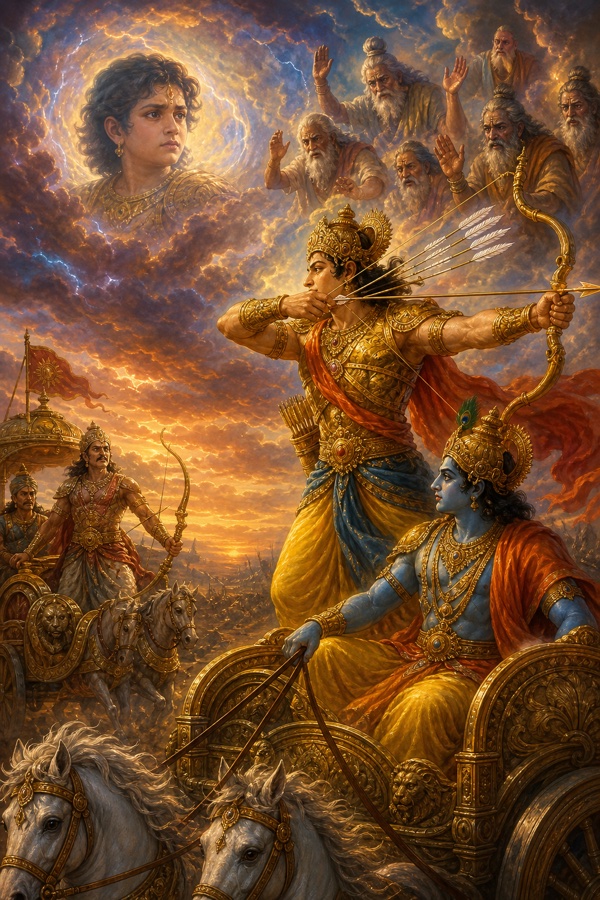
Krishna saw Arjuna hard pressed. “Go close to Karna and strike him with your best weapons.” Arjuna, in a rage, took a celestial arrow that looked like fire and was as hard as diamond, charged it with mantras, joined the weapon of Rudra to it, and made ready to shoot. At that very moment, Sanjaya told the king, the earth swallowed one of the wheels of Karna’s chariot. Karna got down quickly. He took hold of the sunken wheel with both arms and heaved at it with all his strength, and so great was that strength that the earth which held the wheel rose up four fingers’ breadth, with her seven islands, her hills, her waters, and her forests. The wheel did not come free. Karna wept with rage. He looked up at Arjuna, and he spoke.
“Partha, Partha, wait a moment, only until I lift this wheel. You can see that the left wheel of my chariot has been swallowed by the earth, by an accident. Give up a purpose that only a coward could hold. Brave men who follow the practice of the righteous never loose their weapons at a man whose hair has come undone, or at one who has turned his face from the battle, or at a Brahmin, or at one who folds his hands, or gives himself up, or asks for quarter, or at one who has put his weapon away, or whose arrows are spent, or whose armor has slipped, or whose weapon has fallen or broken. You are the bravest man in the world. You are righteous in your conduct, son of Pandu, and you know the rules of battle well. For those reasons bear with me for a moment, Dhananjaya, until I free my wheel from the earth. You are standing on your chariot. I am standing on the ground, weak and worn. It is not right for you to kill me now. I am not afraid of Vasudeva, son of Pandu, and I am not afraid of you, not in the least. You were born a Kshatriya, and you carry on a great line. Remember what dharma teaches, and bear with me for a moment.”
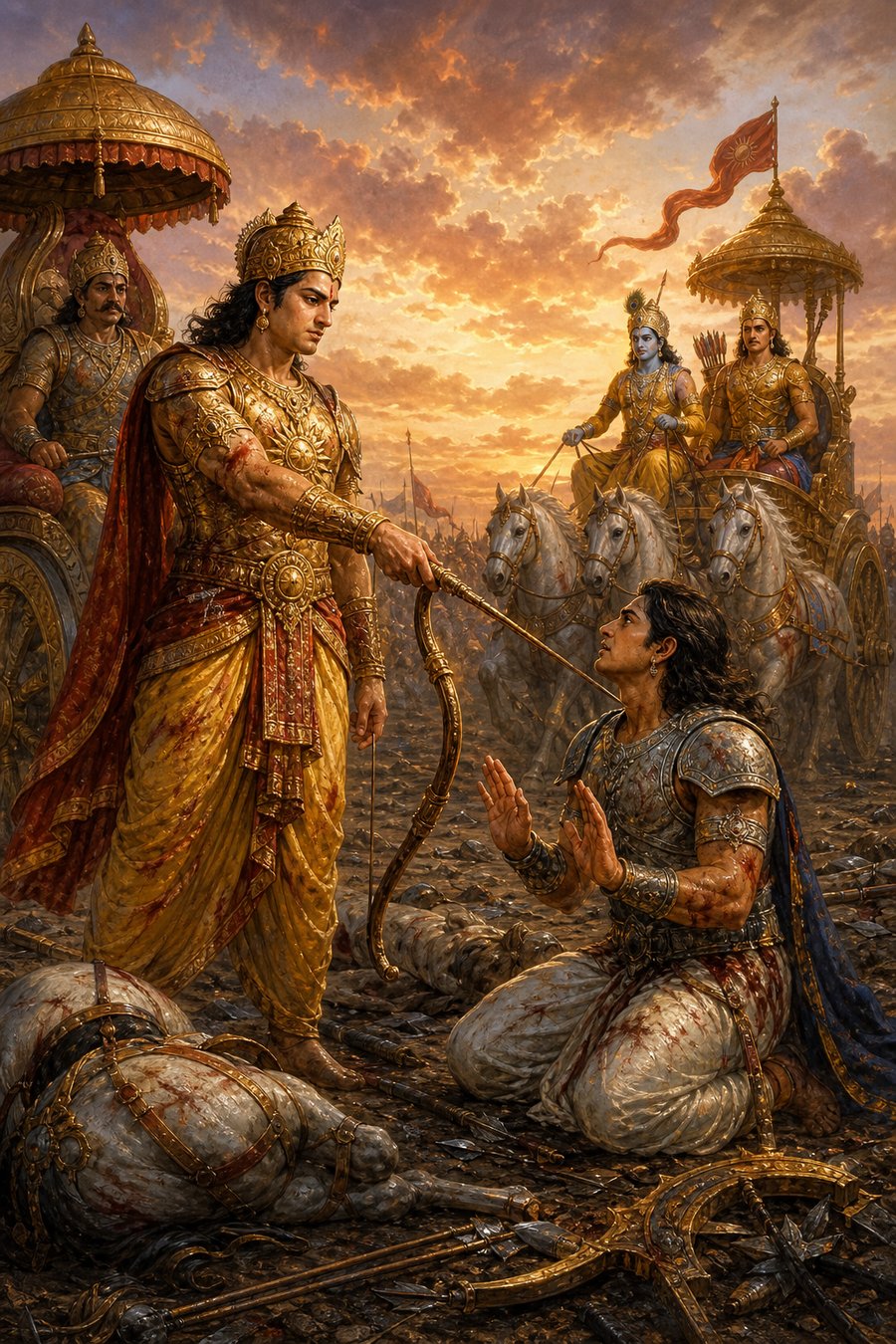
It was Krishna who answered him, from where he stood on the chariot. “How fortunate, son of Radha, that you remember dharma now. It is a common thing to see: low men, when trouble closes over them, blame Providence and never their own misdeeds. You and Duryodhana and Duhshasana and Shakuni, the son of Subala, had Draupadi brought into the middle of the assembly in a single piece of cloth. Your dharma did not show itself that day, Karna. When Shakuni, who was a master of the dice, beat Yudhishthira, who did not know the game, in that same hall, where had your dharma gone? When the Kuru king, acting on your advice, went to work on Bhimasena with snakes and with poisoned food, where had it gone? When the years in the forest were over, and the thirteenth year too, and you did not hand the Pandavas their kingdom, where had it gone? You set fire to the house of lac at Varanavata to burn the sons of Pandu to death in their sleep. Where, son of Radha, was your dharma then? You laughed at Draupadi as she stood in the assembly, scantily clothed because she was in her season, at Duhshasana’s mercy. Where was it then, Karna? When that innocent woman was dragged out of the women’s rooms, you did nothing to stop it. Where had it gone, son of Radha? You spoke to the princess yourself, to that lady who walks with the dignity of an elephant, and you said, ‘The Pandavas are lost, Draupadi. They have sunk into everlasting hell. Choose another husband.’ And you watched the scene with delight. Where was your dharma then? Greedy for the kingdom, and trusting in the king of Gandhara, you summoned the Pandavas to the dice. Where was it then? When many great chariot fighters surrounded the boy Abhimanyu in battle and killed him, where had this dharma of yours gone? If the dharma you call on now was nowhere to be found on any of those days, what is the use of parching your palate with the word today? You are all for dharma now, Suta. You will not get away with your life.”
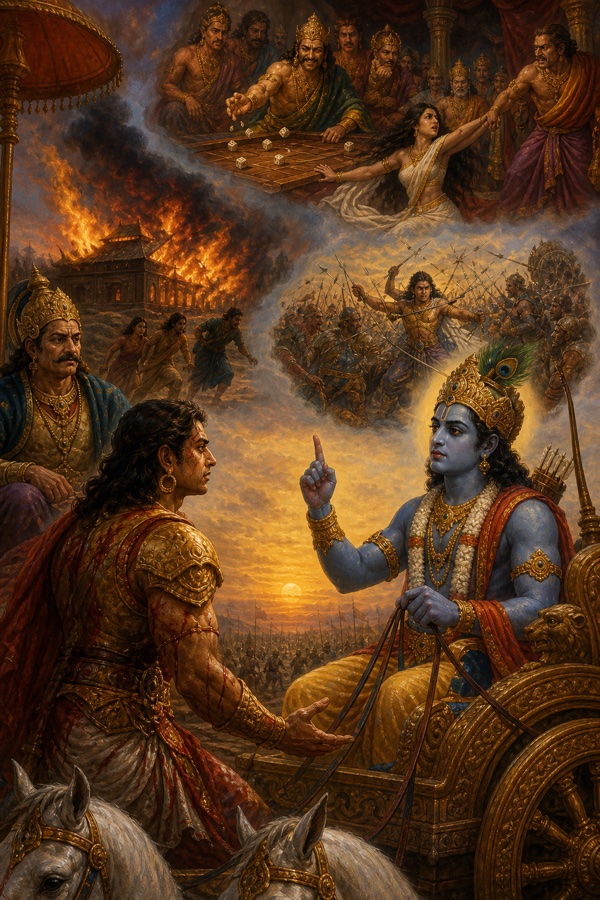
A key to reading this (the heart of the moral difficulty): Karna’s plea is a list of rules, and the rules are real: a fighter of good conduct does not shoot at a man who has put up his weapon, whose arrows are spent, whose armor has slipped, or who asks for quarter. Arjuna had held back on exactly that ground a little earlier, when Karna dropped his bow, and Krishna had told him then that the wise never spare an enemy. Krishna’s answer to Karna disputes none of the rules. It is a second list, ten occasions from the dice hall to the killing of Abhimanyu, each closed with the same question. Sanjaya reports both lists in full and records what followed: Karna hung his head and had no answer.
Krishna had one thing more to tell him. “Nala was beaten at dice by Pushkara and won his kingdom back by his own courage. The Pandavas are free of greed, and in the same way they will win their kingdom back by the strength of their arms, with all their friends beside them. They and the Somakas will kill their powerful enemies in battle and recover what is theirs. The sons of Dhritarashtra will be destroyed by these lions among men, whom dharma has always protected.”
Karna hung his head in shame when he heard it and gave no answer at all. His lips were trembling with anger. He lifted his bow and went on fighting Arjuna, with all the fire and strength that were in him. Krishna turned to Arjuna. “Strike him with a celestial weapon and bring him down.”
The gist: Karna cuts eleven of Gandiva’s strings and for a moment has the upper hand. Then the earth swallows his left wheel. He gets down, strains at it until the earth itself rises four fingers, and asks Arjuna to wait, citing the rules of fair fight. Krishna answers with ten questions: where was this dharma at the dice, at the house of lac, when Draupadi was dragged out, when Abhimanyu was surrounded? Karna has no reply, and he takes up his bow again.
The Anjalika arrow, and the death of Karna
Arjuna had heard every word of that list, and each thing Krishna named came back to him. He was filled with such fury that flames seemed to stand out from every pore of his skin, and the men who saw it wondered. Karna saw it too. He called up the brahmastra and showered Arjuna with arrows, and then he tried once more to drag his chariot free. Arjuna answered with a brahmastra of his own and kept striking. He loosed a weapon charged with the power of Agni that blazed with its own heat, and Karna put the blaze out with the weapon of Varuna and darkened every quarter with cloud, as dark as a day of rain. Arjuna, unafraid, with Karna watching him do it, blew the clouds away with the weapon of the Wind.
Then Karna picked up one arrow to kill him with, a terrible thing that blazed like fire and that he had long held in honor. As he set it on the string the earth shook, with her mountains and waters and forests. A violent wind got up, carrying hard pebbles. Dust closed in the horizon on every side. The gods in the sky cried out in grief, and the Pandavas, seeing the arrow aimed, lost heart and gave themselves up to sorrow. It left Karna’s arms with the brightness of Indra’s thunderbolt, struck Arjuna in the chest, and went into him as a great snake goes into an anthill. Arjuna reeled. His grip loosened, and the bow Gandiva dropped from his hand. He shook like the king of mountains in an earthquake.
Karna used the moment. He jumped down from the chariot, took the sunken wheel in both arms, and pulled. He was a very strong man, and he could not move it; fate would have it so. While he strained there Arjuna came back to his senses and took up an arrow of the kind called Anjalika, as deadly as the rod of Death. Krishna spoke to him. “Cut off this enemy’s head with your arrow now, before he gets back up onto his chariot.”
Arjuna welcomed the word, and with the wheel still fast in the earth he took a razor-headed arrow that blazed like fire fed with butter and shot first at Karna’s standard. That standard bore the elephant’s girth-rope. It was worked with gold and pearls and gems and diamonds by the best craftsmen living; it was known over the whole world; it shone like the sun, and it had always filled the Kaurava soldiers with courage and their enemies with fear. Arjuna cut it down. With it fell the fame of the Kurus, and their pride, and their hope of winning, and everything they held dear, and their hearts, and a wail of “Oh!” and “Alas!” went up from the whole army. From the moment the standard dropped, no one on that side believed any longer that Karna would win.
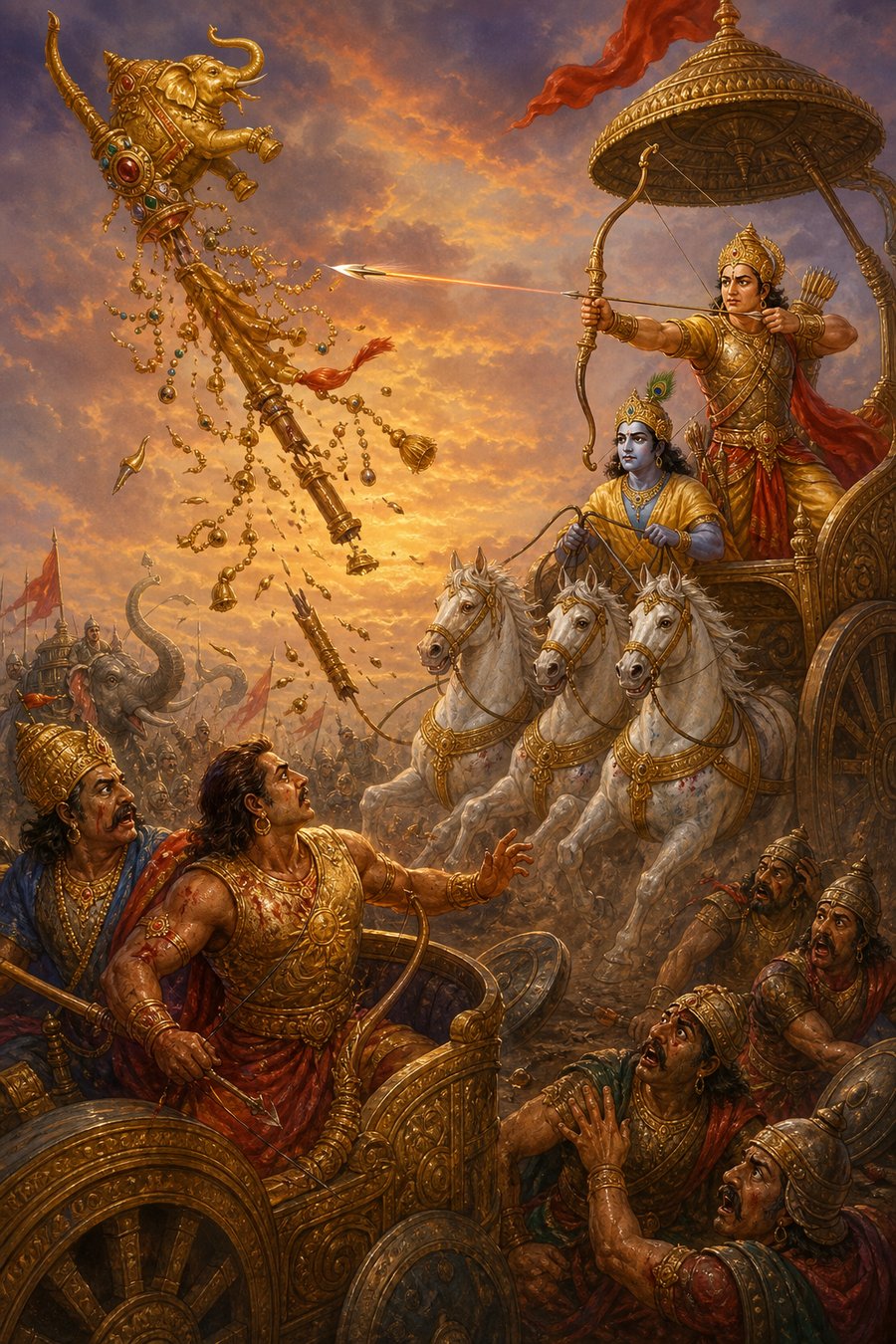
Then, hurrying now to finish it, Arjuna drew the Anjalika from his quiver. It was like Indra’s thunderbolt and like the rod of fire, and it had the brightness of the thousand-rayed sun. It could reach the very seat of life; it was smeared with blood and flesh, a killer of men and horses and elephants, straight in its flight and terrible in its speed, and it measured three cubits and six feet. It had the force of the thunder, it was as hard to stop as Rakshasas in the night, and it was like Shiva’s bow Pinaka and like the discus of Narayana. The gods themselves could not have turned it. Arjuna had always held it in worship. When he took it in his hand the whole world shook, everything that moves and everything that stands still, and the seers, seeing it raised in that battle, cried aloud, “Peace be to the universe!”
He set that arrow on Gandiva and joined a high weapon to it. He drew the bow, and he spoke quickly. “If I have ever practiced austerities, if I have ever satisfied my elders, if I have ever listened to the counsel of those who wished me well, then let this arrow become a great weapon and destroy the body and the heart of my enemy at once. By that truth let this sharp arrow, which I have worshiped, kill my enemy Karna.” And he released it, an arrow as fierce and as sure as a rite laid down in the Atharvan of Angiras, blazing, more than Death himself could have borne in battle. He was glad as it went. “Let this arrow bring me victory,” he said. “Let this arrow, bright as fire and the sun, take Karna into the presence of Yama.”
The arrow lit every quarter of the sky as it flew. With it Arjuna struck off his enemy’s head, as Indra struck off the head of Vritra with the thunderbolt. It was afternoon when the son of Indra cut off the head of Vaikartana, the son of the Sun. The trunk fell to the earth. The head of the commander of the Kaurava army, bright as the sun at its rising and as the autumn sun at noon, fell to the ground like the sun dropping blood-red from the hill of sunset. That head left the body unwillingly, as a man of property leaves a great house full of his wealth; the body was very beautiful and had been cared for in comfort all its days. The tall trunk, with blood coming from every wound, went down like the peak of a mountain of red ocher struck by lightning, streaming crimson after rain. Then a light came out of the fallen body of Karna, passed across the sky, and entered the sun. The fighting men on the field saw that wonder with their own eyes after he fell.
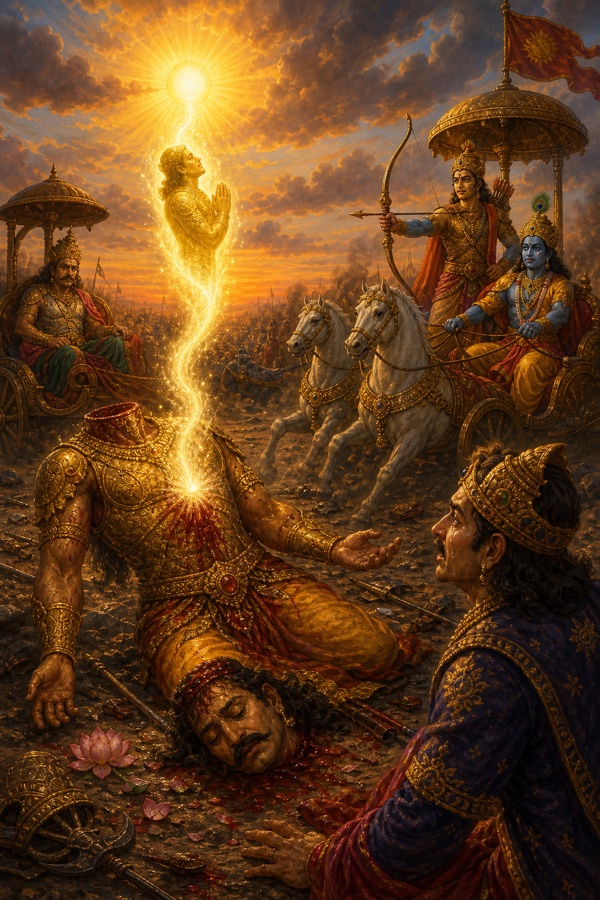
The Pandavas blew their conchs when they saw him dead. Krishna and Arjuna, full of joy, blew theirs at once. The Somakas shouted with the rest of the army, sounded their trumpets, and waved their arms and their clothes in the air; fighters crowded around Arjuna to praise him, and others danced and embraced and shouted, “By good fortune Karna lies stretched on the earth, torn with arrows!” The severed head was beautiful where it lay. It looked like a mountain peak brought down by a storm, like a fire gone out when the sacrifice is finished, like the image of the sun when it has reached the western hill. Karna had been a sun, with arrows for rays, and he had scorched the army of his enemies, and Arjuna had been the hour that made him set. As the sun goes down behind that hill taking all its rays with it, the arrow passed on and took Karna’s life breath with it. The time of his death was the afternoon of that day.
Shalya, king of the Madras, looked at Karna stretched on the earth, pierced with arrows and bathed in blood, and drove away on the chariot that no longer had a standard. The Kauravas, deeply wounded and very much afraid, fled the field, and as they ran they kept looking back at the tall banner of Arjuna, which still blazed. The head lay where it had fallen, with a face like a lotus of a thousand petals, like the sun of a thousand rays at the close of day.
A key to reading this (Arjuna’s act of truth): Before he shoots the Anjalika, Arjuna stakes his life’s conduct on it, aloud: if he has practiced austerity, satisfied his elders, and listened to those who wished him well, then by that truth let the arrow kill. Karna dies on the ground beside his sunken wheel, in the afternoon, and a light leaves his body and goes into the sun, whose son Sanjaya has called him all through this day. The human soldiers see it, and the last images Sanjaya gives the dead man are of a sunset.
The gist: Karna wounds Arjuna so badly that Gandiva falls from his hand, and uses the moment to pull at his wheel again. At Krishna’s word Arjuna first cuts down the elephant-rope standard and then, with an oath on the truth of his own life, looses the Anjalika and takes off Karna’s head while he is still on the ground. A light passes from the body into the sun. Shalya drives away on the chariot that has lost its standard, and the Kaurava army runs.
After Karna: the broken army, and Duryodhana’s call
Sanjaya said that Shalya left the place in anger, on a chariot stripped of its gear, having watched the troops ground down by arrows in the fight between Karna and Arjuna. Duryodhana looked at an army that no longer had the charioteer’s son in it, its chariots and horses and elephants destroyed, and his eyes filled, and he sighed again and again, the picture of grief. Soldiers came to see Karna. He lay on the earth pierced with arrows and bathed in blood, like the sun fallen out of the sky, and men of both armies stood in a ring around him. Some of them showed joy and some fear, some sorrow and some wonder, and some gave way to great grief, each according to his nature.
Other Kauravas, when they heard that Arjuna had killed Karna, ran like a herd of cattle that has lost its bull. Bhima roared until the sky shook. He slapped his arms and leaped and danced, and the sight of it frightened Duryodhana’s men further. The Somakas and the Srinjayas blew their conchs, and the Kshatriyas of that side embraced one another for joy. Karna had fought a dreadful battle, Sanjaya said, and Arjuna had killed him as a lion kills an elephant. Arjuna had kept his vow, and his long enmity with Karna was at an end.
Shalya, his mind numb, drove quickly to Duryodhana on the chariot that had no standard and spoke to him in sorrow. “Your elephants, your horses, and the best of your chariot fighters are dead. Great warriors and horses and elephants as big as hills have killed one another, and your army looks like the kingdom of Yama. There has never been a battle like the one Karna and Arjuna fought today. Karna pressed the two Krishnas hard, and every other enemy you have. But destiny has run the way Partha willed it. Destiny protects the Pandavas and weakens us. Many brave kings who had made your cause their own, men equal to Kubera or Yama or Indra or Varuna in courage and strength, have been killed by the Pandavas. Do not grieve over it. This is destiny. Take comfort; no one can win every time.” Duryodhana listened, and he thought about the wrongs he himself had done. His heart sank, his senses nearly left him, and he sighed over and over.
What did they look like, Dhritarashtra asked, the Kuru host and the Srinjaya host, on that dreadful day, crushed and scorched in the fight between Karna and Arjuna, and what did my army look like as it ran? Sanjaya asked him to listen closely. When Arjuna gave his lion’s shout over the fallen Karna, he said, a great fear entered the hearts of the king’s sons, and from that moment no warrior in the army gave a thought to rallying the troops or to showing what he could do. Arjuna had destroyed their shelter. They were merchants whose ship has gone down in a sea with no bottom and who have no raft. They were a herd of elephants with no keeper, set on by lions. They ran that afternoon like bulls with broken horns, like snakes with broken fangs. They had lost their weapons and their armor. They could not tell one direction from another, and they trampled one another as they went and looked at one another in terror. Each man was sure that he was the one being chased. “Vibhatsu is coming after me!” “Vrikodara is coming after me!” They went pale and fell as they ran. Elephants broke chariots, chariot fighters rode down horsemen, horsemen trod the infantry under, and to all of them the whole world seemed to be full of Arjuna.
Duryodhana saw them leaving the field by the thousand and cried out, “Oh!” and “Alas!” Then he spoke to his driver. “Partha will never get past me while I stand with a bow in my hand. Take my horses slowly along behind the whole army. If I fight from the rear, the son of Kunti will no more get past me than the ocean gets past its shore. I will kill Arjuna and Govinda and the proud Vrikodara and the rest of my enemies, and so pay the debt I owe to Karna.” They were the words of a hero and a man of honor, and the driver walked the gold-harnessed horses slowly to the rear.
Twenty-five thousand of the Kaurava infantry, with no chariots or horse or elephants among them, formed up to fight. Bhima and Dhrishtadyumna surrounded them with all four arms of their force and began to shoot. The men on foot fought back, and some of them called out the two champions by name. That angered Bhima. He kept the rule of fair fight: he got down from his chariot, trusting to the strength of his arms, and went against men on foot as a man on foot, with his great gold-bound mace, like the Destroyer with his club. They came at him careless of their lives, as insects come at a fire, and they died as fast. He moved among them like a hawk and killed all twenty-five thousand. Then he took his stand again, with Dhrishtadyumna in front of him.
Arjuna went against what remained of the Kaurava chariots. Nakula, Sahadeva, and Satyaki rode gladly at Shakuni, cut up his cavalry and his elephants, and then attacked the son of Subala himself. Wherever the Kaurava soldiers saw the white horses, with Krishna driving and Arjuna standing behind him and Gandiva sounding, they ran. They ran from Dhrishtadyumna too, when his chariot came in sight with its pigeon-white horses and its standard cut from the trunk of a kovidara tree. Chekitana, Shikhandi, and the sons of Draupadi blew their conchs over the army they had destroyed, and all of them went on after the fugitives as bulls that have won a fight go on after the beaten bulls.
One body of chariots still stood its ground, and the sight of it angered Arjuna. He drew Gandiva, a bow known through the three worlds, and covered those chariots with arrows, and the dust that went up hid everything. In that darkness the last of the army fled in every direction. With his host broken, Duryodhana himself turned and drove at the enemy who were coming on. He challenged all the Pandavas together, as the demon Bali once challenged the gods. Every Pandava champion went for him at once, shooting and hurling weapons and shouting their reproaches, and he, in a rage and without fear, killed them by hundreds and thousands with sharp arrows. Sanjaya called it a marvel that one man, with nobody beside him, fought the whole united Pandava force.
Then Duryodhana saw his own soldiers, cut up with arrows and bent on flight, still within reach. He meant to keep his honor. He called them back and tried to put heart into them. “I see no place on this earth or in the mountains where you can run and the Pandavas will not kill you. What use is running? Their force is small now, and the two Krishnas are badly wounded. If we all stand and fight, the victory is certainly ours. If we scatter, those sinful Pandavas will hunt us down and kill every one of us. Better to die in battle, then. Death in battle is a happy death. The dead feel no misery, and they have bliss without end afterward. Listen to me, all you Kshatriyas gathered here. Yama spares neither the brave man nor the coward. Who that has taken a Kshatriya’s vow would be fool enough to refuse a fight? Will you put yourselves in the hands of Bhimasena in his anger? Do not abandon the duty your fathers and grandfathers kept. A Kshatriya has no greater sin than running from a battle, and no surer road to heaven than fighting one. Die fighting, and take heaven today.” He was still speaking when his wounded soldiers broke away on every side and left him, paying the speech no heed.
A key to reading this (Duryodhana’s last note): Sanjaya gives Duryodhana three things in this last hour, one after another. He weeps for Karna and, hearing Shalya lay the defeat on destiny, thinks of his own wrongdoing until his senses nearly leave him. He tells his driver to walk the horses slowly at the rear and vows to pay his debt to Karna, and Sanjaya calls the words those of a hero and a man of honor. Then he fights the whole Pandava force alone and preaches a Kshatriya’s death to men who are already running.
The gist: With Karna dead the Kaurava army has no shelter left, and it scatters like a herd without its bull. Bhima gets down from his chariot and kills twenty-five thousand foot soldiers with his mace; the twins and Satyaki drive off Shakuni; Arjuna breaks the last chariots. Duryodhana, in tears and thinking of his own misdeeds, stands alone against all the Pandavas and calls on his men to die as Kshatriyas, and they run on regardless.
Shalya’s survey of the field, and the first cry of Karna’s name
Shalya had watched him try. The king of the Madras had driven Karna’s chariot all that day and had come away from it with the standard shot off, and he looked now at Duryodhana still calling after men who would not stop, and fear showed in his face, and grief had slowed his mind. He brought his chariot alongside and began to speak, and what he said was a walk over the ground they were standing on.
“Look at this field. Look at it as it is, heaped with dead men and dead horses and dead elephants. Over there the ground is covered with elephants as big as hills, cut to pieces, their vitals pierced with arrows, lying where they could not help themselves, their armor slipped off them and the shields and swords and weapons they carried thrown about around them. They look like mountains split by thunder, with their rocks and their tall trees and their herbs shaken loose and scattered. The bells they wore, the iron hooks, the lances, the standards they carried, all of it is lying on the ground. Their housings were of gold. Their bodies are bathed in blood now. Over there the ground is covered with horses torn by arrows, breathing hard in their pain and vomiting blood. Some of them are whimpering. Some are biting the earth with their eyes rolling, and some are neighing in a way that is hard to listen to. The men who rode the horses and the elephants have fallen off them, and whole crews of chariot fighters have been flung down out of their chariots, and some of these men are dead and some are dying. With the corpses of men and horses and elephants on it, and crushed chariots, and great elephants with their trunks and their limbs cut off, this earth has become as terrible to look at as the Vaitarani, the river the dead cross at the border of Yama’s country.”
“Look at the elephants stretched out there, trembling, with their tusks broken, vomiting blood and crying softly, with no riders left on their backs and no armor left on their limbs, the foot soldiers who guarded their flanks and their rear all gone, their quivers and banners and standards knocked askew, their gold housings struck through by the enemy’s weapons. Elephant riders and horsemen and chariot fighters, all men of great name, and the foot soldiers killed face to face by the men they were fighting, lie stripped of their armor and their ornaments and their clothes and their weapons, and the earth looks like a sky packed with cloud. Thousands of fallen men mangled with arrows, lying open to the sky with no sense left in them, and here and there one whose breath is slowly coming back, make it look like a field of fires gone out. The best of the Kurus and the best of the Srinjayas, shot through and killed by Partha and Karna, lie on it like blazing planets fallen out of heaven, or they make it look like the night sky itself, spangled with planets of a quiet light. The arrows that left the arms of Karna and Arjuna went through elephants and horses and men, stilled their lives in a moment, and went on into the earth like great snakes going down headfirst into their holes. No one can cross this ground now, for the heaps of slain men and horses and elephants, for the chariots broken by the arrows of Dhananjaya and of Adhiratha’s son, and for the arrows themselves, past counting. The chariots lie smashed with their warriors and their weapons and their standards still on them, traces broken, joints sprung, axles and yokes and poles in splinters, wheels loose, under-frames destroyed, fittings cut apart, the fastenings of the quivers cut, the drivers’ seats broken. Strewn with those gold and jeweled vehicles the earth looks like the autumn sky full of clouds. Royal chariots with no one aboard them, dragged by fast horses, and men and elephants and chariots and horses running every way, have broken the army in a hundred places.”
“Spiked maces with golden bells have fallen on the field, and battle-axes, sharp lances, heavy clubs, mallets, bright swords out of their sheaths, maces wrapped in cloth of gold. Bows decked with gold, arrows winged with pure gold, bright rapiers of fine temper, lances, scimitars bright as gold, parasols, fans, conchs, arms wreathed with flowers and gold, the caparisons of elephants, standards, chariot fences, diadems, necklaces, bright crowns, yak-tail whisks, garlands shining with coral and pearl, chaplets for the head, bracelets for the wrist and for the upper arm, collars strung with gold, costly diamonds and gems and pearls of every kind, bodies raised in great luxury, and heads as beautiful as the moon, all of it lying about. The men who owned these things have given up their bodies and their pleasures, their robes and every agreeable thing they had, and for the devotion they showed to the duty of their order they have gone quickly, in a blaze of flame, to the regions of bliss. Turn back, Duryodhana. Let the troops retire. Go to your camp. The sun is hanging low in the sky. And remember that you are the cause of all this.”
Shalya stopped there, his heart full of grief. Duryodhana did not answer him. He was past answering anyone. His senses had nearly left him, his eyes were full of tears, and the only words he had were for the charioteer’s son. “Karna! Oh, Karna!” The kings who were still with him, Ashvatthama at their head, comforted him over and over and took him toward the camp, and as they went they kept turning to look back at Arjuna’s tall standard, which seemed to be on fire with his fame. It was a strange, bright hour. Everything around them was lit. The Kauravas had all made up their minds to go to the other world, and their faces could no longer be told apart for the blood on them, and they looked at an earth so drenched with the blood of men and horses and elephants that it seemed to them a courtesan dressed in crimson robes and flower garlands and ornaments of gold, and they could not stay there. They wept aloud for Karna as they went. “Alas, Karna! Alas, Karna!” The sun had turned crimson, and at the sight of it they hurried toward the camp.
A key to reading this (Shalya’s last word): Shalya’s survey is the only full account Sanjaya gives of the ground the duel was fought on, and it comes from the man who drove Karna’s chariot all day and told him all day that Arjuna would win. He gives Duryodhana the dead in the order a soldier would notice them, elephants, horses, men, chariots, and last the gold, and he ends with one sentence of blame. Duryodhana’s whole answer is Karna’s name, twice.
The gist: Shalya walks Duryodhana’s eyes over the field: elephants like split mountains, horses vomiting blood, the arrows of Karna and Arjuna gone into the earth like snakes into their holes, the gold of a whole kingdom’s war gear lying in the dirt. He tells him the dead have gone to bliss, that the sun is low, and that he is the cause of it all. Duryodhana can only cry Karna’s name, and the kings lead him away toward the camp, looking back at Arjuna’s blazing standard.
The sun goes down to bathe, and Karna’s face unchanged in death
Karna lay where he had fallen. He was stuck full of the arrows from Gandiva, gold-winged, whetted on stone, feathered, dyed in his own blood, and he still shone; a hero down on the ground with the brilliance of the sun itself. To those who saw it, it looked as if the Sun, who is kind to the people who worship him, had touched the blood-soaked body with his rays and then gone on to the western ocean to bathe, his face crimson with grief. The gods and the seers who had gathered in the sky to watch the fight thought so, and they left for their own homes. The great crowd of other beings who had watched with them thought so too and went their ways, some to heaven and some to earth. The chiefs of the Kurus, who had seen a battle between Dhananjaya and the son of Adhiratha that had frightened everything alive, went off to their quarters for the night full of wonder, praising it.
The arrows had cut away his armor, and he had died in a dreadful fight, and the beauty that Radha’s son had carried all his life did not leave him in death. Everyone who looked at the body saw heated gold. It seemed still to have life in it, and to give off the light of fire or of the sun. The fighting men were afraid of it, as other animals are afraid of a lion even when it lies still, and the dead man looked ready to give an order. Nothing about him had changed. He was handsomely dressed. His neck was beautiful, his face was as splendid as the full moon, and he wore his ornaments and his armlets of bright gold, and Vaikartana, killed, lay stretched out like a great tree with all its branches and twigs on it. He lay like a heap of pure gold. He lay like a blazing fire put out with the water of Partha’s arrows, for the fire that was Karna had met the cloud that was Partha and gone out, as fire goes out when water reaches it. He had shot his showers of arrows and scorched the ten directions, and then Partha’s power had quieted him, him and his sons. He left the world taking with him the burning glory he had won on earth in fair fight. He had scorched the Pandavas and the Panchalas with his weapons, poured arrows on the enemy’s divisions and burned them, heated the whole world like the beautiful sun with its thousand rays, and now he had gone out of it, with his sons and his followers.
So fell the man who had been a wishing tree to the flocks of birds that came to him asking. Whoever asked, his answer was “I give.” He never once in his life said the words “I have not.” The righteous counted him a righteous man. That was Vrisha, who fell in single combat. Everything the great-hearted man owned had been dedicated to the Brahmins, and there was nothing, his own life included, that he could not give them. The ladies loved him. He gave without limit, and he was a mighty chariot fighter, and burned by Partha’s weapons he reached the highest end. The man Duryodhana had trusted when he picked this quarrel went to heaven, and he took with him the Kauravas’ hope of victory, their happiness, and their armor.
When Karna fell the rivers stood still. The sun went down pale. Mercury, the son of Soma, took the color of fire, or of the sun, and seemed to slant across the sky. The sky looked split in two. The earth roared aloud. Violent, dreadful winds got up. Every quarter of the horizon smoked and seemed to burn. The great oceans heaved and made a frightening sound. The mountains shook with their forests, and every creature felt pain. Jupiter stood over Rohini, oppressing her, and turned the color of the moon, or of the sun. The lesser quarters of the compass caught fire too. Darkness closed over the sky. The earth trembled. Meteors fell blazing. The Rakshasas and the other walkers of the night were glad. And at the moment when Arjuna’s razor-headed arrow had taken off that head with its face as beautiful as the moon, a loud cry of “Oh!” and “Alas!” had gone up from every creature in heaven, in the air between, and on the earth.
A key to reading this (the eulogy): Sanjaya, who has called Karna the son of the Sun all day, lets the sun itself close the day over him: it touches the body and goes crimson to the far ocean to bathe, and the gods take that as their cue to leave. The praise that follows is the fullest the epic gives Karna, and the heart of it is a habit of speech, “I give” and never “I have not.” The omens are told last, after the eulogy, as though the world had waited for the praise to finish.
The gist: Karna’s body keeps its beauty and seems ready to command, and the fighters fear it as beasts fear a lion. The sun, having touched him, goes crimson to the western ocean to bathe, and the gods go home. Sanjaya gives him his eulogy: a wishing tree to those who asked, a man who said “I give” and never “I have not,” who takes the Kauravas’ hope and happiness and armor with him. The rivers stand still, the planets go wrong, and the earth roars.
Two conchs, and the order of the retreat
Arjuna had killed an enemy whom gods and gandharvas and men had honored, and he stood in his own light now as Indra of the thousand eyes stood after killing Vritra. He and Krishna rode over the field at speed on that chariot of theirs, whose rattle was the roar of clouds and whose brightness was the noon sun of an autumn sky, under its banners and its loud standard, the chariot itself as white as snow or the moon or a conch or crystal, and its horses the equals of Indra’s own. The two men on it, the son of Pandu and the killer of Keshi, had Indra’s own energy in them; they were dressed in gold and pearls and gems and diamonds and coral, they were bright as fire or as the sun, and they went over the field without fear, like Vishnu and Indra riding one chariot. With the twang of Gandiva and the slap of their palms they stripped the enemy of what spirit he had left, and they killed Kurus with showers of arrows, and then, in their joy, the man with the ape on his banner and the man with Garuda on his took up their great conchs, white as snow and bound with gold, set them to their lips, and blew them together, and the sound went through the hearts of their enemies. Panchajanya and Devadatta filled the earth and the sky and heaven.
Every Kaurava who heard Madhava’s conch and Arjuna’s was afraid. The two of them made the forests and the mountains and the rivers and the quarters of the sky ring with it, filled Duryodhana’s army with terror, and gladdened Yudhishthira where he lay. The Kauravas, hearing those conchs blown, left the field as fast as they could go, and left the king of the Madras and the chief of the Bharatas, Duryodhana, standing where they were. Creatures of every kind came together to congratulate Dhananjaya, shining on the field, and Janardana with him, and the two of them looked like a pair of suns risen at once. Karna’s arrows were still in them, and they looked like the many-rayed moon and the sun come up after a darkness. They drew the arrows out, and with their friends and well-wishers around them the two went happily into their own camp, like Indra and Vishnu called in by the priests of a sacrifice. Gods and gandharvas and men, charanas and great seers, yakshas and great nagas honored Krishna and Arjuna for the killing of Karna and wished them victory in everything. They greeted their friends one by one, each according to his age, were praised in return for what they had done, and took their pleasure in it with those friends, as Indra and Vishnu did after the overthrow of Bali.
On the other side of the field the Kauravas were going, with fear in them, their eyes on empty air. The word that Karna had been killed had gone through the whole army and stupefied it, and it broke every way. The commanders, anxious now to get their troops away, had watched Duryodhana try to hold them; Duryodhana understood what they wanted, took Shalya’s advice, and withdrew the army. Kritavarma went first toward the camp, with what was left unslaughtered of the Narayana troops around him. Shakuni, who had seen Adhiratha’s son killed, went quickly after him in the middle of a thousand of his own men. Kripa, the son of Sharadvata, went with the great elephant force, which moved like a bank of cloud. Ashvatthama went breathing deep, again and again, at the sight of the Pandavas’ victory. Susharma went with what remained of the Samsaptakas, which was still a large force, looking at the frightened faces of his soldiers. King Duryodhana went stripped of everything, with grief in his heart and a crowd of cheerless thoughts. Shalya, the great chariot fighter, went toward the camp on his chariot with no standard, looking about him on every side. The other great chariot fighters of the Bharata army, who were still many, went fast, afraid, ashamed, and nearly out of their senses, and some of them as they ran praised Arjuna and some praised Karna. Among all those thousands of warriors there was no longer one man who still wanted to fight. With Karna gone they had given up hope of life, of kingdom, of their wives and of their wealth. Duryodhana, sick with grief, guided them with care and set his mind on getting them rest for the night, and the great chariot fighters bowed their heads to his orders and went off the field with cheerless hearts and pale faces.
A key to reading this (the roll call): Sanjaya names the order of the retreat like a muster: Kritavarma, Shakuni, Kripa, Ashvatthama, Susharma, Duryodhana, and Shalya last, on the chariot with no standard, looking about him. These are the men who will fight the eighteenth day. Of the seven, three, Kritavarma, Kripa and Ashvatthama, will be alive when the war ends.
The gist: Arjuna and Krishna ride over the field and blow Devadatta and Panchajanya, and the Kauravas who hear the conchs leave even Shalya and Duryodhana standing. The two are honored into their camp like Indra and Vishnu. Duryodhana withdraws his army on Shalya’s advice, chief by chief, with nobody left in it who wants to fight, and they rest for the night with pale faces.
Yudhishthira by lamplight, and the news in Hastinapura
Before the two of them had left the lines, Krishna put his arms around Arjuna. He was overjoyed. “You have killed your Vritra,” he said. “From now on, when men speak of the killing of Vritra, they will speak of the killing of Karna in the same breath. The god of great energy killed Vritra with his thunderbolt. You killed Karna with a bow and sharp arrows. Go, son of Kunti, and tell this to Yudhishthira the just, this feat that will bring you great fame and that the world already knows. You have been working toward Karna’s death for years, and when you have told the king that it is done you will have paid the debt you owed him. While you and Karna were fighting, Dharma’s son came out once to watch. He was too deeply wounded to stay, and he went back to his tent.” Arjuna said, “So be it.” Krishna turned the chariot cheerfully and spoke to the soldiers. “Blessings on you. Stand here, all of you, with care, facing the enemy.” To Dhrishtadyumna and Yudhamanyu and the twin sons of Madri and Vrikodara and Satyaki he said, “Kings, until we come back from telling the king that Arjuna has killed Karna, keep your places here and keep watch.” They gave him leave, and he set out with Partha for the king’s quarters.
They found Yudhishthira, a tiger among kings, lying on a fine bed of gold. Both of them, full of joy, touched his feet. He saw the joy in their faces and the extraordinary wounds on their bodies, and he knew from those two things together that the son of Radha was dead, and he came up off the bed quickly and took first Vasudeva and then Arjuna into his arms, and did it again. Then he asked Vasudeva how it had happened, and Vasudeva, who had a sweet tongue, told him Karna’s death exactly as it had been. When he had finished he smiled, joined his palms, and spoke to the king whose enemies were killed. “By good luck the wielder of Gandiva is safe, and Vrikodara, and you yourself, and the two sons of Madri, all five of you out of a battle that has destroyed so many heroes and made the hair stand up on the body. Now do whatever should be done next. Karna the charioteer’s son, the mighty one they called Vaikartana, is dead. By good luck the victory is yours, king of kings. By good luck you grow. Today the earth is drinking the blood of that wretch who laughed at Draupadi when she had been won at dice. Your enemy is lying on the bare ground, shot through and through with arrows. Go and look at him, that tiger among men, pierced and mangled with shafts. Rule this earth now with care; there is no one left on it to oppose you. Enjoy it, with us, and everything in it that is good.”
Yudhishthira heard him out with great joy and gave the honor back to him. “Good luck, good luck!” he said. “There is nothing wonderful in it, son of Devaki, if Partha, with you for his charioteer, does things beyond the reach of men.” Then he took hold of Krishna’s right arm, with its gold armlets, and spoke to both of them. “Narada told me that the two of you are the gods Nara and Narayana, the ancient and best of seers, who are forever at work keeping righteousness alive. The master Krishna Dvaipayana, the blessed Vyasa, with his great understanding, has told me this celestial history more than once. It is by your influence, Krishna, that this son of Pandu, Dhananjaya, has met his enemies and beaten them without once turning his back on any of them. With you holding Partha’s reins in battle we were always sure of victory.” He said it, and then he had his chariot brought, a gold-worked chariot drawn by horses as white as ivory, with black tails, as fast as thought, and with a large escort of Pandava troops he rode out to see the field where a thousand things had happened, talking pleasantly with Krishna and Arjuna on the way.
Talking with the two of them, Madhava and Phalguna, the king came to where Karna lay. He saw him stuck so full of arrows that he looked like a kadamba flower, whose straight filaments stand out all around it. He saw him lit by thousands of golden lamps filled with perfumed oil. He saw him with his son dead beside him, both of them torn by the arrows of Gandiva, and he looked, and looked away, and looked again, before he could believe his own eyes. Then he praised the two men beside him. “Govinda, today, with my brothers, I have become king of the earth, because you in your great wisdom have been my protector and my lord. When Dhritarashtra’s wicked son hears that the proud son of Radha has been killed, he will give up hope of his life and of his kingdom together. By your grace we have what we set out for. By good luck the victory is yours, Govinda. By good luck the enemy is dead. By good luck Pandu’s son, the wielder of Gandiva, has been crowned with victory. Thirteen years we have lived in wakefulness and great sorrow. Tonight, by your grace, we will sleep happily.” So Yudhishthira the just praised Janardana and Arjuna at length, Sanjaya said.
Standing over Karna and his son, killed by Partha’s arrows, Yudhishthira felt himself born again. The kings of the Pandava army, the great chariot fighters, came to him full of joy and gladdened him more. Nakula and Sahadeva and Vrikodara, Satyaki, the best chariot fighter of the Vrishnis, Dhrishtadyumna, Shikhandi, and the rest of the Pandus and the Panchalas and the Srinjayas honored the son of Kunti for the death of the charioteer’s son. They praised the king, those lovers of battle, sure-aimed men who hit what they shot at and longed for victory, and they praised the two Krishnas, the scorchers of their enemies, in speeches full of eulogy. Then the great chariot fighters, delighted, went back toward their own camp. That was the end of that great slaughter, Sanjaya said, the kind that makes the hair stand on end, and all of it had come of the blind king’s own bad counsel. What was the use of his grieving over it now?
Dhritarashtra heard that and fell to the floor from his fine seat. Gandhari, the queen whose foresight was so great, fell beside him and broke into lament after lament for the killing of Karna. Vidura and Sanjaya lifted the old king between them and began to console him, and the Kuru ladies lifted Gandhari. He had decided that destiny and necessity rule everything, and under that great grief he seemed for a time to lose his senses. His heart was full of anxiety and sorrow, and he did not faint again. Comforted by the two men, he sat silent, turning it over and over in his mind.
The battle between Dhananjaya and the son of Adhiratha was itself like a sacrifice, and the man who reads it and the man who hears it read both have the fruit of a great sacrifice duly performed. The learned say that the holy and eternal Vishnu is Sacrifice, and that Agni, the Wind, Soma and the Sun are so too, and so the man who hears this parva or recites it without malice will be happy and may reach every region of bliss. Men full of devotion read it always, this sacred collection, the first of them all, and they rejoice, and wealth and grain and fame come to them; a man should hear it always without malice, and every kind of happiness will be his, and Vishnu, the foremost of persons, and the Self-born, and Bhava are pleased with him. A Brahmin who reads it has the fruit of having studied the Vedas. A Kshatriya gains strength and victory in battle. A Vaishya gains great wealth, and a Shudra health and freedom from disease. Vishnu is eternal, and it is he who has been glorified in this parva, and that is why the man who reads it or hears it is happy and gets what his heart desires. The words of the great seer Vyasa cannot be untrue. The merit of hearing the Karna Parva recited is the merit of a man who gives good cows with their calves, without stopping, for a whole year.
A key to reading this (the two falls): Yudhishthira learns the news before a word is spoken, from the joy in two faces and the wounds under it, and the first thing he does with it is go out in the dark to look. The lamps, the kadamba flower, the son lying beside the father, and the sentence about thirteen years of wakefulness are all Sanjaya’s, told to Dhritarashtra, and they fell him. The Karna Parva opened with the blind king collapsing at the first word of Karna’s death; it closes with him on the floor again, at the last.
The gist: Krishna embraces Arjuna, posts the guard, and takes him to the king’s tent, where Yudhishthira reads the news in their faces and then hears it whole. By lamplight he rides out to see Karna’s body and his son’s, and says that after thirteen years the Pandavas will sleep tonight. In Hastinapura the telling fells Dhritarashtra and Gandhari, and the old king sits silent. The Karna Parva ends with this night, and the next morning belongs to Shalya.
Source: the Mahabharata of Krishna-Dwaipayana Vyasa, Karna Parva, Sections 41 to 96. The Sanskrit e-text, the Gita Press Hindi edition, and Kisari Mohan Ganguli’s complete English translation were used to verify names, sequence, and principal events. Where the recensions differ, this English retelling follows Ganguli, and the Hindi edition follows Gita Press.
Based on: the Mahabharata, Vedavyasa (K. M. Ganguli’s English translation; Gita Press, Gorakhpur)