On this page
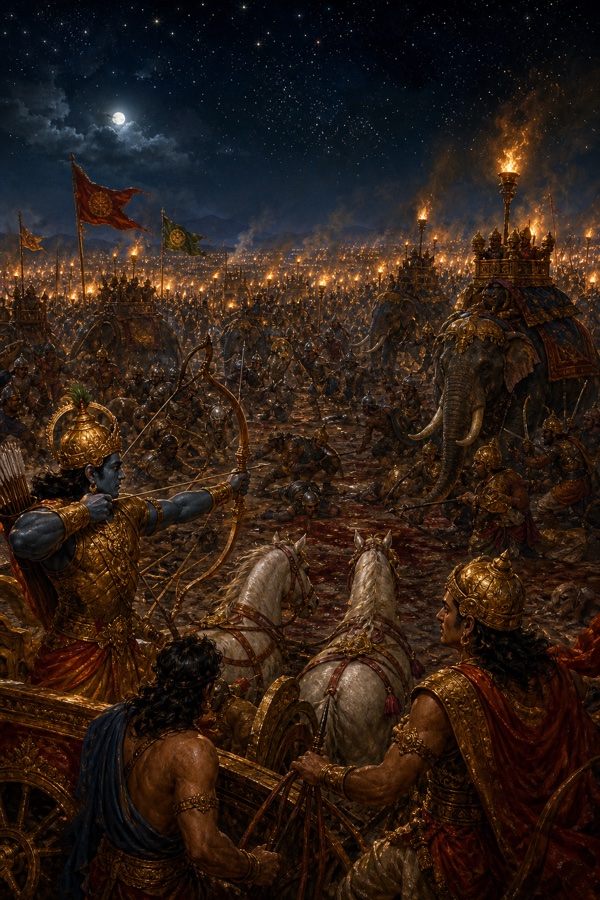
Night was in its deepest watch when Ghatotkacha, pierced by the unfailing dart Indra had once given, fell to the earth like a toppling mountain, and Karna spent on a single Rakshasa the thunderbolt he had hoarded for years to kill Arjuna. Grief ran through the Pandava camp. Yet Vasudeva’s eyes held no tears. Joy flashed in them, for he knew the thorn of Arjuna’s death had now been drawn. In that same darkness, when the sun returned and the light of the fifteenth day spread across the field, the thing happened that blurred forever the border between truth and falsehood in the Mahabharata. This stream of the story carries you to the turn where the half-truth of an elephant named Ashvatthama being killed reached the ears of Acharya Drona, where a single sentence from Yudhishthira made Drona lay down his weapons, and where the aged teacher met his end at the hands of Dhrishtadyumna.
After midnight: warriors blind with sleep, Arjuna’s word that they may rest, and the armies waking again at moonrise
Vyasa’s words had done their work. Yudhishthira, who a moment earlier had been ready to go after Karna himself, let the sage restrain him, and Sanjaya was careful to tell the blind king so. What Vyasa could not take away was the grief and the anger, because Ghatotkacha was dead, killed that night by the Suta’s son with the one weapon that had been saved for Arjuna. The king looked out at the Kaurava host, which Bhima was holding in check, and he turned the whole of his fury onto the one man he could still reach. He called for Dhrishtadyumna. Resist the Pot-born, he said, using the name that reminded Drona of the vessel he had been born from. Scorcher of foes, you came out of the fire already in armor, already holding bow and arrows and sword, for the destruction of Drona. Go into this battle gladly. You have nothing to fear. And then he named the army. Let Janamejaya and Shikhandi and Durmukha’s son and Yashodhara fall on the Pot-born from every side in their anger. Let Nakula and Sahadeva, the sons of Draupadi, the Prabhadrakas, Drupada and Virata with their sons and brothers, Satyaki, the Kaikeyas, the Pandavas and Dhananjaya, rush at Bharadvaja’s son wanting his death. Let every chariot we have, every elephant and horse, every foot soldier, throw Drona down. They went at his order with all the force that was left in them, and Drona, who had no equal with any weapon, received them, suddenly and steadily, the way he had received everything for fourteen days. Duryodhana, wanting Drona alive more than he wanted anything, came in on the other side with the same steadiness, and the Kurus and the Pandavas roared at each other and closed.
But something had gone out of the fighting, and Sanjaya, who watched it, described what it was. The animals of both hosts were exhausted. So were the men. The great chariot warriors, their eyes closing, worn down by hours of exertion, no longer knew what they were doing. That night, nine hours long, terrible and destructive of creatures, had become the whole of their world. They killed and were mangled and the sleep sat on their eyes, and midnight came. Every Kshatriya on the field lost heart. Neither army had weapons or arrows left. Most of the men, out of modesty and energy and the duties of their order, stayed in their divisions. Others, blind with sleep, put their weapons down and lay where they stood: some on the backs of elephants, some on the floors of chariots, some on horseback, perfectly still. And the men who were still awake went among the sleepers and sent them to Yama. Others, out of their senses, dreaming as they slept, killed their own comrades along with their enemies, fighting a battle that was half inside their heads and shouting as they fought. Many in the Kaurava army stood wanting to go on and could not keep their eyes open. Some brave men, sightless with sleep, still slid across the field in the darkness and killed one another. Many on the Pandava side, stupefied by slumber, died without ever being aware of the stroke that killed them.
It was Arjuna who ended it, and he ended it with his voice. Seeing the condition of the soldiers, Vibhatsu called out across the field in a voice that carried to both armies. All of you, with your animals, are worn out and blind with sleep. You are wrapped in darkness and dust. So if you wish, rest. Here, on the field, close your eyes for a while. Then when the moon rises, Kurus and Pandavas, having slept and taken your rest, meet each other again for the sake of heaven. The righteous men of the Kuru army heard the righteous Arjuna and took him at his word. They called to one another, loudly, Karna, Karna, king Duryodhana, stop fighting; the Pandava army has stopped striking us. And at Phalguna’s loud words both hosts, the Pandavas’ and Dhritarashtra’s, stopped. The gods applauded what Partha had said, and the rishis, and every gladdened soldier on the ground, and the tired men praised those kind words and lay down. Then the Kaurava army, happy at the prospect of rest, did something Sanjaya did not expect to have to report to Dhritarashtra: it blessed the enemy. In you are the Vedas and all weapons, they said to Arjuna. In you are intelligence and prowess. In you, mighty-armed one, are righteousness and compassion for every creature, sinless one. You have comforted us, and we wish you well, Partha. May prosperity be yours. May you soon win, hero, the things your heart holds dear. Having blessed him, those great chariot warriors, overcome with sleep, fell silent.
What followed was the strangest picture of the whole war, and Sanjaya drew it for the king slowly. Some men lay down on horseback, some on the boxes of their chariots, some on the necks of elephants, some on the bare ground. Many lay down apart from one another still wearing their armor, still holding their weapons, their maces and swords and battle-axes and lances. The elephants, heavy with sleep, cooled the earth with the breath from their trunks, dust-spotted trunks that lay along the ground like snakes, so that the beasts looked like hills scattered over the field with great serpents hissing on their breasts. The horses in their gold trappings, manes tangled with their yokes, stamped and made the level ground uneven. Every man slept beside the animal he rode. Horses and elephants and warriors, all of them worn out, slept and left the battle alone. That slumbering host, senseless and sunk in sleep, looked like a wonderful picture painted on canvas by skilled artists. The young Kshatriyas in their earrings, their limbs torn by arrows, lay with their heads on the frontal globes of the elephants as if they lay on the deep breasts of beautiful women.
Then the moon came up. The delighter of eyes, the lord of lilies, white as the cheeks of a lovely woman, rose and adorned the quarter that Indra rules. Like a lion of the eastern hills with a mane of brilliant yellow rays, he came out of his cave in the east and tore to pieces the thick gloom of the night, which lay over the field like a vast herd of elephants. The lover of all the lilies of the world, bright as the body of Mahadeva’s bull, full-arched and radiant as Karna’s bow, delightful as the smile on the lips of a bashful bride, bloomed in the sky. Soon the divine lord who carries the hare as his mark showed himself with brighter rays, and a halo of far-reaching light like the splendor of gold spread out from him and crept over the quarters, the sky and the earth. The world was lit. The unspeakable darkness that had hidden everything fled. Among the creatures that wander at night, some went on wandering in that near-daylight and some stopped. And the army woke. That sea of troops bloomed under the moon’s rays as a bed of lotuses opens under the sun, and it rose the way the ocean rises in agitated surges when the moon comes up over it. Then, Sanjaya said, the battle began again on the earth, for the destruction of the earth’s population, between men who desired heaven.
A key to reading this (the night and the names): This is still the night of the fourteenth day, which did not end at sunset after Jayadratha’s death and which Sanjaya reckons at nine hours of fighting. “The Pot-born” is Drona, born from a vessel (a drona) that held Bharadvaja’s seed; Dhrishtadyumna came out of the fire of a sacrifice Drupada performed for the express purpose of producing Drona’s killer, which is why Yudhishthira reminds him of it. Vyasa’s restraining words, referred to in the first line, were spoken just after Ghatotkacha’s death, when Yudhishthira rose to attack Karna himself; that scene closes the previous chapter. Vibhatsu and Phalguna are names of Arjuna. Indra’s quarter is the east. The moon’s epithets here, lord of lilies, hare-marked, are Vyasa’s own.
The gist: With Ghatotkacha dead, Yudhishthira throws his whole army at Drona, but by midnight both sides are so exhausted that men are killing their own comrades in their sleep. Arjuna calls out across the field that everyone may lie down where they are and fight again at moonrise. The Kaurava army blesses him for it and sleeps on the backs of its elephants and horses. The moon rises, the field turns as bright as day, and the sea of troops stands up again.
Duryodhana’s reproach and Drona’s bitter answer: “What Kshatriya is there who could kill the bearer of Gandiva?”
Duryodhana had watched the enemy sleep, and it had eaten at him. Now, with the field awake again, he went to Drona in a temper, and Sanjaya was precise about his purpose: to inspire the old man with joy and to provoke his anger, both at once, because Duryodhana believed that Drona fought best when he was stung. No mercy should have been shown to our enemies, he said, while they were heartless and worn out and resting, least of all when every one of them shoots to kill. Wanting to please you, we were kind to them and left them alone. The tired Pandavas have rested and grown stronger, and in every way we are losing energy and strength. The Pandavas, protected by you, keep gaining. Every celestial weapon and every weapon of Brahma lives in you. I tell you truly, neither the Pandavas nor we nor any other bowman in the world is a match for you when you fight. Foremost of the twice-born, you know every weapon; with your celestial weapons you could destroy the three worlds with their gods and Asuras and Gandharvas. The Pandavas are all afraid of you. And still you forgive them, because you remember that they were your pupils. Or perhaps, he added, it is only my bad luck.
It was the last sentence that did it. Drona, rebuked and angered by the king’s son, turned on him in a rage, and what came out was the plainest account he ever gave of what this war was costing him. I am an old man, Duryodhana, he said, and I am still fighting in this battle to the last limit of my strength. These men know nothing of weapons. I know everything of them. If I kill them out of a wish for victory, there is no baser act I could commit. And yet, whatever is in your mind, good or bad, I will carry it out at your command, Kaurava. It will not be otherwise. I will put out my strength in battle and slay all the Panchalas, and then I will take off my armor, king. That I swear to you truly. Then he took up the thing Duryodhana had said about the Pandavas being tired, and he answered it with a list. You think Kunti’s son Arjuna was worn out. Mighty-armed Kaurava, listen to what I truly say about his strength. If Savyasachin’s wrath is roused, neither Gandharvas nor Yakshas nor Rakshasas can bear him. At Khandava he met the divine chief of the gods himself and baffled the pouring Indra with his arrows. Yakshas and Nagas and Daityas and everyone else proud of their might died at the hands of that foremost of men, and you know it. When the cattle were taken, the Gandharvas led by Chitrasena were beaten by him, and it was that firm bowman who rescued you when those Gandharvas were carrying you off. The Nivatakavachas, enemies of the gods whom the gods themselves could not kill in battle, he defeated. Thousands of Danavas living in Hiranyapura that tiger among men subdued. How are human beings to stand against him? King, you have seen with your own eyes how this host of yours, fighting as heroically as it has, has been destroyed by Pandu’s son.
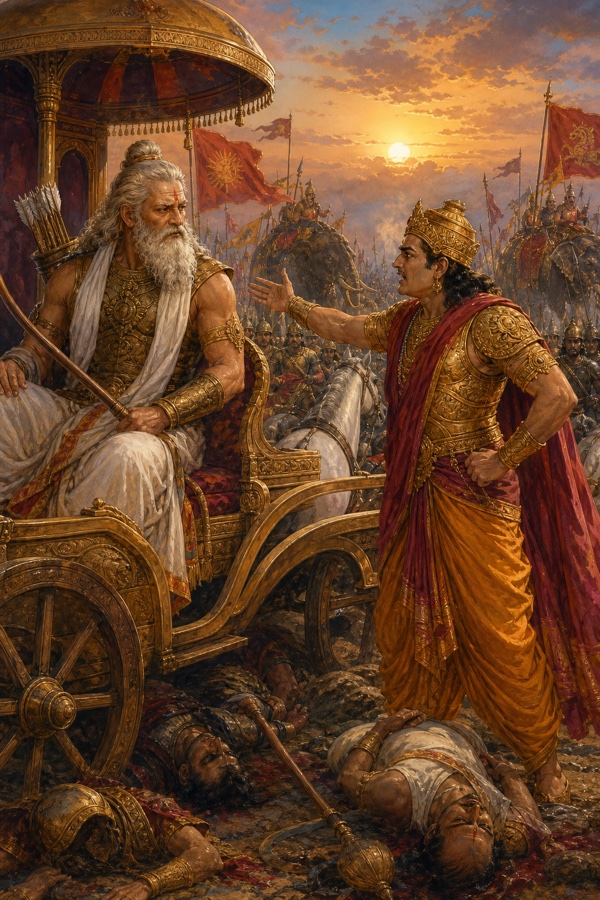
Duryodhana could not bear to hear Arjuna praised, least of all by the man he had come to provoke, and his anger produced a boast. I myself, and Duhshasana, and Karna, and my mother’s brother Shakuni, he said, will divide this Bharata host into two divisions, take one, and kill Arjuna in battle today. Bharadvaja’s son laughed. He gave his sanction to the plan, and then he gave Duryodhana his blessing, and the blessing was worse than any refusal. Blessings on you, he said. What Kshatriya is there who could kill that bull among Kshatriyas, that unslayable one, the bearer of Gandiva, that hero blazing with energy? Neither the lord of treasures, nor Indra, nor Yama, nor the Asuras, the Uragas and the Rakshasas can stop Arjuna when he has his weapons in his hands. Only fools say the kind of thing you have just said, Bharata. Who has ever met Arjuna in battle and come home alive? As for you, you are sinful and cruel and suspicious of everyone; even the men working for your welfare you are ready to rebuke like this. Then go against Kunti’s son yourself, to stop him on your own account. You are a well-born Kshatriya. You want this battle. Why are you having all these blameless Kshatriyas killed? You are the root of this enmity. So go against Arjuna. And this uncle of yours, so wise, so observant of Kshatriya duties: son of Gandhari, let this gambling addict go against Arjuna in battle. This man so skilled with dice, wedded to deception, given to gambling, expert in cunning and fraud, this gambler who knows every way of cheating, he will conquer the Pandavas in battle. With Karna beside you, you boasted joyfully, out of folly and an empty head, in Dhritarashtra’s hearing, again and again: father, I and Karna and my brother Duhshasana, the three of us together, will kill the sons of Pandu in battle. That boast was heard in every session of the court. Now keep your vow, be true to your word, with those same two. There stands your mortal enemy, the son of Pandu, in front of you. Observe the duties of a Kshatriya. To be killed by Jaya would be a death worth every praise. You have given in charity. You have eaten whatever you desired. You have obtained wealth to the full measure of your wish. You have no debts. You have done everything a man should do. Do not be afraid. Fight the son of Pandu now. And with those words said, Sanjaya told the king, the battle began.
A key to reading this (Drona’s list): Everything Drona counts off has already happened earlier in the epic. At the burning of the Khandava forest, in the Adi Parva, Arjuna held off Indra’s rain with a roof of arrows. The “taking of the cattle” is the Ghoshayatra of the Vana Parva (chapter 14, part 2), when the Gandharva Chitrasena carried Duryodhana off and Arjuna freed him. The Nivatakavachas and the Danavas of Hiranyapura belong to Arjuna’s years in Indra’s heaven (chapter 12). Jaya and Savyasachin are names of Arjuna; the lord of treasures is Kubera. Drona’s sneer about Shakuni conquering the Pandavas with dice is deliberate: the dice game of the Sabha Parva is the root of the war, and Drona sends Duryodhana back to it. The oath “I will slay all the Panchalas and then take off my armor” is the one that governs the rest of this day.
The gist: Duryodhana reproaches Drona for letting the sleeping Pandavas live and says he spares them out of a teacher’s fondness. Drona swears he will kill every Panchala before he takes off his armor, and in the same breath recites Arjuna’s victories to prove that no one can kill him. When Duryodhana boasts that he, Karna, Duhshasana and Shakuni will kill Arjuna today, Drona laughs and tells him to go and do it himself, reminding him of his old boasts at court and of the dice that started everything. On that bitterness the fighting resumes.
Sunrise of the fifteenth day: two arrows after the morning prayer, the deaths of Drupada and Virata, and Dhrishtadyumna’s oath
Three quarters of the night were gone when the Kurus and the Pandavas closed again, and Sanjaya noticed something he did not expect: both sides were glad. Rested men wanted to fight. Soon Aruna, the charioteer of the sun, dimmed the moon and turned the sky the color of copper, and the east reddened under the first rays of a sun that looked like a round plate of gold. And then the whole war stopped for a second time that night, for a different reason. Every warrior of both hosts got down from his chariot or his horse or the litter that men carried, stood facing the sun with joined hands, and said the prayers of the twilight of dawn. Then they got back up. The Kuru army had been divided into two bodies, as Duryodhana had promised, and Drona, with Duryodhana in front of him, took one of them against the Somakas, the Pandavas and the Panchalas. Krishna saw the split and read it at once. Keep your enemies on your left, he told Arjuna, and put this division of Drona’s on your right. Arjuna obeyed and moved to the left of the two great bowmen, Drona and Karna. Bhima, at the front of the army, understood what Krishna intended, and he gave the order its edge. Arjuna, Vibhatsu, listen to me. The hour has come for the purpose for which Kshatriya women bear sons. If at such a time you do not strive to win prosperity, you will be acting as meanly as a wretch. Put out your strength and pay the debt you owe to Truth, to Prosperity, to Virtue and to Fame. Foremost of warriors, pierce this division and keep them on your right.
Urged by Bhima and Keshava together, Savyasachin got the better of Drona and Karna and began to hold the enemy all around him. The foremost Kshatriyas of the Kurus put out everything they had and could not stop him; he came on at the very head of his troops like a raging fire and consumed the best of them. Duryodhana and Karna and Shakuni, Subala’s son, covered Kunti’s son with showers of shafts. Arjuna, the most skilled of all men who ever handled a weapon, baffled everything they sent and covered them in return, aiming at their weapons to cut them and then, with that lightness of hand and that complete command of his senses, putting ten sharp arrows into each of them. And then the field disappeared. Dust covered the sky. Arrows fell in thick showers. Darkness set in and a terrible uproar rose, and neither the sky nor the earth nor the points of the compass could be seen. Stupefied by the dust, the troops went blind. Neither the enemy nor we, Sanjaya said, could tell each other apart, and so the kings fought by guesswork and by the names they shouted. Chariot warriors thrown from their chariots ran into one another and became one tangled mass without order. Men whose horses and drivers were dead stood inactive, guarding their lives, badly frightened. Dead horses with dead riders on them lay across dead elephants as if they had been stretched over the breasts of mountains.
Out of that blindness Drona withdrew, moving away from the fight toward the north, and took his station there, and he looked, Sanjaya said, like a fire without smoke. The Pandava troops saw him move north and trembled. He stood there resplendent, handsome, blazing with energy, summoning the hostile army to battle like an elephant in rut, and the enemy turned pale and wavered and gave up hope of beating him, the way the Danavas give up hope of beating Vasava. Some lost heart entirely. Some, who had energy in them, grew angry. Some were filled with wonder and some could not brook the challenge. Some of the kings wrung their hands, some out of their senses with rage bit their lips, some whirled their weapons, some rubbed their arms, and some, men of great energy whose souls were under their own control, went straight at him. The Panchalas above all, tormented by Drona’s arrows and in great pain, kept fighting. Then Drupada and Virata went against him, the invincible one careering across the field, and after them the three grandsons of Drupada and the great bowmen of the Chedis. With three sharp arrows Drona took the lives of Drupada’s three grandsons, and the princes fell to the earth. He beat the Chedis, the Kaikeyas and the Srinjayas. Bharadvaja’s son then beat all the Matsyas. Drupada and Virata, in a fury, poured arrows on him; he baffled the shower and covered them both; shrouded, they went on piercing him; and Drona, full of wrath and the wish for revenge, cut both their bows with two broad-headed arrows. Virata answered with ten lances and ten arrows, meaning to kill him. Drupada hurled at Drona’s chariot a terrible dart made of iron, decked with gold, like a great snake. Drona cut Virata’s ten lances with sharp broad-headed shafts and Drupada’s dart, gold and lapis lazuli and all, with others. And then, with two well-tempered broad-headed arrows, Drona sent Drupada and Virata to Yama’s house.
The fall of Virata and Drupada, on top of the slaughter of the Kshatriyas, the Chedis, the Matsyas and the Panchalas, on top of the three grandsons of Drupada lying dead, was more than Dhrishtadyumna could stand. Filled with rage and grief, the prince swore an oath in the hearing of every chariot warrior on the field. May I lose the merit of all my religious acts, and my Kshatriya energy and my Brahma energy too, if Drona escapes me today with his life, or if he succeeds in defeating me. Having sworn it in the midst of all the bowmen, the prince of the Panchalas advanced on Drona with his division behind him. The Panchalas struck at Drona from one side and Arjuna from another. But Duryodhana and Karna and Shakuni and Duryodhana’s brothers, stationed in order of precedence, protected Drona, and behind that wall of illustrious men the Panchalas, though they struggled hard, could not even look at him. It was then that Bhima lost his temper with Dhrishtadyumna, and Pandu’s son pierced the prince with words as fierce as arrows. What man, he said, who is called a Kshatriya, who was born in Drupada’s line, who is the foremost of all men in the knowledge of weapons, would only stand and look at his enemy in front of him like this? What man who has seen his father and his son killed, and who has sworn such an oath in the middle of the king’s army, would be this indifferent to his enemy? There stands Drona like a fire swelling on its own energy. His bow and arrows are his fuel and he is burning up all the Kshatriyas. Soon he will annihilate the Pandava army. Stand there, all of you, and watch what I do. I am going against Drona myself. Vrikodara, raging, drove into Drona’s array and began to break and rout it, and then Dhrishtadyumna too broke into that great host and engaged Drona. The fight turned furious. We had never seen or heard of such an encounter, Sanjaya said, as the one that took place at sunrise that day. Chariots were tangled in chariots. The limbs of the dead lay everywhere on the field. Men moving toward another part of the field were cut down on the way; men running were struck in the back and in the side. The general engagement raged, and the morning sun climbed.
A key to reading this (who dies, who speaks): This is the morning of the fifteenth day, and in it Drona kills the two kings who gave the Pandava house its wives: Drupada, father of Draupadi and of Dhrishtadyumna, and Virata, whose daughter Uttara is Abhimanyu’s widow. The three grandsons of Drupada who fall first are Dhrishtadyumna’s sons, which is why Bhima reminds him that he has watched his father and his son die. Matsya is Virata’s country; the Chedis, Kaikeyas, Srinjayas and Somakas are all houses on the Pandava side. Aruna, the sun’s charioteer, is the copper light that precedes sunrise. Bhima’s saying that the hour has come for which Kshatriya women bear sons is an old formula of the warrior code: a Kshatriya is born to die in an hour like this one. Drona’s stand in the north is the position from which the rest of this chapter unfolds.
The gist: The battle resumes in the last quarter of the night, and at sunrise both armies stop to say the morning prayer with joined hands. Krishna and Bhima steer Arjuna to the left of Drona’s and Karna’s division; dust blinds everyone and men fight by shouting names. Drona withdraws to the north and stands there like a smokeless fire, kills Drupada’s three grandsons, and then Drupada and Virata with two broad-headed arrows. Dhrishtadyumna swears that Drona will not leave the field alive; Drona’s guard keeps him away, and Bhima shames him with hard words and breaks into Drona’s array himself as the sun climbs.
The fifteenth morning: a salute to the sun, night returning in the dust, four pairs of champions, and Nakula’s challenge to Duryodhana
The warrior who had armed himself on the field turned east and bowed to the sun as it came up. That is how Sanjaya begins the fifteenth day for the blind king: with a man in mail saluting the thousand-rayed Aditya, and with the light itself as the signal for the killing to resume. The sun rose the color of burning gold, the world filled with it, and the battle that had never really stopped simply became visible again. The same men who had been fighting the same enemies before dawn went on fighting them after it. Horsemen against chariots, elephants against horsemen, foot soldiers against elephants, riders against riders, sometimes in massed bodies, sometimes one man on one man. Many of them had fought hard all night, and hunger and thirst and exhaustion had emptied their heads; they moved like men asleep. Over them the noise climbed: conches, drums, elephants trumpeting, bowstrings drawn to full stretch and released, and under all of it the running of infantry, the clatter of dropped weapons, horses screaming, chariot wheels, the shouting of men, a roar that grew by the minute until it seemed to be pressing on the roof of heaven. And through the roar came the other sound, the one Sanjaya cannot leave out: the groans of the fallen and the falling, foot soldiers and charioteers and elephants alike, pitiable and loud.
When the engagement became general, both sides killed their own. Swords flew from the hands of heroes at men and elephants and lay in heaps on the ground like heaps of cloth at a washing ghat, and the sound of swords lifting and coming down in strong arms was the sound of cloth being beaten on the stones. Sword and scimitar, lance and battle-ax; the fighting at close quarters became a horror. The heroes made a river there, and it ran toward the country of the dead. Its current was the blood of elephants and horses and men. Its fish were weapons, in great shoals. Its mud was blood and flesh. Its roar was the wailing of the wounded, and its foam was banners and torn cloth. Elephants and horses that had been pierced with arrows and darts and worn down by the night’s labor stood on the field without moving a limb. The men, though, still looked magnificent to the eye: arms held in fine attitudes, handsome coats of mail, earrings on their heads, every piece of war gear on them. There was no longer a path anywhere on the field for a chariot; the carrion beasts and the dead and the dying had closed it. Horses of the noblest breed, elephant-sized and high-mettled, were seen trembling with the effort of dragging chariots whose wheels had sunk into the earth. That whole host, vast as the sea, shook and suffered and was afraid, with two exceptions. Drona and Arjuna. Those two were the refuge of their own sides and the saviors of their own sides, and whoever met either of them went to Yama’s house.
Then the dust came up and turned the morning back into night. The great host of the Kurus was in confusion and the Panchalas were bunched so tight that no one could tell them apart, and in that slaughter of Kshatriyas on a field that looked like a burning ground, Sanjaya says, nothing could be seen at all: neither Karna nor Drona nor Arjuna nor Yudhishthira, neither Bhima nor the twins, neither the Panchala prince nor Satyaki, neither Duhshasana nor Drona’s son nor Duryodhana nor Shakuni, neither Kripa nor Shalya nor Kritavarma, not the others, not Sanjaya himself, not the earth, not the points of the compass. Everyone was inside the dust. Men decided that night had come again. Kaurava and Panchala and Pandava could not be told from one another, nor sky from earth, nor level ground from broken. Warriors wanting victory killed whatever they could reach with their hands, friend or enemy, whoever was there to be touched. Then the wind rose and the blood came down and between them they settled the dust, and the elephants and horses and chariot warriors and foot soldiers, all of them bathed in red, looked to Sanjaya as beautiful as the parijata forest of heaven.
Out of that the day arranged itself into four duels, and the two armies stopped to watch. Duryodhana, Karna, Drona and Duhshasana, four Kaurava champions, met four of the other side. Duryodhana and his brothers took the twins, Nakula and Sahadeva. Radha’s son took Bhima. Arjuna took the son of Bharadvaja, his own teacher. The chariot warriors of both hosts stood quietly and looked on at what Sanjaya calls a beautiful and superhuman engagement, fierce men who knew every mode of warfare driving splendid chariots through their evolutions, each one straining to beat the other, covering each other with arrows the way clouds at the end of summer cover the earth with rain. On their chariots, bright as the sun, they looked like banks of cloud gathered in an autumn sky. Then wrath and the hunger for revenge took them, all of them great bowmen, and they roared their challenges and went at each other like the maddened leaders of elephant herds. Sanjaya draws the lesson himself: death does not come before its hour, or all of those men would have died together in that battle. Around them the field was a heaven of stars: severed arms and legs, heads with fine earrings still on them, bows and arrows, lances and scimitars and axes of every kind, nalika shafts and razor-headed arrows and cloth-yard shafts and darts, beautiful armor of every pattern, beautiful chariots in pieces, dead elephants, chariots without standards broken open like sacked cities, empty vehicles dragged in every direction at the speed of the wind by terrified driverless horses, well-dressed warriors of great courage lying dead in numbers, fallen fans and mail coats and banners, ornaments and robes and fragrant garlands, gold chains, diadems, crowns, headdresses, rows of bells, jewels from breastplates, cuirasses and collars and the gems that decorate helmets.
The first of the four duels to be told is the one between cousins. Duryodhana was full of wrath and the wish for revenge, and Nakula was full of exactly the same. Madri’s son, shooting hundreds of arrows and enjoying himself, maneuvered until he had the king on his right side, and the field cheered him for it. Placed on the right by his cousin, and in anger, Duryodhana turned on him and began, from that same side, to counter him with a skill that Sanjaya calls wonderful. Nakula, who knew every course a chariot can be driven, held his own against the king’s pressure from his right. But Duryodhana, pouring arrows on him and blocking him at every turn, forced him to give ground, and all the troops applauded that feat of the king’s. Nakula did not go quietly. As he fell back he called out to Duryodhana, and in the call was everything the dice hall and the forest and the years of hiding had cost him. Wait, he shouted. Wait. He was remembering, Sanjaya says, all the misery that this man’s evil counsels had brought on him.
A key to reading this (the right side): Getting an opponent onto your right was a chariot maneuver that gave a bowman a clear shooting line and put the other man at a disadvantage, which is why the field cheers Nakula for it and why Duryodhana answers by countering him from that very side. The warrior who salutes the sun is the one the previous scene left arming himself at the end of the night. Radha’s son is Karna; the son of Bharadvaja is Drona; Shakuni is Subala’s son, and the ruler of the Madras is Shalya. The nalika, the cloth-yard shaft and the razor-headed arrow are types of arrow; the parijata is the flowering tree of Indra’s heaven.
The gist: Sunrise on the fifteenth day sends the same exhausted men back at the same enemies. A river of blood runs toward Yama’s country, the dust turns day into a second night, and men kill whatever their hands touch. Only Drona and Arjuna hold their sides together. Then the field sorts itself into four duels for both armies to watch: Duryodhana and his brothers against the twins, Karna against Bhima, Arjuna against Drona. Duryodhana forces Nakula back, and Nakula, remembering everything, shouts at him to wait.
Teacher against pupil, Karna’s mace and a chariot on one wheel, Duryodhana and Satyaki remembering their boyhood, and Bhima’s advice: leave the preceptor alone on the field
Duhshasana came at Sahadeva so fast that the ground shook under his chariot, and Sahadeva answered with a single broad-headed arrow that took the head off Duhshasana’s driver, headgear and all, before anyone had seen the shot. That is the detail Sanjaya insists on: neither Duhshasana nor any of the troops knew the driver was dead. The reins were in no one’s hands, the horses ran where they liked, and only then did the prince understand what had happened. He was a horseman as well as an archer, and what he did next won him applause from both armies. He gathered the reins himself and went on fighting from a driverless chariot, fearlessly and with real skill, and Sahadeva at once began shooting his horses, which bolted and wheeled and would not be held. Duhshasana had to put the bow down to catch the reins and drop the reins to pick up the bow, and in every gap between the two Madri’s son covered him with arrows. Karna saw it and came to pull the king’s brother out. Bhima saw Karna coming. He drew his bow to its full stretch and put three broad-headed shafts into Karna’s chest and arms with great deliberation, and Karna stopped the way a snake stops when it has been struck with a stick, and turned on Bhima with keen arrows of his own. The two of them roared like bulls, their eyes wide with rage, and rushed at each other until they were so close that neither could shoot. So they took up maces. Bhima’s first blow broke the kuvara of Karna’s chariot, the pole that couples the yoke, and the field thought it a marvel. Karna hurled a mace at Bhima’s chariot and Bhima broke it in the air with his own. Bhima hurled a heavier one at Adhiratha’s son, and Karna met it with a stream of gold-winged arrows shot with all his force, and then with more, until the mace turned in the air like a snake under a spell and came back toward Bhima. On the rebound it broke Bhima’s tall standard and dropped his driver senseless. Bhima, mad with rage, sent eight arrows at Karna, at his standard, his bow and his leather finger-guard, and cut all three away with the greatest care. Karna took up another bow, an invincible one chased with gold, killed Bhima’s bear-colored horses with a flight of arrows, and then killed both his drivers. With his chariot wrecked under him, Bhima leaped onto Nakula’s, the way a lion leaps down onto the shoulder of a mountain.
Meanwhile the duel that the whole field had really stopped to see was going on: Drona and Arjuna, preceptor and pupil, the two finest chariot warriors alive, both masters of every weapon, dazzling the eyes and minds of the men around them with the speed of their hands, the sureness of their aim, and the movement of their chariots. Nothing like it had been seen before, and the other warriors stopped fighting and trembled as they watched. Each of the two, driving through beautiful evolutions, tried to get the other on his right. The battle between Drona and the son of Pandu was like a fight between two hawks in the sky over a scrap of meat: whatever Drona did to beat Kunti’s son, Arjuna did the same thing back and canceled it. When force of skill gave him nothing, the son of Bharadvaja, who knew the course of every weapon, called up the weapons of Indra, of Pashupati, of Tvashtri, of Vayu and of Yama, one after another. As each left Drona’s bow, Dhananjaya destroyed it. Drona then shrouded him in the mightiest celestial weapons he possessed, and every one of them Partha met and baffled with its counterweapon. And here Sanjaya gives the blind king something he would not have expected: Drona, watching all his weapons and even the divine ones turned aside, praised Arjuna in his heart. He thought himself, in that moment, the greatest master of arms in the world, because this man had been his pupil. Resisted by Partha in the presence of all those famous warriors, Drona struggled on with vigor, and cheerfully, and wondering all the while. The sky filled. Gods and Gandharvas in thousands, rishis and companies of Siddhas, Apsaras, Yakshas, Rakshasas, all of them crowding in to watch until it seemed that clouds had darkened the heavens, and out of the crowd an invisible voice ran back and forth across the firmament praising Drona and praising Partha. When the weapons of the two men set every quarter of the sky ablaze, the Siddhas and rishis who were present said this: this is no battle of men, nor of Asuras, nor of Rakshasas, nor of gods, nor of Gandharvas; without doubt this is a high Brahma combat, very beautiful and very wonderful, and we have never seen or heard its like. Now the preceptor is on top of the son of Pandu, now the son of Pandu is on top of Drona, and no one can find a difference between them. Only if Rudra divided himself in two and fought himself could there be a match for this; nowhere else. Knowledge in one place is in the preceptor; knowledge and means are in the son of Pandu. Heroism in one place is in Drona; heroism and might are in the son of Pandu. No enemy could withstand either of them, and if they wished, the two together could destroy the universe with its gods. Every being, visible and invisible, said those words as they watched. Then Drona called up the Brahma weapon, and Partha felt it and so did every invisible creature in the air. The earth shook, with its mountains and waters and trees. Fierce winds blew. The seas swelled. The soldiers of both armies and every other living thing were afraid when that famous man raised that weapon. Partha, without fear, answered it with a Brahma weapon of his own, and the whole convulsion of nature went quiet. When at last neither man could beat the other, the two hosts went at each other again in a general engagement, and confusion covered the field. Once more nothing could be made out. The sky was a mass of arrows like a mass of cloud, and the creatures whose element the air is could find no way through it.
In that carnage of men and horses and elephants Duhshasana met Dhrishtadyumna. The Panchala prince, badly cut by Duhshasana’s arrows, poured his own on the prince’s horses from his golden chariot until Duhshasana’s chariot, standard and driver vanished under the shafts of Prishata’s grandson, and Duhshasana could not stay in front of him. Dhrishtadyumna forced him back with arrows, scattered more arrows around himself, and went for Drona. Kritavarma, Hridika’s son, appeared with three of his own brothers to stop him, and the twins, Nakula and Sahadeva, came up behind Dhrishtadyumna, who was moving toward Drona like a spreading fire, and guarded his advance. Then those great chariot warriors, strong and furious, struck at each other with death as the goal, and Sanjaya pauses to say something about how they did it. They were men of pure soul and pure conduct, of stainless lineage and stainless deeds, and they fought with heaven in view and by righteous methods. Nothing unfair was done in that fight and no weapon was used that is counted unfair: no barbed arrows, no nalikas, no poisoned shafts, no horn-tipped heads, no many-pointed heads, none made from the bones of bulls and elephants, no double-headed arrows, no rusted heads, none that fly crooked. They used plain, fair weapons, wanting fame and the regions of blessedness both, and they wanted them by fighting fairly. Between the four Kauravas and the three Pandavas the fight was dreadful and clean. Dhrishtadyumna, quick as anyone alive with a weapon, saw the four checked by the twins and went on toward Drona; the four hit the twins like wind hitting a pair of mountains that stand in its road, and each of the twins, great chariot warriors both, kept two arrows at a time going at Drona as well.
Duryodhana saw the unbeatable Panchala prince closing on Drona and his four heroes tied up with the twins, and he came to that place in a storm of blood-drinking arrows. Satyaki saw him and went to meet him. Those two heroes, the descendant of Kuru and the descendant of Madhu, came up to each other wanting to strike, and then, Sanjaya says, they remembered how they had treated each other as boys, and took pleasure in the memory, and looked at each other, and smiled, again and again. The king, silently blaming his own conduct, spoke to the friend he had always loved. Fie on wrath, friend, and fie on vindictiveness. Fie on the Kshatriya’s usage, and fie on might and prowess, since you are aiming your weapons at me and I am aiming mine at you, bull of the Shini race. In those days you were dearer to me than my own life, and I was the same to you. All those things we did as boys, which I remember of you and of myself, have become nothing on this battlefield. Wrath and greed have brought us here today to fight each other, Satvata. Satyaki, who knew the high weapons, picked out some keen arrows and answered him smiling: this is no assembly hall, prince, nor our preceptor’s house, where we used to play together. Where have those games of our boyhood gone, Duryodhana said, bull of the Shini race, and how has this battle come upon us? The power of Time is irresistible. We are driven by the wish for wealth, but what use is wealth to us, gathered here to fight each other out of greed for it? Satyaki’s reply closed the door. It has always been the way of Kshatriyas, he said, that they must fight even their preceptors. If I am dear to you, king, then kill me without delay; through you I shall enter the region of the righteous. Show all your might and prowess now. I do not want to watch this great calamity among friends. Having said that and reasoned that, Satyaki advanced on Duryodhana without fear and with no regard for his life, and the king received him with a perfect shower of arrows, and the fight between the lion of Kuru’s line and the lion of Madhu’s was like an elephant against a lion. Duryodhana, in a fury, pierced him with many keen shafts from a bow drawn to full stretch; Satyaki answered with fifty, then twenty, then ten. The king, smiling, put thirty into him from a string drawn to the ear and with a razor-headed arrow cut his bow in two with the arrow still on it; Satyaki took a stouter bow and rained arrows on him; the king cut the incoming lines of shafts to pieces and the troops roared for him; he struck Satyaki with seventy-three gold-winged arrows steeped in oil from a bow at full stretch, and Satyaki cut all seventy-three away and the king’s bow with them and buried him in arrows until Duryodhana, deeply hurt and in great distress, took shelter in another chariot. He rested, recovered, and came back shooting, and Satyaki, smiling, never stopped. Their arrows met and tangled in the air. The sound of them falling on every side was the sound of a wildfire eating a great forest, and the earth and the sky were both thick with them. Karna, seeing the hero of Madhu’s line proving mightier than the king, came to rescue Duryodhana, and Bhima could not stand for that. He went at Karna shooting arrows without number; Karna cut them all away with ease and cut away Bhima’s bow, his arrows and his driver with them; Bhima took up a mace and smashed Karna’s bow, his standard and his driver, and then broke one wheel of Karna’s chariot. And Karna stood on that one-wheeled chariot as immovable as Meru, king of mountains, and his horses drew it along, beautiful on its single wheel, like the one-wheeled chariot of the sun drawn by its seven celestial horses. He would not accept what Bhima had done to him; he fought on with arrows and weapons of every kind in profusion, and Bhima, just as angry, fought back.
Then the engagement lost its shape again, and Yudhishthira did something a king does when he sees his people standing still. He spoke to all the foremost warriors of the Panchalas and the Matsyas. The men who are our life, he said, who are our heads, the strongest among us, those bulls among men, are all engaged with the sons of Dhritarashtra. Why are you standing here like men stupefied, as if you had lost your senses? Go where those chariot warriors of my army are fighting. Drive off your fear, keep the duties of Kshatriyas in view, and fight, for whether you conquer or are killed you will reach a goal worth wanting. If you win, you will perform sacrifices of every kind with rich gifts to Brahmins; if you are killed, you will become the equals of the gods and win many regions of blessedness. Urged like that, those heroic chariot warriors did their Kshatriya duty and went straight at Drona. The Panchalas assailed him from one side with arrows without number, and Bhima with others pressed him from the other side. And now Sanjaya names a fact plainly: the Pandavas had three crooked-minded great chariot warriors among them, Bhima and the twins, Nakula and Sahadeva. These three shouted to Dhananjaya. Rush, Arjuna, they said, quickly, and drive the Kurus away from around Drona. If the preceptor can be stripped of his protectors, the Panchalas can kill him easily. Partha went at the Kauravas at once, and Drona went at the Panchalas under Dhrishtadyumna, and on that fifth day of Drona’s command, Sanjaya says, those heroic fighters were ground down and crushed by Bharadvaja’s son with terrible speed.
A key to reading this (crooked-minded, and a clean fight): Vyasa himself calls Bhima and the twins crooked-minded here, because their advice is to get Drona killed by stripping him of his guards, and the word is placed on purpose right after the long passage that lists which arrows Kritavarma’s brothers and the twins refused to use against each other. The two things are set side by side, and the next scene is what the crooked advice grows into. Duryodhana and Satyaki were boys together under Drona; the preceptor’s house Satyaki mentions is that school, and Satyaki was also Arjuna’s pupil. The kuvara is the pole that joins a chariot to its yoke. The five named weapons belong to Indra, to Shiva as Pashupati, to Tvashtri the divine craftsman, to Vayu the wind and to Yama; the Brahma weapon outranks them all. Sahadeva and Nakula are Madri’s sons, so “Madri’s son” in this scene means whichever twin is fighting.
The gist: Sahadeva beheads Duhshasana’s driver unseen; Karna intervenes and the mace fight with Bhima ends with Bhima leaping onto Nakula’s chariot. Drona and Arjuna fight a duel the rishis in the sky call a Brahma combat that only Rudra fighting himself could match, and Brahma weapon cancels Brahma weapon. Dhrishtadyumna drives toward Drona while Kritavarma’s brothers and the twins fight the cleanest fight in the war; Duryodhana and Satyaki remember their boyhood and fight anyway; Karna stands on a one-wheeled chariot like Meru. Yudhishthira shames the Panchalas into attacking Drona, and Bhima and the twins tell Arjuna to clear the preceptor’s guards away so the Panchalas can kill him.
The slaughter of the Panchalas, Krishna’s counsel, an elephant named Ashvatthama, rishis come down from the sky, and the chariot of Yudhishthira that touched the ground
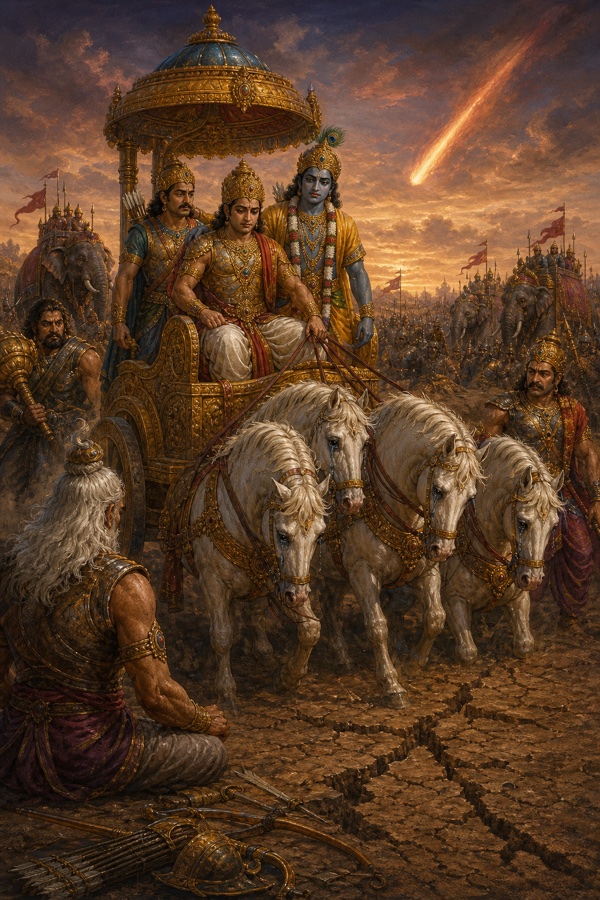
Drona went through the Panchalas the way Indra once went through the Danavas in his rage. The great chariot warriors of the Pandava army had strength and energy and no fear of him even as his weapons cut them down, and that was the terrible thing: the Panchalas and the Srinjayas kept coming, all of them, straight at Drona himself, yelling as they came to close a ring around him, and dying in the ring under his arrows and darts. The Pandavas watched the famous old man kill their allies and watched his weapons cover every quarter of the field, and fear went into their hearts. Looking at that carnage of horses and men, Sanjaya says, they gave up hope of victory, and they began to say it to each other. Is it not plain that Drona, who knows the mightiest weapons, will burn us all the way a fire in spring burns a heap of straw? There is no one who can even look at him in battle. And Arjuna, the one man who is his match, knows the ways of morality and will not fight him. Krishna heard them. He saw the sons of Kunti bleeding under Drona’s arrows and frightened, and being devoted to their welfare, and having great intelligence, he spoke to Arjuna. This foremost of all bowmen, he said, cannot be beaten by force in battle, by the gods themselves with Vasava at their head. But when he lays his weapons down he can be killed on the field even by men. Sons of Pandu, set virtue aside now and find some contrivance for victory, so that Drona of the golden chariot does not kill us all. I think that if his son Ashvatthama falls he will stop fighting. Let some man, then, tell him that Ashvatthama has been killed in battle. Sanjaya records the reception of that advice with care. Kunti’s son Dhananjaya did not approve of it. Others did. Yudhishthira accepted it with great difficulty.
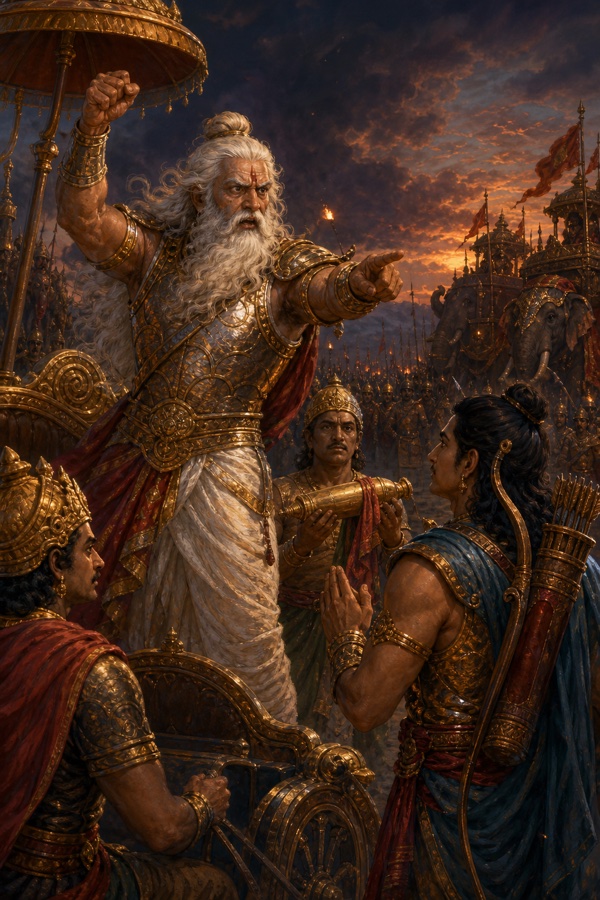
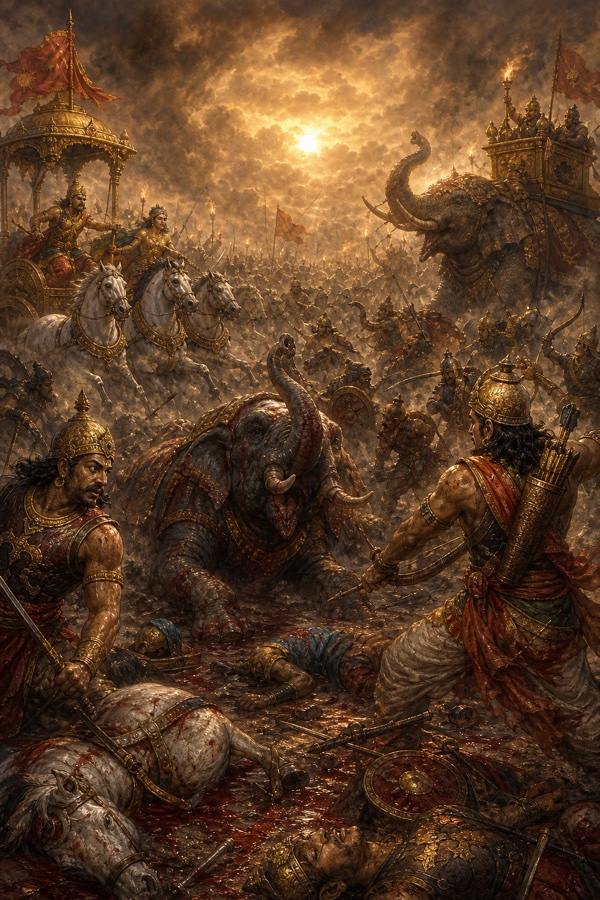
Bhima did not wait for the difficulty to resolve. There was an elephant in the Pandava army, a huge and terrible crusher of enemies belonging to Indravarman, the chief of the Malavas, and its name was Ashvatthama. Bhima killed it with his mace. Then he went to Drona in the middle of the battle, and Sanjaya gives him one word that the rest of the epic will hold against him: he went with some bashfulness. And he shouted, Ashvatthama has been killed. Having killed the elephant named Ashvatthama, he spoke of the killing of Ashvatthama; keeping the true fact inside his mind, he said what was untrue. Drona heard those hateful words and thought about them, and his limbs seemed to dissolve like sand in water. Then he remembered what his son was, what his son could do, and he decided the news was false. The report of his son’s death did not unman him. He recovered himself quickly and took comfort, remembering that no enemy could withstand Ashvatthama, and he turned on Prishata’s son, the man ordained to be his killer, wanting to kill him first, and covered him with a thousand keen arrows fletched with kanka feathers. Twenty thousand Panchala chariot warriors of great energy answered by covering Drona with theirs, and Sanjaya could no longer see him at all: he was the sun in the rainy season, hidden in cloud. Out of that cloud Drona, furious, bent on the destruction of those brave Panchalas, swept the arrows away and called up the Brahma weapon, and he shone like a fire without smoke. He killed all the Somakas in his reach and seemed to be clothed in splendor while he did it. He took off the heads of the Panchalas and cut off their massive arms, arms like spiked maces, heavy with gold ornaments, and the Kshatriyas that Bharadvaja’s son cut down fell and lay scattered like trees uprooted by a storm. Fallen elephants and horses made the ground a mire of flesh and blood that no one could cross. Having killed twenty thousand Panchala chariot warriors, Drona shone like a smokeless fire. Then, angry again, he cut the head of Vasudana from his body with a single broad-headed arrow. Then he killed five hundred Matsyas, and six thousand elephants, and ten thousand horses.
That was when the sky opened. Seeing Drona standing on the field for the extermination of the Kshatriya race, the rishis came: Vishvamitra and Jamadagni, Bharadvaja and Gautama, Vasishtha, Kashyapa and Atri, the Shrikatas, the Prishnis, Garga, the Valakhilyas, the Marichis, the descendants of Bhrigu and of Angiras, and many other sages of subtle form, with the Bearer of sacrificial offerings at their head. They wanted, Sanjaya says, to take Drona to the region of Brahman, and that is the spirit in which they spoke to him. You are fighting unrighteously, they said. The hour of your death has come. Lay your weapons down in battle, Drona, and look at us standing here. After this it does not become you to do such cruel deeds. You know the Vedas and their branches; you are devoted to the duties that truth enjoins; above all you are a Brahmin, and such acts do not become you. Lay down your weapons. Drive away the film of error that covers you. Take the eternal path now. The time you were to spend in the world of men is full. With the Brahma weapon you have burned men on earth who know nothing of weapons, and that act, twice-born one, is not righteous. Lay your weapons down in battle without delay, Drona; do not stay longer on the earth; do not, twice-born one, commit such a sin. Drona heard them. He heard, still, what Bhima had shouted. He looked and saw Dhrishtadyumna in front of him. And the joy went out of his fighting. Burning with grief and badly shaken, he asked Kunti’s son Yudhishthira whether his son had been killed or not. He asked Yudhishthira and no one else, because he was certain that Yudhishthira would never speak an untruth for the sovereignty of the three worlds. He had hoped for truth from Yudhishthira since the boy was a child.
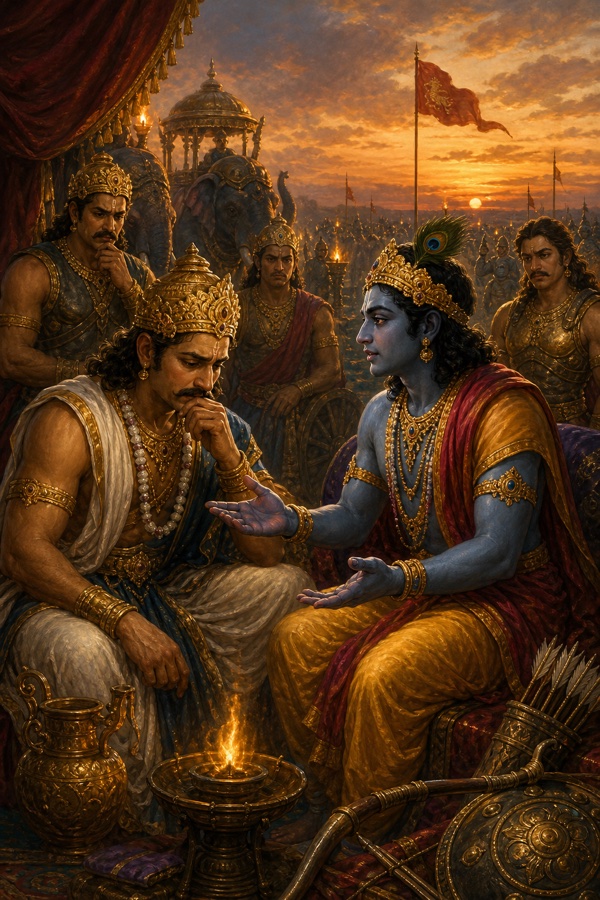
Krishna understood exactly what was being asked and what it would cost, and he understood something else: that Drona, the greatest warrior on that field, was capable of sweeping the Pandavas off the face of the earth, and he was much distressed. He spoke to Yudhishthira. If Drona fights in his rage for even half a day, he said, I tell you truly, your army will be annihilated. Save us from Drona. In circumstances like these falsehood is better than truth. A man who tells an untruth to save a life is not touched by sin. There is no sin in an untruth spoken to women, or at a marriage, or to save a king, or to rescue a Brahmin. While Govinda and Yudhishthira were still talking, Bhima spoke to the king. As soon as I heard, monarch, of the means by which the high-souled Drona might be killed, I put out my strength and at once killed a mighty elephant like Shakra’s own, one belonging to Indravarman, the chief of the Malavas, that was standing inside your army. Then I went to Drona and told him, Ashvatthama has been killed, Brahmin; stop fighting. And truly, bull among men, the preceptor did not believe my words. You want victory; take Govinda’s advice. Tell Drona, king, that the son of Sharadvat’s daughter is no more. Told by you, that bull among Brahmins will never fight. You are known across the three worlds as a truthful man. Yudhishthira heard Bhima, and was moved by Krishna’s counsel, and there was also, Sanjaya says, the inevitability of destiny; and he made up his mind to say what he wanted to say. Afraid of uttering an untruth, and earnestly wanting victory, he said distinctly that Ashvatthama was dead, and added indistinctly, after the name, the word elephant. Until that moment Yudhishthira’s chariot had traveled four fingers’ breadth above the surface of the earth. After he had said that untruth, his vehicle and his animals touched the ground. Drona heard the words from Yudhishthira’s mouth and gave way to despair for his son. The rishis’ words worked in him too, and he saw himself as a great offender against the Pandavas. Cheerless now, and full of anxiety, with the death of his son in his ears and Dhrishtadyumna in front of his eyes, the old warrior could not fight as he had fought before.
A key to reading this (four fingers): Vyasa says that Yudhishthira’s chariot ran four fingers’ breadth above the ground by the power of his truthfulness, and that this one half-truth brought it down onto the earth for the first time. Arjuna refuses the plan, Yudhishthira accepts it with difficulty, and Krishna lists the five occasions on which a lie carries no sin; in the Karna Parva, in chapter 28a, Krishna will recite the same list to Arjuna in the quarrel over Gandiva. Sharadvat’s daughter is Kripi, Ashvatthama’s mother and Kripa’s sister, which is why Bhima frames the message that way. Among the rishis who come down to Drona is Bharadvaja, his own father; they come to take him to Brahman’s world, and their rebuke is meant as a release. Vasudana is the king of Panshu counted among the chariot warriors in chapter 20. The Bearer of sacrificial offerings is Agni. Kanka feathers are the feathers of a heron used to fletch arrows.
The gist: Drona’s slaughter of the Panchalas drives the Pandavas to despair, and Krishna proposes the contrivance that Arjuna rejects and Yudhishthira barely accepts. Bhima kills Indravarman’s elephant Ashvatthama and shouts the name at Drona, who disbelieves him and goes on to kill twenty thousand Panchala chariot warriors, Vasudana, five hundred Matsyas, six thousand elephants and ten thousand horses. The rishis descend and tell him his hour has come. Drona asks Yudhishthira, the one man he trusts, and Yudhishthira says “Ashvatthama is dead” aloud and “the elephant” under his breath. His chariot touches the ground, and Drona, facing Dhrishtadyumna, can no longer fight as he did.
Drona and Dhrishtadyumna: the swordsmanship of a chariotless warrior
Seeing Drona thus sunk in anxiety and almost bereft of his senses by grief, Dhrishtadyumna, son of the Panchala king, rushed at him. Drupada had obtained this hero at a great sacrifice, from Agni the eater of oblations, for this very purpose, that he become Drona’s slayer. He took up a victory-giving, formidable bow whose twang was like the roll of clouds, and fixed on it a fierce arrow like a snake of virulent poison.
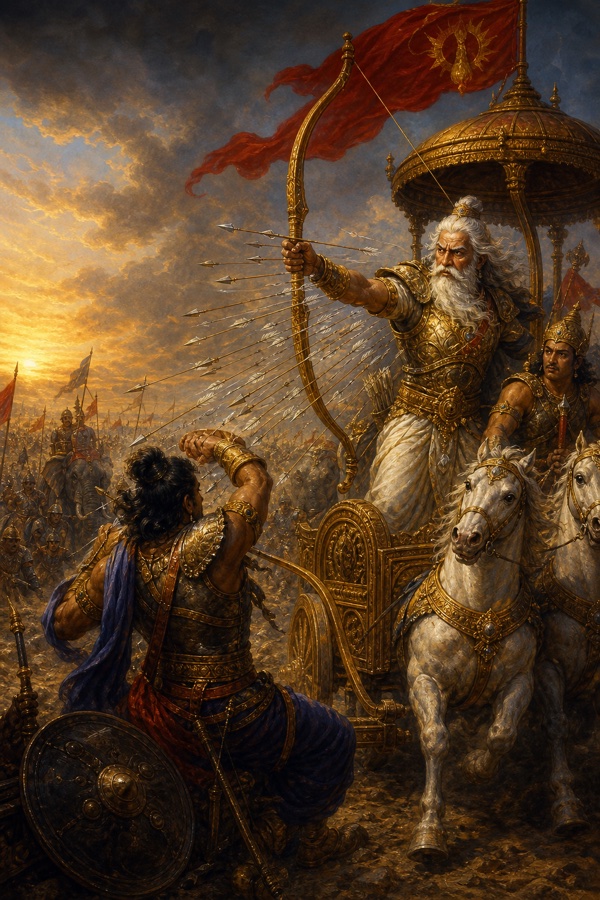
Seeing that blazing arrow taking aim, the teacher thought that the last hour of his body had come. He wished to make the arrow vain, but his celestial weapons no longer appeared at his call. Then, taking up another celestial bow that Angiras had given him, and arrows like a Brahmin’s curse, he fought on. He covered Dhrishtadyumna with a thick shower of arrows, cut his shafts, standard, and bow into a hundred pieces each, and pierced his driver as well.
Dhrishtadyumna, smiling, took up a second bow and drove a keen arrow into the center of Drona’s chest. Drona once more cut off his bow, then severed all his weapons and bows, leaving only his mace and sword, and pierced the enraged Panchala with nine life-taking arrows. Dhrishtadyumna invoked the Brahma weapon and mingled his own horses with the enemy’s. Those red and dove-colored horses looked like roaring clouds charged with lightning in the season of rains.
Drona cut off the axle, the wheels, and the joints of Dhrishtadyumna’s chariot. Deprived of bow, chariot, horses, and driver, the hero Dhrishtadyumna grasped a mace, but Drona cut even that down with his arrows as it was about to be hurled. Then that warrior took up a spotless sword and a bright shield decked with a hundred moons.
Now the chariotless Dhrishtadyumna, sword and shield in hand, showed marvelous skill. He would shelter in the chariot box, mount the chariot shaft, and slip beneath the haunches of Drona’s red horses. He showed the well-known twenty-one kinds of motion: wheeling about, whirling the sword on high, thrusting from the flank, rushing forward, leaping high, striking to the side, drawing back, and closing again with his foe. He showed the arts called Bharata, Kaushika, and Satvata. The gods and the warriors alike were filled with wonder to see it.
Drona, shooting a thousand arrows, cut off Dhrishtadyumna’s sword and his hundred-mooned shield. In such close fighting Drona used arrows a span in length, which serve only in close combat, and which none but Kripa, Partha, Ashvatthama, Karna, Pradyumna, Yuyudhana, and Abhimanyu possessed. Then the teacher, wishing to slay his beloved disciple who was to him as his own son, fixed a swift arrow to his bow. But Satyaki cut that arrow away with ten of his own, before the eyes of your son and of Karna, and rescued Dhrishtadyumna from the very mouth of death.
The gist: Drona alone disarmed Dhrishtadyumna again and again, but grief had settled inside him. Satyaki, saving the Panchala prince, held off the final struggle a few moments longer. Keshava and Dhananjaya, seeing Satyaki’s skill, praised him aloud, “Excellent, excellent.”
Satyaki surrounded, and Drona’s final resolve
Enraged by Satyaki’s feat, Duryodhana and the rest quickly surrounded the grandson of Sini on all sides. Kripa, Karna, and your sons rained keen arrows on him. Then Yudhishthira, the two sons of Madri, and Bhimasena ringed Satyaki to protect him. Satyaki alone, with his own celestial weapons, checked that terrible arrow-storm of all those chariot-warriors. The field filled with cruel sights. Severed arms, heads, and bows, displaced umbrellas, and yak-tail whisks lay in heaps.
Then Dharmaraja Yudhishthira gave his warriors the order, “Great chariot-warriors, put forth all your vigor and rush upon Kumbhaja, the pot-born! There the hero, Prishata’s son, is engaged with Drona. By the look of him, it is evident that in his rage he will overthrow Drona today. Unite, all of you, and fight the pot-born.” So ordered, the Srinjaya chariot-warriors rushed at Drona.
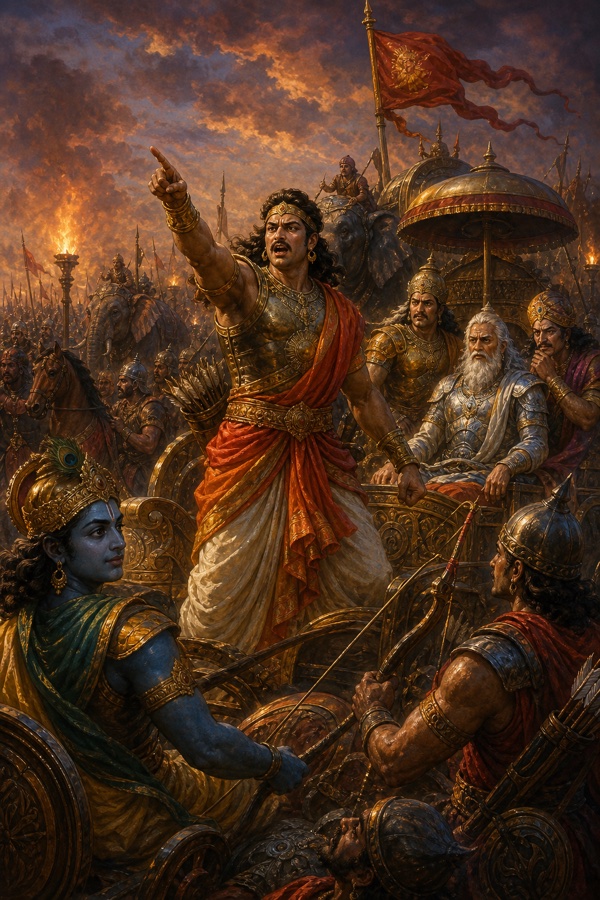
Drona too, knowing for certain that he would now die, rushed swiftly against those warriors. As he advanced, the earth trembled violently, fierce winds blew, and large meteors, seeming to issue from the sun, fell blazing to the ground. The teacher’s weapons seemed to blaze forth, his chariot creaked harshly, and his horses shed tears. His left eye and left arm twitched. Recalling the rishis’ words about his passage to heaven, he grew cheerless and resolved that he would now give up his life fighting fairly.
That day Drona despatched twenty-four thousand Kshatriyas, and then a hundred thousand more warriors, to the house of Yama with his keen shafts. For the extermination of the Kshatriya race he had recourse once more to the Brahma weapon. Then Bhima lifted the chariotless, weaponless Dhrishtadyumna onto his own chariot and said, “Save you, there is no other man who dares to fight the teacher. Be quick to kill him. The burden of his slaughter rests upon you.”
Thus urged by Bhima, Dhrishtadyumna took up a strong new bow that could bear a great strain and began to rain arrows on Drona. Both warriors invoked the Brahma weapon and many other celestial weapons. Drona once more cut off the Panchala’s bow and pierced his vital points with many arrows.
Bhima’s hard words and the rishis’ teaching of dharma
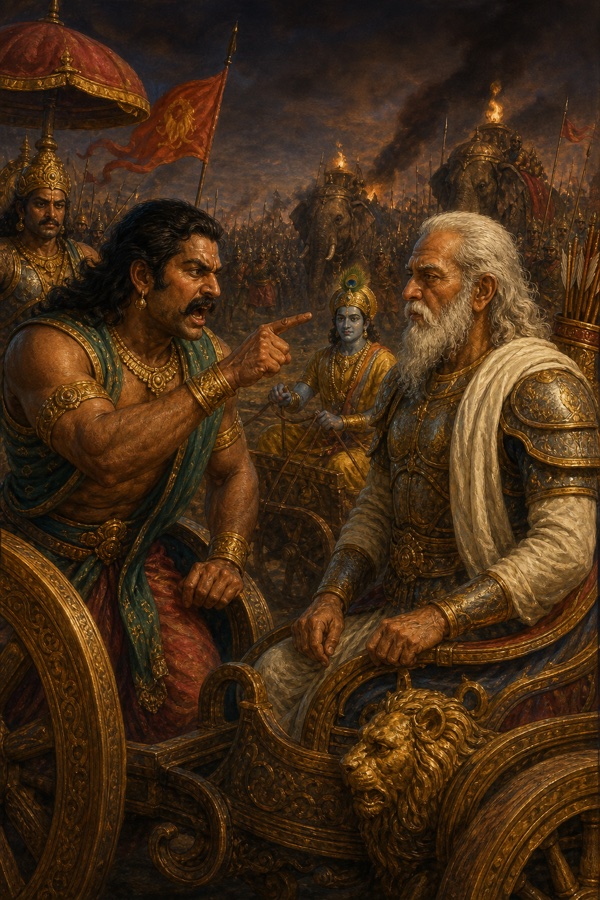
Then the greatly enraged Bhima, holding Drona’s chariot, said these hard words in a low voice. “If wretches among Brahmins, discontented with their own dharma but well-versed in arms, did not fight, the Kshatriya line would not be exterminated like this. Abstention from injury to all creatures is called the highest of virtues, and the Brahmin is the root of that virtue. You are the foremost knower of Brahman. From desire of wealth for son and wife, for the sake of one son alone, slaying all these Mlecchas and warriors, do you feel no shame? He for whom you took up weapons, he for whom you live, lies today lifeless on the field behind your back, unknown to you. King Yudhishthira the just has told you this. It does not become you to doubt it.”
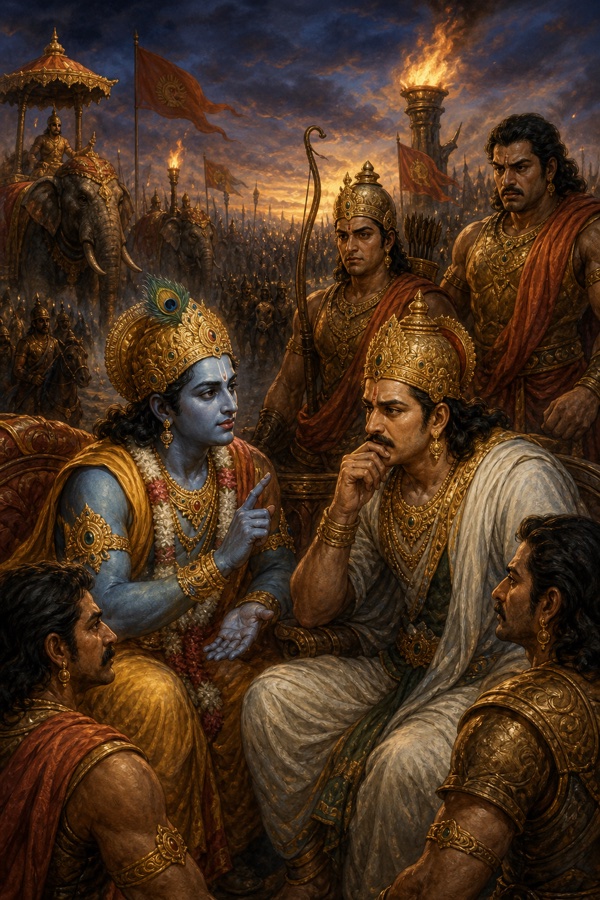
At Bhima’s words Drona laid aside his bow. Ready to lay aside all his weapons, Drona called aloud, “Karna, O Karna! Great bowman! Kripa! Duryodhana! I tell you all again and again, exert your prowess in battle with care. Let no harm come to you from the Pandavas. As for me, I am laying aside my weapons.” Saying this, he called aloud the name of Ashvatthama.
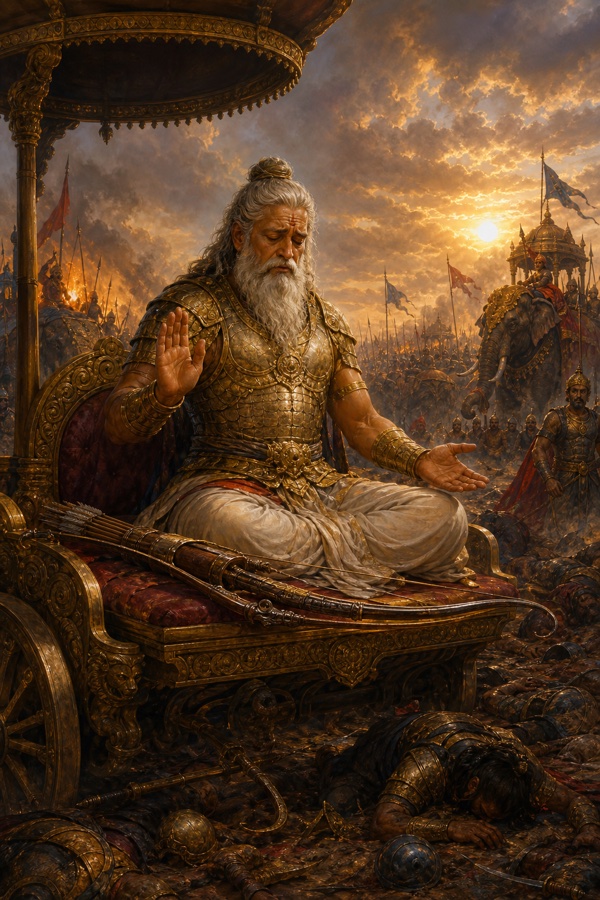
Laying down his weapons, he sat on the terrace of his chariot and gave himself to yoga, granting safety to all creatures. Then the rishis appeared before him and said, “You are fighting unrighteously. Your time in this world is now full. With the Brahma weapon you have burned even men who did not know the science of arms. This deed is not righteous. Lay aside your weapons without delay. Do not perpetrate so sinful an act.”
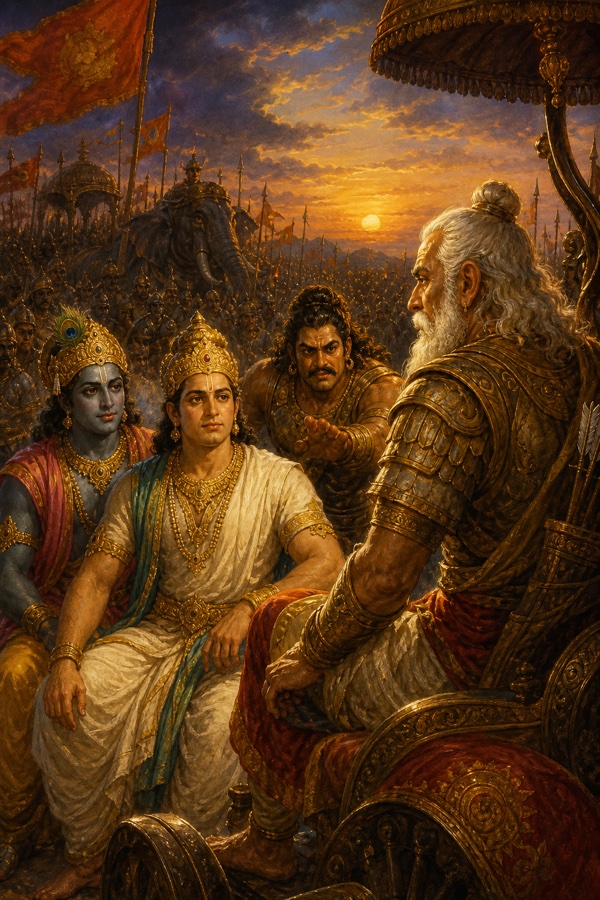
Hearing these words of the rishis and of Bhima, and seeing Dhrishtadyumna before him, Drona grew deeply cheerless. Burning with grief, he asked Kunti’s son Yudhishthira whether his son Ashvatthama had been killed or not. Drona firmly believed that Yudhishthira would not speak an untruth even for the sovereignty of the three worlds. For this reason he asked Yudhishthira alone, and no one else. From Yudhishthira’s infancy he had looked to him for truth.
A sub-tale: At this very moment Krishna repeated to Yudhishthira that if Drona fought even half a day more the Pandava army would be finished, and that untruth spoken to save a life is no sin. Note that Drona deliberately put the question to Yudhishthira alone, since he was the one man from whose mouth Drona could not imagine a lie coming. The blow of the half-truth fell on precisely that trust.
Yudhishthira, though he well knew the evil fruits of untruth, from desire for victory and fear of death, said the same thing again. He added the word “Elephant” indistinctly after the name of Ashvatthama. Hearing this from Yudhishthira’s mouth, the great chariot-warrior Drona, stricken with grief for the supposed death of his son, yielded to the power of despair.
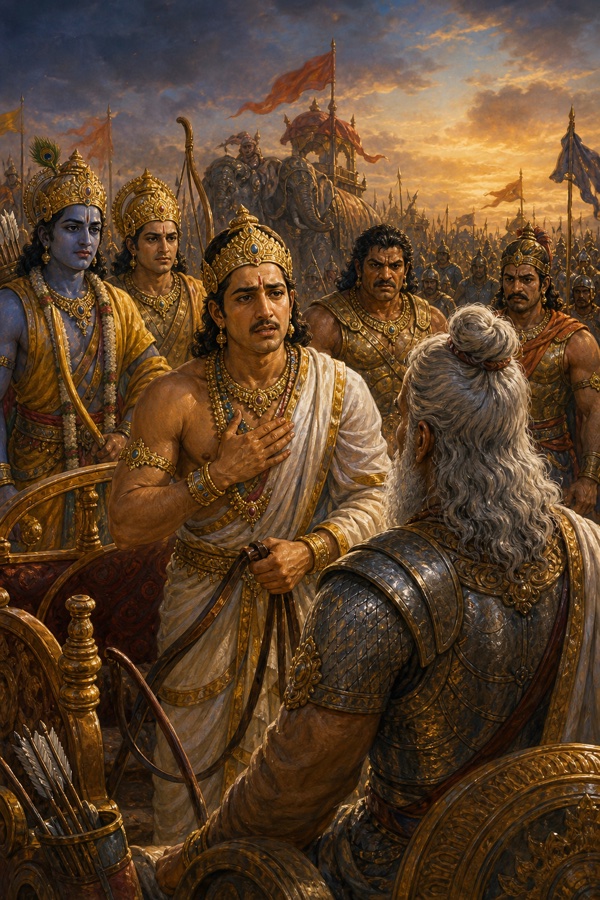
The teacher rapt in yoga, and Dhrishtadyumna’s sword
Seeing Drona thus sunk in anxiety and almost senseless with grief, Dhrishtadyumna gathered all his strength. Laying down on his chariot his formidable bow with its fixed arrow, he took up a sword and, leaping from his vehicle, ran swiftly at Drona. Seeing Drona fall into Dhrishtadyumna’s power, all creatures, human beings and others, cried out in horror. From every side rose the sounds of “Alas” and “Fie.”
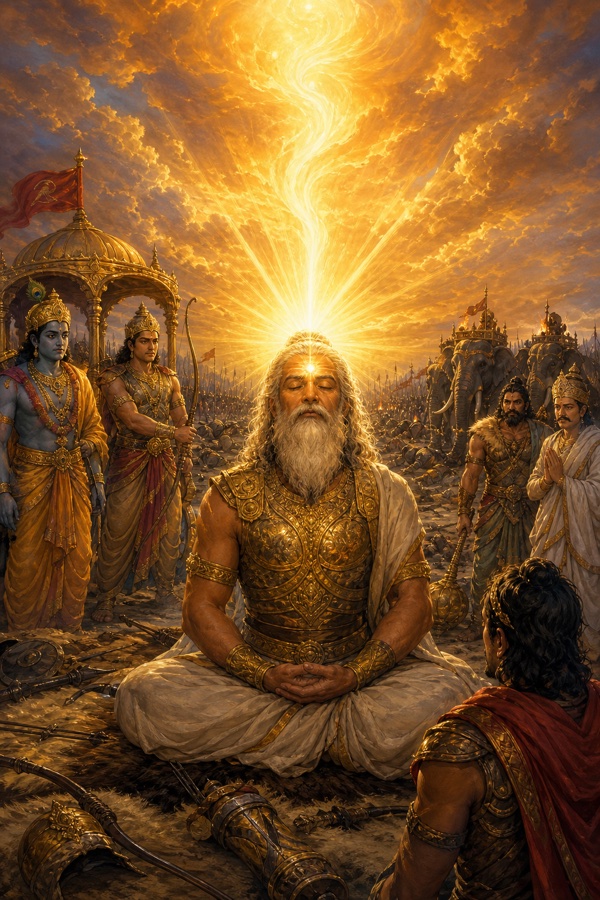
The teacher at that time had laid aside his weapons and was in a supremely tranquil state. Of great splendor and high ascetic merit, he had fixed his heart on that eternal and ancient being, Vishnu. Bending his face a little down, drawing his chest forward, closing his eyes, resting on the quality of goodness, and thinking on the syllable Om, he was rapt in yoga. Sunk in that meditation, Drona of high ascetic merit set out for that heaven which even the pious reach only with difficulty.
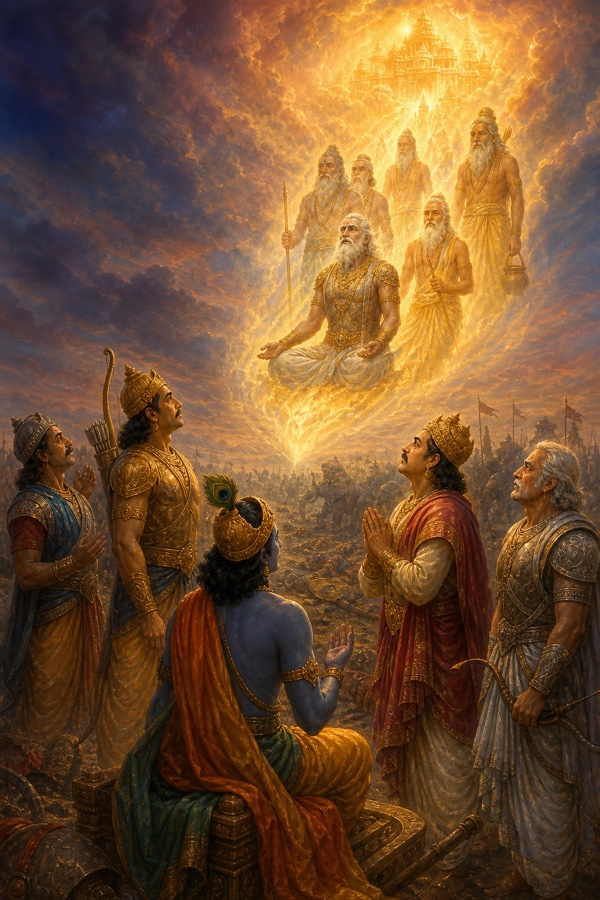
It seemed to us there were two suns in the sky. The whole firmament filled with light as the sun-bright Bharadvaja vanished from there. Confused sounds of joy were heard, uttered by the delighted gods. When Drona went to Brahmaloka, Dhrishtadyumna stood beside him, unconscious of it all. Among men only five beheld the yoga-rapt Drona passing to the supreme abode: I, Sanjaya, and Dhananjaya, and Ashvatthama, and Vasudeva, and Dharmaraja Yudhishthira. No one else saw that glory. The teacher’s body, pierced with arrows and bathed in blood, its weapons laid aside, lay quiet on the earth.
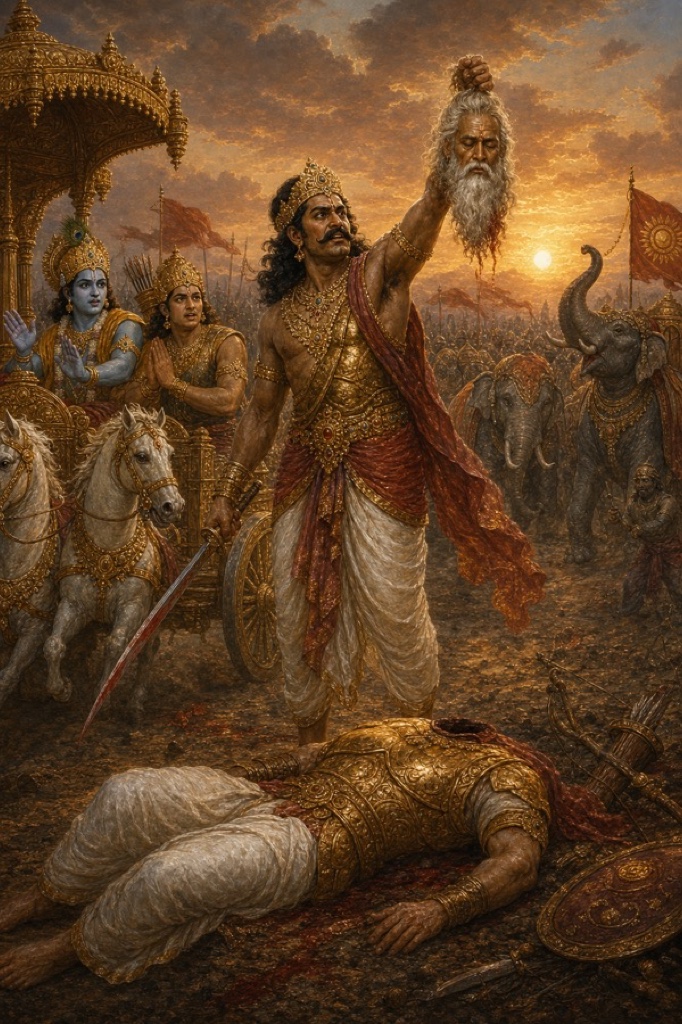
Then Prishata’s son, though everyone cried fie on him, cast his eyes on the head of the lifeless Drona and began to drag it. Then with his sword he cut that head from the trunk of the foe who remained silent at that time. Having slain Bharadvaja’s son, Dhrishtadyumna filled with great joy and, whirling his sword, roared like a lion.
Before the head was cut off, Dhananjaya had cried out, “Bring the teacher alive, do not slay him, he must not be killed.” The whole army had cried out the same. Arjuna in particular, melted with pity, had cried out again and again. But disregarding the protests of Arjuna and of all the kings, Dhrishtadyumna killed Drona on the terrace of his chariot. Covered with Drona’s blood, Dhrishtadyumna leaped from the chariot down to the ground, red as the sun and exceedingly terrible. Then he flung the great head of Bharadvaja’s son before the warriors of your army.
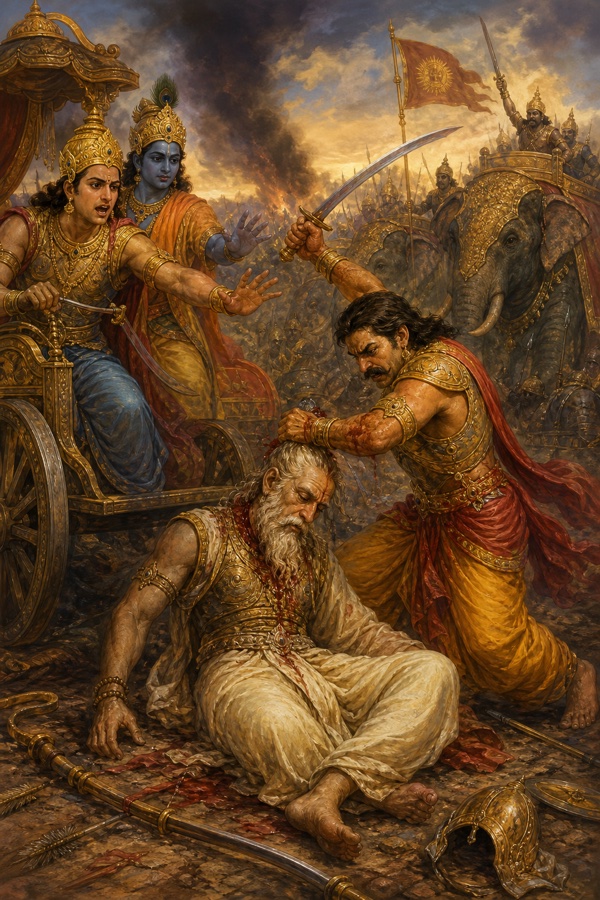
A key to reading this (the numbers): Drona was eighty-five years old, and yet he fought like a youth of sixteen. Only five men witnessed his passage in yoga. In a modern comparison, this is the scene where the commander of a nation, still at the full of his strength, sets down his arms under a psychological blow, the news of his son’s death, and is killed in that very moment. The line between the ethics of war and outright deceit blurs right here.
The rout of the Kaurava army and the flight of its commanders
Your soldiers, beholding the head of Bharadvaja’s son, set their hearts on flight and ran away in all directions. Meanwhile Drona, ascending the skies, entered the path of the stars. Through the grace of Krishna Dvaipayana, the son of Satyavati, and by the favor of the rishis, I saw the true circumstances of Drona’s death. I beheld Drona, after he had ascended the sky, going like a smokeless brand of blazing splendor.
Upon Drona’s fall the Kurus, the Pandavas, and the Srinjayas all became cheerless and fled with great speed. The army broke up. Many had been killed, and many wounded by keen shafts. Your warriors, upon Drona’s fall, seemed to be deprived of life. Having suffered defeat and filled with fear about the future, the Kauravas regarded themselves cut off from both worlds. They lost all self-control. On the field, covered with thousands of headless trunks, the kings searched for the body of Bharadvaja’s son but could not find it.
The Pandavas, having gained the victory and great prospects of future renown, made loud sounds with their arrows and conches and uttered leonine roars. Then Bhimasena and Prishata’s son Dhrishtadyumna were seen embracing each other in the midst of the Pandava host. Bhima said to Dhrishtadyumna, “I will embrace you again as one crowned with victory, when that wretch of a suta’s son and that other wretch, Duryodhana, are slain in battle.” Saying this, Bhima in his joy slapped his arms, and the earth trembled.
Upon Drona’s fall the Kaurava army, deprived of its leader, broken and routed, grew weak with grief. Covered with dust, trembling with fear, their throats dry, they resembled the Daityas of old after the fall of Hiranyaksha. Your son Duryodhana could not hold his place among them.
Shakuni, the ruler of the Gandharas, seeing Drona of the golden chariot slain, fled with his troops at even greater speed. Karna the suta’s son too fled in fear, taking with him his vast division. Shalya, the ruler of the Madras, casting empty looks around, fled with his division teeming with chariots, elephants, and horses. Kripa, Sharadvat’s son, crying “Alas, alas,” fled with the remnant of his elephants and foot-soldiers. Kritavarma fled on his swift steeds, surrounded by the remnants of his Bhoja, Kalinga, Aratta, and Bahlika troops. Uluka, afflicted with fear, fled with a large body of foot-soldiers. Duhshasana, in great anxiety, fled surrounded by his elephant division.
Vrishasena fled with speed, taking ten thousand chariots and three thousand elephants. The great chariot-warrior Duryodhana, surrounded by elephants, horses, chariots, and foot-soldiers, fled with the remnant of the Samshaptakas whom Arjuna had not yet slaughtered. Susharma too fled, beholding Drona slain. Riding elephants, chariots, and horses, all the warriors of the Kaurava army fled the field at the sight of Drona of the golden chariot slain. With disheveled hair and loosened armor, they fled in such a way that no two could be seen running together. “The Kuru army has been totally destroyed,” this was the belief of every one of them.
The gist: The moment the teacher’s head fell to the earth, the whole morale of the Kaurava camp shattered. Every great commander, Shakuni, Karna, Shalya, Kripa, Kritavarma, Uluka, Duhshasana, Vrishasena, Duryodhana, and Susharma, fled with his division. On the Pandava side, Bhima and Dhrishtadyumna shared a victory embrace, but Bhima said plainly that the celebration would be complete only when Karna and Duryodhana too were slain.
Ashvatthama’s grief and rage: his vow before Duryodhana
While all the armies fled with speed, only Drona’s son Ashvatthama, like a huge alligator coming up against the current of a stream, fell upon his foes. A fierce battle broke out among the warriors headed by Shikhandi, the Prabhadrakas, the Panchalas, the Chedis, and the Kaikeyas. Then that hero, with the tread of an infuriated elephant, saw that the Kaurava host was resolved on flight. He came to Duryodhana and said, “Bharata, why do the troops fly as if in fear? Why do you not rally them? You too do not seem to be in your usual frame of mind. Upon the slaughter of what warrior has your force fallen into this plight? Has some calamity befallen your soldiers, Bharata?”
Hearing these words of Ashvatthama, Duryodhana could not give the bitter news. Like a boat foundering in an ocean of grief, he was bathed in tears. Suffused with shame, the king told the son of Sharadvat, “You tell why the army is flying away.” Then Kripa, feeling great anguish again and again, told Drona’s son how his father had been slain.
Kripa said, “We began the fight against the Panchalas with Drona at our head. Your father, filled with rage, invoked the Brahma weapon and killed his enemies by thousands. He sent a thousand brave warriors and two thousand elephants to the house of Yama. But when the enemy began to turn back, Madhusudana said to the Pandavas that this foremost wielder of arms could not be vanquished in battle even by Indra. Sons of Pandu, he said, lay aside righteousness and guard your victory, or Drona of the golden chariot will slay you all. My thought is, he said, that Drona will not fight after Ashvatthama’s fall. Let someone tell him the lie that Ashvatthama has been slain.”
Kripa went on, “Hearing this, Kunti’s son Dhananjaya would not accept it. But all the rest, and with difficulty Yudhishthira, accepted it. Then Bhimasena, with a tinge of shame, told your father, ‘Ashvatthama has been slain.’ But your father did not believe him. Suspecting the news to be false, out of affection for you, your father asked Yudhishthira whether you were really dead or not.”
From fear of a lie, yet desirous of victory, Yudhishthira, keeping in mind that huge elephant, mountain-vast and named Ashvatthama, belonging to Indravarma the Malava chief and slain by Bhima, told Drona, “He for whom you wield weapons, he looking upon whom you live, your dear son Ashvatthama has been slain, and lies on the bare earth like a young lion.” Aware full well of the evil consequences of falsehood, the king added the word “Elephant” indistinctly after the name Ashvatthama.
Hearing of his son’s fall, Drona began to wail. Restraining his celestial weapons, he fought no longer as before. Beholding him sunk in anxiety and almost senseless, the cruel-deeded Panchala prince rushed at him. Seeing before him the prince ordained as his slayer, Drona, versed in all the truths of men and things, abandoned his celestial weapons and sat in praya, the fast unto death, on the field. Then Prishata’s son, seizing Drona’s head with his left hand and disregarding the loud protests of all the heroes, cut it off. “Drona must not be killed,” rose the cry from every side. Arjuna too leaped from his chariot, arms upraised, and ran, saying, “You who know the ways of morality, do not slay the teacher, bring him alive.” But despite the protests of the Kauravas and of Arjuna, Dhrishtadyumna killed your father-like teacher. It is from fear of this that the army flees, and we too, in deep cheerlessness, do the same.
Hearing of his father’s killing, Drona’s son, like a snake struck by the foot, filled with fierce wrath. He blazed up like a fire fed with a great quantity of fuel. Squeezing his hands, grinding his teeth, and breathing like a snake, his eyes turned red as blood.
A sub-tale: Dhritarashtra asked Sanjaya who Ashvatthama was. Sanjaya said he was the equal of Karna in the science of weapons, of Purandara (Indra) in battle, of Kartavirya in energy, and of Brihaspati in wisdom. In fortitude he was a mountain, in energy a fire, in gravity an ocean, and in wrath the venom of a snake. Drona, having gained the science of arms from Rama (Parashurama), had imparted all the celestial weapons to his son. And it was ordained too that, just as Yajnasena’s son was fixed as the slayer of Drona, so Ashvatthama was fixed as the slayer of Dhrishtadyumna.
The gist: Kripa told Ashvatthama the whole story: the Brahma weapon, Krishna’s counsel, Bhima’s killing of the elephant, Yudhishthira’s half-truth, Drona’s praya-vow, and Dhrishtadyumna’s sword. Hearing it, Ashvatthama’s grief turned into fierce rage, and the next chapter moves toward his terrible vow and the Narayana weapon.
Ashvatthama’s vow and the tale of the Narayana weapon
Repeatedly wiping his tearful eyes and breathing hot sighs in his rage, Ashvatthama said to Duryodhana, “I have now learned how those low wretches made my father lay aside his weapons and killed him, and what a sinful act Yudhishthira, wearing only the outward garb of virtue, has done. For one engaged in battle, one of two things must happen, victory or defeat. Death in battle is always to be applauded. One who dies fighting under circumstances of righteousness is not to be mourned, so the sages have observed. Without doubt my father has gone to the region of heroes, and for that I do not grieve.”
“But the humiliation he bore, the seizure of his locks in the very sight of all the troops while he was righteously engaged in battle, is tearing the very core of my heart. My father’s locks were seized while I, his son, am alive. Then why should the childless entertain any desire for children? The cruel, son of Prishata perpetrated this most sinful act in total disregard of me. Dhrishtadyumna shall therefore surely suffer the dreadful consequence of that act, and so shall that false-speeched son of Pandu who acted so wrongly. Today the earth shall certainly drink the blood of that King Yudhishthira the just, who by an act of deceit caused the teacher to lay aside his weapons.”
Ashvatthama said, “I swear by truth, O Kauravya, and by my acts of dharma, that I shall never bear the burden of life if I fail to exterminate the Panchalas. By every means, mild or violent, before peace becomes mine I shall effect the destruction of all the Panchalas. That Dhrishtadyumna, the injurer of friends, of Brahmins, and of his own teacher, I shall surely slay in battle. Today neither the gods, nor the gandharvas, nor the asuras, the uragas, and the rakshasas, nor the warrior, shall be able to vanquish me on my chariot in battle. In the knowledge of weapons there is none in the world equal to me and Arjuna.”
Then Ashvatthama told the tale of the Narayana weapon. “Once, assuming the form of a Brahmin, Narayana came to my father. Bowing to him, my father presented his offerings in due form. Taking them, the divine Lord offered him a boon. My father then solicited that supreme weapon called Narayana. The god said, ‘No man shall ever become your equal in battle. But this weapon should never be used in haste. It never returns without effecting the destruction of the foe. I know none whom it cannot slay; it would slay even the unslayable. So it should not be used without the greatest deliberation. Upon those who abandon their chariots or weapons in battle, upon those who seek for quarter, or upon those who yield themselves up, this weapon must never be hurled. He who seeks to strike the unslayable with it is himself sorely afflicted by it.’”
Ashvatthama said, “Thus my father received that weapon. Then Lord Narayana, addressing me also, said, ‘With the aid of this weapon you too shall pour diverse showers of celestial weapons in battle and blaze with energy.’ Saying these words, the divine Lord ascended to heaven. This is the history of the Narayana weapon, which has now come to my father’s son. With it I shall rout and slay the Pandavas, the Panchalas, the Matsyas, and the Kaikeyas in battle, as the lord of Sachi routs and slays the asuras. That wretch among the Panchalas, Dhrishtadyumna, the injurer of friends, of Brahmins, and of his own teacher, shall never escape me today with his life.”
Hearing these words of Drona’s son, the Kuru army rallied once more. Many of the foremost men blew their gigantic conches. Filled with delight, they beat their drums and kettledrums by the thousand. The earth, afflicted by the hooves of steeds and the wheels of chariots, resounded with that din. Hearing that uproar, deep as the roll of clouds, the warrior gathered together and took counsel of one another. And having spoken those words, Ashvatthama touched water and invoked the celestial weapon called Narayana.
The gist: In the rage born of grief, Ashvatthama swore three vows: to kill Dhrishtadyumna, to exterminate all the Panchalas, and to avenge himself on the deceitful Yudhishthira. Then he told the origin-tale of the Narayana weapon, along with its warning that the weapon is never loosed on one who has laid down his arms or sought refuge. The seed of the coming story lies hidden in that very rule. Then he touched water and released the great weapon, and a mighty upheaval broke out across nature.
Source: the Mahabharata of Krishna-Dwaipayana Vyasa, Drona Parva, Drona-vadha sub-book. This chapter follows K. M. Ganguli, sections CLXXXIV to CCIII (184 to 203); the Gita Press Hindi edition numbers these chapters differently. Names, order, and events were checked against Ganguli’s complete translation. Where the recensions differ, this English retelling follows Ganguli, and the Hindi edition follows Gita Press. Dialogue and commentary are adapted, not a verbatim translation. About the sources.
Based on: The Mahabharata, Vyasa (K. M. Ganguli’s English translation; Gita Press, Gorakhpur)