On this page
Om. The bow comes first, to Narayana, and to Nara, the highest of men, and to the goddess Sarasvati; only then is the word “Jaya” spoken. Janamejaya asked, “The Kurus, the Pandavas, the Somakas, and all those great kings who had come together from so many countries: how did they fight?” Vaishampayana answered, “Hear how they fought, on the sacred plain of Kurukshetra. The Pandavas came onto that ground in their strength, the Somakas with them, and went forward against the Kauravas wanting victory. Every one of them was a finished student of the Vedas, and every one of them loved a battle. They expected to win, and they turned with their troops to face the fight. When they came near the army of Dhritarashtra’s son, those men whom no one had beaten in the field halted on the western side of the plain and stationed their divisions there, with their faces to the east.”
The Whole Earth Gathered at Kurukshetra
Yudhishthira, Kunti’s son, had tents raised by the thousand, by rule, beyond the tract called Samantapanchaka. The rest of the earth looked emptied. Its horses were gone and its men, its chariots and its elephants, and in the houses only the children and the old remained. That army had been drawn from the whole breadth of Jambudvipa, from every land the sun’s rays fall on. Men of every people were camped there together, and the camp ran on for many yojanas, over districts and rivers, over hills and woods.
Yudhishthira saw to it that all of them ate well, the men and their animals alike, and that nothing else a soldier needs was missing. Then he turned to a danger that so mixed a host carried inside itself. He gave out watchwords, several of them, so that a man who spoke the right one would be known at once for a Pandava’s man. And he fixed names and badges for every one of them, so that when the fighting closed in, a friend could still be told from an enemy.
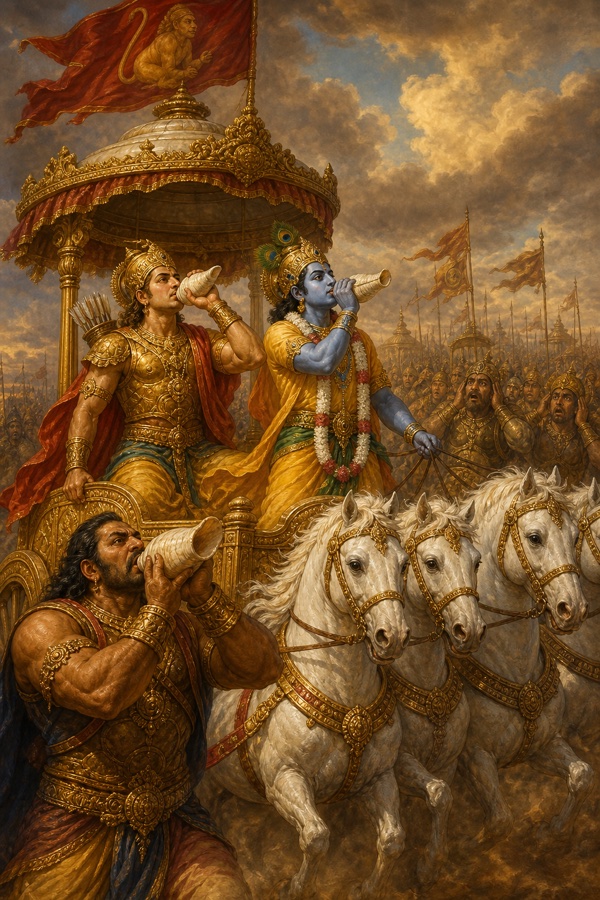
Across the field the son of Dhritarashtra saw the tip of the Pandava standard rise. Duryodhana stood in the midst of a thousand elephants, with a white umbrella held over his head and his hundred brothers around him, and with every king who had taken his side he began to draw up his troops against the son of Pandu. The Panchalas saw him and were glad. They were men who loved a fight, and they blew their great conches and struck cymbals that rang sweetly. Their gladness reached Arjuna, and it reached Krishna, the son of Vasudeva, and the two of them, seated together on one chariot, lifted their own celestial conches in the same joy and blew.
A key to reading this (place): the army at Kurukshetra is said to have been gathered from the whole of Jambudvipa, every land the sun shines on. Sanjaya will give the name its reason when the blind king asks him about the earth: an undying Jambu tree stands in that country, eleven hundred yojanas tall, and the land is called Jambudvipa after it. He also gives Jambudvipa a second name, Bharata. The opening book of the Bhishma Parva, which lays out this geography before an arrow flies, is the Jambukhanda-nirmana Parva, the making of Jambukhanda.
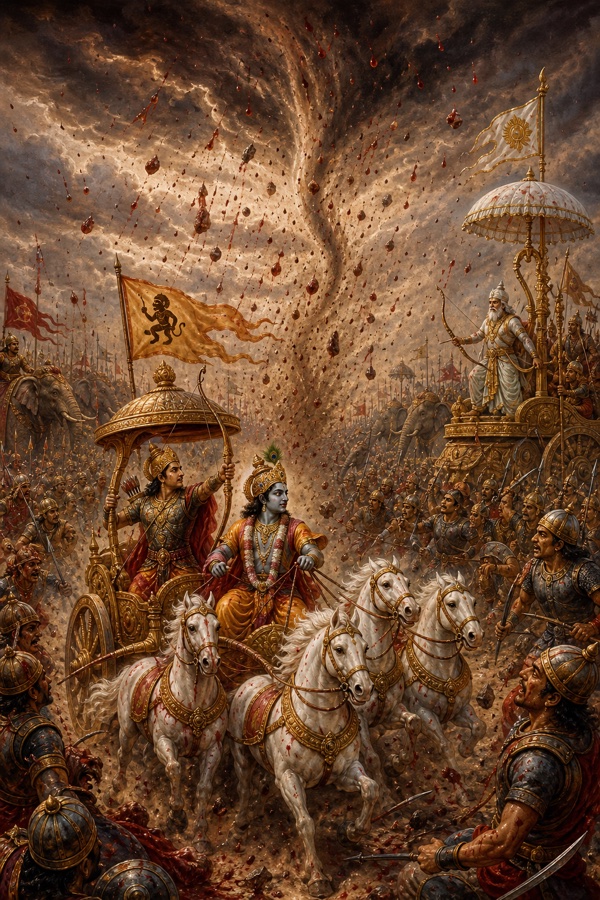
Two blasts went out over the field, Krishna’s Panchajanya and Arjuna’s Devadatta, and at the sound of them fighting men lost control of bladder and bowel. A whole army took fright the way the animals of a forest take fright when a lion roars. Then the dust came up, a terrible dust in which nothing could be seen, and the sun, swallowed all at once, seemed to have set. A black cloud rained flesh and blood on the troops on every side. A wind got up that drove stony pebbles along the ground in countless numbers and battered the men by the hundred and the thousand. None of it belonged to the ordinary world. And still both armies stood there glad, ready for battle, heaving on Kurukshetra like two seas in a storm, and what waited to meet on that plain was a wonder, two oceans coming together at the end of an age.
The gist: every land of Jambudvipa has sent its men to Kurukshetra, and only children and the old are left at home. The Pandavas camp on the west of the plain facing east, with watchwords and badges to know one another by. When Krishna and Arjuna blow their conches, dust hides the sun and a black cloud rains flesh and blood, and the two armies go on standing face to face, glad, like two oceans at the end of an age.
The Compact on the Rules of War
Before anything else the two sides bound themselves. The Kurus, the Pandavas, and the Somakas made covenants with one another and settled the rules for every kind of combat. Men would fight their equals, and fight fairly. If two men had fought fairly and then drew apart, each could withdraw unharmed, and both sides would be content with that. A man who fought with words would be answered with words. And a man who had left the ranks was never to be killed.
A chariot fighter would take a chariot fighter for his opponent. A man riding on an elephant’s neck would meet another such, a horseman a horseman, a foot soldier a foot soldier. A man was to weigh fitness, willingness, daring, and strength, and to strike only after he had given warning. No one would strike a man who was unprepared or in the grip of panic. A man already engaged with another, a man asking for quarter, a man in retreat, a man whose weapon had broken, a man without his armor: none of these was ever to be struck. The same held for chariot drivers, for the animals in harness and the animals that carried weapons, for the men who hauled the arms, and for those who beat the drums and blew the conches. When the covenants were made, the Kurus and the Pandavas and the Somakas looked across at one another for a long moment and marveled. Then each side stood at its stations, and the gladness in those men showed on their faces.
The gist: before the fighting, both sides agree on rules: equal against equal and arm against like arm, a warning before a blow, and no blow at all against a man unready, panicked, retreating, disarmed, unarmored, or asking for quarter. Drivers, animals, weapon bearers, drummers, and conch blowers are to be left alone. Before the first forenoon is out, Sanjaya will report chariots, elephants, horses, and foot soldiers fighting one another on the same ground.
Vyasa’s Boon and Sanjaya’s Divine Sight
The armies were standing east and west of each other, and the battle was close, when the holy rishi Vyasa came to Dhritarashtra. He was Satyavati’s son, and no man knew the Vedas better. He was the grandsire of the Bharatas, and past, present, and future lay open to him as if all three were happening in front of his eyes. He found the king, Vichitravirya’s royal son, sunk in grief, turning over and over the ruinous course his own sons had taken. And he spoke to him in private.
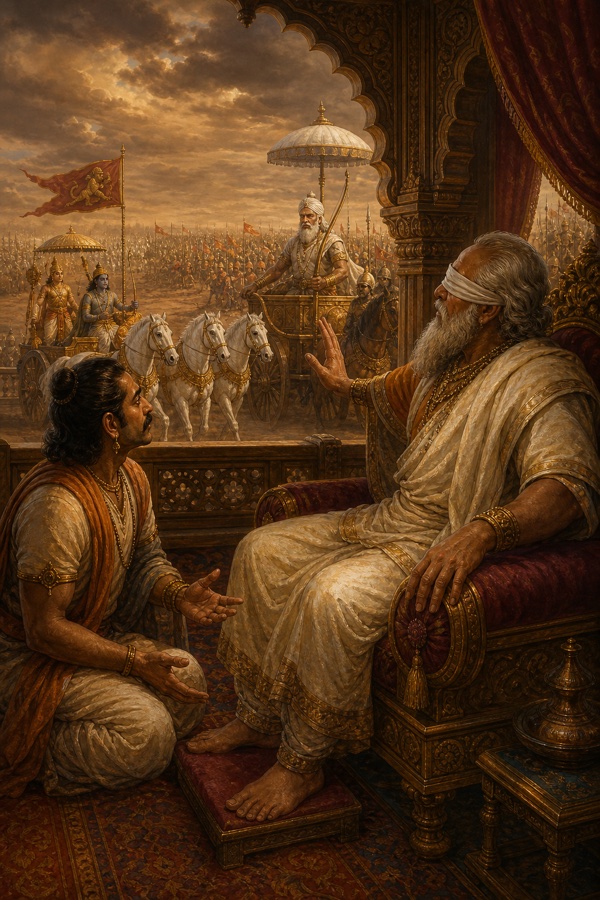
Vyasa said, “The hour of your sons and of the other kings has come. They have mustered for battle, and they will kill one another. Their time is up, and they will all perish. Remember what time does to everything, and do not give your heart over to grief. If you want to watch them fight, my son, I will give you sight. Look on the battle.” The blind king answered, “Holy one, I have no wish to see my kinsmen slaughtered. Let me hear of this battle, through your power, down to its smallest part.”
Dhritarashtra would not see it and still wanted to hear it, so Vyasa, who had boons in his gift, gave one to Sanjaya, the suta’s son in the king’s service. “This Sanjaya will describe the battle to you,” he told the king. “Nothing in the whole of it will be beyond his eyes. He will have celestial sight, and he will tell you the war. He will know everything: what is done in the open and what is hidden, what happens by day and by night, even what a man only thinks in his own mind. Weapons will not cut him. Exertion will not tire him. This son of Gavalgana will come out of the battle alive. As for me, I will spread the fame of these Kurus and of all the Pandavas. Do not grieve. This is destiny, and it cannot be prevented. And as for victory, it is there where righteousness is.”
A key to reading this (idea): “Yato dharmas tato jayah”: where dharma is, there is victory. Vyasa says it here before a blow has been struck. Arjuna will say it to a frightened Yudhishthira on the morning of the battle, and Sanjaya will end his account of the hymn to Durga with it. The gift Vyasa gives is exact in its terms: Sanjaya, the suta’s son, will see the open and the hidden, by day and by night, and even what is only thought, and no weapon will cut him.
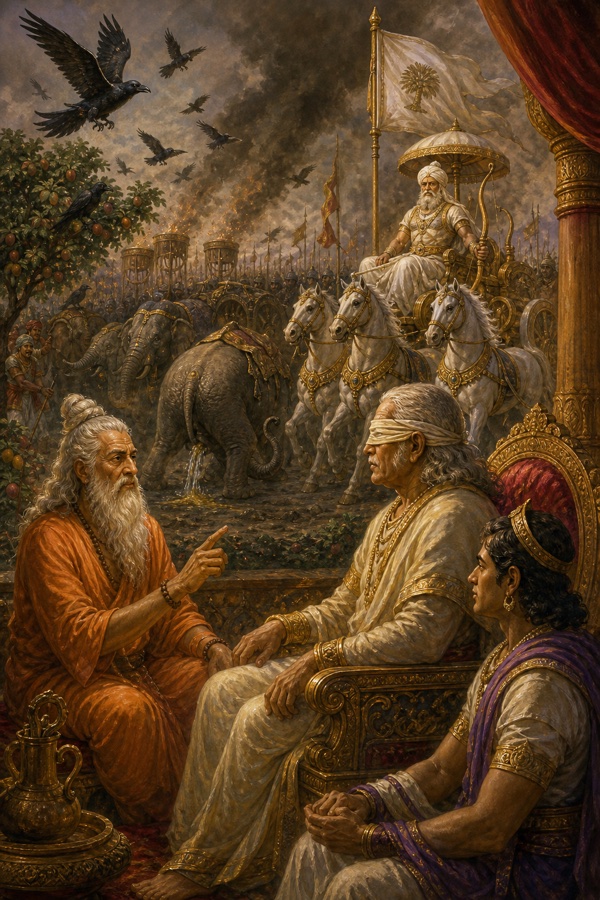
Then the grandsire of the Kurus spoke to Dhritarashtra again, and what he gave him now was a list. “The slaughter in this battle will be great. I see the signs of it here, and they are signs of terror. Hawks and vultures, crows and herons and cranes are coming down on the treetops and gathering in flocks, and they look at the field in front of them with delight, because a battle is coming. Beasts that eat flesh will feed on elephants and horses. Fierce herons wheel across the middle of the sky toward the south with pitiless cries. Every day, at both twilights, I see the sun at his rising and at his setting covered by headless trunks. Clouds of three colors, white and red at the edges and black at the neck, charged with lightning and shaped like maces, close around the sun at dawn and at dusk. I have seen the sun, the moon, and the stars all blazing together, with nothing to tell their look apart at evening, and I have seen it all day and all night. All of it forebodes fear.”
“On the fifteenth night of the bright fortnight of Kartika the moon lost his light. He could not be seen, or he showed the color of fire, in a sky the color of a lotus. Many kings and princes, brave men with arms like maces, will be killed and will sleep on the bare earth. Night after night I hear boars and cats fighting in the sky and screaming. The images of the gods and goddesses laugh sometimes, and sometimes tremble; they vomit blood from their mouths, they sweat, they fall. Drums sound with no hand on them. The great chariots of the Kshatriyas move with no animals in the traces. Kokilas, woodpeckers, jays, water-cocks, parrots, crows, and peacocks cry out terribly. Horsemen in mail, weapons in hand, send up fierce shouts here and there. At sunrise insects fly up by the hundred. At both twilights the quarters of the sky seem to be on fire, and the clouds rain dust and flesh. Arundhati, the star that is praised in all three worlds and that the righteous applaud, now keeps her lord Vasishtha at her back. Saturn bears down on Rohini. The mark of the deer has shifted on the face of the moon. A terrible roar comes out of a sky with no cloud in it. And the animals are all weeping, and their tears fall fast.”
The Omens of the Great Slaughter
Vyasa said, “Cows are giving birth to asses. Sons are taking their pleasure with their mothers. The forest trees are putting out flowers and fruit in the wrong season. Women who are with child, and some who are not, are giving birth to monsters. Beasts and birds that eat flesh are feeding side by side. Creatures of ill omen are being born, some with three horns, some with four eyes, some with five legs, some with two sets of sexual organs, some with two heads or two tails, some with savage teeth, and they open their mouths wide and make unholy cries. Horses are foaled with three legs, with crests, with four teeth, with horns. In your own city the wives of many Brahmins who chant the Veda are bringing forth Garudas and peacocks. The mare is dropping a cow’s calf. The bitch is whelping jackals and cocks, and antelopes and parrots are all crying ill. Some women are bearing four or five daughters at a birth, and the girls dance and sing and laugh the moment they are born. The lowest orders of men are laughing and dancing and singing, and that is a sign of dreadful things. Small children, as if death itself were urging them, are drawing armed figures and running at one another with clubs, and in their eagerness for battle they knock down the play towns they have built. Lotuses and lilies of several kinds are growing on trees. A strong wind blows hard, and the dust never settles.”
“The earth shakes again and again, and Rahu is approaching the sun. The white planet Ketu has passed beyond the constellation Chitra and stands there. All of this points, above everything, to the destruction of the Kurus. A fierce comet has risen and presses on Pushya, and that great planet will do frightful harm to both armies. Mars wheels toward Magha, and Jupiter toward Shravana. Saturn, the Sun’s own child, has come up to the constellation of Bhaga and presses on it. Venus climbs toward Purva Bhadra and shines there, then wheels on toward Uttara Bhadra with its gaze fixed on it, a smaller planet joined to it. The white planet, blazing like fire mixed with smoke, has attacked bright Jyeshtha, the constellation sacred to Indra, and stays there. The pole star burns fiercely and wheels to the right. Moon and sun together bear down on Rohini. Rahu has taken his station between Chitra and Svati. And red Mars, bright as fire, travels a crooked path and stands in a line with Shravana, where Jupiter rides.”
“The earth, which gives each crop in its own season, is covered now with the crops of every season at once. Every stalk of barley carries five ears, and every stalk of rice a hundred. No creatures in the world stand higher than cows, and the universe depends on them; milked after their calves have sucked, they give only blood. Rays of light stream from the bows, and the swords blaze. The weapons plainly see the battle in front of them, as if it had already come. The color of weapons and of water, of mail and of standards, is the color of fire. A great slaughter is coming. In this battle of the Kurus with the Pandavas the earth will be a river of blood, and the standards of the fighting men will be the rafts on it. Beasts and birds on every side, their mouths blazing, cry out fiercely and show these omens of what is to follow. A bird with one wing, one eye, and one leg hovers in the night sky and screams in such fury that those who hear it might vomit blood. Every weapon seems to be shining now. And the light of the seven Rishis, the constellation that bears their name, has grown dim.”
“Jupiter and Saturn, two blazing planets, have come up to Vishakha and stood still there for a whole year. Three lunar days have twice run together inside one fortnight and cut it short by two days, so that on the thirteenth day from the first of the fortnight, at full moon and at new moon alike, Rahu has seized the moon and then the sun. Eclipses as strange as these foretell a great slaughter. Every quarter of the earth lies under falling dust and looks unlucky. Fierce clouds drop showers of blood in the night. Rahu is pressing on Krittika. Rough winds blow without rest. All of this breeds a war with many sorrows in it. The constellations fall into three classes, and on one or another star of each class a planet of evil omen has laid its influence. I have known a fortnight to run fourteen days, or fifteen, or sixteen. I never knew the new moon to fall on the thirteenth day, or the full moon on the thirteenth day. Yet in one month both moon and sun have been eclipsed on the thirteenth. Eclipsed on days that are not theirs, they will bring great slaughter on the creatures of the earth, and the Rakshasas, though they drink blood by the mouthful, will still not have had enough.”
“The great rivers are flowing backward. Their waters have turned to blood. The wells foam up and bellow like bulls. Meteors bright as Indra’s thunderbolt fall hissing. When this night is over, evil will overtake you all. People come out of their houses with lit torches to find one another, and still meet thick darkness on every side. The great rishis have said that at such a time the earth drinks the blood of kings by the thousand. From Kailasa, from Mandara, from Himavat come thousands of explosions, and thousands of peaks are crashing down. The earth trembles, and each of the four oceans, swollen, seems ready to overrun its shores. Fierce winds full of sharp pebbles are breaking great trees, and in villages and towns the trees, common and sacred both, go down under wind and lightning. When the Brahmins pour their offerings, the fire turns blue, or red, or yellow; its flames lean to the left, it stinks, and it burns with loud reports. Touch, smell, and taste are no longer what they were. The standards tremble again and again and give off smoke. Drums and cymbals throw off showers of coal dust. From the tops of the tall trees crows wheel in circles from the left with fierce cries; they scream pakka, pakka, and they settle on the tips of the standards, for the destruction of the kings. Vicious elephants run here and there shaking in every limb, voiding urine and dung. The horses are all dejected, and the elephants keep going down to the water. You have heard all this. Now do what the hour calls for, so that the world is not emptied of its people.”
The gist: Vyasa lays the omens before Dhritarashtra one after another: monstrous births, images of the gods that sweat and bleed, a moon gone dark on the night it should have been full in Kartika, eclipses of moon and sun on the thirteenth day within a single month, rivers running backward and red, peaks falling from Kailasa, Mandara, and Himavat, and a sacrificial fire that burns blue and leans to the left. He ends with a demand that the king act, so that the world is not left empty.
Dhritarashtra’s Reply and the Decree of Time
Dhritarashtra heard his father out. Then he said, “I think all of this was ordained long ago. There will be a great slaughter of men. If the kings die in battle doing what the Kshatriya order requires of them, they will go to the worlds kept for heroes, and they will have nothing there except happiness. Men who throw away their lives in a great battle win fame here, and great bliss, forever, in the world after.”
That was his son’s answer, and Vyasa, a prince among poets, drew his mind inward into the deepest yoga. He stayed so for only a short while. Then he spoke again. “It is Time that destroys the universe, there is no doubt of it, and Time that creates the worlds. Nothing here lasts forever. Show the Kurus the path of righteousness. Show it to your kinsmen, your relatives, your friends. You are able to restrain them. The killing of kinsmen has been called a sin. Do not do the thing that displeases me. Death himself has been born in the shape of your son. Slaughter is never praised in the Vedas, and no good can ever come of it. The customs of one’s line are like one’s own body, and they kill the man who destroys them. You are able to walk the right road, and Time is turning you off it like a man in distress, for the destruction of this line and of these kings of the earth. Calamity has come to you in the shape of your kingdom. Your virtue is wasting badly. Show your sons what righteousness is. What is a kingdom worth to you if it brings you sin? Look to your good name, your virtue, and your fame, and you will win heaven. Let the Pandavas have their kingdom, and let the Kauravas have peace.”
The Brahmin was still speaking, and speaking in sorrow, when Dhritarashtra, Ambika’s son, a man who knew how to use words, answered him again. “What I know of life and death is what you know. The truth of these things is plain to me. Yet where his own interests are concerned a man loses his judgment, and you must count me, sire, an ordinary man. Your power has no measure. I beg you to extend it over us. You have mastered yourself, and you are our refuge and our teacher. My sons do not obey me, great rishi. My own mind has no leaning toward sin. The fame of the Bharatas, what they have achieved, their inclination to virtue, all come from you. You are the revered grandsire of the Kurus and the Pandavas alike.”
Vyasa said, “Royal son of Vichitravirya, tell me freely what is in your mind. I will clear away your doubts.” And Dhritarashtra, who had just been told how the war could be stopped, asked about something else. “Holy one, I want to hear from you all the signs that come to those who are going to win a battle.”
The Signs of Victory and the Ways of War
Vyasa said, “The sacred fire takes on a cheerful light. Its flame rises straight up and leans to the right. It burns without smoke, and the offerings poured into it give off a sweet smell. These, it is said, are the signs of success to come. The conches and cymbals sound deep and loud. The sun and the moon shed clean rays. These too are signs of success. Crows, perched or flying, make pleasant cries; the ones behind the army urge it on, and the ones ahead of it forbid any advance. Where vultures, swans, parrots, cranes, and woodpeckers call sweetly and wheel to the right, the Brahmins say that victory in battle is certain.”
“An army wins when its divisions shine with ornaments and mail and standards, and with the musical neighing of its horses, until the eye cannot rest on them. The men who shout cheerfully, whose spirits are not damped and whose garlands do not fade, always cross the ocean of battle. So do the men who shout cheerfully even inside the enemy’s ranks, who speak kindly even to an enemy, and who warn a man before they strike him. Whatever such men hear, see, taste, touch, and smell turns out well and suffers no change for the worse. Joy among the fighting men at every hour is another mark of an army that will win. The winds, the clouds, and the birds all favor it, and its clouds and rainbows let fall helpful showers. Those are the signs of the army that will be crowned. In the army that is about to be destroyed, every one of them runs the other way.”
“Whether an army is small or large, cheerfulness in its men is called the sure sign of victory. One soldier struck with panic can make even a large army take fright and run, and when an army runs, the brave take fright too. A large army once broken is like a herd of deer scattering in terror or a great current of water: it cannot easily be checked, and it cannot be rallied. Men well skilled in battle lose heart at the sight of it. The panic spreads outward from the men who are running, and soon the whole army has broken and is flying in every direction, and then even brave leaders at the head of large divisions, with all four arms of a force under them, cannot bring it back. A man of sense, always exerting himself, should work for success through means. Success won by negotiation and the like is the best. Success won by setting the enemy against one another is middling. Success won by battle is the worst. Battle has many evils in it, and the first, they say, is slaughter. Fifty brave men who know one another, who are not downcast, who have no family ties to hold them back, and who are firmly resolved can crush a large army. Five men, or six, or seven, who will not retreat, win. Garuda, Vinata’s son, sees a great flock of birds and asks for no crowd of followers to help him. So the numbers of an army are not always what brings victory. Victory is uncertain. It depends on chance. And even those who win have losses to bear.”
The gist: Vyasa names the signs of the winning side: a smokeless fire that leans to the right, deep-voiced conches, birds calling sweetly and wheeling to the right, and above all cheerfulness in the ranks. He ranks the roads to success, with negotiation first, division of the enemy second, and battle last, and he warns that numbers do not decide a war. Then he leaves, and Dhritarashtra turns to Sanjaya with a question about the earth these kings are dying for.
The Description of Jambudvipa and Bharatavarsha
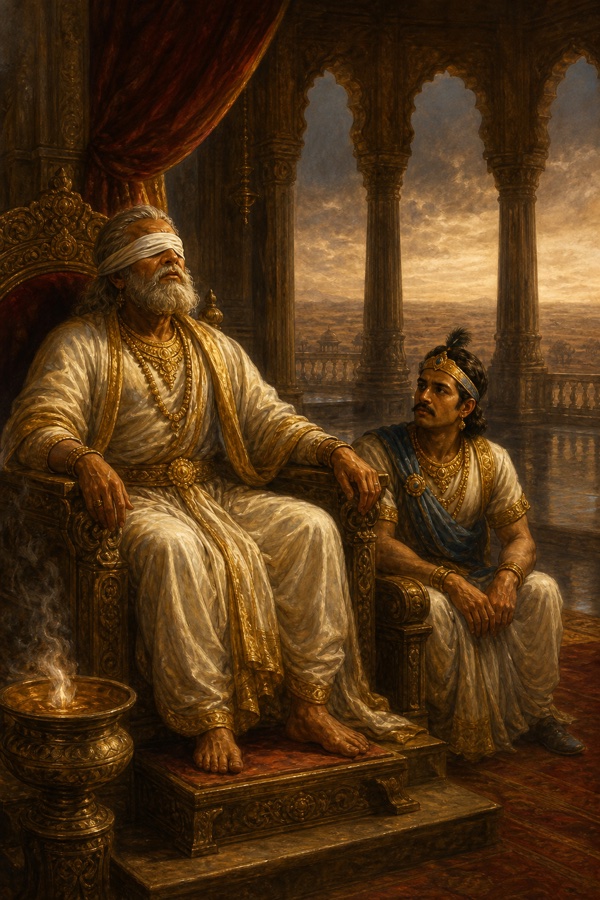
Vyasa said these things to Dhritarashtra and left. The king thought over what he had heard in silence, for only a little while, and then he began to sigh, again and again. Soon he turned to Sanjaya. “These kings, Sanjaya, these rulers of the earth, are brave men who delight in battle, and they are ready to give up life itself for the sake of earth. No one can restrain them. They strike at one another with every kind of weapon and swell the population of Yama’s realm. They want the prosperity that comes with owning earth, and they cannot bear each other. So I think earth must have many attributes. Tell me all of them. Many thousands, many millions, many tens of millions, many hundreds of millions of heroes have come together at Kurujangala. I want to hear, in exact detail, where the countries and cities they have come from lie, and how large they are. Through the power of the rishi Vyasa you now carry the lamp of celestial perception and the eye of knowledge.”
Sanjaya said, “You are a man of great wisdom, and I will recount the merits of earth to you as far as my knowledge goes. See them with the eye of your wisdom. I bow to you. The creatures of this world are of two kinds, the mobile and the immobile. The mobile are of three kinds by their birth: those born from eggs, those born from the womb, and those bred of heat and damp. Those born of the womb stand first among them, and first among the womb-born are men and animals. The animals come in fourteen species. Seven live in the woods and seven are domestic. Lions, tigers, boars, buffaloes, elephants, bears, and apes are counted wild. Cows, goats, sheep, men, horses, mules, and asses are counted domestic by the learned. Those fourteen are named in the Vedas, and the sacrifices rest on them. Men are first among the domestic creatures and lions among those of the woods, and all creatures support their lives by living on one another. The immobile are the plants: trees, shrubs, creepers, the creeping plants that last only a year, and all the stemless grasses. That makes nineteen kinds of creatures, mobile and immobile. Add the five elements they are made of and there are twenty-four, and the twenty-four are called Gayatri, as everyone knows. The man who truly knows them as the sacred Gayatri is safe from destruction in this world.”
“Everything springs from the earth, and everything, when it is destroyed, merges into the earth again. The Earth is the stay and the refuge of all creatures, and the Earth is eternal. He who has the Earth has the entire universe, with all that moves in it and all that stays still. It is for this that kings, longing to possess the Earth, kill one another.”
Dhritarashtra asked next for the names of the rivers and the mountains and the provinces, and of everything else that rests on the earth, with their dimensions, for Sanjaya now knew the measure of the whole earth and its forests. Sanjaya said, “Great king, the wise have said that all things in the universe are equal, because the five elements are present in all of them. The elements are space, air, fire, water, and earth, and their attributes are sound, touch, vision, taste, and scent. Each element has its own attribute and also the attributes of those that come before it. Earth, then, is first among them, because it has all five; so the rishis who know the truth have said. Water has four attributes, for scent is absent from it. Fire has three: sound, touch, and vision. Air has sound and touch. Space has sound alone. All creatures in the universe depend on these five. When the universe is at rest in sameness, the elements exist apart and independent. When they leave that state and combine, creatures with bodies spring into life, and it is never otherwise. They are destroyed in order, each merging into the one before it, and they arise in order, each from the one before it. All of them are beyond measure, and their forms are Brahman itself. Men use their reason to find the proportions of the elements in things. What is inconceivable, though, should never be put to the test of reason, and whatever is above nature is a mark of the inconceivable.”
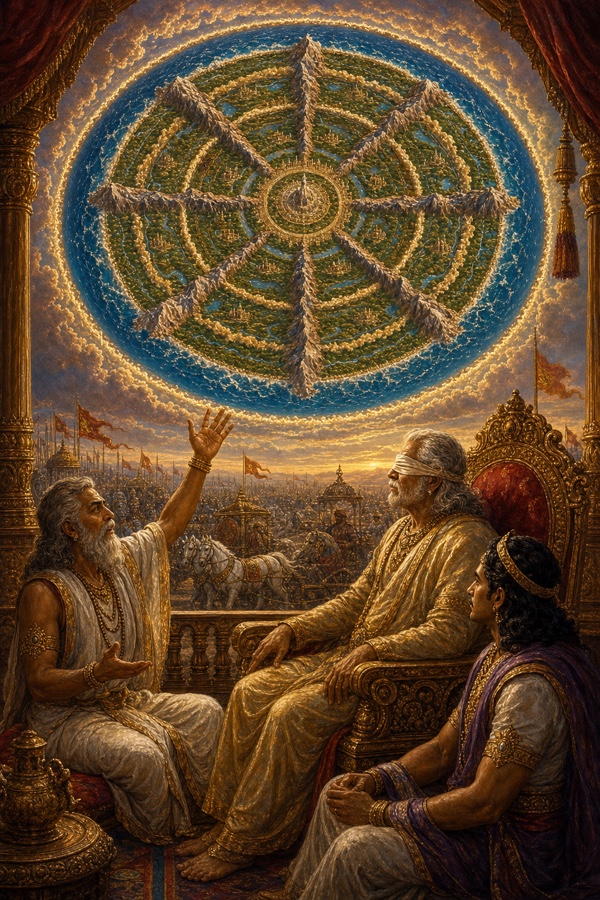
“Still, I will describe to you the island called Sudarshana. That island is circular, with the form of a wheel. Rivers and other waters cover it, and mountains that look like masses of cloud, and cities, and many delightful provinces. It is full of trees in flower and fruit, of crops of many kinds, and of other wealth, and the salt ocean surrounds it on all sides. A person can see his own face in a mirror; the island called Sudarshana is seen in just that way in the disc of the moon. Two of its parts look like a pipal tree, and two others like a large hare, and plants of every kind that sheds its leaves grow all around them. Everything apart from these portions is water. That is the island in brief, and the rest I will tell you afterward.”
The king wanted the island in detail, and Sanjaya gave him its frame first. Six mountain ranges cross it from the eastern ocean to the western, all of them equal: Himavat; Hemakuta; Nishadha; Nila, full of lapis lazuli; Shveta, white as the moon; and Shringavat, made of every kind of metal. Siddhas and Charanas haunt all six. A thousand yojanas lie between each range and the next, and those spaces hold many pleasant kingdoms. The divisions are called Varshas. “The land where we are,” Sanjaya said, “is the Varsha named for Bharata.” North of it lies the Varsha named for Himavat, and beyond Hemakuta the one called Harivarsha.
A key to reading this (lineage and place): a Varsha in Sanjaya’s account is a tract of land, the country lying between one great mountain range and the next. He counts seven of them. Bharata’s Varsha lies at the southern end and Airavata at the northern, both shaped like a bow, and Elavrita lies at the very middle of them all. The golden mountain Meru stands between the ranges of Malyavat and Gandhamadana, and beside it he sets four islands: Bhadrashva, Ketumala, Jambudvipa, which he also calls Bharata, and Uttara-Kuru.
Between Malyavat and Gandhamadana stands Meru, a globe of a mountain made of gold, bright as the morning sun, like a fire without smoke. It rises eighty-four thousand yojanas, and its depth, Sanjaya said, is eighty-four yojanas. It holds up the worlds above it, below it, and across. The sun circles Meru always, and the moon with his constellations, and the god of wind. Its slopes carry fruit and flowers that are not of the earth and mansions of polished gold, and there the gods, the Gandharvas, the Asuras, and the Rakshasas take their pleasure with the bands of Apsaras. Brahma and Rudra and Shakra, chief of the gods, once gathered on it to perform sacrifices with lavish gifts, while Tumburu, Narada, Vishvavasu, the Hahas, and the Huhus sang hymns. The seven Rishis and Kashyapa, lord of creatures, come there on every parva day. Ushanas, whom they call the Poet, lives on the summit with his disciples the Daityas. The jewels and gems men know come from Meru; a fourth part of that wealth is Kubera’s, and he passes on to men only a sixteenth. On its northern side lies a forest of karnikara trees, flowering in every season, and there Pashupati himself walks with Uma beside him and his attendants around him, wearing a chain of karnikara blossoms that reaches to his feet, his three eyes blazing like three risen suns. Only Siddhas of true speech and hard austerities can see him. From the summit of that mountain the Ganga, also called Bhagirathi, comes down like a stream of milk, with a terrible noise, and falls into the lake of Chandramas, a lake wide as a sea that her own waters made. The mountains themselves could not bear her as she leapt. Shiva, the bearer of the bow Pinaka, held her on his head for a hundred thousand years.
South of the Nila range and north of Meru, Sanjaya went on, lie the Northern Kurus, where the Siddhas live. The trees there are always in fruit and flower, and some give whatever fruit the picker wishes. Others are called milk trees; they yield milk and the six kinds of food, all tasting of amrita, and they yield cloth as well, and ornaments inside their fruit. The ground is fine golden sand and never turns to mud. The people have come down from the world of the gods. They are born as twins, a boy and a girl, who grow up equal in beauty and dress and love each other like a pair of chakravaka birds; they live eleven thousand years and never leave one another, and when they die, strong sharp-beaked birds called Bharundas carry them off and throw them into mountain caves. East of Meru lies Bhadrashva, with its forest of Bhadra-salas and a great tree called Kalamra, a yojana high, whose juice keeps men young through lives of ten thousand years. South of Nila and north of Nishadha stands an undying Jambu tree that grants every wish, eleven hundred yojanas tall and touching the sky, and the whole division is called Jambudvipa after it. A fruit of that tree measures twenty-five hundred cubits around. It bursts when it is ripe and falls with a crash, and the silvery juice becomes a river that winds around Meru to the Northern Kurus; whoever drinks it has peace of mind and never knows thirst or old age, and from it comes the gold called Jambunada, bright as the indragopaka insect, that the gods wear. He named the lands further on by the years men live in them: Romanaka, eleven thousand five hundred; Hiranmaya, by the river Hiranvati, where Garuda lives, twelve thousand five hundred; Airavata, north of Shringavat at the edge of the sea, thirteen thousand, where the sun gives no heat and the people smell of lotus and go without food. North of the ocean of milk the lord Hari rides a golden chariot on eight wheels, swift as thought. Then the king asked about the one land the armies had come for, the Varsha of Bharata, “which my son Duryodhana covets, which the sons of Pandu want as well, and in which my own mind is sinking.” Sanjaya set him right: the sons of Pandu did not covet it; Duryodhana did, and Shakuni, and many other Kshatriyas who could not bear one another. This, he said, is the land Indra loves, and it was loved by Manu the son of Vivasvat, by Prithu, Ikshvaku, Yayati, Ambarisha, Mandhatri, Nahusha, Muchukunda, Shibi the son of Ushinara, Nriga, Gadhi, Dilipa, and many another king. Seven ranges mark it: Mahendra, Malaya, Sahya, Shuktimat, Rikshavat, Vindhya, and Paripatra. Aryans and Mlecchas and peoples mixed of both drink from its rivers, the Ganga, the Sindhu and the Sarasvati, the Godavari, the Narmada and the Yamuna, the Sarayu and the Gomati, the Kaveri and the Kaushiki, and many more that Sanjaya named until he said he had told all he could remember. Its peoples he counted the same way: the Kuru-Panchalas, the Matsyas, the Chedis, the Kashi-Kosalas, the Magadhas, the Angas, the Vangas, and the Kalingas; in the south the Dravidas, the Keralas, and the Cholas; in the north the Yavanas, the Chinas, the Kambojas, and the Hunas. Earth well tended, he said, is a cow that never runs dry, and the kings had become like dogs snatching meat from one another.
The king asked how long men live in Bharata’s Varsha and what they are like, and Sanjaya gave him the four yugas that turn there: Krita first, then Treta, then Dvapara, and Kali last. In Krita the measure of a life is four thousand years, in Treta three thousand, and now in Dvapara men live two thousand. In Kali there is no fixed measure at all, and men die in the womb or just after birth. The men of Krita are strong, wise, wealthy, and handsome, and they father children by the hundred and the thousand; the Kshatriya kings of Treta ruled from sea to sea and bowed to no one; in Dvapara all four orders are capable of great effort and want to conquer one another; and the men of Kali have little energy and much anger, and they are greedy and untruthful. “What is left of this Dvapara age,” Sanjaya said, “is small.” Then Dhritarashtra wanted the islands beyond his own, and the measure of Rahu, the moon, and the sun. Sanjaya gave him seven islands. Jambu stretches eighteen thousand six hundred yojanas, and the salt ocean around it is twice as wide. Beyond lies Shakadvipa, twice the size of Jambudvipa, where the people do not die and there is no famine. It has seven jeweled mountains, a great Shaka tree at its center that the people worship, and four provinces in which there is no king, no punishment, and no one deserving to be punished, because every man keeps to his duty and they protect one another. Northward come oceans of clarified butter, of curds, of wine, and of water, and islands each double the last: Kusha with its sacred clump of kusha grass, Shalmali with its tree, Krauncha with its mountain of gems, Pushkara where Prajapati himself lives. Past these regions four great elephants, Vamana, Airavata, Supratika, and one more, catch the wandering winds in the tips of their trunks and breathe them out again, and by that breath the creatures of the earth draw breath and live. Then he gave the measures. Rahu is a globe twelve thousand yojanas across and forty-two thousand around. The moon is eleven thousand across and thirty-eight thousand nine hundred around. The sun is ten thousand across and thirty-five thousand eight hundred around; and Rahu, being the largest, covers both of them when their times come. “I have told you how the universe is built, as the Shastras show it,” he finished. “Therefore pacify your son Duryodhana.”
A sub-tale: on Meru every bird has golden plumage. Sumukha, a son of Suparna, looked at them and found that the good birds, the middling, and the bad could no longer be told apart, and he reflected that he ought to leave the mountain for that reason. Sanjaya gives the bird that one sentence and goes on to the sun, the moon, and the wind that circle Meru.
The News of Bhishma’s Fall
Ten nights of battle had gone by when Sanjaya came back. The learned son of Gavalgana, to whom past, present, and future were now as plain as things in front of his eyes, came quickly from the field and rushed into the court in his grief. Dhritarashtra was sitting sunk in thought. “I am Sanjaya, great king,” he said. “I bow to you. Bhishma, Shantanu’s son, the grandsire of the Bharatas, has been killed. The first of all warriors, the gathered strength of every bowman there is, the grandsire of the Kurus lies today on a bed of arrows. Your son leaned on that man’s strength when he sat down to the match at dice, and that man lies on the battlefield now, struck down by Shikhandi.”
“He once stood alone on a single chariot at the city of Kashi and beat all the kings of the earth, gathered against him in a terrible fight. He fought Rama, Jamadagni’s son, without fear, and Rama could not kill him. Shikhandi has brought him down today. He was Indra’s equal in courage and steady as Himavat, deep as the ocean and patient as the earth. He was a lion among men, his arrows were his teeth, his bow his mouth, his sword his tongue, and the prince of Panchala has killed him. When he stood ready for battle the great army of the Pandavas lost its nerve and shook like a herd of cows that has seen a lion. He guarded your army for ten nights and did what hardly any man could do, and he has set like the sun. For ten days, with perfect calm, he rained arrows by the thousand like Shakra and killed ten thousand fighting men a day. Now he lies on the bare ground like a great tree the wind has broken, a death he did not deserve, and it has come of your own evil counsels.”
A key to reading this (idea): Sanjaya tells the end first. The ten days of Bhishma’s command are already over when he bursts into the court, and everything after this is his answer to the king’s demand to hear how it happened, from the first morning. One detail in his news matters more than the rest: Bhishma had said he would not fight Shikhandi, of whom it was said that he had once been a woman.
Dhritarashtra’s Lament
Dhritarashtra asked, “How was Bhishma killed by Shikhandi? How did my father, who was like Vasava himself, come to fall from his chariot? He lived a life of celibacy for his own father’s sake, and he was like a god; what became of my sons when they lost him? When he drove forward, who went behind him and who went ahead? Who stayed at his side? Which brave men rode in his rear when he broke into the enemy’s divisions? He scattered their ranks the way the sun scatters darkness. How did the Pandavas stand against him when he came at them striking? His arrows were his teeth, his bow was his open mouth, his terrible sword was his tongue. He had never been beaten, and he was a modest man with it. How did Kunti’s son throw down a man like that? The great army of the Pandavas used to waver at the mere sight of him ready for battle. For ten nights he tore their troops, and then he set like the sun. He rained arrows like Shakra and killed a hundred million fighting men in ten days, and now he lies on the bare ground like a great tree the winds have torn up, and it is my evil counsel that put him there.”
“How is it that Bhishma could not win while Drona lives? Kripa was near him, and Drona’s son Ashvatthama. How could he be killed? He was counted an Atiratha, and the gods themselves could not stand against him. How could Shikhandi, the prince of Panchala, kill him in battle? Which of my great bowmen did not desert him? Which heroes stood around him at Duryodhana’s command? When all the Pandavas put Shikhandi in front of them and came on against Bhishma, did not all the Kurus stay at his side? Who guarded his right wheel, and who his left? Who held off the enemy from his rear, and who stood close in front of him? Who guarded his wings? If our heroes protected him and he protected them, why could he not quickly beat the Pandava army? In the old days the gods themselves asked his help when they were killing the Danavas. When he was born, Shantanu, whose name the world knew, put away every grief he had. Rama, Jamadagni’s son, who knew every weapon and had beaten the Kshatriyas again and again, once took the field on Amba’s behalf, and Bhishma beat him. And Shikhandi has killed the man Rama could not kill. Then Drupada’s son must be greater than Rama himself. I hear that Bhishma is dead, and I count the rest of my army dead already. My son’s army without him is a woman with no protector, a herd in panic with its herdsman gone. I cannot be at peace until I know it all.”
“My heart must be made of adamant. I have heard that Bhishma is dead and it does not break. No weapon frees a man from death, and no courage, no ascetic merit, no intelligence, no firmness, no gift. Nothing in the world gets past Time, since you tell me Shantanu’s son is dead. I was burning with grief for my sons already, and I had hoped for relief from Bhishma. What refuge did Duryodhana find when he saw him lying on the ground like a sun fallen out of the sky? The duties the rishis laid on the Kshatriya order are cruel. The Pandavas want sovereignty even at the price of that man’s death, and we want it even at the price of offering him up as a sacrifice. Tell me how the troops were arrayed. Tell me what Duryodhana said, and Karna, and Shakuni the cheat, and Duhshasana, when he was killed. That battlefield is a gaming house where the board is laid with the bodies of men and elephants and horses, and arrows and javelins and broad swords are the dice. Who were the wretched gamblers who sat down there and staked their lives? Who won, who lost, and who else is dead besides Bhishma? You have poured clarified butter on a grief that was already burning. My sons must be mourning even now. Tell me everything that happened in that battle, Sanjaya, well ordered or ill, everything born of the folly of my wicked son.”
Duryodhana’s Order to Protect Bhishma
Sanjaya said, “The question is worthy of you, and you have every right to ask it. Yet it is wrong for you to lay this fault on Duryodhana. A man who suffers through his own misconduct ought to keep the charge at his own door, and a man who does every kind of injury to other men deserves death at the hands of all men for it. The Pandavas knew nothing of the ways of wickedness. For a long time, with their friends and counselors, they lived in the forest, looking to you, and bore the injuries done to them and forgave them. Now hear what I saw by the power of yoga, of horses and elephants and kings, and keep your heart from sorrow, for all of it was destined. I bow first to your father, the wise son of Parashara. By his gift I have sight beyond the reach of the eye and hearing across great distance. I know what is in other men’s hearts, and the past and the future. I can travel through the sky, and weapons cannot touch me in battle. Listen, then, to the battle of the Bharatas as it happened, a thing to make the hair stand up.”
“The fighting men had been drawn up by rule and were ready for battle when Duryodhana spoke to Duhshasana. ‘Duhshasana, have chariots sent quickly to protect Bhishma, and get all our divisions moving. The thing I have thought about for years has come to me now: the Pandavas and the Kurus meeting at the head of their armies. I can think of nothing in this battle that matters more than protecting Bhishma. Protected, he will kill the Pandavas, the Somakas, and the Srinjayas.’”
“‘He is a man of clean soul, and he has said, “I will not kill Shikhandi. They say he was a woman before, and for that reason I must give him up in battle.” That is why Bhishma above all must be guarded. Let every one of my warriors take his place with one purpose, to kill Shikhandi. Let the troops from the east and the west, the south and the north, men trained in every weapon, protect the grandsire. Even a lion of great strength, left unguarded, can be killed by a wolf. We must never let Shikhandi kill Bhishma like a jackal killing a lion. Yudhamanyu guards Arjuna’s left wheel and Uttamaujas his right, and Arjuna, so guarded, guards Shikhandi. Shikhandi has Arjuna to protect him, and Bhishma will refuse to fight him. See to it, Duhshasana, that he does not kill the son of Ganga.’”
The gist: Sanjaya refuses to let the king put the whole blame on Duryodhana, and then he begins at the beginning. With the armies drawn up, Duryodhana gives Duhshasana one order above every other: guard Bhishma. The grandsire has said he will give up Shikhandi in battle, since Shikhandi is said to have been a woman once, and Shikhandi comes on under Arjuna’s protection, with Yudhamanyu and Uttamaujas at Arjuna’s wheels.
Sunrise and the Sight of the Armies
Sanjaya said, “When the night was over, a great noise went up from the kings, all of them shouting the same word: Array! Array! Conches blared and drums roared like lions. Horses neighed, chariot wheels clattered, elephants trumpeted, and men shouted and slapped their armpits and bellowed, and the noise was enormous everywhere. Both armies had risen at sunrise, and now they finished their preparations. When the sun was up, everything stood plain to see: the weapons and the mail of your sons and of the Pandavas, and the size and splendor of both hosts. Elephants and chariots trimmed with gold shone like clouds with lightning in them. The chariots stood in such ranks that they looked like cities. And your father, at his station, shone like the full moon.”
“The men took their places in the ranks with bows and swords, scimitars and maces, javelins and lances and bright weapons of many kinds. Standards went up by the thousand on our side and theirs, worked in gold and set with gems, blazing like fire, and the men in mail looked up at them and longed for battle. Captains with eyes as large as a bull’s stood at the heads of their divisions, quivers on their backs and leather guards on their hands, weapons raised. Ten kings each stood at the head of a full akshauhini: Shakuni the son of Subala; Shalya; Jayadratha; the two princes of Avanti, Vinda and Anuvinda; the Kekaya brothers; Sudakshina, who ruled the Kambojas; Shrutayudha, who ruled the Kalingas; King Jayatsena; Brihadbala, who ruled the Kosalas; and Kritavarma of the Satvata line. They were brave men with arms like maces, givers of rich sacrifices, and with them stood many other kings and princes who took their orders from Duryodhana. All of them wore black deerskins. All were ready, cheerfully, to go up to the world of Brahma for Duryodhana’s sake. Ten akshauhinis stood under their command.”
A key to reading this (numbers): Sanjaya counts eleven akshauhinis on the Kaurava side, ten under the allied kings and the eleventh made up of Dhritarashtra’s own troops, against seven on the Pandava side. He gives the scale in his own figures as he goes: a hundred thousand chariots, eight thousand elephants, and sixty thousand horsemen under Jayadratha alone; sixty thousand chariots and ten thousand elephants under the king of the Kalingas; ten thousand elephants under the king of Magadha; and six million men posted only to guard chariot wheels and elephants.
“The eleventh great division of the Kauravas was made up of the Dhartarashtra troops themselves, and it stood in front of the whole army. At its head was Shantanu’s son. His headgear was white, the umbrella over him was white, his mail was white, and we saw Bhishma, whose strength never failed, look like the moon just risen. His standard carried a palmyra of gold. He stood on a chariot made of silver, and Kurus and Pandavas alike saw him there like the moon ringed with white cloud. The great bowmen of the Srinjayas, with Dhrishtadyumna at their head, looked at him the way small animals look at a great lion yawning, and they trembled, again and again. Those were the eleven divisions of your army, and the seven divisions of the Pandavas were as well guarded. The two hosts facing each other were like two oceans at the end of the yuga, churned by makaras and full of great crocodiles. We had never seen or heard of two such armies meeting.”
Bhishma’s Command and the Kaurava Array
Sanjaya said, “It happened as the holy Krishna-Dvaipayana Vyasa had said it would. The kings of the earth came together and met. On the day the battle began, the moon had entered the region of the Pitris. The seven great planets stood in the sky all burning like fire. The sun at his rising seemed split in two, and as he climbed he seemed to break into flames. Jackals and crows, waiting for bodies to feed on, cried fiercely from every quarter of a horizon that looked to be burning.”
“Every morning the old grandsire of the Kurus and Drona, Bharadvaja’s son, rose from their beds, gathered their minds, and said, ‘Victory to the sons of Pandu.’ And every day they fought for you, as they had pledged to. That morning your father Devavrata, who knew every duty, called all the kings together. ‘Kshatriyas,’ he said, ‘this broad door stands open for you to enter heaven. Go through it to the world of Shakra and of Brahma. The rishis of old showed you this eternal road. Do yourselves honor by fighting with your whole mind. Nabhaga, Yayati, Mandhatri, Nahusha, and Nriga won their crowns and the highest heaven by deeds like these. For a Kshatriya, to die at home of disease is a sin. The death he meets in battle is his eternal duty.’”
“The kings heard him and went, splendid on their chariots, to the heads of their divisions. Only Karna, Vikartana’s son, with his friends and his kinsmen, laid his weapons aside, and he did it on Bhishma’s account. Your sons and all the kings of your side went forward without him, and their lion roars rang to the ten points of the horizon. The divisions were bright with white umbrellas, banners, standards, elephants, horses, chariots, and men on foot. The ground shook with drums and tabors and cymbals and the clatter of wheels. The great chariot fighters, with gold on their arms and gold on their bows, looked like hills on fire. And Bhishma, commander of the whole Kuru army, under his tall palmyra standard set with five stars, looked like the sun itself.”
A key to reading this (idea): Karna stays out of the battle from the first morning. Sanjaya says only that he laid his weapons aside on Bhishma’s account. Krishna says more when he goes to Karna just before the fighting begins: he has heard that Karna will not fight out of hatred for Bhishma, and he invites him over to the Pandava side until Bhishma is dead. Karna refuses. He will do nothing that displeases Duryodhana, and he says he has already cast off his life for him.
“The royal bowmen of your side took the places Shantanu’s son gave them. King Shaibya of the Govasanas rode out with all the monarchs on a princely elephant fit for a king, a banner on its back. Ashvatthama, with skin the color of a lotus, took the very front of all the divisions, ready for anything, under a standard that carried a lion’s tail. Seven great bowmen in fine mail followed behind Drona’s son and ahead of Bhishma: Shrutayudha, Chitrasena, Purumitra, Vivimshati, Shalya, Bhurishravas, and the great chariot fighter Vikarna. Their tall golden standards shone above their chariots. Drona, the teacher above all teachers, flew a standard that showed a golden altar with a water pot and the figure of a bow. Duryodhana, who led many hundreds and thousands of divisions, flew an elephant worked in gems, and Paurava and the ruler of the Kalingas and Shalya, chariot fighters all three, took their places in his van.”
“The ruler of the Magadhas marched against the enemy on a costly chariot, his standard marked with a bull, leading the very front of his division. That great force of Easterners looked like the fleecy clouds of autumn, and the chief of the Angas and Kripa guarded it. Jayadratha stood at the front of his own division under a beautiful silver standard with the device of a boar. A hundred thousand chariots, eight thousand elephants, and sixty thousand horsemen were his to command, and that division held the very van of the army. The ruler of the Kalingas went out with sixty thousand chariots and ten thousand elephants, and Ketumat went with him. His elephants were as big as hills, fitted with engines, lances, quivers, and standards, and he himself shone under a tall standard bright as fire, with his white umbrella, his golden cuirass, and the yak-tail fans that cooled him. Ketumat rode an elephant, a fine hook in his hand, and looked like the sun among dark clouds. King Bhagadatta went out on his elephant blazing like the wielder of the thunderbolt, and Vinda and Anuvinda of Avanti, who were counted his equals, followed Ketumat on the necks of their own elephants. Drona, the royal son of Shantanu, Drona’s son, Bahlika, and Kripa arrayed that host together. It was built of many divisions of chariots, with the elephants for its body, the kings for its head, and the horses for its wings. It faced every way at once, and it seemed to smile, and to be gathering itself to spring.”
“Soon afterward a roar went up from the men ready to fight, loud enough to make the heart shake. Conches and drums, the grunting of elephants, and the clatter of wheels seemed to split the earth, and the neighing of horses and the shouting of men filled the sky. The troops of your sons and of the Pandavas both trembled as they came in sight of each other. Behind Bhishma, guarding his back, went your sons Duhshasana, Durvishaha, Durmukha, Duhsaha, Vivimshati, Chitrasena, and the great chariot fighter Vikarna, and with them Satyavrata, Purumitra, Jaya, Bhurishravas, and Shala, and twenty thousand chariot fighters followed them. Twelve brave peoples had resolved to fight without a thought for their lives, and they guarded the grandsire with a great array of chariots: the Abhishahas, the Shurasenas, the Shibis, the Vasatis, the Shalvas, the Matsyas, the Ambashthas, the Trigartas, the Kekayas, the Sauviras, the Kitavas, and the men of the eastern, western, and northern countries. Behind that mass of chariots came the king of Magadha with ten thousand quick elephants. The men who guarded chariot wheels and the men who guarded elephants numbered a full six million. In front of the army marched foot soldiers in the hundreds of thousands, with bows and swords and shields, men who fought also with their nails and with bearded darts. The eleven akshauhinis of your son looked like the Ganga where she runs apart from the Yamuna.”
The gist: on the morning of the first day Bhishma tells the kings that a Kshatriya’s death in battle is an open door to heaven, and they go to their posts. Karna alone lays his weapons aside. Ashvatthama takes the front, seven great bowmen ride between him and Bhishma, and Duhshasana and his brothers guard the grandsire’s back with twelve peoples and twenty thousand chariots. The whole array has elephants for its body, kings for its head, and horses for its wings.
Yudhishthira’s Counter-Array: the Vajra
Dhritarashtra asked, “Yudhishthira saw our eleven akshauhinis in order of battle. His own force was the smaller. How did he make his counter-array? Bhishma knew every kind of array there is, the human, the celestial, the Gandharva, and the Asura. How did Kunti’s son form his own against a man like that?” Sanjaya said, “He looked at the Dhartarashtra divisions drawn up, and he turned to Arjuna. ‘We have it from the great rishi Brihaspati,’ he said, ‘that the few must be drawn in tight to fight, and the many may be spread as wide as they please. When the few meet the many, the array to form is the needle-mouthed one. Our troops are few beside the enemy’s. Keep the great rishi’s rule in mind and array them.’”
“Arjuna answered, ‘There is an array called the Vajra, the thunderbolt, that cannot be moved. The wielder of the thunderbolt designed it himself. I will make that one for you, and nothing breaks it. Bhima will fight at our head. He comes on like a storm bursting, and no enemy can stand up to him in battle. He knows every means of fighting there is, and he will lead us and fight in the van and crush the spirit of the other side. Duryodhana and every man behind him will see Bhima and fall back in panic like small animals that have seen a lion. The rest of us will shelter behind him as behind a wall, with our fear gone, the way the gods shelter behind Indra. No man breathes who can bear to look at Bhima, Vrikodara of the fierce deeds, when he is angry.’”
“Arjuna did as he had said. He put the troops quickly into battle order and moved, and the great Pandava army, watching the Kuru army come on, looked like the Ganga in full current, brimming and steady and fast. Bhimasena, Dhrishtadyumna, Nakula, Sahadeva, and King Dhrishtaketu led it. King Virata marched behind them with an akshauhini of troops, his brothers and his sons beside him, and guarded their rear. Madri’s two sons protected Bhima’s wheels. Draupadi’s five sons and the son of Subhadra, all quick men, protected Bhima from behind, and behind those princes rode Dhrishtadyumna, the prince of Panchala, with the Prabhadrakas, as brave a body of chariot fighters as there was. Behind him came Shikhandi, moving with his whole mind fixed on the destruction of Bhishma, and Arjuna protected him. Behind Arjuna came Yuyudhana in his strength. The two Panchala princes Yudhamanyu and Uttamaujas guarded Arjuna’s wheels, with the Kekaya brothers, Dhrishtaketu, and Chekitana. Arjuna pointed Bhima out to the king. ‘Look at Bhimasena there, with a mace of the hardest metal in his hand. He moves over a battlefield at a speed that could dry up the ocean. And there, looking at him, stand the sons of Dhritarashtra with their counselors.’ While he was still speaking, all the troops on the field cheered Arjuna.”
“King Yudhishthira took his station in the center of his army, with huge and furious elephants around him like hills that moved. Drupada, the king of the Panchalas, whom men called Yajnasena, stood behind Virata with an akshauhini for the Pandavas’ sake. Tall standards rose from the chariots of those kings, each with its own device, trimmed in gold and bright as the sun and the moon. Dhrishtadyumna made the kings move and give him room, and with his brothers and his sons he guarded Yudhishthira’s back. One standard stood higher than every standard on every chariot, yours or theirs: the huge ape on Arjuna’s chariot. Foot soldiers in the hundreds of thousands, with swords and spears and scimitars, went ahead to protect Bhimasena. Ten thousand elephants followed the king like mountains on the move, costly animals of great courage, their golden armor blazing, the juice of their rut running down cheek and mouth like rain from a cloud, and the scent of lotus on them.”
“And Bhimasena whirled his fierce mace, a thing like an iron bar, and seemed to be crushing your son’s great army already. No man could bear to look at him from anywhere near; he was like the sun for that, and he seemed to scorch the army opposite like fire. That was the Vajra. It feared nothing and faced every way at once, with bows for its lightning, and the wielder of Gandiva guarded it. The Pandavas, having set their troops against yours in that counter-array, waited for battle, and with them guarding it nothing in the world of men could break it. Both armies stood through the dawn waiting for the sun. A wind got up with drops of water in it, and thunder rolled where there were no clouds. Dry winds blew all around and drove a shower of sharp pebbles along the ground, and thick dust rose and covered the world in darkness. Great meteors fell toward the east, struck the rising sun, and broke apart with a great noise. When the troops stood arrayed the sun rose with his splendor gone. The earth shook loudly and cracked in many places. Thunder kept rolling on every side, and the dust was so thick that nothing could be seen. The tall standards, with their strings of bells, their gold, their garlands and rich cloth, shook suddenly in the wind and jingled like a forest of palmyra palms. So the sons of Pandu stood, glad of the battle, set against your son’s army, seeming to draw the very marrow out of our men, and every one of them had his eyes on Bhimasena, at their head, with the mace in his hand.”
A key to reading this (idea): Yudhishthira asks for the needle-mouthed array that Brihaspati’s rule prescribes for the few against the many. Arjuna answers with the Vajra, the thunderbolt array that Indra designed, and puts Bhima at its head. Sanjaya describes it as fearless, facing every side, with bows for its lightning. Behind Bhima and his guards rides Shikhandi, intent on the destruction of Bhishma and protected by Arjuna, which is the very arrangement Duryodhana warned Duhshasana about.
The Facing of the Two Armies
Dhritarashtra asked, “When the sun rose, Sanjaya, which went gladly at the other first, wanting the fight: my army with Bhishma leading it, or the Pandava army with Bhima leading it? Which side had the sun and the moon and the wind against it? Which side did the beasts of prey cry out against? Whose young men had cheerful faces? Tell me all of it truly, in order.” Sanjaya said, “Both armies were equally glad when they stood arrayed. Both looked equally fair, like woods in blossom, and both were full of elephants, chariots, and horses. Both were vast, and terrible to see, and neither could bear the other. Both had drawn up to conquer heaven itself, and both were made of good men.”
“The Kauravas of Dhritarashtra’s side stood facing west. The sons of Pritha stood facing east, ready. The Kaurava troops looked like the army of the lord of the Danavas, and the Pandava troops like the army of the gods. The wind began to blow from behind the Pandavas, into the faces of the Dhartarashtras, and the beasts of prey began to howl against the Dhartarashtras. Your sons’ elephants could not stand the strong smell of rut that came off the great elephants of the other side.”
“Duryodhana rode an elephant the color of a lotus, its temples split with rut, a golden housing on its back and a net of steel armor over it. He was at the very center of the Kurus, with bards and singers of praise around him, and a white umbrella bright as the moon was held over his head, hung with a golden chain. Shakuni, the ruler of the Gandharas, followed him with the hill men of Gandhara posted all around. The venerable Bhishma was at the head of all the troops. A white umbrella was held over him. He had his bow and his sword, a white headdress, a white banner on his chariot, and white horses in the traces, and all together he looked like a white mountain.”
“In Bhishma’s division were all the sons of Dhritarashtra, and Shala, who was a countryman of the Bahlikas, and the Kshatriyas called Ambashthas, and those called Sindhus and Sauviras, and the brave men of the country of the five rivers. Drona, teacher of almost all those kings, stood on a golden chariot drawn by red horses, with his bow in his hand and a heart that never failed, and stayed behind all the troops, protecting them like Indra. Kripa, Sharadvat’s son, whom they also call Gautama, a great bowman who fought in the van and knew every way of making war, took the northern point of the army with the Shakas, the Kiratas, the Yavanas, and the Pahlavas. A large force guarded by the great chariot fighters of the Vrishnis and the Bhojas, and by the well-armed warriors of Surashtra, went toward the south of the army under Kritavarma. Ten thousand chariots of the Samshaptakas went out as well. They had been made, it was said, for Arjuna’s death or for his fame, and they meant to follow at his heels; and the brave Trigartas went with them.”
“There were a thousand elephants of the best fighting strength in your army. A hundred chariots were assigned to each elephant, a hundred horsemen to each chariot, ten bowmen to each horseman, and ten men with sword and shield to each bowman. That was how Bhishma arrayed your divisions. As each day dawned he would draw them up differently, sometimes in the human array, sometimes in the celestial, sometimes in the Gandharva, and sometimes in the Asura. Crowded with great chariot fighters and roaring like the sea itself, the Dhartarashtra army stood facing west for battle. It had no limit that I could see, and it was terrible to look at. The army of the Pandavas had nothing like those numbers. And yet it seemed to me very large, and impossible to beat, because Krishna and Arjuna were leading it.”
The gist: the Kauravas face west and the Pandavas east. Both armies are equally glad and equally fair, and the wind and the beasts of prey go against the Dhartarashtras. Duryodhana rides a lotus-colored elephant at the center, Bhishma stands all in white at the front, Drona holds the rear, Kripa the north, and Kritavarma the south. To Sanjaya the smaller army looks the harder to beat, because Krishna and Arjuna lead it.
Yudhishthira’s Dejection and Arjuna’s Reassurance
Sanjaya said, “King Yudhishthira looked at the vast Dhartarashtra army ready for battle, and he gave way to grief. He saw the array Bhishma had formed, an array that could not be pierced, and he believed it could not be pierced. The color left his face. ‘Arjuna,’ he said, ‘how are we going to fight the Dhartarashtras when the grandsire himself is fighting for them? Bhishma has designed this array by the rules the scriptures lay down. It cannot be moved and it cannot be broken. We and our troops are in doubt now. How can victory be ours in the face of an array like this one?’”
“Your army had plunged him into grief, and Arjuna answered him. ‘Hear how a few men may beat many, even many who have every quality on their side. You are a man without malice, so I will tell you the means. The rishi Narada knows it, and so do Bhishma and Drona. Brahma the Grandsire himself spoke of it long ago, at the battle between the gods and the Asuras, to Indra and the other gods. Those who want victory, he told them, conquer by truth, by compassion, by righteousness, and by energy, and these count for more than might. So know righteousness from unrighteousness, understand what covetousness is, put out your whole effort, and fight without arrogance, for victory is there where righteousness is. That is how I know that victory is certain for us in this battle. Narada said it too: where Krishna is, there is victory. Victory belongs to Krishna by nature. It follows Madhava. And as victory is one of his attributes, humility is another. Govinda’s energy has no end. In the middle of enemies past counting he feels no pain. He is the most eternal of beings, and where Krishna is, there is victory. I see no reason at all for you to grieve. The sovereign of the universe, the lord of the gods himself, wishes victory for you.’”
A sub-tale: Arjuna adds an old story to his argument. Krishna, whose weapons never fail, once appeared as Hari and called out in a loud voice to the gods and the Asuras, “Who among you will be victorious?” The ones who conquered were the ones who answered, “With Krishna at our front we will conquer.” It was through Hari’s grace, Arjuna says, that the gods under Shakra won the three worlds.
Sanjaya said, “Then King Yudhishthira set his troops in counter-array against Bhishma’s divisions and urged them on. ‘The Pandavas have drawn up their forces as the scriptures prescribe. Fight fairly, you who are without sin, and set your hearts on the highest heaven.’ Shikhandi and his troops held the center of the Pandava army, and Arjuna protected them. Dhrishtadyumna moved in the van, and Bhima protected him. The southern division was under Yuyudhana, a handsome man and a great bowman, the pride of the Satvata line and a match for Indra.”
“Yudhishthira stood among his elephant divisions on a chariot fit to carry great Indra, with a fine standard, gold and gems worked into it, and traces of gold for the horses. The umbrella raised over his head was pure white with an ivory handle. Great rishis walked around the king speaking his praise, and priests and Brahmin rishis and Siddhas walked around him too, chanting, wishing destruction on his enemies with muttered prayers and mantras, with potent herbs, and with rites of blessing. He gave the Brahmins cows and fruit and flowers and gold coins and cloth, and then he went forward like Shakra, the chief of the gods.”
“Arjuna’s chariot had a hundred bells on it. It was trimmed with the best Jambunada gold, it ran on fine wheels, it shone like fire, and white horses drew it, so that it looked as bright as a thousand suns. An ape rode on its banner. Krishna held its reins. And Arjuna stood on it with Gandiva and his arrows in his hands, a bowman who has no equal on earth and never will have. Bhimasena, whom they also call Vrikodara, took on the most dreadful of forms for the crushing of your sons’ troops. He is a man who with no weapon at all, with his bare hands, pounds men and horses and elephants to dust, and with the twins beside him he became the protector of the chariot fighters of the Pandava army. Your warriors saw him stationed in the van like a furious lion at play, like great Indra walking the earth in a body, like the proud leader of a herd of elephants. The strength went out of them, and they began to shake like elephants sunk in mud.”
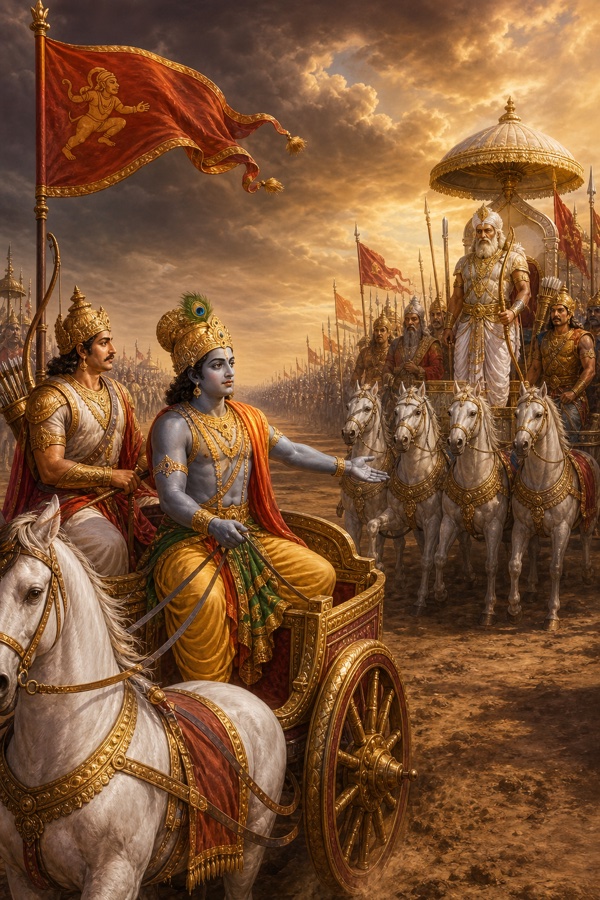
“Arjuna, whom they call Gudakesha, stood in the midst of his troops, and Krishna spoke to him. ‘There he stands in the middle of his forces, burning us with his anger: the man who will come at our troops like a lion, the man who performed three hundred horse sacrifices, the banner of Kuru’s line. That is Bhishma. Great warriors stand around him on every side the way clouds close around the sun. Kill those troops, Arjuna, and look for your battle with him.’”
The gist: the sight of Bhishma’s array drains the color from Yudhishthira’s face. Arjuna answers with what Brahma once told the gods, that truth, compassion, and righteousness count for more than might, and with what Narada said, that victory is where Krishna is. Yudhishthira sets his counter-array, with Shikhandi at the center under Arjuna’s guard and Dhrishtadyumna in the van under Bhima’s, and Krishna points Arjuna toward Bhishma.
Arjuna’s Hymn to Durga
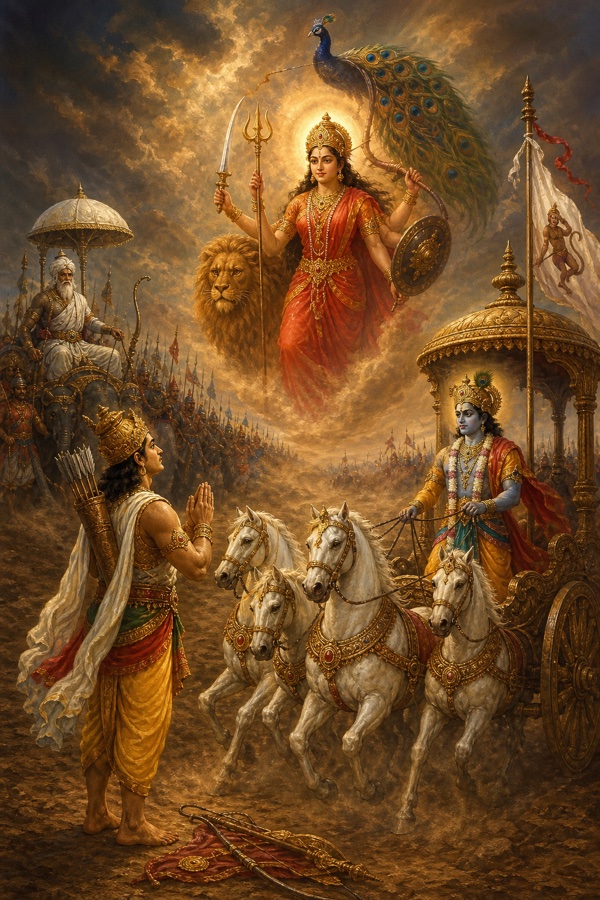
Sanjaya said, “The Dhartarashtra army was coming on to fight, and Krishna saw it and spoke to Arjuna for Arjuna’s own good. ‘Purify yourself,’ he said, ‘and on the eve of this battle say your hymn to Durga, for the defeat of the enemy.’ Arjuna did as Krishna told him. He stepped down from his chariot, joined his hands, and spoke.”
“‘I bow to you, leader of yogis, you who are one with Brahman, who live in the forest of Mandara, who are free of age and decay. Kali, wife of Kapala, black and tawny in color, I bow to you. You bring good to those who are devoted to you. Mahakali, wife of the destroyer of the universe, I bow to you. You are proud, and you rescue from danger, and every auspicious quality is yours. You are sprung from the Kata line and worthy of the most careful worship. You are fierce. You give victory, and you are victory. You carry a banner of peacock plumes and wear every ornament; you carry a dreadful spear, and a sword and a shield. You are the younger sister of the chief of the cowherds, and you are the eldest, born in the family of the cowherd Nanda. You are always fond of the blood of the buffalo. You were born in the line of Kushika, you are dressed in yellow, and you took the face of a wolf and devoured the Asuras. I bow to you who love battle.’”
“‘Uma, Shakambhari, you are white and you are black. You killed the Asura Kaitabha. Your eyes are yellow, your eyes are of many colors, your eyes are the color of smoke, and I bow to you. You are the Vedas, the Shrutis, and the highest virtue. You are gracious to Brahmins at their sacrifices. You know the past, and you are always present in the sacred houses raised to you in the cities of Jambudvipa. I bow to you. Among the sciences you are the science of Brahman, and you are that sleep of creatures from which there is no waking. Mother of Skanda, mistress of the six attributes, Durga, they call you Svaha and Svadha, Kala and Kashtha, Sarasvati, Savitri the mother of the Vedas, and the science of Vedanta. With my inner self made clean I praise you. Great goddess, let victory always attend me on the field of battle through your grace. You live in the places no one can reach, where there is fear, in the hard places, in the homes of those who worship you and in Patala below. You always defeat the Danavas. You are the unconsciousness of creatures, their sleep, their illusion, their modesty, and their beauty. You are the twilight and the day, you are Savitri, you are the mother. You are contentment, growth, and light. You hold up the sun and the moon and make them shine. You are the prosperity of the prosperous, and the Siddhas and the Charanas see you in their contemplation.’”
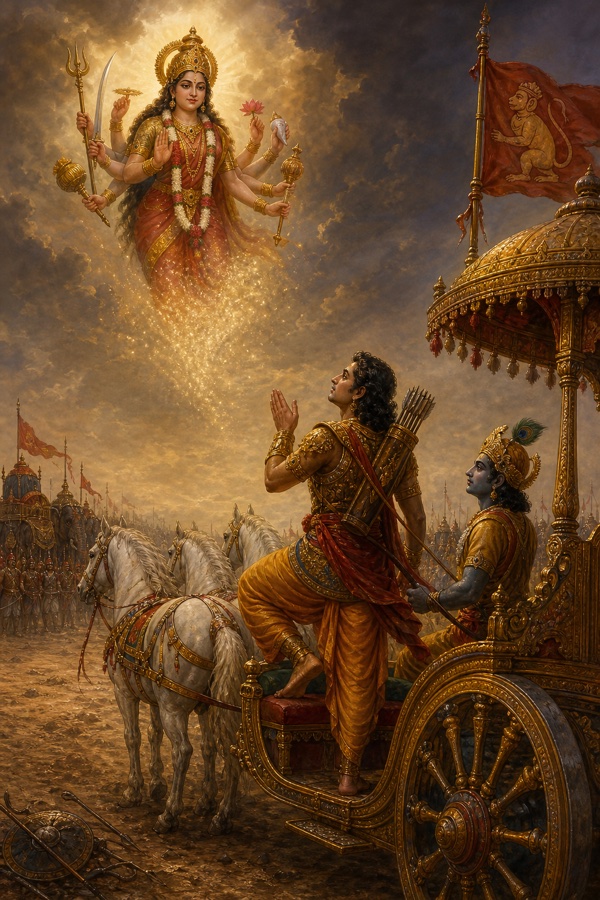
Sanjaya said, “Durga is always kindly inclined toward men, and she understood how deep Arjuna’s devotion ran. She appeared in the sky, with Krishna there to see, and said, ‘In a short time, Pandava, you will conquer your enemies. You have Narayana to help you. No enemy can defeat you, and the wielder of the thunderbolt himself could not.’ The goddess who grants boons said that and was gone. Kunti’s son had his boon, and he counted himself already successful. He climbed back onto his chariot, and Krishna and Arjuna, seated on the one chariot, blew their celestial conches.”
A key to reading this (idea): Sanjaya follows the hymn with a promise. The man who rises at dawn and recites it has nothing to fear from Yakshas, Rakshasas, or Pishachas, from snakes and fanged animals, or from kings. He wins his disputes, he is freed if he is bound, he is safe from thieves, and he lives a hundred years in health and strength. Then Sanjaya tells the king what his sons, caught in the net of death, have failed to see: that Krishna and Arjuna are Narayana and Nara, and that where righteousness is, there is Krishna, and where Krishna is, there is victory.
The Beginning of the First Battle
Dhritarashtra asked, “Whose men went forward to that battle first, Sanjaya, and went gladly? Whose hearts were full of confidence, and whose were low and spiritless? It is a battle that makes men’s hearts shake with fear. Who struck the first blow in it, my side or the Pandavas? Tell me all of it. In whose ranks did the garlands and the scented oils give off their fragrance? And whose troops, roaring as they went, spoke words of mercy?”
Sanjaya said, “The men of both armies were cheerful then, and the garlands and perfumes of both gave off the same fragrance. The close ranks drawn up for battle came against each other, and the meeting was fierce. Instruments played, conches blared, drums beat, brave men roared at one another, and it all grew very loud. Men full of joy stared across at the men they were about to fight, the elephants grunted and would not be quiet, and the two armies came together with a dreadful shock.”
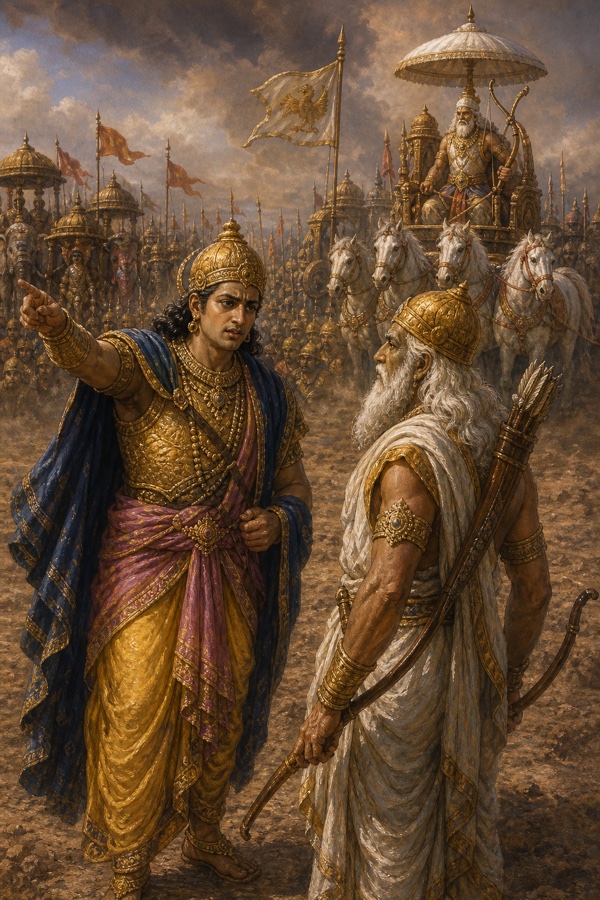
Dhritarashtra asked again, “They had gathered on the sacred plain of Kurukshetra wanting to fight, my sons and the Pandavas. What did they do, Sanjaya?” Sanjaya said, “King Duryodhana looked at the army of the Pandavas in its array and went to his teacher Drona. ‘Look at it, teacher,’ he said, ‘this vast army of Pandu’s sons, arrayed by your own clever pupil, the son of Drupada. There are brave men in it and great bowmen, equal in battle to Bhima and Arjuna: Yuyudhana and Virata, and Drupada, that great chariot fighter, Dhrishtaketu and Chekitana, and the ruler of Kashi, Purujit and Kuntibhoja and Shaibya, Yudhamanyu and Uttamaujas, Subhadra’s son and the sons of Draupadi, great chariot fighters all of them.’”
“‘Now hear who stands out among us, the leaders of my army. I will name them for you. Yourself, and Bhishma, and Karna, and Kripa, who always wins; Ashvatthama and Vikarna, Somadatta’s son and Jayadratha. And there are many heroes besides, ready to lay down their lives for me, armed with weapons of many kinds, every one of them practiced in battle. Our army, then, with Bhishma protecting it, is insufficient. This force of theirs, with Bhima protecting it, is sufficient. So take your stations, all of you, at the entrances of the divisions assigned to you, and protect Bhishma and no one else.’”
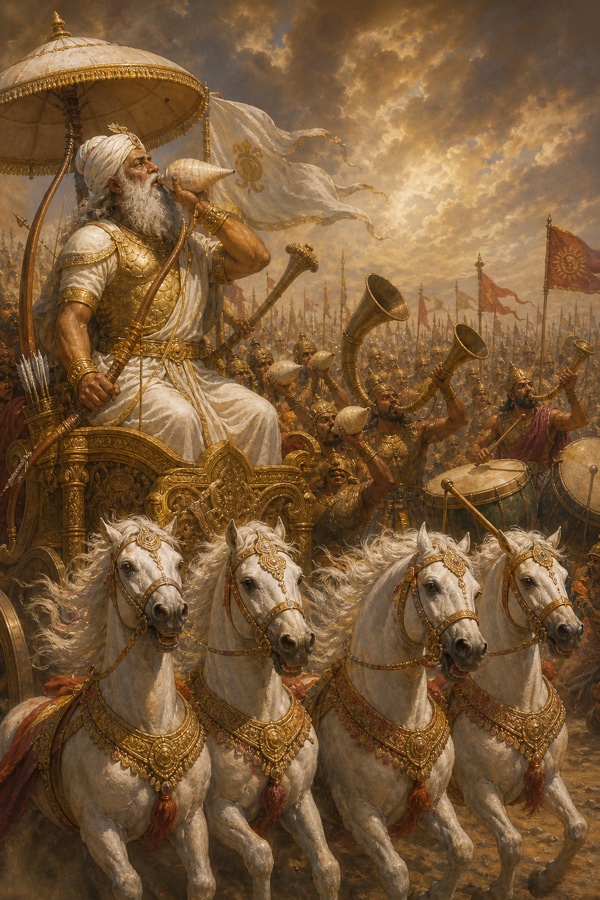
“The old grandsire of the Kurus gave Duryodhana great joy just then. He roared like a lion, loudly, and blew his conch. Conches and drums and cymbals and horns sounded all at once after it, and the noise became an uproar. Then Krishna and Arjuna, standing on a great chariot drawn by white horses, blew their celestial conches, Krishna the one called Panchajanya and Arjuna the one called Devadatta. Bhima blew the huge conch Paundra, King Yudhishthira blew Anantavijaya, and Nakula and Sahadeva blew Sughosha and Manipushpaka, and the blare of them rang through sky and earth and tore the hearts of the Dhartarashtras.”
The gist: both armies go forward equally glad, and their garlands smell equally sweet. Duryodhana goes to Drona, names the great fighters on both sides, and asks every commander to protect Bhishma and no one else. Bhishma roars like a lion and blows his conch, the Kaurava instruments answer, and then Krishna, Arjuna, and the other Pandavas sound theirs.
Gandiva Taken Up Again, and Yudhishthira’s Walk to the Elders
A sub-tale: after the hymn and the conches comes the conversation that fills the next eighteen sections. Arjuna asks Krishna to place the chariot between the two armies so that he may look at the men he must fight, and Krishna places it there, in view of Bhishma and Drona and all the kings. What the two of them say to each other on that ground is the Bhagavad Gita. At its end Arjuna says that his delusion is destroyed, that his doubts are dispelled, and that he will do Krishna’s bidding, and he takes up his arrows and Gandiva once again.
Arjuna picked up Gandiva again, and the sound that went up from the Pandava line was the sound of an army that had almost lost its war before a single arrow flew. The great chariot warriors shouted. The Pandavas and the Somakas and everyone who followed them filled their lungs and blew the conches that are born of the sea, and the drums answered, and the Pesis and the Karkachas, and the horns made of cow horn, until the noise was one solid thing standing over the field. Above it the sky filled. The gods came to watch, and with them the Gandharvas and the fathers of the dead, and the hosts of Siddhas and Charanas, and behind them the blessed rishis in a body with the lord of a hundred sacrifices at their head, all of them gathered to see a slaughter that had not yet begun. Below them the two armies moved without advancing, the way two oceans move, and Yudhishthira looked at them for a long moment from his chariot. Then he did something no one on either side had prepared for. He unfastened his coat of mail and let it fall. He set his weapon aside. He stepped down onto the ground, put his palms together, turned his face to the east, fixed his eyes on his grandfather, and began to walk, on foot and unarmed, toward the army that had come to kill him.
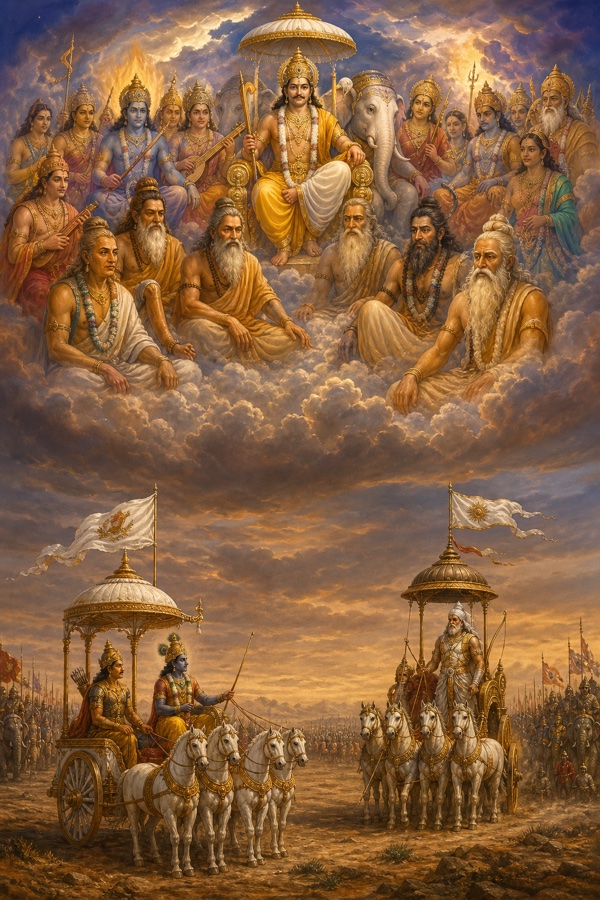
Arjuna was off his chariot before he had finished thinking, and his brothers with him, and behind them Krishna, and behind Krishna the chief kings of the army with alarm rising in their faces. What is this, Arjuna said, that you leave your brothers and walk east on foot into the enemy. Bhima came up on the other side. Where will you go, king of kings, with your armor thrown away and your weapons thrown away, toward men who are wearing theirs. Nakula was frightened and said so plainly: you are my eldest brother, and seeing you go like this puts fear in my chest; tell us where you are going. Sahadeva tried logic. These divisions in front of us are terrible and there are very many of them and we have to fight them, and you are walking toward them. Yudhishthira answered none of them. He kept his mouth closed and his hands joined and he kept walking, and it was Krishna, smiling, who finally explained him to his own brothers. I know what he intends. He is going to pay his respects to Bhishma, to Drona, to Kripa, to Shalya, and then he will fight them. The old histories say that a man who honors his teachers and his elders and his kinsmen in the proper form, and then fights his superiors, is certain of victory. That is my opinion too.
In the Kaurava ranks a groan went up, a long confused noise of alas and oh, while the Pandava army stood in total silence. Then the Kaurava soldiers began to talk, and what they said traveled down the line and pleased them. This one is a disgrace to his family. He is walking to Bhishma in terror; he has come to beg for shelter, he and his brothers with him. What is he afraid of, with Arjuna to protect him, and Bhima, and Nakula and Sahadeva? Whatever his reputation in the world, no man born a Kshatriya is this weak, and his chest is full of fear at the prospect of battle. They praised their own side. They laughed and waved their garments over their heads, delighted, and they cursed Yudhishthira and his brothers and Keshava along with them. And then, all at once, the entire Kaurava army went quiet, because it occurred to every man in it that something was about to be said. What will the king say. What will Bhishma answer him. What will Bhima say, Bhima who boasts of his strength, and what will Krishna say, and Arjuna. The curiosity in both armies at that moment was enormous. Through that silence Yudhishthira walked into a hostile formation bristling with arrows and javelins, his brothers around him, and reached the old man standing ready for battle, and took his feet in both his hands.
I salute you, he said. You cannot be defeated, and we are going to fight you. Give us your permission for it. Give us your blessing as well. Bhishma looked down at him and answered like a man who had been waiting years to be asked. If you had gone into this battle without coming to me like this, I would have cursed you, and you would have lost. I am pleased with you, my son. Fight, and win. Whatever else you want, take it in battle. Ask me for a boon, and if you do, defeat will not be yours. Then his voice changed, and he said the sentence that four men would say to Yudhishthira that morning, each in his own place in the line. A man is the slave of wealth, and wealth is no man’s slave. That is simply true. The Kauravas have bound me with their money. That is why I stand here talking to you like a man who has been unmanned, saying: bound I am by the Kauravas with wealth, and so, battle excepted, what is it that you want? Yudhishthira asked for the only thing that mattered. From this day, every day, think about my welfare. Fight for the Kauravas. That is my prayer to you. Bhishma said, what help can I possibly be to you in that? I will be fighting for your enemies. Say what you have come to say. So Yudhishthira said it, bowing. How do we defeat you in battle, you who cannot be defeated? Tell me, if you see any good in telling me. Bhishma said he could not see that man anywhere, not even the chief of the celestials himself, who could beat him while he was fighting. Then tell us, Yudhishthira said, how your death can be brought about by enemies in the field. And the grandsire answered him twice over, with a door left open in the second half of it: I do not see the man who can vanquish me in battle. And the time of my death has not yet come round to me again.
Yudhishthira bowed again, took that answer with a bend of his head, and walked on through the middle of an army that was watching him move, to the chariot of his teacher. He saluted Drona, walked around him, and asked his question: how do I fight without incurring sin, and how, with your permission, do I defeat all my enemies? Drona gave him the same opening. Had you come to this battle without coming to me, I would have cursed you to be destroyed. You have honored me and I am pleased. I permit you. Fight and win. And I will grant your wish besides, so say it, because battle excepted, what is it that you want? A man is the slave of wealth, and wealth is no man’s slave. The Kauravas have bound me with their money, and so I will fight for the Kauravas like a man unmanned, and I will pray for your victory. Pray for it, Yudhishthira said, and counsel me for my good, and fight for them. That is the boon I ask. Victory is certain, Drona told him, for a man who has Hari for his counselor. I grant it myself. Where righteousness is, there Krishna is, and where Krishna is, there is victory. Go and fight. Ask me what you came to ask. So Yudhishthira asked it: how do we defeat you? Drona’s answer was the plainest thing said on that field all morning. As long as I am fighting, victory can never be yours. Seek my death, you and your brothers, and seek it quickly. Then tell us the means of it, Yudhishthira said, and he said it prostrate. The teacher told him. No enemy can kill me while I stand in battle in my anger, pouring out arrows without stopping. Only when I have set myself for death, when I have thrown down my weapons and drawn my mind in from everything around me and sat in meditation, only then can anyone kill me. That is the truth. And this is also the truth: I will throw down my weapons in battle on the day I hear something unbearable from a man whose word I trust.
He went on to Kripa, saluted him, walked around him, and asked to be allowed to fight without sin. Kripa gave him the curse-that-was-not-given, and the sentence about wealth, and the question about what he wanted apart from battle, and Yudhishthira began to answer and could not. The king stood there in front of his teacher with his wits scattered, saying nothing at all. Kripa understood the unasked question and answered it for him. I cannot be killed. Fight, and win. I am glad you came. Every morning when I rise from my bed I will pray for your victory, and that I tell you truly. Then Yudhishthira walked to the ruler of the Madras, who was his brothers’ uncle and was fighting against them, and saluted him, and Shalya gave him the same four things: the curse withheld, the permission, the sentence about wealth, and the offer. Nephew, he said, the Kauravas bought me, and that is why I am speaking to you like this. Name what you want. Yudhishthira asked him to think daily of his good and to fight for the enemy as he pleased, and when Shalya asked what earthly use that could be, the king named the boon he had asked for once already, back when the armies were still being gathered. In the battle, when the hour comes, drain the energy out of the son of the Suta. It will be done, Shalya said. Go and fight as you please. I will look after your victory.
He came back out of that vast hostile army with his brothers around him, alive, permitted, and carrying the manner of three deaths in his head. Krishna was not finished. He crossed to Radha’s son where he stood on the field, and the elder brother of Gada made Karna an offer on the Pandavas’ behalf: I have heard that you will not fight while you hate Bhishma so. Come over to us, and stay with us as long as Bhishma is alive. When Bhishma has been killed, go back and fight on Duryodhana’s side, if neither party is dearer to you than the other. Karna did not take even a moment over it. I will do nothing that Dhritarashtra’s son would find disagreeable. I am devoted to Duryodhana’s good, and you should understand that I have already thrown my life away for him. Krishna said nothing more and went back to the Pandavas. Then Yudhishthira raised his voice so that both armies could hear him: whoever will choose us, him we choose for our ally. And out of the Kaurava line, with a glad face, came Yuyutsu, who said he would fight under Yudhishthira against the sons of Dhritarashtra if the king would have him. Come, Yudhishthira said. Come, and all of us together will fight your foolish brothers. Vasudeva says it and we all say it: I accept you, fight for my cause. It seems that the thread of Dhritarashtra’s line rests on you now, and his funeral cake with it. Accept us who accept you. Duryodhana with his angry, ruined understanding is not going to live. So Yuyutsu walked out of his family and into the Pandava army with drums and cymbals beating him across, and Yudhishthira, happy, put his shining golden armor back on. They mounted their chariots. They drew their divisions up again as they had been. Hundreds of drums and cymbals went off, and the lion-roars started, and Dhrishtadyumna and the kings on that side shouted for joy at the sight of the sons of Pandu back on their chariots. Every king present praised them for what they had just done, and the monarchs turned to one another and talked about it: the friendship in it, the compassion, the kindness shown to kinsmen at exactly the right hour. Excellent, excellent, ran along the line, mixed with verses in praise of those famous men, and everyone’s heart went with it. Mlechchhas and Aryas alike, whoever had seen it or only heard about it, wept with their throats closing. Then those men of great energy had hundreds upon hundreds of great drums and Pushkaras sounded, and blew their conches, which were as white as cow’s milk.
A key to reading this (names and one refrain): Pesis, Karkachas and Pushkaras are war instruments, and the cow-horn is a horn trumpet; the lord of a hundred sacrifices is Indra. The refrain that Bhishma, Drona, Kripa and Shalya all repeat, that a man is the slave of wealth while wealth is no man’s slave, is each of them confessing the same thing: they eat Duryodhana’s bread and will kill for it. Shalya calls Yudhishthira nephew because he is the brother of Madri, mother of Nakula and Sahadeva, and the promise to drain Karna’s energy is one he had already given during the mustering of the armies. Gada’s elder brother is Krishna; Radha’s son is Karna, named for the woman who raised him. Yuyutsu is Dhritarashtra’s son by a Vaishya wife, which is why Yudhishthira tells him that his father’s line and his father’s funeral offering now rest on him alone.
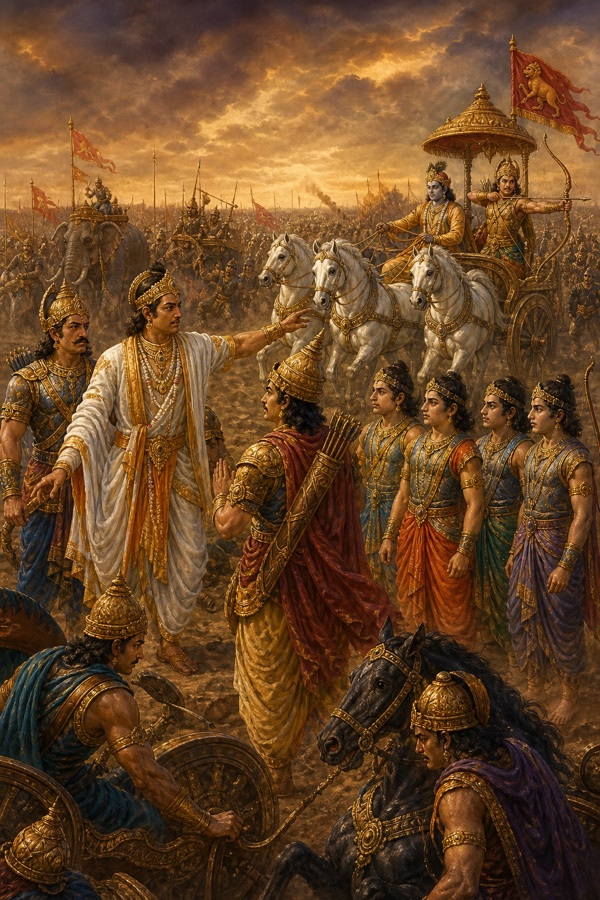
The gist: Arjuna says the hymn to Durga, and the goddess promises him victory. After the Gita, Yudhishthira lays down his armor and walks on foot to Bhishma, Drona, Kripa, and Shalya for their permission and blessing; each says the Kauravas’ wealth binds him, and each sends him back to fight. Yuyutsu crosses to the Pandavas.
The first blow, Bhima’s roar, and the single combats of the first forenoon are told in full in chapter 23.
Source: the Mahabharata of Krishna-Dwaipayana Vyasa, Bhishma Parva, Jambukhanda-vinirmana, Bhumi and Bhagavad Gita sub-parvas, Sections 1 to 25 and 43. The Sanskrit e-text, the Gita Press Hindi edition, and Kisari Mohan Ganguli’s complete English translation were used to verify names, sequence, and principal events. Where the recensions differ, this English retelling follows Ganguli, and the Hindi edition follows Gita Press.
Based on: the Mahabharata, Vedavyasa (K. M. Ganguli’s English translation; Gita Press, Gorakhpur)