On this page
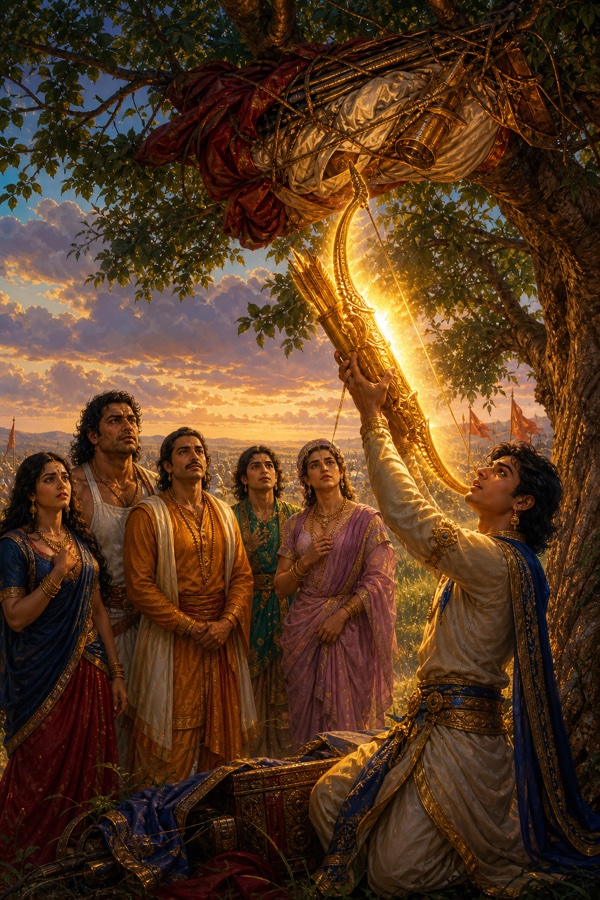
Outside the city of the Matsyas, beside the burning ground, stood a shami tree so heavy with leaves that nothing in its crown could be seen from the road, and people kept away from it because a corpse was said to be tied up there. What hung in its branches belonged to five brothers. The sons of Pandu had lost their kingdom at dice and had sworn to live twelve years in the forest and a thirteenth among men without being known, on the understanding that discovery in that last year would send them back to the forest for twelve more. They had spent the thirteenth in the household of King Virata, and Arjuna, the bowman among them, had passed it in a braid and red garments as Brihannala, a eunuch who taught dancing to the king’s daughter. The hair stood up along Uttara’s arms, and with his hands on those great bows he called down to the figure waiting in the chariot.
Uttara’s question: whose are these divine arms
“What famous warrior owns this bow?” Uttara asked. “It carries a hundred bosses of gold, and its two ends shine. And this one, so well shaped along its sides and so easy to grip, with golden elephants gleaming down the staff, whose is it? Whose is this, with sixty Indragopakas, the little red insects, worked in pure gold and set along its back at even spaces? Whose is this, with three golden suns on it that blaze as if they were alight? And this beautiful one, patterned in gold and gems, with insects of gold set among fine stones, whose is that?”
He had found the quivers by then, and the questions kept coming. “Here are a thousand arrows, feathered all round, with heads of gold, lying in golden quivers. Whose are they? Who owns these big shafts, thick and sharp, fletched with vulture feathers, whetted on stone, yellowish, well tempered, iron from end to end? Whose is this black quiver with five tigers figured on it, holding ten shafts with boar-eared arrows among them? Whose are these seven hundred, long and thick, made to drink blood and curved like the crescent moon? And these with golden crests, whetted on stone, their lower halves winged with feathers green as a parrot’s and their upper halves of tempered steel?”
Last he came to the swords. “Whose is this blade that nothing could stand against, with a toad marked on it and a point like a toad’s head? Whose is this large one in a sheath of mottled tiger skin, worked with gold and hung with little bells that ring? Whose is this handsome scimitar with the polished blade and the golden hilt? This one was forged in the country of the Nishadas, it could never be broken, and its scabbard is cowhide. Whose is it? Whose is this long sword, dark as the sky, mounted in gold, well tempered, in a goatskin sheath? Who owns this heavy, broad one, a little longer than thirty fingers laid side by side, worn bright from striking other men’s weapons and kept in a case of gold that shines like fire? And this scimitar with the dark blade and the golden bosses, which would go straight through a man’s body, and which is as deadly to touch as a poisonous snake? I am asking you, Brihannala. Tell me the truth. I look at all these things and I cannot stop wondering at them.”
A key to reading this (the idea): the arms of the five brothers were tied in this tree, bound in wrappings and rope: their bows, arrows, banners and coats of mail. Each weapon is known by its ornament and its make. When the prince describes them one by one, he is describing their owners without knowing it, and the answer he is about to get will name the men who have been living in his father’s house.
Brihannala’s answer: the weapons of the five brothers
“The one you asked about first is Arjuna’s,” Brihannala said. “It is called Gandiva, the whole world knows its name, and it can lay waste the armies of an enemy. It is the largest of all weapons and the highest, it is dressed in gold, and it is worth a hundred thousand others. A kingdom’s borders grow wherever it goes. With this bow Partha, the son of Pritha, defeats men and gods alike in battle. The gods have honored it always, and so have the Danavas and the Gandharvas. It is painted in fine colors, it is long and smooth, and you will find no knot or flaw anywhere on it.”
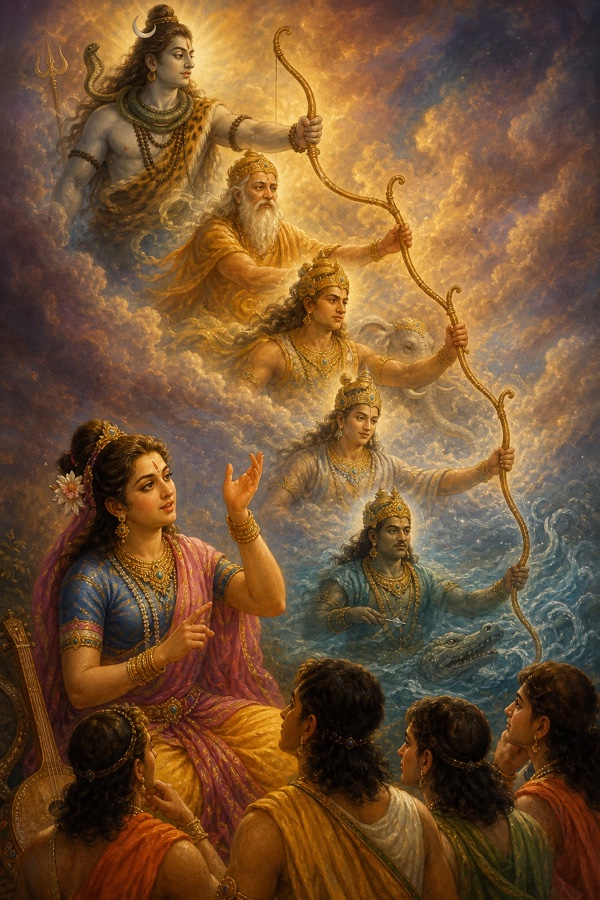
Then the dancing teacher gave the bow’s history, holder by holder. “Shiva had it first, for a thousand years. After him Prajapati held it for five hundred and three. Then Shakra, the king of the gods, for eighty-five. Then Soma, the moon, for five hundred. Then Varuna, lord of the waters, for a hundred. And Partha, whom men call Shvetavahana for his white horses, has now held it sixty-five years. It came from heaven, there is great power in it, and no bow anywhere is its equal. Gods and men both revere it. It was from Varuna that Partha received it.
“This next bow, with the fine sides and the golden grip, is Bhima’s. With it that son of Pritha conquered the whole of the east. The one with the red insects figured on it belongs to King Yudhishthira. The one whose golden suns throw such a glare is Nakula’s. And this one, with its golden insects and its gems and stones, belongs to Sahadeva, the son of Madri.
“These thousand winged arrows, sharp as razors and deadly as snake venom, are Arjuna’s. When he shoots them at an enemy they fly brighter than before, and they never run out. The long thick ones shaped like the crescent moon, keen along the edge, which thin an enemy’s ranks, are Bhima’s. The quiver with the five tigers, full of yellowish shafts whetted on stone and winged with gold, is Nakula’s, and that wise son of Madri carried it when he conquered the whole of the west. These arrows bright as the sun, painted all over in many colors, each flight of them able to bring down enemies by the thousand, are Sahadeva’s. And the short thick ones, well tempered, long in the feather and golden in the head, with three knots, belong to King Yudhishthira.
“The long sword with the toad carved on the blade and the tip shaped like a toad’s mouth is Arjuna’s, and nothing withstands it. The one in the tiger-skin sheath, long in the blade and handsome, a terror to the men who face it, is Bhimasena’s. The one with the excellent blade, the painted sheath and the golden hilt belongs to the wise head of the Kuru house, Yudhishthira the just. The strong blade in the goatskin sheath, made for many kinds of fighting, is Nakula’s. And the huge scimitar in the cowhide sheath, strong and hard to stand against, is Sahadeva’s.”
A key to reading this (lineage): Pandu’s five sons were born of two mothers. Yudhishthira, Bhima and Arjuna are the sons of Kunti, whose other name is Pritha, and so each of them is called Partha, son of Pritha. Nakula and Sahadeva are the sons of Madri. Brihannala has now tied every weapon in the tree to its owner. The prince has the whole secret in his hands, and his next question shows that he has yet to see it.
A telling: the ten names of Arjuna
“They are beautiful to look at, these gold-decked weapons of Partha, whose hands are so quick,” Uttara said. “But where is Arjuna himself? Where is Yudhishthira of the Kuru line, and Nakula, and Sahadeva, and Bhimasena? The sons of Pandu could have destroyed any enemy, and they lost their kingdom at dice, and since then no one has heard of them. And where is Draupadi, the princess of Panchala, whom people call the jewel among women? She followed them into the forest after that game.”
“I am Arjuna,” the dancing teacher said. “They call me Partha as well. The courtier who sits beside your father is Yudhishthira. Your father’s cook, Vallava, is Bhimasena. The man who keeps the horses is Nakula, and Sahadeva is in the cattle pens. And the Sairandhri, the maid for whose sake the Kichakas were killed, is Draupadi.”
The prince did not take it on trust. “Arjuna has ten names, and I have heard them,” he said. “Give me all ten, and I will believe the whole of this.”
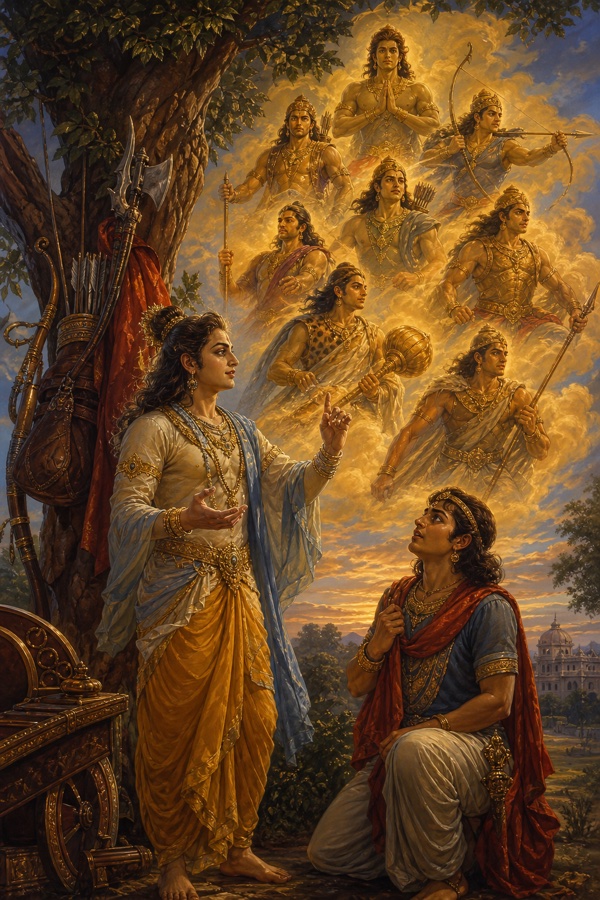
“Then listen closely, son of Virata, with your whole mind, and set each one against what you were told. They are Arjuna, Phalguna, Jishnu, Kiritin, Shvetavahana, Vibhatsu, Vijaya, Krishna, Savyasachin and Dhananjaya.”
Uttara was still testing him. “Then tell me truly why you are called Vijaya, and why Shvetavahana. Why Krishna, why Arjuna, why Phalguna, why Jishnu and Kiritin and Vibhatsu? What made you Dhananjaya, and what made you Savyasachin? I was told long ago how that hero came by each of his names. Account for all of them and I can put my faith in what you say.”
“They named me Dhananjaya, winner of wealth, because I subdued every country, carried off its treasure, and lived in the midst of riches,” Arjuna said. “They named me Vijaya, victory, because when I go out against kings who have never been beaten I do not come back from the field until I have beaten them. I am Shvetavahana because the horses yoked to my chariot in battle are white, and they wear golden armor. I am Phalguna because I was born on the slopes of the Himalaya on a day when the constellation Uttara Phalguni was rising. I am Kiritin, the diademed, because long ago, while I was fighting the powerful Danavas, Indra set on my head a diadem as bright as the sun. And gods and men know me as Vibhatsu because I have never once done a thing on a battlefield that a man would turn from in disgust.
“Either of my hands can draw the Gandiva, and for that gods and men call me Savyasachin. I am Arjuna because a complexion like mine is rare within the four bounds of the earth, and because nothing I do leaves a stain. Men and gods know me as Jishnu because no one can come near me or hold me down, because I tame those who stand against me, and because I am the son of the god who killed Paka. And the tenth name, Krishna, the dark one, my father gave me out of tenderness for his dark-skinned boy, who was pure of heart.”
The son of Virata came close then and bowed to him. “My name is Bhuminjaya, and I am also called Uttara,” he said. “It is my good fortune to see you, Partha. You are welcome here, Dhananjaya. Your eyes are red and your arms are each as strong as an elephant’s trunk, and I spoke to you out of ignorance. Forgive what I said. The things you have done before today were wonderful and hard, and knowing them, I am no longer afraid. What I feel for you is a great love.”
A key to reading this (the idea): among the ten names, Vibhatsu carries a promise. Arjuna says he has never done a deed on the battlefield that disgust would turn from. Before this day is over a whole army will lie senseless in front of him, and Bhishma himself will say why its men are still alive.
The chariot as a fortress, and Uttara at the reins
The prince’s next question was a charioteer’s question. “This is a big chariot, and I will drive it for you,” Uttara said. “Which part of their army do you mean to break into? Give the word and I will take you there.”
“I am pleased with you,” Arjuna said. “You have nothing to fear. I will rout every enemy you have in this battle, so put your mind at rest. There is hard and terrible work to be done in that press of men, and I will do it. Now be quick. Tie all those quivers to my chariot, and bring down one sword with them, a polished blade dressed in gold.”
At that Uttara shook off his slowness. He came down out of the tree fast, with Arjuna’s weapons in his arms, and Arjuna went on talking while he worked. “Yes, I will fight the Kurus, and I will bring your cattle back. With me to guard it, the top of this chariot will be a citadel for you. Think of its passages and its divisions as the streets and the houses of a walled town. My two arms are the ramparts and the gates. The triple pole and my quiver are the outworks, and no enemy gets past them. I fly one banner, a great one. Will it not stand for all the banners of your city? My bowstring is the engine on the wall that throws missiles down on the besiegers. My anger makes the fortress a fearful one, and the clatter of my wheels, will that not serve for the kettledrums of your capital? I will be riding this chariot with the Gandiva in my hands, and no army will take it. Let your fear go, son of Virata.”
“I am no longer afraid of them,” Uttara said. “I know how steady you are in battle. You stand as Keshava stands, or Indra himself. But there is one thing I keep turning over, and I am too slow to come to the end of it. A man with limbs as fine as yours, with every lucky mark on him: what misfortune could take his manhood away? You look to me like Mahadeva, or Indra, or the chief of the Gandharvas, living for a while in the shape of one of the third sex.”
“Here is the truth of it,” Arjuna said. “This is a vow, and I have kept it for one whole year at my elder brother’s command. I took this condition on because another’s will required it of me and because there was merit to be had by it. It was never my nature. And know this too, prince: the vow is finished.”
“Then you have done me a great kindness today,” Uttara said, “because I see that my suspicion had something in it. A man like you could never be what you seemed. Now I have an ally in battle. Now I could fight the gods themselves. My fear is gone. Tell me what to do and I will do it. A learned teacher trained me to drive, and I will hold your horses, which are fit to break the line of any enemy’s chariots. As a charioteer you may count me the equal of Daruka, who drives for Vasudeva, or of Matali, who drives for Shakra.”
Then he praised the team in front of him, horse by horse, as a driver will. “The one yoked at the right-hand pole, whose hooves can hardly be seen to touch the ground when he runs, is like Krishna’s Sugriva. This handsome one at the left-hand pole, the finest of his breed, I hold to be as fast as Meghapushpa. The third, in the golden mail, yoked at the rear on the left, I take to be Shaibya’s match in speed and stronger than Shaibya. And the fourth, at the rear on the right, is counted better than Balahaka in speed and in strength. This chariot is fit to carry a bowman like you into battle, and you are fit to fight from it. That is what I think.”
A sub-tale: the prince, who ran from this field a little while ago, is measuring himself against the best drivers he has ever heard named. Daruka is the charioteer of Vasudeva, who is Krishna, and Matali is the charioteer of Shakra, who is Indra. Sugriva, Meghapushpa, Shaibya and Balahaka are the horses he sets beside his own four, beginning with the one he calls Krishna’s Sugriva. Fear has left him, and a warrior’s pride has come back in its place.
Arjuna summons his weapons, and the Gandiva sounds
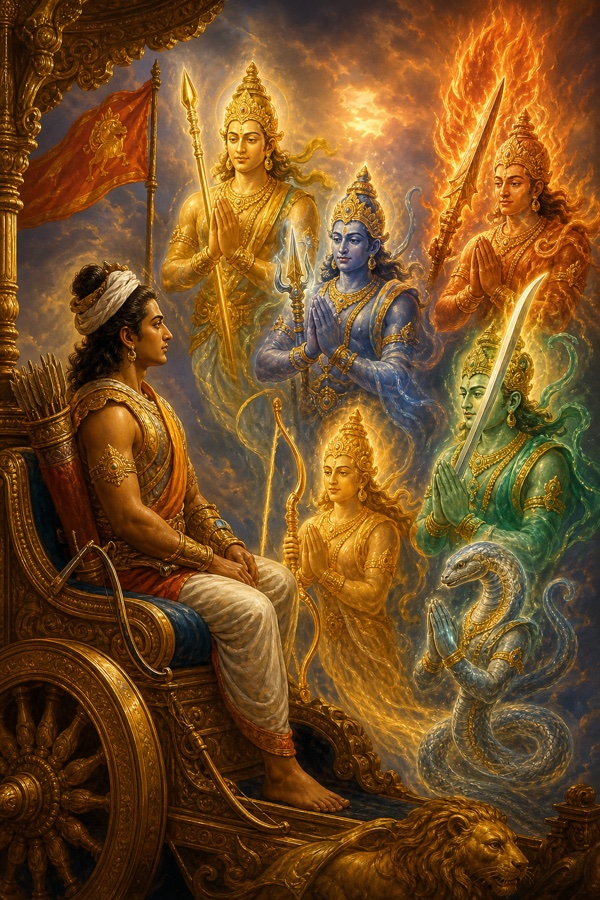
Arjuna drew the bangles off his arms and pulled on a pair of fine gloves embroidered with gold. He tied up his black, curling hair in a strip of white cloth. Then he sat down on the chariot with his face to the east, made his body clean and his mind single, and called all his weapons to memory. They came. They stood before the royal son of Pritha and spoke: “We are here. We are your servants, son of Indra.” He bowed to them and took them into his hands, and he said, “Stay, all of you, in my memory.” With every one of his weapons his own again, his face cleared, and he looked glad.
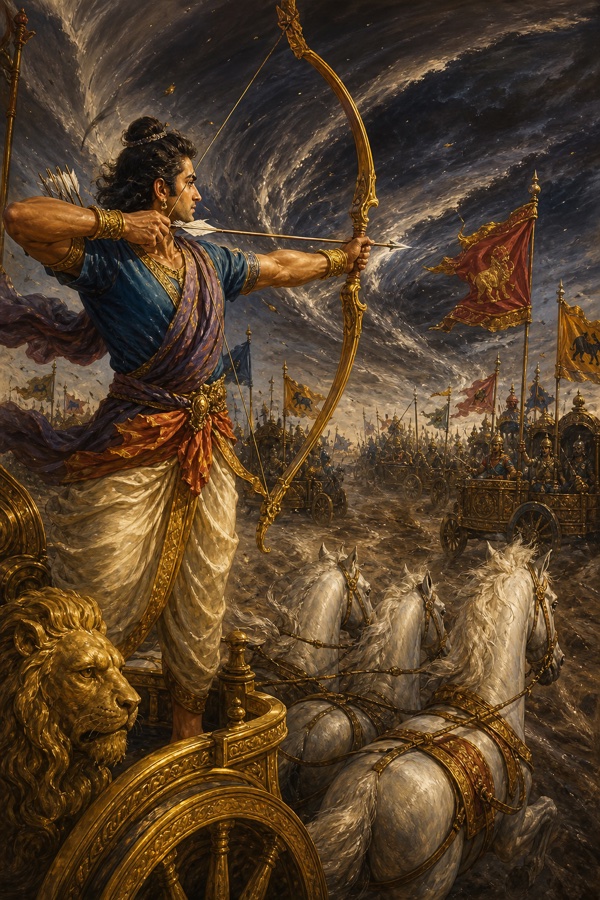
He strung the Gandiva quickly and plucked the string. The sound was the sound of two great bulls crashing together. It filled the earth, and a violent wind got up on every side. Meteors fell thick, the horizon went dark all the way round, birds reeled in the air, and big trees shook. The Kurus heard it as a burst of thunder, and from that sound alone they knew who was standing on a chariot out there with his hands on the string of that bow.
The prince’s courage, so newly found, wavered at the sight of what lay ahead. “You are one man, and their great chariot fighters are many,” Uttara said. “Every one of them knows every kind of weapon. How will you beat them all? You have no one behind you, son of Kunti, and the Kauravas have a multitude. That is why I am standing here beside you sick with fear.”
Arjuna laughed out loud. “Do not be afraid. When I fought the Gandharvas, strong as they were, on the Ghoshayatra, what friend did I have behind me? Who was my ally at Khandava, in that fearful fight against so many gods and Danavas? Who stood with me when I fought the Nivatakavachas and the Paulomas for the lord of the gods? And who was my ally, child, at the bride-choice of the princess of Panchala, when I had kings without number against me? Drona taught me arms. So did Shakra, and Vaishravana the lord of wealth, and Yama, and Varuna, and Agni, and Kripa, and Krishna of the Madhu line, and Shiva who carries the bow Pinaka. Why should I not fight these men? Drive fast, and let that fever go out of your heart.”
A key to reading this (lineage and place): each feat Arjuna counts off was done alone. The Ghoshayatra is the expedition to the cattle stations on which the Kurus were taken by the Gandharvas under their king Chitrasena, and it was Arjuna who brought them out. Khandava is the forest Agni consumed while Arjuna held off gods and Danavas together. The Nivatakavachas, whom the gods themselves could not kill, and the Paulomas he fought on behalf of Indra, the lord of the gods. Kripa will recite much the same list to Karna before the fighting starts.
The winning of the ape-banner, and the blast of the conch
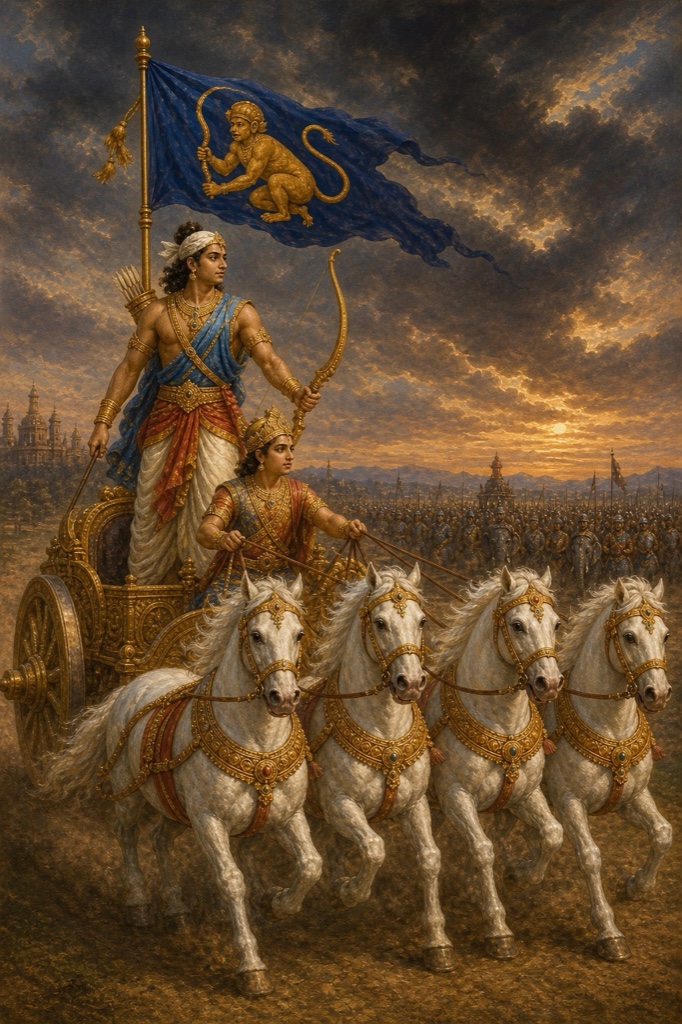
With Uttara as his driver, Arjuna circled the shami tree in reverence and set out, carrying every weapon he owned. First he had the prince’s banner taken down, the one with the lion on it, and laid at the foot of the tree. In its place he raised his own: a golden standard bearing the figure of an ape with a lion’s tail, a heavenly illusion that Vishvakarma, the craftsman of the gods, had made with his own hands. It was a gift of Agni. Arjuna had only to think of it, and Agni, knowing what he wanted, ordered the unearthly creatures that belonged to that banner to take their places in it. Then the staff itself, as beautiful as anything in heaven, dressed in gold, with a fine flag flying from it and quivers bound to it, dropped out of the sky and settled on the chariot. Arjuna walked around it too, with the same reverence, when he saw that it had come.
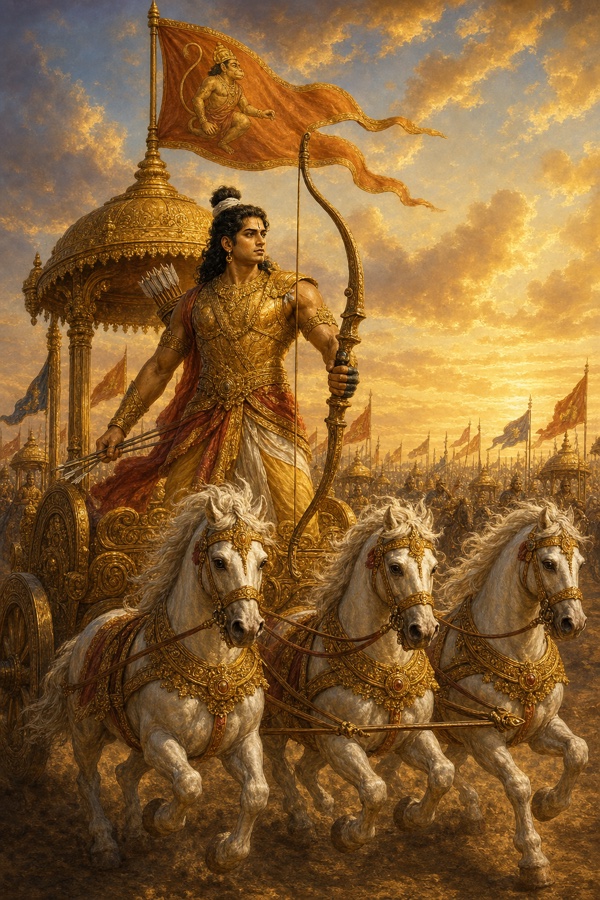
So the ape was on the banner again. Vibhatsu, the son of Kunti, the rider of white horses, drew the iguana-skin guards over his fingers, took up his bow and arrows, and started north. Then, with all his strength, he blew his great conch. It thundered, and it was a sound to raise the hair on an enemy’s body. The horses, fast as they were, dropped to their knees on the ground. Uttara, badly frightened, sat down where he stood. The son of Kunti took the reins himself, got the horses up, and set each one back in its place, and then he put his arms around the prince and steadied him as well. “Do not be afraid. You are a prince, and a Kshatriya by birth. Why should your heart fail you with the enemy in front of you? You have heard conches before this, plenty of them, and trumpets, and the roar of elephants standing in ranks drawn up for battle. Why does one conch leave you shaken and cowering like a common man?”
“I have heard many conches and many trumpets, and many elephants roaring in the battle line,” Uttara said. “I have never heard a conch like that one. I have never seen a banner like this one, and I have never heard a bowstring sound as yours does. The conch, the bow, the cries of those creatures on the banner that are like nothing on earth, the rattle of this chariot: between them my mind is reeling. I have lost my sense of the directions, and there is a pain in my heart. The banner seems to cover the whole sky, so that everything is hidden from me. And the twang of the Gandiva has left me deaf.”
“Then stand firm,” Arjuna said. “Plant your feet hard on the floor of the chariot and take a tight hold of the reins, because I am going to blow it again.” He blew, and it was the conch that fills enemies with grief and lifts the hearts of friends. The sound seemed to split the hills and to go on into the mountain caves and out to the ends of the sky. Uttara sat down again, clinging to the chariot in his fear. Between the conch and the rattle of the wheels and the twang of the Gandiva the earth itself seemed to shake, and Arjuna, seeing the state the prince was in, set about comforting him a second time.
A key to reading this (the idea): the ape on the banner is the reason Arjuna is called Kapidhvaja, the ape-bannered. The banner is a gift of Agni, made by Vishvakarma, and creatures that are no part of this world sit on it and cry out with the ape. Drona, seeing it come, calls it the sign of the one who laid waste the gardens of the lord of Lanka. The Kurus see its top shining from far off, and they know who is driving at them.
Drona reads the omens, and Duryodhana’s dilemma
In the Kuru lines Drona was reading the same sounds. “Listen to the rattle of that chariot,” he said. “Look how the clouds have closed over the sky, and feel the earth shake. That warrior can be no one but Savyasachin. Our weapons have lost their shine. Our horses have no spirit in them. Our fires are fed with fuel and will not blaze. Every one of these is a bad sign. All our animals are staring toward the sun and howling, and crows are settling on our banners. Those vultures and kites on our right mean great danger. A jackal ran wailing through the ranks just now, and look, it got away without a blow. That means heavy calamity. The hair is standing on your bodies, all of you, and that tells of a great killing of Kshatriyas. Whatever gives light has gone pale. The beasts and the birds look savage. Wherever I turn I see terrible portents, and every one of them speaks of slaughter among our own men.”
Then he spoke to Duryodhana directly. “Duryodhana, these blazing meteors have thrown your ranks into confusion. Your animals are cast down, and they look as if they were weeping. Vultures and kites are wheeling over your troops on every side. You will have cause to repent when you see your army under Partha’s arrows. Our ranks look beaten already. No one is eager to go forward, and every warrior’s face is pale, as if the sense had half gone out of him. Send the cattle on ahead. The rest of us should stand here in battle order, every man of us, ready to strike.”
Duryodhana answered on the field, in front of Bhishma and Drona and Kripa. “Karna and I have said this to the teachers already. I am saying it again, because saying it once has not satisfied me. The sons of Pandu gave their pledge. If they lost at dice they would live twelve years in countries and forests where we could know of them, and one year more where we could not. That thirteenth year has not ended. It is still running, and here is Vibhatsu, who was supposed to stay hidden, standing in front of us. If he has come out before the term is over, the Pandavas owe another twelve years in the forest. Perhaps they forgot themselves in their hunger for a kingdom. Perhaps the mistake is ours. Bhishma is the one to reckon whether the promised time falls short or runs over. Where a thing wished for may or may not be had, doubt hangs on one side or the other, and a matter settled one way often ends in another. Even men who know what is right are confused when they have to judge their own acts.”
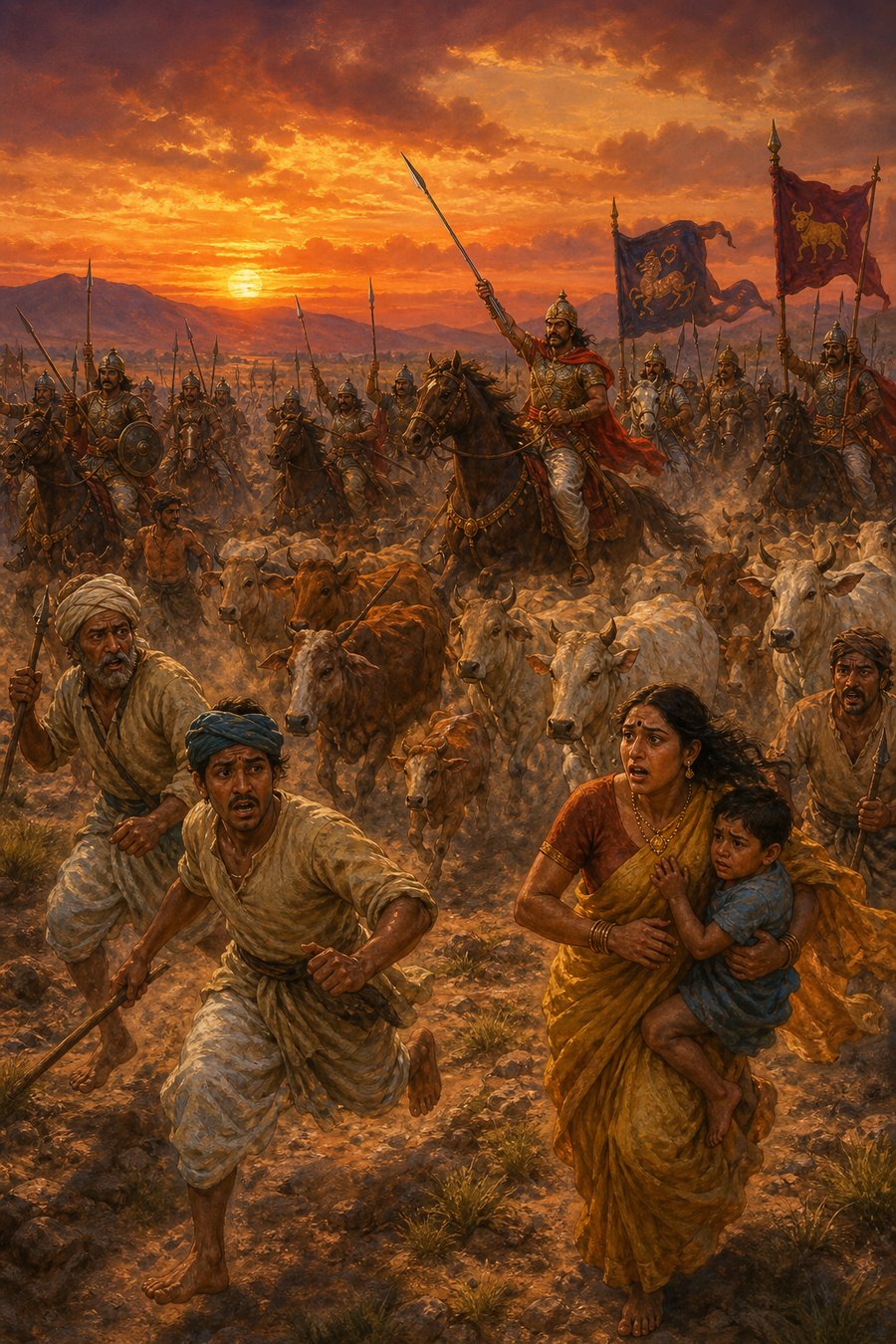
He turned from the pledge to the raid. “As for us, we came here to fight the Matsyas and to take their cattle in the north. If it is Arjuna who has come in the meantime, what blame is that to us? We came on behalf of the Trigartas. They told us of one oppression after another that the Matsyas had put on them, they were afraid, and we promised them help. It was agreed that they would seize the great herds of the Matsyas first, on the afternoon of the seventh day of the moon, and that we would take the rest at sunrise on the eighth, while the Matsya king was away chasing what had been taken first. Perhaps the Trigartas are bringing those cattle off now. Perhaps they have been beaten and are on their way to us to make terms with the Matsya king. Perhaps he has driven them off and has come up with his people and his whole army of hard fighters to fall on us by night. Perhaps this is some one leader of theirs with great strength in him, or perhaps the king himself. Whether it is the king of the Matsyas or Vibhatsu, we all have to fight him. That was our pledge. Why are our best chariot fighters, Bhishma and Drona and Kripa and Vikarna and Drona’s son, sitting on their chariots sick with fright? There is nothing better for us now than fighting, so make up your minds. If the wielder of the thunderbolt himself came to fight us for these cattle, or Yama, which of us would be likely to reach Hastinapura? When the horsemen can hardly hope to get away, how would the foot soldiers come through the deep forest alive, running with their backs to the field and arrows in them?”
A key to reading this (the count): everything here turns on a date. The pledge was twelve years in the forest where the Kurus could know of them and a thirteenth unknown, and to be found in the thirteenth meant twelve more years of exile. Duryodhana holds that the thirteenth year is still running, and he asks Bhishma to reckon whether the time falls short or runs over. Bhishma’s answer, when it comes, is a sum: over thirteen years the reckoning gains five months and twelve nights.
Karna’s boast, and the answers of Kripa and Ashvatthama
Karna spoke as soon as Duryodhana had finished. “Leave the teacher out of it and make your arrangements. He knows what the Pandavas intend, and he is putting fear into us. I can see how much he loves Arjuna. He only has to see him coming and he starts singing his praises. Arrange things so the troops do not break. Everything is in confusion because Drona heard some horses neigh. These men have come to a far country, in the hot season, in the middle of a great forest. See that they are not thrown into disorder and beaten. The Pandavas have always been the teacher’s favorites. They look to their own interest, and they have kept Drona posted among us. His own words give him away. Who praises a man because he has heard his horses? Horses neigh whether they are walking or standing still. The wind blows at all times. Indra is always sending rain, and clouds can be heard roaring often enough. What has Partha to do with any of it, and why should he be praised for it? This is Drona wishing Arjuna well, or else it is his anger and his hatred of us. Teachers are wise and blameless and kind to every creature, and they should never be consulted in an hour of danger. Learned men who can make speeches are in their place in fine palaces, in assemblies, in pleasure gardens. They belong where wonders are performed before a gathering, or where the vessels of a sacrifice have to be set out and washed. Knowing where other people have slipped, studying men’s characters, the science of horses and elephants and chariots, treating the diseases of asses and camels and goats and sheep and cattle, planning buildings and gateways, finding what is wrong with the food and the drink: there the learned are in their own country. Pay no attention to learned men who praise the enemy’s courage. Arrange things so the enemy is destroyed. Put the cattle where they are safe, draw up the troops, and post guards in the right places so that we can fight.”
Then he made his boast. “I look at all these good men and they seem alarmed, undecided, unwilling to fight. Let it be the king of the Matsyas who has come, or let it be Vibhatsu. I will hold him as the shore holds the swelling sea. The arrows from my bow fly straight as gliding snakes and never miss. My hands are quick, and these keen, gold-winged shafts will cover Partha as locusts cover a tree. The string will beat on my arm guards until the noise is like a pair of kettledrums. Vibhatsu has spent thirteen years at his austerities, so he will strike me only gently, and a son of Kunti who has turned Brahmin, with a Brahmin’s virtues, is a fit person to receive my arrows in silence, by the thousand. He is a great bowman, known through the three worlds, and I am in no way less than he is. Let the sky seem to swarm with fireflies today when my vulture-feathered arrows of gold go out on every side. Today I will kill Arjuna and pay the debt I promised long ago to Dhritarashtra’s son, a hard debt to pay. Is there anyone among gods and Asuras who will stand in the path of my arrows? Let him be as hard as Indra’s thunderbolt and as strong as Indra. I will wear him down as men torment an elephant with burning brands. I will take him unresisting, as Garuda takes a snake. The Pandava fire is fed with swords and darts and arrows, and it burns its enemies, and I am the great cloud that will put it out, with my chariots for the thunder, the speed of my horses for the wind in front, and my arrows for the rain. They will go into Partha’s body as snakes go into an anthill. You will see him today stuck full of gold-winged shafts like a hill covered with karnikara flowers. I had my weapons from Jamadagni’s son, the great ascetic, and with them I would fight the gods themselves. My javelin will bring the ape down off his banner today, howling, and the creatures on that flagstaff will fill the sky with their cries and scatter. Today I pull out by the root the dart that has been in Duryodhana’s heart for so long, by throwing Arjuna down from his chariot. The Kauravas will see him with his chariot broken, his horses dead, his courage gone, hissing like a snake. Let them go off with the cattle if they choose. Or let them stay on their chariots and watch me fight.”
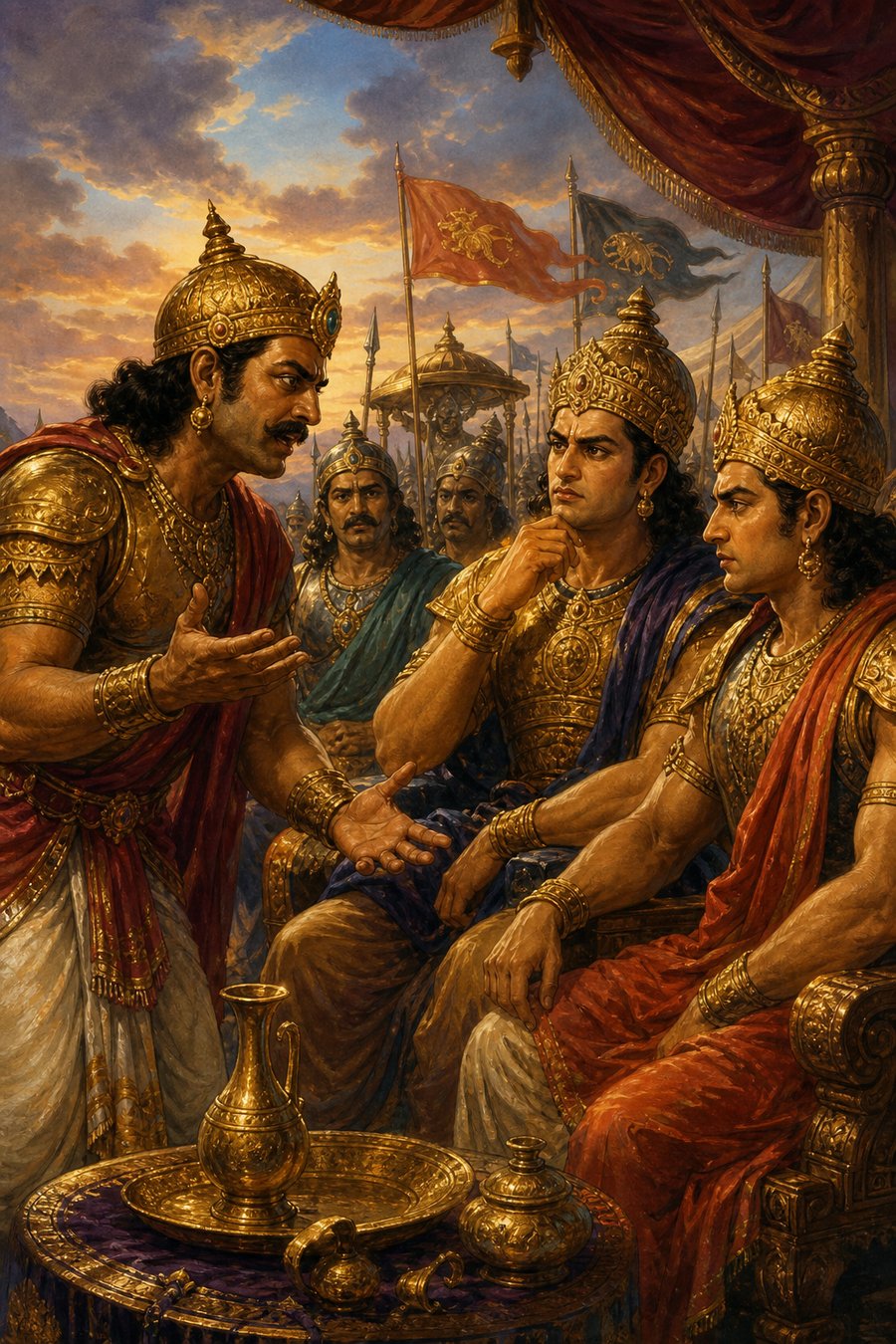
Kripa answered him first. “Son of Radha, that crooked heart of yours always leans toward war. You do not know things as they are, and you never count what comes after. The scriptures teach many ways of gaining an end, and those who knew the past held battle to be the most sinful of them all. Fighting succeeds only when the time and the place favor it. Here the time is against us, and nothing good will come of it. Courage shown at the proper time and place brings a benefit, and whether an act is in season is settled by whether time and place are with it. Learned men cannot go by the notions of a chariot maker. Weigh all that, and a meeting with Partha is no course for us. Alone he saved the Kurus from the Gandharvas. Alone he satisfied Agni. Alone he lived five years as a celibate student on the Himalaya. Alone he took Subhadra up on his chariot and challenged Krishna to single combat. Alone he fought Rudra, who stood before him as a forest hunter. In this very forest he rescued Draupadi when she was being carried off. He alone studied the science of weapons for five years under Indra. Alone he overcame every enemy and spread the fame of the Kurus. Alone he defeated Chitrasena, king of the Gandharvas, and in a moment that king’s unbeatable troops. Alone he overthrew the fierce Nivatakavachas and the Kalakhanjas, whom the gods themselves could not kill. And what have you done single-handed, Karna, to set beside any of the sons of Pandu, each of whom has brought many kings under his rule by himself?”
He was not finished. “Indra himself is no match for Partha in battle, and a man who wants to fight Arjuna should take something to calm himself. You want to draw the fangs of an angry and venomous snake with your right hand, using your forefinger. You want to ride a maddened elephant through the forest, alone, with no hook in your hand. You want to rub yourself with butter, dress in silk, and walk through a blaze fed with fat and tallow. Who ties his own hands and feet, hangs a great stone on his neck, and swims the ocean? What manhood is there in that? Only a fool, without the skill or the strength, wants to fight a man as strong and as skilled as Partha. We deceived him dishonestly, and now he is free of his thirteen years. Will he not destroy us? We came without knowing it to the place where he lay hidden like fire in a well, and we have walked into great danger. Still, hard as he is to stand against, we should fight him. Let the troops put on their mail and stand here in their ranks, ready to strike. Let Drona, Duryodhana, Bhishma, you, Drona’s son and I all fight him together. Do not be so rash as to go alone, Karna. He has made up his mind to fight, and he is as fierce as the god of the thunderbolt, but if the six of us are united, with our troops in order behind us, we can be a match for him, as the Danavas are when they meet Vasava.”
Ashvatthama, Drona’s son, was harder on him. “The cattle have not been won yet, Karna. They have not crossed the border of their owner’s kingdom, and they have not reached Hastinapura. What are you boasting about? Real heroes win many battles, take great wealth, beat whole armies, and say nothing of what they did. Fire burns without a word. The sun shines without a word. The earth carries everything on it, what moves and what stands still, without a word. The Self-existent laid down a calling for each of the four orders, so that each can earn its wealth without blame. A Brahmin studies the Vedas, performs sacrifices of his own, and officiates at the sacrifices of others. A Kshatriya lives by the bow and performs his own sacrifices, and he never officiates for another. A Vaishya earns wealth and has the Vedic rites performed for him. A Shudra serves the other three. The sellers of flowers and the sellers of meat may get their wealth by tricks and fraud. The sons of Pandu always followed the scriptures, and that is how they won the rule of the whole earth, and they treat their elders with respect even when those elders turn against them. What Kshatriya ever showed delight at winning a kingdom with dice, as this wicked and shameless son of Dhritarashtra did? What man of sense gets wealth by cheating, like a seller of meat, and then boasts of it?”
Then he went through the record. “In what single combat did you beat Dhananjaya, or Nakula, or Sahadeva, you who stripped them of their wealth? In what battle did you beat Yudhishthira, or Bhima, the strongest of men? In what battle did you take Indraprastha? What you did, you doer of wicked deeds, was drag that princess into the hall when she was in her season and had one cloth on her. You cut the great root of the Pandava tree, a root as fine as sandalwood. When your greed for wealth made the Pandavas serve as slaves, do you remember what Vidura said? Men forgive as far as they can bear to, and so do other creatures, even insects and ants. The son of Pandu cannot forgive what Draupadi suffered. Dhananjaya is coming here to destroy the sons of Dhritarashtra. You make speeches and pretend to wisdom, but will Vibhatsu leave any of us alive? Gods, Gandharvas, Asuras, Rakshasas: is there one of them he would be afraid to fight? Whoever he falls on in his anger goes down like a tree under the weight of Garuda. He is a better man than you in battle. As a bowman he is the equal of the lord of the gods, and in war he is the equal of Vasudeva. Who would refuse to praise him? He meets heavenly weapons with heavenly and human with human, and no man is his match. Those who know the scriptures say a pupil is no less than a son, and that is why Drona loves him. So use the means you used at the dice match. Use what won you Indraprastha and what dragged Draupadi into the assembly. Here is your wise uncle, who knows a Kshatriya’s duty so well, the cheating gambler Shakuni, prince of Gandhara. Let him fight now. The Gandiva has never thrown a Krita or a Dvapara. It throws arrows, burning and keen, by the tens of thousands, vulture-feathered arrows that go through mountains. Yama, the ender of all, leaves something standing. So does Vayu, and so does the horse-faced fire. Dhananjaya in his anger leaves nothing. You played in the hall with your uncle to help you. Fight now with Subala’s son to protect you. Let my father fight if he chooses. I will not fight Dhananjaya. Our business is with the king of the Matsyas, if he comes after his cattle.”
A key to reading this (the idea): the answers to Karna come from inside Duryodhana’s own army. Kripa says outright that the Pandavas were deceived dishonestly. Ashvatthama names the dice match and the dragging of Draupadi into the hall, with Duryodhana standing there to hear it, and declines to fight Arjuna at all. Drona has already said who is coming and what he can do. Every one of them takes the field against him all the same.
Bhishma’s reckoning, and the drawing of the array
Bhishma made the peace. “Drona’s son sees clearly, and so does Kripa. As for Karna, he wants to fight only out of regard for a Kshatriya’s duty. No wise man can find fault with the teacher. My own view is that we have to fight, given the time and the place. A man with five enemies as bright as five suns, heroes who have just come out of their bad years, may well be confused. Even those who know what is right lose their way where their own interest is concerned. So I tell you this, Duryodhana, whether it pleases you or not. What Karna said, he said to lift our courage when it was sinking. You, son of the teacher, forgive all of it. The matter in front of us is grave. The son of Kunti has come, and this is no time to quarrel. You and the teacher Kripa should forgive everything. Mastery of every weapon lives in you two as light lives in the sun. As beauty never leaves the moon, the Vedas and the Brahma weapon are both settled in you. We often see the four Vedas in one man and the qualities of a Kshatriya in another. We have never heard of the two together in anyone but the teacher of the Bharata house and his son. In the Vedantas, in the Puranas, in the old histories, who except Jamadagni would stand above Drona? The Brahma weapon joined to the Vedas is seen nowhere else. Forgive, son of the teacher. This is no time for division. Indra’s son has come. Let us all fight him together. Wise men have counted the calamities that can fall on an army, and the worst of them is disunion among its leaders.”
Ashvatthama answered that such just words need not be spoken before them. His father had praised Arjuna in anger, and an enemy’s virtues ought to be admitted, as a teacher’s faults may be pointed out, so a man should speak as well as he can of a son’s merits or a pupil’s. Duryodhana asked the teacher’s forgiveness. “Let there be peace again. If the teacher is of one mind with us, whatever this hour calls for is as good as done.” Then, with Karna and Kripa and Bhishma to help him, he soothed Drona, and Drona said, “What Bhishma, the son of Shantanu, said at the beginning had already appeased me. Now arrange things so that Partha cannot get near Duryodhana in the fighting, and so that the king is not taken by the enemy through rashness or bad judgment. Arjuna has surely not shown himself before the term was out. And getting his cattle back will not make him forgive what we have done today. So see to it that he does not reach Dhritarashtra’s son and does not break our troops. I had my own doubt whether the term was complete, and Duryodhana raised the same doubt earlier. With that in mind, let the son of Ganga say what is true.”
Bhishma gave them the count. “The wheel of time turns with all its divisions, with kalas and kashthas and muhurtas, with days and fortnights and months, with constellations and planets, seasons and years. Because of the fractions left over and the wandering of the heavenly bodies, two months are gained in every five years. Reckoned so, I find five months and twelve nights over and above in thirteen years. Everything the sons of Pandu promised, they have done to the letter, and Vibhatsu showed himself because he knew it for certain. They are all men of great heart who know what the scriptures mean. With Yudhishthira to lead them, how would they stray from what is right? The sons of Kunti do not give way to temptation, and they have done a hard thing. Had they wanted their kingdom by unfair means, they would have shown their strength on the day of the dice. They were bound by virtue then, and they kept to a Kshatriya’s duty. Anyone who takes them for cheats will be beaten. The sons of Pritha would choose death before a lie. But when their time has come they will not give up what is theirs, though the god of the thunderbolt himself were guarding it. We are about to face the finest bowman living. So let whatever good and honest men would approve be arranged at once, so that what we hold does not pass to the enemy. I have never seen a battle, Duryodhana, in which one side could say, ‘We are certain to win.’ When men fight there is victory or defeat, good fortune or bad, and each side must take one of the two. So whether a battle now is proper or improper, lawful or unlawful, make your arrangements quickly. Dhananjaya is at hand.”
“Grandsire, I will not give the Pandavas back their kingdom,” Duryodhana said. “Let everything be made ready for battle, and at once.” “Then hear what I think best, if it pleases you,” Bhishma said. “I shall always tell you what is for your good. Take a fourth of the army and start for the capital without losing a moment. Let another fourth go as escort to the cattle. With the half that is left we will fight the Pandava. Drona and I, Karna, Ashvatthama and Kripa will stand against Vibhatsu, or the king of the Matsyas, or Indra himself if he comes. We will hold any of them as the shore holds the surging sea.”
They all found this acceptable, and the king of the Kauravas did as he was told without delay. Bhishma sent the king away first and the cattle after him, and then he began to draw up the troops. “Teacher, take the center,” he said to Drona. “Ashvatthama will stand on the left, and wise Kripa, the son of Sharadvat, will hold the right wing. Karna of the Suta caste, in his mail, will stand in the van. I will take the rear and guard the whole army from there.”
A key to reading this (the count, a modern parallel): Bhishma’s rule is that the fractions left over, and the wandering of the heavenly bodies, add two months in every five years. Over thirteen years that comes to five months and twelve nights of extra time, so the thirteenth year the Pandavas promised was complete, with time to spare, before Arjuna showed himself. Calendars that count their months by the moon still add a month every few years for the same reason.
Arjuna drives toward Duryodhana, and the cattle are freed
The Kauravas had barely taken their stations when Arjuna came on fast, and the rattle and din of his chariot filled the air ahead of him. They saw the top of his banner. They heard the wheels, and they heard the Gandiva, drawn and released again and again. Drona watched the great chariot fighter come and told the others what they were looking at. “That is the top of Partha’s banner shining in the distance. That noise is his chariot. That roaring is the ape, and the ape is putting fear into the troops. And there he stands, drawing the Gandiva, whose twang is as loud as thunder. Look at this. Two arrows have come down together at my feet, and two more have gone by so close that they brushed my ears. He has finished his exile, he has done many wonderful things, and with the first pair he salutes me and with the second he whispers in my ear. He is wise, and his kin love him, and it is long since we saw him. See how he blazes with beauty and grace. Chariot and arrows, fine arm guards and quiver, conch and banner and coat of mail, diadem and sword and bow: the son of Pritha shines like the sacrificial fire with the ladles standing round it, fed with clarified butter.”
Arjuna looked over the Kuru line and spoke to the prince as the moment required. “Driver, hold the horses at a point from which my arrows can reach the enemy. I want to see where that vile wretch of the Kuru house is standing in all this army. I will pass over every one of these and go for the head of the vainest prince alive, because once he is beaten the others will count themselves beaten too. There is Drona, and behind him his son. There are the great bowmen, Bhishma and Kripa and Karna. The king I do not see. I suspect he is anxious for his life and is making off by the southern road with the cattle. Leave these chariots where they stand and take me to Suyodhana. That is where I will fight, son of Virata, because a fight there will come to something. When I have beaten him I will come back, and I will bring the cattle with me.”
Uttara hauled the horses round with an effort, turned them by the bridle away from the Kuru champions, and sent them toward the place where Duryodhana was. Kripa saw the chariot swing wide of that thick array and guessed what it meant. “Vibhatsu has no wish to take his stand anywhere far from the king,” he told the men around him. “We must get onto his flanks, and quickly. When his anger is up, no one who meets him alone can hold him, except the god of the thousand eyes or Krishna, the son of Devaki. What use will the cattle be to us, or all this wealth, if Duryodhana goes down like a boat in the ocean that Partha is?”
Arjuna had reached the other division by then. He called out his name, quickly, and covered the troops with arrows as thick as locusts. They could see nothing under that cover. Earth and sky were both blotted out, and soldiers who had been ready for a fight were so stunned that not one of them could even run, though in their hearts they all admired the speed of his hands. Then he blew the conch that always raised the hair on an enemy’s body, and he plucked the string of his bow and drove the creatures on his flagstaff to a more fearful roaring. Conch, wheels, bowstring and the howling of those unearthly things on the banner came together, and the ground began to shake. The cattle threw up their tails and bellowed with one voice. Then they wheeled about and went streaming back along the southern road.
The gist: before any single combat is fought, the raid has already failed. Arjuna leaves the Kuru champions standing in their array, drives for the division that is taking the cattle away, and stuns it with arrows, the conch and the roar from his banner. The herds turn of themselves and run for home. What is left is the Kuru host, which now comes at him from every side.
First combat: Vikarna, Shatruntapa, and the flight of Karna
He had broken that division by main force and the cattle were free, and he wanted more fighting, so he went on toward Duryodhana. The Kuru champions saw the herds running wild for the city of the Matsyas and understood that the diademed one had already won what he came for. All at once they fell on him as he advanced. Arjuna looked at their divisions, past counting, standing firm in battle order under banners past counting, and spoke to the son of the Matsya king. “Take these white horses with the golden bridles down this road, as fast as they can go. Do it well, because I mean to get in among that crowd of Kuru lions. The Suta’s son, that wicked soul, wants a fight with me as one elephant wants a fight with another. Take me to him, prince. Duryodhana’s favor has made him proud.” The prince sent the big horses in their golden armor through the line of chariots at the speed of the wind and brought the Pandava out into the middle of the field. Four chariot fighters came at him then to help Karna: Chitrasena, Sangramajit, Shatrusaha and Jaya, with arrows and long shafts. He was angry now, and the arrows from his bow went through the chariots of those Kuru champions like a great fire going through a forest.
The fight was raging when Vikarna, a Kuru hero, came up on his chariot and poured long, thick, terrible arrows on Partha, the younger brother of Bhima. Arjuna cut his bow, a bow with a tough string and horns overlaid with gold, and then he cut down his flagstaff. Vikarna saw his standard fall and fled at once. After him came King Shatruntapa, who could not hold his anger in, and he put a storm of arrows on Partha, so that Arjuna seemed to go under in the midst of the Kuru array. Arjuna had been hit by him. He hit Shatruntapa back with five arrows and killed his driver with ten, and then he sent one shaft that could split the thickest mail, and Shatruntapa fell dead on the field like a tree torn off a mountain top by the wind. The brave men around him began to sway and tremble as great forests do in the gale that blows when the world is ending. Well-dressed heroes, givers of wealth, men with the energy of Vasava in them, went down before Vasava’s son and measured their length on the ground like full-grown Himalayan elephants in mail of black steel trimmed with gold. He moved over the field in every direction with the Gandiva in his hands, killing as a fire eats a forest at the end of summer, and his enemies blew away in front of him as clouds and fallen leaves blow in front of the spring wind.
He killed the red horses yoked to the chariot of Sangramajit, who was a brother of Karna, the son of Vikartana, and then he took off Sangramajit’s head with a crescent-headed arrow. Karna saw his brother killed. He gathered everything he had and came at Arjuna like a great elephant with its tusks thrust out, or like a tiger going for a strong bull. He put twelve arrows into the son of Pandu, hit every one of his horses all over their bodies, and hit Virata’s son in the hand. Arjuna went to meet that sudden rush as Garuda, with his many-colored wings, stoops on a snake. Both men were bowmen of the first rank, both were very strong, and each was able to kill whoever stood against him. The Kauravas saw that the two were about to meet, and they drew off to watch.
Here in front of him was Karna, the offender. Fury took Arjuna at the sight, and gladness with it at having him within reach, and he made Karna vanish, horses, chariot, driver and all, under a fearful shower of arrows. The warriors of the Bharatas with Bhishma at their head, their horses and elephants and chariots, were hit and hidden by the same arrows, and with their ranks scattered and broken they cried out in grief. Karna cut those shafts down with a great many of his own and came back into view, bow in hand, like a fire flaring up. The Kurus clapped and sounded conches, trumpets and kettledrums for him, and the slap of his bowstring on his arm guard filled the air. He saw Arjuna filling the same air with the Gandiva’s twang, and he saw the lifted tail of the ape on the flagstaff and heard it yelling up there, and he gave a great roar. Arjuna struck at him, at his horses, at his chariot and his driver, pouring arrows on him fast, with his eyes on the grandsire and Drona and Kripa all the while. Karna rained arrows back like a cloud heavy with water, and Arjuna covered him again. To the men watching, the two on their chariots, each making clouds of keen arrows, looked like the sun and the moon behind cloud. Karna, quick of hand and unable to bear the sight of his enemy, hit Arjuna’s four horses with whetted arrows, the driver with three shafts, and the flagstaff with three. Arjuna came at him then like a lion woken from sleep. He covered Karna’s chariot with arrows as the sun covers the worlds with its rays. He drew crescent-headed arrows from his quiver, pulled the string to his ear, and hit the Suta’s son in every part of his body. Arms, thighs, head, forehead, neck: the shafts from the Gandiva went in with the force of thunderbolts. Torn and in pain, Karna left the front of the battle and fled, as one elephant flees when another has beaten it.
A key to reading this (the idea): Karna is called the offender because of the day Draupadi was dragged into the Kuru hall. Arjuna will say it to his face before this battle is over: Karna looked on while she was outraged there, and he spoke harsh words. The first meeting of the two ends with Karna’s flight, and Arjuna will remind him of that as well.
Arjuna’s cataclysmic rain of arrows, and the coming of the gods
With the son of Radha gone, the rest came on, Duryodhana leading, one division after another, each in battle order and each shooting clouds of arrows. Arjuna stood against that countless host as a shore stands against the fury of the sea. Then Vibhatsu of the white horses went forward, loosing the weapons of the gods as he went. The arrows from the Gandiva covered every point of the horizon as the sun’s rays cover the earth. Among all who fought from chariots and horses and elephants, and among the mailed men on foot, there was not one with a space of two fingers on his body left unwounded. Between his skill with those weapons, the training of the horses and the handling Uttara gave them, the flight of his shafts, his strength and the lightness of his hand, people began to think of him as the fire that flares up when the world is dissolved, to burn everything that was made. No enemy could bear to look at him. He shone too brightly. The ranks his arrows had torn looked like new clouds on a hillside with the sun on them, or like groves of ashoka trees bright with clusters of flowers, or like a garland whose blossoms wither and drop one by one. The wind carried off their torn flags and umbrellas through the sky. Horses cut loose from their yokes by his arrows bolted in every direction, dragging broken pieces of chariots behind them. Elephants struck in the ear, the ribs, the tusk, the lower lip, in every tender place, began to fall, and in a short time the ground was so strewn with the bodies of Kaurava elephants that it looked like a sky banked with black cloud. The power of his weapons, the twang of the bow, the cries of the things on his flagstaff, the terrible roar of the ape and the blast of the conch put fear into every man Duryodhana had, and at the mere sight of Arjuna the strength of each of them seemed to sink into the dust.
He would not commit the sin of killing men who could no longer defend themselves. So he fell back suddenly and struck the army from behind, with clouds of keen arrows that flew to their marks like hawks slipped by fowlers. Soon the whole sky was full of them. As the sun’s countless rays are cramped when they enter a small vessel, his arrows could find no room to spread even in that wide sky. A man saw his chariot come near once, and only once, because the next moment he and his horses had gone to the other world. His arrows went through the bodies of his enemies without being stopped, and his chariot went through their ranks in the same way. He churned that host as Vasuki of the thousand heads churns the great ocean in his play. The noise of his bowstring rose over every other noise, and no living thing had heard its like. Wherever he ranged, shooting to the right and to the left, the bow was seen drawn to a full circle, and his arrows fell on nothing but the mark. A path opened for his chariot of its own accord, as a path opens in the forest where a herd of elephants has gone through. The men he struck believed that Indra and all the immortals had come to kill them for Partha’s sake, or that Death had put on Arjuna’s shape. He took off heads as reapers take off the tops of standing plants. Dust and blood went up together on the wind and reddened the sun’s own rays until the sky looked like evening, and the sun stops shedding his rays when he sets, but the son of Pandu did not stop. Then he dealt with the great bowmen one by one. He put seventy-three arrows into Drona, ten into Duhsaha, eight into Drona’s son, twelve into Duhshasana, three into Kripa the son of Sharadvat. He pierced Bhishma, and he pierced King Duryodhana with a hundred. Last he hit Karna in the ear with a barbed shaft, and when Karna’s horses, chariot and driver had all been destroyed, the troops supporting him began to break. Uttara saw them give way and wanted to know what Partha meant to do next. “Which division now?” he asked. “Name it and I will have you there.” “The one in the tiger-skin coat, on the chariot with the blue flag and the red horses, is Kripa,” Arjuna said, “and that is the front of his division. Take me there. I will show that great bowman how fast my hands are. The one whose flag carries a fine water pot worked in gold is the teacher Drona. I honor him, as every man who bears arms honors him, so drive around him gladly, in reverence. We will bow our heads there, because that is the eternal law. If he strikes my body first, then I will strike him, and he will have no cause for anger. Close beside him, the one with a bow on his flag is his son Ashvatthama, a great chariot fighter, whom I also honor. Check the horses again and again as you come near his chariot. The one in golden mail, with a third of the army and its best troops around him, whose flag shows an elephant on a field of gold, is King Duryodhana. Take this chariot in front of him. He is hard to beat, and he is counted the first of all Drona’s pupils for lightness of hand, and I will show him hands that are lighter. The one whose flag carries the stout rope that binds an elephant is Karna, whom you know already. Be very careful when you come before that wicked son of Radha, because he never stops challenging me. And the one with the blue flag bearing five stars and a sun, with the great bow in his hand and the pure white umbrella over his head, who stands at the head of that mass of chariots like the sun in front of black clouds, whose golden mail shines like the sun or the moon and whose golden helmet puts fear in my heart, is Bhishma, the son of Shantanu, grandsire to all of us. Duryodhana keeps him in royal splendor, and he leans toward that prince. Leave him until last, because even now he may stand in my way. And when he is fighting me, guide the horses with care.” The prince turned the chariot with a will toward the place where Kripa waited, eager to fight.
The ranks of the Kuru bowmen looked like banks of cloud in the rains, drifting before a light wind. Close behind the men on foot stood the horses with their terrible riders, and the elephants, fearful to look at and splendid in their armor, with skilled men on their backs driving them with hooks and iron goads. And above them the sky was filling. Shakra came on a beautiful chariot with the gods about him, the Vishvedevas and the Maruts. Gods, Yakshas, Gandharvas and Nagas crowded the air until it shone as it does on a cloudless night with all the planets out. Each came on his own chariot. They wanted to see what their weapons would do in a war of men, and they wanted to see the great and fearful fight that would come when Bhishma and Arjuna met. The chariot of the king of the gods stood out in the clear sky. It was set with every kind of gem, it could go wherever its rider wished, and its roof was held up by a hundred thousand pillars of gold around a central one made wholly of jewels. The thirty-three gods were there with Vasava at their head, and Gandharvas, Rakshasas, Nagas and the Pitris, the ancestors, with the great rishis. And on Indra’s own chariot, shining, stood kings: Vasumana, Valaksha, Supratardana, Ashtaka, Shibi, Yayati, Nahusha, Gaya, Manu, Puru, Raghu, Bhanu, Krishashva, Sagara and Nala.
In a splendid row, each in its proper place, stood the chariots of the other gods: those of Agni, Isha, Soma, Varuna, Prajapati, Dhatri, Vidhatri, Kubera and Yama, of Alambusha and Ugrasena and others, and of the Gandharva Tumburu. All the gods had come, and the Siddhas, and the greatest of the sages, to watch one man fight the Kurus. The scent of heavenly garlands hung in the air like the scent of woods in blossom when spring begins. The umbrellas of the gods, red and reddish, their robes and garlands and yak-tail fans made a beautiful sight as they waited there. The dust of the field went down, and a light that was not the sun’s lit everything. A breeze carrying the perfumes of heaven began to cool the fighters. The whole sky seemed to burn with chariots already come and chariots still coming, of many handsome makes, each lit with its own jewels and each brought by one of the great gods. In the midst of them the wielder of the thunderbolt, wearing a garland of lotuses and lilies, looked very beautiful on his chariot. He kept his eyes steadily on his son down there on the field, and however long he looked, he had not looked enough.
A key to reading this (lineage): Arjuna is the son of Indra, and the weapons spoke to him by that name when he summoned them. Shakra, Vasava and the wielder of the thunderbolt are all names of the same god. The fifteen named from Vasumana to Nala are kings, and they are seen standing on Indra’s own chariot. The father has come with his whole court to watch, and he cannot get his fill of looking.
The duel with Kripa
Arjuna looked over the Kuru army in its array and gave the prince his mark. “See the chariot whose flag shows a golden altar. Kripa, the son of Sharadvat, is moving along its southern side. Take me to him.” Uttara did not lose a moment. He sent the silver-white horses forward in their golden armor and took them up through every one of the faster paces, one after another, those fiery animals the color of the moon. He knew horses. He ran them up to the Kuru host and turned them back, and then, being a driver who knew his work, he wheeled, and ran them in circles within circles, and swung to the left, until the Kurus could no longer tell where he was going. When he had wheeled once more he brought the chariot in, without fear, and stopped it face to face with Kripa’s.
Then Arjuna called out his own name and blew Devadatta, the great conch, with all his strength. The blast of it on that field was like the splitting of a mountain. When the conch itself did not burst into a hundred pieces under his breath, the Kurus and all their warriors gave it high praise. The sound went up as far as heaven and came back down like the crash of the thunderbolt Indra hurls against a mountainside. Kripa, the son of Sharadvat, was a brave man and a strong one, and he could not bear that noise. Angry with Arjuna and eager to fight, he took up his own sea-born conch and blew it hard, and it filled the three worlds. Then he took up a large bow and struck the string a great stroke. The two chariot fighters stood opposite each other like two suns, bright as two banks of autumn cloud.
Kripa shot first: ten swift, whetted arrows of the kind that go into a man’s vitals. Arjuna drew the Gandiva and answered with more iron arrows than could be counted, every one made to reach the core of the body, and Kripa cut those blood-drinking shafts into hundreds and thousands of pieces before they could arrive. Arjuna grew angry then. He showed one maneuver after another, covered every side with arrows until the sky was hidden, and wrapped Kripa in hundreds of shafts. Those arrows burned like tongues of fire. Kripa, hurt and furious, put ten thousand arrows on Partha as fast as he could shoot, and roared across the field.
Arjuna picked out the four horses of Kripa’s chariot and hit them with four deadly arrows from the Gandiva, sharp, straight, and winged with gold. The arrows burned like flames, the horses reared all at once, and Kripa was thrown from his footing. Arjuna saw him knocked out of his place, and out of regard for his opponent’s dignity he stopped shooting. Kripa got back to his place. As soon as he had it he put ten arrows fledged with the feathers of the kanka bird into Savyasachin.
A keen crescent-headed arrow came next, and with it Arjuna cut through Kripa’s bow and his leather arm guards together. Then, with arrows that could have gone through to the vitals, he cut the coat of mail off Kripa’s body and never broke the skin. Kripa stood there out of his armor like a snake that has shed its slough in season. He snatched up another bow the moment the first was cut and had it strung in an instant, and, strange to tell, Arjuna cut that one as well with straight shafts. So it went, bow after bow. Whatever the son of Sharadvat took up, the son of Pandu cut in his hands.
When there were no bows left, Kripa threw a javelin from his chariot, a thing like a blazing thunderbolt. It was dressed in gold and came whistling through the air with the flash of a meteor, and Arjuna cut it down with ten arrows. Kripa found one more bow and loosed a flight of crescent-headed arrows almost in the same motion. Arjuna broke them with ten keen shafts, and then, in his anger, he let fly thirteen arrows whetted on stone, bright as flames. The first cut the yoke of Kripa’s chariot. The next four went into his four horses. The sixth took the driver’s head from his body. Three hit the triple bamboo pole, and two the wheels. The twelfth cut down the flagstaff. With the thirteenth Phalguna, who looked like Indra as he did it, and who seemed to be smiling in mockery, hit Kripa in the chest.
His bow was cut, his chariot broken, his horses and his driver dead. Kripa jumped down, caught up a mace, and threw it. It was heavy and polished, and Arjuna’s arrows met it in the air and sent it back the way it had come. Then the warriors of Kripa’s division closed in from every side to save him and covered Partha with arrows. Uttara swung the horses to the left and began the circling maneuver called Yamaka, and by that alone he held all of them off. They gathered up Kripa, who had no chariot left to stand on, and carried him away out of Dhananjaya’s reach.
A key to reading this (the idea): twice in this duel Arjuna has Kripa at his mercy and declines to use it. He stops shooting when Kripa is thrown from his footing, out of regard for his dignity, and he cuts away the coat of mail without wounding the body under it. Kripa was one of the men who trained him in arms, and Arjuna counts him among the Kuru elders. The name Vibhatsu, which he explained to the prince under the shami tree, is being kept.
The struggle with the teacher Drona
Kripa had been carried off, and Drona of the red horses came on, with an arrow already fitted to the string, straight at Arjuna of the white. Arjuna saw his teacher coming on the golden chariot, close now, and spoke to Uttara. “Bless you, friend. Take me to that warrior. See the golden altar on his tall standard, like a long flame, with the many flags set about it. See the horses in his traces, red and large, handsome and perfectly trained, gentle in the face and quiet in their bearing, coral in color with mouths like copper. That is Drona, and I want to fight him. He is long in the arm and full of power, strong and fine to look at, and his name for courage has gone through all the worlds. He has the intelligence of Ushanas, and he knows what is right as Brihaspati knows it. He has the four Vedas, and he keeps the discipline of the celibate student. The heavenly weapons live in him, friend, with the secret of calling them back, and the whole science of arms. Forgiveness, self-command, truth, harmlessness, uprightness: these and more virtues than I can count are always in that Brahmin. He is greatly blessed, and I want to meet him on the field. Take me to the teacher, Uttara.”
The prince turned the gold-decked horses toward the chariot of Bharadvaja’s son, and Drona came to meet that headlong advance as one maddened elephant goes at another. He blew his conch, and it sounded like a hundred trumpets, and the whole army heaved like the sea in a storm. The watchers saw the fine red horses running in among Arjuna’s, which were white as swans and quick as thought, and they marveled. There on the field were the teacher and his pupil, each a master, each unbeaten, each highly trained, each with great strength and spirit, and they had engaged. A shudder went through the great host of the Bharatas, and it came again and again. Arjuna was full of joy as his chariot drew up to Drona’s. He saluted his teacher, and he spoke to him humbly and gently. “We have finished our exile in the forest, and now we want redress for our wrongs. You cannot be beaten in battle, and it would not be like you to be angry with us. I will not strike you unless you strike me first. That is what I intend. Do as you think best.”
Drona’s answer was more than twenty arrows. Arjuna’s hands were quick, and he cut them down before they reached him. Drona showed how light his own hand was and covered the chariot with a thousand. Then, to make Arjuna angry, he covered those silver-white horses with arrows whetted on stone and winged with kanka feathers. So the battle between Drona and the diademed one began. Both shot arrows that blazed. Both were known for what they had done, both were as swift as the wind, both were masters of the heavenly weapons and full of power, and the clouds of arrows they sent up left the royal Kshatriyas around them dazed. Every warrior gathered there marveled at it. They admired how fast Drona shot, and they called out, “Well done! Well done!” And they said to one another on that field, “Who except Phalguna is fit to fight Drona? A Kshatriya’s duty is a hard one. Here is Arjuna fighting his own teacher.”
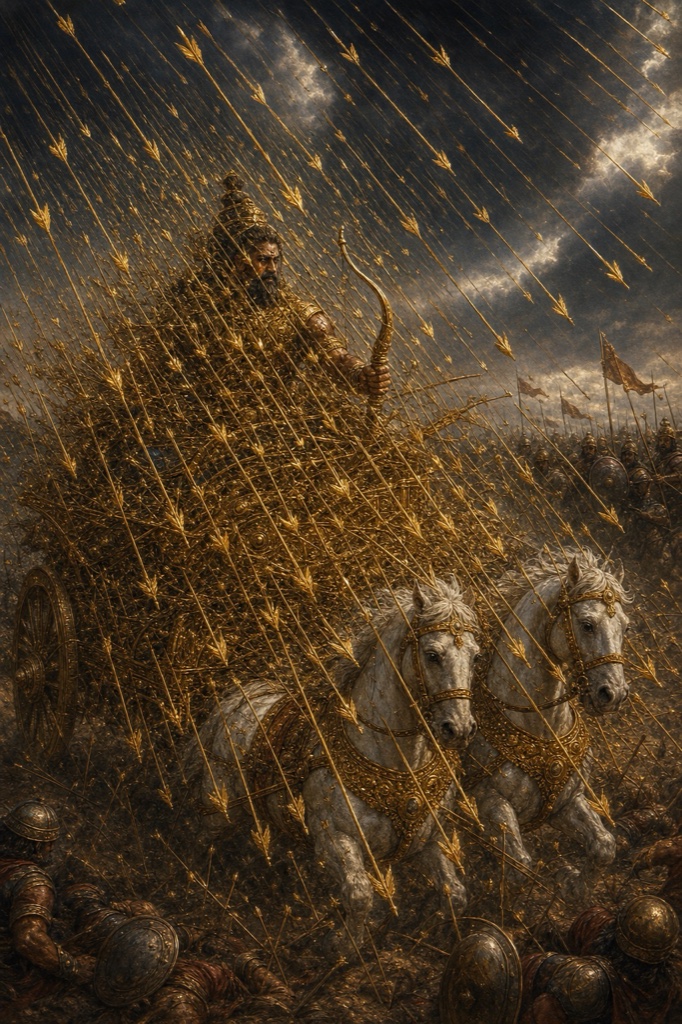
The two stood face to face, burning, neither able to overcome the other, and covered each other with arrows. Bharadvaja’s son, angry now, drew his great unconquered bow, plated with gold along the back, and hit Phalguna. He sent so many whetted arrows at the chariot, each as bright as the sun, that the sun’s own light was shut out, and he struck Pritha’s son hard and often with keen shafts, as clouds beat on a mountain. Arjuna took up the Gandiva, that destroyer of enemies, which can bear any strain, and gladly loosed countless arrows of many kinds, trimmed with gold. In a moment his shafts had made Drona’s shower come to nothing, and the men watching marveled again. Arjuna ranged about on his chariot and showed his weapons on every side at once. The whole sky, roofed with his arrows, became one wide shade, and Drona was lost to sight like the sun in mist. With those fine arrows closing him in on every side he looked like a mountain on fire.
Drona saw his chariot wholly covered. He bent his terrible bow, whose voice was the voice of the clouds, drew it until it was a ring of fire, and loosed a cloud of keen arrows, and a noise went over the field like bamboo splitting in a blaze. His gold-winged shafts covered every side and shut out the sun in their turn. Smooth at the joints and winged with gold, they looked like flights of birds, and as they left his bow they touched wing to wing, so that they seemed one endless line across the sky. The two of them, shooting gold-decked arrows, seemed to be covering the heavens with showers of meteors, and their kanka-feathered shafts looked like lines of cranes crossing an autumn sky. They shot at each other from bows drawn to the full, like two elephants going at each other with their tusks. Angry as they were, they kept strictly to the rules of fighting, and they brought out the heavenly weapons in due order. Arjuna met the teacher’s whetted arrows with his own and filled the sky with shafts of many kinds for all to see, and Drona, seeing him fierce and bent on striking, fought him out of affection as if in play, with smooth, straight arrows, meeting each heavenly weapon with one of his own. It was like a fight of gods and Danavas. Again and again Arjuna turned back with his own weapons the Aindra, the Vayavya and the Agneya that Drona sent, and between them they made of the sky a single spread of shade. Arjuna’s arrows fell on the enemy’s warriors with a crash like thunderbolts. Elephants, chariots and horses stood bathed in blood like kimshuka trees in flower. The ground was covered with arms still wearing their bangles, with richly dressed chariot fighters, with coats of mail patterned in gold, with fallen banners, with men killed by Partha’s arrows, and the Kuru host looked at it and was seized with panic. The two of them, with their very lives staked, fought on as Bali and Vasava once fought.
Out of the sky a voice was heard, and it praised Drona. “It is a hard thing Drona does. He is fighting Arjuna, who wears down his enemies, who is full of power and firm in his grip, who cannot be beaten in battle, who has conquered gods and Daityas both.” Drona himself was amazed at Arjuna’s unfailing aim, his training, the speed of his hand and the range of his arrows. Arjuna would not be outdone. He lifted the Gandiva and drew it now with one hand and now with the other and sent out a shower like a flight of locusts, and the watchers cried, “Excellent! Excellent!” He shot so ceaselessly that the air itself could not pass through that mass of arrows, and no one could see any gap between his taking up a shaft and his letting it go. Then he shot faster. All at once hundreds and thousands of straight arrows came down on Drona’s chariot. The Kuru army saw Drona wholly covered by the wielder of the Gandiva and cried “Oh!” and “Alas!” Indra, with the Gandharvas and Apsaras who had come there, praised the speed of Partha’s hand. And Ashvatthama, the teacher’s son, came up with a great body of chariots to hold the Pandava off. He was angry with Arjuna, and in his heart he admired what Pritha’s son had done. He rushed at him and poured arrows on him like a cloudburst. Arjuna turned his horses toward Drona’s son, and by turning he gave Drona his chance to leave the field. Drona had been wounded in that fearful meeting. His mail was gone and his banner was gone, and his fast horses carried him away.
A key to reading this (the idea): Arjuna salutes Drona before a single arrow is exchanged, and he tells him that he will not strike unless Drona strikes first. Drona, for his part, fights his pupil out of affection, as if in play. The warriors who watch say aloud that a Kshatriya’s duty is hard when it sets a man against his own teacher. When Ashvatthama attacks, Arjuna turns to meet him, and the turn leaves Drona free to go.
A fresh clash with Ashvatthama and Karna
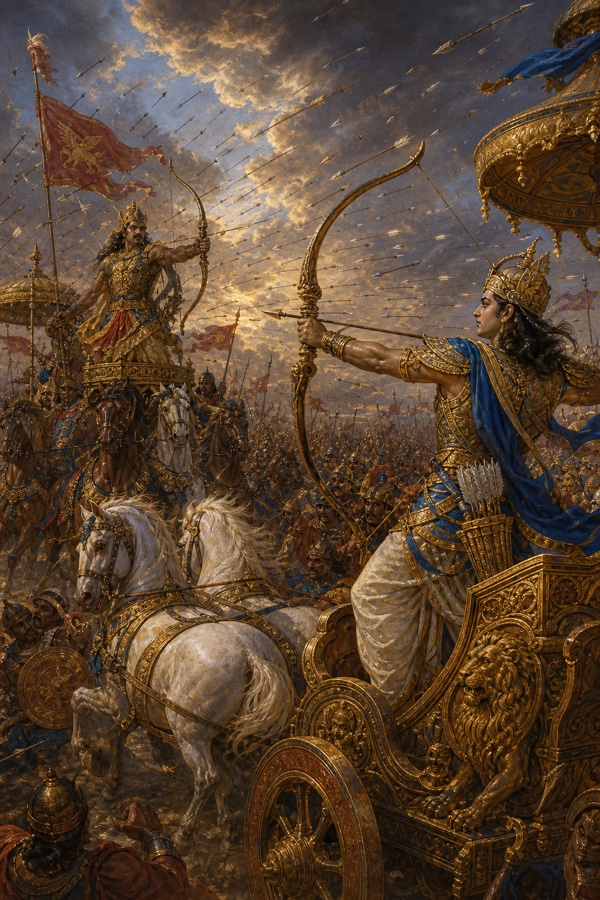
Drona’s son came on like a hurricane, shedding arrows as a rain cloud sheds water, and Arjuna received him with a cloud of his own. It was a terrible meeting, like one of the old meetings of gods and Danavas. The sky was closed in with arrows on every side, the sun was wholly hidden, and the air itself went still. Where their shafts struck together there were loud reports like bamboo bursting in a fire. Arjuna hurt Ashvatthama’s horses so badly that they lost their bearings and no longer knew which way to go. But as Pritha’s son ranged across the field, Drona’s son saw an opening, and with an arrow that had a head like a horseshoe he cut the string of the Gandiva. It was an extraordinary thing to have done. The gods praised it highly, and Drona and Bhishma, Karna and the great warrior Kripa all cried, “Well done! Well done!” Then Ashvatthama drew his fine bow and drove kanka-feathered shafts into Partha’s chest.
Arjuna laughed aloud. He fitted a fresh, strong string to the Gandiva, and he wet it with the sweat standing on his forehead, a forehead curved like the crescent moon, and went at his opponent as the leader of an elephant herd, maddened, goes at another bull. The fight those two matchless men made on that field was so fierce that the hair rose on the bodies of the watchers, and the Kurus looked on in wonder as at two great elephants. They struck at each other with arrows like snakes and like burning brands. Arjuna carried two quivers that never emptied, and so he could stand on that field as unmoved as a mountain. Ashvatthama shot without stopping, his arrows were soon spent, and that was how Arjuna got the better of him.
Then Karna drew his great bow with all his force and let the string go, and at the sound of it loud cries of “Oh!” and “Alas!” went up. Arjuna looked toward the place where that bow had sounded and saw the son of Radha in front of him. The sight filled him with rage. He wanted Karna dead, and he stared at him with his eyes rolling. The Kuru warriors saw Partha turn away from Ashvatthama, and they loosed thousands of arrows on him. He left Drona’s son where he was and went straight at Karna, his eyes red with anger, wanting a single combat, and when he was close enough he spoke.
“The time has come, Karna, to make good the loud boast you made in the assembly, that no one is your equal in a fight. Today you will meet me in a terrible battle, and you will learn what your strength is, and you will stop holding other men cheap. You forgot your breeding that day and said many harsh things, and what you are trying to do now is, I think, very hard indeed. So make it good, son of Radha. You said it in contempt of me. Make it good against me, with the Kurus looking on. You watched the princess of Panchala outraged by villains in the middle of the court. Take the fruit of that now. I was held by the bonds of what is right in those days, and I kept my hands from revenge. See today, in the fight that is on us, what that anger has ripened into. We bore great misery in the forest, wicked man, for twelve full years. Today you will have the fruit of a vengeance stored up through all of them. Come, Karna. Fight me, and let your Kaurava warriors watch.”
“Do in deed what you say in words, Partha,” Karna answered. “The world knows that your words run ahead of your deeds. If you held back in those days, it was because you could do nothing. Let us see this strength of yours now, and then we may grant that it is real. You say the bonds of what is right held you then. Truly they hold you just as fast today, though you think yourself free. And by your own account you have passed your exile in the forest exactly as you pledged, and a life of austerities has worn you down. How can you want a fight with me now? If Shakra himself came to fight at your side, son of Pritha, I would feel no anxiety about putting out my strength. Your wish is about to be granted, son of Kunti. Fight me now, and see what I can do.”
“A little while ago, son of Radha, you ran from a fight with me,” Arjuna said, “and that is the reason you are alive, though your younger brother is dead. Who else, having watched his younger brother killed in battle, would leave the field himself and then stand boasting among good and honest men?”
He said no more. Vibhatsu, who had never been beaten, charged and loosed a volley of shafts made to go through mail. Karna, a great chariot fighter, took that volley eagerly with a shower of his own as heavy as a cloudburst, and those fierce arrows covered every side and found the horses, the arms and the leather guards of both men. Arjuna would not endure it. With one straight, sharp arrow he cut the straps of Karna’s quiver. Karna drew another arrow from that quiver and hit the Pandava in the hand, and Arjuna’s grip on the bow slackened. Then Partha cut Karna’s bow to pieces. Karna answered by throwing a dart, and Arjuna cut it down with arrows. The warriors who followed the son of Radha came at Arjuna in a crowd, and the arrows of the Gandiva sent every one of them to the house of Yama.
Vibhatsu drew the string to his ear and shot sharp, tough arrows into Karna’s horses. They fell to the ground dead. He took one more arrow, sharp and blazing and full of force, and hit Karna in the chest with it. It split his mail and went into his body. Karna’s sight darkened and his senses left him. When he came to himself the pain was great, and he left the fight and fled toward the north. Arjuna, that great chariot fighter, and Uttara with him, called insults after him as he went.
The gist: after the cattle are freed, the Kuru champions come at Arjuna one after another, and each is dealt with according to what he is. Kripa, his horses and driver dead and his chariot broken, is carried off by his own men. Drona is saluted first, fought second, and allowed to withdraw when his son attacks. Ashvatthama cuts the string of the Gandiva and then runs out of arrows. Karna, who fled once already, hears the old charge about Draupadi, loses his bow and his horses, takes an arrow through his mail, and flees again, toward the north.
The river of blood, and the battle with Bhishma
With Vikartana’s son beaten, Arjuna spoke to the son of Virata. “Take me to that division, where you see the golden palm tree on the standard. Our grandfather is waiting there, Shantanu’s son, who is like one of the gods, and he wants to meet me.” Uttara looked at that great host, thick with chariots and horses and elephants. He had arrows in him, and he was badly hurt. “I cannot drive your horses any longer,” he said. “My spirit is failing and my mind is in confusion. The weapons of the gods that you and the Kurus are using have such power in them that every direction seems to spin in front of my eyes. The stench of fat and blood and flesh has taken my senses. I look at all this and terror splits my mind in two. I never saw such a muster of horses in a battle. The slap of bowstrings on arm guards, the conches, the warriors roaring like lions, the screaming of elephants, the Gandiva going like thunder: it has stunned me until I can neither hear nor remember. I watch you draw the Gandiva into a circle again and again, like a ring of fire, and my sight gives out and my heart is torn. You look as fierce as the bearer of the Pinaka in his wrath, and when I see that, and the terrible arrows you shoot, I am filled with fear. I cannot see when you take an arrow up, or when you set it on the string, or when you let it go. It all happens in front of my eyes and I do not see it. My spirit is sinking, the earth seems to swim, and I have no strength left to hold the whip and the reins.”
“Do not be afraid,” Arjuna said. “Steady yourself. You have done wonderful things on this field too. Bless you, you are a prince, born in the famous line of the Matsyas, and it is not for you to lose heart while your enemies are being punished. Stand firm on my chariot, prince. Gather all the courage you have and hold my horses, because I am going into battle again.”
Then he told the prince what was coming. “Take me without delay to the front of Bhishma’s division. I will cut his very bowstring in this fight. You will see the weapons of the gods leave my hands today, blazing, like lightning playing in the clouds. The Kauravas will see the golden back of the Gandiva, and the whole enemy will stand arguing, ‘Which hand is he shooting with, the right or the left?’ Today I will set a dreadful river flowing toward the other world, with blood for its water, chariots for its eddies and elephants for its crocodiles. With my straight arrows I will clear the Kuru forest, whose branches are hands and feet and heads and backs and arms. One man with a bow will beat the Kuru host, and a hundred paths will open in front of me, as they open through a forest on fire. You will see their army go round and round like a wheel under my blows. I will show you how well I was trained in arrows and in weapons. Stand fast on my chariot, whether the ground is smooth or rough. My winged arrows could go through Mount Sumeru, which stands touching heaven. Long ago, at Indra’s command, I killed Paulomas and Kalakhanjas in battle by the hundred and the thousand. I had my firm grip from Indra and my lightness of hand from Brahma, and from Prajapati I learned many ways of fierce attack and defense in a crowd of enemies. On the far side of the great ocean I defeated sixty thousand chariot fighters, fierce bowmen all, who lived in Hiranyapura. Watch me now scatter the multitude of the Kurus as a storm scatters a heap of cotton. With arrows of fire I will burn the Kuru forest, whose trees are its banners, whose undergrowth is its foot soldiers, and whose beasts of prey are its chariot fighters. As the wielder of the thunderbolt throws down the Danavas, I will bring their great warriors down, alone, out of the chambers of their chariots, however hard they struggle. I have the Raudra from Rudra, the Varuna from Varuna, the Agneya from Agni, the Vayavya from the god of wind, and from Shakra the thunderbolt and others. Lions guard the forest of Dhritarashtra’s sons, and I will root it out all the same. So let your fear go, son of Virata.”
Reassured, the prince drove into the fierce array of chariots that Bhishma guarded. The son of Ganga, whose deeds were fierce, was glad to stand against the man who came to conquer heroes. Arjuna faced him and with one gold-decked arrow cut his standard off clean at the root, and it fell to the ground. At that, four strong warriors rushed the terrible bowman and ringed him round: Duhshasana, Vikarna, Duhsaha and Vivimshati, all skilled in weapons, all in fine garlands and ornaments. Duhshasana hit Virata’s son with a crescent-headed arrow and put another into Arjuna’s chest. Arjuna turned on him, cut his gold-wound bow with a sharp vulture-feathered arrow, and then hit him in the chest with five. Duhshasana left the fight and fled. Vikarna, another of Dhritarashtra’s sons, shot Arjuna with sharp, straight, vulture-feathered arrows, and in a moment Arjuna had hit him in the forehead with straight shafts, and he fell from his chariot. Duhsaha came up with Vivimshati supporting him to rescue their brother, and they covered Arjuna with a cloud of sharp arrows. He was untroubled. He hit both of them at almost the same instant with a pair of keen arrows and then killed the horses of both. With their horses dead and their bodies torn, those two sons of Dhritarashtra were taken away by warriors who had hurried up behind them on other chariots. Then the diademed son of Kunti, unbeaten, sure of his aim, struck out with his arrows on every side at once.
All the great chariot fighters of the Kurus joined together then and attacked him from every side with all the force they had. He covered every one of them with clouds of arrows as mist covers the mountains. The roaring of huge elephants and the noise of conches ran together into one great uproar. His arrows went through the bodies of elephants and horses and through coats of steel mail, and they fell in thousands. He shot so fast that he looked, in that fight, like the blazing sun at noon on an autumn day. Chariot fighters in their terror jumped down from their chariots, horsemen jumped from their horses, and the men on foot began to run in every direction. There was a loud clatter as his shafts split the armor of strong warriors, armor of steel and silver and copper. Soon the field was covered with the bodies of men who had ridden elephants and horses, torn by arrows that came hissing like snakes. Dhananjaya, bow in hand, seemed to be dancing on the battlefield. Many fled that terrible fight in dread of the Gandiva alone, which sounded like thunder. Severed heads lay strewn about in their turbans, earrings and golden necklaces, and the earth was littered with mangled trunks, with arms still gripping bows, with hands wearing their ornaments. Heads cut off by his whetted shafts kept dropping to the ground as if a shower of stones were falling from the sky. He ranged the field showing his fierceness, pouring the fire of his wrath on the sons of Dhritarashtra, and the Kuru warriors who watched him scorch their host lost heart, there in Duryodhana’s own presence, and stopped fighting.
Having put fear into that army and routed its great chariot fighters, he ranged on. And he made a dreadful river of blood run across the field, with waves on it, like the river of death that Time makes at the end of an age. The loose hair of the dead and the dying was its floating moss and straw. Bows and arrows were its boats. Flesh and the juices of animals were its mud. Coats of mail and turbans floated thick on its surface. Elephants were its alligators and chariots its rafts, and marrow and fat and blood made its currents. It was a sight to put terror into anyone who saw it. Savage beasts howled along it. Keen weapons were its crocodiles, and Rakshasas and other eaters of men haunted it from one end to the other. Strings of pearls made its ripples and fine ornaments its bubbles. Swarms of arrows were its fierce eddies, horses its tortoises, and the great chariot fighters its large islands, and it rang with the blare of conches and the beating of drums. No one could have crossed that river. And still his hands were so quick that the watchers could find no gap between his taking up an arrow, his setting it on the string, and his sending it off with a pull of the Gandiva.
It was in the middle of this slaughter of the Kurus that Bhishma, the son of Shantanu and grandsire of the Bharatas, came at Arjuna. He carried a fine bow dressed in gold and many keen arrows made to go through to the vitals and give great pain. A white umbrella was held above his head, and under it he looked like a hill at sunrise. He blew his conch and put heart into the sons of Dhritarashtra, wheeled round to the right, came down on Vibhatsu and blocked his way. The son of Kunti saw him coming and took him gladly, as a hill takes a cloud heavy with rain. Bhishma shot eight arrows into Arjuna’s flagstaff, and they hit the blazing ape and the creatures sitting at the top of the banner with him. Arjuna cut down Bhishma’s umbrella with a great sharp-edged javelin, and it dropped at once to the ground. Then, his hands as light as ever, he hit Bhishma’s flagstaff with many shafts, and after that his horses, and after that the two drivers who guarded his flanks.
Bhishma could not endure this. He knew well what the Pandava could do, and he covered him with a powerful weapon of the gods. Arjuna hurled one of the same order back and took Bhishma’s as a hill takes a deep bank of cloud. It was a fierce meeting, and the Kaurava warriors and their troops stood and watched it. Arrow struck arrow in the air between them and flashed like fireflies in the rainy season. Arjuna was shooting with the right hand and the left by turns, and the bent Gandiva looked like an unbroken ring of fire. He covered Bhishma with hundreds of keen arrows as a cloud covers a mountainside with its downpour. Bhishma broke that shower with his own arrows as a shore breaks the swelling sea, and covered Arjuna in return, and the shafts that had been cut to pieces in the air fell thick around Arjuna’s chariot. Then another flight of gold-winged arrows came pouring from that chariot through the sky like a swarm of locusts, and once more Bhishma turned it back with hundreds of whetted shafts.
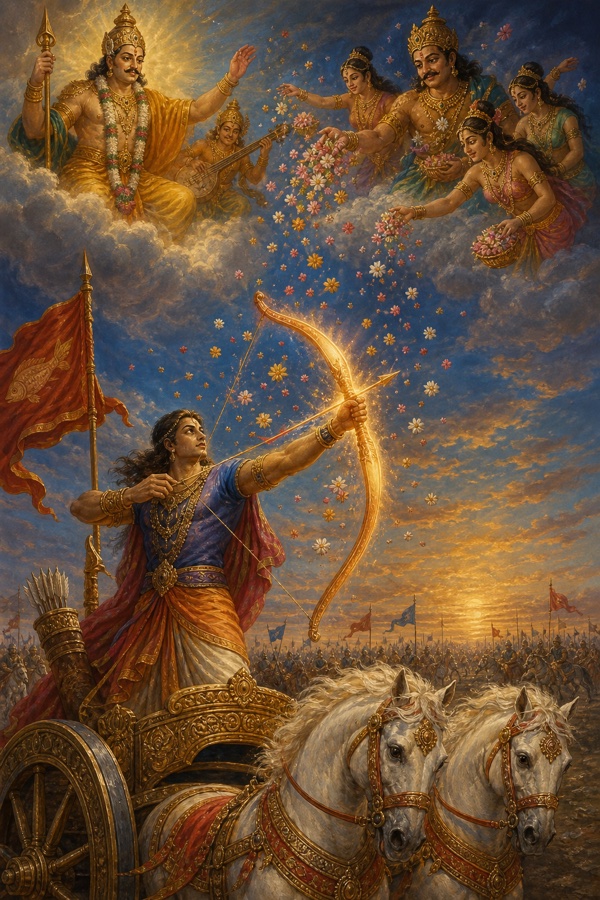
The Kauravas cried, “Excellent! Excellent! Bhishma has done a very hard thing in fighting Arjuna. Dhananjaya is strong and young, skillful and quick of hand. Who can bear the force of Partha in battle except Bhishma, the son of Shantanu, or Krishna, the son of Devaki, or the great son of Bharadvaja, the first of teachers?” The two of them met weapon with weapon and fought on as if at play, and the eyes of every creature were held by it. They ranged the field using the weapons they had from Prajapati and Indra, from Agni and fierce Rudra, from Kubera, Varuna, Yama and Vayu, and all who saw them were astonished and called out, “Well done, Partha of the long arms! Well done, Bhishma! Such a use of the weapons of the gods is hardly ever seen among men.” When the contest of those weapons was over, the contest of arrows began. Arjuna closed in and cut Bhishma’s gold-decked bow with an arrow as sharp as a razor. Bhishma had another bow up and strung almost before the first had fallen, and in his anger he showered arrows on Dhananjaya. Arjuna rained keen arrows on him, and Bhishma rained them back, and no one could have told which of the two was the better. Between them they darkened the ten directions. The brave men who guarded Bhishma’s chariot were killed and fell beside the chariot of Kunti’s son. The feathered arrows of the rider of white horses flew from the Gandiva on every side, as if he meant to leave no enemy alive, and the gold-winged shafts blazing out from his chariot looked like lines of swans in the sky. Then he hurled another weapon of the gods with great force, and all the gods who stood in the sky with Indra gazed at it in wonder. Chitrasena, the king of the Gandharvas, was delighted with it, and he spoke to the lord of the gods. “Look at Partha’s arrows, traveling through the sky in one unbroken line. The skill with which Jishnu brings that weapon forth is a wonder. Human beings cannot shoot such a weapon. It does not exist among men. And what a gathering of great and ancient weapons this is. No one can see a gap between his taking the arrows, fitting them to the string, and loosing them with a pull of the Gandiva. The soldiers cannot even look at the son of Pandu. He is like the midday sun blazing in the sky. And no one dares look at Bhishma, the son of Ganga. Both are famous for what they have done. Both are fierce in their strength. They are equals in heroism, and both are hard to defeat in battle.” Indra heard what the Gandharva said of that fight, and he honored both men with a shower of heavenly flowers.
While this was happening Bhishma struck at Arjuna’s left side, just as Arjuna, who draws the bow with either hand, was on the point of shooting him. Arjuna laughed aloud, and with a keen-edged, vulture-feathered arrow he cut the bow of Bhishma, who shone like the sun. Then he put ten shafts into Bhishma’s chest, though Bhishma was fighting with everything he had. The son of Ganga, who had never been turned back in battle, was in great pain, and for a long time he stood leaning on the pole of his chariot. The man who drove his horses saw that he had lost consciousness. He remembered what drivers are taught about protecting a warrior who has fainted, and he took him away to safety.
A key to reading this (the idea): Bhishma is shot in the chest with ten arrows, stands a long time leaning on the pole of his chariot, and is driven off the field unconscious by a charioteer who is following his instructions for a warrior in a swoon. Arjuna had promised the prince a river of blood running toward the other world before he drove at the grandsire’s division. He made that river on the way to him, and Indra, who had come with the gods to see these two meet, honored both with a shower of flowers.
The battle with Duryodhana, and the weapon of stupefaction
Bhishma had left the front of the battle. Duryodhana raised his flag high and came at Arjuna himself, bow in hand, with a great roar. Arjuna was ranging among his enemies, and the king drew a spear-headed shaft to his ear and shot him in the forehead. The arrow was keen, with a point of gold, and it stood there in his brow, so that he looked like a fair hill with a single peak. Warm blood welled from the cut and ran down his body, and on him it shone like a wreath of golden flowers.
Arjuna’s strength never failed him and his hands were quick. Swelling with rage, he took up arrows that had the force of venomous snakes in them and shot the king in return. Duryodhana attacked Arjuna and Arjuna attacked Duryodhana, two men of the house of Ajamidha striking each other blow for blow. Then Vikarna came at Arjuna on a maddened elephant as big as a mountain, with four chariots in support. Arjuna saw the huge animal coming at speed. He drew the string to his ear and sent an iron arrow, with all the force that draw could give it, into the elephant’s head between the temples. As Indra’s thunderbolt splits a mountain, the vulture-feathered shaft went into that hill of a beast up to its feathers. The lord of elephants began to tremble. Its strength left it and it sank to the ground in agony, like a mountain peak broken off by thunder. Vikarna jumped down in terror as it fell, ran back a full eight hundred paces, and climbed onto the chariot of Vivimshati.
The elephant, huge as a great hill and dark as a mass of cloud, was dead, killed by that one arrow like a thunderbolt. Arjuna hit Duryodhana in the chest with another of the same kind. Now the elephant was down and the king wounded, Vikarna had broken and fled, and the men supporting the king’s chariot had gone with him, and the rest of the warriors, under the arrows of the Gandiva, ran from the field in panic. Duryodhana saw the elephant dead and everyone else running. He swung his chariot round in haste and fled toward whatever part of the field Arjuna was not in.
Duryodhana was running fast and in fear, with that arrow in him, vomiting blood. Kiritin wanted more fighting, and he was a man who could stand against any enemy, and his anger went after Duryodhana in words. “Why are you running with your back turned, throwing away your great name and your glory? Why are the trumpets silent now? They sounded loudly enough when you marched out of your kingdom. Look at me. I do what Yudhishthira tells me. I am the third son of Pritha, and I am standing here ready to fight. Turn back, son of Dhritarashtra. Show me your face, and remember how kings behave. They named you Duryodhana, and from this day that name means nothing. You leave the battle and run. Where is your staying power in a fight? I see no guard in front of you, Duryodhana, and none behind. Run then, and save that life you love so much from the hands of Pandu’s son.”
The summons stung. Dhritarashtra’s son turned back like a great maddened elephant pricked by the hook. He could not bear those taunts, and that fast, brave chariot fighter brought his chariot round like a snake that has been trodden on. Karna, with a golden necklace on his chest, saw the king coming back wounded and stopped him on the way. He soothed him, and then he himself moved up along the north side of Duryodhana’s chariot to meet Partha. Bhishma, the son of Shantanu, turned his horses as well, huge tawny animals decked with gold, and hurried up bow in hand to guard Duryodhana from Arjuna. Drona came back too, and Kripa, Vivimshati, Duhshasana and others, all turning quickly and rushing forward with bows drawn and arrows on the string to protect the king.
Arjuna watched those divisions roll toward him like the swelling surges of the ocean, and he went at them fast, as a crane flies at a cloud that is coming down. They had the weapons of the gods in their hands. They ringed him completely and rained shafts on him from every side, as clouds pour heavy rain on a mountainside. He turned every weapon of those Kuru champions aside with weapons of his own. Then the wielder of the Gandiva brought out another, one that nothing could resist. He had it from Indra, and it was called Sanmohana. He covered every direction with sharp, keen, finely feathered arrows, and with the twang of the Gandiva he took away their senses. Once more he lifted the great loud conch in both hands and blew with all his strength, and the sound filled every quarter of the sky and the whole of the earth.
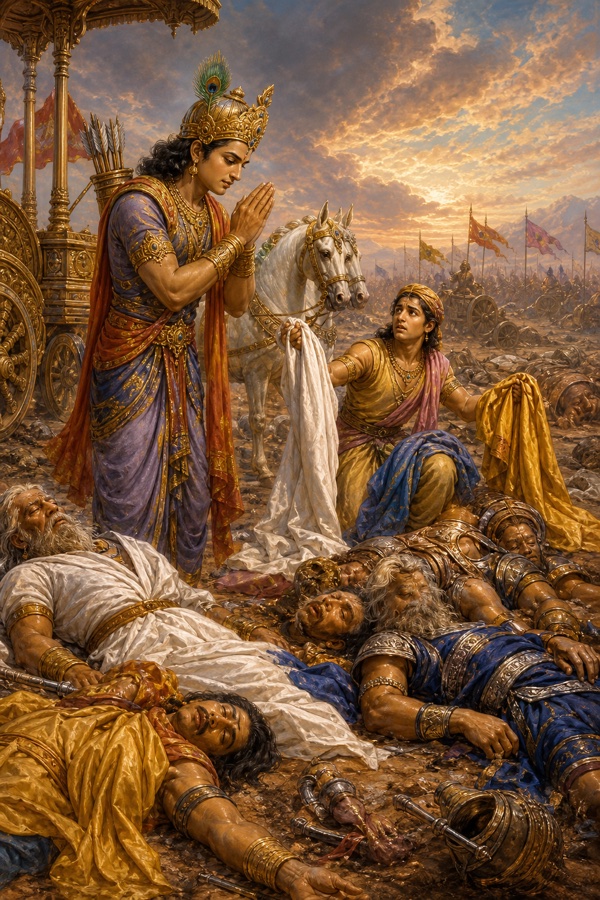
At the sound of that conch the Kuru champions lost their senses, every one. They stood still. Their bows, which never left their hands, slipped from their fingers and fell. Arjuna looked at an army that no longer knew where it was, and he remembered what Uttara, the king’s daughter, and her girls had asked of him as the chariot left the city: fine cloth for their dolls, once the Kurus were beaten. He spoke to her brother. “Go in among the Kurus while they are still senseless and bring out the white garments of Drona and Kripa, the fine yellow ones of Karna, and the blue ones of the king and of Drona’s son. I do not think Bhishma is stunned. He knows how to counter this weapon of mine. So go by him with his horses on your left, because that is how to pass those who still have their wits.”
The prince dropped the reins and jumped down from the chariot. He stripped the garments from those warriors and came back to his place. Then he urged on the four handsome horses with the golden armor on their flanks, and the white team carried Arjuna out of the middle of the battlefield, past the ranks of foot soldiers holding their standards. Bhishma saw him going and hit him with arrows. Arjuna killed Bhishma’s horses and put ten shafts into him. He killed Bhishma’s driver and left the grandsire where he was on the field. Then, with his beautiful bow in his hand, he came out of that mass of chariots like the sun coming out of cloud.
Duryodhana came to his senses and saw the son of Pritha standing by himself on the battlefield like the lord of the gods. He turned on Bhishma in a hurry. “How did this man get away from you? Press him, so that he does not escape.” Bhishma smiled. “Where was this good sense of yours, and where was your courage, while you stood there unconscious with your arrows and your fine bow dropped on the ground? Vibhatsu is no doer of atrocious deeds. His heart has no leaning toward sin, and he would not give up his principles for the three worlds. That is the only reason every one of us was not killed in this battle. Go back to the city of the Kurus, first of the Kuru heroes, and let Partha go his way with the cattle he has won. Never throw away your own good out of folly. A man should do what leads to his welfare.”
A key to reading this (the idea): the Sanmohana, which Arjuna had from Indra, leaves an army standing senseless with its bows on the ground. He sends the prince in among those men for their clothes, and he takes no life. Bhishma, whom the weapon did not touch, gives Duryodhana the reason: Vibhatsu does no atrocious deed and would not give up his principles for the three worlds. The garments are for the prince’s sister. The princess Uttara and her girls had asked Brihannala to bring back fine cloth for their dolls, and afterward he puts those garments into her hands himself.
The Kauravas turn home, and the sign of the reveal to come
The grandsire’s words were for his good, and Duryodhana listened to them. He was still angry. But his eagerness for battle had gone out of him, and he drew a deep breath and said nothing. The other warriors judged Bhishma’s advice sound. They could see the Pandava growing stronger, they wanted the king kept safe, and they made up their minds to go home. Arjuna watched those Kuru champions start for their city. His heart was light, and he followed them for a little way, because he wished to speak to his elders and do them honor.
He paid his worship to the old grandsire, the son of Shantanu, and to his teacher Drona. He saluted Drona’s son, and Kripa, and the others among the Kurus to whom reverence was owed, and he did it with beautiful arrows. Then, with one arrow more, he broke Duryodhana’s jeweled crown to pieces. When every elder and every brave man had been greeted in this fashion, he filled the three worlds with the twang of the Gandiva, and without warning he blew Devadatta, and the sound went through the heart of every enemy he had. He had humbled them all, and he stood shining on his chariot under its handsome flag. As the Kurus drew off, Kiritin spoke cheerfully to the son of the Matsya king. “Turn the horses. Your cattle are won back and the enemy is leaving. Go home to your city with a glad heart.” The gods had seen that most wonderful fight between Phalguna and the Kurus, and they were delighted with it. They went away, each to his own place, thinking over what Partha had done.
So the man with eyes like a bull’s defeated the Kurus in battle and brought back the great cattle wealth of Virata. While the sons of Dhritarashtra were going off in their rout, a large number of Kuru soldiers came out of the deep forest and walked slowly up to him, afraid. They stood before him with their palms joined and their hair hanging loose. They were worn out with hunger and thirst, they were in a foreign country, and terror had left them dazed and confused. They all bowed to the son of Pritha and said, “We are your slaves.” “You are welcome. Bless you,” Arjuna said. “Go your way. You have nothing to fear. I do not take the lives of men in distress. You have my promise of protection.” The soldiers gathered there heard that promise and answered with blessings. They praised his deeds and his fame and wished him a long life. And as he moved off toward Virata’s city with his enemies routed, like an elephant in the season when its temples run, no Kaurava was able to face him.
He had scattered the whole Kuru army as a violent wind scatters clouds. Now he spoke to the Matsya prince with courtesy. “Child, you alone know that the sons of Pritha are all living in your father’s house. Do not praise them when you enter the city, or the king of the Matsyas may hide himself in fear. Go in and tell your father that the deed was yours. Say to him, ‘I defeated the army of the Kurus, and I recovered the cattle from the enemy.’” “What you did is beyond me,” Uttara said. “I have no such power in me. But I will not make you known to my father, Savyasachin, until you tell me that I may.”
With the enemy army beaten and every head of cattle taken back from the Kurus, Arjuna returned to the burning ground and came once more to the shami tree. He stood there with his body torn by enemy arrows. Then the terrible ape, blazing like fire, rose into the sky with the other creatures of the flagstaff. The illusion that Vishvakarma made melted away, and the prince’s own banner with its lion was set up on the chariot again. The arrows and quivers of the Pandava princes went back to their place, and with them that other weapon, the Gandiva, which makes any battle fiercer. The two of them, the Matsya prince and the Bharata prince, glad of their victory, took up the ornaments and robes they had left at the foot of the tree, put them on, and loaded the rest on the chariot. Arjuna bound his hair into a braid as it had been before, and he took the reins out of Uttara’s hands. He was Brihannala again, the prince’s driver, and he was content.
By then the Kauravas, routed and beaten, were on the road to Hastinapura in low spirits. On the way back Arjuna laid out the rest of the day for the prince. “The herdsmen are driving the cattle on ahead of us. Let us water the horses and bathe them, and we will go into Virata’s capital in the afternoon. Send some of the herdsmen ahead at once. Let them take the good news to the city and proclaim your victory.” Uttara did as he was asked and gave the messengers their orders quickly. “Go and proclaim the king’s victory. The enemy is routed and the cattle are recovered.” And so, with the whole enemy army defeated and all its plunder taken back from the Kurus, the son of Virata rode home to his father’s city, and the driver of his chariot was Brihannala.
The gist: Duryodhana wounds Arjuna in the forehead, is shot in the chest, runs, and is shamed into turning back. When the whole Kuru command closes round to protect him, Arjuna brings out the Sanmohana, and they stand senseless while the prince collects their garments. Bhishma, who was not stunned, tells the king why they are all alive and sends him home. Arjuna salutes his elders with arrows, breaks Duryodhana’s crown, spares the soldiers who come out of the forest, hides his weapons in the tree again and takes back the reins. Only the prince knows who won the battle, and he has promised to keep silent before his father until Arjuna gives him leave.
Virata comes home, and the blow of the die
Virata reached his capital ahead of that news. He had beaten the Trigartas, he had every animal they had driven off, and he rode in glowing with it, and beside him rode Kanka, Ballava and the two keepers of his horses and his cattle, four men whose names he believed he knew. The Brahmins and the townspeople were waiting. He took their homage from the throne, returned the greeting of each company in turn, and sent them home pleased. Then he looked about the hall for his son and asked where Uttara had gone.
The women of the inner apartments answered him, and they were still bright with it. The Kurus had carried off the herds while the army was away. Bhuminjaya had been so angry, and so sure of himself, that he had gone out alone against the six great chariot warriors who had come with the Kuru host, Bhishma the son of Shantanu, Kripa, Karna, Duryodhana, Drona and Drona’s son, and the one companion he took was Brihannala, to drive for him.
The king heard that his boy had gone out in a single chariot with the dancing teacher at the reins, and the gladness drained out of him. He turned to his counselors. “The Kauravas and the kings who ride with them will hear that the Trigartas are beaten, and after that they will never hold their ground. Every man of mine who came through the Trigarta fight unwounded is to go out now, in strength, and bring Uttara in.” Horses, elephants, chariots and foot soldiers went out at once, armed and in their trappings, a whole division of the four arms, and as they went he gave them their real errand. “Learn quickly whether the prince is alive. I expect he is dead. A man who has a eunuch for his charioteer is dead.”
Yudhishthira smiled at the stricken king. “If Brihannala is driving him, no enemy takes your cattle today. With that charioteer to guard him, your son could beat every king allied with the Kurus, and the gods and the Asuras and the Siddhas and the Yakshas as well if they all came at once.”
Uttara’s runners reached the city while the division was still forming up, and they brought the victory with them. The chief minister carried it to the king entire: a great victory won, the Kurus beaten, the prince on the road home. “All the cattle are recovered. The Kurus are routed. Uttara is unhurt, and so is his charioteer.” “Good fortune,” Yudhishthira said, “that the cattle are back and the Kurus have run. I find nothing strange in your son beating them. Victory is certain for a man who has Brihannala to drive him.”
Virata’s hair stood on end with joy. He gave the messengers robes and began to pour out orders. The highways were to be hung with flags. Every god and goddess was to be worshiped with flowers. Princes and fighting men, musicians, and courtesans in their jewelry were to march out and meet his son. A crier on an elephant in rut was to ride to every place where four roads met and proclaim the king’s victory. And the princess Uttara, dressed in her finest, was to go out among her maidens and her singers of praise to receive her brother. The city emptied itself onto the road. Townsmen went with auspicious things in their hands, cymbals and trumpets and conchs went ahead of them, women came out in their good robes, reciters chanted the holy hymns, and the bards and the drummers and every other kind of player walked out in a body to welcome a prince whose strength nobody had yet measured.
When the troops and the girls and the courtesans had all gone, the king settled back in the lightest of moods. “Sairandhri, fetch the dice. Kanka, let us play.” The man he called Kanka answered carefully. “We have heard it said that a man whose heart is full of joy should never sit down against a skilled gambler. You are carried away with joy today, and I would rather spare you. Your good is what I want. But if it pleases you, let the play begin.” “My slave women and my cattle, my gold and whatever else I own,” Virata said, “you could protect none of it from me today, whether I threw the dice or kept them in the box.” Kanka tried once more. “Giver of honors, what business have you with a game that carries so many evils? Gambling is full of them, and the wise man keeps away from it. You will have seen Yudhishthira the son of Pandu, or at least heard of him. He lost his wide and prosperous kingdom at dice, and his godlike brothers with it. That is why I shrink from the game. But if you like, I will play.”
So they played, and the king talked while the dice went round. “Look at it. The Kauravas, those terrible men, beaten in battle by my son.” “Why should he fail,” said Yudhishthira, “with Brihannala for his charioteer?” The king’s face changed. “You wretch of a Brahmin, you set a eunuch beside my son? Have you no sense of what may be said and what may not? You hold me cheap, that is plain. Why should my son fail to beat them all, with Bhishma and Drona at their head? For friendship’s sake I let the offense pass this once. Say it again and you will not live.”
Yudhishthira said it again. “Where Bhishma and Drona and Drona’s son stand together with the son of Vikartana and Kripa and King Duryodhana and the other great chariot warriors, or where Indra himself stands ringed by the Maruts, who besides Brihannala could meet them all and fight? No one has matched the strength of those arms, and no one will. Brihannala is the one man whose heart lifts at the sight of a terrible battle. He has beaten the gods and the Asuras and men fighting all together. With such an ally, why would your son fail?” “I have forbidden you again and again,” said Virata, “and still you cannot hold your tongue. Where no one punishes, no one keeps to right conduct.” He was blazing by then, and he struck Yudhishthira full in the face with a die, hard, and shouted at him never to do it again.
The blow drew blood. It ran from Yudhishthira’s nose, and he cupped his hands under it before a drop could reach the floor. Then he looked at Draupadi, who stood at his side. She knew his wishes without being told; she had always known them. She brought a golden vessel filled with water and held it under his face, and the blood from his nose fell into the water and nowhere else.
At that hour Uttara was coming slowly through the city, perfumed and garlanded, received with honor by the townsmen and the women and the people of the outlying country. At the palace gate he sent word of his arrival to his father, and the porter went in. “Your son Uttara waits at the gate, with Brihannala for his companion.” “Bring them both in,” the king said cheerfully. “I am very eager to see them.” Yudhishthira caught the warder on his way out and spoke close to his ear. “Let Uttara come in alone. Brihannala must stay outside. That strong-armed hero has sworn that any man who wounds me or draws my blood anywhere except in battle shall lose his life. He will never bear to see me bleeding. He would kill Virata this moment, counselors and troops and horses together.”
The prince gives the victory away
Bhuminjaya came in alone, the king’s eldest son, and he bowed to his father’s feet and went across to greet Kanka. Kanka was sitting on the ground at the far end of the court with blood on him, and the Sairandhri was tending him. The prince turned on his father in a hurry. “Who struck this man? Who has done a thing so wicked?”
“I struck him,” Virata said. “This crooked Brahmin had worse coming to him. I was praising you, and he praised that creature of the third sex.” “You have done wrong,” said Uttara. “Make your peace with him quickly, before the poison of a Brahmin’s curse eats you down to the root.” The king heard his son, and he went to soothe the son of Kunti, who sat there like a fire banked under ash, and asked to be forgiven. Yudhishthira answered the man who had struck him. “I forgave it long ago. There is no anger in me. Had this blood from my nose fallen on the ground, you would have been destroyed, and your kingdom with you. I lay no blame on you for striking a man who had done nothing. Those who hold power generally act with a harshness that has no reason in it.”
When the bleeding had stopped, Brihannala came into the council room, saluted Virata and Kanka both, and stood to one side without a word. The king had appeased the chief of the Kurus, and now, in Savyasachin’s hearing, he began to praise the son who had come back from the battle. “Joy of the Kekaya princess, in you I have a son at last. I never had one your equal, and I never shall. How did you face Karna, child, who leaves no mark untouched among a thousand he aims at all at once? How did you face Bhishma, who has no match in the whole world of men? How did you face Drona, the first of all who bear weapons, the teacher of the Vrishnis and the Kauravas, the Brahmin who may be called the master of every Kshatriya alive? How did you meet Ashvatthama in battle, whose fame everyone knows? How did you face Duryodhana, a prince whose arrows could split a mountain? My enemies are thrashed. There is a sweet wind blowing round me. You took back in battle everything of mine the Kurus had seized, and I can only think those mighty men panicked. You routed them, bull among men, and you snatched my cattle out of their hands the way a man snatches its kill from a tiger.”
Uttara had promised to keep a secret, and he kept it, and he gave the glory away in the same breath. “I recovered no cattle, father, and I beat no enemy. Everything was done by the son of a god. He strikes like a thunderbolt, that young man of heavenly birth. He saw me running away in terror, and he stopped me, and he climbed onto my chariot himself. It was he who won back the herds and beat the Kauravas. The deed belongs to that hero. My hands only held the reins. He drove off Kripa and Drona and Drona’s son, for all their power, and the son of the charioteer and Bhishma, with his arrows. Then he called out to Duryodhana, who was running from him the way the leader of an elephant herd runs. ‘Prince of the Kuru line, I see no safety for you anywhere, even at Hastinapura. Put out your strength and save your life. You will never escape me by flight, so make up your mind to fight. If you win, the lordship of the earth is yours. If you fall, heaven is.’”
“Duryodhana turned back,” the prince went on, “sighing on his chariot like a snake, with his counselors round him, and he poured arrows with the speed and weight of thunderbolts. My thighs were shaking as I watched it. Then that heavenly young man shot his way through the Kuru army, which was made of warriors like lions, and when he had broken that crowd of chariots and left them helpless he laughed at them and stripped them of their clothes and ornaments. The six great chariot warriors of the Kurus were beaten by that one man, as herds grazing in a forest are scattered by a single tiger in a rage.”
“Where is he?” Virata said. “Where is this famous young man of heavenly birth, with the arms of a hero, who won back my wealth from the Kurus? I want to see him and worship him. He saved you, and my cattle too.” “The mighty son of the god vanished where he stood,” Uttara said. “I think he will show himself tomorrow, or the day after.”
So Virata heard the son of Pandu described to him and went on knowing nothing, with the man himself living under his roof in disguise. And Partha, with the king’s leave, carried the garments he had brought from the field to the king’s daughter and presented them to her with his own hands. The beautiful princess Uttara took those new and costly clothes of every kind and was delighted with them, and her brother, the son of the Matsya king, was delighted with her.
The third day: five on the thrones of kings
On the third day the five brothers bathed, put on white robes and every ornament they owned, and walked in through the palace gate together, with Yudhishthira at their head, like five elephants in rut. Their vow was complete. They crossed Virata’s council hall and sat down on the thrones that were kept there for kings, and they shone on those seats like the fires on a sacrificial altar. The king came in to hold his council and attend to the day’s business and saw them blazing there, and for a moment he only looked. Then the anger took him. He spoke to Kanka, who sat among the others like a god among gods, like the lord of the celestials ringed by the Maruts. “You were a dice player. I took you on as a courtier. How do you come to be sitting on a royal seat, dressed up in handsome robes and jewels?”
Arjuna heard him, and because he felt like teasing the king a little, he answered with a smile. “This man could share a seat with Indra himself. He is devoted to the Brahmins and he knows the Vedas. He is indifferent to luxury and to the pleasures of the body. He performs the sacrifices and he keeps his vows, and he is righteousness given a body. His energy puts him first among men, and his intelligence puts him above everyone on earth. He is given to austerities, and he knows weapons of every kind. No creature of the three worlds, moving or still, has such a knowledge of arms or ever will, and there is no one like him among gods or Asuras or men, among Rakshasas or Gandharvas, among the chiefs of the Yakshas, the Kinnaras or the great serpents. He is farsighted and full of fire, the townsmen and the country people love him, and he is the greatest chariot warrior among the sons of Pandu. He sacrifices, he keeps the law, he has mastered his passions, and like a great rishi this royal sage is famous through all the worlds. He is strong and wise, able and truthful, and every one of his senses is under his hand. He is Indra’s equal in wealth and Kubera’s in hoarding it, and he protects the worlds as Manu did in his great strength. He is kind to every living thing. He is the bull of the Kuru race, King Yudhishthira the just.”
“The deeds of this king are like the sun in full blaze,” Arjuna went on, “and his fame has gone out in every direction like the sun’s rays. When he lived among the Kurus, ten thousand swift elephants followed him as the rays follow the risen sun, and thirty thousand chariots, worked with gold and drawn by the finest horses. Eight hundred bards wearing earrings of shining gems, with minstrels beside them, sang his praises in those days as the rishis sing Indra’s. The Kauravas and the other lords of the earth waited on him as slaves wait on a master, as the gods wait on Kubera. This king, bright as the sun, made every ruler on earth pay him tribute the way farmers pay it, and eighty-eight thousand Snatakas, men of high soul who had finished their study, lived on his bounty while he kept his hard vows. He protected the aged and the helpless, the maimed and the blind, as if they were his sons, and he ruled his people by the law. He is steady in righteousness and in self-command, he can hold his anger down, he gives freely, he is devoted to the Brahmins, and he speaks the truth. This is the son of Pandu. His prosperity and his prowess are a torment to King Suyodhana and all his party, Karna and the son of Subala among them. His virtues cannot be counted, lord of men. He keeps the law and he does no injury. Tell me, does a man like this, this bull among kings, this son of Pandu, deserve a royal seat or does he not?”
“If this is truly the Kuru king Yudhishthira, Kunti’s son,” Virata said slowly, “then which of these is his brother Arjuna, and which is the mighty Bhima? Which is Nakula, and which Sahadeva, and where is the famous Draupadi? Since their defeat at dice, no one has had word of the sons of Pritha.”
“This one, whom you call Ballava and who is your cook,” Arjuna said, “is Bhima of the mighty arms, terrible in his strength and furious when he moves. It was he who killed the savage Rakshasas on the slopes of Gandhamadana and brought Krishnaa the heavenly flowers with the wonderful scent. He is the Gandharva who killed the wicked Kichaka, and it was he who killed the tigers and bears and boars in the inner courts of your palace. The man who kept your horses is the destroyer of enemies called Nakula, and this one, who kept your cattle, is Sahadeva. Both are sons of Madri, great chariot warriors, famous and handsome, and these two bulls of the Bharata line, in their fine robes and ornaments, are a match for a thousand great warriors each. And this lady with eyes like lotus petals and a slender waist and a sweet smile is Drupada’s daughter, your wife’s Sairandhri, for whose sake the Kichakas died. I am Arjuna. You will have heard of him. I am the son of Pritha who is Bhima’s junior and the elder of the twins. We have passed the year of hiding happily in your house, like infants in the womb.”
When Arjuna had pointed out the five, the son of Virata told who they were a second time, by their looks, as though his father might still doubt it. “That one with the complexion of pure gold, built like a grown lion, with the prominent nose and the large wide eyes and the broad coppery face, is the king of the Kurus. That one who walks like an elephant in rut, colored like heated gold, with the broad shoulders and the long thick arms, is Vrikodara. The dark young man beside him, built like the leader of an elephant herd, with a lion’s shoulders and an elephant’s tread and eyes as wide as lotus leaves, is Arjuna, the first of bowmen. Close by the king are those two foremost men, the twins, like Vishnu and Indra, who have no equals among men for beauty or strength or bearing. And near them stands Krishnaa, lovely as gold, light itself in a woman’s form, with the color of the blue lotus, like a girl of heaven, like Lakshmi herself come to stand in this hall.”
Then the prince told Arjuna’s deeds. “This is the man who destroyed the enemy the way a lion destroys a herd of deer. He went through crowds of hostile chariots killing the best men on them. He killed a huge elephant in rut with a single arrow, and that great beast with its flanks armored in gold went down with its tusks driven into the earth. He won back the cattle and he beat the Kauravas in battle. His conch deafened my ears. It was this hero of terrible deeds who beat Bhishma and Drona, and Duryodhana with them. Everything was his. My hands did nothing except hold the reins.”
A daughter-in-law for the house of Pandu, and the wedding at Upaplavya
The king of the Matsyas heard his son out, and the memory of the die in his hand sat heavy on him. He had struck Yudhishthira. He turned to Uttara. “I think the hour has come for me to make my peace with the sons of Pandu. If it pleases you, I will give your sister Uttara to Arjuna.” “They deserve our worship and our honor and our respect,” Uttara said, “and the hour for worshiping the illustrious sons of Pandu has come.” “When the enemy took me captive in the field,” Virata said, “it was Bhimasena who rescued me. My cattle were won back by Arjuna. We owe the victory to the strength of their arms. So all of us, with our counselors, will make our peace with Yudhishthira the son of Kunti.” Then he spoke across the hall to the five. “Blessings on you, bull among the sons of Pandu, and on all your brothers. If we have said or done anything in ignorance that gave you offense, you should forgive us. The son of Pandu is righteous.”
He went up to Yudhishthira, glad through and through, and made alliance with him, and he offered the whole of his kingdom, the scepter, the treasury and the capital with it. He turned to each of the Pandavas, and to Dhananjaya most of all, and said again and again, “What good fortune, that I see you.” He embraced Yudhishthira and Bhima and the sons of Madri over and over, and smelled their heads, and could not look at them enough. “What good fortune, that I see you safe out of the woods,” he said to Yudhishthira. “What good fortune, that you have come through the hard term of your exile without those wicked men discovering you. I make over my entire kingdom to the sons of Pritha, and everything else I have. Let the sons of Pandu take it without a moment’s hesitation. And let Dhananjaya, who is also called Savyasachin, take the hand of my daughter Uttara. That best of men is fit to be her lord.”
Yudhishthira said nothing; he looked at Arjuna. And Arjuna, with his brother’s eyes on him, answered the Matsya king. “I accept your daughter as my daughter-in-law. An alliance of this kind between the Matsyas and the Bharatas is very much to be desired.” “Why will you not take her as your wife, best of the Pandavas,” Virata said, “this daughter of mine whom I give you?”
“I lived in your inner apartments,” Arjuna said, “and I saw your daughter every day, alone or in company, and she trusted me as she would trust her father. I taught her singing and dancing, she was fond of me and thought well of me, and she looked on me as her protector. I spent a whole year with her, and she was a grown girl. In such circumstances you yourself, or other men, might harbor suspicions against her or against me, with no reason at all. So I, who am pure and have my senses in hand, ask you for your daughter as my daughter-in-law. In that way I bear witness to her purity. There is no difference between a daughter-in-law and a daughter, as there is none between a son and one’s own self. If I take this course her purity stands proved. I am afraid of lies and of slander. Therefore I accept your daughter Uttara as my daughter-in-law. My son Abhimanyu, the strong-armed, is beyond everyone in his knowledge of weapons, and he is as handsome as a young god, and he is the favorite nephew of Vasudeva, the wielder of the discus. He is fit to be your son-in-law and your daughter’s husband.”
“It is right that Dhananjaya the son of Kunti should speak like this,” Virata said, “the best of the Kurus, so righteous and so wise. Do what you think should follow from it, son of Pritha. The man who has Arjuna for the father of his son-in-law has every wish he ever had.” Yudhishthira gave his assent to what the Matsya king and Arjuna had agreed between them, and the son of Kunti sent invitations to Vasudeva and to all his friends and kinsmen, and Virata sent his.
A key to reading this (the idea): Abhimanyu is Arjuna’s son by Subhadra, who is Krishna’s sister; that is why Arjuna names him as Vasudeva’s favorite nephew, and why a wedding at Virata’s court draws the Yadavas and their armies to the Matsya country. Arjuna’s argument turns on a rule of the household: a daughter-in-law stands to a man exactly as a daughter does. By asking for the girl in that name he puts the whole year he spent in her apartments beyond anyone’s suspicion, hers and his own.
The thirteenth year was over. The five Pandavas took up residence in one of Virata’s towns, a place called Upaplavya, and Arjuna went to the Anarta country and brought back Abhimanyu and Janardana and a great many of the Dasharha people with them. The king of Kashi and Shaibya, both close friends of Yudhishthira, arrived with an akshauhini of troops apiece. The mighty Drupada came with the heroic sons of Draupadi, with Shikhandi whom no one had ever beaten, and with Dhrishtadyumna, the first of all who bear arms, whom no one could defeat, and he brought another akshauhini. Every king who came was lord of an akshauhini, and every one of them was a performer of sacrifices who gave to Brahmins without stint, learned in the Vedas, brave, and ready to die in battle. The king of the Matsyas, the first of righteous men, received them with every honor and entertained their troops and their servants and their beasts of burden, and he was glad in his heart to be giving his daughter to Abhimanyu.
When the kings had gathered from their several countries, Krishna arrived, garlanded with flowers, with Balarama who fights with the plow, Kritavarma the son of Hridika, Yuyudhana, Anadhrishti and Akrura, Samba and Nishatha, and those tamers of enemies brought Abhimanyu and his mother with them. Indrasena and the others who had spent the whole year at Dwaraka came too, bringing the Pandavas’ own chariots, splendidly fitted out. Ten thousand elephants came in Krishna’s train, ten thousand chariots, horses and foot soldiers in numbers that nobody troubled to count, and the Vrishni and Andhaka and Bhoja warriors past numbering, men of great energy, all following that tiger of the Vrishnis in his splendor. Krishna gave each of the illustrious sons of Pandu slave women in plenty, and gems, and robes.
Then the wedding festival began between the house of the Matsya king and the house of Pandu. Conchs and cymbals, horns and drums and every instrument the Pandavas had appointed sounded through Virata’s palace. Deer of many kinds and clean animals were killed by the hundred, and wines of many kinds and the heady juices of trees were gathered in abundance. Mimes and bards and panegyrists, skilled in song and in the old lore, waited on the kings and chanted their praises and their lineages. The matrons of the Matsyas, well formed, wearing earrings of pearls and gems, came to the place where the knot was to be tied, and Sudeshna led them. Among all those fair women in their fine ornaments, Krishnaa was the first in beauty and in fame and in splendor. They led out the princess Uttara, decked in every ornament, who looked like the daughter of great Indra himself, and Dhananjaya the son of Kunti accepted Virata’s daughter of the faultless limbs on behalf of his son by Subhadra. The great king Yudhishthira, standing there like Indra, accepted her as his daughter-in-law. Then, with Janardana before him, the son of Pritha had the marriage rites performed for Subhadra’s illustrious son.
Virata gave as her dowry seven thousand horses swift as the wind, two hundred elephants of the best kind, and a great deal of wealth besides. He poured the libations of clarified butter on the blazing fire, paid his homage to the Brahmins, and offered the Pandavas his kingdom, his army, his treasury and himself. When the marriage was done, Yudhishthira the son of Dharma gave away to the Brahmins all the wealth that Krishna of undying glory had brought. He gave cattle by the thousand, robes of every kind, fine ornaments, carriages and beds, delicious food of all sorts and choice drinks of every species. He made gifts of land to the Brahmins with the proper rites, and cattle by the thousand, and he gave horses by the thousand, and gold, and wealth of every other kind, to people of every age. The city of the Matsya king, crowded with cheerful and well-fed men, shone like one great festival. So the Virata Parva ends, and the sons of Pandu, known again to the world and allied to the Matsyas by marriage, sleep that night in a palace full of kings who have come to see a wedding and will wake to be asked a question about a kingdom.
The gist: Virata comes home from the Trigartas, learns that his son rode out alone with Brihannala, and gives him up for dead until Uttara’s runners bring the victory. Over dice he boasts of his son, Kanka twice credits the charioteer, and the king strikes him in the face with a die; Yudhishthira catches the blood in his hands and Draupadi in a golden bowl of water, and he keeps Brihannala out of the hall so that Arjuna will not see it. Uttara gives all the glory to a son of a god who vanished. On the third day the five sit on the royal thrones in white; Arjuna names each of them and Draupadi; Virata offers his kingdom and his daughter, and Arjuna takes the girl for Abhimanyu, having been her teacher for a year. The Pandavas settle at Upaplavya, the Yadavas, Drupada, Kashi and Shaibya arrive with their armies, and the wedding of Abhimanyu and Uttara closes the parva.
Source: the Mahabharata of Krishna-Dwaipayana Vyasa, Virata Parva, Go-harana and Vaivahika sub-parvas, Sections 42 to 72. The Sanskrit e-text, the Gita Press Hindi edition, and Kisari Mohan Ganguli’s complete English translation were used to verify names, sequence, and principal events. Where the recensions differ, this English retelling follows Ganguli, and the Hindi edition follows Gita Press.
Source text: the Mahabharata of Vedavyasa (Gita Press, Gorakhpur)