On this page
Twelve years in the forest were behind them. The thirteenth stood in front of them now, and its terms were the hardest part of the whole promise made to Duryodhana: for one full year the five sons of Pandu and their wife had to live among people, inside a city, without a single person learning who they were. This was the ajnatavasa, the year unknown. If even one of the six was recognized before it ran out, all of them would go back to the forest for twelve years more.
“How did my great-grandfathers get through that year in the city of Virata without being found out, with the fear of Duryodhana on them the whole time?” King Janamejaya asked. “And Draupadi, who had so much to grieve over, who was devoted to her husbands and never stopped adoring the Deity: how did she pass her days there with no one knowing her?”
“Hear how they passed it,” Vaishampayana said, and he began with the day Yudhishthira came back to the hermitage carrying the boons the god of Justice had just granted him. One of those boons was the thing the brothers needed most, a promise that they would move among men in the coming year and go unrecognized. Yudhishthira told the Brahmins of the hermitage everything that had happened, and to the Brahmin who had followed him there he gave back the churning staff and the fire-sticks the man had lost. What Vaishampayana told from that point on was the year itself: how the eldest son of Pandu took service under Virata, king of the Matsyas, with his brothers and his wife around him in disguise, and how Kichaka, the commander of Virata’s army, set his eyes on Draupadi and died for it at Bhima’s hands.
The Plan for the Year Unknown, and the Brothers’ Disguises
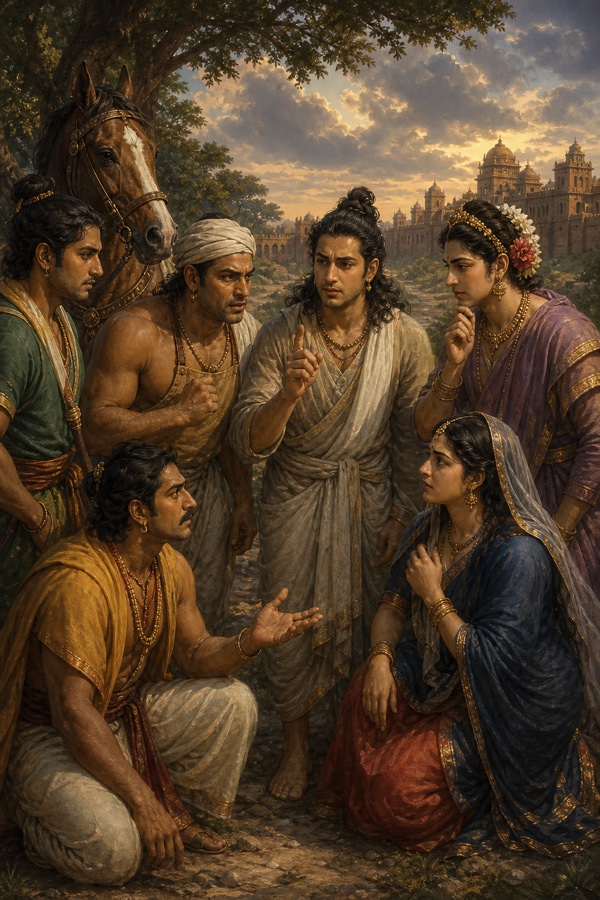
Yudhishthira, who was himself the son of that god, called his four younger brothers to sit with him. “We have been out of our kingdom for twelve years,” he said. “Now the thirteenth has come, and it is the hard one to get through. Arjuna, son of Kunti, choose us a place where we can live it out without our enemies finding us.”
“Dharma has given his word, and by it we will walk among men unknown,” Arjuna said. “Still, we have to live somewhere, so let me name some countries that are pleasant and out of the way, and you choose among them. All around the land of the Kurus lie kingdoms that are beautiful and rich in grain: Panchala, Chedi, Matsya, Shurasena, Pattachchara, Dasharna, Navarashtra, Malla, Shalva, Yugandhara, Saurashtra, Avanti, and the broad country of Kuntirashtra. Which of them do you want? Where do we spend this year?”
“It will be as you say,” Yudhishthira answered. “What the lord of all creatures has spoken has to come true. Even so, we should talk it through and settle on a place that is pleasant and lucky for us, somewhere we can live without fear. Old Virata, the king of the Matsyas, is a good man and a strong one. He gives freely, everyone likes him, and he has always been attached to the sons of Pandu. We will spend the year in his city, and we will spend it in his service.” He looked around at the four of them. “So tell me, each of you. As what will you present yourself to the king of the Matsyas?”
Arjuna turned the question on him first. “And you? What work will you take in Virata’s kingdom? You are mild, and generous, and modest, and you hold to what is right and to whatever you have promised. A calamity has come down on you, and a king has to carry trouble the way an ordinary man carries it. How will you get through this one?”
“Listen, then, to what I will do when I stand in front of King Virata,” Yudhishthira said. “I will be a Brahmin named Kanka, a man who knows dice and loves to play, and I will sit in that king’s court as one of his courtiers. I will move pawns of ivory across the boards, beautiful pieces colored blue and yellow and red and white, to the throw of black dice and red, and I will keep the king amused, and his courtiers and friends with him. While he is enjoying himself, no one will think to look at me closely. If he asks who I was before, I will say I was once the dearest friend Yudhishthira had. That is how I will pass my days there.” Then he turned to Bhima, who was also called Vrikodara. “And you? What place will you fill in Virata’s city?”
“I mean to go before the lord of the Matsyas as a cook, and my name will be Ballava,” Bhima said. “I know my way around a kitchen. I will make dishes for the king better than anything the skilled cooks before me have set in front of him, and he will be pleased with me. I will carry in loads of firewood that no one else could lift, and when the king sees that he will be pleased again, and the servants of the royal household, watching feats like those, will treat me as if I were a king myself. Everything that is eaten and drunk in that palace will pass through my hands. If I am ordered to bring strong elephants and big bulls under control, I will do it. And if fighters come to meet me in the arena, I will beat them and give the king his entertainment, though I will take the life of none of them. I will bring each man down in such a way that he gets up again. When they ask where I come from, I will say that I used to be Yudhishthira’s wrestler and his cook. That is how I will keep myself.”
A key to reading this (terms): A Sairandhri is a woman who works at a craft in another person’s house and keeps her independence. Draupadi names the class herself as one that respectable women do not join, and she will tell the queen that she stays in a place only as long as it gives her good food and clothing. Kichaka, the general of the Matsya army, is called the Suta’s son throughout, and the kinsmen who gather around his body are the Sutas. A yojana is a measure of distance, and Sahadeva will claim to know every cow within ten of them.
The Disguises of Arjuna, Nakula, Sahadeva, and Draupadi
Yudhishthira spoke next about Arjuna, and he put the question to Bhima. “And what work is there for Dhananjaya? Once, when he was staying with Krishna, the god Agni came to him in the shape of a Brahmin, wanting to burn the Khandava forest. Arjuna went to that forest and gave the Fire what it wanted, and on a single chariot he defeated and killed great Nagas and Rakshasas. He married the sister of Vasuki himself, the king of the Nagas. The sun is first among all things that give heat, the Brahmin among all that walk on two feet, the cobra among serpents, fire among things that have energy, the thunderbolt among weapons, the humped bull among cattle, the ocean among waters, the rain cloud among clouds, Ananta among the Nagas, Airavata among elephants, the son among all that a man holds dear, and the wife among all his friends. In that same way, Vrikodara, young Arjuna is first among all who draw a bow. He carries Gandiva, white horses pull his chariot, and he is the equal of Indra and of Vasudeva. He lived five years in the house of thousand-eyed Indra, and by his own effort he came away with the science of weapons no man owns, and with every weapon of the gods. I count him the tenth Rudra, the thirteenth Aditya, the ninth Vasu, the tenth of the planets. His arms are long and even, and the skin of them has been hardened by the bowstring until the scars look like the ones on the humps of bulls. He is what Himavat is among mountains, the ocean among waters, Indra among the gods, fire among the Vasus, the tiger among beasts, Garuda among birds. What work can a man like that take up?”
“I will say that I am of the third sex, neither man nor woman,” Arjuna answered. “The marks of the bowstring on my arms are hard to hide, it is true, so I will cover both scarred arms with bangles. I will wear bright rings in my ears and bracelets of conch on my wrists, and let a braid hang down from my head, and my name will be Brihannala. Living as a woman, I will keep the king and the people of the inner apartments entertained with stories. I will teach the women of Virata’s palace to sing, and to dance in the ways that please the eye, and to play instruments of many kinds, and I will tell over the great deeds of men, and behind all that I will hide. If the king asks, I will say I lived in Yudhishthira’s palace as a waiting-maid to Draupadi. Fire can be kept under ashes, and I will keep myself that way, and pass my days pleasantly enough in the house of Virata.” Having said it, he fell silent, and the king turned to another brother.
“Nakula, you are tender, you carry yourself gracefully, and you deserve every comfort there is,” Yudhishthira said. “What work will you do while we live in that king’s country? Tell me all of it.”
“I will be the keeper of King Virata’s horses, and my name will be Granthika,” Nakula said. “I know that work through and through. I am good at tending horses, at training them, and at treating them when they are sick, and the task suits me, because horses have always been as dear to me as they are to you. In my hands even colts and mares turn gentle. They never go bad under a rider or in the traces of a chariot. To anyone in Virata’s city who asks, I will say that Yudhishthira once put me in charge of his horses. The king will be pleased with me, and no one will find me out.”
Yudhishthira asked Sahadeva, the youngest, how he would carry himself before the king and what he would do to stay hidden. “I will keep King Virata’s cattle,” Sahadeva said. “I know how to milk cows, how to keep the count and the history of a herd, and how to quiet the fierce ones. I will go by the name of Tantripala and do the work deftly, so let that fever in your heart cool. You used to send me often to look after your own herds, and I know the work well. I know the nature of cattle, the lucky marks on them, and everything else about them. I can pick out the bulls with the right marks, the ones the smell of whose urine can make even the barren conceive. It is work I have always enjoyed. No one will recognize me, and the king will be glad to have me.”
Then Yudhishthira came to the sixth of them. “This is our beloved wife, dearer to us than our own lives,” he said. “She ought to be cherished by us as a mother is, and respected as an elder sister is. What work can Draupadi, the daughter of Drupada, possibly do? She knows none of the tasks that women do in a house. She is delicate and young, a princess whose name is known everywhere, devoted to her husbands and good all through. Since the day she was born she has known only garlands and perfumes, ornaments and costly clothes. How is she to live?”
“There are people called Sairandhris, who go into service in the houses of others,” Draupadi said. “Respectable women do not do it, and yet there is such a class. I will give myself out as a Sairandhri whose skill is dressing hair. If the king questions me, I will say that I served as a waiting-woman to Draupadi in Yudhishthira’s household. That is how I will pass my days in disguise. I will serve Sudeshna, the king’s wife, whose name everyone knows, and once she has me she will surely look after me. Do not grieve like this.”
“You speak well,” Yudhishthira told her. “And still, you were born in a great house. You are chaste, you have kept every vow of a good woman, and you do not know what sin is. So carry yourself in such a way that men with evil in their hearts get no pleasure from staring at you.”
A key to reading this (lineage and names): For the year of hiding Yudhishthira gave himself and his four brothers, in order of age, the private names Jaya, Jayanta, Vijaya, Jayatsena and Jayadbala, and it is by these that Draupadi will cry out for them. Their names in service are Kanka for Yudhishthira, Ballava for Bhima, Brihannala for Arjuna and Granthika for Nakula. Sahadeva promises to be Tantripala and tells the king he is a Vaishya called Arishtanemi whom people used to call Tantripala. Draupadi is the Sairandhri, and Malini, the garland-maker, is the name she says Draupadi gave her. Vrikodara is Bhima; Dhananjaya is Arjuna; Panchali and the daughter of Yajnasena are Draupadi; and Kaikeyi, when Draupadi says it, is Queen Sudeshna, the daughter of the king of Kekaya.
The Priest’s Departure, and Dhaumya’s Counsel
With the six parts settled, Yudhishthira disposed of everyone who could not come with them. “Each of you has said what work he will do, and I have said mine as well as I could think it out. Our priest is to go to the house of Drupada, with the charioteers and the cooks, and keep our Agnihotra fires alive there. Indrasena and the others are to take the empty chariots and drive quickly to Dwarka. That is my wish. And all of Draupadi’s maidservants are to go to the Panchalas along with the charioteers and cooks. Every one of them is to say the same thing: ‘We do not know where the Pandavas went. They left us at the lake of Dvaitavana.’”
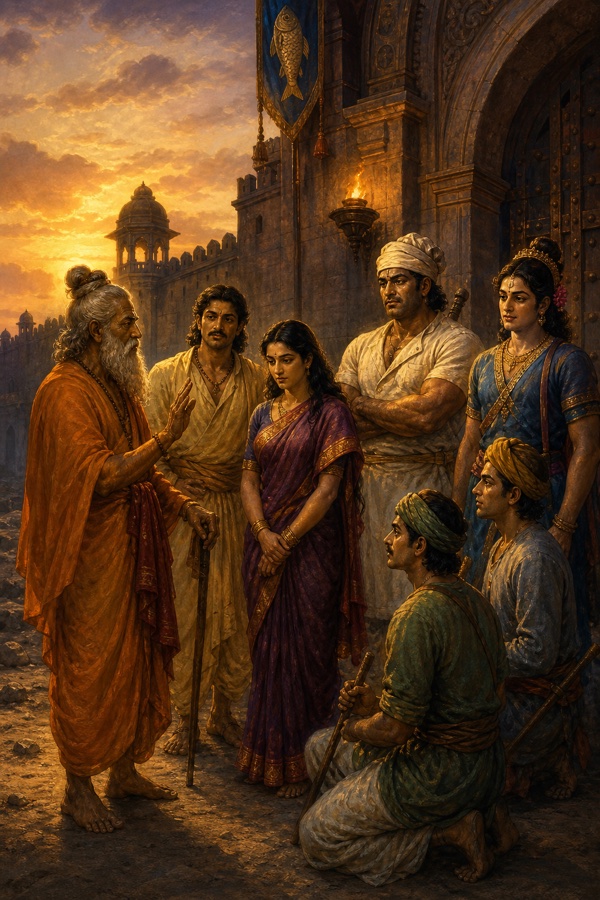
When all of it had been talked through, the Pandavas asked their priest Dhaumya for his advice, and he gave it. “Sons of Pandu, what you have arranged for the Brahmins, your friends, your chariots, your weapons and your fires is well arranged. You, Yudhishthira, and Arjuna above all, must also see to it that Draupadi is protected. You know what men are like. Even so, a friend who loves you may be allowed to repeat what you already know, so listen. Living with a king is hard. Whether you are honored there or slighted, you will have to get through this year in a king’s palace without being known by those who know you, and in the fourteenth year you will live happily. I will tell you how to live in a royal household and give no offense. A king cherishes and protects every creature, and he is a god in a body, a great fire made holy with every mantra. Go in to him only after you have been given leave at the gate. Keep away from royal secrets. Do not want a seat that another man wants. Only the man who never presumes on being a favorite, and never climbs into the king’s chariot or onto his couch, his seat, his carriage or his elephant, is fit to live in a royal household, and so is the man who avoids any seat that would set malicious people whispering if he took it. Give no advice until you are asked for it. Pay your respects at the proper times and then sit beside the king quietly and with respect, because kings take offense at men who chatter, and they disgrace counselors who lie. A wise man makes no friendship with the king’s wife, or with the people of the inner apartments, or with anyone the king is displeased with. Do even the smallest thing with the king’s knowledge, and no harm will come to you. However high the office you reach, as long as you have not been asked or ordered, think of yourself as a man born blind, out of regard for the king’s dignity. Rulers do not forgive even their sons and grandsons and brothers for trespassing on it. A king is to be served with the care that is given to Agni and the other gods, and the man who is false to his king is destroyed by him.
“Put away anger and pride and carelessness, and follow the course the king lays down. Think a matter through, and then put before him the things that are both useful and pleasant to hear; and if a thing is useful and unpleasant, tell him anyway, however badly it sits. Be on his side in everything that concerns him, and keep back whatever is both unpleasant and useless. Tell yourself always, ‘The king does not like me,’ and you will never grow careless about what pleases him and does him good. The man fit for a palace keeps to his own place, makes no friends among the king’s enemies, and never works against him. A learned man sits at the king’s right or at his left. He does not sit behind him, for that is where the armed guards stand, and to sit in front of him is forbidden always. When the king is dealing with one of his servants, let no one push himself forward ahead of the others; even in a poor man with a grievance that is inexcusable. If the king has told a lie, repeat it to no one, because kings hate those who report their falsehoods, and they have no use for men who think themselves learned. Never grow proud and say, ‘I am brave,’ or ‘I am clever.’ It is by doing what the king wishes that a man wins his good graces and the good things of life, and having won them, and wealth that is so hard to come by, he should go on doing what is useful and pleasant to the king. A king’s anger is a great obstacle and his favor bears great fruit; what sensible man would think of doing him harm? Do not work your lips or your arms or your thighs in front of him. Speak softly there, and if you must spit, do that softly too. When something is funny, do not burst out laughing like a madman, and do not hold yourself so stiff that you seem grave beyond reason. Smile modestly, to show you are following. The man who has the king’s good always in mind, who is neither lifted up by reward nor cast down by disgrace, is fit to live in a palace. A courtier who pleases the king and the king’s son with what he says stays a favorite, and a favorite who has lost favor for good cause, and still speaks no ill of the king, gets his fortune back. Praise the king in his hearing and out of it. The man who tries to force his way with a king does not keep his place long and may lose his life. Open no dealings with the king’s enemies for your own gain, and never outshine the king in anything that calls for skill and talent. Be cheerful and strong, brave and truthful, mild, master of your senses, and follow your master like his shadow. When a task is being handed out, step forward and say, ‘I will do this,’ and whether it lies inside the kingdom or beyond it, never be afraid to take it on. Far from home, do not pine for those you love, and bear the misery of the present for the sake of the happiness to come. Do not dress like the king, do not laugh loudly in his presence, do not let out his secrets. If you are sent on some business, touch no bribe, for that ends in chains or in death. And the robes and ornaments and chariots and whatever else the king is pleased to give you, use them always, because that too wins his favor. Master your minds, my children, and live this year in this way. When you have your own kingdom back, you may live as you please.”
“You have taught us well, and may you be blessed for it,” Yudhishthira said. “No one else could have said this to us except our mother Kunti and the wise Vidura. Now do whatever must be done for our setting out, so that we come safely through this trouble and win against our enemies.” Dhaumya performed the rites that are laid down for a departure. He lit their fires and poured offerings into them with mantras, for the prosperity and success of the Pandavas and for their winning back of the whole earth. The six of them walked around those fires and around the Brahmins whose wealth was their austerity, and then they set out, with Draupadi, the daughter of Yajnasena, walking in front. When they were gone, Dhaumya took up their sacred fires and left for the country of the Panchalas. Indrasena and the others went to the Yadavas, as they had been told, and there they looked after the horses and chariots of the Pandavas and lived quietly, out of sight.
The gist: The Pandavas choose the city of Virata, king of the Matsyas, for the thirteenth year. Yudhishthira will be the dice-playing Brahmin Kanka, Bhima the cook Ballava, Arjuna the dance teacher Brihannala, Nakula the horse-keeper Granthika, Sahadeva the cowherd Tantripala, and Draupadi a hair-dressing Sairandhri in the service of Queen Sudeshna. The priest, the servants, the chariots and the sacred fires are sent to Drupada’s house and to Dwarka with one story to tell, and Dhaumya teaches the six how a servant survives in a king’s house before he sends them off with the rites of departure.
Hiding the Weapons in the Shami Tree, and the Hymn to Durga
They buckled swords at their waists, pulled on finger-guards of iguana skin, took up the rest of their weapons, and walked toward the river Yamuna. For years they had lived in hills no one could reach and in the thick of the forest. Now, wanting their kingdom back and soon, they ended that life and came down to the southern bank of the river. They traveled as hunters, living on the deer they killed, and passed through Yakrilloma and Shurasena with the country of the Panchalas lying on their right hand and the country of the Dasharnas on their left. They were wan and bearded men with swords by the time they came out of the forest into the lands of Matsya, and hunters is what they called themselves to anyone who asked. Somewhere inside that country Draupadi spoke to Yudhishthira. “I see footpaths here, and fields. Virata’s city must still be a long way off. Let us stop where we are for what is left of the night. I am very tired.” Yudhishthira told Arjuna to pick her up and carry her, since the city lay just beyond the edge of the forest. Arjuna picked her up at once, as the leader of an elephant herd might have done it, and set her down again only when the city was near.
When they reached the city Yudhishthira stopped. “Where are we going to leave our weapons before we go in?” he asked Arjuna. “If we walk into that city armed, we will frighten the people in it. And everyone alive knows the great bow Gandiva. They would know us by it at once, and if even one of us is found out, we are bound by our promise to spend another twelve years in the forest.”
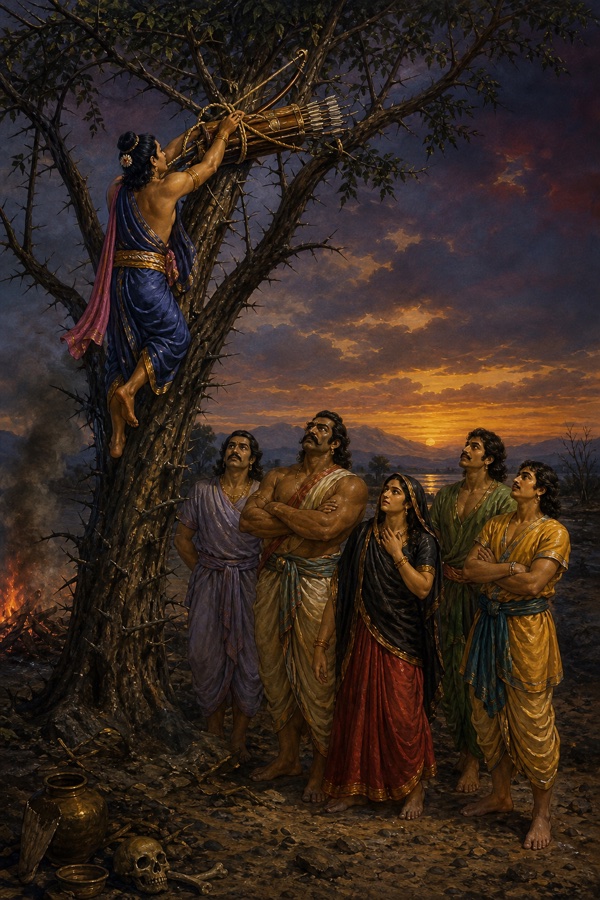
“There is a huge shami tree over there, near the burning ground and close to that peak no one can climb,” Arjuna said. “Its branches are enormous and it is hard to get up into. I do not think there is a human being anywhere near to watch us put our weapons in it. It stands in the middle of a forest that lies off every road and is full of wild animals and snakes, and it has that dismal burning ground beside it. Let us stow the weapons in the shami, go on to the city, and live there with easy minds.”
So they unstrung their bows, one after another. Arjuna loosened the string of Gandiva, the great and terrible bow whose voice was thunder, with which he had conquered gods and men and Nagas and rich provinces from a single chariot. Yudhishthira took off the string, one that never frayed, from the bow with which he had defended the field of Kurukshetra. Bhima unstrung the bow with which he had beaten the Panchalas and the lord of Sindhu, and had stood alone against enemies past counting on his march of conquest, a bow whose twang was like a thunderclap or a mountain splitting and sent men running from the field. Nakula, copper-skinned and soft-spoken, whose beauty no one else in the family could match, undid the string of the bow with which he had conquered the whole of the west, and gentle Sahadeva the string of the bow with which he had brought the countries of the south under his hand. With the bows they laid their long bright swords, their costly quivers, and their arrows sharp as razors. Nakula climbed the tree with all of it and tied it fast in the places where he judged the branches would not break and the rain would not get in. Then the Pandavas hung a corpse in the tree, knowing that anyone who caught the stench would say there was a dead body up there and keep well away. Shepherds and cowherds asked them about it. “That is our mother,” they said. “She was a hundred and eighty years old. We have hung her body in the tree because that is the custom our forefathers kept.” Yudhishthira gave himself and his brothers five names to use in secret, Jaya, Jayanta, Vijaya, Jayatsena and Jayadbala, and then they walked toward the great city to spend the thirteenth year in that kingdom unknown, as they had promised Duryodhana they would.
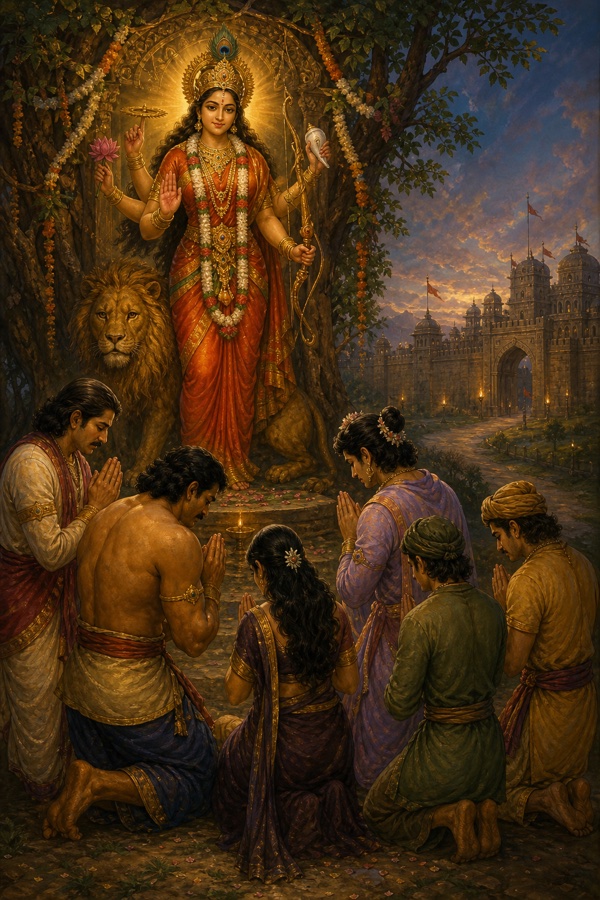
On the road to the city Yudhishthira prayed without speaking. He praised Durga, the supreme goddess of the universe, born from the womb of Yashoda in the family of the cowherd Nanda, sister of Vasudeva, the terror of Kamsa and the destroyer of Asuras, who rose into the sky when Kamsa dashed her down on a slab of stone. He wanted, and his brothers with him, to see her, and so he called on her by the names the hymns give her. “I bow to you, giver of boons, maiden, keeper of the vow of chastity, whose body is bright as the sun just risen and whose face is the full moon. You carry sword and shield, and you lift the worshiper who is sunk in his trouble as a man lifts a cow out of the mud. You are dark as the black clouds. You have a diadem and a braid, peacock plumes standing on your head, snakes for your robe and a bright girdle at your hips, so that you shine like Mount Mandara with the serpents around it. In your hands are a vessel, a lotus, a bell, a noose, a bow, a great discus. You killed Mahishasura, and for that the gods praise and worship you, so that the three worlds may be safe. You are Jaya and Vijaya, and it is you who give victory in battle. Give me victory, Goddess, and give me boons in this hour of distress. Your lasting home is on the Vindhya mountain. Kali, great Kali, lover of wine and meat and sacrifice, you go wherever you will and grant what your devotees ask, and Brahma and the other gods follow where you travel. Because you bring people through hard places, when they are lost in the wilderness or going down in the great ocean, everyone calls you Durga. You are the one refuge of men set upon by robbers, or crossing rivers and seas, or caught in the wild. You are Fame, you are Prosperity, you are Steadiness and Success. You are the Wife, and men’s Offspring, and Knowledge, and the Intellect. You are the two twilights, night and sleep, the light of the sun and of the moon, beauty, forgiveness, mercy. Worshiped, you take away chains and ignorance, the loss of children and the loss of wealth, sickness, death and fear. I have lost my kingdom, and I come to you for protection. I bow my head to you, Goddess with eyes like lotus leaves. We are keeping to the truth; be the truth that grants our prayer. Durga, kind to everyone who seeks you, protect me.”
The Goddess heard him out and then showed herself to him. She came up to the king and spoke. “Listen to me. By my grace you will defeat and destroy the ranks of the Kauravas, and victory in battle will soon be yours. You will rule the whole earth again, with every thorn cleared from it, and you and your brothers will have great happiness, and joy and health besides. Those who tell over my qualities and my deeds will be freed of their sins, and I will give them kingdom, long life, beauty and children. Those who call on me as you have done, in exile or in the city, in the middle of a battle or in danger from enemies, in forests and deserts no one can cross, on the sea or in the mountains, will find nothing in this world beyond their reach. Whoever listens to this hymn with devotion, or recites it, will succeed in all he undertakes. And by my grace neither the spies of the Kurus nor the people who live in the country of the Matsyas will know any of you, for as long as you stay in Virata’s city.” Having said this and seen to the safety of the sons of Pandu, she vanished from the spot.
A key to reading this (place): The Pandavas come down out of the hills to the southern bank of the Yamuna and walk as hunters through Yakrilloma and Shurasena, with Panchala on their right and Dasharna on their left, until the forest gives way to the footpaths and fields of Matsya. The shami tree Arjuna chooses stands near a burning ground and a peak that is hard to reach, in a forest full of beasts and snakes that lies off every road. Dvaitavana is the forest lake where the Pandavas left their servants, and it is the last place those servants can say they saw them.
Yudhishthira and Bhima Enter Virata’s Court
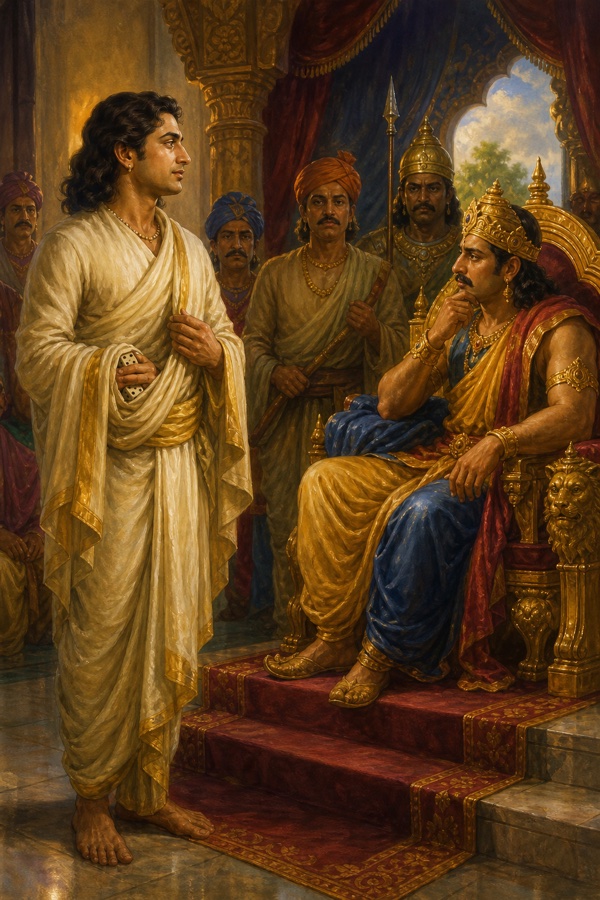
Yudhishthira went in first. He had tied his dice into a fold of his cloth, golden dice set with lapis lazuli, and he carried the bundle tucked under his arm when he walked into the hall where Virata, the well-known king of the Matsyas, was sitting with his court. He was a king himself, the pride of the Kuru line, a man other kings looked up to, strong and handsome and as dangerous as a snake with strong venom, and that day he looked like a god with something drawn over him, the sun behind heavy cloud or a fire under ash. Virata saw a face like the full moon coming toward him through that cloud, and he turned to his counselors, to the Brahmins, the charioteers, the Vaishyas and the rest. “Find out who that is, looking at my court for the first time and looking so much like a king. He cannot be a Brahmin. I think he is a ruler of the earth. He has no slaves with him, no chariots, no elephants, and still he shines like Indra. The marks on his body say that his head has been sprinkled in the rite that makes a king. That is what I believe. And look how he comes up to me, without the least hesitation, like an elephant in rut walking into a bed of lotuses.”
He was still thinking it when Yudhishthira stood in front of him. “Great king, I am a Brahmin who has lost everything he had, and I have come to you for a living,” he said. “I would like to stay here at your side and do as you direct.”
“You are welcome,” Virata said, and he was pleased. “Take the place you are asking for.” Having given it, he asked the rest out of plain liking for the man. “Tell me, child, from which king’s country have you come? Tell me truly your name and your family, and what it is you know.”
“My name is Kanka,” Yudhishthira said. “I am a Brahmin of the family called Vaiyaghra. I am skilled at throwing dice, and I used to be a friend of Yudhishthira.”
“Whatever boon you want, I will give you,” Virata said. “Rule the Matsyas yourself, and I will take your orders. I like even the sly gamblers, and you are like a god and deserve a kingdom.”
“The first thing I ask is that I never be dragged into a quarrel over dice with low people,” Yudhishthira said. “And further, that a man I have beaten at dice not be allowed to hold back what I won from him. Grant me that much by your grace.”
“Anyone who offends you I will certainly put to death, and if he is one of the twice-born I will banish him from my country,” Virata answered, and then he raised his voice for the hall. “Let all my people here listen. Kanka is as much the lord of this kingdom as I am.” He turned back to the stranger. “You will be my friend and ride in the carriages I ride in. You will have clothes in plenty and every kind of food and drink at your disposal. You will look into my affairs, those inside the palace and those outside it, and all my doors will be open to you. When men who are out of work or in want come to you, bring me what they say at any hour, and I will give them what they ask. As long as you live with me, you have nothing to fear.” So Yudhishthira had his audience with King Virata and his boons from him, and he began to live there in comfort, respected by everyone, and nobody found him out.
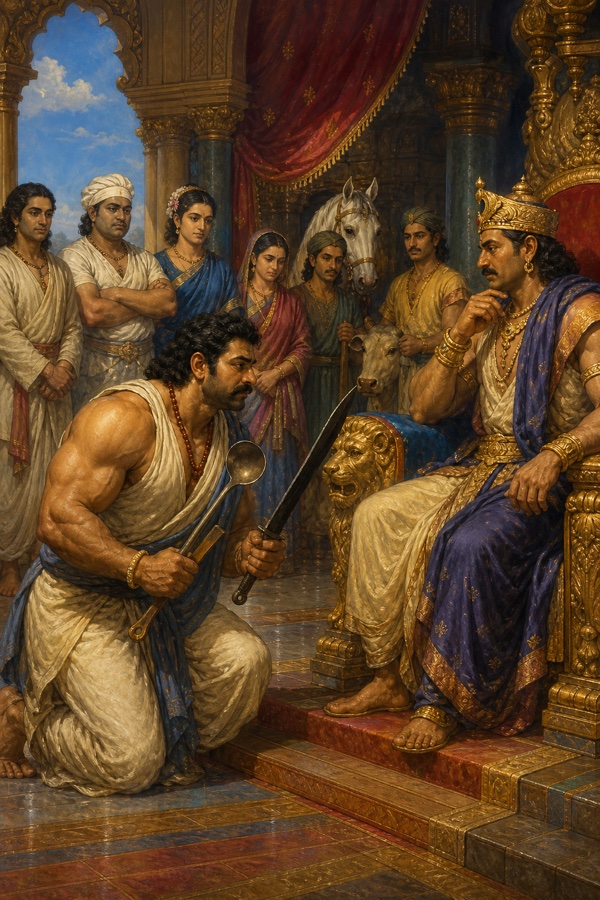
The next to come walked with the easy, playful stride of a lion. He carried a cooking ladle and a spoon, and with them a drawn sword, black, without a mark on the blade. He was dressed in black, he had the strength of a mountain in him, and he came in a cook’s guise and lit the place around him as the sun lights the world. He walked up to the king of the Matsyas and stood there. “Who is that young man with shoulders as broad as a lion’s, and so very handsome?” Virata asked the people around him. “I have never seen him before, and he is like the sun. I turn it over in my mind and cannot tell who he is, and however hard I think I cannot guess what he wants here. Looking at him, I would say he is the king of the Gandharvas, or Indra himself. Find out who it is standing in front of me, and let him have what he is after, quickly.” The king’s messengers ran to the son of Kunti and told him everything Virata had said.
Bhima came forward and chose words that would serve his purpose. “I am a cook, great king, and my name is Ballava. I am good at preparing dishes. Put me to work in your kitchen.”
“I do not believe cooking is your trade, Ballava,” Virata said. “You look like the god of a thousand eyes. For grace and beauty and strength you stand out among all these men like a king.”
“King of kings, I am your cook and your servant before anything else,” Bhima said. “And it is true that I know more than curries, though King Yudhishthira always used to taste what I made in the old days. I am a wrestler too. There is no one who is my equal in strength, and I will fight lions and elephants and keep you entertained.” Virata said he would grant him boons as well. “Do what you want to do, since you say you are skilled in it. I do not think the work is worthy of you. You deserve this whole earth with the sea around it. Have it your way, though. You are the superintendent of my kitchen, and I set you over everyone I appointed there before you.” So Bhima was installed in the kitchen and soon became a favorite of the king, and neither Virata’s other servants nor anyone else knew who he was.
Draupadi in Sudeshna’s Service, and the Rest of the Brothers Arrive
Draupadi came into the city alone. She had gathered her hair, black and soft and fine and long, curling at the ends, into one knotted braid, thrown it over her right shoulder and hidden it under her cloth, and the cloth was a single length of black, costly stuff gone dirty. Dressed like that, as a Sairandhri, she wandered up and down the streets as though she were in trouble. Men and women hurried up to her and asked who she was and what she was looking for. “I am a king’s Sairandhri,” she told them. “I want to serve anyone who will keep me.” They looked at her beauty and her dress, and heard how sweetly she spoke, and could not take her for a maid in search of a living. It happened that Virata’s favorite queen, Sudeshna, the daughter of the king of Kekaya, was looking this way and that from the palace terrace, and her eye fell on Draupadi, forlorn in her one piece of cloth. She called to her. “Beautiful one, who are you, and what are you looking for?”
“I am a Sairandhri, great queen,” Draupadi said. “I will serve anybody who will keep me.”
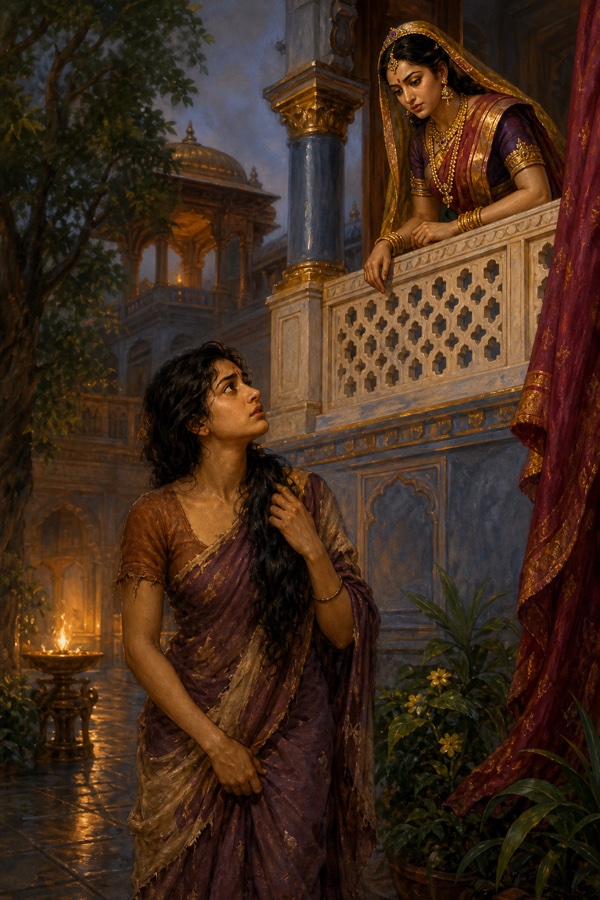
“What you say about your work cannot be true of a woman who looks as you do,” Sudeshna said. “You could be the mistress of servants yourself, men and women both. Your heels do not jut, your thighs touch, your navel is deep, your mind is quick and your speech is grave. Your palms and soles and face have a red glow. Your voice is as sweet as a swan’s. Your hair is lovely, your waist is slender, your neck has the lines of a conch shell, your veins hardly show. Like a mare of Kashmir you carry every lucky mark there is. Your face is the full moon, your eyes are the petals of an autumn lotus, and your body has a lotus’s fragrance. You are as beautiful as Sri herself. Tell me who you are, for you can never be a maidservant. Are you a Yakshi, a goddess, a Gandharvi, an Apsara? A daughter of the gods, a woman of the Nagas, the guardian goddess of some city? A Vidyadhari, a Kinnari, or Rohini herself? Are you Alambusha, or Mishrakeshi, or Pundarika, or Malini, or the queen of Indra or of Varuna, or the wife of Vishvakarma, or of the Creator? Which of the goddesses they tell of in heaven are you?”
“I am no goddess, lady, and no Gandharvi or Yakshi or Rakshasi,” Draupadi answered. “I am a serving-woman of the Sairandhri kind, and that is the truth. I know how to dress hair, how to pound the fragrant things that go into unguents, and how to weave beautiful garlands of many colors from jasmine and lotus and blue lily and champaka. I used to serve Satyabhama, the favorite queen of Krishna, and I served Draupadi too, the wife of the Pandavas and the greatest beauty of the Kuru house. I go about alone and earn good food and good clothes, and I stay in a place for as long as it gives me those. Draupadi herself used to call me Malini, the garland-maker.”
“I would keep you on my own head,” Sudeshna said, “if one doubt did not cross my mind, and it is that the king will be drawn to you with his whole heart. Look: the women of this household and my own maids cannot take their eyes off you. What man, then, is going to resist? When King Virata sees a body as beautiful as yours he will leave me and turn to you entirely. Any man you look at with desire will be struck down by it, and any man who sees you every day will catch fire. A person can climb a tree to his own death. A crab conceives and is destroyed by her own young. In taking you in I may be doing the same thing to myself.”
“Neither Virata nor any other man can have me, fair lady,” Draupadi said. “I have five young husbands. They are Gandharvas, the sons of a Gandharva king of enormous power, and they guard me always. No one can do me a wrong. It is their wish that I serve only in a house where I am never given food to touch that someone else has already eaten from, and never told to wash anyone’s feet. Any man who tries to take me the way he would take a common woman is dead that same night. No one succeeds, because those Gandharvas, strong as they are and dear to me, watch over me in secret.” Sudeshna said that if this was so she would take her into the household, and gave her word on both points: she would touch no one’s leavings and wash no one’s feet. That was how Draupadi, faithful as ever to her husbands, came to live in that city, and no one there could find out who she really was.
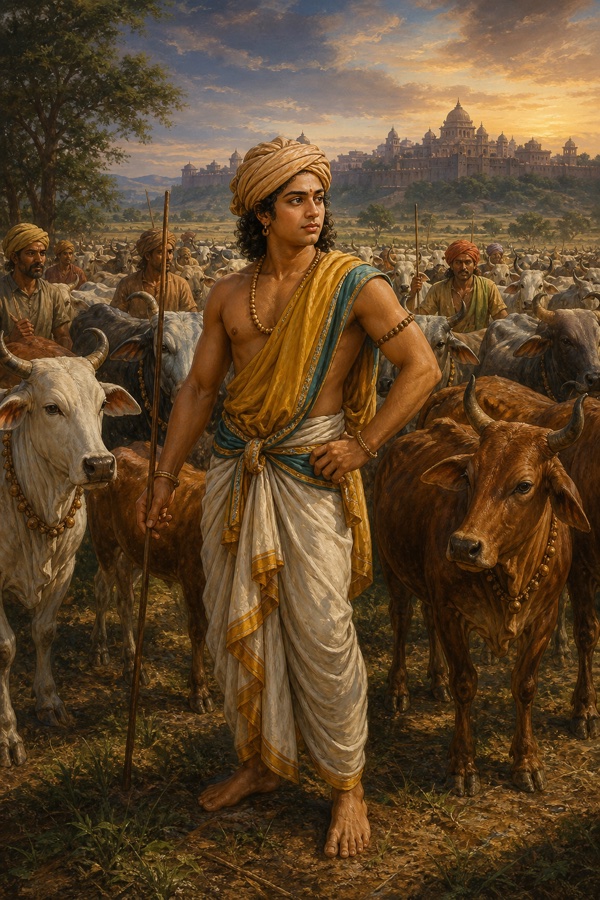
Sahadeva came next, dressed as a cowherd and speaking the cowherds’ dialect, and he went to the cattle pens of Virata’s city. The king saw him there, a man who shone, and was astonished, and sent his people to call him over. “Whose man are you? Where have you come from, and what work do you want? I have never seen you before. Tell me the truth about yourself.” Sahadeva answered in a voice as deep as a rolling cloud. “I am a Vaishya, and my name is Arishtanemi. I kept cattle for the sons of Pandu. I do not know where they are now, and I cannot live without work, and there is no one I would care to serve except you.” Virata would not have it. “You must be a Brahmin or a Kshatriya. You look like the master of the whole earth and the sea around it. A Vaishya’s work does not fit you. Tell me which king’s country you come from, what you know, what place you would take with us, and what pay you would accept.” Sahadeva told him. “Yudhishthira, the eldest of the five sons of Pandu, had one herd of eight hundred and ten thousand cattle, and another of ten thousand, and another of twenty thousand, and more besides, and I was the one who kept them. People called me Tantripala. Within ten yojanas I know the present, the past and the future of every cow that has been counted. Yudhishthira knew what I was worth and was well pleased with me. I know how to make a herd multiply in a short time and how to keep it free of disease. And I can pick out the bulls with the lucky marks, the ones men honor, the smell of whose urine lets the barren conceive.” Virata said, “I have a hundred thousand cattle, divided into separate herds. I put them all in your hands, and their keepers with them.” From then on Sahadeva lived well at Virata’s expense, and neither the king nor anyone else outside his own family knew him.
After him a man of great size and striking beauty appeared at the gate of the ramparts, wearing the ornaments of a woman. He had large earrings and fine bracelets of conch overlaid with gold, his long thick hair floated about his neck, and he walked like an elephant. The ground seemed to shake under him as he came up to Virata and stood in the court. This was the son of great Indra, with his true shape hidden under that dress. “Where does this person come from?” Virata asked his courtiers. “I have never heard of him.” Nobody present knew him either, and the king spoke to the stranger in wonder. “You are as strong as a god. You are young and dark, and you look like the leader of a herd of elephants. You wear a braid and earrings and conch bracelets with gold on them, and still you shine like one of those who ride out on chariots in mail, with bow and arrows and garlands. I am old and I would like to put down my burden. Be a son to me, or rule all the Matsyas as I do. I cannot believe that a person like you is of the neuter sex.”
“I sing, I dance, and I play instruments,” Arjuna said. “I am practiced in dance and skilled in song. Give me to the princess Uttara, lord of men, and I will be her dancing teacher. As for how I came to have this form, what good would it do you to hear a story that would only add to my pain? Know me as Brihannala, a son or a daughter with neither father nor mother.” Virata said, “Brihannala, I give you what you ask. Teach my daughter, and the girls like her, to dance. To me the work seems beneath you. You deserve the whole earth with the ocean around it.” Then the king of the Matsyas tried Brihannala in dancing and music and the other fine arts, took the opinion of his ministers, and had him examined by women. When he was told that the condition was permanent, he sent him to the maidens’ apartments. There Arjuna began giving lessons in singing and in instrumental music to Virata’s daughter and her friends and her waiting-maids, and they were soon fond of him. He kept himself in hand and lived among them in that disguise, sharing their amusements, and no one inside the palace or outside it knew who he was.
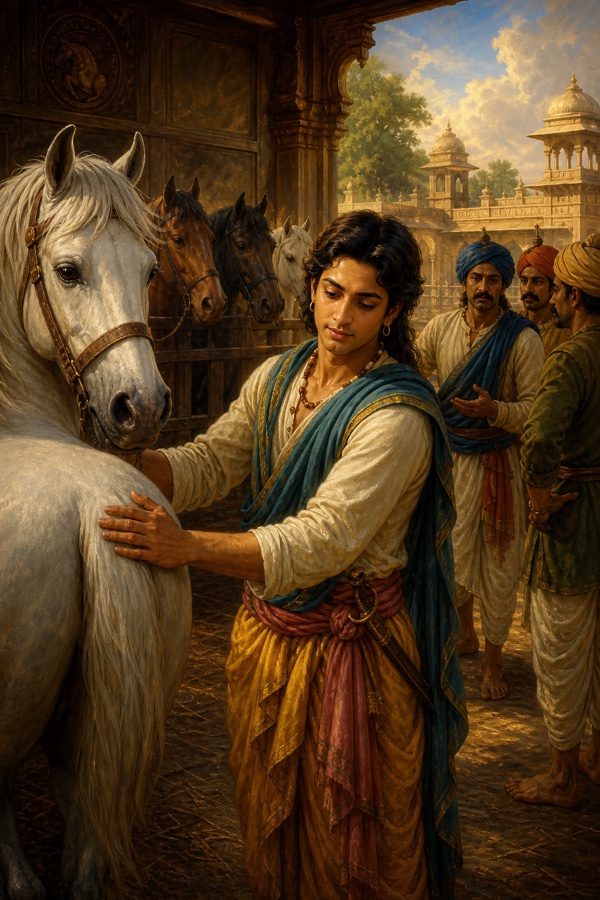
Some time afterward another son of Pandu was seen coming toward King Virata in a hurry, and to everyone who watched he looked like the sun breaking out of cloud. As he came he kept looking over the horses that stood around. “I wonder where this man comes from, bright as a god,” the king of the Matsyas said to his followers. “See how closely he looks at my horses. He must know horses well. Bring him to me quickly. He is a warrior, and he looks like one of the gods.” Nakula walked up and greeted him. “Victory to you, king, and blessings on you. I am a trainer of horses, and kings have always thought well of me. I will make you a clever keeper of yours.” Virata promised him carriages and money and a roomy place to live, and the charge of the royal horses, and asked first to hear where he came from, who he was, how he happened to be there, and what arts he was master of. “Yudhishthira is the eldest of the five sons of Pandu,” Nakula said. “He used to employ me to keep his horses. I know the temper of horses and the whole art of breaking them, I know how to correct a vicious one, and I know every way of treating their diseases. No animal in my hands grows weak or falls ill. Horses aside, even the mares I handle never turn vicious. People called me Granthika, and so did Yudhishthira.” Virata said, “Every horse I own is in your care from today, and all the keepers of my horses and all my charioteers will answer to you. If that suits you, name your pay. And yet the place of a master of horse is not good enough for you. You look like a king, and I think highly of you. Seeing you here has pleased me as much as if Yudhishthira himself had come. How does that blameless son of Pandu live now, I wonder, and pass his time in the forest, with no servants around him?” In this way all the sons of Pandu came to live in the country of the Matsyas, true to their pledge, and bore the days of hiding calmly for all that it cost them.
A sub-tale: Draupadi tells the queen that she has five young husbands who are Gandharvas, the sons of a Gandharva king, who guard her unseen and kill before morning any man who tries to take her as a common woman. She adds two conditions as their wish: she will touch no one’s leftover food and wash no one’s feet. Everything that follows leans on this account. Kichaka will be warned with it and will laugh at it, the guards who find his body will decide that a Gandharva killed him, the Sutas will run from the Gandharva with a tree on his shoulder, and Virata will be too afraid of the Gandharvas to dismiss the Sairandhri to her face.
The gist: One after another the six walk into Virata’s city, and the king suspects every one of the brothers of being more than he says. Yudhishthira is made a friend and equal of the king on two conditions about dice. Bhima is set over the kitchen, Sahadeva over a hundred thousand cattle, Arjuna over the dancing of the princess Uttara, and Nakula over the horses and charioteers. Draupadi enters Queen Sudeshna’s service on her own two conditions and under the protection of five Gandharva husbands whom no one has seen.
Keeping the Days, and Bhima’s Wrestling at the Festival of Brahma
So the Pandavas lived in the city of the Matsyas and waited on its king, and by the grace of the sage Trinabindu and of the lord of Justice no one knew them. Yudhishthira, as a courtier, made himself pleasant to Virata, to Virata’s sons, and to all the Matsyas. He knew the secrets of dice, and he had them playing as he pleased, sitting in a line in the dice-hall like birds tied along one string. What he won from Virata he divided among his brothers in fair shares, and the king never knew of it. Bhima, for his part, sold Yudhishthira the meat and the dishes that came to him from the king’s table. Arjuna handed around what he made from the worn clothes he was given in the inner apartments. Sahadeva, in his cowherd’s dress, brought his brothers milk and curds and clarified butter, and Nakula shared the money the king gave him when the horses were well managed. Draupadi, whose own state was pitiable, looked after all five of them and carried herself so that no one guessed. They met one another’s needs in this way and lived in Virata’s capital as hidden as if they had gone back into their mother’s womb, always afraid of what Dhritarashtra’s son might do, always keeping watch over their wife.
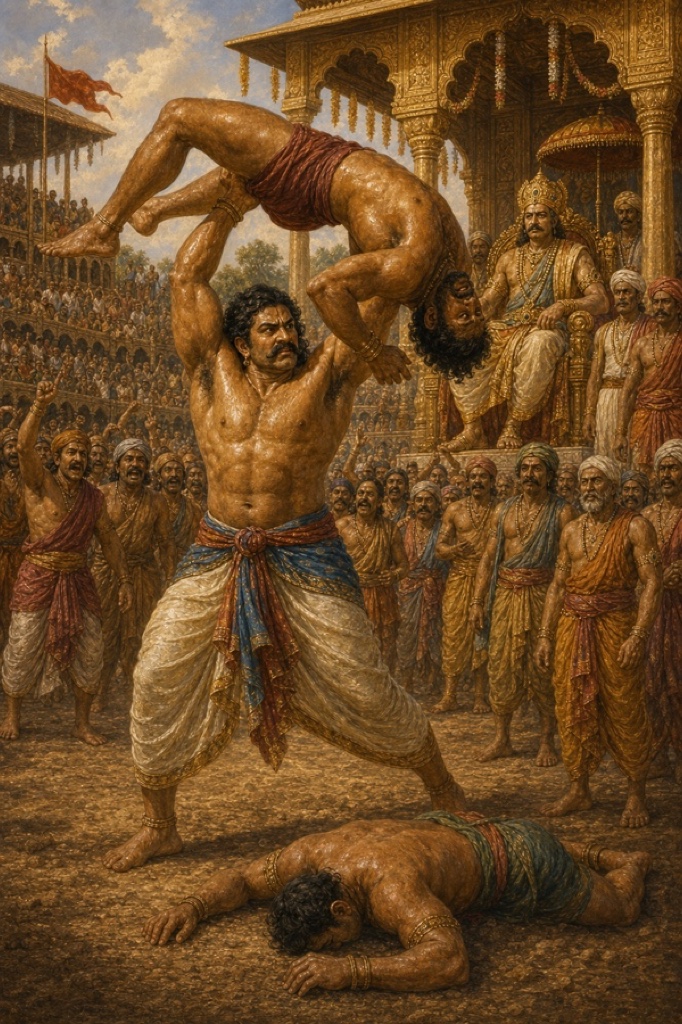
Three months went by. In the fourth came the great festival of Brahma, which the Matsya country kept with much display, and wrestlers arrived for it by the thousand from every direction, as the gods gather at the house of Brahma or of Shiva. They were huge men, strong as the demons called Kalakhanjas, proud of that strength, and the king made much of them. They had the shoulders and waists and necks of lions, their bodies were clean, their minds were easy, and every one of them had won before kings many times. One of them stood above all the rest, and he challenged the whole company to fight him. He stalked the arena and nobody dared go near him. When all the other wrestlers stood there downcast, the king of the Matsyas matched him against his cook. Bhima did not want it. He could not openly refuse a royal order, though, so he made up his mind to it, saluted the king, and walked into the wide arena with the loose step of a tiger. The crowd was delighted when he tied up his waistcloth for the bout. Then he called out the champion, whose name was Jimuta, a man as famous for his strength as the Asura Vritra.
Both men had courage and both were terrible to look at, like two enormous elephants in rut, each sixty years old. They closed gladly, each meaning to win, and the meeting was like a thunderbolt striking the stone face of a mountain. Each took pleasure in the other’s strength and watched for the other’s slip. They attacked and blocked with clenched fists. Each rammed the other and flung him off, threw him and pinned him to the ground, got up and crushed him in his arms, knocked him out of his stance with blows to the chest, caught him by the legs and spun him and brought him down. They slapped with palms that landed like thunderbolts, they stabbed with stiffened fingers and drove their nails in like spearheads, and they kicked hard. Knee struck knee and head struck head with the crack of stone on stone. They fought without weapons, on the strength of their arms and the force of body and mind behind them, and the crowd could not have been happier. People cheered both of them at the top of their voices, as if they were watching Indra fight Vritra. The two broad-chested, long-armed men pulled and pressed and whirled and threw each other, drove their knees in, and shouted their contempt the whole time, fighting with bare arms that were like spiked iron clubs. At last Bhima gave a shout, caught the bellowing wrestler in his arms as a lion catches an elephant, lifted him clear of the ground, and began to swing him around over his head while the other wrestlers and the people of Matsya stared. He swung him a hundred times, until the man was senseless, and then he dashed him down on the ground and killed him.
Virata and his friends were overjoyed that the famous Jimuta was dead, and in his delight the king rewarded Ballava on the spot, with the open hand of Kubera. After that Bhima killed many wrestlers and many other men of great strength, and the king was very pleased with him. When no one could be found to stand against him, Virata had him fight tigers and lions and elephants, and he had him fight strong, furious lions in the women’s quarters too, for the pleasure of the ladies. Arjuna pleased the king and all the women of the inner apartments with his singing and dancing. Nakula showed Virata swift, well-trained horses that followed him wherever he walked, and was given generous presents for it. Sahadeva was seen with a herd of well-broken bullocks around him and was given wealth of many kinds. Draupadi watched all of them endure it, and she could not stop sighing.
The gist: In hiding, the brothers quietly pool what they earn: Yudhishthira’s winnings at dice, Bhima’s food, Arjuna’s proceeds from old clothes, Sahadeva’s milk and butter, Nakula’s rewards. In the fourth month, at the festival of Brahma, Virata sets his cook against the wrestler Jimuta, whom no one else will face, and Bhima swings him around a hundred times and kills him. From then on the king has Bhima fight men and then beasts for sport, some of it in the women’s quarters, and Draupadi has to watch.
The Kichaka-vadha Parva Begins, and Kichaka’s Wicked Gaze
Ten months passed in the city of the Matsyas with the sons of Pritha living in disguise. Draupadi, the daughter of Yajnasena, a woman who should have had others waiting on her, spent those months waiting on Sudeshna and was miserable. She pleased the queen all the same, and the other women of the inner apartments. The year was nearly out when Kichaka, the formidable commander of Virata’s army, happened to see her. She looked to him like a daughter of the gods walking the earth, and the arrows of Kama went into him, and he wanted to have her.
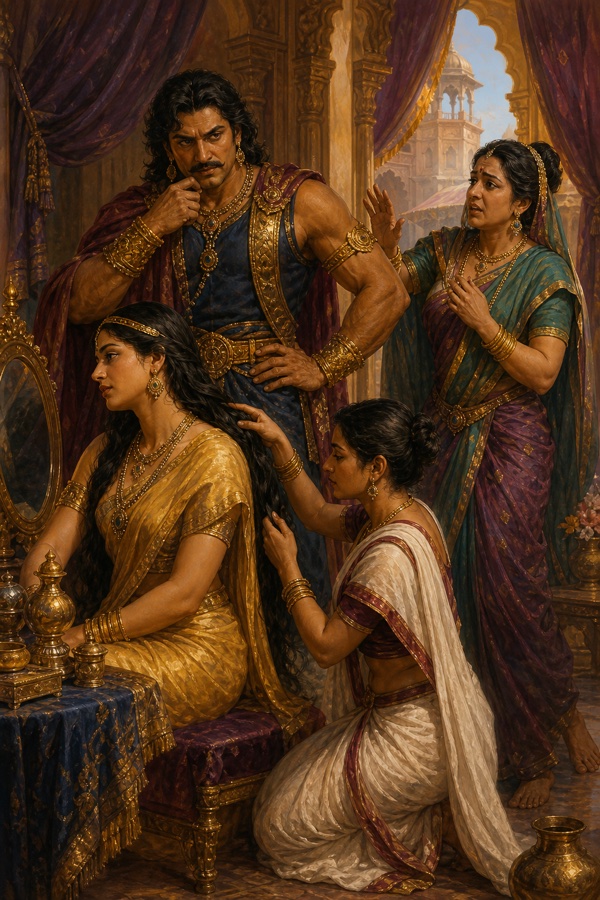
Burning with it, the general went to Sudeshna, who was his sister, and spoke to her with a smile. “I have never seen this beautiful woman in King Virata’s house before. Her beauty goes to my head the way a new wine does with its scent. Tell me who she is, this graceful creature who looks like a goddess, and whose she is, and where she came from. She has ground my heart down and made me her subject, and I do not think there is any medicine for what ails me except her. A maid like this is wasted in serving you. Let her rule me and everything I own. Let her adorn my house, which is large and handsome and bright with gold, where there is food and drink in abundance and fine plate and every kind of plenty, and elephants and horses and chariots by the thousand.”
Having spoken to Sudeshna, Kichaka went to Draupadi herself, a jackal in the forest walking up to a lioness, and used his most winning voice. “Who are you, beautiful one, and whose? Where did you come from to the city of Virata? Tell me.” He told her that her face shone like the moon, that her eyes were lotus petals and her voice the call of the cuckoo, and that he had never seen a woman like her in the world. He asked whether she was Lakshmi from among the lotuses, or Bhuti, or Hri, or Sri, or Kirti, or Kanti, or Rati who lies in the arms of the god of love. Then he went over her body to her face: her breasts, which he said were fit for garlands of gold and were Kama’s whips driving him on, her waist, which he measured at a span, her hips. He said that desire was burning him like a forest fire and that her surrender was the only rain that could put it out, that the arrows of Manmatha had gone into the core of his heart and were driving him mad, and that she must rescue him by giving herself to him. “You are made for happiness and you have none. You should not be living here in misery. Wear garlands and fine clothes and every ornament, drink the best wines with me, and take your pleasure as you like. Your beauty and your youth are going unused, like a fine garland that no one wears. I will put aside all my wives. Let them be your slaves. I will stay beside you as your slave too, and do whatever you say.”
“Son of a Suta, you are wanting a serving-woman of low birth, whose work is the despised one of dressing hair,” Draupadi answered. “I am not fit for the honor you intend. And then, I am the wife of others. I wish you well, and what you are doing is wrong. Remember the rule that a man should take his pleasure only in the wife he has married, and do not let your heart bend toward adultery. Good men make it their study to keep from what is improper. It is sinful men, blind with ignorance and pushed by desire, who end in great disgrace or in something terrible.”
Kichaka had lost all hold on himself. He knew the many evils of going after another man’s wife, evils that everyone condemns and that sometimes cost a man his life, and he spoke on regardless. “You should not push me away like this, when Manmatha has put me in your power. I am speaking to you gently. Turn me down now and you will be sorry for it afterward. I am the real lord of this whole kingdom. Its people live by leaning on me. No one on earth is my equal in energy or in courage, and no other man can match me for looks, or youth, or wealth, or the fine things I have to enjoy. Why would you choose to be a servant when every pleasure and comfort is yours for the taking? I will give you this kingdom to be mistress of. Take me, and enjoy the best of everything.”
Draupadi answered those foul words sharply. “Do not be such a fool, son of a Suta, and do not throw your life away. Five husbands protect me. You cannot have me. My husbands are Gandharvas, and if they are angered they will kill you, so do not bring that on yourself. The road you want to walk is one no man can walk. You are like a silly child standing on one shore of the ocean who means to cross to the other. Go down into the earth, fly up into the sky, run to the far side of the sea, and you will still find no escape from those sons of the gods, who range the sky and grind down every enemy. Why do you keep asking me, Kichaka, like a sick man asking for the night that will end him? Why do you want me, like a baby in its mother’s lap reaching for the moon? For a man who pesters their beloved wife there is no refuge on earth or in the sky. Have you no sense at all, the kind that looks for your own good and might save your life?”
A key to reading this (a concept): Kama and Manmatha are two names of the god of desire, whose arrows Kichaka says have gone into his heart; Rati is the one who lies in that god’s arms. Bhuti, Hri, Sri, Kirti and Kanti, the names he tries on Draupadi, are Prosperity, Modesty, Beauty, Fame and Loveliness in the form of goddesses. Kichaka knows the evils of what he is attempting, evils that everyone condemns and that can end a man’s life, and he goes ahead with his senses out of his control.
Sudeshna’s Deception, and Draupadi at Kichaka’s House
Turned away by the princess, crazed with lust and past all sense of what was decent, Kichaka went back to Sudeshna. “Daughter of Kekaya, arrange it so that your Sairandhri comes into my arms. Find the way to make her accept me, Sudeshna. I am dying of this.” He went on lamenting at length, and the queen, a gentle and intelligent woman, was moved to pity. She thought it over by herself, weighing what her brother wanted against what Draupadi feared, and then she said to the Suta’s son, “On some festival day, have food and wines prepared for me. I will send my Sairandhri to your house on the excuse of fetching wine. When she comes, you will have her alone and uninterrupted, and you may coax her however you like. Soothed in that way, she may turn her mind toward you.”
Kichaka left his sister’s rooms and soon had wines laid in, well filtered and fit for a king. He set skilled cooks to work, and they made choice dishes of many kinds, delicious drinks, and meats of every grade. When it was all ready, Sudeshna did as her brother had asked and spoke to her maid. “Get up, Sairandhri. Go to Kichaka’s house and bring me wine. I am tormented by thirst.”
“Princess, I cannot go to Kichaka’s rooms,” Draupadi said. “You know yourself how shameless he is. I am not going to live loosely in your palace and be false to my husbands. You remember the conditions I made before I entered your house. That fool is sick with desire, and the moment he sees me he will insult me. I will not go to his quarters. You have many maids, princess. Send one of them, and may it go well with you. Kichaka will certainly insult me.”
“You go from me, out of my own house. He will surely do you no harm,” Sudeshna said, and she put a golden vessel with a lid into her hands. Draupadi set out for Kichaka’s house to fetch the wine, full of dread and weeping, and in her mind she asked the gods to protect her. She made an act of truth as she went. “I know no man other than my husbands. As that is true, let Kichaka have no power to overcome me, even when I am standing in front of him.”
For a moment, helpless as she was, she worshiped Surya, the Sun. Surya considered everything she asked and ordered a Rakshasa to guard her unseen, and from that time the Rakshasa stayed by that blameless woman whatever happened. She came into Kichaka’s presence like a frightened doe. The Suta got up from his seat when he saw her, as glad as a man who wants to reach the far bank of a river and is handed a boat.
Kichaka’s Assault, and Draupadi’s Humiliation in the Court
“Welcome, you with the curling hair,” Kichaka said. “The night that has just ended brought me a lucky day, for today I have you as the mistress of my house. Now do what pleases me. I will have chains of gold brought for you, and conch bangles, and bright gold earrings made in many countries, fine rubies and gems, silk robes and deerskins. I have a good bed made ready for you too. Come and sit on it, and drink the honey-flower wine with me.”
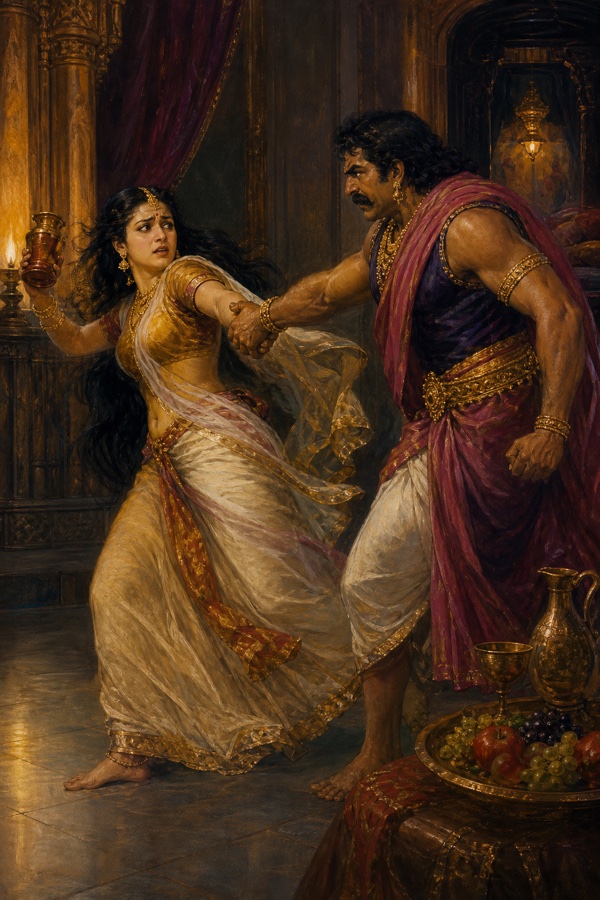
“The princess sent me to you to fetch wine,” Draupadi said. “Give it to me quickly. She told me she is very thirsty.”
“Others will carry what the princess wants, gentle lady,” Kichaka said, and he took hold of her right arm.
Draupadi cried out. “I have never been false to my husbands, never once, even in my heart, through any drunkenness of the senses. As that is true, you wretch, I will see you dragged down and lying helpless on the ground.”
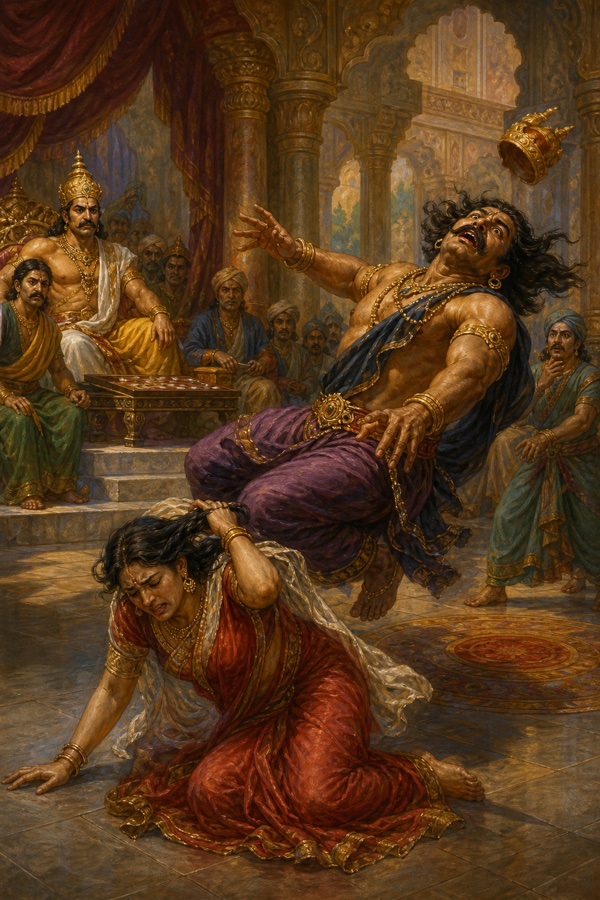
She tried to run, and as she turned Kichaka grabbed the end of her upper garment. She could not bear being held like that. Shaking with anger and breathing fast, she threw him to the floor, and he went down like a tree whose roots have been cut through. Then, trembling all over, she ran for the court, where King Yudhishthira was, to find protection. She ran as fast as she could. Kichaka came after her, caught her by the hair, pulled her down on the ground, and kicked her, in front of the king. At that the Rakshasa whom Surya had set to guard her gave Kichaka a shove with the force of a gale, and he reeled and fell senseless, like a tree torn out of the earth.
Yudhishthira and Bhima were both sitting in that hall, and both of them watched it with anger in their eyes. Bhima wanted Kichaka dead. He ground his teeth, sweat came out on his forehead and the skin of it drew into terrible furrows, something like smoke came from his eyes, and his eyelashes stood up. He pressed his forehead with his hands. Rage was already lifting him out of his seat when Yudhishthira, afraid they would be discovered, squeezed his thumbs and signaled him to stay where he was. Bhima looked like a maddened elephant measuring a big tree, and it was of trees that his elder brother spoke. “Cook, are you looking for wood to burn? If it is firewood you need, go outside and cut down trees.”
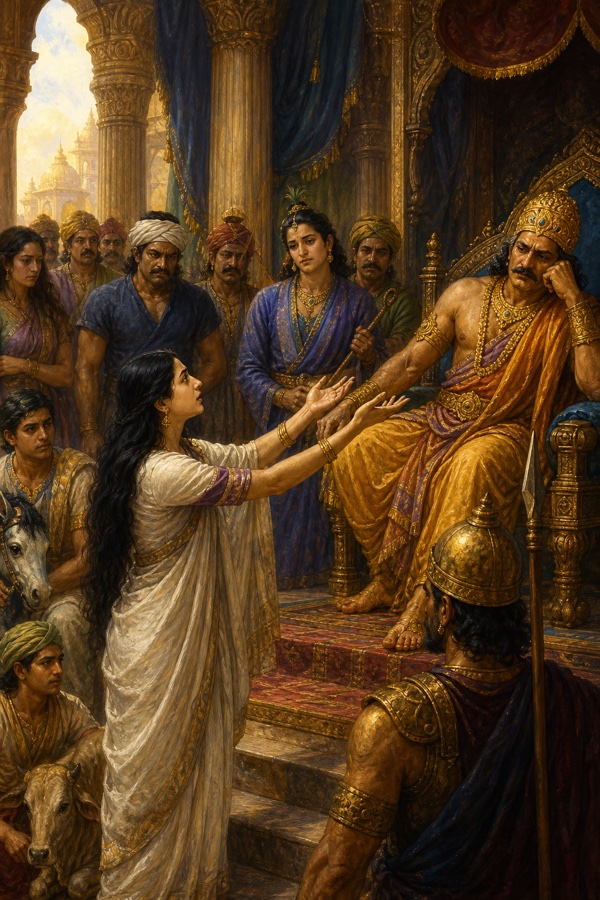
Draupadi came weeping to the entrance of the court. She saw her husbands sitting there downcast and still holding to their disguise, because their pledge bound them, and with her eyes burning she spoke to the king of the Matsyas. “The son of a Suta has kicked, today, the proud and beloved wife of men whose enemy cannot sleep in peace with four kingdoms lying between him and them. The son of a Suta has kicked today the proud and beloved wife of men who speak the truth, who are devoted to Brahmins, who are always giving and never ask a gift for themselves. The son of a Suta has kicked today the proud and beloved wife of men whose kettledrums and bowstrings are never silent. The son of a Suta has kicked today the proud and beloved wife of men who have strength and energy in abundance, who are open-handed and proud of their honor. The son of a Suta has kicked today the proud and beloved wife of men who could destroy this whole world if duty did not tie their hands. Where are they today, those great warriors who, even living in disguise, have always protected anyone who asked them for protection? Why do those heroes, with all their strength, sit quiet like eunuchs while a Suta’s son insults their dear and faithful wife? Where is their anger now, and their courage, and their fire, that they bear it calmly when a wicked man does this to her? And what can I do, when Virata has so little virtue that he looks on coolly while an innocent woman is wronged? You are not acting like a king toward this Kichaka. This is how a robber behaves, and it has no place in a court. That I should be insulted before your very eyes, king of Matsya, is a great wrong. Let every courtier here look at Kichaka’s violence. Kichaka knows nothing of duty or right, and neither does Matsya, and the courtiers who wait on such a king have no virtue in them either.”
With these words and more like them she rebuked the king, her eyes full of tears. “I do not know what passed between you two out of our sight,” Virata said. “If I do not know the real cause, how can I judge?” The courtiers, once they had learned everything, praised Draupadi, cried “Well done! Well done!” and blamed Kichaka. “The man who has this large-eyed woman for his wife, beautiful in every limb, owns something beyond price and has nothing to grieve about,” they said. “A woman like this is hardly found among human beings. We think she is a goddess.” While they were admiring her, the sweat of anger came out on Yudhishthira’s forehead, and he spoke to the princess who was his own beloved wife. “Do not stay here, Sairandhri. Go back to Sudeshna’s rooms. The wives of heroes bear hardship for their husbands’ sake, and by the toil of serving them they come at last to the place where their husbands go. Your Gandharva husbands are bright as the sun, and I suppose they do not judge this the moment to show their anger, since they have not come running to help you. You have no sense of what the time calls for, Sairandhri. That is why you stand there weeping like an actress, and interrupting the dice game in the court of Matsya besides. Go. The Gandharvas will do what you would wish. They will take away your grief, and they will take the life of the man who wronged you.”
“The men whose wife I am are very kind, I think,” the Sairandhri said. “And because the eldest of them is addicted to dice, anyone at all may trample on them.” With her hair loose and her eyes red with anger she ran off toward Sudeshna’s apartments. She had wept so long that her face was lovely with it, like the moon when it comes out from the clouds.
Sudeshna saw the state she was in. “Who has insulted you, my beauty? Why are you crying? Who has done you wrong? Where does this grief come from?”
“I went to bring you wine,” Draupadi said, “and Kichaka struck me in the court, under the eyes of the king, as though we had been alone in the middle of a forest.”
“Kichaka has gone mad with lust and insulted a woman he can never have,” Sudeshna said. “If you want it, I will have him put to death.”
“Others will kill him,” Draupadi answered. “The ones he has wronged will do it. I think it is certain that he goes to the house of Yama this very day.”
The gist: Sudeshna, pitying her brother, sends Draupadi to his house on the excuse of fetching wine, and Draupadi goes weeping, on an act of truth, with a Rakshasa sent by the Sun guarding her unseen. Kichaka takes her by the arm; she throws him down and runs to the court; he drags her down by the hair and kicks her in front of Virata, Yudhishthira and Bhima. Yudhishthira holds Bhima in his seat with a sign and a remark about firewood, Virata says he cannot judge what he did not see, and Yudhishthira sends the Sairandhri away for interrupting the dice. Her answer names the cause: the eldest of her husbands is addicted to dice.
Draupadi Goes to Bhima and Pours Out Her Grief
Draupadi went to her own quarters wanting one thing, the death of Virata’s general. She bathed. She washed her body and her clothes with water, and she wept while she thought about how to end her grief. “What am I to do? Where can I go? How is this to be done?” Turning it over, she remembered Bhima. “No one but Bhima can do today what my heart is set on.” In the night she got up from her bed and went quickly to the cooking quarters to find him. He was asleep there, breathing hard like a lion. She came to him as a young cow raised in the woods comes to a strong bull in her first season, and wound her arms around him as a creeper winds around a great sala tree on the bank of the Gomati, and she woke him the way a lioness wakes a sleeping lion in a forest without paths. Her voice was as sweet as a string sounding the Gandhara note. “Get up, get up! Why are you lying there like a dead man, Bhimasena? No man who is alive lets a wretch go on living who has disgraced his wife. How can you sleep while that commander of Virata’s army, my enemy, is still breathing after what he did today?”
Bhima woke and sat up on his couch with its rich bedding. “What has brought you here in such a hurry?” he asked his wife. “Your color is gone. You look thin and pale. Tell me all of it, in detail. I have to know the truth. Pleasant or painful, welcome or unwelcome, tell me everything, and when I have heard it I will find the remedy. I am the one you should trust in everything, Draupadi, because it is I who get you out of danger, time after time. Say quickly what you want and what you have in mind, and then go back to your bed before the others wake.”
“What grief does a woman not have, who has Yudhishthira for her husband?” Draupadi said. “You know every one of my griefs. Why do you ask? The Pratikamin, Duryodhana’s messenger, dragged me into the hall in front of the whole assembly and called me a slave. That burns me still. What other princess would go on living after that? Who but I could have borne the second insult, the one the wicked king of Sindhu offered me while we were living in the forest? And who else of my rank could live after being kicked by Kichaka under the eyes of that wicked king of the Matsyas? What is my life worth, if you can see all this and still not think me wretched? This vile Kichaka, who is King Virata’s brother-in-law and the commander of his army, says to me every day, as I go about the palace as a Sairandhri, ‘Be my wife.’ I listen to that from a man who deserves to be killed, and my heart is splitting like a fruit that has ripened in its season.
“Blame your elder brother and his cursed dice. It is through his doing alone that I suffer this. Who but a desperate gambler would play away his kingdom and everything in it, and me with it, to go and live in the woods? If he had gambled morning and evening for years on end and staked nishkas by the thousand, his silver and gold, his robes and carriages and teams, his goats and sheep and all his horses and mares and mules would never have run short. Now the dice have stripped him, and he sits dumb like a fool, thinking over what he did. Ten thousand elephants in golden garlands used to follow him when he traveled, and he lives by throwing dice. At Indraprastha kings by the hundred thousand did him honor. A hundred thousand serving-women, plate in hand, fed his guests in his kitchen day and night, and he gave away a thousand nishkas daily. Bards and singers of praise came to him by the thousand every morning and evening, with jeweled rings in their ears. A thousand sages who knew the Vedas sat in his court. He kept eighty-eight thousand Brahmin householders, with thirty serving-girls assigned to each, and ten thousand ascetics besides who accepted no gifts. He was the one who fed the blind, the old, the helpless and the orphaned of his kingdom out of pity. That same Yudhishthira is a dependent of Matsya now, a thrower of dice in another man’s court, and calls himself Kanka. The rulers of the earth used to bring him tribute on the appointed day, and he begs his living from another’s hand. He lit the whole earth like the sun, and he sits beside Virata and says flattering things to him. Who could watch that and feel no grief? And still you do not see me as a woman drowning.
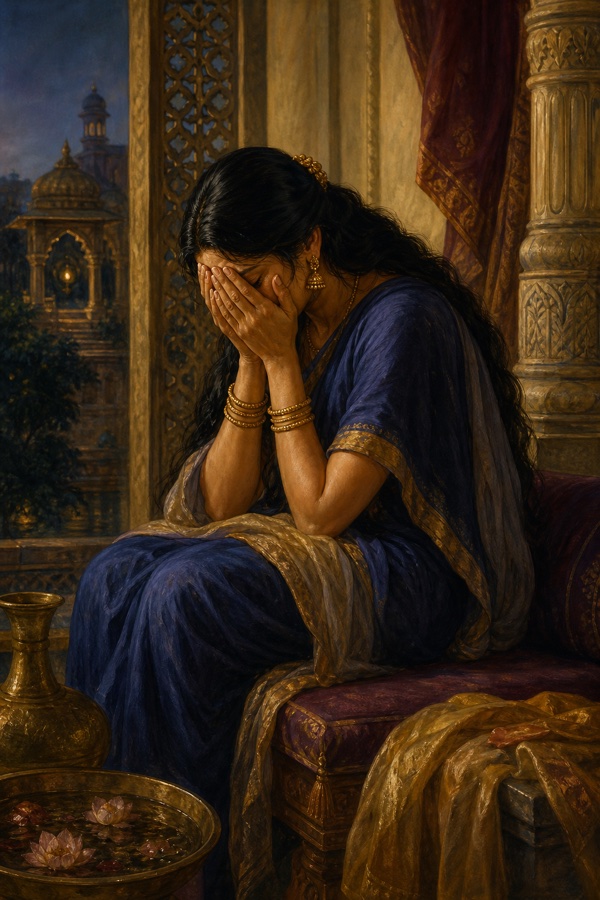
“There is another grief, and you must not blame me for telling it, because I speak out of a sad heart. Who would not be hurt to see you doing a cook’s work, so far beneath you, and saying you are of the Ballava caste? People know you as Virata’s cook, a man sunk in service. When your work in the kitchen is done and you sit down humbly near Virata, my heart sinks. When the king, in his pleasure, sets you to fight elephants and the women of the inner apartments laugh the whole time, I can hardly bear it. When you fight lions and tigers and buffaloes in the women’s quarters while Queen Sudeshna looks on, I nearly faint. And when she and her maids get up and come to me and find that I am unhurt and have only swooned, she tells her women, ‘It must be affection, and the bond that comes of living close, that makes this sweet-smiling woman grieve for the strong cook when he fights the beasts. The Sairandhri is beautiful and Ballava is a handsome man. A woman’s heart is hard to read, and I think the two deserve each other. Likely she weeps for her lover. They came into this household at the same time, after all.’ She is always taunting me with that, and when she sees it makes me angry she is surer than ever. And Arjuna, who beat gods and men from a single chariot, is the dancing teacher of King Virata’s daughter. The man who fed Agni in the Khandava forest lives in the inner rooms like a fire hidden at the bottom of a well. His arms are scarred by the bowstring, and he covers his wrists with bracelets of conch. The twang of his bow used to make every enemy shake, and now he pleases women with his songs. A diadem bright as the sun sat on his head once, and now he wears a braid, and earrings. When I see him in the music hall before Virata, standing among the women like a bull elephant in rut among she-elephants, I lose my sense of where I am. Our mother-in-law surely does not know that he has come to this. And Sahadeva, the youngest of you: when I see him among the cattle in a cowherd’s dress, in clothes dyed red, I go pale and feverish. I cannot sleep for thinking of him. I do not know what sin he ever committed to deserve it. When we were leaving for the forest, Kunti stood weeping with her arms around him and said to me, ‘Sahadeva is shy and soft-spoken and good. He is my favorite child. Look after him in the forest day and night, Draupadi. Feed him with your own hands.’ Now he tends cows and sleeps at night on calfskins. How am I to bear living? And Nakula, who has beauty and skill at arms and intelligence all three, at the sight of whom enemy armies ran, breaks horses in front of the king and shows them off to him. See what time has done. With a hundred miseries like these on me because of Yudhishthira, how can you think me happy?
“And I, because of that desperate gambler, am under Sudeshna’s orders, living in the palace as a Sairandhri. Look at what a princess has come to. I live only for this term to end. I tell myself that success and victory and defeat do not last, that fortune and misfortune turn like a wheel, that those who give may come to beg and those who kill may be killed, that a pond once dry fills again, and so I wait for my husbands’ luck to return. Nothing is hard for Destiny and no one overrides it. But who else, the queen of the sons of Pandu and the daughter of Drupada, would want to live after falling this low? What has happened to me has shamed the whole Kuru house, and the Panchalas, and the sons of Pandu. I must have done something in my childhood that deeply offended the Ordainer. Look at how pale I have become. Even the forest, with all its hardship, never did that to me. I had the whole earth under me to the edge of the sea, and now I am under Sudeshna and afraid of her. I had attendants walking in front of me and behind me, and now I walk in front of Sudeshna and behind her. And here is one more thing I cannot bear. I never pounded unguents even for myself, only ever for Kunti, and now I pound sandalwood for other people. Look at these hands. They were never like this.” She held them out to him, and they were marked with calluses. “I was never afraid of Kunti, or of you and your brothers. Now I stand in front of Virata like a slave, afraid of what he will say about how the paste has been made, because the king of Matsya does not like sandal that anyone else has pounded.”
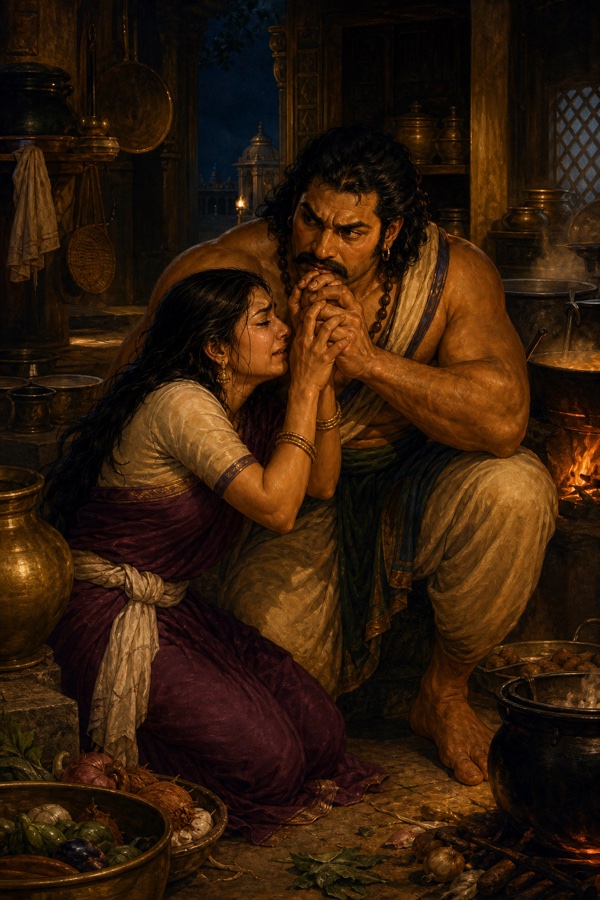
When she had told it all, Draupadi wept without a sound, with her eyes on Bhima. Then, sighing over and over, her words half lost in tears, she said something that went through him. “I must have given the gods some great offense long ago, Bhima. I am an unlucky woman, and I am still alive when I ought to be dead.” Bhima took those delicate, callused hands of his wife and covered his own face with them, and he wept. He held her hands in his and the tears ran down, and in that misery he began to speak.
A sub-tale: Draupadi’s lament counts three insults. The Pratikamin, the attendant Duryodhana sent for her, dragged her into the assembly and called her a slave; the king of Sindhu, Jayadratha, whom Bhima and his brothers defeated, insulted her in the forest; and now Kichaka has kicked her in the sight of the king of the Matsyas. She lays all three at one door, asking who but a desperate gambler would stake his kingdom and his wife. Her picture of Indraprastha is given in numbers: ten thousand elephants, a hundred thousand serving-women, a thousand nishkas a day in gifts, eighty-eight thousand Brahmin householders and ten thousand ascetics maintained by the man who now sits in Virata’s court as Kanka.
Bhima’s Words of Comfort, and the Plan to Kill Kichaka
“Shame on the strength of my arms, and shame on Arjuna’s Gandiva, when your hands, which used to be red, are covered with calluses,” Bhima said. “I would have made a slaughter in Virata’s court. I would have crushed Kichaka’s head as an elephant would, drunk as he is with the pride of power. When I saw him kick you, I decided in that instant to kill every Matsya there. Yudhishthira, the son of Kunti, forbade it with a glance, and I understood him and kept still. We have been robbed of our kingdom. I have not yet killed the Kurus. I have not yet taken the heads of Duryodhana and Karna, of Shakuni the son of Subala, of the wicked Duhshasana. All of that, done to us and left undone by me, burns in every limb I have. It sits in my heart like a javelin driven in.
“Even so, do not give up what is right, and master your anger. If King Yudhishthira hears you reproach him like this, he will end his life. If Arjuna and the twins hear it, they will give up theirs. And with them gone I could not bear my own. Long ago Sukanya, the beautiful daughter of Sharyati, followed Chyavana of Bhrigu’s line into the forest, an ascetic so sunk in meditation that the ants had raised a hill over him. You have heard of Indrasena, who was as lovely as Narayani and followed a husband a thousand years old. You have heard how Sita, Janaka’s daughter, the princess of Videha, followed her lord into the deep woods, how she suffered and was tormented by Rakshasas, and how she came back to Rama in the end. Lopamudra had youth and beauty, and she gave up every pleasure and followed Agastya. Savitri, wise and without fault, followed the brave Satyavan, the son of Dyumatsena, alone into the world of Yama. You are like those women, chaste and beautiful and full of every virtue. Hold out a little longer. It is only half a month now. When the thirteenth year is complete you will be the queen of a king again.”
“I could not carry my griefs any longer, Bhima, and that is the only reason for these tears,” Draupadi said. “I do not blame Yudhishthira. There is no use in going over what is past. Come quickly to the work of the hour. The queen is jealous of my looks and is always troubling me, to keep the king from taking a fancy to me, and Kichaka, who knows how she feels, keeps after me himself. I swallow my anger and tell him, ‘Look to yourself, Kichaka. I am the queen and the beloved wife of five Gandharvas, and they will kill you for your rashness.’ He says, ‘I am not in the least afraid of Gandharvas, sweet-smiling Sairandhri. I will kill a hundred thousand of them in battle. So consent.’ I tell him he is no match for them, and that he is alive only because I keep to what is right and never wish for anyone’s death, and he bursts out laughing. Then the queen, out of love for her brother, who had put her up to it, sent me to his house for wine. He began with sweet words, and when they failed he grew furious and meant to force me. I saw it and ran for the place where the king was. He threw me down and kicked me in front of the king himself, in front of Kanka and many others, charioteers and royal favorites and elephant riders and townsmen. I rebuked the king, and Kanka, again and again. The king did not stop him and has not punished him. Kichaka is Virata’s chief ally in war, and both the king and the queen love him. He is brave, proud, sinful, a chaser of other men’s wives. He draws great wealth from the king and takes what belongs to others while they cry out. He has never walked a good road or done a good deed. He has been refused many times, and if he sees me again he will violate me, and then I will certainly give up my life, and all the merit you five are earning will come to nothing. You are keeping your pledge, and you will lose your wife. A man who protects his wife protects his children, and in protecting his children he protects himself, because he is born again in her. I have heard Brahmins say, when they set out the duties of the orders, that a Kshatriya has no duty except to put down his enemies. Kichaka kicked me before the eyes of Yudhishthira the Just, and before yours. It was you who saved me from the terrible Jatasura. It was you, with your brothers, who beat Jayadratha. Now kill this one too. Break him like a clay pot thrown against a stone. If tomorrow’s sun rises on him, I will mix poison and drink it. I will never go to Kichaka. I would much sooner die here in front of you.”
She hid her face against his chest and wept. Bhima put his arms around her and comforted her as well as he could, with grave and sensible words, and wiped her wet face with his hands. Then his mind went to Kichaka, and he licked the corners of his mouth in his anger. “I will do exactly what you say. I will kill Kichaka, and all his friends with him. Put away your grief, daughter of Yajnasena, and arrange to meet him tomorrow evening. The king of the Matsyas has had a dancing hall built. The girls use it for dancing during the day and go home to their own houses at night. There is a good wooden bedstead in it, solidly set. In that hall I will show him the ghosts of his dead forefathers. Only take care, when you speak with him, that no one sees you at it.” They talked in this way and wept, and then they waited for the end of that night, and the waiting was hard.
The Assignation in the Dancing-hall, and Bhima’s Ambush
In the morning Kichaka got up and went to the palace and found Draupadi. “I threw you down in the court and kicked you in front of the king,” he said. “A strong man laid hands on you and you found no one to protect you. Virata is king of the Matsyas in name only. I command the army of this country, and I am its real lord. Take me, and take me gladly. I will be your slave. I will give you a hundred nishkas on the spot, and a hundred men and a hundred women to wait on you, and carriages with she-mules in the traces. Let us come together, timid one.”
“Then hear my condition, Kichaka,” Draupadi said. “None of your friends and none of your brothers may know that you are meeting me. I am terrified that those Gandharvas will find out. Promise me that, and I am yours.”
“I will do just as you say,” Kichaka answered. “The god of love has me in his grip, and I will come to you alone, so that those Gandharvas, bright as the sun, never learn what you have done.”
“When it is dark, go to the dancing hall the king of the Matsyas built,” Draupadi told him. “The girls dance there by day and go to their homes at night. The Gandharvas do not know the place. There, surely, no blame can reach us.”
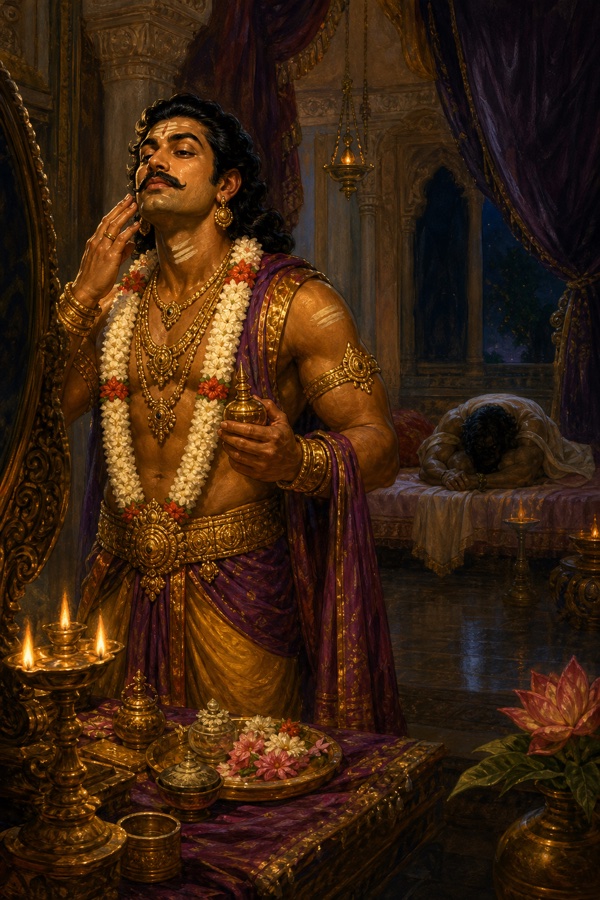
Draupadi thought over what she had said to him, and the half of the day that remained felt to her as long as a month. Kichaka went home in the highest spirits. The fool did not know that what had taken the shape of a Sairandhri was his death. Lust had emptied his head, and he set at once to making himself fine with unguents and garlands and ornaments, thinking of the large-eyed woman while he did it, and the day seemed to him as if it would never end. He was about to part with his beauty for good, and it grew brighter, as the wick of a lamp flares just before it goes out. He trusted Draupadi completely. He was so lost in picturing the meeting that he did not notice when the day was gone.
Draupadi, meanwhile, went to Bhima and stood before him in the kitchen. “I have done as you told me. Kichaka believes that he and I are to meet in the dancing hall. He will come at night, alone, to that empty hall. Kill him there. Go to the hall and take the life of this Suta’s son, who is drunk on his own vanity. It is vanity alone that makes him sneer at the Gandharvas. Lift him off the ground the way Krishna lifted the Naga Kaliya out of the Yamuna. I am worn out with grief. Wipe away my tears, and guard your own honor and the honor of your house.”
“Welcome, and welcome to your news,” Bhima said. “It is all the help I need. Hearing that I am to meet Kichaka gives me the same joy I had when I killed Hidimba. I swear to you by truth, by my brothers and by what is right that I will kill Kichaka as the king of the gods killed Vritra. In secret or in the open, I will crush him, and if the Matsyas fight for him I will kill them too. After that I will kill Duryodhana and take back the earth. Let Yudhishthira go on paying court to the king of Matsya.”
“Then kill him in secret, my lord,” Draupadi said, “so that you never have to go back on the word you have just given me.”
“Tonight, then, in the dark, with no one the wiser, I will kill Kichaka and his friends with him,” Bhima promised her. “He wants what he can never have, and I will crush his head the way an elephant crushes a vela fruit.”
That night Bhima went to the meeting place first. He disguised himself, sat down, and waited for Kichaka as a lion lies up for a deer. Kichaka dressed and adorned himself to his own taste and came to the dancing hall at the hour agreed, expecting Draupadi. His mind was full of the meeting as he stepped inside. The hall was wrapped in deep darkness, and Bhima, who had arrived a little earlier, was in a corner of it, lying on the bed and burning at the thought of what had been done to Draupadi. Kichaka walked toward him as an insect goes to a blazing fire, or some small animal to a lion.
The Killing of Kichaka
He came up to the bed full of lust and delight, and he was smiling. “You with the fine-drawn brows, I have already set aside for you wealth of many kinds out of what I have earned, and a hundred maids, and many fine robes, and a mansion with inner rooms full of pretty young serving-girls and every sort of game and amusement. I arranged all of it for you and came straight here. And do you know, all of a sudden the women have started praising me. They say there is no man in the world to match me for looks and dress.”
“It is good that you are handsome,” Bhima said, “and good that you praise yourself. I do not think you have ever felt a touch as pleasant as this one, though. You have a fine sense of touch, and you know the ways of courtship. You are skilled in love and a favorite with women. There is no one like you in the world.”
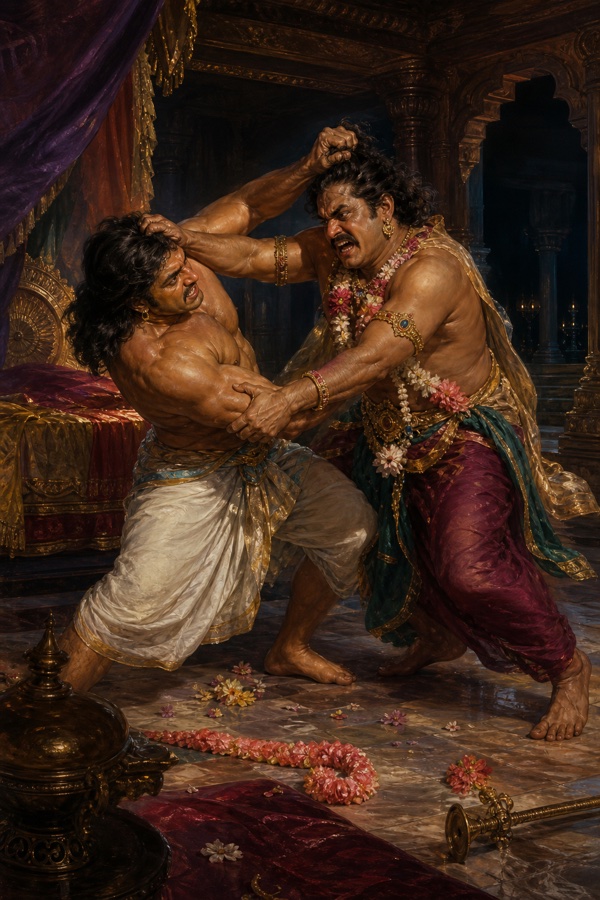
With that Bhima rose up suddenly from the bed, and he was laughing. “Your sister is going to see you dragged along the ground by me today, you wretch, the way a lion drags down an elephant the size of a hill. With you dead the Sairandhri will live in peace, and so will we, her husbands.” He seized Kichaka by the hair of his head, garlands and all. Kichaka was a very strong man. He tore his hair free at once and caught Bhima by the arms, and the two of them, both in a rage, went at each other hand to hand, like two great elephants fighting over a female in the spring, or like the monkey brothers Vali and Sugriva in the old days.
Each was as furious as the other and as set on winning. They raised arms that looked like five-headed snakes and attacked with nails and teeth, worked up to a frenzy. Kichaka came on hard, and Bhima did not give a single step. They locked together and dragged each other about like a pair of bulls. With nothing for weapons except their nails and teeth, they fought as savagely as two tigers. They knocked each other down like elephants in rut. Bhima got a hold on Kichaka, and Kichaka, with his great strength, threw Bhima off violently. The slap and crack of their arms was as loud as bamboo splitting.
Then Bhima threw Kichaka down inside the room by main force and flung him back and forth as a storm wind flings a tree. Kichaka weakened under it and began to shake. Even so he hauled at the son of Pandu with all he had left, rocked him a little, drove in with his knees, and brought him down to the floor. Bhima was up again instantly, like Yama with his club in his hand. So the Suta and the Pandava, each drunk on his own strength and each daring the other, grappled at midnight in that empty place. They roared at one another, and at every roar the building, well made and solid as it was, shook.
Bhima struck him on the chest with his open hand. Kichaka, blazing with anger, did not move a pace. He bore that blow, which nothing on earth could bear, for a moment only. Then Bhima’s strength overcame him and his own began to go. Bhima saw him fading, pulled him in against his chest, and pressed hard. Breathing heavily again and again in his fury, he took hold of Kichaka by the hair once more, and he roared like a hungry tiger that has brought down a large animal. Finding him completely spent, he locked his arms around him the way a man ropes a beast.
For a long time then he whirled Kichaka around, senseless, and the sound that came out of the man was terrible, like a cracked trumpet. To quiet Draupadi’s anger, Bhima caught him around the throat with his arms and squeezed. Every limb of Kichaka’s body was already broken, and his eyelids had closed. Bhima drove his knees into his waist and killed him as a man kills a beast. When he saw that Kichaka no longer moved at all, the son of Pandu rolled the body over and over on the ground. “I have killed the wretch who meant to violate our wife, the thorn in the Sairandhri’s side,” he said. “I have paid the debt I owed my brothers, and I am entirely at peace.”
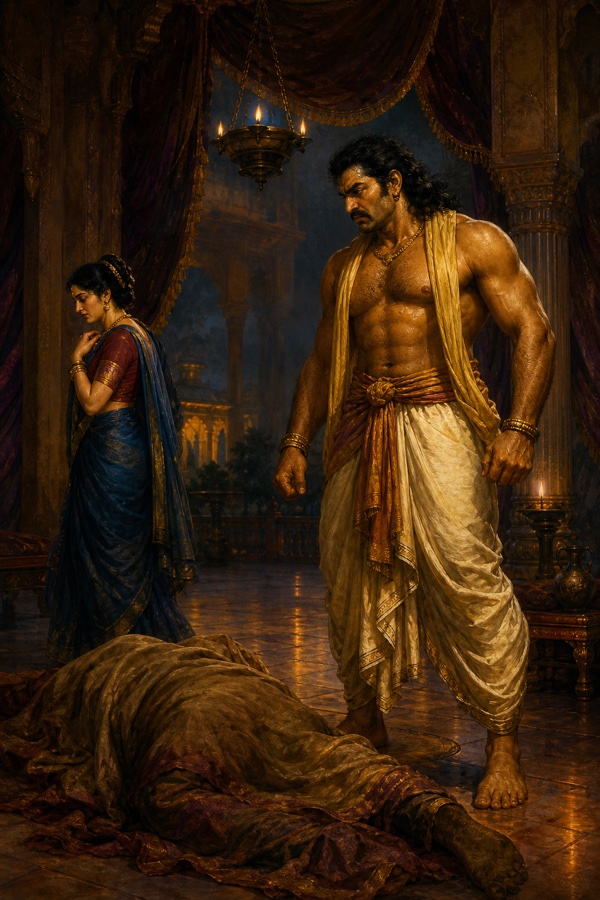
Having said so, with his eyes red, he let go of Kichaka. The clothes and ornaments had been torn from the body, the eyes were rolling, and it was still twitching. Bhima wrung his own hands and bit his lip in rage, and went at his enemy again. He drove the arms and the legs and the neck and the head into the trunk, as the god who carries the bow Pinaka once crushed out of shape the deer whose form Sacrifice had taken to escape his anger. When every limb was crushed and what was left was a ball of flesh, he showed it to Draupadi. “Come here, princess of Panchala, and see what has become of that lecher,” he said, and he pressed the body under his feet.
He lit a torch and showed her Kichaka’s body by its light. “Anyone who comes asking for you, good as you are and gentle as you are, will be killed by me as this Kichaka has been.” He had done the hard thing she wanted so much, and with Kichaka dead his own anger was quiet. He said goodbye to the daughter of Drupada and went quickly back to the kitchen. Draupadi had brought about Kichaka’s death, and her grief was gone, and she was as glad as she had ever been. She called out to the keepers of the dancing hall. “Come and look at Kichaka, who went after other men’s wives. He is lying here, killed by my Gandharva husbands.”
The guards of the hall came at her call by the thousand, with torches in their hands. They went into the room and saw Kichaka lying dead on the floor, soaked in blood, with no arms and no legs to be seen, and they were stricken. They stared at him in amazement. It was more than any man could have done. “Where is his neck?” they said. “Where are his legs?” And seeing him like that, they all concluded that a Gandharva had killed him.
A key to reading this (numbers and signs): Kichaka’s morning offer is a hundred nishkas, a hundred men and a hundred women as servants, and carriages drawn by she-mules; Draupadi has already told Bhima that Yudhishthira used to give away a thousand nishkas every day. The half day before the meeting feels as long as a month to her, while Kichaka’s beauty brightens like a lamp wick about to go out. The guards find a body whose neck and limbs cannot be seen and decide that a Gandharva did it, and that conclusion is what keeps the six of them hidden. The tree Bhima will uproot next is ten vyamas long, a vyama being the reach of a man’s two arms stretched wide.
The Resolve of Kichaka’s Kinsmen, and the End of One Hundred and Five at Bhima’s Hands
Then Kichaka’s relatives arrived, all of them. They saw him and stood around him on every side and wailed aloud. He lay with every limb mangled, like a tortoise that has been dragged out of the water onto dry ground, and the sight terrified them so that the hair rose on their bodies. Bhima had crushed him all over, as Indra crushes a Danava. They lifted him to carry him outside for the funeral rites, and it was then that those men of the Suta clan caught sight of Draupadi close by, standing with her back against a pillar.
The assembled Kichakas cried out together. “Kill this unchaste woman! Kichaka lost his life for her. Or do not kill her here. Let us burn her with the man who wanted her. We owe the dead son of the Suta whatever would please him.” They went to Virata. “Kichaka died on her account, so let him be cremated along with her. You must give us leave.” King Virata knew very well what the Sutas’ strength amounted to, and he gave his consent to the Sairandhri’s being burned with the Suta’s son.
Draupadi was frightened and dazed. The Kichakas seized her roughly, tied her, laid her on the bier, and set off for the burning ground at a great pace. As those sons of the Suta clan carried her away by force, she cried aloud for her husbands to help her. “Let Jaya hear me, and Jayanta, and Vijaya, and Jayatsena, and Jayadbala! The Sutas are taking me away. Let those quick-handed Gandharvas hear me, whose chariots rattle and whose bowstrings sound like thunder in the thick of battle. The Sutas are taking me away!”
Bhima heard that cry and those laments, and he was off his bed without stopping to think. “I have heard what you said, Sairandhri. You have nothing more to fear from the Sutas.” Meaning to kill the Kichakas, he let his body swell. He changed his clothes with care and left the palace by a way that was no proper exit. He got over a wall with the help of a tree, and once over it and outside the city he ran hard for the burning ground, where the Kichakas had gone.
On the way to the pyre he saw a big tree, as tall as a palmyra palm, with huge limbs and a withered crown. It measured ten vyamas. He put his arms around it, pulled it out of the ground as an elephant would, and laid it on his shoulder. With that tree, trunk and branches together, he ran at the Sutas like Yama coming with his club. The force of his thighs as he ran brought down banyans and peepals and kinshukas, and they lay in heaps behind him.
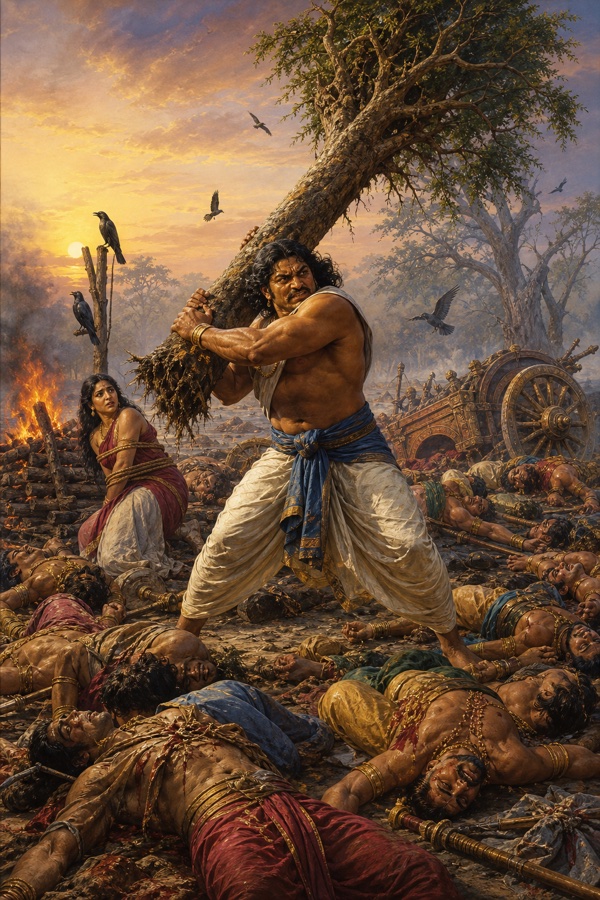
The Sutas saw the Gandharva coming at them like an angry lion, and every one of them began to shake, and panic took hold. “The mighty Gandharva is coming, furious, with a tree held up in his hand,” they said to each other. “Let the Sairandhri go. She is where this danger comes from.” They looked at the tree Bhima had torn up, let Draupadi loose, and ran for the city, gasping. Bhima, the son of the Wind, saw them running, and with that tree he sent a hundred and five of them to the house of Yama, as the god of the thunderbolt cuts down the Danavas.
He untied Draupadi and comforted her. Her face was wet with tears. “This is how men die who wrong you without cause, timid one,” he said. “Go back to the city, Draupadi. There is nothing left for you to fear. I will get to Virata’s kitchen by another road.” So a hundred and five of the Kichakas were killed. Their bodies lay across the ground and made it look like a great forest flattened by a storm, with the trees torn up and scattered. With Virata’s general, killed earlier, the count of the dead Sutas came to one hundred and six. The men and women who had gathered saw what had been done, and they were so astonished that not one of them could speak.
The gist: Kichaka’s kinsmen find Draupadi beside his body and ask Virata’s leave to burn her with him, and Virata, who knows the strength of the Sutas, consents. Tied to the bier, she calls on her husbands by their secret names. Bhima goes over the palace wall, pulls up a tree ten vyamas long, and kills a hundred and five Kichakas as they run for the city, which with the general makes one hundred and six dead. Everyone who sees it believes a Gandharva has done it.
The City’s Fear, Draupadi’s Return, and a Secret Exchange
The townspeople saw the Sutas lying dead and went to the king to tell him. “King, those powerful sons of the Sutas have all been killed by the Gandharvas. They are strewn over the ground like great mountain peaks split by thunder. And the Sairandhri has been set free and is coming back to your palace in the city. If she comes, your whole kingdom is in danger. She is very beautiful, the Gandharvas are very strong, and men, there is no doubt of it, are given to lust. Think of something quickly, so that the kingdom is not destroyed for wrongs done to the Sairandhri.”
Virata heard them out. “See to the last rites of the Sutas,” he said. “Burn all the Kichakas on one blazing pyre, with gems and fragrant unguents in plenty.” Then, frightened, he went to his queen. “When the Sairandhri comes back, Sudeshna, give her this message from me: ‘Blessings on you, fair-faced Sairandhri. Go wherever you please. The king is alarmed by the defeat he has already suffered at the hands of the Gandharvas. You are under their protection, and I do not dare say this to you myself. A woman can give no offense, and so I say it through a woman.’”
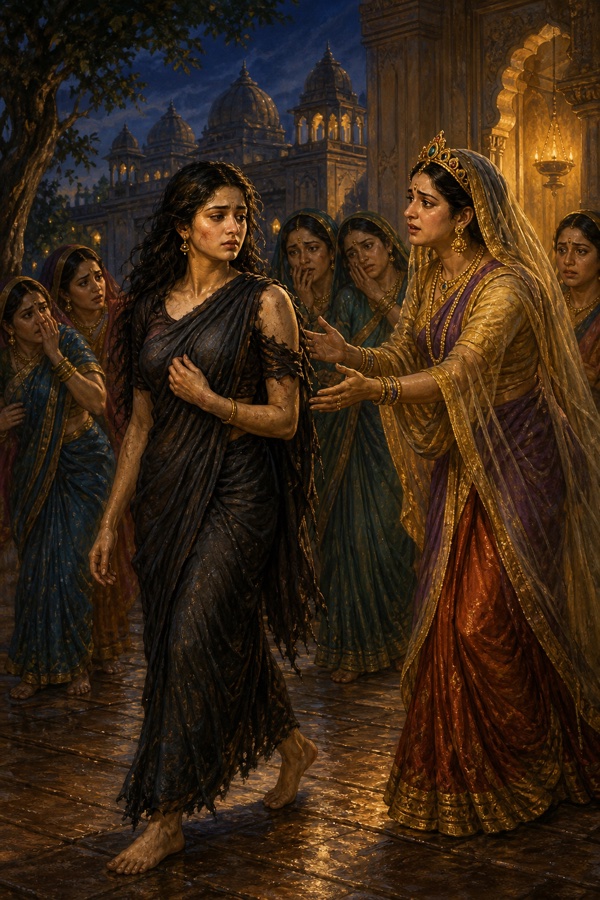
Draupadi, freed by Bhima after the killing of the Sutas and with her fears behind her, washed her limbs and her clothes in water and walked back toward the city like a doe that a tiger has frightened. The townspeople saw her and scattered in every direction for fear of the Gandharvas. Some of them went so far as to shut their eyes. At the door of the kitchen she saw Bhima standing, as huge as a great elephant in rut. She looked at him with wide, wondering eyes and spoke in words that only the two of them would understand. “I bow to the prince of the Gandharvas, who rescued me.” Bhima answered in the same way: the Gandharvas had been living in that city in obedience to her, and now that they had heard her say so, they would go about it with their debt paid.
After that she saw Arjuna in the dancing hall, teaching King Virata’s daughters to dance. The girls came out of the hall with him and went up to Draupadi, who had been so cruelly treated though she had done nothing. “What good luck, Sairandhri, that you are out of danger,” they said. “What good luck that you have come back safe, and that those Sutas are dead who wronged you when you were innocent.”
“How did you get free, Sairandhri?” Brihannala asked. “And how were those wicked men killed? I want to hear all of it from you, just as it happened.”
“Fortunate Brihannala, you spend your days pleasantly in the girls’ apartments,” the Sairandhri said. “What is a Sairandhri’s fate to you? You have none of her griefs to carry. That is why you can question me like this, when I am in distress, to make fun of me.”
“Brihannala has sorrows of her own, fortunate one, and they have no equal,” Brihannala said. “She has been brought as low as an animal. You do not understand that, girl. I have lived beside you, and you have lived with all of us. When you are in misery, who would fail to feel it? Yet no one can read another’s heart all the way through, and that is why, gentle one, you do not know mine.”
Draupadi went on into the royal house with the girls, to present herself to Sudeshna. When she stood before her, Virata’s wife spoke as the king had ordered. “Go quickly, Sairandhri, wherever you wish to go, and good fortune go with you. The king is full of fear after this defeat at the hands of the Gandharvas. You are young, there is no beauty on earth to match yours, and men desire you. And the Gandharvas are very quick to anger.”
“Lovely lady, let the king put up with me here for only thirteen days more,” the Sairandhri said. “The Gandharvas will certainly be grateful for it. After that they will take me away, and they will do what Virata would wish. If the king allows this, he and his friends will without doubt gain a great deal by it.”
A key to reading this (a concept): Bhima speaks twice of a debt. Over Kichaka’s body he says he has paid what he owed his brothers; at the kitchen door, in words meant for Draupadi alone, he says that the Gandharvas who obey her have done no more than repay one. The night before the killing he told her that only half a month of the thirteenth year remained. Now she asks the queen for thirteen days and promises that at the end of them the Gandharvas will take her away and do Virata a service.
The gist: The townspeople tell Virata that the Gandharvas have killed the Sutas and that the Sairandhri’s return endangers the kingdom. The king has all the Kichakas burned on one pyre and, afraid to speak to her himself, has Sudeshna tell her to leave. Draupadi comes back through a city that runs from her, exchanges a guarded word with Bhima at the kitchen door and another with Brihannala among the dancing girls, and asks the queen for thirteen days more.
Source: the Mahabharata of Krishna-Dwaipayana Vyasa, Virata Parva, Pandava-pravesha and Kichaka-vadha sub-parvas, Sections 1 to 24. The Sanskrit e-text, the Gita Press Hindi edition, and Kisari Mohan Ganguli’s complete English translation were used to verify names, sequence, and principal events. Where the recensions differ, this English retelling follows Ganguli, and the Hindi edition follows Gita Press.
Based on: the Mahabharata, Vedavyasa (K. M. Ganguli’s English translation; Gita Press, Gorakhpur)