On this page
The swift journey and the knowledge of dice
Rituparna summoned Vahuka after hearing Sudeva’s message. He spoke gently to the man whose skill with horses he needed. “You know how to train and drive them. If you are willing, I want to reach Damayanti’s svayamvara within a single day.” Nala felt as though his heart would burst. At her first svayamvara, Damayanti had faced 5 figures wearing his appearance. Four were gods who wanted her as their bride; she had prayed to distinguish them and placed her garland on the mortal man she loved. Now, while that man stood before Rituparna under another name and in another form, the king was asking him to drive to her choice of a new husband. Perhaps grief had blinded Damayanti. Perhaps she had devised this extraordinary plan for his sake. He had deceived her. The guilt for leaving her belonged to his own sinful, foolish conduct; she had been innocent. Yet the act she now intended seemed cruel to him, and the thought of it burned. He thought of the inconstancy people attributed to women. Then he turned the accusation back toward his own great offense. Their separation might have extinguished her love. Yet she was grieving because of him, and she was the mother of his children. Surely she would never do this. He could settle the question only by going to Vidarbha himself. The journey would serve both Rituparna’s purpose and his own. With sorrow still in his heart, he joined his hands and agreed. “I will obey. I will take you to Vidarbha’s city in one day.” He went to the stables. Rituparna kept urging haste, but Nala examined the horses carefully before choosing. The animals he selected came from Sindhu. There was little flesh on them, but they had strength and the endurance a long journey demanded. Their breeding was excellent, their energy abundant, and they would answer a driver obediently. Those qualities mattered to the man who had promised to bring the king to Vidarbha within the day. Their nostrils were wide and their cheeks full. Nala examined the markings on their coats, including the 10 whorls where the hair curled around a center. He found no unfavorable sign, no fault in the whorls by which their fitness was judged. They could run like the wind. The king grew irritated at the choice. “What are you doing? Don’t make a joke of this. These horses look weak and short of breath. How can they carry us so far?” Vahuka explained the markings he had examined. “Each has 1 whorl on the forehead, 2 at the temples, 4 on the sides, 4 on the chest, and 1 on the back. They can certainly reach Vidarbha. If you prefer others, point them out and I will harness them.” Rituparna yielded to his expertise and told him to harness whichever animals he trusted, quickly.
Nala yoked 4 of the excellent, swift, obedient horses to the chariot. The king mounted immediately, and the horses sank to their knees. Nala soothed them, raised them with the reins, and brought Varshneya aboard. Then he urged the team forward. The same team that had just sunk to its knees now rose into the air. Rituparna was astonished. Under Vahuka’s direction, the horses he had thought too weak for the journey were pulling him forward with the speed of the wind. Varshneya listened to the chariot’s rattle and watched the handling of the team. Who was this driver? Could he be Matali, who drove for Indra, king of the gods? Vahuka showed the same extraordinary skill. Could Salihotra, the master of horse lore, have taken this beautiful human form? Or was this Nala himself, the king who conquered enemy cities? Perhaps Vahuka simply possessed the same knowledge. He was Nala’s age, although that alone proved little; someone else might be equally skilled. Still, distinguished men sometimes traveled in disguise, forced into concealment by misfortune or following the prescriptions of sacred teaching. An unattractive appearance should not settle the matter. Nala might have lost his familiar features. The age was right, the face was different, and Vahuka possessed every accomplishment. Varshneya’s thoughts returned to Nala. His former charioteer became absorbed in that possibility. Rituparna, too, delighted in the driver’s expertise. The care he took, his energy, and the way he held the reins gave the king enormous pleasure. They sped over rivers, mountains, woods, and lakes like a bird crossing the sky.
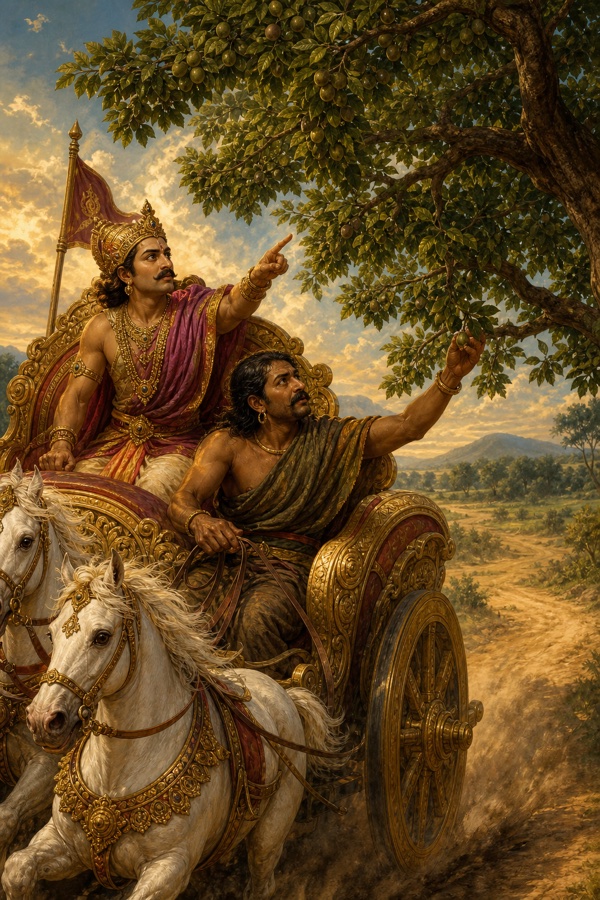
Rituparna’s upper garment fell from the moving chariot. He immediately asked Vahuka to stop the horses so that Varshneya could retrieve it. “It is already far behind us,” Nala replied. “We have traveled a yojana since it fell. It cannot be recovered now.” A whole yojana, several miles of distance, already separated them from the fallen cloth. A little later they came upon a fruiting vibhitaka tree. Rituparna pointed it out, offering a demonstration of his own skill. “No one knows everything. No single person has mastered every branch of knowledge. Now see what I can do with numbers. The leaves on the ground exceed those on the tree by 101, and the fallen fruits also exceed those still on it by 101. Those 2 branches hold 50 million leaves and 2,095 fruits. Examine the branches and all their smaller boughs.” Vahuka stopped the chariot. “You claim a skill I cannot verify by looking. I will cut down the tree and count for myself. Then I will know by direct observation. I cannot yet say whether your figures are right. Let Varshneya hold the reins while I count the fruits and leaves in your presence.” Rituparna protested that there was no time. Vahuka answered respectfully that he needed only a short while. If the king could not wait, Varshneya could drive him onward; the road was straight and level. Rituparna tried to persuade him. “You are the only driver who can do this. I am relying on you to get me to Vidarbha. I place myself in your hands. Don’t obstruct the journey. Take me there today so that I may see the sun rise there, and I will grant whatever you wish.” Vahuka insisted that he would continue after the count. At last the king reluctantly agreed. Counting the leaves and fruits on part of the branch, he said, would be enough to establish the truth.
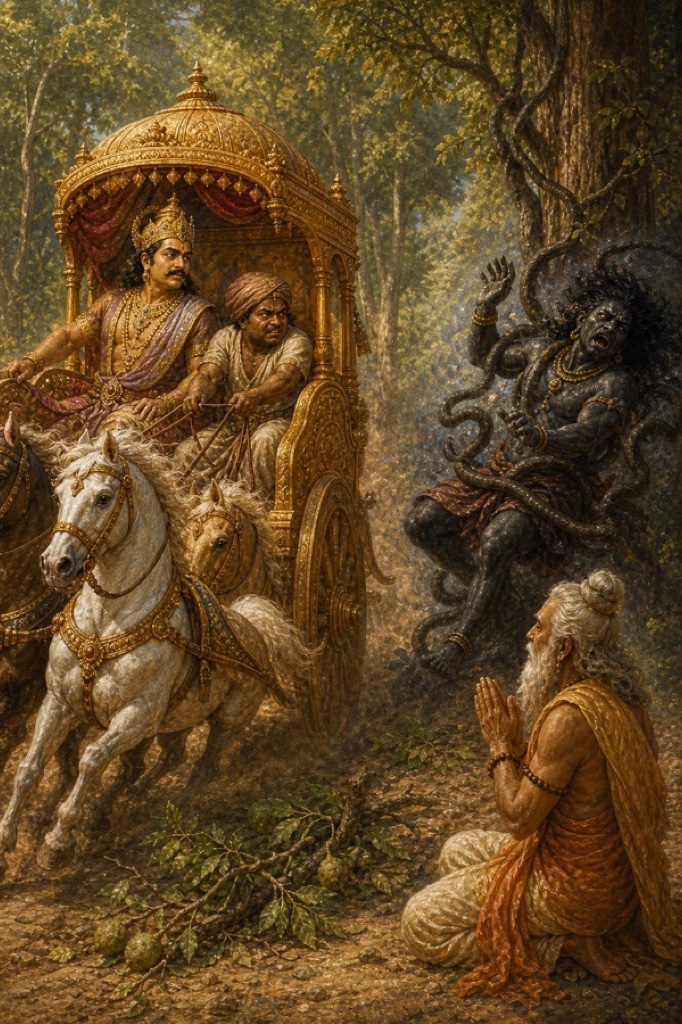
Vahuka quickly stepped down and felled the tree. His calculation of the fruits confirmed Rituparna’s number. Astonished, he asked to learn the method. The king, still intent on reaching Vidarbha quickly, told him that he was skilled at dice as well as numbers. Vahuka offered the exchange Karkotaka had foretold. He had arrived in Ayodhya possessing the knowledge of horses. Rituparna held the other knowledge the serpent had told him to seek: command of the dice that had taken his kingdom from him. Karkotaka had promised that learning it would open the way to his wife, his children, and his kingdom again. “Teach me that knowledge, and take my knowledge of horses in return.” The success of Rituparna’s journey depended on the driver’s goodwill, and he wanted that mastery of horses. He agreed. “Receive the knowledge of dice you have asked for. Keep the horse lore that is to be mine in trust for me.” He then imparted the knowledge to Nala. As Nala learned it, Kali came out of his body, repeatedly vomiting Karkotaka’s powerful venom. Damayanti’s curse had tormented Kali; as he emerged, its burning force also left him. Nala had suffered under that possession for a long time, afflicted as though he were a man without spiritual discipline. Freed of the poison, Kali recovered his own form. Nala’s anger rose, and he prepared to curse the being who had brought him so much misery. Kali trembled, joined his hands, and pleaded for restraint. “Control your anger. I will make you renowned. Indrasena’s mother cursed me when you left her. Since then I have lived inside you in terrible distress, burning night and day from the serpent king’s venom. I seek your protection. If you spare me your curse now, when I am afraid and have come to you for refuge, anyone who recites your story attentively will have nothing to fear from me.”
Nala restrained his anger. When Damayanti woke alone in the forest, she had cursed the unknown being who had brought her husband to that misery. Now that being stood before Nala asking protection. Her curse and Karkotaka’s venom had tortured him inside the king; the promise he offered in return for mercy would protect those who told the king’s story. The frightened Kali entered the vibhitaka tree. Throughout the conversation, no one else could see him. Nala had finished counting its fruits and was now free of the affliction within him. With great joy and renewed energy, he climbed back into the chariot and urged the swift horses forward. Kali’s touch brought the vibhitaka tree into disrepute from that time onward. Nala drove toward Vidarbha, his heart glad, while the horses sprang repeatedly into the air like winged creatures. After the chariot had gone far away, Kali returned to his own abode. The king of the Nishadhas was free of the calamity Kali had caused. His familiar appearance had not returned; he still traveled in the form of Vahuka.
The gist: Nala drives Rituparna toward Vidarbha at extraordinary speed, while Varshneya begins to suspect his identity. Rituparna demonstrates his command of numbers and teaches Nala the knowledge of dice. Kali leaves Nala’s body, receives mercy, and promises that attentive tellers of Nala’s story will be safe from him.
The familiar sound and the unfamiliar driver
Rituparna reached Vidarbha in the evening. When Bhima received word of his arrival, he invited him into Kundina. The chariot’s rattle filled all 10 directions as it entered the city. Nala’s own horses were there, the team Varshneya had brought with the children, and the sound delighted them as Nala’s presence once had. Damayanti heard it too, deep as the roar of rain clouds. She wondered at the sound. Both she and the horses recognized the clatter they used to hear when Nala drove his own team. Peacocks on the terraces, elephants in their stalls, and the other horses heard Rituparna’s chariot approaching. The elephants and peacocks turned toward it and cried out with the delight that real thunder brought them. Damayanti’s heart answered that familiar sound. “It must be Nala. The rattle fills the earth and makes me glad. If I do not see him, his face bright as the moon, that man of countless virtues, I will die. If he does not hold me today in that embrace that sends a thrill through me, I cannot go on living. If the king with the voice as deep as clouds does not come to me today, I will enter a pyre blazing like gold. If that great king, strong as a lion and powerful as a furious elephant, does not stand before me, my life will end. I cannot remember a single lie he told or a wrong he did to anyone. He never lied even in jest. Nala is noble, forgiving, brave, and magnificent, greater than all other kings. He has kept his marriage vow, without desire for other women. Day and night I think of his virtues. My heart is close to breaking because he is absent.”
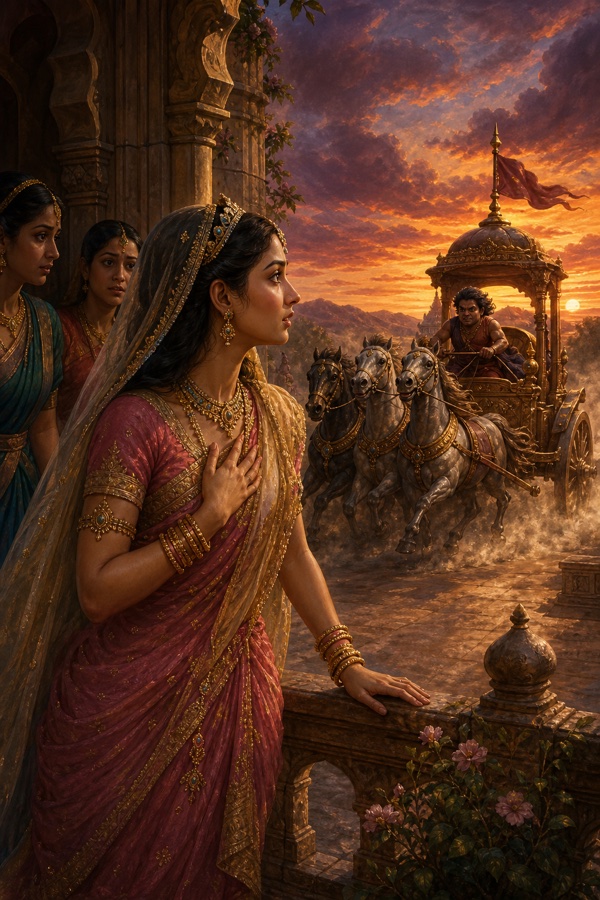
Distracted with longing, Damayanti climbed to the terrace to look for him. In the central courtyard she saw Rituparna on the chariot with Varshneya and Vahuka. The 2 charioteers stepped down, unharnessed the horses, and put the vehicle in its proper place. Rituparna descended too and went to Bhima, who received him with great honor. Such a distinguished guest seldom came without a special occasion. Rituparna looked around repeatedly. A svayamvara had drawn him across the distance from Ayodhya: a royal gathering where Damayanti would choose among the men who had come to seek her. He had arrived to find Bhima welcoming a guest. There was no sign of the ceremony Sudeva had announced. Bhima welcomed him and asked what had brought him, unaware that the visiting king had come to seek Damayanti’s hand. Rituparna saw no other kings or princes. He heard no discussion of a husband-choice ceremony and saw no gathering of brahmins. The intelligent ruler of Kosala considered the situation, then said he had come to pay his respects. Bhima was astonished. His guest had traveled 100 yojanas, passing other rulers and crossing countless countries. A courtesy call scarcely seemed enough to explain such a journey. He thought that the real reason would emerge in time. He continued to honor Rituparna and repeatedly urged him to rest after his exertions. Satisfied with his reception, Rituparna went gladly to the rooms prepared for him, attended by members of the royal household.
After Rituparna left with Varshneya, Vahuka took the chariot to the stables. He released the horses, tended them properly, soothed them himself, and sat beside the vehicle. Damayanti had seen Bhangasura’s royal son, Varshneya of the charioteer line, and the strangely formed Vahuka. She still could not see Nala. Who had produced that unmistakable sound? Perhaps Varshneya had learned Nala’s art and could now make a chariot sound the same. Perhaps Rituparna possessed equal skill. She sent a woman named Kesini to find out. “Go to the unattractive, short-armed driver sitting by the chariot. Approach him carefully, speak pleasantly, and ask the usual questions of courtesy. Learn the truth about him. The contentment I feel, the delight in my heart, makes me suspect that he is Nala himself. After asking about his welfare, repeat the words Parnada spoke and attend closely to the reply.” Kesini approached while Damayanti watched from the terrace. She welcomed the driver and wished him well. “Damayanti asks when you set out and why you came here. Tell me truthfully; the princess of Vidarbha wants to know.” Vahuka said that the king of Kosala had heard from a brahmin about Damayanti’s second svayamvara. He had come with horses swift as the wind, capable of traveling 100 yojanas. Vahuka was his driver.
Kesini asked about the third man who had come with them: where he was from and whose son he was. She asked Vahuka the same questions and how he had come to this work. He identified the other driver. “He was the charioteer of the righteous Nala and is known everywhere as Varshneya. After Nala left his kingdom, Varshneya came to Bhangasura’s son. As for me, I know the science of horses, and that is why I was appointed charioteer. Rituparna himself chose me to drive and cook for him.” Kesini suggested that Varshneya might know where Nala had gone, or might have spoken about him to Vahuka. The answer was firm. “After bringing Nala’s children here, Varshneya went where he wished. He does not know where the king is. No one else knows either. Nala wanders the world in disguise, deprived of his own beauty. Only Nala knows Nala. He never reveals the signs by which he could be identified.” The driver had answered how he earned his position in Rituparna’s household and why Varshneya was there. Asked where Nala could be found, he described a king whose disguise concealed him from everyone. Kesini then repeated the message that the brahmin had taken to Ayodhya. “My beloved gambler, where did you go after cutting away half my cloth and leaving your devoted wife asleep in the woods? As you directed, she waits for you in half a garment, burning with grief day and night. Have compassion on the woman who weeps without ceasing over that misfortune, and answer her.” She urged him to say what Damayanti longed to hear. He had replied to those words before; the princess wanted to hear that answer again.
Nala’s heart ached, and tears filled his eyes. He struggled to contain his grief, then repeated the reply in a voice choked with tears. “Faithful women protect themselves even when disaster strikes, and by that conduct they gain heaven. When their husbands leave them, they do not become angry. Their virtue is the armor in which they continue to live. A woman abandoned by a man overwhelmed by calamity, deprived of judgment, and stripped of every happiness should not be angry with him. A virtuous woman should not resent the man whose garment birds stole while he was trying to find food, the man who is burning with misery. Whether he treated her well or badly, she would not be angry when she saw him deprived of his kingdom and prosperity, suffering from hunger, and overcome by disaster.” As he spoke, his grief became too much to restrain. He began to weep. Kesini returned to Damayanti and reported the whole conversation, including the tears with which Vahuka had answered.
The gist: The arriving chariot sounds like Nala’s, but Damayanti sees only Rituparna, Varshneya, and Vahuka. Rituparna finds no svayamvara and presents his visit as a courtesy call. Sent to question Vahuka, Kesini hears the same reply Parnada brought back and sees the driver’s uncontrollable grief.
The tests, the children, and the reunion
After hearing Kesini’s report, Damayanti sent her back to observe Vahuka quietly. She was to watch every skilled act closely. If he asked for water or fire, she must delay supplying it and see what he did. Whatever seemed human or beyond human power, she was to report it all. His appearance was unfamiliar; his reply and his grief were already known to her. Now she wanted to see how this driver worked when the ordinary means of doing a task were withheld. Kesini returned amazed. She had never seen or heard of anyone with such command over the elements. When Vahuka approached a low passage, he did not stoop; the passage grew taller to let him through. Narrow openings widened before him. Bhima had sent meat from various animals for Rituparna’s meal, and vessels had been set out for washing it. When Vahuka looked at the vessels, they filled with water. He washed the meat and prepared to cook. Taking a handful of grass, he held it in the sunlight, and fire suddenly blazed from it. He touched fire without being burned. Water flowed in a stream at his will. Then he took flowers and slowly pressed them between his hands. They kept their shape and became more beautiful and fragrant. These were the wonders Kesini had hurried back to describe. Damayanti had seen the gods give Nala their gifts after her choice at the svayamvara. Agni had promised to appear whenever Nala wished; Varuna had promised his presence at Nala’s call and garlands of exceptional fragrance. The reports of fire, water, and flowers reached a woman who had been there when those promises were made. Damayanti recognized Nala’s ways in the report and felt that she had almost recovered him. Weeping, she asked Kesini to return once more and secretly bring some of the meat he had cooked. Kesini brought it while it was still hot. Damayanti had often eaten food Nala prepared. She knew its flavor from their life together. Yama too had given Nala a gift at the svayamvara: whatever food he made would have an exceptional taste. She tasted the meat Kesini brought, and what she recognized settled the question for her. Vahuka was Nala. Her husband had been found, and grief broke from her in a cry.
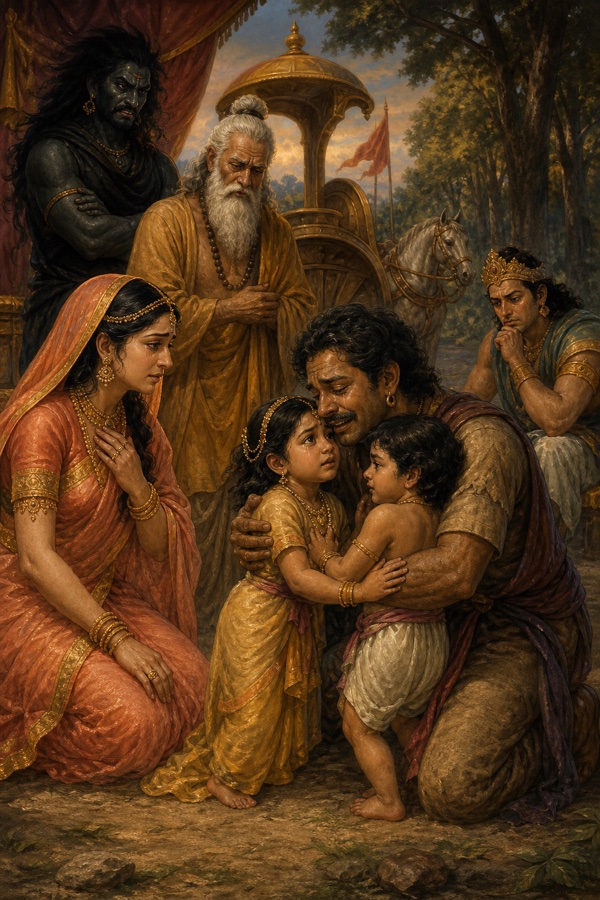
She washed her face and sent her 2 children with Kesini. Vahuka saw Indrasena and her brother, recognized them, and hurried forward. He embraced them and took them onto his lap. These were the twins Damayanti had sent away with Varshneya while the dice game was still consuming their wealth. They had been brought safely to their grandfather in Vidarbha; their father had gone on into exile and separation. Now he held the son and daughter he recognized, children as beautiful as the children of the gods. He wept loudly, his voice deep with sorrow. Again and again his agitation showed. Then he abruptly let the children go and spoke to Kesini. “These twins look so much like my own children. Seeing them unexpectedly brought tears to my eyes. We are visitors from another country. If you keep coming here, people may think badly of it. Go now, without worry.” Kesini reported everything. Eager to see Nala, Damayanti sent her to her mother with another message. “I suspected Vahuka was Nala and tested him in several ways. Only his appearance still leaves room for doubt. I want to question him myself. Let him come into the palace, or let me go to him. Arrange it with Father’s knowledge or without it.” Her mother told Bhima, and he consented. With both parents’ permission, Damayanti had Nala brought to her rooms. The unexpected sight of her overwhelmed him, and he wept. She grieved to see him in that condition. Damayanti wore a red cloth. Her hair was matted, and dirt and dust still covered her. The woman speaking to Vahuka was the wife who had followed Nala when he left his city with one garment. She began with the act that had separated them, putting to this changed man the question she had cried into the forest.
“Vahuka,” she asked, “have you ever known a man who understood duty yet left his wife asleep in a forest? Who except the righteous Nala could abandon a loving, innocent wife exhausted with weariness? What wrong had I done him, from my earliest youth onward, that he should leave me while I slept? I chose him over the gods themselves. Why did he abandon the wife who loved him, who was devoted to him, who had borne his children? Before the fire, in the presence of the gods, he took my hand and promised, ‘I will be yours.’ Where was that vow when he left me?” Tears flowed as she spoke. Nala wept too, from eyes dark as a gazelle’s and reddish at the corners. He answered that Kali had caused both the loss of his kingdom and the abandonment; those deeds, he said, had not been his own. “In the forest, grieving for me day and night, you cursed Kali. After that he remained inside my body, burning from your curse, like fire within fire. Through my observances and austerities, I overcame that wretch so that our suffering could end. He has left me. That is why I have come here. I came for you alone. But could any other woman do as you have done, give up a devoted husband who loves her and choose another? Messengers sent by the king are traveling the earth, announcing that Bhima’s daughter will freely choose a second husband worthy of her. Bhangasura’s son came as soon as he heard it.”
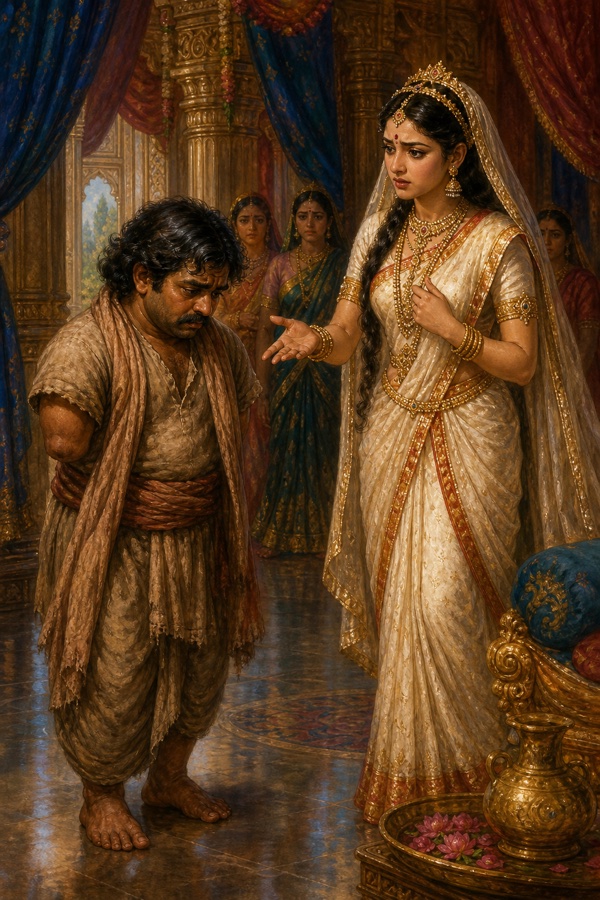
Damayanti trembled with fear and joined her hands. “Do not suspect me of wrongdoing. I passed over the gods and chose you. To bring you back, I sent brahmins in every direction, carrying my words as songs. Parnada found you at Rituparna’s palace in Kosala. When you answered him as you did, I devised this plan to recover you. No one else in the world can drive horses 100 yojanas in one day. Touching your feet, I can swear that I have committed no wrong, even in thought. May the Wind, who moves through the world and witnesses everything, take my life if I have done wrong. May the Sun, who travels the sky, take my life if I have done wrong. May the Moon, who dwells as a witness within every creature, take my life if I have done wrong. Let these 3 gods, who sustain the 3 worlds, speak the truth, or let them abandon me today.” The Wind god answered from the sky. “Nala, she has done no wrong. She has guarded your family’s honor and increased it. We are witnesses; for these 3 years we have protected her. She devised this extraordinary plan for you. No one else on earth could travel 100 yojanas in a day. You have found Bhima’s daughter, and she has found you. Put away your suspicion and be reunited with your wife.” Flowers showered down. A celestial kettledrum sounded, and auspicious breezes began to blow. At these wonders, Nala dismissed every doubt about Damayanti. He remembered Karkotaka and put on the pure garment the serpent king had given him. The clothes had been entrusted to him with a promise: whenever he wished to see himself as he had been, he was to remember the serpent and wear them. Now, before Damayanti, he did so. The appearance that had hidden the king under the name Vahuka fell away, and his own form returned.
Damayanti saw her husband as himself again. She embraced him and wept aloud. Nala held her as he had before, embraced their children, and felt immense joy. She buried her face against his chest and sighed heavily as memories of her suffering returned. He stood holding his dust-covered wife for a while, overcome by sorrow too. Damayanti’s mother gladly told Bhima everything that had happened. He said to leave Nala in peace for the rest of the day. Tomorrow, after Nala had bathed and prayed, Bhima would receive him with Damayanti beside him. Husband and wife spent that night happily, telling one another what had happened to each of them in the forest. They remained in Bhima’s palace, their hearts full of joy, each intent on the other’s happiness. Their reunion came in the 4th year after Nala lost his kingdom. His wishes fulfilled, he experienced the greatest happiness again. Damayanti rejoiced like a field of tender plants receiving rain. Her weariness and anxiety were gone. With her husband restored to her, she shone in her joy like a night illuminated by the bright moon.
The gist: Vahuka’s abilities, cooking, and love for the children reveal Nala. Damayanti confronts him about leaving her; he explains Kali’s possession and questions the second svayamvara. She reveals her plan and invokes divine witnesses. The Wind confirms her fidelity, Nala recovers his own form, and the family is reunited.
The final wager and a brother’s life
The next morning, at the proper time, Nala appeared before Bhima wearing his ornaments, with Damayanti beside him. He greeted his father-in-law humbly; Damayanti then paid her respects to her father. Bhima welcomed Nala as a son, honored husband and wife, and comforted them with fitting words. Nala accepted the welcome and offered Bhima his service. The citizens rejoiced when they learned he had returned. A great sound of celebration rose through the city. Flags, standards, and flower garlands decorated it. The streets were sprinkled with water and adorned with wreaths and other ornaments; people heaped flowers at their gates and decorated temples and shrines. Rituparna heard that Vahuka had been reunited with Damayanti and was glad. He sent for Nala and asked forgiveness. Nala, giving his own reasons, asked Rituparna’s forgiveness in turn. The king of Ayodhya looked at him in wonder. “You have found happiness with your wife again. While you lived in disguise in my house, I hope I never wronged you. If I knowingly caused you any injury, forgive me.” Nala assured him that he had done him no harm. Even if there had been an injury, it had caused no anger and deserved forgiveness. “You were already my friend, and we are related. I will take still greater pleasure in your friendship now. All my wishes were met in your home. I lived there more happily than in my own. The knowledge of horses that belongs to you is still in my keeping. If you wish, I will give it to you now.” Nala imparted the knowledge, and Rituparna received it with the prescribed rites. The exchange begun on the road was complete. Rituparna had taught the knowledge of dice beside the vibhitaka tree, leaving his own instruction in horses in Nala’s keeping until later. He now received that knowledge from the king who had driven him to Vidarbha under another name. Having given Nala the secrets of dice and received the secrets of horses, Bhangasura’s son returned to his own city with another driver.
Nala remained in Kundina for a month. Then, with Bhima’s permission, he set out for Nishadha with a small following: 1 white chariot, 16 elephants, 50 horses, and 600 infantry. Anger filled him as he entered his country without delay, his force making the earth tremble. He approached his brother Pushkara. When their earlier game had consumed everything Nala owned, Pushkara had proposed Damayanti as the next stake. Nala had left without answering him, taking off his ornaments and walking out of the city. Now he returned with the knowledge of dice he had learned from Rituparna, and his own challenge included Damayanti. “We will play again. I have earned great wealth. I will stake Damayanti and everything else I own; you will stake your kingdom. This is my settled decision. Let us put everything on the game, including our lives. The rule is clear: when a man has won another’s wealth or kingdom, he is bound to stake it again if its former owner demands a game. If you have no wish to play with dice, we can compete with weapons. Let single combat settle the matter for one of us. The sages authorize recovering an ancestral kingdom by whatever means the circumstances require. Choose: the dice, or the drawn bow.” Confident of winning, Pushkara laughed. “How fortunate that you have earned more wealth to stake. How fortunate that Damayanti’s bad luck is finally ending, and that you and your wife are still alive. Once I win, she will wear the wealth you have brought and attend me like an Apsara attending Indra in heaven. I remember you every day and have been waiting for you. I find no pleasure in gambling with men outside my own family. When I win beautiful Damayanti today, I will consider myself fortunate indeed. She has always occupied my heart.”
At the boast, Nala wanted to cut off his brother’s head with a curved sword. He smiled, although anger reddened his eyes. “Let us play. Why talk like this now? Defeat me first, and then say what you like.” The game began. With a single throw, Nala won back his wealth and treasures, together with Pushkara’s life, which his brother had also staked. Smiling, Nala addressed the defeated man. “The whole kingdom is mine again, free of opposition. You cannot even look at the princess of Vidarbha now. You and your entire family are reduced to being her servants. But you did not bring about my earlier defeat by your own power. You do not know that Kali did it all. I will not charge you with someone else’s faults. Live happily as you choose. I give you your life, and your share of our father’s kingdom, with everything you need. My affection for you is what it was before. My love for you as a brother will never diminish. Pushkara, you are my brother. Live for 100 years.” He comforted Pushkara, embraced him repeatedly, and gave him permission to return to his own town. Pushkara bowed to Nala and joined his hands. “May your fame never die. Live happily for 10,000 years, you who have given me both life and refuge.”
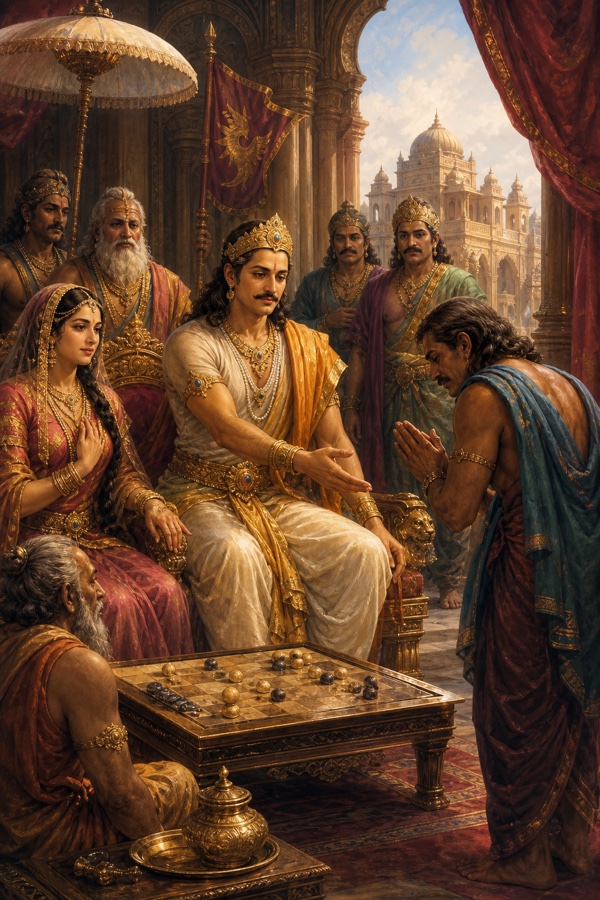
Nala entertained his brother for a month. Then Pushkara returned joyfully to his own town with a large force, many obedient servants, and his relatives. Nala shone like a second sun. He had established Pushkara securely, supplied him with wealth, and freed him from distress. Now he entered his richly decorated palace and reassured the citizens. Joy made the people of both city and countryside tremble. With the officers of state at their head, they joined their hands and addressed him. “Today we are happy throughout the city and the country. We have our ruler again, as the gods have their lord of a hundred sacrifices.” They welcomed Nala as the gods welcomed Indra.
The gist: Nala completes his exchange of knowledge with Rituparna, then returns to Nishadha and challenges Pushkara. One throw wins back the kingdom and gives him power over his brother’s life. He spares Pushkara, restores his share of the inheritance, and resumes his place among a rejoicing people.
What Brihadaswa gives Yudhishthira
Celebrations began in Nishadha, and the city was joyful and free of anxiety. Nala brought Damayanti from her father’s house with a large escort. Bhima, the powerful warrior of generous spirit, honored his daughter and sent her to her husband. She arrived with their son and daughter. Nala lived happily with them, like Indra in the celestial gardens of Nandana. His kingdom was his again, and his fame spread among the rulers of Jambudvipa. He resumed his rule and performed many sacrifices, giving generously to the brahmins. Brihadaswa turned from Nala’s restored household to the king listening in the forest. “You too will soon shine with your family and relatives around you,” he told Yudhishthira. “This is how dice brought Nala and his wife into distress. He endured that terrible suffering alone and recovered his prosperity. You have kept your heart fixed on dharma, and you are enjoying life in this great forest with your brothers and Draupadi beside you. Each day you spend time with fortunate brahmins who know the Vedas and their branches of learning. You have little cause to surrender to sorrow.”
Brihadaswa described the power of the story he had told: the history of the Naga Karkotaka, Damayanti, Nala, and the royal sage Rituparna. “It destroys evil and the influence of Kali. Hearing it can comfort those who suffer as you do. Consider how uncertain the results of human effort are. Do not rejoice over prosperity or grieve over adversity. Take comfort from this story. Do not waste away under misfortune. People who govern themselves consider the unpredictability of destiny and the way effort can fail, and they refuse to let despair master them. Those who repeatedly tell this noble history of Nala, and those who hear it recited, will remain untouched by adversity. Whoever listens to this ancient, excellent story will see their purposes fulfilled and gain fame, sons and grandsons, livestock, high standing, health, and happiness.” Then he addressed the particular fear Yudhishthira carried: a master of dice might challenge him again. Bhima had pressed that danger when he urged immediate war. Even if the brothers fulfilled the exile, he had argued, another summons to the dice could ruin them again. Yudhishthira had refused to shorten his pledged time by calling it complete. Brihadaswa now offered him the knowledge to meet the feared challenge. “I will remove that fear. I know the science of dice in its entirety. I am pleased with you. Receive this knowledge from me, son of Kunti; I will teach it to you.”
Yudhishthira gladly accepted. “I want to learn the science of dice from you.” The sage gave him the knowledge. Yudhishthira had heard how Nala learned the art from Rituparna and won his kingdom back. Now, still in the forest with his own exile to complete, he received that art from the man who had told the story. After imparting it, Brihadaswa left to bathe in the sacred waters of Hayasirsha. Later, brahmins and ascetics came to Yudhishthira from different directions, from pilgrimage places, mountains, and forests. They brought news of Arjuna, the brother whose absence had weighed on him when Brihadaswa arrived. The intelligent warrior who could draw his bow with his left hand was still engaged in the most severe austerities, living on air alone. They said that no one before him had undertaken such fierce discipline. Arjuna, Pritha’s son, also called Partha and Dhananjaya, maintained his vows with a fixed mind and observed complete silence. In that austerity he resembled the blazing god of justice appearing in bodily form. Hearing what his beloved brother Jaya, Kunti’s son, was enduring in the great forest, Yudhishthira began to grieve for him again. With sorrow burning in his heart, the eldest Pandava sought consolation in conversation with the brahmins of varied learning who were staying there with him.
The gist: Nala resumes a happy life with his family and rules again. Brihadaswa uses his story to console Yudhishthira and teaches him dice lore before leaving for Hayasirsha. Reports of Arjuna’s extraordinary austerities then renew Yudhishthira’s concern for his absent brother.
Source: the Mahabharata of Krishna-Dwaipayana Vyasa, Vana Parva. This chapter follows K. M. Ganguli, sections LII-LXXIX (52-79); the Gita Press Hindi edition numbers these chapters differently. Names, order, and events were checked against Ganguli’s complete translation. Dialogue and commentary are adapted, not a verbatim translation. About the sources.
Based on: The Mahabharata, Vyasa (Gita Press, Gorakhpur)
The same story elsewhere
- Arjuna’s austerities and Indra’s realm
The preceding chapter - The pilgrimage with Lomasha
The next chapter