On this page
The elephants at the sleeping camp
Damayanti joined the caravan, still hoping to find her husband. For many days she traveled with the merchants through the dense and dangerous forest. Then they reached a large lake fragrant with lotus flowers. Its banks offered grass, firewood, fruit, and flowers; birds of many kinds lived there. The water was clear and sweet, the place cool and beautiful. The exhausted travelers decided to rest. With their leader’s permission, they spread out through the lovely woods around the lake and made their evening halt. By midnight, the caravan was asleep and everything had fallen quiet. A herd of wild elephants was making its way toward a mountain stream to drink, its water fouled by the fluid from their temples. The herd caught sight of the caravan and the many tame elephants traveling with it. At the sight of those domesticated animals, the wild elephants became furious. With fluid trickling down their temples, they charged, intent on killing them. Their rush was as difficult to withstand as mountain peaks breaking loose and rolling toward the plain. The forest paths around the lotus lake were blocked by the sleeping caravan. The elephants drove into it and began crushing men who lay unaware on the ground.
Cries broke out as the merchants struggled to wake. Still dazed with sleep, they fled into thickets and woods, searching for refuge. Some died on the elephants’ tusks, some under their trunks, and some beneath their feet. Countless horses and camels were killed. Terrified people running on foot killed one another in the crush. Men fell to the ground shouting; others climbed trees or stumbled on uneven ground. The sudden encounter devastated the caravan. An uproar rose that seemed capable of terrifying all 3 worlds. “A great fire has broken out! Save us! Run, quickly!” Other cries urged people to stop. “Why are you running? Pick up the heaps of jewels scattered here!” “All this wealth is worth so little! I am telling the truth.” Someone called again to the distraught travelers to listen and consider what was being said. They ran about in terror, shouting conflicting appeals. Damayanti woke while the slaughter was still going on. She had not foreseen anything like it. At the sight of the destruction around her, she rose almost breathless with fear. The travelers who had escaped injury gathered and began asking what they had done to bring this upon themselves. “We must have failed to worship Manibhadra, or the great and gracious Vaisravana, king of the Yakshas. Perhaps we neglected the deities who bring calamity. Perhaps we failed to honor them before the others. Or was this the evil foretold by the birds we saw? Our stars were not unfavorable. What else could have caused this disaster?”
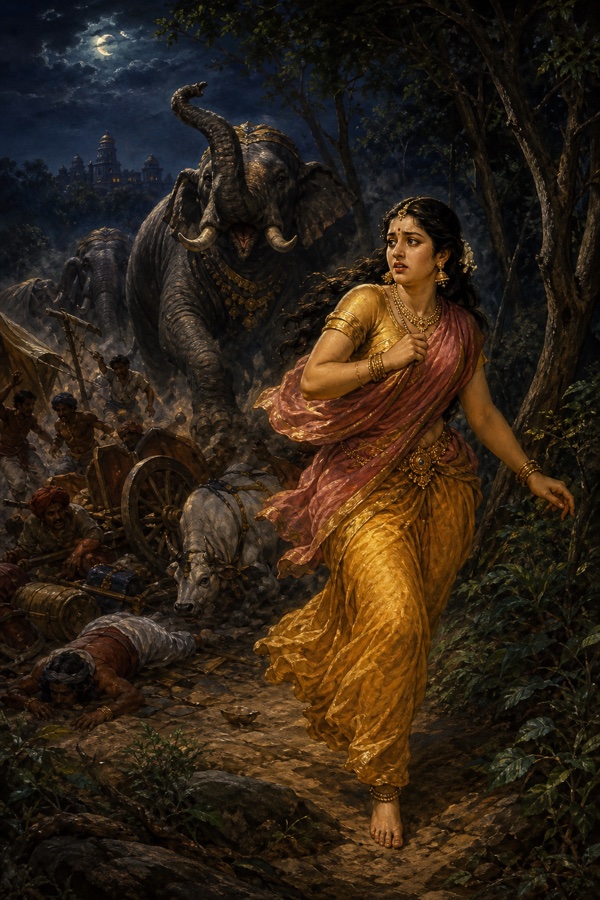
Others had lost both wealth and relatives. They turned their suspicion toward the woman who had joined them in the forest. “That strange, distracted woman looked scarcely human. She arranged this terrible illusion. She must be a Rakshasi, a Yakshi, or a Pishachi. All of this is her doing. There can be no doubt. If we see her again, we will kill her. She has destroyed merchants and brought us endless suffering. We will use stones, dust, grass, wood, and our fists to kill her.” Damayanti heard the threats. Fear, shame, and anxiety drove her back into the woods, where she began reproaching herself. “The divine anger against me is terrible. Peace follows me nowhere. What wrong have I done to deserve this? I cannot remember causing anyone even the smallest injury in thought, word, or deed. What action of mine has brought this result? I must have committed great sins in a former life. My husband has lost his kingdom and been defeated by his own family. I have been separated from him and from my son and daughter. I have no protector, and I am here in a forest filled with beasts of prey.” Her search for an explanation turned inward as the merchants’ accusations had turned toward her. On the following day, the surviving travelers left the camp, mourning the brothers, fathers, sons, and friends they had lost. Damayanti grieved for them too. “What have I done? In this lonely forest I found a company of people, and a herd of elephants destroyed them. Surely my misfortune brought it about. I must have a long time of suffering still before me. I have heard elders say that no one dies before the appointed hour. That must be why the elephants did not trample me to death. Everything that happens to people comes through destiny. Even as a child, I committed no wrong in thought, speech, or action that could have brought such suffering. Perhaps the guardians of the worlds have caused this separation from my husband. They came to my svayamvara, and I passed them over for Nala.” In her grief, she returned to the choice she had made before the gods and wondered whether her suffering had begun there.
The gist: Wild elephants charge the caravan’s tame elephants and crush the sleeping camp. Some survivors blame Damayanti and threaten to kill her. She escapes into the woods, grieving for the dead and searching for a reason for the misfortunes that keep overtaking her.
Shelter on Damayanti’s terms
Damayanti left with the brahmins who had survived the destruction of the caravan. They were men learned in the Vedas. Still devoted to Nala, pale as the autumn moon and burdened with sorrow, she traveled quickly in their company. Toward evening they reached the great city of Suvahu, the truthful king of the Chedis. She entered it wearing half a garment. The citizens saw a frightened, thin, unhappy woman with disheveled hair and dust on her body, moving through the streets like someone distracted from her senses. Curious boys began following her. By the time she reached the king’s palace, they surrounded her. From a terrace above, the king’s mother saw the crowd and the solitary woman at its center. She sent her nurse to bring Damayanti up to her. “That woman has no one to help her, and the crowd is tormenting her. She is in distress and needs protection. Yet her beauty seems to light up my house. She looks distracted, but with those large eyes she could be Shri herself.” The queen mother saw in the dusty stranger a likeness to the goddess of beauty and prosperity. The nurse went down, dispersed the crowd, and brought Damayanti to the terrace. Astonished by her appearance, she began to question her. “Even in this terrible distress, you are beautiful. You shine like lightning among clouds. Who are you? Whose family do you belong to? You wear no ornaments, yet your beauty seems beyond anything human. You have no one to protect you, and still the insults of those men have not shaken you.”
Damayanti answered the nurse. “I am a human woman, devoted to my husband. I am a serving woman from a good family. I live wherever I choose, eating roots and fruit, without a companion. I stop wherever evening finds me. My husband has countless virtues and was always devoted to me. I loved him deeply too and followed him like his shadow. Then he became desperately caught up in a game of dice. After losing, he went alone into the forest. I accompanied him, comforting him as he wandered in a single garment, distracted and overwhelmed by disaster. Hunger, thirst, and grief tormented him. At one point, circumstances forced him to lose even that one covering in the woods. He had no clothes and seemed to have lost his judgment. I followed him, wearing one garment myself. I went without sleep for nights at a time. Many days passed that way. At last, while I was sleeping, he cut away half my cloth and left me, although I had done him no wrong. I am searching for my husband, but I cannot find him. His coloring is like the fine filaments of a lotus. He holds my heart and brings it joy; his bearing is like a god’s. I cannot set eyes on the man I love. Day and night I burn with grief.” Tears filled her eyes, and sorrow caught in her voice as she spoke. The king’s mother now addressed her directly. “Stay here with me. I am pleased with you. My men will search for your husband. Perhaps, in the course of his wanderings, he will come here himself. If you remain here, you will find him again.”
Damayanti was willing to stay, but she set out the conditions under which she could accept the queen mother’s protection. “Mother of heroes, I will live with you if you agree to these terms. I will not eat food left on anyone’s plate. I will not wash anyone’s feet, and I must not be required to converse with other men. If a man seeks me as a wife or lover, you must punish him. If he persists and approaches me again and again, that wicked man must be put to death. This is the vow I have taken. I do wish to speak with the brahmins who will go out to search for my husband. If you can grant all this, I will certainly stay. Otherwise, I cannot bring myself to live here.” The queen mother accepted gladly. “I will do everything you ask. You have done well to take such a vow.” Then she called her daughter Sunanda. “Take this woman, who is like a goddess, as your Sairindhri. She is your own age. Let her be your companion, and enjoy her company without care.” As a Sairindhri, Damayanti would have a place among the women who attended a royal woman’s person, arranging her hair, making garlands, and preparing sandal paste. The position gave her the treatment of a close companion, with the personal limits the queen mother had just promised to uphold. Sunanda welcomed her cheerfully. Accompanied by her other attendants, she took Damayanti to her own rooms. Damayanti was treated with respect. Her needs and wishes were met, and she settled into the household content with the arrangements, free of anxiety there.
The gist: Chedi’s queen mother gives Damayanti refuge and promises to help find her husband. Damayanti secures clear conditions protecting her vow and her person. She joins the queen mother’s daughter Sunanda as a Sairindhri and companion, treated with respect.
Karkotaka’s bite and the name Vahuka
After leaving Damayanti, Nala came upon a great fire raging in the dense forest. From inside it, a creature called his name again and again. “Nala, righteous king, come here!” He answered, “Don’t be afraid,” and went into the fire. There he found a mighty Naga lying coiled on the ground. The serpent trembled and joined his hands in appeal. “I am Karkotaka. I deceived the great sage Narada, whose power comes from his austerities, and in anger he cursed me. He said, ‘Remain here, unable to move, until Nala carries you away. At the place where he takes you, you will be freed from my curse.’ Because of that curse, I cannot move even a step. Save me, and I will tell you what will help you. I will be your friend. No serpent is my equal, and I will be light in your hands. Pick me up and get out of here quickly.” Karkotaka shrank to the size of a thumb. Nala lifted him and carried him out of the burning forest to an open place beyond the fire. He was about to put the serpent down when Karkotaka spoke again. “King of the Nishadhas, walk a little farther and count your steps. I am going to do you a great service.” Nala began counting. At the 10th step, the serpent bit him. His appearance changed at once. He looked at himself in astonishment, then saw Karkotaka take on his own full form again.
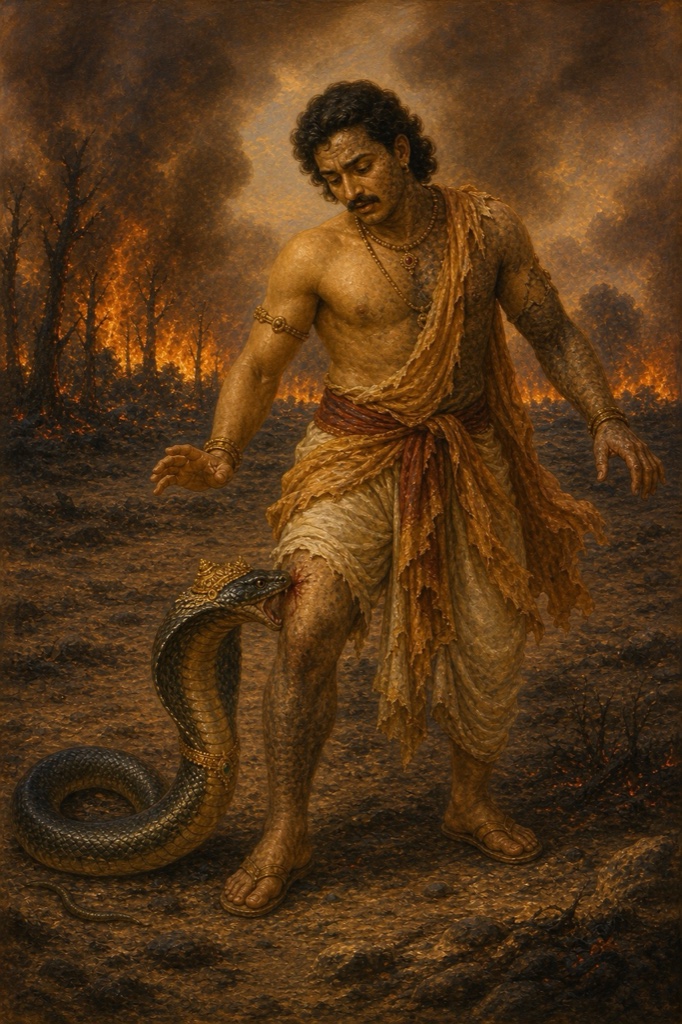
The serpent reassured him. “I have taken away your beauty so that people will not recognize you. The being who deceived you and brought you to this misery will remain inside you, tormented by my venom. As long as he stays, the poison filling every part of your body will cause him pain. I have saved you from the one who acted against you out of anger and hatred, although you were innocent and had done nothing to deserve it. Through my favor, you will no longer need to fear creatures with fangs, your enemies, or even brahmins learned in the Vedas. My poison will cause you no pain. You will always be victorious in battle. Set out this very day for the beautiful city of Ayodhya. Present yourself to its king, Rituparna, who is skilled at dice, and say, ‘I am a charioteer named Vahuka.’ He will give you his knowledge of dice in exchange for your knowledge of horses. He comes from the line of Ikshvaku and is a prosperous king. He will become your friend. Once you are an expert at dice, prosperity will return to you. You will meet your wife and children again, and you will regain your kingdom. What I am telling you is true. Don’t let sorrow occupy your mind. When you want to recover your own appearance, remember me and put on this clothing. Wearing it will restore your true form.” Karkotaka gave Nala 2 pieces of celestial cloth. Having shown him the way forward and provided the means to recover his appearance, the serpent king vanished. The poison would work on the being inside Nala; the changed appearance would allow the king himself to go unrecognized.
Nala set out for Ayodhya and entered Rituparna’s city on the 10th day. He went before the king under the name Karkotaka had given him. “My name is Vahuka. No one in the world equals me at handling horses. You may also consult me in difficult matters and in anything requiring skill. I surpass others at cooking. Whatever the art, whatever task is hard to accomplish, I will work to succeed at it. Rituparna, take me into your service.” The king welcomed him. “Stay with me, Vahuka, and may all go well for you. You will have the chance to do everything you have described. I have always especially wanted to travel fast. Find a way to make my horses swift. I appoint you superintendent of my stables, with a salary of 10,000 coins. Varshneya and Jivala will work under your direction. You will live happily in their company. Stay here.” So Nala entered Rituparna’s household, where he was treated with respect. Varshneya, the charioteer who had taken Nala’s children to their grandfather in Vidarbha, had already found work in Ayodhya. Now he and Jivala became the companions of the man presented to them as Vahuka. Nala’s identity remained unknown. Every evening, remembering Damayanti, he recited a verse: “Where does she lie, helpless, hungry, thirsty, and worn out, thinking of that wretch? Whom does she serve now?”
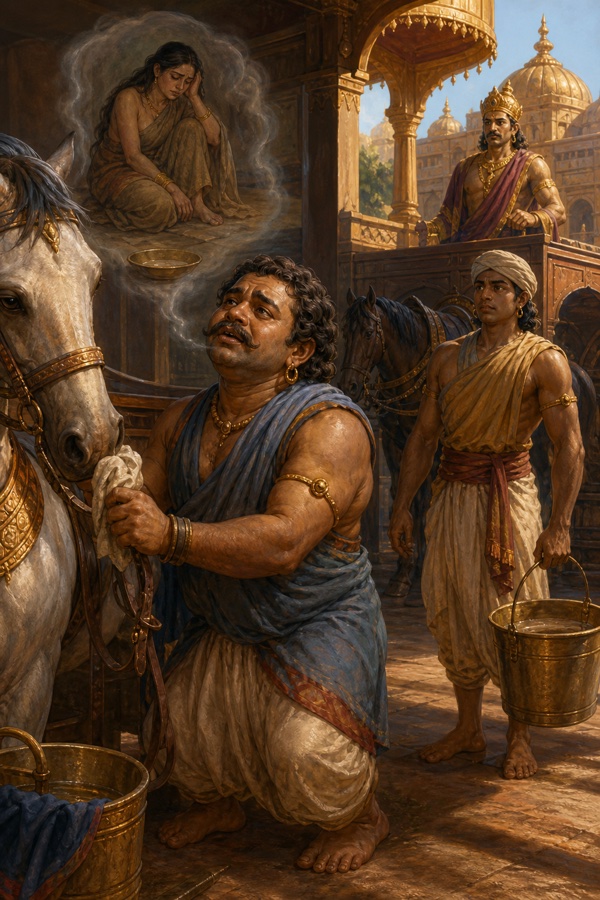
One night Jivala heard him repeat it and asked whom he mourned every day. “Vahuka, I want to understand. Whose wife is the woman you grieve for like this?” Nala answered by speaking of himself as another man. “There was a foolish man whose wife was known to many people. He was a wretch who broke his promises. For a certain reason, that wicked man became separated from her. Since then he has wandered in sorrow. His grief burns so fiercely that he finds no rest by day or night. At night, when he remembers her, he recites that verse. After wandering through the world, he has at last found a refuge. He did not deserve the disaster that befell him, and now he spends his days remembering his wife. When trouble came upon him, she followed him into the woods. He abandoned her there, a man with so little goodness that he placed her very life in danger. She is alone and does not know the paths. She can scarcely bear hardship; hunger and thirst leave her faint. How can she keep herself alive? My friend, that unfortunate, senseless man left her in an immense and terrible forest, always full of beasts of prey.” Under the borrowed name, the king of the Nishadhas continued living in Rituparna’s house, remembering Damayanti.
The gist: Nala rescues Karkotaka from a forest fire. The serpent changes Nala’s appearance, poisons the being afflicting him, and sends him to Rituparna to exchange knowledge of horses for skill at dice. As Vahuka, Nala gains work in Ayodhya, where he mourns Damayanti every night without revealing his identity.
The birthmark beneath the dust
With Nala stripped of his kingdom and both he and Damayanti reduced to service, King Bhima sent brahmins to search for them. He gave the searchers abundant funds and promised a reward. Anyone who found the king of the Nishadhas and brought him and Damayanti home would receive 1,000 cows, fields, and a village as prosperous as a town. Even someone who could only establish their whereabouts, without bringing them back, would receive wealth equal to 1,000 cows. The brahmins set out willingly in every direction, searching cities and provinces. For a time they found neither husband nor wife. Then a brahmin named Sudeva reached the beautiful city of the Chedis. During the king’s prayers, he saw Damayanti in the palace, seated with Sunanda. She was dirty and thin, her incomparable beauty only partly visible, like fire through curling smoke. He studied what he saw and recognized her. She was still the woman he had seen before. Finding her felt like a blessing: she resembled Shri, whose beauty gladdened the world. Her youth seemed unchanged, her breasts were rounded, and her large eyes had the loveliness of lotuses. Light seemed to spread from her as from the full moon. She was like Rati, the beloved of Kama, the god of desire. Yet misfortune had uprooted her from Vidarbha as a lotus stalk might be pulled from its lake and covered in mud.
Sudeva considered her sorrow. Grieving for her husband, she resembled a full-moon night when Rahu had swallowed the moon, or a stream whose current had run dry. Her condition recalled a lake ravaged by elephants, its lotus leaves crushed by their trunks and its birds scattered in fright. Her delicate body and lovely limbs belonged in a palace adorned with jewels. Instead, she looked like an uprooted lotus stalk scorched by the sun. She possessed both beauty and generosity, but she wore none of the ornaments she deserved. She was like a crescent moon obscured by dark clouds. Deprived of comfort and separated from family and friends, she lived on the hope of seeing Nala again. Sudeva thought that a husband was a woman’s finest ornament, even when she wore no jewels; without hers beside her, Damayanti’s beauty had lost its brightness. How could Nala bear to live, separated from such a wife? Even Sudeva’s own heart hurt at the sight of her dark hair and lotus eyes, the woman who deserved happiness enduring this distress. When would she cross this vast sorrow and be reunited with her husband, as Rohini returned to the Moon, her celestial consort? Nala’s joy at finding her would surely equal a dispossessed king’s joy at recovering his kingdom. They were matched in character, age, and birth. Each deserved the other. Sudeva resolved to comfort the queen of that powerful warrior, the woman whose moonlike face showed suffering she had never known before, whose thoughts remained fixed on her husband.
He approached her. “Princess of Vidarbha, I am Sudeva, your brother’s close friend. King Bhima sent me to search for you. Your father is well, and so are your mother and brothers. Your son and daughter are safe and living peacefully. Your relatives are alive, but grief for you has almost made them like the dead. Hundreds of brahmins are searching the world for you.” Damayanti recognized him and asked about her relatives one by one. The unexpected sight of her brother’s friend brought bitter tears. Sunanda saw her weeping as she spoke privately with the brahmin and went, distressed, to her mother. “Sairindhri is crying bitterly with a brahmin. Come and see, if you wish.” The king’s mother left the inner rooms and came to them. She called Sudeva over and asked whose wife and daughter this beautiful woman was. How had she become separated from her family and husband? How did he know her? She wanted the full, true account. Sudeva sat comfortably and told her. “Her father is Bhima, the virtuous and renowned king of Vidarbha. She is widely known as Damayanti. Her husband is Nala, son of Virasena, the wise and righteous king of the Nishadhas. His brother defeated him at dice and took his kingdom. Nala went away with Damayanti, and no one knew where they had gone. We have searched the whole earth for her. At last I have found her in your son’s house.”
Sudeva described the sign that confirmed her identity. “No woman equals her beauty. Between her eyebrows she has had a lovely mark from birth, shaped like a lotus. We noticed it before. Now the dust on her forehead nearly hides it, as clouds hide the moon. The Creator placed it there as a sign of prosperity and wealth. It can still be seen faintly, like the first crescent of the waxing moon through clouds. Dust covers her body, and she has neglected her appearance, yet her beauty remains. It shines like gold. Her form and that mark allowed me to identify her, as heat reveals a fire that has been covered over.” Sunanda washed the dust from between Damayanti’s eyebrows. The mark appeared clearly, like the moon emerging from clouds. Sunanda and the queen mother began to weep. They embraced Damayanti and stood silently with her for a while. Then the king’s mother spoke gently through her tears. “That mark tells me you are my sister’s daughter. Your mother and I are daughters of Sudaman, the noble ruler of the Dasarnas. She was married to Bhima; I was married to Viravahu. I was there when you were born at our father’s palace in Dasarna. This house is as much your home as your father’s house. Its wealth belongs to you as much as it belongs to me.” The woman who had protected an unknown stranger had been sheltering her own niece. She had first seen Damayanti from this palace’s terrace, surrounded by curious boys, and sent her nurse to rescue her from the crowd. She had granted the stranger’s conditions and placed her with Sunanda without knowing whose daughter she was. The mark now visible between Damayanti’s eyebrows connected that woman to the child born in her own father’s house. Damayanti bowed gladly to her mother’s sister. “Even before you knew who I was, you cared for me and supplied everything I needed. I have been happy here, and now I would be happier still. But I have been away for so long. Please give me permission to leave. My son and daughter were sent to my father’s palace. They have been deprived of both their father and their mother. How are they passing their days in sorrow? If you wish to do what will please me, have a vehicle made ready without delay. I want to go to Vidarbha.”
Her aunt agreed gladly. With her son’s permission, the queen mother arranged for Damayanti to travel in a handsome litter carried by men. A large escort protected her; food, drink, and fine clothing were provided for the journey. She soon reached Vidarbha, where her relatives welcomed her with joy and respect. She saw that her children, both her parents, her other relatives, and all her serving women were well. She honored the gods and brahmins with the proper, excellent rites. Bhima rejoiced to see his daughter and gave Sudeva 1,000 cows, substantial wealth, and a village. Varshneya had brought the children to this same household while their father was still losing at dice. Their mother had sent them ahead to safety, then followed Nala out of Nishadha. Now she was with them again, received by the family that had grieved for her. Nala was still missing.
The gist: Sudeva finds Damayanti in Chedi and identifies the lotus-shaped birthmark beneath the dust on her forehead. The queen mother recognizes her as her sister’s daughter. Damayanti returns to Vidarbha and her children, while Bhima rewards Sudeva for finding her.
A reply from Ayodhya, and a secret invitation
After a night in her father’s palace, Damayanti had recovered from the journey’s fatigue. She went to her mother. “If you want me to live, help bring Nala back. I am telling you the truth.” The queen was overcome with sorrow. Tears covered her face, and she could not answer. Seeing her distress, the women of the inner household began crying out and weeping too. The queen went to Bhima. “Your daughter is grieving for her husband. She has set aside her reserve and told me herself what she wants. Send your men to find that righteous king.” Bhima ordered the brahmins in his service to search in every direction. Before leaving, they came to Damayanti and told her about their mission. She gave them the words they were to repeat in every kingdom and public assembly. “My beloved gambler, where have you gone? You cut away half my garment and left your devoted wife asleep in the forest. She waits for you, as you directed, wearing half a cloth and burning with grief. Answer her. Have compassion on the woman who weeps for you without ceasing.” The appeal named neither speaker nor husband. The cut garment and the sleeping wife carried the circumstances of their separation into every place where the searchers would speak. The brahmins could repeat those words before an assembly without declaring whose wife had been left, or where she now waited. Anyone who answered would reveal that the story meant something to him.
Damayanti instructed them to say this and more, so that he might be moved to pity. Fire, helped by the wind, consumed a forest; her appeal was to reach the man for whom she burned with sorrow. They were also to remind him of a husband’s obligations. “A wife must always be protected and supported by her husband. You are good and know every duty. Why have you neglected both? You have honor, wisdom, noble birth, and kindness. Why have you been unkind? I fear my good fortune has deserted me. Have pity on me. I heard from your own lips that kindness is the highest virtue.” If anyone answered, the brahmins were to find out who he was and where he lived. They must bring Damayanti his exact response. They were to learn everything they could about him: whether he was wealthy or poor, whether he had any power or standing. Above all, they must conceal that she had sent the message and that they would return to her. The brahmins set out as instructed. They searched cities, kingdoms, villages, hermitages, and settlements of cowherds, repeating her words wherever they went. A long time passed. Then a brahmin named Parnada returned to Vidarbha with news from Ayodhya.
Parnada had spoken before Rituparna, son of Bhangasura. He had repeated Damayanti’s message several times in the royal court, but neither the king nor anyone attending him had answered. After the king dismissed him, a man in Rituparna’s service approached. His name was Vahuka, the king’s charioteer. He was unattractive, with short arms, but skilled at driving fast and accomplished at cooking. Sighing often and repeatedly shedding tears, he asked after Parnada’s welfare. Then he replied to the message. “Faithful women protect themselves even when misfortune overtakes them, and in doing so they gain heaven. Even when their husbands abandon them, they do not become angry; their good conduct is the armor in which they live. She should not be angry with the man who left her. Disaster had overwhelmed him, and every happiness had been taken away. A beautiful, virtuous woman should not be angry with someone whose garment was stolen by birds while he was trying to find food, someone consumed with grief. Whether he treated her well or badly, she should not give way to anger when she sees her husband stripped of his kingdom and prosperity, hungry and overcome by calamity.” Parnada had hurried back after hearing this. “Now you know everything,” he told Damayanti. “Decide what to do, and inform the king.” Vahuka’s answer had added the birds and the stolen cloth, a detail her public message had never supplied. Nala had tried to catch the golden-winged birds for food; they had flown away carrying the garment he spread over them. This unknown driver in Ayodhya had spoken about that loss while asking mercy for the man who suffered it.
With tears in her eyes, Damayanti went privately to her mother. “Father must not learn what I intend. I will give Sudeva his instructions in your presence. If you wish me well, make sure King Bhima knows nothing of the plan. Let Sudeva leave for Ayodhya at once to bring Nala. Have the same auspicious rites performed that brought me so quickly back among my family and friends.” Once Parnada had rested from his journey, she honored him with abundant wealth. She promised him more when Nala returned. “You have done me a service no one else could have done. Because of you, I will soon recover my husband.” Parnada comforted her with auspicious blessings and went home, satisfied that his mission had succeeded. After he left, Damayanti summoned Sudeva and spoke before her mother. “Go straight to Ayodhya, as a bird flies, and tell Rituparna this: ‘Bhima’s daughter Damayanti will hold another svayamvara. Kings and princes are on their way. By my reckoning, the ceremony is tomorrow. If you can make the journey, go without delay. Tomorrow after sunrise she will choose a second husband, because she does not know whether Nala is alive.’” The invitation announced Damayanti’s choice for the following morning. Rituparna would have to reach Vidarbha in time if he wanted to be present. The man receiving the message would be Rituparna, the king whose unattractive, short-armed driver was known for extraordinary speed. Sudeva, who had found Damayanti and brought her back among her relatives, was now to carry the words meant to bring Nala to her. Sudeva departed and told Rituparna exactly what Damayanti had instructed him to say.
The gist: Damayanti sends searchers with a message about the night Nala left her. Vahuka answers in Ayodhya, adding the detail of the birds that stole his garment. Keeping her plan from Bhima, Damayanti sends Rituparna an announcement of a second svayamvara the next morning.
Source: the Mahabharata of Krishna-Dwaipayana Vyasa, Vana Parva. This chapter follows K. M. Ganguli, sections LII-LXXIX (52-79); the Gita Press Hindi edition numbers these chapters differently. Names, order, and events were checked against Ganguli’s complete translation. Dialogue and commentary are adapted, not a verbatim translation. About the sources.
Based on: The Mahabharata, Vyasa (Gita Press, Gorakhpur)