On this page
The king will not answer, and Damayanti sends the children away
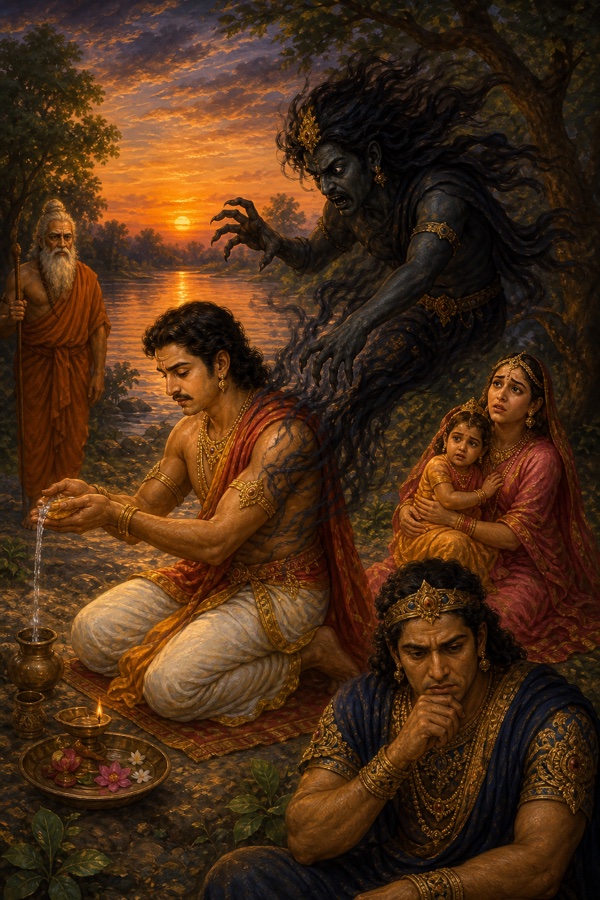
After making his compact with Dvapara, Kali came to the country of the Nishadhas. He stayed there for a long time, watching Nala for a lapse through which he could enter him. The opportunity came in the 12th year. One day Nala relieved himself, touched water, and began his twilight prayers. He had omitted the washing of his feet that should have preceded them. The omission gave Kali the opening he had waited for through those years. Through that failure in ritual purity, he entered Nala’s body. The king whose conduct had left him no earlier opening was now possessed by the being determined to take away his kingdom and life with Damayanti. Once he had possessed Nala, he approached Pushkara, the king’s own brother. “Come and play dice with Nala,” Kali urged him. “With my help you are certain to win. Defeat him, acquire his kingdom, and rule the Nishadhas yourself.” Pushkara went to Nala. Dvapara came to him as well, taking the form of the principal die, called Vrisha. Each was carrying out his part of their compact. Kali had entered the man who would play; Dvapara entered the dice with which Pushkara would challenge him. In Damayanti’s presence, Pushkara repeatedly challenged the king to play. Nala could not keep refusing. He fixed a time for the contest, and the game began with Kali in possession of him. He began to lose his stakes in gold and silver, chariots with the teams that drew them, and robes. The losses continued. Nala grew so absorbed in the dice that none of his friends could persuade him to stop.
The chief counselors and the citizens came together to see their troubled king and draw him away from the game. A charioteer brought news of their arrival to Damayanti. They were waiting at the gate: the people of the city and the officers entrusted with the kingdom’s affairs. They could no longer bear the disaster overtaking a ruler who understood both dharma and the practical work of kingship. Would she tell him they had come? Grief had almost overwhelmed Damayanti’s reason. In a voice choked by sorrow, she addressed Nala. “The citizens are at the gate with your counselors. Loyalty has brought them here; they want to see you. Please receive them.” Kali still held the king. Nala gave his lamenting wife no answer, not a single word. The counselors and the citizens went home, ashamed and grieving. “He is no longer alive,” they said. The man they had come to see remained at the dice. Brihadaswa told Yudhishthira that Nala and Pushkara went on playing for many months. Throughout that time, Nala kept losing.
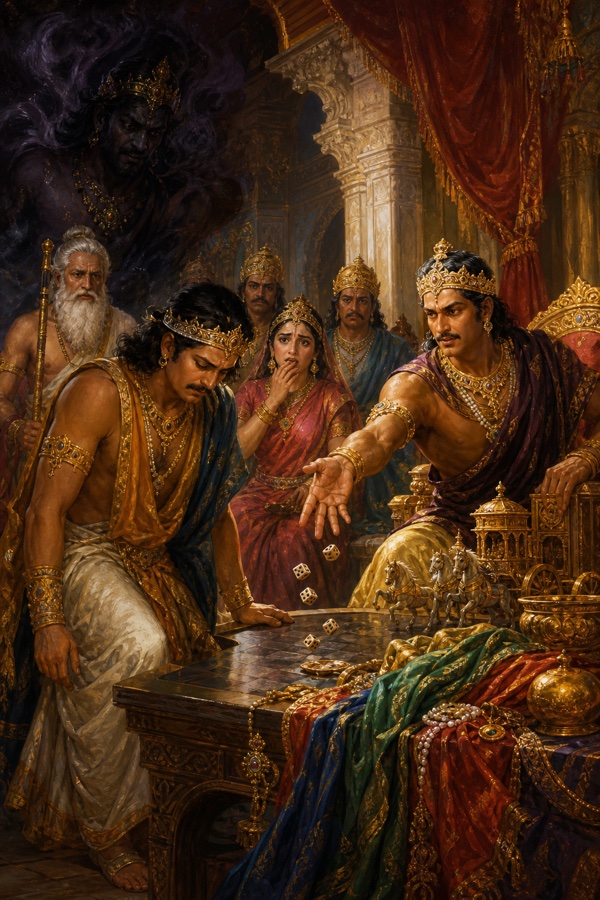
Damayanti, normally clearheaded, saw the frenzy of the game depriving her husband of his judgment. She was alarmed and sorrowful, aware of the seriousness of what was happening and anxious for his welfare. At last she understood that he had lost everything. She turned to Brihatsena, her nurse and attendant, a trusted woman of good reputation, skilled in every duty and gentle in speech. “Go and summon the counselors in Nala’s name,” Damayanti told her. “Tell them what wealth and other possessions have been lost, and what remains.” The summons was to be issued in Nala’s name. The same counselors who had gone home without an answer would now be called back as though by the king himself. When they heard that the king had called for them, they welcomed the news. “This is good fortune for us,” they said, and approached him. The citizens assembled for a second time. Damayanti told Nala they had come, but he ignored her again. Ashamed at having her words disregarded by her husband, she returned to her apartments. Reports of the play followed her: the dice continued to fall against Nala, and he had lost everything. She called Brihatsena once more. “Go again in Nala’s name and bring his charioteer Varshneya here. The situation is very serious.” Brihatsena sent trustworthy servants to summon him.
Damayanti chose the words that the moment required and spoke gently to Varshneya. “You know how the king has always treated you. He is in difficulty now, and you must help him. The more he loses to Pushkara, the more eager he becomes to play. The dice obey Pushkara’s wishes; everything in the game runs against Nala. He is so absorbed that he listens to neither friends nor relatives, and he does not even listen to me. Yet I do not think he deserves the blame for this. He is lost in the game, and that is why he disregards my words. I seek your protection. Do what I ask. My heart is full of misgiving, and I fear that disaster may fall upon the king. Harness Nala’s favorite horses, the ones swift as thought. Put these twins, my son and daughter, into the chariot and take them to Kundina. Leave them with my family there. Leave the chariot and the horses as well. Afterward you may stay there if you wish, or go anywhere else you choose.” Kundina was the royal city of her father, Bhima of Vidarbha. The children would be entrusted to their mother’s relatives, together with the team their father prized.
Varshneya took Damayanti’s instructions to the king’s chief officers and reported them in full. He consulted with them, settled the arrangements, and obtained their consent. Then he placed the children in the chariot and drove toward Vidarbha. There he left the boy Indrasena and the girl Indrasena, along with the fine vehicle and its horses. With a sorrowful heart, grieving for Nala, he took leave of Bhima. He wandered for some time before reaching Ayodhya. Still burdened by grief, he presented himself to its king, Rituparna, and entered his service as a charioteer.
The gist: In the 12th year of waiting, Kali finds a ritual lapse and enters Nala. Dvapara becomes a die to help Pushkara. Nala loses for months and twice ignores attempts by his people and counselors to reach him. Damayanti sends the twins to her family with Varshneya. After leaving the children, chariot, and horses in Vidarbha, the driver eventually takes service with Rituparna in Ayodhya.
The last garment, and the wife Nala leaves asleep
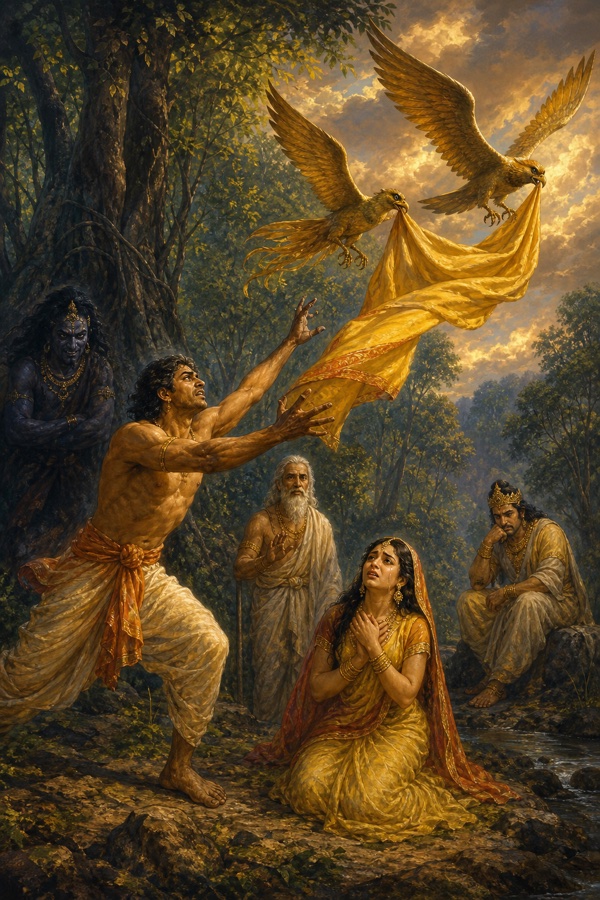
After Varshneya left, Pushkara won Nala’s kingdom and everything else he possessed. Then he laughed and urged his brother to continue. “Let us keep playing. What can you stake now? I have won everything you own. Only Damayanti remains. If you wish, we can make her the next stake.” Nala felt as though his heart would burst with rage. He said nothing. He looked at Pushkara in anguish, then removed every ornament from his body. Giving up all his wealth, he left with a single piece of cloth to cover him. His friends grieved still more at the sight of his departure. Damayanti followed him out of the city, also wearing only one cloth. Husband and wife stopped on the outskirts and remained there for 3 nights. Pushkara had a proclamation carried through the city: anyone who showed Nala kindness would be put to death. The citizens knew Pushkara’s hatred for their former ruler. They obeyed his order and offered Nala no hospitality, although he deserved to be received with honor. For those 3 nights, the king lived on water alone. Hunger eventually drove him farther away, searching for roots and fruit, with Damayanti following behind. Many days passed in that search for food. At last, tormented by hunger, Nala saw birds whose feathers had the color of gold. He thought that here, at last, were both a meal and something of value. He spread the cloth he was wearing over them. The birds rose into the air with it, carrying away the only garment he had left.
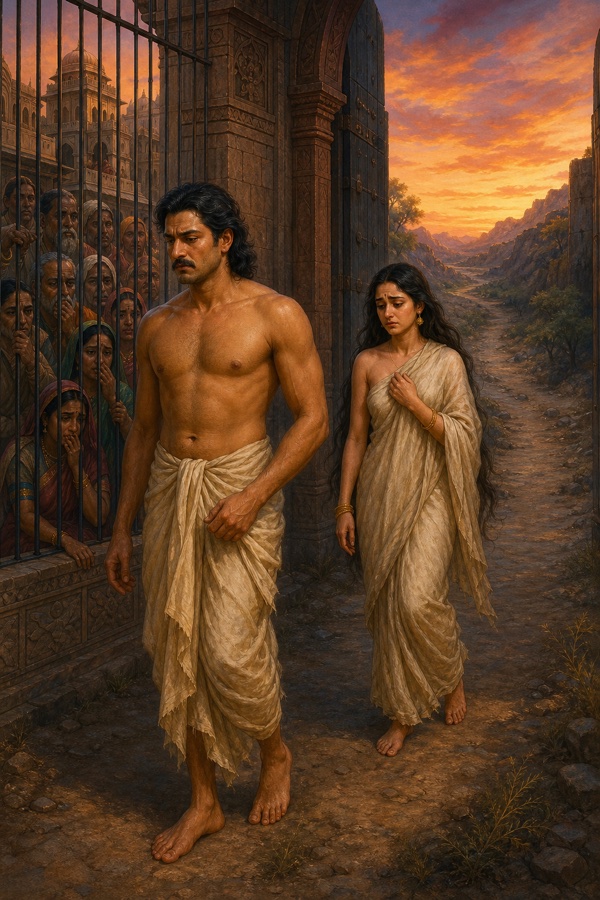
Nala stood naked and miserable, his face lowered toward the ground. From the sky, the birds spoke to him. “You fool. We are the dice. We came to take your cloth. We were displeased that you had managed to leave with even that much still on you.” He knew now who was departing with the garment. He spoke to Damayanti about the beings responsible for their suffering. “They are the ones whose anger deprived me of my kingdom. Through their influence, I have been reduced to hunger and distress, unable to find anything to sustain us. Because of them, the Nishadhas offered me no shelter or hospitality. Now they have become birds and taken my cloth as well. This terrible disaster has filled me with grief and robbed me of my judgment. I am your husband, and what I am about to say is for your good. Listen to me.” He began pointing out the routes before them. Many roads led toward the south, passing Avanti and the Rikshavat mountains. There was the great Vindhya mountain; there was the Payasvini River flowing toward the sea. He showed her the hermitages of ascetics, places supplied with different kinds of roots and fruit. One road led to Vidarbha, her father’s country, where Varshneya had taken their son and daughter. Another led to Kosala, the kingdom whose royal city was Ayodhya. Beyond those roads lay the southern country. The distressed king repeated these directions to her again and again.
Damayanti answered through tears. “When I think about what you intend, my heart trembles and my limbs lose their strength. How can I leave you alone in this forest? You have lost your kingdom and wealth. You have no garment, and hunger and exhaustion have worn you down. When you are deep in the woods, tired and hungry, remembering the happiness you once knew, I will be here to ease your weariness. Those who know the art of healing say that in every sorrow there is no remedy to equal a wife. I am telling you the truth, Nala.” He agreed with her. “It is as you say. A man in distress has no friend or remedy equal to his wife. I have no intention of abandoning you. Why are you afraid? I will never leave you, even if I must give myself up.” Damayanti asked why he kept showing her the road to Vidarbha if he intended to stay with her. “I know you would never desert me,” she said. “But your mind is distracted, and in that condition you may leave me. Every time you point out the road, you increase my grief. If you want me to go to my family, then let us both go there. My father will receive you with respect. You will be honored in our home and live there happily.” Nala answered that her father’s kingdom was as much his own, yet he could not go there in his present condition. “I came there once in splendor, adding to your happiness. How can I come back in misery and deepen your sorrow?” He said this repeatedly, trying to comfort her.
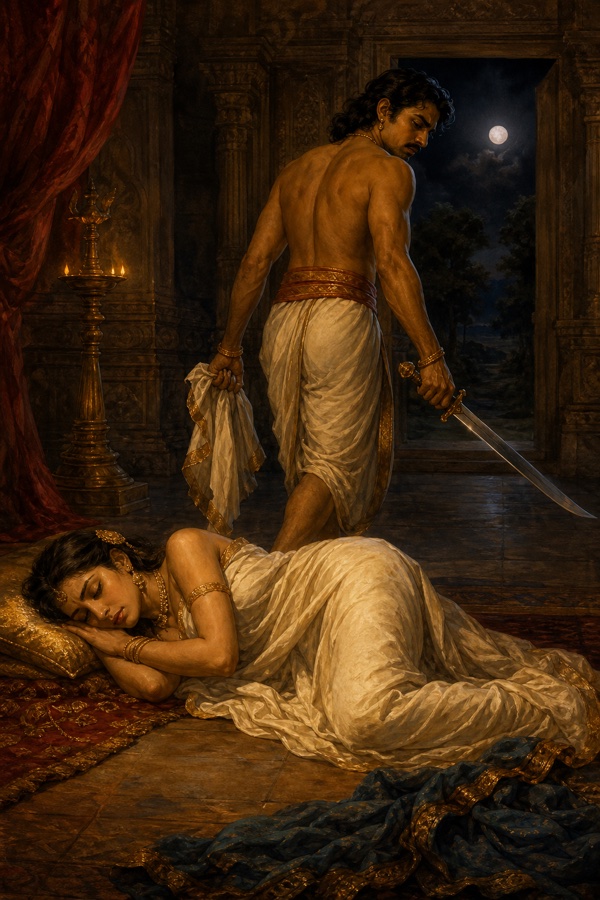
Nala was wrapped in half of Damayanti’s garment; the single cloth covered both of them. Worn down by hunger and thirst, they wandered until they reached a travelers’ shelter. There the king sat with the princess of Vidarbha on the bare earth. Dirty, haggard, and covered with dust, sharing the same cloth, they lay down together and slept from exhaustion. Damayanti, delicate and innocent of wrong, sank into a deep sleep after the sudden distress that had overtaken her. Nala could find no lasting rest. His heart and mind remained in turmoil. He thought about the kingdom he had lost, the friends who had deserted him, and the misery of wandering through the woods. What was the use of continuing as he was? What would happen if he changed his course? Would death be better? Should he leave his wife? She was devoted to him and suffering on his account. Perhaps, if they were separated, she would make her way to her relatives. While he remained with her, her devotion would keep her beside him, enduring whatever misery he endured. He saw continued suffering as certain if they stayed together. Leaving her would make the outcome uncertain, and in that uncertainty he imagined the possibility of happiness for her. She might reach her family. Some better life might still be possible after their separation. He considered this again and again until he decided that abandoning Damayanti was the best course. Her good name, good fortune, and fidelity to him would protect her, he thought. Her own spiritual strength would prevent anyone from harming her on the road. Kali was influencing his mind as he reached that decision. Nala had just agreed with Damayanti that a wife was a man’s best friend and remedy in distress. She had offered to go with him to Vidarbha, where her father would honor them both. Now, beside her as she slept, he was deciding to leave her to find her own way there.
Then Nala considered the clothing. He had none of his own, and Damayanti had only the single garment they shared. He decided to cut off half of it for himself. How could he divide the cloth without letting her know? He paced back and forth through the shelter, thinking about it, and found a fine sword lying unsheathed nearby. With that blade he cut the garment in half. He threw the sword away and left Damayanti deeply asleep. But he could not sustain the departure. He returned to the shelter and burst into tears at the sight of her. The woman he loved, whom neither wind nor sun had seen before, lay abandoned on the bare ground. “What will she do when she wakes?” he lamented. “She lies here in this torn piece of cloth, as though she has lost her senses. How will Bhima’s lovely daughter, faithful to her husband, wander alone through these deep woods full of wild animals and snakes? May the Adityas, the Vasus, the twin Ashvins, and the Maruts protect you. Your own virtue is your greatest safeguard.” He tried to go again. Kali deprived him of his reason and pulled him away; love drew him back to the shelter. He left and returned, left and returned. The decision formed under Kali’s influence could carry him out of the shelter; his love for the woman sleeping inside brought him back. It was as though his heart had been torn into two parts. He moved like a swing, going out of the shelter and coming back into it. After long and pitiful lamenting, the king finally went away. Bewildered by Kali, grieving and thinking about what he had done, he left his wife sleeping alone in the deserted forest.
The gist: Nala leaves the game when Pushkara proposes staking Damayanti. Denied help and then robbed of his last cloth by the dice in bird form, he points her toward her father’s country. She asks that they go together; he refuses. In a travelers’ shelter, under Kali’s influence, he decides that leaving her may give her a chance of happiness. He cuts their shared garment, repeatedly leaves and returns, and finally abandons her while she sleeps.
Damayanti wakes alone
Sleep had restored some of Damayanti’s strength. When she woke, Nala was gone. Fear took hold of her in that lonely forest, and she cried out for her husband. “My king! Have you left me? I am lost here, terrified, with no one beside me. You speak the truth; you know what is right. How could you give me your word and then abandon me while I slept? I have been faithful to you. Others have wronged you, but I have done you no injury. Why have you left the wife who is devoted to you? Remember what you promised me before the guardians of the worlds. Keep the words you spoke in their presence.” Those gods had stood before her at the svayamvara, when she had chosen the mortal Nala as her husband. His pledge belonged to that choice and to the life they had shared since. Now she called on him to honor it in the forest where he had left her. “If your wife can go on living even for a moment after you have abandoned her, it can only be because death comes to mortals at its appointed time. Enough of this joke. I am terribly afraid. Show yourself! I see you. I see you, Nala! Why are you hiding behind those bushes? Why won’t you answer me? How cruel you are to see me suffering and crying out like this, yet refuse to come and comfort me.” She called to him as though he were close enough to hear and answer. “My grief is for you. How will you spend your days alone? When evening comes and you are hungry, thirsty, and exhausted beneath the trees, how will you bear it when I am no longer there?”
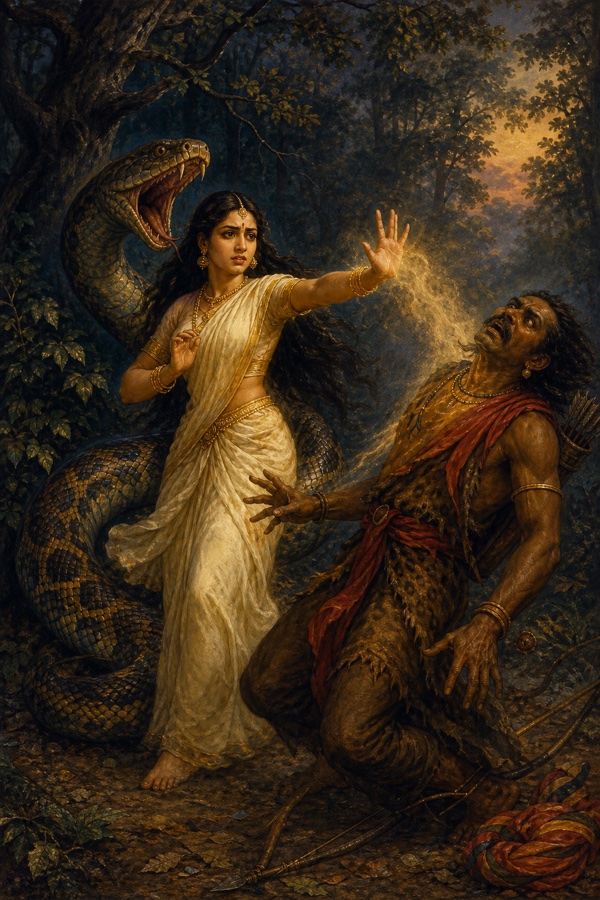
Damayanti ran this way and that, weeping. At one moment she sprang up; at another she sank down, stunned. She drew back in terror, then cried aloud again. The daughter of Vidarbha’s King Bhima was helpless with grief, her strength failing as she sighed and wept for the husband she loved. She spoke a curse against whoever had brought him to this suffering. “May the being whose curse has afflicted Nala endure a sorrow greater than ours. Whoever has done this to a man whose heart is free of wrongdoing, may that wicked being live in still greater misery and bear still greater troubles.” She continued searching for him through woods inhabited by beasts of prey. She had been Nala’s crowned queen. Now she wandered wildly from place to place, calling his name, her cries as piercing as those of a female osprey. In the course of that search she came within reach of a gigantic serpent. It was hungry. As she moved near it, the serpent seized her and enclosed her in its coils. Even there, with her own life in danger, she went on weeping for Nala. “My husband, why don’t you hurry to me? This serpent has caught me in the wilderness, and I have no one to protect me. What will become of you when you remember me? Why did you go away and leave me in the forest today? When you are free of the curse, when your mind and senses and wealth have returned to you, what will you feel when you think of me? Nala, you have done no wrong. Who will soothe you when you are weary and hungry, when you are fainting from exhaustion? You who stand among kings as a tiger among animals, who will be there for you?”
A hunter moving through the deep forest heard her cries and hurried toward them. He found the wide-eyed woman caught in the serpent’s coils. Rushing forward, he cut off its head with his sharp weapon, killed it, and freed Damayanti. He sprinkled water over her body, gave her food, and comforted her. Then he began to ask her questions. “Your eyes are like a young gazelle’s. Who are you? Why have you come into these woods? How has a woman like you fallen into such terrible distress?” Damayanti told him everything that had happened. As she spoke, he looked at the woman he had rescued. Half a garment covered her. She had a full bosom and rounded hips, delicate, faultless limbs, and a face like the full moon. Curved lashes framed her eyes, and her voice was sweet as honey. Desire for her grew in him. Under the power of the god of love, the hunter began addressing her in a coaxing voice, using gentle words to win her over. Damayanti looked at him and understood his intention. Anger filled her. She seemed to blaze with it. The hunter’s desire turned angry in its turn, and he tried to force himself on her. Damayanti remained unconquerable, like a burning flame. She had already lost her kingdom and been separated from her husband; in that hour of grief beyond words, she pronounced a curse. “I have never even thought of any man other than Nala. By that truth, let this vile man who lives by hunting fall dead.” The fidelity she had declared to her absent husband became the truth on which she staked those words. As soon as she spoke, the hunter fell lifeless to the ground, like a tree consumed by fire.
The gist: Damayanti wakes to find Nala gone and searches the forest, calling on him to remember his promise. A serpent seizes her, and a hunter frees her. When her rescuer attempts to assault her, she invokes the truth of her fidelity to Nala and curses him. He falls dead.
Questions for a tiger and a mountain
Damayanti left the dead hunter and went farther into the forest. Crickets sounded through its lonely reaches. Lions, leopards, ruru deer, tigers, buffaloes, bears, and other deer lived there, and birds of many kinds filled the woods. Thieves and mlechchha tribes also occupied that wilderness. Around her stood sal trees and bamboo, dhava and ashvattha, tinduka and inguda, kinsuka and arjuna, neem and tinisa, silk-cotton and jamun, mango and lodhra, catechu and cane, padmaka and amalaki, plaksha and kadamba, udumbara and badari, bilva and banyan, piyala and palms, date trees, haritaka, and vibhitaka. As she traveled, the princess of Vidarbha saw mountains containing different ores and groves alive with birdsong. There were remarkable glens, rivers, lakes, and tanks, and animals and birds of many species. Countless snakes inhabited the forest. So did goblins and fierce-faced Rakshasas. Pools and tanks lay among the hillocks, with streams and springs of striking beauty. She passed herds of buffaloes, wild boars, bears, and the serpents of the wilderness. Through all of it, Damayanti continued alone, searching for Nala. Her virtue, the strength of her character, her good fortune, and her patience kept her safe. The frightening forest did not terrify her. Separation from her husband was the sorrow that occupied her. At last she sat on a stone. Every limb trembled with grief as she began calling to him again.
“King of the Nishadhas, with your broad chest and mighty arms, where have you gone? Why have you left me alone in this forest? You performed the Ashvamedha and other sacrifices, giving generously to the brahmins who served at them. You fulfilled those great obligations. Why have you broken faith with me? Remember what you promised. Remember, too, what the swans said when they flew between us, carrying news of each to the other before we had ever met. All 4 Vedas, studied fully with their Angas and Upangas, their supporting branches of knowledge, stand equal to a single truth. Keep the word you gave me. Nala, you have done no wrong, and I belong to you. I am close to death in this dreadful forest. Why don’t you answer? That terrifying lord of the forest, with its fierce face and open jaws, is starving. It fills me with fear. Shouldn’t you come and save me? You always used to say, ‘There is no one dear to me but you.’ Make those words true now. Your wife loves you, and you love her. Why won’t you answer her as she cries for you, distracted with grief? You have overcome your enemies and ruled the earth. You are honored, with those great eyes of yours. Why don’t you look at me now? I am thin, distressed, pale, and changed in color, covered by half a cloth. I am alone, weeping like someone with no one left, like a doe separated from the herd. It is Damayanti calling you, your devoted wife, alone in this great forest. Why is there no answer? You were nobly born, noble in conduct, graceful in every limb. Today I cannot see you on this mountain. King of the Nishadhas, this forest is full of lions and tigers, and your absence adds to my sorrow. Are you lying down somewhere? Sitting? Standing? Have you gone away? Who can tell me? Whom can I ask, ‘Have you seen King Nala in these woods?’ Who here can tell me where to find the handsome, generous-hearted man who broke the ranks of hostile armies? Who will give me the happiness of hearing, ‘The king with eyes like lotus petals, the Nala you are searching for, is here’?”
A tiger was coming toward her. Damayanti saw the forest king’s graceful bearing, its prominent cheeks, and its 4 great teeth. She decided to question it without fear. “You are lord of the animals, king of this forest. I am Damayanti, daughter of the king of Vidarbha and wife of Nala, the king of the Nishadhas who defeats his enemies. I am searching for my husband alone in these woods, overcome with sorrow. If you have seen him, comfort me with news of him. If you cannot tell me anything about Nala, then devour me and free me from this misery.” The tiger paid no attention to her appeal. It went toward the clear river flowing to the sea. Damayanti turned her search to a mountain. Its countless peaks rose high above the forest, beautiful in their different colors, with ores and gems in its slopes. It stood over the broad woodland like a banner. Lions, tigers, elephants, boars, bears, and stags ranged across it, and the calls of many kinds of birds echoed around it. Kinsuka, ashoka, vakula, and punnaga trees grew there, along with flowering karnikara, dhava, and plaksha. Waterbirds gathered along its streams, and summit after summit rose above them. To this high, sacred mountain she addressed her next plea. “You are a refuge for those in distress, a blessed and famous mountain, wonderful to see. I bow to you, pillar of the earth. I have come before you and bow again. My name is Damayanti. A king is my father, a king was my father-in-law, and a king is my husband. Bhima, the powerful warrior who rules Vidarbha and protects all 4 social orders, is my father. He performed the Rajasuya and Ashvamedha sacrifices, distributing abundant gifts among the brahmins. His eyes are large and beautiful; his devotion to the Vedas is unwavering. His conduct is without stain. He speaks the truth, acts without deceit, and is gentle as well as brave. He possesses immense wealth, understands dharma, and lives purely. Having defeated his enemies, he gives the people of Vidarbha his protection. I am his daughter, and I have come to you.”
“My father-in-law was Virasena, the celebrated ruler of the Nishadhas. His son governs the kingdom inherited from him. That son is Nala, a brave and handsome man whose power cannot be thwarted. He is also called Punyasloka, a king remembered with honor. His complexion has the brightness of gold. He is devoted to the brahmins, learned in the Vedas, and eloquent in speech. He acts justly, drinks the sacred Soma at the rites, tends the sacrificial fire, and performs sacrifices. Generous in giving and powerful in war, he also punishes wrongdoing as it deserves. I am his blameless wife, the first of his queens, standing before you. My prosperity has been taken from me. I have been separated from my husband, left without protection, and afflicted by disaster. I have come here searching for him. Mountain, with your hundreds of peaks reaching into the sky, have you seen King Nala in this terrible forest? Have you seen my husband, the famous king of the Nishadhas, who walks with the bearing of a mighty elephant? He is intelligent, long-armed, and fierce in his energy, a man of courage, strength, patience, and great renown. You see me here alone, crying, overwhelmed with grief. Why don’t you speak and comfort me as you would your own daughter in distress?” Again her words turned toward Nala himself. “You are a warrior of great strength, a king who knows every duty and holds firmly to the truth. If you are in this forest, show yourself. When will I hear your voice again? It is gentle and deep as a rain cloud, sweet as amrita, the nectar of immortality. When will I hear you call me ‘Vidarbha’s daughter’? Every syllable is clear, your voice sacred and musical as the chanting of the Vedas, full and rich, easing all my sorrow. Nala, I am afraid. You are a good man. Come and comfort me.”
The gist: Damayanti searches the forest, calling on Nala to keep the truth of his promise. She asks a tiger for news, then appeals to a mountain, naming her family and describing her husband. Her search returns again and again to the hope of hearing his voice.
A vanished hermitage and a caravan bound for Chedi
Leaving the mountain, Damayanti turned north. She traveled for 3 days and 3 nights before reaching a grove where ascetics practiced their austerities. It was as beautiful as a grove in heaven. The men who lived there resembled the great sages Vasishtha, Bhrigu, and Atri in their holiness and self-restraint. Their minds and senses were under control. They limited what they ate, some living on water, some on air, and some on fallen leaves. Wearing bark and deerskins, they kept their passions subdued and pursued the path to heaven. Herds of deer and monkeys lived in the hermitage. The sight cheered Damayanti, and she entered it with the radiance and dignity that were still hers: gracefully shaped eyebrows, long hair, beautiful hips, a full bosom, fine teeth, and large, dark eyes. She greeted the ascetics, men who had grown old in their spiritual discipline, and stood humbly before them. They welcomed her, honored her, and invited her to sit. “Tell us what we can do for you.” Damayanti first asked after their own welfare. “Are your austerities going well, and the tending of your sacrificial fires? Are your religious observances and the duties of your order prospering? Are the animals and birds of this hermitage well?” They told her that all was well with them. Then they asked who she was and what she sought. Her beauty and brightness astonished them. “Take heart. Don’t grieve. Are you the goddess of this forest, or of this mountain, or of the river?” Damayanti answered the sages whose wealth lay in their austerities. “I am no goddess of the forest, mountain, or stream. I am human. Listen, and I will tell you my story.”
“Bhima, the powerful ruler of Vidarbha, is my father. My husband is Nala, the wise and famous king of the Nishadhas, a learned warrior who is always victorious in battle. He worships the gods and is devoted to the brahmins. He guards the Nishadha line with immense strength and energy. He speaks the truth, understands every duty, exercises good judgment, and never wavers in his promises. He defeats his enemies and conquers their cities. Devout in his service to the gods and graceful in his bearing, he has the splendor of Indra, their king. His eyes are large, and his complexion shines like the full moon. He performs great sacrifices and knows the Vedas and their branches of learning. He destroys his enemies in battle, radiant as the sun and moon. That is my husband. This king, devoted to truth and dharma, was challenged to dice by deceitful men. They were mean in spirit, lacking in refinement, crooked in their conduct, and skilled at gambling. They took his wealth and his kingdom. I am the wife of that king, known to everyone as Damayanti, and I am searching for him. With grief in my heart, I have wandered through woods and over mountains, past lakes, rivers, and tanks, trying to find Nala. He is a great-hearted man, skilled in battle and in the use of weapons. Has the king of the Nishadhas come to this beautiful hermitage of yours? I entered this desolate, terrifying forest, with its tigers and other beasts, because I was seeking him. If I do not see him within a few days and nights, I will give up this body and seek release from my suffering. What use is life to me without him? How can I go on living with this grief for my husband?” The ascetics spoke truthfully to the forlorn woman. Through the power of their austerities, they could see happiness awaiting her. “You will soon see Nala. You will see the king of the Nishadhas, that good man who defeats his enemies, freed from distress. You will see your husband free of wrongdoing, adorned with every kind of jewel, ruling the very same city again. He will punish his enemies and fill them with fear. He will bring joy to his friends, with every blessing restored to him.”
As soon as they had spoken to Nala’s beloved queen, the ascetics vanished. Their sacred fires and the hermitage disappeared with them. Damayanti stood amazed at what had happened. “Was that a dream? What have I just seen? Where are those ascetics? Where is their hermitage? Where is that lovely river, its sacred water visited by so many kinds of birds? Where are the beautiful trees covered in fruit and flowers?” She thought about it for a while. Then grief for Nala returned, and the color faded from her face again. Farther into the woods, she came upon an ashoka tree, beautiful under its load of leaves and blossoms, alive with the calls of birds. She approached it with tears in her eyes and a voice choked by sorrow. “Here in the forest you stand covered in flowers, as beautiful as a mountain king. Ashoka, quickly free me from grief. Have you seen Nala, who defeats his enemies, Damayanti’s beloved husband? Have you seen him free of fear, sorrow, and trouble? Have you seen the king of the Nishadhas, the hero with delicate skin, dressed in half a garment, who came into this wilderness in misery? Ashoka, release me from sorrow. Be true to your name. You are called the destroyer of grief.” She walked around the tree 3 times and went on, still sorrowing, into a more terrible part of the forest. Searching for her husband, she passed trees and streams, beautiful mountains, birds and animals, caves and steep precipices, and rivers of extraordinary appearance. Eventually she reached a broad route and saw a company of merchants with horses and elephants arriving on a riverbank. The river was wide and beautiful, its water clear and cool. Cane thickets grew along it. Cranes, ospreys, and chakravakas called there, and tortoises, alligators, and fish lived in the water among countless little islands.
Damayanti approached the caravan and entered its midst. She wore half a garment; her hair was dusty, her body thin, pale, and dirty. Grief had made her seem wild and distracted. Some of the travelers fled at the sight of her. Others grew anxious, cried out, laughed at her, or recoiled from her with hatred. Some felt pity and spoke to her. “Who are you, and whose family do you belong to? What are you searching for in these woods? Seeing you here has frightened us. Are you human? Tell us the truth. Are you the goddess of this forest, this mountain, or the directions of the sky? We ask your protection. Are you a Yakshi, a Rakshasi, or a celestial woman? Bless us and keep us safe. Let this caravan leave here soon in prosperity, with everyone in it well.” Damayanti answered them, her devotion to her husband unchanged by the calamity that had overtaken her. “Leader of the caravan, merchants, young men, elders, children, all of you traveling together: I am human. I am a king’s daughter, a king’s daughter-in-law, and a king’s wife. I am longing to see my husband. The ruler of Vidarbha is my father. My husband is Nala, king of the Nishadhas, a blessed man who has never been overcome in battle. I am searching for him now. If you have seen my beloved Nala, who stands foremost among men and breaks the ranks of his enemies, tell me quickly.” The leader of the great caravan was a merchant named Suchi. He answered her. “Listen to me. I am the merchant who leads this caravan, and I have seen no man named Nala. In this vast forest, where people do not live, we have found only elephants, leopards, buffaloes, tigers, bears, and other animals. You are the only man or woman I have met here. May Manibhadra, king of the Yakshas, help us!” Damayanti asked the merchants and their leader where they were traveling. Suchi told her they were going directly to the city of Suvahu, the truthful king of the Chedis. They hoped to trade there at a profit.
The gist: Ascetics promise Damayanti that she will see Nala restored to his kingdom, then disappear with their hermitage. She continues searching, appeals to an ashoka tree, and meets Suchi’s caravan. No one there has seen Nala; the merchants are traveling to the city of Chedi’s King Suvahu.
Source: the Mahabharata of Krishna-Dwaipayana Vyasa, Vana Parva. This chapter follows K. M. Ganguli, sections LII-LXXIX (52-79); the Gita Press Hindi edition numbers these chapters differently. Names, order, and events were checked against Ganguli’s complete translation. Dialogue and commentary are adapted, not a verbatim translation. About the sources.
Based on: The Mahabharata, Vyasa (Gita Press, Gorakhpur)