On this page
By the time Shakuni asked his question, the game in the assembly hall at Hastinapura had already swallowed a great part of what the Pandavas owned. Shakuni was the son of Subala and the king of Gandhara, and he threw the dice on behalf of Duryodhana, eldest son of the blind old king Dhritarashtra. Across from him sat Duryodhana’s cousin Yudhishthira, eldest of the five sons of Pandu, a king with a capital of his own who had come to this hall because he had been summoned to it. The elders of the Kuru house watched from their seats: Bhishma, the old grandsire; Drona, preceptor to the Kuru princes; Kripa; and Vidura, the king’s brother and counselor, whom the court addressed as Kshatta. Kings from every direction filled the rest of the hall. Every throw so far had fallen the same way.
“You have lost a great deal of the Pandavas’ wealth, Yudhishthira,” Shakuni said. He had the dice in his hand and he did not put them down. “If you still own anything that has not come across to us, tell us what it is.”
The question left a door open, and Yudhishthira did not use it. A king of his order, called to the dice, plays. He answered as a man who meant to go on.
The last of the treasure, and the brothers one by one
“I know what I have, and it is past counting,” Yudhishthira said. “Why do you ask me about my wealth, Shakuni? Set your stake in tens of thousands, in millions and tens of millions and hundreds of millions, in tens of billions and hundreds of billions, in trillions, tens of trillions and hundreds of trillions, in tens of quadrillions and hundreds of quadrillions, or set it higher still. I have as much. With that wealth I will play you.”
Shakuni had the dice ready. He threw them by the foul means he had used on every throw so far. “Look,” he said. “I have won.”
“I have cattle and horses that no one has ever numbered,” Yudhishthira said. “I have milk cows with their calves, and goats, and sheep, grazing the whole country from the river Parnasha to the eastern bank of the Sindhu. I play with those.”
The dice went down again, thrown the same way. “I have won,” Shakuni said.
“I have my city,” Yudhishthira said. “I have the country around it and the land itself. I have the wealth of every person living there, apart from what belongs to the Brahmins, and I have the people themselves, apart from the Brahmins. All of that is still mine. I play with it.”
The dice fell, and the same voice followed them. “I have won.”
“These princes,” Yudhishthira said, and he meant the ones who sat there bright with ornaments, wearing their earrings and their nishkas and every adornment a royal house puts on its sons. “They are my wealth now. I play with them.”
Shakuni cast. “Look,” he said. “I have won them.”
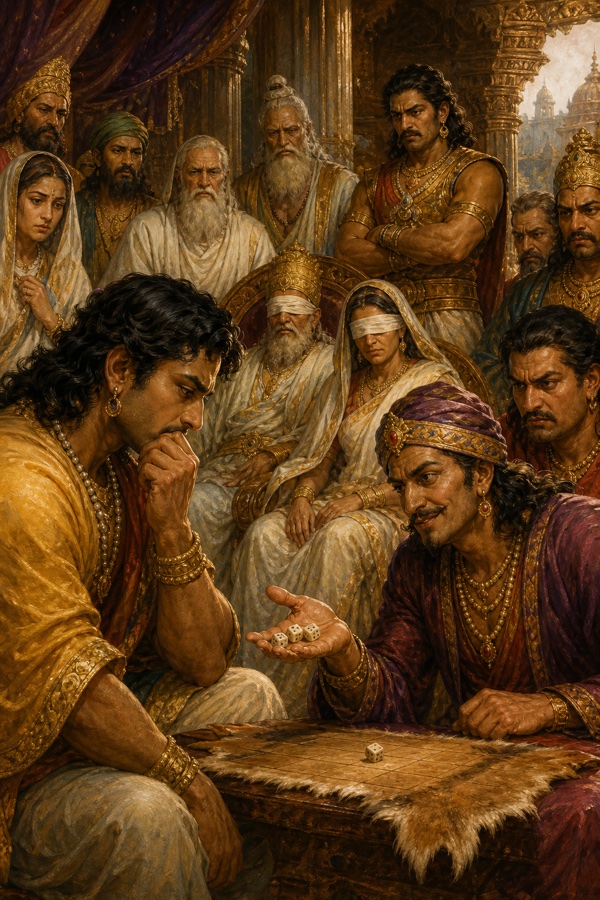
Four brothers had come to Hastinapura with him. Bhima and Arjuna were, like him, sons of Kunti, the mother the family also called Pritha. The twins, Nakula and Sahadeva, were the sons Madri had borne to Pandu. The game reached the brothers next, and it took the twins first.
“Nakula,” Yudhishthira said. “He has strong arms and a neck like a lion’s. His eyes are red and he is in the fullness of his youth. He is my one stake now. Count him as my wealth.”
“Prince Nakula is dear to you, King Yudhishthira,” Shakuni said, “and he is already in our hands. What will you play with after him?” He threw as he finished speaking. “Look. We have won him.”
“Sahadeva administers justice,” Yudhishthira said. “The world knows him for his learning. He does not deserve to be laid down as a stake in a game. I am going to stake him all the same, and play with someone that dear as though he were nothing to me.”
Shakuni threw by the same foul means. “I have won,” he said, and this time he was in no hurry to ask for the next stake. “Both of Madri’s sons were dear to you, and both are mine. Bhima and Arjuna, I notice, you seem to hold a good deal higher.”
“You wretch,” Yudhishthira said. “We five are of one heart, and you are trying to split us. That is a sin, and you commit it with no regard for what is right.”
A key to reading this (numbers in modern terms): The count Yudhishthira throws at Shakuni climbs from tens of thousands through millions, billions and trillions to hundreds of quadrillions, and he adds that he has more than that. He never names a figure for what he owns. The stakes that follow are things a hall can picture: the herds between the river Parnasha and the eastern bank of the Sindhu; the city, the country and everyone in it, with the Brahmins and their property held back; the princes in their gold. Each of them is gone on a single throw.
Shakuni gave way at once, as smoothly as he threw. “A man who is drunk falls into a pit and lies there, unable to move,” he said. “You are older than we are, and you have every accomplishment a man can have. I bow to you and ask your pardon. You know how gamblers are in the heat of play, Yudhishthira. They rave. They say things they would never say awake, and would never say even in a dream.”
Yudhishthira did not answer the apology. He named his next stake. “There is one who carries us like a boat to the far shore of the sea of battle. He has never lost to an enemy. He is quick in everything he does, and this world has one hero, and he is that hero. He is Phalguna, my brother Arjuna, and he no more deserves to be staked than Sahadeva did. I play with him now.”
Shakuni threw by his foul means. “I have won,” he said. “This son of Pandu, the finest archer alive, who draws a bow as fast with his left hand as with his right, is mine. Play on with the wealth you still have, son of Pandu. Your dear brother Bhima is left to you. Make him your stake.”
“He deserves it no more than the others,” Yudhishthira said, “and I will stake him. Bhimasena leads us. He goes first into a fight, as the god who carries the thunderbolt, the one great enemy of the Danavas, goes first. He has a lion’s neck and arched brows, and he looks at a man out of the side of his eyes. He cannot swallow an insult. No one in the world is his equal in strength. No one handles a mace as he does, and he grinds down whatever enemy he meets. I play with Bhimasena.”
“I have won,” Shakuni said. He let the words stand a moment in a hall where four princes now belonged to another man. “You have lost a great deal, son of Kunti. Horses, elephants, and your brothers as well. Say so, if there is anything you have not yet lost.”
The gist: Shakuni throws by foul means every time and announces every time that he has won. Yudhishthira stakes and loses wealth without count, his herds, his city and country and people, the princes in their ornaments, and then his four brothers in order: Nakula, Sahadeva, Arjuna, Bhima. When Shakuni suggests that he holds Madri’s sons cheaper than the other two, Yudhishthira calls it an attempt to divide brothers who are of one heart, and stakes the other two as well. Shakuni’s last question is whether anything is left.
The stake of himself, and then Draupadi
“There is myself,” Yudhishthira said. “I am the eldest of my brothers and they love me, and I am the one of us who has not been won. I stake myself. If you win me, I will do whatever a man who has been won is bound to do.”
Shakuni threw by his foul means. “I have won,” he said, and then he turned the win into a reproach. “You have allowed yourself to be lost, and that is a great sin. You still had wealth left, king. A man who loses himself while he has anything else to stake has done wrong.”
He was skilled at dice and he knew the value of saying a thing aloud. He turned to the kings seated around the hall and told them, one name after another, that he had won every one of the Pandavas. Then he came back to Yudhishthira. “One stake is left to you, king, and it is dear to you, and it has not been won. Stake Krishna, the princess of Panchala. Win yourself back with her.” He was speaking of Draupadi, daughter of King Drupada of Panchala, whose own name was Krishna, the wife the five brothers held in common.
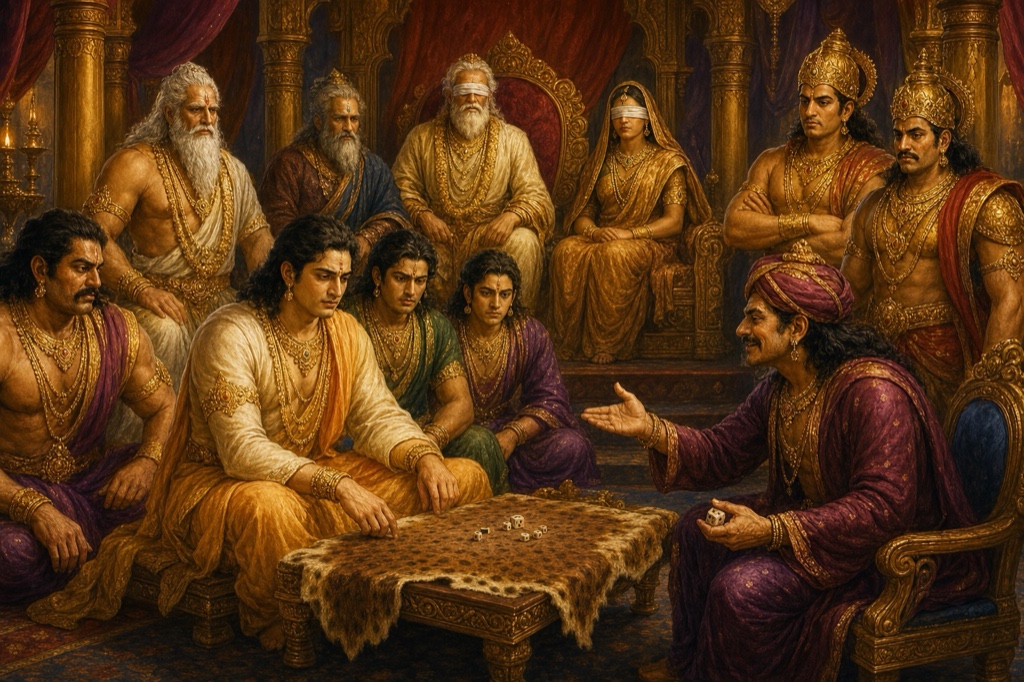
Yudhishthira staked her, and as he had done with his brothers he told the hall what he was putting down. “She is neither short nor tall, neither thin nor heavy, and her hair is blue-black and curls. Her eyes are like the leaves of the autumn lotus and she carries the scent of the autumn lotus. In beauty she is the equal of Lakshmi, who delights in those lotuses, and the equal of Shri herself in the balance of her form and in every grace. A man who wanted a wife for softness of heart, for wealth of beauty and wealth of virtues, would want a woman like her. She is accomplished in everything, she is compassionate, and her speech is sweet; a man who wanted a wife fit to help him toward virtue and pleasure and wealth would want a woman like her. She is the last in the house to lie down and the first to wake, and she looks after everyone, down to the cowherds and the shepherds. When her face is damp with sweat it looks like the lotus or the jasmine. Her waist is as slender as a wasp’s, her hair is long and loose, her lips are red, and her skin is smooth. That is the princess of Panchala. That is Draupadi. I make her my stake, son of Subala, and I play.”
He had hardly finished when the old men in the hall cried out. “Shame! Shame!” The whole assembly was in commotion, and the kings who sat there gave themselves up to grief. Sweat stood on Bhishma and on Drona and on Kripa. Vidura took his head between his hands and sat like a man whose reason had gone, his face turned to the floor, sunk in his own thoughts, his breath coming like the hiss of a snake. Dhritarashtra could see none of it. He was glad at heart, and he could not keep the gladness out of his voice. “Has the stake been won?” he asked, and asked again. “Has the stake been won?” Karna laughed out loud, and Duryodhana’s brother Duhshasana laughed with him, and so did others of their party, while everyone else in that hall had tears running from their eyes. And Shakuni, proud of his success and flushed with it, repeated his own words about the one dear stake still left, threw, said, “Look, I have won,” and gathered up the dice from where they lay.
A sub-tale: Draupadi was born of no woman. Drona tells it himself, once the Pandavas have gone: Drupada, king of Panchala, performed a sacrifice with the help of the ascetics Yaja and Upayaja to obtain a son, and a son, Dhrishtadyumna, and a daughter, Krishna, rose together from the sacrificial platform. Sanjaya says the same of her to Dhritarashtra: she came from the sacred fire and from no woman’s womb. The hair that is about to be seized in this hall had been sprinkled with water made holy by mantras at the great Rajasuya sacrifice. Drona also says why he fears her brother. It is widely believed, and he has heard it himself, that Dhrishtadyumna was born to kill him.
The gist: Yudhishthira stakes himself and loses, and Shakuni tells him that losing himself while he still had something else to stake was a sin. The something else is Draupadi. Yudhishthira describes her to the hall and stakes her, the elders cry shame, Vidura sits with his head in his hands, and Dhritarashtra keeps asking whether the stake has been won. Shakuni throws and says that it has. The order of those two losses, himself first and his wife second, is what the hall will be asked to judge.
The summons to the hall, and Draupadi’s question
Duryodhana spoke first, and he spoke to Vidura. “Come, Kshatta. Go and fetch Draupadi, the dear and cherished wife of the Pandavas. Let her sweep the rooms. Make her do it. Let the unlucky woman live where our serving women live.”
“You wretch,” Vidura said. “Do you not know that with words like these you are tying yourself up in cords? Do you not understand that you are hanging over the edge of a precipice? You are a deer, and you are baiting tigers. Snakes full of deadly venom have been roused, and they are on your head. Do not provoke them further, or you will go to the realm of Yama, where the dead go. In my judgment Krishna has not become a slave. The king staked her after he had lost himself, when he was no longer his own master. The bamboo bears fruit only when it is about to die, and that is how the son of Dhritarashtra wins this treasure at play. He is drunk, and in these last moments of his he cannot see that dice breed enmity and terror. No man should speak harshly and pierce the hearts of others. No man should bring his enemies down with dice or with foul means of that kind. No one should use words the Vedas disapprove, words that lead to hell and wound whoever hears them. One man lets a harsh word out of his mouth, and another, stung by it, burns day and night, because such words go to the very heart. The learned never aim them at anyone. A goat once swallowed a hook, and when the hook had caught, the hunter laid the animal’s head on the ground and tore its throat open horribly, dragging the hook out. Do not swallow the wealth of the Pandavas, Duryodhana. Do not make them your enemies. The sons of Pritha never use words like yours. Only low men, men who are like dogs, speak harshly to every class of person, to those who have retired to the woods, to householders, to those given to austerities, and to those of great learning. The son of Dhritarashtra does not know that dishonesty is one of the terrible doors of hell.”
“Many of the Kurus have followed him down that road in this game, and Duhshasana is among them,” Vidura went on. “Gourds may sink and stones may float, and boats may go to the bottom every time they are put on the water, and still this foolish king, Dhritarashtra’s son, will not listen to me, though what I tell him is the diet that would cure him. He will be the destruction of the Kurus. I have no doubt of it. When friends speak the wisdom that would heal and no one listens, and greed keeps growing all the while, a terrible destruction comes, and it takes all the Kurus together.”
Duryodhana was drunk on his own pride. “Shame on Kshatta,” he said, and looked past him to the Pratikamin, a man of the Suta caste who stood in attendance. In front of all those reverend elders he gave the order to him. “Go, Pratikamin, and bring Draupadi here. You have nothing to fear from the sons of Pandu. Only Vidura raves, out of fright. And he has never wished us to prosper.” The Pratikamin heard his king and went quickly. He entered the quarters of the Pandavas as a dog enters a lion’s den, and came before their queen.
“Yudhishthira was drunk on the dice, Draupadi, and Duryodhana has won you,” he said. “You are to come now to the house of Dhritarashtra. I am to take you there, Yajnaseni, and put you to some menial work.”
“Why do you say this to me, Pratikamin?” Draupadi said. “What prince is there who plays with his wife for a stake? The king must have been drunk on the dice. Was there nothing else he could find to put down?”
“He staked you when he had nothing else left,” the Pratikamin said. “Ajatashatru, Pandu’s son, staked his brothers first. Then he staked himself. Then he staked you, princess.”
She heard the order of it, and she saw what the order might be worth. “Go back, son of the Suta race,” Draupadi said. “Ask that gambler in the assembly which he lost first, himself or me. Find that out and come back to me. Then you may take me with you.”
The messenger went back to the hall and told everyone there what Draupadi had said. Then he stood in front of Yudhishthira, who sat among the kings, and put her question to him in her words. “Draupadi asks you: whose lord were you when you lost me at play? Did you lose yourself first, or me?” Yudhishthira sat as a man sits who has lost his senses and his reason. He gave the Suta no answer, good or bad.
Duryodhana answered in his place. “Let the princess of Panchala come here and ask her question herself. Let everyone in this assembly hear what passes between her and Yudhishthira.”
The messenger obeyed. He went to the palace a second time, and he was by now a badly troubled man. “Princess,” he said to Draupadi, “those in the assembly are sending for you. It looks to me as though the end of the Kauravas is close. When Duryodhana is ready to have you brought before the assembly, a king so weak in the head will not be able to guard his fortune much longer.”
“The great Ordainer of the world has surely arranged it so,” Draupadi said. “Happiness and misery come to wait on the wise and the unwise alike. It has been said that dharma is the one highest thing in this world, and that if we cherish it, it will bring us blessings. Let dharma not abandon the Kauravas now. Go back to those who sit in that assembly and repeat what I say, for it is in keeping with dharma: I am ready to do whatever those elders, who are virtuous and who know dharma, tell me plainly that I must do.”
The Suta took her words back to the hall and repeated them. No one answered. They all sat with their faces lowered and said nothing, because they knew how eager the son of Dhritarashtra was and how fixed his purpose.
A key to reading this (the idea): Draupadi sends back a point of law. If Yudhishthira lost himself first, then he was no longer his own master when he staked her, and that is the ground Vidura has already taken against Duryodhana. Bhishma, when the question reaches him, will weigh it two ways. A man who owns nothing cannot stake what belongs to someone else. A wife is always under the orders of her lord and at his disposal. He will say he cannot decide between the two, and he will call dharma subtle.
Krishna dragged by the hair
Yudhishthira had understood by now what Duryodhana intended, and he sent a messenger of his own to her, a man he trusted. Her season had come. She was wearing a single cloth, tied so low that her navel showed. He asked that she come as she was, and come weeping bitterly, and stand before her father-in-law. The messenger was a sensible man. He went quickly to her rooms and told her what Yudhishthira had in mind. In the hall the Pandavas sat in distress and sorrow, held by their given word, unable to decide among themselves what they ought to do.
Duryodhana looked them over and was glad at heart. “Pratikamin, bring her here,” he told the Suta. “Let the Kauravas answer her question to her face.” The Suta was a man who obeyed, and he was also a man afraid of what the daughter of Drupada might do in her anger. He gave up his reputation for good sense and turned to the assembly a second time. “What am I to say to Krishna?” he asked them.
“Duhshasana,” Duryodhana said, “this son of my Suta has very little sense, and he is afraid of Bhima. Go yourself. Bring the daughter of Yajnasena here by force. Our enemies depend on our will now. What can they do to you?”
Duhshasana got up at his brother’s order with his eyes red as blood. He walked into the quarters of those great warriors and spoke to the princess. “Come, Krishna. Come, princess of Panchala. We have won you. Come, you with eyes as wide as lotus leaves, and take the Kurus for your lords. You were won fairly. Come to the assembly.” Draupadi rose in great distress and rubbed her pale face with her hands. Then she ran, in her misery, toward the place where the women of Dhritarashtra’s household were.
Duhshasana roared in anger and ran after her, and he caught the queen by her hair, that long, blue-black, waving hair. It had been sprinkled with water made holy by mantras at the great Rajasuya sacrifice. A son of Dhritarashtra now had it in his fist, and what the Pandavas could do in battle counted for nothing with him. He dragged Krishna of the long hair toward the assembly as though she had no one to protect her, though her protectors were powerful men, and he pulled at her until she shook as a banana plant shakes in a storm.
She was bent almost double as he dragged her, and her voice was faint. “You wretch. It is wrong of you to take me before the assembly. My season has come. I have one cloth on.”
She was praying as she spoke, a piteous prayer to Krishna and to Vishnu, who walked the earth as Narayana and Nara. Duhshasana had her by her black hair and he kept dragging. “Your season may have come or it may not,” he said. “You may be wearing one cloth or nothing at all. You have been won at dice and made our slave, and you will live among our serving women however you please.”
Her hair had come loose and half her cloth had slipped, and still he dragged her. She was a modest woman and she was burning with anger, and when she spoke again her voice was low.
“There are men in this assembly who know every branch of learning,” she said. “They are devoted to the sacrifices and the other rites, and every one of them is the equal of Indra. Some of them are truly my elders, and others deserve the respect that elders are given. I cannot stand in front of them in this state. You wretch, you man of cruel deeds, do not drag me like this. Do not uncover me like this. The princes, my lords, will never forgive you, even if you had the gods themselves and Indra with them for your allies. The son of Dharma is held fast now by what dharma requires of him. Dharma is subtle, and only those who see with great clearness can make it out. I will not admit in words even an atom of fault in my lord and forget his virtues. You are dragging me in front of these Kuru heroes while I am in my season. It is a vile act, and no one here rebukes you for it. They must all be of one mind with you. Shame on it! The virtue of the Bharatas is truly gone. The usage of those who know the Kshatriya way is gone with it, or these Kurus would never have sat in this assembly and looked on in silence at an act that breaks every limit their own practice sets. Drona and Bhishma have lost their strength. So has Kshatta, and so has this king. Why else would the eldest and greatest of the Kurus watch this great crime and say nothing?”
So Krishna of the slender waist cried out in her distress before that assembly. She turned her eyes on her husbands, the five Pandavas, who were already filled with a terrible anger, and with that one look she set them burning hotter. They had been robbed that day of their kingdom, of their wealth, of their costliest gems, and none of it had hurt them as that look hurt them, with modesty and rage together in it. Duhshasana saw her looking at lords who could not help her. He dragged her harder, and he called her “Slave! Slave!” and laughed aloud. Karna was delighted with the word and showed it by laughing aloud himself. Shakuni, Subala’s son, the king of Gandhara, applauded Duhshasana in the same way. Those three were pleased, and Duryodhana was pleased. Everyone else in the assembly who saw Krishna dragged in before them was filled with sorrow.
A key to reading this (lineage): Draupadi goes by several names in these scenes. Krishna is her own name. Yajnaseni marks her as the daughter of Yajnasena, which is what Duhshasana later calls her father, King Drupada of the Somaka line. Panchali and “princess of Panchala” come from his kingdom. The Krishna she prays to while she is dragged is another person altogether: the one who lives in Dwarka, whom her prayer will also call Govinda and Keshava, who is also named Vishnu and Hari.
The gist: The Pratikamin is too frightened to fetch her, so Duryodhana sends Duhshasana. He seizes Draupadi by the hair that was consecrated at the Rajasuya and drags her into the full assembly in her season, in a single cloth. She tells him the princes will never forgive him, refuses to speak a word against Yudhishthira, and charges Bhishma, Drona, Vidura and the king with watching a crime in silence. Duhshasana calls her a slave. Karna and Shakuni laugh and applaud, Duryodhana is glad, and the rest of the hall grieves.
Bhishma’s dilemma, and Vikarna’s courage
Bhishma had seen all of it, and it was Bhishma who spoke. “Blessed lady, dharma is subtle, and I am unable to settle the point you have raised. On one side, a man who has no wealth cannot stake wealth that belongs to others. On the other, wives are always under the orders of their lords and at their disposal. Yudhishthira would give up the whole world and all its riches, and he would never give up dharma. And the son of Pandu has said, ‘I am won.’ So I cannot decide this. No man alive is Shakuni’s equal at dice, and the son of Kunti staked against him all the same, of his own will. Yudhishthira himself does not hold that Shakuni played him false. So I cannot decide this point.”
“The king was summoned to this assembly,” Draupadi said. “He has no skill at dice, and he was made to play against gamblers who are skilled and wicked and deceitful and desperate. How can anyone say he staked of his own will? Wretches of crooked conduct and unholy instincts worked together to take the senses from the chief of the Pandavas, and then they beat him. He could not see through their tricks then. He sees through them now. There are Kurus sitting in this assembly who are lords over their own sons and their own daughters-in-law. Let every one of them think carefully about what I have said and give a proper answer to the point I have raised.”
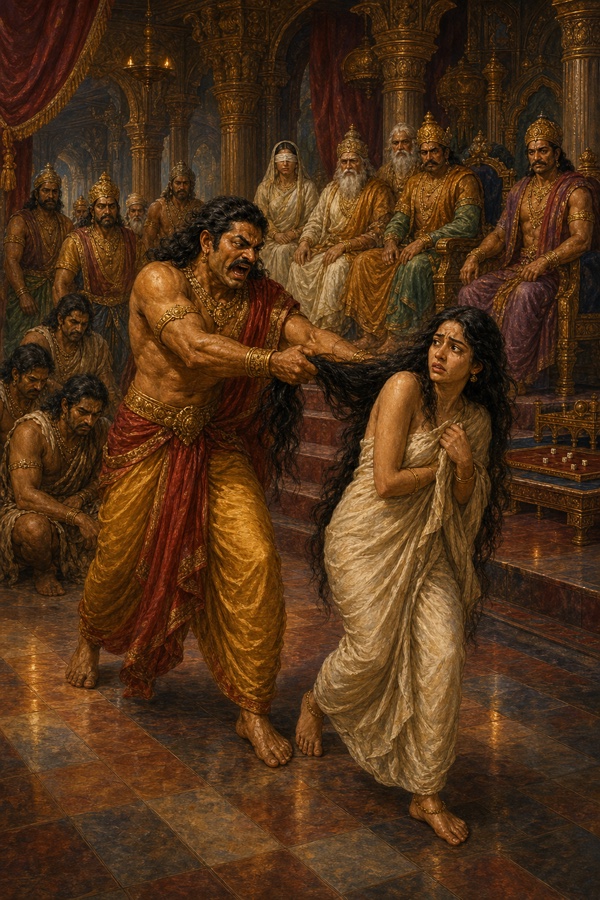
She was weeping as she spoke, crying out piteously, and her eyes kept going to the husbands who could do nothing for her. Duhshasana answered her with a string of harsh and ugly words. She was in her season, and she was being dragged, and her upper cloth was coming loose, and she had done nothing to deserve any of it. Bhima saw her so and it was more than he could endure. He fixed his eyes on Yudhishthira and let his anger go.
“Yudhishthira,” Bhima said, “gamblers keep plenty of loose women in their houses, and they do not stake even those. They have that much kindness for them. The king of Kashi gave us wealth and fine things. Other kings of the earth gave us gems and animals and riches, coats of mail and weapons. All of that, and our kingdom, and you yourself, and the four of us, the enemy has won. None of it made me angry, because you are our lord. Staking Draupadi is different. I count that a thing that should never have been done. This innocent girl does not deserve it. She got the Pandavas for her lords, and it is on your account alone that low, contemptible, cruel, small-minded Kauravas are tormenting her like this. It is for her sake, king, that my anger falls on you. I am going to burn those hands of yours. Sahadeva, bring fire.”
“Bhimasena, you have never spoken words like these before,” Arjuna said. “These cruel enemies must have destroyed your high sense of dharma. Do not give them what they want. Hold to the highest dharma. Who has the right to go against his own virtuous eldest brother? The enemy summoned the king, and he remembered the usage of the Kshatriyas and played at dice against his own wish. That will bring us great fame.”
“If I had not known that the king acted by Kshatriya usage, Arjuna,” Bhima said, “I would have taken both his hands by main force and burned them in a blazing fire.”
One of Dhritarashtra’s own sons spoke next. Vikarna looked at the Pandavas in their distress and at the princess of Panchala in hers, and addressed the hall. “Kings, answer the question Yajnaseni has asked. If we refuse to judge a matter that has been put before us, every one of us will go to hell, and we will not wait long for it. Bhishma and Dhritarashtra are the two eldest of the Kurus. Why do they say nothing? Why does Vidura say nothing? Bharadvaja’s son, the preceptor of us all, is here, and so is Kripa. Why do those two Brahmins not answer? And the other kings, who have gathered from every direction: let them put aside every thought of gain and every anger and answer by their own judgment. Kings, answer what this blessed daughter of King Drupada has asked. Think it over, and say on which side each of you stands.”
He made the appeal again and again. The kings gave him not one word, good or bad. Vikarna, having asked them all and asked them repeatedly, began to rub his hands together, and his breath came like a snake’s. At last the prince said, “Kings of the earth, Kauravas, whether you answer this question or keep silent, I will say what I hold to be just and proper.”
“It has been said that hunting, drinking, gambling and too much enjoyment of women are the four vices of kings,” Vikarna said. “A man given over to them lives with virtue left behind him, and people give no authority to what a man does while he is so wrongly engaged. This son of Pandu was deep in one of those vices, and deceitful gamblers pushed him on, when he made Draupadi a stake. The innocent Draupadi is, besides, the common wife of all the sons of Pandu. The king had lost himself first, and offered her as a stake afterward. And it was Shakuni, wanting a stake, who talked the king into staking this Krishna. I have thought about all of these circumstances, and I hold that Draupadi has not been won.”
A great noise went up from the assembly when he had finished. They all applauded Vikarna, and they all blamed the son of Subala. The sound of it drove Karna, the son of Radha, out of his senses with anger. He waved his shapely arms and answered.
“Vikarna, I see a good many contrary and inconsistent things in this assembly. Fire is born from a stick of kindling and eats the stick it came from, and this anger of yours will eat you. These great men here have been pressed by Krishna to speak, and they have not said a word. Every one of them holds that the daughter of Drupada was properly won. You alone, son of Dhritarashtra, are bursting with rage, and it is your unripe years that do it. You are a boy, and you talk in the assembly as though you were an old man.”
Karna had more for him, and he laid it out point by point. “You do not know what dharma really is, younger brother of Duryodhana, when you say like a fool that this Krishna, who has been justly won, has not been won at all. How can you hold her unwon, when the eldest of the Pandavas staked everything he possessed in front of this assembly? Draupadi is included in everything he possessed. Why, then, do you call her unwon, who was justly won? She was named as a stake, and the Pandavas approved her as a stake. For what reason do you still count her unwon? Or perhaps you think it improper that she was brought here in a single cloth. Then listen to some excellent reasons. The gods have ordained one husband for one woman. This Draupadi has many husbands. It is certain, therefore, that she is an unchaste woman, and to bring such a woman into this assembly in one cloth, or to uncover her altogether, is nothing to be surprised at. Whatever wealth the Pandavas had, and she herself, and the Pandavas themselves, have all been justly won by the son of Subala.”
Then he turned from the boy to Duhshasana. “Duhshasana, this Vikarna talks what sounds like wisdom, and he is a child. Take the robes off the Pandavas. Take off Draupadi’s clothing too.” The Pandavas heard him. They took off their upper garments, threw them down, and sat where they were in that assembly. And Duhshasana, in front of every eye in the hall, took hold of Draupadi’s cloth by force and began to pull it from her body.
A key to reading this (the idea): Vikarna is one of Dhritarashtra’s sons and a younger brother of Duryodhana, and he is the first man in the hall to give Draupadi’s question an answer. He gives four reasons. A king sunk in one of the four royal vices acts without authority; Draupadi is the common wife of all the sons of Pandu; Yudhishthira had already lost himself; and the stake was Shakuni’s suggestion. Karna meets him with three: Yudhishthira staked all he owned and a wife is part of that, the Pandavas accepted her as the stake, and a woman with many husbands is unchaste, so that nothing done to her in the hall ought to surprise anyone.
The call to Hari, and the endless stream of cloth
While the cloth was being pulled from her, Draupadi put her whole mind on Hari and cried aloud. “Govinda! You who live in Dwarka! Krishna, beloved of the cowherd women of Vrindavana! Keshava, do you not see how the Kauravas are humiliating me? Lord, husband of Lakshmi, lord of Vraja, you who destroy every affliction, Janardana, rescue me. I am going under in this ocean of Kauravas. Krishna, Krishna, great yogi, soul of the universe, maker of all things, Govinda, save me. I am in agony, and I am losing my senses here among the Kurus.” She was in torment, and her beauty shone through the torment. She covered her face and went on crying out, her thought fixed on Krishna, on Hari, on the lord of the three worlds.
Krishna heard the words of Draupadi and was deeply moved. He rose from his seat and, out of compassion, came there on foot. And while Yajnaseni was crying for protection to Krishna, who is also called Vishnu and Hari and Nara, Dharma himself, unseen by anyone, covered her with fine cloth of many colors. Duhshasana pulled a garment away and another of the same kind was there, already wrapped around her. He pulled that one away and there was another. It went on in that way until cloth lay in plain sight all over the floor. Under the protection of Dharma, robes by the hundred, in every color, came off the body of Draupadi, and she stood clothed. A deep roar of many voices rose in the hall. The kings in that assembly were looking at the most extraordinary sight the world had to show them, and they began to praise Draupadi and to blame the son of Dhritarashtra.
Bhima was wringing his hands, and his lips shook with rage. There, in the middle of all those kings, he swore a terrible oath, and he swore it at the top of his voice.
“Hear me, Kshatriyas of the world. No man has ever spoken words like these before, and no man will ever speak them again. Kings, if I say this and afterward fail to do it, may I never reach the place where my dead ancestors are. I will tear open the breast of this wretch in battle by sheer strength, this scoundrel with a wicked mind who was born among the Bharatas, and I will drink his lifeblood. If I do not, may I never reach the place where my ancestors are.”
The hair rose on the bodies of the men who heard it. Everyone there applauded Bhima and blamed the son of Dhritarashtra. By then a great heap of cloth had collected in the hall, every piece of it pulled from Draupadi, and Duhshasana, tired and ashamed, sat down. The men of that assembly, who were like gods among men, looked at the sons of Kunti in the state they were in, and with one voice they cried “Shame!” The sound was loud enough to raise the hair on anyone who heard it. The honest men among them began to say it openly: “The Kauravas are not answering the question Draupadi put to them.” And together they blamed Dhritarashtra, and the hall filled with their clamor.
A sub-tale: Two names stand over this rescue. Draupadi fixes her thought on Hari and calls on Krishna of Dwarka by one name after another, and Krishna, hearing her, is moved, leaves his seat and comes on foot out of compassion. The cloth comes from Dharma, who stays unseen and covers her again, in many colors, as fast as each garment is pulled away, until the robes taken from her are counted by the hundred.
The gist: Draupadi calls on Hari. Dharma, unseen, keeps her covered, and the robes pile up on the floor until Duhshasana sits down tired and ashamed. Bhima swears before the kings that he will tear open that man’s breast in battle and drink his blood, or lose his place among his ancestors. The hall praises Draupadi, blames Dhritarashtra and his son aloud, and says that the Kauravas have still given her no answer.
Vidura’s parable, and Draupadi’s unanswered question
Vidura had made the science of dharma his own. He waved his hands until the hall was quiet, and then he spoke.
“You who sit in this assembly: Draupadi has put her question, and she is weeping, and she has no one to help her, and you do not answer. Dharma itself is being persecuted by conduct like this. A person in distress comes to an assembly of good men as someone comes who is on fire. Those who sit in the assembly put out that fire and cool him, and what they use is truth and dharma. The one in distress asks the assembly what his rights are, as dharma allows them. Those who sit there should answer, and neither interest nor anger should move them. Kings, Vikarna has answered the question by his own knowledge and his own judgment. You should answer it too, each as he thinks right. A man who knows the rules of dharma, who has taken his seat in an assembly, and who then gives no answer when a question is put, takes on half the guilt that belongs to a lie. A man who knows those rules, who has joined an assembly, and who answers falsely, takes on the whole sin of a lie. The learned have an old history they quote on this point. It is the history of Prahlada and the son of Angiras.”
And Vidura told it to them. Long ago there was a chief of the Daityas whose name was Prahlada, and he had a son named Virochana. Virochana fell into a quarrel with Sudhanvan, the son of Angiras, and the quarrel was over a bride each of them wanted. It is told that each declared, “I am the better man,” and that for the sake of the bride they wagered their lives on it. When they had quarreled long enough, the two of them made Prahlada the judge between them.
“Which of us is superior to the other?” they asked him. “Answer the question. Do not speak falsely.”
The quarrel frightened Prahlada, and he looked toward Sudhanvan. Sudhanvan was in a rage, burning like the mace of Yama, and he gave the judge a warning. “If you answer falsely, or if you give no answer at all, the wielder of the thunderbolt will split your head into a hundred pieces with that bolt of his.”
The Daitya shook like a leaf of the fig tree. He left them and went to Kashyapa, whose power was great, to take counsel with him.
“You know completely the rules of dharma that should guide the gods and the Asuras, and the Brahmins as well,” Prahlada said to him. “I am in a place where duty is very hard to find. I ask you to tell me: what worlds are waiting for those who are asked a question and do not answer it, or who answer it falsely?”
“A man who knows the answer and withholds it, out of temptation or anger or fear, throws a thousand nooses of Varuna around himself,” Kashyapa said. “A man who is called as a witness to something he has seen with his eyes or heard with his ears, and who speaks carelessly, throws a thousand nooses of Varuna around his own body. One such noose comes loose when one full year has passed. So a man who knows should speak the truth and hide nothing. When virtue, pierced by sin, comes into an assembly for help, it is the duty of everyone there to draw out the dart. If they leave it, the dart pierces them. In an assembly where an act that truly deserves blame goes unrebuked, half the guilt of that act attaches to the head of the assembly, a quarter to the one who did it, and a quarter to the others who are present. In an assembly where the one who deserves blame is rebuked, the head of the assembly is freed from all sin and the other members take on none. The one who did the act answers for it alone. Prahlada, those who are asked about dharma and answer falsely destroy the merit of seven generations above them and seven generations below.”
Kashyapa had not finished. “There are griefs the gods have declared equal in degree,” he said. “The grief of one who has lost all his wealth. The grief of one who has lost a son. The grief of one who is in debt. The grief of one separated from his companions. The grief of a woman who has lost her husband. The grief of one who has lost everything to the demand of the king. The grief of a woman who is barren. The grief of one in the claws of a tiger, in his last struggles as it devours him. The grief of a co-wife. The grief of one whom false witnesses have stripped of his property. Every one of those griefs belongs to the man who speaks falsely. A person becomes a witness because he has seen a thing, heard it and understood it, and for that reason a witness should always tell the truth. A witness who tells the truth never loses his religious merit, and he keeps his earthly possessions too.”
Prahlada heard Kashyapa out and went back, and he gave his judgment to his own son. “Sudhanvan is superior to you, as his father Angiras is superior to me. The mother of Sudhanvan is superior to your mother also. So, Virochana, this Sudhanvan is now the lord of your life.”
Sudhanvan answered the judge. “You were not moved by love for your son, and you held to virtue,” he said. “For that, I command it: let this son of yours live for a hundred years.”
That was the story. “So let everyone present in this assembly, having heard these high truths of dharma,” Vidura said, “think about what the answer to Draupadi’s question ought to be.”
The kings heard Vidura, and they answered him with not one word. Only Karna spoke, and he spoke to Duhshasana. “Take this serving woman Krishna away to the inner apartments.” And Duhshasana, in front of everyone who was watching, began to drag her again. She was helpless and she was modest, and she shook, and she cried out piteously to the Pandavas, her lords.
A sub-tale: Vidura tells the history of Prahlada and Sudhanvan to put the hall under its duty. Prahlada, made judge between his own son and a rival, learns from Kashyapa what it costs to keep silent or to answer falsely, and gives judgment against Virochana, whose life is forfeit by the wager. Sudhanvan answers that honesty by granting the son a hundred years of life. Vidura draws one lesson for the kings in front of him: they have heard what dharma says about a question left unanswered, and Draupadi’s question is still waiting.
The gist: Vidura quiets the hall and tells it that a man who knows dharma, sits in an assembly and will not answer a question takes on half the guilt of a lie. He supports it with the old history of Prahlada, Virochana and Sudhanvan, and with Kashyapa’s teaching on witnesses and on assemblies that leave a wrong unrebuked. The kings stay silent all the same. Karna orders Draupadi taken to the inner apartments as a serving woman, and Duhshasana begins to drag her again.
Draupadi’s last question, and Duryodhana’s answer
“Wait a little, you worst of men, you wicked-minded Duhshasana,” Draupadi said. “There is something I must do, a high duty I have not yet performed. This wretch’s strong arms dragged me here by force and I lost my senses. I salute these reverend elders in the assembly of the Kurus. If I could not do it before now, the fault cannot be mine.”
He dragged her harder than he had before. She was in agony and helpless, and she had done nothing to deserve it, and she fell to the ground. There, on the floor of the assembly of the Kurus, she wept, and spoke through her weeping.
“Only once before did an assembly of kings look at me. That was in the arena at my svayamvara, and after that day I was never seen again. Today I have been brought before this assembly. I am a woman whom the winds and the sun had never seen inside her palace, and today I am in front of this assembly with a crowd staring at me. The sons of Pandu could not bear that even the wind should touch me in my palace, and today the Pandavas bear it while this wretch seizes me and drags me. These Kauravas bear it too. They watch their daughter-in-law, who deserves none of it, tormented in front of them. The times must be out of joint. I am well born and I am chaste, and I am forced to enter a public court. What could be more painful to me than that? Where is the virtue these kings were known for? We have always heard that the kings of old never brought their wedded wives into the public court. That eternal usage has vanished from among the Kauravas. How else could the chaste wife of the Pandavas, sister to the prince of Prishata’s line and friend to Vasudeva, be brought before this assembly? Kauravas, I am the wedded wife of King Yudhishthira the just, and I come of the same order the king comes of. Tell me now whether I am a serving maid or something else. I will accept your answer cheerfully. This mean wretch, this destroyer of the Kurus’ good name, is hurting me badly. Kauravas, I cannot bear it any longer. Kings, I want you to tell me whether you hold me won or unwon. Whatever your verdict is, I will accept it.”
Bhishma answered her. “Blessed lady, I have said already that the course of dharma is subtle. Even the wisest in this world do not always understand it. What a strong man in this world calls dharma, others take for dharma, however far from it the thing may really be. What a weak man calls dharma is hardly taken for it, even when it is the highest dharma. The question you ask is important, and it is intricate and subtle, and for those reasons I am unable to answer it with certainty. One thing is certain. All the Kurus have become the slaves of greed and folly, and the destruction of this race of ours is close. Blessed lady, the family you entered as a daughter-in-law is one whose sons, whatever calamities fall on them, never leave the paths of virtue and dharma. And your own conduct, princess of Panchala, is worthy of you: you are sunk in distress, and your eyes are still on virtue and dharma. Drona and these others are men of ripe years who know dharma, and they sit with their heads hanging like dead men, like bodies the life has left. It seems to me that Yudhishthira is the authority on this question. He is the one who should declare whether you are won or unwon.”
The kings in that assembly were afraid of Duryodhana. They watched Draupadi crying in her pain like a female osprey, they heard her appeal to them again and again, and they did not say a word, good or bad. The son of Dhritarashtra looked at those kings, and at the sons and grandsons of kings, all sitting silent. He smiled a little. Then he spoke to the daughter of the king of Panchala.
“Yajnaseni, the question you have asked rests with your husbands. It rests with Bhima, whose strength is so great, and with Arjuna, and with Nakula and Sahadeva. Let them answer it. Let them declare for your sake, Panchali, here among these respectable men, that Yudhishthira is not their lord. Let them make King Yudhishthira the just a liar. You will be free from slavery when they do. Or let the son of Dharma himself, who always holds to virtue and who is like Indra, declare whether he is your lord or is not. On his word, take the Pandavas or take us, and be quick about it. All the Kauravas in this assembly are adrift on the ocean of your distress. They are generous men. They look at your unfortunate husbands and find they cannot answer you.”
His party thought it a delightful speech. Everyone in the assembly applauded the Kuru king loudly, and they shouted their approval and signaled to one another with their eyes and their lips, though from some seats came sounds of distress, an “Oh!” here and an “Alas!” there. The Kauravas in the hall were overjoyed. The kings turned their faces sideways to look at Yudhishthira, who knew the rules of dharma, curious to hear what he would say. They were curious about the others too: what Arjuna would say, that son of Pandu who had never been beaten in battle, and Bhima, and the twins. The busy hum of all those voices died away. Bhima raised his arms, strong and finely made and smeared with sandal paste, and he was the one who spoke.
“If King Yudhishthira the just, our eldest brother, were not our lord, we would never have forgiven the Kuru race for any of this. He is the lord of every merit we have earned by our rites and our austerities. He is the lord of our very lives. If he counts himself won, then all of us have been won with him. If that were not so, what creature that is mortal and walks the earth on feet would have touched the hair of the princess of Panchala and got away from me alive? Look at these arms of mine. They are thick and well made, and they are like maces of iron. Once he is inside them, even the god of the hundred sacrifices cannot get out. I am tied by virtue and by the reverence I owe our eldest brother, and Arjuna keeps urging me to be silent, and so I do nothing terrible. Let King Yudhishthira the just give me the order once. I would kill these wretched sons of Dhritarashtra with the flat of my hands and never need a sword, as a lion kills a pack of little animals.”
Bhishma and Drona and Vidura spoke to him then. “Be patient, Bhima. With you, anything is possible.”
The gist: Thrown to the floor, Draupadi stops to salute the elders and then asks the Kauravas plainly whether she is a serving maid, won or unwon. Bhishma says again that dharma is subtle, that the strong decide what is called dharma, that the Kurus are close to destruction, and that Yudhishthira is the one to answer. Duryodhana turns the question on the husbands: let the four brothers say that Yudhishthira is not their lord, and she is free. Bhima answers that Yudhishthira is the lord of their merits and their lives, and that only his elder brother’s authority and Arjuna’s urging hold his hands.
Karna’s bitter words, and Duryodhana’s bared thigh
Karna spoke next, and he spoke to Draupadi. “There are three in this assembly who seem to be their own men: Bhishma, Vidura, and Drona, the preceptor of the Kurus. They are forever calling their master wicked, forever finding fault with him, and they never wish him to prosper. The slave, the son and the wife are always dependent. They cannot earn wealth, because whatever they earn belongs to their master. You are the wife of a slave who can own nothing on his own account. Go now to the inner apartments of King Dhritarashtra and wait on the king’s relatives. That is your proper business from now on, and we direct you to it. All the sons of Dhritarashtra are your masters now, princess, and the sons of Pritha are your masters no longer. Choose another husband, a man who will not gamble you into slavery. Everyone knows that women are not blamed for choosing husbands freely, slave women least of all. So choose. Nakula has been won, and Bhimasena, and Yudhishthira, and Sahadeva, and Arjuna. You are a slave now, Yajnaseni, and husbands who are slaves cannot go on being your lords. Does the son of Pritha think that life and prowess and manhood are of no use, that he offers this daughter of Drupada, the king of Panchala, as a stake at dice in front of this whole assembly?”
Bhima heard it, and his anger showed in the way he breathed. He was the picture of misery. He was obedient to the king and tied by virtue and by duty, and his eyes, red with rage, burned whatever they rested on. He spoke to Yudhishthira.
“King, I cannot be angry at what this son of a Suta says. We really have become slaves. But could our enemies have said such things to my face, if you had not played with this princess for a stake?”
Yudhishthira sat silent, like a man who had lost his senses, and Duryodhana pressed him. “King, Bhima and Arjuna are under your rule, and so are the twins. Answer the question Draupadi has asked. Say whether you hold Krishna to be unwon.”
He did not wait for the answer. He wanted to encourage Karna and he wanted to insult Bhima, and he quickly pulled the cloth back from his left thigh and showed it to Draupadi where she could not help seeing it. It was a thigh like the stem of a plantain tree or the trunk of an elephant, marked with every sign of good fortune, hard as a thunderbolt. Bhima saw it. His red eyes opened wide, and he spoke to Duryodhana in the middle of all those kings in words like darts, words that seemed to go through every man there. “May Bhima never reach the worlds his ancestors have reached, if he does not break that thigh of yours in the great battle.” He was full of wrath, and sparks of fire began to come from every organ of his senses, as sparks come from every crack and hollow in the trunk of a tree that is burning.
Vidura spoke to all of them. “Kings of Pratipa’s line, look at the great danger that rises from Bhimasena. Know for certain that this calamity which threatens to overtake the Bharatas has been sent by Destiny itself. The sons of Dhritarashtra have gambled with no regard for anything that ought to have been regarded. Even now they are disputing in this assembly over a lady of the royal house. The prosperity of our kingdom is at an end. The Kauravas, even now, are deep in sinful counsels. Kauravas, take to heart the high precept I give you: when virtue is persecuted, the whole assembly is defiled. If Yudhishthira had staked her before he was won himself, he would certainly have been counted her master. But when a man stakes a thing at a time when he is himself unable to hold any wealth, winning it is very like getting wealth in a dream. You have listened to the words of the king of Gandhara. Do not let them move you off this truth, which is beyond doubt.”
“I am willing to abide by the word of Bhima, of Arjuna, and of the twins,” Duryodhana said when Vidura had finished. “Let them say that Yudhishthira is not their master. Yajnaseni will be free of her bondage the moment they say it.”
Arjuna answered him. “This son of Kunti, King Yudhishthira the just, was certainly our master before he began to play. He then lost himself. Whose master he could be after that, let all the Kauravas judge.”
A key to reading this (the idea): Karna’s argument is the law of dependents: a slave, a son and a wife own nothing, so the wife of a slave belongs to the slave’s master. Duryodhana adds an offer that is also a trap. Draupadi goes free when her husbands say that Yudhishthira is not their lord. Bhima will not say it. Vidura gives the hall the rule he holds to: had Yudhishthira staked her before he lost himself, he would have been her master, and a stake laid by a man who can hold no wealth is won as wealth is won in a dream. Arjuna answers inside those lines. Yudhishthira was their master before the play began, and whose master he could be after losing himself is for the Kauravas to judge.
The omens, Dhritarashtra waking, and three boons
At that moment a jackal began to howl. The sound came from inside King Dhritarashtra’s palace, from the chamber where the homa fire was kept. Asses brayed in answer to the jackal. Then terrible birds took it up from every side, cry answering cry. Vidura, who understood everything, knew what those sounds meant, and so did Gandhari, the daughter of Subala and the king’s wife. Bhishma and Drona and the learned Kripa, whom they called Gautama, cried out loudly the word of benediction, “Svasti! Svasti!” Gandhari and Vidura had seen a fearful omen, and in great distress they went to the king and told him everything. And at last the king spoke.
“Duryodhana, you wretch with a wicked mind,” Dhritarashtra said. “Destruction has already overtaken you, when you insult in language like this the wife of the greatest men among the Kurus, and Draupadi above all, their wedded wife.” Dhritarashtra was a man of knowledge, and now he used what wisdom he had. He wanted to save his kin and his friends from being destroyed, and he turned to Krishna, the princess of Panchala, and began to comfort her. “Ask me for any boon you want, princess of Panchala. You are chaste and devoted to virtue, and you are the first among all my daughters-in-law.”
“If you will grant me a boon,” Draupadi said, “I ask that the handsome Yudhishthira, who is obedient to every duty, be freed from slavery. I have a son by him, Prativindhya, a boy with great strength of mind. Thoughtless children must not call him the son of a slave. He has been a prince, above other men, brought up by kings. It is not right that he should be called a slave’s child.”
“Let it be as you say,” Dhritarashtra said. “Ask me for another boon, and I will give it. My heart inclines to give you a second. You deserve more than one.”
“Then I ask, king,” Draupadi said, “that Bhimasena and Arjuna and the twins, with their chariots and their bows, be freed from bondage and have their liberty again.”
“Blessed daughter, let it be as you wish,” Dhritarashtra said. “Ask for a third boon. Two have not honored you enough. Your conduct is virtuous, and you stand first among all my daughters-in-law.”
“Greed always brings a loss of virtue, king,” Draupadi said. “I do not deserve a third boon, and so I dare not ask for one. It has been said that a Vaishya may ask one boon, a Kshatriya woman two, a Kshatriya man three, and a Brahmin a hundred. My husbands are free of the wretched state of bondage. They will be able to win prosperity by their own virtuous acts.”
A key to reading this (numbers): Draupadi refuses the third boon by citing a rule: one boon for a Vaishya, two for a Kshatriya woman, three for a Kshatriya man, a hundred for a Brahmin. She is a Kshatriya woman, and she takes her two. The first frees Yudhishthira, so that her son Prativindhya cannot be called the son of a slave. The second frees Bhima, Arjuna and the twins and gives them back their chariots and bows. She asks for no kingdom and no wealth, and says her husbands will earn their prosperity themselves.
Karna was the one who put a name to what she had done. “We have never heard of an act like this from any of the women the world celebrates for beauty. The sons of Pandu and the sons of Dhritarashtra were roused to fury against each other, and this Draupadi became the salvation of the sons of Pandu. They were sinking in an ocean of distress with no boat anywhere on it. The princess of Panchala became their boat and brought them safe to shore.”
The words went through the Kurus: the sons of Pandu had been saved by their wife. Bhima heard them, and they hurt him, and in his anger he turned to Arjuna. “Arjuna, Devala has said that three lights live in every person: offspring, acts and learning. Creation itself sprang from those three. When life goes out, and the body becomes unclean and the relatives cast it away, those three are what still serve a person. And the light that is in us has been dimmed by this insult to our wife. How can a son born of a wife who has been insulted like this ever be of service to us?”
“Bharata,” Arjuna answered, calling his brother by the name of their line, “superior men never chatter about the harsh words that lesser men may or may not let fall. Men who have earned respect for themselves, even when they are able to pay an injury back, forget what their enemies did to them in hostility and store up only the good those enemies have done.”
Bhima turned from him to Yudhishthira. “King, shall I kill every one of these enemies right here, now, while they are all gathered in one place? Or shall I take them outside this palace and tear them up by the roots? Why do we need words? Why do I need an order? I will kill them all this moment, and you will rule the whole earth with no rival left on it.”
He stood with his younger brothers around him, like a lion among a herd of lesser animals, and he kept throwing angry looks around the hall. Arjuna, whose deeds were clean, tried to quiet his elder brother with pleading looks. It did no good. The fire of Bhima’s anger was up, and it began to come out of him, out of his ears and his other senses, with smoke and sparks and flames. His brows drew together until his face was terrible to look at, like the face of Yama at the hour when the universe is destroyed. Then Yudhishthira put his arms around that powerful man and held him back. “Do not be like this,” he said. “Be silent, and be at peace.” When he had calmed Bhima, whose eyes were still red with rage, the king went up to his uncle Dhritarashtra with his palms joined in entreaty.
The gist: A jackal howls in the palace fire chamber, asses and birds answer it, and Gandhari and Vidura carry the omen to Dhritarashtra. He rebukes Duryodhana and offers Draupadi a boon, then a second, then a third. She asks for Yudhishthira’s freedom, then for the freedom of the other four with their chariots and bows, and declines the third. Karna says the Pandavas were saved by their wife. Bhima takes it as a wound and offers to kill everyone in the hall, and Yudhishthira holds him back and goes to the old king.
Dhritarashtra’s pardon, and the return to Indraprastha
“King, you are our master,” Yudhishthira said. “Command us. Tell us what we are to do. We wish to live always in obedience to you.”
“Bless you, Ajatashatru,” Dhritarashtra said. “Go in peace and in safety. I command it: go and rule your own kingdom, with your wealth. And take to heart, child, what an old man commands you now. It is wholesome advice, and it will nourish you. Yudhishthira, child, you know the subtle path of dharma. You have great wisdom, you are humble, and you wait on the old. Where there is intelligence there is forbearance, and so I tell you to follow the counsels of peace. The axe bites into wood and leaves the stone alone. You are a man who can take advice, and Duryodhana is a man who cannot. The finest men forget the hostile acts of their enemies. They see their enemies’ merits and overlook their faults, and they never begin a quarrel themselves. Good men remember only the good their enemies have done them and let the injuries go. Good men, besides, do good to others and expect nothing back for it. It is only the worst men, Yudhishthira, who use harsh words when they quarrel. Middling men answer harsh words when others have spoken them first. The good and the wise never think about such words or go back over them, and they hardly care whether their enemies spoke them or never did. Good men know their own feelings, and so they understand the feelings of others, and for that reason they remember good deeds and forget hostile ones. You have acted as good men act, men whose faces draw others to them, who never step across the limits of virtue, wealth, pleasure and salvation.”
“Child, do not remember Duryodhana’s harsh words,” the old king went on. “If you wish to remember only what is good, look at your mother Gandhari, and look at me. Look at me, Bharata. I am a father to you. I am old and blind, and I am still alive. I allowed this match at dice to go forward for reasons of policy. I wanted to see our friends, and I wanted to measure the strength and the weakness of my children. King, those among the Kurus who have you to rule them, and who have the intelligent Vidura, learned in every branch of knowledge, to counsel them, have nothing at all to grieve over. In you there is virtue. In Arjuna there is patience. In Bhimasena there is prowess. In the twins, those fine men, there is pure reverence for their elders. Bless you, Ajatashatru. Go back to Khandavaprastha. Let there be brotherly love between you and your cousins, and let your heart stay fixed on virtue always.”
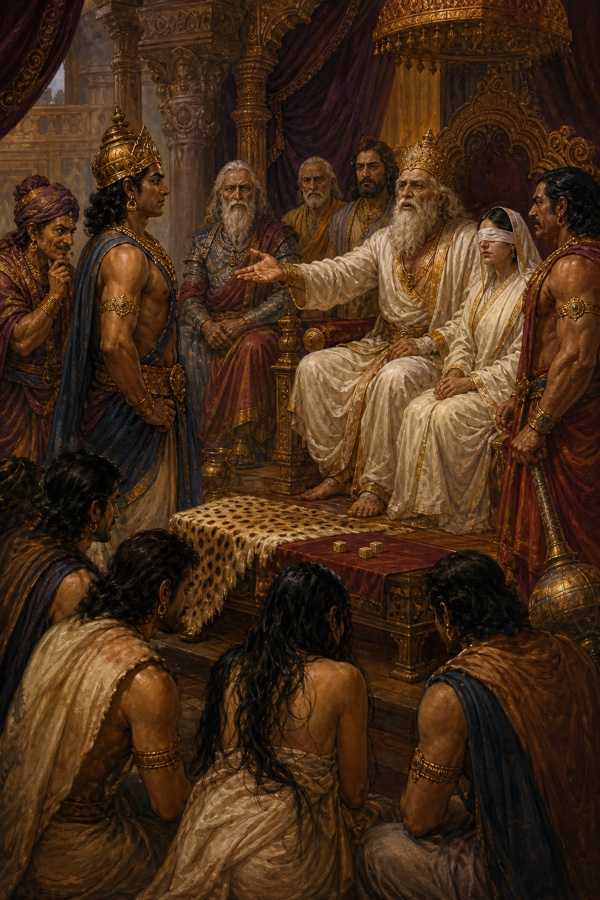
His uncle had spoken, and Yudhishthira went through every form that courtesy required of him. Then he set out with his brothers for Khandavaprastha. Draupadi was with them. They climbed onto chariots that were all the color of rain clouds, and with light hearts they drove away toward that finest of cities, the one called Indraprastha.
A key to reading this (place): Khandavaprastha and Indraprastha are one city under two names. Dhritarashtra tells Yudhishthira to go back to Khandavaprastha and rule his own kingdom, and the brothers drive off, with Draupadi, for the city called Indraprastha. It is the Pandavas’ own capital, a different seat from Hastinapura, where the dice were thrown. They leave free, with their bows, their chariots and their wealth restored to them, and with the old king’s blessing.
Duhshasana’s complaint, and the plan for the second game
King Janamejaya, to whom all of this was being told, stopped the teller here with a question. “The Pandavas left Hastinapura with Dhritarashtra’s leave, and they took all their wealth and their jewels with them. How did the sons of Dhritarashtra feel when they came to know of it?”
Vaishampayana told him. Duhshasana learned that the wise Dhritarashtra had ordered the Pandavas home to their capital, and he lost no time. He went straight to his brother and found Duryodhana sitting with his counselor, and he was sick with grief as he spoke. “Great warriors, what we won with so much trouble the old man, our father, has thrown away. Understand what he has done. He has handed the whole of that wealth back to the enemy.”
The three of them heard him: Duryodhana, Karna, and Shakuni the son of Subala. Vanity guided them all, and they joined forces at once to undo what had been done for the sons of Pandu. They hurried to the wise King Dhritarashtra, Vichitravirya’s son, saw him in private, and spoke to him in words that were pleasant and artful.
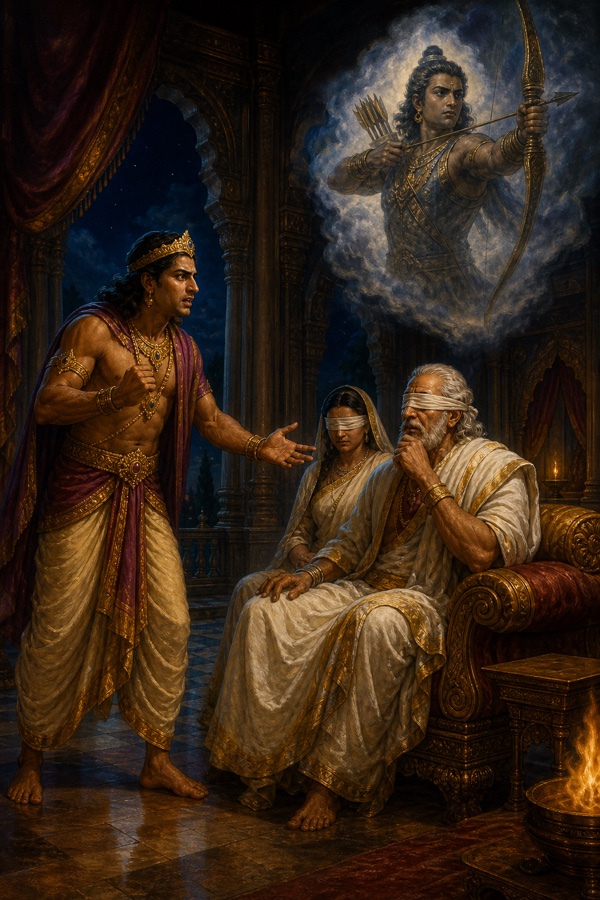
“King, have you not heard what the learned Brihaspati, preceptor of the gods, said when he was counseling Shakra about mortals and about policy?” Duryodhana said. “These were his words: ‘Enemies who always do you wrong, by stratagem or by force, should be killed by every means.’ Suppose, then, that we use the wealth of the Pandavas to win the kings of the earth to our side, and afterward fight the sons of Pandu. What reverse could reach us? A man who has laid angry, venomous snakes on his own neck and back, snakes that will be the death of him, cannot lift them off again. Father, the sons of Pandu are armed and on their chariots, and they are angry. Like furious, venomous snakes they will certainly wipe us out. Arjuna is on the road now, in his armor, with his pair of quivers. He keeps taking up the bow Gandiva, he is breathing hard, and he throws angry looks all around him. We have heard that Bhima called in haste for his chariot to be made ready, and rides on it whirling his heavy mace as he goes. Nakula travels with his sword in his fist and his half-moon shield on his arm. Sahadeva and the king have made signs that leave no doubt about what they intend. They have mounted chariots loaded with every kind of weapon, they are whipping their horses to reach Khandava quickly, and they are assembling their forces.”
“We have persecuted them, and they are not capable of forgiving those injuries,” Duryodhana went on. “Which of them will ever forgive the insult to Draupadi? Bless you, Father. We will gamble with the son of Pandu again, and this time the game will send them into exile. In that way we can bring them under our rule. Whoever is beaten at dice, we or they, will put on skins and go to the forest for twelve years. The thirteenth year must be spent in some inhabited country, unrecognized, and if the losers are recognized, another twelve years of exile will follow. Either we will live so, or they will. Let the play begin. Let the dice be thrown and let the sons of Pandu play once more. This is our highest duty, king. This Shakuni knows the whole science of dice. And even if they manage to keep the vow for all thirteen years, we will have used the time. We will be firmly rooted in the kingdom. We will have made our alliances and assembled a vast army that cannot be beaten, and kept it content, and if the sons of Pandu reappear we will defeat them. Let the plan commend itself to you.”
“Then bring the Pandavas back,” Dhritarashtra said, “even if they have gone a long way. Let them come at once and throw the dice again.”
Then the men of weight at that court spoke against it: Drona; Somadatta and Bahlika; Kripa the Gautama; Vidura; Drona’s son; the strong son Dhritarashtra had by his Vaishya wife; Bhurishravas; Bhishma; and that great fighter Vikarna. They all said the same thing. “Do not let the play begin. Let there be peace.” Dhritarashtra was partial to his sons. He set aside the counsel of every wise friend and relative he had, and sent for the sons of Pandu.
A key to reading this (numbers): The stake of the second game is time. Whoever loses puts on skins and lives in the forest for twelve years, then spends the thirteenth in an inhabited country without being recognized, and if he is recognized in that year, another twelve years of exile follow. Duryodhana tells his father what the thirteen years are for: to root himself in the kingdom, make alliances, and raise an army large enough to beat the Pandavas if they come back.
Gandhari’s warning, and Yudhishthira’s return
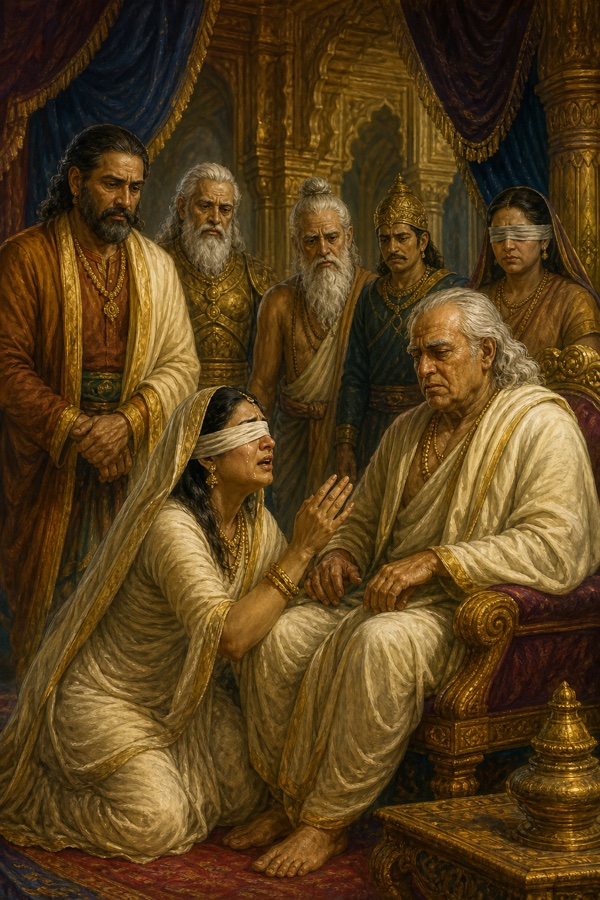
It was then, Vaishampayana said, that Gandhari spoke. She was a virtuous woman, and love for her sons had filled her with grief. She went to King Dhritarashtra.
“When Duryodhana was born, Vidura, with all his intelligence, said this: ‘It would be well to send this disgrace of our line to the other world. He has cried again and again, and his cry is harsh, like a jackal’s. He will certainly be the destruction of our race.’ Take that to heart, king of the Kurus. Do not sink into an ocean of calamity through a fault of your own, Bharata. My lord, do not give your approval to the counsels of wicked boys who have not grown up. Do not become the cause of the terrible destruction of this race. Who breaks down an embankment that has been finished? Who lights again a great fire that has been put out? Who would provoke the sons of Pritha, now that they are at peace? You remember everything, Ajamidha, and still I will call this to your mind: the scriptures can never govern a wicked-minded man, for good or for evil. A man whose understanding is unripe will never act as a man of ripe years acts. Let your sons follow you as their leader. Do not let them be parted from you forever by losing their lives. So, at my word, king, give up this wretch of our race.”
“You could not do it before, king, because you loved him as a father,” Gandhari said. “Know that the time has come when the race will be destroyed through him. Do not go wrong, king. Let your mind be what it is by nature, guided by counsels of peace, of virtue, and of true policy. Prosperity that is gained by wicked acts is soon destroyed. Prosperity that is won by gentle means takes root and goes down from generation to generation.”
That was how Gandhari showed him the path of virtue, and that was the language she used. The king’s answer was ready. “If the destruction of our race has come, let it come freely. I am in no condition to prevent it. Let it be as these sons of mine wish. Let the Pandavas return, and let my sons gamble with the sons of Pandu again.”
A sub-tale: Gandhari takes her husband back to the day Duryodhana was born. The child cried again and again, harshly, like a jackal, and Vidura said then that it would be well to send him to the other world, because he would destroy the race. Dhritarashtra could not give up his son then, out of a father’s love. She asks him to do it now. He answers that if the destruction of the race has come he is unable to prevent it, and orders the Pandavas recalled.
The second game, and the single stake of exile
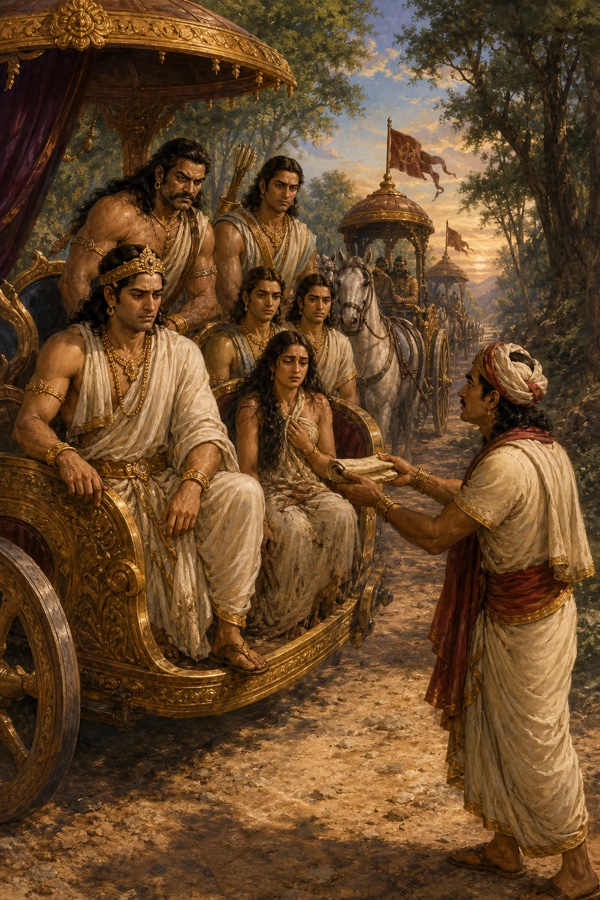
The royal messenger went out at King Dhritarashtra’s command. Yudhishthira, the son of Pritha, had gone a long way by then. The messenger caught up with him on the road and spoke to him. “These are the words of your uncle, who is as a father to you, Bharata. ‘The assembly is ready. Son of Pandu, King Yudhishthira, come and throw the dice.’”
“Creatures receive what is good for them and what is bad for them as the Ordainer of creation deals it out,” Yudhishthira said. “Those fruits will come to me whether I play or stay away. This is a summons to dice. It is also the command of the old king. I know it will destroy me, and I cannot refuse.”
A living animal made of gold was an impossible thing, and Rama let himself be tempted by a golden deer all the same. The minds of men over whom calamity hangs come loose and fall out of order.
So Yudhishthira, having said what he said, turned around on the road, and his brothers turned with him. He knew perfectly well what kind of deception Shakuni practiced, and the son of Pritha went back to sit at dice with him again. Those great warriors walked into that assembly a second time, and the hearts of all their friends were wrung to see it. Fate compelled them. They sat down at their ease, once more, to gamble for their own destruction.
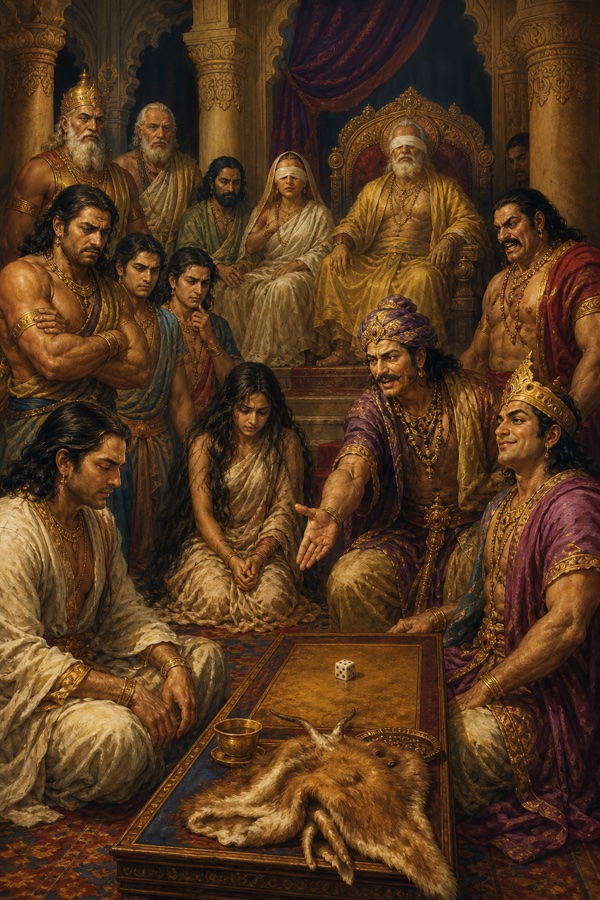
“The old king has given you back all your wealth, and that is well,” Shakuni said. “Now listen to me. There is a stake of great value. If you beat us at dice, we will put on deerskins and enter the great forest and live there twelve years. We will spend the whole of the thirteenth year in some inhabited region, unrecognized, and if we are recognized we will go back to an exile of another twelve years. If we beat you, then you, with Draupadi, will put on deerskins and live twelve years in the woods, and spend the whole of the thirteenth year unrecognized in some inhabited region, and if you are recognized, another twelve years of exile will follow. When the thirteenth year is over, the side that went into exile is to have its kingdom given back by the other. With that understanding, Yudhishthira, throw the dice and play with us.”
The men in the assembly threw up their arms when they heard it. They were deeply anxious, and the strength of what they felt forced the words out of them, and the words were addressed to Dhritarashtra. “Shame on the friends of Duryodhana, who will not warn him of the great danger he is in! Whether he has the sense to understand it himself or lacks that sense, it is your duty, king, to tell him plainly.”
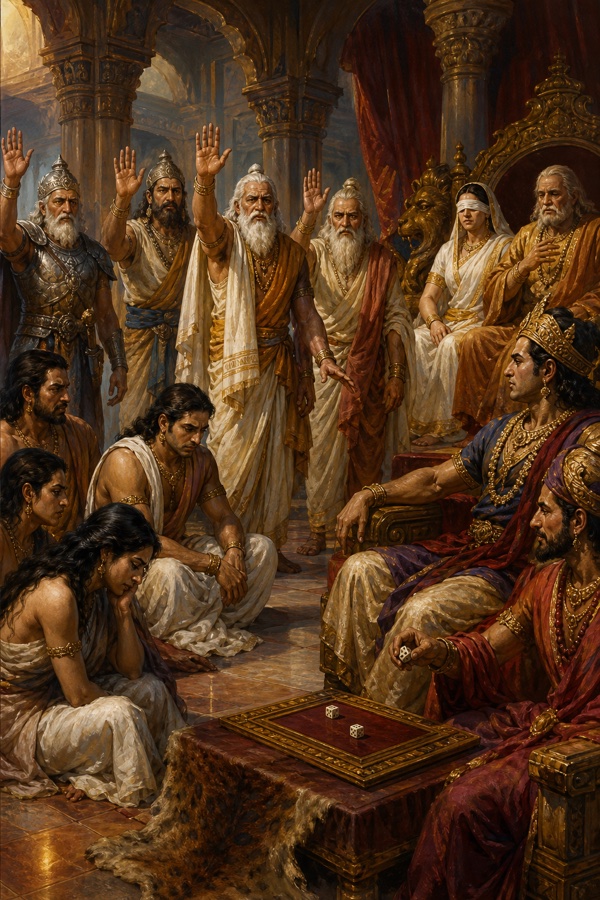
Yudhishthira heard those remarks, all of them. Shame, and his sense of what virtue required, sat him down at the dice again. He was a man of great intelligence and he knew exactly what would follow, and he began to play as though he knew that the destruction of the Kurus was at hand. “I am a king who has always kept the usage of his order, Shakuni,” he said. “How can a king like me refuse when he is summoned to dice? So I play with you.”
“We have many cattle and horses and milk cows,” Shakuni answered, “and goats and sheep beyond number, and elephants, and treasure, and gold, and slaves, both men and women. All of that was staked between us before. This time let there be one stake, and let it be exile to the woods. Whoever is beaten, you or we, will live in the woods for twelve years, and for the thirteenth year will live unrecognized in some inhabited place. With that settled, we will play.”
The proposal of a life in the woods, Vaishampayana told the king, was spoken only once. The son of Pritha accepted it. Shakuni took up the dice and threw them, and said to Yudhishthira, “Look. I have won.”
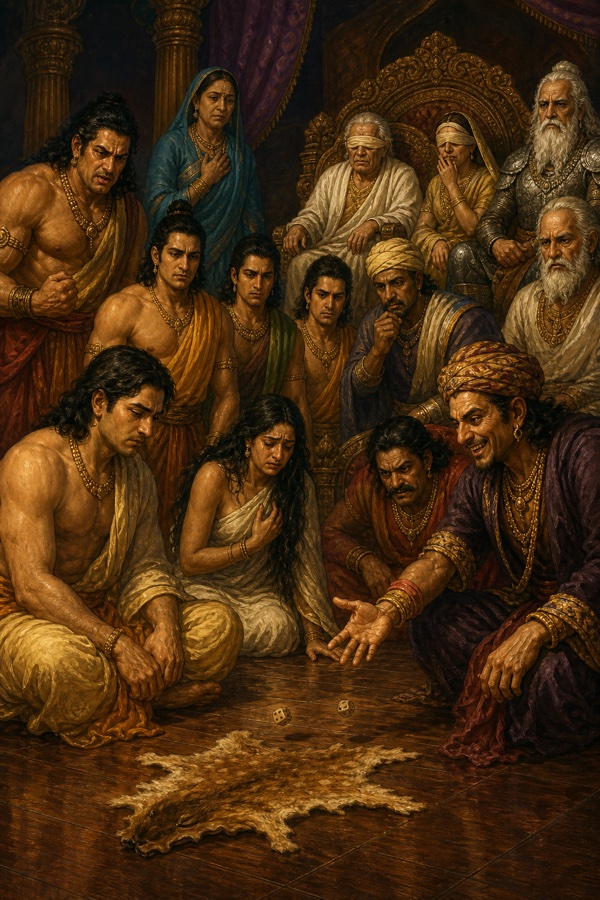
The gist: Gandhari’s warning fails, and Dhritarashtra’s messenger overtakes the Pandavas on the road home. Yudhishthira knows the summons will destroy him and holds that a king called to the dice by the old king cannot refuse. Shakuni names a single stake: twelve years in the forest in deerskins and a thirteenth year unrecognized in an inhabited place, with another twelve years if the losers are found out. The terms are spoken once, Yudhishthira accepts them, and Shakuni throws and wins.
The deerskins, Duhshasana’s mockery, and the vows of the four brothers
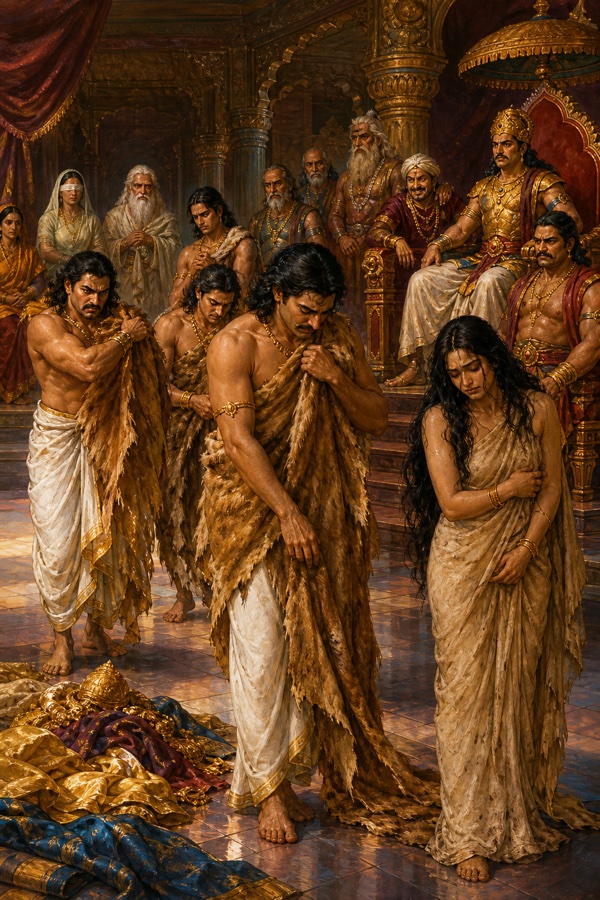
The sons of Pritha had lost, and they made ready for their exile in the woods. One after another, in due order, they took off their royal robes and dressed themselves in deerskins. Duhshasana watched them do it. These were men who had punished every enemy they ever met, and they stood in skins, their kingdom gone, ready to walk into the forest, and he could not keep quiet.
“The absolute rule of King Duryodhana has begun! The sons of Pandu are beaten and sunk in misery. We have reached the goal today, whether the roads we took were broad or narrow. Today we stand above our enemies in prosperity and in the length of time we will reign, and men will praise us for it. We have sent the sons of Pritha down into a hell that will not end. Their happiness and their kingdom are taken from them forever and ever. They were proud of their wealth and they laughed at the son of Dhritarashtra, and now they must go to the woods, beaten, with every piece of that wealth stripped from them by us. Let them take off their many-colored coats of mail. Let them take off those shining robes of heavenly make, and let every one of them put on deerskins, as the stake they accepted from the son of Subala requires. They used to boast that they had no equals in all the world. In this calamity they will learn to count themselves as sesame grains with no kernel in them. Dressed like this, the Pandavas might pass for wise and powerful men installed at a sacrifice, and yet they look like men who have no right to perform one.”
He had more, and the rest was for Draupadi. “The wise Yajnasena of the Somaka line gave his daughter, the princess of Panchala, to the sons of Pandu, and it was a most unlucky thing to do, because these husbands of Yajnaseni, these sons of Pritha, are as eunuchs. What joy will you have, Yajnaseni, when you see your husbands in the woods, in skins and threadbare rags, with their wealth and their possessions gone? Choose a husband from among the men here, whichever one you like. These Kurus gathered here are all forbearing and self-controlled, and they are very rich. Choose one of them for your lord, so that this great calamity does not drag you down into wretchedness. The sons of Pandu are now like sesame grains without the kernel, or like show animals stuffed into skins, or like grains of rice without the kernel. Why should you wait on the fallen sons of Pandu any longer? Pressing a sesame seed that has no kernel is labor thrown away.”
Those were the words Duhshasana, Dhritarashtra’s son, spoke within the hearing of the Pandavas, and they were as cruel as words can be. Bhima was a man who could not bear such things. He heard them and went for that prince in his anger as a Himalayan lion goes for a jackal, and he rebuked him in a loud voice, to punish him.
“You villain with a wicked mind, do you rave in words that only the sinful use? Do you boast like this among the kings, when it was the skill of the king of Gandhara that brought you where you stand? You pierce our hearts here with words like arrows. I will pierce your heart in battle the same way, and I will remind you of all this when I do. And those who walk behind you as your protectors, out of anger or out of greed, I will send them to the house of Yama too, with their descendants and their kin.”
Bhima stood there in deerskins and said these furious things and did nothing, because he could not leave the path of virtue. Duhshasana threw off whatever shame he had and danced around among the Kurus, calling out at the top of his voice, “Cow! Cow!”
“Wretch,” Bhima said, “do you dare, Duhshasana, to use words like these? What man has the right to boast when he has won wealth by foul means? I tell you this. If Bhima, the son of Pritha, does not tear your breast open in battle and drink your lifeblood, may he never reach the worlds of the blessed. And I tell you truly that I will kill the sons of Dhritarashtra in battle, in front of all the warriors, and that will quiet this anger of mine, and soon.”
The Pandavas began to walk out of the assembly. King Duryodhana, wicked and wild with joy, mimicked with his own steps the easy, lion’s tread of Bhima. Bhima half turned toward the king. “Do not think, you fool, that this puts you above me. I will kill you soon, and all your followers with you, and that will be my answer, and I will remind you of all this when I give it.”
Bhima was powerful and he was proud, and he had seen the insult done to him. He forced his rising anger down and followed in the steps of Yudhishthira, and he spoke again as he went out of the Kaurava court. “I will kill Duryodhana. Arjuna will kill Karna. Sahadeva will kill Shakuni, that gambler with the dice. I say these proud words again in this assembly, and the gods will make them good. If we ever meet the Kurus in battle, I will kill this wretched Duryodhana with my mace. I will stretch him on the ground and put my foot on his head. And this other wicked man, Duhshasana, who is so bold with his tongue: I will drink his blood as a lion does.”
“Bhima,” Arjuna said, “the resolutions of superior men are not known by their words alone. In the fourteenth year from this day, they will see what happens.”
“The earth will drink the blood of Duryodhana,” Bhima said, “and of Karna, and of the wicked Shakuni, and of Duhshasana, who makes the fourth.”
“Bhima, I will do as you direct,” Arjuna said. “I will kill this Karna in battle, malicious and jealous and harsh of speech and vain as he is. To do what Bhima wishes, Arjuna vows that he will kill Karna in battle with his arrows, and all Karna’s followers with him. And any other kings who are foolish enough to fight against me, I will send to the realm of Yama as well. The mountains of Himavat may be moved from where they stand. The maker of the day may lose his brightness and the moon his coolness. This vow of mine will be kept. And all of it will certainly happen, if in the fourteenth year from now Duryodhana does not give us back our kingdom with proper respect.”
When Arjuna had spoken, Sahadeva spoke, the handsome son of Madri, a man of great force. He wanted Shakuni’s death. He waved his powerful arms, his breath came like a snake’s, and his eyes were red with anger. “You disgrace of the kings of Gandhara! The men you think you have beaten are not beaten. They are sharp-pointed arrows, and you have put yourself in the way of their wounds in battle. I will certainly do everything Bhima has said, and do it to you and to all your followers. If you have anything left to do, do it before that day comes. I will kill you in battle, and all your followers with you, and soon enough, son of Subala, provided you stay in the fight as Kshatriya usage requires.”
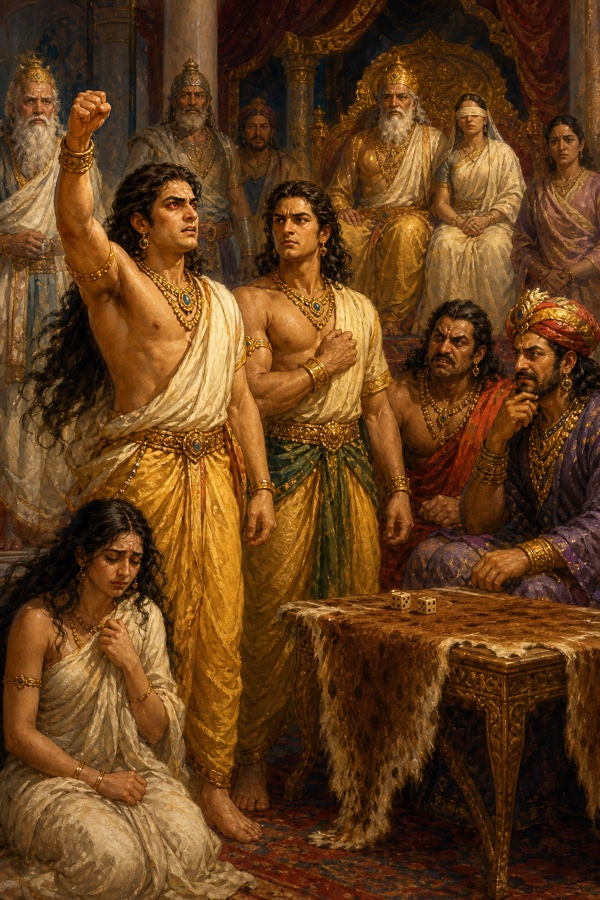
Nakula heard Sahadeva, and Nakula, the handsomest of men, spoke last. “There are wicked sons of Dhritarashtra who want to die, whom Fate is driving. They wished to please Duryodhana, and at the gambling match they used harsh and insulting language to this daughter of Yajnasena. I will send every one of them to the house of Yama. At Yudhishthira’s command, and remembering the wrongs done to Draupadi, I will soon empty the earth of the sons of Dhritarashtra.”
So those long-armed men bound themselves, each of them, to a righteous promise. Then they went to King Dhritarashtra.
The gist: The Pandavas put on deerskins. Duhshasana calls them sesame grains without a kernel and tells Draupadi to choose a new husband from among the Kurus, and Duryodhana mimics Bhima’s walk. Bhima vows to tear open Duhshasana’s breast and drink his blood, and to kill Duryodhana with his mace and set a foot on his head. Arjuna vows to kill Karna, Sahadeva to kill Shakuni, and Nakula to empty the earth of the sons of Dhritarashtra. Arjuna sets the date and the condition: the fourteenth year from this day, if Duryodhana does not return the kingdom with proper respect.
Vidura’s parting counsel, and the lament of Kunti and Draupadi
Yudhishthira spoke for all five. “I take my leave of all the Bharatas. I take my leave of my old grandsire Bhishma, of King Somadatta, of the great King Bahlika, of Drona and of Kripa, of all the other kings, of Ashvatthama, of Vidura, of Dhritarashtra and all the sons of Dhritarashtra, of Yuyutsu, of Sanjaya, and of every man of this court. I bid all of you farewell. I will come back, and I will see you again.”
Shame had hold of everyone who heard him. Not one of them could find a thing to say to Yudhishthira. In their hearts, though, they prayed for the welfare of that intelligent prince.
Vidura spoke, and what he spoke about was their mother, Kunti, whom he called by her name Pritha. “The revered Pritha is a princess by birth, and she ought not to go into the woods. She is delicate, she is old, and she has known comfort all her life. That blessed lady will stay in my house, and I will treat her with honor. Know this, sons of Pandu, and may you always be safe.”
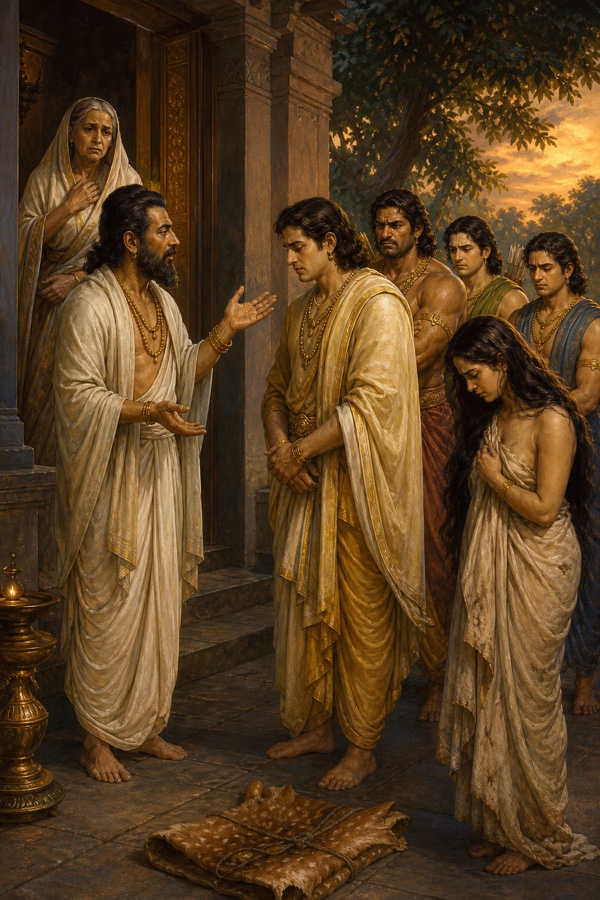
“Let it be as you say,” the Pandavas answered. “You are our uncle, and so you are like a father to us. All of us are obedient to you. You are a learned man and our most respected elder, and whatever you choose to command, we should always obey. Tell us whatever else remains to be done.”
“Yudhishthira,” Vidura said, “know that this is my opinion: a man who has been beaten by sinful means has no need to be pained by the defeat. You know every rule of dharma. Arjuna always wins in battle. Bhima destroys his enemies. Nakula gathers wealth. Sahadeva has the gift of administration. Your priest Dhaumya stands first among all who know the Vedas, and Draupadi, whose conduct is good, understands both virtue and the management of a household. You are attached to one another. You are glad at the sight of one another. No enemy can separate you, and you are content. Who is there, then, who will not envy you? This patient withdrawal from the possessions of the world will do you great good, Bharata. No enemy will be able to stand against it, even if he were the equal of Shakra himself.”
“You have had teachers before now,” Vidura went on. “Meru Savarni instructed you on the mountains of Himavat. Krishna Dvaipayana instructed you in the town of Varanavata. Rama instructed you on the cliff of Bhrigu, and Shambhu himself on the banks of the Drishadvati. You have listened to the great rishi Asita on the hills of Anjana, and you became a disciple of Bhrigu on the banks of the Kalmashi. Narada and your priest Dhaumya will be your instructors now. In what concerns the next world, do not abandon the excellent lessons you have had from the rishis. Son of Pandu, you surpass even Pururavas, the son of Ila, in intelligence. You surpass all other kings in strength, and even the rishis in virtue. So resolve in earnest to win victory, which belongs to Indra. Resolve to control your wrath, which belongs to Yama, to give in charity, which belongs to Kubera, and to control all the passions, which belongs to Varuna. Take the power to gladden from the moon, Bharata, and the power to sustain everything from water. Take forbearance from the earth, energy from the whole disc of the sun, strength from the winds, and abundance from the other elements. May you be well and free of every sickness. I hope to see you return. Act as you should, Yudhishthira, and at the right time, in every season, in seasons of distress, in seasons of difficulty, in everything. Son of Kunti, go from here with our leave. Blessings on you, Bharata. No one can say that any of you has ever done a sinful thing before this. And so we hope to see you come back safe, and crowned with success.”
Yudhishthira, the son of Pandu, whose strength no one had ever turned aside, said, “So be it.” He bowed low to Bhishma and to Drona, and he went.
Draupadi was about to set out with them. Before she did, she went to Pritha and asked her leave to go. She asked leave of the other women of the household too, and all of them were sunk in grief. She saluted each one and embraced each one as that woman’s place deserved, and then she was ready. A great wail of sorrow went up in the inner apartments of the Pandavas. Kunti saw Draupadi standing at the start of her journey and it was a terrible blow to her. Her voice was choked with grief when she spoke.
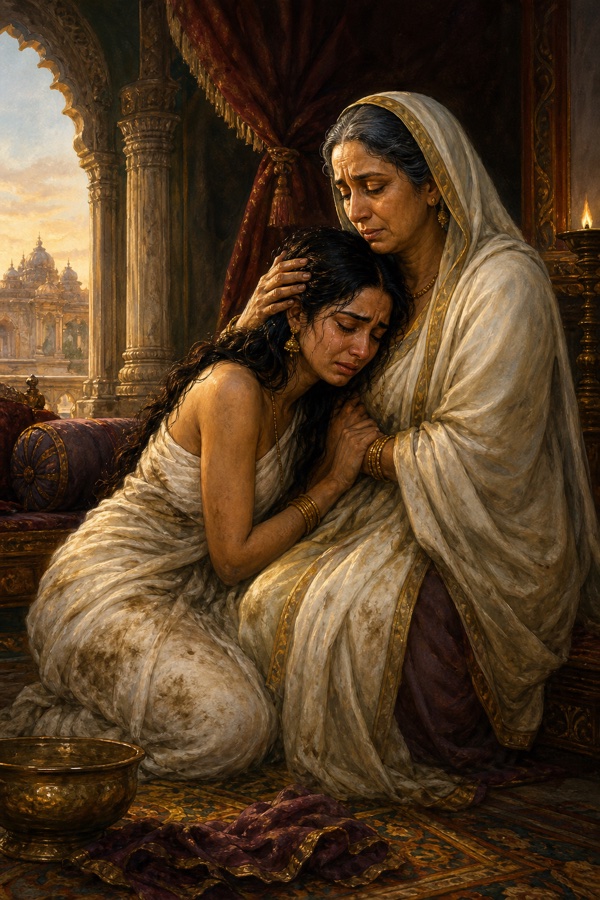
“Child, do not grieve that this great calamity has come to you. You know very well what the duties of a woman are, and your behavior and your conduct are what they should be. You of the sweet smiles, there is nothing I need to teach you about your duties to your lords. You are chaste and accomplished, and your qualities have adorned the family you were born into and the family you entered by marriage. The Kauravas are lucky that your anger has not burned them. Go safely, child, with my prayers to bless you. Good women do not let their hearts come unstrung at what cannot be avoided. Virtue is above everything, and it will protect you, and good fortune will come to you soon. While you live in the woods, keep an eye on my child Sahadeva. See that his heart does not sink under this great calamity.”
“So be it,” the princess Draupadi said. Her face was bathed in tears. She wore one cloth, and the cloth was stained with blood, and her hair hung loose. So she left her mother-in-law. She went weeping and wailing, and Pritha, in her own grief, followed after her. Pritha had not gone far when she saw her sons. Their ornaments and their robes had been taken off them. Their bodies were wrapped in deerskins, and their heads hung down with shame. Enemies stood around them rejoicing, and friends stood around them full of pity. Kunti’s love for her children was more than she could hold. She went up to her sons as they were, and embraced every one of them, and spoke in a voice that woe had choked.
“You are virtuous and well mannered. You have every excellent quality and you behave with respect. You are high-minded, all of you, and you serve your elders. You are devoted to the gods and to the performance of sacrifices. Why, then, has this calamity come down on you? Where does this turn of fortune come from? I cannot see whose wickedness it is that has brought this sin on you. I gave birth to you. All of this must be the work of my own ill fortune. That is why you have been overtaken by calamity, though every one of you has such virtues.”
She could not stop. “In energy and prowess and strength and firmness and might you lack nothing. How will you live now, poor, in the pathless woods, with your wealth and your possessions gone? If I had known that you were fated to live in the woods, I would never have come down from the mountains of Shatashringa to Hastinapura when Pandu died. Your father was fortunate. I see that now. He truly reaped the fruit of his asceticism, and he had the gift of foresight, for he formed the wish to go up to heaven before he had to feel any pain on account of his sons. The virtuous Madri was fortunate too. I see that today. She seems to have known beforehand what would happen, and so she took the high path of emancipation and every blessing that goes with it. Madri looked on me as her support. Her mind and her affections were always fixed on me. Shame on my love of life, which has kept me here to suffer all this! Children, you are all excellent and you are dear to me. I got you after much suffering. I cannot leave you. I will go with you myself. Krishna, my child, why do you leave me like this? Everything that has life is sure to perish. Has Dhata himself forgotten to ordain my death? Perhaps he has, and that is why life will not leave me.”
Then her cry went past everyone in front of her. “Krishna! You who live in Dwarka, younger brother of Sankarshana, where are you? Why do you not deliver me, and these finest of men with me, from such woe? They say that you are without beginning and without end, and that you deliver those who think of you. Why is that saying proving false? These sons of mine have always held to virtue and nobility and good fame and prowess. They do not deserve to suffer. Show them mercy! When our race has elders in it like Bhishma and Drona and Kripa, men who know dharma and know the ways of the world, how could a calamity like this come at all? Pandu, my king, where are you? Why do you quietly allow your good children to be sent into exile, beaten at dice? Sahadeva, do not go. You are my dearest child, son of Madri, dearer to me than my own body. Do not forsake me. You ought to have some kindness for me. Your brothers are bound by the ties of virtue. Let them go. You stay, and earn the virtue that comes from waiting on me.”
The Pandavas comforted their weeping mother. Then, with hearts sunk in grief, they set out for the woods. Vidura was in great distress himself. He reasoned with Kunti to console her, and led her slowly to his house. The women of Dhritarashtra’s household heard all of it as it had happened: the exile of the Pandavas, and the dragging of Krishna into the assembly where the princes had gambled. They wept aloud, and they blamed the Kauravas. Then the ladies of the royal house sat silent for a long time, with their fair hands covering their lotus faces. King Dhritarashtra thought about the dangers that now threatened his sons, and anxiety took hold of him and would not let him rest. He turned everything over in his mind, and grief had unsettled it. He sent a messenger to Vidura with the words, “Let Kshatta come to me without a moment’s delay.” Vidura came quickly to the palace when he was summoned. The moment he arrived, the king, in great anxiety, asked him how the Pandavas had left Hastinapura.
The gist: Yudhishthira takes leave of the court by name, and no one can answer him for shame. Vidura keeps Kunti in his own house and sends the brothers off with counsel: defeat by sinful means is no cause for pain, no enemy can divide them, and they should take the virtues of Indra, Yama, Kubera and Varuna, and of the moon, water, earth, sun and wind. Kunti blesses Draupadi and asks her to watch over Sahadeva, then breaks down before her sons, calls on Krishna of Dwarka and on the dead Pandu, and begs Sahadeva to stay. The Pandavas comfort her and leave for the woods. Dhritarashtra, unable to rest, sends for Vidura to ask how they went.
Vidura’s account, the omens, and Narada’s prophecy
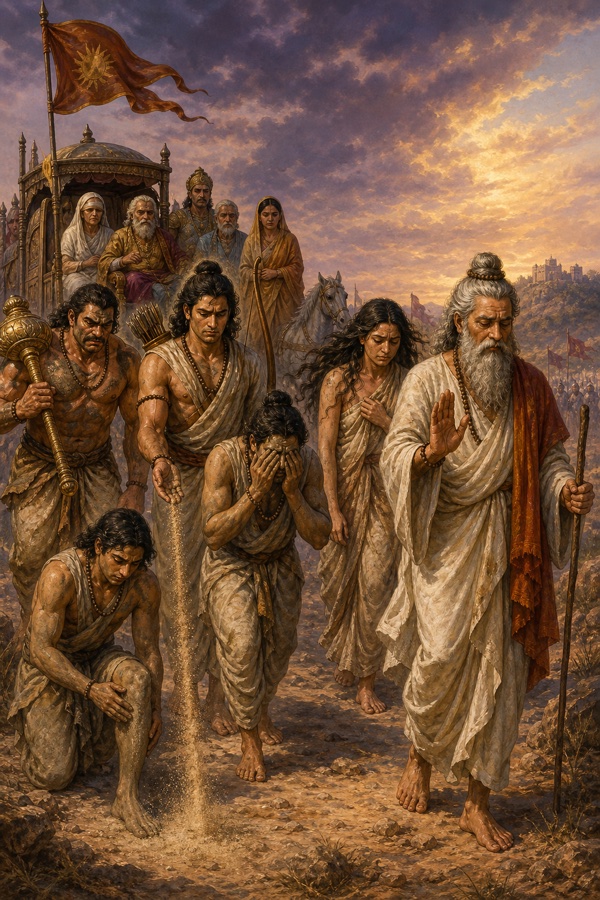
Vidura was a man who saw far ahead. He had hardly come in when King Dhritarashtra, the son of Ambika, began to question him, and the old king asked his brother timidly. “How does Yudhishthira, the son of Dharma, go on his way? How does Arjuna? How do the twin sons of Madri? And Dhaumya, Kshatta, how does he go? And Draupadi? I want to hear everything, Kshatta. Describe to me everything they do.”
“Yudhishthira, the son of Kunti, has gone with his cloth drawn over his face,” Vidura said. “Bhima has gone looking at his own great arms. Jishnu, your nephew Arjuna, has gone behind the king, scattering grains of sand around him. Sahadeva, the son of Madri, has gone with his face smeared, and Nakula, the handsomest of men, has gone with dust rubbed all over himself and his heart in great pain. Krishna, the beautiful, large-eyed Krishna, has gone with her loose hair covering her face, weeping, in tears, following where the king walks. And Dhaumya goes along the road with kusha grass in his hand, chanting the dreadful mantras of the Sama Veda that belong to Yama.”
“Tell me, Vidura,” Dhritarashtra said. “Why do the Pandavas leave Hastinapura in such different guises?”
“Your sons have persecuted him and robbed him of his kingdom and his wealth,” Vidura said, “and the mind of the wise King Yudhishthira the just has still not left the path of virtue. He is always kind to your children, Bharata. He has been stripped by foul means and he is full of wrath, and he will not open his eyes. ‘I must not burn the people by looking at them with angry eyes.’ That is his thought, and so the royal son of Pandu goes with his face covered. Now hear why Bhima goes as he does. ‘No one is my equal in the strength of his arms.’ That is his thought, and so he goes stretching out those great arms again and again. He is proud of them, and he shows them, and he wants to do to his enemies deeds that are worthy of them. Arjuna, the son of Kunti, who can use either arm to draw the Gandiva, follows in Yudhishthira’s footsteps scattering grains of sand, and the sand stands for the arrows he will shower in battle. He is showing that he will rain arrows on the enemy, when the fighting comes, as easily as he scatters those grains.”
“Sahadeva goes with his face smeared,” Vidura went on, “and his thought is this: ‘Let no one recognize me on this day of trouble.’ Nakula goes with dust rubbed over himself, and his thought is this: ‘Otherwise I may steal the hearts of the women who look at me.’ Draupadi goes in one stained cloth, her hair loose, weeping, and her meaning is this: ‘The wives of the men who brought me to this state will, in the fourteenth year from now, lose their husbands and their sons and their kin and everyone dear to them. They will be smeared all over with blood, with their hair loose, every one of them in her season, and so they will enter Hastinapura after offering water to their dead.’ And the learned Dhaumya, Bharata, who has his passions fully under control, walks in front. He holds the kusha grass in his hand with its points turned toward the southwest, and he sings the mantras of the Sama Veda that belong to Yama. That learned Brahmin’s meaning is this: ‘When the Bharatas have been killed in battle, the priests of the Kurus will sing these same Sama mantras for the dead.’”
He told the king about the city too. “The citizens are in great grief, and they cry out again and again: ‘Our masters are going away! Shame on the elders of the Kurus, who have behaved like foolish children and banished the heirs of Pandu out of greed and nothing else! Parted from the son of Pandu, we will all be without a master. What love can we have for the wicked and greedy Kurus?’ That is how the sons of Kunti have gone, king, men of great strength of mind, showing by their manner and by signs the resolutions they carry in their hearts. And when those finest of men had left Hastinapura, lightning flashed in a sky that had no clouds in it, and the earth itself began to tremble. Rahu came to swallow the sun, though it was not the day of conjunction. Meteors began to fall, keeping the city on their right. Jackals and vultures and ravens, and other beasts and birds that live on flesh, began to shriek and cry from the temples of the gods, from the tops of the sacred trees, from the walls and from the roofs of the houses. Those extraordinary and calamitous portents were seen and heard, king. They point to the destruction of the Bharatas, and it will come as the result of your evil counsels.”
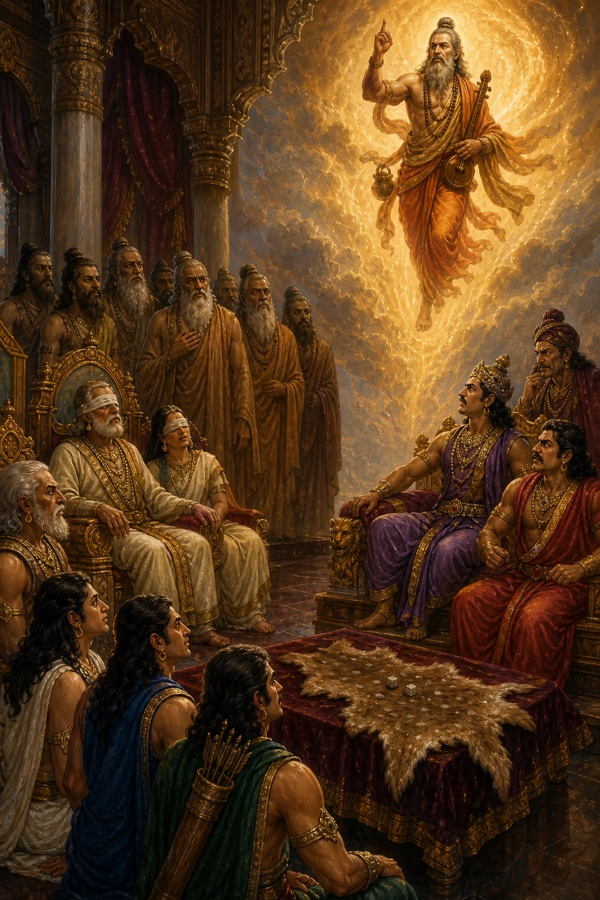
King Dhritarashtra and the wise Vidura were still talking, Vaishampayana said, when someone else appeared in that assembly of the Kauravas, before the eyes of everyone: the greatest of the celestial rishis, Narada. He stood in front of them all and spoke terrible words. “In the fourteenth year from now, the Kauravas will all be destroyed, through Duryodhana’s fault, by the might of Bhima and Arjuna.” The splendor of the Vedas was on him. Having said it he went up through the sky and was gone from their sight. Duryodhana, Karna, and Shakuni the son of Subala now looked on Drona as the one refuge they had, and they offered the kingdom to him.
A sub-tale: Vidura reads the departure of the Pandavas sign by sign. Yudhishthira covers his face so that his angry eyes will not burn the people. Bhima stretches out his arms because he means to use them. Arjuna’s scattered sand is the arrows he will shower. Sahadeva smears his face so that no one will recognize him on a day of trouble, and Nakula covers himself with dust so that no woman’s heart will be stolen by his looks. Draupadi’s loose hair and stained cloth foretell the widows of the fourteenth year, and Dhaumya’s chant to Yama, with the kusha grass turned to the southwest, is the chant the Kuru priests will sing for their dead.
Drona’s fear, Dhritarashtra’s remorse, and Sanjaya’s truth
Drona answered them. He spoke to Duryodhana, who was envious and angry, and to Duhshasana and Karna and all the Bharatas. “The Brahmins have said that the Pandavas are of divine origin and cannot be killed. The sons of Dhritarashtra, however, and all these kings with them, have sought my protection with their whole hearts and with reverence, and I will look after them as far as my power goes. Destiny is supreme. I cannot abandon them. The sons of Pandu were beaten at dice, and they are going into exile to keep their promise. They will live in the woods for twelve years, and for all that time they will keep the brahmacharya way of life. Then they will come back in anger, and to our great grief they will take the fullest vengeance on their enemies. There is something else. Long ago, in a quarrel between friends, I took Drupada’s kingdom from him. The king, robbed of it by me, performed a sacrifice to obtain a son who would kill me. The ascetic power of Yaja and Upayaja helped him, and from the sacrificial fire Drupada obtained a son named Dhrishtadyumna and a daughter, the faultless Krishna, and both of them rose from the sacrificial platform. That Dhrishtadyumna is brother-in-law to the sons of Pandu through her marriage, and he is dear to them. So it is him I am afraid of. His origin is divine and he blazes like fire. He was born holding a bow and arrows, and he was born in armor. I am a being who must die, and my fear of him is great.”
“That destroyer of enemies, that prince of Prishata’s line, has taken the side of the Pandavas,” Drona said. “If he and I ever meet in battle, I will have to lose my life. Kauravas, what grief in this world can be greater for me than this: that everyone believes Dhrishtadyumna is the man fated to kill Drona? I have heard it said that he was born to kill me, and the whole world has heard it too. Duryodhana, it is on your account that the terrible season of destruction has almost arrived. Do what will benefit you, and lose no time over it. Do not imagine that everything was accomplished when you sent the Pandavas into exile. This happiness of yours will last a moment and no longer, as the shadow of a palm tree’s crown, in winter, rests for a short while at the foot of the tree. Perform sacrifices of every kind. Enjoy yourself, Bharata, and give away whatever you like. In the fourteenth year from now a great calamity will overwhelm you.”
Dhritarashtra heard Drona and turned to Vidura. “Kshatta, what the preceptor has said is true. Go and bring the Pandavas back. If they will not come back, let them go with respect and affection shown to them. Let those sons of mine go with weapons, and chariots, and infantry, and let them have every other good thing to enjoy.”
The Pandavas had been beaten at dice and had gone to the woods, Vaishampayana told the king, and afterward anxiety overcame Dhritarashtra. He sat restless with it, sighing in his grief, and Sanjaya, a man of his court, came to him. “You have the whole earth now, with all its wealth, and you have sent the sons of Pandu away into exile. Why, king, do you grieve like this?”
“What do they not have to grieve for,” Dhritarashtra said, “who will have to meet the sons of Pandu in battle? Those are the greatest of warriors. They will come on great chariots, and they will have allies to help them.”
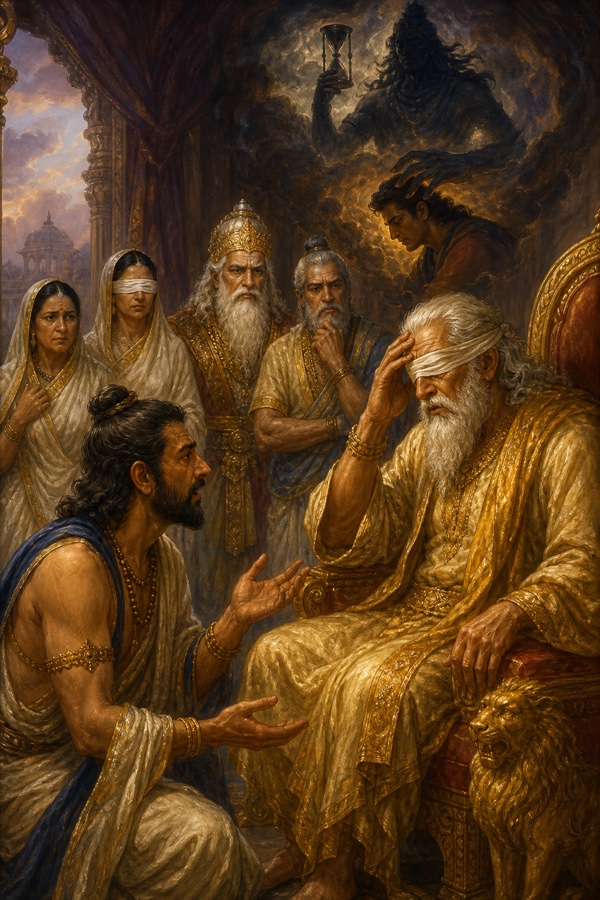
“King, this whole great enmity became inevitable through a mistaken act of yours,” Sanjaya said, “and it will certainly bring the wholesale destruction of the entire world. Bhishma forbade it, and so did Drona and Vidura, and your son Duryodhana, wicked-minded and shameless, sent his Suta messenger all the same with orders to bring the beloved and virtuous wife of the Pandavas into the court. When the gods mean to send a man defeat and disgrace, they first take away his reason. That is why such a man sees things in a strange light. When destruction is close, evil looks like good to an understanding that sin has polluted, and the man holds to it firmly. To a man about to be overwhelmed by destruction, what is improper looks proper and what is proper looks improper, and evil and impropriety are the things he likes. The time that brings destruction comes with no club raised to smash a man’s head. Its peculiar work is to make a man see evil in good and good in evil.”
“Those wretches brought this terrible, wholesale, horrible destruction on themselves when they dragged the helpless princess of Panchala into the court,” Sanjaya went on. “Who except Duryodhana, that false player of dice, could have brought the daughter of Drupada into the assembly with insults? She has beauty and intelligence. She knows every rule of dharma and of duty. She came from the sacred fire and from no woman’s womb. The handsome Krishna was in her season then, wearing one stained cloth, and when she was brought into the court she looked toward the Pandavas. She saw them robbed of their wealth, of their kingdom, of their very clothing, of their beauty, of every enjoyment, and sunk into bondage. The tie of virtue held them, and they could not use their strength. And in front of all the assembled kings, Duryodhana and Karna spoke cruel and harsh words to Krishna, who was distressed and enraged and had deserved none of it. King, all of this seems to me to promise fearful consequences.”
“Sanjaya, the glances of the distressed daughter of Drupada could burn up the whole earth,” Dhritarashtra said. “Is it possible that even one son of mine will live? The wives of the Bharatas joined Gandhari and set up a frightful wail when they saw the virtuous Krishna, the wedded wife of the Pandavas, young and beautiful, dragged into the court. They weep every day, even now, and all my subjects weep with them. The Brahmins were so enraged at the treatment of Draupadi that not one of them performed his Agnihotra rite that evening. The winds blew as hard as they blew at the dissolution of the universe. There was a terrible thunderstorm. Meteors fell from the sky, and Rahu swallowed the sun out of its season and frightened the people terribly. Our war chariots suddenly blazed up, and every flagstaff on them fell, and that was an evil omen for the Bharatas. Jackals began to cry frightfully from inside Duryodhana’s sacred fire chamber, and asses from every direction brayed in answer.”
“Then Bhishma and Drona and Kripa and Somadatta and Bahlika all left the assembly,” the old king said. “It was then, on Vidura’s advice, that I spoke to Krishna and told her, ‘I will grant you boons, Krishna, whatever you ask.’ The princess of Panchala begged me there for the liberation of the Pandavas. Of my own accord I then set the Pandavas free and ordered them to return to their capital on their chariots, with their bows and arrows. It was then that Vidura told me, ‘This will prove the destruction of the Bharata race, this dragging of Krishna into the court. This daughter of the king of Panchala is the faultless Shri herself. She is of divine origin, and she is the wedded wife of the Pandavas. The wrathful sons of Pandu will never forgive this insult to her. The great bowmen of the Vrishni race will not bear it in silence, and the great warriors among the Panchalas will not. Arjuna will certainly come back, with Vasudeva to support him, whose prowess has never been checked, and with the Panchala army all around him. And Bhimasena, that great warrior among them, with strength beyond any other man’s, will come back too, whirling his mace as Yama himself whirls his club. These kings will hardly be able to bear the force of Bhima’s mace.’”
“Vidura had more to say to me,” Dhritarashtra said. “‘So, king, peace with the sons of Pandu, peace forever and no hostility at all, is what seems best to me. The sons of Pandu are always stronger than the Kurus. You know, king, that the great and powerful King Jarasandha was killed in battle by Bhima with his bare arms and nothing else. So you ought to make peace with the sons of Pandu. Bring the two sides together, king, and have no scruples about it. If you act in this way you are sure of good fortune.’ That, Sanjaya, is how Vidura spoke to me, in words that held both virtue and profit. And I did not accept his counsel. Affection for my son moved me.” Here the Sabha Parva ends.
A key to reading this (lineage): Drona’s fear has a history. Drupada, robbed of his kingdom by Drona, performed a sacrifice to obtain a son who would kill him, and Dhrishtadyumna and Krishna rose together from the sacrificial platform. Dhrishtadyumna is therefore Draupadi’s brother, and through her marriage he is brother-in-law to the Pandavas. The rishi’s prophecy, Drona’s warning and Draupadi’s loose hair all name the same year, the fourteenth from this day. Dhritarashtra himself says what kept him from making peace: affection for his son.
The gist: Narada appears before the whole court, foretells the destruction of the Kauravas in the fourteenth year at the hands of Bhima and Arjuna, and vanishes into the sky. Duryodhana, Karna and Shakuni offer the kingdom to Drona, who accepts their cause, tells them the Pandavas will return for vengeance, confesses his fear of Dhrishtadyumna, and warns that their happiness is as brief as a palm tree’s winter shadow. Sanjaya tells Dhritarashtra that the enmity is the fruit of his own mistaken act. The old king recounts the omens, the boons and Vidura’s plea for peace, and admits that he refused it out of affection for his son.
Source: the Mahabharata of Krishna-Dwaipayana Vyasa, Sabha Parva, Dyuta and Anudyuta sub-parvas, Sections 64 to 80. The Sanskrit e-text, the Gita Press Hindi edition, and Kisari Mohan Ganguli’s complete English translation were used to verify names, sequence, and principal events. Where the recensions differ, this English retelling follows Ganguli, and the Hindi edition follows Gita Press.
Based on: the Mahabharata, Vedavyasa (K. M. Ganguli’s English translation; Gita Press, Gorakhpur)