On this page
Every night-walker the searchers have met has lost his life to one slap, and the hills and forests have been searched in many ways. In the dense forest thirst has come on them, and no water is to be found. Hanuman reckons that all of them are about to die without it. The term Sugriva set has passed, and nothing is done.
From the peak of a hill Hanuman beholds a cave in the ground with many birds going into it. Inside, a woman sits, a mass of austerity. At her word they shut their eyes, and when they look again they stand by the sea. There Angada says that either way their death has come, and the monkeys sit down on spread darbha grass. Jambavan, seeing Angada’s grief, says that Rama is not to be taken for a man. An old vulture comes out of a hollow in the hill and speaks of eating them all. He hears Angada’s speech on Jatayu, does his younger brother’s rites, and tells his own story and a sage’s words. He sees Sita, he says, and they do not. Each one declares his strength and keeps his doubt. Jambavan asks why Hanuman keeps silent, and later charges him to see Sita and come and tell the news. Then comes a forecast that Rama will bring Sita, the month-long reading takes a pause, and the Kishkindhakand ends.
A thirsty party, and an old vulture
The main figures in this episode
- Hanuman who reckons that the party is about to die without water, and, climbing a peak, beholds the cave the birds go into. The party puts him ahead and goes in. On the shore Jambavan asks why he has kept silent, and as soon as he hears it he becomes the size of a mountain. He says he can leap the salt sea in play, and he asks Jambavan for fitting counsel.
- Angada Vali’s son, the crown prince. On the shore, his eyes full of tears, he tells them that their death has come either way, and again and again that there is no doubt of it. When the vulture comes out, he says that no one is as blessed as Jatayu. Later he says he would go across, and that he has some doubt about the return. Jambavan asks how the leader of all is to be sent.
- Jambavan who, seeing Angada’s grief, tells tales of special teaching about Rama. A special worry comes into his mind when the vulture speaks. He tells of his seven circuits in two ghadis, when the Lord grew while binding Bali. He tells Angada that he is fit in every way, and tells Hanuman that his coming down is for Rama’s work. His charge to Hanuman is to do this much when he goes and, seeing Sita, to come and tell the news.
- The ascetic in the cave (Svayamprabha, the commentary’s name) a woman who is a mass of austerity, sitting in a bright dwelling inside the cave. She tells the searchers to drink water and eat fruit, and tells them her own story. She tells them to shut their eyes and quit the cave. She goes where Rama is, and Rama gives her a bhakti that never wanes. Then she goes to the Badari forest.
- Sampati Jatayu’s elder brother, an old vulture in a hollow of the hill. Coming out and seeing the monkeys, he speaks of eating them all. Hearing Angada’s speech, he comes near, asks, and hears the whole story. He does his younger brother’s rites on the seashore, and tells how his wings burned near the sun, and what a sage named Chandrama foretold. He names Lanka and the Ashoka grove, says he sees Sita and they do not, and says who will do Rama’s work.
- Jatayu Sampati’s younger brother, whose deed Sampati hears and whose rites he does by the sea. Angada calls him blessed beyond all others, who went to the Lord’s city, leaving his body for Rama’s work.
- Chandrama, the sage who took pity on the fallen Sampati, told him knowledge in many ways, and freed him of the pride born of the body. He foretold the messengers Sampati would meet, and told him to show them Sita.
- Sita whom the party is searching for, and whom Sampati sees, sitting sunk in worry in the Ashoka grove in Lanka.
Thirst, and a cave in the ground
The searchers, wherever they met a night-walker, took his life with one slap each. They searched the hills and forests in many ways. If a sage was found, all of them surrounded him. The commentary adds that it was to ask the way.
Thirst came on them, and they were exceedingly distressed. No water was to be found, and they were lost in the dense forest. Hanuman reckoned in his mind that all of them were about to die without drinking water.
Climbing the peak of a hill, he looked to every side, and he beheld a marvel. It was a cave in the ground. Chakravakas, cranes, and swans were flying there, and many birds were going into it.
Coming down from the hill, Hanuman came. Taking them all, he showed them that cave. They put Hanuman ahead and went into the cave, and made no delay.
They saw, when they had gone in, a fine grove and a pond with many lotuses in bloom. A bright dwelling was there, and there sat a woman who was a mass of austerity.
Inside the cave, and outside it
From afar all of them bowed their heads to her. When she asked, they told her their account. Then she said, “Drink water, and eat the many juicy, beautiful fruits.”
They bathed and ate the sweet fruits, and all of them came near her again. She told them all her own story. “Now I will go where Rama is. Shut your eyes, and, quitting the cave, go. You will find Sita. Have no regret.”
Shutting their eyes, when the heroes looked again, all of them stood on the shore of the sea.
Then she went where Rama was. Going there, she bowed her head at his feet. She made entreaty in many ways, and Rama gave her a bhakti that never wanes.
She went to the Badari forest, bearing Rama’s command on her head, and holding in her breast the two feet of Rama, which Brahma and Shiva worship. The commentary names her Svayamprabha, and names the forest Badarikashrama.
Death on the shore
Here the monkeys thought in their minds that the term had passed and nothing was done. All of them said to one another, “Without news, what shall we do, brother?”
Angada said, his eyes full of tears, “Either way, our death has come. Here no news of Sita is found, and if we go there, Sugriva will kill us. When my father was killed, he would have killed me. Rama saved me, no favor of Sugriva’s.” Again and again Angada said to them all, “Death has come. There is no doubt of it.”
Hearing Angada’s words, the monkey heroes could not speak. Tears flowed from their eyes. For a moment they stayed sunk in worry. Then all of them began to say such words: “We will not go without news of Sita, skilled crown prince.” So saying, going to the shore of the salt sea, all the monkeys sat down, spreading darbha grass.
What Jambavan does
Seeing Angada’s grief, Jambavan told tales of special teaching. “Dear one, do not take Rama for a man. Know him as Brahman without qualities, unconquered and unborn. All of us servants are very fortunate, ever full of love for Brahman with qualities.”
“Of his own will the Lord comes down for the gods, the earth, cows, and brahmins. There the worshipers of the one with qualities stay with him, leaving all release.” The commentary adds that no bond of karma brings him down. It names the five kinds of release they leave: a dwelling in his world, nearness to him, his likeness, his powers, and union with him.
Out of the hollow of the hill
In this way Jambavan told the tales in many ways. In a hollow of the hill Sampati heard them. Coming out, he saw many monkeys. “The Lord of the world has given me food. Today I will eat them all. Many days have gone, and I have been dying without food. I never get my belly’s fill. Today the Creator has given it all at once.”
They were afraid, hearing the vulture’s words with their ears: “Now death has truly come. We know it.” All the monkeys rose, seeing the vulture. In Jambavan’s mind was a special worry.
Angada said, having thought in his mind, “No one is as blessed as Jatayu. Leaving his body for Rama’s work, he went to the Lord’s city, supremely fortunate.”
Hearing speech full of gladness and sorrow, the bird came near the monkeys, and they were afraid. Making them fearless, he asked, going to them, and they told him the whole story. Hearing his brother’s deed, Sampati told Rama’s greatness in many ways. “Take me to the shore of the sea, and I will give him the offering of sesame and water. I will help you with words. You will find the one you seek.”
Jatayu’s brother, and the sun
Having done his younger brother’s rites on the seashore, Sampati told his own story. “Listen, monkey heroes. We two brothers, in early youth, went flying in the sky near the sun. He could not bear the blaze, and he turned back. Proud, I went near the sun. My wings burned in the very boundless blaze, and I fell to the ground, giving a terrible cry.”
“There was a sage named Chandrama. Pity came to him when he saw me. He told me knowledge in many ways, and he freed me of the pride born of the body: ‘In the Treta age Brahman will take a human body. The lord of the night-walkers will carry off his wife. The Lord will send messengers to search for her. On meeting them you will be made pure. The wings will grow. Do not be anxious. Show them Sita.’ The sage’s voice has come true today. Hearing my words, do the Lord’s work.”
Boundless sight, and a name
Sampati went on. “Lanka stands on Mount Trikuta. There lives Ravana, fearless by nature. There is the Ashoka grove, where Sita stays. She sits sunk in worry.”
“I see her. You do not. A vulture’s sight is boundless. I have grown old, or I would have helped you a little.”
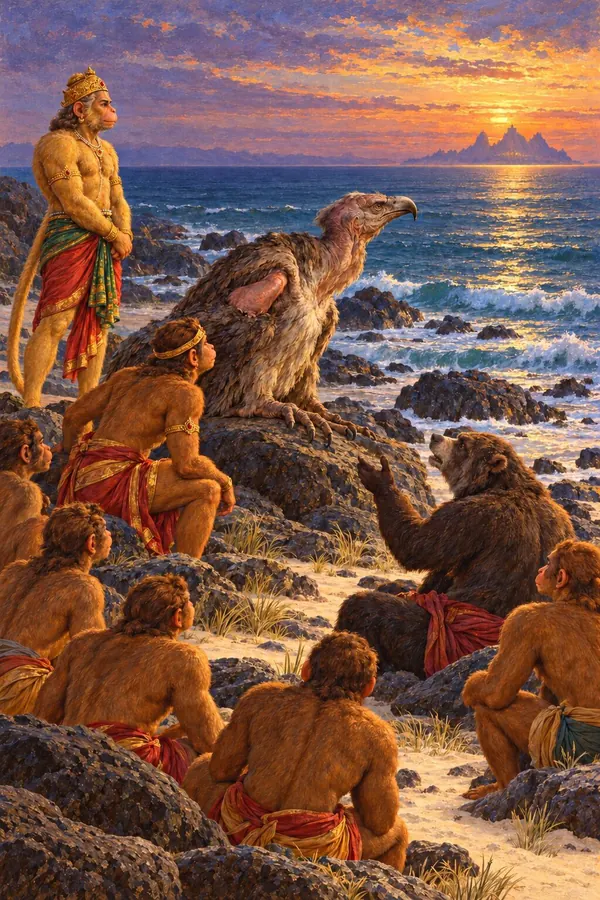
Sampati went on. “Whoever leaps the hundred-yojana sea, and is rich in wit, will do Rama’s work. Looking at me, hold patience in your minds. By Rama’s grace, what my body has become!” The commentary reckons the hundred yojanas as four hundred kos. It adds that the body had been wretched without wings, and has become beautiful with the wings grown.
“Even sinners who remember his name cross the very boundless sea of becoming. You are his messengers. Giving up faint-heartedness, holding Rama in your heart, find the means.”
Who has how much strength
In the commentary’s reading Kakabhushundi here speaks to Garuda: “Having said this, Garuda, when the vulture had gone, they wondered very much in their minds.” Every one of them declared his own strength, and kept doubt of going across.
Jambavan said, “I have grown old now. Not a trace of my former strength is left in my body. When Rama became Trivikrama, I was young, and my strength was great. While binding Bali, the Lord grew. That body cannot be told. In two ghadis, a short span, I made seven circuits, running.” The commentary reads Trivikrama as Vamana.
Angada said, “I would go across. There is some doubt in my heart about the time of returning.” Jambavan said, “You are fit in every way. How is the leader of all to be sent?”
Jambavan said, “Listen, Hanuman. Why have you kept silent, strong one? You are the son of the wind, and in strength the wind’s equal. You are a treasury of intellect, discernment, and wisdom. What work in the world is so hard that it cannot be done, dear one, by you? Your coming down is for Rama’s work.” As soon as he heard it, Hanuman became the size of a mountain.
His body was golden in color, and radiance shone on it, as if he were another king of mountains. The commentary names that king of mountains Sumeru. He gave a lion’s roar again and again. “I can leap the salt sea in play. Killing Ravana with his helpers, I can bring Trikuta here, uprooting it. Jambavan, I ask you. Give me fitting counsel.”
Jambavan said, “Do this much, dear one, when you go. Seeing Sita, come and tell the news. Then Rama, by the strength of his own arms, the monkey army with him for sport.” The commentary adds that Rama will destroy the rakshasas and bring Sita by the strength of his own arms, and will take the army with him for sport alone.
Rama’s fame, and the end of the kand
With the monkey army, destroying the rakshasas, Rama will bring Sita. Gods and sages, Narada and the rest, will describe the fair fame that makes the three worlds pure. Men who hear it, sing it, tell it, and understand it gain the highest state. The servant Tulsi, a bee at Rama’s lotus feet, sings it.
Rama’s fame is the medicine for becoming. The men and women who hear it, Rama fulfills all their wishes.
His body is the dark of the blue lotus, and his beauty is more than ten million Kamas’. To be heard is the host of the virtues of him whose name is a fowler to the birds of sin.
Here the month-long reading takes its twenty-third pause. After the sortha comes the colophon: in the Ramcharitmanas, which destroys all the sins of the Kali age, the fourth sopan, the fourth step down into the lake, is complete. Kishkindhakand ends here.
From the cave to the shore
Thirst came in the dense forest, and Hanuman beheld the cave from the top of a hill. The ascetic of the cave told them to drink and eat, and told her own story. When they shut their eyes as she told them, they stood on the shore. She went where Rama was, received a bhakti that never wanes, and went on to the Badari forest.
The term was past, and Angada said that death had come either way. The monkeys sat on darbha grass, and Jambavan told tales of special teaching about Rama. An old vulture came out of the hill’s hollow and spoke of eating them all. When he heard Angada’s speech on Jatayu, he came near. He asked, he heard the whole story, and he did the rites for his younger brother on the shore. He told of the sun, of his burned wings, of the sage Chandrama, and of the sage’s words. He named Mount Trikuta, Lanka, Ravana, and the Ashoka grove where Sita sits sunk in worry. He said who will do Rama’s work, and spoke of what his body had become by Rama’s grace.
Every one declared his strength and kept his doubt. Jambavan told of seven circuits in two ghadis, asked how the leader of all was to be sent, and asked Hanuman why he kept silent. Hanuman grew to a mountain’s size and asked for fitting counsel. Jambavan’s counsel was that, seeing Sita, he should come and tell the news. Then came the forecast that Rama would bring Sita, and the word that he fulfills the wishes of those who hear his fame. The fourth sopan came to its close.
The same story, elsewhere: Valmiki’s Ramayana, chapter 17: The Rains, Sugriva’s Delay, and the Quarters of the Search, and chapter 18: Sampati, and the Shore of the Sea.
Source: the Gita Press edition of Tulsidas’s Ramcharitmanas, Kishkindhakand, doha 24 to sortha 30 (b), read with Hanuman Prasad Poddar’s Hindi commentary.