On this page
Devi Mahatmya
Chapter 5 · The “Ya Devi” Hymn and Shumbha’s Messenger · Final Charita
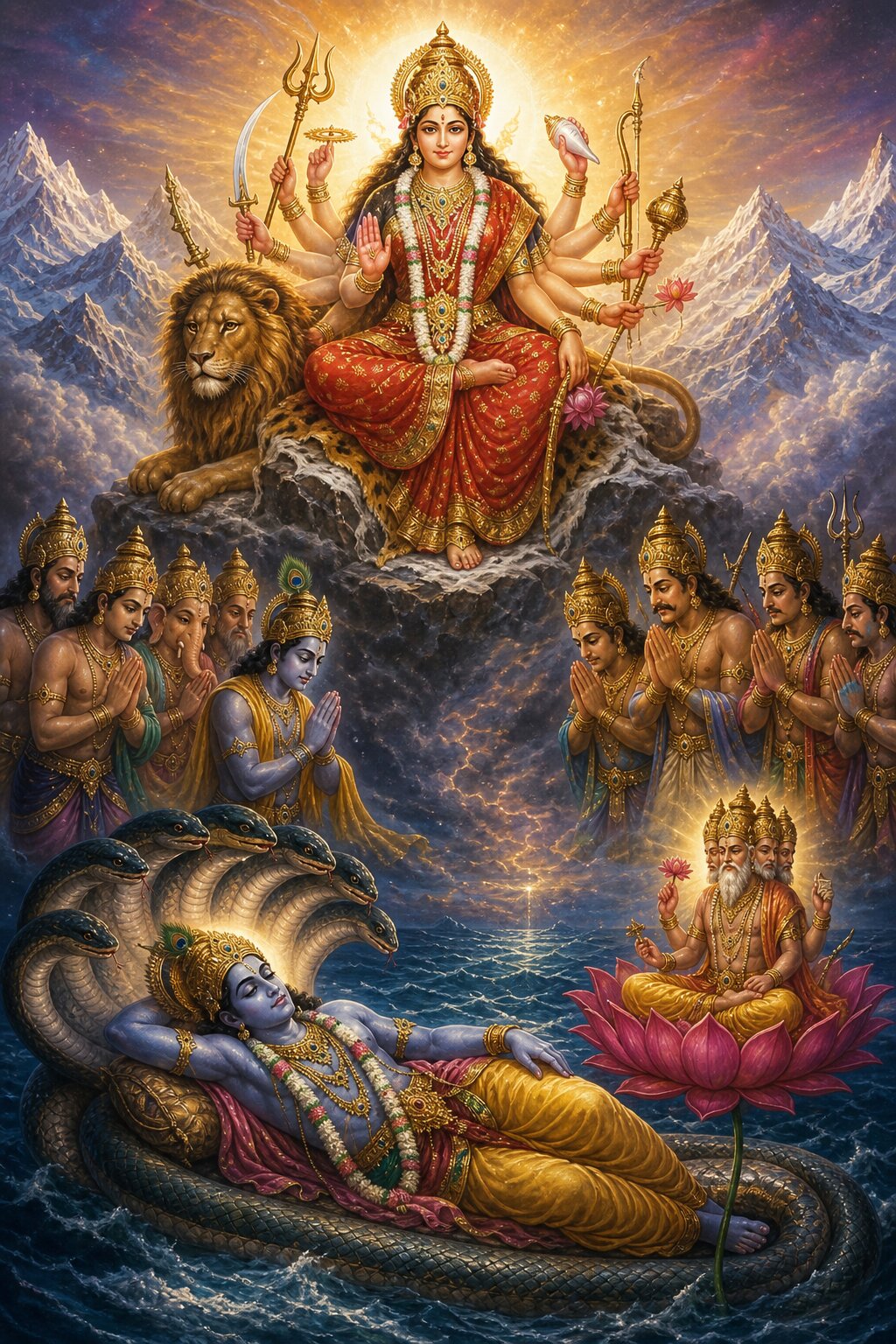
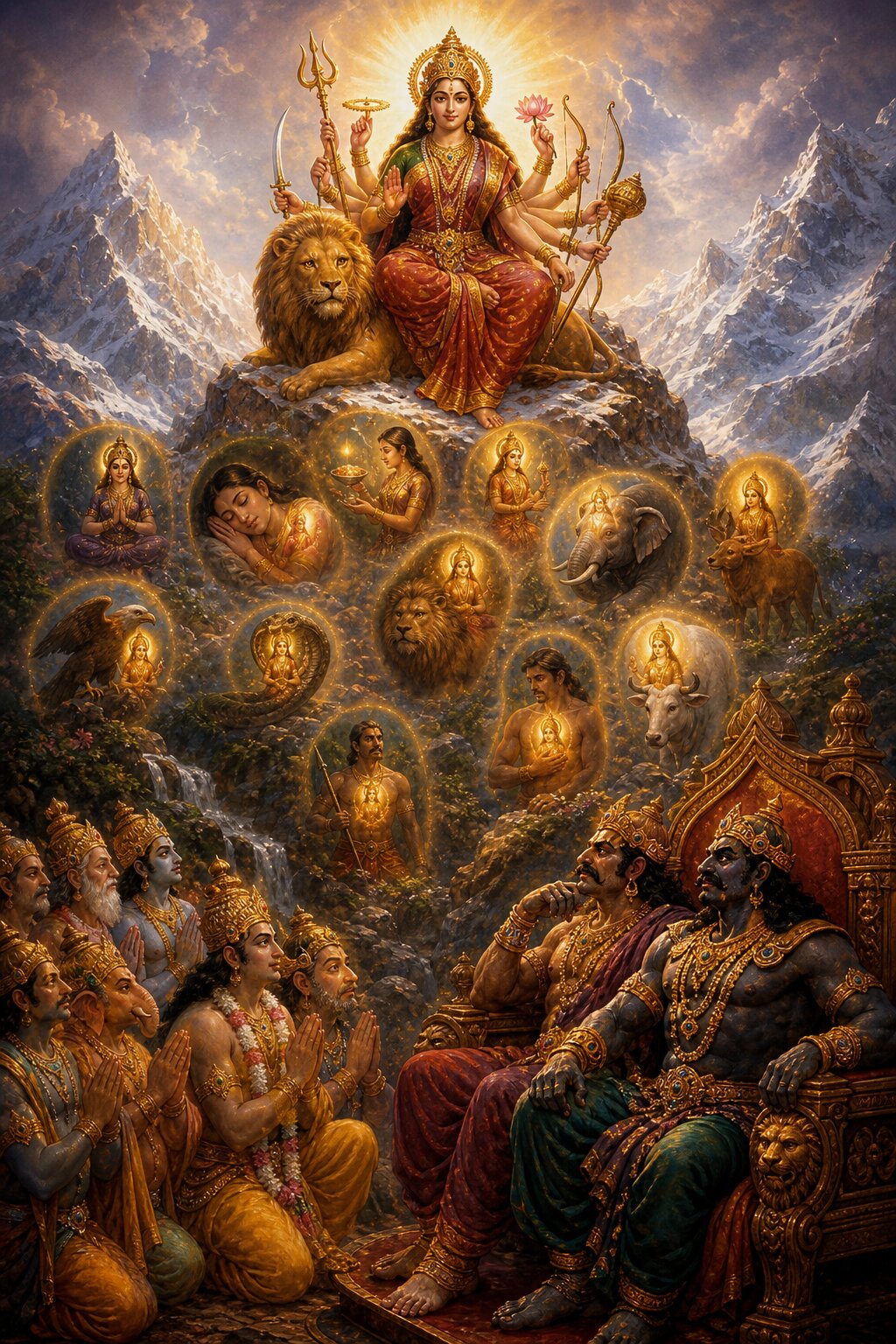
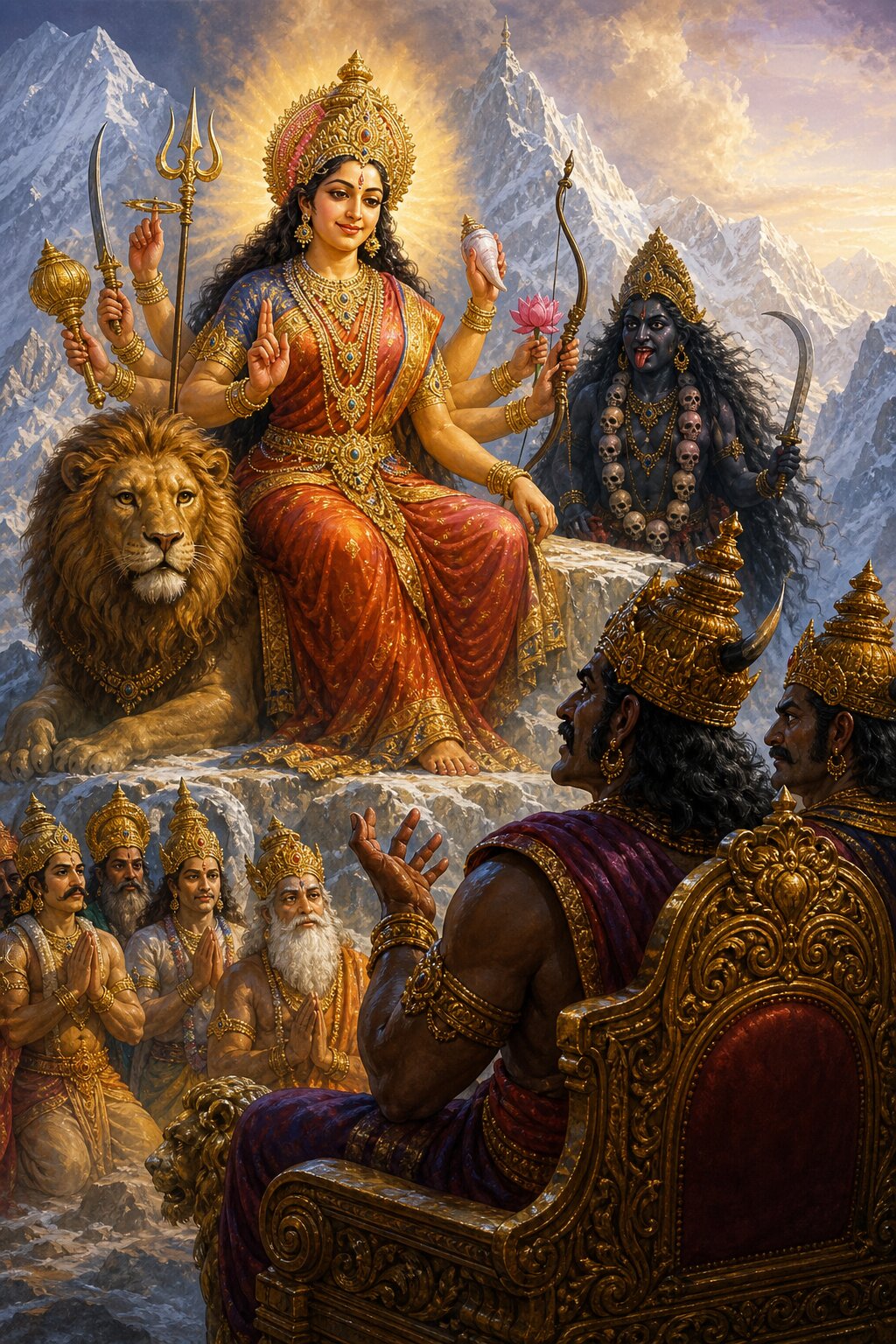
Shumbha and Nishumbha tore the three worlds from Indra and swallowed the gods’ shares of the yajna, and the shelterless gods climbed to the Himalaya to remember the Unconquered One who had promised to come at a single thought of her in a time of trouble. From their mouths rose the hymn that still fills every Durga puja, “Ya Devi sarva-bhuteshu.” Then Parvati came down to bathe, Kaushiki stepped forth from her body’s own sheath, Chanda and Munda caught sight of that matchless form, and Shumbha’s messenger arrived carrying an offer of marriage. In that moment the Devi pronounced the vow that pulls the whole story forward, and every battle still to come already lay folded inside it.
1 · 2 · 3
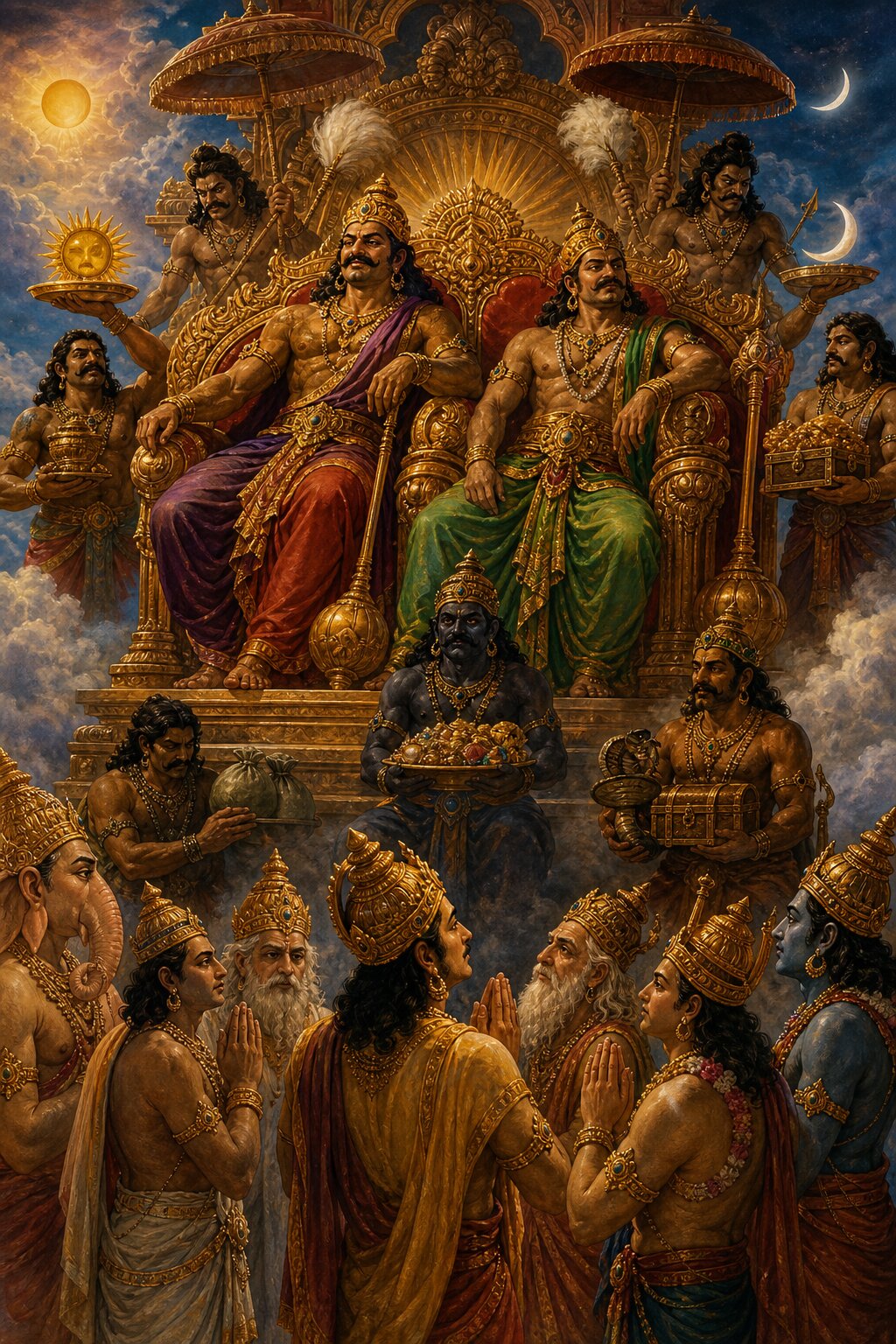
This was long ago, King. Two asuras, the brothers Shumbha and Nishumbha, trusting to nothing in the world beyond their own pride and their own strength, tore the three worlds away from Indra, the lord of Shachi, and took for themselves the gods’ shares of every yajna, the portions of the fire-rite that had fed the bright ones since the first offering was poured. From there they reached for the rest. They seized the office of the sun and the dominion of the moon; they took over the work of Kubera the wealth-keeper, of Yama who rules the dead, and of Varuna who rules the waters; they wielded the authority of the wind and the domain of fire; and the offices of all the remaining gods they ran with their own hands. The machinery of the universe kept turning, and usurpers now sat at every one of its levers. So the gods were scattered, stripped of their sovereignty, beaten, and driven from place to place, wanderers in the very worlds they had governed.
4 · 5 · 6
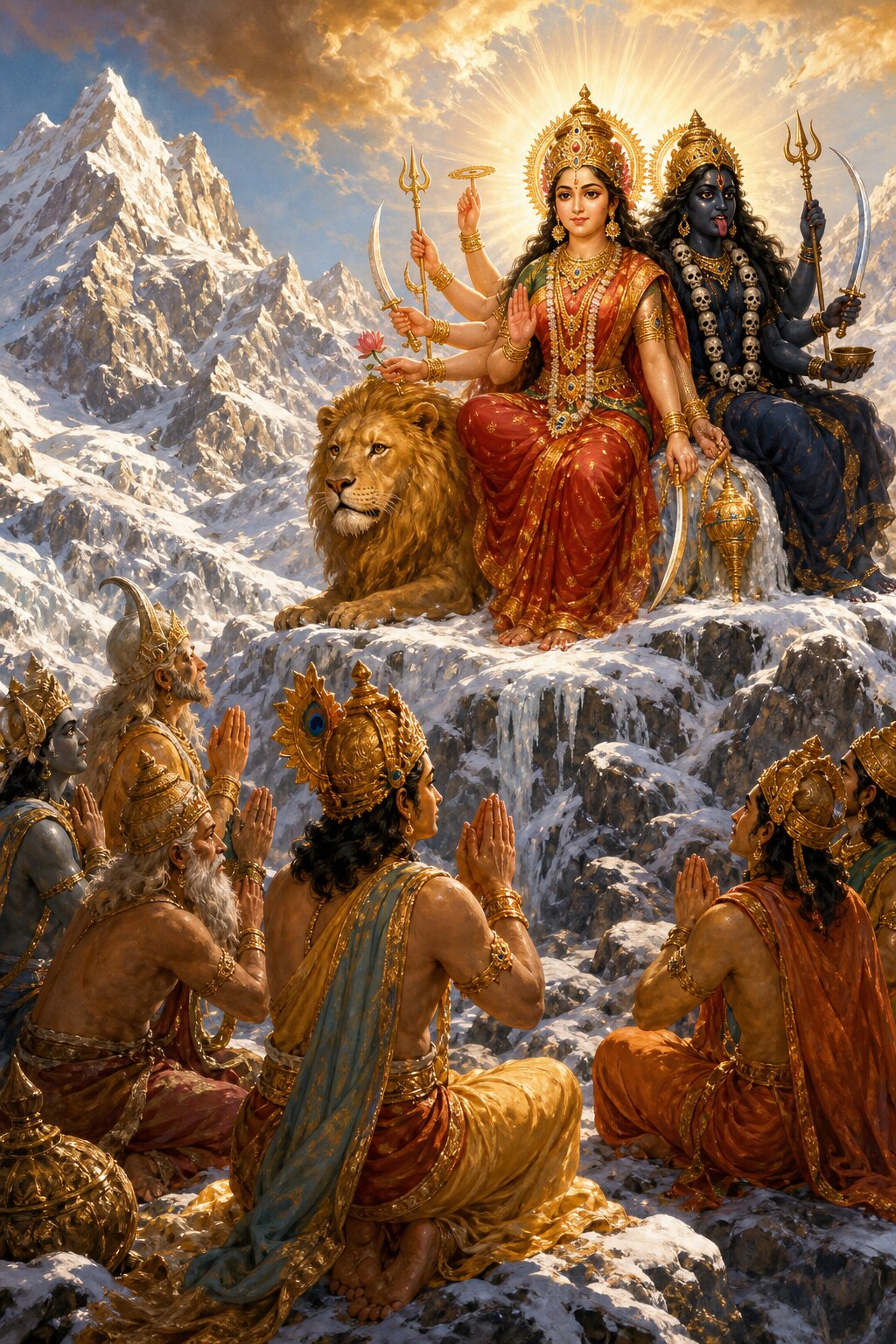
Their offices torn from them, set at nought on every side by those two great asuras, the thirty gods turned their minds to the goddess who is never conquered. They remembered the promise she had given them at the close of the last great war, when Mahishasura had fallen and their hymn of praise was barely done: whenever calamity found them and they called her to mind, in that very instant she would put an end to their gravest distress. A promise like that is a door left standing open, and the gods now walked toward it with everything they had left. Holding it before them, they climbed to Himavat, the lord of mountains, up into the snows where the air runs thin and holy, and there they raised their hymn to her who is the illusive power of Vishnu.
7 · 8 · 9
The voice of the gods went up as a single cry, many mouths carried on one breath. Salutation to the Devi, to the great Devi, to the auspicious one, salutation without end. Salutation to Prakriti, to the gracious Bhadra; disciplined and low, we bow before her. To the fierce one, to the eternal one, to Gauri the fair, to Dhatri who upholds all, salutation and again salutation. To the Devi who is the very ground the world stands on, to Kritya who is action itself, salutation and again salutation. To moonlight, to her whose form is the moon, to happiness itself, salutation without end. To Kalyani, to the increase that comes to all who bow low, to Siddhi who brings them to fulfillment, salutation and again salutation.
10 · 11
Then they called out to the faces that seem to war with one another, and called them all in a single breath, for they knew every one to be the same goddess, the way a man who has watched the sky his whole life knows the storm and the clear morning for one sky. To Nairriti who presides over dissolution, to the good fortune that attends kings, to Sharvani, salutation and again salutation. To Durga, to the far shore that no hardship can keep us from reaching, to the essence within all things, to the maker of all. To Khyati who is fame, to Krishna the blue-black, to Dhumra the smoke-dark, salutation without end. Before her who is gentlest of the gentle and most terrible of the terrible at once they bowed low, and once more they spoke the line they kept returning to, the line that steadies the whole hymn: to the Devi who is the ground the world stands on, to Kritya who is action itself, salutation and again salutation.
12 · 13
Now the hymn reached its very heart, the verses that gave this chapter its name and that are sung at every Durga puja to this day. From here it would name the one goddess in form after form, and after each name the gods let the same salutation fall three times over, a pulse that would not stop, a heartbeat passed down from that mountain into every generation since. The Devi who abides in all beings and is spoken of as the illusive power of Vishnu, she who laid Vishnu himself in his yoga-sleep upon the world-ocean at the very start of this story and who unrolls the whole world out of that slumber: salutation to her, salutation to her, salutation to her. The Devi who abides in all beings and is named consciousness, the awareness that sits within and knows: salutation to her, salutation to her, salutation to her.
14 · 15 · 16 · 17
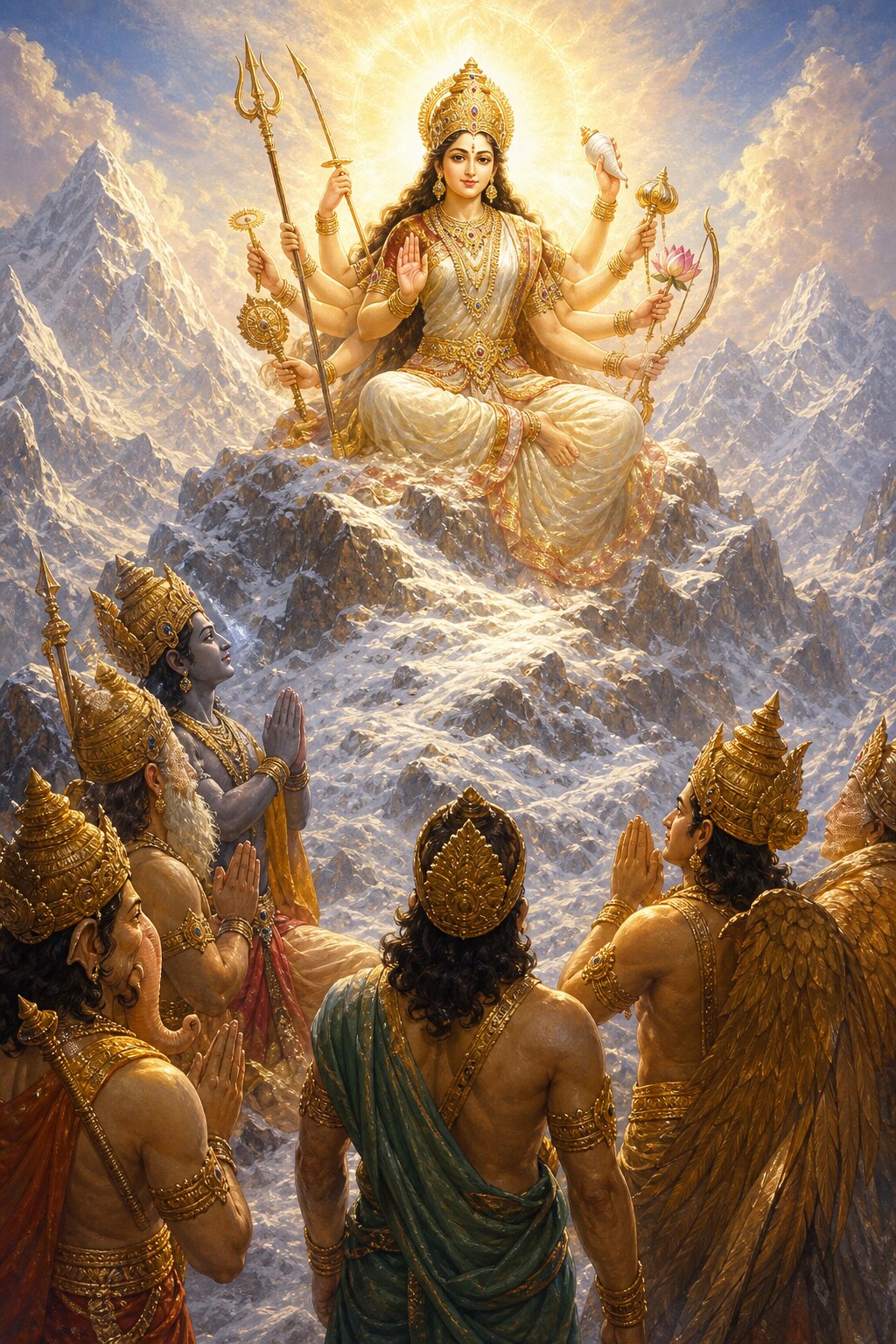
And the pulse did not stop. The Devi who abides in all beings as intelligence, the power that weighs and decides and understands: salutation to her, salutation to her, salutation to her. The Devi who abides in all beings as sleep, from the yoga-slumber of Vishnu down to the rest that closes our own eyes each night: salutation to her, salutation to her, salutation to her. The Devi who abides in all beings as hunger, the pang that drives every living creature, from the smallest to the greatest, to keep reaching for life: salutation to her, salutation to her, salutation to her. The Devi who abides in all beings as shadow, the shape that walks beside us all day and is seen by everyone, although the thing itself is nothing: salutation to her, salutation to her, salutation to her.
18 · 19 · 20 · 21
The Devi who abides in all beings as energy, the force that stands behind every act ever done, from the lifting of a hand to the turning of the worlds: salutation to her, salutation to her, salutation to her. The Devi who abides in all beings as thirst, the craving inside every reach for something more: salutation to her, salutation to her, salutation to her. The Devi who abides in all beings as forbearance, the patience that lets us bear what comes and forgive the one who brings it: salutation to her, salutation to her, salutation to her. The Devi who abides in all beings as species, the shared nature that binds each kind of birth to its own: salutation to her, salutation to her, salutation to her.
22 · 23 · 24 · 25
The Devi who abides in all beings as modesty, the quiet reserve a true knower carries: salutation to her, salutation to her, salutation to her. The Devi who abides in all beings as peace, the stillness every seeker on every road is trying to reach: salutation to her, salutation to her, salutation to her. The Devi who abides in all beings as faith, the seed from which every practice grows and by which the seeker is carried onward when nothing else will carry him: salutation to her, salutation to her, salutation to her. The Devi who abides in all beings as loveliness, alive in every gleam and every grace the eye has ever caught: salutation to her, salutation to her, salutation to her.
26 · 27 · 28 · 29
The Devi who abides in all beings as good fortune, the Lakshmi within all plenty and wealth: salutation to her, salutation to her, salutation to her. The Devi who abides in all beings as fortitude, the holding power and the steadiness that keep each thing in its place while the ages pass: salutation to her, salutation to her, salutation to her. The Devi who abides in all beings as activity, moving both the current of the mind and the daily work by which we live: salutation to her, salutation to her, salutation to her. The Devi who abides in all beings as memory, the remembering that makes us who we are, without which a life would come apart into loose days: salutation to her, salutation to her, salutation to her.
30 · 31 · 32 · 33
The Devi who abides in all beings as compassion, the tenderness we keep for one another even in a world at war: salutation to her, salutation to her, salutation to her. The Devi who abides in all beings as right conduct, the sense that tells right from wrong before a single word is spoken: salutation to her, salutation to her, salutation to her. The Devi who abides in all beings as contentment, the ease that lets a restless mind finally settle: salutation to her, salutation to her, salutation to her. The Devi who abides in all beings as nourishment, at work in every growth and every flourishing, in the grain and in the child alike: salutation to her, salutation to her, salutation to her.
34 · 35 · 36 · 37
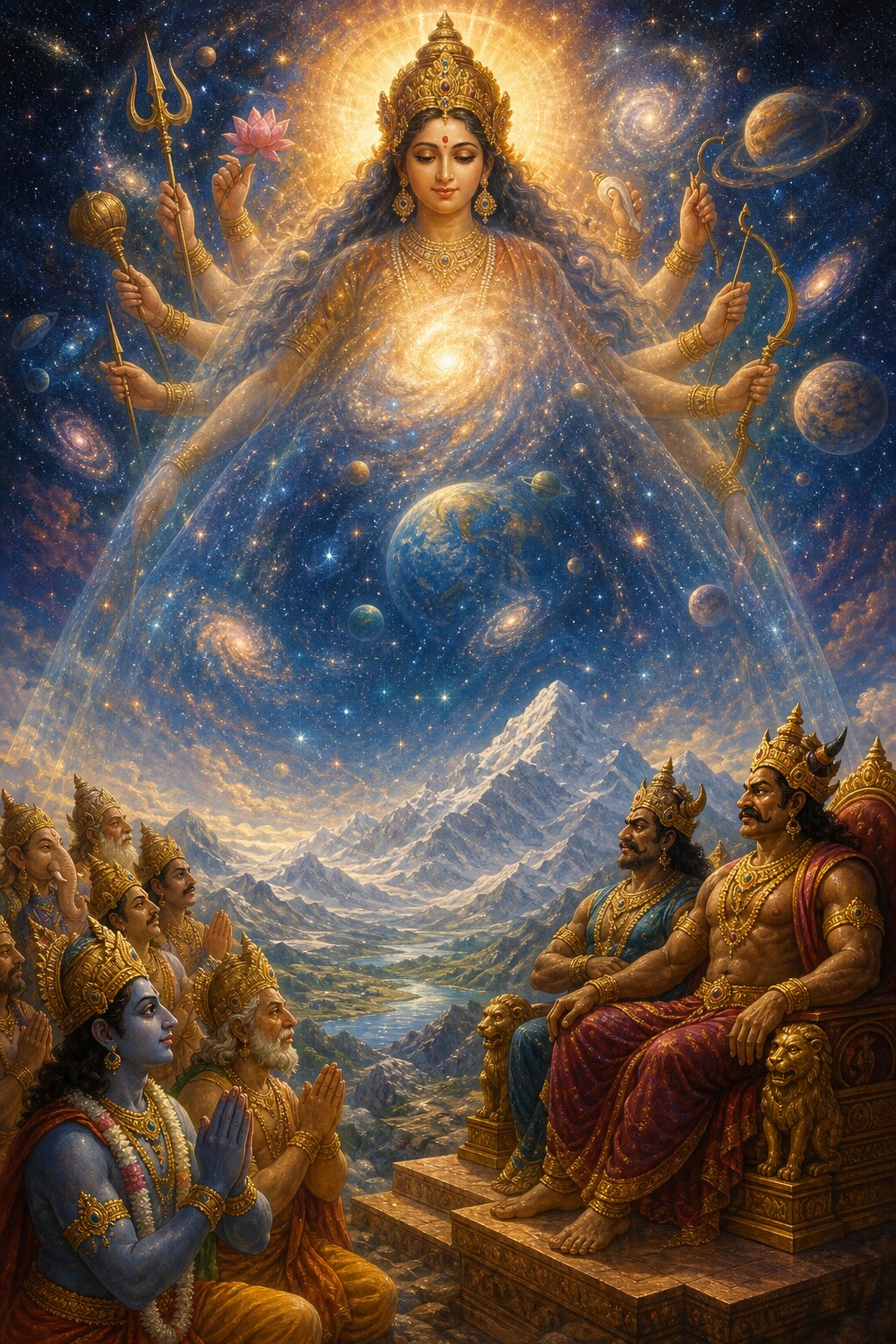
Now the hymn made its boldest turn. The Devi who abides in all beings as mother, the motherhood at the root of every bond, older than every other love we know: salutation to her, salutation to her, salutation to her. The Devi who abides in all beings even as error, present inside our very own mistakes and wanderings, so that nothing we live through, however crooked, falls outside her: salutation to her, salutation to her, salutation to her. To her who governs the organs of sense and rules forever among all beings, the goddess whose whole nature is to pervade, salutation and again salutation. And to her who stands pervading this entire world in the form of pure awareness, the knowing behind every knowing: salutation to her, salutation to her, salutation to her.
38 · 39
Then the whole flood of praise narrowed to a single prayer, the way a river narrows before it falls. She whom the gods praised in ages past to win the protection they longed for, she whom Indra, lord of the gods, served day after day: may she, the sovereign lady who is the very source of all that is bright, work good for us, grant us blessing and grace, and beat back every calamity. And she whom we gods, tormented now by these insolent daityas, bow to as our queen, she who the moment she is called to mind by those bent low in devotion carries off all their distress in that same breath: may that goddess guard us. On that word the hymn ended, and the mountain stood quiet around them, waiting.
40 · 41 · 42
O prince, at exactly this point the story turns. While the gods stood lost in their hymn, Parvati herself, the daughter of this very mountain on which they prayed, came down to bathe in the waters of the Jahnavi, the Ganga. Fair of brow, she asked them straight out whom they were praising here. Before any god could shape an answer, another voice gave it: from the sheath of Parvati’s own body an auspicious goddess stepped forth and said, this hymn is raised for me, by these gods whom the daitya Shumbha has cast from their places and Nishumbha has beaten in battle. The one they had been calling had been walking toward them all the while.
43 · 44 · 45
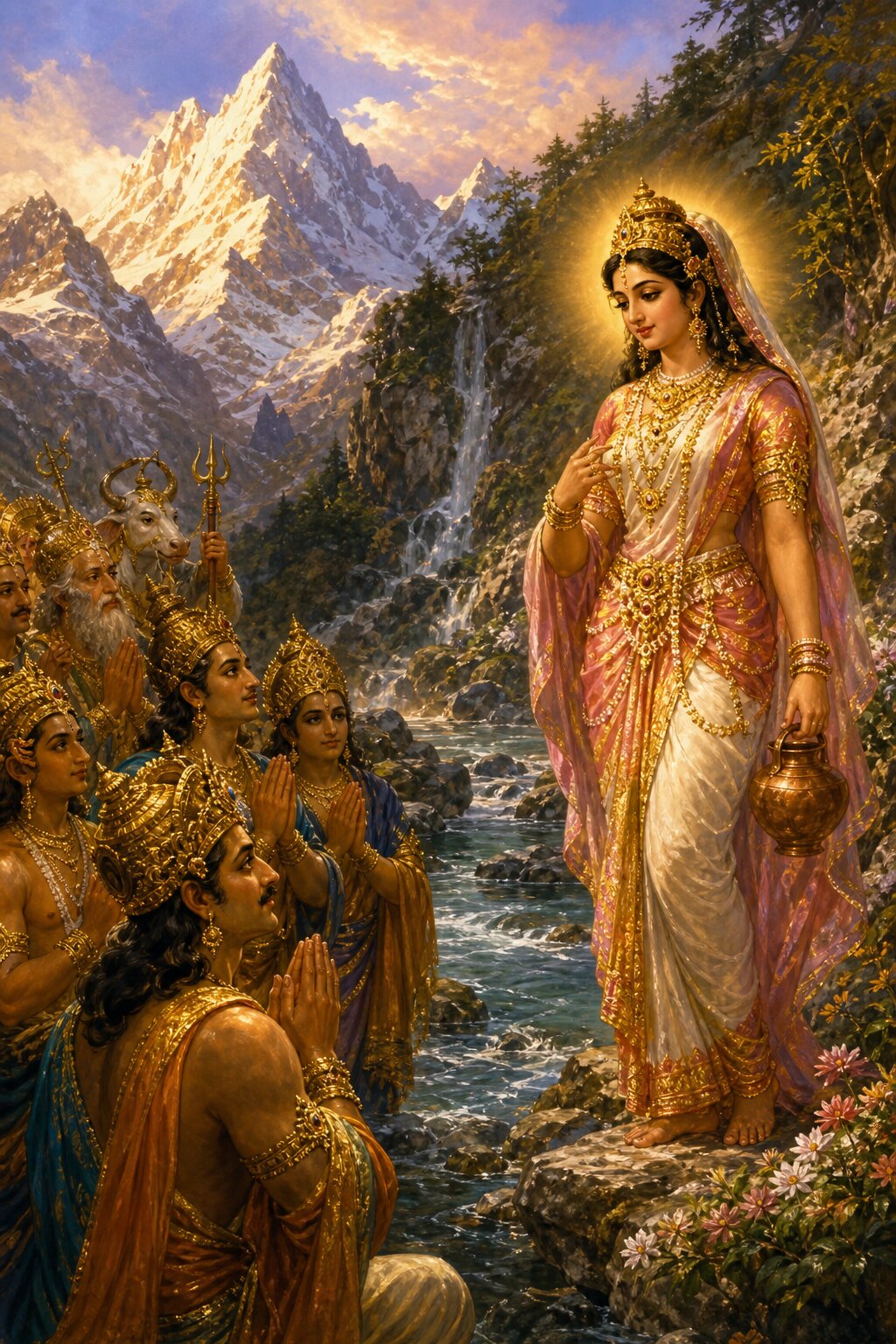
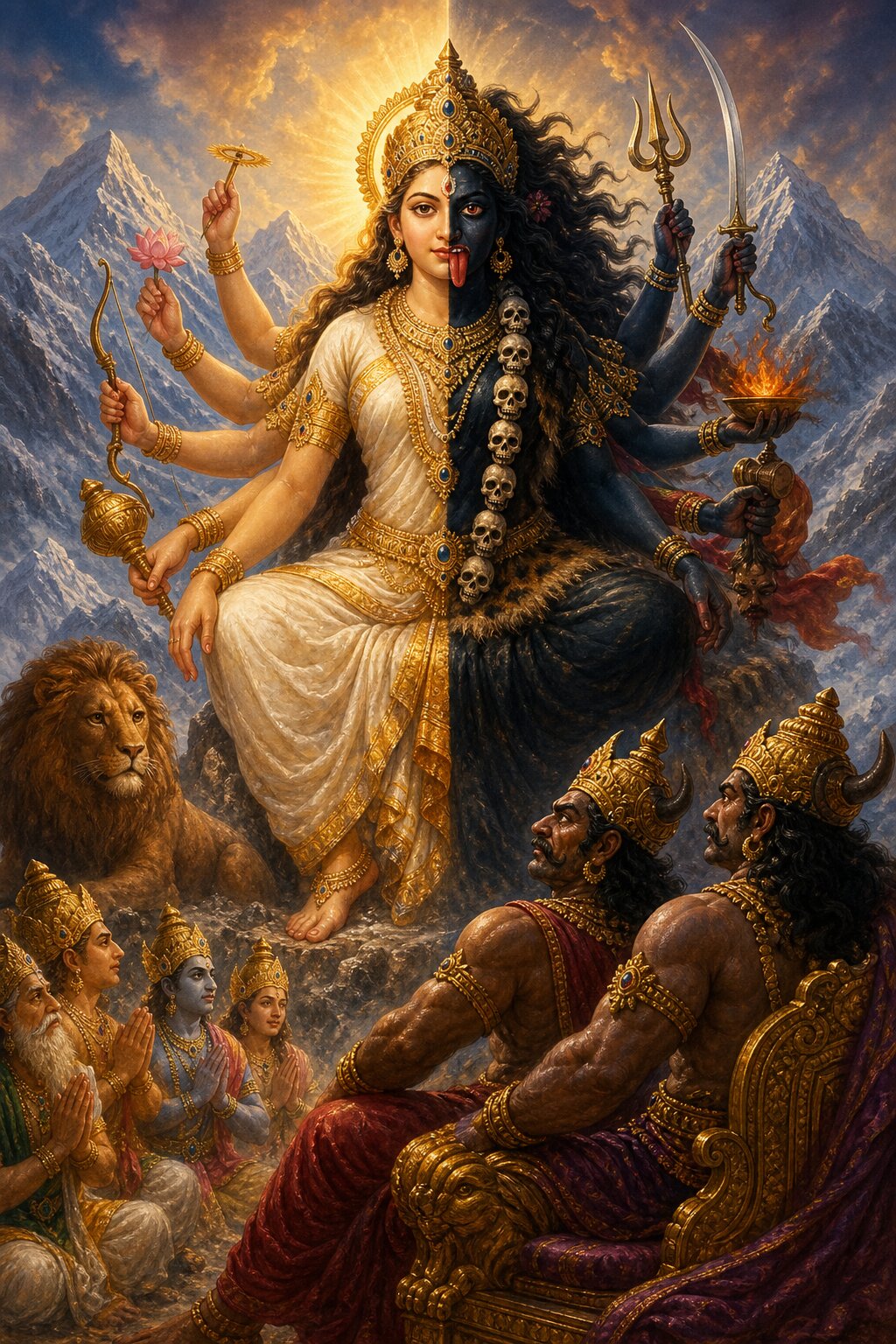
Because this Ambika came out of the sheath, the kosha, of Parvati’s body, all the worlds sing her under the name Kaushiki. And once she had stepped away, Parvati herself turned dark, and as the dark one she came to be called Kalika, making her home upon Himavat. So the goddess stood now as two upon one mountain, Kaushiki the radiant and Kalika the dark, light and night side by side on the same snows. At that very hour Chanda and Munda, two servants of Shumbha and Nishumbha prowling those heights, caught sight of Ambika wearing her sublime and utterly captivating form, and could not look away.
46 · 47 · 48
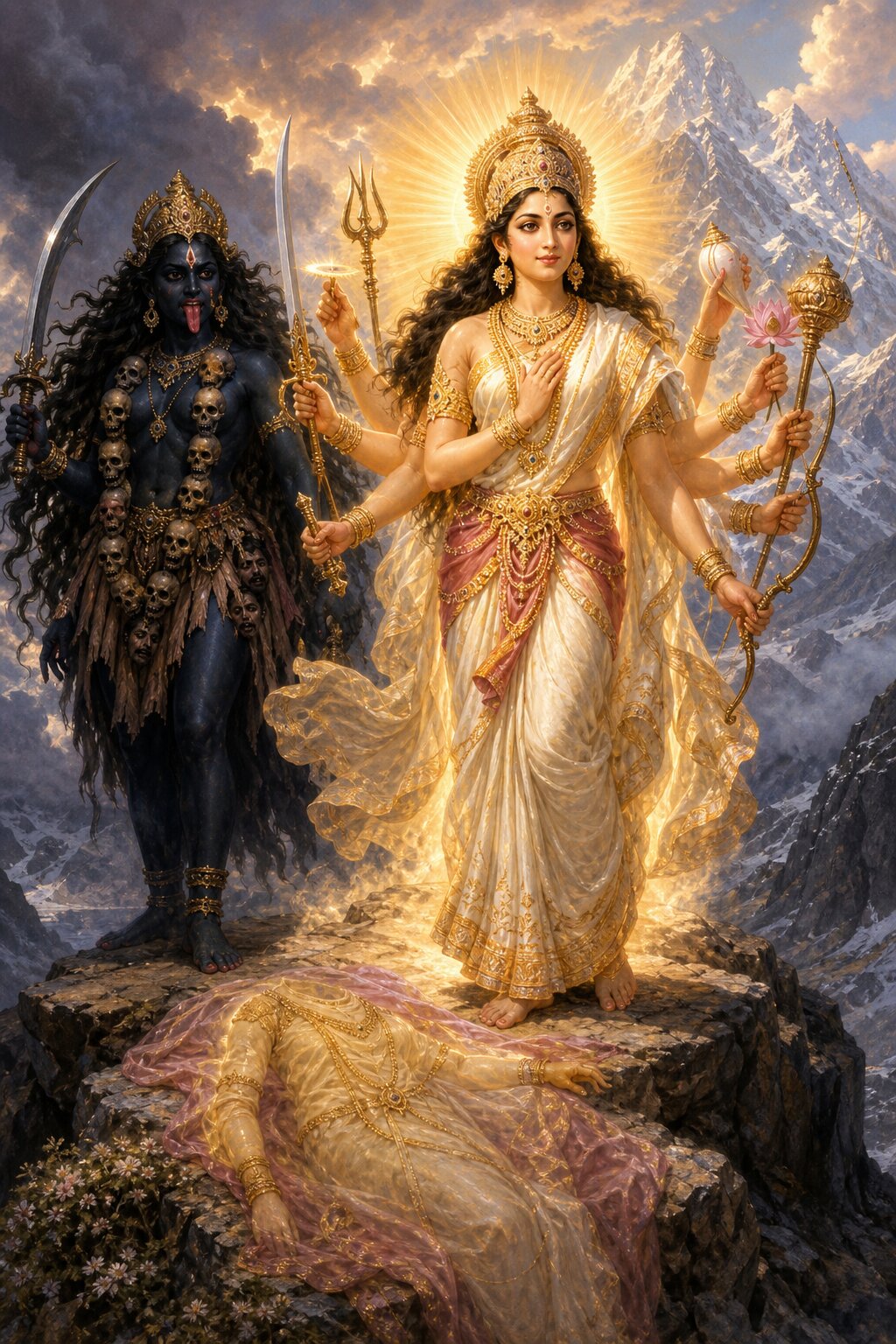
The two of them hurried back to Shumbha with the news still hot in their mouths. A woman past all describing sits up there, great king, they said, and the whole of Himavat is bright with her, the snows themselves lit by her presence. No one anywhere has ever seen beauty to match it. Find out, lord of the asuras, what goddess she may be, and take her for your own. She is a gem among women, flawless in every limb, and her radiance sets the very horizons alight; she is worth your going, lord of the daityas, to see with your own eyes. They spoke of her exactly as they would speak of a treasure for his vaults, and that was the whole of their understanding.
49 · 50 · 51
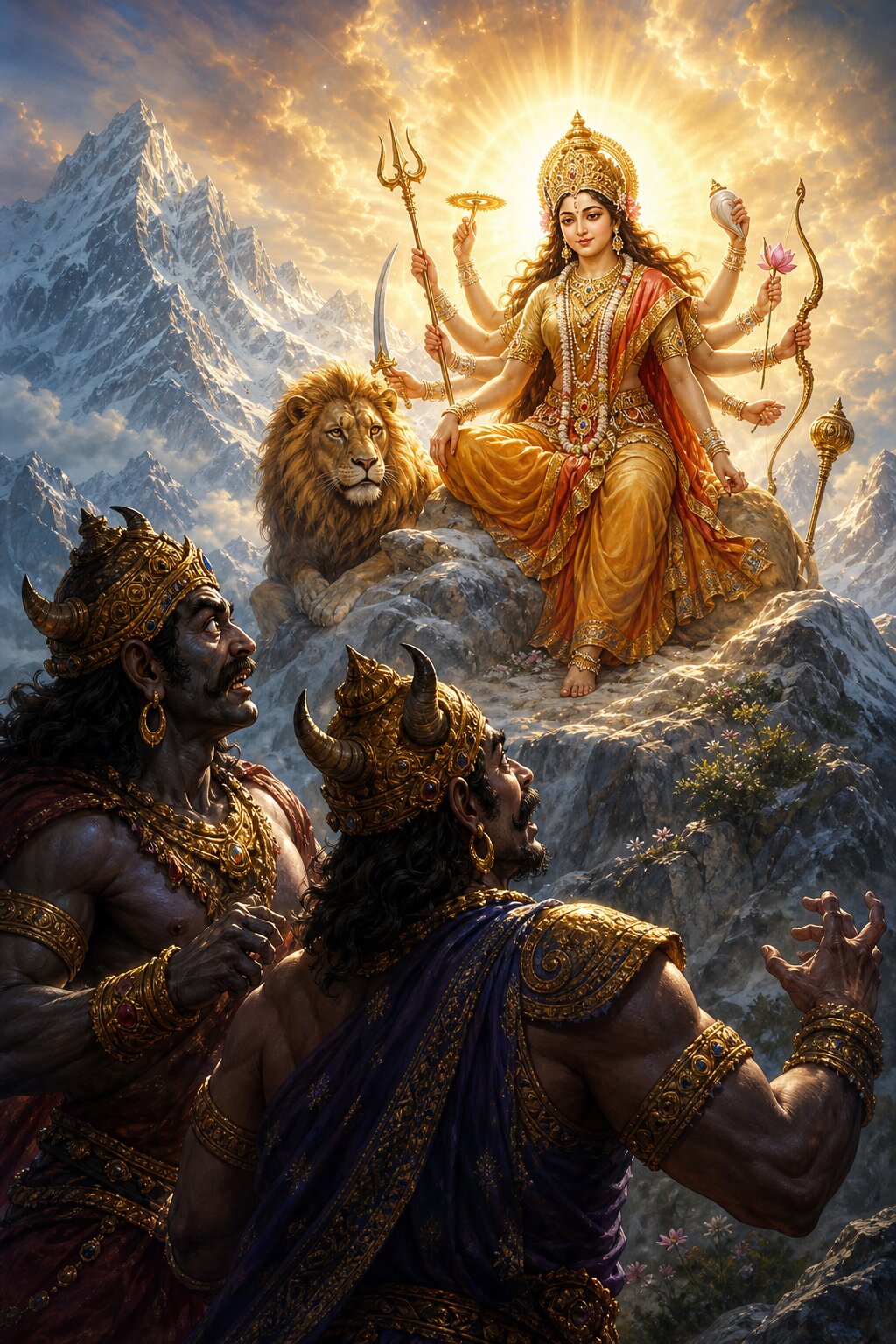
Then they laid out his wealth before him, item by item, as if to point at the one prize still missing. Every gem, my lord, every jewel and elephant and horse in all three worlds now shines inside your house. Airavata, the gem among elephants, the white mountain of a beast that once carried the king of the gods, was taken from Purandara; the Parijata tree, whose blossoms had perfumed all of heaven, came to you, and with it the horse Uchchaihshravas. Brahma’s own marvel, the gem-wrought chariot yoked to swans, stands waiting in your courtyard.
52 · 53 · 54 · 55
And the count ran on, growing stranger and more terrible as it went. From Kubera, lord of riches, came the treasure called Mahapadma; the ocean gave up its garland of lotuses that never wilt. Varuna’s parasol, raining gold as it turns, stands in your house, and beside it the finest chariot Prajapati once drove. From Death himself you wrenched the power named Utkranti-da, the power that grants a life its final departure, so that even the hour of leaving now waited on your word. The noose of Varuna, king of the waters, rests in your brother’s keeping; Nishumbha holds every kind of gem the sea has ever borne; and Agni gave you two garments that fire itself has washed clean.
56 · 57
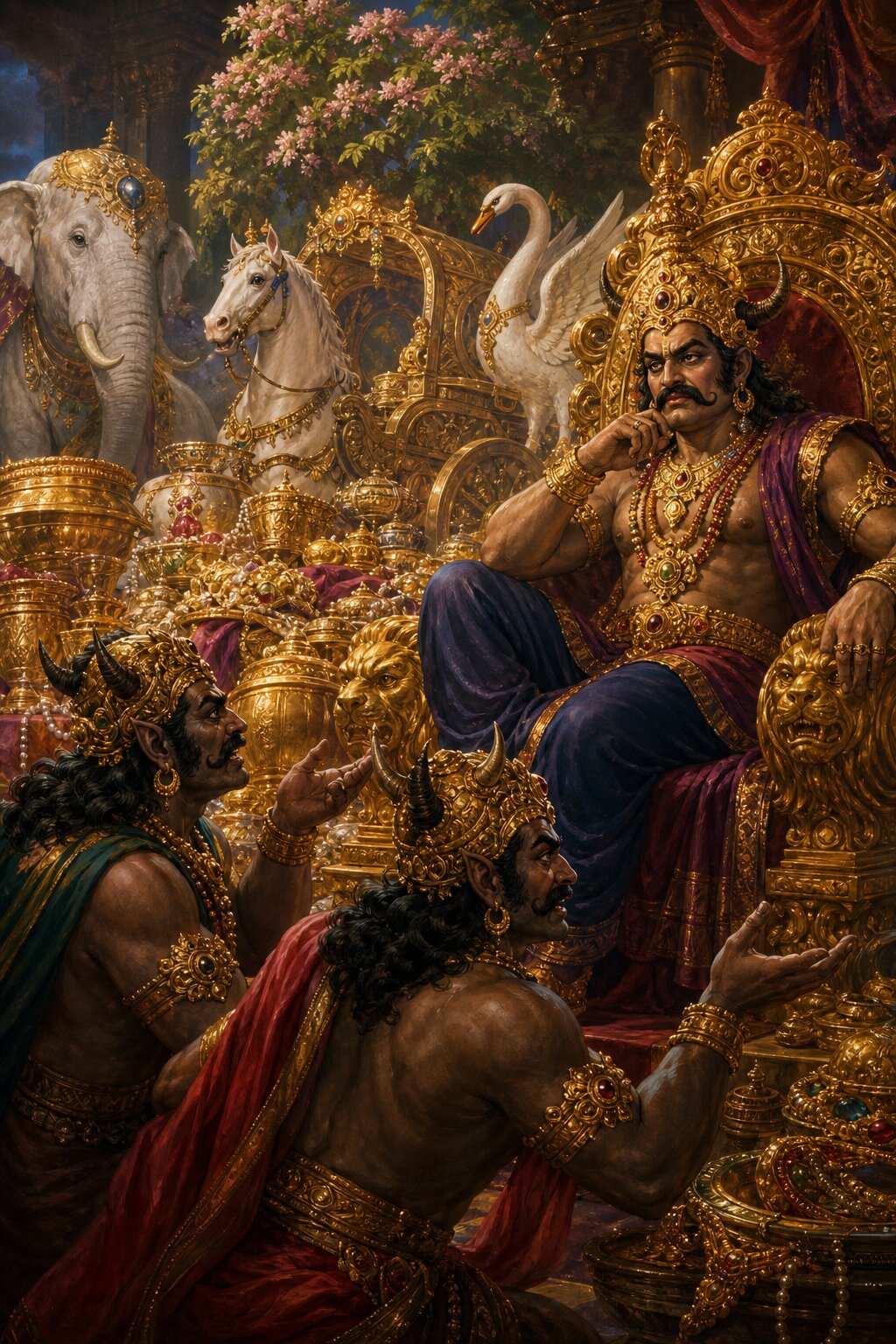
Every treasure named, Chanda and Munda came at last to the thing they had climbed down the mountain to say. All the gems of the three worlds are already yours, lord of the daityas; why then have you still not taken this one auspicious jewel among women? The question was aimed with care, and it landed where they meant it to land, for a collector cannot bear one empty place in his hoard. Hearing them out, the great asura Shumbha sent a messenger to the goddess, the mighty asura named Sugriva.
58 · 59 · 60
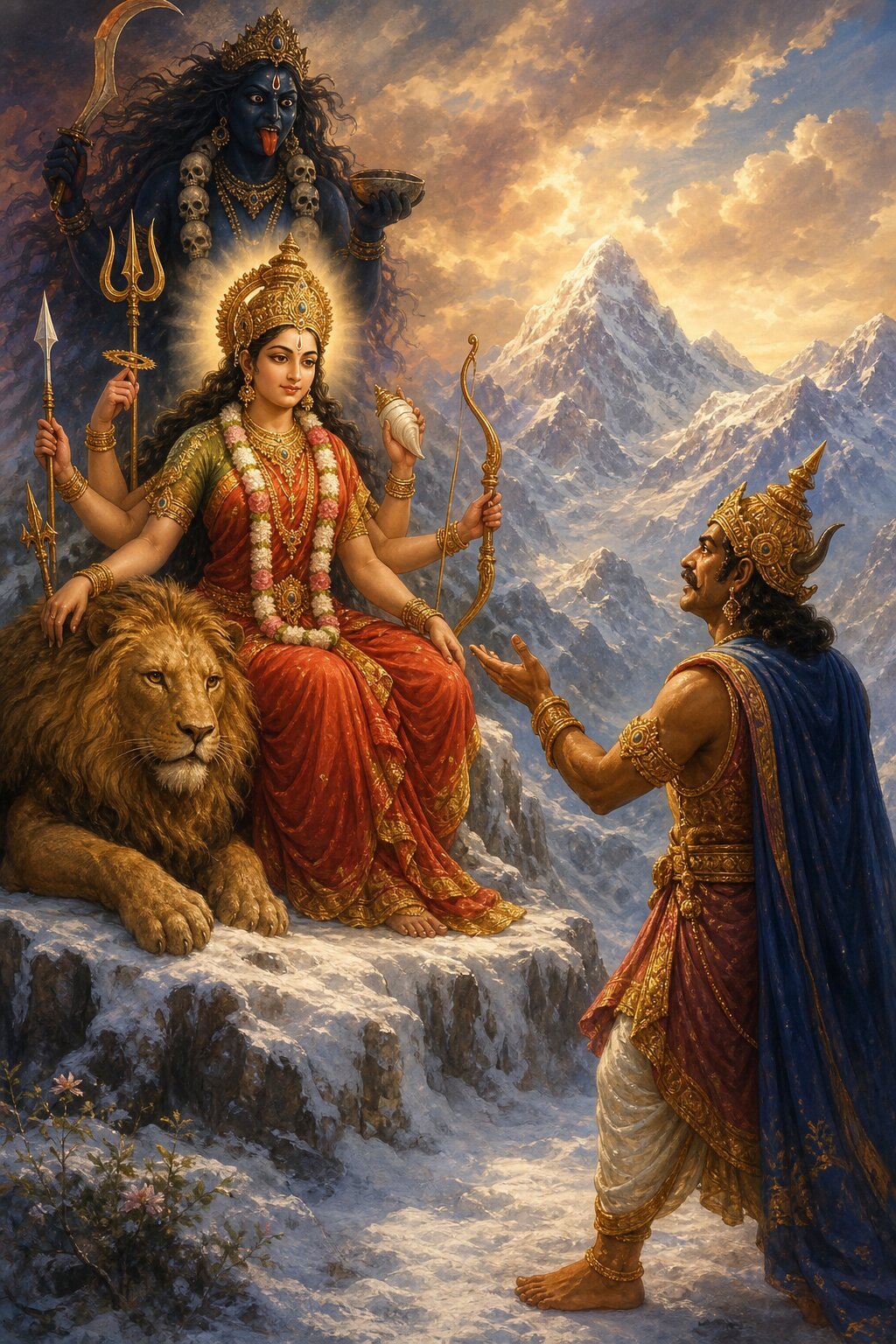
Shumbha coached him with care: carry her these words of mine, he said, and handle it so smoothly that she comes to me gladly, of her own accord. Even now he imagined the whole matter as an acquisition wanting only the right tone. The messenger climbed to the shining stretch of mountain where the goddess sat and began in a voice made soft and honeyed for the errand. Goddess, Shumbha the lord of the daityas is the supreme master of the three worlds, and I am his messenger, sent by him and standing now before you.
61 · 62 · 63
Then he set out his master’s rank and his pride in one breath. Hear now the words of one whose command has never once been refused among all the races of the gods, one who has broken every enemy the daityas ever had. He says: the three worlds are mine, the gods move at my will, and every share of every yajna I enjoy myself, each one apart, tasting one by one what once fed the thirty. The choicest jewels of the three worlds lie wholly in my power, and I have taken even the gem among elephants that once carried the king of the gods across the sky.
64 · 65 · 66
His master’s message only grew sweeter as it ran on, and under the sweetness the counting never stopped. Uchchaihshravas, the gem among horses churned up from the ocean of milk in the oldest age of the world, the immortals bowed low and set in my hands with their own. Whatever else has the worth of a jewel, among the gods, the gandharvas who make heaven’s music, and the serpent nagas of the deep, all of it has come to rest with me alone, radiant one. And you, goddess, we hold to be the one gem among all the women of the world; so come to us, for we are keepers and enjoyers of gems. In the whole proposal there was no room for her to be anything more than the finest object in a house full of objects.
67 · 68 · 69
Then the choice itself was set before her, as though a bride were being offered her pick of thrones. Take whichever of us you please, came the word, me or my younger brother Nishumbha, whose valor reaches everywhere, lady of the restless glance, for a true gem you are. Come into my keeping and a sovereignty beyond all compare is yours; weigh it with your own good sense, and give yourself into my hands. The goddess heard it all through to the end and smiled, a deep and unhurried smile held far within, she who is Durga, Bhagavati Bhadra, by whom this whole world is upheld, she who had taken this very birth to end the two brothers now bidding for her hand. Then she spoke.
70 · 71 · 72
The goddess began by granting him every word, and the courtesy itself should have been a warning. You have spoken the truth, she said, and nothing in it is false. Shumbha is indeed the overlord of the three worlds, and Nishumbha stands just as high. But a vow once taken, how is it to be turned into a lie? Hear then the vow I made long ago, out of the small wisdom I had at the time. The words were modest, and inside them the whole war was already waiting. I resolved that whoever defeats me in battle, whoever strips the pride out of me, whoever in this world meets me as my equal in strength, he alone shall be my husband.
73 · 74
So she set the challenge down in plain words, without heat and without haste. Let Shumbha come here, then, or the great asura Nishumbha. Let him defeat me, and why any delay after that; let him take my hand that very hour. At this the messenger flared, for he had come to fetch a bride and found himself handed a declaration of war. Pride has gone to your head, goddess, he said; do not talk this way in front of me. What man in all three worlds could stand face to face with Shumbha and Nishumbha?
75 · 76 · 77
His warning turned sharper still. Against even the lesser daityas the massed gods cannot hold the field in war, goddess; how then will you, one woman, standing alone? Indra and all the gods beside him could not keep their ground against the likes of Shumbha; how will a lone woman walk out to face such asuras? Go to Shumbha and Nishumbha on your own feet, as I have told you, before you are dragged there by the hair and every shred of your dignity is shaken into the dust. One woman, alone: he said it again and again, as though saying it could make her small.
78 · 79
The goddess answered the threat without lifting her voice, and the calm in it ran deeper than any shout. It is just as you say: Shumbha is strong, and Nishumbha’s courage is past all telling. Yet what am I to do, when a promise I made long ago, without weighing it, still stands and holds me? Go, then, and carry to the lord of the asuras, with all respect, every word I have spoken to you, and let him do whatever he judges fit. So the messenger turned back down the mountain, carrying an answer that left the choosing, and the ruin folded inside it, entirely in his master’s hands.
Ahead
The sixth chapter brings the slaying of Dhumralochana. The messenger returns empty-handed, rage takes hold of Shumbha, and he sends a general named Dhumralochana with sixty thousand asuras to march upon the Devi. He advances on her in his pride, and at a single “humkara” from the Devi he burns to ash where he stands.