Devi Mahatmya
Chapter 4 · The Shakradi Stuti, the Devi’s Boon · Middle Charita
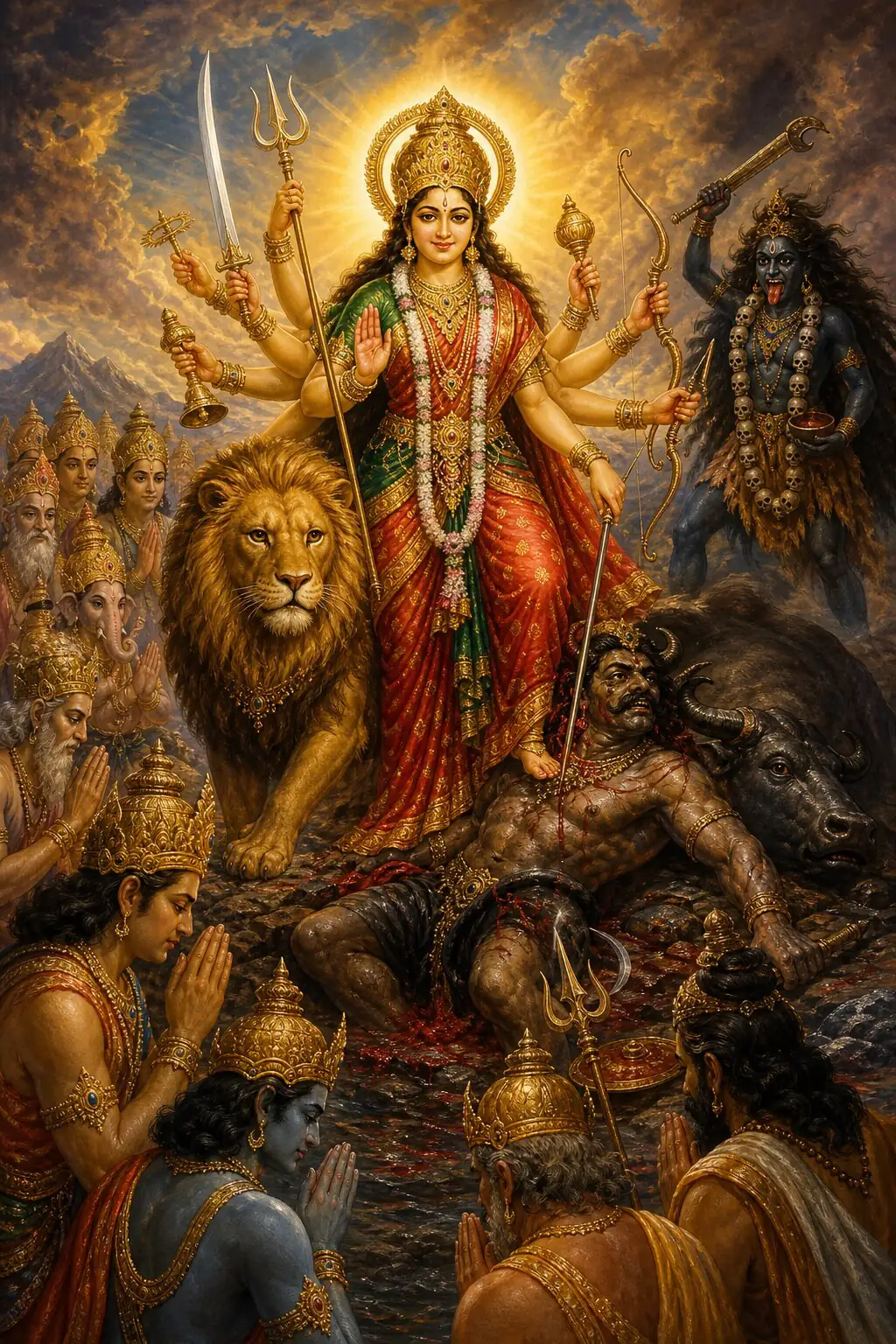
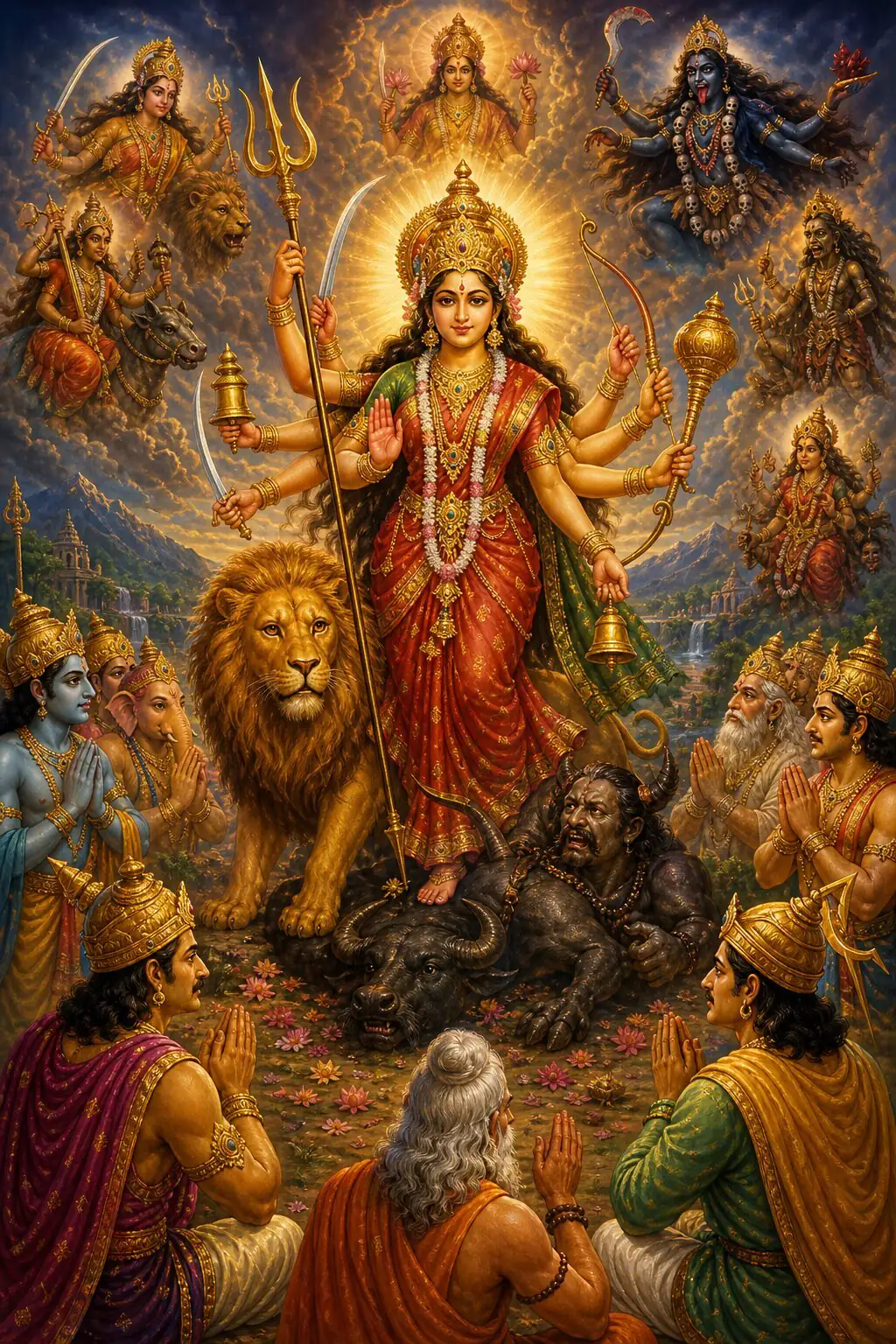
Mahishasura had fallen, and the seat torn from Indra had come back to him. Then, their bodies thrilling with joy and their necks bowed low, Indra and all the hosts of heaven bent before the Devi, and voice upon voice there rose the hymn that is the most poetry-laden passage of the Devi Mahatmya. Every shloka reaches her from a fresh angle: now beauty, now strength, now compassion, now Shri and Svaha and Svadha, now Medha, Durga, and Gauri, and at the last that prayer for protection from all four directions which is repeated to this day like armor. When the hymn was complete the Devi told them to ask a boon, and the gods passed over heaven and riches alike and asked for one thing only, that whenever they remembered her she keep destroying their calamities. It is the oldest bargain in this text, and the gentlest: memory on one side, rescue on the other.
1 · 2
Mahishasura had fallen. Mahishasura lay slain on the field he had owned an hour before, and with him the whole army of the gods’ enemies, all of it brought down by the Devi. So the gods rose to sing, Indra at their head, the king of heaven leading the choir as once he had led the retreat. Joy ran through them until the hair lifted on their arms, and that thrill of awe made their very bodies beautiful. They bent head and neck and shoulder low before her, and out of that reverence, bowed and shining at once, their voices rose into praise.
3 · 4 · 5
The gods said: We bow in faith to Ambika, who spread out this entire world by her own power and who stands before us now as the massed might of every divine host gathered into a single form. All the gods and the great rishis worship her. May she ordain what is good for us. Her matchless majesty and strength find no measure anywhere: Ananta the adorable, the endless serpent on whom the worlds rest, cannot declare them, and Brahma cannot, and Shiva cannot, though among the three of them they hold creation itself. May that Chandika bend her mind to guarding the whole world and to destroying the fear of every evil thing. And she is nearer than her vastness tells. She is Shri, good fortune herself, moving through the houses of those who do good, and Alakshmi, misfortune, standing in the doorways of the wicked; she is the intelligence in discerning hearts, the faith in good people, the modesty in the well-born. To you, who are all of this at once, we bow. Protect this universe, O Devi.
6 · 7
Still bowed low, the gods went on. What words can hold this form of yours that no thought can reach, or that boundless valor of yours that destroys the asuras, or the wonders you worked in battle before the massed hosts of gods and asuras alike, deeds we watched with our own eyes and cannot describe even now? You are the cause of all the worlds. The three gunas, the qualities woven through the whole of nature, run through you too, and still no flaw of theirs can touch you or mark you as its own; even Vishnu, even Shiva, even the rest of us who are called gods cannot fathom you. You are the ground on which everything rests, and this whole universe, every heaven and every world between, is a single portion of you, for you are the unmanifest, the supreme and primal prakriti, the first cause standing before all causes.
8 · 9 · 10
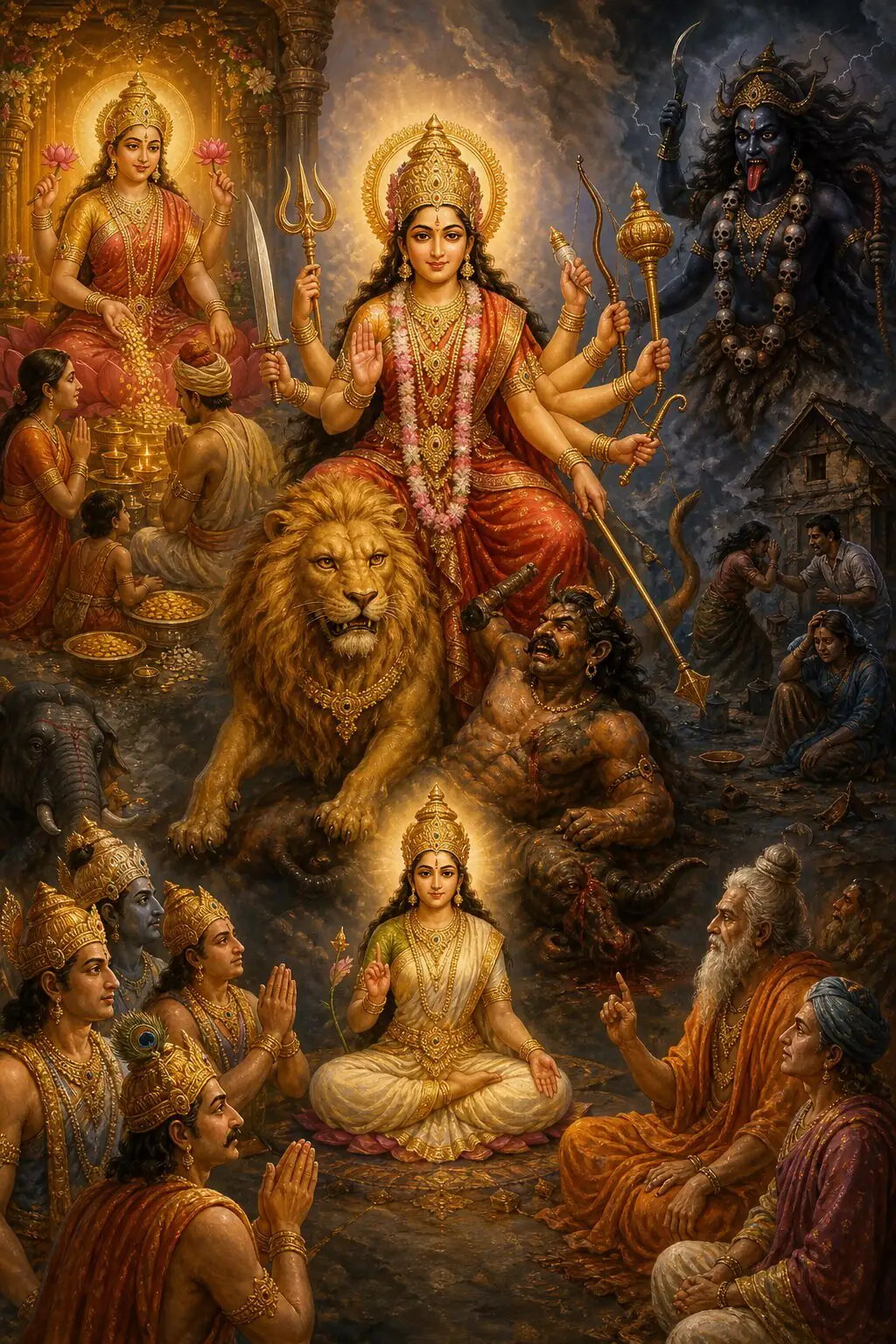
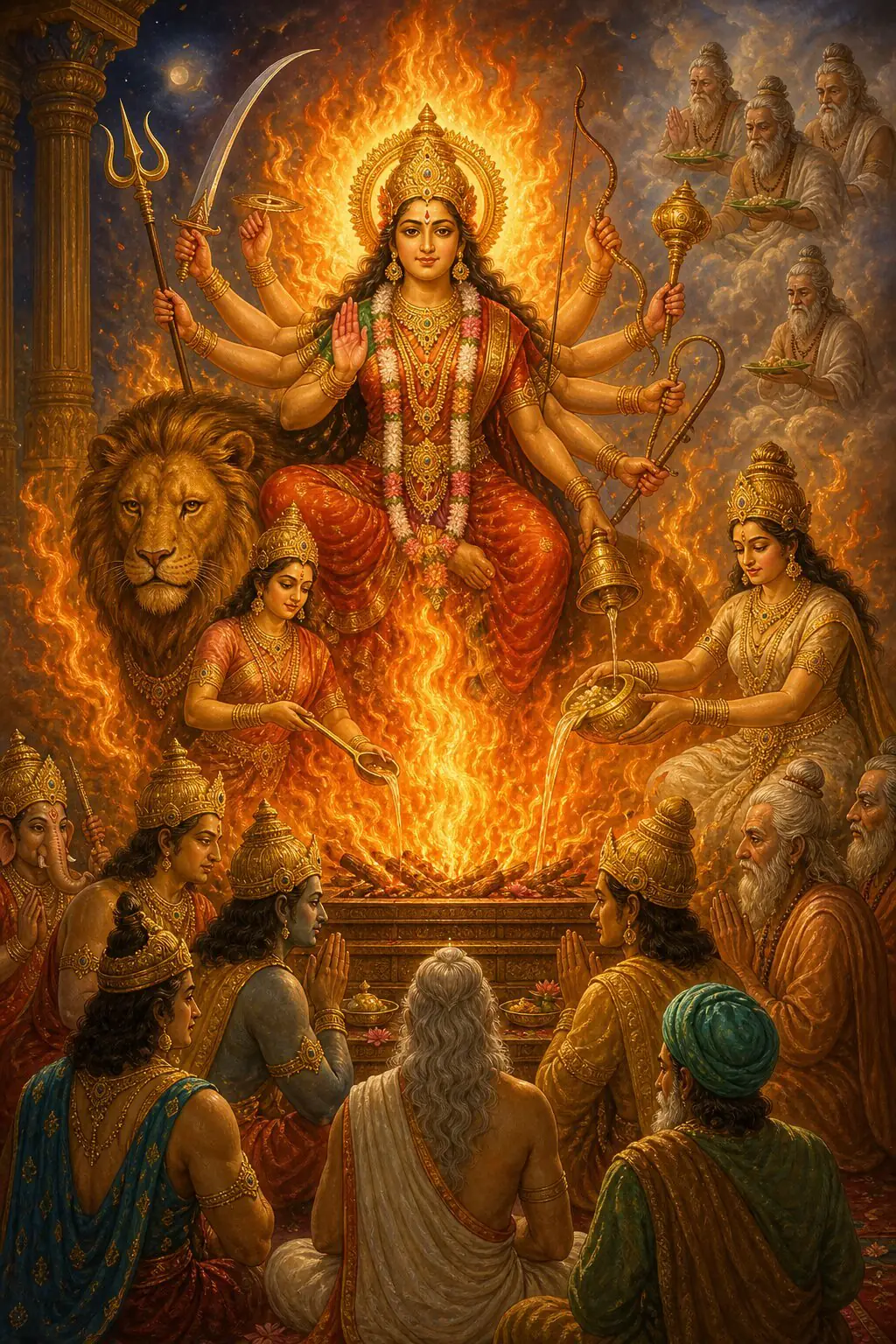
You are Svaha, O Devi, the word poured with every offering into the fire, and at the utterance of your name the whole host of gods takes its fill in every yajna, the fire-rite; through you the ancestors too are fed and satisfied, and so people call you Svadha as well, the word that carries the offering to the dead. You are the cause of final release, keeper of a great vow no mind can grasp; sages who long for moksha reach you through practice, their senses reined in, their whole being fixed on the essence of the tattvas, the true principles of things, every fault burned away, for you are that supreme and blessed Vidya, the knowledge that sets the knower free. Sound itself is your body. You are the treasury of the flawless verses of the Rig and the Yajur, and of the Samans that go clothed in melody, lovely with the chanting of the Udgitha. You are the goddess Trayi, the three Vedas standing as one; and for the being and the welfare of the world you are Varta too, the daily livelihood by which every creature eats and lives, and the remover of their deepest pain. The gods were saying something enormous in the gentlest way: the power that had just beheaded a demon is also the grain in the field and the verse in the fire-rite.
11 · 12 · 13
You are Medha, the mind’s own power, O Devi, who has drawn into herself the essence of every shastra ever spoken. You are Durga, the boat that ferries souls across the ocean of existence so hard to cross, herself touched by no current and bound to nothing she carries. You are Shri, who has made the heart of Vishnu her single dwelling, slayer of Kaitabha, and you are Gauri, whose seat is fixed forever beside Shiva, the god who wears the moon in his hair. Then the hymn turned to her face, and to the marvel of the battle just ended. Faintly smiling, spotless, a match for the full moon’s disc, warm with the sheen of the finest gold, a wonder past telling: Mahishasura looked straight at that face and, in a blind rush of fury, struck at it. And stranger still, O Devi, when the same face turned wrathful above him, terrible under its knotted brows, glowing dusk-red like the moon at its rising, Mahisha did not yield up his life on the spot, and that is the greater wonder. For who looks on Death grown angry and lives?
14 · 15 · 16
Be gracious, O Devi. You are the highest, and everything you do is for the good of all. Roused to anger, you bring whole clans to nothing in a single moment; we did not have to take that on faith, we learned it in this very hour, watching the vast strength of Mahishasura go down to its setting before you like a sun. And the other side of that anger is a tenderness just as total. Those you look on with favor stand honored among their people; wealth is theirs, and glory, and their store of dharma never thins. Happy indeed are the ones whose children and servants and wives live untroubled, for you, the giver of every rising fortune, keep your pleasure on that house. By your grace the man of good deeds performs each rightful act with care, day after day, and passes at the last to heaven. Who else but you, O Devi, gives the fruit of it across all three worlds?
17 · 18 · 19
Now came the verse that people still speak in every hour of danger, the one line of this hymn that has never stopped being prayed. O Durga, when you are remembered you take away the fear of every living thing, and remembered by those at peace in themselves, you give a mind turned toward the highest good. Dispeller of poverty and sorrow and fear, who is there but you whose heart stays soft, always and toward everyone, with the wish to help? Then the gods looked down at the slain and found mercy hiding even there. The world comes to happiness once these asuras are killed, and though the sins they piled up might justly have held them in hell for ages, you reason that a death met in battle carries a warrior to heaven, and with that thought you strike your enemies down. Why else would you not simply burn every asura to ash with a single glance? Why trouble to send weapons against them at all? For this one reason: that even your foes, made clean by the touch of your weapon in their dying, may rise to the bright worlds. So kind runs your intention, even toward those who hate you.
20 · 21 · 22
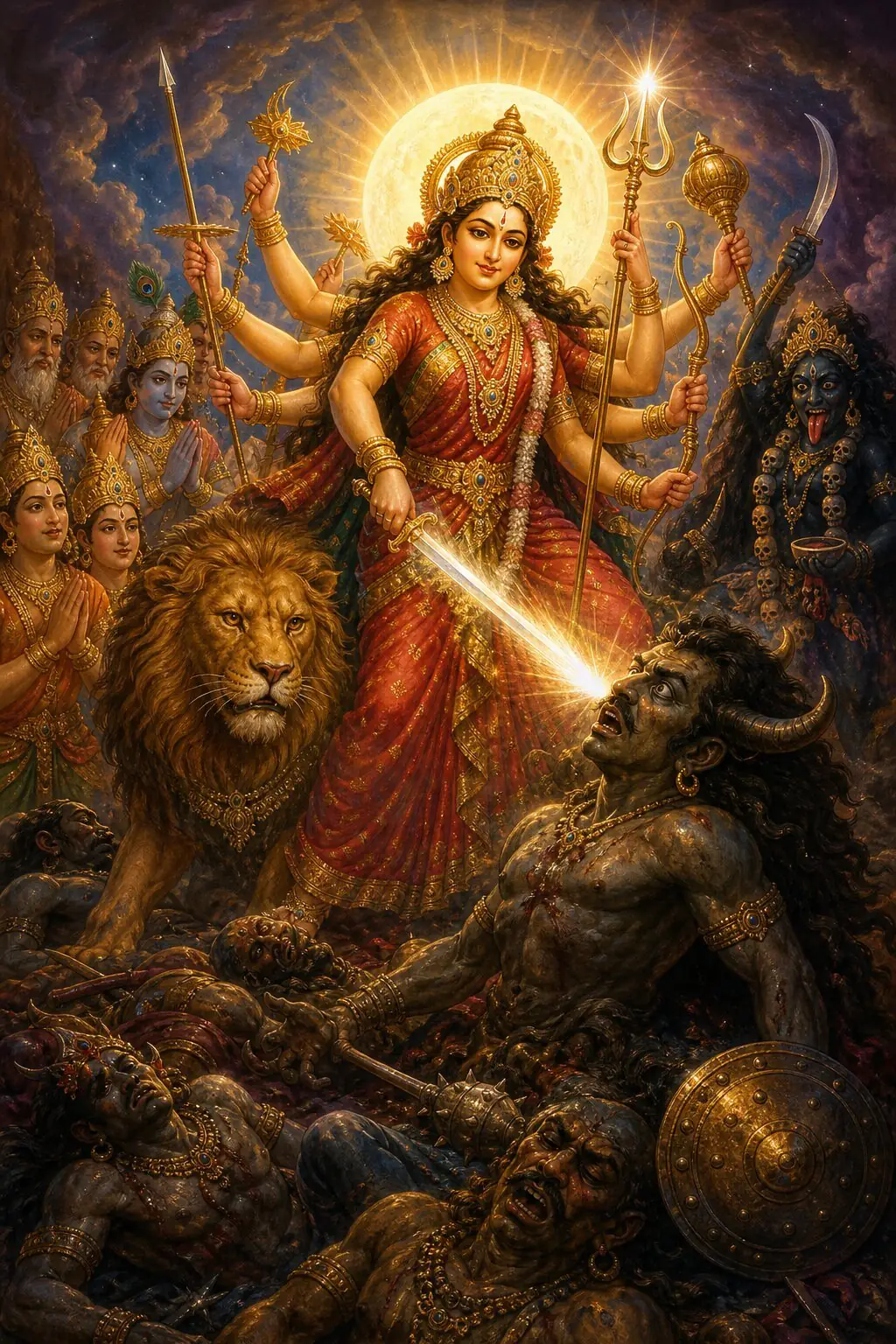
The savage glare off your sword and the pouring light from your spear-point should by rights have burned the asuras’ eyes away, and never did, and the reason was this: in the same instant they were gazing on your face, bright as a fragment of the beaming moon, and the face kept undoing what the blade-light did. Your very nature, O Devi, is to still the conduct of the wicked; this form of yours stands past all thought and past all rivalry; your valor destroys the very powers that had stripped the gods of theirs; and so, even upon your enemies, your mercy shows itself in the open. To what shall we compare this valor of yours? Where is there another form like this, that strikes terror into foes and steals the heart in the same glance? Mercy in the mind and hardness in battle, O giver of boons: in all three worlds those two live together in you alone.
23 · 24 · 25
O Devi, by destroying its enemies you have saved this whole triple world, and those same enemies, cut down at the very front of the battle, you have sent up to heaven as though their deaths were one more gift. The fear the frenzied god-haters had planted in us is gone, drawn out like a thorn. We bow to you. Then the gods wound their prayer around the four directions the way a soldier binds on armor, piece by piece, leaving no side bare. Guard us with your spear, O Devi. Guard us with your sword, O Ambika. Guard us with the clang of your bell and the deep answering note of your bowstring. Watch over us in the east, O Chandika, and in the west, and in the south; and in the north, O Ishvari, guard us with the wheeling sweep of your spear.
26 · 27 · 28
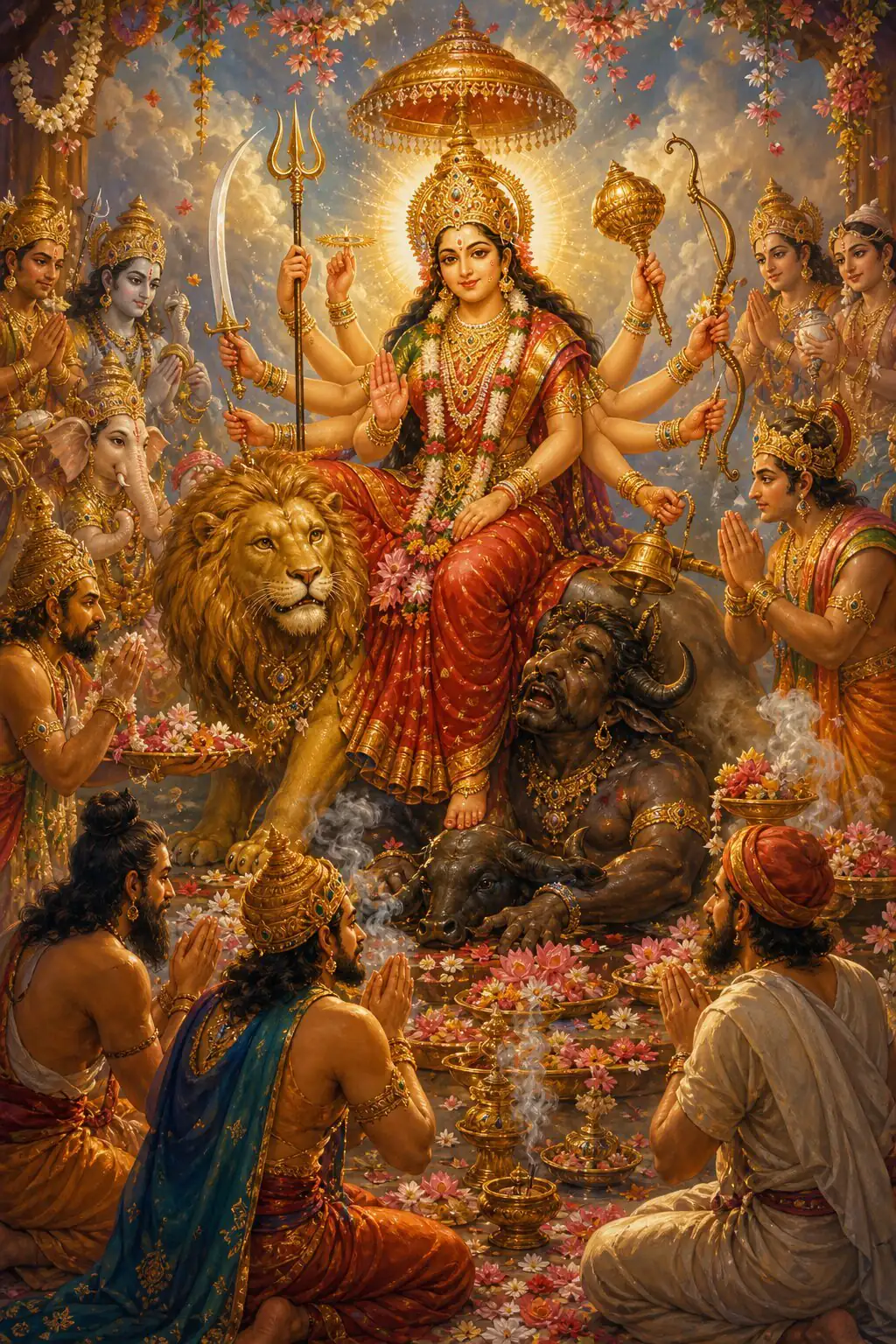
Whatever gentle forms of yours move through the three worlds, and whatever forms of sheer terror walk there too, with every one of them keep us safe, and keep this earth safe. Whatever weapons rest in your soft hands, O Ambika, hands tender as new leaves holding sword, spear, mace, and the rest, with all of them guard us on every side. The hymn ended there, and worship followed it. The gods honored her, the Devi who upholds the worlds, with divine flowers that had opened in Nandana, the pleasure-grove of Indra’s own heaven, and with perfumes and fragrant unguents.
29 · 30 · 31
Then all the gods censed her with heavenly incense, their devotion rising in every breath of it, and the Devi, her face gentle with favor, looked out over the whole bowed company and spoke. The Devi said: O dwellers of heaven, you have honored us well with these hymns, and we are greatly pleased. Choose, then. Whatever you desire, we grant it gladly. Nothing is left anywhere that we would count too hard to do. The victor of the field was offering heaven an open hand. Hearing these words of the Devi, the gods gave their answer.
32 · 33 · 34
The gods said: You have done it all; nothing at all remains, for Mahishasura our enemy lies slain. Yet if you would give us a boon, O Maheshvari, give us this alone: that whenever we call you to mind, you put an end to our worst calamities. And you whose face is without stain, toward any mortal who praises you with these same hymns, stay always gracious, O Ambika, and make his wealth and prosperity and splendor grow, with the good fortune of wife and home.
35 · 36 · 37 · 38
The rishi said: So the gods won her favor, King, praying both for the world’s sake and for their own, and Bhadrakali answered, So be it, and vanished where she stood, gone between one heartbeat and the next, leaving behind a field of flowers, incense, and dead asuras. This much I have told you, King: how the Devi who wills the good of all three worlds first came into being long ago out of the gathered bodies of the gods. What comes next is how that same Devi took birth again from the body of Gauri, to slay the wicked daityas Shumbha and Nishumbha and to guard the worlds as the helper of the gods. That story too I will now tell you, just as it happened. Listen.
Ahead
The next chapter opens the Final Charita. Shumbha and Nishumbha have seized Indra’s place, and the gods, holding fast to the boon just given, once again turn to the Devi, this time in the Himalayas, with a hymn. That chapter carries the famous stotra beginning “Ya devi sarva-bhuteshu…”, in which the Devi is saluted in every living being as consciousness, as power, as forgiveness, and as peace.