Devi Mahatmya
Chapter 3 · The Slaying of Mahishasura · Middle Charita
The army was gone. Now Mahisha’s generals came forward one by one, Chikshura, Chamara, Udagra, Karala, each certain he would be the one to turn the day, and one by one they fell. Then Mahishasura himself came down in his buffalo form, and the fight changed its nature, for every shape the Devi’s blow found he slipped out of and made another: lion, man, elephant, buffalo again, maya wearing body after body. At last the Devi bound him in her noose, pinned his throat beneath her foot, drove in her spear, and in the instant he hung trapped between two bodies, half beast and half demon, took his head off with her sword. Through the three worlds a single cry rose: victory.
1 · 2 · 3 · 4
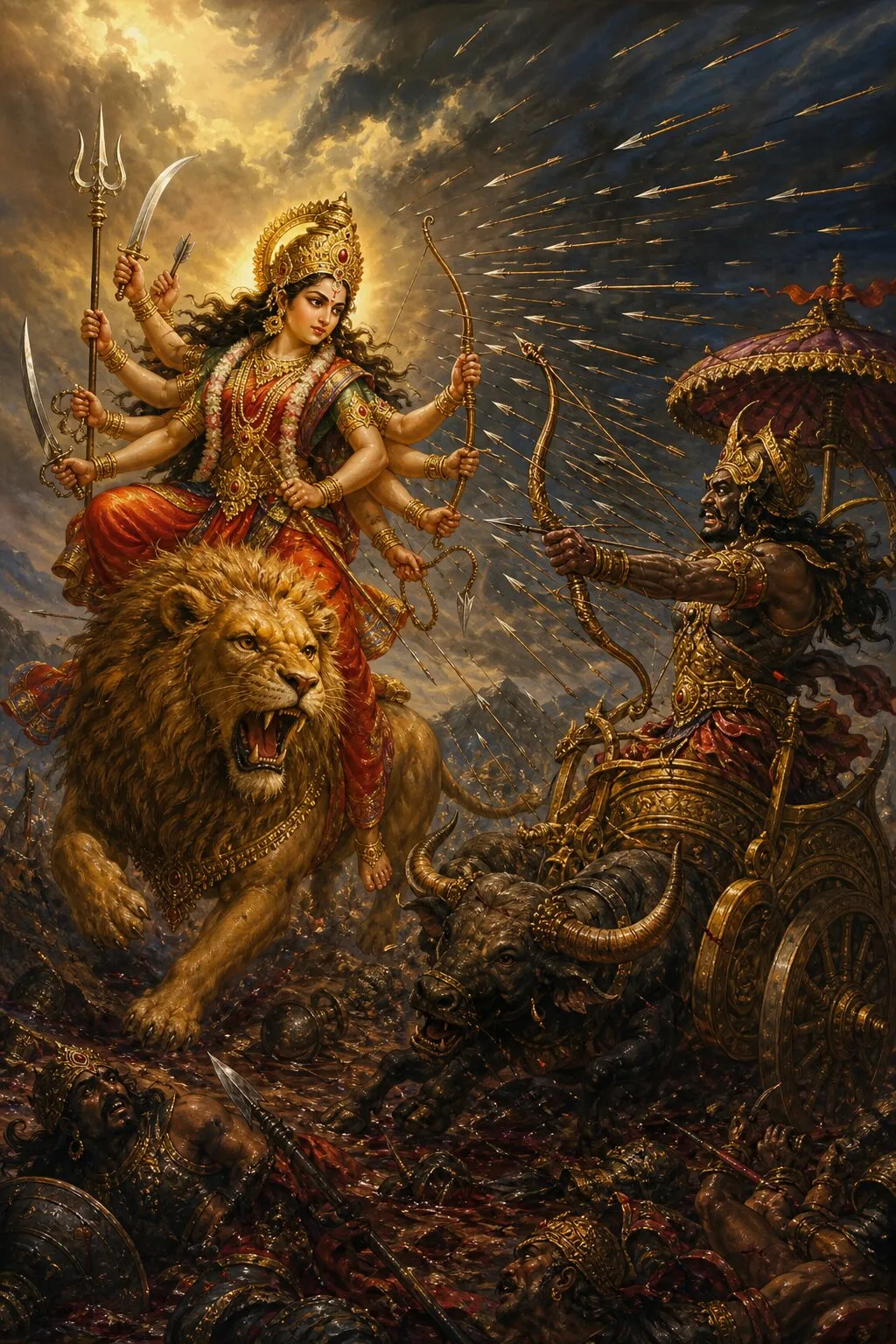
The sight of his whole army cut to pieces set Chikshura, Mahisha’s own general, ablaze, and he advanced to fight Ambika himself, the commander stepping at last into the ruin of his command. He poured arrows down on the Devi the way a thundercloud deluges the summit of Mount Meru, the golden mountain at the axis of the world, with rain. For the Devi the whole assault was pure play. She sheared his massed arrows out of the air as if amusing herself, and her own shafts crossed the field the other way and found his horses and his charioteer, dropping them where they stood. In the same breath she cut away his bow and the banner raised high above his chariot, and while his bow-hand still hung empty she drove her swift arrows deep into the asura’s limbs.
5 · 6 · 7
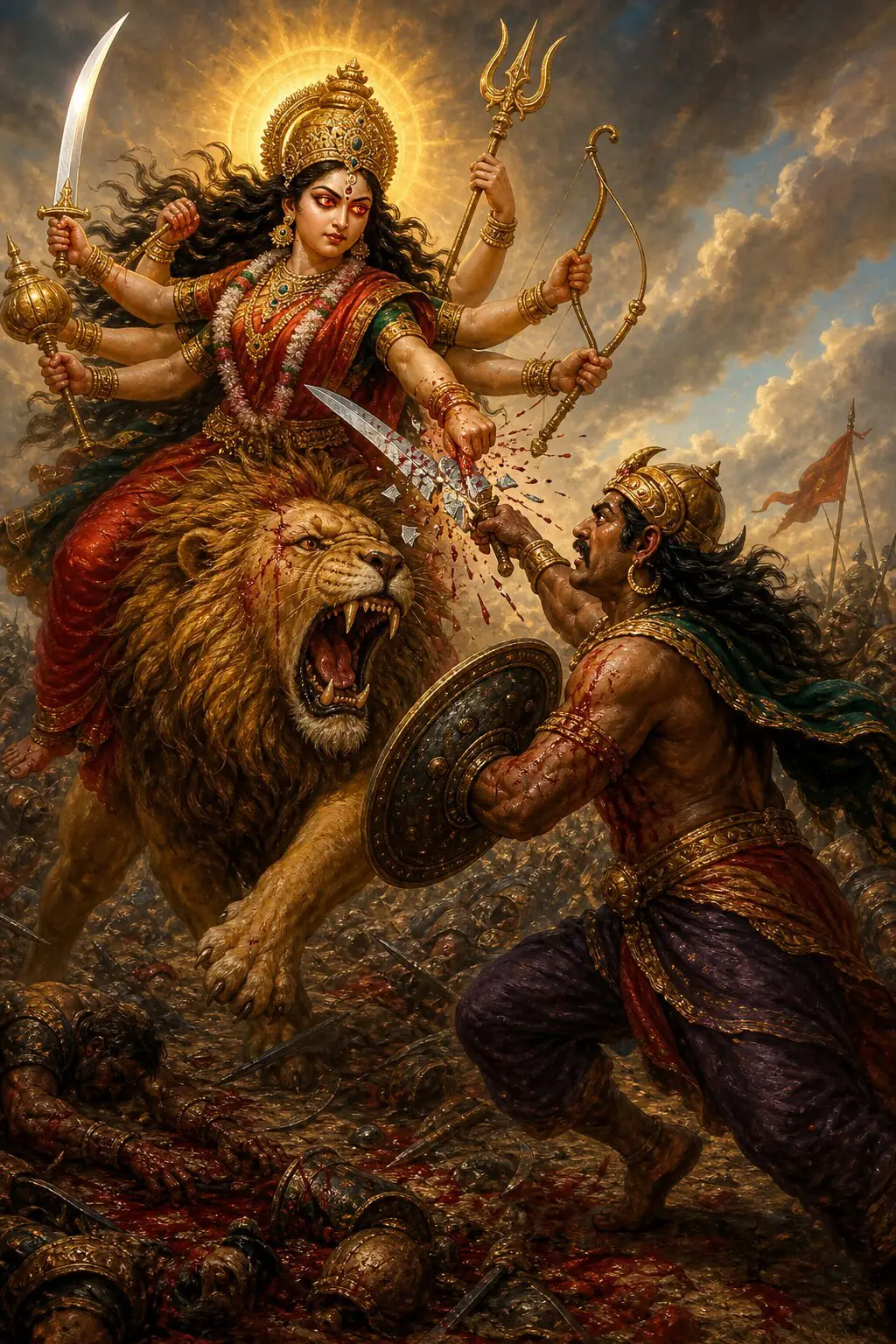
His bow gone, his chariot wrecked, his horses and his charioteer dead, the asura still would not yield; stripped of everything a warrior fights with, he fought with what was left. He caught up sword and shield and threw himself at the Devi on foot. His sharp-edged blade came down first on the crown of her lion’s head, then swung with furious speed at the Devi’s left arm, a blow with his whole body behind it. And there, O prince, the fight told him the truth about itself: the moment the sword met that divine arm it shattered of its own accord, steel refusing its own work. His eyes went red with rage, and he took up his spear, his last weapon.
8 · 9
The great asura hurled it at Bhadrakali, and it went blazing across the field with a light so fierce that watchers might have sworn the sun’s own orb had torn loose from the sky and was falling on her. The Devi saw it coming and let her own spear fly to meet it. The two met once. One stroke, and his spear lay in a hundred pieces, and the great asura Chikshura was finished along with it, Mahisha’s first general gone the way of his army.
10 · 11 · 12
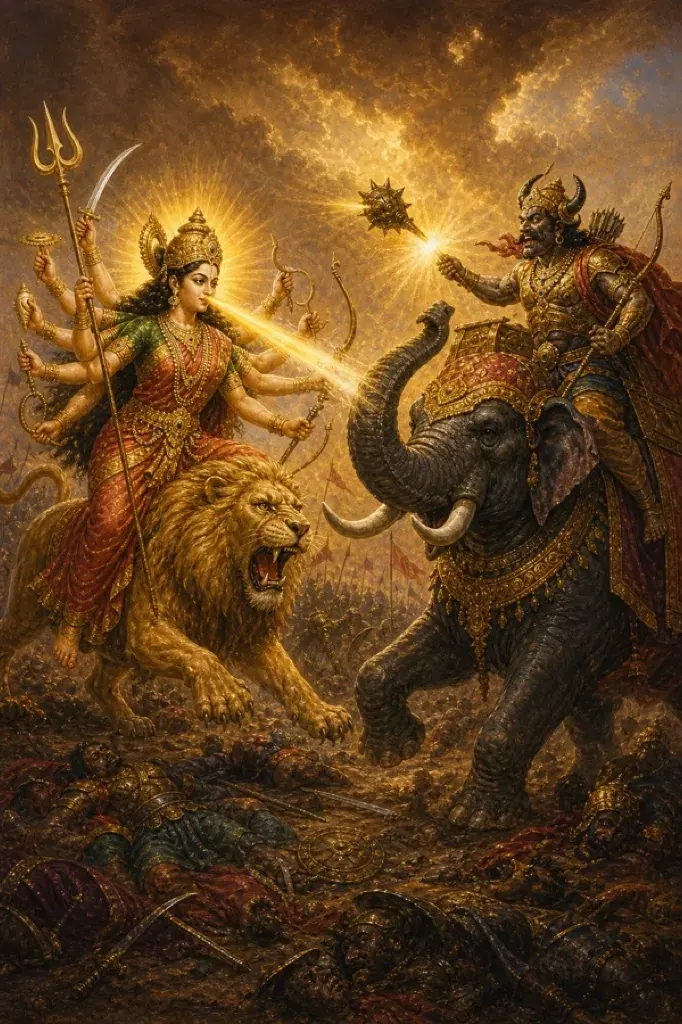
With that mighty commander of the host slain, Chamara came forward, tormentor of the gods, riding high on a war elephant, the better to look down on a woman mounted on a lion. He let fly his dart at the Devi, and Ambika did not trouble to raise a weapon against it; she met it with a single scornful cry, a hunkara, and struck by that one syllable of contempt the dart lost its glow in mid-flight and fell useless to the earth. The sight of it lying broken drove Chamara into a fury, and he flung his spear, and the Devi’s arrows cut that too apart in the air.
13 · 14 · 15
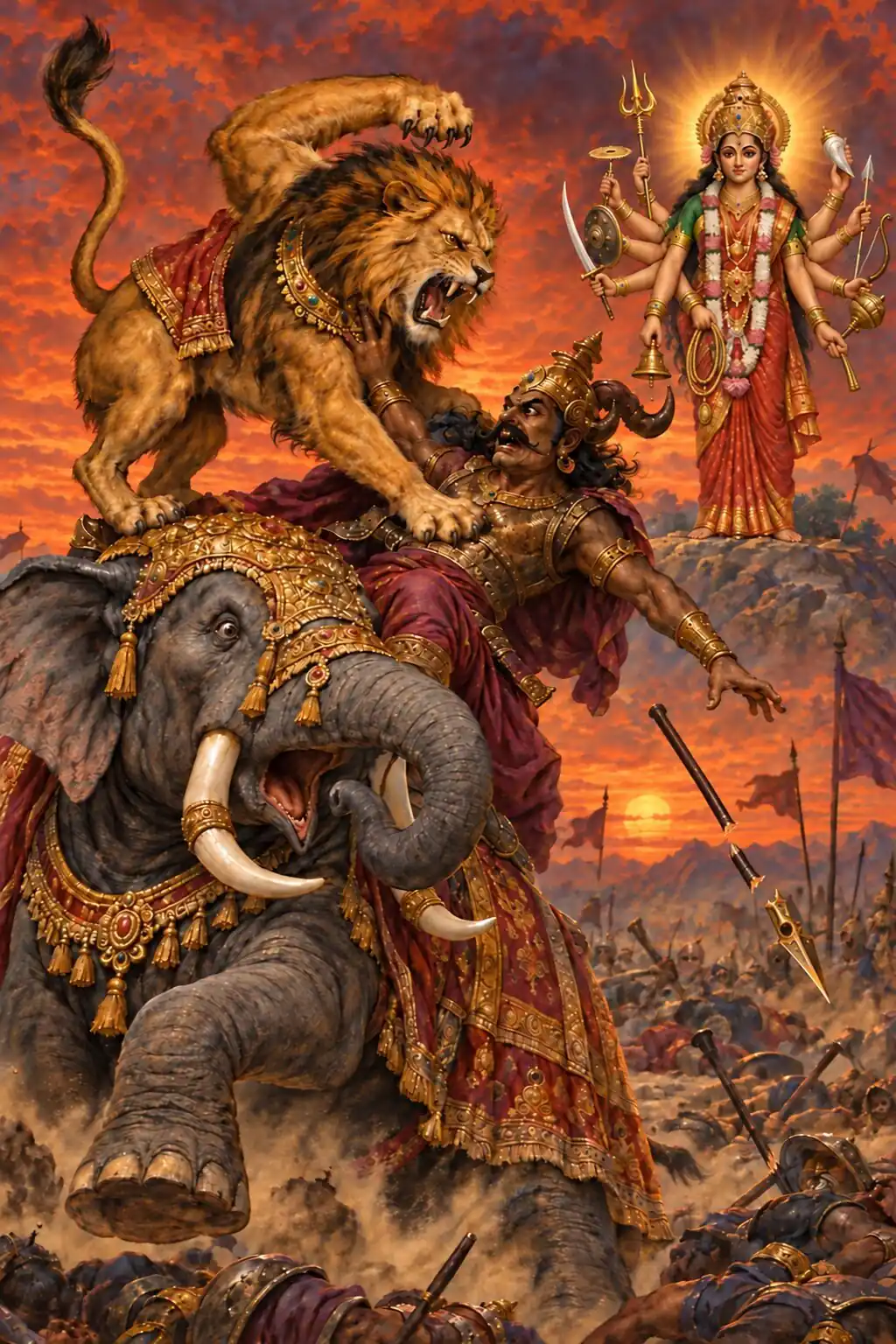
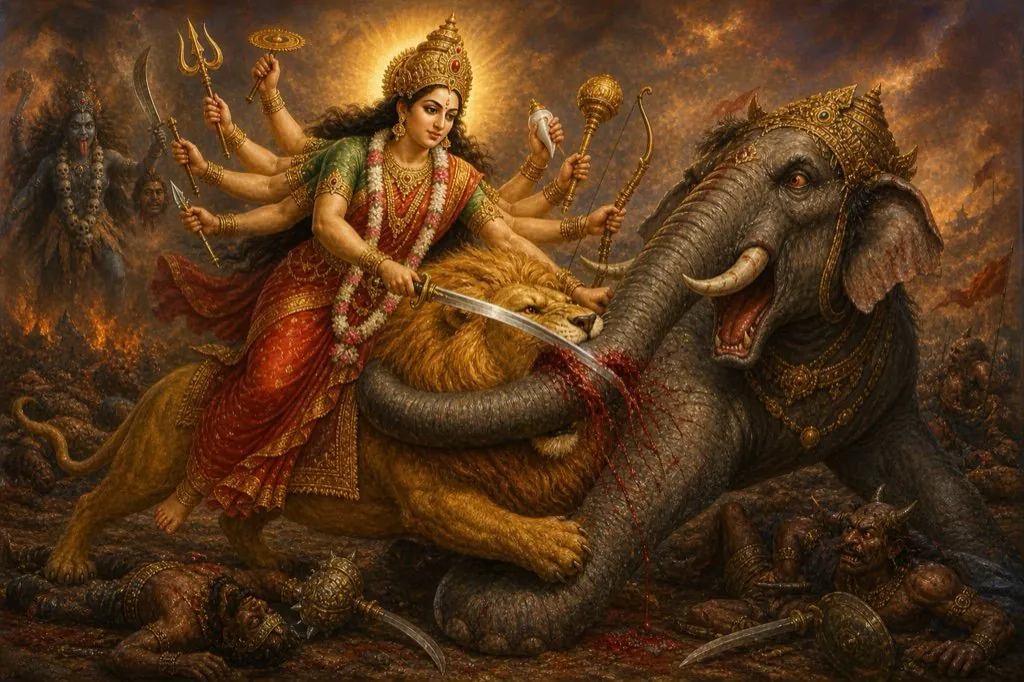
In that instant the Devi’s lion settled the matter itself. It sprang, fastened onto the great boss of the elephant’s forehead, and closed with that foe of the gods in a grappling fight high above the field, beast and asura wrestling on a moving tower. Locked together, the two crashed down from the elephant and tore at each other on the ground with savage blows. Then the lion broke free, sprang skyward once more, and as it came down, a single stroke of its paw parted Chamara’s head from his body. The goddess had never touched him.
16 · 17 · 18
Now the Devi killed with whatever came to hand, and the earth itself was in her hand. Udagra she battered down with boulders and whole uprooted trees; Karala she felled with her teeth, her fists, and the flats of her palms, no weapon in the blow at all. In her wrath she ground Uddhata to powder under the strokes of her club, ran the bhindipala javelin clean through Vashkala, and pinned Tamra and Andhaka to the earth with arrows. Then the three-eyed supreme goddess raised her trident, and Ugrasya, Ugravirya, and Mahahanu went down before it, three great asuras gone between one breath and the next.
19 · 20
Here the Devi took on the form of Kalaratri, the Night that gathers even Time into herself. Her sword lifted Bidala’s head clean from his body; her arrows sent Durdhara and Durmukha traveling together to the house of Yama; and the asura who bore the name Kala, Time, she struck down with the staff of Time itself, ending him with his own namesake. With fierce strokes of her blade she beat Agradarshana to the ground, and Asiloma she severed with that same sword. For the Devi’s ganas this battle too was a festival, and the field rang end to end with the victory-cries of the ganas, the lion, and the Devi together.
21 · 22 · 23
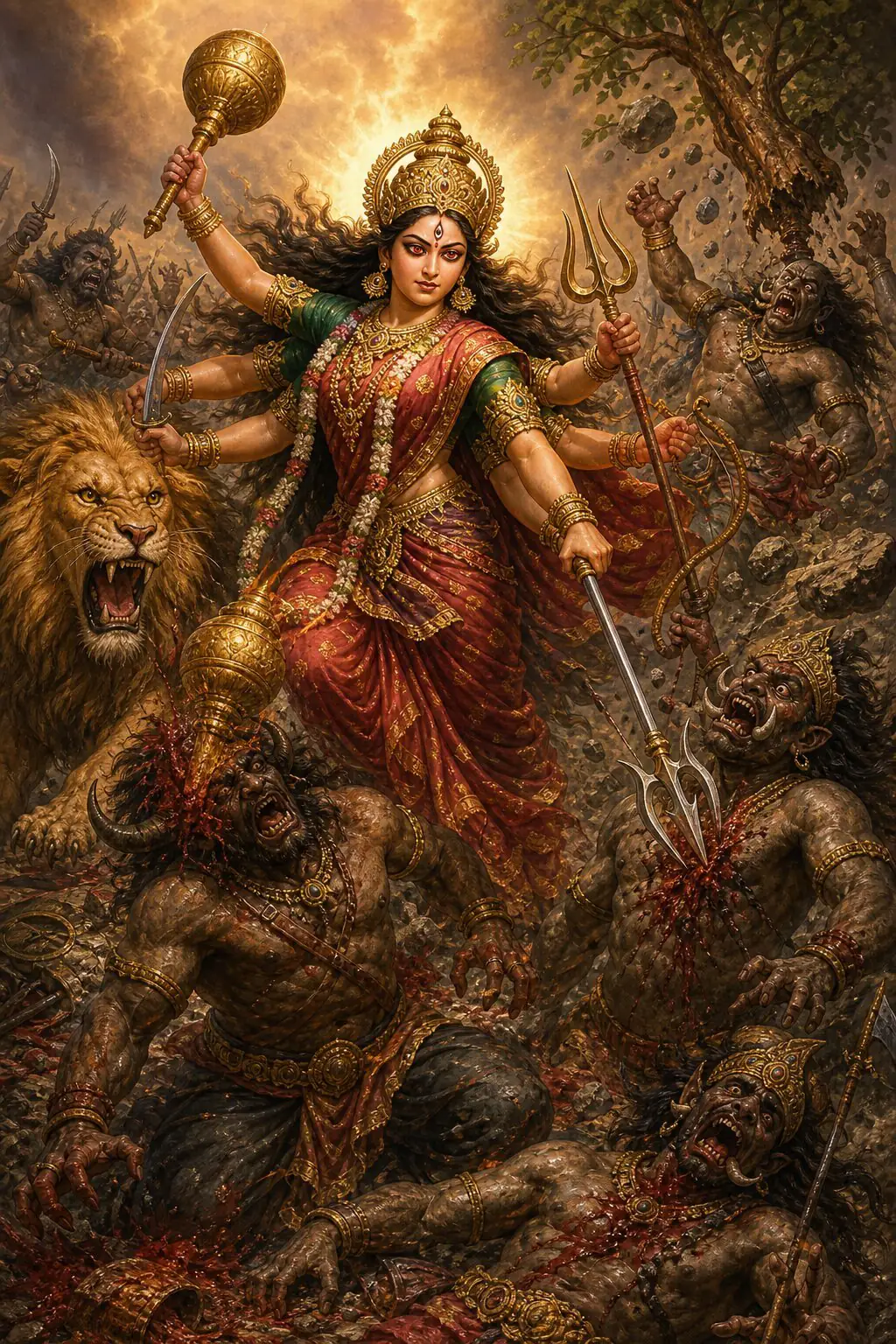
So it went until his whole army had wasted away to nothing, and then Mahishasura himself, who had watched his generals die one after another, came down into his own buffalo form at last and set upon the Devi’s hosts. Every part of that enormous body was now a weapon. Some he tore open with a drive of his muzzle, some he broke with a stamp of his hooves, some he cut down with the lash of his tail, some he carried away on the points of his horns. Others he flung to the earth by sheer speed, by his bellowing alone, by the whirl of his wheeling bulk, by nothing more than the gale that came off his breathing.
24 · 25 · 26
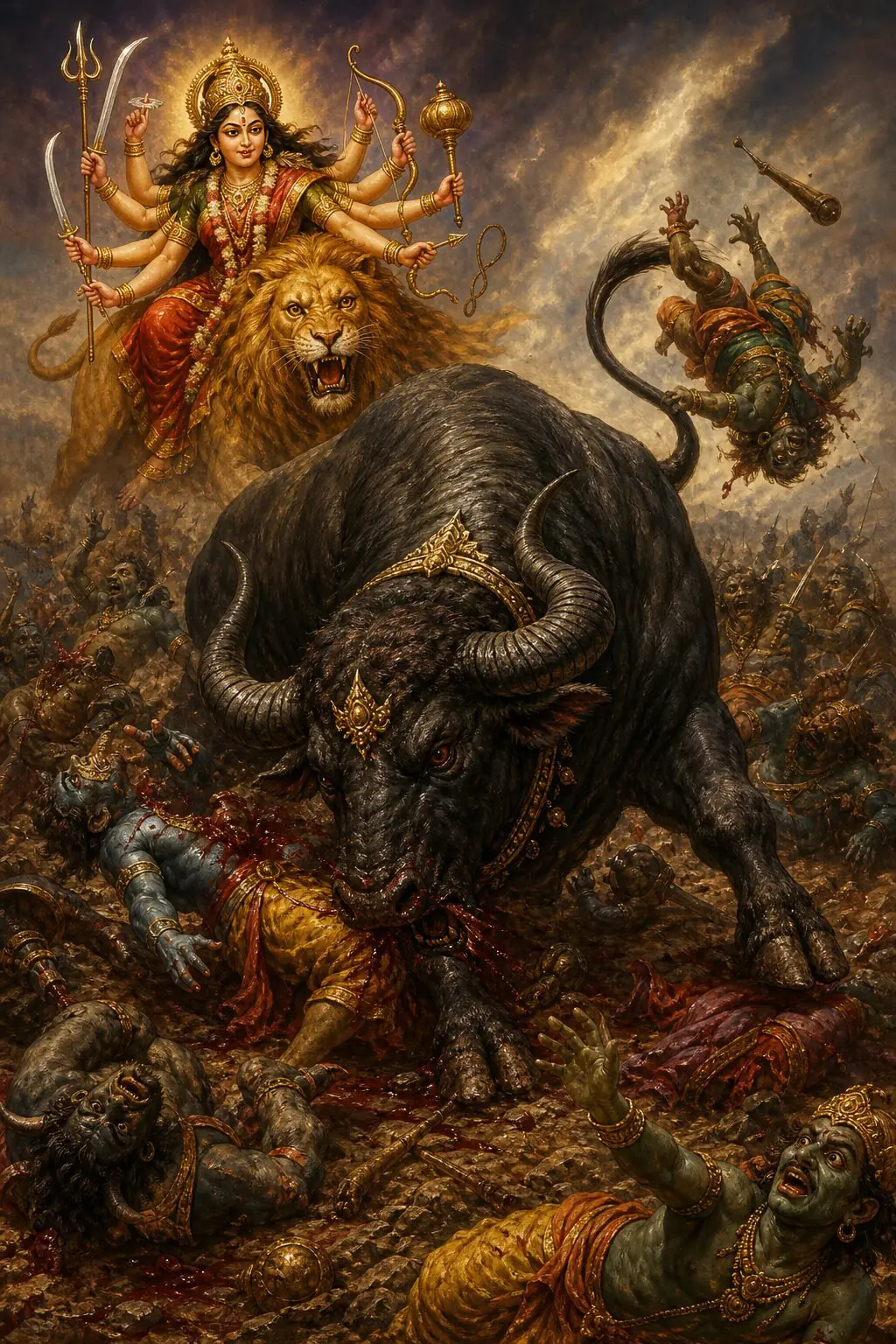
He trampled the Pramatha host flat and then charged the Devi’s own lion to kill it, and at that Ambika’s true wrath awoke; the army she could replace with a breath, the lion was hers. His fury swelled to meet hers. His hooves tore and gouged the ground into trenches; he got whole mountains up on his horns and flung them ahead of him, bellowing as he came. The earth crumbled to pieces under his speed and his wheeling, and the ocean, lashed by his tail, rose over its shores and washed out across the land on every side.
27 · 28
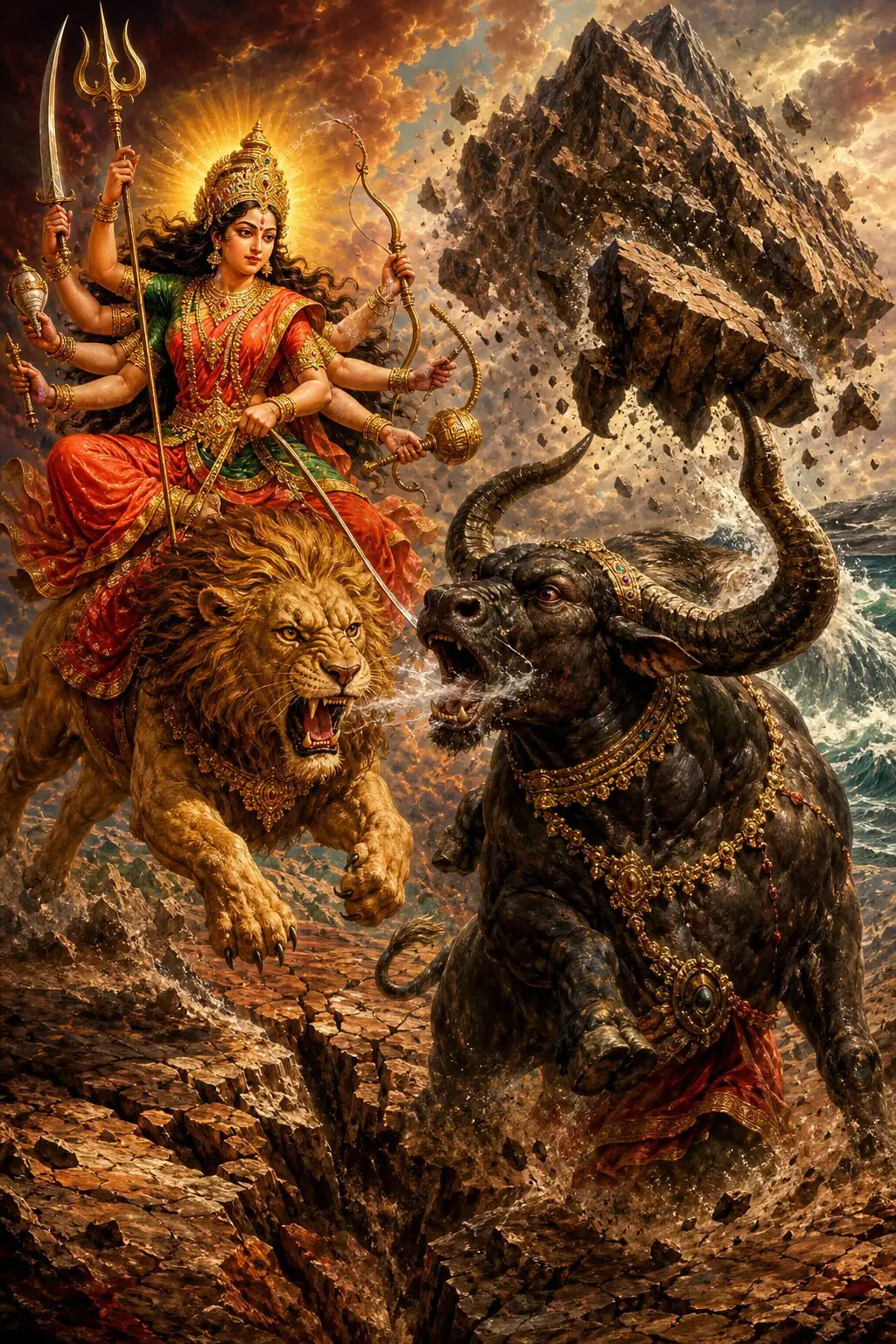
The clouds of the sky, ripped by his swaying horns, went to drifting shreds, and the gale of his breath tore mountains loose and brought them crashing down from the heavens by the hundreds. This was the enemy heaven had lost to for a hundred years, and he was in full flood. Chandika watched the great asura bear down on her, swollen with rage, and gave way at last to her own wrath, cold and entire, set now on one object only: his death.
29 · 30 · 31
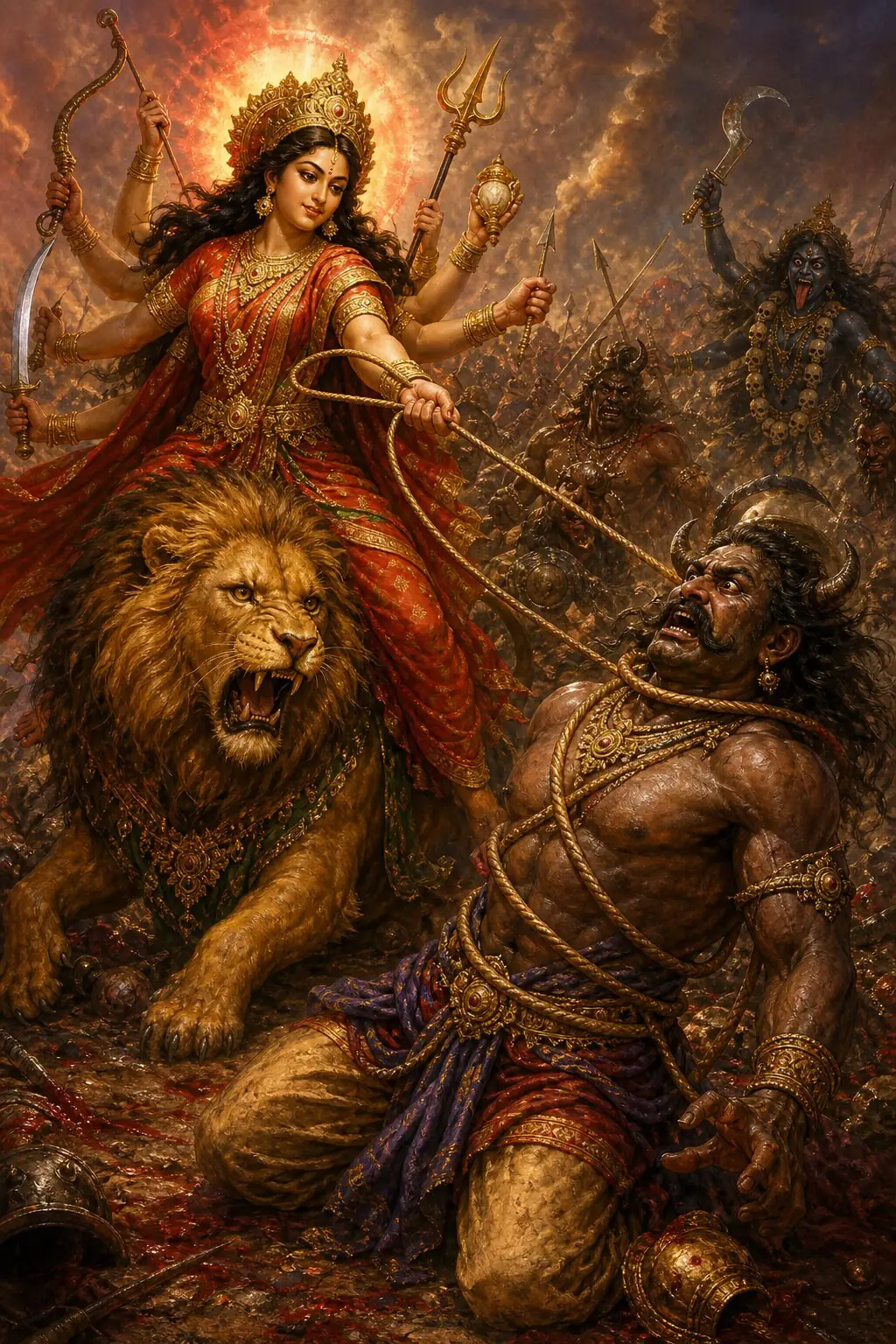
The Devi flung her noose full over him and bound the great asura fast, and the moment it held him, there in the middle of the great battle, he shed his buffalo shape the way a wrestler slips a hold. The play of maya had begun. He was a lion at once, and just as Ambika moved to take the lion’s head he slipped out of that shape too and stood as a man, sword in hand, small and quick where the lion had been vast. In a breath the Devi’s shafts cut the man down, sword and shield and all, and at once he swelled into a huge elephant, each body abandoned the instant her blow arrived, each new one raised in its place.
32 · 33
The elephant coiled its trunk around the Devi’s great lion and dragged at it, trumpeting, and the Devi’s sword severed the pulling trunk at a single stroke. Then the great asura climbed back into the same buffalo body he had started from and shook the three worlds again, everything that moves and everything that stands still, exactly as before. Maya had circled back to its own beginning, and the circle had bought him nothing.
34 · 35 · 36
Then Chandika, mother of the world, did the last thing a battlefield expects. In her anger she lifted the finest of drinks, the cup Kubera had given her, filled and refilled of itself, and drank, and drank again, and her eyes glowed ruddy as a wild laughter rose in her. Across the field the asura bellowed back, puffed up with his strength and valor and frenzy, and went on flinging mountains at Chandika with his horns. She shivered each mountain to powder in mid-flight under showers of arrows, and then, her mouth reddened by the mead and her words coming loose and unsteady, she spoke to him.
37 · 38
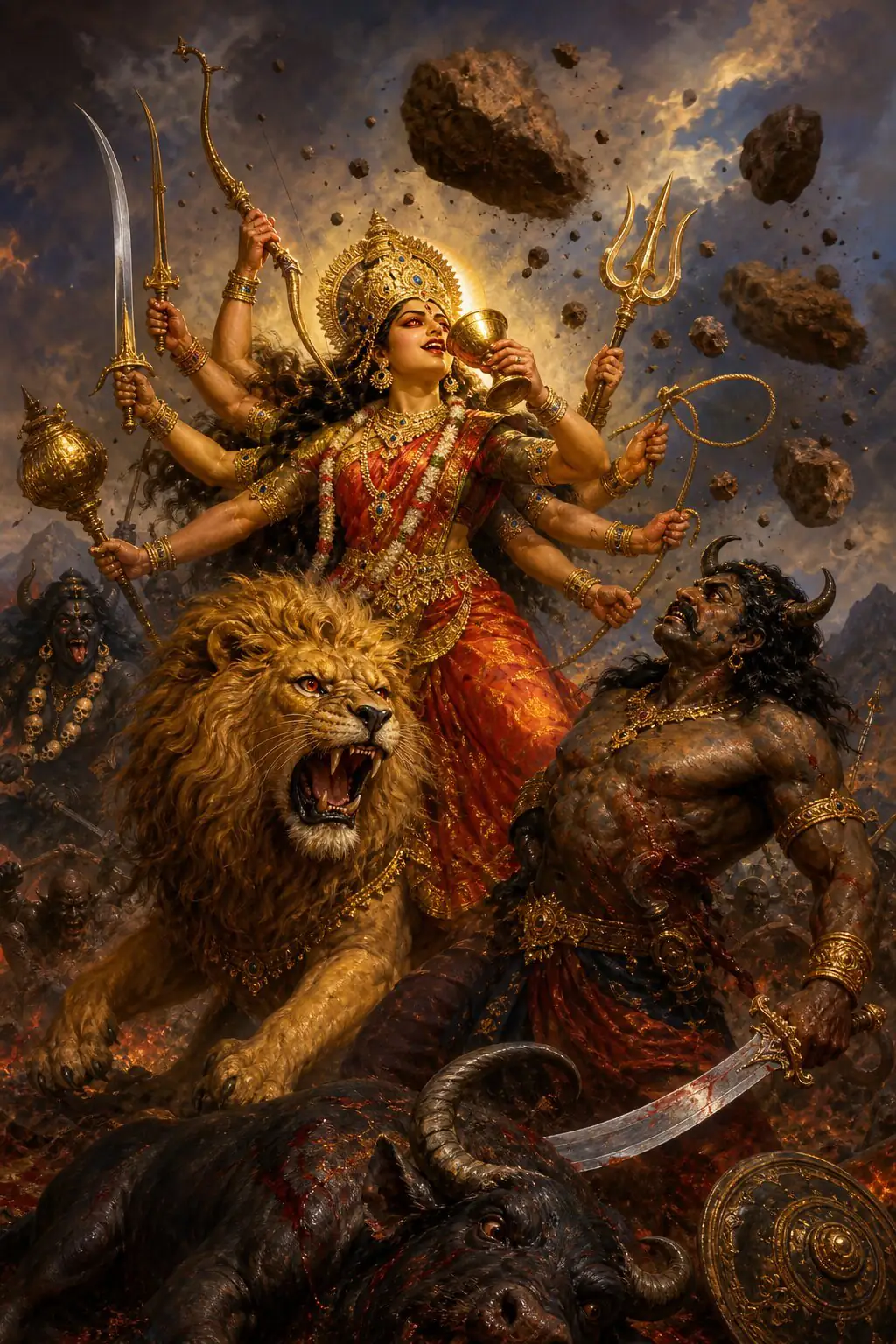
What she told him left nothing in doubt. Roar, fool, roar out your brief moment while I finish this mead; when you die at my hands, on this very ground, it is the gods who will do the roaring. With that the Devi sprang, rose over him, and came down astride the great asura himself; she pinned his throat beneath her foot and drove her spear into him.
39 · 40
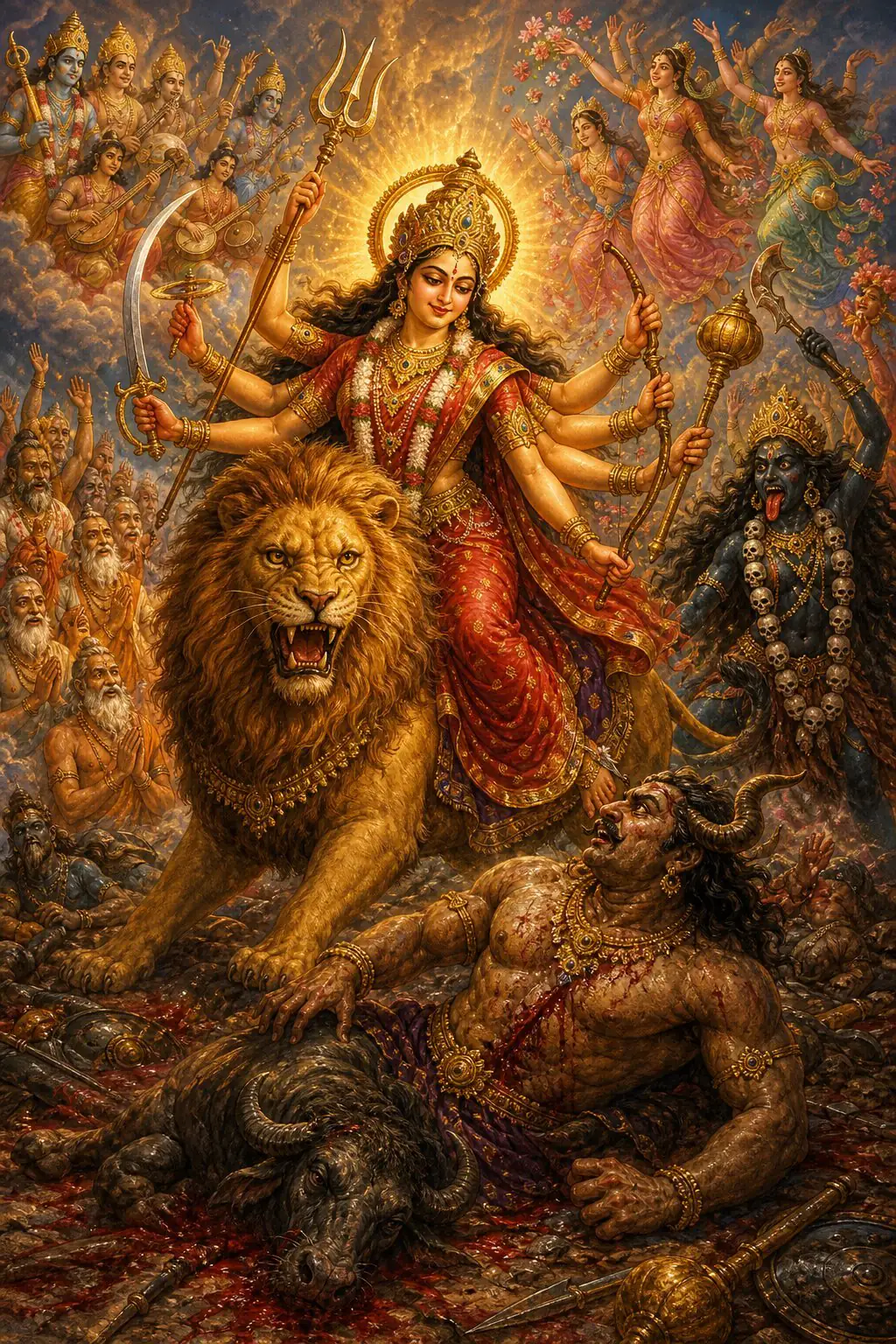
Crushed under her foot, the asura tried one shape too many. He began forcing his way out through the buffalo’s own mouth, his true man-form emerging from the beast, and the Devi’s own might closed over him right there and held him fast, half out and half in, wedged between the body he was leaving and the body he could no longer reach. Caught like that, between two shapes, he was fighting still when the Devi’s great sword swept down, cut his head from him, and laid him in the dust. The last of his forms lay finished in mid-change, maya run out of bodies at last.
41 · 42
So ended Mahisha, who with his army and his allied hosts had held all three worlds under his spell and his heel. The instant he fell, every being in the three worlds, gods and asuras and humans alike, raised a single shout: victory. Even his own kind cried it, for his rule had lain heavy on everything that breathed.
43 · 44
What remained of the daitya army perished then amid cries of grief, and the entire company of the gods rose into the highest joy they had known in a hundred years. Gods and divine maharishis together poured out their praise of the Devi, the lords of the gandharvas, heaven’s own singers, broke into song, and the troops of apsaras began to dance. The great slaying was done, though the Middle Charita would close only in the chapter to come, with the gods’ own hymn of thanks rising over the quiet field.
Ahead
The next chapter is the fourth. After the victory the gods together offered the Devi a long hymn of praise, known as the Shakradi Stuti, the hymn made by Shakra and the others, and it stands among the most poetry-filled passages of the whole Devi Mahatmya. At its end the Devi bade them ask a boon, and the gods passed over every treasure they might have named and repeated their one prayer, that she come whenever remembered in a time of danger. The Devi accepted. The Middle Charita of the three closes here.