On this page
Devi Mahatmya
Chapter 12 · The Phala-shruti · Final Charita
Until now the gods have done the praising. Here the Devi gives her own word: whoever reads and hears this Mahatmya with faith, every obstacle in that life she takes upon herself. Enemies and bandits, a king’s fury and the prisoner’s chains, fire and floodwater, savage beasts and storms on the open sea: against each of these stands her pledge of fearlessness. She declares here, too, the glory of the great annual worship of autumn, and then, with the gods still watching, she vanishes, as suddenly as she once gathered out of their pooled radiance.
1
The Devi spoke the whole phala-shruti, the promise of fruits, with her own mouth. After chapter upon chapter in which gods and sages did the praising, the final word about this text belongs to her alone. Her first sentence was itself a vow: whoever praises her daily with these hymns, mind gathered to a single point, she takes the destruction of that person’s every obstacle into her own hands. Of this, she says, there is no doubt.
2 · 3 · 4
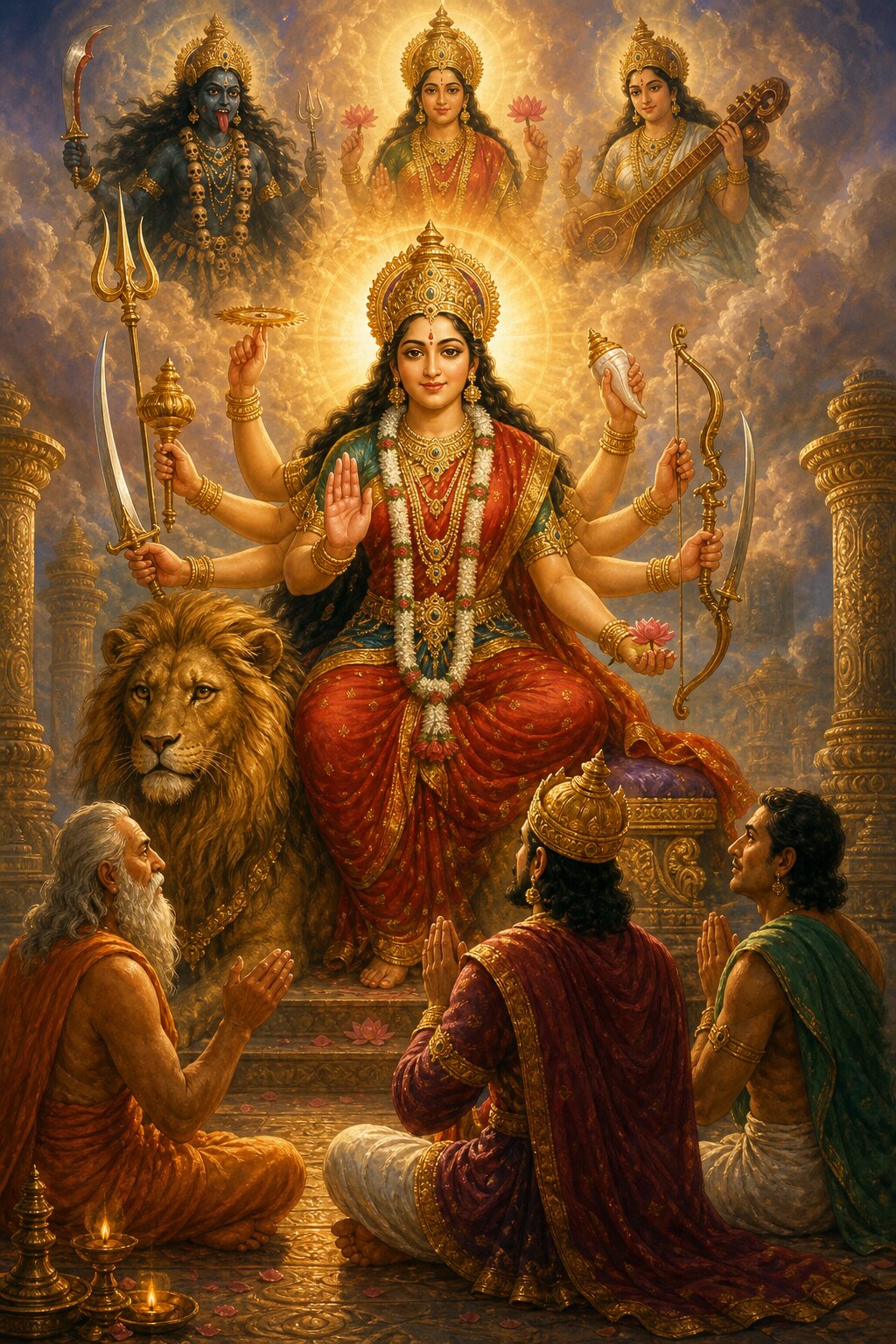
Then she counted her three charitas in a single breath: the First Charita, the destruction of Madhu and Kaitabha, the two demons who sprang from the root of Vishnu’s ear while he slept on the waters of the great dissolution; the slaying of Mahishasura, the buffalo demon; and the killing of Shumbha and Nishumbha, still warm on the field. Those who sing the fame of these three, and those who on the eighth, the fourteenth, and the ninth days of the lunar fortnight, the days that belong to her, sing this highest Mahatmya of hers with devotion and a single mind, for them the whole harvest that follows is promised. No evil deed clings to such a devotee, and no calamity born of evil. Poverty never finds them. Neither does parting from those they love.
5 · 6 · 7
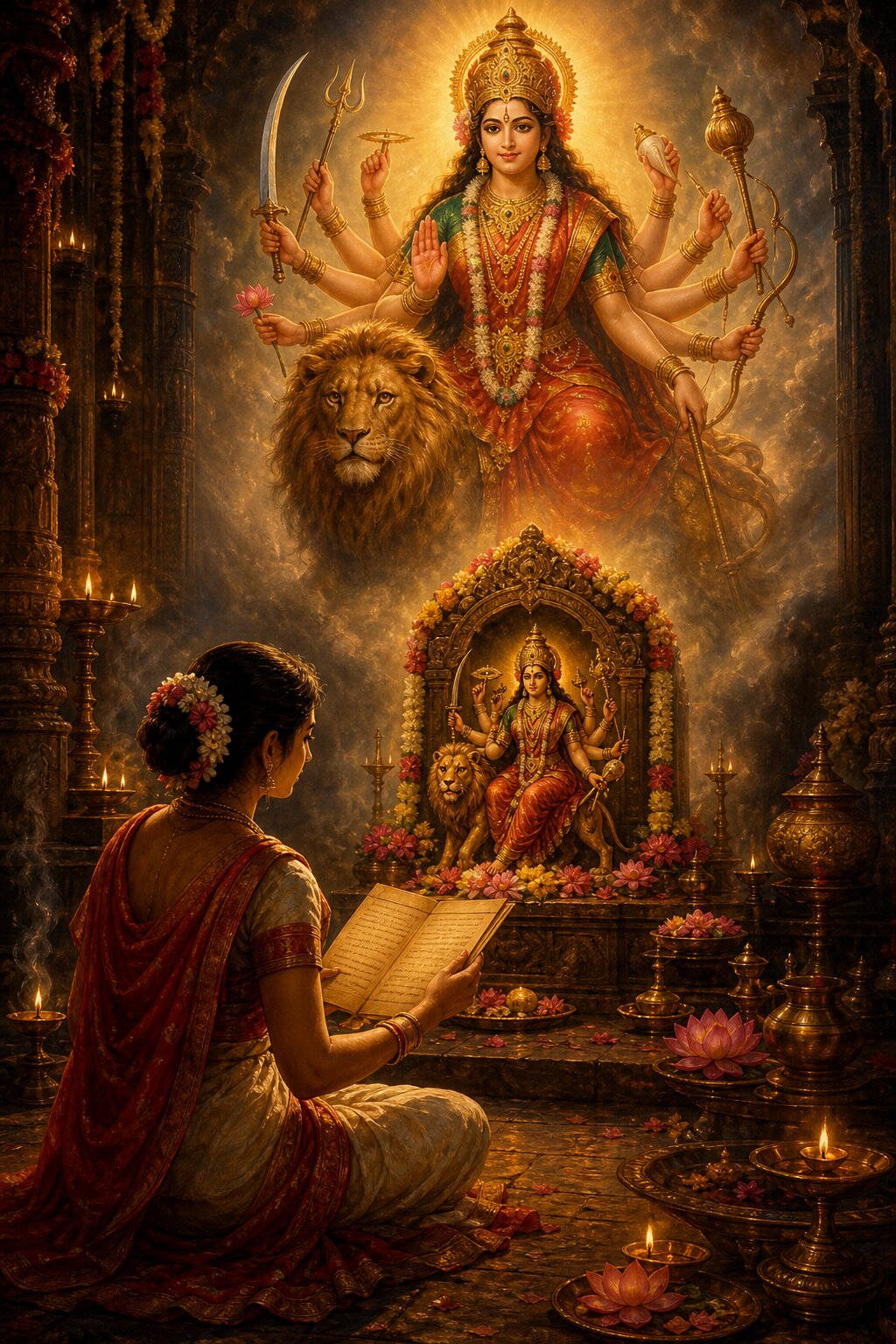
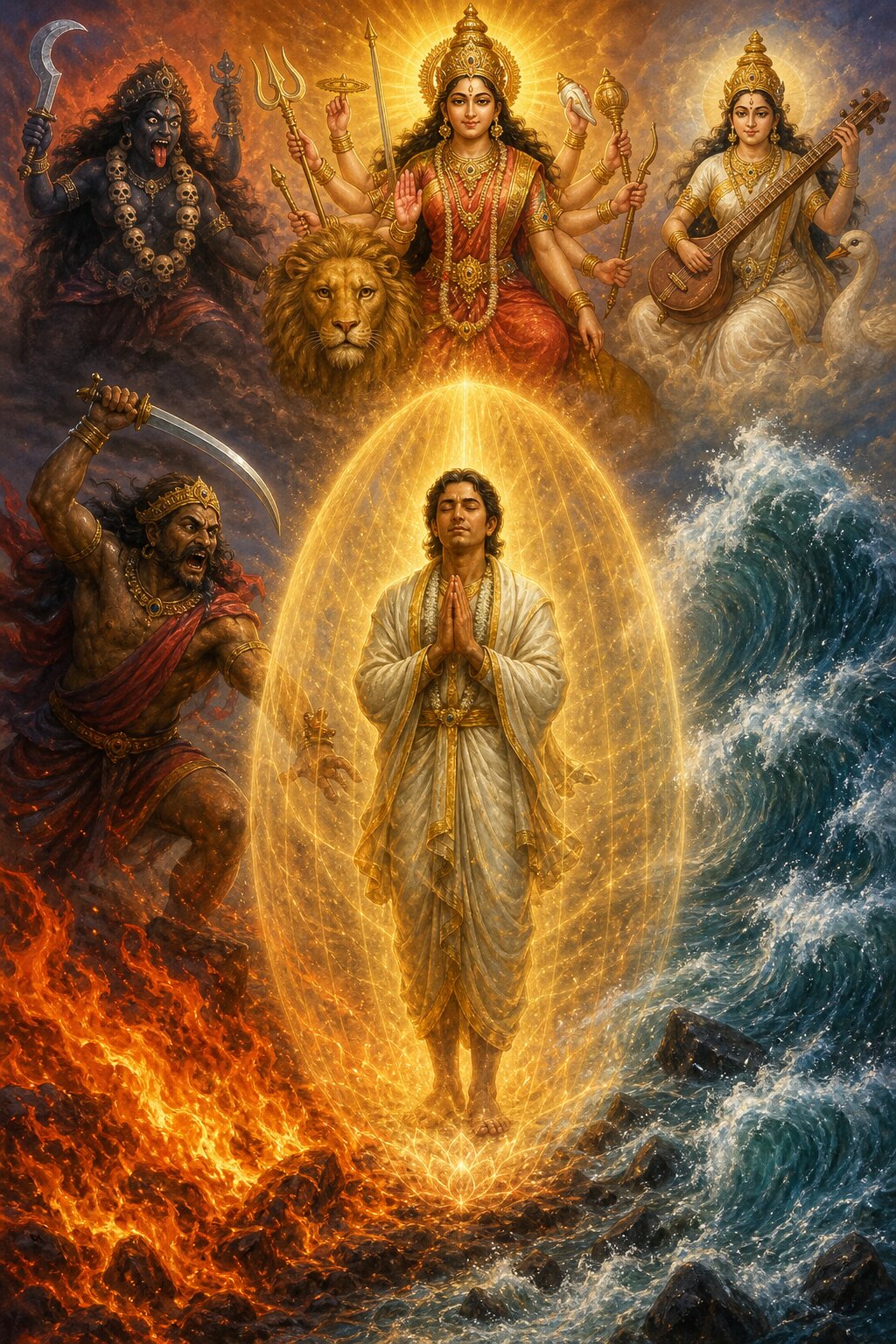
Such a person moves without fear of enemy, of bandit, of the king’s rod; no terror of weapon, fire, or floodwater ever finds a way to him. For this reason, the Devi says, the steady-minded should always read this Mahatmya of hers and hear it with devotion, for it is the great and supreme road to well-being. Every disturbance a great epidemic breeds falls silent under its recitation, and so do the three kinds of upheaval, those sent down by the gods, those rising out of the elements around us, and those born within a person’s own body and mind.
8 · 9 · 10
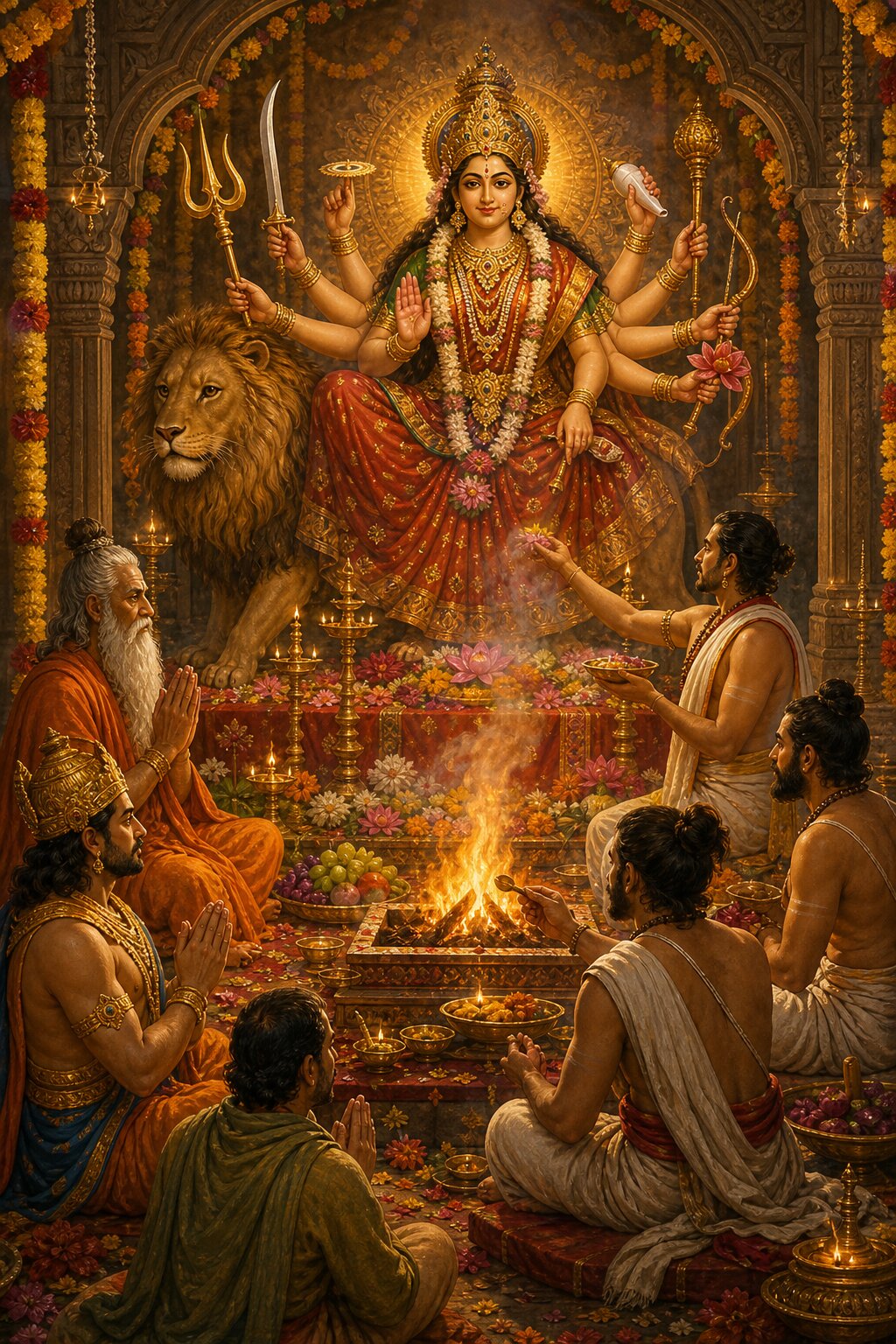
Now comes the Devi’s gentlest word. Wherever this Mahatmya is read rightly and daily in a sanctuary of hers, from that place she never withdraws; her nearness stays settled there, the way warmth stays in a hearth-stone long after the fire. At the offering of bali, in worship, in the fire-rite, at a great festival, this whole charita of hers deserves to be spoken aloud and heard. And then she bends lower still. Whether the procedure is mastered or not, whether the bali-worship and the fire-oblation are performed knowingly or in ignorance, she receives them with love, the way a mother receives a child’s clumsy gift. She sets faith above skill in ritual.
11 · 12 · 13
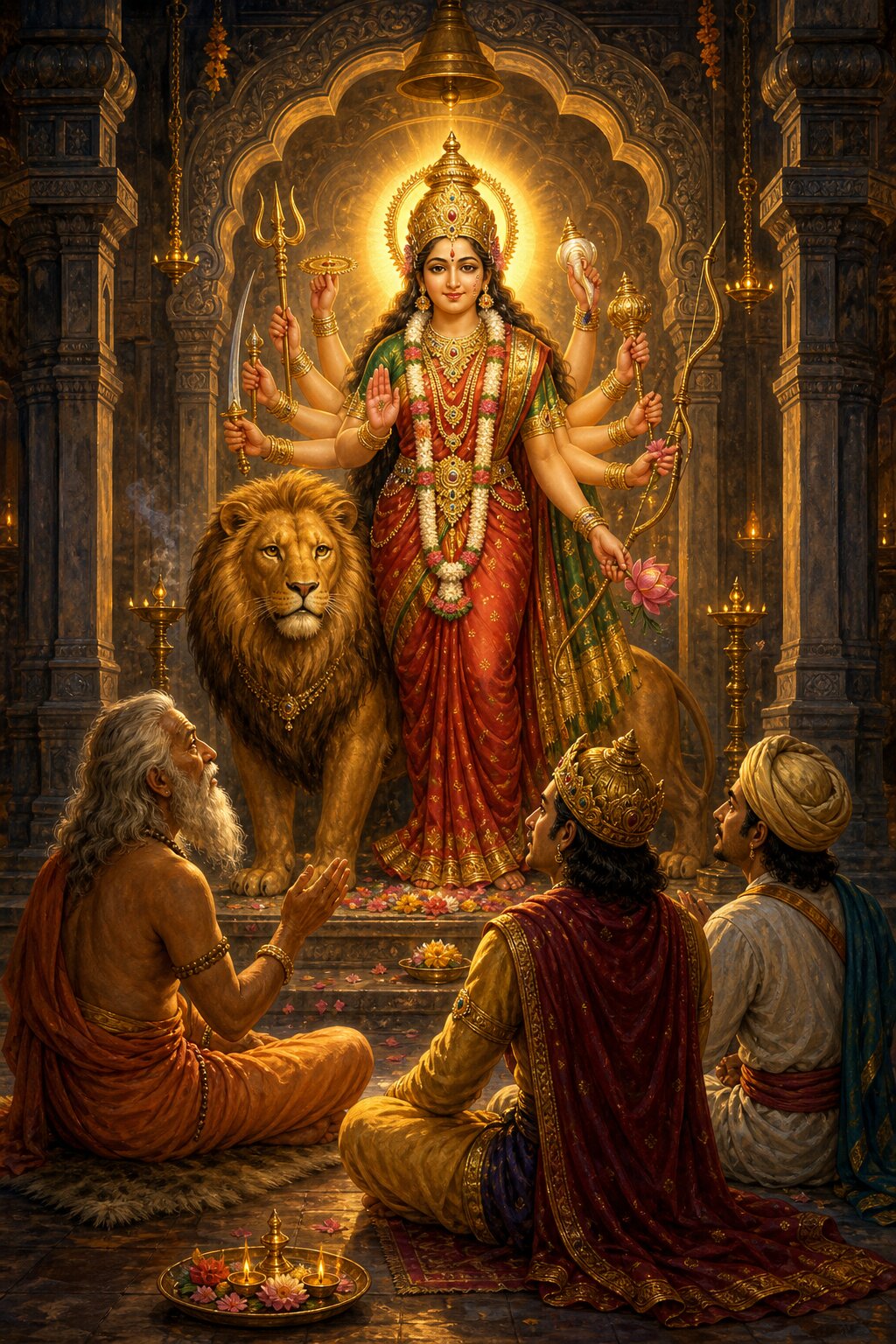
The great annual worship of the autumn season, the observance that would later settle into the sharadiya Navaratri, nine nights of lamps and recitation kept in homes and temples to this day, is where the Devi binds the hearing of this Mahatmya most closely. Whoever hears it there, filled with devotion, comes free by her grace of every obstacle and grows rich in wealth and grain; no doubt attends this, she says. And whoever hears of her greatness, of her separate auspicious births, of her prowess in battle after battle, that man becomes fearless.
14 · 15 · 16
The fruit spreads beyond the listener himself. His enemies waste away, good fortune turns toward him, and his whole family shares the joy, the household prospering around one hearing the way a field greens around one channel of water. For every rite of peace, for the night a foul dream comes, for the fierce afflictions of the planets, the Devi names one remedy: the hearing of this Mahatmya. She states the result along with the prescription: the disturbances and the cruel planetary torments subside, and the bad dreams men have seen turn into dreams of good omen.
17 · 18 · 19
It brings calm to children seized by the child-tormenting spirits, the graha-terrors that parents of that age feared through every fevered night, and where a community has split into factions, it is the finest means of knitting friendship back together. It drains the strength of all whose nature runs to wickedness, and rakshasas, ghosts, and pishachas perish at its bare recitation. Beneath every one of these fruits lies a single cause: this whole Mahatmya, in the end, draws the Devi’s own presence near, and nothing that torments a creature can stand where she is standing.
20 · 21
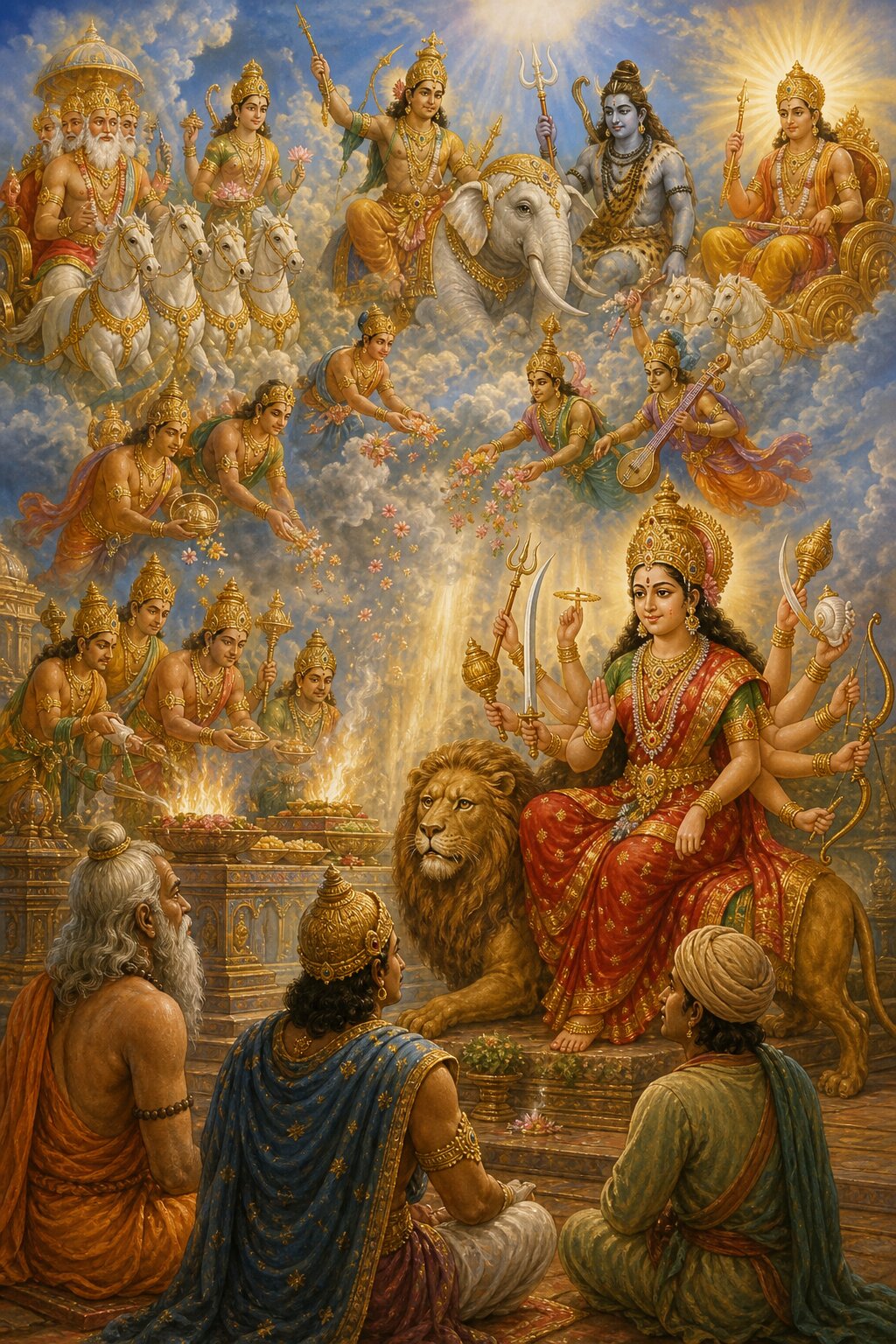
Then the Devi counts out the full inventory of worship: bali, flowers, the arghya of water, incense, fine fragrances, and lamps; the feeding of Brahmins, the fire-oblations, and the sprinklings of consecrated water, offered on through day and night. Yet the delight that a whole year of these varied offerings and gifts brings her, she receives equally from a single faithful hearing of this good charita. One hearing, she declares, weighs as much as a year of worship laid out item by item.
22 · 23 · 24
This recital of her many births, once heard, works three effects at once: it carries away sin, it bestows health, and it guards against the assaults of spirits. Whoever hears the story of her cutting down the wicked daityas on the battlefield finds that fear sown by an enemy no longer takes root in his mind. And the hymns of praise gathered into this Mahatmya, those the gods made in their gratitude, those the brahmarshis made, and the one Brahma himself raised while the world was still water, carry the devotee toward an auspicious destiny.
25 · 26
Now the Devi paints the dangers one by one, and the list reads like a map of every road a traveler of that age had cause to fear. A man ringed by wildfire in a lonely forest or on a deserted plain. A man surrounded by bandits in an empty waste, or seized outright by his enemies. A man with lions and tigers on his trail, or hemmed in by the wild elephants of the forest, or standing under an angry king’s sentence of death, or already in the dungeon with the chains on.
27 · 28 · 29
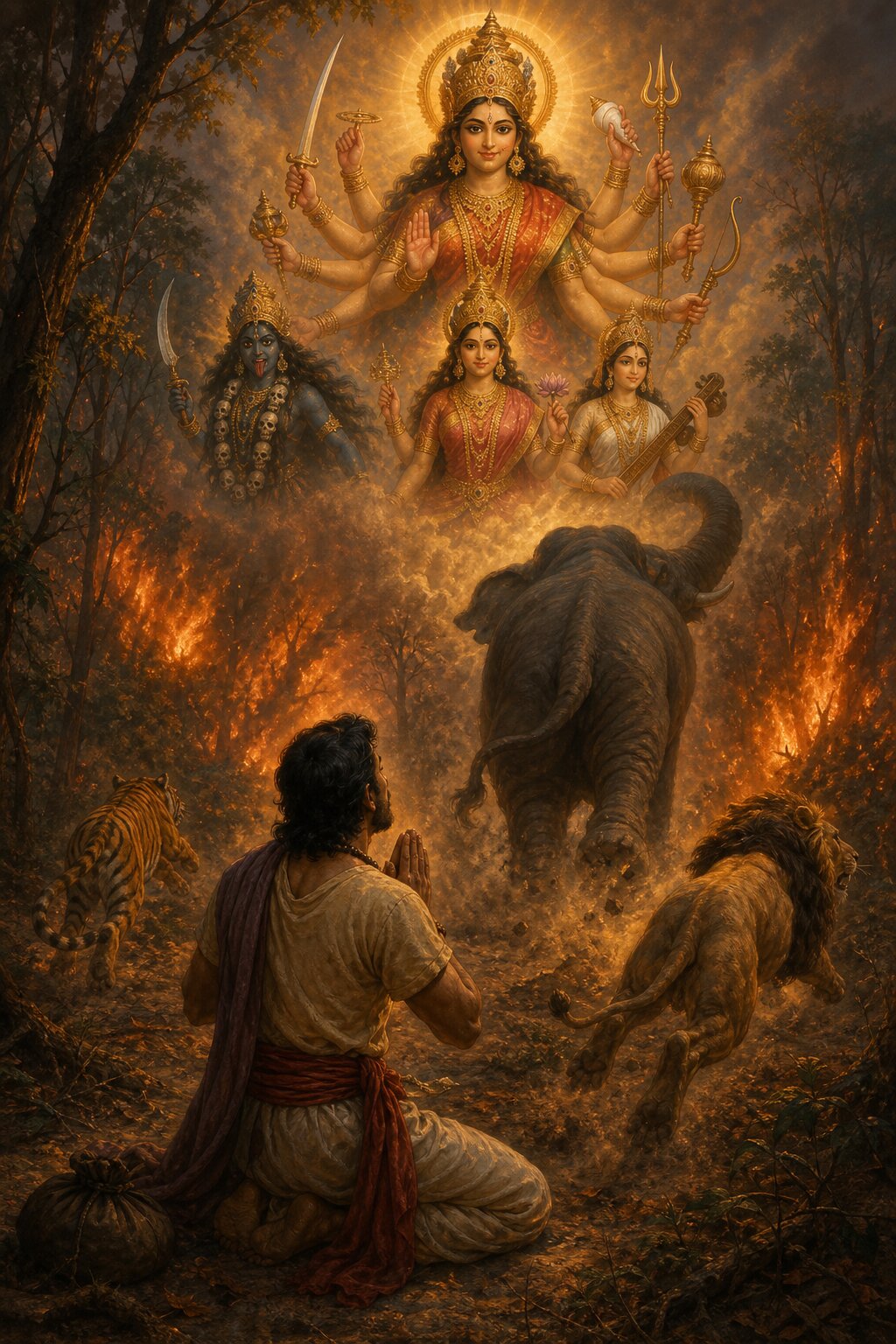
A man on a ship spun about by a violent gale far out on the great ocean, or caught in a battle so terrible that weapons rain down on him from every side. In the midst of all these horrors, or ground down by any anguish at all, whoever remembers this charita of hers walks free of the danger. Remembrance alone, without even a recitation, is enough; the story held in the mind is already her hand on the shoulder. By her power the lion and its kind, the bandit, the enemy, never even reach the one who holds her deeds in memory; they turn and flee while still far off.
30 · 31
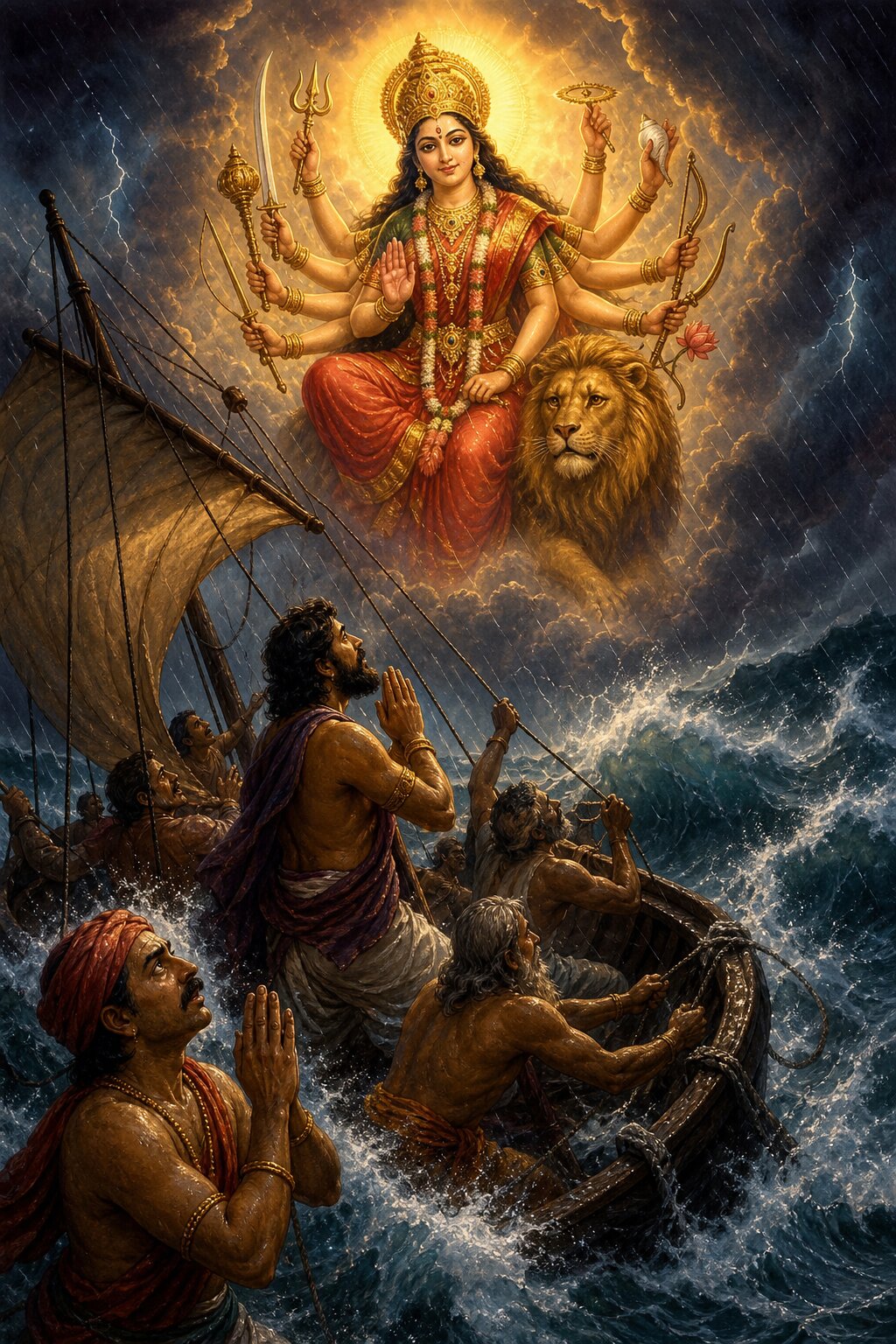
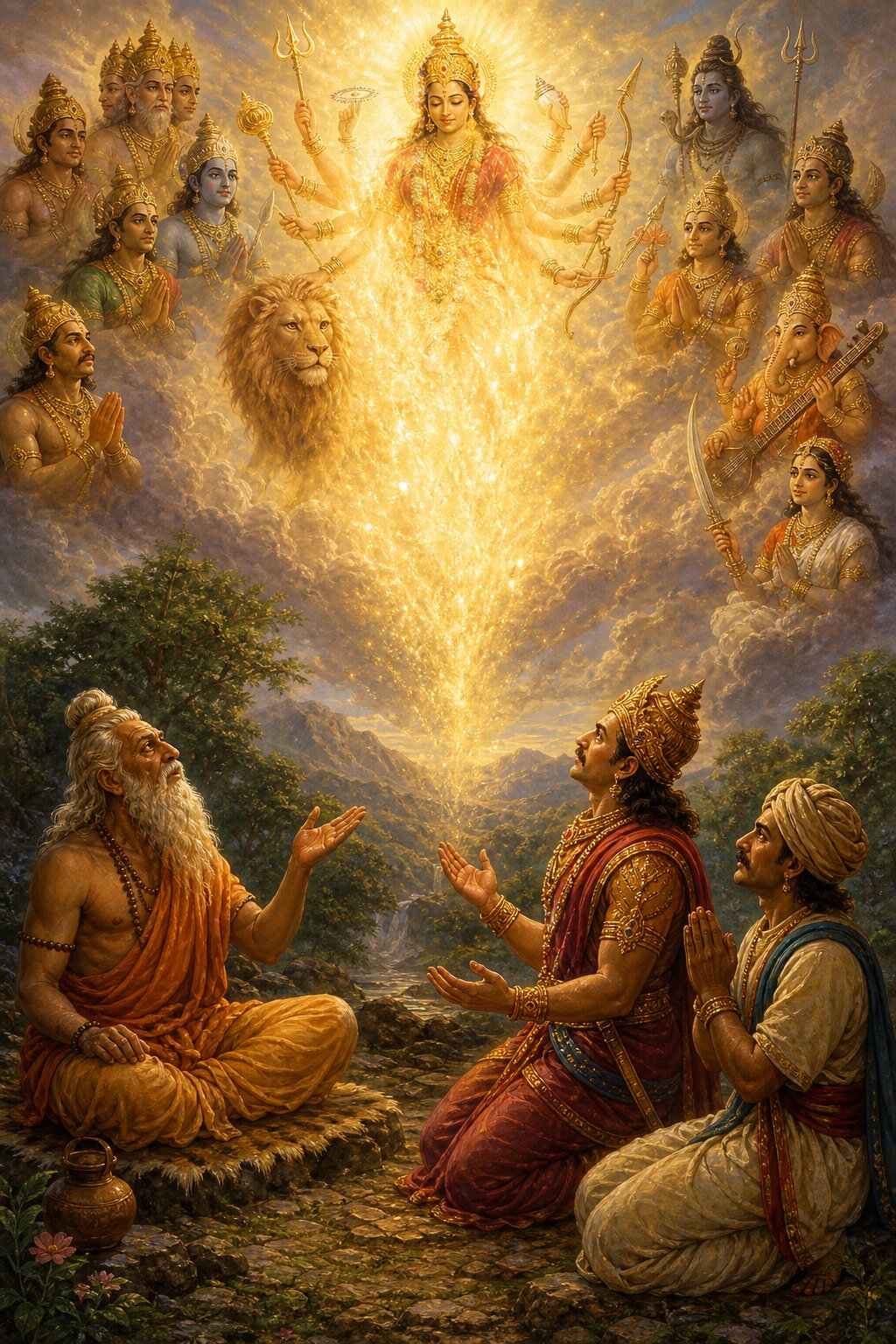
With this, the thread of the story returns to the hands of the rishi Medha. Her phala-shruti spoken, the blessed Chandika of fierce valor vanished on the spot before the watching gods, gone the way she had come, without door or direction. And the gods whose enemies she had swept away, their dread gone, took up their old dominions as before and began once more to receive their shares of the yajna, the portions of every fire-offering that had been theirs before the demon brothers seized them.
32 · 33
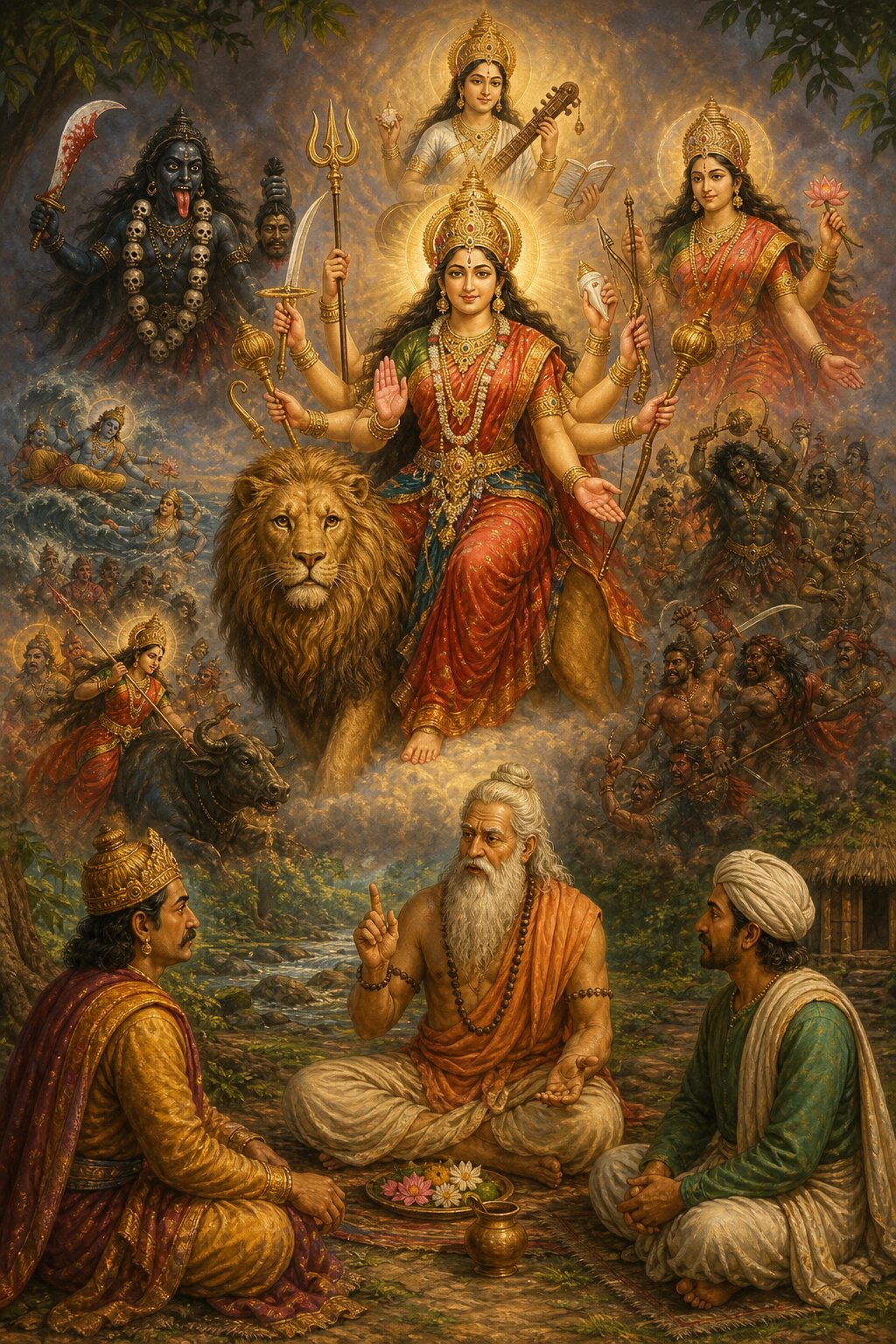
Shumbha, that most savage enemy of the gods who had set out to unmake the world, and Nishumbha of vast prowess, both lay slain in battle at the Devi’s hands; the daityas who survived slipped down to Patala, the realm beneath the worlds where their race waits out its defeats. Turning to King Suratha, the rishi gives the gist: in just this way the blessed Devi, eternal and unborn though she is, takes form again and again for the protection of the world.
34 · 35 · 36
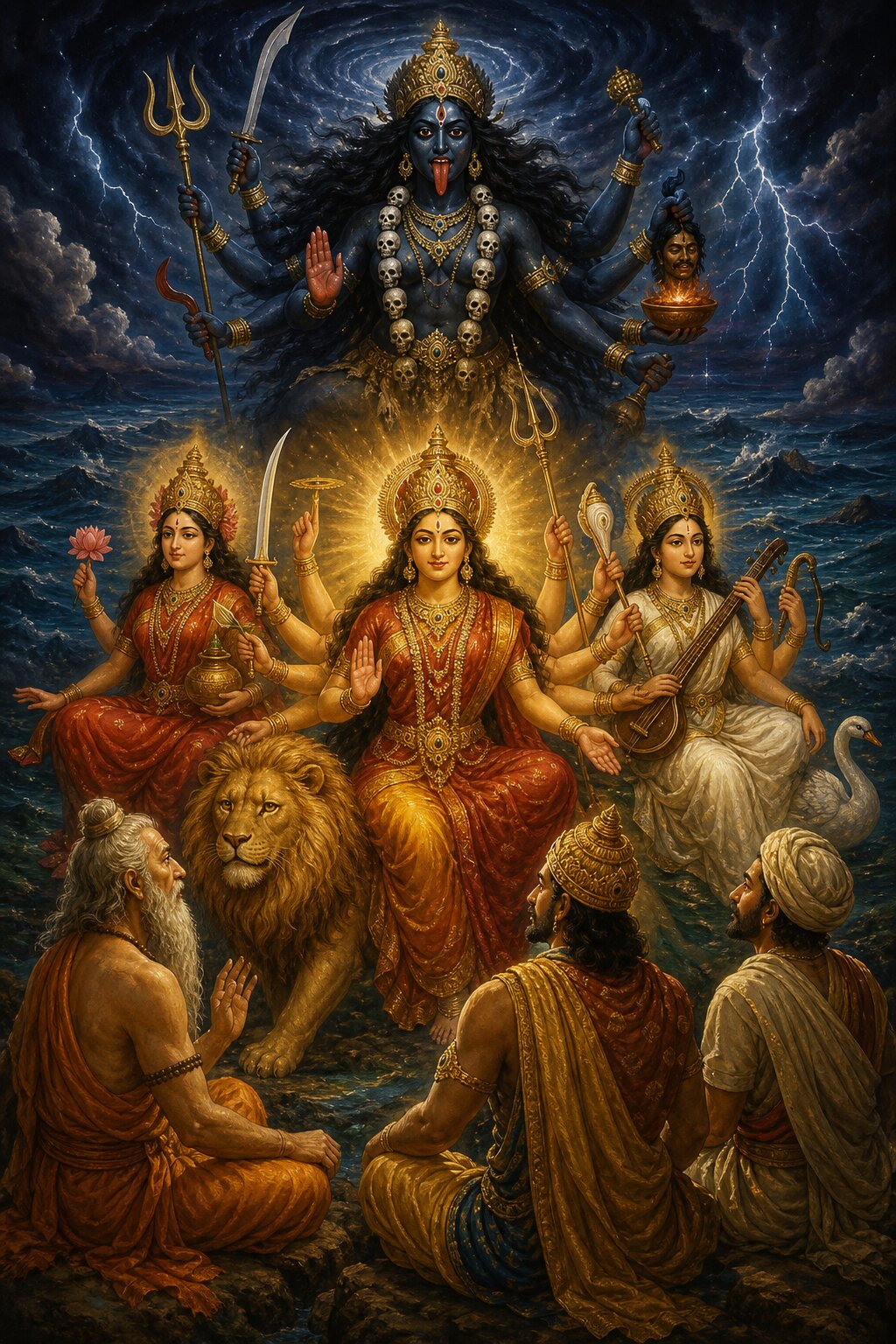
It is she, Mahamaya, who casts this universe into delusion, and she who gives it birth. Asked for knowledge, she grants knowledge; pleased, she grants riches of her own accord. King, in the great hour of dissolution this entire brahmanda, the whole egg of creation from Brahma’s height to the lowest deep, is pervaded by her in the form of Mahakali. When the time comes she becomes the great plague that is destruction; she, the unborn, appears as creation itself; and she it is who holds all beings in their place through the long middle of time. Three acts, one eternal shakti.
37 · 38
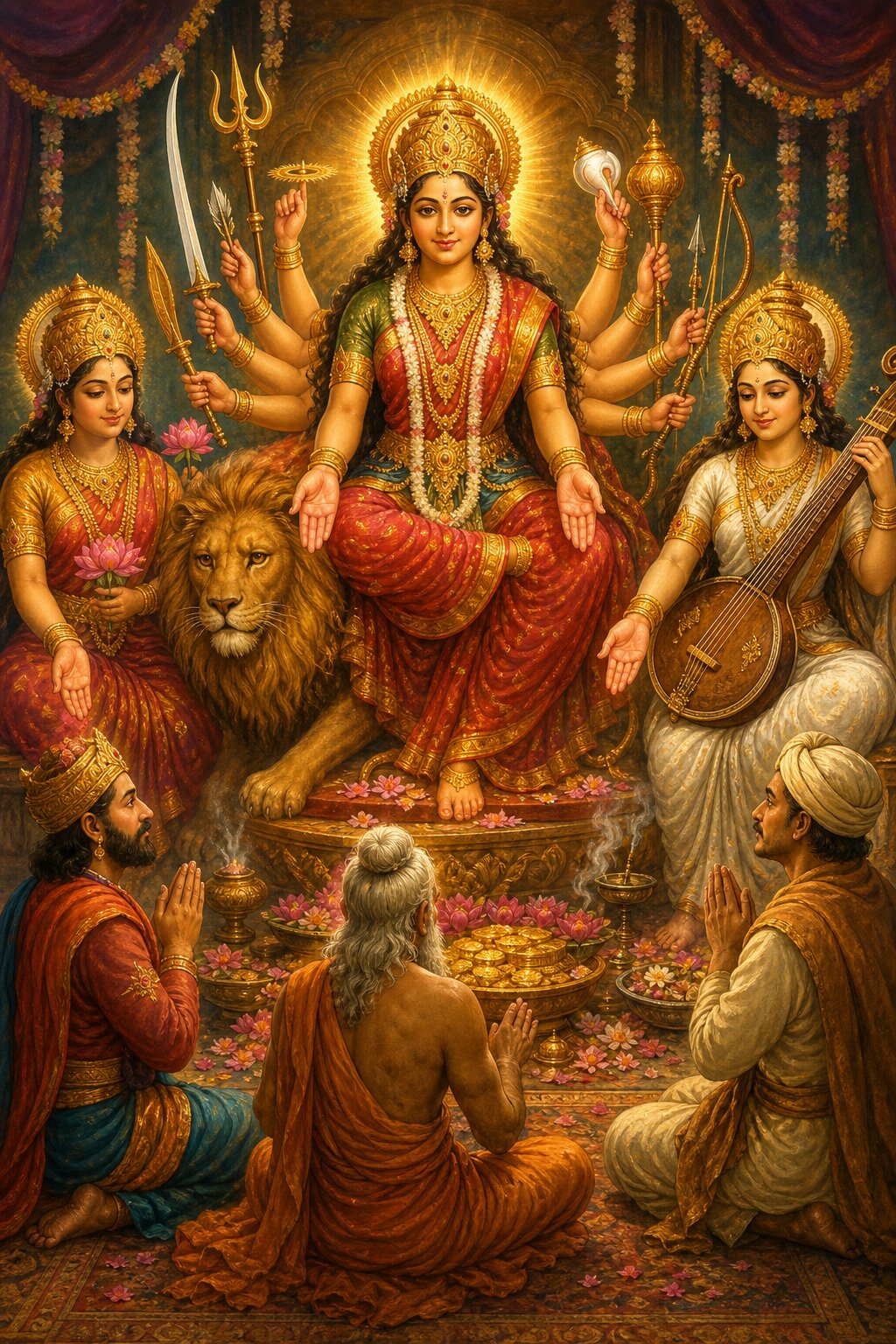
In seasons of rise she enters people’s homes as Mahalakshmi and multiplies their plenty; in seasons of decline she comes as Alakshmi, misfortune wearing a face, and leads the house toward ruin; the two conditions are one shakti at play. The chapter closes on the giving of boons. Praised and honored with flowers, with incense and fragrance, that same Devi gives wealth, gives children, gives a mind turned to dharma, and at the end an auspicious destiny: she grants it all, and holds nothing back.
Ahead
Chapter 13 closes the text. King Suratha and Samadhi the merchant go into the forest and undertake a severe tapas for the Devi. She appears before them in person and grants their boons: Suratha will become Savarni Manu in the coming manvantara, and Samadhi receives the self-knowledge he had asked for.