On this page
Devi Mahatmya
Chapter 11 · The Narayani Stuti · Final Charita
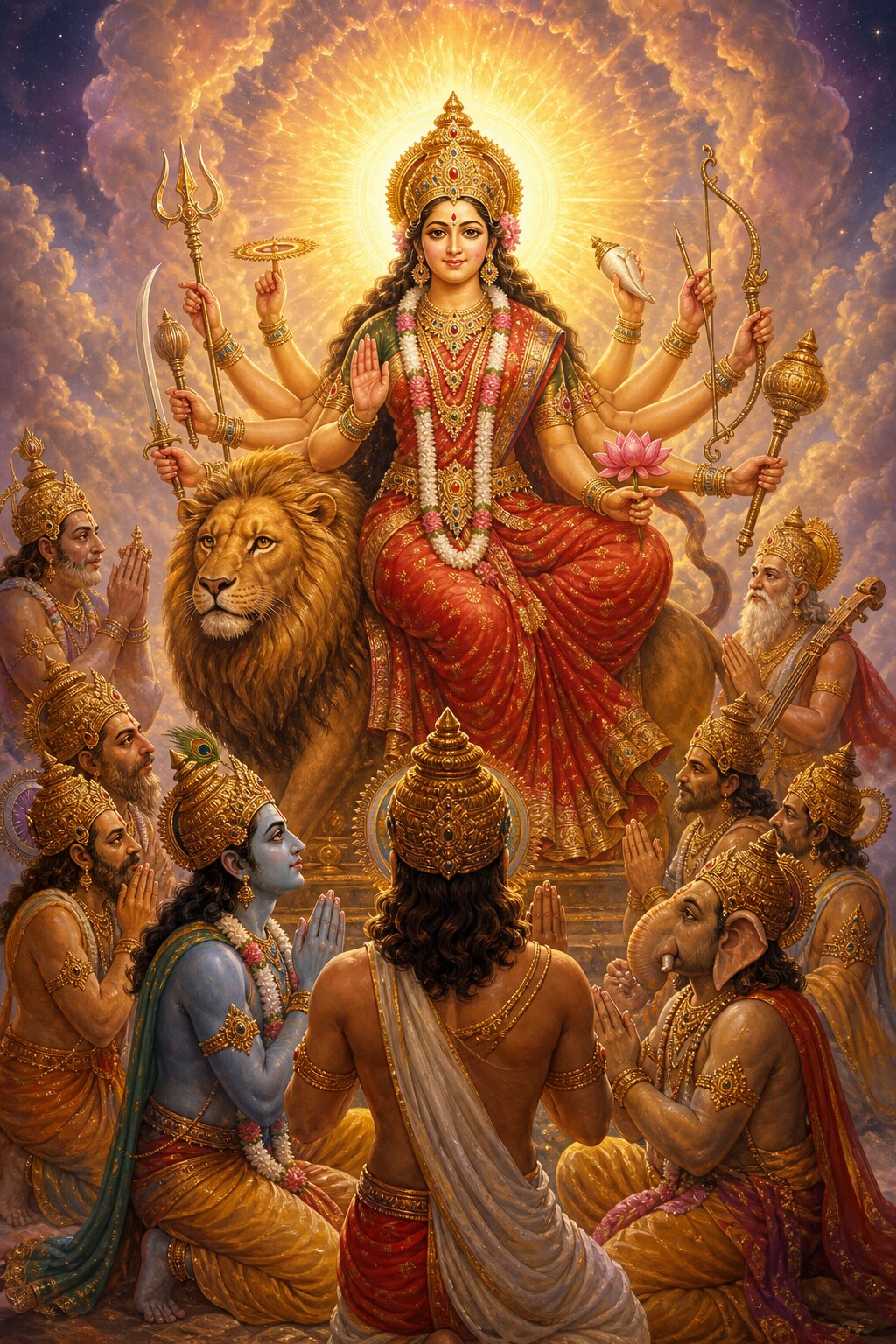
Shumbha had fallen. The instant that greatest lord of the asuras went down, the dread drained out of heaven and the faces of the gods lifted and opened like lotuses. Indra and all the suras came forward with Agni at their head and stood before Katyayani with folded hands. Then one voice rose, and the same salutation returned at the close of shloka after shloka, Narayani, salutation to you. Pleased by the hymn, the Devi offered them a boon, and the gods asked nothing for themselves. They asked only that she keep calming every affliction across the three worlds and keep destroying their foes. At the end she told them the story of the descents still to come, from her birth in the house of Nanda the cowherd to her forms as Rakta-dantika, Shakambhari, Bhima, and Bhramari.
1
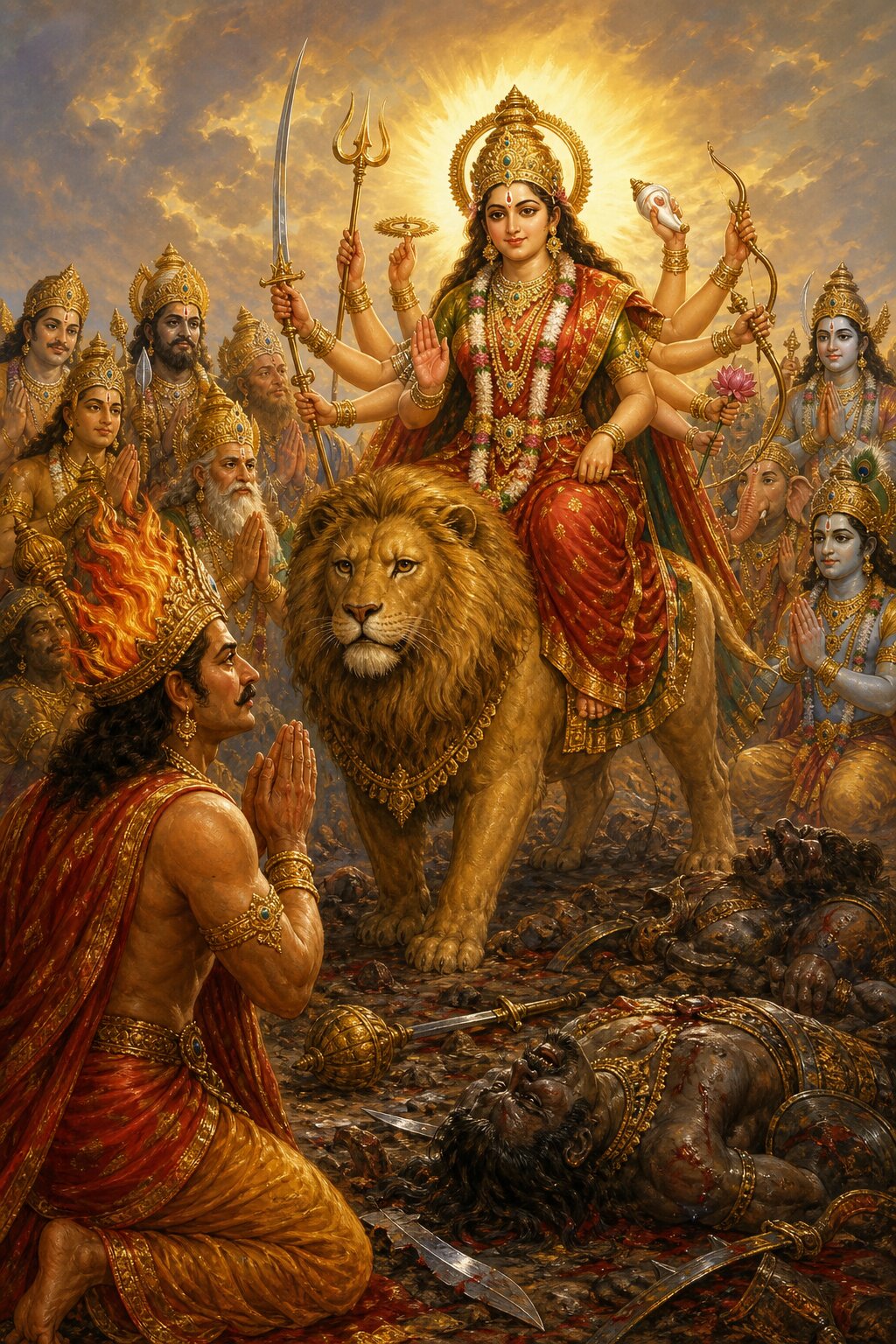
Shumbha, the greatest lord the asuras had, lay dead on the field. The gods came down onto that same ground where the war had raged, Indra among them, Agni at the head of the procession, carrying its front the way he carries every offering made in fire. Everything they had prayed for through the long fight stood accomplished in front of them, and their faces opened like lotuses at first light, so bright that the very horizons seemed to catch the glow. With that gladness rising in them, they lifted their voices and began to praise Katyayani.
2 · 3
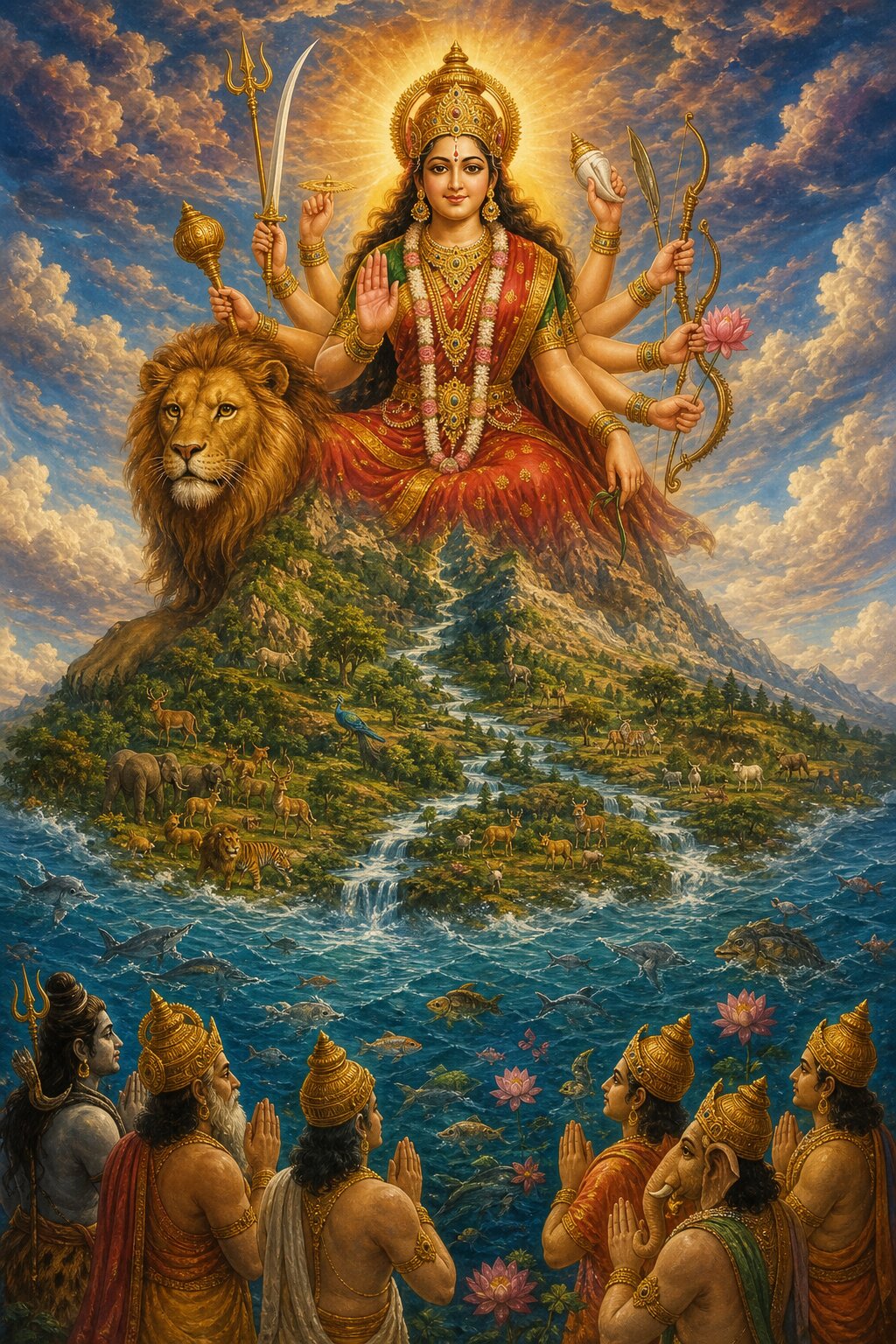
Their first words were a plea. O Devi who lifts away the pain of everyone who turns to you, be gracious, be gracious, for you are the mother of the whole world. O ruler of all, be gracious and guard this world, for you alone hold sway over everything that moves and everything that stands still. Even as they begged her to protect creation, they were naming what she already was, the ground on which that creation stood. You alone became the support of the world, they said, because you abide within it as the earth itself, the same earth that was holding up the gods where they stood. You abide within it as water too, and by you the whole of it is filled and its thirst is answered, O you whose power nothing can cross.
4 · 5
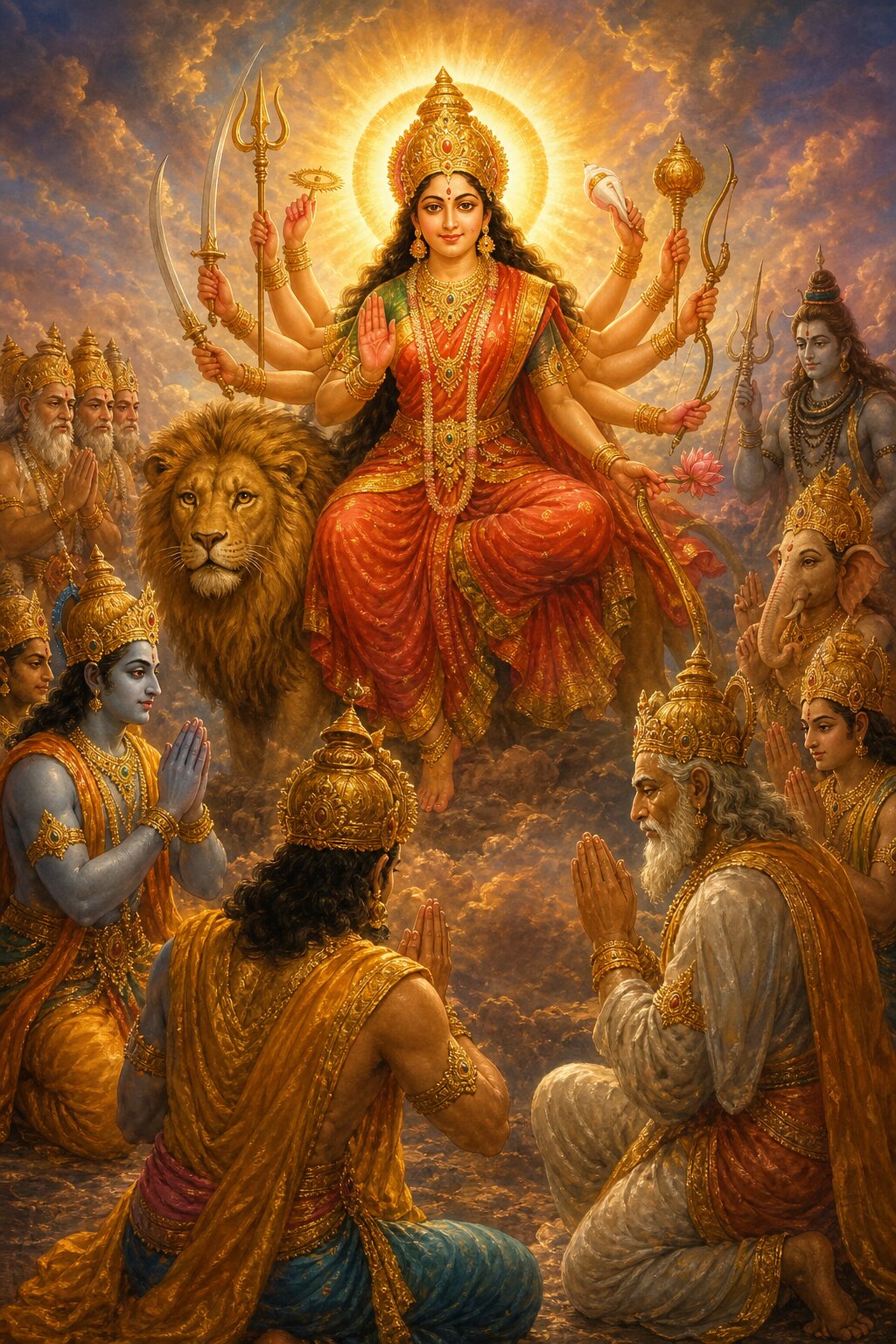
They went on. You are Vishnu’s own energy, the Vaishnavi shakti, boundless in power. You are the seed of the universe and the supreme maya, and this entire world lies spellbound in you. It was a strange thing to say to the face of their rescuer, that the enchantment over the world is also hers, and they said it without flinching, because the same truth turns: when you are pleased, that very power becomes, here on this very earth, the cause of a soul’s release. Every branch of knowledge is a form of you, O Devi, and every woman in every world is you. When you alone, the one Amba, have filled all that exists, what praise could ever reach you, what utterance could rise higher than the one it means to praise.
6 · 7
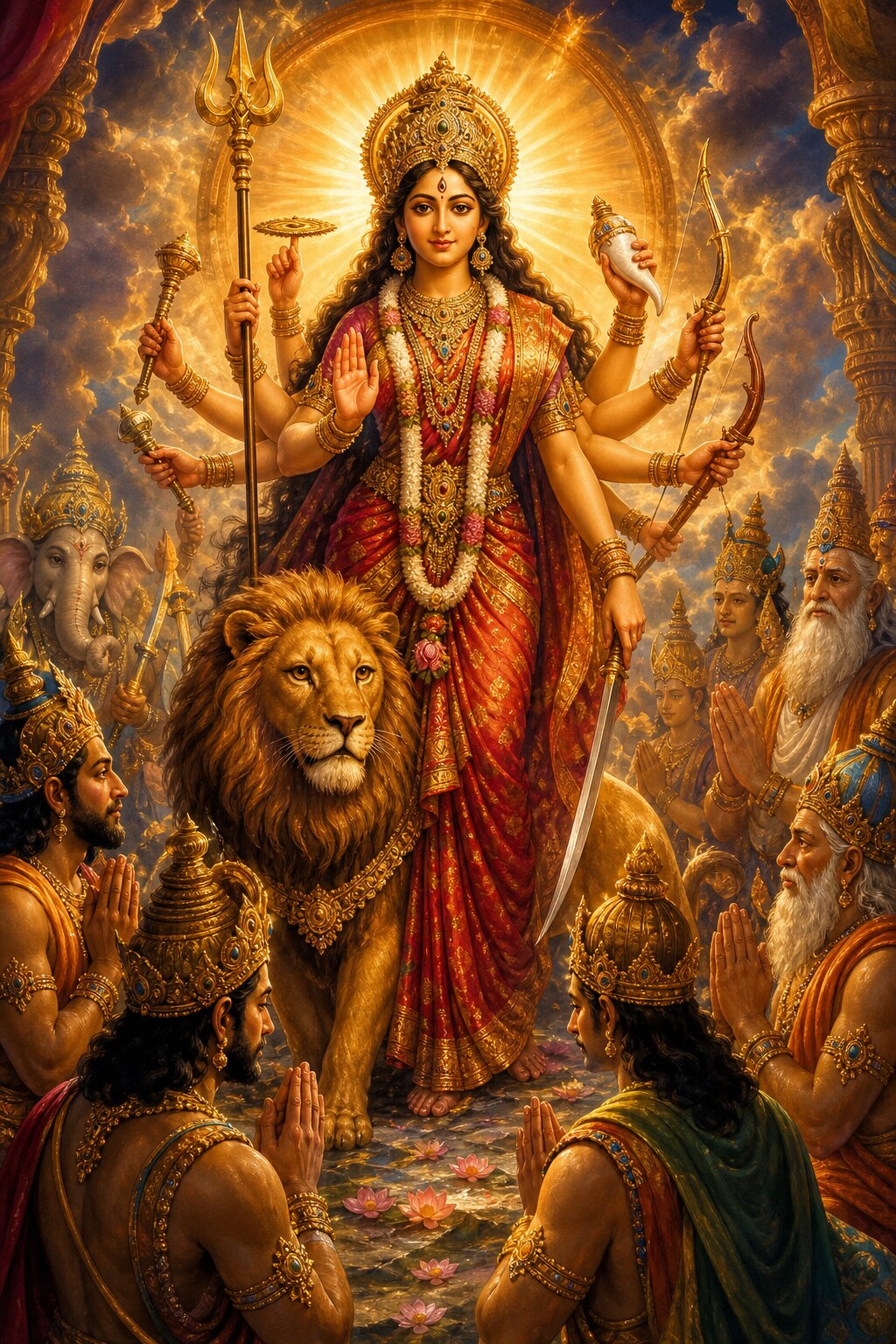
You are the form of all that lives, they said, the giver of heaven and of final release alike, so what words could ever be worthy of your praise. And then, still bent low, they arrived at the salutation that would return again and again through everything to come, the name that joins her to Narayana himself as his own eternal power. To Narayani, who abides as intelligence in every living being’s heart, so that whoever has ever understood anything has met her there, who grants both heaven and release, salutation to you.
8 · 9 · 10 · 11
Now the salutation began to come without a break, and one by one, as they recognized her in form after form, the gods bowed. To Narayani, who as the kala and the kashtha and the finer measures of time, slivers thinner than a flicker of the eyelid, drives creation through all its changes, and who at the hour of dissolution holds the power to draw the whole universe back into herself, salutation to you. To Narayani, the good fortune inside everything fortunate, well-being itself, who accomplishes every aim, the refuge of all who seek refuge, the three-eyed Gauri, salutation to you. To Narayani, the one root power behind creation, preservation, and destruction, the eternal, the ground of the three gunas and woven of them, salutation to you. To Narayani, forever bent on rescuing the helpless and the suffering who come to her, who lifts away the pain of every creature, salutation to you.
12 · 13 · 14
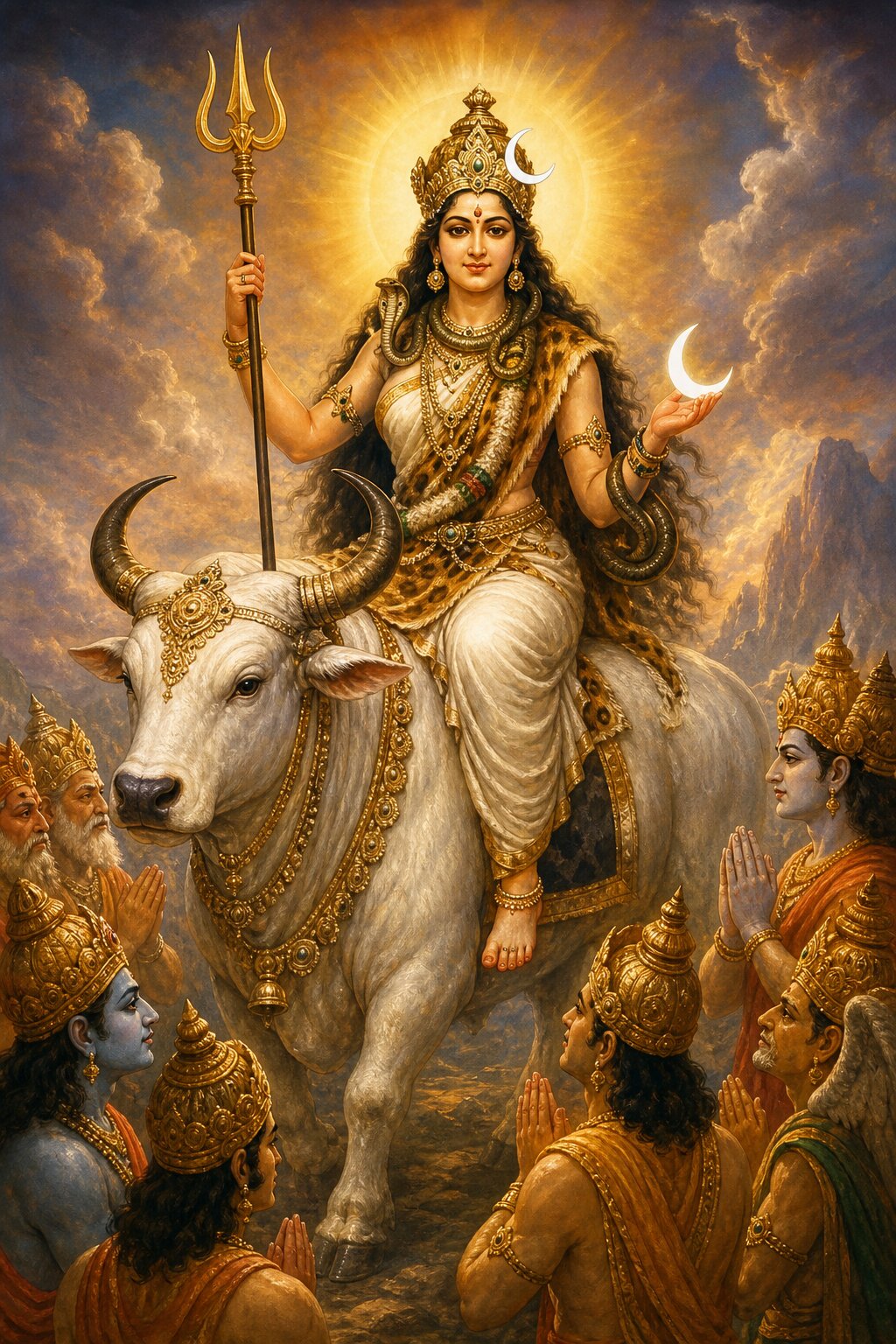
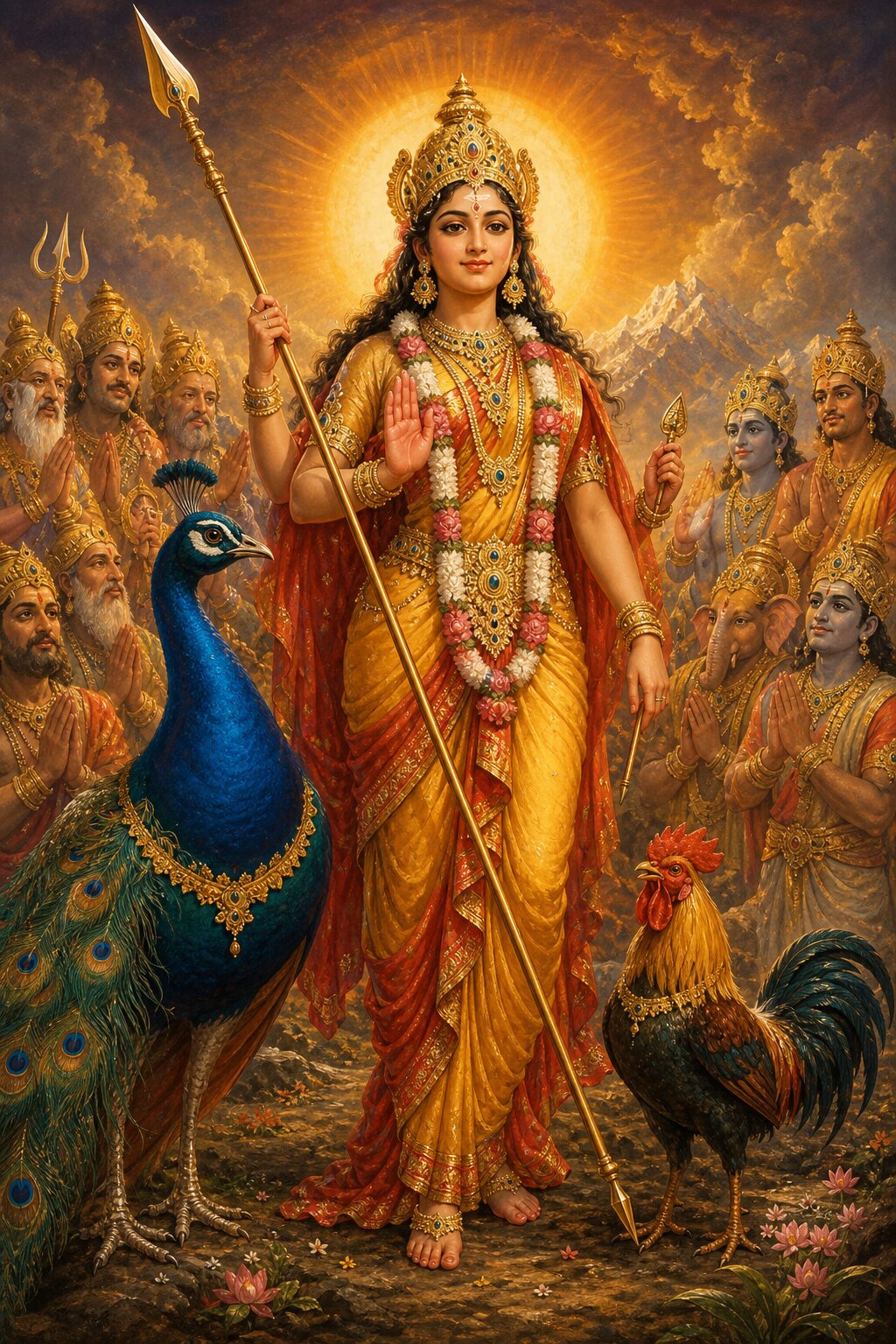
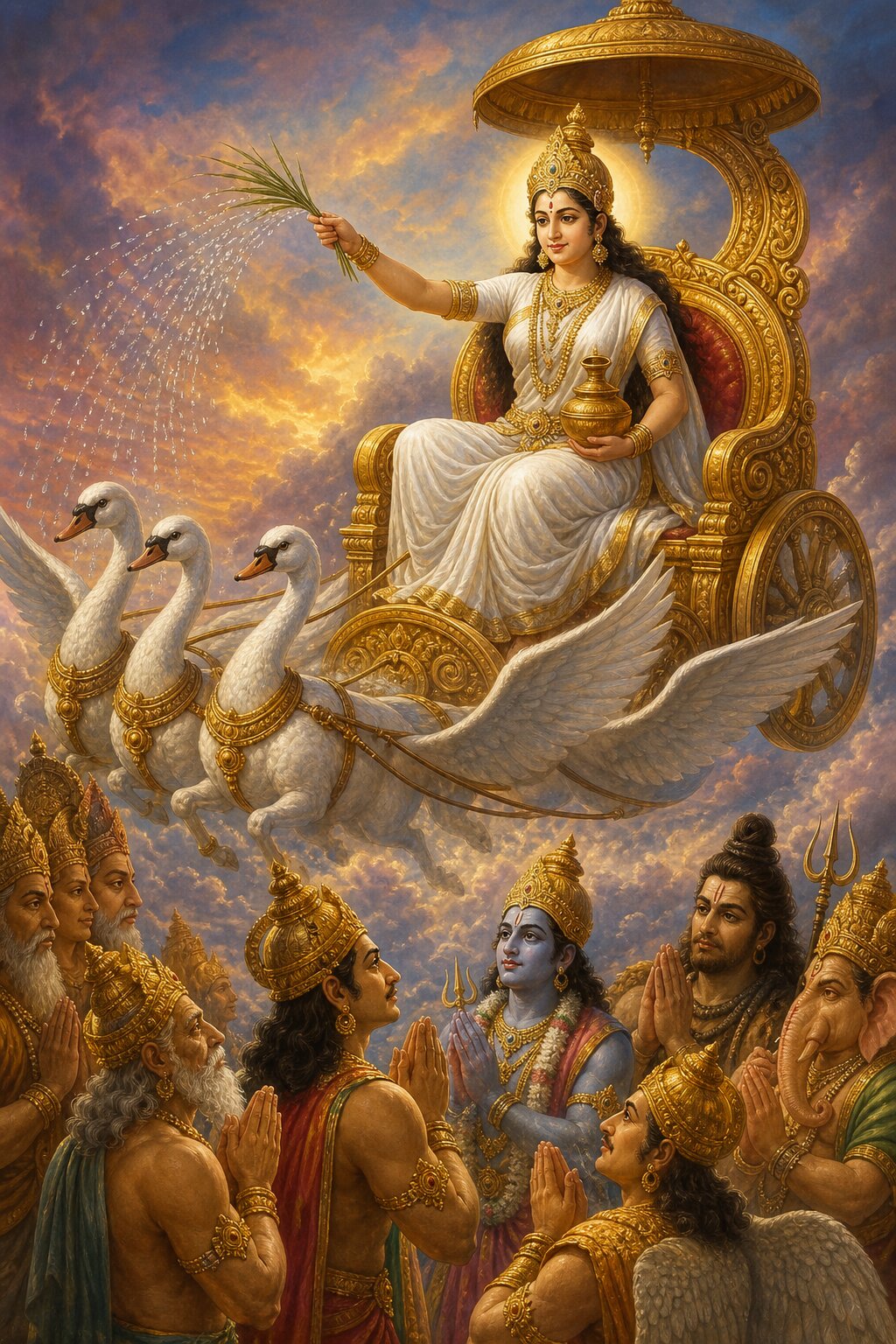
Then they bowed to the shakti-forms that had risen, in this very war, out of the bodies of the gods themselves, and each salutation held a whole portrait. To the one who rides the swan-drawn chariot in the form of Brahmani, sprinkling the water made holy by kusha grass, the same water that had undone great asuras on this field, Narayani, salutation to you. To the one who bears the trident, the crescent moon, and the serpent, mounted on the great bull in the form of Maheshvari, Narayani, salutation to you. To the one attended by the peacock and the cock, the birds that walk beside Kartikeya, wielding the great shakti, standing flawless in the form of Kaumari, Narayani, salutation to you.
15 · 16 · 17
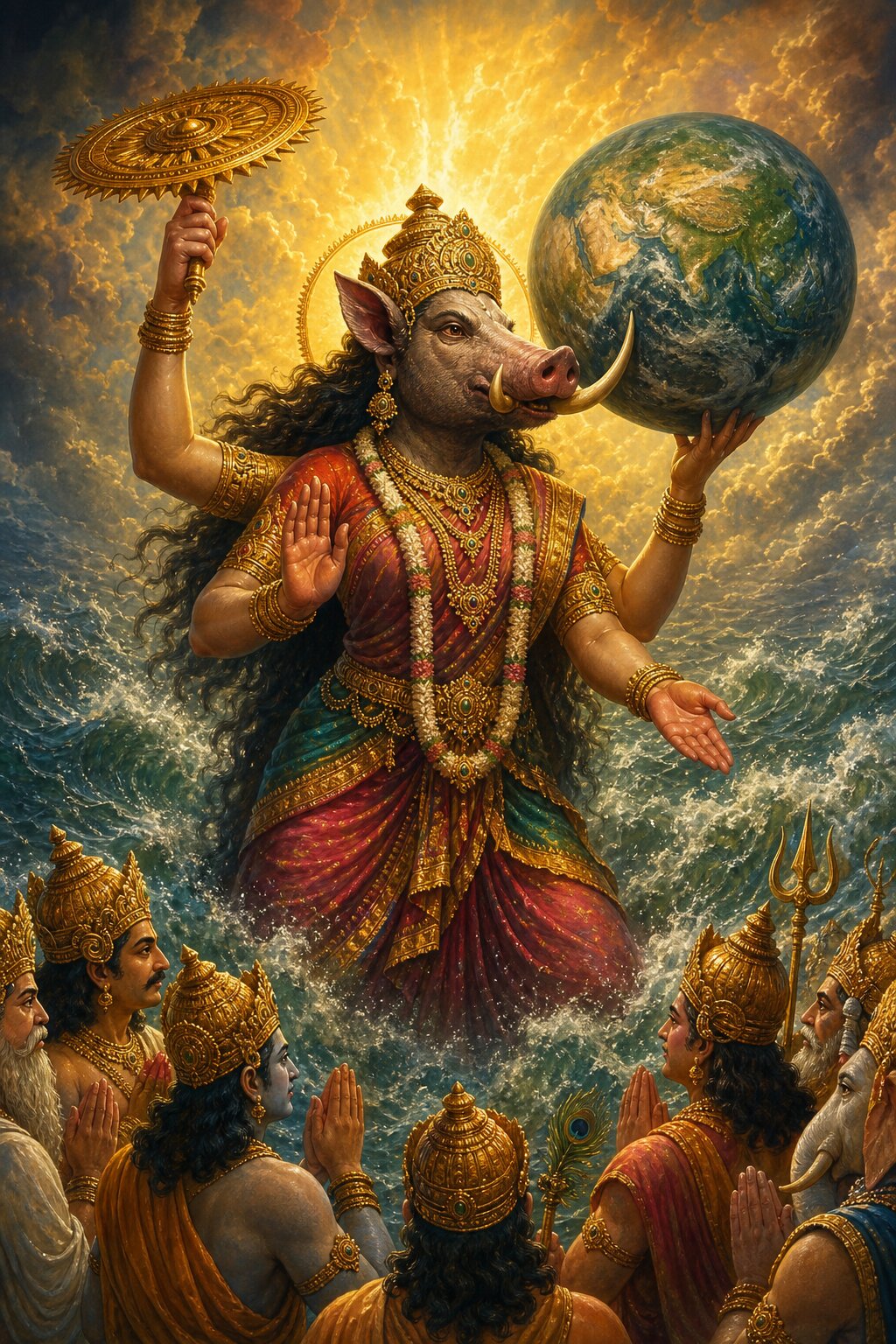
To the one who holds conch and discus and mace and the Sharnga bow, Vishnu’s own supreme weapons, appearing in the form of Vaishnavi, be gracious, Narayani, salutation to you. To the one who grips the fierce great discus, who once lifted the drowning earth out of the flood on her tusk as the boar, gracious now in the form of Varahi, Narayani, salutation to you. To the one who took the terrible man-lion shape as Narasimhi, all mane and claw, rising to tear the daityas apart and to shield the three worlds, Narayani, salutation to you.
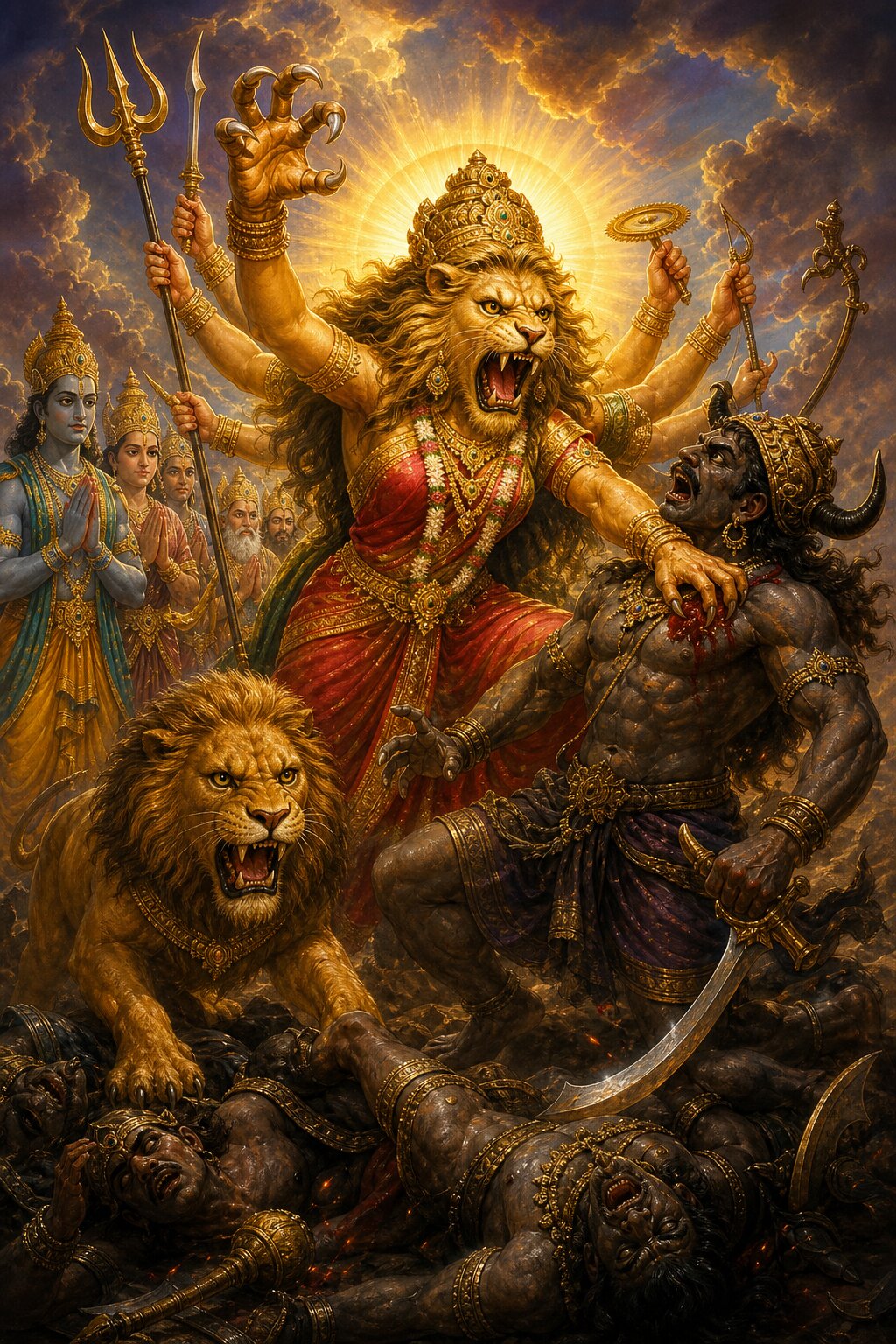
18 · 19 · 20
To the one crowned and bearing the great thunderbolt, blazing with a thousand eyes, who as the power of Indra tore the life from Vritra, the serpent that once swallowed the world’s waters, in the form of Aindri, Narayani, salutation to you. To the one who made Shiva himself her messenger and sent him to the demon court, who broke the vast strength of the daityas, terrible in form and thunderous in voice, the Shiva-duti, Narayani, salutation to you. To the one whose mouth is jagged with fangs, adorned with a garland of skulls, who ground Chanda and Munda to nothing and carries that deed as the name Chamunda, Narayani, salutation to you.
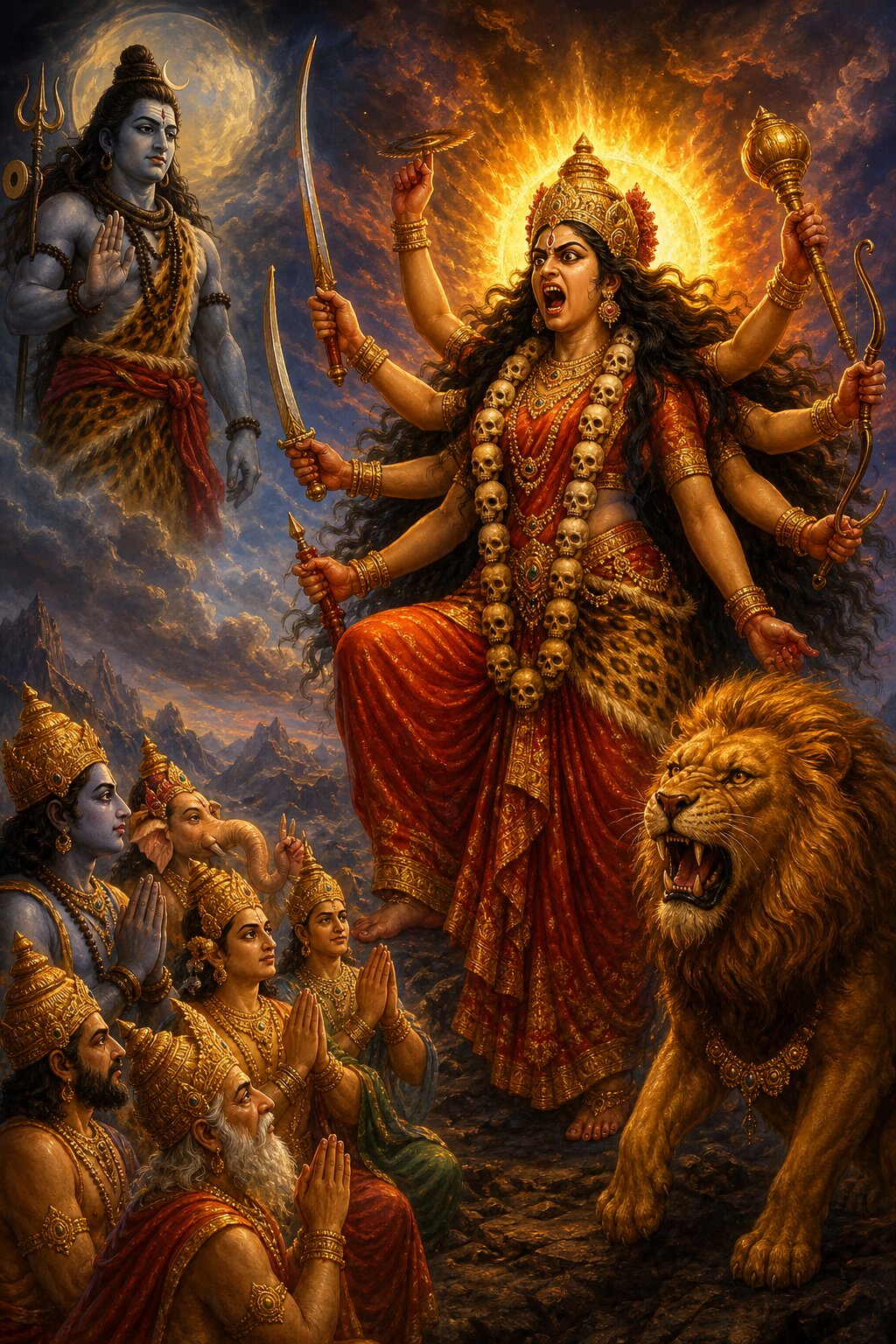
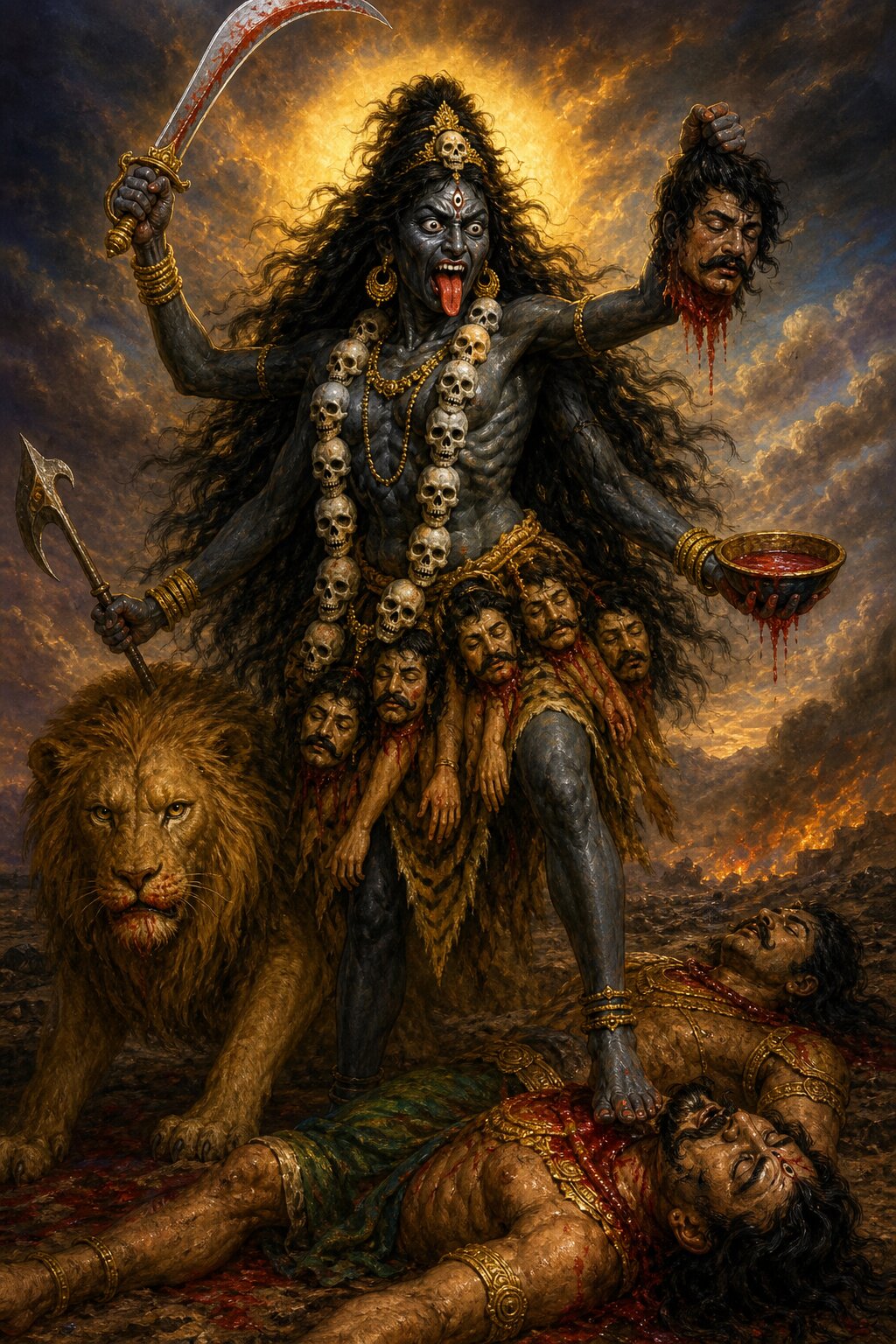
21 · 22
In the last two turns of that long litany they gathered all her forms into a single breath and bowed. To Lakshmi, Lajja, Mahavidya, Shraddha, Pushti, Svadha, and Dhruva, fortune and modesty, great wisdom and faith, nourishment, the ancestors’ portion, and the fixed pole of things, to Maharatri, the great night of dissolution, and Mahamaya, to Narayani who lives in every one of these, salutation to you. To Medha and Sarasvati, to Vara and Bhuti, to Babhravi and Tamasi and Niyata, be gracious, O Ishvari, Narayani, salutation to you.
23 · 24
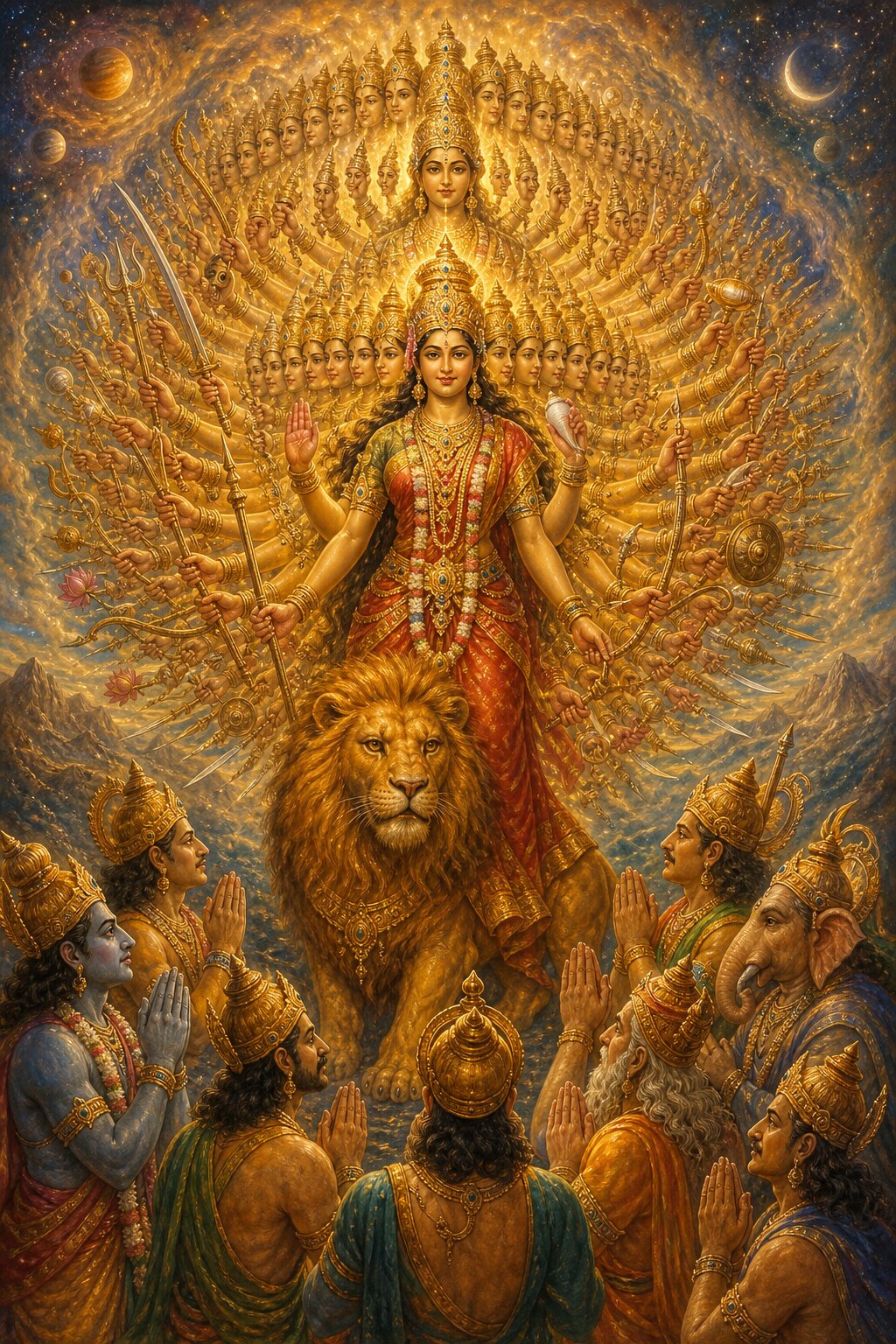
Now the hymn changed key, and the vision widened until it held her cosmic body. Hands and feet on every side, eyes and heads and faces on every side, ears and nostrils on every side, hearing everything everywhere in the world, O Narayani, salutation to you. By now the words reached past the warrior in front of them and took in everything they could see, and everything they could not. You who are the form of all, the ruler of all, holding every power at once, carry us across every fear, O Devi Durga, salutation to you.
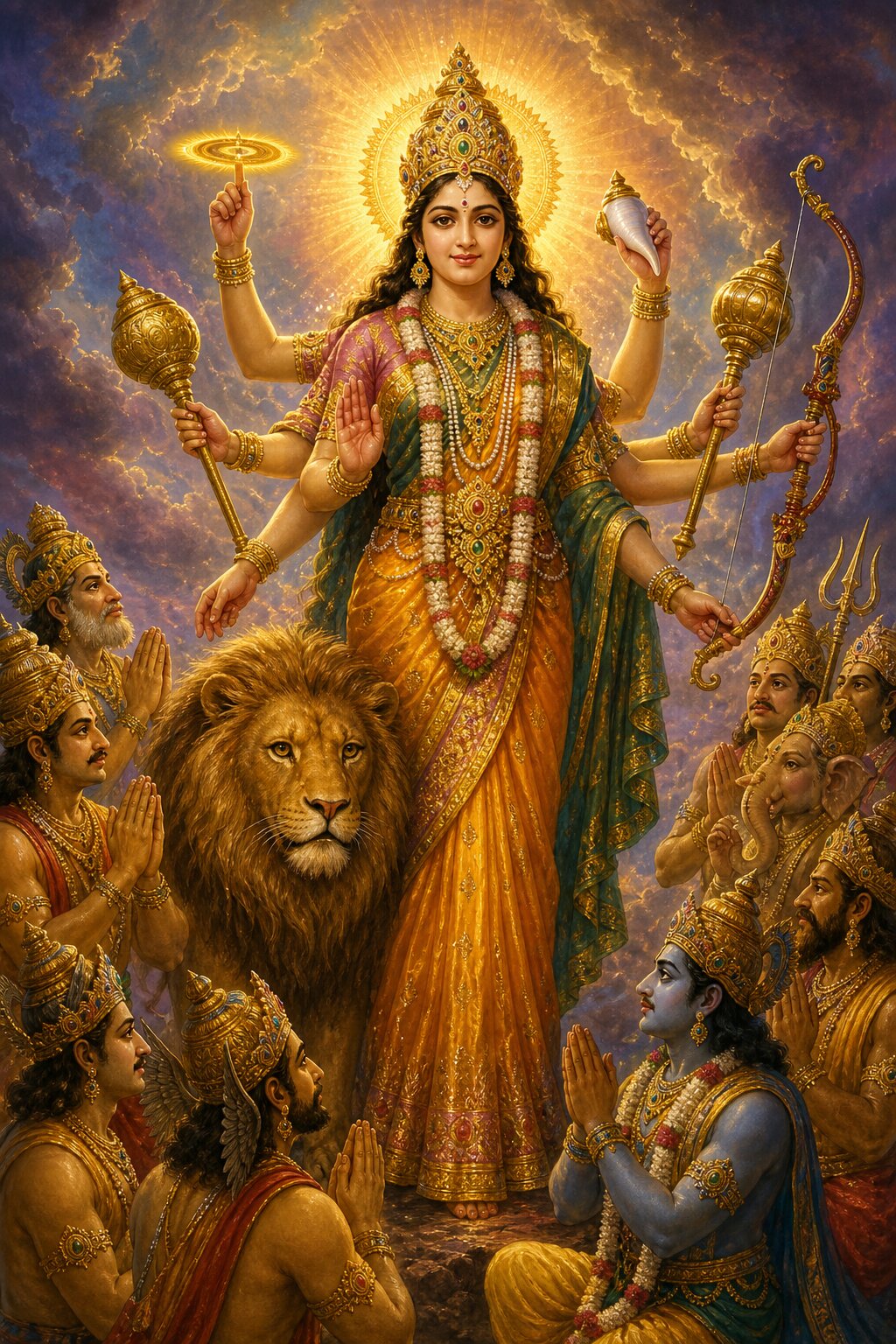
25 · 26 · 27
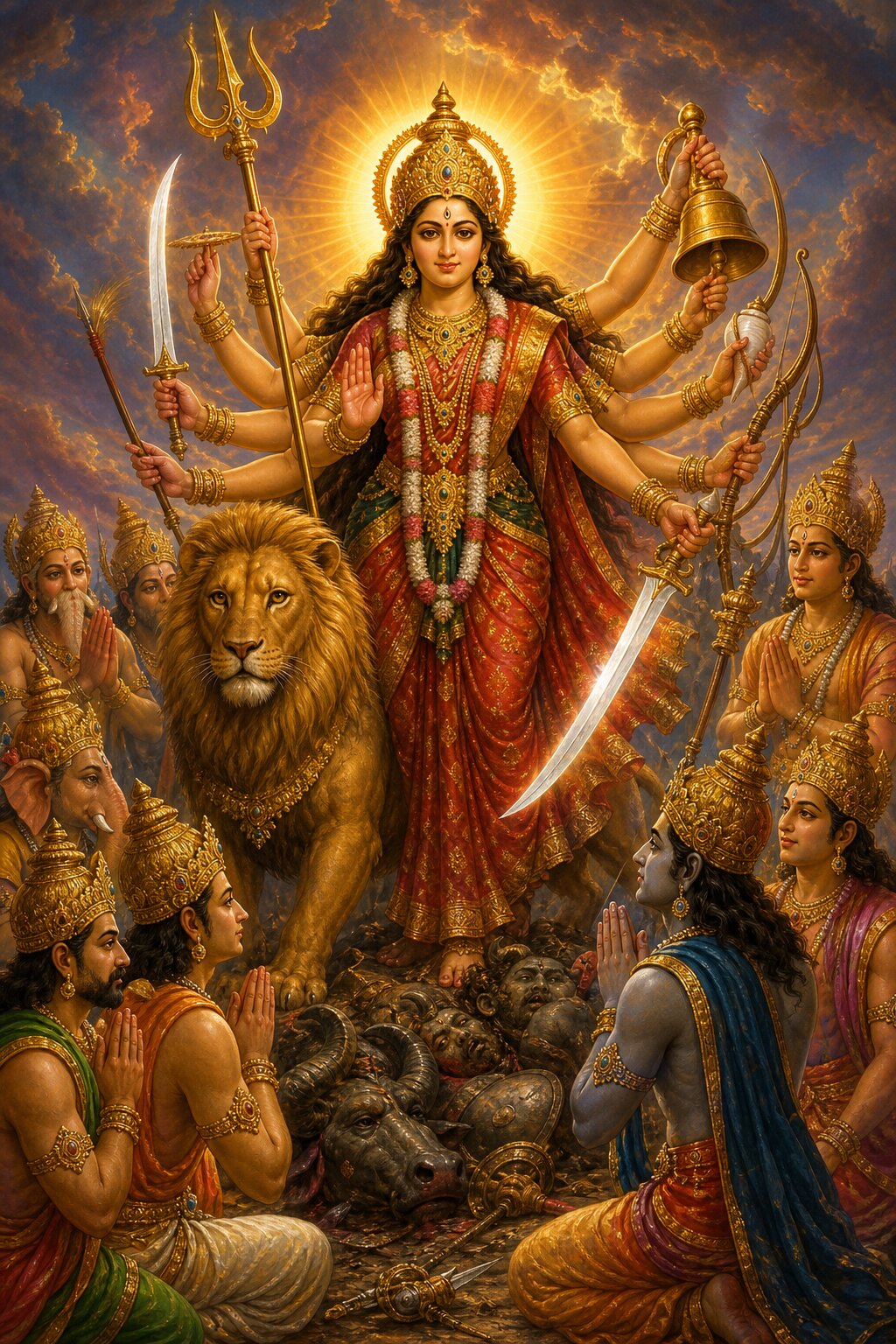
Then they turned to her face, to her weapons, and to her bell. May this gentle face of yours, graced with three eyes, the face that had just looked on a war without flinching, keep us safe from every terror, Katyayani, salutation to you. May your trident, fierce as flame and utterly dreadful, the slayer of every asura, carry us past our fear, Bhadrakali, salutation to you. And your bell, which floods the whole world with its sound and drains the fire out of the asuras, may it guard us from our sins the way a mother guards her sons.
28 · 29
May the sword in your hand, smeared still with the blood and fat of the asuras and blazing through it, turn to our good, Chandika, we bow to you. Pleased, you take away every disease. Angered, you still grant your devotees all they long for, for even your anger carries their welfare inside it. No ruin comes near those who shelter in you, and they themselves become a shelter for others.
30 · 31
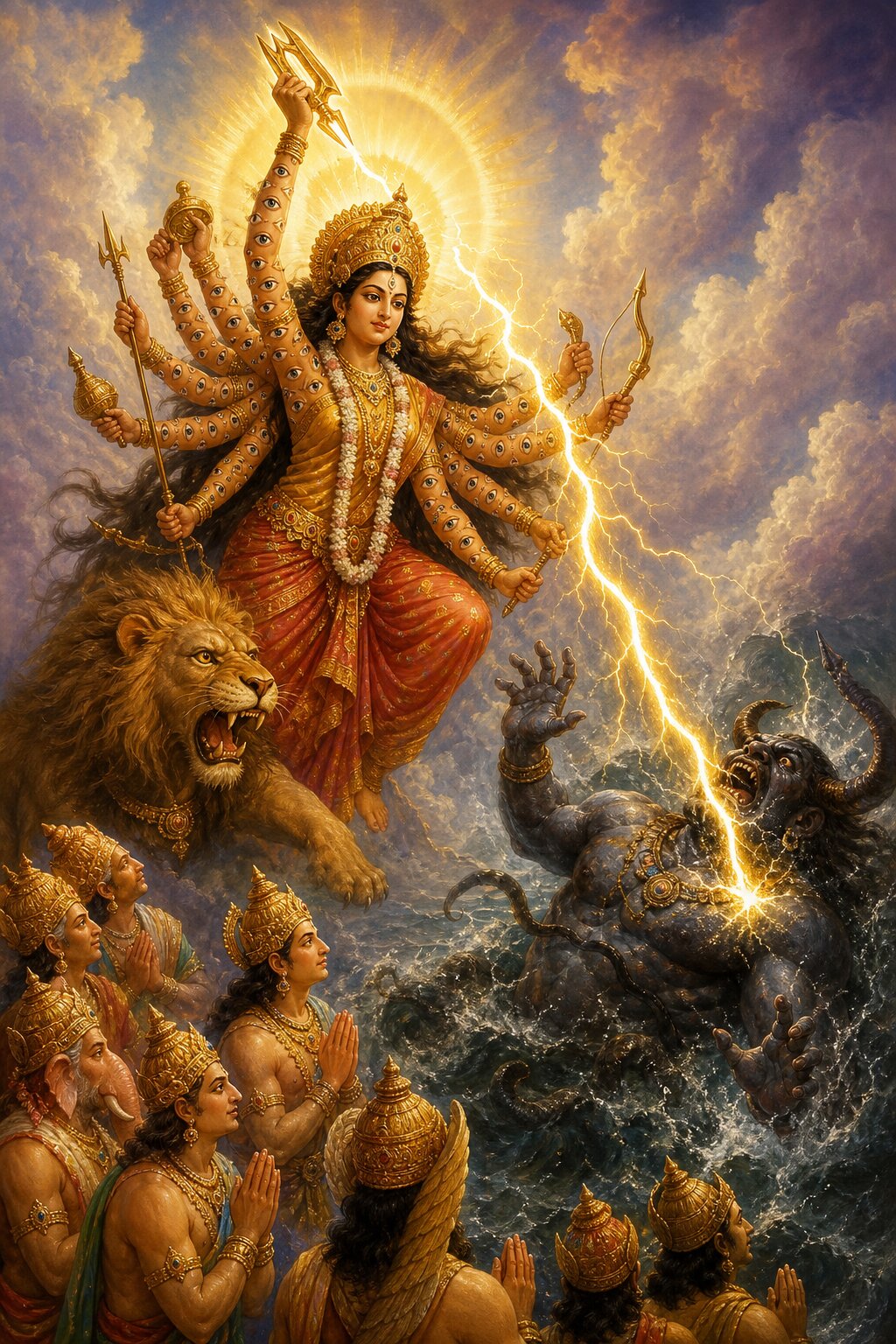
Look at what you have done today, they said, this slaughter of the great asuras who hate all dharma. You took your single self and gave it many shapes to do it, and no one watching could say where the one ended and the many began. Who else, Ambika, could work such a thing? In the sciences, in the shastras, in the lamps of discernment, in the first words ever spoken, who is there anywhere like you? And it is you again who leaves this whole world stumbling in the dark, down in the pit of that one small word, mine.
32 · 33
Where there are rakshasas, where there are serpents with burning venom, where enemies close in or robber bands gather on the road, where a forest fire roars, or far from every shore in the middle of the sea, there you stand, and there you guard the world. O ruler of all, you keep the world alive. You are the self of the world, and you hold it up. The lords of the worlds bow to you, and those who bend before you in devotion become the refuge of all the world.
34 · 35
At the last they tied the prayer back to the day itself. Be gracious, O Devi. Just as the demon fell in a single instant today, guard us always from the terror of our enemies. Quickly still the sins of all the worlds and the great calamities born of upheaval and ruin. O Devi who lifts away the world’s pain, worthy of the worship of all who dwell in the three worlds, be gracious to us who bow before you, and grant your boon to every world.
36 · 37
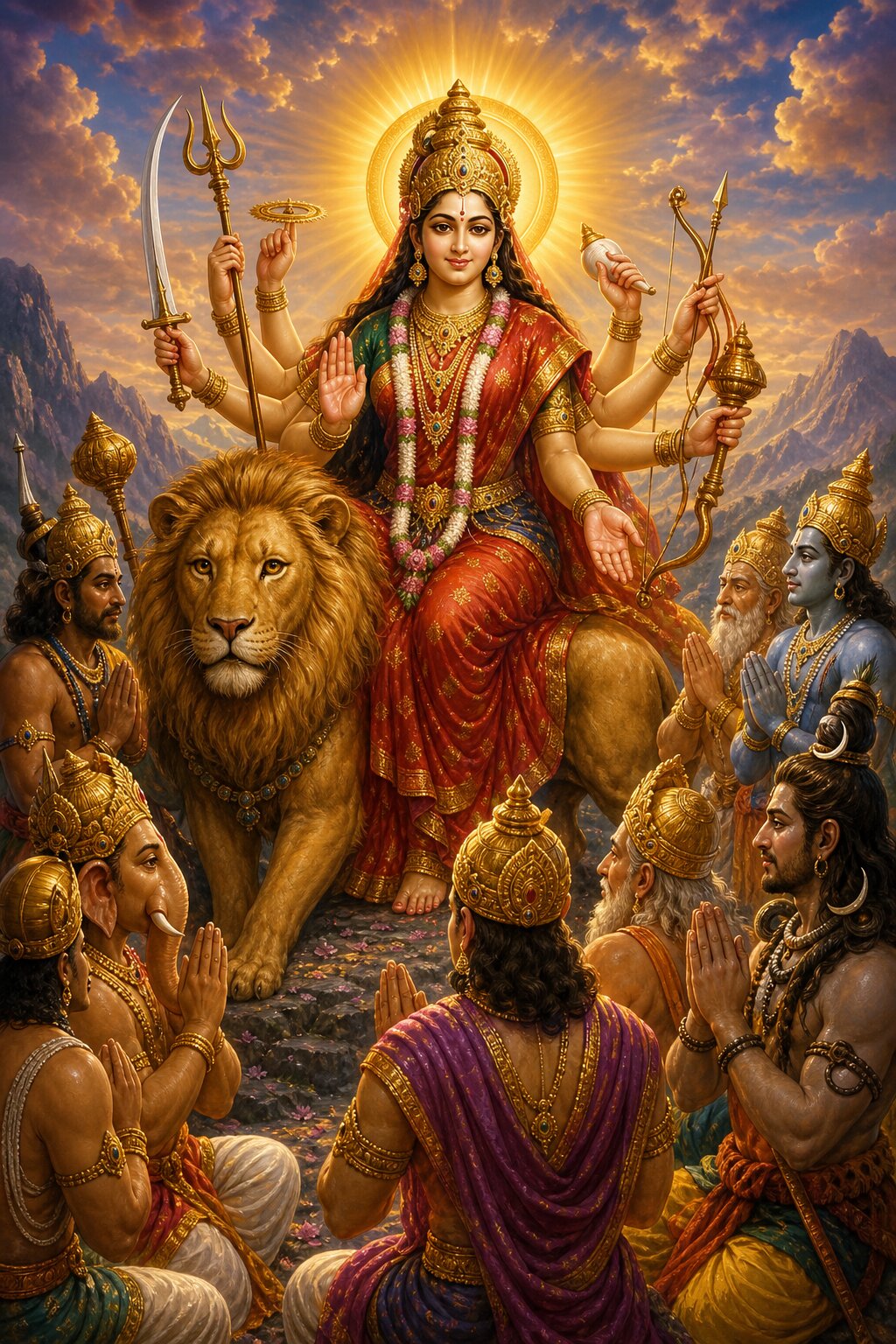
Pleased with the hymn, the Devi answered them in her own voice. O gods, I am ready to give. Whatever boon you hold in your hearts for the good of the world, ask it, and I will grant that very thing. They had a whole war’s worth of losses to repair, thrones and honors and the shares of the sacrifices that had been stripped from them, and the gods asked nothing for themselves. They asked only this, that she keep calming every affliction of the three worlds exactly as she had, and keep destroying their enemies.
38 · 39
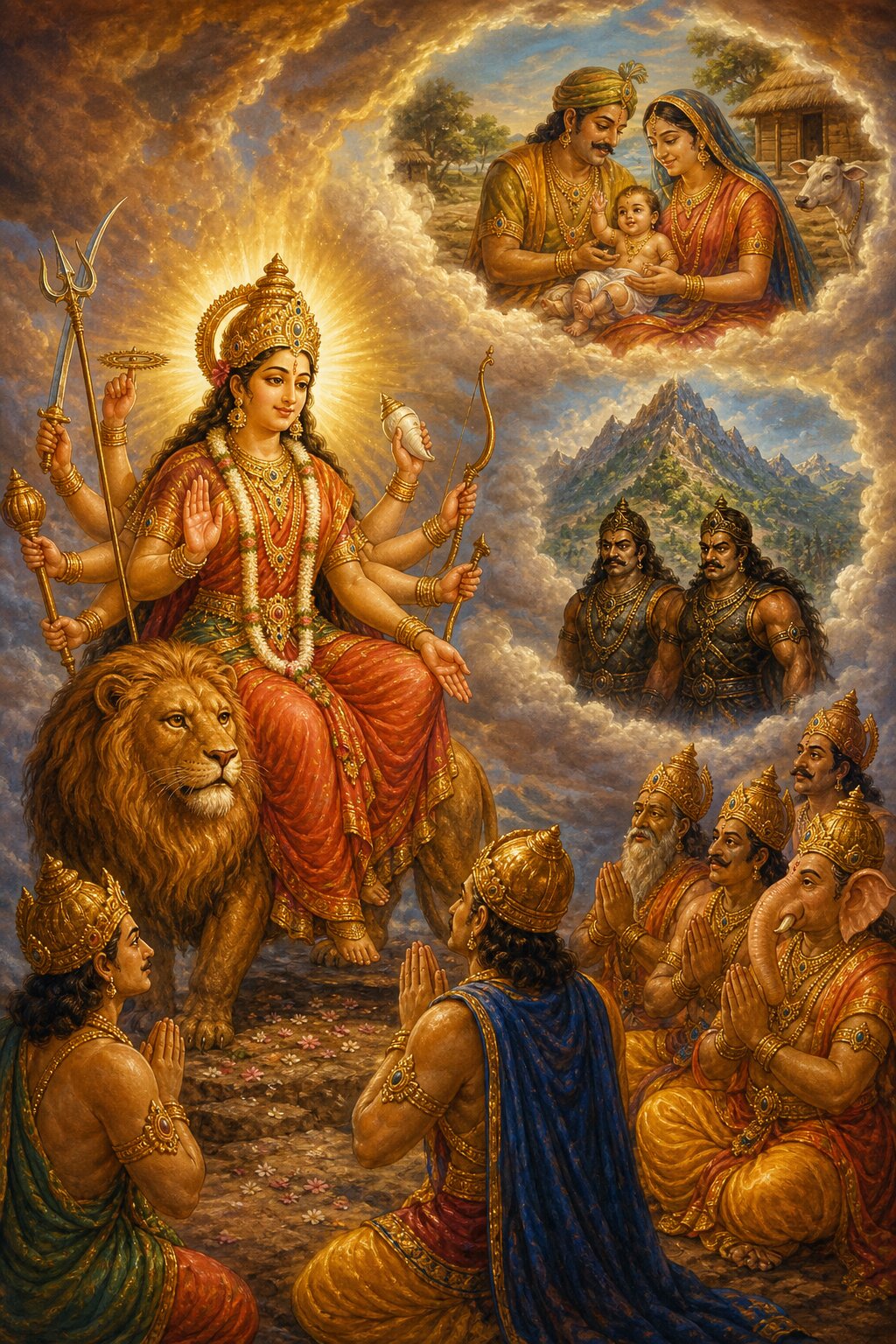
Moved by a request that reached for nothing, the Devi began to tell them of the descents still ahead of her. When the twenty-eighth age arrives in this present cycle, the Manvantara of Vaivasvata, she said, two more great asuras will be born, and they too will carry the names Shumbha and Nishumbha. I will take birth then in the house of Nanda the cowherd, from the womb of Yashoda, and dwelling in the Vindhya mountains I will destroy them both. This is the Yogamaya whose story runs alongside the birth of Krishna, the goddess those hills have honored ever since as the lady of the Vindhyas.
40 · 41 · 42
After that, she said, I will come down to the earth again in a form more savage still, and I will kill the danavas born of the line of Viprachitti. As I devour those fierce ones, my teeth will redden until they look like pomegranate blossoms, that exact red, vivid against white. From then on the gods in heaven and men on the earth will name me, over and over, Rakta-dantika, the goddess of the red teeth.
43 · 44 · 45
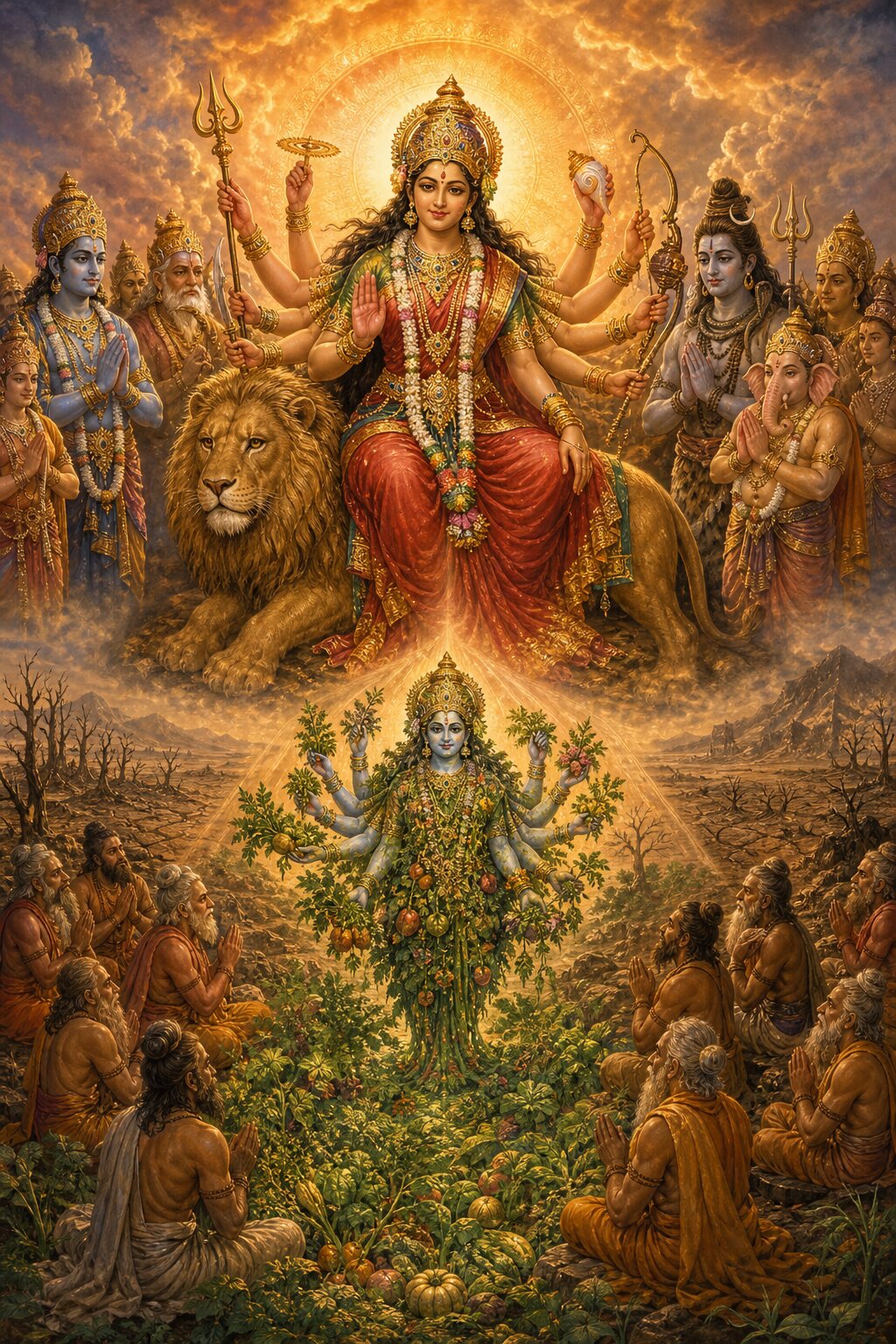
Then, she went on, in a hundred-year drought when not a drop of water is left anywhere on the earth, the sages will praise me, and I will appear without being born from any womb. I will look upon those sages out of a hundred eyes, a gaze wide enough to hold every one of them at once, and for that men will call me Shatakshi, the hundred-eyed. And until the rains return, I will feed the whole world with the plants and green herbs that grow from my own body, and every life will hang on them.
46 · 47 · 48
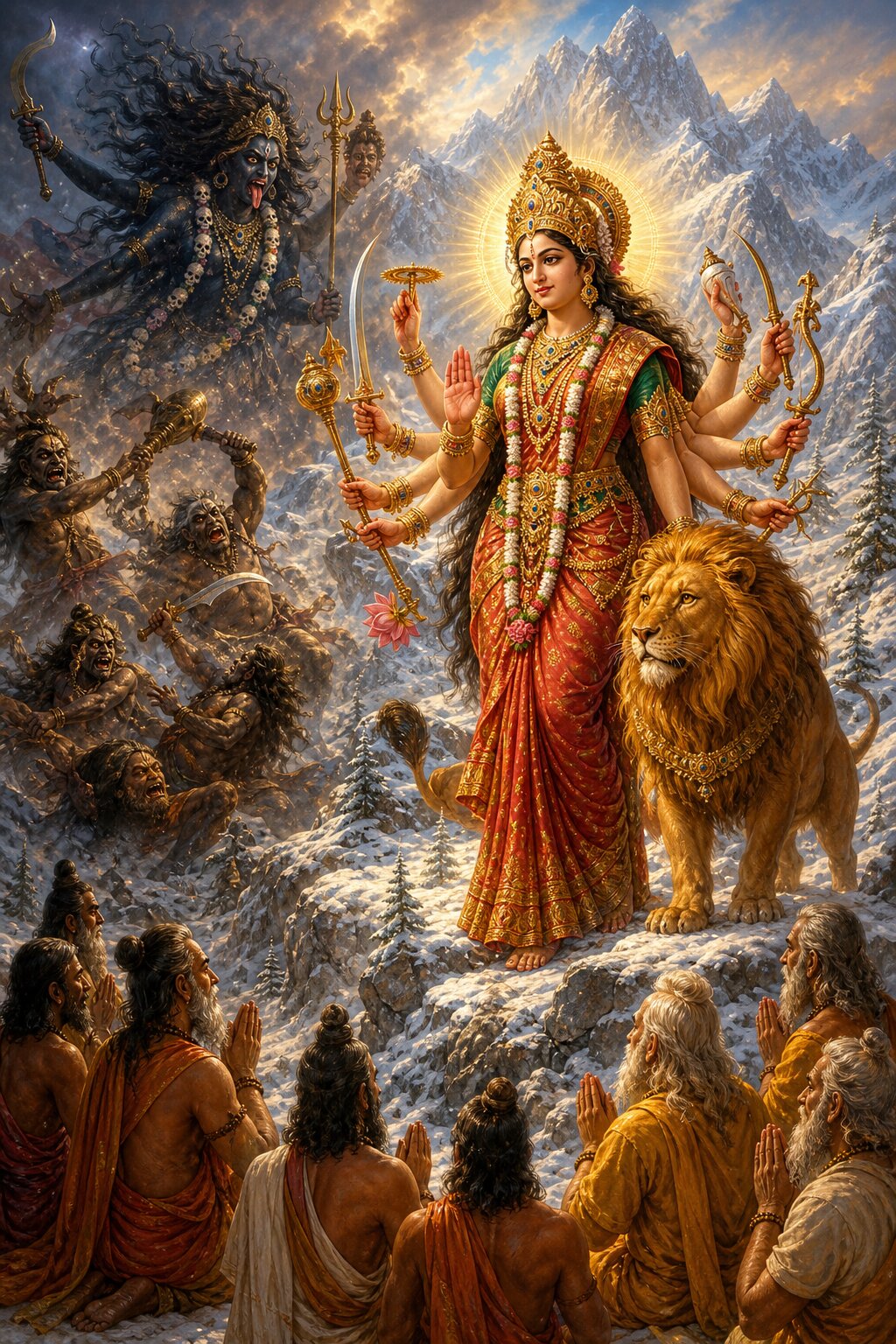
From that, she said, I will become known across the earth as Shakambhari, she who nourishes with herbs. In that very place I will kill the great asura named Durgama, and for that my name will ring out as Durga-devi. Of all the names she foretold that day, that is the one the world took up and never set down. Later, on the Himalaya, I will take a form of sheer terror to guard the sages, she said, and I will devour the rakshasas that hunt them. The sages will bow low and praise me, and that name too will spread, Bhima-devi, the terrible goddess.
49 · 50 · 51
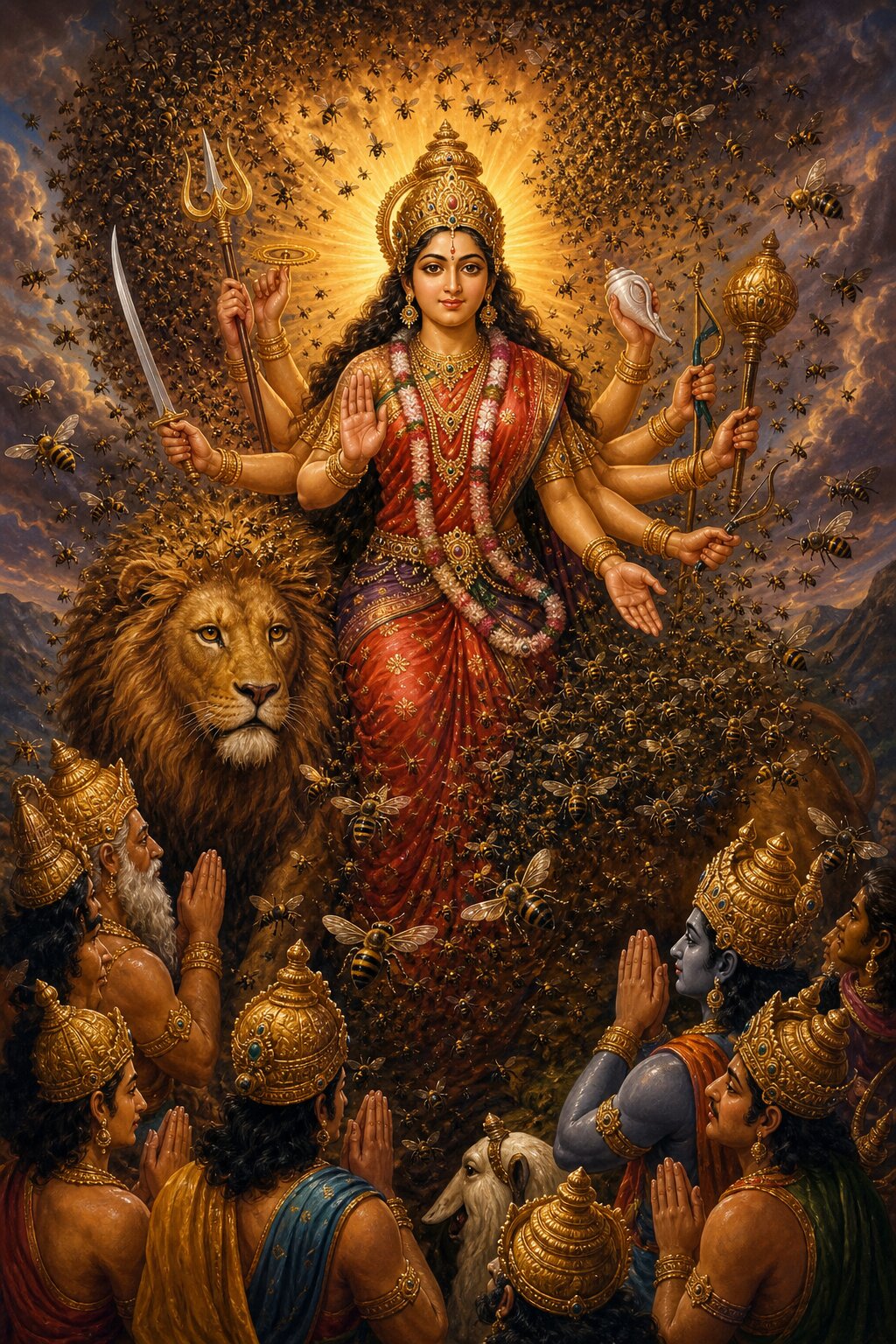
And when an asura named Aruna throws the three worlds into torment, she said, I will take the form of a swarm, a Bhramari body made of countless bees on their six small feet, a darkness of wings filling the sky. For the sake of the three worlds I will kill that great asura, and everywhere people will praise me as Bhramari, the goddess of the bees. Then she spoke the promise that would outlast every age. Whenever an affliction rises out of the danavas, she said, I will descend in that very hour and cut the enemies down. It is the same vow that sounds through the Gita in the words yada yada hi dharmasya, that whenever dharma weakens, the divine descends.
Ahead
Chapter 12 is the phala-shruti, the fruit of the hearing. In it the Devi herself tells the fruit of reciting and hearing this Mahatmya, that whoever listens to it with devotion, the Devi protects them in every calamity.