On this page
Devi Mahatmya
Chapter 13 · The Boons to Suratha and the Merchant · The Conclusion
The sage Medha has told the whole story, and something has stirred awake in King Suratha and in Samadhi the merchant, the two listeners who came to his forest carrying the same wound. They go down to a riverbank, shape the Devi’s image out of wet clay with their own hands, and hold to their tapas for three years. Then the Devi appears before them in person, ready to grant boons: to the king, that he will be reborn from the Sun himself as the eighth Manu, sovereign of the coming manvantara; to the merchant, the knowledge that severs attachment at its very root. Here the whole text comes to its close.
1 · 2
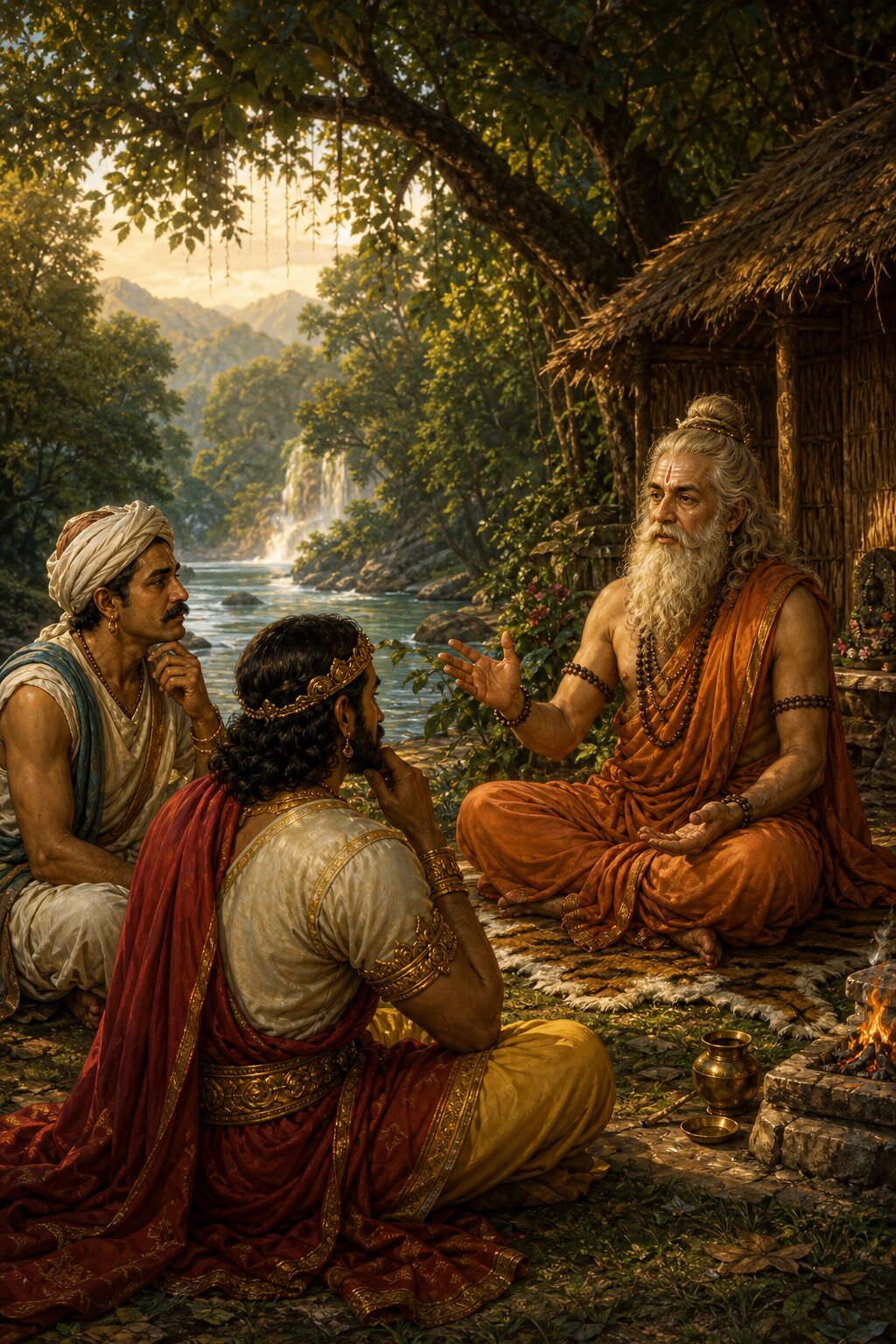
Now the rishi began to draw his whole story toward its end. Three battles had risen and fallen since two ruined men first came to his door, and the ashram, where even the wild animals kept the peace, had gone quiet around the telling. King, he said, this supreme Devi Mahatmya has now been told to you; such is the power of the Devi by whom this whole world is upheld. Then he opened a deeper truth: even what we call vidya, knowledge itself, is fashioned by that same maya of Bhagavan Vishnu. It was the answer they had come for, the answer to why a man stays bound to what he knows has cast him out. So you, this merchant, and other discerning men besides all fall into delusion, have fallen already, and will go on falling.
3
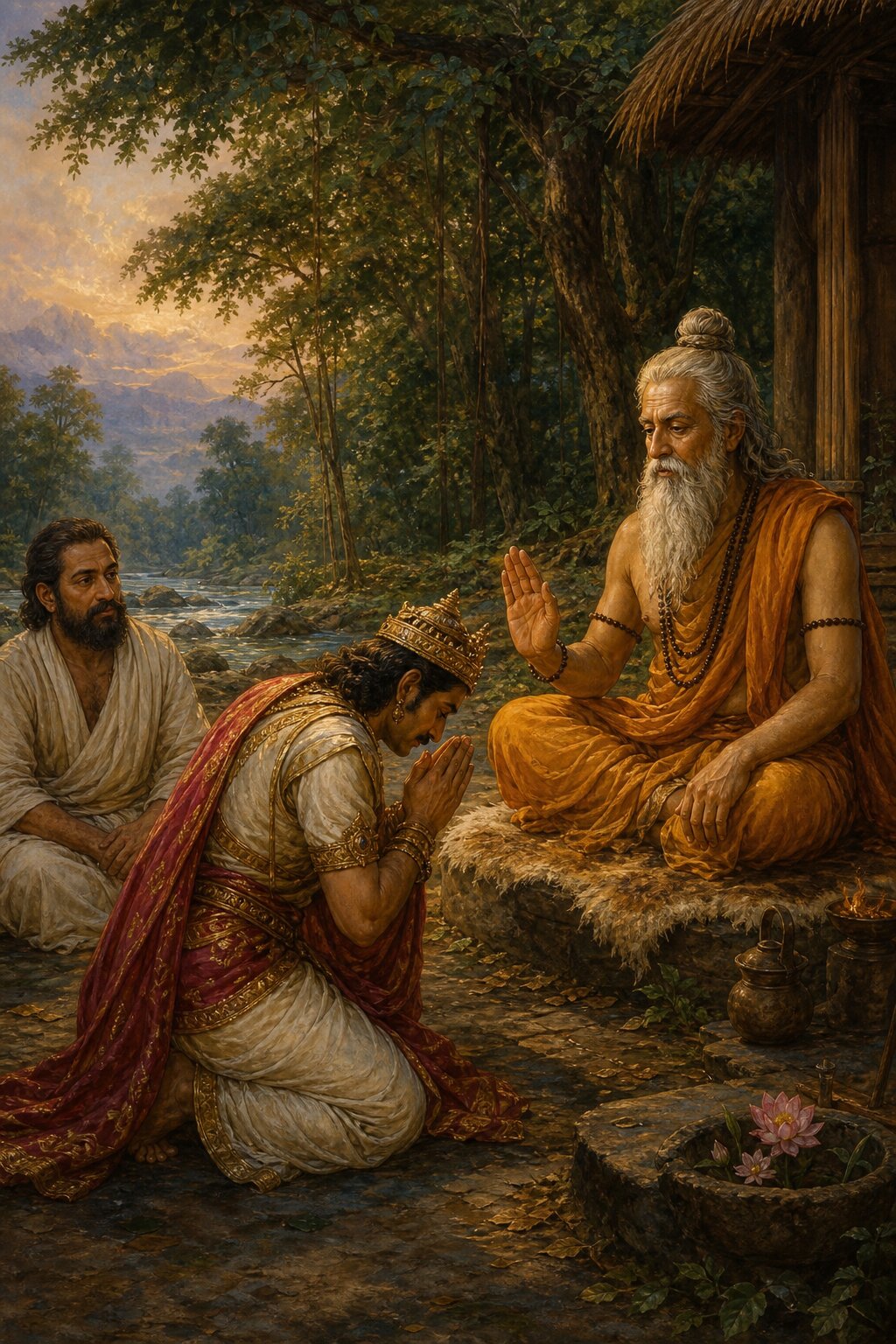
This bond of maya spares not even the wise, and so the rishi delivered his highest teaching. Maharaja, he said, go for refuge to that same Parameshvari. He had told them at the very start that she binds the world into delusion and that she alone, propitiated, releases it; now he told them what a bound man can do. Sought in worship, that Mother herself gives people enjoyment, gives heaven, and gives apavarga, the final liberation, as well. This is the one path, and refuge is its door.
4 · 5
Markandeya says that when he heard the rishi’s words, Suratha, lord of men, bowed low to that muni of firm vows. This was a king who had guarded his subjects as his own children, watched lesser enemies break him in the field, and then lost treasury and army to his own ministers inside his own walls before riding into the forest alone. His heart had already turned from it all, worn by his own fierce clinging and by a kingdom torn from his hands. That very moment he and the merchant set out for tapas.
6 · 7
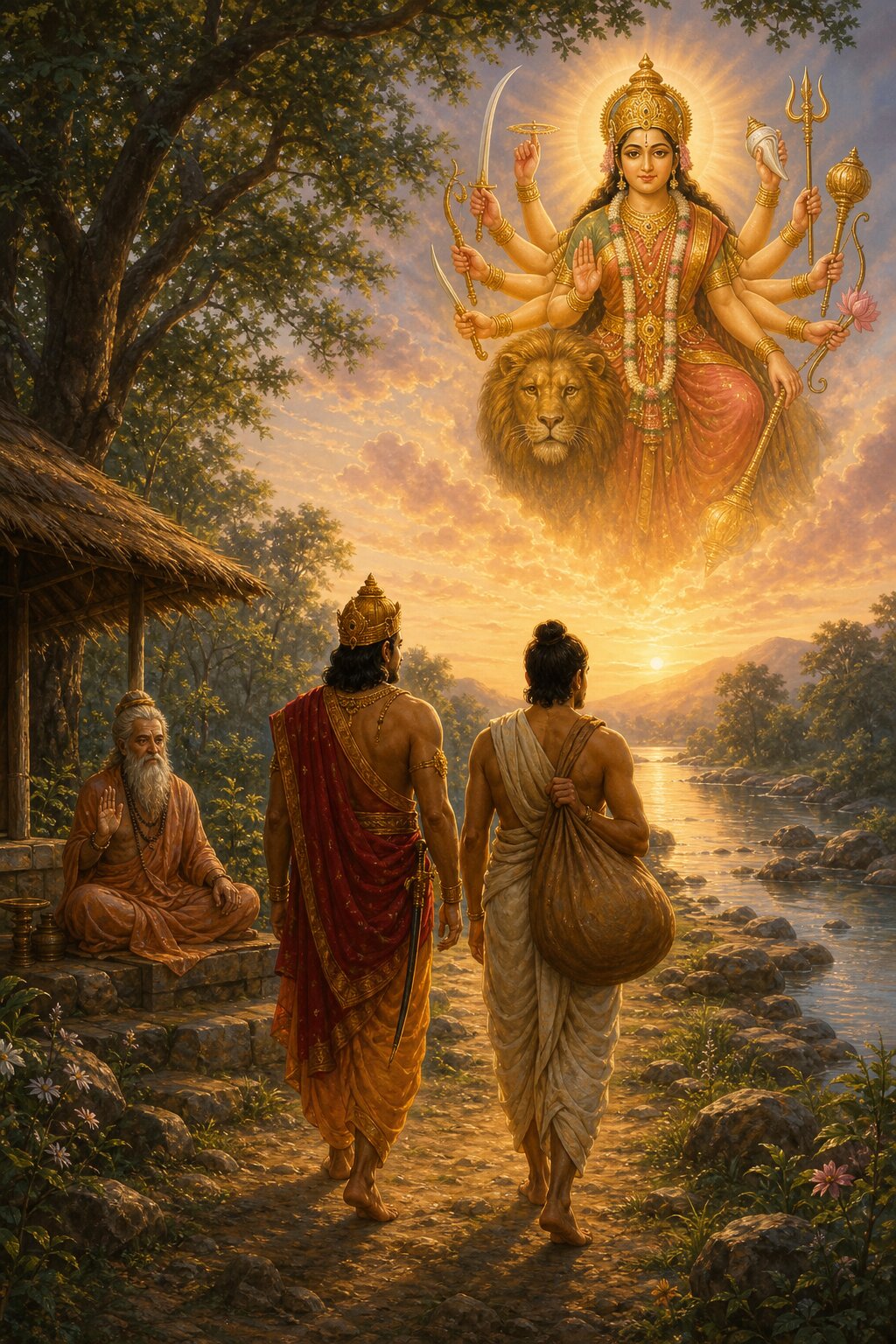
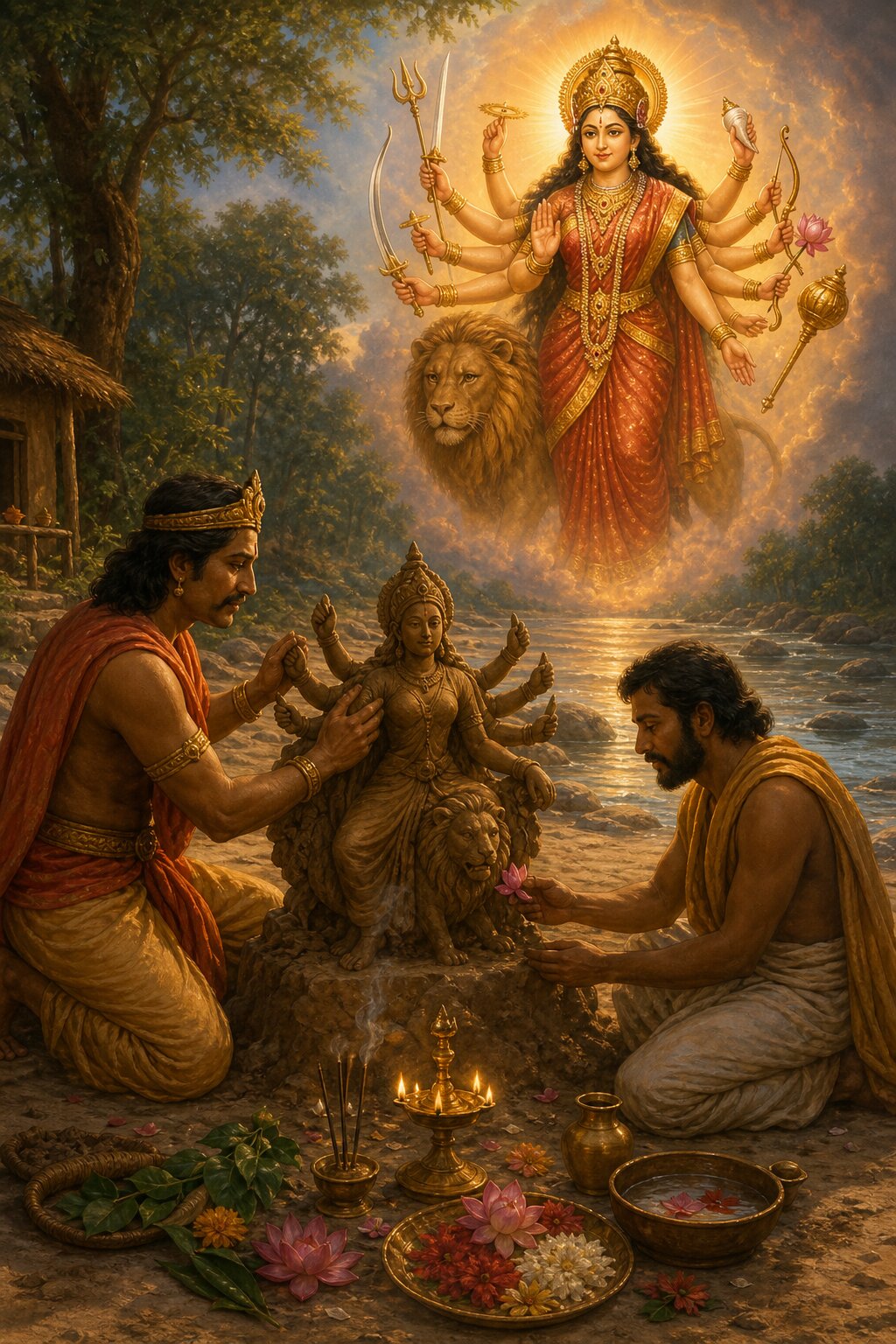
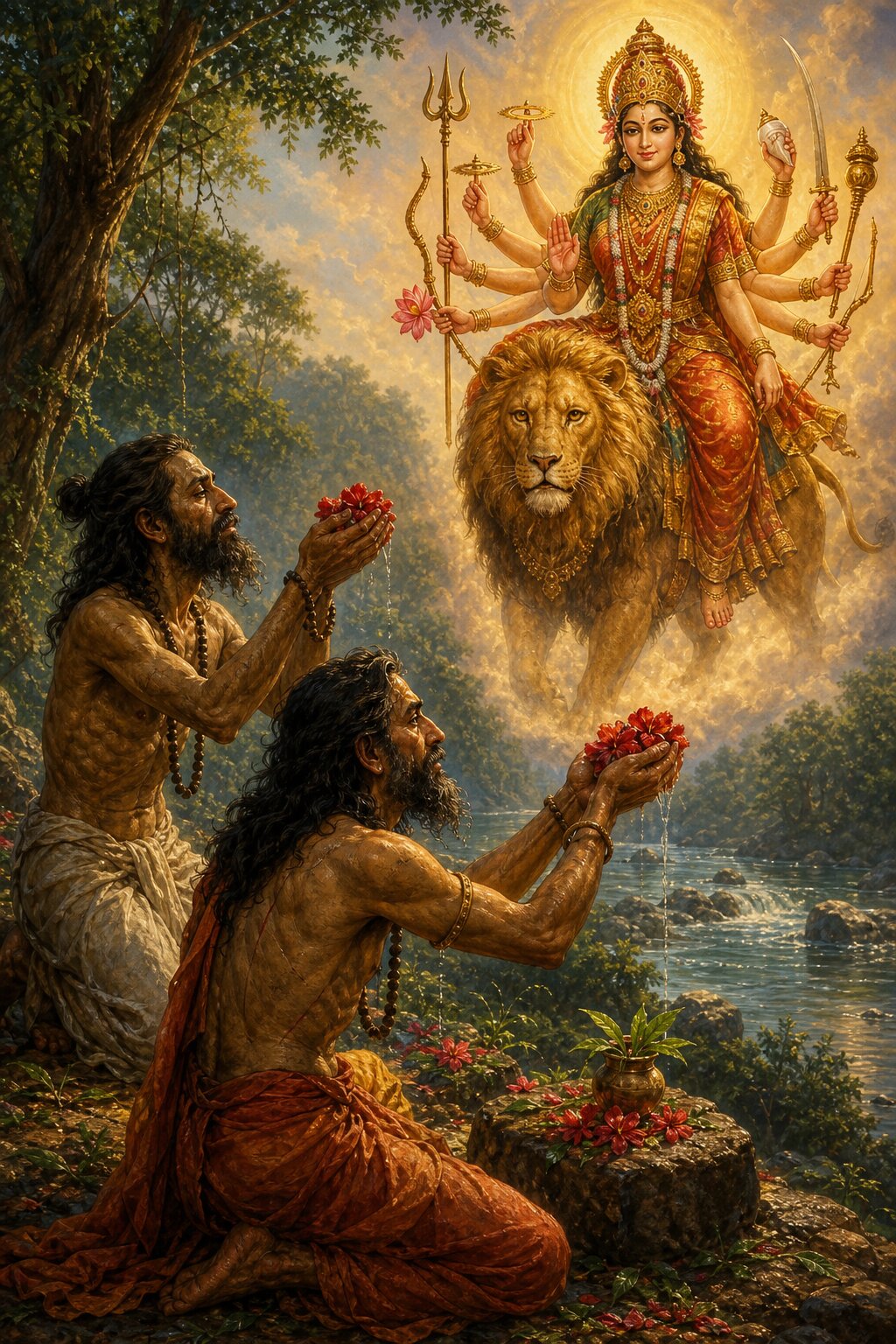
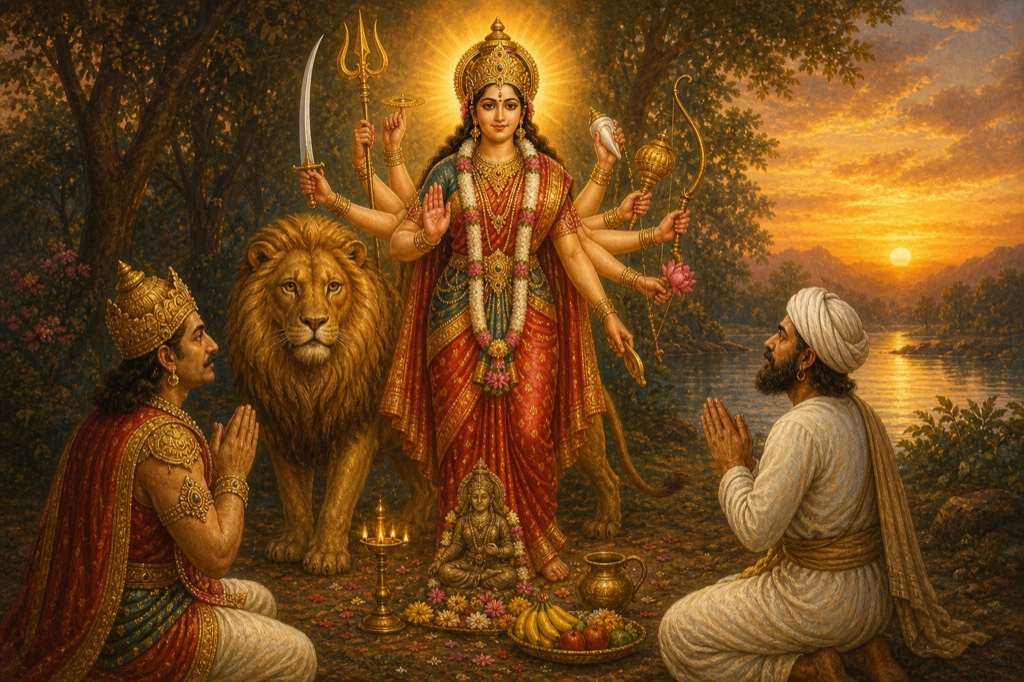
Thirsting for the darshan of Amba, the Mother whose story he had just heard from beginning to end, the merchant settled on the sandbank of a river and began his tapas, reciting the supreme Devi Sukta until the hymn moved on his lips of its own accord. On that same stretch of sand the two shaped an image of the Devi out of river clay, a king’s hands and a merchant’s hands working the same wet earth, and honored it with flowers, incense, fire, and offerings of water. It was as if, into that small figure of clay, they had invited the infinite.
8 · 9
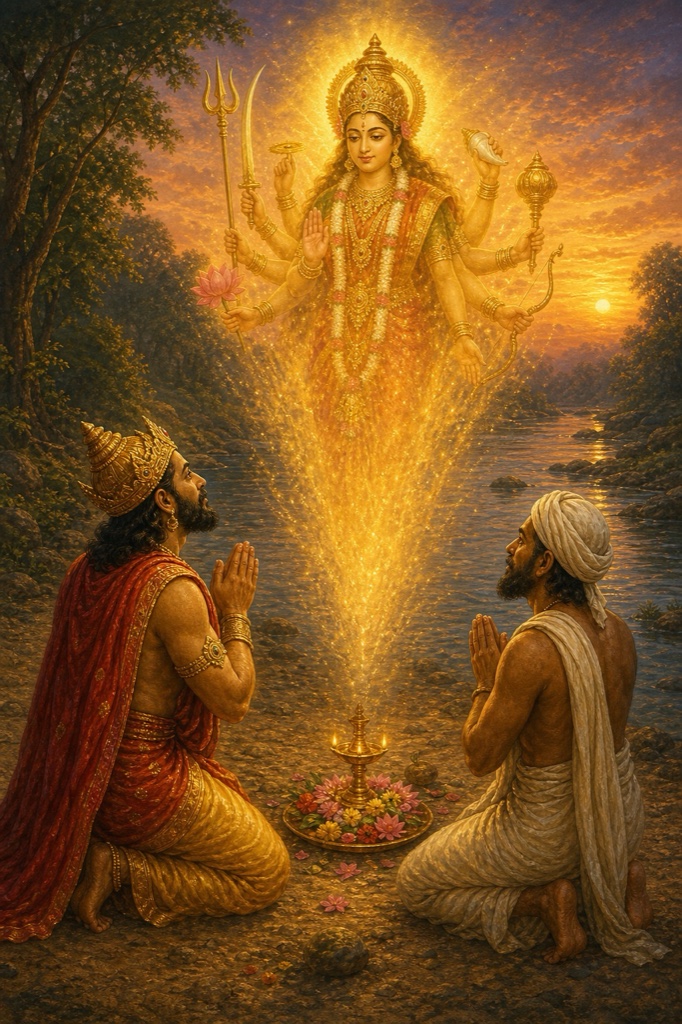
Theirs was a tapas of the severest order. Taking no food, minds reined in, absorbed in the Mother and fixed on her alone, they sat on while the river ran past them day after day. And when the time came to offer, they gave a bali moistened with blood drawn from their own limbs: what tapas was this, ready to surrender the very body. Three years passed in that adoration, the two restrained seekers and the clay Mother between them, until Chandika, upholder of the world, was well pleased with them, and appearing before them in person, she spoke.
10 · 11
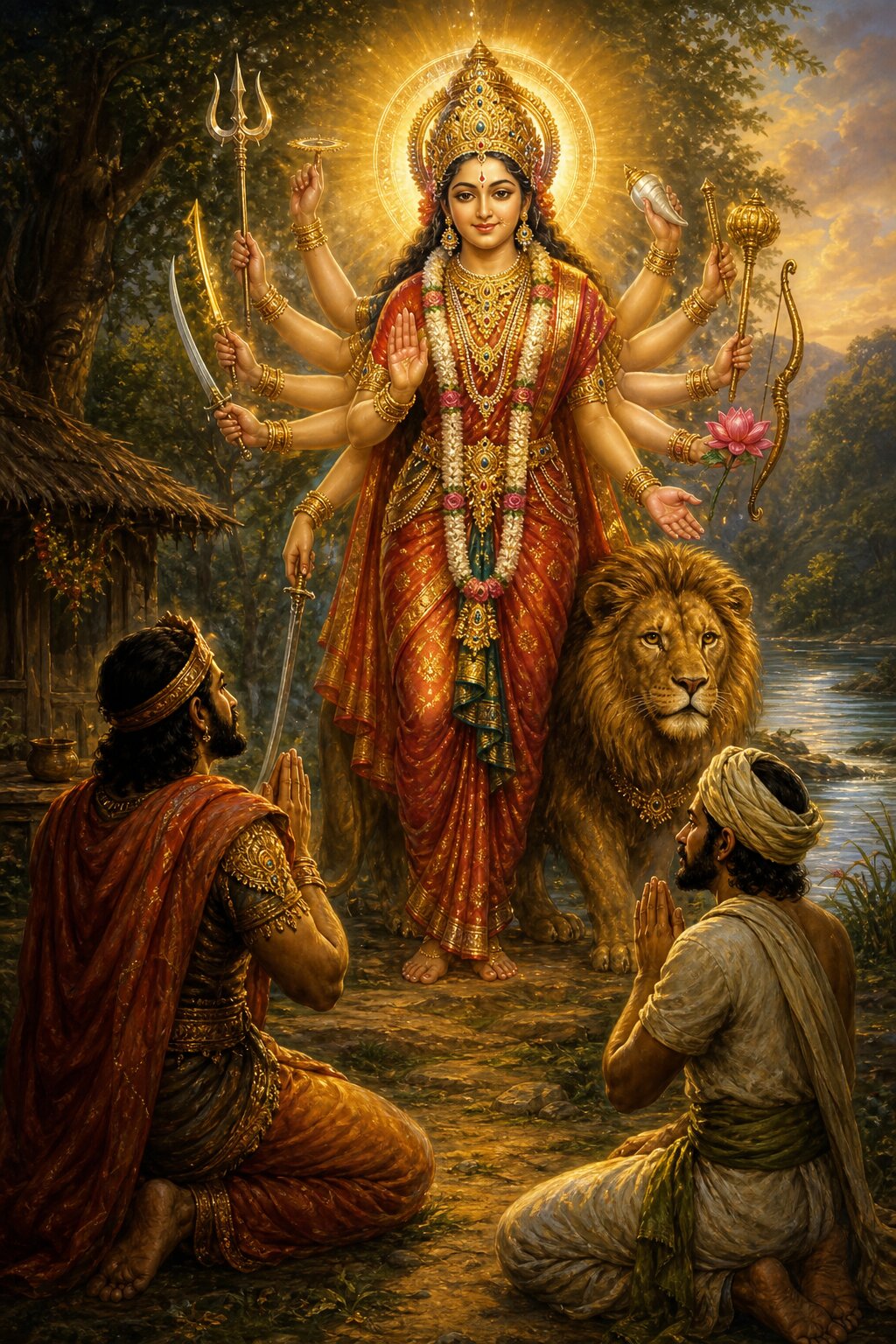
The Devi spoke, and her voice was full of affection: King, and you, delight of your line, whatever the two of you wish to ask, ask it all of me; well pleased, I shall grant it to you. Markandeya says the king then chose his boon: a kingdom in his next birth that could never slip from him, and in this very life his own kingdom back, its enemies’ forces uprooted by force. Three years of hunger and offered blood, and the first wish that rose in him was the wish he had carried into the forest.
12 · 13
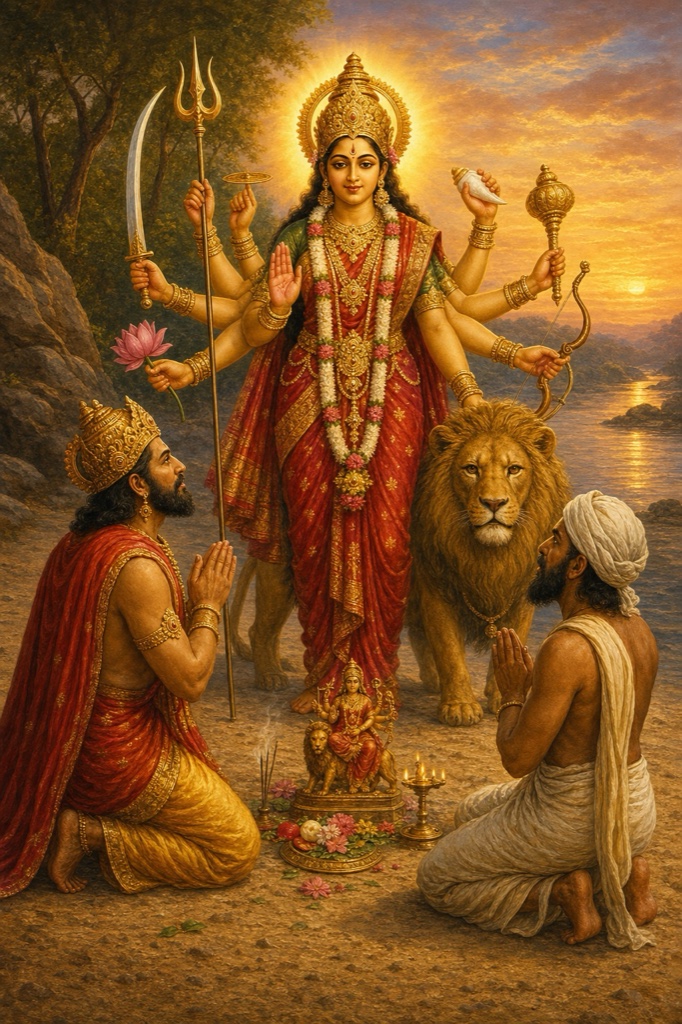
The king, detached though he had grown, still ended by asking for a kingdom. The merchant’s gaze rested elsewhere. He had come to the forest aching for the wife and sons who threw him out of his own house, and after three years on the sand he wanted that ache pulled out at its source. World-weary in mind, that wise man passed over kingdom and enjoyment alike and asked for knowledge, the precise knowledge that cuts the clinging of “I” and “mine” at the root. And she refused neither of them. To the king the Devi said: King, within a few days you will hold your kingdom again; your enemies slain, your rule there will stand firm and unshaken.
14 · 15
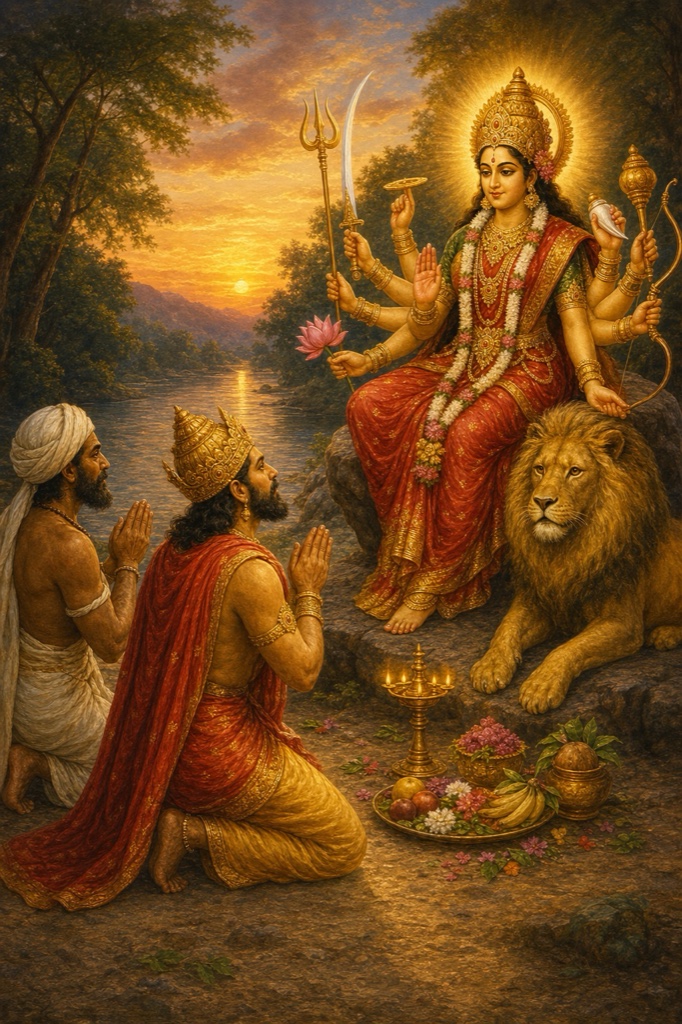
Then the Devi unrolled the king’s future beyond this body. When this life ends, she said, you will take birth again from the deva Vivasvan, the Sun, and on this earth you will rise as Savarnika, the eighth Manu, sovereign of the manvantara to come, the long world-age that will bear your name. With that sentence the frame of the whole book closed: the telling had opened with a promise to relate how the Sun’s son Savarni became the eighth Manu, and the answer had been sitting on a river sandbank all along, a beaten king with clay drying on his hands. Then she turned to the merchant: O best of merchants, the boon you sought from me, I grant you; for your complete attainment, that very liberating knowledge will be yours.
16 · 17
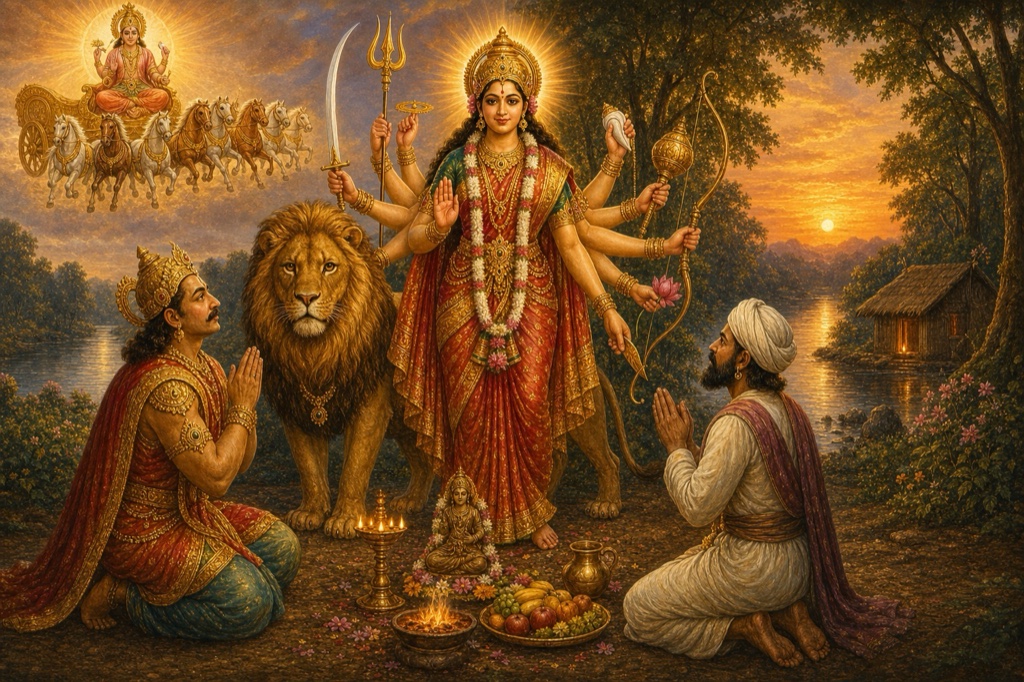
Markandeya says that having granted the two of them the boons they longed for, and even as their devoted praise still rose to her, the Devi vanished that very instant, leaving the river, the sandbank, and the small clay image that had held her. So, having won his boon from the Devi, Suratha, best of Kshatriyas, will take birth from the Sun when this body ends and become the Manu named Savarni; within days the king will hold his throne again, and the merchant, still seated on the open sand, will feel the old ache of “I” and “mine” loosen and fall away. Here the whole Devi Mahatmya comes to its rest. Om Shri Durgayai Namah.
The Devi Mahatmya complete, at a glance
Thirteen chapters, seven hundred shlokas. It opens with a beaten king and a cast-out merchant, and with the question of why Mahamaya casts even the wise into delusion. Then come the three charitas: Madhu and Kaitabha slain through Vishnu once the Devi releases him from her sleep, Mahishasura slain by the Devi born of the gathered radiance of the devas, and Shumbha and Nishumbha slain by Kaushiki, who emerged from the sheath of Gauri’s body, and then by the seven Matrikas. Each time the Devi remains eternal; she only becomes manifest. At the end, Suratha and the merchant each receive from the Devi the boon their own heart had chosen, and each boon is granted whole.
The text’s famous promise comes in shloka 11.51, “ittham yada yada badha danavottha bhavishyati, tada tadavatiryaham karishyamy ari-sankshayam.” That is: whenever trouble arises from the danavas, then and then again I shall descend and destroy the enemies. It is the Mother’s standing vow to the world, and the echo of the Gita’s “yada yada hi dharmasya”, whenever dharma weakens, is heard right here.