On this page
Devi Mahatmya
Chapter 2 · The Birth of the Goddess and the Slaying of Mahishasura’s Army · Middle Charita
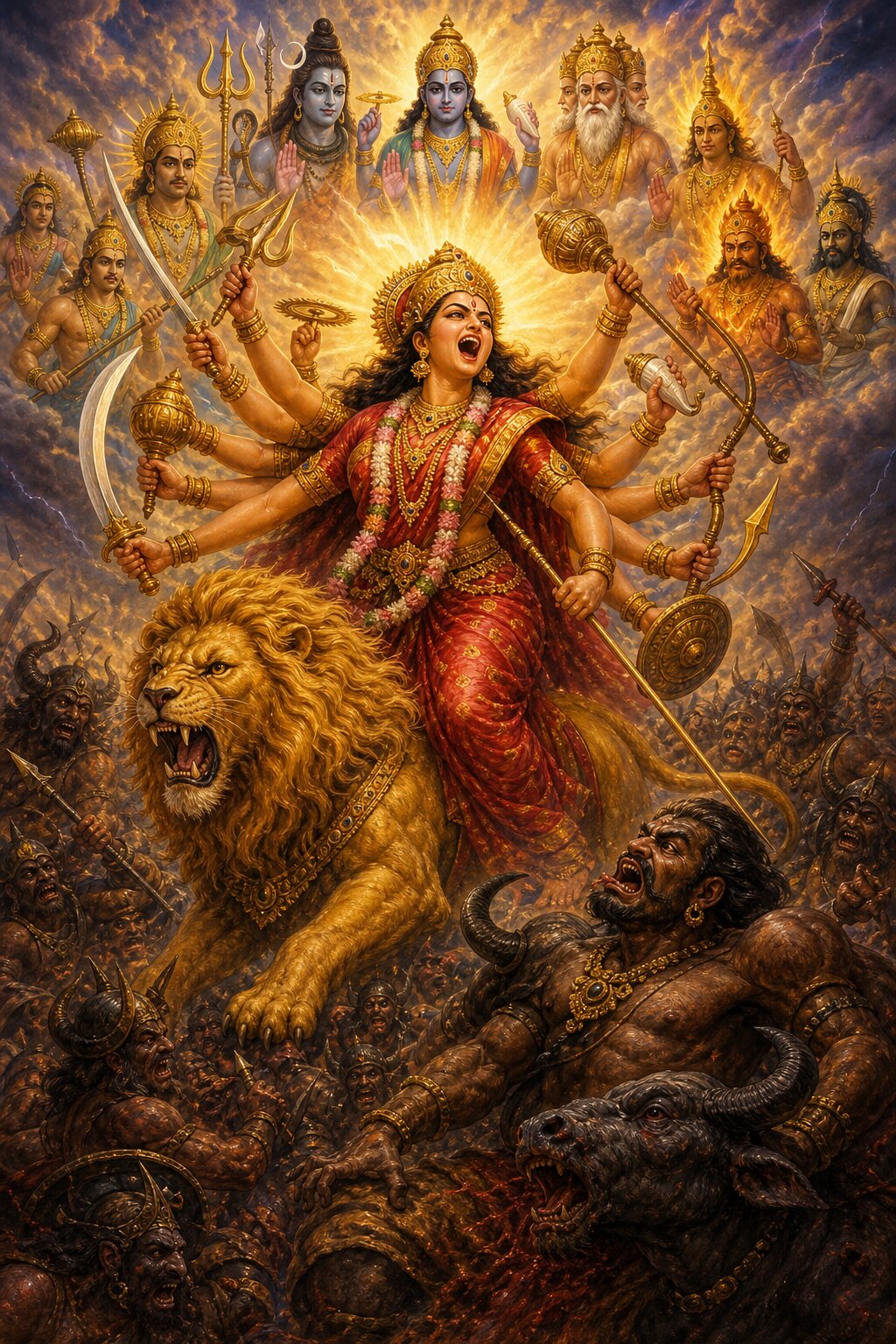
For a hundred full years the war between gods and asuras burned, and at its end Mahishasura climbed onto Indra’s throne, an asura seated in the seat of heaven itself. The beaten gods put Brahma at their head and went for refuge to Vishnu and Shiva. At the telling of their ruin the brows of both listeners hardened, and from the faces of the three gods a vast splendor broke forth. The splendor of every god flowed together into one mass, blazing like a mountain on fire, and out of that blaze a goddess took form, every limb of her body the gathered power of a god. Each god offered her his own weapon, and mounted on a lion she loosed a roar so terrible that all three worlds shuddered. This chapter is her birth, and the world’s first sight of her.
1 · 2
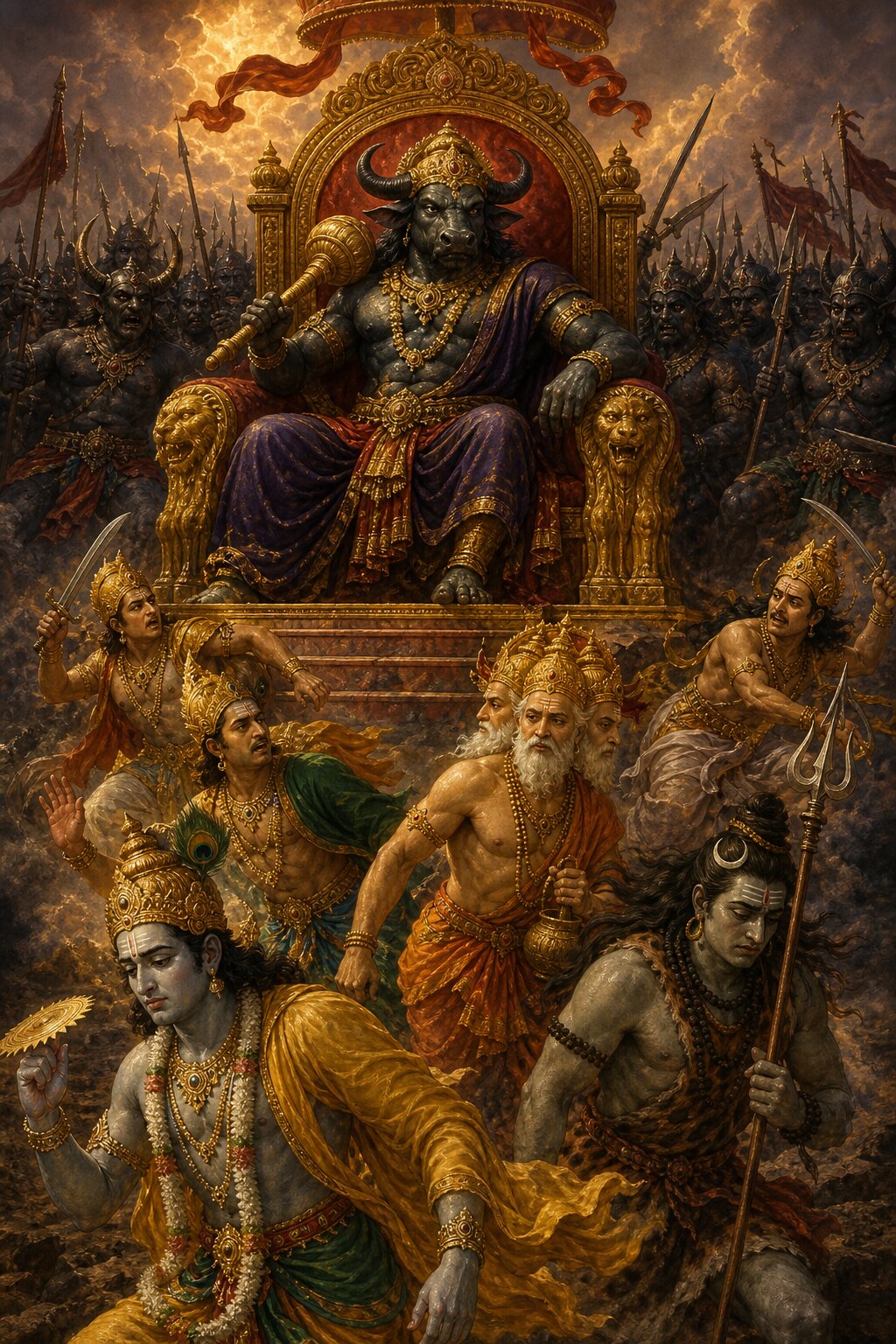
The rishi says: this is a tale of very ancient days. Between the gods and the asuras a savage war burned for a full hundred years, Mahishasura, overlord of the asuras, on one side, and Purandara Indra, breaker of enemy citadels and lord of the gods, on the other. A hundred years, and heaven lost. In that struggle the army of heaven broke before the mighty asuras and went down in defeat, and having conquered every god there was to conquer, Mahishasura himself sat down in Indra’s place, an asura wearing the office of the king of heaven.
3 · 4 · 5 · 6
Then the defeated gods placed the lotus-born Prajapati Brahma at their head and went to where Shiva and Vishnu sat. Before the two of them they laid out everything, exactly as it had happened, each move of Mahishasura and the whole measure of their own downfall. They told how Mahishasura now wielded alone the offices of Surya, Indra, Agni, Vayu, Chandra, Yama, and Varuna, and of every other god besides, one usurper doing duty as sun and rain and fire and death, the whole administration of the universe pulled into a single pair of hands. Cast out of heaven, the entire company of gods now wandered the earth like ordinary mortals, gods in name and wanderers in fact.
7 · 8 · 9
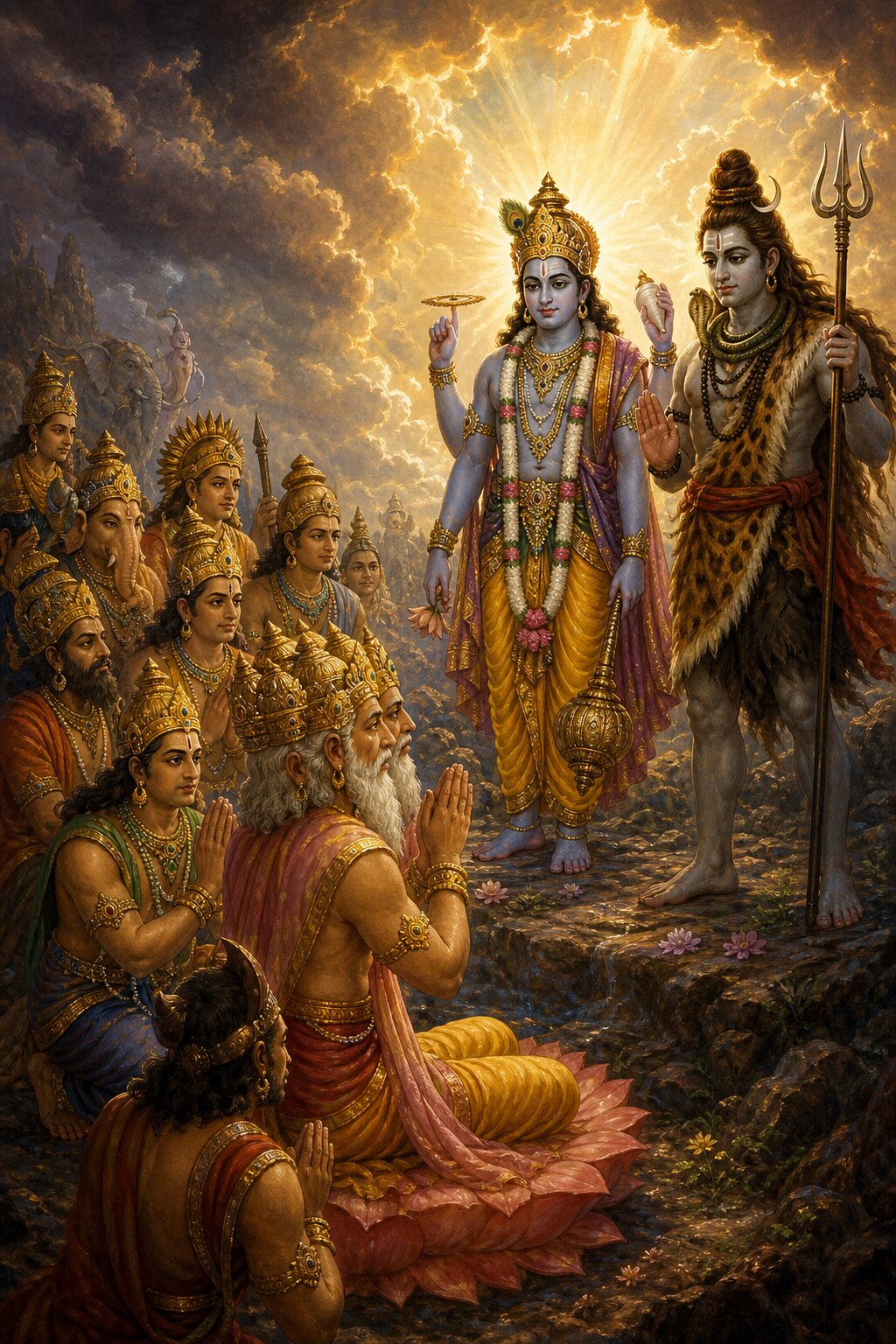
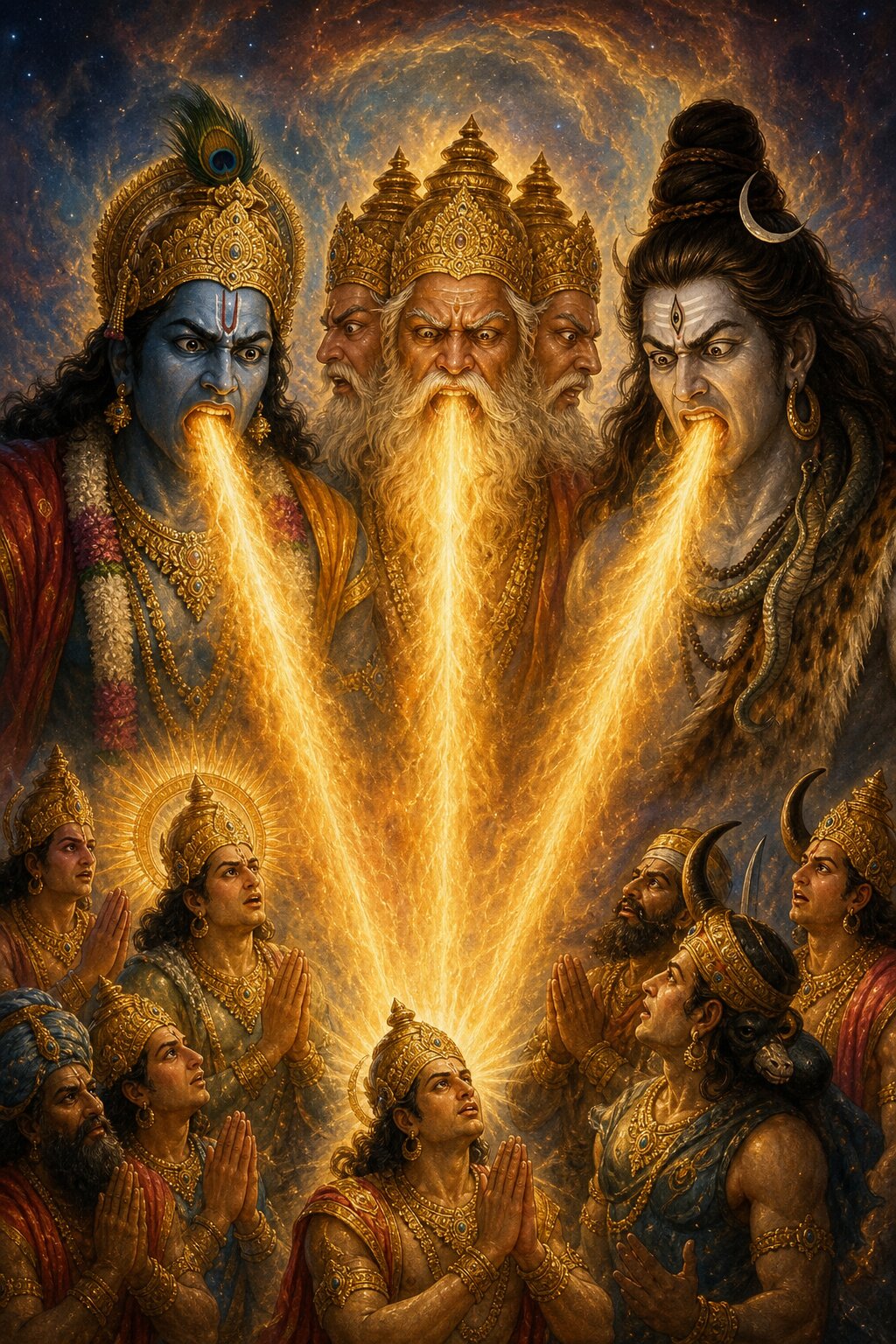
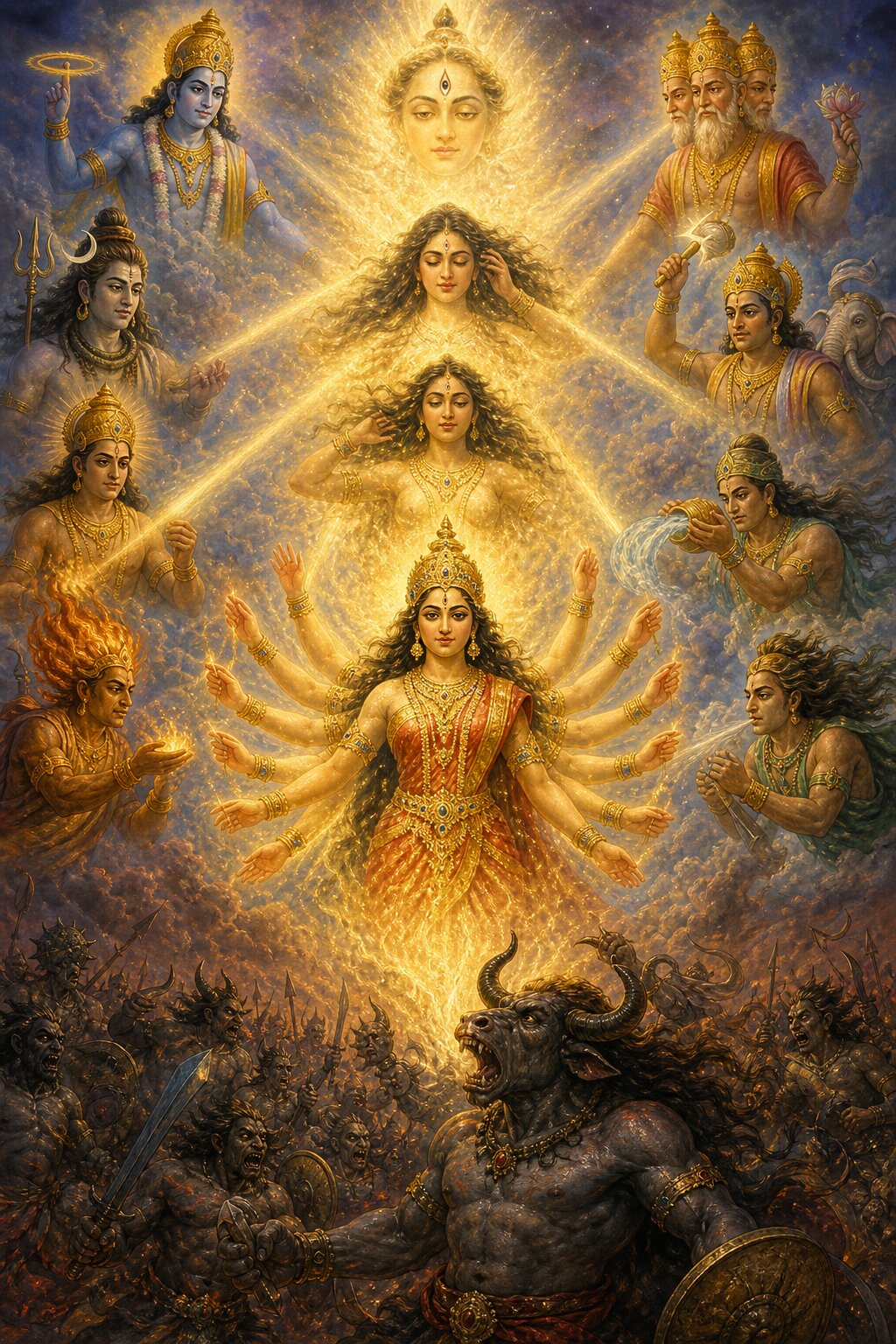
Having told all these doings of the enemy of the gods, they folded their hands: we have come to your shelter; now think of some way to slay this Mahishasura. At those words the faces of Madhusudana Vishnu and Shambhu Shiva twisted with anger, and their brows drew taut. What happened next no god had planned. From the face of the discus-bearing Vishnu, brimming with a wrath too great for one body to hold, and with it from the faces of Brahma and Shankara, a great splendor burst forth and kept coming, light with heat and mass in it. Here anger itself became the cause of creation.
10 · 11 · 12
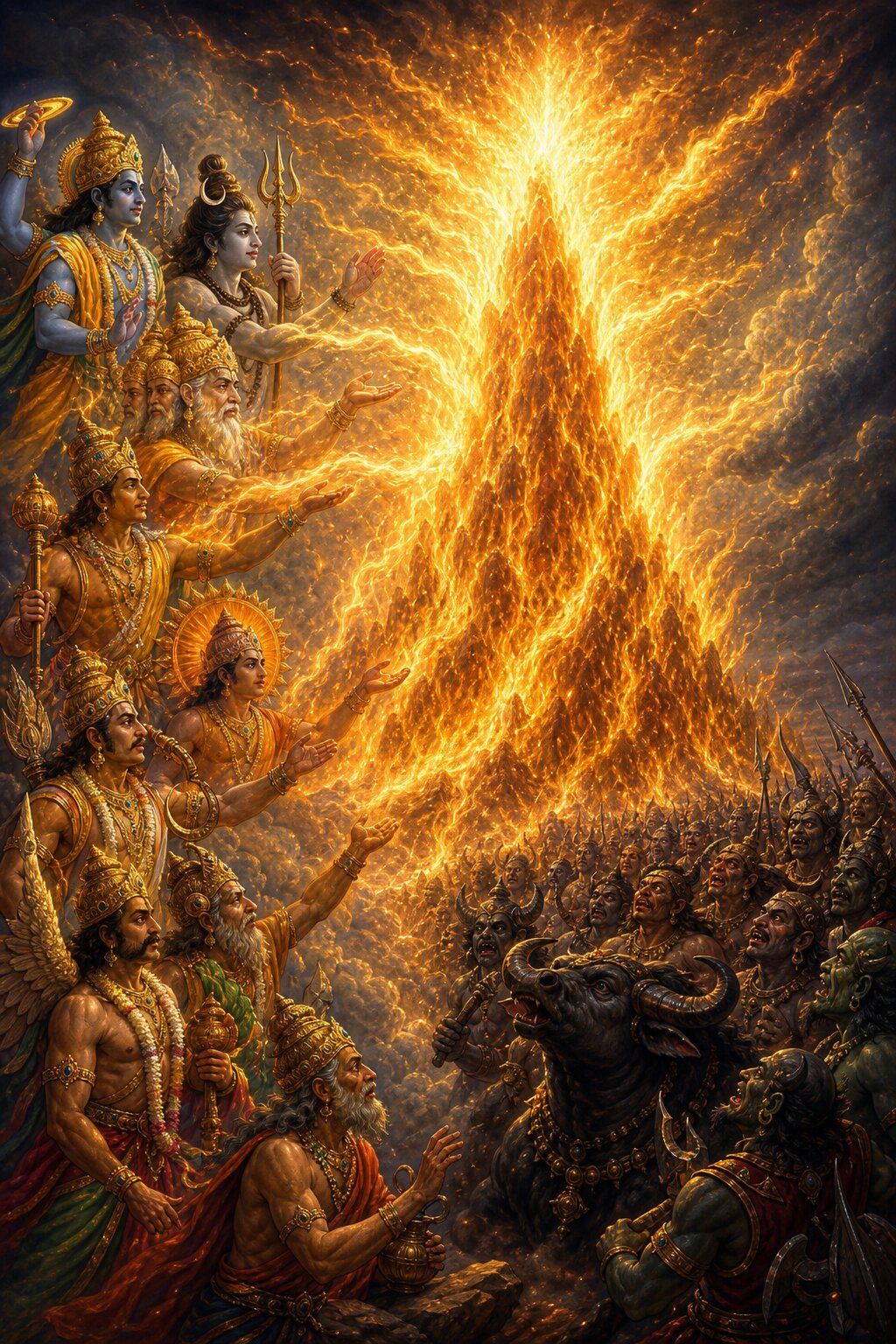
From the bodies of Indra and the other gods too a mighty splendor came forth, from every god who had lost a throne and an office, and all of it flowed together into one. The gods stood back and watched that mass of blazing splendor rise like a mountain on fire, its flames filling every quarter of the sky and making their own diminished bodies look like shadows. Then the matchless blaze, born of the bodies of all the gods together, gathered into one place and settled into the figure of a woman, a single form holding the massed strength of every god at once, her radiance flooding the three worlds. What no single god had managed to be, she now was.
13 · 14 · 15
Now the splendor of each god shaped one part of the goddess, and the tally reads like a map of heaven. From Shambhu’s splendor her face took form, from Yama’s her thick, flowing hair, and from Vishnu’s her arms. From the Moon’s splendor came her twin breasts, from Indra’s her waist, from the splendor of Varuna, lord of the waters, her calves and thighs, and from the earth’s own splendor her hips. From Brahma’s splendor came her feet, from Surya’s the toes upon them, from the splendor of the Vasus the fingers of her hands, and from Kubera’s splendor her nose.
16 · 17 · 18
From Prajapati’s splendor the goddess’s teeth were made, and from Agni’s her three blazing eyes, fire itself looking out of a face formed from Shiva’s light. From the splendor of the two twilights, the hinge-hours of dawn and dusk, came her brows, from Vayu’s her two ears, and from the splendor of the remaining gods every other limb, until nothing of heaven had been left out of her, and so the wholly auspicious Kalyani stood complete. When the gods so long tormented by Mahisha looked on her, formed from the massed splendor of them all, and saw their own surrendered light looking back at them as a living being, joy swept through them.
19 · 20 · 21
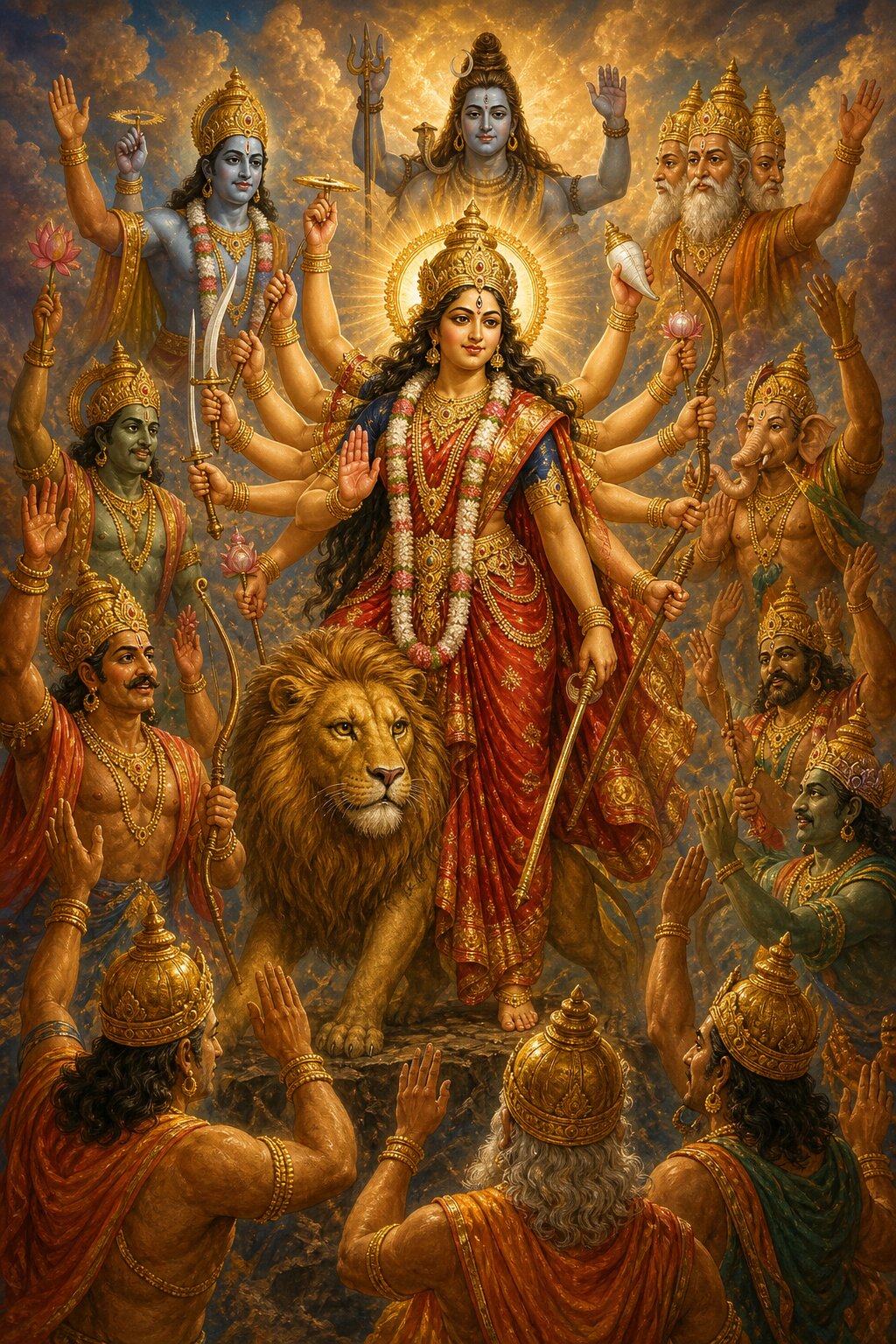
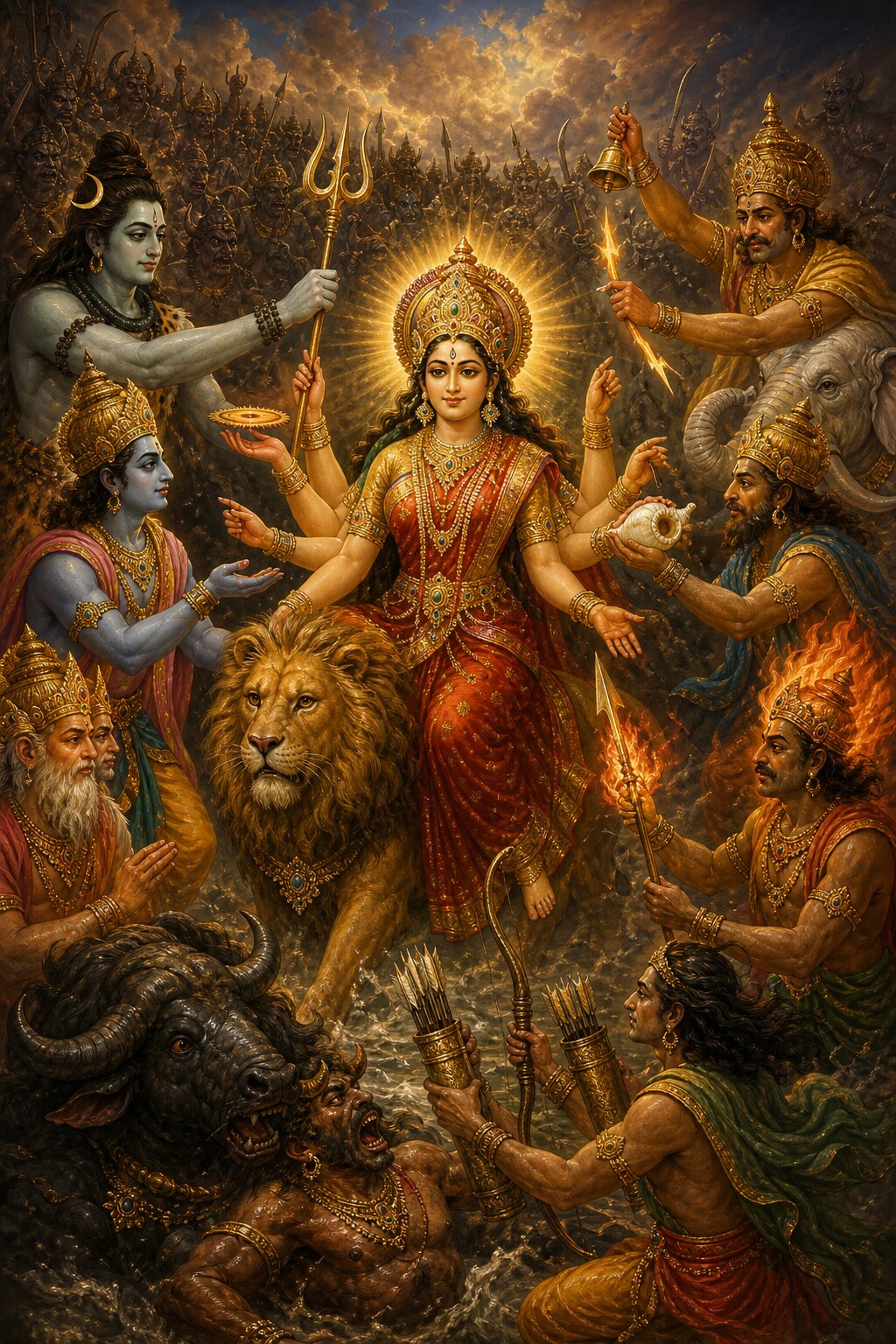
Then, longing for victory, the gods armed her, each from his own hand, and raised the cry of triumph high. And the giving had a strangeness in it: no god handed his weapon away and stood empty. Shiva, bearer of the Pinaka, drew a second trident out of his own trident and gave it, and Krishna spun a fresh discus from the discus at his own finger and offered that; each original stayed where it had always been, and its double went to her. Varuna gave a conch, the sea’s own war-horn, Agni gave a spear, and Vayu a bow with two quivers packed full of arrows.
22 · 23 · 24
Thousand-eyed Indra, sovereign of the immortals, struck a thunderbolt from his own vajra and gave it, and from his great elephant Airavata came a bell, so that even her music in battle would be heaven’s. Yama gave a staff drawn from the very staff of death with which he closes every life in its season, Varuna gave a noose, Prajapati a rosary of beads, and Brahma a water pot, gifts of prayer laid down among the weapons. Divakara the sun poured his rays into every pore of the goddess’s skin, clothing her in light from within, and Kala, Time himself, offered a sword and a stainless shield.
25 · 26
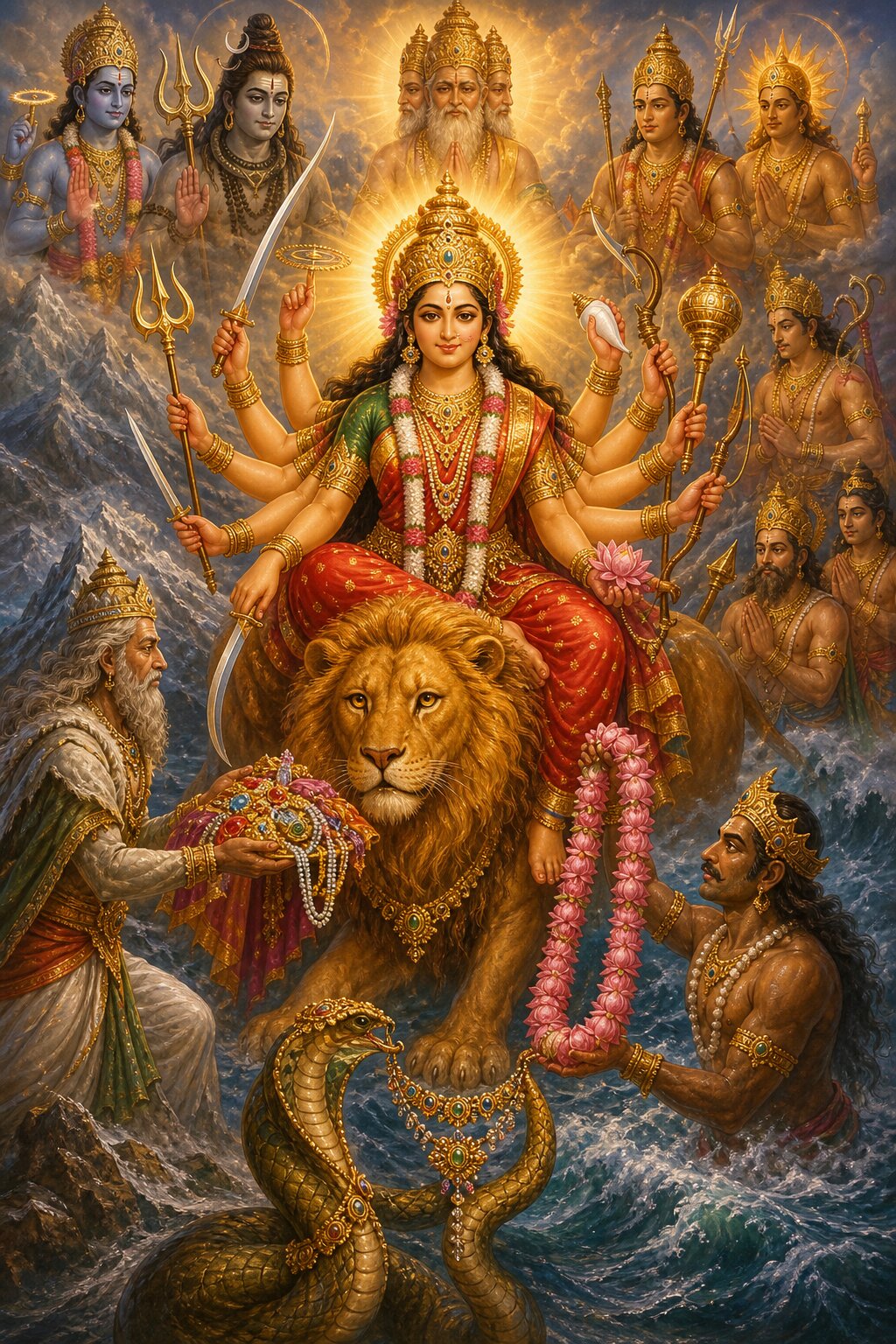
The ocean of milk, the white deep from which Lakshmi herself once rose, gave the goddess a necklace that would never dim and garments that would never wear thin, a divine crest-jewel, earrings, and bracelets. It gave a bright half-moon besides, armlets for every arm, spotless anklets, a peerless collar for her throat, and jeweled rings for every finger, and the goddess stood adorned from crown to foot, dressed by the sea as for a wedding and armed by heaven as for a war.
27 · 28 · 29
Vishvakarma, craftsman of the gods, who builds their palaces and forges their chariots, gave a battle-axe of flawless polish, weapons of many forms, and armor no blade could pierce. The sea offered the goddess lotus garlands that would never fade, one for her head and one for her breast, and with them a single lotus of surpassing beauty. Himavan, king of mountains, gave the goddess her mount, a lion, along with jewels of many kinds, and so the beast that will carry her through every battle to come walks into the story as a mountain’s gift. And Kubera gave a drinking cup that never runs dry of wine.
30 · 31
Shesha, lord of all serpents, who carries this earth upon his hoods, gave the goddess a serpent-necklace set with a great jewel. Beyond all these, still other gods honored her with ornaments and weapons, until there was nothing left in the three worlds worth the giving. Then the goddess, arrayed in every particular, answered all of it, the gifts, the hopes, the waiting war, with the first sound that was wholly her own: a fearsome roar loosed again and again, rolling with wild laughter.
32 · 33 · 34 · 35
That dreadful roar filled the whole sky and pressed outward past it, and an echo vast beyond measure rang back, as though space itself had answered her. All the worlds shuddered at it, the seas heaved in their beds, the earth swayed, and every mountain shook from root to summit. The gods, brimming with joy, cried victory to the rider of the lion, and the sages, their bodies bowed low in devotion, began her praise. And far away, seeing the three worlds so shaken, the asuras, enemies of the gods, read the sound rightly as a challenge, mustered their entire army, and rose for battle with weapons lifted.
36 · 37 · 38
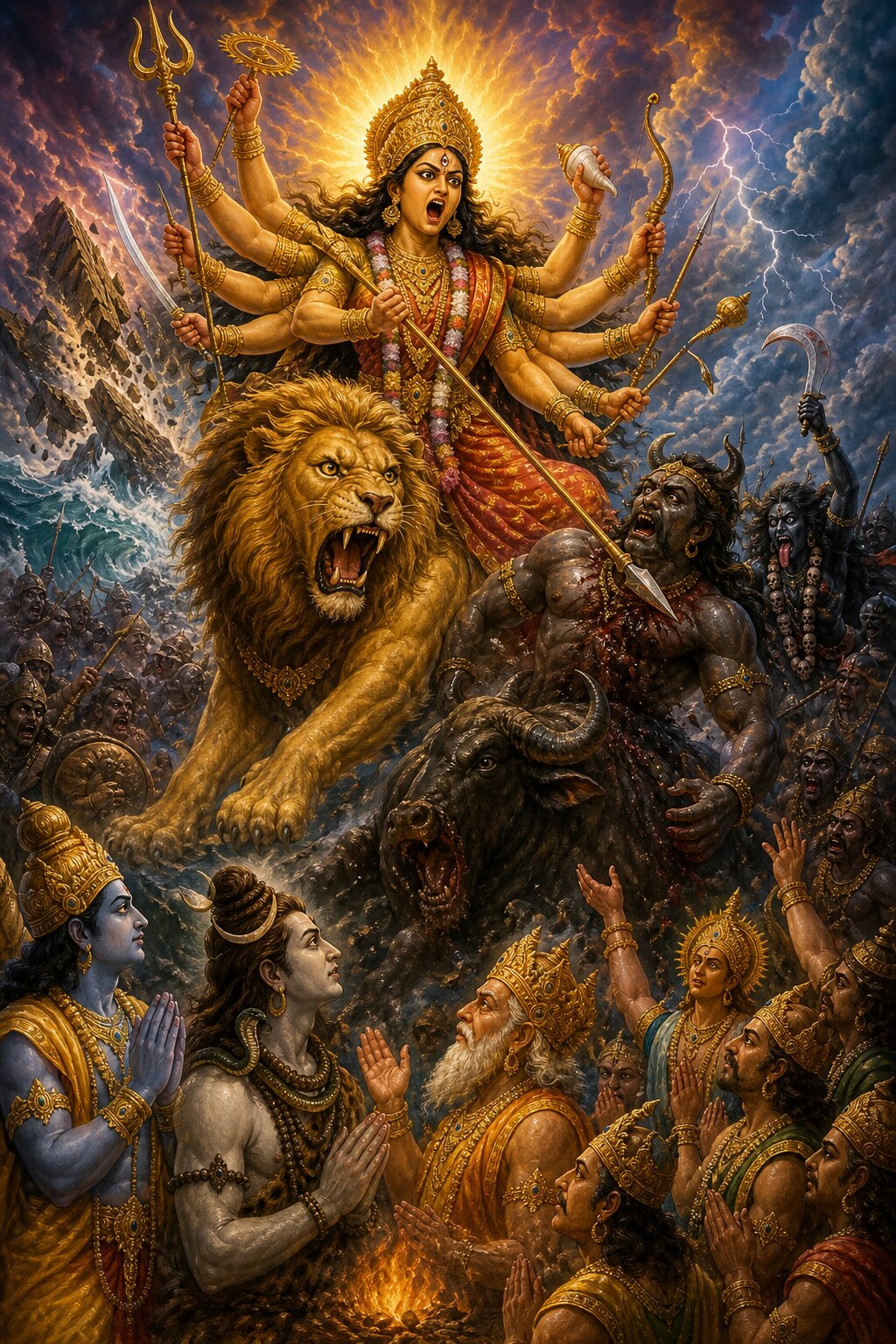
At that roar Mahishasura flared into rage. Ah, what is this, he cried, and rushed toward the sound itself, ringed by the whole host of asuras. Then he saw her, and the sight answered more than his question: the goddess whose radiance filled the three worlds, under whose tread the earth bowed low, whose crown grazed the vault of the sky. The twang of her bowstring alone convulsed the netherworlds to their depths, and with a thousand arms she stood filling every direction at once, so that wherever an asura looked, she was already there.
39 · 40 · 41
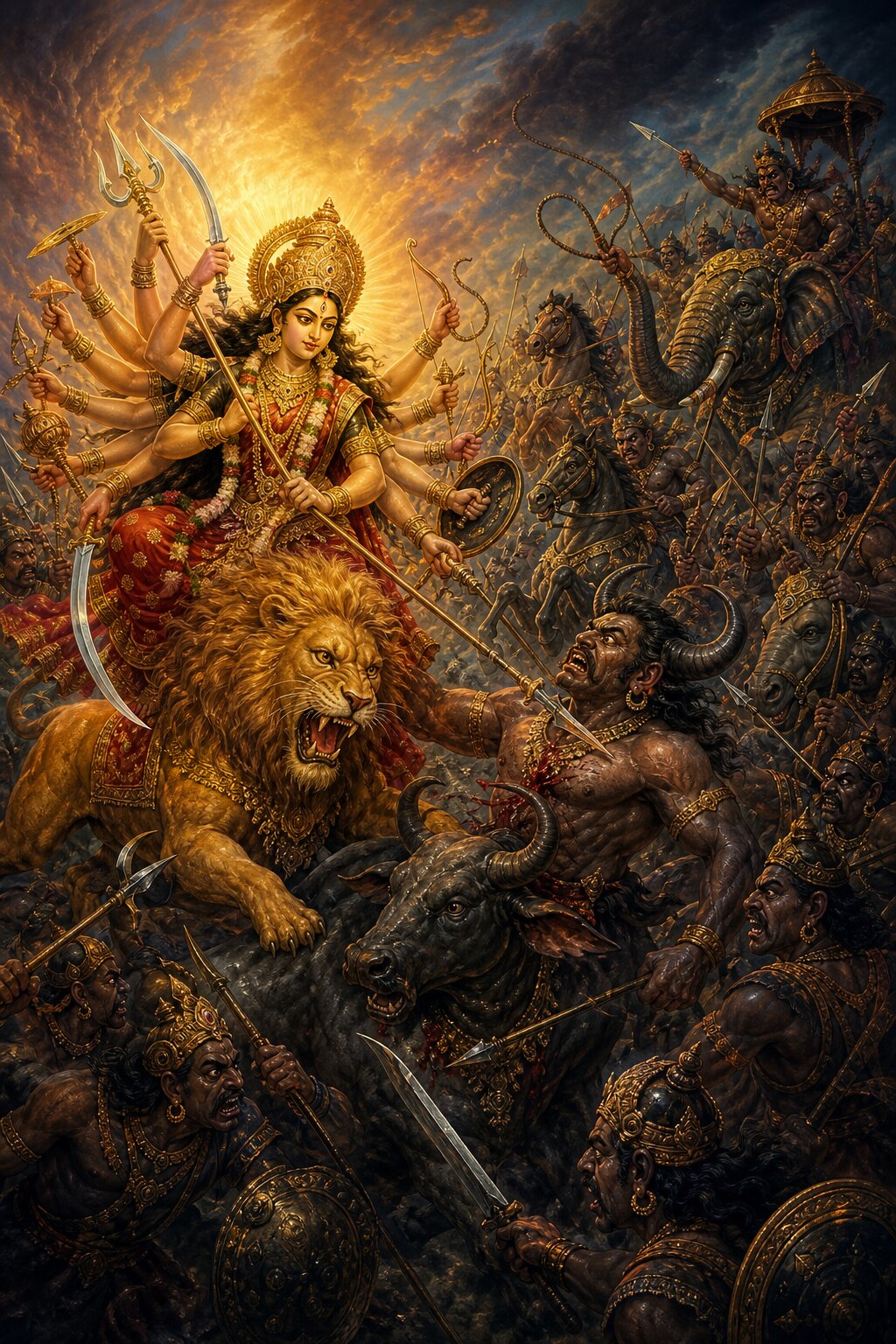
Then a great war broke open between the goddess and those haters of the gods, and the quarters of the sky blazed with the weapons and missiles flung from every side. Chikshura, the great asura who served as Mahishasura’s general, and Chamara with other asuras came at the goddess with a fourfold army, chariots, elephants, horsemen, and foot soldiers advancing as one. A great asura named Udagra fought with sixty thousand chariots, and Mahahanu with a host of ten million.
42 · 43 · 44 · 45
The great asura Asiloma took the field with fifty million troops, and Vashkala with six million. Ugradarshana, ringed by many thousands of elephants and horses and by ten million chariots, fought hard through that battle. Bidalaksha joined the struggle ringed by five billion chariots, and the asura Kala fought on, ringed by five hundred thousand chariots and as many foot soldiers. The numbers climb past anything a mind can picture, and still they were about to mean nothing.
46 · 47 · 48 · 49
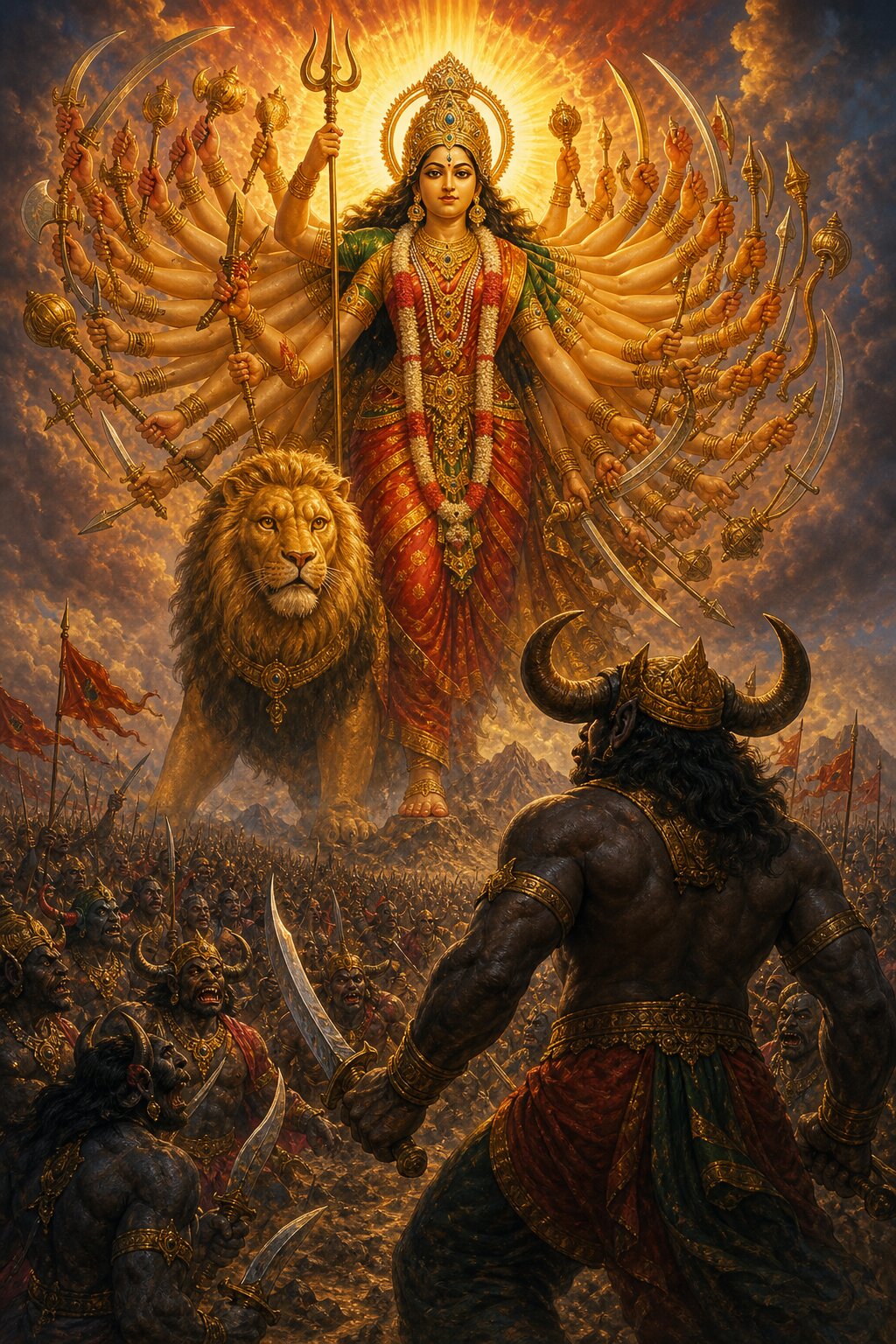
Many more great asuras, each ringed by tens of thousands of chariots, elephants, and horses, threw themselves against the goddess. Mahishasura himself stood fixed at the heart of the field, ringed by chariots, elephants, and horses in the untold thousands of ten million times ten million. The asuras came down on the goddess with tomaras and bhindipalas, with spears and musalas, with swords, axes, and pattishas, every shape that iron takes when it is forged for killing. Some hurled their spears, some cast nooses to drag her down, and some closed in to finish her with strokes of the sword, the armory of a world converging on one woman.
50 · 51 · 52
And the goddess Chandika cut every weapon and missile of theirs to pieces as if at play, shearing them out of the air while she rained down her own. No strain touched her face. Gods and rishis sang her praise overhead while she worked, and the Ishvari, unhurried, kept pouring weapons and missiles onto the bodies of the asuras the way a cloud pours rain. And her mount the lion, roused to fury, shook out its mane and moved through the asura armies the way fire moves through a summer forest, leaving the same silence behind it.
53 · 54 · 55
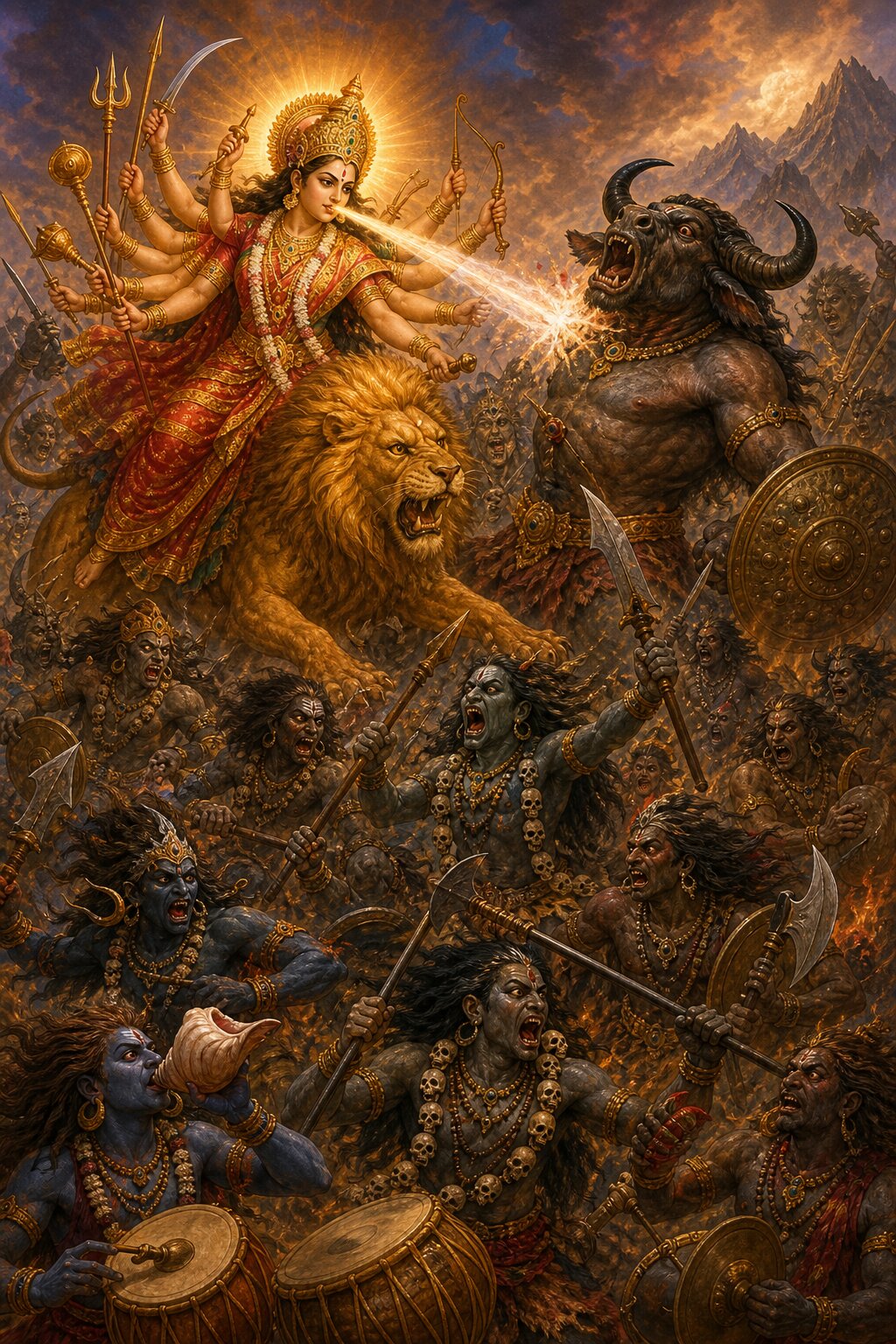
The breaths Ambika released as she fought became, on the instant, ganas by the hundreds and thousands, whole companies of fighters exhaled into being; she had no need to raise an army, she needed only to breathe. Fed by the goddess’s shakti, those ganas set about destroying the asura hosts with axes, bhindipalas, swords, and pattishas. And as they fought, some ganas beat war drums, some blew conches, others sounded the mridanga, drumming the slaughter into rhythm, until that dreadful struggle wore the face of a festival of war.
56 · 57 · 58
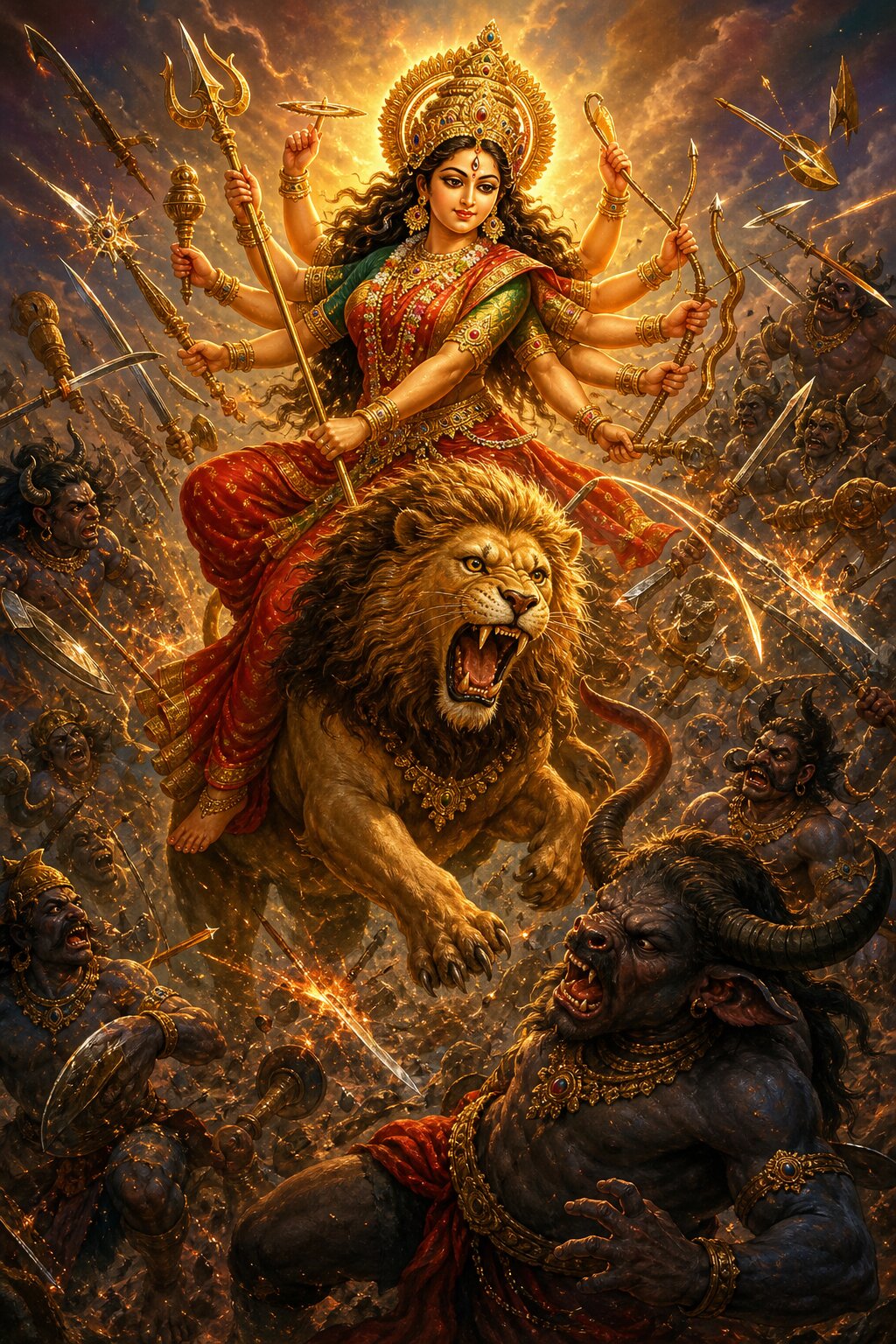
Then the goddess cut down great asuras by the hundreds with trident, mace, showers of spears, sword, and the rest, each gift of the gods doing the work its giver had dreamed for it. Some she felled dazed by the mere tolling of her bell, sound alone enough to end them, and others she bound with the noose and dragged across the ground. Some were split in two by keen strokes of the sword, and some, crushed under the falling mace, lay battered on the earth and did not rise.
59 · 60 · 61
Some asuras fell vomiting blood under the battering of the musala, and some collapsed to the ground with spears standing in their chests. Riddled by torrents of arrows, some enemies of the gods gave up their lives on that field, their shaft-filled bodies bristling like thorns. Arms were severed, necks were cut through, heads dropped and rolled, some were torn open down the middle, and still the tide of asuras kept coming.
62 · 63 · 64
Great asuras dropped to the earth with their thighs cut away, and some the goddess split clean down the middle, so that each half was left with a single arm, a single eye, a single foot. And now the battle crossed into the uncanny. Some, their heads already struck off, fell and rose again; headless trunks now, they groped for their finest weapons and fought the goddess on. Other headless trunks, sword, spear, and rishti still in hand, caught the beat of the war drums and began to dance, keeping perfect time with no head left to hear it.
65 · 66 · 67
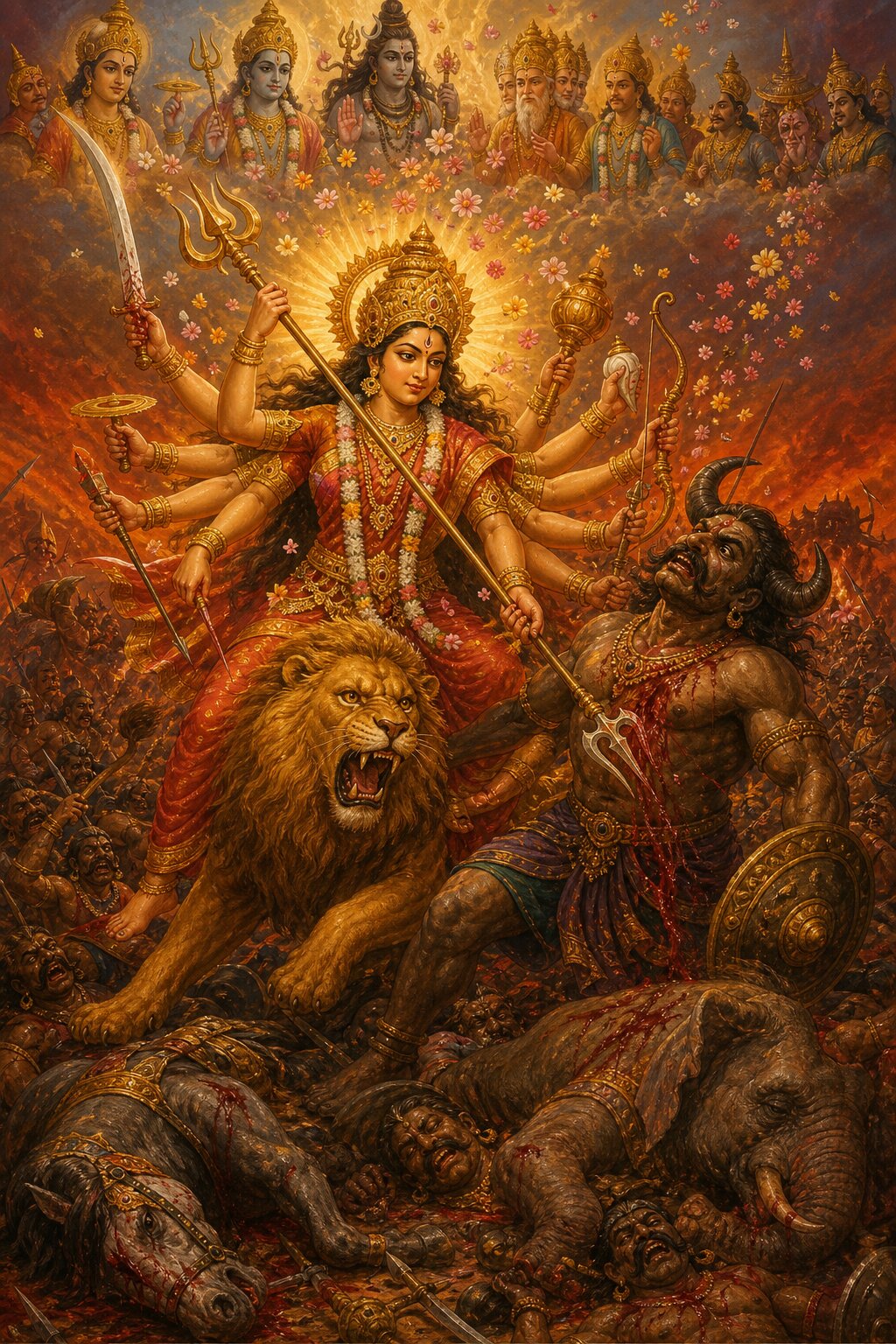
Drenched in streams of their own blood, some great asuras still flung their challenge at the goddess, stand, stand, as if she were the one retreating, and the struggle rose to a pitch that set the body’s hair on end. Fallen chariots, elephants, horses, and asuras so choked the ground that the field where that great battle raged could no longer be crossed on foot at all. And among the dead elephants, the horses, and the asuras, blood gathered into a current of its own and ran out in torrents like great rivers seeking the sea.
68 · 69 · 70
In one moment Ambika drove that vast asura army, the counted and uncountable millions of it, to destruction, the way fire devours a huge heap of straw and timber. And the lion, bellowing and shaking its mane, prowled among the asura bodies as if picking the very lives out of them. The gods, well pleased with the war the goddess and her ganas had waged upon the asuras there, rained flowers from heaven onto the reddened field. But the chief target, Mahishasura himself, still lived and still stood, and the next story rises from exactly there.
Ahead
In this chapter the goddess’s whole force has broken Mahishasura’s army, yet Mahishasura himself still holds the field, and he is untouched. The next chapter rises from that very ground. In Chapter 3 the goddess destroys the generals Chikshura and Chamara; Udagra, Vashkala, and the other chief asuras fall one by one; and at the last Mahisha himself, sliding from form to form as fast as her blows can land, comes to grips with the goddess on the battlefield.