On this page
Devi Mahatmya
Chapter 1 · The Slaying of Madhu and Kaitabha · First Charita
It begins with a beaten king. Suratha’s kingdom is gone, his treasury is gone, and his own ministers have turned their faces from him. Still his mind steals back to that same city, asking whether all is well there. Deep in the forest, at the ashram of the rishi Medha, he meets a merchant named Samadhi, driven out by his own wife and sons, carrying the same wound in another body. The two sit before the rishi with one question between them: why will this attachment not let go, even of men who have seen through it. In answer the rishi speaks of Mahamaya, the power that turns every mind, and then tells the story of Madhu and Kaitabha, and of the first appearing of that primordial shakti on the waters at the end of a world.
1 · 2
Markandeya began. Hear now of Savarni, born son of the Sun himself, the one who is called the eighth Manu, and hear the whole account of how he came to be, told out at its full length. A Manu stands warden over an entire age of the world, an age so long that dynasties rise, flourish, and vanish inside it, and it was the power of Mahamaya, and that power alone, that lifted this great Savarni to the lordship of an entire manvantara. No austerity of his own earned it, and no conquest. Hold on to that one name. Mahamaya stands at the center of everything that follows, and with this single word the key of the whole text is set.
3 · 4 · 5
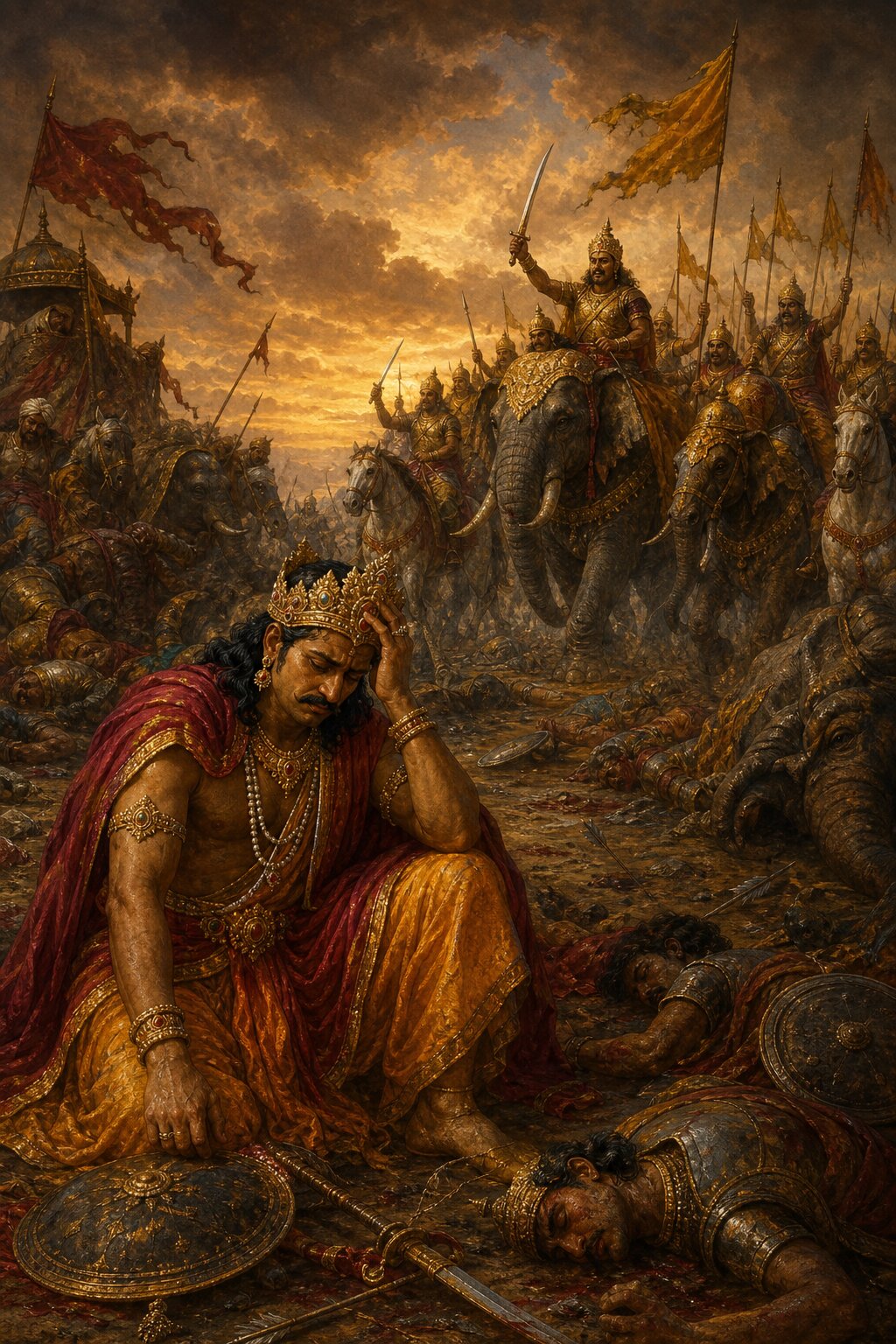
Long ago, in the age of the Svarochisha Manu, a king named Suratha, born of the line of Chaitra, held the whole circle of the earth under one scepter. He guarded his people the way a father guards the sons of his own body, and it shielded him from nothing, for a confederacy of hostile kings, the Kolavidhvansis, rose against him all the same. Goodness by itself shields no one from attack. The armies met, and every count favored Suratha: he commanded the heavier force and the stronger arm of rule, and the enemy came on with fewer men. Still, on that field, the fewer men broke him.
6 · 7
He rode home to his own city. The man who had ruled the whole earth was now the lord of a single country, and even that patch of ground lay ringed by the enemies who had beaten him. Splendor contracts in a single stroke. The foe pressed from beyond the walls, and then, inside them, his own ministers turned. Strong men, corrupt men, rotten to the soul, they had learned the oldest arithmetic of courts, that a weakened king is a treasury with no guard on it, and they stripped the failing king of his gold and then of his army, seal by seal and column by column, inside his own capital, while he still wore its crown.
8 · 9 · 10
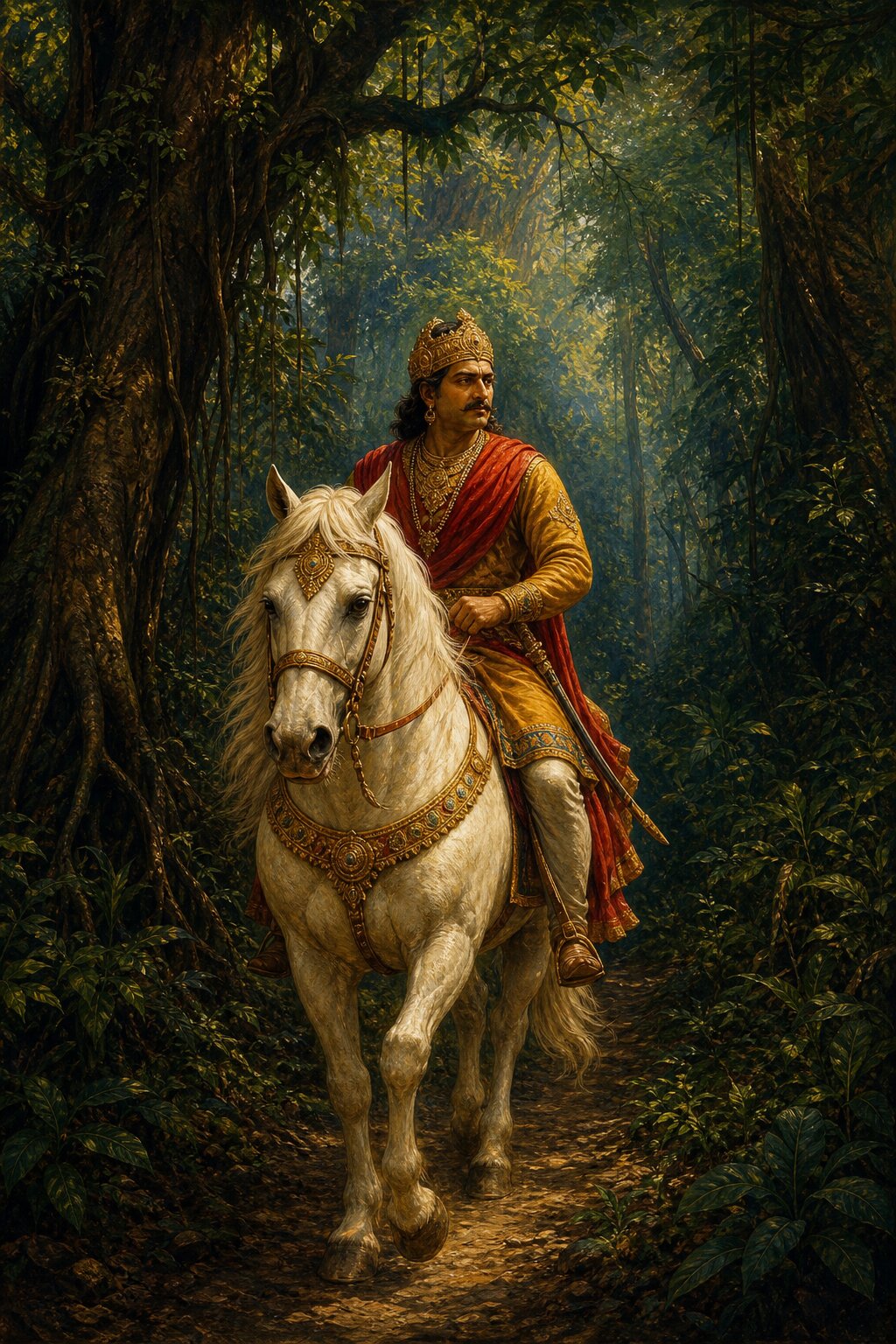
His sovereignty gone, the king put out word of a hunt, the one errand on which a king may ride out of his gates without explanation, mounted a single horse, and went alone into deep forest. No beaters, no hawks, no retinue, one rider passing under the trees with nothing he meant to kill. Here was the first seed of a turning away that the king could not yet name in himself. Deeper in, the forest changed around him. He came on the hermitage of Medha, finest of Brahmins, a clearing whose quiet reached even the beasts of prey, where deer grazed within sight of the tiger and the old enmities of tooth and claw lay set aside, and where the sage’s disciples moved unhurried at their tasks. Medha received the stranger with honor, and the king stayed on for a time, walking here and there through that gracious hermitage, a man with nowhere else in the world to be.
11
Yet the welcome he found outside could not still the man inside. His mind, hauled along by the grip of mine-ness, that quiet claim of mine and mine again which fastens deeper than any chain, kept circling one thought. That city my fathers held and handed down, the city that now stands without me, is it being kept in dharma by those faithless servants of mine, or is it not. He had lost the city; the city had not lost him. Here lies the seed of the whole story. Let a man renounce a thing, or have it torn from his hands, and worry for that very thing refuses to leave his mind.
12 · 13 · 14
He kept turning it over, ledger after ledger of a kingdom he no longer owned. My chief war-elephant, that great tusker always wild with rut, what comforts can he be finding now in the hands of my foes. The men who came to me day after day for favor and riches and food have surely bowed themselves by now before other kings; courtiers follow the treasure, wherever the treasure goes. And the treasury itself, gathered coin by hard coin and grief by grief, bled without a pause by men who spend past all measure, must already be wasting down toward nothing.
15 · 16 · 17
These thoughts, and others like them, ran in the king without rest, through the ashram’s clean mornings and its lamplit evenings alike. And here the story turns. Close by the Brahmin’s hermitage he caught sight of a merchant standing alone, and something in the set of the stranger’s shoulders was familiar to him before either had spoken a word. One grieving heart knows another at a glance. The king went to him. Who are you, he asked, and what has brought you to this place, and why do you stand there looking so struck down with sorrow. At these words, offered in plain kindness by one stripped man to another, the merchant bowed low and began to answer.
18 · 19 · 20
The merchant answered. My name is Samadhi, and I am a trader, born into a house of wealth. And it was the wealth that undid me. My own sons and my wife, made dishonest by their hunger for what I had, drove me out of my home. They took the money, they kept the house, and they left me stripped of riches and of family in the same hour, and even the kinsmen I trusted to speak for me turned their faces away, so I came grieving into this forest. Now comes the strangest part of it. I sit here and cannot so much as learn whether those very sons, that household, that wife, are faring well or ill.
21 · 22
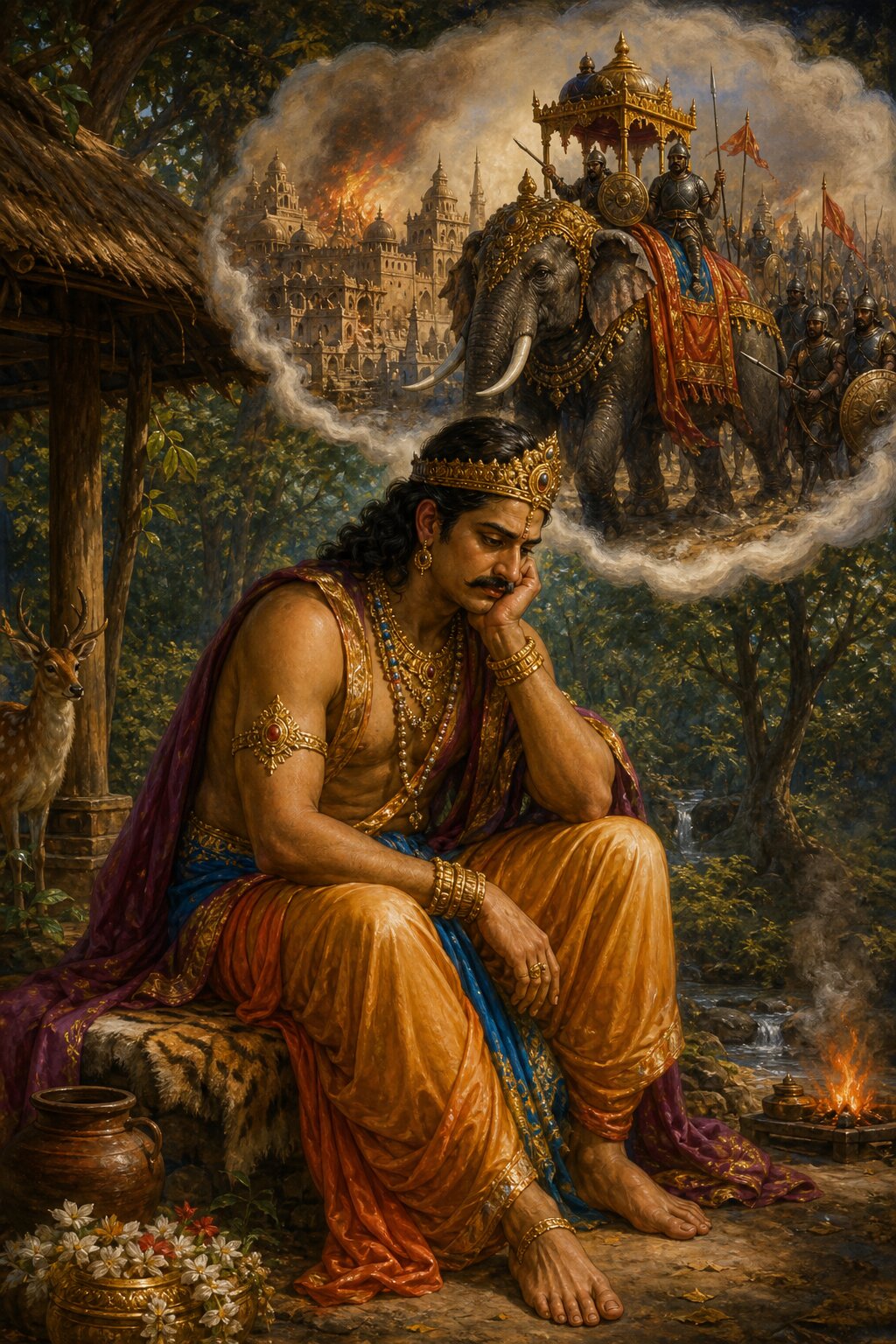
The questions kept rising in him, one after another, and none of them would close. Is there well-being in that house now, or ruin. How do they get on without me. Are my sons living good lives or bad. The king heard him out and recognized every word, for the merchant was reciting the king’s own nights back to him with only the names changed. Then he asked the thing that cut closest. Those grasping people, the very wife and sons who threw you out for the sake of money, why does your heart stay tied to them in love. He saw his own wound plainly in the merchant, and he asked all the same, as though he were putting the question to himself.
23 · 24
It is exactly as you say, the merchant replied, your words sit squarely on my case. But what am I to do. My mind will not close its hand around hardness. They put a father’s love aside, they let greed for wealth eat through even the affection they owed their own blood, they cast me out as curtly as a man dismisses a servant, and still, whenever my heart settles anywhere, it settles on those very people. Here is the deepest riddle of the mind. The intellect grants the whole case, that the love is spent on people who will never return it, and the mind listens, and agrees, and cannot turn that judgment into stone.
25 · 26
He pressed on. O large-minded one, do I not know all this already, and knowing it, do I somehow still not know it, that the heart keeps spending its love on kin who hold not one virtue between them. For their sake my breath goes out in sighs, for their sake my spirits fall into gloom, and none of the grief persuades the love to stop. What am I to do. My mind will not turn relentless even toward people whose every act toward me was unkind. So the king and the merchant stood on the very same ground, the ruler of the earth and the man of the marketplace leveled to one condition, each straining to harden his heart, and each one failing.
27 · 28
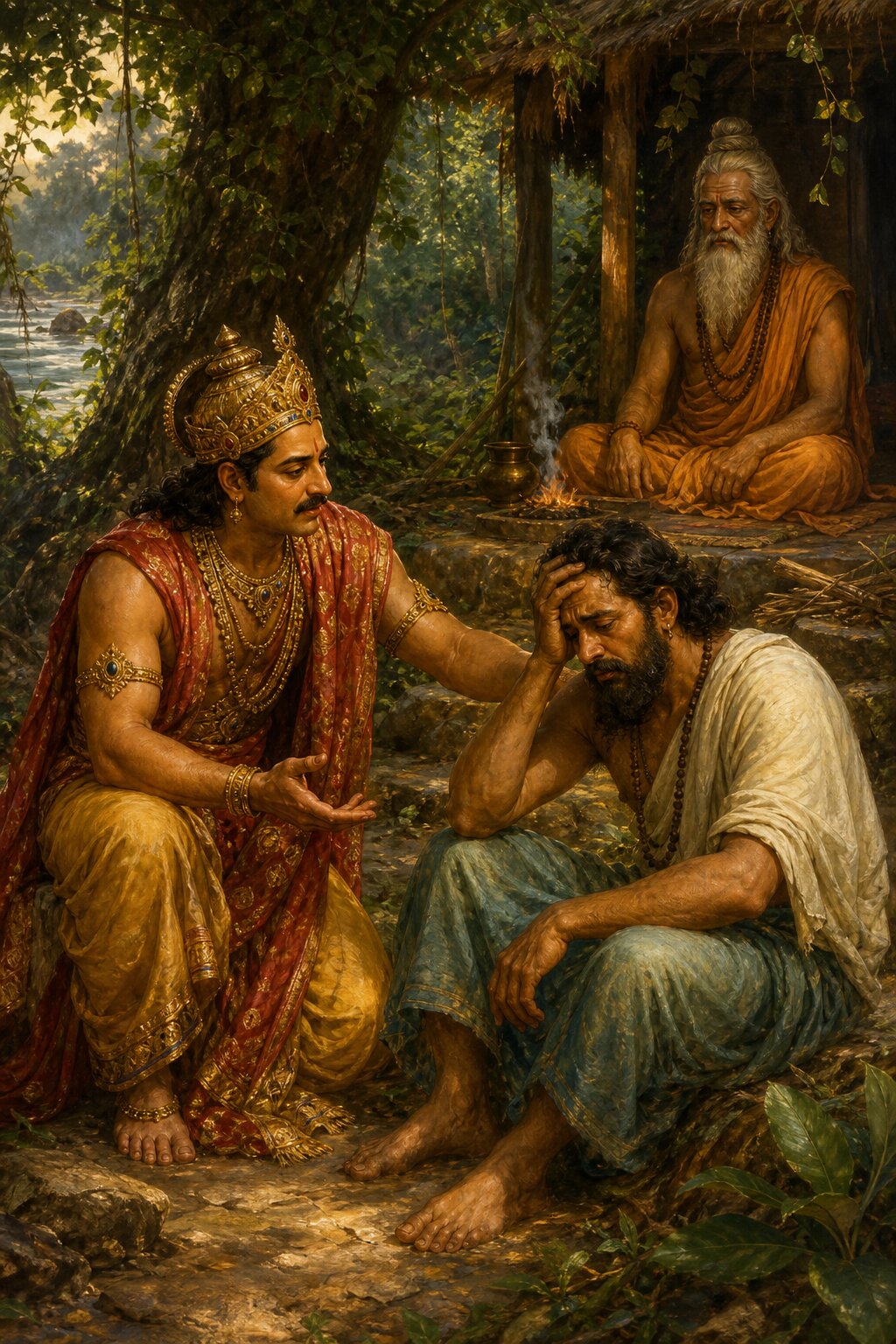
Markandeya said: after this, O Brahmin, the two of them went together to the sage, the merchant Samadhi and that best of kings, carrying their one question between them like a shared load. The hour of a man’s deepest need is the hour he draws near to a teacher, and now both men drew near. They paid the sage the full courtesy that was his due, the bow, the right words, the proper seat, and then settled beside him and fell into talk, unhurried, with nothing forced in it, each heart lying open.
29 · 30
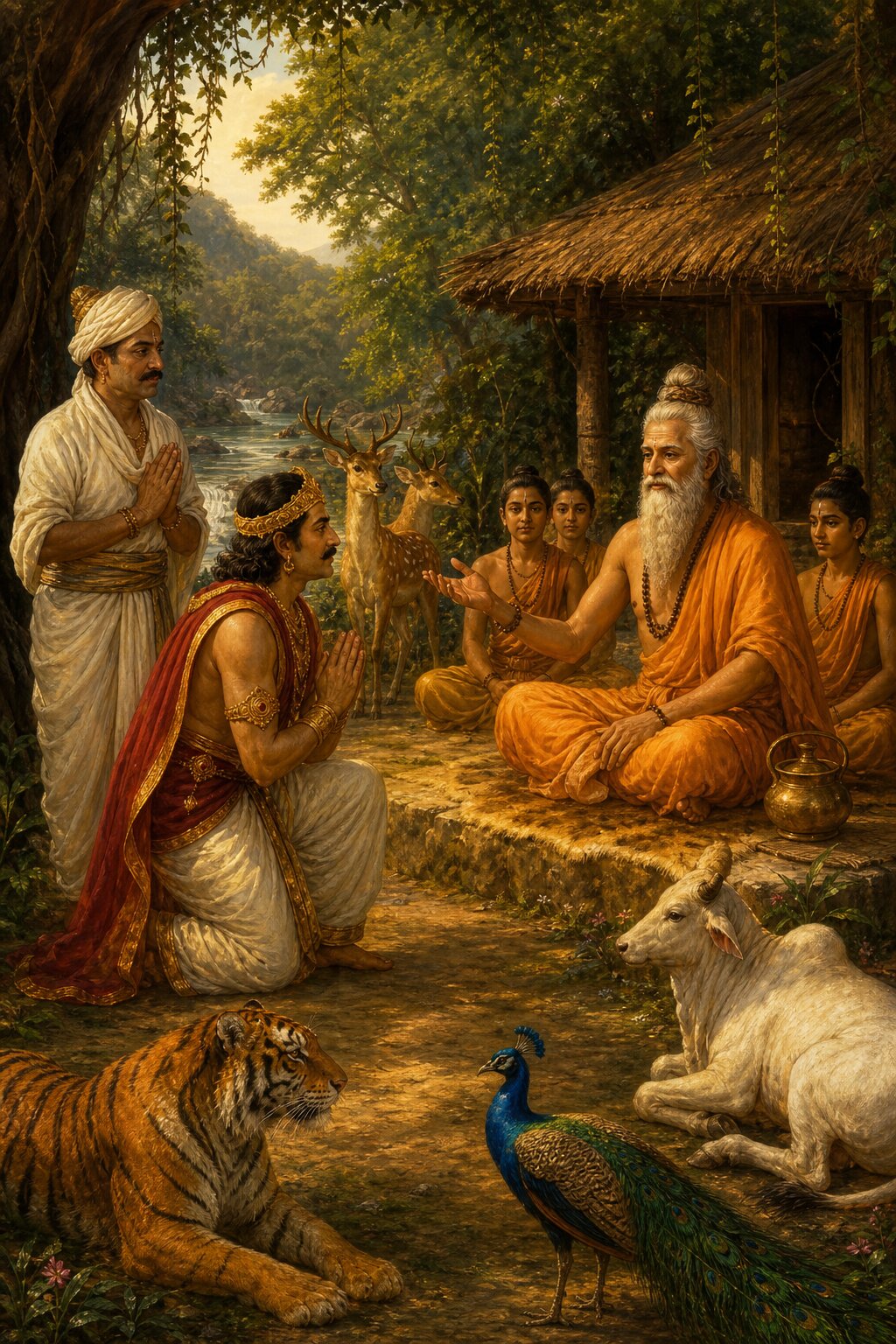
Then the king spoke. Revered one, there is a thing I wish to ask you, and I beg you to tell it. This is what holds my mind in pain: I have no command over my own heart. The kingdom is lost, I watched it go, and still my sense of mine clings to every limb and organ of it, the elephants, the granaries, the banners, the revenues, things that answer to another man’s seal now. I know all this for exactly what it is, I could recite the diagnosis myself, and I keep acting like a man who knows nothing at all. Best of sages, what is this. The distance between knowing a thing and living by it is the sharpest question a person can hold.
31 · 32 · 33
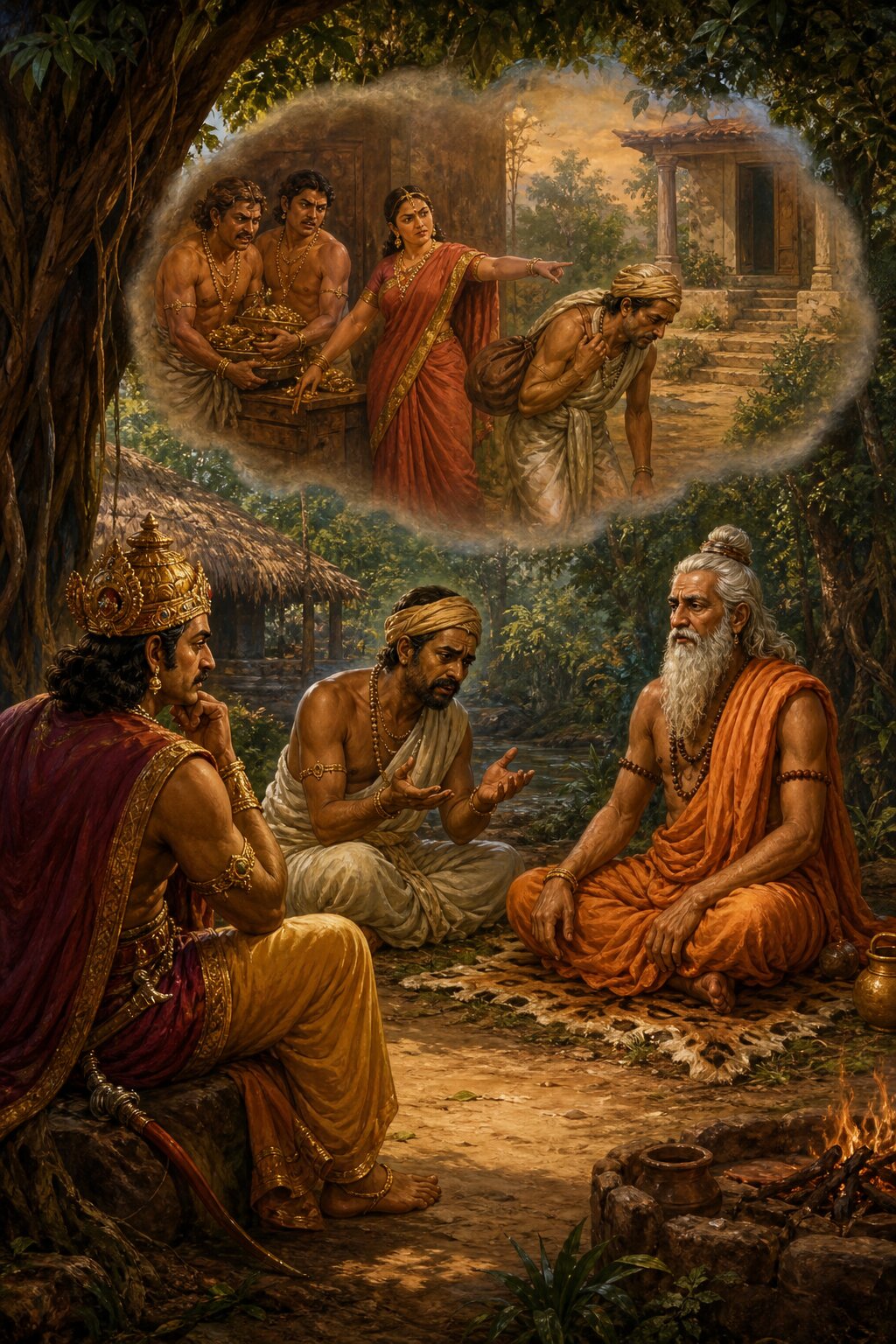
And this merchant beside me, the king went on, shamed by his own sons, abandoned by wife and servants, cut off outright by his kin, still carries a heart full to the brim with love for the very hands that pushed him out. So here we stand, he and I, a king and a trader with nothing left in common except the one thing that matters, two men sunk in the deepest grief, our minds hauled by attachment toward the very thing whose faults our own eyes have already counted. Tell me how does such delusion take hold of two men who know better, until, blind to all discernment, we go on behaving as fools.
34 · 35 · 36
The rishi answered, and he began far from palaces and market towns, out among the creatures. Every being that lives holds some knowledge of whatever its senses can reach, and the objects of sense arrive at each creature by a different road. Some are blind through the day and wake with the dark, some are blind through the night, and some look on day and night alike with steady eyes. So even seeing is parceled out, each kind granted its own portion of the world. Human beings know, that is true, and the knowing is not theirs alone, for cattle and birds and the wild deer all carry it, each after its own fashion.
37 · 38 · 39
What a human being knows, the beast and the bird know too, and what they know, the human knows as well, and in far more than this the two run level. And even with all that knowing, the rishi said, look at these birds, here, in this clearing. Hunger wrings their own small bodies, and still, caught in the same delusion, they carry grain after grain to the nest and drop it into the open beaks of their young, keeping nothing back for themselves. Now set the human parent beside them, best of men. These same men and women hold their children close out of greed, each one reckoning, somewhere beneath the tenderness, on the day the favor comes back to him. The bird at least expects nothing. Do you not see it.
40 · 41 · 42
And for all that, every one of these creatures, winged, hoofed, or crowned, is flung into the whirlpool of mine-ness, down into the pit of delusion, and the force that flings them is Mahamaya herself, she who holds the whole standing order of this world in place; without that binding love no nest would be built, no child fed, and the world would simply stop. So there is nothing here to wonder at, and nothing to be ashamed of either. This sleep is the yoga-nidra of Hari, lord of the world, and it is his Great Illusion, and by her the entire world lies under a spell it mistakes for plain daylight. That same goddess, Bhagavati, reaches even into the minds of the wise, drags them out by main force, and gives them over to delusion. Here is the marrow of the chapter, and the answer the two men had come for: what has hold of you is older and larger than you, and it is a goddess.
43 · 44
That same Devi casts forth this entire universe, all that moves and all that stands still, and when she is pleased she turns giver of boons and hands human beings their liberation. She is the supreme vidya, the eternal cause of moksha, and she is at the same time the cause of every bond that ties a soul into samsara, birth after birth after birth. She is the Ishvari who reigns over every lord who reigns. One and the same shakti forges the chain and strikes it off, and it is inside that single paradox that her greatness lies hidden.
45 · 46
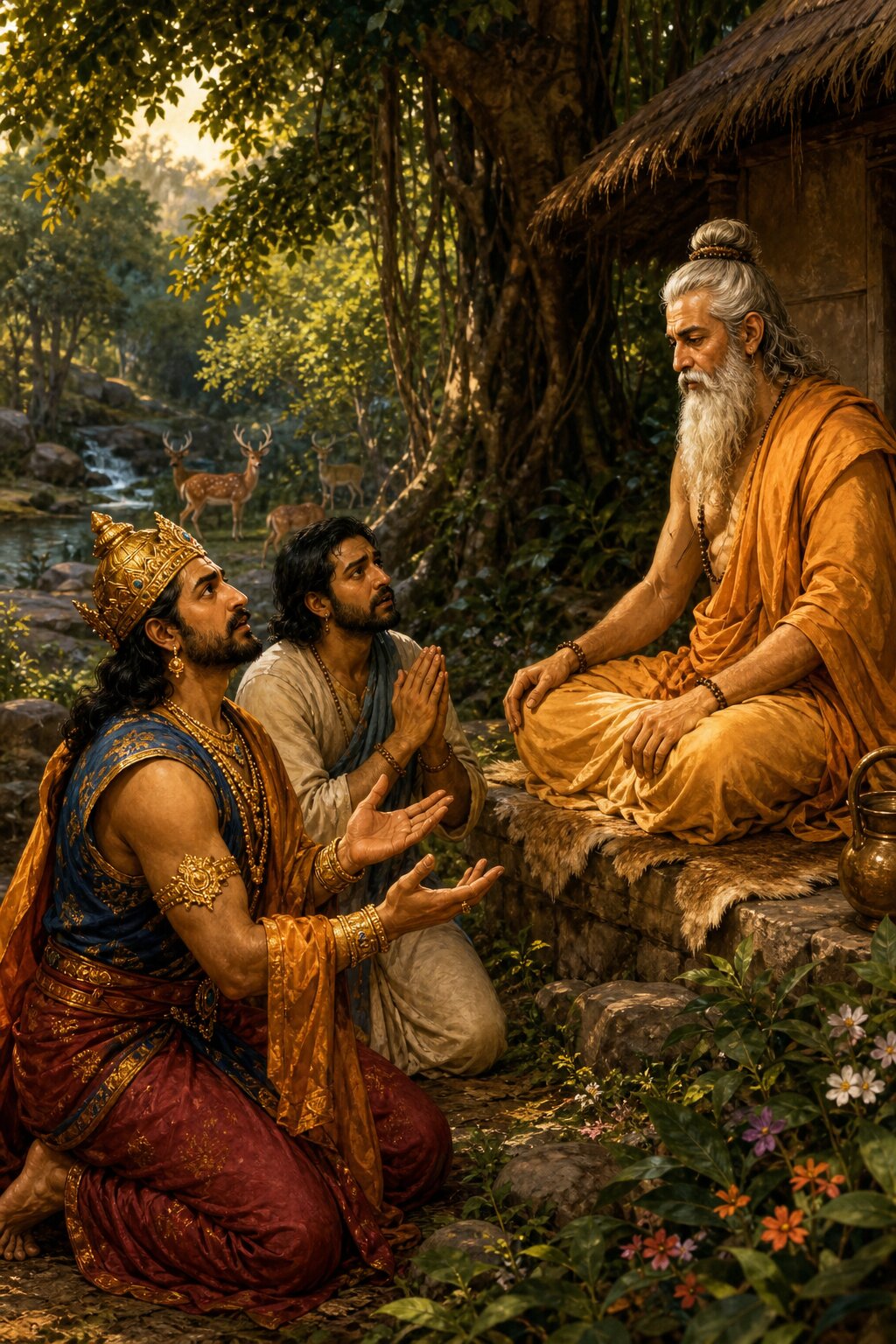
At this the king leaned forward and asked. Revered one, who is this goddess you name Mahamaya. How did she come to be, twice-born sage, and what is the work that is hers. What is her nature, what is her form, and out of what does she arise. A moment ago he had been a man mourning a treasury; now, without marking the turn, he was asking after the root of the world. All of it, O best among the knowers of Brahman, I long to hear from you.
47 · 48
The rishi said. That goddess is eternal. She has no first day. This whole world is her own form, and there is nothing anywhere that she does not pervade. Even so, the manner of her coming forth is told in many ways, and you shall hear it from me. When she shows herself to bring the work of the gods to its end, the world, watching a shape appear where none had been, says that she has been born. She is eternal the whole while; what is born is only the form.
49 · 50
Now the rishi opened the tale that gave this chapter its name. At the close of a kalpa, when the reckoning of ages had run out and the whole world had melted into a single unbroken ocean, no shore, no horizon, no witness, the lord Vishnu spread the great serpent Shesha out upon the waters for a bed and sank down on those coils into yoga-nidra, the sleep of deep contemplation. In that same hour two dreadful asuras, Madhu and Kaitabha, sprung from the wax at the roots of the sleeping god’s ears, rose out of the flood with one purpose, to kill Brahma, and with him the world that was to come.
51 · 52
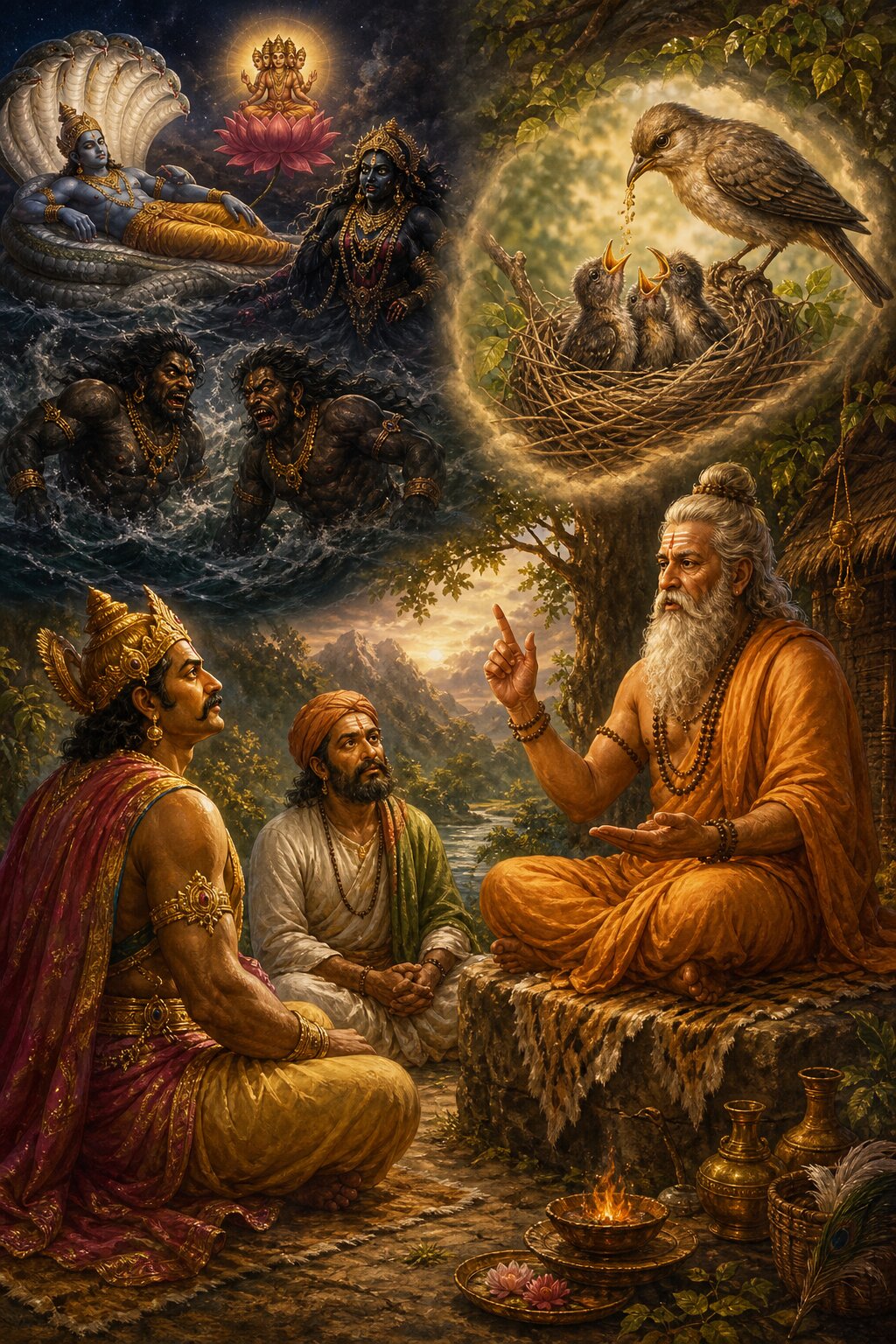
Brahma the Prajapati was seated on the lotus that rose from Vishnu’s navel, the one flower on all that drowned universe, with nowhere to flee and no army to summon. He saw the two savage asuras closing on him, he saw Janardana drowned in sleep, and he turned to the only power on that ocean still awake. Holding his heart to a single point, he began to praise the sleep itself, the yoga-nidra who lay upon the lord. His aim was single. The sleep that had made its dwelling in Hari’s eyes must loosen its hold, and the lord must wake. From here comes the hymn of Brahma, the summit of this chapter, weighted like mantra.
53 · 54
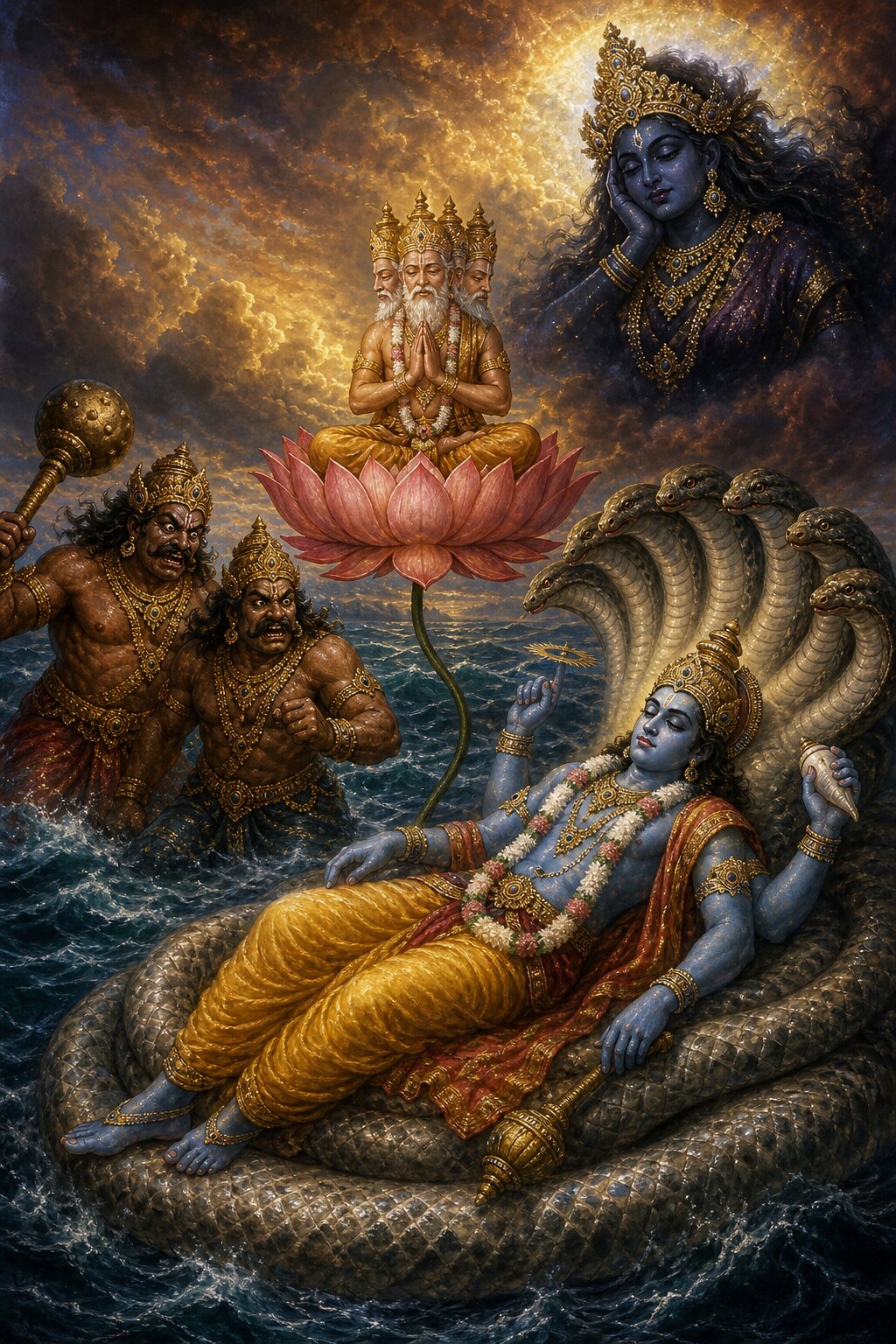
Brahma, lord of a splendor without equal, praised that Bhagavati who is Vishnu’s own sleep, queen of the universe, bearer of the world, the cause at once of its standing and its dissolving. You are Svaha, he said, the word on which every offering rides into the fire toward the gods, and you are Svadha, the word that carries the water and the rice to the ancestors. You are the Vashatkara, the cry that seals the rite, and the soul of every sacred sound is yours. You are the nectar of the gods, the sudha. Imperishable, eternal, you abide as the three sounding matras of the Pranava, the syllable Om itself.
55 · 56
You are the eternal half-matra as well, the hush after Om’s three sounds, the one that is never spoken aloud and never absent. You are Sandhya, the meeting-hour of dusk and dawn when the day itself pauses to pray, and you are Savitri, the mother-verse murmured at those hours since the world began, and you, Devi, are the supreme mother of all that is. By you everything is held up, by you this world is brought into being, by you it is guarded, and at the end, Devi, it is you and always you who draw it back into yourself.
57 · 58 · 59
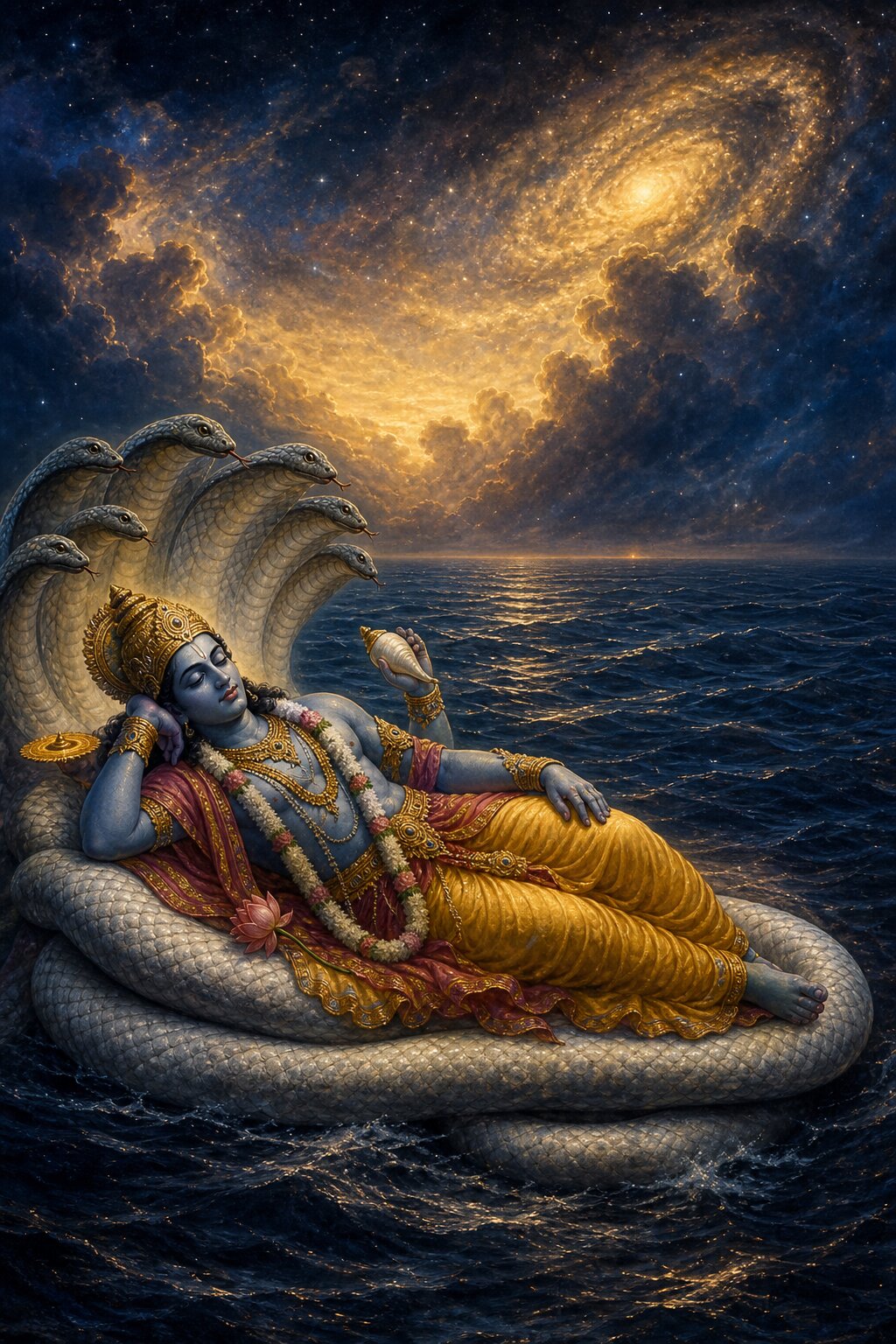
O you whose very substance is the world, in the sending forth you are the form of creation, in the sustaining you are the form of endurance, and at the ending of this world you are the form of dissolution, one goddess wearing the three moments of time. You are Mahavidya and Mahamaya, the great knowledge and the great illusion in one person, Mahamedha and Mahasmriti, and you are Mahamoha too, and Mahadevi and Maheshvari. You are the prakriti of all things, the root-nature who stirs the three gunas into their endless play, and you are Kalaratri the dread night into which time itself is gathered, Maharatri the great night, and Moharatri the night of delusion.
60 · 61
You are Shri, the fortune that lights a house, you are Ishvari, you are Hri, and you are the buddhi whose very mark is understanding. Modesty and nourishment and contentment, peace and patient endurance, every quiet grace by which people manage to live with one another, all of these are you. And you are the terrible one as well, bearing sword and spear and mace, discus and conch, carrying the bow, the arrow, the bhushundi, and the iron parigha, armed past counting for the day the quiet graces fail.
62 · 63
You are gentle, gentler than every gentle thing there is, and beautiful beyond all measure. You stand above the higher and the lower both, Parameshvari, the supreme queen. Whatever exists anywhere at all, real or unreal, named or unnamed, O soul of everything, the power at the heart of it is you, and every hymn can only borrow from you the strength it praises you with. How then is anyone to frame a praise of you.
64 · 65
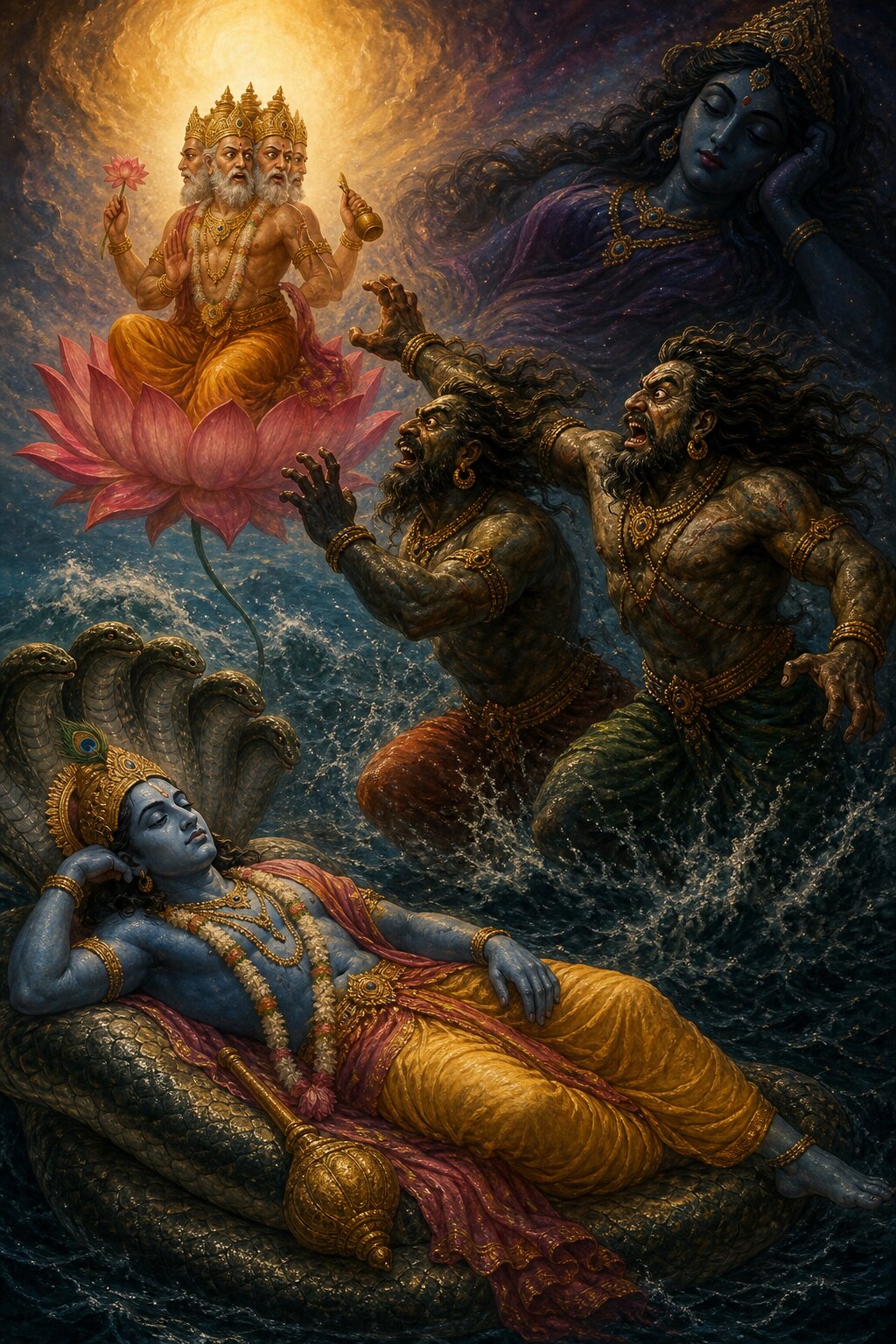
You drew even Vishnu down under the power of sleep, Vishnu who makes this world, holds it up, and swallows it again at the end. What lord anywhere could then stand equal to the task of praising you. It was you who gave Vishnu, and Brahma who is myself, and Ishana their very bodies to wear; the praisers themselves are your handiwork. After that, who is left with the strength to praise you.
66 · 67
So now, Devi, praised here through your own exalted powers, and with this Brahma bent the whole hymn to its point, throw your spell across these two asuras no force can withstand, Madhu and Kaitabha, cloud their minds as you have clouded greater minds than theirs. Wake Achyuta, the imperishable master of the world, and wake him quickly. Kindle in him the clear knowing that will drive him to destroy the two great asuras. The request stood perfect in its symmetry: delusion for the demons, waking for the god, both from the same goddess.
68 · 69
The rishi said: praised in this way by Brahma, the tamasi Devi, the goddess of darkness, consented then and there to wake Vishnu and set the killing of Madhu and Kaitabha moving. She withdrew from the sleeping god the way night withdraws from a landscape, out of his eyes and mouth and nostrils, out of his arms and heart and breast, and she stood in plain sight of Brahma, whose own birth no one can trace. The sleep of Vishnu was now a person standing upon the waters.
70 · 71
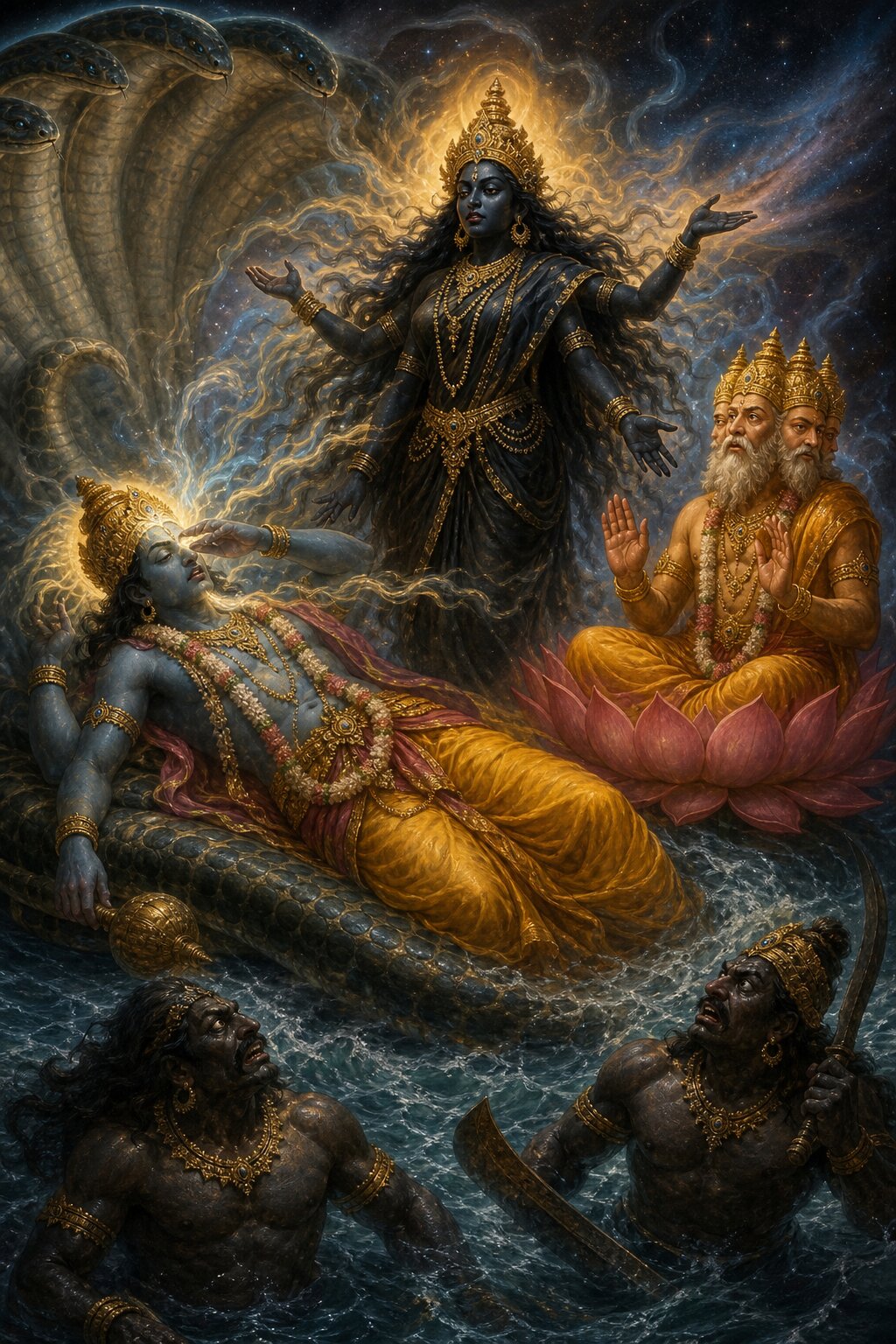
The moment the Devi let him go, Jagannatha Janardana rose from his serpent-couch in that one shoreless sea, awake between one breath and the next. And he saw them, Madhu and Kaitabha, evil to the soul, towering in strength and daring, their eyes gone red with rage, braced to devour Brahma where he sat.
72 · 73
Then the lord Hari rose and closed with them. Five thousand years the mighty one fought, wrestling on the face of the deep, and his own two arms were the only weapons he carried. Five thousand years, and the two asuras still stood, still strong, and by now drunk past reason on that strength. Then Mahamaya’s spell settled over them and did what no blow had managed. Swollen with the certainty of conquerors, they said to Keshava of their own accord, ask of us any boon you wish. Only the utterly deluded grant boons to the enemy they are fighting, and their delusion was exactly her doing.
74 · 75
The lord answered without a pause. If the two of you are truly pleased with me, then grant me this, that you both meet your death at my hands. What need is there of any other boon. This much, and only this, is what I choose. The words closed on them like a snare, for a boon once offered binds the giver, and even asuras hold that law past breaking. The rishi said: caught now in their own trap, the two looked out across a world that was nothing but water, searched it, found what they took for a way out, and spoke again to Vishnu.
76 · 77
Kill us, they said, where the earth does not lie drowned under water. In a universe that was one single flood, it looked like a condition no one could meet. Your fighting has pleased us, they added, and to take our death from hands as worthy of praise as yours is our good fortune. The rishi said: then the lord who bears the conch, the discus, and the mace answered, so be it, and drew the two of them up onto his own thighs, the one stretch of ground in all creation that no water covered, and with the discus struck their heads from their bodies. The way out they had found was exactly the width of a god’s lap.
78
The rishi said: so this Devi, whom Brahma himself drew forth by his praise, first came into the world in this form, as sleep, as spell, as the unseen mover of a rescue the world remembers as Vishnu’s. Madhu and Kaitabha were destroyed, and the work of the gods was done. And this, the sage told the two men before him, is only her first appearing. Now listen to what comes next, for I have more to tell you of this same goddess and her power.
Ahead
The next chapter opens the Middle Charita. Mahishasura has seized the kingdom of the gods, Indra is thrown from his seat, and the gods make their way to Vishnu and Shiva. Out of the massed radiance of their anger a wondrous Devi appears, and there the story of Mahishasura-mardini begins. The heart of the chapter just read sits in a single shloka: the goddess Bhagavati seizes even the minds of the wise by force and delivers them into delusion. Whatever the coming battles bring, that verse has already named the real battlefield.