On this page
Kaikeyi gives her maid Manthara honor in many ways and goes into the chamber of anger. At dusk the king will come to her house, full of bliss. Before she has asked him for anything, he will swear by Rama.
In this episode of the Ramcharitmanas, the city makes ready the auspicious rites, and Rama’s boyhood friends come to him. The king flinches at the name of the chamber of anger and finds her on the ground. He asks, offers, and swears. She rises smiling and puts on her ornaments. He tells her that Rama is to be crown prince tomorrow, and she hides her pain. She doubts that she will get the two boons he said he would give. He tells her to ask four for two, and speaks of the customs of Raghu’s line and of truth. Then she asks for the two boons, and the king, his hand on his brow, shuts his eyes.
The queen, the king, the maid, and the friends
The main figures in this episode
- Kaikeyi the queen. She holds Manthara dear as her life and praises her great intellect. If the Creator fulfills her wish tomorrow, she says, she will make the maid the pupil of her eye. She goes into the chamber of anger, sets out all the trappings of anger, and lies on the ground in a coarse old cloth. She pushes her husband’s hand away. Weighing his great oath, she rises smiling. At the news that Rama is to be crown prince, she hides her pain with a smile. She doubts that she will get even the two boons. Having made the matter firm, she asks for them: the tilak for Bharata, and fourteen years in the forest for Rama.
- Dasharatha the king. Full of bliss, he comes at dusk to Kaikeyi’s house. He flinches at the name of the chamber of anger, and grieves at the sight of her on the ground. He asks the cause of her anger again and again. He offers to make a pauper a king and to drive a king from the land. He says that his life, his sons, his kin, and his subjects are in her power. He calls a hundred oaths by Rama on himself if he speaks to her with guile. Knowing her a well-wisher, he tells her that tomorrow he gives Rama the place of crown prince. He laughs, tells her to ask four boons for two, and speaks of the customs of Raghu’s line and of truth. Hearing the two boons, he loses his color and shuts his eyes, his hand on his brow.
- Manthara the maid. Kaikeyi praises her great intellect again and again. No one in the world means her good as Manthara does, Kaikeyi says, and the maid has become a support to one being swept away. In the commentary’s naming, Manthara is the guru who taught the queen the guileful quick wit that the king does not see.
- Rama who honors his boyhood friends, knowing their love, and asks after their welfare in a soft voice. The king swears by him, and tells Kaikeyi that Rama is to have the place of crown prince tomorrow. Kaikeyi asks that he live fourteen years in the forest in a sage’s dress.
- Bharata for whom Kaikeyi asks the tilak in one of the two boons.
- Rama’s boyhood friends who are glad at heart at the news and come to Rama in fives and tens. Given his leave, they go home praising him to one another. They ask God that in whatever womb karma makes them wander they be servants and Rama their master, and that the bond hold to the end.
Honor for the maid, and the way to the chamber of anger
Kaikeyi held Manthara dear as her life. Again and again she praised her great intellect. “In the world there is no one who means my good as you do,” she said. “You have become a support to one who was being swept away. If the Creator fulfills my wish tomorrow, friend, I will make you the pupil of my eye.” Giving the maid honor in many ways, Kaikeyi went into the chamber of anger.
Trouble was the seed, and the maid the rainy season. Kaikeyi’s ill thinking became the ground. It got the water of guile, and the sprout came up. The two boons were its two leaves, and grief the fruit at the end.
Setting out all the trappings of anger, she lay down. Reigning as she was, she was ruined by her own ill thinking. In the palace and the city there was a loud stir. Of this evil course no one knew anything. Delighted, the men and women of the city all made ready the fine auspicious rites. Some went in and some came out. There was a crowd at the king’s door.
What Rama’s boyhood friends asked for
At the news, Rama’s boyhood friends were glad at heart. In fives and tens they went to Rama. Knowing their love, Rama honored them and asked after their welfare in a soft voice.
Given leave by the one they held dear, they went home, praising Rama to one another. “Who in the world is like Rama,” they said, “in holding to character and love? In whatever womb karma makes us wander, there may God give us this, that we be servants and Sita‘s master our master. May this bond hold to the end.”
Such was the desire of everyone in the city. In Kaikeyi’s heart there was a fierce burning. Who is not ruined by bad company? Under the counsel of the low, quick wit does not stay.
At dusk, as if love had gone near to cruelty
Full of bliss, the king went at dusk to Kaikeyi’s house. It was as if love had taken a body and gone near to cruelty.
At the name of the chamber of anger, the king flinched. In fear his feet would not go forward. By the strength of his arm Indra dwells. The commentary adds that by that arm Indra dwells without fear of the rakshasas. All kings wait on his look. Hearing of a woman’s anger, that same king dried up. Such is the greatness of Kama’s power. Those who bear on their limbs the blows of trident, thunderbolt, and sword were struck down by Kama’s flower arrows.
Afraid, the king went to his beloved. At the sight of her state a terrible grief came over him. She lay on the ground in a coarse old cloth. She had thrown off the many ornaments of her body. How well the ill dress suited her ill thinking! It was as if it signaled the widowhood to come.
Going near, the king said in a soft voice: “Beloved as my life, why are you angry? Why are you angry, queen?” As he touched her with his hand, she pushed her husband’s hand away.
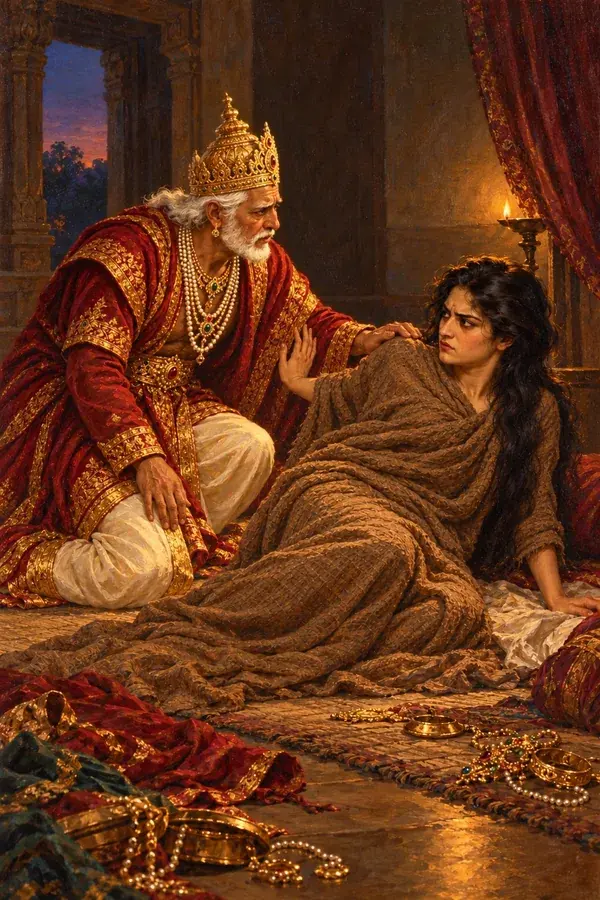
She looked at him in a dire way, as if an enraged she-serpent were looking. The two longings were its tongues, and the two boons its fangs. It looked for the vital place. Under the power of what was to be, the king took it for Kama’s sport. The commentary gives this line, which carries Tulsi’s name, to Tulsi.
Again and again the king said: “You of the fine face, lovely eyes and cuckoo’s voice, tell me, you of the elephant’s walk, the cause of your anger.”
The king offers whatever pleases her mind
“Who has done you harm, beloved?” the king said. “Who has two heads? Whom does Yama want to take? Say which pauper I should make a king. Say which king I should drive from the land.”
“I can kill your enemy, though he were an immortal. What are men and women, poor insects? You know my nature, beautiful one. My mind is a chakora to the moon of your face.”
“Beloved, my life, my sons, all I have, my kin, and my subjects are all in your power. If I say anything to you with guile, lady, a hundred oaths by Rama be on me. Ask with a smile for the thing that pleases your mind. Deck your enchanting limbs with ornaments. Consider in your heart which hour is fit and which is not. Beloved, quickly leave off the ill dress.”
Hearing this and weighing the great oath in her mind, Kaikeyi, dull of wit, rose smiling. She was putting on her ornaments, as if a Kirata woman, seeing a deer, were readying her snare.
The news of Rama, and the pain hidden behind a smile
Knowing her in his heart to be a well-wisher, the king spoke again. He was thrilled with love, and his voice was soft and charming. “Lady, what pleases your mind has come to be,” he said. “In house after house in the city there is the music of congratulation and bliss. Tomorrow I give Rama the place of crown prince. Lovely of eye, make ready the auspicious gear.”
At his words, her hard heart throbbed, as if a ripe boil had been touched. Even such a pain she hid with a smile, as a thief’s wife does not weep openly. The king did not see her guileful quick wit. A guru who was the jewel of ten million crooks had taught it to her, and the commentary names that guru as Manthara.
Though the king was skilled in policy, the ways of women are an unfathomable sea. Afterwards, swelling her guileful love, she spoke, smiling, her eyes and her face turned away. “Ask, ask, you say, beloved,” she said, “and you never give or take anything. You said you would give two boons, and I doubt I will get even those.”
Four for two, and the word that does not go
“I know your secret,” the king said, laughing. “Sulking is very dear to you. You kept them in trust and never asked. And I, forgetful by nature, forgot. Do not lay a false blame on me. Ask four for two, if you will. The customs of Raghu’s line have always come down like this. Life may go, and the word does not go.”
“There is no heap of sins equal to untruth. Can ten million gunja seeds be equal to a mountain? Truth is the root of all handsome merits. It is known in the Vedas and the Puranas, and Manu has sung it. On top of that, I have sworn by Rama. Rama is the utmost of merit and love.”
Having made the matter firm, Kaikeyi laughed and spoke. It was as if she had taken the hood off the evil bird of her ill counsel.
First the tilak for Bharata, then the forest for Rama
The king’s wish was a handsome forest, and his happiness a company of fine birds. Like a Bhil woman, she wanted to loose the fearsome hawk of her word.
“Listen, beloved as my life,” Kaikeyi said. “Give me one boon that pleases my heart: the tilak for Bharata. The second boon I ask with joined hands. Master, fulfill my wish. In a sage’s dress, wholly apart from the world, let Rama live fourteen years in the forest.” The commentary reads the tilak as the royal mark. It reads the staying apart as a complete turning away from kingdom and family, like sages who have renounced the world.
Hearing the soft words, the king felt sorrow in his heart, as a chakravaka is distressed at the touch of the moon’s rays.
The flowering wish, uprooted
The king shrank in fear, and no word came to him. It was as if a hawk had swooped on a quail in a wood. He lost all his color, as if lightning had struck a palm tree.
The king put his hand to his brow and shut both eyes. It was as if worry had taken a body and begun to worry. He thought: “My wish, a wish-tree, had flowered. As it fruited, she uprooted it root and all, like a she-elephant.” Kaikeyi had laid Ayodhya waste and laid a firm foundation of trouble. “On what occasion what has happened!” the king said in his mind. “Trusting a woman, I am undone, as ignorance destroys an ascetic at the time his yoga’s attainment comes to fruit.”
The order of the asking
Kaikeyi praised the maid and gave her honor in many ways, and went into the chamber of anger. No one knew of the evil course, and the city made ready the auspicious rites. Rama’s boyhood friends came to him and went home praising him. At dusk the king came to her house. He found her on the ground and asked the cause of her anger. He set all he had in her power, and called a hundred oaths by Rama on himself if he spoke with guile. She rose smiling and put on her ornaments. Then he told her the news of tomorrow. She hid her pain, and said she doubted she would get even the two boons. He told her to ask four for two, and spoke of the customs of Raghu’s line and of truth. Having made the matter firm, she asked for the tilak for Bharata and the forest for Rama. The king lost his color and shut his eyes.
The same story, elsewhere: Valmiki’s Ramayana, chapter 7: Manthara, Kaikeyi, and the Two Boons.
Source: the Gita Press edition of Tulsidas’s Ramcharitmanas, Ayodhyakand, doha 23 to 29, read with Hanuman Prasad Poddar’s Hindi commentary.