On this page
Sumantra’s report reaches its end. At Rama‘s sign the boatman pushed the boat off, and the minister stood watching with a thunderbolt on his breast. There his words stop. Kausalya asks the king to consider that parting from Rama is a boundless sea, with Ayodhya for a ship, the king for its helmsman, and everyone dear aboard. If he takes her entreaty to heart, she says, Rama, Lakshmana, and Sita will be met again. Bharata will come home, and Kaikeyi will tell him that she arranged everything, that poor Manthara helped, and that the king has set foot in Indra’s city.
In this episode the king falls at the charioteer’s words, and an uproar rises in Ayodhya at the cry from his quarters. His life comes up to his throat. At his beloved’s soft words he opens his eyes. Holding patience, he sits up and asks Sumantra where Rama is. The night runs on like an age, and he remembers the blind ascetic’s curse. He cries out for Rama, Sita, and Lakshmana, and gives up his body saying Rama’s name. The queens, the servants, and the city weep, and all abuse Kaikeyi. Vasishtha removes their sorrow, keeps the king’s body in a boat full of oil, and sends runners to Bharata with the guru’s summons and nothing more. Bharata, with ill omens coming to him and frightful dreams at night, sets out at the guru’s command. He drives through rough country and meets ill omens and silent citizens at the city. Kaikeyi welcomes him with an arati and asks about her father’s house. He asks after his father, all the mothers, Sita, Rama, and Lakshmana. With deceit in her eyes she gives him her answer. He falls, asks the cause, hears all she has done, and stays stunned and silent.
The palace sunk in grief
The main figures in this episode
- Dasharatha the king, who hears the end of Sumantra’s report and falls to the ground with a terrible burning in his breast. His life comes to his throat. He opens his eyes at Kausalya’s soft words. Holding patience, the king sits up. He asks the minister where Rama, Lakshmana, and Sita are. Through a night long as an age he laments, remembers the blind ascetic’s curse, and tells Kausalya the story. He calls shame on the hope of living without Rama and cries out for Rama, for Sita, and for Lakshmana. He gives up his body as he says Rama’s name, and goes to the abode of the gods. His body is kept in a boat filled with oil, and the messengers are to tell no one of him.
- Kausalya Rama’s mother, who sees the king sad and knows in her heart that the sun of the Sun’s line is setting. Holding patience in her breast, she speaks words fitting the hour. The parting from Rama, she tells him, is a boundless sea, the king its helmsman, Ayodhya the ship, and all the dear ones its passengers. If he holds patience the shore is reached, and otherwise the whole family will drown. If her entreaty is taken to heart, the three will be met again. In the long night the king tells her the whole story of the blind ascetic’s curse.
- Sumantra the minister and charioteer, who ends his report with the boat pushing off at Rama’s sign and his standing with a thunderbolt on his breast. He asks how he can tell his own affliction, and says he came back alive carrying Rama’s message. There his words stop, and loss, remorse, and worry take hold of him. The king, sitting up, asks him where Rama is.
- Vasishtha the guru, who speaks when the night of lamenting has passed and the great wise sages have come. Telling many histories fitting the hour, he removes everyone’s sorrow by the light of his wisdom. Filling a boat with oil, he keeps the king’s body in it. Calling messengers, he sends them to Bharata. They are to tell no one the news of the king, and to say only that the guru has sent for the two brothers.
- Bharata and Shatrughna the two brothers away from home, whom the guru has sent for. Since the evil began in Ayodhya Bharata has had ill omens and frightful dreams. Feeding brahmins, he has given gifts every day. He has bathed Shiva in worship and, praying to him in his heart, asked for the welfare of mother, father, family, and brothers. At the guru’s command he sets out, praying to Ganesha, and drives swift horses over rough country, wishing he could fly. At the city he meets ill omens and citizens who salute and say nothing. Kaikeyi meets him at the door with an arati and brings him in, and the commentary has Shatrughna brought in with him. He asks where his father is, where all the mothers are, and where Sita, Rama, and Lakshmana are. At her answer he falls crying for his father, then rises and asks the cause of the death. He forgets his father’s death, hearing of Rama’s going to the forest. Knowing himself the cause, he stays stunned, holding silence.
- Kaikeyi Bharata’s mother, whom all in the city abuse as the one who made the world eyeless. Hearing that her son is coming, she rejoices, moonlight to the lotus of the Sun’s line. She readies an arati, runs to the door, and brings him into the palace. The family grieves, and she rejoices as if a Kirata woman, glad, had set a forest fire. She asks whether all is well at her father’s house. Filling her eyes with the water of deceit, she speaks words like a spike to his ears and mind. The matter was all her arranging, she says, poor Manthara was a help, and the Creator spoiled a little of the work. The king, she says, has set foot in Indra’s city. Asked the cause of his death, she speaks as if cutting open the vital place and pouring poison into it. Crooked and hard, glad in her mind, she tells all her own doing from the beginning.
The boat pushed off, and the minister’s words stopped
Sumantra went on. “At that moment, getting Rama’s sign, the boatman pushed the boat off for the crossing. So Rama went. I stood watching with a thunderbolt set on my breast. How can I tell my own affliction? I came back alive, carrying Rama’s message.”
When he had said this, the minister’s words stopped. He fell into the power of loss, remorse, and worry.
At the charioteer’s words the king fell to the ground. There was a terrible burning in his breast. As he writhed, a fierce delusion overwhelmed his mind. It was as if the foam had spread through a fish. The commentary reads the foam as the water of the first rain.
Lamenting, all the queens wept. How could the great calamity be told? At the lament even grief felt grief, and even patience’s patience fled.
A great uproar rose through Ayodhya at the cry from the king’s quarters. It was as if a hard thunderbolt had fallen at night on a vast forest of birds.
Kausalya’s entreaty, with Ayodhya for a ship
The king’s life came to his throat. It was as if a snake were distraught without its jewel. All his senses were greatly distraught. It was as if a pond’s lotus wood were without water.
Kausalya saw the king sad and knew in her heart that the sun of the Sun’s line was setting. Holding patience in her breast, she spoke words fitting the hour.
“Master, considering in your mind, take thought. Parting from Rama is a boundless sea. You are the helmsman, and Ayodhya is the ship. All the dear ones have boarded it, the company of passengers.” The commentary reads the dear ones as the family and the subjects.
“If you hold patience, the shore is reached. Otherwise the whole family will drown. If you take my entreaty to heart, beloved, Rama, Lakshmana, and Sita will be met again.”
At his beloved’s soft words the king looked, opening his eyes. It was as if cool water were sprinkled on a writhing, sad fish.
Holding patience, the king sat up. “Say, Sumantra, where is merciful Rama? Where is Lakshmana? Where is loving Rama? Where is the dear daughter-in-law, Sita?”
A memory, and Rama’s name six times at the end
The king lamented in many ways, distraught. The night became like an age and did not end. The blind ascetic’s curse came back to his memory, and he told Kausalya the whole story.
He became distraught, telling the history. “Shame on the hope of living without Rama. What shall I do, keeping that body which did not carry my vow of love through?”
“Oh, Rama, dear as life. Many days have passed in living without you. Oh, Sita, Lakshmana. Oh, Rama, cloud that does good to the chatak of the father’s thought.”
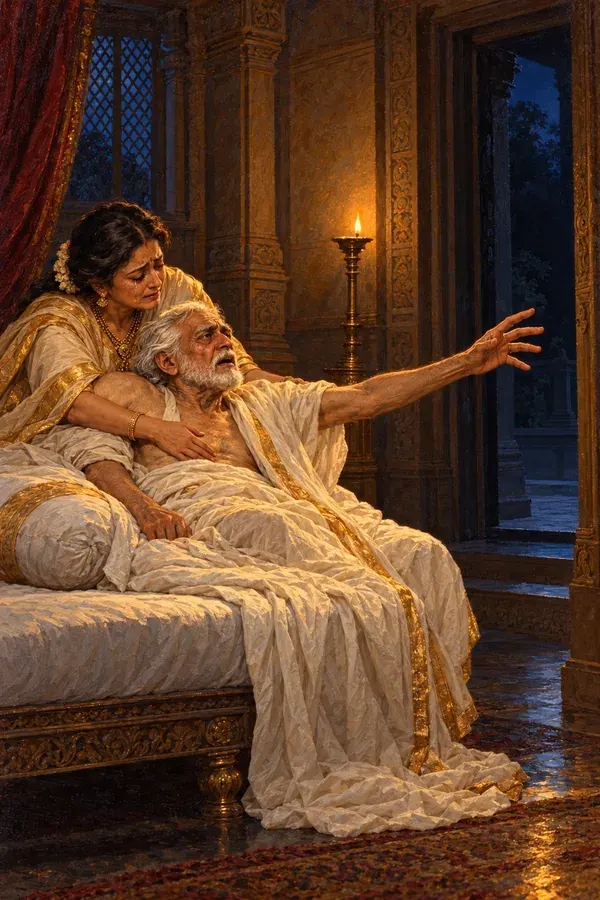
Saying “Rama, Rama,” saying “Rama,” saying “Rama, Rama,” saying “Rama,” the king gave up his body in separation from Rama and went to the abode of the gods.
The sun of the Sun’s line has set
Dasharatha got the fruit of living and of dying. His pure fame spread over many universes. While he lived, he saw Rama’s moon face. Through his parting from Rama he made his death good.
Distraught with sorrow, all the queens wept. Telling his form, conduct, strength, and radiance, they lamented in many ways and fell to the ground again and again.
Servants and maids lamented, distraught. In every house the citizens wept. In the commentary’s reading they said, “Today the sun of the Sun’s line has set, the limit of dharma, the treasury of virtue and form.”
All abused Kaikeyi, who had made the world eyeless. The night passed in such lamenting. All the great wise sages came.
Then, telling many histories fitting the hour, the sage Vasishtha removed everyone’s sorrow by the light of his wisdom.
A summons, with the king’s news kept back
Vasishtha kept the king’s body in a boat filled with oil. Then, calling messengers, he said: “Run quickly, go to Bharata. Tell no one anywhere the news of the king. Say only this to Bharata when you have gone to him: the guru has sent for the two brothers.”
Hearing the sage’s order, the runners ran. They went at a speed that shamed the best horses.
Since the evil began in Ayodhya, ill omens had come to Bharata. He saw frightful dreams at night, and waking he made ten million bitter imaginings.
Feeding brahmins, he gave gifts every day. In many ways he bathed Shiva in worship, the rite the commentary names the Rudrabhisheka. He asked, praying to Shiva in his heart, for the welfare of mother, father, family, and brothers.
So Bharata was worrying in his mind when the runners arrived. Hearing the guru’s command with his ears, he set out, praying to Ganesha.
The city comes near, and no one speaks
He went, driving horses swift as the wind and crossing rough rivers, hills, and forests. In his heart was great worry, and nothing pleased him. He thought to himself, “Let me fly there.”
The time an eyelid takes to fall passed like a year. So Bharata neared the city. At the entering of the city ill omens came. Harsh cries rose in an ill way from bad ground. The commentary names the criers as crows.
Donkeys and jackals gave contrary cries. Hearing it again and again, Bharata felt pain in his mind. Lakes, rivers, woods, and gardens were lusterless. The city seemed especially frightful.
Birds, beasts, horses, and elephants could not be looked at, ruined by the bad sickness of Rama’s parting. The city’s women and men were utterly grieving. It was as if all had lost all their wealth.
The city’s people met him and said nothing. They saluted quietly and went. Bharata could not ask after their welfare. Fear and dejection were in his mind.
Markets and roads could not be looked at. It was as if a forest fire had caught the city in ten directions.
The mother’s joy, and the son’s question
Hearing that her son was coming, Kaikeyi rejoiced, moonlight to the lotus of the Sun’s line. Readying the arati, glad, she rose and ran. Meeting him at the door, she brought him into the palace. The commentary has Shatrughna brought in with him.
Bharata saw the family grieving. It was as if frost had struck a lotus wood. Kaikeyi rejoiced in such a way, as if a Kirata woman, glad, had set a forest fire.
Seeing her son worried and downcast, she asked, “Is all well at my father’s house?”
Bharata told her that all was well. He asked after the welfare of his own family. “Say, where is father? Where are all the mothers? Where is Sita? Where are Rama and Lakshmana, the dear brothers?”
Hearing her son’s loving words and filling her eyes with the water of deceit, the sinful woman spoke words like a spike to Bharata’s ears and mind.
“Son, I had arranged the whole matter. Poor Manthara was a help. The Creator spoiled some small part of the work in the middle. The king has set foot in Indra’s city.”
The father’s death, and then the news of Rama’s going
Hearing it, Bharata became helpless in dejection. It was as if an elephant had shrunk at a lion’s roar. Crying “Father, father, oh, father,” he fell to the ground, greatly distraught.
“I could not see you as you went. Father, you did not give me into Rama’s keeping.” Then, holding patience, he rose, steadying himself. “Tell the cause of father’s death, Mother.”
Hearing her son’s words, Kaikeyi spoke. It was as if she cut open the vital place and poured poison into it. Crooked and hard, glad in her mind, she told all her own doing from the beginning.
Bharata forgot his father’s death, hearing of Rama’s going to the forest. Knowing himself the cause in his heart, he stayed stunned, holding silence.
The course of the episode
Sumantra’s report ended on the boat pushing off and on the thunderbolt he stood with, and his words stopped. The king fell to the ground. A cry rose from his quarters, and Ayodhya was in uproar. His life came to his throat. Kausalya saw the king sad and spoke to him, asking him to hold patience. He opened his eyes, sat up, and asked Sumantra where Rama, Lakshmana, and Sita were.
He lamented through the night, remembered the blind ascetic’s curse, and told Kausalya the story. He cried shame on his hope of life without Rama and called out to Rama, Sita, and Lakshmana. He gave up his body saying Rama’s name, and he went to the gods’ abode. He got the fruit of both living and dying, and his pure fame spread. The queens, the servants, and the citizens wept, and all abused Kaikeyi. The night passed, and the sages came. Vasishtha removed everyone’s sorrow, and the king’s body was kept in a boat full of oil. He sent messengers to Bharata with only the guru’s summons.
Bharata had seen ill omens and frightful dreams. He had fed brahmins, given gifts, and bathed Shiva in worship, asking for the welfare of his parents, family, and brothers. When the guru’s command came he set out, praying to Ganesha. He drove swift horses over rough country and neared the city. There he met ill omens, lusterless lakes and gardens, grieving people, and citizens who saluted and said nothing. Kaikeyi rejoiced, ran to the door with an arati, and brought him in. She asked about her father’s house, and he asked for his father, the mothers, Sita, Rama, and Lakshmana. She told him the king had set foot in Indra’s city. He fell crying for his father, rose, and asked the cause. She told all her doing from the beginning, glad. He forgot his father’s death at the news that Rama had gone to the forest, knew himself the cause, and stayed stunned in silence.
The same story, elsewhere: Valmiki’s Ramayana, chapter 9: The Death of Dasharatha, and chapter 10: The Coming of Bharata, and the Sandals.
Source: the Gita Press edition of Tulsidas’s Ramcharitmanas, Ayodhyakand, doha 153 to 160, read with Hanuman Prasad Poddar’s Hindi commentary.