The Avadhuta Gita
Chapter 4 · The Negation of All and the Nirvana of the Self
“svarupa-nirvanam anamayo’ham”, meaning: I am the nirvana of my own nature, anamaya, past every affliction. This refrain returns through every sound of the chapter. One by one, Dattatreya negates it all here: invocation and dismissal, meditation and mantra, worship and offering, guru and disciple, mother and father, the twilight rites, even samadhi. Whatever stands as two within duality drops away in turn, and what remains carries the name svarupa, one’s own nature, whole, unobstructed, forever at rest in itself.
1 · 2
The chapter fixes its key from the opening line. Dattatreya asks: where there is no deity to summon and none to send away, for whom are the flowers and the leaves offered, and toward whom are the meditation and the mantra aimed? Summoning, seating, offering flowers, holding a meditation, telling a mantra, sending away, every act of worship asks for two, one who worships and one who is worshiped. In advaita that distance dissolves. This condemns no method of worship. It points toward the experience where every method, having finished its work, grows quiet. From here he goes on: whoever is freed from only a single pair, bondage and release, purity and impurity, or union and separation, is not yet wholly liberated. Liberation is complete only when all the opposites fall away together. I am that, like the sky, which holds everything and is bound to nothing.
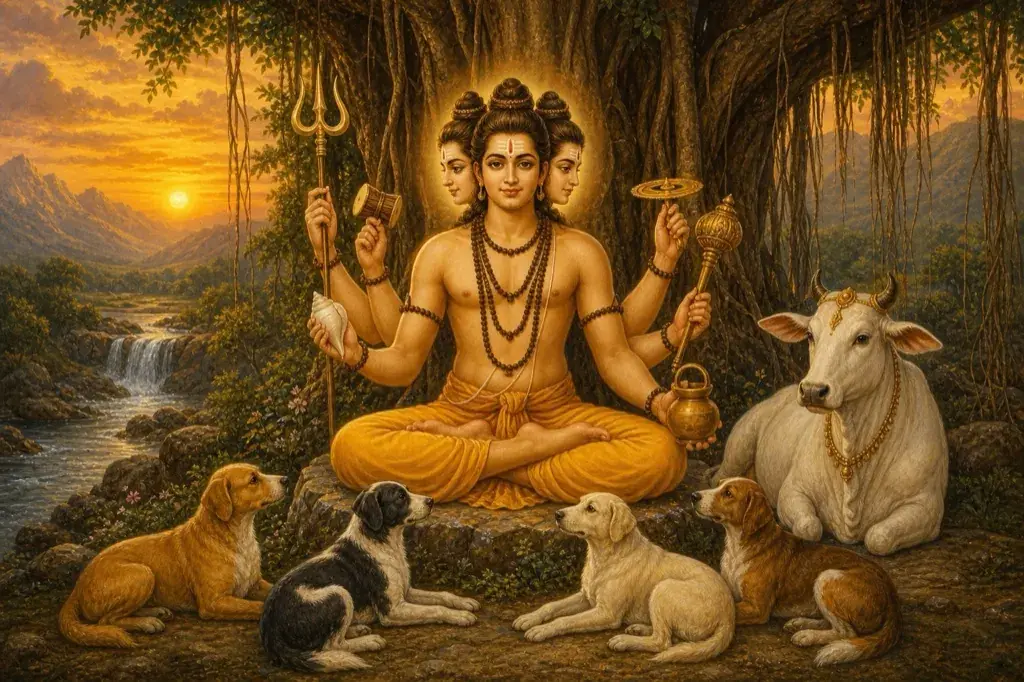
3 · 4
Now he arrives at the refrain that is the axis of this chapter. “All of this is true” or “all of this is false,” no such resolution or doubt was ever born in him. Anamaya means free of disease, and the disease meant here is no bodily ailment. It is that fever of the mind which keeps ruling on everything with a “yes or no.” In the same way, the pair of ignorance and knowledge never rose in him, nor did “I am awareness itself.” So with what mouth would he settle whether awareness is present or not? “I have understood” is a subtle pride, and “I have not understood” is its other face. The atman, the self, is past them both, for it is the light that knows, prior to every act of knowing.
5 · 6
Then comes a burst of denials, and behind every denial is that same compassion. He says: I am joined neither to dharma nor to sin, neither to bondage nor to moksha, release. “I am joined to something” or “I stand apart from something,” even this distinction does not appear. The seeker strives to join with dharma, with merit, with release, and that striving is right in its place, yet the supreme reality joins with nothing, because it is already complete. In the same way, high and low never were, nor the neutral stance between them, no enemy, no friend. So on what ground would he name benefit and harm? The whole web of relation is relative. The one who is an enemy to this person becomes a friend to that one, and to say “I am neutral” is also incomplete, because neutrality too is possible only when two sides stand before you.
7 · 8
Now he opens the inner structure of worship and of knowledge. There is no one who worships, no form of worship, no teaching, no act of his own. So how would he even say “I am pure consciousness itself”? Samvit means pure consciousness, yet consciousness cannot make itself its own object, the way an eye cannot see itself. Then the same point comes in the language of extension: here there is nothing that pervades, nothing for it to pervade, no ground, no groundless state. So how would he name the pair of empty and not-empty? The atman is not the pot, nor the water filling it. Both comparisons fall short.
9 · 10
Now the triad of both knowing and doing breaks apart. In his case there is no one who grasps, no object fit to be grasped, no cause, no effect. So which of these would he say, “beyond thought” or “an object of thought”? Knowing holds three: the knower, the knowing, and what is known. Action too holds three: the doer, the deed, and the act. Yet this triad does not apply to the atman. In this same key he returns to the tender voice of a father and, calling out “tata,” dear one, seats him close, as though explaining to someone he loves: there is no one who divides, nothing to be divided, no knower, nothing fit to be known. So how would he speak of coming and going in time, rising and sitting, being born and dying, this “gone and returned”? The supreme reality stands outside the very stream of time.
11 · 12
Now the denial descends all the way to the body. There is no body of his own, no bodiless state, no intellect, no mind, no senses. So how would he name the split between attachment and its absence? From the gross body to the subtle body, the mind, the intellect, and the senses, all of these are instruments, and attachment and its absence are only movements of the mind. Whatever holds all of them is itself none of them. Then, calling out “mitra,” friend, he says one more thing: nothing becomes high and set apart merely by being named, nothing goes into hiding by being left unnamed. So how would he name the split between equal and unequal? The question of comparison, same or unlike, rises only when there are two. Where there is only one, no ground for comparison remains.
13 · 14
The seeker’s own identities now fall away too. I have not conquered the senses, nor have the senses overpowered me, no restraint arose, no observance. So how would he speak of victory and defeat? “I have brought the senses under control,” this identity too is a subtle bondage, and yoga’s yama and niyama, the restraints and observances, belong to the order of action, and every action asks for a doer. Then he speaks again to “mitra,” friend: the pair of form and formlessness never was, no beginning, no end, no middle. So how would he speak of strength and weakness? The formed and the formless are notions of the mind, beginning, middle, and end are lines drawn on time, and strength and weakness are more relative still, since even a wrestler stands weak before a mountain.
15 · 16
Then, addressing “tata,” dear one, he carries this negation as far as life and death and the states of consciousness. Death and deathlessness, poison and nectar, these pairs never rose within him. So how would he speak of pure and impure? Life and death, poison and cure, defilement and purity, all of these are categories of nature and hold up only by leaning on each other. In the atman nothing new is ever born. Then dream, waking, and the yogic seal fall away as well, no night, no day. So how would he speak of the fourth state and the not-fourth? Waking, dream, deep sleep, and turya, these four states of consciousness appear in the Mandukya Upanishad, yet at the summit of advaita even these four are states held relative to one another, and the pure atman is the witness of them all, itself bound in none.
17 · 18
Now the tone shifts a little, and he speaks straight to the disciple: know me in this form. Know me as the form freed from both “all” and “nothing.” Maya and the absence of maya, neither ever was. So how would he speak of the twilight rites and the rest? The twilight worship, the yajna, fire-rite, the oblation, these are limbs of the earlier discipline and hold their value in their place, yet at the supreme level, where the distinction between the doer and the deed to be done no longer holds, only the natural state remains. And again, know me as the form that rests easy within every samadhi, freed from both goal and goallessness. So how would he speak of union and separation? Samadhi is the name for recognizing your own nature, and effort builds none of it. What is already gathered whole has no need to enter samadhi.
19 · 20
Now the pride of intellect and the identities of family fall away together. I am not a fool, nor a scholar, there is no silence, no speech. So how would he speak of reasoning and counter-reasoning? “I am learned” is the pride of one steeped in the shastra, “I know nothing at all” is the pride of self-reproach, and both are one pride showing two faces, both within the order of intellect. With the same ease, father, mother, lineage, caste, from birth to death, these were never his own. So how would he speak of affection and infatuation? Lineage and caste are a social identity, mother and father a biological one, birth and death the identity of existence, and the affection denied here is biological and social attachment. The atman’s natural love runs far wider than these limits, bound by no cord of relation.
21 · 22
Now, after the long line of denials, comes the turn toward light. First a final denial: I have never set, I am forever risen, radiance and the lack of radiance never were. So how would he speak of the twilight rites and the rest? Sadodita means ever-risen, that which never goes down. Even the image of the sun falls behind, because the sun sets and the atman never does, and the twilight worship is performed at the two joints of rising and setting. Then come three positive signs, and the weight falls on knowing them with certainty. Know without doubt: I am nirakula, untroubled, in whom there is no agitation. I am nirantara, unbroken and whole, in whom there is no crack. I am niranjana, untainted, on whom no stain and no covering ever settles.
23 · 24
At the end the chapter turns back on itself and completes. Addressing “tata,” dear one, he says: the steady ones let go of all meditations, they let go of both deeds, the good and the ill, and they drink the nectar of renunciation. Meditation too is finally an act, and a deed binds with its own cord whether good or ill, whether the cord is of gold or of iron. This is the nectar of renunciation, where the burden of doing slips off and the natural, steady, deathless state remains. And where nothing called “gaining” is left at all, no poetic rule of meter or mark holds sway. Sunk in the rasa of evenness, made pure by feeling, the supreme avadhuta babbles that reality. Here the babble is speech gone unguarded and free of care, the abandon of an avadhuta drenched in the rasa of sameness, carrying on about that same reality with no thought for meter polished to scripture.
Next
Chapter 5: illustration and direct experience, signs that point toward the experience of Brahman.