The Avadhuta Gita
Chapter 3 · Dismissing Praise and Sameness with the Sky
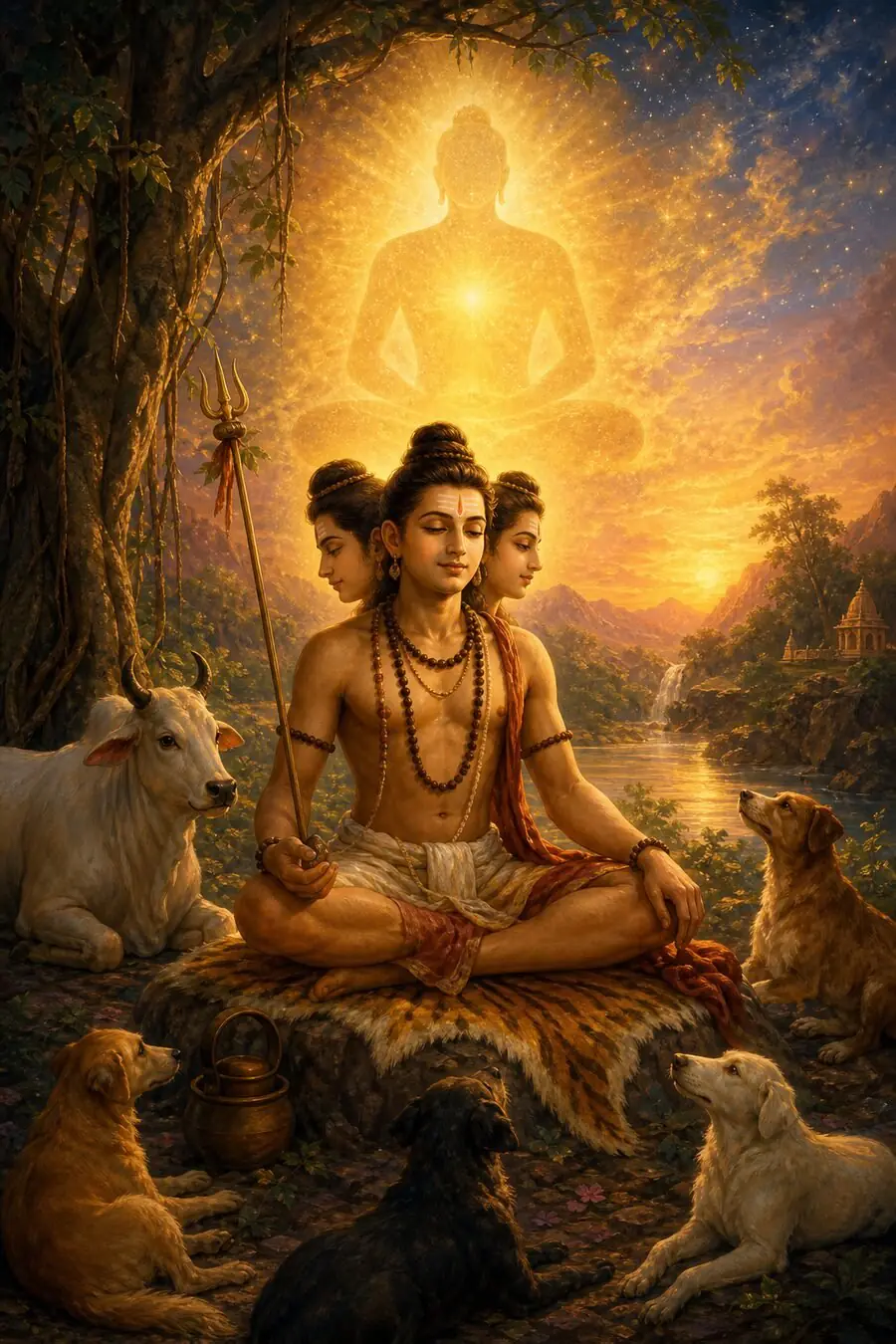
This chapter flows like a mantra. The refrain “jnanamritam samarasam gaganopamo’ham”, I am the nectar of knowledge, one even taste, vast as the open sky, returns at the close of every shloka from 3 through 41, and each time it returns it cancels one more distinction. Here Dattatreya sets aside even praise itself, because wherever the one who praises and the one praised stand as two, duality already stands with them. The shlokas that follow hold a contemplation of the supreme Self in which every pair, every measure, every rank dissolves.
1 · 2
The chapter raises a singular question in its very first breath. Dattatreya sits down to offer praise to Shiva, and then he stops. The Shiva he would praise stands beyond the division of quality and no-quality, free of passion and dispassion, spotless, empty of the whole tangle of the world, all-pervading, wearing the form of the universe. How is such a sky-formed Shiva to be praised at all. And there the secret opens. That Shiva is no other. The eternal Shiva, free of white and every other color, is himself both the effect and the cause, and the one free of every alternative, the one we are, is that same Shiva. Dattatreya calls his disciple “sumitra”, best of friends, and asks how a person is to bow his own self within his own self. A bow is possible only where there are two; where a single Self alone remains, the one who bends and the one bent to both vanish.
3 · 4 · 5 · 6
From here rises the refrain that will keep returning. Dattatreya asks how a person is even to utter these contradiction-laden names, “nishkama-kama”, a desire empty of desire, “nihsanga-sanga”, a nearness empty of attachment, the one free of both essence and its absence. To fix a name is itself a boundary, and what lies past every boundary cannot be caught in a net of words; so every name arrives trailing the words “how shall I say it,” and every time the same echo returns at the close, I am the nectar of knowledge, one even taste, vast as the open sky. Then the maps of non-duality and duality also refuse to sit on the Self, because the moment you say “one,” the word “many” is drawn in beside it. Neither gross nor lean, neither coming nor going, without beginning, middle, or end, neither high nor low: this is the supreme reality. And whether it be the senses or their objects, all are like the sky, hollow within; the Self is one, spotless, neither bound nor released, because binding and release belong only to what stands inside some limit.
7 · 8 · 9 · 10
Calling his disciple “tata”, dear child, Dattatreya lets his voice turn fatherly. I am neither hard to grasp nor easily grasped, he says, neither a rare goal nor an easy one, neither near nor far, because “Brahman is hard” and “Brahman is easy” both set it on the scale of difficulty. Then he becomes a flame, a flame that burns to ash both action and inaction, both pleasure and pain, both the body and bodilessness, in which first “I am the doer” falls away and then “I am the non-doer” falls away too. That same sacrificial fire turns sin and merit, dharma and adharma, bondage and release, every pair, into an offering, and after the offering only the Self remains. And then even the word “free of” becomes forbidden. Dear child, I am not even free of feeling and no-feeling, not even free of union and disunion, not even free of mind and no-mind, because the instant you say “free of feeling,” feeling has already come back.
11 · 12 · 13 · 14
Now Dattatreya lets every title, every rank fall. The title of delusion and freedom from delusion, of grief and freedom from grief, of greed and freedom from greed, none of these is a choice that belongs to me, because “I have slipped free of delusion” and “I am still caught in delusion” are both titles of the mind, and the Self fits into no title at all. The spreading vine of the world was never mine, nor the happiness that springs from contentment, nor the bondage of ignorance, because the true nature never had any tie to that vine to begin with. The three gunas, too, belong to prakriti, the primal nature, and the Self holds none of them; rajas that spreads the world outward, tamas that spreads torment, and even sattva that gives birth to one’s own duty is no distortion of mine, because sattva also comes and goes. And the final cause of sorrow finds no seat in the Self; the ordinance that gives birth to the sorrow of torment is not mine, the mind born of torment is not mine, and so the pride that says “I am this way” is not mine either, and once that pride is gone the very seed of sorrow is gone.
15 · 16 · 17 · 18
Every pair comes to rest where the word “pair” no longer runs. The end of trembling and stillness, where there is no wavering and no resolve; the end of dream and waking, where there is no gain and no loss; the end of essence and emptiness, where there is nothing moving and nothing still. This is no pair of the known and the knower, and no object for reasoning; speech does not catch it, nor mind, nor intellect; where speech turns back, there this reality rests, and still Dattatreya speaks, only to point toward it. This is the supreme reality, free of the different and the undifferentiated, so what would its inside and outside even be; it was never once born, and it is not any “thing” either, because even the word “thing” draws a boundary. And the reality free of passion and the other flaws, free of fate and the other flaws, free of the world and its grief, that reality is what I am, because prarabdha, the karma already set in motion, lays hold of body and mind, and the Self stays beyond its reach.
19 · 20 · 21 · 22
Now number and rank fall as well. When the three states of waking, dream, and deep sleep are not there at all, how can there be a “turiya”, a fourth; when the three times are not there, how can there be directions; the still supreme station alone is the supreme reality, because a “fourth” can be named only when there are “three.” The division of long and short is not in the Self, nor of wide and narrow, nor of angled and round, because the sky holds no angle, and the sky-like Self holds none either. Mother and father, son, birth and death, and even the mind were never once mine, and this is the steady supreme reality, free of all agitation, because “father” holds only where there is “son”; family identity is the body’s affair, and it never reaches the Self. Pure and purer, unstained and stained, unbroken and broken, all these pairs lie beyond thought and stand endless in form, because what remains even after you add every pair together is itself the supreme.
23 · 24 · 25 · 26
When the single-formed, spotless supreme reality is all there is, how can Brahma and the other gods stand here, how can heaven and the other worlds stand here, because in pure non-duality the rank of gods and the rank of heaven are themselves divisions. Even the Upanishad’s method of “neti neti”, not this, not this, falls away in the end; how shall I speak of the spotless one that is free even of “neti neti”, free of remainder and no-remainder, free of mark and markless, because to say “not this, not this” is itself a process, and the Self lies past every process. And then the life of the avadhuta becomes an effortless play. Staying past both action and inaction, I go on acting forever, this supreme play free of nearness and no-nearness, this endless game free of the body and bodilessness, where actions keep happening and the weight of a “doer” never settles. The tangle woven by maya, the making of crookedness and conceit, the pair of true and false, no such fabrication is a distortion of mine, because every fabrication stands at the level of prakriti.
27 · 28 · 29 · 30
Free of the divisions of time such as dusk, I undergo no separation; and I am not without inner awareness either, neither deaf nor mute; nor is there even the claim “my feeling is pure,” because the avadhuta is not empty of sensation and not bound by sensation, and he stands past both categories. Free of master and masterless, free of mind and no-mind, free of everything, he alone is untroubled, unshaken, because “I am someone’s servant” and “I am free” are both divisions as well. How shall I say “this is a forest or a temple,” how shall I say “this is perfected or still in doubt,” for this is unbroken sameness, untroubled, because for the avadhuta a temple is a forest and a forest is a temple. And free of the living and the lifeless, free of seed and seedless, free of bondage and nirvana, this reality shines of itself forever, because the very nature of the Self is self-luminous, and it needs no other light to light it.
31 · 32 · 33 · 34
The cycle of creation, preservation, and dissolution also belongs to prakriti. Free of arising, free of the world, free of dissolution, this reality shines forever, because the Self is never born, never dies, and never changes. And now Dattatreya rebukes the mind head-on. You brazen mind, he says, for you there is not even a mention of name and form, and in neither differentiated nor undifferentiated shape is there any object of yours, so what is all this grieving for. Here the refrain is put to its last use, and the voice softens. Friend, what are you weeping over, there is no aging for you, no death, no sorrow of birth, no distortion at all. Friend, you wear no beautiful form and no ugly one, and you pass through no separate stages of your own, because childhood, youth, and old age are stations of the body, and the Self is free of age.
35 · 36 · 37 · 38
Dattatreya repeats the same compassion-filled question again and again. Friend, what are you weeping over, not your stages, not your minds, not your senses, because the mind and the senses are only instruments, and none of them is “you”; whether the instruments weaken or grow strong, the true nature stays the same. Friend, you have no longing, no allurement, no bewilderment, because desire, greed, and delusion are waves of the mind, and the Self is that ocean the waves never touch. Then why this hunger for lordship, you have no wealth, no wife, nothing that is “mine,” because this small word “mine” is the foundation of the world, and once it is gone, for whom would any craving remain. The birth of the whole play of forms is neither yours nor mine; you brazen mind, it looks like something separate, yet it is free of difference and no-difference, because bodies appear distinct, and from that the mind builds “mine and yours,” and the moment you reach the subtle reality that difference breaks apart.
39 · 40 · 41
Not one atom of you wears the form of dispassion, nor of passion, nor of desire, because “I am detached” and “I am attached” are identities that never reach the true nature. The triad of yoga breaks apart here as well. The meditator is not in your heart, nor is your samadhi, that state of absorption; meditation is not in the heart, nor anywhere outside; the object of meditation is not in the heart either; there is no object and no time, because absorption too is a state, one that comes and goes. And then comes the chapter’s gist-shloka. The distillation of everything said is this, you are not, I am not, there is no great one, no guru, no disciple; what remains is only the free and open form, effortless, the supreme reality, liberated and even, where even the distinction of “you, I, guru, disciple” is declared false.
42 · 43 · 44 · 45
The refrain now comes to rest, and in the last four shlokas the tone changes. When the supreme nature is one, wearing the form of the sky, how can the supreme reality be “of the form of bliss,” how “not of the form of bliss,” how “of the form of knowledge and deeper knowing”; even the definition of being-consciousness-bliss stands here as a mere hint, and offers no full account of the final truth. Then know that one deeper knowing, that final awareness, to be free of fire and wind, free of earth and water, free of rest and motion, vast as the open sky; here the sky serves only as a comparison, and it is not that reality itself. Neither of the form of the void nor free of the void, neither pure nor purer, form or formless, I am none of it, and my own nature alone is the supreme reality. And at the end the ultimate instruction rings out, let go, let go of the world, and then let go of “renunciation” too, completely; first the outer grip loosens, and then the pride that says “I am a renouncer” loosens as well, and whatever is purified of the poison of both letting go and not letting go remains as the nectar-formed, effortless, unmoving nature of the Self.
Next
Chapter 4: Dismissing All and Equal Vision, which unfolds “you are not, I am not, this world is not” more deeply still.