The Avadhuta Gita
Chapter 5 · The Exposition of Om and the “All Is Equal” Mantra
This chapter rises from Om and comes to rest on “tat tvam asi”, you are that, then returns one refrain again and again, “kimu rodishi manasi sarva-samam”, O mind, when everything is already equal, for whom then the weeping. Dattatreya raises one distinction after another, high and low, outer and inner, bondage and release, guru and disciple, and dissolves each one into that single even reality.
1 · 2
Dattatreya sets down a first word larger than every boundary. Om is uttered, yet that which Om points to is like the open sky, boundless and without form. In it no inquiry into higher and lower holds, and play and non-play both dissolve there. The three vowels a-u-m and the nasal point resting behind them, even these sound-signs, how could they fix themselves upon a reality vast as space. Then he moves straight to the great utterance (mahavakya). “Tat tvam asi”, you are that, and the shrutis (the revealed texts) of its kind have always taught this one thing about the atman (the self), that it is you yourself, free of every limiting mark and the same in all. The shruti’s task was to reveal this, and it has done so; now only resting here remains. So, O mind, when all is already equal, for whom do you weep.
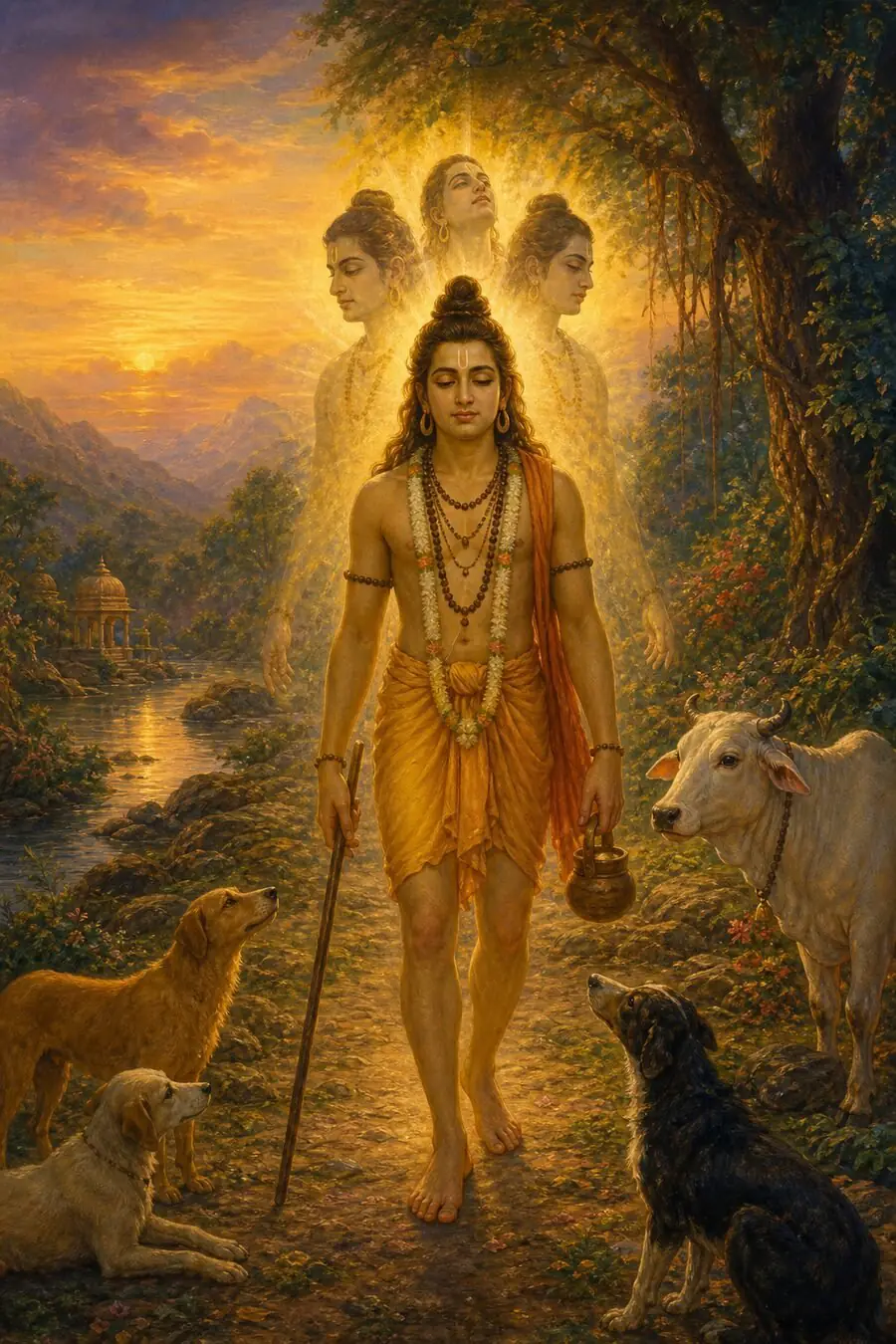
3 · 4 · 5
Now he lifts each distinction and lets it fall, one by one. No split of below and above, all is equal; no partition of outer and inner, all is equal; and here is the startling turn, even to say “it is one” fastens a boundary, for “one” has meaning only where “two” is possible, so this reality stays behind the language of counting itself. There no thought of the imagined and the imaginer holds, no thought of cause and effect holds, even the rules of word-joining, of speech and grammar, do not apply there, and the shruti does not call it inexpressible for nothing. Absorption too is a state, awake in some time and in some place. So there is no absorption of knowing and not-knowing, none of region and place, none of time and season. Even the sense “we are in absorption” stands outside absorption. So, O mind, why do you weep.
6 · 7 · 8 · 9
Then he himself removes the famous Vedanta illustration. You have long heard of the space inside a pot, yet here neither the pot’s space remains nor the pot, neither the body of the living being remains nor the living being, only space is left; the division of cause and effect breaks as well. Here there is only the state of continuous release everywhere, a freedom present in every time and every place, a freedom that is right here, in which no thought of small and large arises, no partition of round and angled, for all the laws of shape belong to the level of the senses. Empty and non-empty, pure and impure, all and not-all, three opposing pairs canceled at once, for contradictions rise in the mind, not in the reality. And there no thought of separate and inseparate holds, and no question of an outer and inner meeting arises, for meeting can happen only where there are two, and it is free even of enemy and friend, the same in all. So, O mind, why do you weep.
10 · 11 · 12
The nature of disciple and non-disciple is also a distinction, and so is the distinction of moving and unmoving, and Dattatreya says, here there is only the state of continuous release everywhere, where all are already complete, so no need of any “disciple” remains. Surely free of form and formless, free of separate and inseparate, free even of emission and withdrawal, of creation and dissolution, for creation and dissolution are the play of prakriti (primal nature) and do not touch the atman. No rope of quality and non-quality binds it, and when there is no birth and death at all, then the rites bound to the dead and the living, the last rites, the shraddha, the birth-rite, for whom are these, since this is pure, unstained, the same in all. So, O mind, why do you weep.
13 · 14 · 15
Free of presence and absence, free of desire and non-desire, and here the summit of awareness is surely the same as release, for full awareness and release do not stand as two. Here within reality there is only that one continuous reality, which stays unbroken as one everywhere, beyond junction and disjunction, free of everything yet the same in all. And if you take up the matter of dwelling, whether homeless or with a hut and a family, to the avadhuta the two are alike, beyond company and solitude, beyond even knowing and not-knowing; a palace or the foot of a tree, for him all are equal. So, O mind, why do you weep.
16 · 17 · 18
Now he lays down the test of truth: what does not change is truth. Change and changelessness both keep shifting, so both are untrue; the marked and the unmarked are untrue as well; truth is only in the atman, which is ever even and still. And here he takes up the living being, the jiva, in a positive sense, for in the avadhuta’s sight the living being and Brahman are not apart, and once the limiting mark falls away the living being is itself Brahman. So here the living being is surely the same in all, continuous everywhere, only and unmoving. On the other side the pair of discernment and non-discernment stands as ignorance, and so does the pair of option and non-option, for discernment too is the language of distinction and stays incomplete at the level of distinction, while the one continuous awareness is free of distinction. So, O mind, why do you weep.
19 · 20 · 21
Turning every experience into a “higher station” or a “lower station” is an old habit of the mind, so Dattatreya lifts away every rank at once: there is no station of release and none of bondage, no station of merit and none of sin, no station of fullness and none of emptiness, in this reality there is no gradation of rank at all. Then, leaning on three “ifs”, he explains it to the mind in the mind’s own language: if it is even, free of color and colorlessness; if it is even, free of cause and effect; if it is even, free of division and subdivision, then where is the ground for weeping left. And what is called the one consciousness pervading all, in that all-consciousness every category dissolves, from the two-legged human down to the animal, and it is only and unmoving, beyond every category and the same in all. So, O mind, why do you weep.
22 · 23 · 24
The atman pervades all only by going beyond all, so he says: beyond everything, continuous, all-reaching, utterly spotless, unmoving, and free of day and night, for day and night are pieces of time and the atman is beyond time. Into it nothing comes and nothing goes; no arrival of bondage and unbinding, no arrival of union and separation, no arrival of argument and counter-argument, for arguments and counter-arguments keep coming and going in the mind while the atman stays unmoving. Here the current of negation negates time and non-time, negates even the atom-sized krishanu, the subtlest spark of fire, yet it does not negate the final and only truth, and it stops right where the lone truth is left. So, O mind, why do you weep.
25 · 26 · 27
Free of body and bodilessness, beyond dream and deep sleep, beyond name and ordinance, for names and rules are all relative and pure experience is free of name. Then the same likeness returns: pure and vast as the sky, beyond everything and set apart, the same in all, gone past essence and non-essence and change; yet the sky’s clarity and vastness are only a likeness, for the sky is itself a physical element and the atman is beyond even that. And he carries detachment two steps further: here utterly detached from dharma and non-dharma, utterly detached from substance and non-substance, utterly detached from desire and non-desire, for above the sense “we are detached” stands the state “we are detached even from detachment”, and in the end the grip of dispassion also lets go. So, O mind, why do you weep.
28 · 29 · 30
Now comes the turn of the tenderest distinction. Free of pleasure and pain, the same in all; beyond grief and non-grief; and free of guru and disciple, beyond even reality, for at the final reality the guru sets aside even his own guruhood, and here no guru remains and no disciple. Then he takes up the first moment of arising: not even the first sprout breaking from a seed can be tied into the frame of essence and non-essence, no evenness and unevenness of moving and unmoving is there, and this is free of thought and non-thought itself. And whatever was called the gathered essence of all essences, the division of one’s own nature that was described, and the notion of the senses being an instrument toward an object, all of that is untrue, for when the object too is not apart from the atman, then whose instrument is the sense organ; all of it is mere superimposition. So, O mind, why do you weep.
31 · 32
At the end Dattatreya brings in the witness of the shruti. The shrutis say in many ways this one thing, that the whole world, beginning with space, is like a mirage, that illusion of water in the desert which is not there at all; and if everything is one, continuous, the same in all, then what is the weeping for something that is not there at all. Then comes the very shloka that completes both Chapter 4 and Chapter 5, Dattatreya’s signature: where nothing is left to attain, there the law of poetry no longer holds either; sunk in the even rasa (the taste of oneness), purified by feeling, the supreme avadhuta babbles out the reality. What was spoken may not be clean by the rules of meter, yet an avadhuta absorbed in even rasa speaks just like this.
Next
Chapter 6: The rejection of all things and abiding in one’s own nature, the dissolving of the three gunas, the three times, and the three bodies.