Avadhuta Gita
Chapter 2 · The Nature of the Self, Part Two · Shlokas 1-38
The “I” that spoke through the first chapter now points to itself as “he.” From verse thirty to thirty-seven a single line keeps returning, “tam isham atmanam upaiti shashvatam,” he reaches that eternal Self, the Lord. Every shloka opens a fresh angle, and the destination stays one.
Context
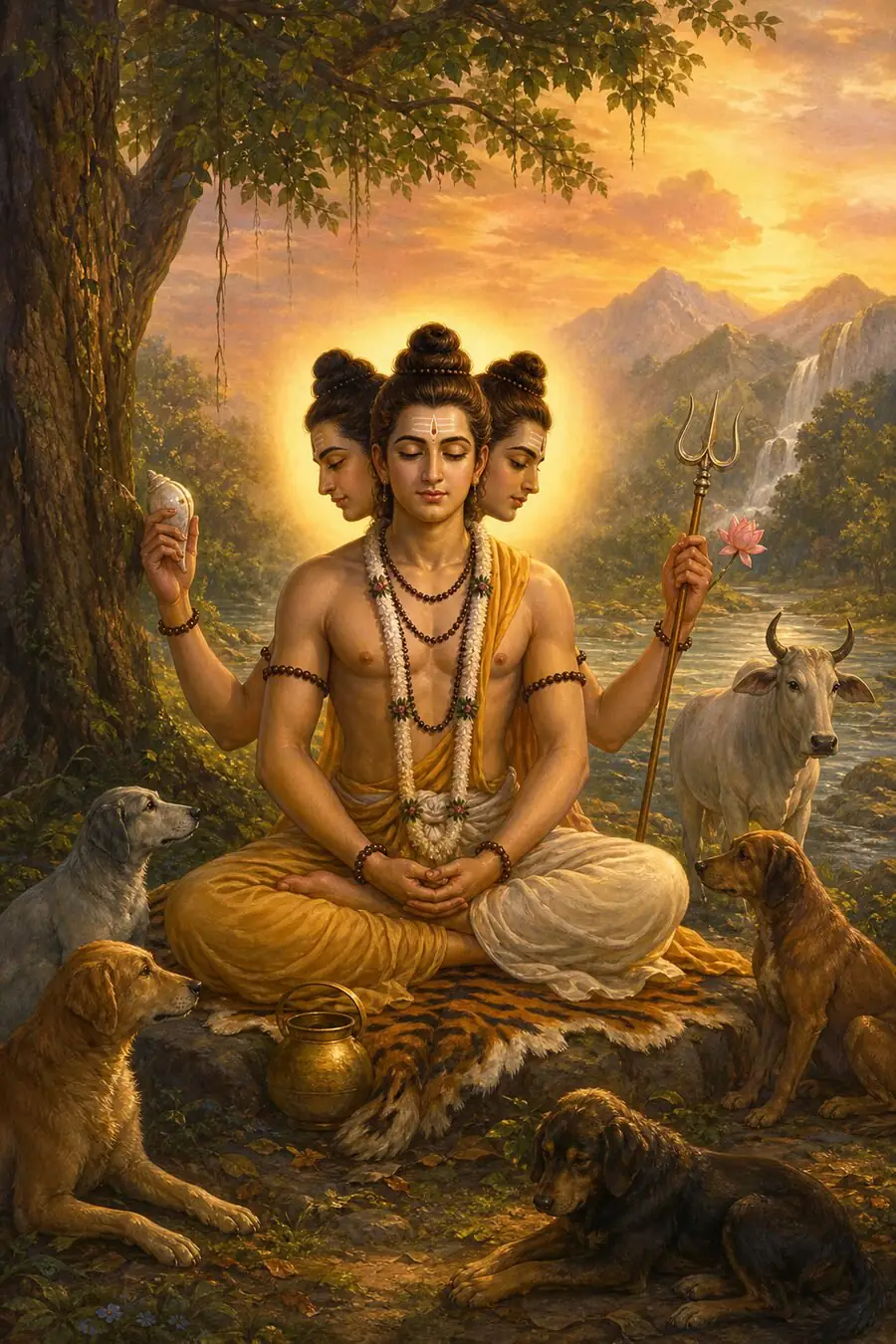
This song of Dattatreya is the most fearless voice of non-duality. No softening, no cover. The current of the first chapter moves ahead here, while the stance of the voice shifts. Sometimes in the first person, sometimes in the third, “to that Lord,” and the essence stays one. From verse thirty to thirty-seven, “tam isham atmanam upaiti shashvatam”, he reaches that eternal Self, the Lord, returns eight times and becomes a refrain.
1 · 2
With his very first breath the Avadhuta settles the matter of worth. Never mind who is speaking; attend to what is said. Whether the words of a guru come from a child, from someone sunk in the senses, from a fool, a servant, or a householder, nothing in them lies beyond consideration. Who would throw away a jewel that has fallen into filth? A jewel stays a jewel wherever it lies. And what is that jewel? It is the one that, with no effort at all, by its stillness alone, swallows this whole moving world, the one that is by nature calm, pure awareness, unstained like the sky.
3 · 4
A realization that has to be earned through practice is still incomplete. The self’s own nature comes as a natural state; effort does not earn it. Then the Avadhuta loosens a knot of reasoning. The one who moves this single world of the moving and the unmoving without any effort is present everywhere. How, then, could it stand apart from us and still be non-dual? To hold it as separate from oneself is duality itself. And so he says without hesitation: we alone are the highest, for we are Shiva, more essential than the essence, free of coming and going, without alternatives, without agitation. When everything has been strained away, what remains at the end is the truth of the Self.
5 · 6 · 7
We are free of every limb and part, and the gods worship us. Yet because we are complete, no division into the three great gods and the rest can apply to us; completeness admits no partition. We have no fear of heedlessness. What is there to do even while the mind’s waves rise? Those waves lift and dissolve on their own, like bubbles in water. There is no wrestling with them; there is only remaining the witness. From the great principle onward, all the elements are forever coming to their end, whether they are soft or sharp, sweet or bitter. What never comes to an end is the atman.
8 · 9 · 10
An image makes it clearer. Just as bitterness, coolness, and softness in water are not separate from the water, so nature and spirit appear to us as one undivided reality, both held within a single thing. That reality is free of all names, finer than the finest, supreme, beyond mind and intellect and the senses, flawless, the master of the world. What is finer than the finest never falls into the grip of any sense. And where such a natural reality stands, how can there be an “I,” how a “you,” how a world of the moving and the unmoving? In the natural Self these three distinctions dissolve, and nothing is left over except the One.
11 · 12 · 13
When it was called “sky-like,” that was no mere word; it truly is sky-like, pure awareness, flawless, all-knowing, complete. The image of the sky holds true here: it is genuinely unstained like space, endless, and without fault. The four gross elements never reach it. It does not walk on earth, does not ride the wind, is not covered by water, does not sit within fire. Its home is the fifth, the element of space itself. And notice how strange this is: even space is pervaded by it, while it is pervaded by nothing. It stands whole and unbroken within and without, spread through all things, and itself contained by none.
14 · 15 · 16
So subtle a reality is hard to grasp directly, and for that reason the yogis prescribed supports and other aids. Even that support is won only step by step; a prop does not bear fruit all at once. Yet the summit of practice is the letting go of that very support. When a seeker joined to steady practice becomes free of every support, he dissolves into that absorption and grows free of virtue and fault within. When the prop too falls away, only the Self remains. And for the poison of this world, the poison that casts one into delusion and stupor, there is a single unfailing cure against this fierce poison-shaped cosmos: the natural nectar, the natural knowledge of the Self.
17 · 18 · 19
Now a beautiful figure arrives, that of the coconut. It is grasped through the formless mode and seen through the form-bearing gaze. What is free of both being and non-being is called the “in-between,” that state without opposites that lies between the formed and the formless, where the mind is to be rested. The outer form is this cosmos, the inner is called nature, and like the water inside the coconut fruit, one must know the reality that lies inward of the inward. The coconut has three layers, husk, kernel, and water, and the truth of the Self is that innermost water. In the same way, mistaken knowledge stays on the outside, right knowledge in the middle, and the reality more central than the center is the one to know. Right knowledge is not the final stop either; the goal is to reach still deeper, to what is the essence even of that.
20 · 21 · 22
The full moon is a single, utterly clear thing. It should be seen as just that, one; to see one reality in two forms is confusion, and to see it as one is true sight. In the same way, the mind’s habit of division does not reach everywhere. Even as the sense of difference grows, the root reality stays one, and the one who arrives at steadiness is sung under millions of names, the countless names of that single One. The level of one’s intellect decides nothing here. By the grace of a guru’s wisdom, whether fool or scholar, whoever comes to know the reality turns away from the ocean of the world. The one who gains knowledge of the truth by a guru’s grace holds the only real detachment.
23 · 24
What is such a knower like? Free of attraction and aversion, devoted to the welfare of all beings, firm in realization and steady, he reaches the highest state. His realization does not close in on itself; his natural place is the good of all beings. And what is his end like? As the space within a pot merges into the great space when the pot breaks, so, when the body falls away, the yogi merges into his own nature, the supreme Self. The space inside the pot was the great space even before the breaking; when the body breaks, the “I” remains that very supreme space.
25 · 26
Now the Avadhuta draws a line between two paths. The understanding just described belongs to those bound to action, and in the end it becomes their destination as well. For those joined to yoga, no such understanding or destination has been named at all. For those on the path of action the scriptures describe an understanding and a destination; for those on the path of yoga they give no description, and only experience remains. The destination of those bound to action can be spoken by the tongue, while the destination of the yogis cannot be told, supremely powerful. The yogis’ journey’s end fits into no word; there speech turns back.
27 · 28
Knowing this, one should understand that the yogis’ path is not imagined. They do not have to labor to earn attainment; once alternatives are dropped, attainment sets itself in motion, and the moment the alternatives lift, it descends on its own. Nor does place or time bind it. At a holy ford or in an outcaste’s house, wherever he dies, the yogi sees no womb again and merges into the supreme Brahman. “Sees no womb again” means there is no rebirth; whatever the place of death, his course is one and the same.
29 · 30
Now the fearlessness reaches its peak. Whoever sees the natural, unborn, unthinkable Self stays unstained by faults, however he behaves. Even if he performs not a single act, he is neither bound, nor an ascetic of restraint, nor a man of austerity. Whether he acts or refrains, the one who knows the Self stays untouched by it, and the labels of restraint and austerity do not stick to him either. And it is here that the refrain begins, the one that will return eight times through the thirty-seventh verse. That reality is without disease, without compare, formless, without support, bodiless, without desire, without opposites, without delusion, and holding undecaying power; the seeker reaches that eternal Self, the Lord. From here every shloka will strip away one attribute after another, and at the end only that eternal Self will remain.
31 · 32
Watch now how the attributes fall away one by one. Where there is no Veda, no initiation, no rite of tonsure, no guru, no disciple, no wealth of ritual instruments, and where even the mudras and the rest do not appear, the seeker reaches that eternal Self, the Lord. Every outer rule and ritual grows quiet there. The three streams of Tantric method halt there too. Where there is no Shambhava method, no Shakta, no Anava, no pinda, no form, no stage of pada and the rest, none of the states of beginning, completion, and vessel, the seeker reaches that eternal Self, the Lord. That reality lies beyond all methods.
33 · 34
Then another image, that of milk. As foam and bubbles rise from the churning of milk, so from whose own nature the moving and unmoving world is born, abides, and dissolves; the seeker reaches that eternal Self, the Lord. Milk becomes curd, becomes foam, becomes bubbles, and all of it stays milk; in the same way this whole world, at its root, is Brahman. And all the procedures of yoga fall away there in the end. Where there is no closing of the nostrils, no fixed gaze or posture, where neither knowing nor unknowing appears, where there is no coursing of the breath through the channels, the seeker reaches that eternal Self, the Lord. That state lies beyond every hold of technique.
35 · 36
Every pair of counting and measure collapses there as well. What is free of manyness, oneness, twoness, and otherness, free of smallness, length, greatness, and emptiness, free of measurer, measured, and equality; the seeker reaches that eternal Self, the Lord. Not one and not many, not small and not large, such is that reality without any attribute. And outer conduct neither blocks nor secures its attainment. Well restrained or unrestrained, a good gatherer or no gatherer, without action or full of action, such a seeker reaches that eternal Self, the Lord. Only the realization within decides.
37 · 38
Now the refrain comes to its last and densest shedding of attributes. What is not mind, not intellect, not body, not sense, not the subtle elements, not the five gross elements, not the ego, and is itself the very nature of space; the seeker reaches that eternal Self, the Lord. When every attribute has been let go one by one, the root nature that remains is unstained like the sky. And in the final verse the scripture’s pair of injunction and prohibition breaks apart too. Once injunction and restraint have merged into the state of the supreme Self, in the yogi’s undivided mind there is neither purity nor impurity; in that markless awareness all that is enjoined and all that is forbidden become one. Where there is no division at all, doing and not doing no longer stand apart.
What comes next
After this comes chapter three, where the non-duality of the “I” opens out into something even subtler.
The refrain running from verse thirty to thirty-seven, “tam isham atmanam upaiti shashvatam,” he reaches that eternal Self, the Lord, is the gist of this section. When every attribute has fallen away, the eternal Self that remains at the end is the destination of the whole Avadhuta Gita.