The Avadhuta Gita
Chapter 1 · The Nature of the Self, Part One · Verses 1-76
Dattatreya’s most fearless utterance. The whole weight of the first chapter rests on a single truth: the atman (self) alone is Brahman, and nothing exists besides it. There is no support here in ritual, no separate deity to worship, no division between bondage and release. Only the nature of “I,” boundless as the sky and untouched by any stain.
The way in
The avadhuta is the one who has thrown everything off. The throwing off reaches past clothing to the mind itself: every veil, every imagining, every grip of “I am this” has already fallen away. Tradition holds Dattatreya to be Brahma, Vishnu, and Shiva combined into one form, and in this text he speaks in a single voice: the atman is that supreme reality, it has always been, it always will be. Nothing here asks you to become anything; the task is simply to recognize what you already are.
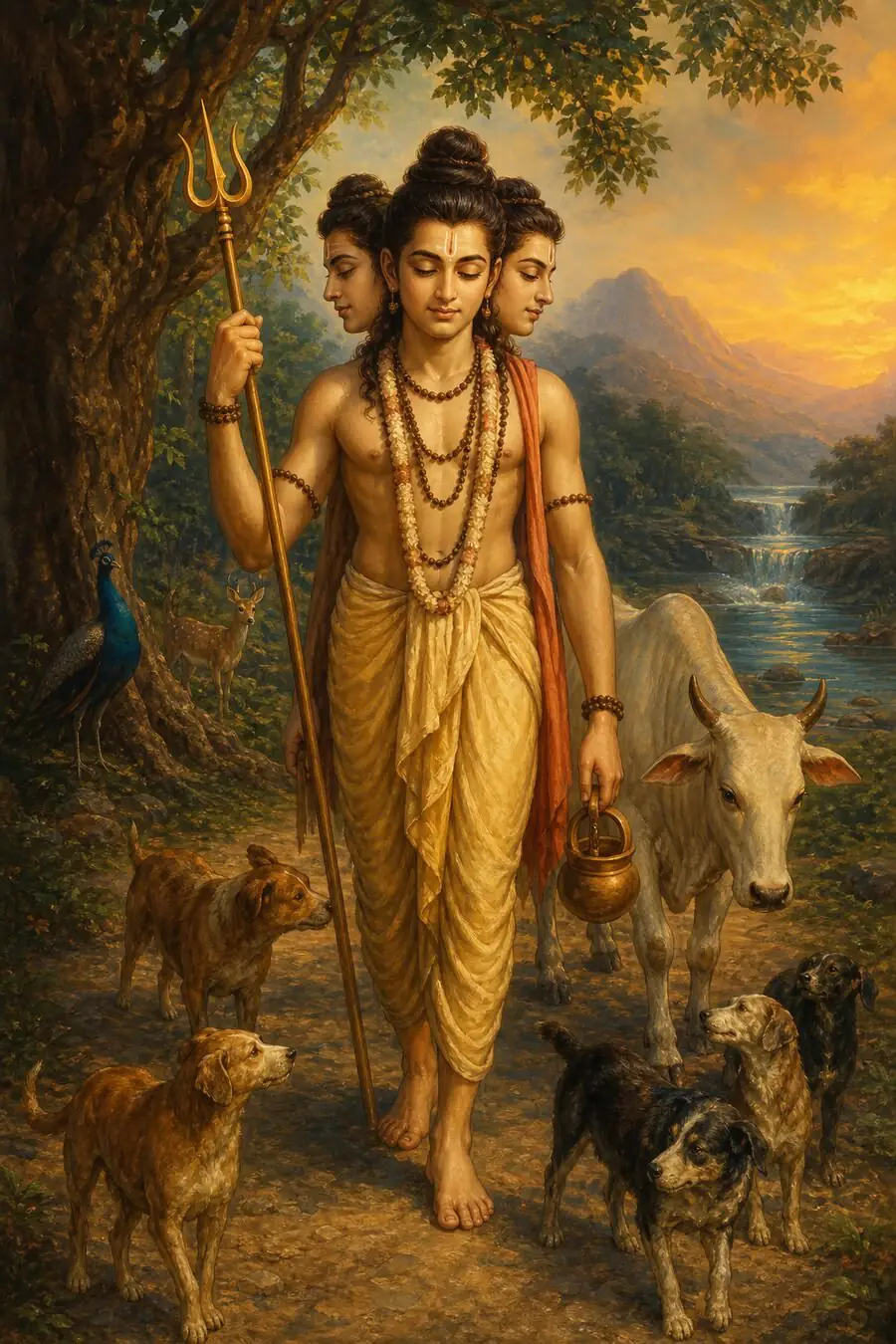
The seventy-six shlokas of the first chapter are a direct account of the atman. There is no story here, no crowd of similes, only plain declarations. Every shloka settles on the same target, and that one truth returns again and again in fresh words, because there is only one thing to say.
The through-line
The anchoring shlokas of this chapter: shloka 1 (the leaning toward non-duality comes by the grace of the Lord), 8 (the three acts of mind, speech, and body are not mine), 25 (“You are That” and “not this, not this”), 27 (if I do not know Shiva, how am I to worship him), 31 (the simile of the space inside a pot), 41 (the fourfold mantra of “know all this world to be”), 50 (neither bound nor free), 68 (O mind, you yourself are the reality, vast as the sky). The Avadhuta Gita rewards contemplation over analysis; sit with each shloka, one at a time, and that lingering is the reading itself.
1 · 2 · 3 · 4
The text lays its hand on its own root in its very first utterance. The pull toward non-duality that rises in a person comes as a sign of the Lord’s grace; no effort of one’s own produces it. That same pull wakes in order to carry the seeker across the great fear of worldly existence. Then the avadhuta unlocks the whole mystery in a single question. He who has filled all this, out of the self and within the self, that formless, undivided, imperishable Shiva, with what mouth are we to praise him, since praise asks for two, one who praises and one who is praised, and here there is no second. This entire universe made of the five elements is like the water of a desert that shows itself from far off and vanishes as you approach; and in the midst of it we stand alone, stainless, so to whom would we bow. The atman alone is everything, no division and no union; whether we say “it is” or “it is not,” nothing comes of it, only wonder remains.
5 · 6 · 7 · 8 · 9
This is the whole gist of Vedanta, this is both knowledge and realization: we are the atman, formless, all-pervading by nature; this pervasiveness is the original condition, not a thing anyone acquires. The deity who is the self of all, undivided, boundless as the sky, pure and spotless by nature, that very one is “this, I am,” and of this there is no doubt. We ourselves are the imperishable, the infinite, the very form of pure knowing; pleasure and pain pass across the mind and never so much as touch that “I,” so how could they belong to anyone. The acts of mind, body, and speech, whether good or ill, carry no “mine” upon them, because we are the nectar of knowledge, pure, beyond the senses. And look at this mind too: now it takes the shape of the sky, now it faces every direction, now it lies beyond mind, now mind is everything; yet seen in the highest truth, no thing named “mind” survives at all.
10 · 11 · 12 · 13 · 14
We are one, we are all this, beyond the void, unbroken; so how are we to see the atman as visible or as hidden, since seeing asks for both a seer and a seen, and here there is only one. Now the avadhuta calls out to the mind and reasons with it. You are one, the same in all, imperishable; why do you not grasp this. Lord of all, you are forever risen and undivided, so how do you hold to a difference of day and night, since day and night belong to the one who stands apart from the sun and watches, never to the sun itself. Know the atman as continuous, one everywhere, unbroken; “we are the meditator, the supreme is the meditated upon,” how will this partition break what cannot be broken. You were never born and never died, your body has never once existed; scripture proclaims this in many forms, “all is Brahman.” You are outside and within, everywhere and always Shiva alone, so why, having forgotten your own nature, do you run here and there like a man possessed.
15 · 16 · 17 · 18
Union and separation belong neither to you nor to us; joining and distance rest on the assumption of “two,” yet neither you, nor we, nor this world exist; all of it is only the atman. Of the five objects, sound, touch, form, taste, and smell, you are not, nor are they yours; you yourself are the supreme reality, so why do you take on this grief. Birth and death, bondage and release, good and ill, these do not belong to your consciousness; O child, why do you weep, name and form are neither yours nor ours. This tender call of the guru turns toward the mind: O mind, why do you run about deluded, like one possessed; look upon the atman as undivided, and grow happy by letting go of attachment, because once the seeing comes first, the letting go follows on its own.
19 · 20 · 21 · 22
You yourself are the reality, free of any flaw, unshaken, one, the very embodiment of liberation; you have neither passion nor aversion, so why do you burn with desire, for the moment you recognize “we are liberation itself,” the root of desire is cut. All the scriptures say only this: that reality is without qualities, pure, imperishable, bodiless, the same throughout; know it to be your very self, and of this there is no doubt. Know the formed to be false and the formless to be unbroken truth; from the teaching of this one discernment alone, no possibility of rebirth remains. The wise give word of a single, uniform reality, and once attachment falls away the mind no longer keeps the split between “one” and “many”; as the vision of multiplicity goes, all divisions go with it.
23 · 24 · 25 · 26
When all is one, the very form of liberation, then upon what does absorption fix itself, on the non-self, or on the self’s own form, or on “is and is not”; absorption too is a kind of doing that proceeds by accepting a difference between the meditator and the meditated, and in non-duality that difference does not exist. You are utterly pure, the uniform reality, beyond the body, unborn, imperishable; then “I know” or “I do not know,” how do you hold this of the atman, for this split of knowledge and ignorance belongs to the mind alone. By the great sayings such as “You are That,” one’s own atman stands directly one with Brahman, and the scripture “not this, not this” releases you by declaring the thing made of five elements to be false; the first grasps the real, the second lets go of the unreal. In the atman, out of the atman, everything is forever full with you; meditator, meditation, and mind are not yours at all, so how would that which is itself full meditate, without shame, upon some other.
27 · 28 · 29 · 30
Now comes the utterance where the duality of devotion dissolves into its own non-duality. We do not know Shiva, so how are we to speak of him, how are we to worship him; and if we ourselves are Shiva, the ultimate reality, uniform in nature, vast as the sky, then to worship him is to stand apart from ourselves. Even the statement “we are the reality” is imagination; the uniform reality is free of the very ground of imagining, and that which is free of the grasped and the grasper, how could it even be known to itself, since the difference between the knower and the known does not hold there at all. There is no thing of infinite form, no thing of the nature of reality, because the very word “thing” is the illusion that would set a limit on it; the ultimate reality is one with the self, and there neither a doer of harm nor non-harm exists. You are utterly pure, the uniform reality, beyond the body, unborn, imperishable; then what confusion could there be about the atman, and how could “we are confused” arise, since the very one who doubts is that same atman.
31 · 32 · 33 · 34
Now comes the famous simile. The pot breaks, and the space that was within it merges into the great space, without any division; what the pot’s wall had enclosed was never separate at all. Made pure by the Shiva-mind, we see no division. Then the avadhuta cuts away even the simile, because in the end the simile itself must be dropped: no pot, no space within a pot, no living creature, no body of a living creature; know only Brahman, in which neither the knower nor the known exists. Everywhere, always, know all to be the atman alone, constant and fixed; it is empty of form and not empty of being, beyond both categories and pervading both, know that very one to be your self. And then society, ritual, and the coming and going of souls are all set aside: no Vedas, no worlds, no gods, no yajna (fire-rite), no caste and no stage of life, no lineage, no birth-group, no smoke-path of the ancestors, no radiant path of the gods; only the ultimate reality, one with Brahman, remains.
35 · 36 · 37 · 38
You are the one, free of both the pervaded and the pervader; beyond both what covers and what is covered, so how are we to hold the atman as directly seen or indirectly known. Some want non-duality, some want duality, yet they do not find that uniform reality which is free of both duality and non-duality, because to want “non-duality” is itself a final grip. That reality is without any color such as white, without any quality such as sound, unreachable by mind and speech, so how could anyone describe it, since speech turns back from that very place. And when all this seen world, the body and the rest, is known as false, present like the sky yet as if it were not there at all, only then does the sensing of Brahman arise, and your long habit of duality breaks on its own.
39 · 40 · 41 · 42
That effortless, innate atman appears to us as one even with the supreme Brahman; it is a single sky-shaped whole, so where within it is the bridge between meditator and meditation. What we do, what we eat, what we offer in the fire and give in charity, all of it is nothing for us; let action go on, we remain utterly pure, unborn, imperishable. Then in the rhythm of a single mantra the same vision returns four times, so that it may settle into the mind: know all the world to be without shape, know all the world to be free of change, know all the world to be a pure body, know all the world to be the one form of Shiva. You yourself are the reality, of this there is no doubt; so what else is there to know, since the atman is known by no other proof; it is lit by itself, out of itself alone.
43 · 44 · 45 · 46
O dear one, maya and the absence of maya, shadow and no-shadow, these are all imaginings of duality, and not one of them exists; the reality is one, it is everything, sky-shaped, stainless. We are free of beginning, middle, and end; we were never bound, we are spotless and pure by nature, this is our settled conviction, and to never grant that bondage ever happened is the heart of it. This whole world, starting from the great principle, does not appear to us as anything at all; where that root change of creation is not even seen, there is only Brahman, so where is there a place for the standing of caste and stage of life. We know everything in every way, one and unbroken; we are not empty and rest on no support, while the five elements beginning with the void are empty, and this is the clear discernment of being and non-being.
47 · 48 · 49 · 50
The atman is not neuter, not male, not female; not perception, not imagination; how could we hold it as filled with bliss or empty of bliss, since it lies past both categories of bliss and non-bliss. It is not made pure by the six-limbed yoga, nor by the destruction of the mind, nor even by the teaching of a guru; for practices purify what was impure to begin with, yet the reality is forever pure, itself the reality, itself already awake. There is no body made of five elements, nor any bodiless state; the atman alone is everything, so what standing have these states, waking, dream, and deep sleep, these three, and the fourth beyond them. And then comes the crowning utterance of Vedanta: we are neither bound nor free, not separate from Brahman, not a doer, not an enjoyer, free of both the pervaded and the pervader; when bondage never once existed, then whose release, and from what.
51 · 52 · 53 · 54
As water poured into water becomes one without division, so the two roots of Samkhya, prakriti and purusha, appear to us as undivided. If in truth you are neither free nor ever bound, then how are we to hold the atman as formed or formless; that too is only a partition. We know your supreme form, present and vast as the sky; and the form that is seen is like the water of the desert that shows from far off and is not found on approach. There is no guru, no disciple, no settled resolve of the mind; even that bond of teaching, where the guru stands on one side and the disciple on the other, in the end disappears, and what remains is only “we are Brahman,” nothing else, and this is the whole of it, high and low alike.
55 · 56 · 57 · 58
Now a note of wonder sounds before every word: ah, awakening, ah, knowledge, ah, happiness, ah, the supreme, ah, shastra, ah, pilgrimage, ah, meditation, ah, delusion; every thing that was held to be great is gathered into a single wonder and, at the last, called “delusion.” Then in a friend’s tone the same call returns: O friend, why do you weep; you have no old age, no death, no shape of sorrow, no changing nature, no flaw within you. O friend, why do you wander; you have no aging, no mind, no span of years, no character of your own, only that one steady patience of explaining the same thing again and again. And for you, who are free of the discriminating intellect, what infatuation with woman and gold, what infatuation with honor; where the intellect that draws distinctions is absent, how could these roots of greed hold at all.
59 · 60 · 61 · 62
Now the “I” reaches its furthest expanse: ah, we ourselves are Shiva, we ourselves are the one worthy of praise, we ourselves are the deity, and this world of the moving and the unmoving that appears, that too is only us. If that deity is all-pervading, steady, full, unbroken, then nowhere do we see a gap, and where there is no empty space, how could it be outside and within. This whole world is flashing forth, undivided and unbroken; ah, this great enchantment of maya, this fabrication of duality and non-duality, and seeing these alternatives laid upon one undivided reality, both wonder and compassion rise. Formed or formless, as you keep setting both aside forever with “not this, not this,” free of division and union, what remains at the end is Shiva alone.
63 · 64 · 65 · 66
You have no mother, no father, no kinsman, no wife, no son, no friend, no one who takes your side, no one who opposes you; every relationship too has been answered with “no,” and this is the hardest utterance to digest, and for that reason the most daring, so what is this grief in your consciousness. Day and night do not belong to your consciousness, there is no rising and no setting; then for that which is beyond the body, how would the wise imagine a bodily state. Not undivided, not divided, not sorrow and pleasure and the rest, not all, not not-all; cutting away every opposing pair at once, know the atman as imperishable, for it fits into none of these categories. We are not a doer, not an enjoyer; we had no action before and have none now; we have no body and no bodiless state, so what question is there of “mine” or “not mine,” since to be free of “mine” is itself a condition, and the reality lies past even that.
67 · 68 · 69
In us there is no flaw such as passion, and the suffering of the body and the rest is not ours either; know us as the one, vast atman, wide as the sky, and this is the image on which the mind comes to rest. And at the last, taking the mind as a friend, the avadhuta sets the gist of the entire chapter into a single sentence: O mind, my friend, what is gained by so much talk, all of it is merely a matter for argument; the gist of what we have said is only this, you yourself are the reality, vast as the sky. Then comes the matter of leaving the body: in any state of mind, in any place, when the body falls away the yogis merge right there, as the space of a pot merges into the great sky, because the place, the manner, and the time of dying settle nothing.
70 · 71 · 72
Whether in a place of pilgrimage or in the house of an outcaste, the one who gives up the body, even with memory lost, in that very moment becomes free of the body and spreads into absolute aloneness; the merit or sin attached to the place of dying is a minor thing in the sight of reality, and this is Dattatreya’s fearless word. Dharma, wealth, desire, and liberation, and all that moves and stands still, from the two-footed on outward, the yogis reckon all of it as the water of the desert; where bondage itself is a mirage, its ending, liberation too, falls into the same category. The acts of all three times, past, yet to come, and present, “we neither do them nor taste their fruit,” this is our unshaken conviction, and steadied in this certainty, everything comes to rest.
73 · 74 · 75 · 76
Now the word “avadhuta” takes on flesh: in an empty house, made holy by the taste of sameness, alone, he sits in ease; he wanders naked, having let go of pride, and finds everything within the atman alone, and this is the line his life runs along. Where the three, waking, dream, and deep sleep, are not, and the fourth is not either, there he finds only the atman; and where dharma and non-dharma too are absent, what question is there of bound and free. He seeks and gains nothing at all; no mantra, no mark of meter, no tantra; sunk in the taste of sameness and made holy by feeling, the supreme avadhuta calls this very utterance of his “raving,” because where nothing remains to be said, words too are only a meaningless flow. And here the first chapter comes to rest: all is empty and not empty, and the difference between true and false does not hold; this utterance has risen from the ease of one’s own nature and is borne out by the understanding of shastra, so that experience and proof stand together in it.
Where the chapter points
In the second chapter this same current flows on, in a somewhat more concrete form, where the same utterance returns again and again, “you yourself are Brahman.” The nail that holds the first chapter is in shloka 50, “neither bound, nor free, nor separate from Brahman.” If bondage never once happened, then the question of liberation dissolves on its own.