On this page
Yoga Vasistha · Story 20
Kashthamauna, the Hunter, and the Wounded Deer
A hunter asks a forest sage where his wounded quarry has fled. Kashthamauna answers from a mode of awareness in which sensory events no longer gather around an ego that claims to see and report. The hunter does not understand and resumes the hunt through the forest.
Rama’s Question About Turiya
Rama asked Vasistha how a person liberated while living differs from someone who has acquired extraordinary powers through mantra, austerity, or another discipline. Either person might display abilities that appear remarkable. What, then, distinguishes liberation?
Vasistha placed the distinction in knowledge. A power demonstrates a capacity. The liberated sage rests in direct knowledge of reality. Attachment to objects has grown quiet, and the hold of desire, anger, grief, delusion, and greed continues to fade. Such a person completes the appropriate action that the present brings, without carrying the loss of the past or an anxious claim upon the future.
The answer led to the relation between a sense and its object. Repeated movement toward an object develops interest. Interest gathers expectation and ownership around itself. Discernment examines that bond and observes both the sense and what it encounters. Vasistha distinguished the gross body, the subtle mind shaped by intention, and a third identity that has neither beginning nor end. That third ground is consciousness itself. The distinction prepares Rama to ask how such awareness remains present through changing states.
Rama then asked about turiya. The Sanskrit word means “the fourth” and names the lucid awareness present through waking, dream, and deep sleep. Vasistha described it as even, clear, peaceful, and settled in its own nature after the movement of ego and mental construction has subsided.
He offered a brief incident from a forest to make the point exact. Its action is small, while the claim under examination reaches every act of perception.
The Hunter’s Question
The sage in that forest was called Kashthamauna, a name associated with a silence as still as wood. He sat in profound quiet, and the ego that organizes ordinary transactions had long ceased to govern his awareness.
One day, a hunter shot a deer with an arrow. The wounded animal fled. The hunter ran after it until it passed from his sight. When he came upon the seated sage, he asked the direct question required by the chase: “Revered one, a deer wounded by my arrow came this way. Which direction did it take?”
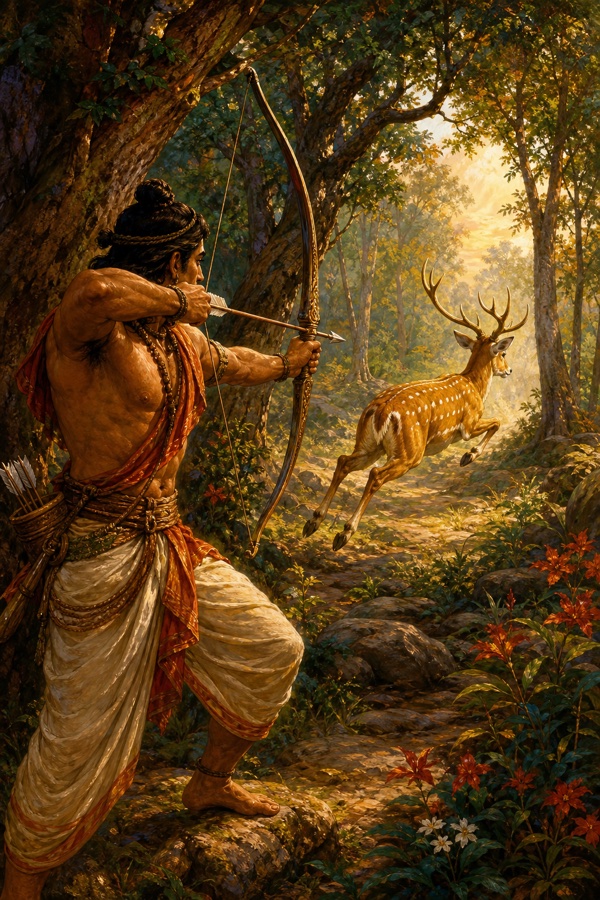
The answer could have been left or right. Kashthamauna instead examined what allows a person to say, “I saw,” and then turn seeing into a spoken report.
“Friend,” the sage said, “forest ascetics abide in evenness and disciplined conduct. The ego required for ordinary dealings no longer remains in us. The ego-shaped mind claims the work of all the senses as its own. That mind dissolved here long ago.”
Seeing, Speaking, and the Claim of “I”
Activity unfolds in sunlight or lamplight, though the sun and lamp claim none of the acts they illuminate. Kashthamauna used that image to describe awareness and the senses. The eye receives form, the ear receives sound, and speech gives words. Awareness illumines these events. The ego-sense binds them into the claim that one owner has seen, remembered, desired, and reported.
He compared the ego to the thread running through a garland. The beads remain distinct, while the thread makes them appear as one organized object. When the thread breaks, that organization falls apart. An army after its king is gone, cattle after their keeper is absent, and children after the loss of a father offered further images of a governing relation that once held separate activities in a familiar order.
Kashthamauna applied the analysis to the hunter’s request. The eye may have received the form of the running deer. The eye cannot speak. Speech can form an answer, though speech did not see the animal. Each sense operates in its own field and has no access to the function of another. The ego ordinarily gathers those distinct events into “I saw” and “I say.” In the sage, that appropriating center no longer claimed them.
The senses still had their natural activity. Their operations no longer assembled themselves as the possessions of a separate master. They resembled figures painted on a wall, present without becoming independent actors.
Kashthamauna then told the hunter that he knew no state he could claim as waking, dream, or deep sleep. He abided in turiya, beyond identification with all three. From that position he could give no owned report of a deer seen by “me” and described by “me.”
An Answer the Hunter Could Not Use
The hunter had asked for a route through the forest. He received an account of consciousness in which seeing, speaking, memory, and ownership had become the objects of inquiry. The sage’s meaning lay beyond his immediate understanding. He bowed, rose, and continued in his intended direction.
The wounded deer remained somewhere ahead, and the hunter’s pursuit carried him away from the silent ascetic. A profound statement had been heard respectfully while remaining inaccessible to a listener absorbed in another purpose. The hunter needed a direction. Kashthamauna’s reply exposed the unexamined claimant within every assertion of direction.
Vasistha’s Application
Vasistha returned to turiya. Waking consciousness is occupied with external objects. Dream generates a world from impressions within the mind. Deep sleep quiets visible thought while retaining the obscurity of unknowing. Turiya is lucid and even. It is the witnessing awareness through which the three states are known.
Vasistha called the conditioned mind “dead” when its attachment to the three states had ended. The expression describes the fading of agitation and inertia. Kashthamauna heard the hunter, understood his words, and answered him. Activity continued throughout the exchange while the ownership claim behind “my seeing,” “my memory,” and “my action” remained still.
The parable leaves two questions with the reader. One concerns the thread joining sight, recollection, desire, and speech into the continuous story of one possessor. The other concerns readiness. Words that are coherent within one order of inquiry can remain unusable within another, as the hunter’s respectful departure quietly reveals.