Story · 23
Hemachuda and Hemalekha: The love that became a guru
A king lost his heart to a beautiful young woman. She set only one condition for the marriage, that he would listen to everything she taught him. The king agreed, and after that every day brought a new question, and every night a new understanding.
Rama asked, “Gurudev, can a wife teach her husband without ever letting him know she is teaching?”
Vasishtha said, “Rama, Chudala taught her husband, but she was not accepted as a woman, and she had to become Kumbha. There is another story, in which the same thing unfolded in a different way. Hemalekha teaches her husband Hemachuda in her own form, only through questions, and her husband accepted her as a woman. Yet even in this there was a path. Listen.”
Hemachuda
Hemachuda was a prince. His father was the great king of a great kingdom, and Hemachuda was his only son, raised in deep affection and indulgence.
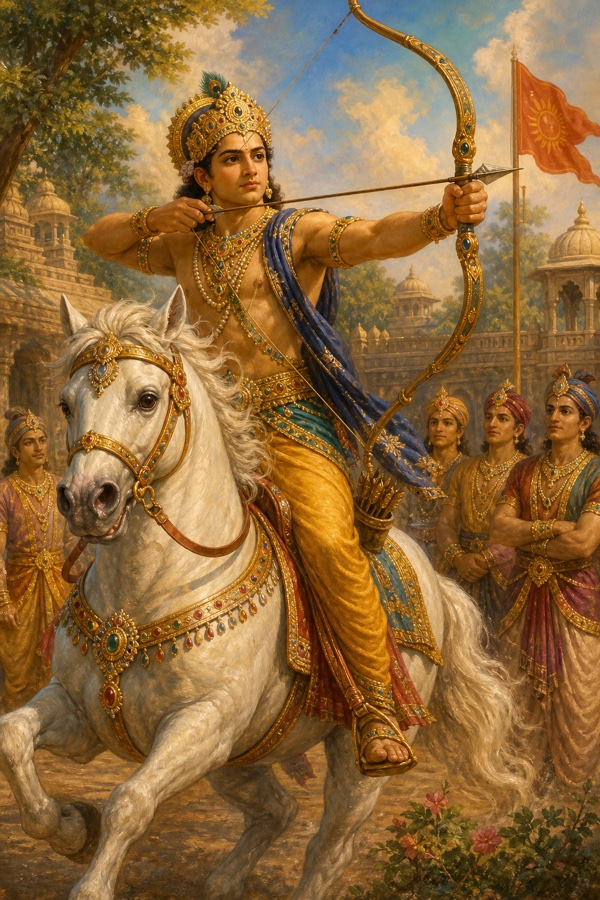
His body was beautiful and his laughter sweet, and his manners were those of royalty. He rode horses, drew the bow, and studied the arts of war.
Inside, though, he was quite ordinary. He carried no great thirst, and no great lack.
His life held everything.
When he came of age, his father raised the matter of his marriage.
The names of many royal princesses came forward, and Hemachuda studied their portraits one after another, yet not one of them felt special to him. Then one portrait arrived.
Hemalekha
In the portrait was a woman.
She was not a princess. Her clothes were plain, and behind her stood a hermitage and a few trees. But there was something in her eyes.
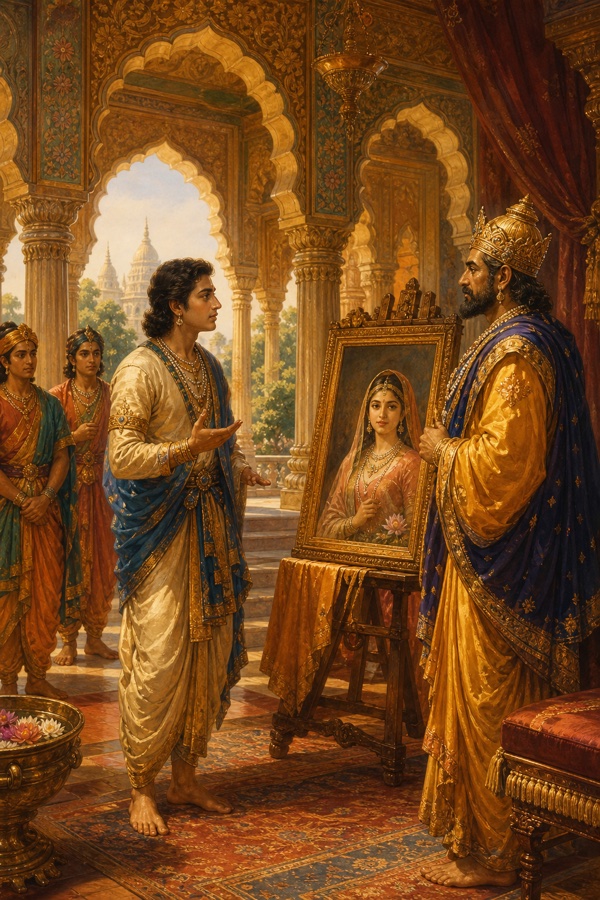
Hemachuda looked at the portrait for a long while, then asked his father, “Father, who is this?”
His father said, “Son, this is Hemalekha, the daughter of an apsara, a celestial nymph. But her mother raised her in a rishi’s hermitage, and she grew up there. The rishi taught her the shastras, and her mind is of a very unusual kind. Still, she may not be suitable for you. You are a prince; your wife should be a princess.”
Hemachuda said, “Father, I like her. There is something in her eyes, and I feel my thirst will find what it seeks in her.”
His father was silent a moment, then said, “Son, think it over.”
“I have thought it over.”
The marriage took place.
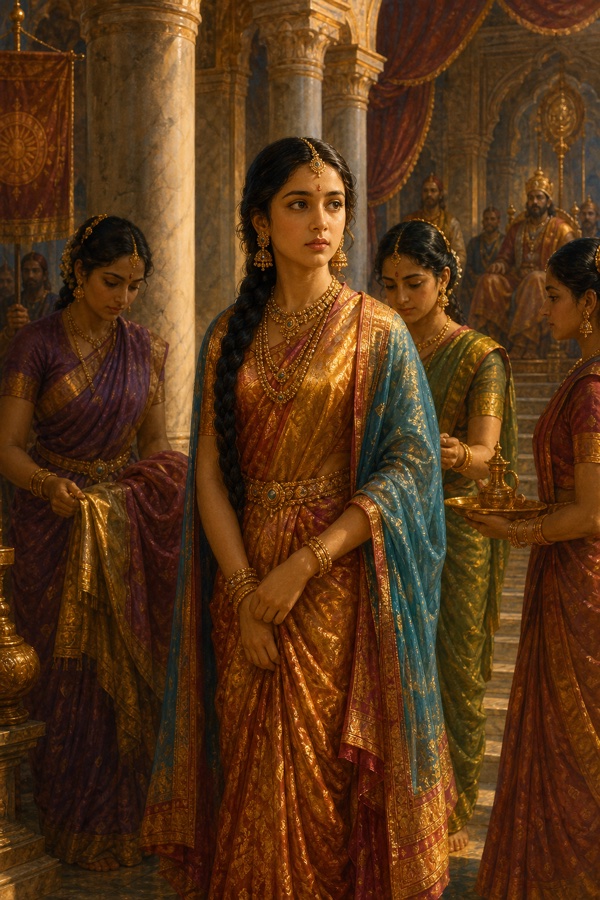
Hemalekha came to the royal palace. She was beautiful, in a plain way. Her body was slender, her hair tied back in a simple knot, and her clothes were now those of royalty, though she looked ill at ease in them.
Her eyes were different. In them was a stillness, a sharpness, a question.
Hemalekha had brought very few things with her, only a small bundle. In it were some plain clothes, a copper water pot, and a rudraksha mala that her foster-rishi had given her the day before the wedding.
The mala stayed around her neck, but under the silk of her dupatta.
Hemalekha had one habit. When she thought over a difficult question, the fingers of her right hand would reach for her rudraksha mala without looking, touch a single bead, and pause there. This was the private sound of her thinking, exactly as it had been for her foster-rishi.
There was an irony in this. Hemalekha told everyone, “Let go of your grip.” Yet she had a grip of her own, this mala, which she had never once taken off.
At night as she slept the mala rested on her chest, and in the morning when she woke, the mala was the first thing she touched. This she never told Hemachuda.
The first night
The first night of the marriage.
Hemachuda was in his chamber, and Hemalekha stood before him. The two were silent for a while, then Hemachuda said, “Hemalekha, what do you expect of me?”
Hemalekha said, “Maharaj, I expect nothing large of you, only one small thing. I will ask you questions, many questions, and you will not grow annoyed with them.”
Hemachuda said, “That is all?”
“That is all.”
“Then it is settled.”
The first question
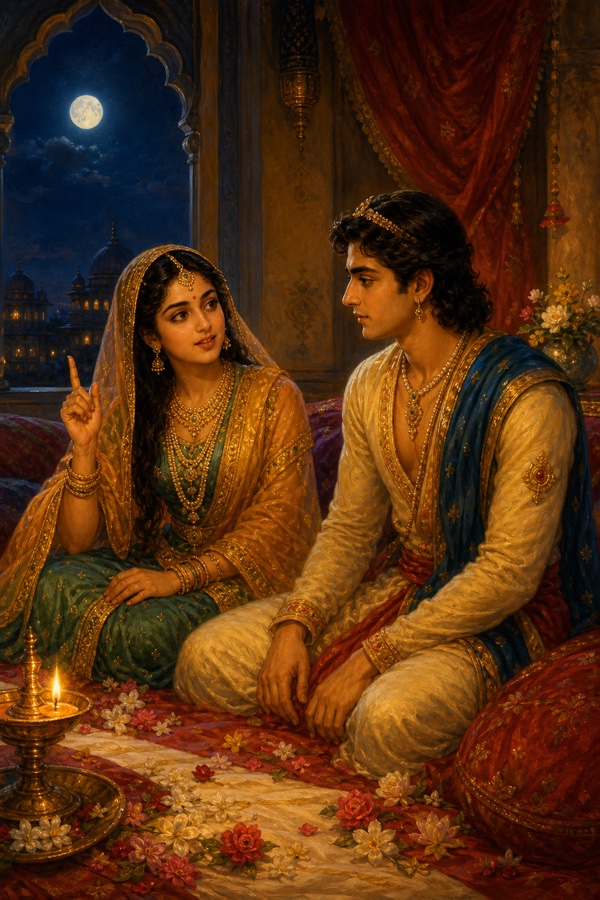
A watch of the night later, Hemalekha said, “Maharaj, what are you happy about?”
Hemachuda said, “I am beside you, and all of this is mine. The kingdom, the wealth, everything.”
“But will all of this last forever?”
Hemachuda paused, then said, “No.”
“Then when all of this is gone, what will happen?”
“I do not know.”
“Then how secure is your happiness?”
This time Hemachuda had no answer.
Hemalekha said, “Maharaj, hold on to this question, do not answer it yet.”
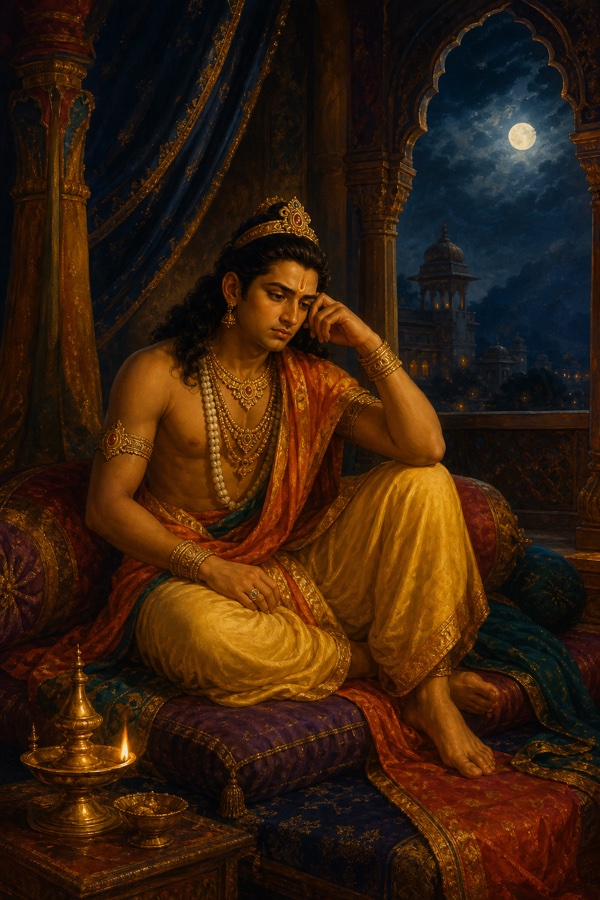
Hemachuda thought all night. My happiness rests on all these things, but these things will pass. So will my happiness pass too?
In the morning he said to Hemalekha, “Hemalekha, your question stayed inside me all night.”
“What did you understand?”
“That my happiness is fragile, because it rests on outer things, and outer things never last.”
Hemalekha said, “So?”
“So I must find a happiness that does not depend on the outer.”
“And where would that be?”
“I do not know.”
“Then keep thinking.”
The second question
Hemachuda kept thinking for several days. One night he said to Hemalekha, “Hemalekha, perhaps that happiness is within.”
“Within where?”
“In my mind.”
“Is the mind within?”
“Yes.”
“But the mind keeps changing, happy one moment, sad the next. So any happiness that lives in the mind will change too.”
Hemachuda paused, then said, “Then…”
Hemalekha said, “Maharaj, think. Where is the true home of happiness? There, where nothing changes.”
“But where nothing changes, what is there?”
Hemalekha said, “Maharaj, this is a very good question, and you will have to find it yourself. I only stand beside you.”
The third question
After this many nights passed.
Every night Hemalekha asked a new question, and each question carried Hemachuda a little deeper.
One night Hemalekha asked, “Maharaj, who are you?”
“I am Prince Hemachuda.”
“That is a name. Who is behind the name?”
“I am.”
“What is this ‘I’?”
“The body.”
“Are you the body?”
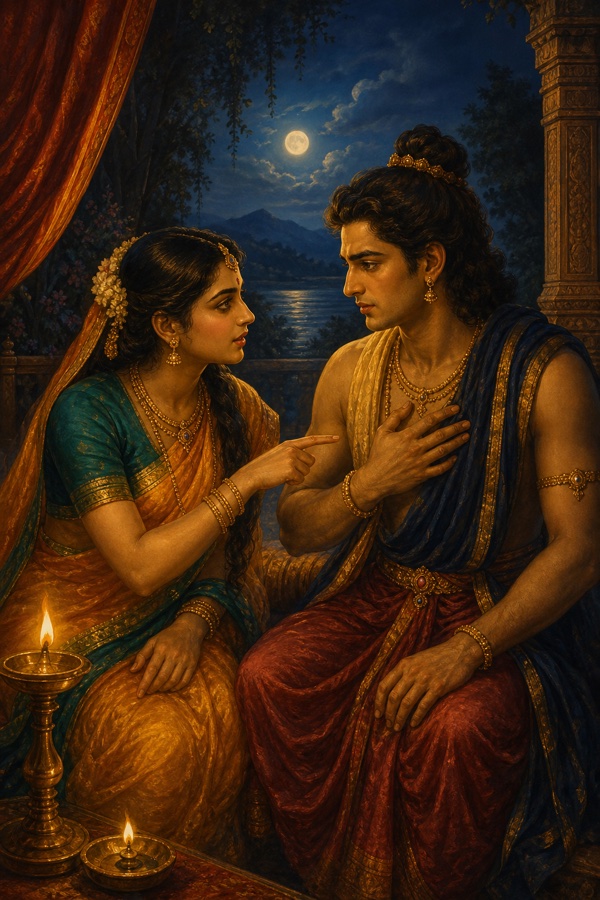
Hemachuda thought a moment, then said, “The body is mine.”
“Mine? Then you are separate from the body?”
“Perhaps.”
“Then what are you?”
“The mind.”
“The mind too is mine. So are you separate from the mind as well?”
“I do not know.”
“Think.”
The fourth
One night Hemalekha asked, “Maharaj, if you had not remembered the last ten minutes, would you still be the same Hemachuda?”
“Yes.”
“Why?”
“Because my body is the same.”
“But the body changes. The body of your childhood is not the body you have now, and yet you are the same Hemachuda?”
“Yes.”
“Then you are the one who stands behind every body.”
“Perhaps.”
“And behind every memory.”
“Yes.”
“And behind every thought.”
“Yes.”
“Then you are the one who does not change.”
Hemachuda said, “I understand.”
“Not yet. You have only heard it now. Understanding takes longer.”
The fifth
One night Hemalekha asked a different question, “Maharaj, if you come to know that you are the one who does not change, what will become of your happiness?”
Hemachuda thought and said, “Perhaps it too will not change.”
“And sorrow?”
“That too?”
“Yes. Because whatever changes is not you. Happiness and sorrow both change, so neither of them is you.”
Hemachuda said, “Then I am separate from both.”
“Yes.”
“And what I am stays always the same?”
“Yes.”
“Then how would it ever be happy or sad?”
Hemalekha said, “Maharaj, a very good question. In that place there is no happiness and no sorrow, only being. And being is complete in itself.”
Having said this, Hemalekha paused for a moment.
Without looking, she touched her rudraksha mala and stopped on a single bead.
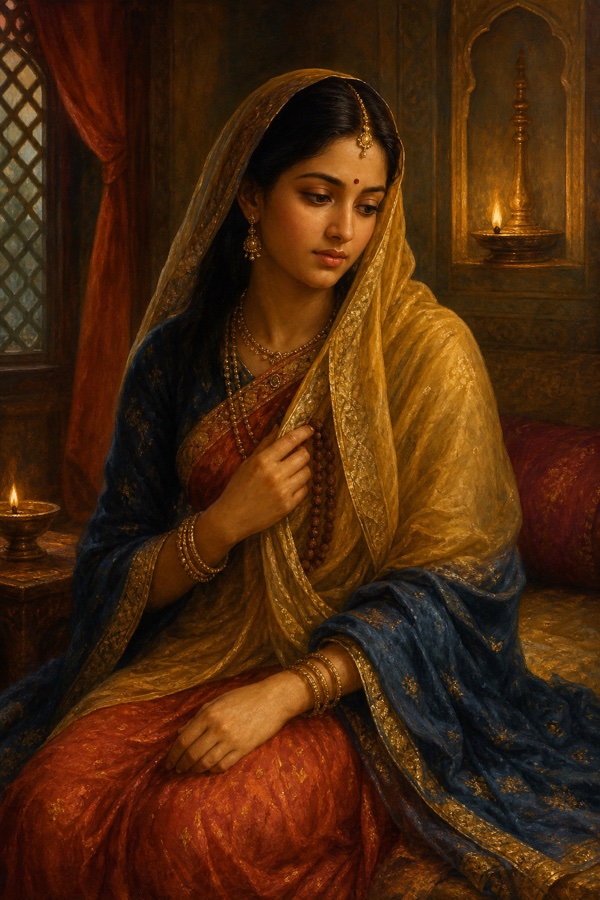
Something stirred inside her. She thought, “I just said that being is complete. Then why this mala of mine? It too is a marker, of my old identity, of the hermitage, of my foster-rishi.”
Hemalekha did not look at Hemachuda. Her eyes were on the mala, and her mouth was closed.
For the first time she felt that on one level of what she was teaching her husband, she was herself unfinished.
Hemachuda did not notice this; he was absorbed in his own question.
Hemalekha gently drew her hand away from the mala, but the mala was still around her neck.
The sixth question
One night Hemalekha asked, “Maharaj, what is going on inside you right now?”
Hemachuda thought and said, “Hemalekha, there is a restlessness in me. Every day I sit with these questions, but I find no clear answers.”
Hemalekha said, “Maharaj, answers are never clear.”
“Then?”
“Then you simply stay with the question. Answers come on their own, without being called.”
The seventh
A few days later Hemalekha asked, “Maharaj, are you happy?”
Hemachuda thought and said, “I was happy back then. But it is a strange thing now, I am not restless, and I am not happy either.”
“Then what are you?”
“I simply am.”
Hemalekha said, “Maharaj, this is it.”
“What?”
“Simply being. This is the highest state. To be happy is a condition, and to be sad is one too. Simply being lies behind both.”
The eighth
A night later Hemalekha asked, “Maharaj, what is your ‘simply being’ made of?”
Hemachuda paused, then said, “Meaning?”
“Meaning, you say, I simply am. But ‘I simply am’ is also an experience. What is the source of that experience?”
Hemachuda said, “Hemalekha, I do not know.”
“Then look within.”
Hemachuda closed his eyes and looked within.
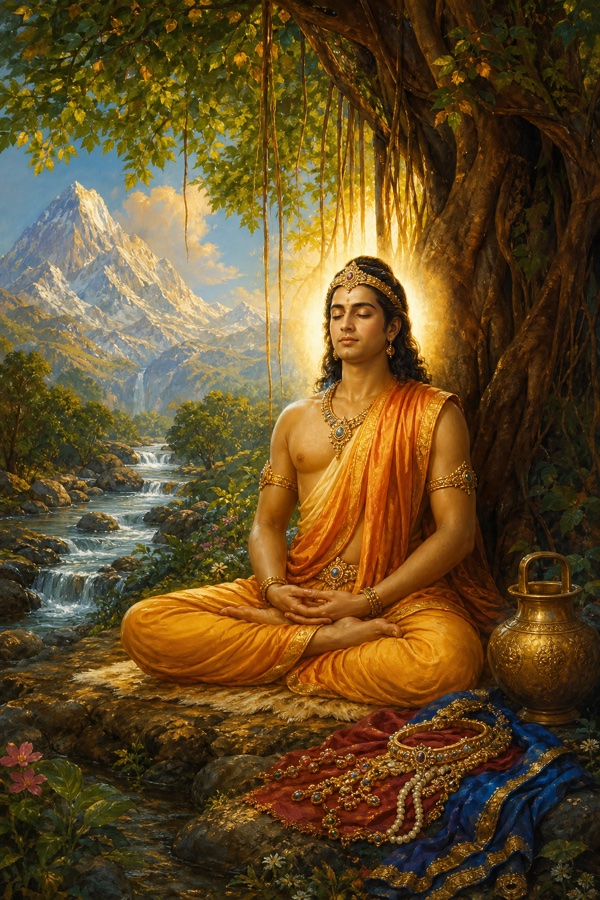
There was the sense of simply being. But behind it was an awareness, watching the simply being.
Hemachuda opened his eyes and said, “Hemalekha, there is a watcher inside me. It watches every experience.”
“And who is that?”
Hemachuda said, “That is me.”
“Are you sure?”
“Yes.”
Hemalekha said, “Maharaj, you have caught hold of this.”
The ninth
Many days passed.
One night, this time it was Hemachuda who said to Hemalekha, “Hemalekha, I have a question.”
“Ask.”
“How did you come to know all this?”
Hemalekha said, “Maharaj, I am the daughter of an apsara, but my mother raised me in a rishi’s hermitage, and there I was taught all of this.”
“But you tell me these things through questions. Why did you choose this way?”
Hemalekha said, “Maharaj, a direct statement often does not land.”
“Why?”
“Because when we hear a direct statement, we do not accept it. We think, that is only her opinion. But through a question we find the answer ourselves, and then the answer feels like our own.”
Hemachuda nodded.
Hemalekha went on, “And one more thing.”
“What?”
“I had to learn to say this. That a wife should ask her husband questions, this does not happen very often.”
Hemachuda asked, “Hemalekha, if you were a man, what questions would you ask me?”
Hemalekha said, “Maharaj, this is a good question. But a man does not have the patience a wife has. Men say, understand this. A wife says, go and find it.”
The tenth
One night Hemalekha asked, “Maharaj, if something were to happen to me, what would you do?”
Hemachuda paused, then said, “Hemalekha, why do you ask this?”
“It is only a question.”
Hemachuda thought and said, “I would grieve.”
“And?”
“I would miss you.”
“And?”
“My body would tremble to weep.”
“And?”
Hemachuda was silent for a while.
Then he said, “And on one level, I would remain where I am.”
“Meaning?”
“Meaning, that still thing inside me would remain. The one that does not weep, that does not fear, that stays with you always.”
Hemalekha said, “Maharaj, now you are ready.”
“For what?”
“For my leaving.”
Hemachuda said, “Hemalekha, you are not leaving now.”
“No. But one day I will. And then, if it matters for me, I will know that you are ready.”
Hemachuda took Hemalekha’s hand in his, and the two were silent for a long time.
The experience
Hemachuda kept thinking for many days. One night he closed his eyes and asked himself, I am not the body, I am not the mind, so what am I?
He looked within. There was a still thing there, present before every thought, apart from every feeling, watching everything.
That is what I am.
Hemachuda opened his eyes. Hemalekha sat beside him.
She asked, “Maharaj, what did you find?”
Hemachuda said, “The one that witnesses everything, that is what I am.”
Hemalekha said, “And now your happiness?”
“It belongs to that witness.”
“And is that always present?”
“Always.”
“Then your happiness?”
“Always.”
Hemalekha smiled.
The mother’s word
Many years passed.
One day, after many years, Hemalekha’s mother came. She was an apsara. She looked at Hemachuda and Hemalekha.
Hemalekha said, “Mother.”
The mother looked toward Hemachuda and said, “Son-in-law.”
“Mother.”
The mother was silent a moment, then spoke.
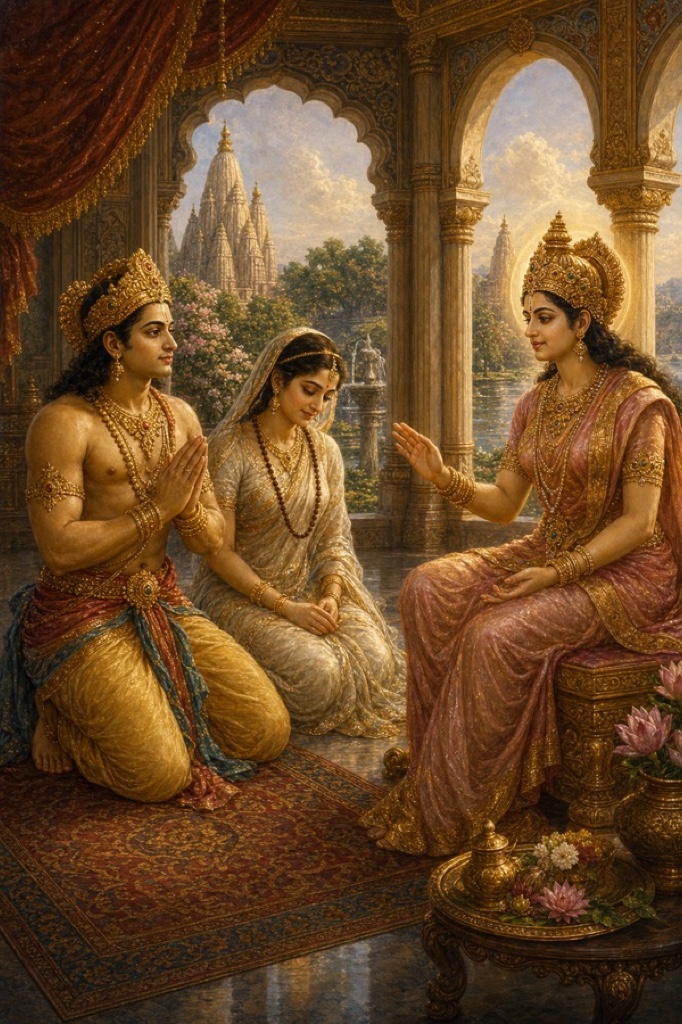
“Daughter, I left you with the rishi so that you could learn what heaven does not offer. You learned it, and now you have taught your husband as well. I am glad.”
Hemalekha lowered her head.
The mother asked, “Daughter, will you come with me to heaven?”
Hemalekha looked toward Hemachuda.
Hemachuda said, “Hemalekha, if you wish, then go.”
Hemalekha said, “No, Maharaj. My place is here.”
The mother said, “Daughter, you are wise. Even so, if you ever feel like it, come.”
Hemalekha nodded, and the mother left.
Hemachuda took Hemalekha’s hand in his and said, “Hemalekha, you have given me a very great gift.”
“No, Maharaj. I gave nothing, I only asked questions. The answers were yours.”
“But the questions were yours.”
“Yes.”
“Then you are my guru.”
Hemalekha said, “Maharaj, the game of guru and disciple is an old affair. We two are one, and to see it as divided is itself an illusion.”
Hemachuda nodded.
The king
Many years passed. His father died, and Hemachuda became king.
He ran the kingdom, but now there was a different color to the way he ruled. No haste, no large desire, only a steady understanding.
Hemalekha became queen, but she came to the court very rarely. Mostly she stayed in her chamber, reading, or she stayed in the garden.
Slowly the people of the kingdom came to know that Hemachuda was a different kind of king. He did not grow angry quickly over anything, he did not decide anything in a hurry, but heard everything out and then answered calmly.
The ministers challenged him many times, but each time Hemachuda handled them with calm. He did not lose, yet he held no great desire to win either.
Once a minister asked Hemalekha, “Maharani, the king is different. He does not become very anxious about anything.”
Hemalekha said, “Minister, because he knows that anxiety changes nothing. Anxiety only lessens one’s own peace.”
The minister asked, “And if I too wish to become like this?”
Hemalekha said, “Minister, then ask questions. Of yourself. Not of me, not of Hemachuda, only of yourself, every day.”
“Which questions?”
“Who am I. Where is my happiness. What is my pain. Hold these questions, and answers will come in their own time.”
The minister lowered his head.
More questions
Many years passed.
One night Hemachuda and Hemalekha sat in their old chamber.
They had lived together many years, and the silence between them had grown larger.
Hemalekha drew a breath, then said, “Maharaj, there is still a question.”
“What now?”
“Maharaj, we have made this journey over so many years. You found it, and I already knew it. What now?”
Hemachuda thought and said, “Hemalekha, now we know. But knowing too is a state. Beyond it lies another state, being. Now we will be.”
“Being, meaning?”
“Meaning, now we will not hold on to our knowledge. Knowledge will simply be, with no pride in it, no identity, only a still thing.”
Hemalekha said, “Maharaj, well said.”
“But one thing.”
“What?”
“What will we do now?”
Hemalekha said, “Maharaj, this was never a question of yours. But now you are asking it, and that is the change.”
“The change?”
“Earlier you asked questions to gain knowledge. Now you ask questions to live the knowledge. The two are different.”
Hemachuda asked, “And the answer?”
Hemalekha said, “The answer is, govern the kingdom. But now with no ego in it, no desire to win, no fear of losing. Only governance, and love for the people, without division, without attachment.”
For many years he kept putting this into practice.
The eleventh
Many years later, one night Hemalekha said, “Maharaj, today I heard a question from a child.”
“What?”
“He asked me, Maharani, are you happy?”
Hemachuda asked, “And what did you say?”
“I said, child, I am something larger than happy.”
“Larger?”
“Yes. Happiness is a state, and I am behind it.”
“And the child?”
“The child asked again, what is behind it? I said, you will know this yourself, one day.”
Hemachuda said, “Hemalekha, you are teaching children now too.”
“No, Maharaj. I am not teaching, I am giving them questions. They will find the answers on their own.”
The twelfth
Many years passed.
One day a young woman came to Hemalekha. She was beautiful, but there was a thirst in her eyes.
The young woman said, “Maharani, I have something to ask. I love my husband, but he does not listen to me. How do I teach him?”
Hemalekha was silent for a while, then spoke.
“Sister, first understand one thing. Your husband does not listen to you because you are the wife. This is the nature of many men. And second, you do not need to teach him, you only need to walk your own path.”
The young woman was startled and said, “But Maharani, is this not my responsibility?”
Hemalekha said, “Sister, teaching your husband is not your responsibility. Your own knowledge, your own dharma, your own learning, that is your responsibility. If your husband is to learn, he will learn by watching you, from your natural way of being. But if you set out to teach him by force, he will resist.”
The young woman said, “Maharani, this is very difficult.”
Hemalekha said, “Yes, sister, it is difficult, but it is true. Walk your own path, ask questions of yourself, and find the answers yourself. One day your husband will see that you have changed, and then perhaps he too will want to learn.”
The young woman said, “Thank you, Maharani.” And she left.
Hemalekha looked at Hemachuda and asked, “Maharaj, did I say the right thing?”
Hemachuda said, “Hemalekha, you said what my father should have said to me many years ago. You said it well.”
The thirteenth
Hemachuda was growing very old now. His body had turned thin, his hair had gone white, but his eyes stayed as steady as ever.
One night he said to Hemalekha, “Hemalekha, I want to do one thing. I want to leave the affairs of the kingdom now and start a small school.”
Hemalekha said, “Maharaj, now?”
“Yes, now.”
“Why?”
“Because I have learned, and now let me teach.”
Hemalekha said, “Maharaj, very good. But will you give up the affairs of the kingdom?”
“My son will take charge.”
“And us?”
“The two of us will run the school.”
Hemalekha smiled.
The school
Hemachuda seated his son on the throne. Outside the kingdom he chose a small place, beside a garden, where a small river flowed, and there he built a school.
The school was plain. A small room, mud walls, and a clean floor. Hemachuda set aside his old royal clothes and put on simple ones.
People began to come, a few at first, then more. The young, the middle-aged, the old, women, men, children, all came.
Hemachuda took a different approach with each person, but the core was the same, to ask questions. Not to give answers, only to ask questions.
A young man came and said, “Maharaj, what should I do with my life?”
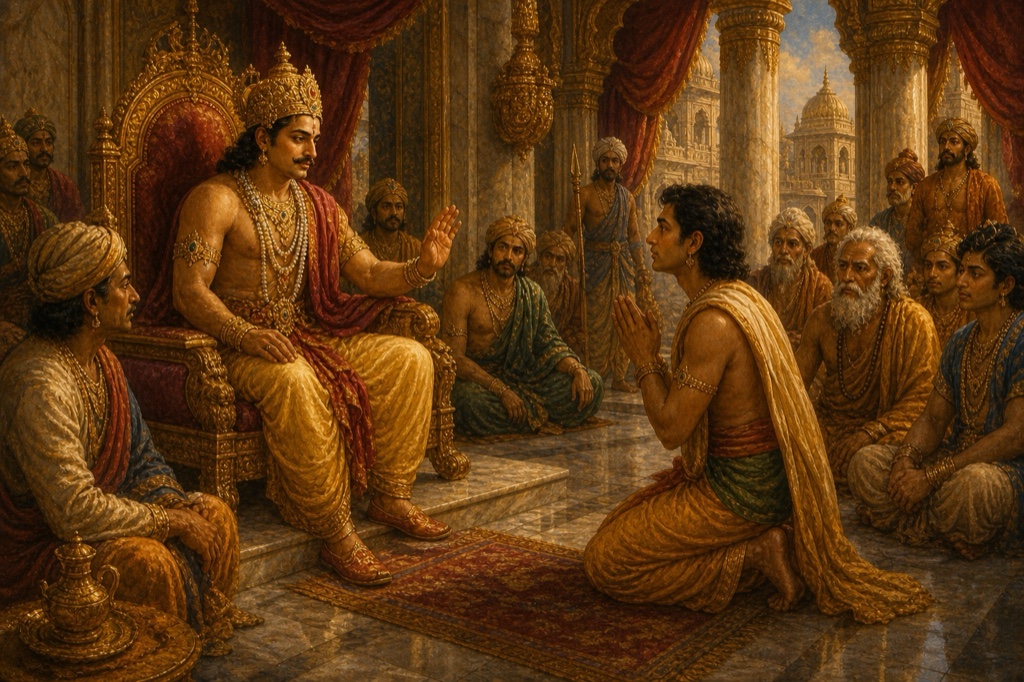
Hemachuda said, “Son, ask this question not of me, but of yourself. Sit, and ask yourself. The answer will come from within you.”
“But Maharaj, I have no answer.”
“Then stay with the question. One day the answer will come.”
The young man was startled and said, “Maharaj, for how long?”
Hemachuda said, “Son, I cannot say. Sometimes soon, sometimes late. But it will come.”
The young man sat down right there.
For many days he sat there. Hemachuda taught him nothing, only sat beside him, silent together.
One day the young man smiled and said, “Maharaj, I found it.”
“What?”
“My answer.”
“What is it?”
The young man said, “Maharaj, I cannot tell you.”
“Why?”
“Because if I tell it, it will remain only my answer. But if I live it, it will become my life.”
Hemachuda said, “Son, you have learned.”
The women
Many women came too, and Hemalekha would sit with them.
One day a woman came, very unhappy, and said, “Maharani, my husband is very quick to anger, and he treats me badly.”
Hemalekha said, “Sister, this is hard.”
“What should I do?”
“Sister, there are two paths.”
“Tell me.”
Hemalekha said, “The first path is that you can leave him and go to your parents. If your parents will support you, this path is fine. And the second path is that if you can stay, then stay. But in staying you will have to build a stillness inside yourself, such that his anger does not touch you. Let his ill treatment touch your body, but not your awareness.”
The woman said, “Maharani, the second path is very hard.”
“Yes, very.”
“And the first?”
“The first is easy, but hard in the eyes of society.”
The woman thought and said, “Maharani, I will think about it.”
“Think, sister. Then come back.”
The woman left, and returned many months later. This time there was a different color on her face.
The woman said, “Maharani, I decided to stay.”
“And?”
“And I began to build a small stillness inside myself. Not fully yet, but it is a beginning.”
“That is good.”
“And one more change happened.”
“What?”
“My husband’s anger has lessened a little.”
“Why?”
“Perhaps because I do not react. Earlier I would cry, I would shout, and now I only listen, then go back to my work.”
Hemalekha said, “Sister, this is a very good thing.”
“Maharani, thank you.”
“For what? This is your own experience.”
The woman lowered her head and left.
The children
Many children came too, and Hemachuda and Hemalekha spoke with children in a different way.
With the children they also played.
One day a child asked Hemalekha, “Mother, do you ever cry?”
Hemalekha said, “Yes, child.”
“Why?”
“Because sometimes my body needs to cry. I am a human being too.”
“But you are a queen.”
“Being a queen does not mean one never cries. Being a queen is only an identity.”
The child said, “Mother, my mother also cries sometimes.”
“And what do you do?”
“I hug her.”
Hemalekha said, “Child, that is the best thing of all.”
The child laughed and left.
In this way many years passed.
The fourteenth
Many years later Hemachuda and Hemalekha sat one night in their school.
Hemalekha asked Hemachuda a new question, “Maharaj, are you afraid of dying?”
Hemachuda thought and said, “Hemalekha, I do not fear the death of the body. But there is a faint thing.”
“What?”
“I fear dying alone.”
Hemalekha said, “Maharaj, we are together.”
“But one day one of us will go first.”
“Yes. And the one who remains will be alone for some time.”
Hemachuda asked, “Will you go first, or will I?”
Hemalekha said, “Maharaj, who can know that?”
“But if you go first, then?”
“Then you will be alone.”
“And if I go first?”
“Then I will be alone.”
Hemachuda was silent for a while, then said, “Hemalekha, this thought is hard.”
“Maharaj, this thought is hard for everyone.”
The fifteenth
A few days later Hemachuda said, “Hemalekha, I thought of something. Dying does not frighten me. What frightens me is living without you.”
Hemalekha said, “Maharaj, that is natural. But one thing.”
“What?”
“If you live without me, you will find me inside yourself. I will not go anywhere.”
“But the body will not be there.”
“The body is only a form. My true form is awareness, and awareness is always here.”
Hemachuda said, “Hemalekha, you have said this many times.”
“Yes.”
“But it does not fully settle in me yet.”
“Maharaj, this does not settle by thinking. It comes through experience.”
The sixteenth
One night Hemalekha fell ill, very ill. A fever rose, and she began to have trouble breathing.
Hemachuda stayed beside her all night. The royal physicians came and gave medicine.
But the illness did not lift.
Three days passed, and Hemalekha grew weaker.
On the fourth day she said to Hemachuda, “Maharaj, my time is coming.”
Hemachuda’s eyes filled, but no tears fell. He said, “Hemalekha, I longed for these many years of ours together.”
“Maharaj, so did I.”
The two were silent for a while.
Then Hemalekha asked, “Maharaj, I have a question. Are you afraid of dying now?”
Hemachuda was silent for a while, then said, “Hemalekha, not now.”
“Why not?”
“Because you taught me. Dying belongs to the body, and I am not the body.”
Hemalekha said, “Maharaj, you have learned.”
Then she asked, “And one more question. What about living without me?”
Hemachuda was silent for a while, then said, “Hemalekha, of that I am still a little afraid.”
Hemalekha said, “Maharaj, that is all right, this fear will remain. But one thing.”
“What?”
“I am not going.”
Hemalekha’s eyes closed.
But a moment later they opened again, and Hemalekha said, “Maharaj, I am not going yet.”
Hemachuda paused, then said, “Meaning?”
Hemalekha said, “Meaning, my illness is easing. I had thought I was going, but now it seems, a little longer.”
Hemachuda laughed softly and said, “Hemalekha, you are good at frightening me.”
Hemalekha laughed too.
Hemalekha recovered, and lived many more years.
The seventeenth
Many years later Hemachuda and Hemalekha were in their school.
One day a middle-aged man came. There was a heavy shadow on his face.
He said, “Maharaj, I have something to ask. I lost my son.”
Hemachuda asked, “When?”
“A few months ago.”
“How?”
“By illness.”
Hemachuda said, “Brother, forgive me.”
“Maharaj, there is one thing I cannot understand.”
“What?”
“Maharaj, why did my son die?”
Hemachuda said, “Brother, there is no direct answer to this question.”
“I need an answer.”
Hemachuda looked at Hemalekha, and Hemalekha came forward.
Hemalekha asked, “Brother, why are you asking this question?”
The man paused, then said, “Maharani, what do you mean?”
“Brother, are you asking this question for the sake of an answer, or for some other reason?”
The man thought and said, “Maharani, I do not know.”
“Brother, think.”
The man was silent for a long time, then his weeping broke loose. He said, “Maharani, I need to ask this question because I feel it was my fault.”
Hemalekha said, “Brother, now we can talk.”
“Maharani?”
“Brother, your real question is hidden behind the one you asked. It is this: are you to blame?”
The man wept for a long time.
Hemalekha let him weep.
When he stopped, Hemalekha asked, “Brother, what did you do for your son?”
The man told her that he had done a great deal. He called physicians, bought medicine, and sat beside his son all night.
Hemalekha said, “Brother, that is enough.”
“Maharani?”
“You did everything you could.”
“And still?”
“And still your son died, because some things are not in our hands.”
The man asked, “Maharani, then what of my responsibility?”
Hemalekha said, “Brother, your responsibility was to do everything you could, and you did. The rest was your son’s own story, the limit of his body.”
The man said, “Maharani, this will take a long time to settle in me.”
“Yes, brother.”
“But I feel lighter now.”
“That is enough.”
The man bowed and left.
Hemalekha asked Hemachuda, “Maharaj, why did you stay silent?”
Hemachuda said, “Hemalekha, this was for you to do.”
“Why?”
“Because you are a mother. You can understand the pain of losing a son, I cannot.”
Hemalekha was silent for a while.
Then she said, “Maharaj, our child, many years ago.”
Hemachuda paused, then said softly, “Hemalekha.”
“He too did not stay with us.”
“Yes.”
“I know that pain.”
Hemachuda took Hemalekha’s hand in his, and held it for a long time.
The eighteenth
Many years later, Hemachuda had grown very old now, and Hemalekha too.
One night they spoke to each other.
Hemalekha said, “Maharaj, now the time has come.”
“Yes.”
Both of them nodded.
“Together?”
“Together.”
The two sat beside each other, hand in hand.
Hemalekha asked one last question, “Maharaj, are you no longer afraid?”
Hemachuda said, “Hemalekha, not now.”
“Why?”
“Because you are with me, and I am with you. We are going together, both at once.”
“If one had gone first?”
“Then there would have been fear. But not now.”
Both of them closed their eyes.
The nineteenth
Many years passed.
The people of the kingdom changed. The old generation was passing, and a new one was arriving. Hemachuda and Hemalekha were very old now, but their school still ran.
One day a little girl came, who had something to ask.
The girl said, “Grandmother, I have something to ask.”
“Ask.”
“Grandmother, my friend told me I am weak. Am I?”
Hemalekha said, “Child, how do you see yourself?”
“I am not weak.”
“So?”
“Then why do I feel that I am?”
Hemalekha said, “Child, when someone says something to us, it stirs a small ripple inside us. That ripple forces us to wonder, am I like that, or not? But the real thing is this: how you see yourself, that is what is true.”
“Grandmother, I see myself as strong.”
“Then you are.”
The girl laughed and said, “Grandmother, thank you.”
Hemalekha said, “Child, and one more thing.”
“What?”
“Forgive your friend. She probably said it out of her own weakness.”
The girl asked, “Grandmother, how so?”
Hemalekha said, “Child, people who call others weak are very often weak themselves. But they cannot see their own weakness, so they see it in others.”
The girl said, “Grandmother, I understand.” And she left.
Hemachuda said to Hemalekha, “Hemalekha, you are teaching children now too.”
“No, Maharaj. I am giving them a way to think for themselves.”
The twentieth
One day a young man came. There was a great thirst on his face.
The young man said, “Maharaj, I have heard that you learned from your wife.”
“Yes.”
“But Maharaj, how is this possible? Men do not learn from women.”
Hemachuda said, “Son, that very sentence is the problem. You said, men do not learn from women, but that sentence is a belief. Men can learn from women, only most of them do not. And why do they not learn? Because they hold the belief that they cannot. This is the cycle.”
The young man asked, “Maharaj, then what about me?”
Hemachuda said, “Son, if you want to learn, you can. But first break your belief.”
The young man paused, then said, “Maharaj, this is difficult.”
“Yes.”
“Maharaj, I will try.”
Hemachuda went on, “Son, one more thing. Merely listening to your wife is a small matter. The larger matter is to see a guru in your wife. She may know something special for you, only you have never yet seen her as a guru.”
The young man said, “Maharaj, I will look.” And he left.
Hemalekha said, “Maharaj, you told him something very great.”
Hemachuda said, “Hemalekha, only what you taught me.”
The twenty-first
One night Hemachuda and Hemalekha sat in their chamber. Outside a light wind was blowing.
Hemalekha was silent for a while, then said, “Maharaj, I have something to say. I taught you for many years, but now I feel there is something left for me to learn myself.”
Hemachuda paused, then said, “You?”
“Yes.”
“What?”
Hemalekha said, “Maharaj, I poured everything into teaching you, but there was one thing I never attended to.”
“What?”
“My own inner self. My own old wounds.”
Hemachuda asked, “Hemalekha, which wounds?”
Hemalekha said, “Maharaj, my mother. She left me with a rishi when I was very small. I set this away in a corner inside myself.”
Hemachuda took Hemalekha’s hand in his.
He said, “Hemalekha, you never told me this before. Why?”
Hemalekha said, “Maharaj, because I was teaching you, and I did not want to show my own weakness.”
Hemachuda said, “Hemalekha, now I will teach.”
“You?”
“Yes. What you taught me, that is what I will teach you.”
Hemalekha said, “Go on.”
Hemachuda said, “Hemalekha, look at the pain about your mother. Do not hold it back, only look at it.”
“I am looking.”
“What is behind it?”
Hemalekha was silent for a while, then said, “Maharaj, a thirst.”
“For what?”
“For my mother.”
Hemachuda said, “Hemalekha, look deeper.”
Hemalekha closed her eyes and sat that way for a long time.
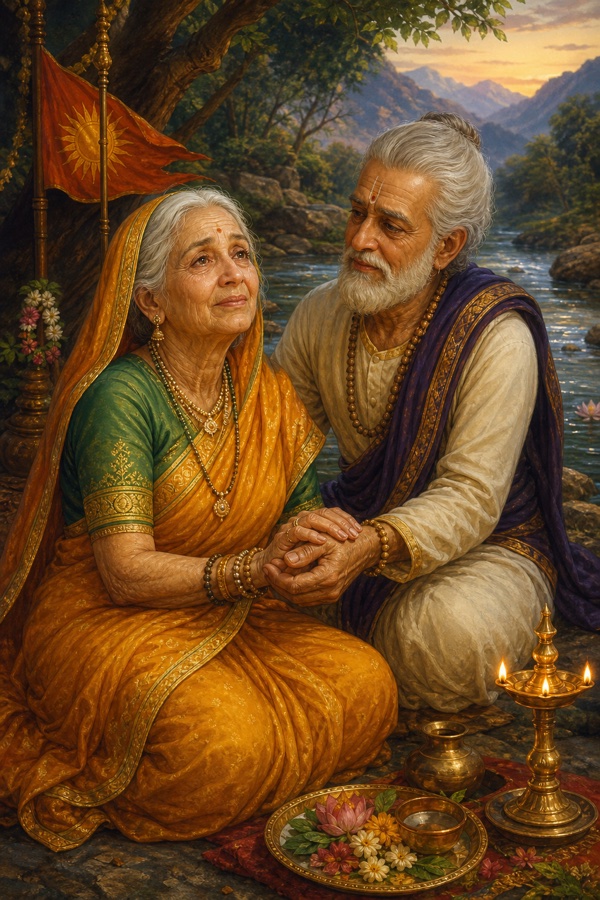
When she opened her eyes, they were wet. She said, “Maharaj, I have forgiven my mother.”
Hemachuda said, “Hemalekha, this is a very great thing.”
“Maharaj, and one more thing.”
“What?”
Hemalekha said, “I have forgiven myself too.”
“Why yourself?”
“Because I kept this pain inside me for many years and never brought it out. That too was a mistake.”
Hemachuda said, “Hemalekha, forgiveness is a very great thing.”
“Yes.”
The two were silent for a while.
Hemalekha said, “Maharaj, thank you.”
Hemachuda said, “Hemalekha, this time you learned from me.”
“Yes.”
The two smiled softly.
The departure
Many years passed, and Hemachuda and Hemalekha grew old.
One night they were in that same old chamber where, many years earlier, Hemalekha had asked her first question.
Hemachuda said, “Hemalekha, my time is coming.”
Hemalekha was silent for a while, then said, “Mine too.”
“Together?”
“Together.”
The two sat beside each other, hand in hand, and closed their eyes.
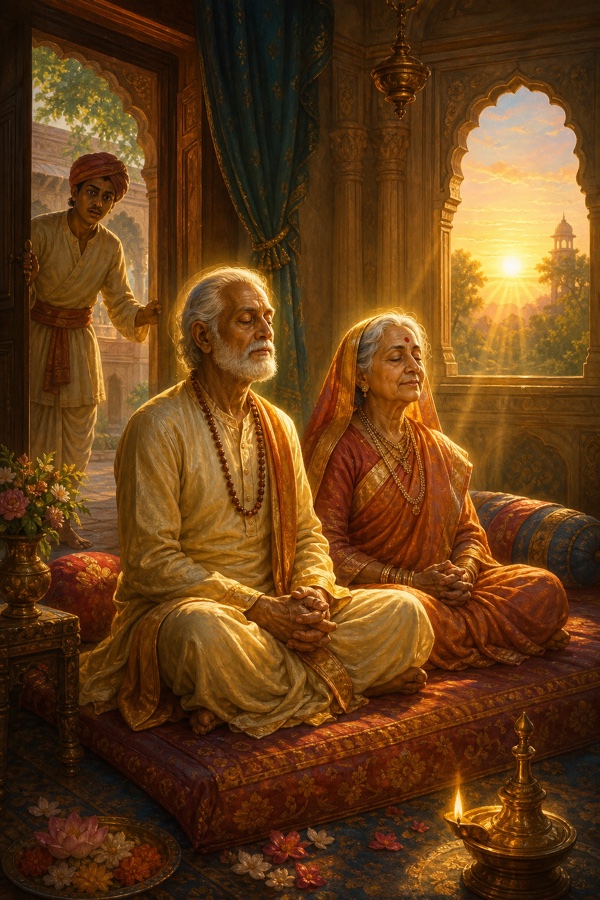
In the morning a servant found them just like that. The two sat, hand in hand, faces at peace, but there was no breath.
When the people heard this, someone said, “How can this be?” But the old minister, who was very old now, said, “When two awarenesses come so close that they become one, their bodies too are let go at the same time. It is a simple thing.”
The people nodded.
Even many years later their school kept running. Their disciples sat there, and the disciples of those disciples as well.
In every generation the same questions were asked. “Who am I?” “Where is my happiness?” “What is my pain?”
And in every generation some people found their answers, and the rest carried these questions forward.
In one generation a woman took charge of the school. She was not from Hemalekha’s line, only an ordinary woman who had come there to study.
That woman taught the new disciples, and she too asked the same questions.
One day a young man came to her and said, “Maharani.”
The woman laughed and said, “Son, I am not a queen, I am an ordinary woman.”
“But you are in Hemalekha’s school.”
“Yes. But Hemalekha too was an ordinary woman. She may have been the daughter of an apsara, but an apsara in the end is a woman as well.”
The young man asked, “I have a question. Can a woman truly be a man’s guru?”
The woman said, “Son, this question is hundreds of years old. Hemachuda must have asked the very same thing at first. And the answer Hemalekha gave him, that is the one I will give you.”
“What?”
“Son, guru and disciple are not a caste, they are a relationship. A woman can be a man’s guru, if he is willing to learn from her. And very often men are not willing, and that is the real problem.”
The young man said, “I am willing.”
The woman said, “Son, then let us begin.”
For many years he stayed there. The young man learned, and later he too began to run a school.
And so the story went on.
Rama said, “Gurudev, Hemalekha’s way was different from Chudala’s. She stayed in her own form, she did not become Kumbha, because her husband accepted her as a woman. So which lesson should I take?”
Vasishtha said, “Rama, take both lessons.”
“From Chudala, learn that if the husband does not listen, still do not give up, teach even by changing your form. And from Hemachuda, learn that if you are the husband, listen to your wife, do not stop her because she is a woman. The two stories are two sides of the same coin, one from the woman’s side, one from the man’s.”
Rama nodded.
Literary context
This story is based on the Laghu Yoga Vasistha. Hemalekha awakening her husband through questions is another beautiful story of the woman as guru. Its great difference from Chudala’s story is that Hemalekha did not need to teach in disguise. This story shows that if a man opens his limits even a little, a woman’s knowledge can reach him directly.
A philosophical view
Hemachuda is a prince. His wife Hemalekha, the daughter of an apsara, was raised in a hermitage. She sets a question on every comfort and possession, and each time she draws her husband a little further within. Her questions hand down no imposed teaching; they open an emptiness into which Hemachuda falls on his own. The story says that a real guru does not give answers, but places the right question in the right spot, and the seeker, sitting with that question, awakens by himself.
Jiddu Krishnamurti (1895-1986) said again and again in his Freedom from the Known (1969) that every ready answer shuts the mind down, and that true observation happens only when we begin from an open question, setting aside every known answer. Hemalekha’s method is exactly this. She teaches her husband no Vedanta; each time she places a question to which she herself has no prior answer, and she asks him to sit and watch alongside her.