On this page
Yoga Vasistha · Story 26
The Three Unborn Princes
A child asks his nurse for a story and receives an itinerary built entirely from impossibilities: unborn princes, unplanted trees, waterless rivers, an unbuilt city, a wall-less palace, and a meal whose quantities defeat arithmetic. His delight becomes Vasistha’s lesson on sankalpa and the worlds built by conceptual projection.
The Nurse Begins
Rama asked Vasistha to explain the child’s tale he had mentioned in the preceding discourse. Vasistha described a young child asking his nurse for a story that would entertain him. She began gently and placed an impossibility in her first sentence.
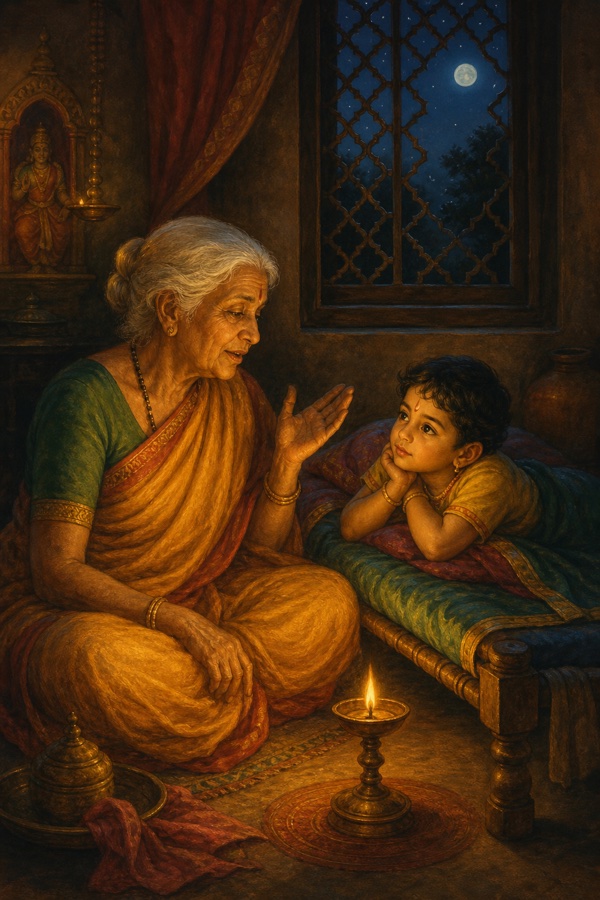
In a city that had no existence, three handsome princes lived in an immense emptiness. They were courageous, thoughtful, virtuous, and accomplished. Two of them had never been born. The third had never entered his mother’s womb.
The nurse described their qualities with the assurance usually reserved for people standing in plain view. The child raised no objection. Once he accepted the three princes, their relatives, citizens, decisions, and journeys could begin to gather around them.
In time, the princes’ relatives died. Famine left the faces of the citizens dejected. The three princes decided to leave their empty city and search for a better one. They set out together like Mercury, Venus, and Saturn appearing near one another in the sky.
A Road Through Impossible Heat
The princes had limbs as delicate as the shirish flower. The sun beat upon them from behind. Hot sand burned their feet, the sharp tips of kusha grass pierced them, and dust covered their bodies. Their joints weakened in the heat. Separated from everything familiar, they cried out as deer might call after losing their herd.
After a long journey, they came upon three trees laden with flowering clusters, fruit, leaves, and shelter for animals and birds. Two of the trees had never grown. The seed of the third had never been planted.
The travelers rested beneath one of them. They ate fruit with a nectar-like taste, drank its juice, and made a garland from the flowers of the guluccha vine. The shade, fruit, drink, and flowers all arrived as consequences of a tree whose own arising had already been denied. The child followed the sequence without asking the nurse to repair it.
The nurse compared the three princes beneath the tree with Indra, Vayu, and Yama resting under the celestial parijata. The elevated comparison lends dignity to figures who have no birth and to a tree whose seed was never sown. Language supplies rank, posture, and a sacred parallel after existence itself has been withdrawn.
At midday, the princes reached three rivers. One was completely dry. The other two contained no water at all. The three travelers entered the completely dry river, bathed with pleasure, played in its water for a long time, and drank water as clear as milk.
Their bath receives another divine comparison. The nurse presents them like Brahma, Vishnu, and Shiva entering the Ganges for relief from the heat. The image gives the dry river depth, movement, coolness, and ceremonial stature. Each quality enters through association, independent of any water in the stated scene.
Each new action drew its conditions from words already accepted. The word “river” made bathing, play, and drinking available even after the nurse had removed every drop of water.
The City That Would Be Built Later
Near sunset, the princes saw a city as high as a mountain. Its construction was scheduled for the future. Though it had yet to be built, flags spread above it, lotus ponds and blue reservoirs filled its grounds, and groups of citizens sang with voices that carried over a great distance.
Time has become part of the impossibility. The city belongs to a future act of construction, yet its inhabitants already gather, sing, and maintain reservoirs. The princes can approach it from a journey through the present. The story allows completed experience to precede the conditions that would ordinarily make it possible.
The city contained three splendid palaces of jewels and gold. Two had never been constructed. The third had no walls. The princes entered the wall-less palace, sat down, and made themselves at home.
There they found three cooking pots made of heated gold. Two had broken into two pieces each. The third had been pulverized. The princes, whom the nurse continued to call exceptionally intelligent, chose the powdered pot.
They cooked ninety-nine dronas of rice in it, exactly one drona less than one hundred. A drona is a traditional measure of volume, and the immense quantity soon became part of the tale’s impossible arithmetic.
The princes invited three Brahmins to eat. Two guests had no bodies. The third had no mouth. The mouthless guest consumed one hundred dronas of rice. The princes then ate what remained from the original ninety-nine dronas and were fully satisfied.
The nurse did not correct the subtraction, restore the pot, supply a mouth, or build the palace. She said that the three princes still lived happily in that future city and continued to hunt. She asked the child to keep the story in his heart so that he might become learned.
He was delighted.
The impossible objects support practical consequences. Heat tires bodies that were never conceived. Fruit nourishes them. A dry river relieves thirst. A future city offers lodging. A powdered pot cooks a measured meal. By giving every unreal object a use, the nurse turns assertion into an environment through which the princes can move.
How Acceptance Builds a World
The child never asked how the princes could travel without having been born. He did not question the trees, the rivers, the unfinished city, the wall-less palace, the powdered vessel, or the meal. The nurse introduced each object in a confident narrative sequence, and his mind gave the next consequence room to appear.
Vasistha used the tale to explain sankalpa, formative mental construction. The first assumption does not remain alone. It gathers distinctions, relations, expectations, and consequences. Once the princes are accepted, they can have relatives. Their relatives can die. A famine can afflict citizens of a nonexistent city. The resulting grief can send the princes onto a road.
The process continues through its own internal references. A tree yields fruit because the mind has accepted the category “tree.” A river supports bathing because the name activates everything associated with a river. A city supplies palaces and citizens even when its construction belongs to the future. Each detail becomes evidence for the next because the mind rarely returns to test the first premise.
Vasistha called the proliferating distinctions vikalpa, conceptual projections arising within the initial construction. In a few minutes, the nurse’s speech creates geography, weather, kinship, social life, architecture, food, quantity, and time. None requires an independent foundation inside the story once the listener’s assent has begun.
The delight of the child is essential to the example. He is not presented as deceitful. His attention cooperates with a familiar storytelling act and accepts each offered relation. Vasistha uses that ordinary receptivity to expose a wider habit: a mind can inherit the consequences of an assumption so fluently that the originating assumption disappears from view.
Vasistha’s Direction to Rama
Vasistha extended the pattern to the mind’s presentation of a world. Sky, earth, air, mountains, rivers, and directions develop within mental construction as scenes develop in a dream. One accepted distinction supports another. Names and forms establish relations; relations produce attraction, fear, ownership, bondage, and the wish for release.
He compared the movement to waves arising in the ocean’s own water. Sankalpa does not need another substance from which to fashion its variations. It differentiates within its own field, then experiences those differentiations as an ordered environment.
Vasistha instructed Rama to examine and relinquish the formative claim through which the construction acquires independent authority. Nirvikalpa knowledge is awareness free of the proliferating divisions built by conceptual insistence. The tale turns attention toward the premise the mind has accepted and the resulting world it then uses to certify that premise.
The child’s pleasure makes the demonstration immediate. A story can be coherent as an experience while every material statement inside it is impossible. Vasistha directs the same scrutiny toward convictions whose long familiarity hides the assumptions from which they grew.