On this page
Yoga Vasistha · Story 27
The Elephant of Vindhya and the Pit of Ignorance
A mighty elephant breaks the iron chains that held him for three days, then spares the mahout who caused his suffering. That act of compassion leaves ignorance free to prepare a deeper trap. Kumbha offers the parable to King Shikhidhvaja, whose outward renunciation has concealed a subtler form of bondage.
Kumbha Begins the Parable
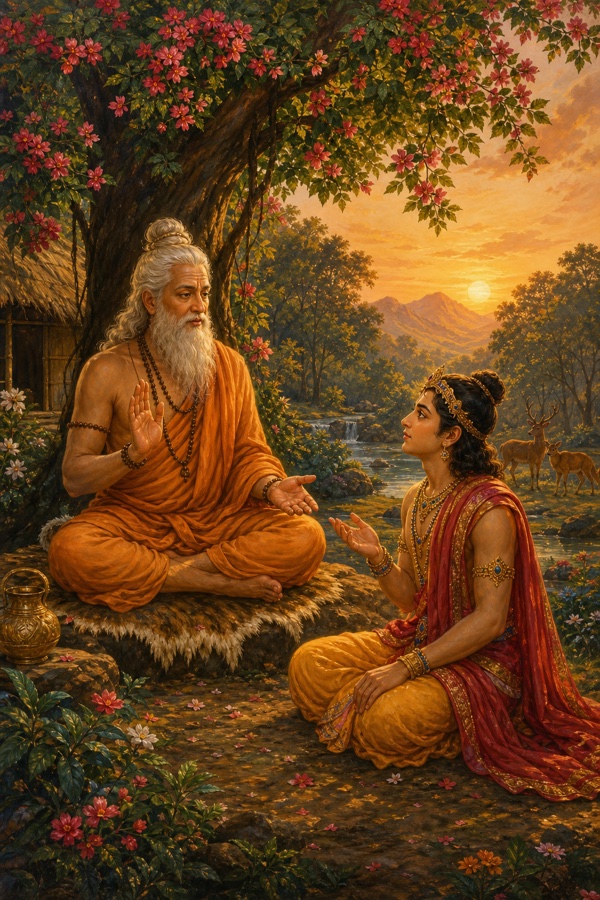
King Shikhidhvaja had left his throne, wealth, and palace life behind. He now lived in the forest with the deliberate habits of an ascetic. His wife Chudala had already attained clear knowledge of the Self, yet the king had been unable to receive her teaching. Familiarity stood between the truth of her words and his willingness to hear them.
Chudala therefore approached him in the form of Kumbha, a radiant young Brahmin whom the king took to be a divine visitor. The disguise gave her teaching a place in his attention that it had never received in the palace.
Kumbha had just shown him, through another parable, how a person may discard a real cintamani, a wish-fulfilling jewel, and cling instead to a glittering imitation. Shikhidhvaja now asked to understand his own condition more fully.
“King,” Kumbha said, “listen carefully to the history of an elephant in the forest of Vindhyagiri. Its power was great enough to command the leaders of vast herds. Even such strength could be governed by an enemy the elephant had failed to understand.”
Three Days in Iron Chains
The elephant was immense. Two long white tusks curved from his face, bright, sharp, and strong. A single mahout had captured him and bound him on every side with iron chains. The man struck the elephant’s temples with weapons and kept him in pain.
For three days the animal remained confined. The iron bit into him whenever he moved. The mahout had reduced the lord of the herd to a creature measured by the reach of its chains.
Then resistance gathered into one purpose. The elephant placed both tusks against the bonds and pulled. For two muhurtas, also reckoned as four ghari, he strained against the iron. Link after link opened. The chains fell away, and his trumpet spread through the forest.
The mahout had watched from a distance. When he understood that the elephant was escaping, he climbed a palm tree near the path. He held his goad and waited above the animal, hoping to leap onto its head and recover control.
As the elephant passed below, the mahout jumped. His aim failed. He struck the ground before the animal and lay there alive, uninjured enough to recover, yet entirely helpless beneath the feet of the being he had beaten.
The elephant needed only one step to end the danger. He remembered the blows and the confinement. He also saw a fallen creature who could no longer defend himself. Compassion arose. The elephant did not crush him. He turned away and moved into the depth of the forest.
Freedom appeared complete. The chains were broken. The mahout lay behind him. Nothing visible followed.
The Mahout Prepares Another Bond
The mahout eventually rose. Gratitude did not soften him. He felt the loss of the animal he had treated as a possession, and he began to search.
The forest was large, and the elephant had travelled far. After a long time the mahout found him resting beneath a tree. He did not approach with another chain. The failure of force had taught him to conceal his purpose.
Beside the elephant’s resting place, he dug a deep, round pit. He covered its mouth with tender creepers. Their fresh leaves made the ground appear gentle and continuous. Nothing in that green surface announced the hollow beneath it.
The mahout withdrew and waited.
A few days later, the elephant wandered across the covered place. The creepers yielded under his weight, and the earth seemed to disappear. He fell into the pit. Its steep sides denied his tusks the purchase they had found against the iron chains.
The mahout came forward. He bound the elephant securely once more and left him suffering in the excavation. The animal had possessed enough strength to break iron. He had spared the enemy who understood how to turn that strength against him.
Kumbha allowed the image to remain before Shikhidhvaja: a lordly elephant at the bottom of a pit, restrained by a man whose life the elephant had chosen to preserve.
“You Are the Elephant”
Shikhidhvaja asked, “Who is this elephant? Who is the mahout, and what do the chains and the pit signify?”
Kumbha answered directly. “You are the elephant.”
The king listened in silence.
“His two white tusks are your dispassion and discrimination. Dispassion gave you the strength to turn away from royal pleasure. Discrimination showed you that wealth, rank, and bodily enjoyment cannot provide lasting peace. These powers are genuine. The elephant’s tusks were real, and so is the clarity that brought you away from the palace.”
The iron chain was hope joined to craving, the inward expectation that fulfilment would arrive through possessions, pleasure, or status. Shikhidhvaja had broken much of that chain when he abandoned his kingdom.
“The mahout is ignorance,” Kumbha continued. “It is the failure to know the mind and the Self as they are. When the mahout fell before the elephant, ignorance stood exposed. The elephant had an opportunity to end the cause of his bondage. He spared it and went away.”
Shikhidhvaja’s departure from the palace had removed objects around which his mind once organised itself. The organising claim remained. It now said, “I have renounced. I practise austerity. I shall reach freedom through the severity of this life.” The shape of desire had changed with his surroundings.
The king had treated mind as an unquestioned observer of his renunciation. He had not examined the one who claimed to have given everything away. That unexamined claim allowed ignorance to rise again.
The Creepers Over the Pit
Kumbha then explained the concealed ground. The round pit represented severe and painful austerity undertaken without knowledge. Its tender creepers represented the real virtues that can accompany such a life: restraint, solitude, association with holy people, simplicity, and endurance.
Those qualities could support inquiry. They could also cover a mistake when hardship itself was taken for realization. Their beauty made the surface persuasive.
Shikhidhvaja had entered the forest sincerely. He had accepted discomfort, ordered his days, worshipped, fasted, and disciplined his senses. Kumbha did not dismiss those efforts. They had weakened old habits and prepared the king to listen. Their value could not turn the pit into open ground.
The king’s error lay in granting suffering a meaning it did not carry by itself. Solitude could quiet distraction without revealing the Self. Austerity could reduce appetite while strengthening the thought of being an exceptional renunciant. Sacred association could nourish discernment while leaving the central assumption of a separate seeker untouched.
The few virtues of the practice were the creepers. The hidden depth was the conviction that the body and mind could manufacture liberation through pain.
“This earth is Vindhyagiri,” Kumbha said. “The elephant is the power of your own intelligence. Hope and craving were its iron chain. Ignorance was the mahout. You left the kingdom as the elephant broke the iron, yet you did not relinquish the mind through which ignorance acts. You entered the pit of harsh austerity and called it freedom.”
The Renunciation Still Required
The parable did not ask Shikhidhvaja to recover his palace or condemn his years in the forest. It asked him to see where bondage was actually maintained.
Objects had never possessed the power to imprison him on their own. A throne, a hut, a silken garment, and a bark covering acquired their force through the meanings mind placed upon them. When those meanings were joined to “I” and “mine,” they became chains. When the same claim attached itself to renunciation, it became a pit.
The next relinquishment concerned the mind that measured itself as king or ascetic, successful or unsuccessful, bound or nearly free. Such relinquishment did not require violence toward thought. It required knowledge clear enough to remove the imagined owner of thought.
Shikhidhvaja had travelled far from Malava. The distance had changed his duties, food, clothing, and daily surroundings. Kumbha’s story brought him to the place the journey had not reached.
The elephant’s strength had never been in doubt. What it lacked was complete recognition of its adversary. In the same way, Shikhidhvaja possessed dispassion and discrimination. Kumbha now directed both toward the ignorance that had survived his most impressive act of renunciation.