On this page
Yoga Vasistha · Story 19
Kaca: The Song and the Meaning of Total Renunciation
Vasistha tells Rama about Kaca in two distinct moments. On Mount Meru, Kaca sings from a vision in which all experience is the Self. In another account, years of outward renunciation leave him searching until his father, Brihaspati, identifies the mental bond that must be understood before freedom becomes stable.
Two Teachings About Kaca
Vasistha introduces Kaca twice. In one account, Kaca is established in self-knowledge in a forest on Mount Meru, and his understanding rises as a song. In the other, he asks his father how anyone can escape samsara, the cycle of conditioned existence. Eight years of austerity and then three more pass before that question is resolved.
The song gives voice to the vision in which Kaca rests. His conversation with Brihaspati follows the inquiry through which the apparent owner of possessions, disciplines, and spiritual progress is examined.
The Song on Mount Meru
Vasistha asked Rama to listen to a sacred song once sung by Kaca. At that time, Kaca lived in a forest on Mount Meru. He had heard the teaching of Brahmavidya, knowledge of ultimate reality, and had carried it through reflection and sustained contemplation. The teaching had ceased to be an idea held at a distance. His attention had settled in the Self.
The visible world of the five elements remained before him. Its objects had lost their power to divide his understanding. Wherever attention moved, Kaca found no independent thing standing outside the reality he knew as the Self. Joy pressed into speech, and he opened with four questions:
“What shall I do? Where shall I go? What shall I take up? What shall I relinquish?” He compared the Self’s pervasive presence to the waters of cosmic dissolution filling the whole world.
Each question depends on a distinction. Action assumes an actor facing a task. Travel assumes a place outside the traveler. Taking and relinquishing assume objects separate from the one who handles them. Kaca searched for that separation and could not establish it. Sorrow, the living being who experiences sorrow, and the happiness that being seeks all appeared within the same indivisible ground.
His song widened through every direction. Above and below, before and behind, within the body and beyond it, he recognized the same presence. Living beings called conscious and objects called inert arose in it. Changes of form belonged to it. Desires and imagined destinations moved within it. He knew himself as that pervasive Self, full in itself and present throughout the expanse of experience.
Kaca then intoned Om. The sound extended like the resonance of a bell, becoming progressively finer as the earlier measures subsided. His contemplation reached the final half-measure associated here with turiya, the fourth mode beyond waking, dream, and deep sleep. The movement of breath settled into the heart. Mental construction grew quiet. Vasistha leaves Kaca there, absorbed in the clarity to which his own song had given voice.
Alone in the forest, Kaca remained absorbed in the understanding his own voice had expressed.
The Question of Escape
After recounting the realization of Sikhidhvaja and Chudala, Vasistha told Rama that Kaca also attained knowledge. Rama asked to hear how it happened.
Kaca had passed beyond the unexamined understanding of childhood. He could see how identification with the body and its possessions produced the sense of an individual life held inside samsara. He went to Brihaspati and asked, “Father, how can I escape this cage of worldly existence? Please tell me the means of freedom from the false identification that binds a living being to the body and what belongs to it.”
Brihaspati answered with one instruction: “My son, a person leaves this ruinous confinement through total renunciation. Relinquish everything and be free.”
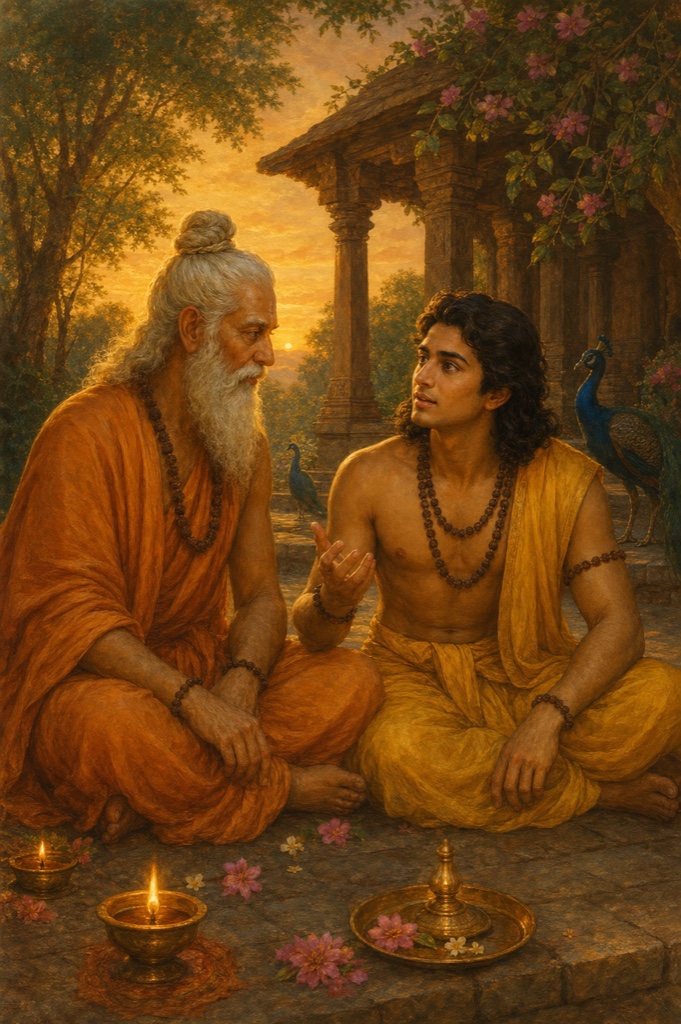
Kaca treated the statement as a command concerning all that he possessed. He gave up his prosperity, left for the forest, and made his home in a cave. There he undertook tapas, the disciplined austerity through which he intended to carry out his father’s teaching. Vasistha says that Brihaspati remained even-minded when his son departed. Union and separation did not unsettle the sage.
Eight Years Later
Eight years passed in the cave. Brihaspati came and found Kaca seated there. The son received his father as his teacher, offered the prescribed marks of respect, and bowed. Brihaspati embraced him.
Kaca spoke without disguising the result of his practice. “Father, eight years have passed since I began total renunciation, and peace has still not come. Please show me the means by which I may reach it.”
Brihaspati gave the same reply: “My son, practice total renunciation. Through it, peace will come.” Then he departed through the sky.
The brevity of the answer forced Kaca to examine what he had retained. He relinquished his seat and deerskin, left that forest, and entered another. In a different cave, with the remaining external supports removed, he resumed his austerity.
Three more years passed. Brihaspati came again. Kaca worshiped him as guru, bowed, and received his embrace. He then reported the same unresolved fact: “Father, I have practiced total renunciation, and peace has not come. What should I do now?”
This time Brihaspati named the object of the instruction. “My son, your renunciation is incomplete. Chitta is the cause of all that appears. Relinquish chitta and abide in your own nature. Those who know reality call the relinquishment of chitta total renunciation.” He left once more.
Chitta can name the conditioned mental field, the movement in which perceptions, impressions, and a sense of personal ownership take shape. Kaca had discarded possessions he could identify. He now had to discover precisely what his father meant.
Searching for Chitta
Kaca turned his inquiry inward. He considered the body, then each sense separately. Sight performed one function, hearing another. The remaining senses had their own fields and operations. None could by itself account for the mental principle Brihaspati had called the cause of all.
Punishing the body further would answer nothing. Relinquishment without accurate knowledge of chitta would remain an action directed at the wrong object. Kaca decided to ask his father for the definition on which the whole instruction depended.
He rose, traveled unclothed through the sky, and reached Brihaspati in heaven. After worshiping and saluting him, Kaca addressed him by his office: “Teacher of thirty-three crore gods, tell me the nature of chitta. Once I understand it, I can relinquish it.” Thirty-three crore is equivalent to 330 million.
Brihaspati replied, “My son, those who know chitta call it the ego-sense. The inward assertion ‘I’ is chitta. It arises from ignorance, and knowledge of the Self brings its apparent existence to an end, as knowledge of a rope ends the snake imagined in it. Relinquish this ego-sense and abide in your own nature.”
Kaca saw the difficulty at once. “Father, how can I relinquish the ego-sense when it seems to be my very self? How am I to understand the abandonment of what I experience as ‘I’?”
The Answer About “I”
Brihaspati told him that relinquishing ego required less effort than crushing a flower or opening and closing the eyes. Effort appeared necessary only while the ego was treated as an independently existing thing. Inquiry revealed its dependence on misunderstanding.
A child may imagine a ghost in his own shadow. A rope may be taken for a snake. Heat over a desert may appear as water. A defect of vision may make one moon seem like two. In each case, the frightening or desired object borrows its appearance from something present. Examination identifies the ground and ends the mistaken attribution.
The limited “I” arises in a similar way. Carelessness in knowing one’s nature gives it apparent standing. The Self itself is pure being and consciousness, present at every time and in every place. No separate ego can be found within it, any more than dust can remain as a constituent of the ocean. Diverse forms appear through movements of chitta. When those movements settle, the one nondual Self remains evident in its own nature.
Brihaspati also turned Kaca’s attention toward the world he could see. Leaves, flowers, and fruit unfold from the potency of a seed. In the same way, the many forms of experience have their basis in consciousness. Clear knowledge of that basis reveals where the claimant “I” has been superimposed and leaves the body and senses to perform their natural work.
Kaca received the instruction and became established in his own nature. He moved through life as a jivanmukta, one liberated while living, free of possessiveness and ego-sense. Vasistha then directed Rama toward the same freedom from personal claim and desire in the pure, nondual state.