On this page
Yoga Vasistha · Story 22
The World Within the Golden Rock
An aerial Vidyadhari asks Vasistha to help her see the world she calls home. It lies within a vast golden rock on the remote mountain of Lokaloka, yet the travellers find only an unbroken mass of stone. When disciplined attention opens another mode of vision, the world within appears, along with a truth that overturns the woman’s understanding of her own life.
A Home Beyond the Known World
Vasistha told Rama that he once met a Vidyadhari while moving through an expanse of sky. A Vidyadhari is a celestial being whose mode of embodiment and movement is subtler than ordinary human life. This woman could remain aloft and pass among regions that a physical traveller could never reach by road. Vasistha asked who she was, where she lived, and what had brought her there.
Her answer began at the scale of a cosmos.
She described three broad regions: Patala below, the earth in the middle, and the celestial worlds above. Across the inhabited earth lay seven great islands, each encircled by an ocean. Beyond those settled domains extended a golden tract, and at the outer boundary rose the immense range called Lokaloka. Traditional cosmography places that mountain between the illuminated worlds and the region beyond their light.
On the mountain’s northern side, she continued, an east-facing summit held a luminous golden rock. Its extent was comparable to the slope of Sumeru, the great cosmic mountain. The word “rock” therefore named something on a landscape’s scale, far exceeding anything that could be lifted or carried.
“My world lies there,” the Vidyadhari said. “It contains earth and sky, mountains and rivers, cities, living beings, and the members of my family. Countless yugas have passed within it.”
For her, the world had always possessed the coherence of home. Its days succeeded one another. Relations aged, generations appeared, and places retained their familiar positions. The golden rock was its encompassing ground as seen from outside. Inside, there was a complete threefold world with its own history.
Vasistha allowed her to finish before judging any part of the account. Her next disclosure concerned the figure from whose mental disposition that inner creation had arisen.
The Intention That Became a Life
An ancient Brahmin sat at the center of the Vidyadhari’s world. Learned in the Veda and committed to celibacy, he had remained on his seat for centuries. His attention rarely moved toward sensory pleasure or domestic life. Within his mind, however, a residual disposition toward a world remained active. Sons, grandsons, relations, their surroundings, and the larger order they inhabited subsisted through that formative conditioning.
At one point, an intention concerning a wife had arisen in him. The Vidyadhari’s embodied appearance issued from that intention. She grew within its world, accepted the identity of wife, and understood the ancient Brahmin as her husband. The relation seemed as established to her as every other feature of her environment.
The Brahmin continued in seclusion. He gave no attention to married life, while desire became the governing force of the woman’s youth. She waited for affection and companionship. Attendants tried to ease her distress, yet the unfulfilled expectation repeatedly renewed it. Her later dispassion arose through the exhaustion of a desire she had lived intensely.
Over a long time, the pressure of longing weakened. She began to examine the expectation that had kept her bound to the Brahmin’s presence. Desire gave way to dispassion, and she turned toward contemplative practice. She trained in dharana, sustained concentration, and in khechari, a yogic discipline associated in this account with subtle movement through space.
The practice carried her beyond the limits of the world she had habitually perceived. In the wider aerial region, she encountered Vasistha. During their extended conversation, she came to understand that her relations and their entire threefold world depended upon the Brahmin’s residual world-conditioning, his vasana. Vasana here means a latent tendency with enough continuity to organize perception, identity, and experience.
The discovery created a practical difficulty. Her attention had become accustomed to regions outside her former home. The world within the rock, once immediate and stable, had faded from clear perception. She retained its location and memory, but could no longer see its order distinctly.
She therefore made two requests. Vasistha should accompany her to the golden rock, and he should teach her how to recover the vision by which its world could be entered. The wish to return now carried a second purpose. She wanted to learn what her relation to the ancient Brahmin actually was.
Vasistha agreed to go.
The Rock That Showed No World
Their passage to Lokaloka took place through subtle movement. They crossed the regions described in the Vidyadhari’s cosmographic account and reached the golden tract at the world’s outer boundary. On the northern side of the mountain, she directed Vasistha toward the east-facing height where her world should have been.
An immense golden rock filled their sight.
No entrance marked its surface. Vasistha saw no land, city, inhabitant, sun, or sky within it. The Vidyadhari herself could recover only an indistinct impression of the place where she said she had spent countless yugas. Her former certainty now met the uninterrupted appearance of stone.
She asked whether the world had perished or her own vision had lost the means to reach it.
Vasistha answered by turning her attention to practice. A repeatedly sustained mode of perception acquires experiential firmness. When that practice changes, the forms supported by it may recede, while another order becomes immediate. Her prolonged attention to the outer regions had strengthened one field of experience and weakened her old familiarity with the inner world.
Such continued practice is called abhyasa. Attention, expectation, and direct experience are trained together until a way of seeing becomes stable. The same discipline can loosen an established appearance when inquiry discloses its basis.
Vasistha instructed the Vidyadhari in dharana. They quieted the assumptions attached to physical embodiment and rested attention in the subtle mode called ativahika. Concentration changed the conditions under which the rock was perceived.
As the practice became steady, the golden surface ceased to govern their entire field of experience. Spatial extension appeared where solidity had seemed absolute. Directions, sky, land, mountains, settlements, and living beings became discernible. The order the Vidyadhari had described emerged with the density of a complete world.
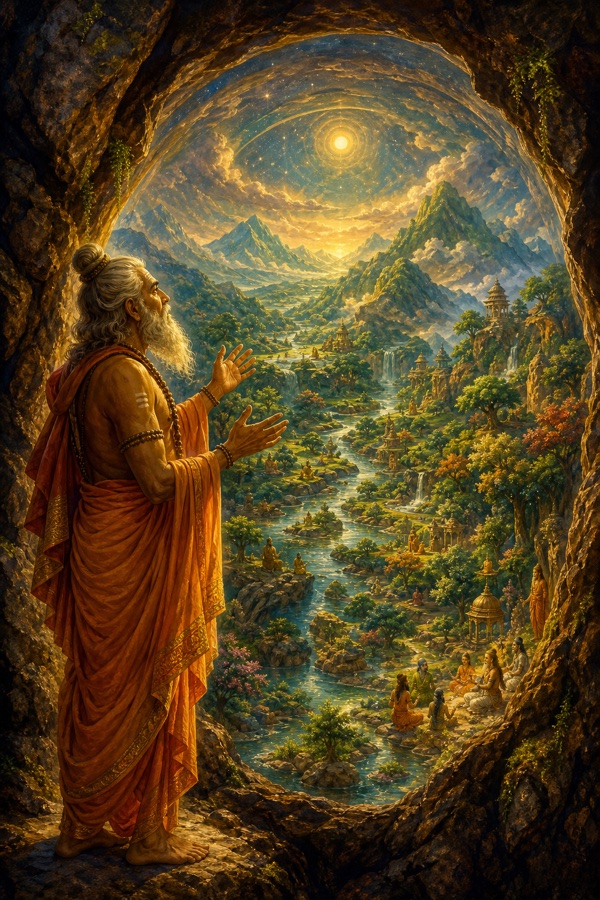
She recognized her former regions. Vasistha entered them with her. The journey had already established the episode’s central discipline: habitual sight, contemplative sight, and awakened insight can disclose different orders upon one ground. The next encounter would show that the identities within such an order can also rest upon conditioning.
One Muhurta Before the Question
The Vidyadhari led Vasistha to the ancient Brahmin. He sat absorbed, and she identified him as her husband. Vasistha recognized him as Brahma, the creator within that particular world. The title identifies his function in this creation; Brahman denotes the limitless reality discussed in the teaching.
When Brahma returned to outward awareness, he received Vasistha with full courtesy. The gods, siddhas, and gandharvas belonging to that world assembled. Greetings, worship, hospitality, and formal inquiries occupied one muhurta, a traditional division of the day. Only after completing every duty owed to a guest did they begin their philosophical examination.
Only then did he raise the Vidyadhari’s request. She had described herself as the creator’s wife and had asked for instruction that could lead them both toward freedom. Her account also presented an apparent inconsistency. The figure she called husband remained absorbed in knowledge and dispassion, while the supposed marriage had left her in prolonged desire and grief.
Brahma corrected the relation at its source. No actual marriage had occurred. The Vidyadhari was the embodied presiding power of the world-vasana remaining in him. His earlier intention concerning a wife had supplied the form and identity through which that conditioning appeared. The belief in marriage belonged to the same mental order as the body, family, memory, and world that had developed around it.
Desire, waiting, suffering, practice, and dispassion remained the Vidyadhari’s lived history within a world that had been experientially complete for her. Brahma’s explanation identified the ground from which those events and the person living through them had arisen. Her private account of an unresponsive husband now opened into an inquiry about the construction of personhood and relation.
Brahma explained that his imagined lifespan had completed two parardhas. A parardha is a cosmological measure of immense duration, traditionally associated with a vast portion of Brahma’s life. His residual impulse to sustain this creation had reached exhaustion. He now intended to enter kaivalya, final freedom in which the conditioning that projected the world would come to an end.
The Vidyadhari’s turn toward dispassion followed the same movement. As the world-vasana approached its conclusion, its embodied presiding power began to seek release. Her practices had brought her to Vasistha because the old organization of desire and relation could no longer sustain itself.
The conversation had reached a threshold much larger than a household bond. The creator’s remaining term, the woman’s conditioning, and the world they inhabited were all moving toward dissolution.
Two Parardhas and Four Dissolutions
Brahma said that four forms of dissolution were converging: nitya, naimittika, dainandina, and atyantika. The cycles associated with a chaturyuga, a Manu, an Indra, and the gods were also reaching their respective conclusions. An entire hierarchy of time was closing around the creator’s withdrawal.
He then explained how a world could appear in connection with a substance that ordinary sight apprehended as rock. Consciousness, called chiti in this part of the teaching, can display a complete field of experience in relation to a pot, cloth, wall, sky, air, water, fire, or stone. The supporting term varies with the perceived object. Chiti remains the luminous capacity through which perceiver, object, extension, and history become known.
Firm vasana and sankalpa, or formative intention, organize this display. They provide continuities through which a world seems to have a location, a past, a population, and an expected future. Practice reinforces the corresponding mode of access. Thus the Vidyadhari had lived in her world for countless yugas, lost her clear access after her habits changed, and recovered it through concentration.
A model of tiny physical cavities hidden inside pieces of stone would miss the teaching’s terms. The golden rock, the one who sees it, and the many worlds disclosed through different modes of sight all appear within consciousness. Gross vision presents a massive surface. Subtle and divine vision can present an articulated world where gross perception finds no passage. The episode examines the relation among consciousness, conditioning, and experience. It offers no physical inventory of ordinary rocks.
Brahma respectfully asked Vasistha to continue on his way. The creator then entered the movement toward dissolution and kaivalya. The Vidyadhari followed that movement in meditation. The identity that had supported her claim of marriage was itself being gathered back into the conditioning from which it arose.
A vast cosmic dissolution followed. Lands, orders of beings, divine offices, and manifested elements passed through an extended withdrawal. By the end of that immense sequence, the creation Vasistha had entered with the Vidyadhari had completed its course.
The Rock After the World
After the world sustained by Brahma had passed through dissolution, Vasistha directed his vision again toward the golden rock.
Physical sight presents one vast rock with an undivided surface and no visible boundary announcing the worlds associated with it. Vasistha then turns the awakened, divine eye toward other regions of the same rock. Innumerable networks of creation appear.
The worlds present different arrangements. In one, a Brahma has just begun the work of manifestation. In another, gods are arising within the creator’s mind. Some contain humans, some omit gods, and some omit demons. Different ages prevail. In certain worlds, beings have overcome old age and death. Elsewhere, obstruction and ignorance shape the order of life.
Vasistha told Rama that he saw worlds in which Rama confronted Ravana and others in which the pattern of the Ramayana took another form. Characters, cosmic offices, and sequences were differently composed across the innumerable creations.
Vasistha told Rama that the first journey had disclosed one world organized by a creator’s vasana. After its dissolution, clear vision revealed innumerable other configurations throughout the same rock. Each possessed its own scale and sequence, while chiti remained undivided across them. He asked Rama to examine what gives a perception its authority and to recognize the consciousness in which rock, world, duration, and every mode of seeing appear.