On this page
Yoga Vasistha · Story 23
Akashaja: The One Death Could Not Touch
Death reaches for a meditating figure and is turned back by fire, then by something stranger: no fatal karma can be found. Yama’s explanation reveals why Akashaja, the space-born Creator, appears active while never acquiring the bodily conviction that would place him within Death’s grasp.
A Life Beyond Death’s Reach
Vasistha asked Rama to hear the story of Akashaja, whose name means “born of space.” Akashaja was the Creator Brahma, also called Hiranyagarbha.
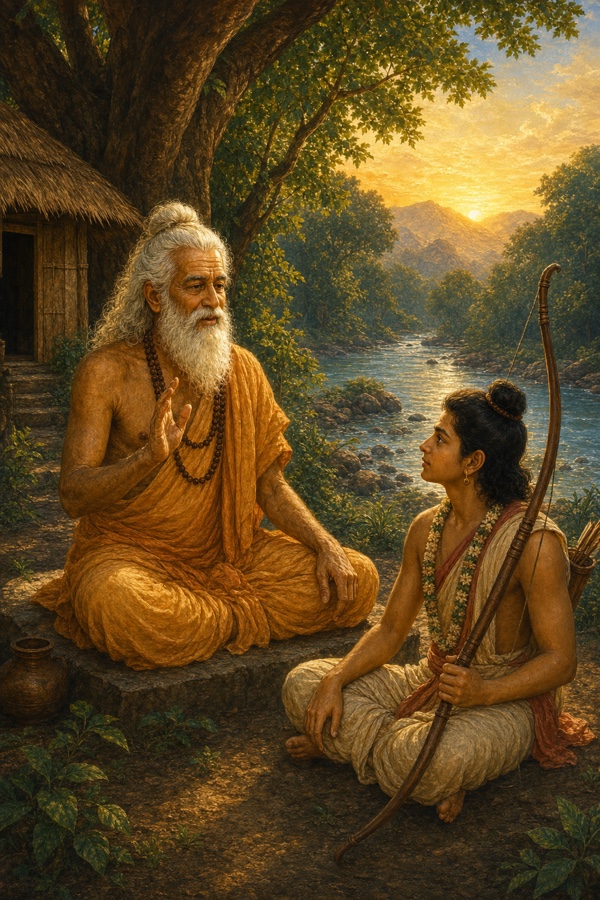
Akashaja lived in Satyaloka, Brahma’s realm at the center of Mount Meru in sacred cosmography. He was devoted to meditation and worked for the welfare of his subjects. His life had continued for a very long time. Death saw him and began to wonder why the power that brought born creatures within her reach failed whenever it approached him. Her force seemed blunted, like the edge of a sword striking stone.
Death resolved to complete her familiar work. She entered Satyaloka and approached Akashaja’s dwelling. A succession of flames rushed toward her with the violence of the fire of cosmic dissolution. Brahma had established this luminous protection to repel disturbances during samadhi, contemplative absorption. Death cut through one flame after another and went inside.
Akashaja remained visible before her. Death extended hundreds of hands to seize him. Every hand failed. He appeared as plainly as a person imagined within another’s resolve, and he was equally unavailable to physical grasp.
Death went to Dharmaraja, the lord who governs the law of action and consequence and is also called Yama. “Why can I not take this Brahmin?” she asked. “What places him beyond my power?”
The Condition Death Requires
Yama told her that her power never acts alone. The karma of the being she seeks to seize supplies the cause through which death can occur. “Find Akashaja’s karma,” he instructed. “With that cause, your effort can succeed.”
Death began an immense search. She examined countries and remote horizons, ponds and rivers, every direction, forests and jungles, mountains and sea coasts. She crossed other islands and wildernesses, cities, towns, villages, nations, and deserts. The journey had one purpose: to discover where Akashaja had previously acted and which action might yield a death-producing consequence.
Across the whole world, she found none.
Death returned to Yama. Embodied beings everywhere could be traced through action and result. Akashaja offered no bodily or mental karma that could support her claim. She asked where such karma had gone.
Yama considered the question for a long time. Then he said, “No such action belongs to him. Akashaja arose from the expanse of consciousness and remains clear as that expanse.”
The “space” in this explanation is chidakasha, the field or expanse of consciousness. Physical emptiness does not supply Akashaja’s substance. He has no separate originating cause through which an independent form could be established. What appears as Akashaja remains within its own ground.
Yama’s answer opened the familiar categories of karma. Prarabdha is action whose consequence is ripening in a present life. Sanchita is the accumulated store from prior action. Agami is action now forming a future result. Current conduct shaped by ego and attachment also builds a causal relation. Death could find no operative strand of any kind.
Mental activity usually carries tendencies from prior embodied experience. These latent traces are called vasanas. Akashaja had no prior body from which such conditioning could be inherited. No mental accumulation connected him to a body that Death could claim.
The Body Others Thought They Saw
Death’s difficulty invited an obvious question. Akashaja seemed to breathe. He appeared to possess a body and to act for the good of his subjects. How could Yama deny the causal structure visible to observers?
Yama answered by separating appearance from Akashaja’s own conviction. Observers, guided by their habitual understanding of embodiment, attributed breathing and bodily activity to him. Akashaja did not take those appearances as an independently existing self. The thought “my form stands apart from Brahman” had no authority for him. Any trace of such a thought was recognized as an appearance of conditioning, without a factual object behind it.
Water is known through fluidity, air through motion, and space through openness. Akashaja was established just as directly in the supreme ground. Consciousness had not entered a separate body and lost knowledge of itself. With no independent cause, the appearing figure never acquired an existence apart from its source.
Yama explained the consequence. A being firmly convinced that “this body made of earth and the other elements is myself” becomes subject to the conditions of that body. Akashaja held no such five-element self-conception. A strong rope cannot bind the sky. Hundreds of hands could no more seize the space-born Creator.
Death would gain access only when Brahma’s own truth-effective resolve introduced death into his order of creation. Until then, the necessary bodily identification and causal action were absent.
This condition keeps the encounter inside a cosmological account of the Creator. Death’s authority begins when the Creator’s own resolve establishes the order in which bodily life and its ending operate. She cannot create that basis independently merely by applying greater force.
How the Unborn Appears
Death pressed the inquiry further. How could an unborn figure appear from space? Earth and the other elements seemed present. What did it mean to say that they possessed no independent reality?
Yama answered through the doctrine of vivarta, appearance without material transformation of the underlying ground. An effect has no existence separate from its cause. Forms arise within consciousness while consciousness remains itself. The language of birth describes an appearance within that field.
At cosmic dissolution, pure consciousness remains still, beginningless, and undivided. When creation appears, the ignorance, latent tendencies, and unseen causal conditions of living beings make the vast or four-faced Creator-form appear near that consciousness as a dream image appears in mind. Those conditions belong to the living beings whose experience is unfolding. They do not become Brahma’s personal karma or conditioning.
Akashaja is therefore described as self-born. The term points to the absence of a prior body, external material cause, or separate doer. His apparent form is made of resolve and mind alone. Death had searched for the causal history of an ordinary embodied individual. The figure before her belonged to a different explanatory order.
Yama told Death to abandon the attempt. No one can grasp open space. She returned home in wonder.
The Creator Revealed
Rama recognized the identity concealed by the story’s designation. “The one called Akashaja is the self-born Brahma,” he said. Vasistha confirmed it.
He placed the dialogue in an ancient manvantara, a vast cycle governed by a Manu. Death had consumed other beings and, through the momentum of work repeatedly performed, turned toward Brahma.
Vasistha developed the visual logic through several analogies. A great inverted vessel of sapphire may seem to hang in the sky. A pearl necklace may appear suspended against clear space. A city can stand complete within resolve or dream. A painter first holds an entire picture inwardly before any material image reaches a surface.
The painter’s inward picture is decisive. Form can be cognitively present without having acquired a separate physical body. Brahma appears within consciousness as a resolve-bodied, mind-only figure. Beginningless and endless consciousness remains unchanged while a person-like form becomes visible within it.
The story closes at the limit of Death’s reach. She can act where karma, prior embodiment, and bodily self-identification supply a causal path. Before Akashaja, every path she knows ends in the same clear expanse from which he appears.