On this page
Yoga Vasistha · Story 11
Indu’s Ten Sons: Ten Minds, Ten Creations
Brahma wakes to begin creation and discovers ten complete universes already present in the space of consciousness. Their source lies with ten brothers whose bodies vanished long ago. Across two yugas of austerity, four yugas of contemplation, and a cosmic dissolution, one settled conviction has endured. Bhanu, the sun of one such universe, explains its reach.
Brahma Finds Ten Creations
Vasistha said to Rama, “Brahma once told me how worlds arise. Listen carefully to the account he gave.”
At the close of a kalpa-day, Brahma withdrew the whole creation and entered the repose of the cosmic night. When that night had passed, he awoke, completed his prescribed morning observances, and prepared to create again. He directed his awareness into chidakasha, the clear expanse of consciousness. Ten vast creations were already present there.
Each possessed its own internal order. In every creation Brahma saw a creator, Vishnu, Rudra, gods, gandharvas, kinnaras, human beings, and creatures of the nether regions. Mountains such as Sumeru, Mandara, Kailasa, and the Himalayas stood in their places. Rivers crossed the earth, seven seas surrounded its divisions, and the sun and moon moved through appointed courses. Winds blew, time advanced through its measures, and living beings encountered actions and their results according to their latent tendencies.
Brahma saw all this through inward, subtle vision. His physical eyes offered no object he could grasp. Some realms seemed steady in light; others flashed into appearance and disappeared. He considered the spectacle for a long time. Then he summoned the sun from one of the ten creations.
The sun approached and bowed. Brahma asked, “Bhaskara, who are you? How did these creations arise? I see ten complete worlds where I expected to begin one. Tell me their history.”
The sun, Bhanu, answered with courtesy. “Lord, this displayed world takes form through the movement of mind. The history of these ten worlds begins with a Brahmin named Indu and with the sons born to him near Mount Kailasa.”
A Vow on Kailasa
Bhanu placed the story in Brahma’s previous kalpa-day. In a corner of Jambudvipa stood Mount Kailasa. Suvarnajyeshtha, a son of Brahma, lived in a cave there and had established a hermitage for holy people.
Indu, a peaceful Brahmin of Kashyapa’s lineage and a knower of the Vedas, came to that hermitage with his wife. The couple shared an affectionate life and remained childless. Their grief led them to undertake an austerity for the sake of children.
They climbed to the upper summit of Kailasa, a solitary place without living creatures. Standing as motionless as trees, they began their discipline. At first they lived on water. Later, they took a single handful of water in the evening and returned to the same unmoving posture. Treta and Dvapara, two complete yugas, passed while they remained in austerity.
Their practice pleased Shiva. He appeared with Uma, mounted on the bull. In this passage he bears the epithet Chandrashekhara, “the moon-crested one.” The couple bowed before him.
Shiva addressed Indu. “Brahmin, I am pleased with you. Ask for the boon held in your mind.”
Indu replied, “Lord of the gods, grant me ten sons. May they possess great intelligence, and may their conduct be auspicious, so that the grief of childlessness does not trouble me again.”
“Your wish will be fulfilled,” Shiva said. He and Uma disappeared, and the couple returned to their home.
Indu’s wife conceived. In the tenth month she gave birth to ten sons. The boys received the traditional rites of a Brahmin household and grew quickly. By the age of seven, all ten had mastered the shastras, the scriptural and philosophical disciplines in which they had been educated.
Much later, Indu and his wife relinquished their bodies. Because they knew Brahman, limitless reality, they attained an excellent state. Their sons were overcome by grief. The ten brothers left their home, ascended Kailasa, and began to ask what station a human being could seek that would endure without ending in sorrow.
The Highest Office They Could Conceive
The brothers compared forms of dominion in a deliberate sequence. One proposed the office of a regional lord, whose command governed a territory. Another observed that such a lord remained subject to a king. A third placed the universal monarch above an ordinary king. The next recalled that even a universal monarch remained within Yama’s authority. A fifth placed Indra, ruler of heaven, above Yama in power.
The comparison then moved from political reach to cosmic duration. Another brother explained that an Indra’s tenure comes to an end within one muhurta of Brahma, a traditional division within Brahma’s vastly longer span. The eldest drew the conclusion. Every lesser dominion disappears within a kalpa of Brahma. Brahma’s office therefore offered the widest and most enduring sovereignty they could conceive.
His brothers accepted the reasoning. “How can we attain the station of Brahma,” they asked, “the station honored throughout the worlds and capable of ending our sorrow?”
The eldest gave them a single discipline. They were to release every competing mental formation and sustain one settled conviction: “We are Brahma, seated upon the lotus. We create, maintain, and dissolve the worlds. The whole universe abides within us.” Remaining established in that one form of contemplation, he said, would bring the contemplated office into experience.
The other nine agreed. Together they entered the practice.
One Conviction Without Interruption
The brothers stood as still as figures painted on a cloth. Each sustained the same inward declaration: “I am Brahma, seated on a fully opened lotus. I am the creator, experiencer, and governor of the universe. Sarasvati, Gayatri, and the Vedas with all their branches are present before me. Heaven, earth, the nether regions, mountains, continents, rivers, and seas exist within me. Indra and the guardians of the directions act under my authority. The sun gives heat at my command. Moments, days, months, years, and yugas are divisions of time established within my creation. I bring forth the day and gather it again at night. I abide in the station of the Self.”
This was sankalpa in its formative sense: a resolve held so completely that it ordered the field of experience. The brothers gave it their entire attention. Sun and wind dried their bodies. The bodies fell, and forest creatures dragged away and consumed what remained. The loss of the physical form did not return their awareness to bodily identity. Their contemplation continued through the subtle inner structure called the puryashtaka.
No deity appointed them creators. Shiva’s boon had brought the ten sons into birth. Their later station arose through their own uninterrupted identification with Brahma.
Beyond the Dissolution
A full course of four yugas ended. Brahma’s kalpa-day approached its close, and the sequence of cosmic dissolution began. Twelve suns blazed. The destructive Pushkaravarta clouds released their torrents. The earth shook, the winds of the kalpa’s end rose, and the seas broke beyond their boundaries. At last a single great ocean remained, and living beings were absorbed into the dissolution.
No trace of the brothers’ physical bodies survived. Their subtle inner being remained in the space of consciousness, still organized by the same conviction. Through Brahma’s night, they continued to experience the activity of the creations formed in their minds.
When Brahma awoke again, the ten sons of Indu had become ten Brahmas. Ten distinct universes stood within their mind-like spaces. The conviction sustained through bodily death and cosmic dissolution had opened into a complete experienced order for each brother.
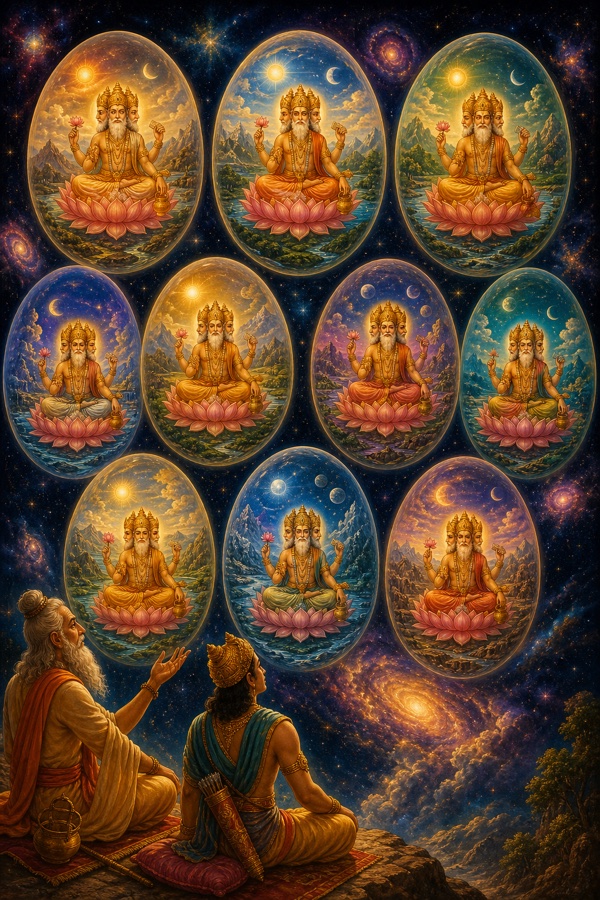
Bhanu then identified himself. “Lord, I am the sun of one of those ten creations. My dwelling is in its sky. They assigned me the movement by which moments, days, fortnights, months, and yugas are measured. The ten Brahmas and ten worlds you have seen arose in this sequence. Each creation expands according to the ordering impressed upon its creator’s mind.”
Bhanu’s Answer to Brahma
Brahma now faced a practical question. “Bhanu, ten Brahmas have created ten universes. What purpose can my own act of creation serve?”
Bhanu replied that Brahma had no private desire to satisfy and no personal reward to gain. Creation was the natural activity associated with his office. A reflection appears in water without a private intention on the sun’s part. Sunrise begins the day, and sunset closes it, while the sun remains free of the consequences attributed to those changes. Brahma could act in the same spirit, allowing creation to proceed without possessiveness.
The ten other worlds placed no obstacle before him. Brahma perceived them with the eye of mind. Each son of Indu directly experienced the universe established through his own long-held determination. The order seen by one arose within the mind that had formed and sustained it.
Bhanu then distinguished two kinds of construction. An object assembled from physical materials can be broken apart through physical means. A determination rooted through the whole structure of mind cannot be removed by an external agent. It changes when insight arises in the one who holds it, or when that person relinquishes it. The disappearance of a body alone leaves such a deeply established formation unresolved.
“Continue your own creation according to your nature,” Bhanu told him. “Let the ten creations remain in their respective courses.”
Brahma’s original astonishment had found its answer. The worlds before him were the mature consequence of ten minds that had ceased to turn away from one conviction. Bhanu’s counsel also restored Brahma’s course of action: clear knowledge of other creations gave him no reason to abandon the work proper to his own office.